ELECTRO-
CHEMICAL
MACHINING
Presented by:
Usama Ansari
INTRODUCTION:
 ECM is used to remove metal and alloys which are
difficult or impossible to machine by mechanical
machining process.
 The Reverse of Electroplating.
 This machining process is based on Faraday’s
classical laws of electrolysis , requiring basically
two electrodes , an electrolyte , a gap and a
source of D.C current power supply.
Principle:
 Faraday’s Law of Electrolysis:
‘ The Weight of the substance produced during
electrolysis process is directly proportional to
1. The current which passes.
2. The length of time for process.
3. The equivalent weight of the material.
 Two dissimilar metals are in contact with an
electrolyte and Anode loses metal to Cathode.
Working of ECM:
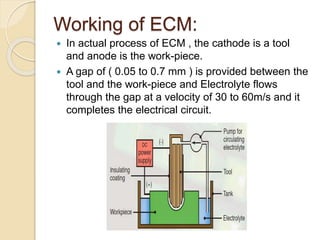
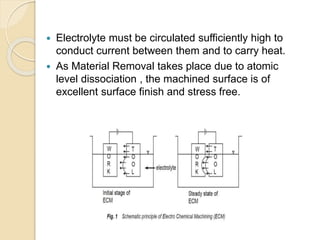
 In actual process of ECM , the cathode is a tool
and anode is the work-piece.
 A gap of ( 0.05 to 0.7 mm ) is provided between the
tool and the work-piece and Electrolyte flows
through the gap at a velocity of 30 to 60m/s and it
completes the electrical circuit.
 Electrolyte must be circulated sufficiently high to
conduct current between them and to carry heat.
 As Material Removal takes place due to atomic
level dissociation , the machined surface is of
excellent surface finish and stress free.
Machining Process:
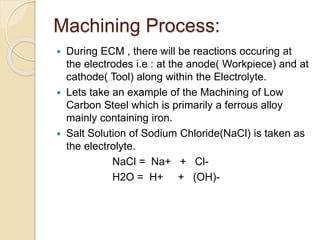
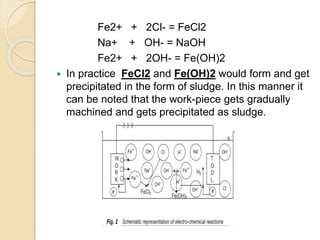
 During ECM , there will be reactions occuring at
the electrodes i.e : at the anode( Workpiece) and at
cathode( Tool) along within the Electrolyte.
 Lets take an example of the Machining of Low
Carbon Steel which is primarily a ferrous alloy
mainly containing iron.
 Salt Solution of Sodium Chloride(NaCl) is taken as
the electrolyte.
NaCl = Na+ + Cl-
H2O = H+ + (OH)-
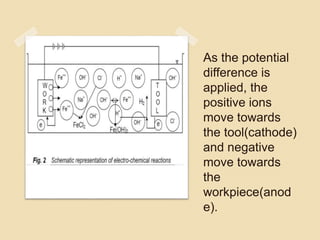
As the potential
difference is
applied, the
positive ions
move towards
the tool(cathode)
and negative
move towards
the
workpiece(anod
e).
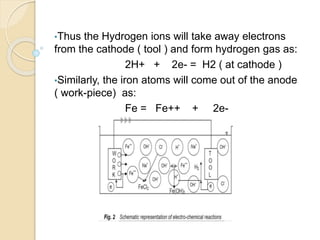
•Thus the Hydrogen ions will take away electrons
from the cathode ( tool ) and form hydrogen gas as:
2H+ + 2e- = H2 ( at cathode )
•Similarly, the iron atoms will come out of the anode
( work-piece) as:
Fe = Fe++ + 2e-
 Within the electrolyte iron ions would combine with
chloride to form Ferrous Chloride (FeCl2 ) .
 Hydroxyl ions to form Ferrous Hydroxide
[Fe(OH)2] .
 Similarly Sodium ions would combine with Hydroxyl
ions to form Sodium Hydroxide [Na(OH)].
Fe2+ + 2Cl- = FeCl2
Na+ + OH- = NaOH
Fe2+ + 2OH- = Fe(OH)2
 In practice FeCl2 and Fe(OH)2 would form and get
precipitated in the form of sludge. In this manner it
can be noted that the work-piece gets gradually
machined and gets precipitated as sludge.
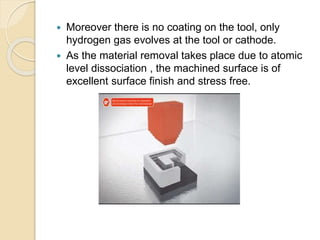
 Moreover there is no coating on the tool, only
hydrogen gas evolves at the tool or cathode.
 As the material removal takes place due to atomic
level dissociation , the machined surface is of
excellent surface finish and stress free.
Elements of ECM:
Important elements of ECM are:
 Electrolyte
 Tool ( cathode ).
 Work-piece ( anode ).
 D.C Power Supply.
ELECTROLYTE:
 Common electrolytes used are sodium chloride ,
sodium nitrate , sodium hydroxide , sodium fluoride ,
sodium chlorate , potassium chloride ,and sulphuric
acid.
 These solutions on reaction produce an insoluble
compound in the form of sludge.
1. The main functions of electrolyte in
ECM are:
 It carries current between tool and work-piece.
 It removes the product of machining and other
insoluble products from the cutting region.
 It dissipates heat produced in the operation.
2. The essential characteristics include:
 Good electrical conductivity.
 Non-toxicity and chemical stability.
 Non- corrosive property.
 Low viscosity and high specific heat.
 High velocity flow over the electrode surface
is one of the key factors. It is necessary to
prevent crowding of Hydrogen gas and debris
of machining.
Tool ( Cathode ):
 The most commonly used material are Copper,
Brass, Titanium, Copper tungsten and Stainless
steels.
 Titanium has been found to be the most suitable
tool where the electrolyte has the tendency to
anodize the tool as in case of Sulphuric Acid.
 The accuracy of tool shape directly effects the
work-piece accuracy.
 Electro-forming and Cold forging are two methods
of tool shaping.
 General requirements of tool
material:
1. It should be conductor of electricity.
2. It should be rigid enough to take up the load due
3. It should be chemically inert to the electrolyte
4. It should be easily machinable to make it in
desired shape.
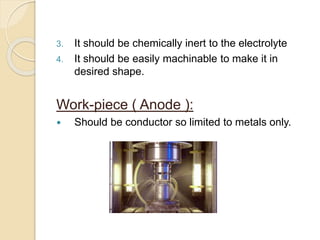
Work-piece ( Anode ):
 Should be conductor so limited to metals only.
Material Removal Rate:
 Material removal rate is an important characteristic
to evaluate efficiency of non-traditional machining
process.
 In ECM , material removal takes place due to
atomic dissolution of work material which is
governed by Faraday’s Law of Electrolysis:
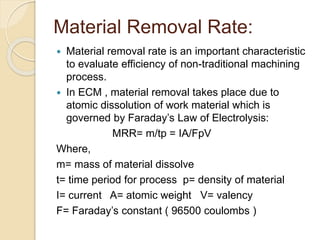
MRR= m/tp = IA/FpV
Where,
m= mass of material dissolve
t= time period for process p= density of material
I= current A= atomic weight V= valency
F= Faraday’s constant ( 96500 coulombs )
PROBLEM:
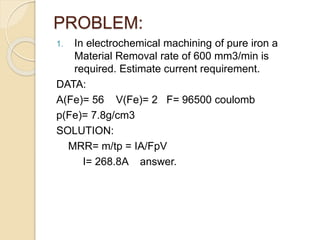
1. In electrochemical machining of pure iron a
Material Removal rate of 600 mm3/min is
required. Estimate current requirement.
DATA:
A(Fe)= 56 V(Fe)= 2 F= 96500 coulomb
p(Fe)= 7.8g/cm3
SOLUTION:
MRR= m/tp = IA/FpV
I= 268.8A answer.
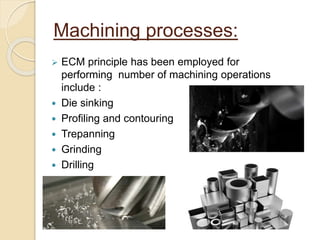
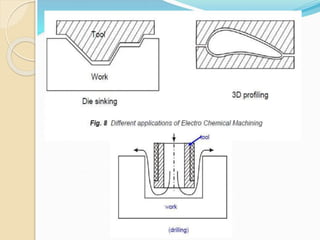
Machining processes:
 ECM principle has been employed for
performing number of machining operations
include :
 Die sinking
 Profiling and contouring
 Trepanning
 Grinding
 Drilling
 Micro-machining
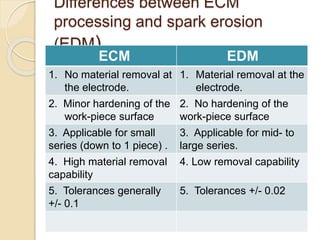
Differences between ECM
processing and spark erosion
(EDM)
ECM EDM
1. No material removal at
the electrode.
1. Material removal at the
electrode.
2. Minor hardening of the
work-piece surface
2. No hardening of the
work-piece surface
3. Applicable for small
series (down to 1 piece) .
3. Applicable for mid- to
large series.
4. High material removal
capability
4. Low removal capability
5. Tolerances generally
+/- 0.1
5. Tolerances +/- 0.02
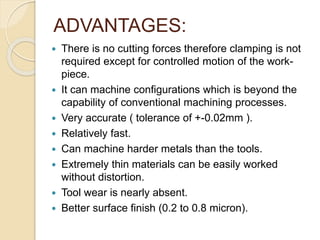
ADVANTAGES:
 There is no cutting forces therefore clamping is not
required except for controlled motion of the work-
piece.
 It can machine configurations which is beyond the
capability of conventional machining processes.
 Very accurate ( tolerance of +-0.02mm ).
 Relatively fast.
 Can machine harder metals than the tools.
 Extremely thin materials can be easily worked
without distortion.
 Tool wear is nearly absent.
 Better surface finish (0.2 to 0.8 micron).
DISADVANTAGES:
 High energy consumption.
 Non conducting material cannot be machined.
 Corrosion or rust of ECM machine can be
hazardous but preventive measures can help in
this regard.
 Initial tooling can be time taking and costly.
 Environmentally harmful By-products.
 Large power consumption.
LIMITATIONS:
 Out of all the unconventional machining
methods, electro chemical machining
requires high specific cutting energy.
 Sharp edges and corners are not possible
to produce.
 Work material must be electrically
conducting.
 Generally preferable for producing contours
only.
CONCLUSION:
 The Conclusions derived are summarized
as below:
 The machining process is carried out ion by
ion so it is possible to machine intricate
shapes and sizes.
 The machining can be carried out for any
material irrespective of its hardness.
 As there is no tool contact with work piece
the important post process defects such as
thermal damage, stresses, tool wear does
not exist and smooth surface is obtained.
 The processes and the working principles
are the same. Just the shape of the work-
piece/tool and the direction of the flow of
electrolyte differs depending which
operation is to be performed.
 Due to the innovative nature and numerous
material and machining benefits of pECM,
the technology finds very wide cross-
industry application. To current date, ECM
Technologies have researched and
developed for the majority of the high
industries.
References:
 https://www.slideshare.net
 https://www.sciencedirect.com
 http://www.emag.com
 https://en.wikipedia.org
 http://nptel.ac.in
 https://extrudehone.com
 http://www.mechanicalhero.com
 https://link.springer.com
 http://osp.mans.edu.eg/s-hazem/NTM/ECM.html

ECM

  • 2.
  • 3.
    INTRODUCTION:  ECM isused to remove metal and alloys which are difficult or impossible to machine by mechanical machining process.  The Reverse of Electroplating.  This machining process is based on Faraday’s classical laws of electrolysis , requiring basically two electrodes , an electrolyte , a gap and a source of D.C current power supply.
  • 4.
    Principle:  Faraday’s Lawof Electrolysis: ‘ The Weight of the substance produced during electrolysis process is directly proportional to 1. The current which passes. 2. The length of time for process. 3. The equivalent weight of the material.  Two dissimilar metals are in contact with an electrolyte and Anode loses metal to Cathode.
  • 5.
    Working of ECM: In actual process of ECM , the cathode is a tool and anode is the work-piece.  A gap of ( 0.05 to 0.7 mm ) is provided between the tool and the work-piece and Electrolyte flows through the gap at a velocity of 30 to 60m/s and it completes the electrical circuit.
  • 6.
     Electrolyte mustbe circulated sufficiently high to conduct current between them and to carry heat.  As Material Removal takes place due to atomic level dissociation , the machined surface is of excellent surface finish and stress free.
  • 7.
    Machining Process:  DuringECM , there will be reactions occuring at the electrodes i.e : at the anode( Workpiece) and at cathode( Tool) along within the Electrolyte.  Lets take an example of the Machining of Low Carbon Steel which is primarily a ferrous alloy mainly containing iron.  Salt Solution of Sodium Chloride(NaCl) is taken as the electrolyte. NaCl = Na+ + Cl- H2O = H+ + (OH)-
  • 8.
    As the potential differenceis applied, the positive ions move towards the tool(cathode) and negative move towards the workpiece(anod e).
  • 9.
    •Thus the Hydrogenions will take away electrons from the cathode ( tool ) and form hydrogen gas as: 2H+ + 2e- = H2 ( at cathode ) •Similarly, the iron atoms will come out of the anode ( work-piece) as: Fe = Fe++ + 2e-
  • 10.
     Within theelectrolyte iron ions would combine with chloride to form Ferrous Chloride (FeCl2 ) .  Hydroxyl ions to form Ferrous Hydroxide [Fe(OH)2] .  Similarly Sodium ions would combine with Hydroxyl ions to form Sodium Hydroxide [Na(OH)].
  • 11.
    Fe2+ + 2Cl-= FeCl2 Na+ + OH- = NaOH Fe2+ + 2OH- = Fe(OH)2  In practice FeCl2 and Fe(OH)2 would form and get precipitated in the form of sludge. In this manner it can be noted that the work-piece gets gradually machined and gets precipitated as sludge.
  • 12.
     Moreover thereis no coating on the tool, only hydrogen gas evolves at the tool or cathode.  As the material removal takes place due to atomic level dissociation , the machined surface is of excellent surface finish and stress free.
  • 13.
    Elements of ECM: Importantelements of ECM are:  Electrolyte  Tool ( cathode ).  Work-piece ( anode ).  D.C Power Supply. ELECTROLYTE:  Common electrolytes used are sodium chloride , sodium nitrate , sodium hydroxide , sodium fluoride , sodium chlorate , potassium chloride ,and sulphuric acid.  These solutions on reaction produce an insoluble compound in the form of sludge.
  • 14.
    1. The mainfunctions of electrolyte in ECM are:  It carries current between tool and work-piece.  It removes the product of machining and other insoluble products from the cutting region.  It dissipates heat produced in the operation. 2. The essential characteristics include:  Good electrical conductivity.  Non-toxicity and chemical stability.  Non- corrosive property.  Low viscosity and high specific heat.  High velocity flow over the electrode surface is one of the key factors. It is necessary to prevent crowding of Hydrogen gas and debris of machining.
  • 15.
    Tool ( Cathode):  The most commonly used material are Copper, Brass, Titanium, Copper tungsten and Stainless steels.  Titanium has been found to be the most suitable tool where the electrolyte has the tendency to anodize the tool as in case of Sulphuric Acid.  The accuracy of tool shape directly effects the work-piece accuracy.  Electro-forming and Cold forging are two methods of tool shaping.  General requirements of tool material: 1. It should be conductor of electricity. 2. It should be rigid enough to take up the load due
  • 16.
    3. It shouldbe chemically inert to the electrolyte 4. It should be easily machinable to make it in desired shape. Work-piece ( Anode ):  Should be conductor so limited to metals only.
  • 17.
    Material Removal Rate: Material removal rate is an important characteristic to evaluate efficiency of non-traditional machining process.  In ECM , material removal takes place due to atomic dissolution of work material which is governed by Faraday’s Law of Electrolysis: MRR= m/tp = IA/FpV Where, m= mass of material dissolve t= time period for process p= density of material I= current A= atomic weight V= valency F= Faraday’s constant ( 96500 coulombs )
  • 18.
    PROBLEM: 1. In electrochemicalmachining of pure iron a Material Removal rate of 600 mm3/min is required. Estimate current requirement. DATA: A(Fe)= 56 V(Fe)= 2 F= 96500 coulomb p(Fe)= 7.8g/cm3 SOLUTION: MRR= m/tp = IA/FpV I= 268.8A answer.
  • 19.
    Machining processes:  ECMprinciple has been employed for performing number of machining operations include :  Die sinking  Profiling and contouring  Trepanning  Grinding  Drilling  Micro-machining
  • 21.
    Differences between ECM processingand spark erosion (EDM) ECM EDM 1. No material removal at the electrode. 1. Material removal at the electrode. 2. Minor hardening of the work-piece surface 2. No hardening of the work-piece surface 3. Applicable for small series (down to 1 piece) . 3. Applicable for mid- to large series. 4. High material removal capability 4. Low removal capability 5. Tolerances generally +/- 0.1 5. Tolerances +/- 0.02
  • 22.
    ADVANTAGES:  There isno cutting forces therefore clamping is not required except for controlled motion of the work- piece.  It can machine configurations which is beyond the capability of conventional machining processes.  Very accurate ( tolerance of +-0.02mm ).  Relatively fast.  Can machine harder metals than the tools.  Extremely thin materials can be easily worked without distortion.  Tool wear is nearly absent.  Better surface finish (0.2 to 0.8 micron).
  • 23.
    DISADVANTAGES:  High energyconsumption.  Non conducting material cannot be machined.  Corrosion or rust of ECM machine can be hazardous but preventive measures can help in this regard.  Initial tooling can be time taking and costly.  Environmentally harmful By-products.  Large power consumption.
  • 24.
    LIMITATIONS:  Out ofall the unconventional machining methods, electro chemical machining requires high specific cutting energy.  Sharp edges and corners are not possible to produce.  Work material must be electrically conducting.  Generally preferable for producing contours only.
  • 25.
    CONCLUSION:  The Conclusionsderived are summarized as below:  The machining process is carried out ion by ion so it is possible to machine intricate shapes and sizes.  The machining can be carried out for any material irrespective of its hardness.  As there is no tool contact with work piece the important post process defects such as thermal damage, stresses, tool wear does not exist and smooth surface is obtained.
  • 26.
     The processesand the working principles are the same. Just the shape of the work- piece/tool and the direction of the flow of electrolyte differs depending which operation is to be performed.  Due to the innovative nature and numerous material and machining benefits of pECM, the technology finds very wide cross- industry application. To current date, ECM Technologies have researched and developed for the majority of the high industries.
  • 27.
    References:  https://www.slideshare.net  https://www.sciencedirect.com http://www.emag.com  https://en.wikipedia.org  http://nptel.ac.in  https://extrudehone.com  http://www.mechanicalhero.com  https://link.springer.com  http://osp.mans.edu.eg/s-hazem/NTM/ECM.html

Editor's Notes

  • #21 The processes and the working principles are the same. Just the shape of the work-piece/tool and the direction of the flow of electrolyte differs depending which operation is to be performed.