Production Technology:
shell casting
COURSE CODE: C211
REGULATION: R19
2nd BTECH 2nd SEM
PREPARED BY :
POLAYYA CHINTADA M.TECH,M.B.A,(PhD)
ASSISTANT PROFESSOR
LENDI INSTITUTE OF ENGINEERING AND
TECHNOLOGY
2
PRODUCTION TECHNOLOGY
SYLLABUS
UNIT 1:
Introduction: Importance and selection of manufacturing processes.
Casting Processes: Introduction to casting process, process steps; pattern: types, materials
and allowance; Cores: Types of cores, core prints, principles and design of gating system;
Solidification of casting: Concept, solidification of pure metal and alloy; Special casting
processes: Shell casting, investment casting, die casting, centrifugal casting, casting defects
and remedies.
provide insight into Working
principles of different metal casting
processes and gating system
COURSE OBJECTIVE:
COURSE OUTCOMES:
Explain different metal
casting processes and
gating systems. (L2)
APPLICATIONS:
Identify different patterns and
their allowances (L3)
1. Heavy Equipment : Construction,
farming and mining
2. Defence : Vehicles, artillery,
munitions, storage and supporting
equipment
3. Hardware : Plumbing industry
pipes, joints, valves and fitting
Identify the various casting
defects. (L3)
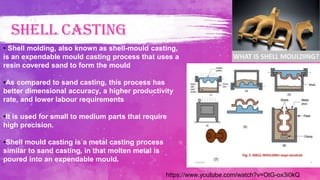
• Shell molding, also known as shell-mould casting,
is an expendable mould casting process that uses a
resin covered sand to form the mould
•As compared to sand casting, this process has
better dimensional accuracy, a higher productivity
rate, and lower labour requirements
•It is used for small to medium parts that require
high precision.
•Shell mould casting is a metal casting process
similar to sand casting, in that molten metal is
poured into an expendable mould.
Shell casting
https://www.youtube.com/watch?v=OtG-ox3i0kQ
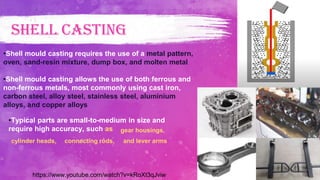
•Shell mould casting requires the use of a metal pattern,
oven, sand-resin mixture, dump box, and molten metal
•Shell mould casting allows the use of both ferrous and
non-ferrous metals, most commonly using cast iron,
carbon steel, alloy steel, stainless steel, aluminium
alloys, and copper alloys
Shell casting
https://www.youtube.com/watch?v=kRoXt3qJviw
•Typical parts are small-to-medium in size and
require high accuracy, such as gear housings,
cylinder heads, connecting rods, and lever arms
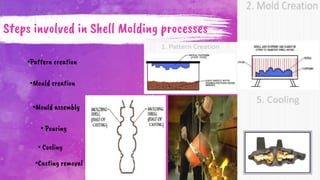
Steps involved in Shell Molding processes
•Pattern creation
•Mould creation
•Mould assembly
• Pouring
• Cooling
•Casting removal
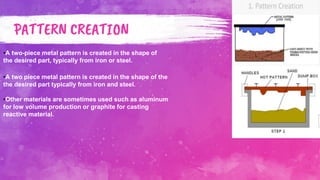
•A two-piece metal pattern is created in the shape of
the desired part, typically from iron or steel.
PATTERN CREATION
•A two piece metal pattern is created in the shape of the
the desired part typically from iron and steel.
•Other materials are sometimes used such as aluminum
for low volume production or graphite for casting
reactive material.
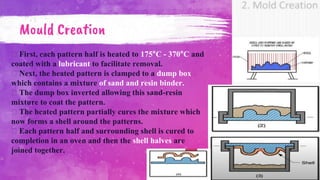
First, each pattern half is heated to 175°C - 370°C and
coated with a lubricant to facilitate removal.
Next, the heated pattern is clamped to a dump box
which contains a mixture of sand and resin binder.
The dump box inverted allowing this sand-resin
mixture to coat the pattern.
The heated pattern partially cures the mixture which
now forms a shell around the patterns.
Each pattern half and surrounding shell is cured to
completion in an oven and then the shell halves are
joined together.
Mould Creation
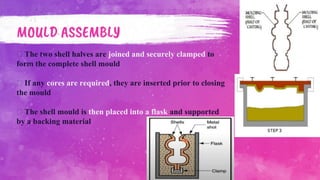
The two shell halves are joined and securely clamped to
form the complete shell mould
If any cores are required, they are inserted prior to closing
the mould
The shell mould is then placed into a flask and supported
by a backing material
MOULD ASSEMBLY
The mould is securely clamped together while the
molten metal is poured from a ladle into the gating
system and fills the mould cavity.
POURING
After the mould has been filled, the molten metal is
allowed to cool and solidify into the shape of the
final casting.
COOLING
•After the molten metal has cooled, the mould can be
broken and the casting removed.
• Trimming and cleaning processes are
required to remove any excess metal from the feed system
and any sand from the mould.
Casting removal
APPLICATIONS
Shell casting
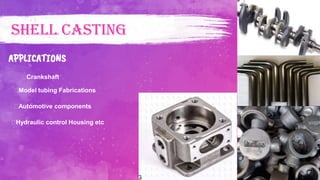
Crankshaft
Model tubing Fabrications
Automotive components
Hydraulic control Housing etc
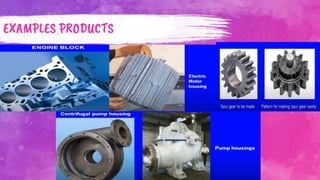
EXAMPLES PRODUCTS
Yours:
POLAYYA CHINTADA M.TECH,M.B.A,(PhD)
ASSISTANT PROFESSOR

Shell casting,steps involved in shell casting and Apllications by polayya chintada

  • 1.
    Production Technology: shell casting COURSECODE: C211 REGULATION: R19 2nd BTECH 2nd SEM PREPARED BY : POLAYYA CHINTADA M.TECH,M.B.A,(PhD) ASSISTANT PROFESSOR LENDI INSTITUTE OF ENGINEERING AND TECHNOLOGY
  • 2.
    2 PRODUCTION TECHNOLOGY SYLLABUS UNIT 1: Introduction:Importance and selection of manufacturing processes. Casting Processes: Introduction to casting process, process steps; pattern: types, materials and allowance; Cores: Types of cores, core prints, principles and design of gating system; Solidification of casting: Concept, solidification of pure metal and alloy; Special casting processes: Shell casting, investment casting, die casting, centrifugal casting, casting defects and remedies. provide insight into Working principles of different metal casting processes and gating system COURSE OBJECTIVE: COURSE OUTCOMES: Explain different metal casting processes and gating systems. (L2) APPLICATIONS: Identify different patterns and their allowances (L3) 1. Heavy Equipment : Construction, farming and mining 2. Defence : Vehicles, artillery, munitions, storage and supporting equipment 3. Hardware : Plumbing industry pipes, joints, valves and fitting Identify the various casting defects. (L3)
  • 3.
    • Shell molding,also known as shell-mould casting, is an expendable mould casting process that uses a resin covered sand to form the mould •As compared to sand casting, this process has better dimensional accuracy, a higher productivity rate, and lower labour requirements •It is used for small to medium parts that require high precision. •Shell mould casting is a metal casting process similar to sand casting, in that molten metal is poured into an expendable mould. Shell casting https://www.youtube.com/watch?v=OtG-ox3i0kQ
  • 4.
    •Shell mould castingrequires the use of a metal pattern, oven, sand-resin mixture, dump box, and molten metal •Shell mould casting allows the use of both ferrous and non-ferrous metals, most commonly using cast iron, carbon steel, alloy steel, stainless steel, aluminium alloys, and copper alloys Shell casting https://www.youtube.com/watch?v=kRoXt3qJviw •Typical parts are small-to-medium in size and require high accuracy, such as gear housings, cylinder heads, connecting rods, and lever arms
  • 5.
    Steps involved inShell Molding processes •Pattern creation •Mould creation •Mould assembly • Pouring • Cooling •Casting removal
  • 6.
    •A two-piece metalpattern is created in the shape of the desired part, typically from iron or steel. PATTERN CREATION •A two piece metal pattern is created in the shape of the the desired part typically from iron and steel. •Other materials are sometimes used such as aluminum for low volume production or graphite for casting reactive material.
  • 7.
    First, each patternhalf is heated to 175°C - 370°C and coated with a lubricant to facilitate removal. Next, the heated pattern is clamped to a dump box which contains a mixture of sand and resin binder. The dump box inverted allowing this sand-resin mixture to coat the pattern. The heated pattern partially cures the mixture which now forms a shell around the patterns. Each pattern half and surrounding shell is cured to completion in an oven and then the shell halves are joined together. Mould Creation
  • 8.
    The two shellhalves are joined and securely clamped to form the complete shell mould If any cores are required, they are inserted prior to closing the mould The shell mould is then placed into a flask and supported by a backing material MOULD ASSEMBLY
  • 9.
    The mould issecurely clamped together while the molten metal is poured from a ladle into the gating system and fills the mould cavity. POURING
  • 10.
    After the mouldhas been filled, the molten metal is allowed to cool and solidify into the shape of the final casting. COOLING
  • 11.
    •After the moltenmetal has cooled, the mould can be broken and the casting removed. • Trimming and cleaning processes are required to remove any excess metal from the feed system and any sand from the mould. Casting removal
  • 12.
    APPLICATIONS Shell casting Crankshaft Model tubingFabrications Automotive components Hydraulic control Housing etc
  • 13.
  • 14.