Electricity
Physics 2
Topic Outline
• Electric Charge
• Coulomb’s Law
• Electrical Conduction
• Electric Field
• Potential Difference
• Capacitor
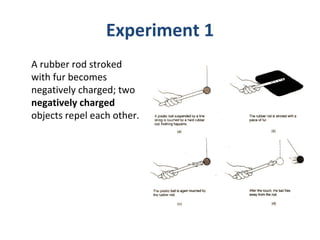
Experiment 1
A rubber rod stroked 
with fur becomes 
negatively charged; two 
negatively charged
objects repel each other.
Experiment 2
A rubber rod stroked 
with silk becomes 
positively  charged; two 
positively charged
objects repel each other.
Experiment 3
Objects with unlike 
charges attracts each 
other.
In Summary:
Like charges repel; Unlike charges attract.
Electric Charge
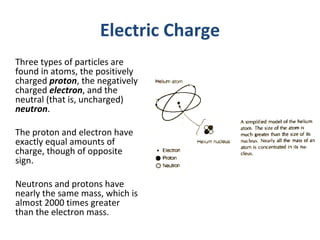
Three types of particles are 
found in atoms, the positively 
charged proton, the negatively 
charged electron, and the 
neutral (that is, uncharged) 
neutron.
The proton and electron have 
exactly equal amounts of 
charge, though of opposite 
sign. 
Neutrons and protons have 
nearly the same mass, which is 
almost 2000 times greater 
than the electron mass.
Conservation of Charge
The net electric charge in an isolated system 
remains constant.
Coulomb’s Law
The Coulomb
The unit of electric charge is the coulomb (abbreviated C). All 
charges, of either sign, occur in multiples of fundamental 
electron charge e of 1.6 x 10‐19 coulomb.
Electricity and Conduction
An electric current is a flow of charge.
Nearly all substances fall into two categories: 
conductors, through which charge can flow easily, 
insulators, through which charge can flow only with 
great difficulty.
Metals, many liquids, and plasmas (gases whose 
particles are charged) are conductors. Nonmetallic 
solids, certain liquids, and gases whose molecules are 
electrically neutral are insulators.
Electric Field
When an electric charge is present somewhere, the properties of 
space around it altered in such a way that another charge brought to 
this region will experience a force there. The “alteration space” caused 
by a charge at rest is called electric field.
Example:
Potential Difference
The potential difference between two points is the 
work per unit charge that must be done to take charge 
from one points to the other. The unit of potential 
difference is the volt which is equal to 1 J/C.
The volt is named after the Italian physicist Alessandro 
Volta (1745 – 1827), who invented the battery.
The Electron Volt
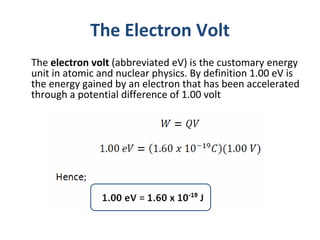
The electron volt (abbreviated eV) is the customary energy 
unit in atomic and nuclear physics. By definition 1.00 eV is 
the energy gained by an electron that has been accelerated 
through a potential difference of 1.00 volt
Capacitor
A capacitor is a system of conductors that stores energy in the form of 
an electric field between the charges.
An example of a capacitor is a pair of parallel metal plates of area A 
that are a distance d apart. Let us imagine that we create an electric 
field between them by bringing electrons from one plate to the other 
until a total charge of Q has been transferred. When we are finished, 
there will be a potential difference of V between the plates.
Capacitance
Parallel‐Plate Capacitor
Example:
Capacitors in Series
Capacitors in Parallel
REFERENCE:
Modern Technical Physics 6th Edition by 
Arthur Beiser
Copyright © 1992 by Addison‐Wesley 
Publishing Company, Inc.

Electricity