Electrostatics
Charge is the total balance between electrons and protons Charge is conserved Conductors easily allow the flow of electricity, insulators prevent it
Static Electricity; Electric Charge and Its Conservation Charge comes in two types, positive and negative; like charges repel and opposite charges attract
Static Electricity; Electric Charge and Its Conservation Electric charge is conserved – the arithmetic sum of the total charge cannot change in any interaction.
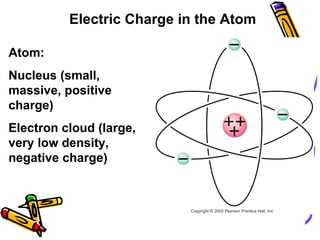
Electric Charge in the Atom Atom:  Nucleus (small, massive, positive charge) Electron cloud (large, very low density, negative charge)
Electric Charge in the Atom Atom is electrically neutral. Rubbing charges objects by moving electrons from one to the other.
Electric Charge in the Atom Polar molecule: neutral overall, but charge not evenly distributed
Insulators and Conductors Conductor: Charge flows freely Metals Insulator: Almost no charge flows Most other materials Some materials are semiconductors.
Metal objects can be charged by conduction:
They can also be charged by induction:
16.4 Induced Charge; the Electroscope Nonconductors won’t become charged by conduction or induction, but will experience charge separation:
Induced Charge; the Electroscope The electroscope can be used for detecting charge:
Induced Charge; the Electroscope The electroscope can be charged either by conduction or by induction.
Induced Charge; the Electroscope The charged electroscope can then be used to determine the sign of an unknown charge.
Summary 4 ways to change the charge of an object Friction – friction causes some atoms to lose electrons, creating a negative charge Induction – The use of an outside charge polarizes the objects Conduction – Touching the two objects transfers charge Grounding – Charge is moved to a large object
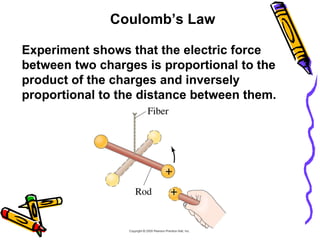
Coulomb’s Law Experiment shows that the electric force between two charges is proportional to the product of the charges and inversely proportional to the distance between them.
Coulomb’s Law Coulomb’s law: (16-1) This equation gives the magnitude of the force.
Coulomb’s Law The force is along the line connecting the charges, and is attractive if the charges are opposite, and repulsive if they are the same.
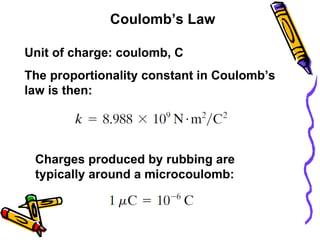
Coulomb’s Law Unit of charge: coulomb, C The proportionality constant in Coulomb’s law is then: Charges produced by rubbing are typically around a microcoulomb:
Coulomb’s Law Charge on the electron: Electric charge is quantized in units of the electron charge.
Coulomb’s Law The proportionality constant  k  can also be written in terms of  , the permittivity of free space: (16-2)
Coulomb’s Law Coulomb’s law strictly applies only to point charges. Superposition: for multiple point charges, the forces on each charge from every other charge can be calculated and then added as vectors.
Solving Problems Involving Coulomb’s Law and Vectors The net force on a charge is the vector sum of all the forces acting on it.
2 electrons are placed 2 x 10 -9 m apart. What is the force each electrons applies to the other? Force must be equal Concept of net force is the same
To the previous problem we add a proton 1 x 10 -9  to the left of the electrons. With what force, and in which direction will the middle electron move?

Electrostatics

  • 1.
  • 2.
    Charge is thetotal balance between electrons and protons Charge is conserved Conductors easily allow the flow of electricity, insulators prevent it
  • 3.
    Static Electricity; ElectricCharge and Its Conservation Charge comes in two types, positive and negative; like charges repel and opposite charges attract
  • 4.
    Static Electricity; ElectricCharge and Its Conservation Electric charge is conserved – the arithmetic sum of the total charge cannot change in any interaction.
  • 5.
    Electric Charge inthe Atom Atom: Nucleus (small, massive, positive charge) Electron cloud (large, very low density, negative charge)
  • 6.
    Electric Charge inthe Atom Atom is electrically neutral. Rubbing charges objects by moving electrons from one to the other.
  • 7.
    Electric Charge inthe Atom Polar molecule: neutral overall, but charge not evenly distributed
  • 8.
    Insulators and ConductorsConductor: Charge flows freely Metals Insulator: Almost no charge flows Most other materials Some materials are semiconductors.
  • 9.
    Metal objects canbe charged by conduction:
  • 10.
    They can alsobe charged by induction:
  • 11.
    16.4 Induced Charge;the Electroscope Nonconductors won’t become charged by conduction or induction, but will experience charge separation:
  • 12.
    Induced Charge; theElectroscope The electroscope can be used for detecting charge:
  • 13.
    Induced Charge; theElectroscope The electroscope can be charged either by conduction or by induction.
  • 14.
    Induced Charge; theElectroscope The charged electroscope can then be used to determine the sign of an unknown charge.
  • 15.
    Summary 4 waysto change the charge of an object Friction – friction causes some atoms to lose electrons, creating a negative charge Induction – The use of an outside charge polarizes the objects Conduction – Touching the two objects transfers charge Grounding – Charge is moved to a large object
  • 16.
    Coulomb’s Law Experimentshows that the electric force between two charges is proportional to the product of the charges and inversely proportional to the distance between them.
  • 17.
    Coulomb’s Law Coulomb’slaw: (16-1) This equation gives the magnitude of the force.
  • 18.
    Coulomb’s Law Theforce is along the line connecting the charges, and is attractive if the charges are opposite, and repulsive if they are the same.
  • 19.
    Coulomb’s Law Unitof charge: coulomb, C The proportionality constant in Coulomb’s law is then: Charges produced by rubbing are typically around a microcoulomb:
  • 20.
    Coulomb’s Law Chargeon the electron: Electric charge is quantized in units of the electron charge.
  • 21.
    Coulomb’s Law Theproportionality constant k can also be written in terms of , the permittivity of free space: (16-2)
  • 22.
    Coulomb’s Law Coulomb’slaw strictly applies only to point charges. Superposition: for multiple point charges, the forces on each charge from every other charge can be calculated and then added as vectors.
  • 23.
    Solving Problems InvolvingCoulomb’s Law and Vectors The net force on a charge is the vector sum of all the forces acting on it.
  • 24.
    2 electrons areplaced 2 x 10 -9 m apart. What is the force each electrons applies to the other? Force must be equal Concept of net force is the same
  • 25.
    To the previousproblem we add a proton 1 x 10 -9 to the left of the electrons. With what force, and in which direction will the middle electron move?