Coulomb’s Law and its
applications
Prepared by:
Sweetu Ratnani (130010111048)
Guided by:
Shailesh Khant (EC. Dept)
Coulomb’s Law
a) form
F =kq1q2 /r2
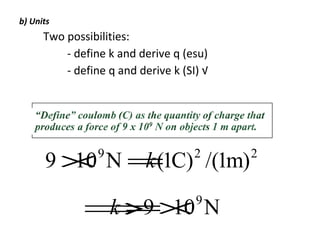
b) Units
Two possibilities:
- define k and derive q (esu)
- define q and derive k (SI) √
9 ×10⁹
N =k(1C)2
/(1m)2
⇒k =9 ×10⁹
N
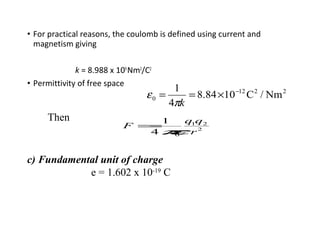
• For practical reasons, the coulomb is defined using current and
magnetism giving
k = 8.988 x 10⁹
Nm2
/C2
• Permittivity of free space
2212
0 Nm/C1084.8
4
1 −
×==
kπ
ε
Then
F =
1
4πε0
q1q2
r2
c) Fundamental unit of charge
e = 1.602 x 10⁻¹⁹
C
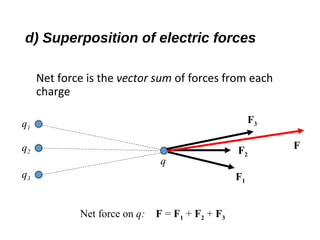
d) Superposition of electric forces
Net force is the vector sum of forces from each
charge
q1
q2
q3
q
F3
F2
F1
Net force on q: F = F1 + F2 + F3
F
Electric Field
- abstraction
- separates cause and effect in Coulomb’s law
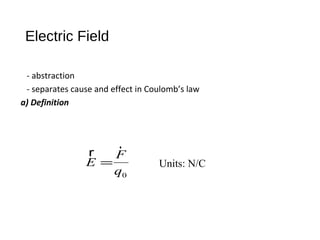
a) Definition
r
E =
r
F
q0
Units: N/C
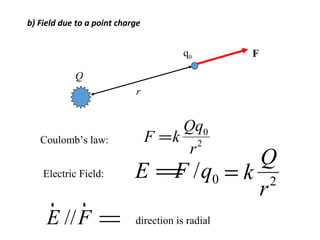
b) Field due to a point charge
F
Q
q0
r
Coulomb’s law: F =k
Qq0
r2
Electric Field: E =F /q0 = k
Q
r2
r
E //
r
F ⇒direction is radial
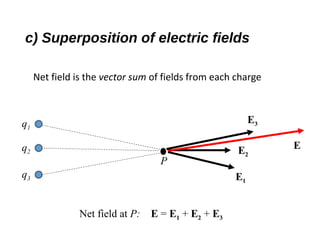
c) Superposition of electric fields
Net field is the vector sum of fields from each charge
P
E3
E2
E1
Net field at P: E = E1 + E2 + E3
E
q1
q2
q3
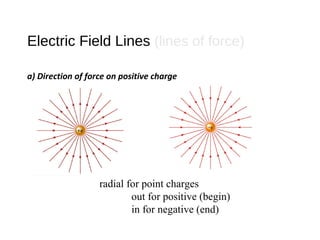
Electric Field Lines (lines of force)
a) Direction of force on positive charge
radial for point charges
out for positive (begin)
in for negative (end)
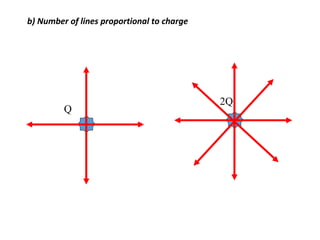
b) Number of lines proportional to charge
Q
2Q
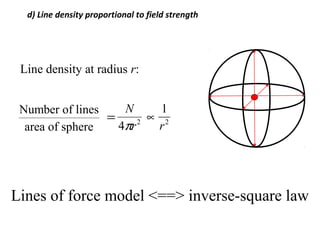
d) Line density proportional to field strength
Line density at radius r:
Number of lines
area of sphere
=
N
4πr2 ∝
1
r2
Lines of force model <==> inverse-square law
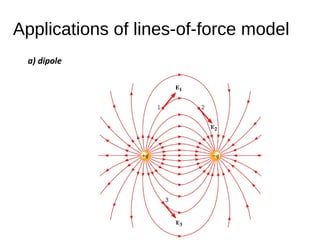
Applications of lines-of-force model
a) dipole
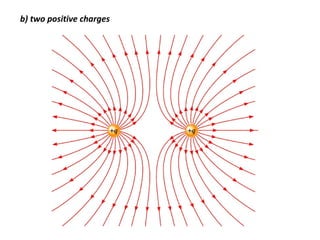
b) two positive charges
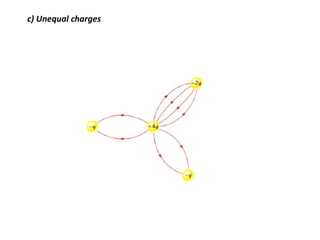
c) Unequal charges
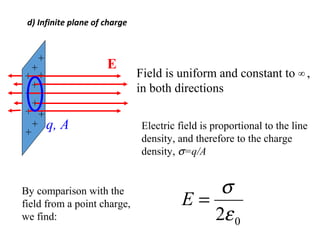
d) Infinite plane of charge
+
+
+
+
+
+
+
+
+
+
+
+
Field is uniform and constant to ,∞
in both directions
Electric field is proportional to the line
density, and therefore to the charge
density, σ=q/A
02ε
σ
=E
By comparison with the
field from a point charge,
we find:
E
q, A
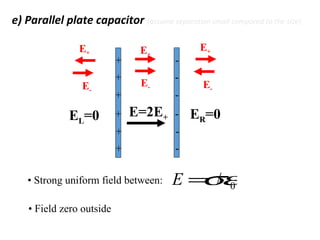
e) Parallel plate capacitor (assume separation small compared to the size)
+
+
+
+
+
+
-
-
-
-
-
-
E+
E-
E=2E+
E+
E-
ER=0
E+
E-
EL=0
• Strong uniform field between: E =σ/ε0
• Field zero outside
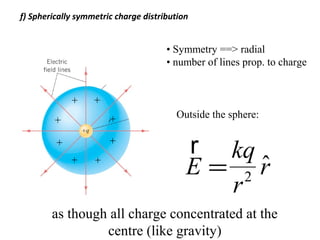
f) Spherically symmetric charge distribution
+ +
+
+
++
+
+
• Symmetry ==> radial
• number of lines prop. to charge
Outside the sphere:
r
E =
kq
r2
ˆr
as though all charge concentrated at the
centre (like gravity)

Coulomb's law and its applications

  • 1.
    Coulomb’s Law andits applications Prepared by: Sweetu Ratnani (130010111048) Guided by: Shailesh Khant (EC. Dept)
  • 2.
  • 3.
    b) Units Two possibilities: -define k and derive q (esu) - define q and derive k (SI) √ 9 ×10⁹ N =k(1C)2 /(1m)2 ⇒k =9 ×10⁹ N
  • 4.
    • For practicalreasons, the coulomb is defined using current and magnetism giving k = 8.988 x 10⁹ Nm2 /C2 • Permittivity of free space 2212 0 Nm/C1084.8 4 1 − ×== kπ ε Then F = 1 4πε0 q1q2 r2 c) Fundamental unit of charge e = 1.602 x 10⁻¹⁹ C
  • 5.
    d) Superposition ofelectric forces Net force is the vector sum of forces from each charge q1 q2 q3 q F3 F2 F1 Net force on q: F = F1 + F2 + F3 F
  • 6.
    Electric Field - abstraction -separates cause and effect in Coulomb’s law a) Definition r E = r F q0 Units: N/C
  • 7.
    b) Field dueto a point charge F Q q0 r Coulomb’s law: F =k Qq0 r2 Electric Field: E =F /q0 = k Q r2 r E // r F ⇒direction is radial
  • 8.
    c) Superposition ofelectric fields Net field is the vector sum of fields from each charge P E3 E2 E1 Net field at P: E = E1 + E2 + E3 E q1 q2 q3
  • 9.
    Electric Field Lines(lines of force) a) Direction of force on positive charge radial for point charges out for positive (begin) in for negative (end)
  • 10.
    b) Number oflines proportional to charge Q 2Q
  • 11.
    d) Line densityproportional to field strength Line density at radius r: Number of lines area of sphere = N 4πr2 ∝ 1 r2 Lines of force model <==> inverse-square law
  • 12.
  • 13.
  • 14.
  • 15.
    d) Infinite planeof charge + + + + + + + + + + + + Field is uniform and constant to ,∞ in both directions Electric field is proportional to the line density, and therefore to the charge density, σ=q/A 02ε σ =E By comparison with the field from a point charge, we find: E q, A
  • 16.
    e) Parallel platecapacitor (assume separation small compared to the size) + + + + + + - - - - - - E+ E- E=2E+ E+ E- ER=0 E+ E- EL=0 • Strong uniform field between: E =σ/ε0 • Field zero outside
  • 17.
    f) Spherically symmetriccharge distribution + + + + ++ + + • Symmetry ==> radial • number of lines prop. to charge Outside the sphere: r E = kq r2 ˆr as though all charge concentrated at the centre (like gravity)