PHYSICS GRADE 11
AUTHOR: Eng. ABDULAHI SAHAL Tell: 0616139496/ 0613685872 PAGE 1
Definition
Electrostatic is the study of charges at rest.
Electric charges
There are two kinds of electric charges. These are positive and negative charges. These
charges are carried by elementary particles called: electrons and protons. Electrons carry
negatively charges, while protons carry positively charges. The charge on an electron is
CQe
19
106.1 
 and charge on a proton is CQe
19
106.1 
 where C is the unit
of charge called coulomb.
The law of conservation of charges states that: in any process, the total amount of charge
does not change. The fundamental law of electrostatics states that: two positives changes
or two negatives charges repel each other, while a positive charge and negative charge
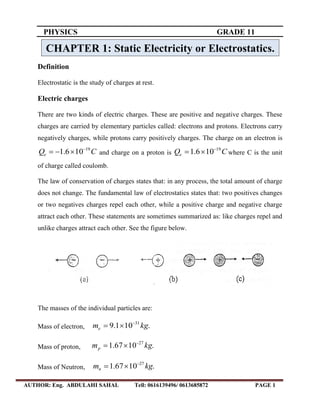
attract each other. These statements are sometimes summarized as: like charges repel and
unlike charges attract each other. See the figure below.
The masses of the individual particles are:
Mass of electron, .101.9 31
kgme


Mass of proton, .1067.1 27
kgmp


Mass of Neutron, .1067.1 27
kgmn


CHAPTER 1: Static Electricity or Electrostatics.
PHYSICS GRADE 11
AUTHOR: Eng. ABDULAHI SAHAL Tell: 0616139496/ 0613685872 PAGE 2
Process of charging
An electrically neutral body has equal number of positive and negative charges.
An electrically charged body has unequal number of positive and negative charges.
A neutral body can charge by using the following methods.
Charging by rubbing
If two different bodies are rubbed together, then one of them gives electrons to the other,
the body which receives electrons becomes negatively charged and the body which loses
electrons becomes positively charged. Charging by rubbing produces two oppositely
charged bodies. For example; rubbing a rubber (plastic) rod with wool makes the rod
negatively charged.
Charging by induction
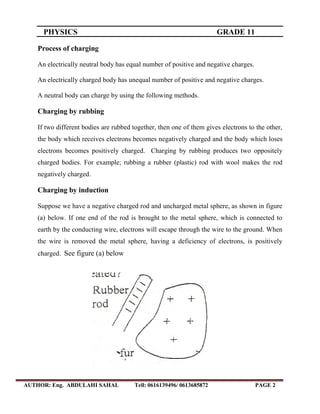
Suppose we have a negative charged rod and uncharged metal sphere, as shown in figure
(a) below. If one end of the rod is brought to the metal sphere, which is connected to
earth by the conducting wire, electrons will escape through the wire to the ground. When
the wire is removed the metal sphere, having a deficiency of electrons, is positively
charged. See figure (a) below
PHYSICS GRADE 11
AUTHOR: Eng. ABDULAHI SAHAL Tell: 0616139496/ 0613685872 PAGE 3
Charging by conduction
Suppose the metal sphere of figure (a), but without grounding, is touched by the
negatively charged rod, then electrons will flow from the rod to the sphere. The sphere
will have excess electrons, and therefore, it will be negatively charged. When charging by
conduction both the sphere and the rod will have the same kind of charge.
Electroscope
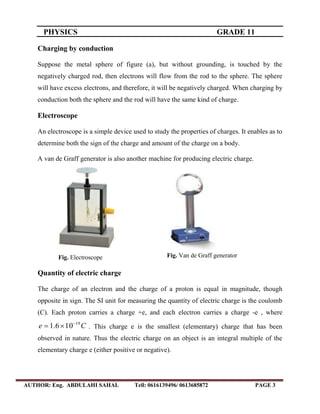
An electroscope is a simple device used to study the properties of charges. It enables as to
determine both the sign of the charge and amount of the charge on a body.
A van de Graff generator is also another machine for producing electric charge.
Quantity of electric charge
The charge of an electron and the charge of a proton is equal in magnitude, though
opposite in sign. The SI unit for measuring the quantity of electric charge is the coulomb
(C). Each proton carries a charge +e, and each electron carries a charge -e , where
Ce 19
106.1 
 . This charge e is the smallest (elementary) charge that has been
observed in nature. Thus the electric charge on an object is an integral multiple of the
elementary charge e (either positive or negative).
Fig. Electroscope Fig. Van de Graff generator
PHYSICS GRADE 11
AUTHOR: Eng. ABDULAHI SAHAL Tell: 0616139496/ 0613685872 PAGE 4
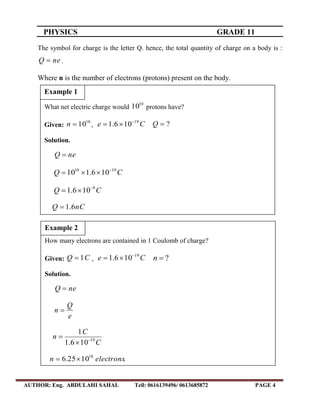
The symbol for charge is the letter Q. hence, the total quantity of charge on a body is :
neQ  .
Where n is the number of electrons (protons) present on the body.
What net electric charge would
10
10 protons have?
Given:
10
10n , Ce 19
106.1 
 ?Q
Solution.
neQ 
CQ 1910
106.110 

CQ 9
106.1 

nCQ 6.1
Example 1
How many electrons are contained in 1 Coulomb of charge?
Given: CQ 1 , Ce 19
106.1 
 ?n
Solution.
neQ 
e
Q
n 
C
C
n 19
106.1
1



.1025.6 18
electronsn 
Example 2
PHYSICS GRADE 11
AUTHOR: Eng. ABDULAHI SAHAL Tell: 0616139496/ 0613685872 PAGE 5
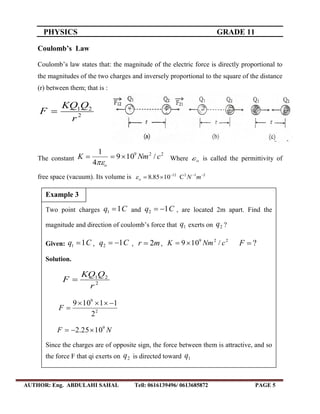
Coulomb’s Law
Coulomb’s law states that: the magnitude of the electric force is directly proportional to
the magnitudes of the two charges and inversely proportional to the square of the distance
(r) between them; that is :
2
21
r
QKQ
F 
The constant
229
/109
4
1
cNmK
o


Where o is called the permittivity of
free space (vacuum). Its volume is 21212
C1085.8 
 mNo
Two point charges Cq 11  and Cq 12  , are located 2m apart. Find the
magnitude and direction of coulomb’s force that 1q exerts on 2q ?
Given: Cq 11  , Cq 12  , mr 2 ,
229
/109 cNmK  ?F
Solution.
2
21
r
QKQ
F 
2
9
2
11109 
F
NF 9
1025.2 
Since the charges are of opposite sign, the force between them is attractive, and so
the force F that qi exerts on 2q is directed toward 1q
Example 3
PHYSICS GRADE 11
AUTHOR: Eng. ABDULAHI SAHAL Tell: 0616139496/ 0613685872 PAGE 6
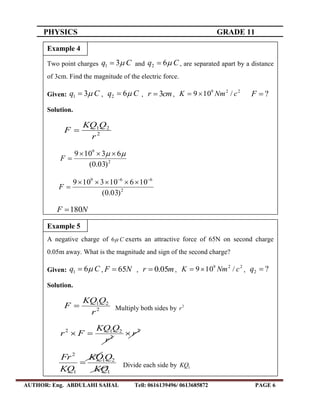
Two point charges Cq 31  and Cq 62  , are separated apart by a distance
of 3cm. Find the magnitude of the electric force.
Given: Cq 31  , Cq 62  , cmr 3 ,
229
/109 cNmK  ?F
Solution.
2
21
r
QKQ
F 
2
9
)03.0(
63109  
F
2
669
)03.0(
106103109 

F
NF 180
Example 4
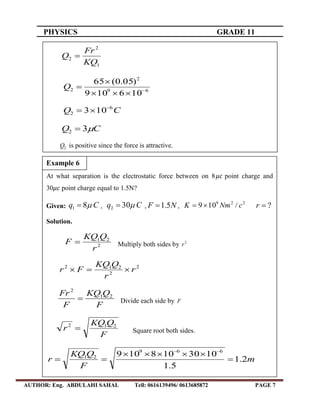
A negative charge of C6 exerts an attractive force of 65N on second charge
0.05m away. What is the magnitude and sign of the second charge?
Given: Cq 61  , NF 65 , mr 05.0 ,
229
/109 cNmK  , ?2 q
Solution.
2
21
r
QKQ
F  Multiply both sides by 2
r
2
2
212
r
r
QKQ
Fr 
1
21
1
2
KQ
QKQ
KQ
Fr
 Divide each side by 1KQ
Example 5
PHYSICS GRADE 11
AUTHOR: Eng. ABDULAHI SAHAL Tell: 0616139496/ 0613685872 PAGE 7
1
2
2
KQ
Fr
Q 
69
2
2
106109
)05.0(65



Q
CQ 6
2 103 

CQ 32 
2Q is positive since the force is attractive.
At what separation is the electrostatic force between on 8 point charge and
30 point charge equal to 1.5N?
Given: Cq 81  , Cq 302  , NF 5.1 ,
229
/109 cNmK  ?r
Solution.
2
21
r
QKQ
F  Multiply both sides by 2
r
2
2
212
r
r
QKQ
Fr 
F
QKQ
F
Fr 21
2
 Divide each side by F
F
QKQ
r 212
 Square root both sides.
m
F
QKQ
r 2.1
5.1
1030108109 669
21




Example 6
PHYSICS GRADE 11
AUTHOR: Eng. ABDULAHI SAHAL Tell: 0616139496/ 0613685872 PAGE 8
The magnitude of electric force between two point charges is initially 180N. what
will be the force if the distance between the two charges is
(a) doubled
(b) halved.
Solution.
Let the initial force and distance be NF 1801  and rr 1
a) When the separation between the charges is doubled rr 22 
From Coulomb’s law
2
1
21
1
r
QKQ
F  or 21
2
11 QKQrF 
And 2
2
21
2
r
QKQ
F  or 21
2
22 QKQrF 
Equating the left terms in both equations we get:
2
22
2
11 rFrF 
N
r
r
r
r
r
rF
F 45
4
180
4
180
)2(
180
2
2
2
2
2
2
2
11
2 




The force is decreased by a factor of 4.
b) When the separation between the charges is halved rr
2
1
2  and ?2 F
N
r
r
r
r
r
rF
F 7204180
4
1
180
4
1
180
2
1
180
2
2
2
2
2
2
2
11
2 










The new force is 4 times the original Force.
Example 7
PHYSICS GRADE 11
AUTHOR: Eng. ABDULAHI SAHAL Tell: 0616139496/ 0613685872 PAGE 9
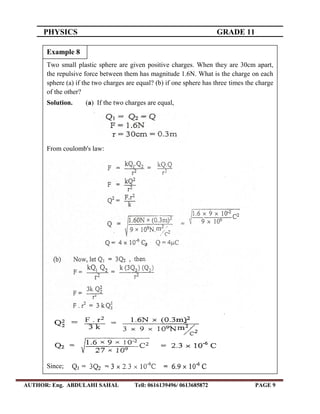
Two small plastic sphere are given positive charges. When they are 30cm apart,
the repulsive force between them has magnitude 1.6N. What is the charge on each
sphere (a) if the two charges are equal? (b) if one sphere has three times the charge
of the other?
Solution. (a) If the two charges are equal,
From coulomb's law:
Since;
Example 8
PHYSICS GRADE 11
AUTHOR: Eng. ABDULAHI SAHAL Tell: 0616139496/ 0613685872 PAGE 10
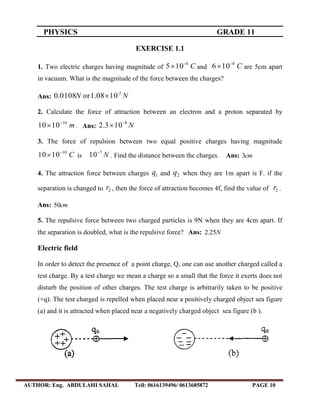
EXERCISE 1.1
1. Two electric charges having magnitude of C105 8
 and C106 8
 are 5cm apart
in vacuum. What is the magnitude of the force between the charges?
Ans: NN -2
101.08or0108.0 
2. Calculate the force of attraction between an electron and a proton separated by
m1010 10
 . Ans: N8
103.2 

3. The force of repulsion between two equal positive charges having magnitude
C1010 10
 is N7
10
. Find the distance between the charges. Ans: cm3
4. The attraction force between charges 1q and 2q when they are 1m apart is F. if the
separation is changed to 2r , then the force of attraction becomes 4f, find the value of 2r .
Ans: cm50
5. The repulsive force between two charged particles is 9N when they are 4cm apart. If
the separation is doubled, what is the repulsive force? Ans: N25.2
Electric field
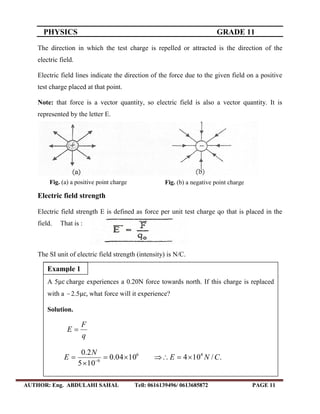
In order to detect the presence of a point charge, Q, one can use another charged called a
test charge. By a test charge we mean a charge so a small that the force it exerts does not
disturb the position of other charges. The test charge is arbitrarily taken to be positive
(+q). The test charged is repelled when placed near a positively charged object sea figure
(a) and it is attracted when placed near a negatively charged object sea figure (b ).
PHYSICS GRADE 11
AUTHOR: Eng. ABDULAHI SAHAL Tell: 0616139496/ 0613685872 PAGE 11
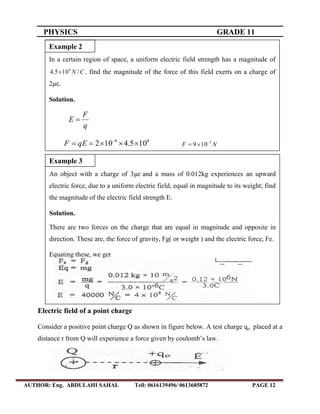
The direction in which the test charge is repelled or attracted is the direction of the
electric field.
Electric field lines indicate the direction of the force due to the given field on a positive
test charge placed at that point.
Note: that force is a vector quantity, so electric field is also a vector quantity. It is
represented by the letter E.
Electric field strength
Electric field strength E is defined as force per unit test charge qo that is placed in the
field. That is :
The SI unit of electric field strength (intensity) is N/C.
Fig. (a) a positive point charge Fig. (b) a negative point charge
A 5 charge experiences a 0.20N force towards north. If this charge is replaced
with a  2.5 what force will it experience?
Solution.
q
F
E 
./1041004.0
105
2.0 46
6
CNE
N
E 

 
Example 1
PHYSICS GRADE 11
AUTHOR: Eng. ABDULAHI SAHAL Tell: 0616139496/ 0613685872 PAGE 12
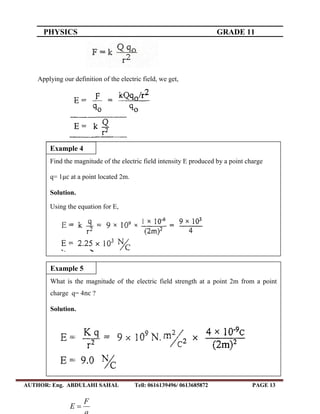
Electric field of a point charge
Consider a positive point charge Q as shown in figure below. A test charge qo placed at a
distance r from Q will experience a force given by coulomb’s law.
An object with a charge of 3 and a mass of 0.012kg experiences an upward
electric force, due to a uniform electric field, equal in magnitude to its weight; find
the magnitude of the electric field strength E.
Solution.
There are two forces on the charge that are equal in magnitude and opposite in
direction. These are, the force of gravity, Fg( or weight ) and the electric force, Fe.
Equating these, we get
Example 3
In a certain region of space, a uniform electric field strength has a magnitude of
CN /105.4 4
 . find the magnitude of the force of this field exerts on a charge of
2
Solution.
q
F
E 
46
105.4102  
qEF NF 2
109 

Example 2
PHYSICS GRADE 11
AUTHOR: Eng. ABDULAHI SAHAL Tell: 0616139496/ 0613685872 PAGE 13
Applying our definition of the electric field, we get,
Find the magnitude of the electric field intensity E produced by a point charge
q= 1 at a point located 2m.
Solution.
Using the equation for E,
q
F
E 
46
105.4102  
qEF NF 2
109 

Example 4
What is the magnitude of the electric field strength at a point 2m from a point
charge q= 4 ?
Solution.
F
E 
Example 5
PHYSICS GRADE 11
AUTHOR: Eng. ABDULAHI SAHAL Tell: 0616139496/ 0613685872 PAGE 14
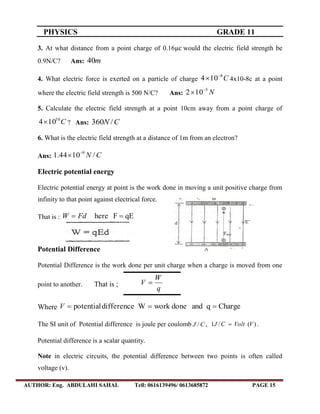
EXERCISE 1.2
1. A uniform electric field intensity has a magnitude of CN /104 4
 . find the force exerts
on a charge of 2.5 Ans: N1.0
2. What is the electric field strength at a point 50cm away from a charge of 7.5
Ans: ./107.2 5
CN
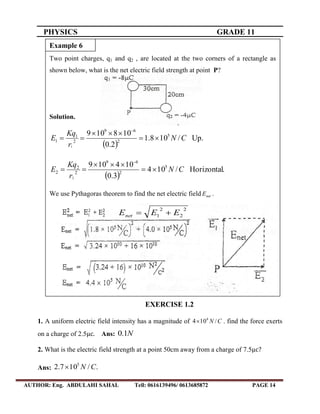
Two point charges, q1 and q2 , are located at the two corners of a rectangle as
shown below, what is the net electric field strength at point P?
Solution.
 
.Up/108.1
2.0
108109 5
2
69
2
1
1
1
CN
r
Kq
E 



 
.Horizontal/104
3.0
104109 5
2
69
2
2
2
2
CN
r
Kq
E 



We use Pythagoras theorem to find the net electric field netE .
Example 6
2
2
2
1 EEEnet 
PHYSICS GRADE 11
AUTHOR: Eng. ABDULAHI SAHAL Tell: 0616139496/ 0613685872 PAGE 15
3. At what distance from a point charge of 0.16 would the electric field strength be
0.9N/C? Ans: m40
4. What electric force is exerted on a particle of charge C8
104 
 4x10⁻⁸c at a point
where the electric field strength is 500 N/C? Ans: N5
102 

5. Calculate the electric field strength at a point 10cm away from a point charge of
C10
104 ? Ans: CN /360
6. What is the electric field strength at a distance of 1m from an electron?
Ans: CN /1044.1 9

Electric potential energy
Electric potential energy at point is the work done in moving a unit positive charge from
infinity to that point against electrical force.
That is : qEFhere  FdW
Potential Difference
Potential Difference is the work done per unit charge when a charge is moved from one
point to another. That is ;
q
W
V 
Where ChargeqanddoneworkWdifferencepotential V
The SI unit of Potential difference is joule per coulomb CJ / , )(/1 VVoltCJ  .
Potential difference is a scalar quantity.
Note in electric circuits, the potential difference between two points is often called
voltage (v).
PHYSICS GRADE 11
AUTHOR: Eng. ABDULAHI SAHAL Tell: 0616139496/ 0613685872 PAGE 16
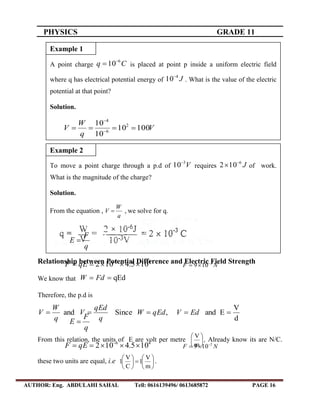
Relationship between Potential Difference and Electric Field Strength
We know that qEd FdW
Therefore, the p.d is
d
V
Eand,Sinceand  EdVqEdW
q
qEd
V
q
W
V
From this relation, the units of E are volt per metre 





m
V
, Already know its are N/C.
these two units are equal, i.e 











m
V
1
C
V
1 .
To move a point charge through a p.d of V3
10
requires J6
102 
 of work.
What is the magnitude of the charge?
Solution.
From the equation ,
q
W
V  , we solve for q.
q
F
E 
46
105.4102  
qEF NF 2
109 

Example 2
A point charge Cq 6
10
 is placed at point p inside a uniform electric field
where q has electrical potential energy of J4
10
. What is the value of the electric
potential at that point?
Solution.
V
q
W
V 10010
10
10 2
6
4
 

q
F
E 
46
105.4102  
qEF NF 2
109 

Example 1
PHYSICS GRADE 11
AUTHOR: Eng. ABDULAHI SAHAL Tell: 0616139496/ 0613685872 PAGE 17
Two parallel plates are charged to p.d of 24V. if the plates are separated by a
distance of 3cm, what electric field exists between them?
Solution.
mV
m
V
d
V
E /800
03.0
24

q
F
E 
46
105.4102  
qEF NF 2
109 

Example 3
A 20nC charge is moved between two points A and B that are 30mm apart and
have an electric p.d of 600V between them. Calculate (a) the electric field strength
between A and B. (b) The work done on the charge.
Given: CCnq 9
102020 
 VVAB 600 , mmmd 03.030  ,
?)?)  WbEa
Solution.
q
F
E 
46
105.4102  
qEF NF 2
109 

Example 4
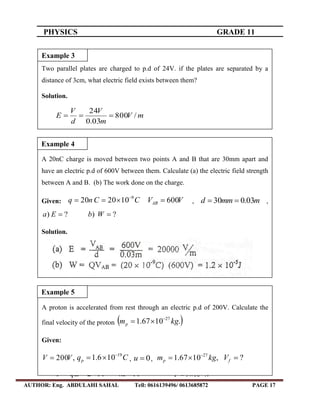
A proton is accelerated from rest through an electric p.d of 200V. Calculate the
final velocity of the proton  .1067.1 27
kgmp


Given:
,200VV  Cqp
19
106.1 
 , 0u , ,1067.1 27
kgmp

 ?fV
Example 5
PHYSICS GRADE 11
AUTHOR: Eng. ABDULAHI SAHAL Tell: 0616139496/ 0613685872 PAGE 18
EXERCISE 1.3
1. The potential difference at a certain distance from a point charge is 600V and the
electric field is 200 N/C. Find the distance between them. Ans: m3
2. Two points in an electric field have a p.d of 10v. if J5
105 
 of work is required to
move a charge between these points, how large must the charge be? Ans: C5
3. 500J of work is required to transfer 50C of charge from one terminal to the other. What
is the p.d between the terminals? Ans: V10
4. How much work is required to carry a charge of 4 from the positive terminal to a
negative terminal of 9V battery? Ans: J5
106.3 

5. If a force of N2
105 
 is required to move 4 charge in an electric field between
two points 10cm a part. What is the p.d between the points? Ans: V1250
Electric potential due to a single point charge (Absolute potential)
Any charge q creates an electric field in its vicinity. The strength of the electric field at a
distance r from q was determined to be :
Solution.
q
F
E 
46
105.4102  
qEF NF 2
109 

PHYSICS GRADE 11
AUTHOR: Eng. ABDULAHI SAHAL Tell: 0616139496/ 0613685872 PAGE 19
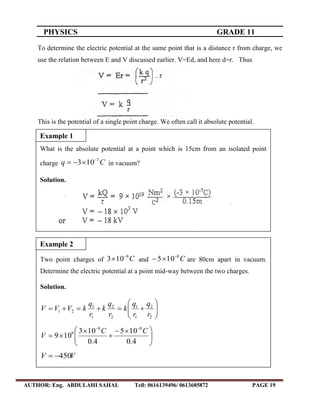
To determine the electric potential at the same point that is a distance r from charge, we
use the relation between E and V discussed earlier. V=Ed, and here d=r. Thus
This is the potential of a single point charge. We often call it absolute potential.
What is the absolute potential at a point which is 15cm from an isolated point
charge Cq 7
103 
 in vacuum?
Solution.
q
F
E 
46
105.4102  
qEF NF 2
109 

Example 1
Two point charges of C8
103 
 and C8
105 
 are 80cm apart in vacuum.
Determine the electric potential at a point mid-way between the two charges.
Solution.







2
2
1
1
2
2
1
1
21
r
q
r
q
k
r
q
k
r
q
kVVV





 




4.0
105
4.0
103
109
88
9 CC
V
VV 450
Example 2
PHYSICS GRADE 11
AUTHOR: Eng. ABDULAHI SAHAL Tell: 0616139496/ 0613685872 PAGE 20
EXERCISE 1.4
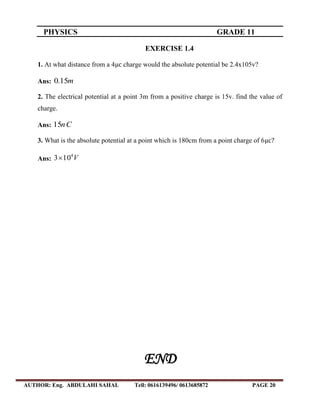
1. At what distance from a 4 charge would the absolute potential be 2.4x10⁵v?
Ans: m15.0
2. The electrical potential at a point 3m from a positive charge is 15v. find the value of
charge.
Ans: Cn15
3. What is the absolute potential at a point which is 180cm from a point charge of 6
Ans: V4
103
END

Chapter (1) electrostatics

  • 1.
    PHYSICS GRADE 11 AUTHOR:Eng. ABDULAHI SAHAL Tell: 0616139496/ 0613685872 PAGE 1 Definition Electrostatic is the study of charges at rest. Electric charges There are two kinds of electric charges. These are positive and negative charges. These charges are carried by elementary particles called: electrons and protons. Electrons carry negatively charges, while protons carry positively charges. The charge on an electron is CQe 19 106.1   and charge on a proton is CQe 19 106.1   where C is the unit of charge called coulomb. The law of conservation of charges states that: in any process, the total amount of charge does not change. The fundamental law of electrostatics states that: two positives changes or two negatives charges repel each other, while a positive charge and negative charge attract each other. These statements are sometimes summarized as: like charges repel and unlike charges attract each other. See the figure below. The masses of the individual particles are: Mass of electron, .101.9 31 kgme   Mass of proton, .1067.1 27 kgmp   Mass of Neutron, .1067.1 27 kgmn   CHAPTER 1: Static Electricity or Electrostatics.
  • 2.
    PHYSICS GRADE 11 AUTHOR:Eng. ABDULAHI SAHAL Tell: 0616139496/ 0613685872 PAGE 2 Process of charging An electrically neutral body has equal number of positive and negative charges. An electrically charged body has unequal number of positive and negative charges. A neutral body can charge by using the following methods. Charging by rubbing If two different bodies are rubbed together, then one of them gives electrons to the other, the body which receives electrons becomes negatively charged and the body which loses electrons becomes positively charged. Charging by rubbing produces two oppositely charged bodies. For example; rubbing a rubber (plastic) rod with wool makes the rod negatively charged. Charging by induction Suppose we have a negative charged rod and uncharged metal sphere, as shown in figure (a) below. If one end of the rod is brought to the metal sphere, which is connected to earth by the conducting wire, electrons will escape through the wire to the ground. When the wire is removed the metal sphere, having a deficiency of electrons, is positively charged. See figure (a) below
  • 3.
    PHYSICS GRADE 11 AUTHOR:Eng. ABDULAHI SAHAL Tell: 0616139496/ 0613685872 PAGE 3 Charging by conduction Suppose the metal sphere of figure (a), but without grounding, is touched by the negatively charged rod, then electrons will flow from the rod to the sphere. The sphere will have excess electrons, and therefore, it will be negatively charged. When charging by conduction both the sphere and the rod will have the same kind of charge. Electroscope An electroscope is a simple device used to study the properties of charges. It enables as to determine both the sign of the charge and amount of the charge on a body. A van de Graff generator is also another machine for producing electric charge. Quantity of electric charge The charge of an electron and the charge of a proton is equal in magnitude, though opposite in sign. The SI unit for measuring the quantity of electric charge is the coulomb (C). Each proton carries a charge +e, and each electron carries a charge -e , where Ce 19 106.1   . This charge e is the smallest (elementary) charge that has been observed in nature. Thus the electric charge on an object is an integral multiple of the elementary charge e (either positive or negative). Fig. Electroscope Fig. Van de Graff generator
  • 4.
    PHYSICS GRADE 11 AUTHOR:Eng. ABDULAHI SAHAL Tell: 0616139496/ 0613685872 PAGE 4 The symbol for charge is the letter Q. hence, the total quantity of charge on a body is : neQ  . Where n is the number of electrons (protons) present on the body. What net electric charge would 10 10 protons have? Given: 10 10n , Ce 19 106.1   ?Q Solution. neQ  CQ 1910 106.110   CQ 9 106.1   nCQ 6.1 Example 1 How many electrons are contained in 1 Coulomb of charge? Given: CQ 1 , Ce 19 106.1   ?n Solution. neQ  e Q n  C C n 19 106.1 1    .1025.6 18 electronsn  Example 2
  • 5.
    PHYSICS GRADE 11 AUTHOR:Eng. ABDULAHI SAHAL Tell: 0616139496/ 0613685872 PAGE 5 Coulomb’s Law Coulomb’s law states that: the magnitude of the electric force is directly proportional to the magnitudes of the two charges and inversely proportional to the square of the distance (r) between them; that is : 2 21 r QKQ F  The constant 229 /109 4 1 cNmK o   Where o is called the permittivity of free space (vacuum). Its volume is 21212 C1085.8   mNo Two point charges Cq 11  and Cq 12  , are located 2m apart. Find the magnitude and direction of coulomb’s force that 1q exerts on 2q ? Given: Cq 11  , Cq 12  , mr 2 , 229 /109 cNmK  ?F Solution. 2 21 r QKQ F  2 9 2 11109  F NF 9 1025.2  Since the charges are of opposite sign, the force between them is attractive, and so the force F that qi exerts on 2q is directed toward 1q Example 3
  • 6.
    PHYSICS GRADE 11 AUTHOR:Eng. ABDULAHI SAHAL Tell: 0616139496/ 0613685872 PAGE 6 Two point charges Cq 31  and Cq 62  , are separated apart by a distance of 3cm. Find the magnitude of the electric force. Given: Cq 31  , Cq 62  , cmr 3 , 229 /109 cNmK  ?F Solution. 2 21 r QKQ F  2 9 )03.0( 63109   F 2 669 )03.0( 106103109   F NF 180 Example 4 A negative charge of C6 exerts an attractive force of 65N on second charge 0.05m away. What is the magnitude and sign of the second charge? Given: Cq 61  , NF 65 , mr 05.0 , 229 /109 cNmK  , ?2 q Solution. 2 21 r QKQ F  Multiply both sides by 2 r 2 2 212 r r QKQ Fr  1 21 1 2 KQ QKQ KQ Fr  Divide each side by 1KQ Example 5
  • 7.
    PHYSICS GRADE 11 AUTHOR:Eng. ABDULAHI SAHAL Tell: 0616139496/ 0613685872 PAGE 7 1 2 2 KQ Fr Q  69 2 2 106109 )05.0(65    Q CQ 6 2 103   CQ 32  2Q is positive since the force is attractive. At what separation is the electrostatic force between on 8 point charge and 30 point charge equal to 1.5N? Given: Cq 81  , Cq 302  , NF 5.1 , 229 /109 cNmK  ?r Solution. 2 21 r QKQ F  Multiply both sides by 2 r 2 2 212 r r QKQ Fr  F QKQ F Fr 21 2  Divide each side by F F QKQ r 212  Square root both sides. m F QKQ r 2.1 5.1 1030108109 669 21     Example 6
  • 8.
    PHYSICS GRADE 11 AUTHOR:Eng. ABDULAHI SAHAL Tell: 0616139496/ 0613685872 PAGE 8 The magnitude of electric force between two point charges is initially 180N. what will be the force if the distance between the two charges is (a) doubled (b) halved. Solution. Let the initial force and distance be NF 1801  and rr 1 a) When the separation between the charges is doubled rr 22  From Coulomb’s law 2 1 21 1 r QKQ F  or 21 2 11 QKQrF  And 2 2 21 2 r QKQ F  or 21 2 22 QKQrF  Equating the left terms in both equations we get: 2 22 2 11 rFrF  N r r r r r rF F 45 4 180 4 180 )2( 180 2 2 2 2 2 2 2 11 2      The force is decreased by a factor of 4. b) When the separation between the charges is halved rr 2 1 2  and ?2 F N r r r r r rF F 7204180 4 1 180 4 1 180 2 1 180 2 2 2 2 2 2 2 11 2            The new force is 4 times the original Force. Example 7
  • 9.
    PHYSICS GRADE 11 AUTHOR:Eng. ABDULAHI SAHAL Tell: 0616139496/ 0613685872 PAGE 9 Two small plastic sphere are given positive charges. When they are 30cm apart, the repulsive force between them has magnitude 1.6N. What is the charge on each sphere (a) if the two charges are equal? (b) if one sphere has three times the charge of the other? Solution. (a) If the two charges are equal, From coulomb's law: Since; Example 8
  • 10.
    PHYSICS GRADE 11 AUTHOR:Eng. ABDULAHI SAHAL Tell: 0616139496/ 0613685872 PAGE 10 EXERCISE 1.1 1. Two electric charges having magnitude of C105 8  and C106 8  are 5cm apart in vacuum. What is the magnitude of the force between the charges? Ans: NN -2 101.08or0108.0  2. Calculate the force of attraction between an electron and a proton separated by m1010 10  . Ans: N8 103.2   3. The force of repulsion between two equal positive charges having magnitude C1010 10  is N7 10 . Find the distance between the charges. Ans: cm3 4. The attraction force between charges 1q and 2q when they are 1m apart is F. if the separation is changed to 2r , then the force of attraction becomes 4f, find the value of 2r . Ans: cm50 5. The repulsive force between two charged particles is 9N when they are 4cm apart. If the separation is doubled, what is the repulsive force? Ans: N25.2 Electric field In order to detect the presence of a point charge, Q, one can use another charged called a test charge. By a test charge we mean a charge so a small that the force it exerts does not disturb the position of other charges. The test charge is arbitrarily taken to be positive (+q). The test charged is repelled when placed near a positively charged object sea figure (a) and it is attracted when placed near a negatively charged object sea figure (b ).
  • 11.
    PHYSICS GRADE 11 AUTHOR:Eng. ABDULAHI SAHAL Tell: 0616139496/ 0613685872 PAGE 11 The direction in which the test charge is repelled or attracted is the direction of the electric field. Electric field lines indicate the direction of the force due to the given field on a positive test charge placed at that point. Note: that force is a vector quantity, so electric field is also a vector quantity. It is represented by the letter E. Electric field strength Electric field strength E is defined as force per unit test charge qo that is placed in the field. That is : The SI unit of electric field strength (intensity) is N/C. Fig. (a) a positive point charge Fig. (b) a negative point charge A 5 charge experiences a 0.20N force towards north. If this charge is replaced with a  2.5 what force will it experience? Solution. q F E  ./1041004.0 105 2.0 46 6 CNE N E     Example 1
  • 12.
    PHYSICS GRADE 11 AUTHOR:Eng. ABDULAHI SAHAL Tell: 0616139496/ 0613685872 PAGE 12 Electric field of a point charge Consider a positive point charge Q as shown in figure below. A test charge qo placed at a distance r from Q will experience a force given by coulomb’s law. An object with a charge of 3 and a mass of 0.012kg experiences an upward electric force, due to a uniform electric field, equal in magnitude to its weight; find the magnitude of the electric field strength E. Solution. There are two forces on the charge that are equal in magnitude and opposite in direction. These are, the force of gravity, Fg( or weight ) and the electric force, Fe. Equating these, we get Example 3 In a certain region of space, a uniform electric field strength has a magnitude of CN /105.4 4  . find the magnitude of the force of this field exerts on a charge of 2 Solution. q F E  46 105.4102   qEF NF 2 109   Example 2
  • 13.
    PHYSICS GRADE 11 AUTHOR:Eng. ABDULAHI SAHAL Tell: 0616139496/ 0613685872 PAGE 13 Applying our definition of the electric field, we get, Find the magnitude of the electric field intensity E produced by a point charge q= 1 at a point located 2m. Solution. Using the equation for E, q F E  46 105.4102   qEF NF 2 109   Example 4 What is the magnitude of the electric field strength at a point 2m from a point charge q= 4 ? Solution. F E  Example 5
  • 14.
    PHYSICS GRADE 11 AUTHOR:Eng. ABDULAHI SAHAL Tell: 0616139496/ 0613685872 PAGE 14 EXERCISE 1.2 1. A uniform electric field intensity has a magnitude of CN /104 4  . find the force exerts on a charge of 2.5 Ans: N1.0 2. What is the electric field strength at a point 50cm away from a charge of 7.5 Ans: ./107.2 5 CN Two point charges, q1 and q2 , are located at the two corners of a rectangle as shown below, what is the net electric field strength at point P? Solution.   .Up/108.1 2.0 108109 5 2 69 2 1 1 1 CN r Kq E       .Horizontal/104 3.0 104109 5 2 69 2 2 2 2 CN r Kq E     We use Pythagoras theorem to find the net electric field netE . Example 6 2 2 2 1 EEEnet 
  • 15.
    PHYSICS GRADE 11 AUTHOR:Eng. ABDULAHI SAHAL Tell: 0616139496/ 0613685872 PAGE 15 3. At what distance from a point charge of 0.16 would the electric field strength be 0.9N/C? Ans: m40 4. What electric force is exerted on a particle of charge C8 104   4x10⁻⁸c at a point where the electric field strength is 500 N/C? Ans: N5 102   5. Calculate the electric field strength at a point 10cm away from a point charge of C10 104 ? Ans: CN /360 6. What is the electric field strength at a distance of 1m from an electron? Ans: CN /1044.1 9  Electric potential energy Electric potential energy at point is the work done in moving a unit positive charge from infinity to that point against electrical force. That is : qEFhere  FdW Potential Difference Potential Difference is the work done per unit charge when a charge is moved from one point to another. That is ; q W V  Where ChargeqanddoneworkWdifferencepotential V The SI unit of Potential difference is joule per coulomb CJ / , )(/1 VVoltCJ  . Potential difference is a scalar quantity. Note in electric circuits, the potential difference between two points is often called voltage (v).
  • 16.
    PHYSICS GRADE 11 AUTHOR:Eng. ABDULAHI SAHAL Tell: 0616139496/ 0613685872 PAGE 16 Relationship between Potential Difference and Electric Field Strength We know that qEd FdW Therefore, the p.d is d V Eand,Sinceand  EdVqEdW q qEd V q W V From this relation, the units of E are volt per metre       m V , Already know its are N/C. these two units are equal, i.e             m V 1 C V 1 . To move a point charge through a p.d of V3 10 requires J6 102   of work. What is the magnitude of the charge? Solution. From the equation , q W V  , we solve for q. q F E  46 105.4102   qEF NF 2 109   Example 2 A point charge Cq 6 10  is placed at point p inside a uniform electric field where q has electrical potential energy of J4 10 . What is the value of the electric potential at that point? Solution. V q W V 10010 10 10 2 6 4    q F E  46 105.4102   qEF NF 2 109   Example 1
  • 17.
    PHYSICS GRADE 11 AUTHOR:Eng. ABDULAHI SAHAL Tell: 0616139496/ 0613685872 PAGE 17 Two parallel plates are charged to p.d of 24V. if the plates are separated by a distance of 3cm, what electric field exists between them? Solution. mV m V d V E /800 03.0 24  q F E  46 105.4102   qEF NF 2 109   Example 3 A 20nC charge is moved between two points A and B that are 30mm apart and have an electric p.d of 600V between them. Calculate (a) the electric field strength between A and B. (b) The work done on the charge. Given: CCnq 9 102020   VVAB 600 , mmmd 03.030  , ?)?)  WbEa Solution. q F E  46 105.4102   qEF NF 2 109   Example 4 A proton is accelerated from rest through an electric p.d of 200V. Calculate the final velocity of the proton  .1067.1 27 kgmp   Given: ,200VV  Cqp 19 106.1   , 0u , ,1067.1 27 kgmp   ?fV Example 5
  • 18.
    PHYSICS GRADE 11 AUTHOR:Eng. ABDULAHI SAHAL Tell: 0616139496/ 0613685872 PAGE 18 EXERCISE 1.3 1. The potential difference at a certain distance from a point charge is 600V and the electric field is 200 N/C. Find the distance between them. Ans: m3 2. Two points in an electric field have a p.d of 10v. if J5 105   of work is required to move a charge between these points, how large must the charge be? Ans: C5 3. 500J of work is required to transfer 50C of charge from one terminal to the other. What is the p.d between the terminals? Ans: V10 4. How much work is required to carry a charge of 4 from the positive terminal to a negative terminal of 9V battery? Ans: J5 106.3   5. If a force of N2 105   is required to move 4 charge in an electric field between two points 10cm a part. What is the p.d between the points? Ans: V1250 Electric potential due to a single point charge (Absolute potential) Any charge q creates an electric field in its vicinity. The strength of the electric field at a distance r from q was determined to be : Solution. q F E  46 105.4102   qEF NF 2 109  
  • 19.
    PHYSICS GRADE 11 AUTHOR:Eng. ABDULAHI SAHAL Tell: 0616139496/ 0613685872 PAGE 19 To determine the electric potential at the same point that is a distance r from charge, we use the relation between E and V discussed earlier. V=Ed, and here d=r. Thus This is the potential of a single point charge. We often call it absolute potential. What is the absolute potential at a point which is 15cm from an isolated point charge Cq 7 103   in vacuum? Solution. q F E  46 105.4102   qEF NF 2 109   Example 1 Two point charges of C8 103   and C8 105   are 80cm apart in vacuum. Determine the electric potential at a point mid-way between the two charges. Solution.        2 2 1 1 2 2 1 1 21 r q r q k r q k r q kVVV            4.0 105 4.0 103 109 88 9 CC V VV 450 Example 2
  • 20.
    PHYSICS GRADE 11 AUTHOR:Eng. ABDULAHI SAHAL Tell: 0616139496/ 0613685872 PAGE 20 EXERCISE 1.4 1. At what distance from a 4 charge would the absolute potential be 2.4x10⁵v? Ans: m15.0 2. The electrical potential at a point 3m from a positive charge is 15v. find the value of charge. Ans: Cn15 3. What is the absolute potential at a point which is 180cm from a point charge of 6 Ans: V4 103 END