

ELECTROSTATICS-PART 2
A POWERPOINT PRESENTATION
BY
BRAJESH KUMAR CHAUDHARY
FACULTY OF PHYSICS
RESONANCE EDUVENTURES PVT. LTD.
NAGPUR, INDIA.
COULOMB’S LAW
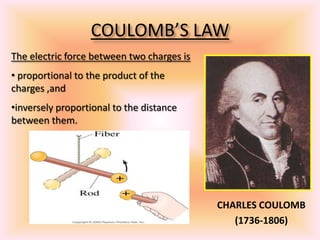
CHARLES COULOMB
(1736-1806)
The electric force between two charges is
• proportional to the product of the
charges ,and
•inversely proportional to the distance
between them.
COULOMB’S LAW
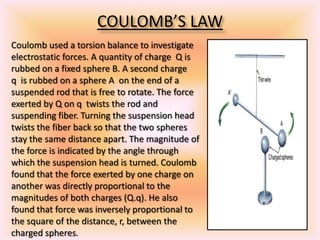
Coulomb used a torsion balance to investigate
electrostatic forces. A quantity of charge Q is
rubbed on a fixed sphere B. A second charge
q is rubbed on a sphere A on the end of a
suspended rod that is free to rotate. The force
exerted by Q on q twists the rod and
suspending fiber. Turning the suspension head
twists the fiber back so that the two spheres
stay the same distance apart. The magnitude of
the force is indicated by the angle through
which the suspension head is turned. Coulomb
found that the force exerted by one charge on
another was directly proportional to the
magnitudes of both charges (Q.q). He also
found that force was inversely proportional to
the square of the distance, r, between the
charged spheres.
COULOMB’S LAW(Contd.)
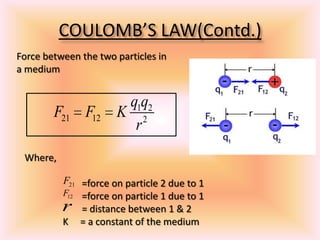
Force between the two particles in
a medium
1 2
21 12 2
q q
F F K
r
Where,
=force on particle 2 due to 1
=force on particle 1 due to 1
= distance between 1 & 2
K = a constant of the medium
21F
12F
r
COULOMB’S LAW(Contd.)
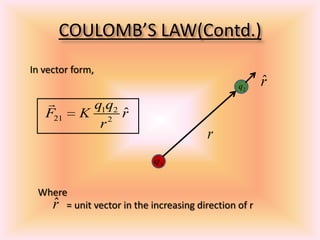
In vector form,
1 2
21 2
ˆ
q q
F K r
r

1q
2q
r
ˆr
Where
= unit vector in the increasing direction of rˆr
COULOMB’S LAW(Contd.)
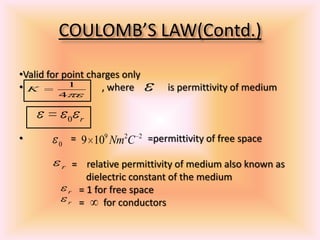
•Valid for point charges only
• , where is permittivity of medium
• = =permittivity of free space
= relative permittivity of medium also known as
dielectric constant of the medium
= 1 for free space
= for conductors
1
4
K
0 r
0
r
r
r
9 2 2
9 10 Nm C
COULOMB’S LAW(Contd.)
•It is a conservative force.
•It is a central force i.e., the force between the two particles is
always along the line joining the two particles.
•Since it is central, hence in the absence of any external force,
angular momentum of one particle with respect to the other (in
two particle system) is conserved.
PRINCIPLE OF SUPERPOSITION FOR
COULOMB’S FORCE
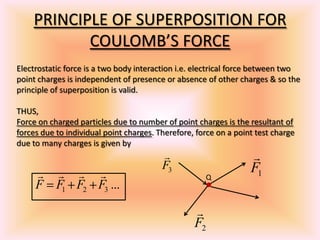
Electrostatic force is a two body interaction i.e. electrical force between two
point charges is independent of presence or absence of other charges & so the
principle of superposition is valid.
THUS,
Force on charged particles due to number of point charges is the resultant of
forces due to individual point charges. Therefore, force on a point test charge
due to many charges is given by
1 2 3 ...F F F F
    Q 1F

2F

3F

CONCEPT QUESTION #3
+Q
A
-Q
B
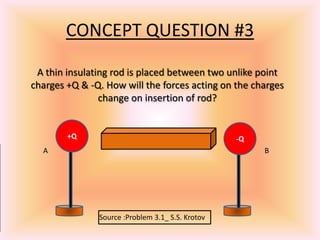
A thin insulating rod is placed between two unlike point
charges +Q & -Q. How will the forces acting on the charges
change on insertion of rod?
Source :Problem 3.1_ S.S. Krotov
NUMERICAL PROBLEM#2
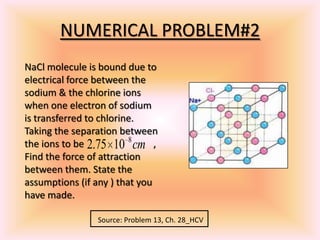
NaCl molecule is bound due to
electrical force between the
sodium & the chlorine ions
when one electron of sodium
is transferred to chlorine.
Taking the separation between
the ions to be ,
Find the force of attraction
between them. State the
assumptions (if any ) that you
have made.
8
2.75 10 cm
Source: Problem 13, Ch. 28_HCV
NUMERICAL PROBLEM #3
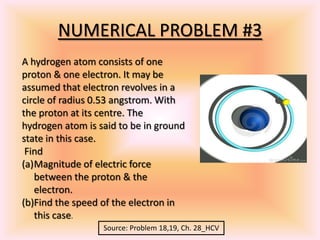
A hydrogen atom consists of one
proton & one electron. It may be
assumed that electron revolves in a
circle of radius 0.53 angstrom. With
the proton at its centre. The
hydrogen atom is said to be in ground
state in this case.
Find
(a)Magnitude of electric force
between the proton & the
electron.
(b)Find the speed of the electron in
this case.
Source: Problem 18,19, Ch. 28_HCV
NUMERICAL PROBLEM #3
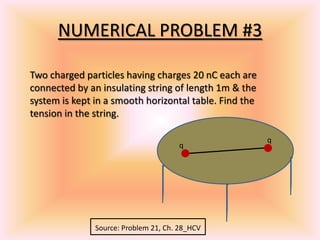
Two charged particles having charges 20 nC each are
connected by an insulating string of length 1m & the
system is kept in a smooth horizontal table. Find the
tension in the string.
q
q
Source: Problem 21, Ch. 28_HCV
NUMERICAL PROBLEM #4
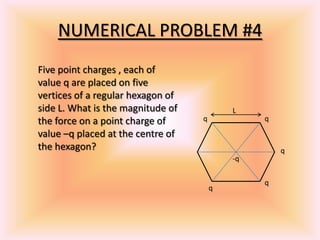
Five point charges , each of
value q are placed on five
vertices of a regular hexagon of
side L. What is the magnitude of
the force on a point charge of
value –q placed at the centre of
the hexagon?
L
q q
q
q
q
-q
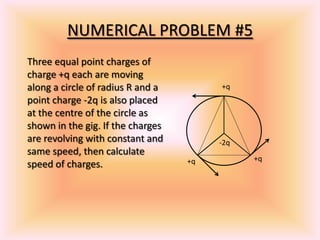
NUMERICAL PROBLEM #5
+q
+q+q
-2q
Three equal point charges of
charge +q each are moving
along a circle of radius R and a
point charge -2q is also placed
at the centre of the circle as
shown in the gig. If the charges
are revolving with constant and
same speed, then calculate
speed of charges.
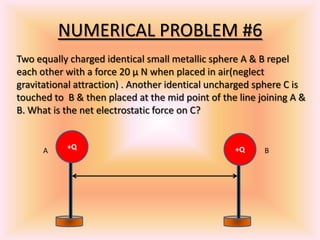
NUMERICAL PROBLEM #6
+Q +Q
Two equally charged identical small metallic sphere A & B repel
each other with a force 20 μ N when placed in air(neglect
gravitational attraction) . Another identical uncharged sphere C is
touched to B & then placed at the mid point of the line joining A &
B. What is the net electrostatic force on C?
A B
NUMERICAL PROBLEM #7
Source:Problem 3.3_I.E Irodov
Two small equally charged sphere, each of mass m, are
suspended from the same point by silk threads of length l.
The distance between the spheres x<<l. find the rate dq/dt
with which the charge leaks off each sphere if their
approach velocity varies as v= a/ √x , where a is a constant.
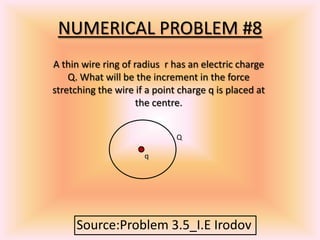
NUMERICAL PROBLEM #8
A thin wire ring of radius r has an electric charge
Q. What will be the increment in the force
stretching the wire if a point charge q is placed at
the centre.
q
Q
Source:Problem 3.5_I.E Irodov
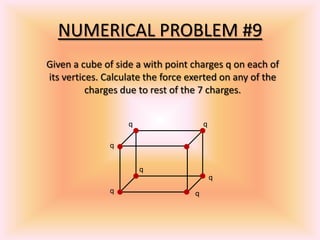
NUMERICAL PROBLEM #9
Given a cube of side a with point charges q on each of
its vertices. Calculate the force exerted on any of the
charges due to rest of the 7 charges.
q
qq
q
q
q q
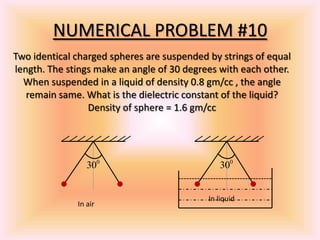
NUMERICAL PROBLEM #10
Two identical charged spheres are suspended by strings of equal
length. The stings make an angle of 30 degrees with each other.
When suspended in a liquid of density 0.8 gm/cc , the angle
remain same. What is the dielectric constant of the liquid?
Density of sphere = 1.6 gm/cc
0
30 0
30
In air
In liquid

Electrostatics part 2

  • 1.
    ELECTROSTATICS-PART 2 A POWERPOINTPRESENTATION BY BRAJESH KUMAR CHAUDHARY FACULTY OF PHYSICS RESONANCE EDUVENTURES PVT. LTD. NAGPUR, INDIA.
  • 2.
    COULOMB’S LAW CHARLES COULOMB (1736-1806) Theelectric force between two charges is • proportional to the product of the charges ,and •inversely proportional to the distance between them.
  • 3.
    COULOMB’S LAW Coulomb useda torsion balance to investigate electrostatic forces. A quantity of charge Q is rubbed on a fixed sphere B. A second charge q is rubbed on a sphere A on the end of a suspended rod that is free to rotate. The force exerted by Q on q twists the rod and suspending fiber. Turning the suspension head twists the fiber back so that the two spheres stay the same distance apart. The magnitude of the force is indicated by the angle through which the suspension head is turned. Coulomb found that the force exerted by one charge on another was directly proportional to the magnitudes of both charges (Q.q). He also found that force was inversely proportional to the square of the distance, r, between the charged spheres.
  • 4.
    COULOMB’S LAW(Contd.) Force betweenthe two particles in a medium 1 2 21 12 2 q q F F K r Where, =force on particle 2 due to 1 =force on particle 1 due to 1 = distance between 1 & 2 K = a constant of the medium 21F 12F r
  • 5.
    COULOMB’S LAW(Contd.) In vectorform, 1 2 21 2 ˆ q q F K r r  1q 2q r ˆr Where = unit vector in the increasing direction of rˆr
  • 6.
    COULOMB’S LAW(Contd.) •Valid forpoint charges only • , where is permittivity of medium • = =permittivity of free space = relative permittivity of medium also known as dielectric constant of the medium = 1 for free space = for conductors 1 4 K 0 r 0 r r r 9 2 2 9 10 Nm C
  • 7.
    COULOMB’S LAW(Contd.) •It isa conservative force. •It is a central force i.e., the force between the two particles is always along the line joining the two particles. •Since it is central, hence in the absence of any external force, angular momentum of one particle with respect to the other (in two particle system) is conserved.
  • 8.
    PRINCIPLE OF SUPERPOSITIONFOR COULOMB’S FORCE Electrostatic force is a two body interaction i.e. electrical force between two point charges is independent of presence or absence of other charges & so the principle of superposition is valid. THUS, Force on charged particles due to number of point charges is the resultant of forces due to individual point charges. Therefore, force on a point test charge due to many charges is given by 1 2 3 ...F F F F     Q 1F  2F  3F 
  • 9.
    CONCEPT QUESTION #3 +Q A -Q B Athin insulating rod is placed between two unlike point charges +Q & -Q. How will the forces acting on the charges change on insertion of rod? Source :Problem 3.1_ S.S. Krotov
  • 10.
    NUMERICAL PROBLEM#2 NaCl moleculeis bound due to electrical force between the sodium & the chlorine ions when one electron of sodium is transferred to chlorine. Taking the separation between the ions to be , Find the force of attraction between them. State the assumptions (if any ) that you have made. 8 2.75 10 cm Source: Problem 13, Ch. 28_HCV
  • 11.
    NUMERICAL PROBLEM #3 Ahydrogen atom consists of one proton & one electron. It may be assumed that electron revolves in a circle of radius 0.53 angstrom. With the proton at its centre. The hydrogen atom is said to be in ground state in this case. Find (a)Magnitude of electric force between the proton & the electron. (b)Find the speed of the electron in this case. Source: Problem 18,19, Ch. 28_HCV
  • 12.
    NUMERICAL PROBLEM #3 Twocharged particles having charges 20 nC each are connected by an insulating string of length 1m & the system is kept in a smooth horizontal table. Find the tension in the string. q q Source: Problem 21, Ch. 28_HCV
  • 13.
    NUMERICAL PROBLEM #4 Fivepoint charges , each of value q are placed on five vertices of a regular hexagon of side L. What is the magnitude of the force on a point charge of value –q placed at the centre of the hexagon? L q q q q q -q
  • 14.
    NUMERICAL PROBLEM #5 +q +q+q -2q Threeequal point charges of charge +q each are moving along a circle of radius R and a point charge -2q is also placed at the centre of the circle as shown in the gig. If the charges are revolving with constant and same speed, then calculate speed of charges.
  • 15.
    NUMERICAL PROBLEM #6 +Q+Q Two equally charged identical small metallic sphere A & B repel each other with a force 20 μ N when placed in air(neglect gravitational attraction) . Another identical uncharged sphere C is touched to B & then placed at the mid point of the line joining A & B. What is the net electrostatic force on C? A B
  • 16.
    NUMERICAL PROBLEM #7 Source:Problem3.3_I.E Irodov Two small equally charged sphere, each of mass m, are suspended from the same point by silk threads of length l. The distance between the spheres x<<l. find the rate dq/dt with which the charge leaks off each sphere if their approach velocity varies as v= a/ √x , where a is a constant.
  • 17.
    NUMERICAL PROBLEM #8 Athin wire ring of radius r has an electric charge Q. What will be the increment in the force stretching the wire if a point charge q is placed at the centre. q Q Source:Problem 3.5_I.E Irodov
  • 18.
    NUMERICAL PROBLEM #9 Givena cube of side a with point charges q on each of its vertices. Calculate the force exerted on any of the charges due to rest of the 7 charges. q qq q q q q
  • 19.
    NUMERICAL PROBLEM #10 Twoidentical charged spheres are suspended by strings of equal length. The stings make an angle of 30 degrees with each other. When suspended in a liquid of density 0.8 gm/cc , the angle remain same. What is the dielectric constant of the liquid? Density of sphere = 1.6 gm/cc 0 30 0 30 In air In liquid