Electrostatics
 Electric charge
 Conservation of charge
 Unit of Charge
 Coulomb’s law
The work is licensed under a CreativeCommons Attribution-NonCommercialShare-Alike4.0InternationalLicense. 1
ElectricCharge
•Unlike mass, there are two different kinds of charge: positive and
negative.
• Particles with a unlike charges attract, while those with like charges
repel.
• Most everyday objects are comprised of billions of charged, but
usually there are about the same number of positive charges as
negative, leaving the object as a whole neutral.
2The work is licensed under a CreativeCommons Attribution-NonCommercialShare-Alike4.0InternationalLicense.
SI unit ofCharge: theCoulomb
• Just as we have an SI unit for mass, the kilogram, we have one
for charge as well. It’s called the coulomb, and its symbol is C.
• It’s named after a French physicist, Charles Coulomb, who did
research on charges in the mid and late 1700’s.
• A coulomb is a fairly large amount of charge, so sometimes we
measure small amounts of charge in μC (mircocoloumbs).
• An electron has a charge of -1.6  10-19 C.
• A proton has a charge of +1.6  10-19 C.
• In a wire, if one coulomb of charge flows past a point in one
second, we say the current in the wire is one ampere.
3The work is licensed under a CreativeCommons Attribution-NonCommercialShare-Alike4.0InternationalLicense.
Coulomb’s Law
K = 9109 Nm2 /C2
F =
K q1 q2
r 2
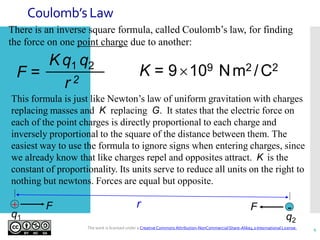
There is an inverse square formula, called Coulomb’s law, for finding
the force on one point charge due to another:
This formula is just like Newton’s law of uniform gravitation with charges
replacing masses and K replacing G. It states that the electric force on
each of the point charges is directly proportional to each charge and
inversely proportional to the square of the distance between them. The
easiest way to use the formula to ignore signs when entering charges, since
we already know that like charges repel and opposites attract. K is the
constant of proportionality. Its units serve to reduce all units on the right to
nothing but newtons. Forces are equal but opposite.
+ -
q1 q2
rF F
4The work is licensed under a CreativeCommons Attribution-NonCommercialShare-Alike4.0InternationalLicense.
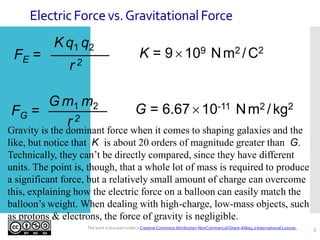
ElectricForcevs.GravitationalForce
K = 9109 Nm2 /C2
FE =
K q1 q2
r 2
G = 6.6710-11 Nm2 /kg2
FG =
G m1 m2
r 2
Gravity is the dominant force when it comes to shaping galaxies and the
like, but notice that K is about 20 orders of magnitude greater than G.
Technically, they can’t be directly compared, since they have different
units. The point is, though, that a whole lot of mass is required to produce
a significant force, but a relatively small amount of charge can overcome
this, explaining how the electric force on a balloon can easily match the
balloon’s weight. When dealing with high-charge, low-mass objects, such
as protons & electrons, the force of gravity is negligible.
5The work is licensed under a CreativeCommons Attribution-NonCommercialShare-Alike4.0InternationalLicense.

Electric charge electrostatics em theory

  • 1.
    Electrostatics  Electric charge Conservation of charge  Unit of Charge  Coulomb’s law The work is licensed under a CreativeCommons Attribution-NonCommercialShare-Alike4.0InternationalLicense. 1
  • 2.
    ElectricCharge •Unlike mass, thereare two different kinds of charge: positive and negative. • Particles with a unlike charges attract, while those with like charges repel. • Most everyday objects are comprised of billions of charged, but usually there are about the same number of positive charges as negative, leaving the object as a whole neutral. 2The work is licensed under a CreativeCommons Attribution-NonCommercialShare-Alike4.0InternationalLicense.
  • 3.
    SI unit ofCharge:theCoulomb • Just as we have an SI unit for mass, the kilogram, we have one for charge as well. It’s called the coulomb, and its symbol is C. • It’s named after a French physicist, Charles Coulomb, who did research on charges in the mid and late 1700’s. • A coulomb is a fairly large amount of charge, so sometimes we measure small amounts of charge in μC (mircocoloumbs). • An electron has a charge of -1.6  10-19 C. • A proton has a charge of +1.6  10-19 C. • In a wire, if one coulomb of charge flows past a point in one second, we say the current in the wire is one ampere. 3The work is licensed under a CreativeCommons Attribution-NonCommercialShare-Alike4.0InternationalLicense.
  • 4.
    Coulomb’s Law K =9109 Nm2 /C2 F = K q1 q2 r 2 There is an inverse square formula, called Coulomb’s law, for finding the force on one point charge due to another: This formula is just like Newton’s law of uniform gravitation with charges replacing masses and K replacing G. It states that the electric force on each of the point charges is directly proportional to each charge and inversely proportional to the square of the distance between them. The easiest way to use the formula to ignore signs when entering charges, since we already know that like charges repel and opposites attract. K is the constant of proportionality. Its units serve to reduce all units on the right to nothing but newtons. Forces are equal but opposite. + - q1 q2 rF F 4The work is licensed under a CreativeCommons Attribution-NonCommercialShare-Alike4.0InternationalLicense.
  • 5.
    ElectricForcevs.GravitationalForce K = 9109Nm2 /C2 FE = K q1 q2 r 2 G = 6.6710-11 Nm2 /kg2 FG = G m1 m2 r 2 Gravity is the dominant force when it comes to shaping galaxies and the like, but notice that K is about 20 orders of magnitude greater than G. Technically, they can’t be directly compared, since they have different units. The point is, though, that a whole lot of mass is required to produce a significant force, but a relatively small amount of charge can overcome this, explaining how the electric force on a balloon can easily match the balloon’s weight. When dealing with high-charge, low-mass objects, such as protons & electrons, the force of gravity is negligible. 5The work is licensed under a CreativeCommons Attribution-NonCommercialShare-Alike4.0InternationalLicense.