ELECTRICAL SAFETY
            &
       PROTECTION

By Oladokun Suleiman Olanrewaju
Power Systems

• Majority of merchant ships have a 3-phase 3
  wire, 440 V insulated neutral to earth power
  systems
• This power system falls in the category of LV
  and meets the power demands of medium
  capacity motors up to 200 kW
contd
• When large loads are connected to the LV
  system the magnitude of current flow becomes
  too large resulting in overheating due to high
  iron and copper losses
Switch Boards
• Switchboard is the main electrical power control
  center of the ship
• All generators deliver their electrical power to the
  main switch board.
• Main switch board supplies power to section boards,
  motor starters, lighting boards and other distribution
  lines
• Main switch board is connected to emergency switch
  board/ generator/battery back up
Types of Switch Boards
• Open front Type
  – All essential switch gears are exposed in front of
    the panel. Used for dc power system
• Dead Front Type
  – All switch gears and live parts are concealed
    behind the front sheet panel
  – Only the operating handle and instruments appear
    on the front. Mandatory for ac power system
Contd

• Dead front SB is made accessible by providing
  hinged doors in the front panel
• Some times too many equipment crowd the SB
  which make maintenance difficult
• Indication Lamp is provided in the
  switchboard to show that the shore supply is
  available for connection to bus bar
Safety Requirement for Electrical System
• The most common accident is the one caused by
  touching a live part – whereby the human body
  becomes a part of the circuit.
• A current of 25 mA flowing from hand to hand is
  already sufficient to cause irregularities in the
  heartbeat.
• At about 50 mA a person can lose consciousness
  and his heart can stop beating resulting fatal.
• Resistance of the human body (of the parts
  through which current is flowing) from hand to
  hand is about 1300  , contact resistance of the
  skin from 500  (dry) to 5 k (wet)
Safety Requirement for Electrical System

• Dangerous Contact Voltage:
- It is the result of the product of the resistance of the
  body and the current intensity: (ex: 1300  x 0.025 A
  = 32.5 V)
- An AC voltage of 50 V is considered dangerous .
- Children, owing to their lower body resistance are not
  allowed to work with voltage exceeding 24 V.
Types of Neutral Connections
• Insulated Neutral System
• Earthed Neutral System
• Earthing Resistance Neutral System
Insulated Neutral to Earth
• This system is totally insulated from the ship’s hull
• This system maintains continuity of power supply to
  the equipment even in the event of single phasing
  fault.
• This ensure power supply to critical equipment
• The power supply to the equipment can disrupt only
  if two single phase faults occur simultaneously in two
  lines which is then equivalent to short circuiting
  faults
• But such fault occur very rare
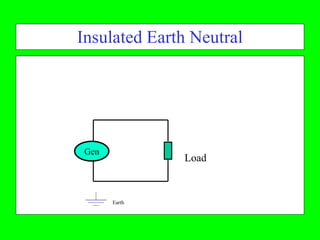
Insulated Earth Neutral


 Gen
               Load


       Earth
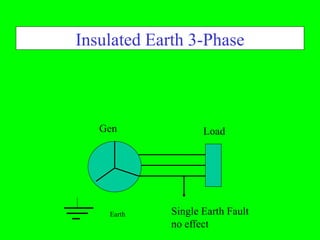
Insulated Earth 3-Phase


   Gen              Load


    Earth    Single Earth Fault
             no effect
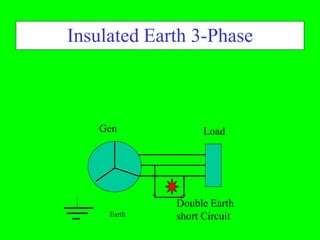
Insulated Earth 3-Phase


   Gen             Load


             Double Earth
     Earth   short Circuit
Neutral Earthed System
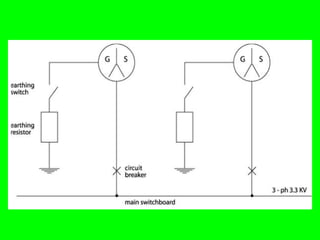
• Earthed Neutral is done in 3-phase system for supply
  voltage of 3.3-6.6 kV and above
• If a solidly earthed system is used for such high
  voltage then magnitude of earthed current will be
  extremely high which can damage the equipment
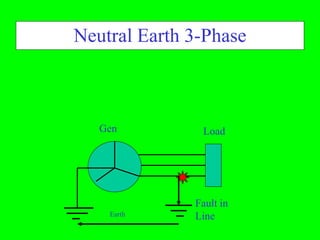
• The earth current is limited by connecting a resistor in
  series between earth and neutral point
• The earth current due to single phasing is limited not
  to exceed rated current at maximum load
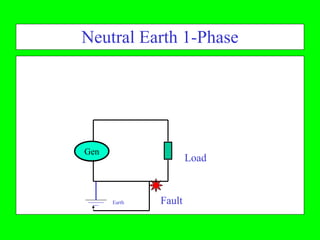
Neutral Earth 1-Phase


Gen
                      Load


      Earth   Fault
Neutral Earth 3-Phase


   Gen         Load


              Fault in
    Earth     Line
Operational Consideration
General
• Shipboard systems - insulated from earth (ship's hull)
• Shore system - earthed to the ground
• HV systems (>1000V) - earthed to ship's hull via
  neutral earthing resistor (NER) or high impedance
  transformer to limit earth fault current
• Priority for shipboard - maintain electrical supply to
  essential equipment in event of single earth fault
• Priority ashore - immediate isolation earth-faulted
  equipment
3 basic circuit faults


An open-circuit fault is due                               A short-circuit fault is due
to a break in the conductor,                               to a double break in the
as at A, so that current                                   insulation, as at C,
cannot flow                                                allowing both conductors
                                                           to be connected so that a
                        An earth fault is due to a break   very large current by-
                        in the insulation, as at B,        passes or "short-circuits"
                        allowing the conductor to touch    the load.
                        the hull or an earthed metal
                        enclosure
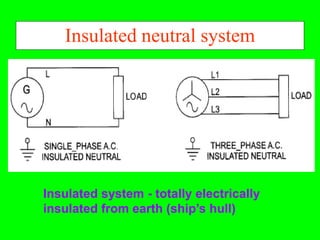
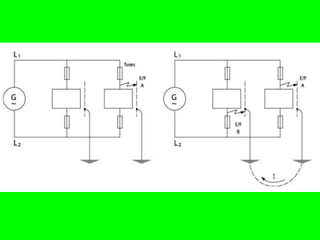
Insulated neutral system


Insulated system - totally electrically
insulated from earth (ship’s hull)
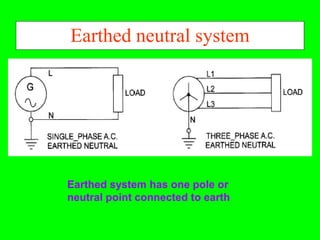
Earthed neutral system


Earthed system has one pole or
neutral point connected to earth
The preferred system??
• If earth fault occurs on insulated pole of ‘EARTHED
  DISTRIBUTION SYSTEM’ - equivalent to ‘short
  circuit’ fault
• Large earth fault current would immediately ‘blow’
  the fuse in line conductor
• Faulted electrical equipment immediately isolated
  from supply & rendered SAFE, but loss of equipment
• Could create hazardous situation if equipment was
  classed ESSENTIAL
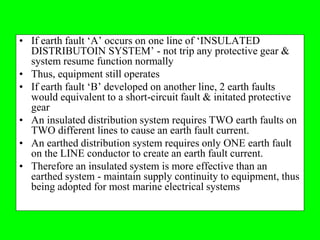
• If earth fault ‘A’ occurs on one line of ‘INSULATED
  DISTRIBUTOIN SYSTEM’ - not trip any protective gear &
  system resume function normally
• Thus, equipment still operates
• If earth fault ‘B’ developed on another line, 2 earth faults
  would equivalent to a short-circuit fault & initated protective
  gear
• An insulated distribution system requires TWO earth faults on
  TWO different lines to cause an earth fault current.
• An earthed distribution system requires only ONE earth fault
  on the LINE conductor to create an earth fault current.
• Therefore an insulated system is more effective than an
  earthed system - maintain supply continuity to equipment, thus
  being adopted for most marine electrical systems
High voltage system
• Shipboard HV systems - ‘earthed’ via resistor
  connecting generator neutrals to earth
• Earthing resistor with ohmic value - chosen to limit
  maximum earth fault current < generator full load
  current
• Neutral Earthing Resistor (NER) - assembled with
  metallic plates in air – due to single earth fault will
  cause circuit disconnected by its protection device
DO`S of Electrical Safety
• DO operate and maintain equipments according to
  manufacturers recommendation or ship owners
  procedures
• DO ensure that al guards cover are securely fitted and
  that all bolt and fixings are in place and tight.
• DO switch off and lock off supplies, remove fuses
  and display warning notices before removing cover of
  equipment for maintenance
• DO confirm that circuits are DEAD before touching
  conductors and terminals.
DO`S of Electrical Safety
DO Get to know the ships electrical system and
  equipments-
• Study the ships to mark the location of switches and
  protection devices supplying distribution boards and
  essential items of equipments
• Write down these information in note book ,
• Become familiar with the normal indications on
  switchboard instruments so that abnormal operations
  can easily be detected.
DON`T of Electrical Safety
• DO NOT touch live conductors under pretext
• DO NOT touch rotating parts
• DO NOT leave live conductors or rotating
  parts exposed
• DO NOT overload equipments
• DO NOT neglect or abuse equipments

Electrical safety and protections

  • 1.
    ELECTRICAL SAFETY & PROTECTION By Oladokun Suleiman Olanrewaju
  • 2.
    Power Systems • Majorityof merchant ships have a 3-phase 3 wire, 440 V insulated neutral to earth power systems • This power system falls in the category of LV and meets the power demands of medium capacity motors up to 200 kW
  • 3.
    contd • When largeloads are connected to the LV system the magnitude of current flow becomes too large resulting in overheating due to high iron and copper losses
  • 4.
    Switch Boards • Switchboardis the main electrical power control center of the ship • All generators deliver their electrical power to the main switch board. • Main switch board supplies power to section boards, motor starters, lighting boards and other distribution lines • Main switch board is connected to emergency switch board/ generator/battery back up
  • 5.
    Types of SwitchBoards • Open front Type – All essential switch gears are exposed in front of the panel. Used for dc power system • Dead Front Type – All switch gears and live parts are concealed behind the front sheet panel – Only the operating handle and instruments appear on the front. Mandatory for ac power system
  • 6.
    Contd • Dead frontSB is made accessible by providing hinged doors in the front panel • Some times too many equipment crowd the SB which make maintenance difficult • Indication Lamp is provided in the switchboard to show that the shore supply is available for connection to bus bar
  • 7.
    Safety Requirement forElectrical System • The most common accident is the one caused by touching a live part – whereby the human body becomes a part of the circuit. • A current of 25 mA flowing from hand to hand is already sufficient to cause irregularities in the heartbeat. • At about 50 mA a person can lose consciousness and his heart can stop beating resulting fatal. • Resistance of the human body (of the parts through which current is flowing) from hand to hand is about 1300  , contact resistance of the skin from 500  (dry) to 5 k (wet)
  • 8.
    Safety Requirement forElectrical System • Dangerous Contact Voltage: - It is the result of the product of the resistance of the body and the current intensity: (ex: 1300  x 0.025 A = 32.5 V) - An AC voltage of 50 V is considered dangerous . - Children, owing to their lower body resistance are not allowed to work with voltage exceeding 24 V.
  • 9.
    Types of NeutralConnections • Insulated Neutral System • Earthed Neutral System • Earthing Resistance Neutral System
  • 10.
    Insulated Neutral toEarth • This system is totally insulated from the ship’s hull • This system maintains continuity of power supply to the equipment even in the event of single phasing fault. • This ensure power supply to critical equipment • The power supply to the equipment can disrupt only if two single phase faults occur simultaneously in two lines which is then equivalent to short circuiting faults • But such fault occur very rare
  • 11.
  • 12.
    Insulated Earth 3-Phase Gen Load Earth Single Earth Fault no effect
  • 13.
    Insulated Earth 3-Phase Gen Load Double Earth Earth short Circuit
  • 14.
    Neutral Earthed System •Earthed Neutral is done in 3-phase system for supply voltage of 3.3-6.6 kV and above • If a solidly earthed system is used for such high voltage then magnitude of earthed current will be extremely high which can damage the equipment • The earth current is limited by connecting a resistor in series between earth and neutral point • The earth current due to single phasing is limited not to exceed rated current at maximum load
  • 15.
  • 16.
    Neutral Earth 3-Phase Gen Load Fault in Earth Line
  • 17.
  • 18.
    General • Shipboard systems- insulated from earth (ship's hull) • Shore system - earthed to the ground • HV systems (>1000V) - earthed to ship's hull via neutral earthing resistor (NER) or high impedance transformer to limit earth fault current • Priority for shipboard - maintain electrical supply to essential equipment in event of single earth fault • Priority ashore - immediate isolation earth-faulted equipment
  • 19.
    3 basic circuitfaults An open-circuit fault is due A short-circuit fault is due to a break in the conductor, to a double break in the as at A, so that current insulation, as at C, cannot flow allowing both conductors to be connected so that a An earth fault is due to a break very large current by- in the insulation, as at B, passes or "short-circuits" allowing the conductor to touch the load. the hull or an earthed metal enclosure
  • 20.
    Insulated neutral system Insulatedsystem - totally electrically insulated from earth (ship’s hull)
  • 21.
    Earthed neutral system Earthedsystem has one pole or neutral point connected to earth
  • 22.
    The preferred system?? •If earth fault occurs on insulated pole of ‘EARTHED DISTRIBUTION SYSTEM’ - equivalent to ‘short circuit’ fault • Large earth fault current would immediately ‘blow’ the fuse in line conductor • Faulted electrical equipment immediately isolated from supply & rendered SAFE, but loss of equipment • Could create hazardous situation if equipment was classed ESSENTIAL
  • 24.
    • If earthfault ‘A’ occurs on one line of ‘INSULATED DISTRIBUTOIN SYSTEM’ - not trip any protective gear & system resume function normally • Thus, equipment still operates • If earth fault ‘B’ developed on another line, 2 earth faults would equivalent to a short-circuit fault & initated protective gear • An insulated distribution system requires TWO earth faults on TWO different lines to cause an earth fault current. • An earthed distribution system requires only ONE earth fault on the LINE conductor to create an earth fault current. • Therefore an insulated system is more effective than an earthed system - maintain supply continuity to equipment, thus being adopted for most marine electrical systems
  • 25.
    High voltage system •Shipboard HV systems - ‘earthed’ via resistor connecting generator neutrals to earth • Earthing resistor with ohmic value - chosen to limit maximum earth fault current < generator full load current • Neutral Earthing Resistor (NER) - assembled with metallic plates in air – due to single earth fault will cause circuit disconnected by its protection device
  • 27.
    DO`S of ElectricalSafety • DO operate and maintain equipments according to manufacturers recommendation or ship owners procedures • DO ensure that al guards cover are securely fitted and that all bolt and fixings are in place and tight. • DO switch off and lock off supplies, remove fuses and display warning notices before removing cover of equipment for maintenance • DO confirm that circuits are DEAD before touching conductors and terminals.
  • 28.
    DO`S of ElectricalSafety DO Get to know the ships electrical system and equipments- • Study the ships to mark the location of switches and protection devices supplying distribution boards and essential items of equipments • Write down these information in note book , • Become familiar with the normal indications on switchboard instruments so that abnormal operations can easily be detected.
  • 29.
    DON`T of ElectricalSafety • DO NOT touch live conductors under pretext • DO NOT touch rotating parts • DO NOT leave live conductors or rotating parts exposed • DO NOT overload equipments • DO NOT neglect or abuse equipments