EE-3111
ELECTRICAL AND ELECTRONIC
SYSTEMS
INSTRUCTOR
ENGR. NEELAM MUGHEES
Lecture Learning Outcomes
Students will be able to:
 Understand Basics of Electrical Safety
 Understand Earthing and Grounding
Disclaimer
 This lecture is not designed to qualify you to work on electrical systems.
 Qualified workers are those with the training and equipment that allow them
to work on high and low voltage lines and to get closer than the minimum
approach distances. Qualified workers from an electric utility use rubber
goods (gloves, blankets, covers) and other protective equipment to protect
themselves against accidental contact.
 As a reminder, if you identify problems with electrical systems, please report
them immediately.
“Play It Safe, It’s The Law”
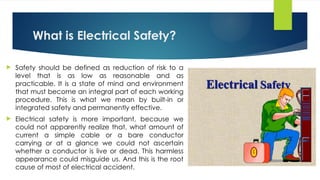
What is Electrical Safety?
 Safety should be defined as reduction of risk to a
level that is as low as reasonable and as
practicable. It is a state of mind and environment
that must become an integral part of each working
procedure. This is what we mean by built-in or
integrated safety and permanently effective.
 Electrical safety is more important, because we
could not apparently realize that, what amount of
current a simple cable or a bare conductor
carrying or at a glance we could not ascertain
whether a conductor is live or dead. This harmless
appearance could misguide us. And this is the root
cause of most of electrical accident.
Electrical Hazard
 An electrical hazard can be defined as
• a dangerous condition where a worker could make electrical
contact with energized equipment or a conductor, and from
which the person may sustain an injury from shock; and/or,
• there is potential for the worker to receive an arc flash burn,
thermal burn, or blast injury.
 An electric hazard is considered to be removed when protective
measures are put in place at the source (remove hazard or
deenergize), or along the path (place electrical
insulation/barrier between the worker and the electrical hazard).
 Where PPE is relied upon for worker protection, an electrical
hazard is considered to remain and it is still necessary to address
safety requirements for other workers in the area.
Electrical Injuries
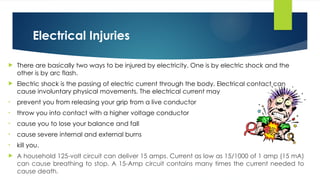
 There are basically two ways to be injured by electricity. One is by electric shock and the
other is by arc flash.
 Electric shock is the passing of electric current through the body. Electrical contact can
cause involuntary physical movements. The electrical current may
• prevent you from releasing your grip from a live conductor
• throw you into contact with a higher voltage conductor
• cause you to lose your balance and fall
• cause severe internal and external burns
• kill you.
 A household 125-volt circuit can deliver 15 amps. Current as low as 15/1000 of 1 amp (15 mA)
can cause breathing to stop. A 15-Amp circuit contains many times the current needed to
cause death.
Electrical Injuries
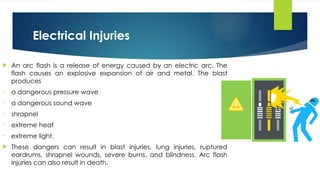
 An arc flash is a release of energy caused by an electric arc. The
flash causes an explosive expansion of air and metal. The blast
produces
• a dangerous pressure wave
• a dangerous sound wave
• shrapnel
• extreme heat
• extreme light.
 These dangers can result in blast injuries, lung injuries, ruptured
eardrums, shrapnel wounds, severe burns, and blindness. Arc flash
injuries can also result in death.
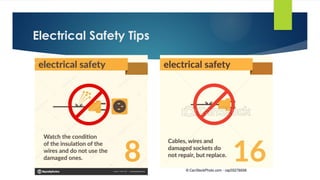
Electrical Safety Tips
Electrical Hazards and Their Prevention
 Watch this video to note down the major Electrical Hazards and their
prevention
https://www.youtube.com/watch?v=ggJo6m8NZtA
Lightning Protection
 We have already studied it. However, watch this video to understand how
lightning protection systems work:
https://www.youtube.com/watch?v=TBbybbmcguo
DISTINCTION BETWEEN GROUNDING
AND EARTHING
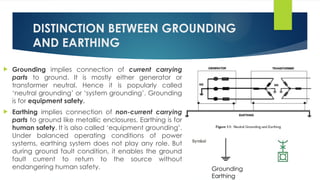
 Grounding implies connection of current carrying
parts to ground. It is mostly either generator or
transformer neutral. Hence it is popularly called
‘neutral grounding’ or ‘system grounding’. Grounding
is for equipment safety.
 Earthing implies connection of non-current carrying
parts to ground like metallic enclosures. Earthing is for
human safety. It is also called ‘equipment grounding’.
Under balanced operating conditions of power
systems, earthing system does not play any role. But
during ground fault condition, it enables the ground
fault current to return to the source without
endangering human safety. Grounding
Earthing
Grounding
 System and circuit conductor grounding is an intentional
connection between the electric system conductors and
grounding electrodes that provides an effective
connection to ground (earth).
 The grounding provides the return path for the leakage
current and hence protect the power system equipment
from damage.
 When the fault occurs in the equipment, the current in all
the three phases of the equipment become
unbalanced. The grounding discharges the fault current
to the ground and hence makes the system balanced.
Grounding
 The basic objectives being sought are to
• Limit over voltages due to lightning,
• Limit line surges, or unintentional contact with high-
voltage lines,
• Stabilize the voltage to ground during normal operation,
and
• Facilitate overcurrent device operation in case of ground
faults.
Earthing
 All exposed metal parts of electrical equipment (including generator frames,
mounting bases, electrical instruments, and enclosures) should be bonded to a
grounding electrode.
 The earthing is achieved by connecting the parts of the installation to the earth by
using the earth conductor or earth electrode in intimate contact with the soil placed
with some distance below the ground level.
Earthing
 The basic objectives being sought are the following:
1. to maintain a low potential difference (almost zero volts) between
nearby metal members, and thereby protect people from dangerous
electric-shock-voltage exposure in a certain area,
2. to provide current-carrying capability, both in magnitude and duration,
adequate to accept the ground-fault current permitted by the
overcurrent protection system without creating a fire or explosive
hazard to buildings or contents,
3. to provide an effective electrical path over which ground-fault currents
can flow without creating a fire or explosive hazard, and
4. to contribute to superior performance of the electrical system (e.g.,
suppression of differential and common-mode electrical noise).
Ungrounded Systems
 The system without neutral grounding is known as the
ungrounded system, or in other words, in the ungrounded
system, none of their conductors is connected to the ground.
 The main feature of the ungrounded system is its ability to
remove the earth faults without interruption. The fact that
any one contact occurring between one phase of the
system and ground is unlikely to cause an immediate outage
to any load may represent an advantage in many plants.
 But the self-cleaning process of the ungrounded system
become disappear when the length of the conductor
becomes excessive.
Grounded Systems
 In most cases Grounded Systems are designed so
that circuit protective devices will remove a faulty
circuit from the system regardless of the type of
fault. A phase-to-ground fault generally results in
the immediate isolation of the faulted circuit with
the attendant outage of the loads on that circuit
(Fig. 2.46).
 However, experience has shown in a number of
systems that greater service continuity may be
obtained with grounded-neutral than with
ungrounded-neutral systems.
Where are Ungrounded Systems
Required?
 Although the NEC requires the majority of electrical
systems to be grounded, some are actually required
to be ungrounded.
 There are only five different electrical power
systems/subsystems noted in NEC Article 250.22 where
the code committee has determined the hazards of
grounding to outweigh safety benefits of grounding.
 One of these system types is an isolated power
system, which is a distribution power system of limited
size, typically for use in hospital operating rooms.
These areas are required to have an ungrounded
system because it would be considered
unacceptable to have a power outage during a
surgical procedure.
Any Questions?

Final Week 6 eeeeeeeeeeeeeeeeeeeeee.pptx

  • 1.
  • 2.
    Lecture Learning Outcomes Studentswill be able to:  Understand Basics of Electrical Safety  Understand Earthing and Grounding
  • 3.
    Disclaimer  This lectureis not designed to qualify you to work on electrical systems.  Qualified workers are those with the training and equipment that allow them to work on high and low voltage lines and to get closer than the minimum approach distances. Qualified workers from an electric utility use rubber goods (gloves, blankets, covers) and other protective equipment to protect themselves against accidental contact.  As a reminder, if you identify problems with electrical systems, please report them immediately. “Play It Safe, It’s The Law”
  • 4.
    What is ElectricalSafety?  Safety should be defined as reduction of risk to a level that is as low as reasonable and as practicable. It is a state of mind and environment that must become an integral part of each working procedure. This is what we mean by built-in or integrated safety and permanently effective.  Electrical safety is more important, because we could not apparently realize that, what amount of current a simple cable or a bare conductor carrying or at a glance we could not ascertain whether a conductor is live or dead. This harmless appearance could misguide us. And this is the root cause of most of electrical accident.
  • 5.
    Electrical Hazard  Anelectrical hazard can be defined as • a dangerous condition where a worker could make electrical contact with energized equipment or a conductor, and from which the person may sustain an injury from shock; and/or, • there is potential for the worker to receive an arc flash burn, thermal burn, or blast injury.  An electric hazard is considered to be removed when protective measures are put in place at the source (remove hazard or deenergize), or along the path (place electrical insulation/barrier between the worker and the electrical hazard).  Where PPE is relied upon for worker protection, an electrical hazard is considered to remain and it is still necessary to address safety requirements for other workers in the area.
  • 6.
    Electrical Injuries  Thereare basically two ways to be injured by electricity. One is by electric shock and the other is by arc flash.  Electric shock is the passing of electric current through the body. Electrical contact can cause involuntary physical movements. The electrical current may • prevent you from releasing your grip from a live conductor • throw you into contact with a higher voltage conductor • cause you to lose your balance and fall • cause severe internal and external burns • kill you.  A household 125-volt circuit can deliver 15 amps. Current as low as 15/1000 of 1 amp (15 mA) can cause breathing to stop. A 15-Amp circuit contains many times the current needed to cause death.
  • 7.
    Electrical Injuries  Anarc flash is a release of energy caused by an electric arc. The flash causes an explosive expansion of air and metal. The blast produces • a dangerous pressure wave • a dangerous sound wave • shrapnel • extreme heat • extreme light.  These dangers can result in blast injuries, lung injuries, ruptured eardrums, shrapnel wounds, severe burns, and blindness. Arc flash injuries can also result in death.
  • 9.
  • 10.
  • 12.
    Electrical Hazards andTheir Prevention  Watch this video to note down the major Electrical Hazards and their prevention https://www.youtube.com/watch?v=ggJo6m8NZtA
  • 13.
    Lightning Protection  Wehave already studied it. However, watch this video to understand how lightning protection systems work: https://www.youtube.com/watch?v=TBbybbmcguo
  • 14.
    DISTINCTION BETWEEN GROUNDING ANDEARTHING  Grounding implies connection of current carrying parts to ground. It is mostly either generator or transformer neutral. Hence it is popularly called ‘neutral grounding’ or ‘system grounding’. Grounding is for equipment safety.  Earthing implies connection of non-current carrying parts to ground like metallic enclosures. Earthing is for human safety. It is also called ‘equipment grounding’. Under balanced operating conditions of power systems, earthing system does not play any role. But during ground fault condition, it enables the ground fault current to return to the source without endangering human safety. Grounding Earthing
  • 15.
    Grounding  System andcircuit conductor grounding is an intentional connection between the electric system conductors and grounding electrodes that provides an effective connection to ground (earth).  The grounding provides the return path for the leakage current and hence protect the power system equipment from damage.  When the fault occurs in the equipment, the current in all the three phases of the equipment become unbalanced. The grounding discharges the fault current to the ground and hence makes the system balanced.
  • 16.
    Grounding  The basicobjectives being sought are to • Limit over voltages due to lightning, • Limit line surges, or unintentional contact with high- voltage lines, • Stabilize the voltage to ground during normal operation, and • Facilitate overcurrent device operation in case of ground faults.
  • 17.
    Earthing  All exposedmetal parts of electrical equipment (including generator frames, mounting bases, electrical instruments, and enclosures) should be bonded to a grounding electrode.  The earthing is achieved by connecting the parts of the installation to the earth by using the earth conductor or earth electrode in intimate contact with the soil placed with some distance below the ground level.
  • 18.
    Earthing  The basicobjectives being sought are the following: 1. to maintain a low potential difference (almost zero volts) between nearby metal members, and thereby protect people from dangerous electric-shock-voltage exposure in a certain area, 2. to provide current-carrying capability, both in magnitude and duration, adequate to accept the ground-fault current permitted by the overcurrent protection system without creating a fire or explosive hazard to buildings or contents, 3. to provide an effective electrical path over which ground-fault currents can flow without creating a fire or explosive hazard, and 4. to contribute to superior performance of the electrical system (e.g., suppression of differential and common-mode electrical noise).
  • 19.
    Ungrounded Systems  Thesystem without neutral grounding is known as the ungrounded system, or in other words, in the ungrounded system, none of their conductors is connected to the ground.  The main feature of the ungrounded system is its ability to remove the earth faults without interruption. The fact that any one contact occurring between one phase of the system and ground is unlikely to cause an immediate outage to any load may represent an advantage in many plants.  But the self-cleaning process of the ungrounded system become disappear when the length of the conductor becomes excessive.
  • 20.
    Grounded Systems  Inmost cases Grounded Systems are designed so that circuit protective devices will remove a faulty circuit from the system regardless of the type of fault. A phase-to-ground fault generally results in the immediate isolation of the faulted circuit with the attendant outage of the loads on that circuit (Fig. 2.46).  However, experience has shown in a number of systems that greater service continuity may be obtained with grounded-neutral than with ungrounded-neutral systems.
  • 21.
    Where are UngroundedSystems Required?  Although the NEC requires the majority of electrical systems to be grounded, some are actually required to be ungrounded.  There are only five different electrical power systems/subsystems noted in NEC Article 250.22 where the code committee has determined the hazards of grounding to outweigh safety benefits of grounding.  One of these system types is an isolated power system, which is a distribution power system of limited size, typically for use in hospital operating rooms. These areas are required to have an ungrounded system because it would be considered unacceptable to have a power outage during a surgical procedure.
  • 22.

Editor's Notes

  • #7 Safety of an electrical installation could be ensured by proper insulation, good earthing system and adopting adequate protection and control systems.