BATTERIES & CHARGING SYSTEM BATTERIES LEAD ACID BATTERIES MF BATTERIES MAINTENANCE, CHARGING & TESTING DIAGNOSING BATTERY FAULTS
BATTERIES & CHARGING SYSTEM CHARGING SYSTEMS REQUIREMENTS OF CHARGING SYSTEM CHARGING SYSTEM PRINCIPLES ALTERNATOR & CHARGING CIRCUITS DIAGNOSING CHARGING & SYSTEM FAULTS
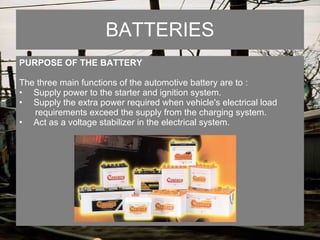
BATTERIES PURPOSE OF THE BATTERY The three main functions of the automotive battery are to : Supply power to the starter and ignition system. Supply the extra power required when vehicle's electrical load  requirements exceed the supply from the charging system. Act as a voltage stabilizer in the electrical system.
BATTERIES LEAD ACID BATTERY Positive plate - lead peroxide  ( Pb O 2  ) Negative plate - sponge lead  ( Pb ) Electrolyte solution - mixture of sulfuric acid and   water  ( H 2  SO 4  ) Produced -  2.1 to 2.5  volt
BATTERIES OPERATION Plate positive (PbO 2 ) + sulfate (SO 4 ) electrolyte + hydrogen = water (H 2 0). Plate negative (Pb) + sulfate (SO 4 ) = Plumbum sulfate(PbSO 4 ) @ ‘Lead sulfate’ Plate positive and plate negative = Plumbum sulfate Electrolyte = water Cathode plate  (change sulfate) Anode plate  (change sulfate) - + Pb O 2 Pb H 2 SO 4 H 2 SO 4
BATTERIES OPERATION Charging Plate positive and plate negative + water = Electrolyte Plate positive = lead peroxide and plate negative= spongy lead Charging gas oxygen and gas hydrogen * chemical action Cathode plate  (change sulfate) Anode plate  (change sulfate) Charger   - + - + Pb SO4 Pb SO4 H2 O H2 O
BATTERIES BATTERY CONSTRUCTION  Vent plug Shell connectors  Grids  Separators  Plates  Container and cover
BATTERIES
BATTERIES BATTERY CAPACITIES Battery capacity is the amount of current that a battery can deliver for a certain length of time at a certain temperature. There are two terms used to express battery capacity: slow discharge capacity and high discharge capacity.
BATTERIES SLOW DISCHARGE CAPACITY The electric power of a battery, when used for low-consumption loads, is called the slow discharge capacity. Ah = A x h
BATTERIES High-discharge capacity can be expressed as:  the length of time that a battery can output a heavy current when it discharges at a constant rate the voltage after the battery has been discharged at constant heavy current for a certain length of time.
BATTERIES INTERNAL RESISTANCE A battery not only creates electromotive force but also   acts as a  resistant, due to the internal resistance of its electrolyte and plates. V = E-lr
BATTERIES CONNECTING METHODS SERIES CONNECTION E 0  = E 1  + E 2
BATTERIES PARALLEL CONNECTION E 0  = E
BATTERIES SELF-DISCHARGE The amount of self-discharge is indicated in terms of a percentage  of the battery capacity, and is approximately 0.3 to 1.5 % per day  at electrolyte temperatures of between 20 and 30°C (68 and  86°F). A battery will become fully self-discharged in 1 to 3 months  if not used or recharged. The amount of self-discharge is larger  when the battery temperature is higher. Therefore, batteries  should be stored in a cool, dark place when not in use.
BATTERIES Self-discharge can be caused by any of the following: a.  Metal impurities (such as iron or manganese) mixed in with the electrolyte or adhering to the plates. This is why distilled water, rather than tap water, is used in batteries since it contains minimal impurities.  b. Antimony used in the plates.
BATTERIES MAINTENANCE FREE BATTERIES
BATTERIES MAINTENANCE FREE BATTERIES DIFFERENCES FROM ORDINARY BATTERIES a. The amount of antimony in the positive and negative plate grids is either extremely small, or the antimony has been replaced with an other metal, such as calcium, for example. b. The height of the ribs at the bottom of the case is reduced to increase the amount of electrolyte.
BATTERIES REDUCED NEED FOR WATER REPLENISHMENT Maintenance interval batteries having low antimony and lead alloy grids  or calcium and lead alloy grids so the rate of electrolyte loss is low.
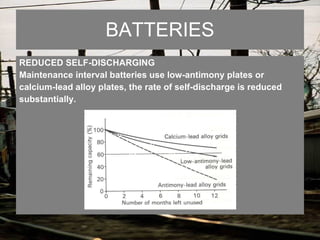
BATTERIES REDUCED SELF-DISCHARGING Maintenance interval batteries use low-antimony plates or  calcium-lead alloy plates, the rate of self-discharge is reduced  substantially.
BATTERIES ELECTROLYTE LEVEL AND SPECIFIC GRAVITY INDICATOR Extended maintenance interval batteries are equipped with an indicator  which allows easy inspection of the electrolyte level and specific  gravity. CONSTRUCTION The indicator contains two floats of different colors, having different  specific gravities. Specific gravity is 1.150 for the blue float and below  1.0 for the red float.
BATTERIES OPERATING PRINCIPLE  Low Electrolyte Level
BATTERIES Electrolyte Level Normal but Specific Gravity Below 1.150
BATTERIES Electrolyte Level and Specific Gravity both Normal
BATTERIES Battery Maintenance Visual inspection Cleaning the battery top, terminals and cable clamps. Testing battery Charging battery
BATTERIES Visual inspection 1.   CHECK BATTERY ELECTROLYTE LEVEL 2. CHECK BATTERY CASE FOR CRACKS
BATTERIES IF BATTERY ELECTROLYTE LEVEL IS LOW,ADD DISTILLED  WATER TO SPECIFIED LEVEL
BATTERIES Visual inspection 4.CHECK BATTERY VENT PLUGS FOR DAMAGE OR CLOGGED BENT HOLES
BATTERIES Cleaning the battery top, terminals and cable clamps.
BATTERIES Battery Testing Testing determines if the battery: Is in good condition Needs recharging Is defective and should be discarded
BATTERIES OPEN CIRCUIT VOLTAGE TEST
BATTERIES HYDROMETER TEST
BATTERIES Sulfuric acid rather than water has been  added Specific gravity too high. Internal shorts ... lack of electrolyte Impurities in cells ... excessive self- discharge Specific gravity too low in  some cells.  Undercharged ... Charging system trouble,  driving  distance or speed too low Overcharged ... Overload, insufficient  generator capacity (Leaking ... Lack of cleaning, too much  electrolyte) Specific gravity too low in  all cells alike. Possible Cause Measurement Result
BATTERIES Specific  Gravity State of Charge 1.265 - 1.299  Fully charged battery 1.235 - 1.265  Three-fourths charged 1.205 - 1.235  One-half charged 1.170 - 1.205  One-fourth charged 1.140 - 1.170  Barely operative 1.110 - 1.140  Completely discharged
BATTERIES LOAD TEST
BATTERIES BATTERY CHARGING
BATTERIES BATTERY CHARGING 1. Slow charging Small current 5 to 7 amps for long period 14-16 hours 2. Fast charging High current 50-60 amps for short time 1-2 hours 3. Trickle charging Very low current, less than 1 amps for wet batteries that must be kept  for any length of time.
BATTERIES Diagnosing battery faults  Fault  Cause undercharging  •  Low alternator output, perhaps due to  a slipping drive belt  •  Excessive use of the battery, which may be due to  a short circuit  •  Faulty alternator regulator •  Terminal corrosion Overcharging  •  Defective cell in battery  (excessive gassing)  •  Faulty alternator regulator Low battery capacity  •  Internal or external short between cells  •  Sulphation  •  Loss of active material from plates •  Low electrolyte level  •  Incorrect electrolyte strength  •  Terminal corrosion
BATTERIES NEXT  CHARGING SYSTEM THANK YOU

Batteries & charging system

  • 1.
    BATTERIES & CHARGINGSYSTEM BATTERIES LEAD ACID BATTERIES MF BATTERIES MAINTENANCE, CHARGING & TESTING DIAGNOSING BATTERY FAULTS
  • 2.
    BATTERIES & CHARGINGSYSTEM CHARGING SYSTEMS REQUIREMENTS OF CHARGING SYSTEM CHARGING SYSTEM PRINCIPLES ALTERNATOR & CHARGING CIRCUITS DIAGNOSING CHARGING & SYSTEM FAULTS
  • 3.
    BATTERIES PURPOSE OFTHE BATTERY The three main functions of the automotive battery are to : Supply power to the starter and ignition system. Supply the extra power required when vehicle's electrical load requirements exceed the supply from the charging system. Act as a voltage stabilizer in the electrical system.
  • 4.
    BATTERIES LEAD ACIDBATTERY Positive plate - lead peroxide ( Pb O 2 ) Negative plate - sponge lead ( Pb ) Electrolyte solution - mixture of sulfuric acid and water ( H 2 SO 4 ) Produced - 2.1 to 2.5 volt
  • 5.
    BATTERIES OPERATION Platepositive (PbO 2 ) + sulfate (SO 4 ) electrolyte + hydrogen = water (H 2 0). Plate negative (Pb) + sulfate (SO 4 ) = Plumbum sulfate(PbSO 4 ) @ ‘Lead sulfate’ Plate positive and plate negative = Plumbum sulfate Electrolyte = water Cathode plate (change sulfate) Anode plate (change sulfate) - + Pb O 2 Pb H 2 SO 4 H 2 SO 4
  • 6.
    BATTERIES OPERATION ChargingPlate positive and plate negative + water = Electrolyte Plate positive = lead peroxide and plate negative= spongy lead Charging gas oxygen and gas hydrogen * chemical action Cathode plate (change sulfate) Anode plate (change sulfate) Charger - + - + Pb SO4 Pb SO4 H2 O H2 O
  • 7.
    BATTERIES BATTERY CONSTRUCTION Vent plug Shell connectors Grids Separators Plates Container and cover
  • 8.
  • 9.
    BATTERIES BATTERY CAPACITIESBattery capacity is the amount of current that a battery can deliver for a certain length of time at a certain temperature. There are two terms used to express battery capacity: slow discharge capacity and high discharge capacity.
  • 10.
    BATTERIES SLOW DISCHARGECAPACITY The electric power of a battery, when used for low-consumption loads, is called the slow discharge capacity. Ah = A x h
  • 11.
    BATTERIES High-discharge capacitycan be expressed as: the length of time that a battery can output a heavy current when it discharges at a constant rate the voltage after the battery has been discharged at constant heavy current for a certain length of time.
  • 12.
    BATTERIES INTERNAL RESISTANCEA battery not only creates electromotive force but also acts as a resistant, due to the internal resistance of its electrolyte and plates. V = E-lr
  • 13.
    BATTERIES CONNECTING METHODSSERIES CONNECTION E 0 = E 1 + E 2
  • 14.
  • 15.
    BATTERIES SELF-DISCHARGE Theamount of self-discharge is indicated in terms of a percentage of the battery capacity, and is approximately 0.3 to 1.5 % per day at electrolyte temperatures of between 20 and 30°C (68 and 86°F). A battery will become fully self-discharged in 1 to 3 months if not used or recharged. The amount of self-discharge is larger when the battery temperature is higher. Therefore, batteries should be stored in a cool, dark place when not in use.
  • 16.
    BATTERIES Self-discharge canbe caused by any of the following: a. Metal impurities (such as iron or manganese) mixed in with the electrolyte or adhering to the plates. This is why distilled water, rather than tap water, is used in batteries since it contains minimal impurities. b. Antimony used in the plates.
  • 17.
  • 18.
    BATTERIES MAINTENANCE FREEBATTERIES DIFFERENCES FROM ORDINARY BATTERIES a. The amount of antimony in the positive and negative plate grids is either extremely small, or the antimony has been replaced with an other metal, such as calcium, for example. b. The height of the ribs at the bottom of the case is reduced to increase the amount of electrolyte.
  • 19.
    BATTERIES REDUCED NEEDFOR WATER REPLENISHMENT Maintenance interval batteries having low antimony and lead alloy grids or calcium and lead alloy grids so the rate of electrolyte loss is low.
  • 20.
    BATTERIES REDUCED SELF-DISCHARGINGMaintenance interval batteries use low-antimony plates or calcium-lead alloy plates, the rate of self-discharge is reduced substantially.
  • 21.
    BATTERIES ELECTROLYTE LEVELAND SPECIFIC GRAVITY INDICATOR Extended maintenance interval batteries are equipped with an indicator which allows easy inspection of the electrolyte level and specific gravity. CONSTRUCTION The indicator contains two floats of different colors, having different specific gravities. Specific gravity is 1.150 for the blue float and below 1.0 for the red float.
  • 22.
    BATTERIES OPERATING PRINCIPLE Low Electrolyte Level
  • 23.
    BATTERIES Electrolyte LevelNormal but Specific Gravity Below 1.150
  • 24.
    BATTERIES Electrolyte Leveland Specific Gravity both Normal
  • 25.
    BATTERIES Battery MaintenanceVisual inspection Cleaning the battery top, terminals and cable clamps. Testing battery Charging battery
  • 26.
    BATTERIES Visual inspection1. CHECK BATTERY ELECTROLYTE LEVEL 2. CHECK BATTERY CASE FOR CRACKS
  • 27.
    BATTERIES IF BATTERYELECTROLYTE LEVEL IS LOW,ADD DISTILLED WATER TO SPECIFIED LEVEL
  • 28.
    BATTERIES Visual inspection4.CHECK BATTERY VENT PLUGS FOR DAMAGE OR CLOGGED BENT HOLES
  • 29.
    BATTERIES Cleaning thebattery top, terminals and cable clamps.
  • 30.
    BATTERIES Battery TestingTesting determines if the battery: Is in good condition Needs recharging Is defective and should be discarded
  • 31.
  • 32.
  • 33.
    BATTERIES Sulfuric acidrather than water has been added Specific gravity too high. Internal shorts ... lack of electrolyte Impurities in cells ... excessive self- discharge Specific gravity too low in some cells. Undercharged ... Charging system trouble, driving distance or speed too low Overcharged ... Overload, insufficient generator capacity (Leaking ... Lack of cleaning, too much electrolyte) Specific gravity too low in all cells alike. Possible Cause Measurement Result
  • 34.
    BATTERIES Specific Gravity State of Charge 1.265 - 1.299 Fully charged battery 1.235 - 1.265 Three-fourths charged 1.205 - 1.235 One-half charged 1.170 - 1.205 One-fourth charged 1.140 - 1.170 Barely operative 1.110 - 1.140 Completely discharged
  • 35.
  • 36.
  • 37.
    BATTERIES BATTERY CHARGING1. Slow charging Small current 5 to 7 amps for long period 14-16 hours 2. Fast charging High current 50-60 amps for short time 1-2 hours 3. Trickle charging Very low current, less than 1 amps for wet batteries that must be kept for any length of time.
  • 38.
    BATTERIES Diagnosing batteryfaults Fault Cause undercharging • Low alternator output, perhaps due to a slipping drive belt • Excessive use of the battery, which may be due to a short circuit • Faulty alternator regulator • Terminal corrosion Overcharging • Defective cell in battery (excessive gassing) • Faulty alternator regulator Low battery capacity • Internal or external short between cells • Sulphation • Loss of active material from plates • Low electrolyte level • Incorrect electrolyte strength • Terminal corrosion
  • 39.
    BATTERIES NEXT CHARGING SYSTEM THANK YOU