1
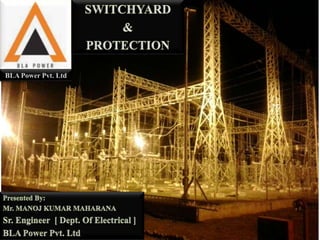
BLA Power Pvt. Ltd
2
DEFINATION
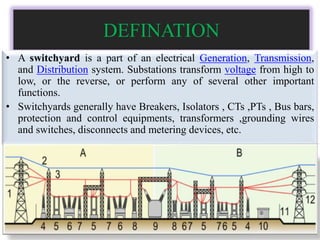
• A switchyard is a part of an electrical Generation, Transmission,
and Distribution system. Substations transform voltage from high to
low, or the reverse, or perform any of several other important
functions.
• Switchyards generally have Breakers, Isolators , CTs ,PTs , Bus bars,
protection and control equipments, transformers ,grounding wires
and switches, disconnects and metering devices, etc.
3
132 KV Switchyard
• Constructional Overview
• Testing
• Operation & Maintenance
• Protection
• Conclusion
4
Constructional Overview
• Two main Bus-1& 2 bars – ACSR TWIN MOOSE Conductor.
Both are used to energize any abnormality with Bus-coupler for un
interruption Operation.
• Current rating 2000A,Fault Level 40KA for 3 Sec.
• Bay Equipment to Equipment Connection-ACSR Moose
Conductor.
• CTs are connected in Series , PTs are connected across supply.
• STG Generator Transformer Bay -01 No.
• Start-up S.A.T. Bay -01 No.
• 132 KV overhead line circuit Bay -02 No.s
• 132 KV Transfer Bus coupler Bay - 01 No.s
• Fully Equipped Bus PT Bay -02 No.s
5
6
GEN. TRFO. BAY
TRNSFER BUS
COUPLER BAY
BUS PT
O/G OHL #1 BAY
STN. TRFO. BAY
O/G OHL # 2 BAY
• Total no. of Towers- 28 (A/B/C/D/E)
• Total no. of SF6 CB- 5
• Total no. of PT-12
• Total no. of CT-12
• Total no. of LA-12
• Total no. of Wave Trap -2
• Total no. of Isolators- 22
• Total no. of CVT- 6
• Total no. of BPI- 18
• Total no. of EMPT -6 7
Constructional Overview
8
GEN BAY SAT BAY
9
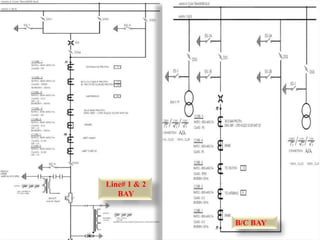
B/C BAY
Line# 1 & 2
BAY
10
Bus Bar
Protection Scheme
• Rated Voltage 145 KV
• Rated Current 1250 A Frequency 50 Hz
• Breaking Capacity 40 KA
• Making Capacity 100 KVP
• Short Time Rating 40 KA for 3 sec
• Operating sequence
O-0.3 sec - CO- 3 MIN- CO
• Trip and Closing Coil Voltage 110V DC
• Motor Supply 240 V
11
These are used to operate on the fault on line or X-mer depending upon where it is
connected. This isolates the faulty line or equipments from the live portion of the sub
station by opening automatically through protective relays; control cables etc. in
definite time.
Testing for SF6:-
Applied Volt 5KV DC
•IR Value
> 20 GΩ CB ON
[R(Y+B+E),Y(R+B+E),B(R+Y+E)]
> 50 GΩ CB OFF
[R-R’,Y-Y’,B-B’]
•Applied current 100 A DC
Contact Resistance test: R-ø ,Y-ø B-ø < 34 μΩ
•SF6 Gas pressure setting 5.4 bar.
•Breaker , Closing Time 72 ms
Opening Time -29 ms Each Phase
12
Make CGL
Type Outdoor
No of Core 2 Core
Ratio 400-800/1-1A
Class 0.25/0.25
Burden 30 VA
ISF <= 5
Make CGL
No of Core 2
Ratio 132KV/√3/110V/√3/110V/√3
Class 0.2/3P
Burden 100 VA/100 VA
a) Measurement of voltage
b) Provide secondary voltage for
protection.
a) Measurement of current
b) Protection current circuits when currents
passed through protective relays like
Distance protection, Backup protection.
Common Testing's Required for CT & PT:-
•IR Test :
Applied Volt 5KV DC
> 10 GΩ [Prim – Earth, Prim – Core]
Applied Volt 1KV DC
> 500 MΩ [Core-Earth]
•Winding Resistance Test:
< 5-6 Ω [Ex: R-ø ,1s1-1s2,1s1-1s3]
•Ratio Test :
[Prim current 400-800]/ [Sec. current 1-1A]
[Ex: R-ø ,1s1-1s2,2s1-2s2]
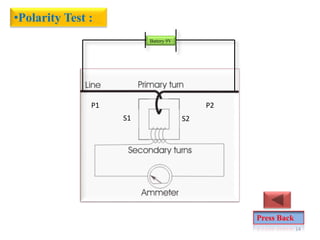
•Polarity Test :
[Ex: R-ø ,1s1-1s2,2s1-2s2]
•Knee voltage Test:
[Only For Protection Class CT ]
is significance of saturation level of a current
transformer core mainly used for protection
purposes. The sinusoidal voltage of rated
frequency is applied to the secondary
terminals of CT, with other winding being
open circuited which increased by10%, cause
the exiting current to increase by 50%. NEXT
Press
14
P1 P2
S1 S2
Battery 9V
Press Back
•Polarity Test :
Make
OBLUM ELECTRICAL
Type METAL OXIDE
LD DISCHARGE CLASS Class-3
Rated Voltage 60 KV
Rated Frequency 48-62 HZ
Maximum continuous Operating
Voltage
102 KV
Nominal Discharge Current 10 KA
MFD 2010
Make
OBLUM ELECTRICAL
 Wave trap is an instrument of Low pass
filter, when power frequency currents are
passed to switchyard & high freq. signals are
blocked. Line trap also is known as Wave trap.
 Shapes like a DRUM.
Use for Carrier Communication (PLCC)
systems for communication among various
substations without dependence on the telecom
company network located in substation control
room (through coupling capacitor and LMU).
To discharge the switching & lighting
voltage surges to earth to protect instrument
in the station. These are high pass filters (50
KHZ to 500 KHZ) pass carrier.
15
16
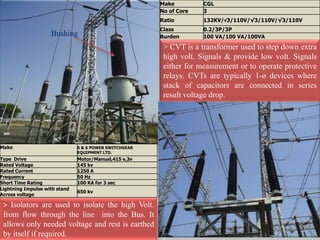
Make CGL
No of Core 3
Ratio 132KV/√3/110V/√3/110V/√3/110V
Class 0.2/3P/3P
Burden 100 VA/100 VA/100VA
> CVT is a transformer used to step down extra
high volt. Signals & provide low volt. Signals
either for measurement or to operate protective
relays. CVTs are typically 1-ø devices where
stack of capacitors are connected in series
result voltage drop.
Make S & S POWER SWITCHGEAR
EQUIPMENT LTD.
Type Drive Motor/Manual,415 v,3ø
Rated Voltage 145 kv
Rated Current 1250 A
Frequency 50 Hz
Short Time Rating 100 KA for 3 sec
Lightning Impulse with stand
Across voltage
650 kv
> Isolators are used to isolate the high Volt.
from flow through the line into the Bus. It
allows only needed voltage and rest is earthed
by itself if required.
Bushing
17
•Bus: is a line in which the incoming feeder
come into & get into the instruments for
further step up or step down.
•Double line in the bus so that if any fault
occurs in one the other can still have the
current and the supply will not stop.
•Two lines are separated by a little distance by
a conductor [spacer] having a connector
between them .
Spacer
Clamp
Tension
Suspension
OPERATIONAL MODES
• Normal Operation :
Synchronization
Start Up / Import
• Inter -Transfer Mode Operation:
Inter Transfer Mode
By Pass change over Scheme:
18
Press
Press
Move Next
Press
Press
G
19
DS-1 DS-2
CB
CB
DS-4
DS-3 DS-2
CB
DS-4
DS-3DS-1
DS-2
CB
DS-3
DS-4
DS-1 DS-2
CB
DS-4
DS-1
DS-3
OUTGOING OHL #2 BAYOUTGOING OHL #1 BAY
BUS COUPLER CUM
TRNSFER BREAKER
MAIN -1 BUS
MAIN -2 CUM TRANSFER BUS <--- GT BAY  <--- STN. TRFO BAY 
GENERATOR
G. TRFO
STN. TRFO
DS-5 DS-5
U.A.TRFO
DS-1 DS-2
Gen CB
LOAD
G
20
DS-1 DS-2
CB
CB
DS-4
DS-3 DS-2
CB
DS-4
DS-3DS-1
DS-2
CB
DS-3
DS-4
DS-1 DS-2
CB
DS-4
DS-1
DS-3
OUTGOING OHL #2 BAYOUTGOING OHL #1 BAY
BUS COUPLER CUM
TRNSFER BREAKER
MAIN -1 BUS
MAIN -2 CUM TRANSFER BUS <--- GT BAY  <--- STN. TRFO BAY 
GENERATOR
G. TRFO
STN. TRFO
DS-5 DS-5
U.A.TRFO
DS-1 DS-2
LOADLOAD
Press Back
G
21
DS-1 DS-2
CB
CB
DS-4
DS-3 DS-2
CB
DS-4
DS-3DS-1
DS-2
CB
DS-3
DS-4
DS-1 DS-2
CB
DS-4
DS-1
DS-3
OUTGOING OHL #2 BAYOUTGOING OHL #1 BAY
BUS COUPLER CUM
TRNSFER BREAKER
MAIN -1 BUS
MAIN -2 CUM TRANSFER BUS <--- GT BAY  <--- STN. TRFO BAY 
GENERATOR
G. TRFO
STN. TRFO
DS-5 DS-5
U.A.TRFO
DS-1 DS-2
LOADLOAD
Press Back
22
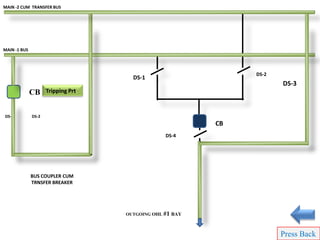
CB
DS-2
CB
DS-4
DS-3DS-1
BUS COUPLER CUM
TRNSFER BREAKERS
MAIN -1 BUS
MAIN -2 CUM TRANSFER BUS
DS-1 DS-2
Tripping Prt.
OUTGOING OHL #1 BAY
1. Close DS-3
2. Open DS-3 & DS4
Close DS-3
Tripping Prt.
23
CB
DS-2
CB
DS-4
DS-3
DS-1
BUS COUPLER CUM
TRNSFER BREAKER
MAIN -1 BUS
MAIN -2 CUM TRANSFER BUS
DS-1 DS-2
Press Back
Tripping Prt.
OUTGOING OHL #1 BAY
24
CB
DS-2
CB
DS-4
DS-3DS-1
BUS COUPLER CUM
TRNSFER BREAKERS
MAIN -1 BUS
MAIN -2 CUM TRANSFER BUS
DS-1 DS-2
Tripping Prt.
OUTGOING OHL #1 BAY
1. Open DS-1
2. Close DS-1
Tripping Prt.
Protection
Tripping fuse Out
Press Back
Maintenance
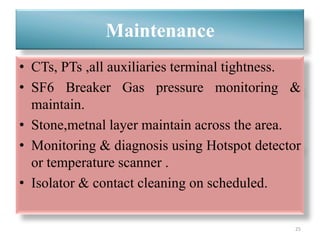
• CTs, PTs ,all auxiliaries terminal tightness.
• SF6 Breaker Gas pressure monitoring &
maintain.
• Stone,metnal layer maintain across the area.
• Monitoring & diagnosis using Hotspot detector
or temperature scanner .
• Isolator & contact cleaning on scheduled.
25
Thermal Sensor / Hot Spot Detector
26
27
Protection
28
29
30
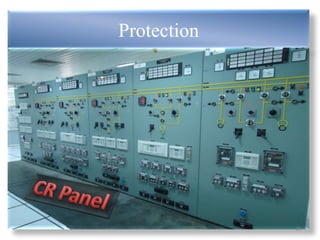
Protection System
• A series of devices whose main purpose is to
protect persons and primary electric power
equipment from the effects of faults.
Why A System Needs Protection?
• There is no ‘fault free’ system.
• It is neither practical nor economical to build a ‘fault free’
system.
• Electrical system shall tolerate certain degree of faults.
• Usually faults are caused by breakdown of insulation due to
various reasons: Short Circuit, High Voltage, system aging,
lighting, etc.
Protection System Elements
• Protective relays
• Circuit breakers
• Current and voltage transducers
• Communications channels
• DC supply system
• Control cables
Three-Phase Diagram of the Protection scheme
CTs
VTs
Relay
CB
Control
Protected
Equipment
How Do Relays Detect Faults?
• When a fault takes place, the
current, voltage, frequency, and other electrical variables
behave in a peculiar way. For example:
– Current suddenly increases
– Voltage suddenly decreases
• Relays can measure the currents and the voltages and
detect that there is an overcurrent, or an undervoltage, or
a combination of both
• Many other detection principles determine the design of
protective relays
Main Protection Requirements
• Reliability
• Selectivity
• Speed
• Sensitivity
Typical Short-Circuit Type Distribution
Single-Phase-Ground: 70–80%
Phase-Phase-Ground: 17–10%
Phase-Phase: 10–08%
Three-Phase: 03–02%
Following type of Protection Curve
used in our plant
1. INSTANTANEOUS/High Speed
2. DMT: (Definite Mean Time-I>>/high set)
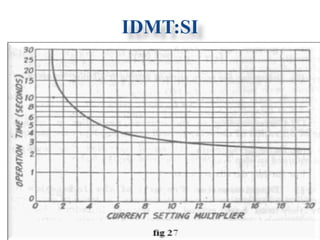
3. IDMT: (Inverse Definite Minimum Time)
a. SI - Standard Inverse (I>)
b. VI - Very Inverse
c. EI - Extreme Inverse
d. LTI - Long Time Inverse
Formula for Relay Operating Time
calculation
Operating Time:
= A X TMS
Ir C - 1
o A=0.14 & C=0.02 for SI
o A=0.13.5 & C=1.0 for VI
o A= 80 & C= 2.0 for EI
o A=120 & C=1.0 for LTI
o Ir= I(multiple of fault current) / Iset
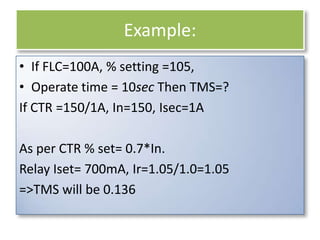
Example:
• If FLC=100A, % setting =105,
• Operate time = 10sec Then TMS=?
If CTR =150/1A, In=150, Isec=1A
As per CTR % set= 0.7*In.
Relay Iset= 700mA, Ir=1.05/1.0=1.05
=>TMS will be 0.136
IDMT:SI
IDMT:
Basic Requirement for Relay Setting
• Equipment Full Rating(V, Amp, Z)
• CT/PT Ratio installed on that feeder
• Identification of CT/PT for Particular
protection.
• Breaker opening & tripping time.
• Equipments Factory Test report/Curve
Relay Setting Adopted for our system:
1. OC: 105% to 120% - SI,
2. EF: 10% to 30%. - SI
3. OV: 110%, U/V: 80% - DMT
4. SEF: more than EF and time >0.8to1.0sc.
5. REF/Diff : 08 to12% -Inst.
6. DPR (Z1-inst. Z2-300ms, Z-800ms)
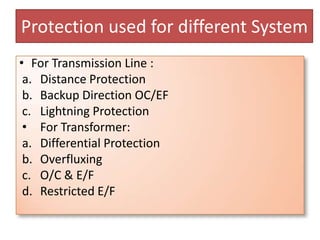
Protection used for different System
• For Transmission Line :
a. Distance Protection
b. Backup Direction OC/EF
c. Lightning Protection
• For Transformer:
a. Differential Protection
b. Overfluxing
c. O/C & E/F
d. Restricted E/F
e.Sensitive or standby E/F
f. Buchholz
g. Pressure Release Valve
h. Winding/ oil Temperature & LA
• For LT Motor (up to 35KW)
a. Thermal Overload
b. Fuse
• For LT Motor (Above 35KW)
a. Thermal Over Laod
b. O/C & E/F
• For HT Motors:
a. Thermal Over Load
b. O/C & E/F
c. Locked Rotor
d. Negative Phase Sequence
e. Start supervision
f. Restart Inhabit
• For Generator :
a. Differential Protection
b. Stator Earth Fault (100% & 90 %)
c. Rotor E/F
d. NPS
e. Backup Impedance
f. Backup O/C & E/F
g. Loss of field
h. Reverse Power (Short Time /Long time)
i. Thermal Overload Alarm
j. Dead Machine
k. Winding temperature
l. O/V & U/V
.
SUMMARY
• The Operative Direction for Directional OC Relays are as follows:
– GT bay relay is having operative direction towards GT.
– Line bay relay is having operative direction towards Line.
– Station Transformer. Relay is having operative direction towards Station Transformer.
• Grading margin of 0.3 seconds has been considered between different levels of
protective devices.
• In case of a fault on Line, Distance relay will operate instantaneously. If it fails to
Operate than Directional OC relay will operate as backup.
• If the fault is still found persisting than GT bay and other line bay relay will give
further backup and will trip their respective breakers to clear the fault.
• In case of a fault on Bus, Bus differential relay will operate instantaneously. If this
relay fails to clear the fault , all other feeders including two line bays and GT bay
relays will trip their respective breakers to clear the fault .
• In case of a fault in Generator Transformer (GT),Differential protection for GT will
operate instantaneously. And Directional relay looking towards GT will give backup to
it. If the fault is still found persisting than all other feeders including two line bays will
trip their respective breaker to clear the fault.
Forward Path
• For Trouble Free Operation.
• Longevity of System.
• 2 No.s Upcoming Bays for Unit-II
51
Special Thanks
• for Guidance
Mr. U.P. Sharma
Sr. Manager [ Dept. Of Electrical ]
• for Co-ordination
Mr. Nilesh Malviya
Mr. Dhanajya Ray
Engineer [ Dept. Of Electrical ]
52
Switch yard & Protection

Switch yard & Protection

  • 1.
  • 2.
  • 3.
    DEFINATION • A switchyardis a part of an electrical Generation, Transmission, and Distribution system. Substations transform voltage from high to low, or the reverse, or perform any of several other important functions. • Switchyards generally have Breakers, Isolators , CTs ,PTs , Bus bars, protection and control equipments, transformers ,grounding wires and switches, disconnects and metering devices, etc. 3
  • 4.
    132 KV Switchyard •Constructional Overview • Testing • Operation & Maintenance • Protection • Conclusion 4
  • 5.
    Constructional Overview • Twomain Bus-1& 2 bars – ACSR TWIN MOOSE Conductor. Both are used to energize any abnormality with Bus-coupler for un interruption Operation. • Current rating 2000A,Fault Level 40KA for 3 Sec. • Bay Equipment to Equipment Connection-ACSR Moose Conductor. • CTs are connected in Series , PTs are connected across supply. • STG Generator Transformer Bay -01 No. • Start-up S.A.T. Bay -01 No. • 132 KV overhead line circuit Bay -02 No.s • 132 KV Transfer Bus coupler Bay - 01 No.s • Fully Equipped Bus PT Bay -02 No.s 5
  • 6.
    6 GEN. TRFO. BAY TRNSFERBUS COUPLER BAY BUS PT O/G OHL #1 BAY STN. TRFO. BAY O/G OHL # 2 BAY
  • 7.
    • Total no.of Towers- 28 (A/B/C/D/E) • Total no. of SF6 CB- 5 • Total no. of PT-12 • Total no. of CT-12 • Total no. of LA-12 • Total no. of Wave Trap -2 • Total no. of Isolators- 22 • Total no. of CVT- 6 • Total no. of BPI- 18 • Total no. of EMPT -6 7 Constructional Overview
  • 8.
  • 9.
  • 10.
  • 11.
    • Rated Voltage145 KV • Rated Current 1250 A Frequency 50 Hz • Breaking Capacity 40 KA • Making Capacity 100 KVP • Short Time Rating 40 KA for 3 sec • Operating sequence O-0.3 sec - CO- 3 MIN- CO • Trip and Closing Coil Voltage 110V DC • Motor Supply 240 V 11 These are used to operate on the fault on line or X-mer depending upon where it is connected. This isolates the faulty line or equipments from the live portion of the sub station by opening automatically through protective relays; control cables etc. in definite time. Testing for SF6:- Applied Volt 5KV DC •IR Value > 20 GΩ CB ON [R(Y+B+E),Y(R+B+E),B(R+Y+E)] > 50 GΩ CB OFF [R-R’,Y-Y’,B-B’] •Applied current 100 A DC Contact Resistance test: R-ø ,Y-ø B-ø < 34 μΩ •SF6 Gas pressure setting 5.4 bar. •Breaker , Closing Time 72 ms Opening Time -29 ms Each Phase
  • 12.
    12 Make CGL Type Outdoor Noof Core 2 Core Ratio 400-800/1-1A Class 0.25/0.25 Burden 30 VA ISF <= 5 Make CGL No of Core 2 Ratio 132KV/√3/110V/√3/110V/√3 Class 0.2/3P Burden 100 VA/100 VA a) Measurement of voltage b) Provide secondary voltage for protection. a) Measurement of current b) Protection current circuits when currents passed through protective relays like Distance protection, Backup protection.
  • 13.
    Common Testing's Requiredfor CT & PT:- •IR Test : Applied Volt 5KV DC > 10 GΩ [Prim – Earth, Prim – Core] Applied Volt 1KV DC > 500 MΩ [Core-Earth] •Winding Resistance Test: < 5-6 Ω [Ex: R-ø ,1s1-1s2,1s1-1s3] •Ratio Test : [Prim current 400-800]/ [Sec. current 1-1A] [Ex: R-ø ,1s1-1s2,2s1-2s2] •Polarity Test : [Ex: R-ø ,1s1-1s2,2s1-2s2] •Knee voltage Test: [Only For Protection Class CT ] is significance of saturation level of a current transformer core mainly used for protection purposes. The sinusoidal voltage of rated frequency is applied to the secondary terminals of CT, with other winding being open circuited which increased by10%, cause the exiting current to increase by 50%. NEXT Press
  • 14.
    14 P1 P2 S1 S2 Battery9V Press Back •Polarity Test :
  • 15.
    Make OBLUM ELECTRICAL Type METALOXIDE LD DISCHARGE CLASS Class-3 Rated Voltage 60 KV Rated Frequency 48-62 HZ Maximum continuous Operating Voltage 102 KV Nominal Discharge Current 10 KA MFD 2010 Make OBLUM ELECTRICAL  Wave trap is an instrument of Low pass filter, when power frequency currents are passed to switchyard & high freq. signals are blocked. Line trap also is known as Wave trap.  Shapes like a DRUM. Use for Carrier Communication (PLCC) systems for communication among various substations without dependence on the telecom company network located in substation control room (through coupling capacitor and LMU). To discharge the switching & lighting voltage surges to earth to protect instrument in the station. These are high pass filters (50 KHZ to 500 KHZ) pass carrier. 15
  • 16.
    16 Make CGL No ofCore 3 Ratio 132KV/√3/110V/√3/110V/√3/110V Class 0.2/3P/3P Burden 100 VA/100 VA/100VA > CVT is a transformer used to step down extra high volt. Signals & provide low volt. Signals either for measurement or to operate protective relays. CVTs are typically 1-ø devices where stack of capacitors are connected in series result voltage drop. Make S & S POWER SWITCHGEAR EQUIPMENT LTD. Type Drive Motor/Manual,415 v,3ø Rated Voltage 145 kv Rated Current 1250 A Frequency 50 Hz Short Time Rating 100 KA for 3 sec Lightning Impulse with stand Across voltage 650 kv > Isolators are used to isolate the high Volt. from flow through the line into the Bus. It allows only needed voltage and rest is earthed by itself if required. Bushing
  • 17.
    17 •Bus: is aline in which the incoming feeder come into & get into the instruments for further step up or step down. •Double line in the bus so that if any fault occurs in one the other can still have the current and the supply will not stop. •Two lines are separated by a little distance by a conductor [spacer] having a connector between them . Spacer Clamp Tension Suspension
  • 18.
    OPERATIONAL MODES • NormalOperation : Synchronization Start Up / Import • Inter -Transfer Mode Operation: Inter Transfer Mode By Pass change over Scheme: 18 Press Press Move Next Press Press
  • 19.
    G 19 DS-1 DS-2 CB CB DS-4 DS-3 DS-2 CB DS-4 DS-3DS-1 DS-2 CB DS-3 DS-4 DS-1DS-2 CB DS-4 DS-1 DS-3 OUTGOING OHL #2 BAYOUTGOING OHL #1 BAY BUS COUPLER CUM TRNSFER BREAKER MAIN -1 BUS MAIN -2 CUM TRANSFER BUS <--- GT BAY  <--- STN. TRFO BAY  GENERATOR G. TRFO STN. TRFO DS-5 DS-5 U.A.TRFO DS-1 DS-2 Gen CB LOAD
  • 20.
    G 20 DS-1 DS-2 CB CB DS-4 DS-3 DS-2 CB DS-4 DS-3DS-1 DS-2 CB DS-3 DS-4 DS-1DS-2 CB DS-4 DS-1 DS-3 OUTGOING OHL #2 BAYOUTGOING OHL #1 BAY BUS COUPLER CUM TRNSFER BREAKER MAIN -1 BUS MAIN -2 CUM TRANSFER BUS <--- GT BAY  <--- STN. TRFO BAY  GENERATOR G. TRFO STN. TRFO DS-5 DS-5 U.A.TRFO DS-1 DS-2 LOADLOAD Press Back
  • 21.
    G 21 DS-1 DS-2 CB CB DS-4 DS-3 DS-2 CB DS-4 DS-3DS-1 DS-2 CB DS-3 DS-4 DS-1DS-2 CB DS-4 DS-1 DS-3 OUTGOING OHL #2 BAYOUTGOING OHL #1 BAY BUS COUPLER CUM TRNSFER BREAKER MAIN -1 BUS MAIN -2 CUM TRANSFER BUS <--- GT BAY  <--- STN. TRFO BAY  GENERATOR G. TRFO STN. TRFO DS-5 DS-5 U.A.TRFO DS-1 DS-2 LOADLOAD Press Back
  • 22.
    22 CB DS-2 CB DS-4 DS-3DS-1 BUS COUPLER CUM TRNSFERBREAKERS MAIN -1 BUS MAIN -2 CUM TRANSFER BUS DS-1 DS-2 Tripping Prt. OUTGOING OHL #1 BAY 1. Close DS-3 2. Open DS-3 & DS4 Close DS-3 Tripping Prt.
  • 23.
    23 CB DS-2 CB DS-4 DS-3 DS-1 BUS COUPLER CUM TRNSFERBREAKER MAIN -1 BUS MAIN -2 CUM TRANSFER BUS DS-1 DS-2 Press Back Tripping Prt. OUTGOING OHL #1 BAY
  • 24.
    24 CB DS-2 CB DS-4 DS-3DS-1 BUS COUPLER CUM TRNSFERBREAKERS MAIN -1 BUS MAIN -2 CUM TRANSFER BUS DS-1 DS-2 Tripping Prt. OUTGOING OHL #1 BAY 1. Open DS-1 2. Close DS-1 Tripping Prt. Protection Tripping fuse Out Press Back
  • 25.
    Maintenance • CTs, PTs,all auxiliaries terminal tightness. • SF6 Breaker Gas pressure monitoring & maintain. • Stone,metnal layer maintain across the area. • Monitoring & diagnosis using Hotspot detector or temperature scanner . • Isolator & contact cleaning on scheduled. 25
  • 26.
    Thermal Sensor /Hot Spot Detector 26
  • 27.
  • 28.
  • 29.
  • 30.
  • 31.
    Protection System • Aseries of devices whose main purpose is to protect persons and primary electric power equipment from the effects of faults.
  • 32.
    Why A SystemNeeds Protection? • There is no ‘fault free’ system. • It is neither practical nor economical to build a ‘fault free’ system. • Electrical system shall tolerate certain degree of faults. • Usually faults are caused by breakdown of insulation due to various reasons: Short Circuit, High Voltage, system aging, lighting, etc.
  • 33.
    Protection System Elements •Protective relays • Circuit breakers • Current and voltage transducers • Communications channels • DC supply system • Control cables
  • 34.
    Three-Phase Diagram ofthe Protection scheme CTs VTs Relay CB Control Protected Equipment
  • 35.
    How Do RelaysDetect Faults? • When a fault takes place, the current, voltage, frequency, and other electrical variables behave in a peculiar way. For example: – Current suddenly increases – Voltage suddenly decreases • Relays can measure the currents and the voltages and detect that there is an overcurrent, or an undervoltage, or a combination of both • Many other detection principles determine the design of protective relays
  • 36.
    Main Protection Requirements •Reliability • Selectivity • Speed • Sensitivity
  • 37.
    Typical Short-Circuit TypeDistribution Single-Phase-Ground: 70–80% Phase-Phase-Ground: 17–10% Phase-Phase: 10–08% Three-Phase: 03–02%
  • 38.
    Following type ofProtection Curve used in our plant 1. INSTANTANEOUS/High Speed 2. DMT: (Definite Mean Time-I>>/high set) 3. IDMT: (Inverse Definite Minimum Time) a. SI - Standard Inverse (I>) b. VI - Very Inverse c. EI - Extreme Inverse d. LTI - Long Time Inverse
  • 39.
    Formula for RelayOperating Time calculation Operating Time: = A X TMS Ir C - 1 o A=0.14 & C=0.02 for SI o A=0.13.5 & C=1.0 for VI o A= 80 & C= 2.0 for EI o A=120 & C=1.0 for LTI o Ir= I(multiple of fault current) / Iset
  • 40.
    Example: • If FLC=100A,% setting =105, • Operate time = 10sec Then TMS=? If CTR =150/1A, In=150, Isec=1A As per CTR % set= 0.7*In. Relay Iset= 700mA, Ir=1.05/1.0=1.05 =>TMS will be 0.136
  • 41.
  • 42.
  • 43.
    Basic Requirement forRelay Setting • Equipment Full Rating(V, Amp, Z) • CT/PT Ratio installed on that feeder • Identification of CT/PT for Particular protection. • Breaker opening & tripping time. • Equipments Factory Test report/Curve
  • 44.
    Relay Setting Adoptedfor our system: 1. OC: 105% to 120% - SI, 2. EF: 10% to 30%. - SI 3. OV: 110%, U/V: 80% - DMT 4. SEF: more than EF and time >0.8to1.0sc. 5. REF/Diff : 08 to12% -Inst. 6. DPR (Z1-inst. Z2-300ms, Z-800ms)
  • 45.
    Protection used fordifferent System • For Transmission Line : a. Distance Protection b. Backup Direction OC/EF c. Lightning Protection • For Transformer: a. Differential Protection b. Overfluxing c. O/C & E/F d. Restricted E/F
  • 46.
    e.Sensitive or standbyE/F f. Buchholz g. Pressure Release Valve h. Winding/ oil Temperature & LA • For LT Motor (up to 35KW) a. Thermal Overload b. Fuse • For LT Motor (Above 35KW) a. Thermal Over Laod b. O/C & E/F
  • 47.
    • For HTMotors: a. Thermal Over Load b. O/C & E/F c. Locked Rotor d. Negative Phase Sequence e. Start supervision f. Restart Inhabit • For Generator : a. Differential Protection b. Stator Earth Fault (100% & 90 %)
  • 48.
    c. Rotor E/F d.NPS e. Backup Impedance f. Backup O/C & E/F g. Loss of field h. Reverse Power (Short Time /Long time) i. Thermal Overload Alarm j. Dead Machine k. Winding temperature l. O/V & U/V
  • 49.
  • 50.
    SUMMARY • The OperativeDirection for Directional OC Relays are as follows: – GT bay relay is having operative direction towards GT. – Line bay relay is having operative direction towards Line. – Station Transformer. Relay is having operative direction towards Station Transformer. • Grading margin of 0.3 seconds has been considered between different levels of protective devices. • In case of a fault on Line, Distance relay will operate instantaneously. If it fails to Operate than Directional OC relay will operate as backup. • If the fault is still found persisting than GT bay and other line bay relay will give further backup and will trip their respective breakers to clear the fault. • In case of a fault on Bus, Bus differential relay will operate instantaneously. If this relay fails to clear the fault , all other feeders including two line bays and GT bay relays will trip their respective breakers to clear the fault . • In case of a fault in Generator Transformer (GT),Differential protection for GT will operate instantaneously. And Directional relay looking towards GT will give backup to it. If the fault is still found persisting than all other feeders including two line bays will trip their respective breaker to clear the fault.
  • 51.
    Forward Path • ForTrouble Free Operation. • Longevity of System. • 2 No.s Upcoming Bays for Unit-II 51
  • 52.
    Special Thanks • forGuidance Mr. U.P. Sharma Sr. Manager [ Dept. Of Electrical ] • for Co-ordination Mr. Nilesh Malviya Mr. Dhanajya Ray Engineer [ Dept. Of Electrical ] 52