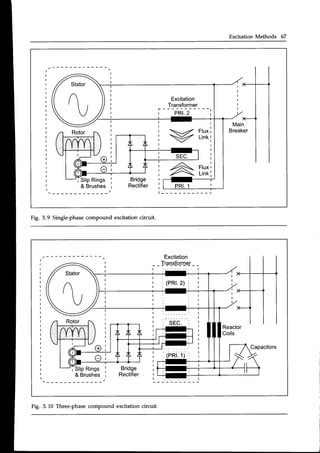
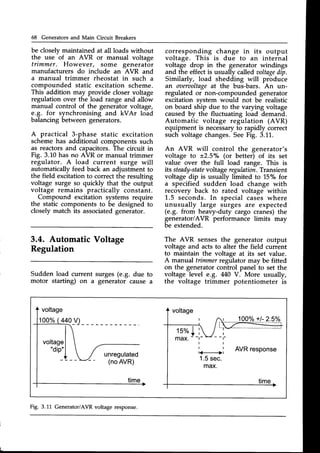
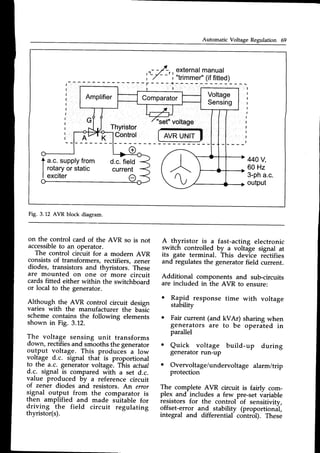
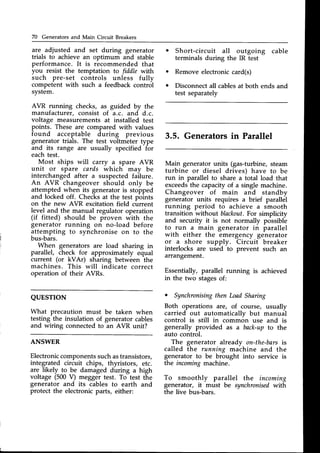
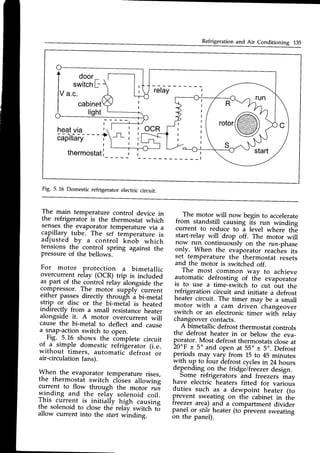
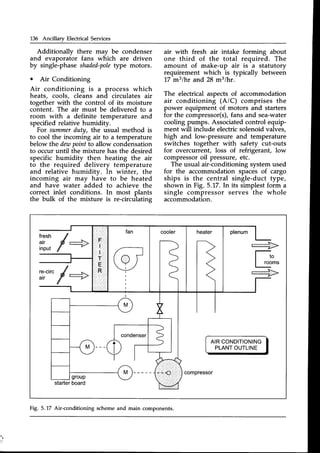
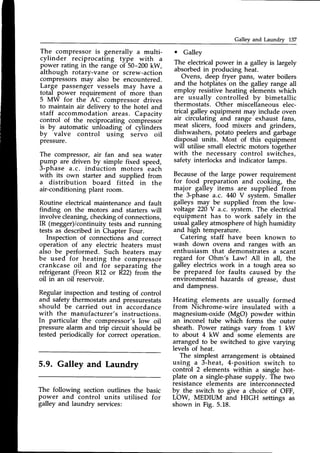
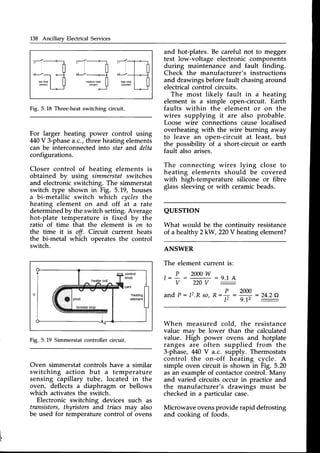
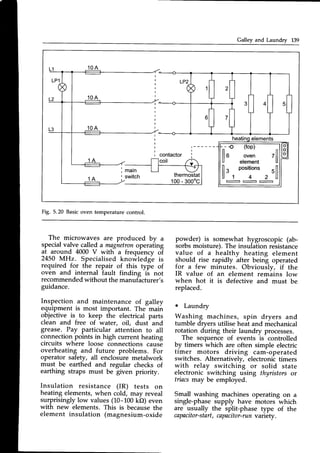
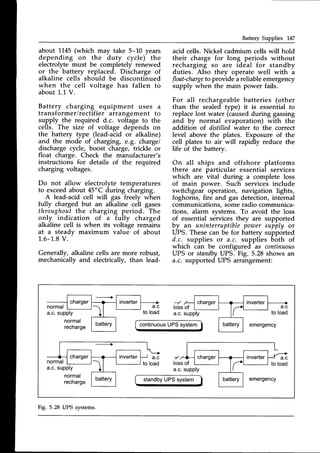
PRACTICAL
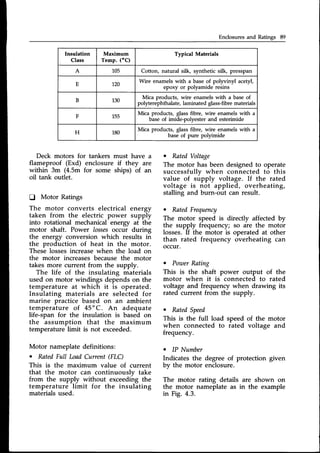
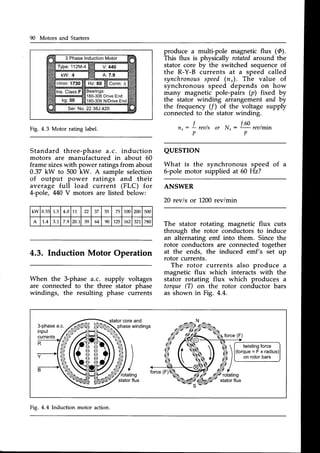
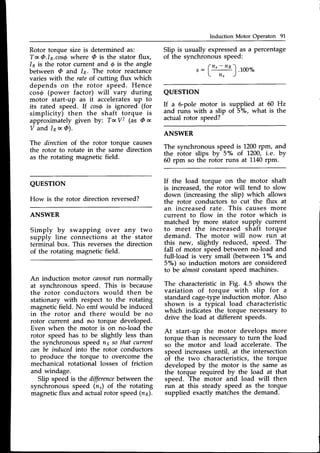
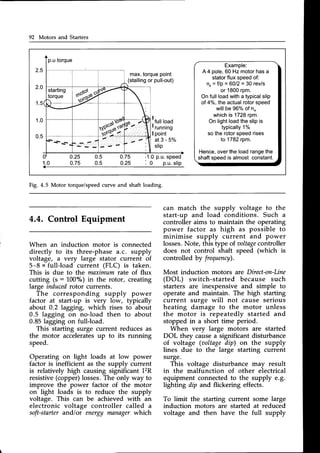
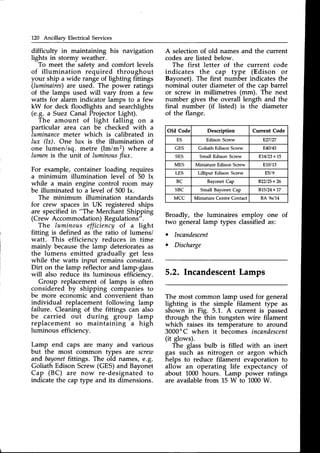
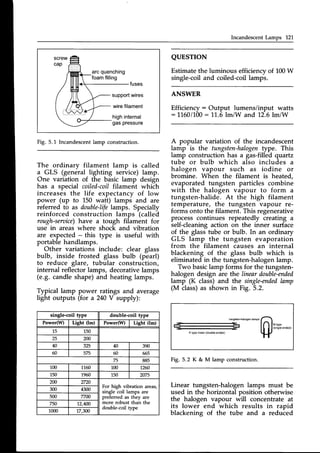
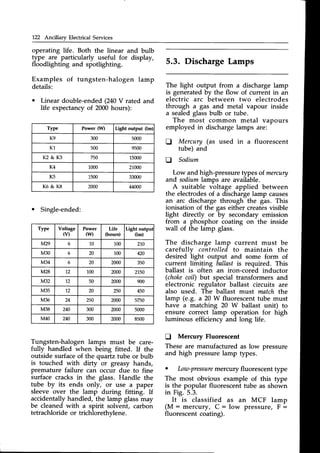
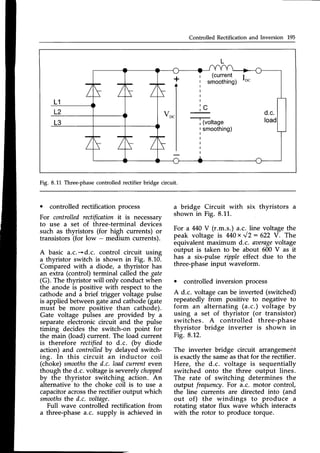
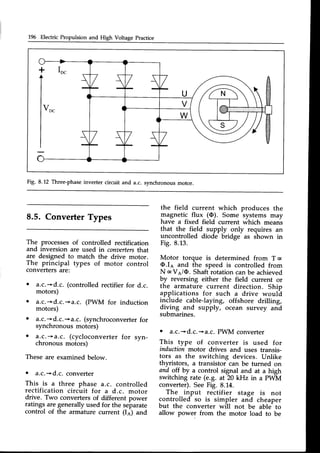
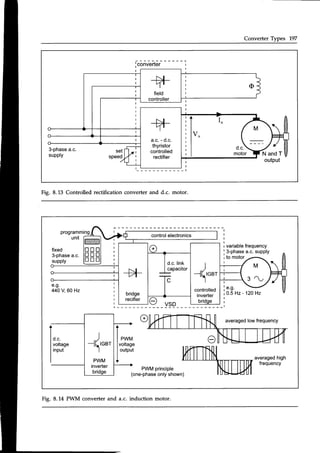
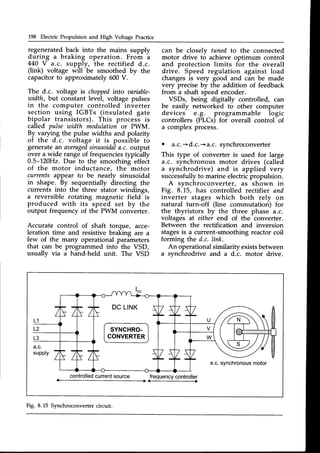
MARINE
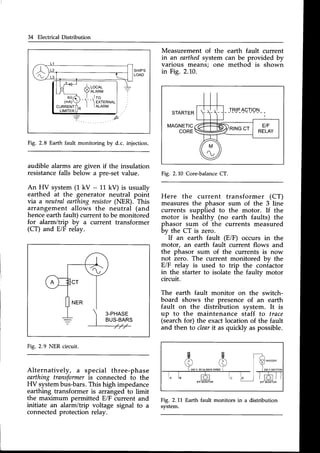
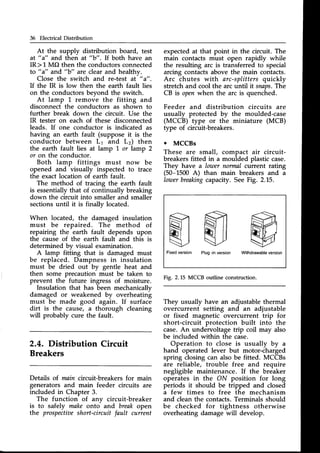
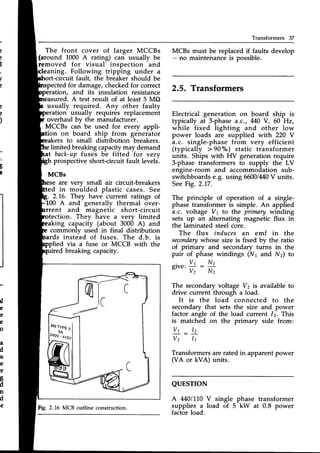
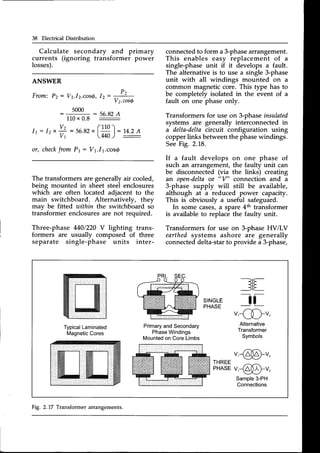
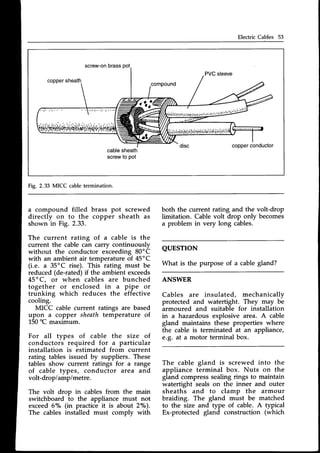
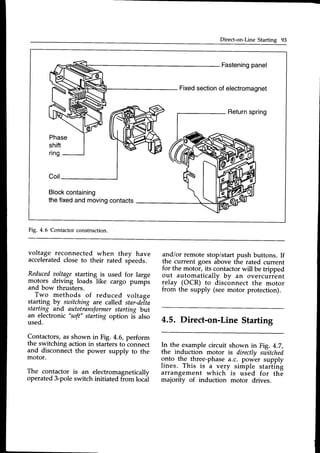
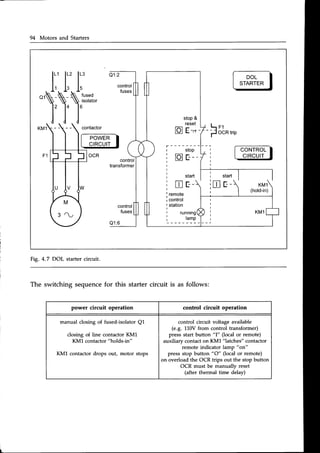
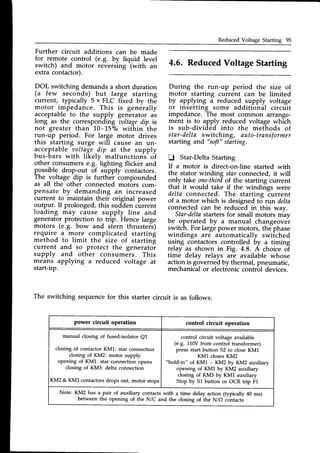
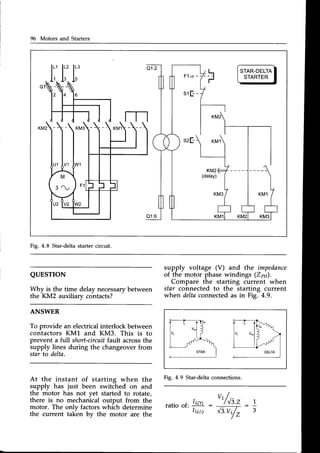
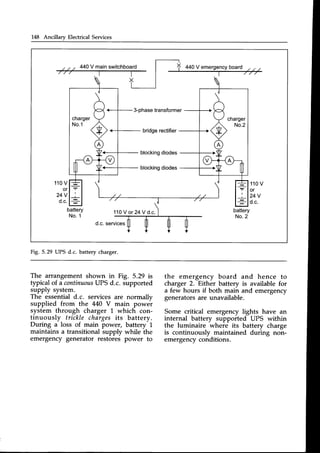
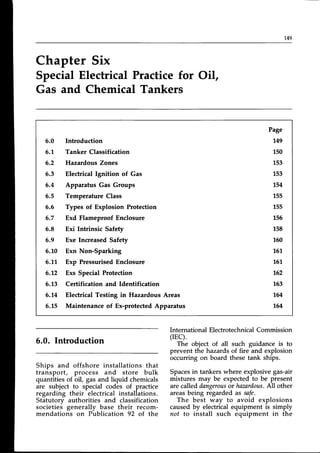
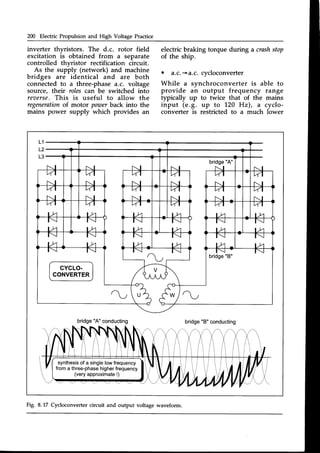
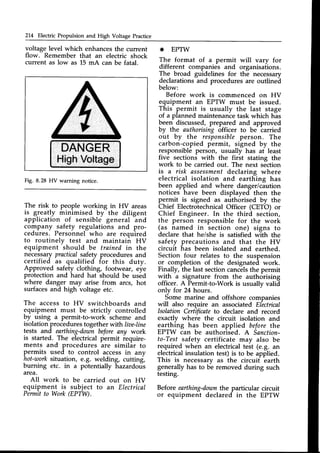
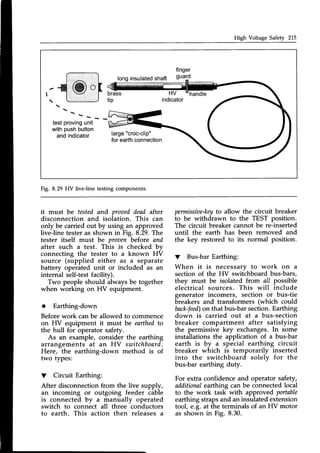
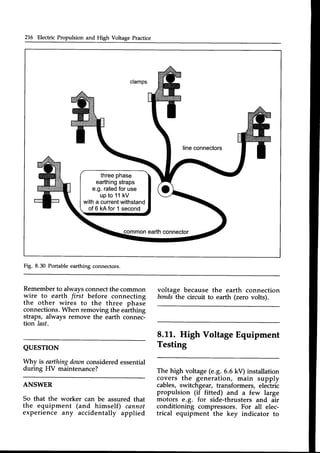
ELECTRICAL
KNOWLEDGE
SecondEdition
Dennis T. Hall B.A. (Honsl,G. Eng., M.|.E.E.' M.l.Mar.E
15l
tol
r9
rT1n. /
U v /
MAIN GENERATORS
t l
Ar"-*n.. I
$y'ceH
I
) )
;;A qrrarrrcrs g sl g
a - ! t r - - - r E - l t ! a E a t r ! r - t t t t t t g l E & r c a r g r g g E E E g E
E l E E S t ! a a t t ! l l t r t r l l t E t a q g E t l ! a E t a r t t E B E E E r E l B E E E 6
E e E E s E t g t t a c - F !
atsle'qa'tln*mra.|{l$4@t{
6.6 kV 60 Hz i/tqlN S /BD
r.if;*f.:::,:::*:
WITIIERBY
20
PRACTICALMARINE
ELECTRICAL
KNOVVLEDGE
DennisT. Hall
BA (Hons), CEng MIEE, MIMaTE
PruAF
t?ot{Pu
"r1 /t/zo o'r
AA*J--,.._*N4
Stolt-Niclsel
Atlantic Flcet
:r!?rffir*
First Published 1984
SecondEdition 1999
ISBN 1 85609182 1.
@ Dennis T. Hall 1999
Witherby & Co Ltd
32-36 Aylesbury Street
London ECIR OET
Tel No: 02072515341
FaxNo: 02072511296
International Tel No: +44 2O7251 5341
Internationaf Fax No: +44 2O7251 1296
Email: books@witherbys.co.uk
www.witherbys.com
British Library Cataloguing in Publication
Hall, Dennis T.
PracticalMarine ElectricalKnowledge
- SecondEdition
1. Title
ISBN 1 856091821
WITHERBY
I mn-l
twl
PUBUSHERS
:
All rights reserved,Nq.p-aft-of this publication may be reproduced, stored in a retrieval system, or transmitted, in any
form or by any means, electronic, mechanical, photocopying, recording or otherwise, without the prior permission
of the publisher and copyright owner.
While the principles discussed and the details given in this book are the product of careful consideration, the author
and the publisher cannot in any way guarantee the suitability of recommendations made in this book for individual
problems or situations, and they shall not be under any legal liability of any kind in respect of or arising out of the
form or contents of this book or any error therein, or the reliance of any person thereon.
Data
t
l
I
I
I
I
I
)
i
I
$.
B
I
!
&,
ts
F
I
r
:
- ' J ' l ' '
_ . n J ;
: ' t , . ;
; -
This book is designed to assist sea-going personnel in their understanding of
testing and maintenance of ships electrical equipment and services.
The publication also supports a series of eight film/video cassettes(with the
which examine practical electrical maintenance and fault-finding procedures on
types.
Further details of the film/video cassettescan be obtained from the producers:
Videotel Productions.
84 Newman Street,
London W1P 3LD,
U.K.
Telephone: +44 207 299 1800
Fax: + 44 207 299 1818
E-mail:mail@videotelmail.com
Website:http://www.videotel.co.
uk
the safe operation,
same chapter titles)
board various ship
;
t
i
Videotel Productions and Witherby Publishers would like to thank the following organisations for
their contribution and assistancein the production of PracticalMarine Electrical Knowledge:
South Tyneside College
P & O Cruises(UK) Ltd.
Atlantic Power
PGS Offshore Technology
BP Shipping Ltd.
Shell Tankers (UK) Ltd.
Mobil Shipping Co. Ltd.
Lothian Shipping
R & B Switchgear ServicesLtd.
The Institute of Marine Engineers
International Maritime Organisation (IMO)
We wish to thank the following authors and publishers for permission to use some of the illustrations
in this book:
M.L. Lewis, Electrical Installation Technology 2 (Hutchinson)
M. Neidle, Electrical Installations and Regulations (Macmillan)
M. Neidle, BasicElectrical Installation Principles (Macmillan)
v
Preface
This book describesup-to-date electrical practice employed in international shipping. The chapters
have the same titles as eight electrical training videos within a seriesalso entitled Practical Marine
Electrical Knowledge. The content of the book has been designed to be complete in itself but is
also arranged to give training support to the practical video material. It has been particularly
written to assist marine engineer and electrical officer personnel in their understanding of
electrical systems, equipment and its maintenance.
A ship's electrical power system is explained in terms of its main and emergency generation
plant and the distribution network. Electrical safety and safe working practice is stressed
throughout. The types and significance of circuit faults are examined together with the various
forms of protection methods and switchgear operation.
An appreciation of generator construction and its control is followed by a guide to its protection
and maintenance. Motor and starter construction, operation and protection are explained.
A survey of variable speed control methods for motors applicable to ships is also included.
A wide range of ancillary electrical services for ships lighting, catering, refrigeration, air-
conditioning, laundry equipment and cathodic protection are described together with battery
support, care and maintenance.
The special design and maintenance for electrical equipment used in potentially hazardous
areas is reviewed in relation to oil, gas and chemical tankers. Various explosion-protected
(Ex) methods are outlined along with electrical testing in hazardous areas.
Specific parts of the electrical network together with its
UMS requirements, are examined in relation to the
electrical survey by a classification society.
correct operation and safety, including
standards to be met for a successful
The application and operation of electrical propulsion for ships is explained, together with
high voltage practice, safety procedures and testing methods.
About the author:
Dennis Hall has a long experience with the marine industry. His initial training in shipbuilding
was followed by practical experience in the merchant navy as an electrical officer. This was
followed by design and inspection work for large power industrial electrical systems around
the world. Further experience and knowledge was acquired in the Royal Navy where he was
introduced to the requirements and effective delivery methods for the training of engineering
personnel. At South Tyneside College, as lecturer and manager, his cumulative knowledge
has been very usefully applied to the training of merchant navy electrical and engineering
candidates from cadet to senior officer level. As Head of Electrical Power Systems at the
college, he has examined many ship types and visited many marine colleges in Europe, USA
and fapan in his drive to meet the training and education needs of the marine industry.
V
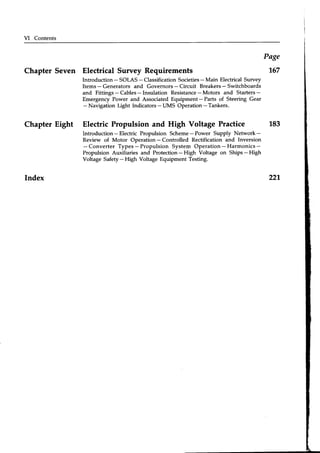
Contents
Chapter Two
Chapter One Ships' Electrical Systems, Safety and Maintenance
Introduction - Ships' Electrical System- Circuit Calculations- Electrical
Diagrams- Electrical Safety- Electric Shock- Insulation Resistance
-
Circuit Testing- Insulation Testing- Continuity Testing- Multimeters
- Diode Tests- Current Clampmeters- Live-line Testers- General
Electrical Maintenance- Fault Finding.
Electrical Distribution
Introduction - Power Distribution System- Insulated and Earthed
Neutral Systems- Significance of Earth Faults- Distribution Circuit
Breakers
- Transformers- Instrument Transformers- Shore Supply
Connection- Circuit Protection- Electric Cables.
Generatorsand Main Circuit Breakers
Introduction - AC Generator Operation - Generator Construction and
Cooling- Excitation Methods - Automatic Voltage Regulation-
Generators in Parallel- Emergency Generators- Generator Protection
- Generator Maintenance- Main Switchboard- Main Circuit Breakers.
Motors and Starters
Introduction - Motor Construction- Enclosuresand Ratings- Induction
Motor Operation- Control Equipment- Direct on-Line Starting-
Reduced Voltage Starting- Speed Control - Motor Protection- Single
PhaseMotors - Maintenance.
Ancillary Electrical Services
Introduction - Ships' Lighting - IncandescentLamps- DischargeLamps
- Voltage Effects on Lighting - Navigation and Signal Lights -
Emergency Lighting - Maintenance of Lighting Fittings - Refrigeration
and Air Conditioning - Galley and Laundry - Cathodic Protection-
Battery Supplies.
Page
L
ttg
Chemical Tankers l4g
Introduction - Tanker Classification - Hazrdous Zones - Electrical
Igintion of Gas - Apparatus Gas Groups - Temperature Class - Types
of Explosion Protection - Exd Flameproof Enclosure - Exi Intrinsic
Safety - Exe Increased Safety - Exn Non-Sparking - Exp Pressurised
Enclosure - Exs Special Protection - Certification and Identification -
Electrical Testing in Hazardous Areas - Maintenance of Ex-protected
Apparatus.
25
57
85
Chapter Three
Chapter Four
Chapter Five
Chapter Six Special Electrical Practicefor Oil, Gas and
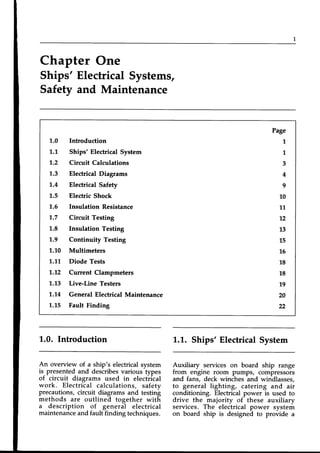
VI Contents
Chapter Seven Electrical Survey Requirements
Introduction - SOLAS - Classification Societies- Main Electrical Survey
Items- Generators and Governors- Circuit Breakers- Switchboards
and Fittings - Cables- Insulation Resistance- Motors and Starters-
Emergency Power and Associated Equipment - Parts of Steering Gear
- Navigation Light Indicators- tlMS Operation - Tankers.
Page
167
Chapter Eight Electric Propulsion and High Voltage Practice
Introduction-Electric Propulsion Scheme-Power Supply Network-
Review of Motor Operation - Controlled Rectification and Inversion
- Converter Types- Propulsion System Operation- Harmonics-
Propulsion Auxiliaries and Protection- High Voltage on Ships- High
Voltage Safety- High Voltage Equipment Testing.
Index
Chapter One
Ships' Electrical Systems,
Safety and Maintenance
L.0
1..1
1.2
1.3
7.4
1,.5
't.6
1.7
1..8
1..9
1.10
1..1L
1..12
1.L3
1.14
1,.15
Introduction
Ships' Electrical System
Circuit Calculations
Electrical Diagrams
Electrical Safety
Electric Shock
Insulation Resistance
Circuit Testing
Insulation Testing
Continuity Testing
Multimeters
Diode Tests
Current Clampmeters
Live-Line Testers
General Elechical Maintenance
Fault Finding
Page
1.
1.
3
4
9
L0
1L
72
13
1.5
76
18
18
t9
20
22
1-.0.Introduction L.1..Ships' Electrical System
An overview of a ship's electrical system
is-presentedand describesvarious types
of circuit diagrams used in electrital
work. Electrical calculations, safety
prec_autions,
circuit diagrams and testing
methods are outlined together with
a description of general electrical
maintenanceand fault finding techniques.
Auxiliary services on board ship range
from engine room pumps, compressors
and fans, deck winches and windlasses,
to general lighting, catering and air
conditioning. Electricalpower is used to
drive the majority of these auxiliary
services. The electrical power system
on board ship is designed to provide a
2 Ships'Electrical Systems,Safetyand Maintenance
securesupply to all loads with adequate
built-in protection for the equipment
and operating personnel.
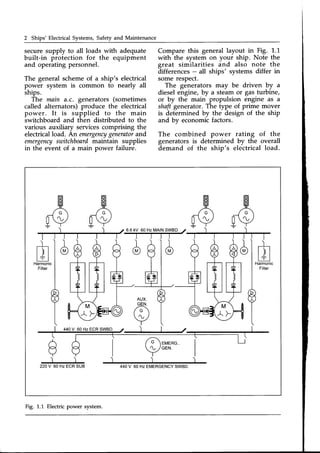
The general schemeof a ship's electrical
power system is common to nearly all
ships.
The main a.c. generators (sometimes
called alternators)produce the electrical
power. It is supplied to the main
switchboard and then distributed to the
various auxiliary servicescomprising the
electricalload. An emergency
generatorand
emergency
switchboardmaintain supplies
in the event of a main power failure.
Compare this general layout in Fig. 1.1
with the system on your ship. Note the
great similarities and also note the
differences - all ships' systems differ in
some respect.
The generators may be driven by u
dieselengine, by a steam or gas turbine,
or by the main propulsion engine as a
shaft generator.The type of prime mover
is determined by the design of the ship
and by economicfactors.
The combined power rating of the
generators is determined by the overall
demand of the ship's electrical load.
FI
ffi
/-:
/  r 
lv
trH
KH
A
[V
ffi
/G
[v
ffi
/G
[v
A
/ ')
60 Hz ECRSWBD
440V 60 Hz EMERGENCY
SWBD.
Fig. 1.1 Electricpower system.
Circuit Calculations 3
Large passenger ships usually have
four large generatorsrated at L0 MW or
more to supply the electric propulsion
motors and the extensive hotel services
on board. A cargo ship may have two
main generatorstypically rated from 350
to 1000kW which are sufficient to supply
the engine room auxiliaries while at sea
and the winches or cranes for handling
cargo while in port. The limited load
required during an emergency requires
that an emergency generator may be
rated from about 10 kW for a small
coaster to about 300 kW or more for
a cargo liner. The shipbuilder must
estimate the number and power rating
of the required generatorsby assessing
the power demand of the load for all
situations whether at seaor in port.
Electrical power on board ship is
commonly generated at 440 V, 60 Hz
(sometimes380 V, 50 Hz). Ships with a
very large electricalpower demand will
require generators that operate at a
high aoltage
(3.3kV, 6.6 kV or 11 kV) to
limit the size of normal load current and
the prospectivefault current.
The British Standard (BS) and Inter-
national ElectrotechnicalCommission
[EC) definition of.Iow aoltage
is 50 V a.c.
to 1000V a.c. (the IEC give this definition
to harmonise British and European
standards).
Lighting and other low power ancillary
services usually operate at 110 V or
220 V, single-phase a.c. Transformers
are used to reduce the 440 V svstem
voltage to these lower voltage leveis.
Where portable equipment is to be
used in dangerous, hot and damp
locations, it is advisable to operate at
55 V or even 24 V supplied again by a
step-down transformer. Occasionally,
transformers are also used to step-up
voltages, e.g. supplying a large 3.3 kV
bow thruster motor from a 440 V
switchboard supply.
Batteriesfor various essentialservices
operate at 1.2 V or 24 V d.c. but
sometimes higher voltages are used
if such loads require a large power
supply.
L.2. Circuit Calculations
The following gives
d.c. and a.c. circuits
a brief revision of
and calculations.
d.c. circuit
Rr = Rr + R2+ Re* . .., (in series)
1 1
* _ * - +. .. (in parallel)
R2 R3
Y: /.R (Ohms
Law)
Zemfs: Zpd's(Kirchhffi
Xlnv: Elour Kirchhffi
P : V . l : 1 2 . R
l = 1 , + 1 ,
Example:
Using the above circuit with a 110 V d.c.
supply and R1 : 6 Q, Rz : 5 O, R3 : 5.5 O:
Calculate all currents, supply power and
p.d. acrossthe 6 O resistor.
Determineas.
11: 11.0/(6
+ 5) : 70A andlz : 110/5.5
: 20A
sosupplycurrenti, f- SOA,.
Supply
poweris P : V.I : 1"L0
. 30 : 3.3kW
fcheckutithP:Z(I'R)]
p.d. across6 Cl resistoris 11.6:1-0 . 6 : 60 V
4 Ships' Electrical Systems, Safety and Maintenance
Example:
Using the above circuit with a
220 V, 60 Hz a.c. supply and R1 : 6 A,
Rz : 5 O, L : 0.1 H, C : 100lF:
Calculate all currents, supply power, overall
power factor and p.d. acrossthe 6 O resistor.
Determineas,
Xy:2.n.f.L= 37.7Q and X6= 7/2.n.f.C:26.5A
Then 21 : 38.2 Q at 81" Aagging)
and 22: 27 A at 79.3" (leading)
So, 11 : 220/38.2 : 5.76 A lagging V by 81"
and l, = 220/27: 8.1,5A leadingV by 79.3"
The total suryIy current is the phasorsum of
11and 12
which must be resoktedinto
"in-phase"
(hoizontal) and
"quadrature" (aertical)
components
beforeadding,
the result (for you to check)is l: 3.34 A
at 43.8" leading
Supply
PowerisP : 220.3.34.cos43.8"
: 531W
lcheckwith P: Z(l2R)]
OaeraIIpowerfactor is cos43.8": 0.72 leading
p.d. across6O : Ir . 6 : 5J6 . 6 -- 34.56V
three phase a.c. circuit
V7 : .l3.Vpp and ly : lpu 0n ST14R)
Vt: Vpu and Iy: '/3.1p11
Gn DELTA)
Ppu = Vp11.Ip11.cosS
: lr&.R
Balanced
3-phase:
P :'/ 3.VL.ly.cosg
Example:
Using the above circuit with a
M0 V, 3-phase, 60 Hz a.c. supply
and Za1: 10 O at p.f. = 0.8 lagging
(balanced load)
Calculate phase and line currents and supply
power when connected as:
(a) STAR and (b) DELTA
Determineas,
(a) in Star, Vpu : 440/J3 : 254 V
so Ippl'J
: 254/1-0: 25.4 A
and ly: lpu : 25.4A also
P : J3 .440
.2s.4
.0.8:1s.49
kw
(b) in Delta, Vpn: VL: 440 V
so lpp: 440/10 : 44 A
and l7: '/S.lE: 76.2A
P : "/3 . 440. 7G.2. 0.8 : 46.46 kw
(noticethis power is three times the
aalue in star)
L.3 Electrical Diagrams
of diagram
an electrical
Singlephase a.c. circuit
I = l, ! l, (phasoraddition)
Xy: 2nfL @) X6: 1/2nfC@)
z : J R 4 x J o r z : J N + x j
l = V / Z
powerfactor
: cosQ: R/Z : PlS (lag or lead)
P : V.l.cos6or P : l2R (W)
Q: V.l.sinfor Q: l2x UAr)
S : V . l o r S : l 2 Z U A )
I
yr,l
V I
' t
v,l
I
There are various types
which attempt to show how
Electrical Diagrams 5
circuit operates. Symbols are used to
representthe various items of equipment.
The shipbuilder provides a complete set
of ships'electrical diagrams. It is
important that you study these diagrams
to be able to read and understand them
competently, and to use them as an aid
in locating electrical faults.
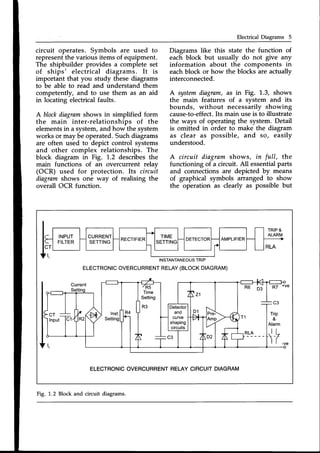
A blockdiagramshows in simplified form
the main inter-relationships of the
elementsin a system,and how the system
works or may be operated.Suchdiagrams
are often used to depict control systems
and other complex relationships. The
block diagram in Fig. 1.2 describesthe
main functions of an overcurrent relay
(OCR) used for protection. lts circuit
diagramshows one way of realising the
overall OCR function.
Diagrams like this state the function of
each block but usually do not give any
information about the components in
eachblock or how the blocks are actually
interconnected.
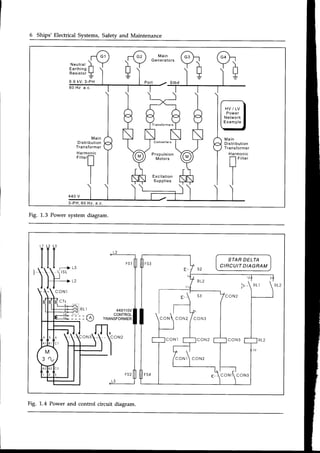
A systemdiagram,as in Fig. 1.3, shows
the main features of a system and its
bounds, without necessarily showing
cause-to-effect.
Its main useis to illustrate
the ways of operating the system. Detail
is omitted in order to make the diagram
as clear as possible, and s0, easily
understood.
A circuit diagram shows, in full, the
functioning of a circuit. A1l essentialparts
and connections are depicted by means
of graphical symbols arranged to show
the operation as clearly as possible but
TRIP
&
ALARM
RLA
INSTANTANEOUS
TRIP
ELECTRONTC
OVERCURRENT
RELAY(BLOCKDTAGRAM)
Ro D3 R7
-c3
Trip
&
Alarm
t l
-r
t l
+ve
-ve
ELECTRONIC
OVERCURRENT
RELAY
CIRCUIT
DIAGRAM
Time
Setting
R3
Fig. 1..2 Block and circuit diagrams.
6 Ships'Electrical Systems,Safetyand Maintenance
I
I
A
I
M ain
Distri
bution
Transformer
Har m onic
rirterll
?
I
I
I
Excitation
S u p p l i e s
3 - P H ,6 0 H z , a . c .
Fig. 1.3 Power systemdiagram.
STARDELTA
CIRCUITDIAGRAM
L3
L2
Fig. 1.4 Power and control circuit diagram.
ElectricalDiagrams 7
without regard to the physical layout
of the various items, their parts or
connections.
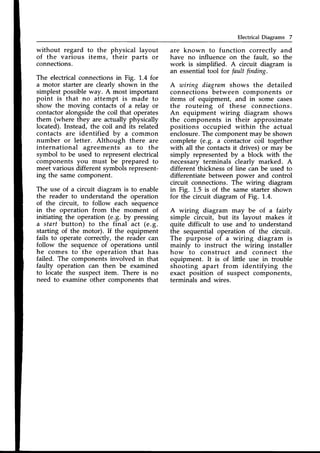
The electricalconnectionsin Fig. 1.4 for
a motor starter are clearly shown in the
simplest possibleway. A most important
point is that no attempt is made to
show the moving contacts of a relay or
contactoralongsidethe coil that operates
them (where they are actually physically
located).Instead, the coil and its related
contacts are identified bv a common
number or letter. Although there are
international agreements as to the
symbol to be used to represent electrical
components you must be prepared to
meet various different symbolsrepresent-
ing the samecomponent.
The use of a circuit diagram is to enable
the reader to understand the operation
of the circuit, to follow each sequence
in the operation from the moment of
initiating the operation (e.g. by pressing
a start button) to the final act (e.9.
starting of the motor). If the equipment
fails to operate correctly, the reader can
follow the sequenceof operations until
he comes to the operation that has
failed. The components involved in that
faulty operation can then be examined
to locate the suspect item. There is no
need to examine other components that
are known to function correctlv and
have no influence on the fault, io the
work is simplified. A circuit diagram is
an essentialtool for fault finding.
A wiring diagram shows the detailed
connections between components or
items of equipment, and in some cases
the routeing of these connections.
An equipment wiring diagram shows
the components in their approximate
positions occupied within the actual
enclosure.The componentmay be shown
complete (e.9. a contactor coil together
with all the contacts it drives) or may be
simply representedby a block with the
necessaryterminals clearly marked. A
different'thicknessof line cln be used to
differentiate between power and control
circuit connections. The wiring diagram
in Fig. 1.5 is of the same starter shown
for the circuit diagram of Fig. 1.4.
A wiring diagram may be of a fairly
simple circuit, but its layout makes it
quite difficult to use and to understand
the sequential operation of the circuit.
The purpose of a wiring diagram is
mainly to instruct the wiring installer
how to construct and connect the
equipment. It is of little use in trouble
shooting apart from identifying the
exact position of suspect components,
terminals and wires.
8 Ships' Electrical Systems, Safety and Maintenance
STAR DELTA
STARTER
WIRING
DIAGRAM
(on door pffid)
t - - - - - - - - -
r STOP START
3 - P H A S E
A . C .
4l 5V.50Hz
AMMEIER
CT
OCR CT s
3 6
O C R U N I T
t 0 l l
0 7 0 8 0 9
L I L 2 L 3
cl To MoToR
Fig. 1.5 Power and control wiring diagram.
Electrical Safety 9
ANSWER
It may well save time and trouble to
convert the wiring diagram into a much
simpler and more useful circuit diagram.
When converting a wiring diagram into
a circuit diagram certain basic rules and
conventions should be followed.
o Every sequence should be drawn
from left to right and from top to
bottom (where possible).
o Each stage should be in order of
occurrencefrom left to right.
. A11contacts and components which
are in series should be drawn in a
straight line (where possible) with the
component they control.
All contacts and components which
are in parallel should be drawn side
by side and at the same level to
emphasisetheir parallel function.
All major components operating
at bus-bar voltage should be drawn
at the same level (or aligned
horizontally) to help identify the
required components quickly.
All contacts should be shown open
ot closedas in their normal or de-
energisedcondition.
QUESTION
What are vou to do if difficulties arise in
locating a'fault on an item of equipment
and only a wiring diagramis available?
There are other conventions but these
cover the main points of good systematic
diagrams. Block,system,circuitand wiing
diagrnmsare the main types in general
use for electrical work. Other types of
diagram are sometimes used to give
information for which the basic types
are unsuitable (e.g. a pictorial view of a
component).
You should study the ship's electrical
diagrams to gain an understanding of
equipment operation prior to carrying
out maintenance or fault finding.
Diagrams should be regarded as an
essential tool when carrying out work
on electricalequipment.
1,.4.Electrical Safety
Large power equipment and processes
utilise high forces.Electrical,mechanical,
thermal and chemical changes produce
the desired operation. Very high values
of voltage, current, power, temperature,
force, pressure etc. createthe possibility
of danger in an engineering system.
To minimise the safetyrisk to personnel
and equipment a system must be
designed and manufactured to the latest
high standardsand be correctlyinstalled.
During its working life the equipment
must be continuously monitored and
correctly maintained by professionally
qualified personnel who understand its
operation and safety requirements.
Before attempting any electrical work,
there are some basic safety precautions
you must bear in mind. The possible
dangers arising from the misuse of
electrical equipment are well known.
Electric shock and fire can causeloss of
life and damage to equipment.
Regulations exist to control the
construction, installation, operation and
maintenance of electrical equipment so
that danger is eliminated as f.ar as
possible. Minimum acceptablestandards
of safety are issued bv various bodies
including national governments, inter-
national governmental conventions
(e.9. SOLAS), national and international
standardsassociations(e.g. BS and IEC),
learned societies(e.9. IEE), classification
societies(e.g. Lloyds), etc. Where danger
arises it is usually due to accident,
neglect or some other contravention of
the regulations.
10 Ships' Electrical Systems, Safety and Maintenance
Ships' staff must operate equipment in
a safe manner and maintain it in a
safe condition at all times. Failure
to do so will cause danger with serious
consequencesarising. Keep in mind an
essential list of DO's and DO NOT's
when working with electricalequipment:
,/ DO get to know the ship's electrical
system and equipment. Study the
ship's diagrams to pinpoint the
location of switches and protection
devicessupplying distribution boards
and essential items of equipment.
Write down this information in
a note book. Become familiar with
the normalindications on switchboard
instruments so that abnormal
operation can be quickly detected.
/ DO operate equipment according
to the manufacturer's recommen-
dations.
DO maintain equipment accordingto
the manufacturer's recommendations
or the shipowner's maintenance
procedures.
DO ensure that all guards, covers
and doors are securelyfitted and that
all bolts and fixings ire in place and
tight.
DO inform the Officer of the Watch
before shutting down equipment for
maintenance.
DO switch off and lock-off supplies,
remove fuses, and display warning
notices before removing covers of
equipment for maintenance.
DO confirm that circuits are DEAD
(by using an approved voltage tester)
before touching conductors and
terminals.
x DO NOT touch live conductorsunder
any pretext
x DO NOT touch rotating parts.
x DO NOT leave live conductors or
rotating parts exposed.
x DO NOT overload equipment.
x DO NOT neglector abuseequipment.
You should think SAFETY at all times
and so develop a safetyconscious
attitude.
This may well save your life and the
lives of others. Most atcidents occur due
to a momentary loss of concentrationor
attempts to short-circuit standard safety
procedures.
DO NOT let this happento YOU.
L.5 Electric Shock
Nearly everyone
electric shock at
it is an unpleasant
it is fatal.
has experienced an
some time. At best
experience,at worst
DAN.'G.ER
r:fla6l1pig
Fig. 1.6 Electricalsafetywarning.
Insulation Resistance 11
Anyone who has accessto live electrical
equipment must be fully aware of first-aid
and safety proceduresrelated to electric
shock as described in relevant safetv
acts. Copies of these safety procedurei
should be displayed on board ship.
Electric shock is due to the flow of
current through your body. This is often
from hand to hand or from hand to foot.
A shock current as low as 15 mA a.c.
or d.c. mav be fatal. Obviouslv the size
of shock current is related to tlie applied
voltage and your body resistance.
Unfortunately, your body resistancegoes
down as the applied voltage goes up.
This means that the shock current is
further increased at high voltages. The
size of your bodv resistance also
depends on other factors such as your
state of health, the degree of contact
with live wires and the perspiration or
dampness on your skin. Typical dry
full-contact body resistance is about
5000 O at 25 V falling to about 2000 O
at 250V.
QUESTION
What would the equivalent shock current
levels be at 25 V and 250 V?
ANSWER
5 mA and 125mA.
Voltages of about 60 V and below are
regarded as reasonablysafe for portable
hand tools. This is why special step-
down isolatingtransformers are used with
portable tools and handlamps. These
transformers supply the tool or lamp
at l,L0 V a.c. but becausethe secondary
winding is centre-tapped to earth, the
maximum shock voltage to earth is
55 V a.c.
Electric shock is often accompanied by
falling, which may cause additional
physical injury and require first-aid
action. If the shock victim is unconscious,
resuscitation must take priority over first
aid methods. Check the resuscitation
techniques described on the electric
shock posters displayed on your ship.
L.6. Insulation Resistance
A11electrical equipment has insulation.
The purpose of the insulation is to keep
electric currents in the conductors and
to prevent contact with live wires. The
electrical resistance of insulation must
be very high (MO) to prevent current
leakingaway from conductors. Insulation
resistanceis measuredbetween:
o Conductors and Earth
o Conductors.
The insulation resistance includes the
resistance of the insulation material and
also the resistanceof any surfacedeposits
of dirt, oil, moisture, etc. Surfacedeposits
can reduce the insulation resistance.
The flow of leakage currents through
such surface deposits is called tracking
which is also affected by the creepage
nnd
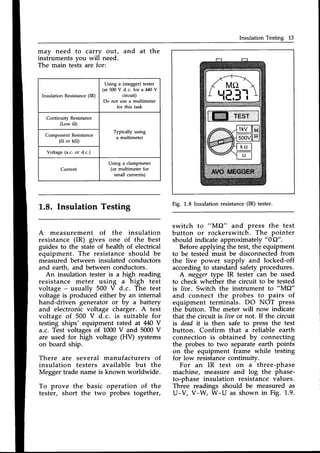
clearance
distances between terminals as
shown in Fig. 1,.7.Equipment must be
maintained in a clean condition to
prevent tracking and to maintain a high
value of insulation resistance (usually at
least 1,MO).
Insulation materials are non-metallic
and have very few of the generally good
physical properties associated with
metals. Insulation is adverselv affected
by many factors such as iumidity,
temperature, electrical and mechanical
stress, vibration, chemicals, oil, dirt and,
of course, old age.
Traditional insulation materials include
cotton, silk, paper, etc. They may be
either dry or treated with suitable
varnishes or resins to exclude moisture
and other harmful substances. Other
12 Ships' Electrical Systems, Safety and Maintenance
Creepage C l e a r a n c e
Distanceacrosssurface
o f i n s u l a t i n g
m a t e r i a l
D i s t a n c e
i n a i r
Fig. 1.7 Creepage and clearance distances.
materials include mica, glass fibre, etc.,
and more modern materialssuch as PVC
and other plastics and compounds. An
extensively used medium not normallv
considered as an insulation material
is the air surrounding the electrical
components.
.
The majority of insulation materials
in common use cannot withstand
temperatures much in excessof 100"C.
All electrical equipment heats up when
carrying load current with the consequent
rise in temperature. This temperature
rise is above that of the ambient cooling
air temperature.
All marine electrical equipment is con-
structed and rated to work satisfactorilv
in a maximum ambient air temperatur-e
of 45"C (Lloyds). Under theseconditions
the expected temperature rise will not
exceed the permitted temperature limit
set for the insulation material. It
is therefore the insulation material
that dictates the maximum permitted
operating temperature of the electrical
equipment.
For this purpose, insulation is
classified according to the maximum
temperature at which it is safe to
operate. Various classes of insulation
are listed in British Standards (BS) and
classes
A, E, B and F are used for marine
electrical equipment. The maximum
temperature allowed for each of these
classes
is:
These are steady surface temperatures
measured with equipment stofped and
no flow of cooling air. Hot-spot
temperaturesof 105'C (Class A) and
130'C (Class B) are generally accepted
as normal at the centre of coils and
windings of machines with these surface
temperatures. A machine operating
continuously with these hot-spot
temperatures would have an expected
life of 15 to 20 vears before the insulation
failed compleiely. However, the life
expectancy would be halved for every
10'C above these allowed hot-spot
temperatures.
1.7. Circuit Testing
This section looks at the various
electrical circuit testing operations you
lnsulation
Class
A E B F H C
Max.
Temp.
55"C 70"c 80"c 105t 130t >130t
Insulation Testing 13
Insulation Resistance (IR)
Using a (megger) tester
(at 500 V d.c. for a 440Y
circuit)
Do not use a multimeter
for this task
Continuity Resistance
(Low O)
Typically using
a multimeter
Component Resistance
(O or kO)
Voltage (a.c. or d.c.)
Current
Using a clampmeter
(or multimeter for
small currents)
may need to carry out, and at the
instruments you will need.
The main tests are for:
f..8. Insulation Testing
A measurement of the insulation
resistance (IR) gives one of the best
guides to the state of health of electrical
equipment. The resistanceshould be
measured between insulated conductors
and earth, and between conductors.
An insulation tester is a high reading
resistance meter using a high test
voltage - usually 500 V d.c. The test
voltage is produced either by an internal
hand-driven generator or by u battery
and electronic voltage charger. A test
voltage of 500 V d.c. is suitable for
testing ships' equipment rated at M0 Y
a.c. Test voltages of 1000V and 5000V
are used for high voltage (Fry systems
on board ship.
There are several manufacturers of
insulation testers available but the
Megger trade name is known worldwide.
To prove the basic operation of the
tester, short the two probes together,
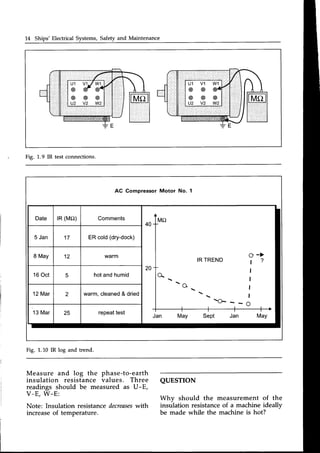
TEST
Fig. 1.8 Insulation resistance(IR) tester.
switch to
t'lll{{2" and press the test
button or rockerswitch. The pointer
should indicate approximately
"0e2".
Beforeapplying the test, the equipment
to be tested must be disconnectedfrom
the live power supply and locked-off
accordingto standard safety procedures.
A meggertype IR tester can be used
to check whether the circuit to be tested
is liae. Switch the instrument to "MO"
and connect the probes to pairs of
equipment terminals. DO NOT press
the button. The meter will now indicate
that the circuit is liae or not. If the circuit
is dendit is then safe to press the test
button. Confirm that a reliable earth
connection is obtained by connecting
the probes to two separate earth points
on the equipment frame while testing
for low resistancecontinuitv.
For an IR test on a
-
three-phase
machine, measure and log the phase-
to-phase insulation resistance values.
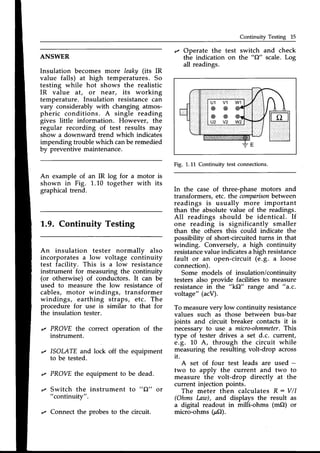
Three readings should be measured as
U-V, V-W, W-U as shown in Fig. 1.9.
1,4 Ships' Electrical Systems, Safety and Maintenance
Fig. 1.9 IR test connections.
AC Compressor Motor No. 1
IR TREND
ERcold(dry-dock)
Fig. 1.10 IR log and trend.
Measure and log the phase-to-earth
insulation resistance values. Three
readings should be measured as U-E,
V-E, W-E:
Note: Insulation resistancedecreases
with
increaseof temperature.
QUESTTON
Whv should the measurement of the
insulation resistanceof a machine ideally
be made while the machine is hot?
Continuity Testing 15
ANSWER
Insulation becomes more leaky (its IR
value falls) at high temperatures. So
testing while hot shows the realistic
IR value dt, or near, its working
temperature. Insulation resistancecan
vary considerably with changing atmos-
pheric conditions. A single reading
gives little information. However, the
regular recording of test results may
show a downward trend which indicates
impending troublewhich canbe remedied
by preventive maintenance.
An example of an IR log for a motor is
shown in Fig. 1.10 together with its
graphical trend.
1.9. Continuity Testing
An insulation tester normally also
incorporates a low voltage continuity
test facilitv. This is a low resistance
instrument-for measuring the continuity
(or otherwise) of conductors. It can be
used to measure the low resistance of
cables, motor windings, transformer
windings, earthing straps, etc. The
procedure for use is similar to that for
the insulation tester.
'z PROVE the correct operation of the
instrument.
r ISOMTE and lock off the equipment
to be tested.
,z PROVEthe equipment to be dead.
,/ Switch the instrument to "Cl" or
"continuity".
,, Connect the probes to the circuit.
r Operate the test
the indication on
all readings.
switch and check
the "C2" scale.Log
Fig. 1.L1 Continuity test connections.
In the case of three-phase motors and
transformers, etc. the comparison
between
readings is usually more important
than the absolutevalue of the readings.
All readings should be identical. If
one reading is significantly smaller
than the others this could indicate the
possibility of short-circuited turns in that
winding. Conversely, a high continuity
resistance
valueindicatesahigh resistance
fault or an open-circuit (e.9. a loose
connection).
Some models of insulation/continuitv
testers also provide facilities to measur-e
resistancein the ttk(2" range and "a.c.
voltage" (acV).
To measureverv low continuitv resistance
values such as those betwe'en bus-bar
joints and circuit breaker contacts it is
necessaryto use a micro-ohmmeter.
This
type of iester drives a set d.c. current,
e.g. l-0 A, through the circuit while
measuring the resulting volt-drop across
it.
A set of four test leads are used -
two to apply the current and two to
measure the volt-drop directly at the
current injection points.
The meter then calculatesR: V/I
(Ohms Law), and displays the result as
a digital readout in milli-ohms (mO) or
micro-ohms (pO).
16 Ships'Electrical Systems,Safetyand Maintenance
L.L0. Multimeters
Routine electrical test work involves
measuringcurrent, voltageand resistance
i.e. Amps, Volts and Ohms. This is most
conveniently done using a multimeter
with all the necessarv functions and
ranges. The instrument may be the
traditional switched-range analogue type
(pointer and scale)or the more common
digital type with auto-ranging and
numerical display.
Digital meters have a clear numeric
readout which may be supported by
a bar-graph display. Where distorted
voltage waveforms are likely (e.g. with
variable frequency motor drives) it is
necessaryto use a "true-rms" meter for
accuracy.Digital meters are also available
which displaythe test voltage waveform
shape with a storageoscilloscopefacility
on the LCD screen.
In all instrument models an internal
battery is fitted for use when measuring
resistance.
Before measuring the resistanceof a
component it is essential that the circuit
is switched off, locked off, and any
capacitorsdischarged.The instrument is
likely to be damagedotherwise.
r l l l r l l l r l l
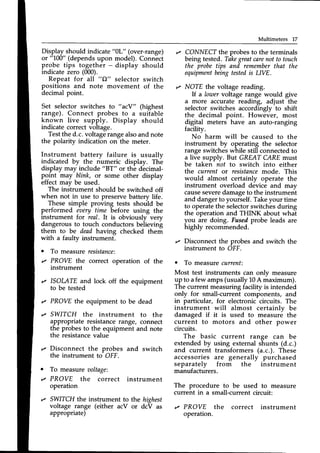
The multimeter should be proaed for
correct operation before use. The
manufacturer's instructions should be
carefully followed for this but a general
procedure is as follows:
Use the correctprobe leads and insert
into the correct socketson the meter.
If the multimeter is an analogue
type:
Ensure the pointer indicates zero -
adjust if necessary.Set selectorswitches
to "{2" and connect probe tips together.
Pointer should deflect to indicate 0 O.
If not at the zero point adjust trimming
controls. Check each resistancerange in
this way.
Set selector switch to " acY" (highest
range). Connect probes to a suitable
known live supply (with CARE) such as
the electricalworkshop testpanel. Pointer
should indicate correctvoltage.
Very special care is necessary when
using a multimeter to check for a live
voltage. If the multimeter has been
accidentallv set to the currentor resistance
range the instrument acts as a low
resistanceacross the live supply. The
resulting short-circuif current may easily
causethe meter to explode with local fire
damage and very serious consequences
for the operator.
Fusedprobe leads are therefore highly
recommended for use with a multimeter.
Instrument batterv failure is checked
when the instrument is set to read "C2"
with the probe tips connectedtogether.
If the pointer fails to reach "0 {1" after
adjustment of the resistance range
trimmer, the battery must be replaced.
The instrument should be switched-off
when not in use to preservebattery life.
If the multimeter is a digital type:
Switch on and connect the two probe
tips together. Set selector switches to
"dcY" (highest range). Display should
indicate zero (000).
Repeat for all " dcY" selector switch
positions and note the shift of the decimal
point. Separate the probe tips. Set
selectorswitches to "C2"(highest range).
Fig. 1.12 Digital multimeter.
Multimeters 17
"0L" (over-range)
model). Connect
display should
Repeat for all "C)"
selector switch
positions and note movement of the
decimal point.
Set selector switches to " acY" (highest
range). Connect probes to a suitable
known live supply. Display should
indicate correctvoltage.
Testthe d.c.voltagerangealsoand note
the polarity indication on the meter.
Instrument battery failure is usuallv
indicated by the numeric display. Thi)
display may include "BT" or the decimal-
point may blink, or some other display
effect mav be used.
The initrument should be switched off
when not in use to preservebattery life.
These simple proving tests should be
performed el)ery time bef.ore using the
instrument for real. It is obviously very
dangerous to touch conductors beiievini;
them to be deadhaving checked them
with a faulty instrument.
o To measure resistance:
Display should indicate
ot "100" (dependsupon
probe tips together -
indicate zero (000).
r PROVE the correct
instrument
r ISOMTE and lock
to be tested
,z CONNECTthe probes to the terminals
being tested. Take
grentcarenot to touch
the probetips and remember
that the
equipment
beingtestedis LIVE.
r NOTE the voltage reading.
lf a lowervoltage range would give
a more accuratereading, adjust the
selector switches accordingly to shift
the decimal point. However, most
digital meters have an auto-ranging
facility.
No harm will be caused to the
instrument by operating the selector
range switcheswhile still connectedto
a live supply. But GREAT CAREmust
be taken not to switch into either
the current or resistance
mode. This
would almost certainly operate the
instrument overload device and mav
causeseveredamageto the instrument
and dangerto yourself.Takeyour time
to operatethe selectorswitches during
the operation and THINK about what
you are doing. Fusedprobe leads are
highly recommended.
,z Disconnect the probes and switch the
instrument to OFF.
r To measurecurrent:
Most test instruments can only measure
up to afew amps(usually 10A maximum).
The current measuring facility is intended
only for small-current components, and
in particular, for electronic circuits. The
instrument will almost certainly be
damaged if it is used to measure the
current to motors and other Dower
circuits.
The basic current range can be
extendedby using external shunts (d.c.)
and current transformers (a.c.). These
accessoriesare generally purchased
separately from the instrument
manufacturers.
The procedure to be used to measure
current in a small-current circuit:
r PROVE the correct instrument
operation.
operation of the
off the equipment
,z PROVEthe equipment to be dead
,z SWITCH the instrument to the
appropriate resistancerange, connect
the probes to the equipment and note
the resistancevalue
,z Disconnect the probes and switch
the instrument to OFF.
o To measureooltage:
r PROVE the correct instrument
operation
r SWITCHthe instrument to the highest
voltage range (either acV or dcV as
appropriate)
18 Ships'Electrical Systems,Safetyand Maintenance
,z SWITCHthe instrument to the highest
current range (either acA or dcA as
appropriate).
,z TURN OFF the power to the circuit
to be tested and discharge all
capacitors.
'z OPEN the circuit in which current
is to be measured - removing a
fuse-link often gives a convenient
point for current measurement.
Securely connect the probes in SER/ES
with the load in which current is to be
measured.
Turn ON the power to the circuit
being tested. Note the current size on
the meter display.
Turn OFF the power to the circuit
being tested and dischargeall capacitors.
Disconnectthe test probes and switch
the instrument to OFF. Reconnect the
circuit that was being tested.
Often, the most convenient way to
measure current is to use a clamp-meter
which is simply clamped around an
insulated
conductor.
through the diode/p-n junction while
it also acts as a voltmeter to measure
the volt-drop acrossit.
,/ CONNECT the two probes acrossthe
diode.
READ the forward volt-drop across
the diode. This should be between
500 mV and 900 mV (0.5-0.8 V)
for a healthy silicon diode or p-n
junction.
REYERSE the probe connections
and the display should indicate
oaer-range.
If the display indicates over-range
in both directions the diode is open-
circuitfaulted. If the display indicates
less than 1 V in both directions, the
diode may be short-circulf
faulted.
The associateddiode circuitrv mav
be giving false readings so the"diod"e
must be disconnectedfrom the circuit
then re-tested.
1..12.Current Clampmeters
I
L.LL.DiodeTests -++-
I
Electronic diodes, and other semi-
conductor devices with p-n junctions
(e.g. the base-emitterof a transistor)can
be tested using a digital type instrument
using the following procedure:
,z PROVE the correct instrument
operation.
'z SWITCHthe instrument to diode test.
If the diode is still in circuit,
turn off the power to the circuit,
dischargeall capacitors and remove
fuses.
In this test the instrument drives
a small d.c. current (a few mA)
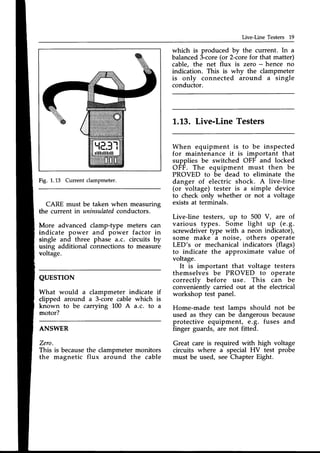
Power currents (a.c.) can be measured
simply by means of a clampmeter
which acts as a current transformer.
The instrument tongs are clipped round
a single insulated conductor - the circuit
is not interrupted.
The value of current is obtained from
the magnetic flux strength around the
conductor and is usually displayed on
a digital display. Direct current (d.c.)
measurement is also available with
clampmeters having a flux-voltage
transducer known as a "Hall-effect"
device.
Many modern clampmeters are virtually
multimeters with the addition of facilities
to measure voltage and resistance as
well as measuring currents up to
1000A.
Live-Line Testers 19
which is produced by the current. In a
balanced3-core(or 2-corefor that matter)
cable, the net flux is zero - hence no
indication. This is why the clampmeter
is only connected around a single
conductor.
L.L3. Live-Line Testers
When equipment is to be inspected
for maintenance it is important that
supplies be switched OFF and locked
OFF. The equipment must then be
PROVED to be dead to eliminate the
danger of electric shock. A live-line
(or voltage) tester is a simple device
to check only whether or not a voltage
existsat terminals.
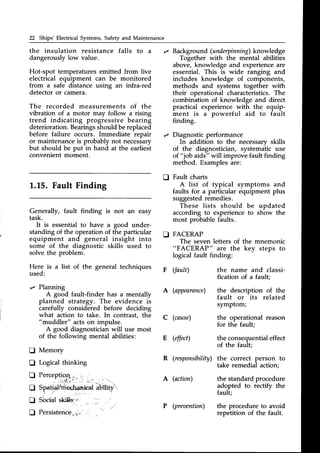
Live-line testers, up to 500 V, are of
various types. Some light up (e.g.
screwdriver type with a neon indicator),
some make a noise, others operate
LED's or mechanical indicators (flags)
to indicate the approximate value of
voltage.
It is important that voltage testers
themselves be PROVED to operate
correctlv before use. This can be
convenientlv carried out at the electrical
workshop t-estpanel.
Home-made test lamps should not be
used as they can be dangerousbecause
protective equipment, e.g. fuses and
finger guards, are not fitted.
Great care is required with high voltage
circuits where a special HV test probe
must be used, see Chapter Eight.
Fig. 1.13 Current clampmeter.
CARE must be taken when measuring
the current in uninsulated
conductors.
More advanced clamp-type meters can
indicate power and power factor in
single and three phase a.c. circuits by
using additional connections to measure
voltage.
QUESTION
What would a clampmeter indicate if
clipped around a 3-core cable which is
known to be carrying 100 A a.c. to a
motor?
ANSWER
Zero.
This is becausethe clampmeter monitors
the magnetic flux around the cable
20 Ships'Electrical Systems,Safetyand Maintenance
LEDINDICATORS
Fig. 1.14 Live-line testers.
1..14.General Electrical
Maintenance
and optimum economy in order to help
keep operational costs to a minimum to
maintain financial competitiveness.
Nearly all equipment needsmain-
tenance.
An efficient maintenance engineer must
get to know the power system and its
equiprnent. The ship's drawings and
circuit diagrams must be checked and
updated to relate them to the actual
equipment. Electrical servicesand equip-
ment must be kept under continuous
observation so that normal healthy
operating conditions become known,
and abnormal operation becomesquickly
apparent. Faults can then be pin-pbinted
and corrected before a breakdown
occurs.
Maintenancecan be classifiedas:
o Breakdownmaintenance
o Planned maintenance
o Condition monitoring
All equipment is subject to wear and
tear, eventually reaching the end of its
useful life when it must be replaced.
As equipment nears the end of its
safe working life its condition can
deteriorate to such an extent as to be
a danger to personnel and other plant.
The purpose of maintenance, therefore,
is to extend the useful life by repair
and/or replacement of defective p-arts
and to maintain it in a safe and
serviceablecondition.
The marine environment is particularly
arduous for electrical equipment du-e
to the damp, salt-laden atmosphere,
extremes of temperature and constant
vibration. Shipboard equipment is in
particular need of correct maintenance.
The continuousoperationof equipment
on board ship demands high effitiency
General Electrical Maintenance 21
Breakdownmaintenance(corrective main-
tenance) is when equipment is left
untouched until a breakdown occurs.
At this time the equipment is repaired
or replaced and any other specified
maintenanceprocedure carried out.
Plannedmaintenance
(preventive main-
tenance) is when equipment is regularly
inspected and maintained according to
a fixed timetable and set of procedures
specifying the actual work to be done
to prevent equipment failure.
Condition monitoring (another form
of preventive maintenance) is when
equipment is regularly monitored and
tested. When monitoring indicates that
a breakdown is imminent, the equipment
is repaired or replaced and any other
specified maintenance procedures are
carried out. Regular insulation testing
and aibration testins are two forms of
condition monitoring.
There are several disadaantagesin
breakdown maintenance:
X A serious breakdown of equipment
may cause sufficient down-time to
put the ship out of commission until
it is repaired.
X If several breakdowns occur simul-
taneously the available manpower on
board ship may not be able to cope
adequately,resulting in delays.
X Some items of equipment may need
the specialist services of the manu-
facturer to carry out repairs which
may causefurther delays.
Planned maintenance is carried out
at fixed regular intervals whether the
equipment needs it or not and the aim
is to prevent breakdown.
This type of maintenance has the
following adaantages:
z Fewer breakdowns and reduced
down time produces higher levels of
operating efficiency.
Maintenance is carried out at times
favourable to the operation of the
plant.
More effective labour utilisation
because maintenance is carried out
at times favourable to the ship's staff.
Replacement equipment can be
ordered in advance.
Equipment is maintained in a safe
condition with reduced possible
dangers.
Where a specialist manufacturer's
services are required these can be
obtained at convenient times to suit
the ship operation.
z Replacementof short-life components
at scheduledintervals.
Condition monitoring is also carried out.
at fixed regular intervals. The aim is
to forestall breakdown by predicting
probable failure from the TREND shown
by the monitoring results.
The advantageof this type of maintenance
is that equipment is not subjected to
unnecessarymarntenance.
Equipment is regularly condition-
monitored according to a monitoring
schedule. Measurements are taken of
insulation resistance, temperature and
vibration (of motors). Contacts and
other parts subject to deterioration are
inspected.
All findings are recorded in an
historical record file. No maintenanceis
carried out until the trend of test results
indicate that it has become necessarv.
The equipment is then either replacei,
repaired or subjectedto a major overhaul
as specifiedon a job card.
A maintenance records svstem is
required. The recorded measurements
of insulation resistance may show a
falling trend indicating a piogressive
degradation of insulation. The equipment
should be inspected and repaired before
22 Ships'Electrical Systems,Safetyand Maintenance
the insulation resistance falls to a
dangerouslylow value.
Hot-spot temperaturesemitted from live
electrical equipment can be monitored
from a safe distance using an infra-red
detectoror camera.
The recorded measurements of the
vibration of a motor may follow a rising
trend indicating progressive bearing
deterioration.Bearingsshouldbereplaced
before failure occurs. Immediate repair
or maintenanceis probably not necessary
but should be put in hand at the earliest
convenient moment.
L.L5. Fault Finding
Generally, fault finding is not an easy
task.
It is essentialto have a good under-
standing of the operation of the particular n
equipment and general insight into
some of the diagnostic skills used to
solve the problem.
Here is a list of the general techniques
used:
z Planning
A good fault-finder has a mentally
planned strategy. The evidence is
carefully considered before deciding
what action to take. In contrast, the
"muddler" actson impulse.
A good diagnosticianwill use most
of the following mental abilities:
I Memory
I Logical thinking
I Percepliog._.,,
. ^ ' ; r Y l
, t - . - . t : : .
' - -
tr Spatiahnrec,lqrieat
iUitity'
f, Socialskills;, _, ,,'
I Persistence.,,i.:-
. .
Backgroun
d (underpinning)
knowledge
Together with the mental abilities
above,knowledge and experienceare
essential. This is wide ranging and
includes knowledge of components,
methods and systems together with
their operational characteristics.The
combination of knowledge and direct
practical experience with the equip-
ment is a powerful aid to fault
finding.
Diagnostic performance
In addition to the necessarv skills
of the diagnostician, systematic use
of " job aids" will improve fault finding
method. Examplesare:
Fault charts
A list of typical symptoms and
faults for a particular equipment plus
suggestedremedies.
These lists should be updated
according to experienceto show the
most probablefaults.
FACERAP
The seven letters of the mnemonic
"FACERAP" are the key steps to
logical fault finding:
D
F (fault)
A (appearance)
C (cause)
E (effect)
the name and classi-
fication of a fault;
the description of the
fault or its related
symptom;
the operational reason
for the fault;
the consequentialeffect
of the fault;
R (responsibility)the correct person to
take remedial action;
A (action) the standardprocedure
adopted to rectify the
fauLt;
(preoention) the procedure to avoid
reoetition of the fault.
Fault Finding 23
z Search strategy
Once the diagnostician can visualise
the circuit or machine as a series of
functions and/or use a job aid, a
search strategy can be applied to
locate the fault in the minimum time.
A "six step approach" is sum-
marised as:
1. Collect evidence (stop and think).
2. Analyse evidence
(checkassumptions).
3. Locatefault (inspect and test).
4. Determine and remove cause.
5. Rectify fault.
6. Check system.
Conclusion?
Fault finding is not easy!
However, a logicalapproach supported
by knowledgeand experience
will certainly
help.
25
Chapter Two
Electrical Distribution
2.0
2.1
2.2
2.3
2.4
2.5
2.6
2.7
2.8
2.9
Introduction
Power Dishibution System
Insulated and Earthed Neutral Systems
Significance of Earth Faults
Distribution Circuit Breakers
Transformers
Instrument Transformers
Shore Supply Connection
Circuit Protection
Electric Cables
Page
25
25
29
3L
36
37
39
4't
43
51
This chapter examines a ship's electrical
distribution network in detail. Particular
attention is paid to earth faults and their
detection together with a survey of the
ralg,e and purpose of the various types
of electrical switchgear and proteition
equipment. Ships' electric cables with
their glanding, terminations and testing
are reviewed.
2.0. Introduction
2.1-.Power Distribution
System
The function of a ship's electrical
distribution system is to safely convey
the generated electrical power to every
item of consumerequipment connected
to it. Probably the most obvious element
in the system is the main distribution
centre, i.e. the ship's main switchboard.
The main board supplies bulk power to
qotor group starter boards (often part
of the main board), section boards
-and
distribution boards. Protection, e.g.
circuit-breakers and fuses, strategically
placed throughout the system auto-
matically disconnects a faulty circuit
within the network. Transformers inter-
c-onnectthe high voltage and low voltage
distribution sectionsof the svstem.
The operational state of a-distribution
system is indicated by the monitors for
power, voltage, current and by protection
relays for overcurrents and earth-faults
at each main control centre. Study the
electrical power diagrams for your own
ship to see if you can relate them to the
actual equipment they represent.
The vast majority of ships have an
alternating current (a.c.) distribution
26 Electrical Distribution
system in preference to a direct current
(d.c.)system.
The required electrical services are
broadlv considered as main and
emetgehcysupplies.
o Main supply
An a.c. network is cheaper to install
and operate than a d.c. system. In
particular, d.c. offers a higher power/
weight ratio for the generation, distribu-
tion and utilisation of electricity. Simple
transformers efficiently step-up or
step-down a.c. voltages where required.
Three-phasea.c. is effectively converted
into rotary mechanicalpower in simple
and efficient induction motors.
A ship's electrical distribution scheme
generally follows shore practice. This
allows normal industrial equipment to be
usedon boardship afterbeing"mtrinised"
,
where necessary,to withstand the rigours
of a sea-life (e.g. it must withstand the
vibration, humidity, high temperature/
ozone, sea-water, etc. encountered in
various parts of the ship).
The majority of ships have a 3-phase
d.c., 3-wire, 440 V insulated-neutral
svstem. This means that the neutral
pbint of star-connectedgeneratorsis not
earthed
to the ship's hull. For continental
European vessels, a 380 V, 3-phase
system is common.
Ships with very large electrical loads
havegeneratorsoperatingathigh voltages
(HV) of 3.3 kV, 6.6 kV and even 11 kV.
Such high voltages are economically
necessary in high power systems to
reduce the size of current, and hence
reduce the size of conductorsand equip-
ment required. Operating at such high
voltages is becoming more common as
ship sizeand complexityincrease,e.g. for
large cruise liners. Offshore oil and gas
production platforms operate at up to
13.8kV, where equipment weight saving
is important. Distribution systems at
these high voltages usually have their
neutral points earthed through a resistor
or earthingtransformerto the ship's hull.
The frequency of an a.c. power system
can be 50 Hz or 60 Hz. In Europe and
most of the world the national frequency
is 50 Hz but is 60 Hz in North America
and in a few other countries. The most
common power frequency adopted for
useon board shipsand offshoreplatforms
is 60 Hz. This higher frequency means
that motors and generatorsrun at higher
speeds with a consequent reduction in
size for a given power rating.
Lighting and low power single-phase
supplies usually operate at the lower
voltage o1220V a.c. although 1L0V a.c.
is alsb used. These voltages are derived
from step-down transformers connected
to the M0 V system.
The distribution system is the means
by which the electrical power produced
by the generators is delivered to the
various motors, lighting, galley services,
navigation aids, etc. which comprise the
ship's electricalload.
The electrical energy is routed through
the main switchboard, then distributed
via cables to section and distribution
boards then ultimately to the final load
consumers.
The circuit-breakers and switches are
the means of interrupting the flow of
electriccurrent, and the fuses and relays
protect the distribution system from the
damaging effects of large fault currents.
Fig. 2.1 shows an HV/LV layout of a
ship's distribution system. The system
is called a radial or branchirg system.
This distribution system has a simple
and logical structure. Each item of load
is supplied at its rated voltage via the
correct size of cable and is protected by
the correctly rated protection device.
The main electrical load is divided into
essentialand non-essential
services.
Essentialservices are those required
for the safety of personnel and for the
safe navigation and propulsion of the
ship. They include certain supplies to
navigational aids, communications,
machinery spaces, control stations and
Power Distribution System 27
fH
A
[V
l_
E l
L+-J
Harmonic
Filter
a
Y
')
22OV 60HzECRSUB
ffi
fa
ffi
[a
A
/ ')
440V 60 Hz EMERGENCY
SWBD.
Fig.2.1 HV/LV power system.
teering gear. The essential services breaker which is typically high set at
150"/"with a 20 seconds delay.
In addition, each generaior has its
9wn preference
overload trip, this being
low set generally at 110"/" current,
instantaneousoperation.
If a generator overload condition
dev,elops,its preference overload trip
will operate to energise the timing
relay. The timing relay then operates
to disconnect non-essential services in
a definite order at set time intervals, e.g.
o 1st trip - air conditioning and
ventilation - 5 seconds
may be supplied directly from the main
switchboard or via section boards or
distribution boards.
Emergency supplies are necessaryfor
loads r,inic6 are required to handle a
potentially dangeroussituation.
To maintain generator operation during
an overload, a preferentialload shedding
arrangement is employed. This is
ac-bie-ved
by u special overload relay,
called a preference
trip relay.
If a generator overload develops, the
preference trip relay sets an alarm and
actsto trip selectednon-essential
loads.
This reducesthe generatorload so that
it may continue to supply essential
circuits.
Each generator has its own normal
overcurrent relay to trip its own circuit-
o 2nd trip - refrigerated cargo plant -
l-0 seconds
o 3rd trip - deck equipment -
L5 seconds
28 ElectrirralDistribution
This order of tripping obviously varies
with the ship type. When sufficient
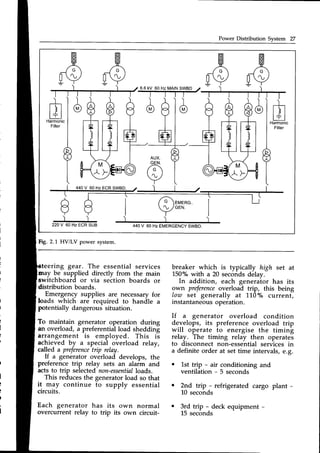
non-essential
load has been disconnected,
the preference overload trip resets and
no further load is disconnected.
The generator preference trip system
can also be initiated by low generator
frequency or by low speed at the
generatorprime-mover.
In many cases the preference trip
protection is incorporated in a combined
electronic relay which also monitors
generatorovercurrentand reversepower.
To maintain the preference relay trip
settings as originally specified they must
be periodically tested by calibrated
current injection.
Preferential load shedding, generator
scheduling and load sharing is usually
part of an overall pout)er
management
system
(PMS)under computer control.
o Emergency supply
An emergency electrical power service
must be provided on board in the event
of a main power failure. Such a supply
is required f.or emergency lighting,
alarms, communications, watertight
doors and other services necessary
to maintain safety and to permit saf-e
evacuationof the ship.
Regulations require that the emergency
power source be a generator, or
batteries,or both. The emergencypower
source must be self-contained and not
dependent upon any other engine room
power supply. A battery when fully
charged is obviously self-contained.
An emergency generator must have an
internal combustion engine as prime
mover and have its own fuel supply tank,
starting equipment and switchboard in
the near vicinity.
The emergencypower sourcemust come
into action following a total mains
failure. Emergency batteries can be
arranged to be switched into service
immediately following a main power
failure. Emergency generators can be
hand cranked, but are usually auto-
matically started by compressed air or
a battery to ensure immediate run-up
following a main power failure.
Although regulations may permit a
battery to be the solesourceof emergency
power, in practice a suitable battery may
be physically very large and hence a
dieseldriven generatoris usually installed
with its own small starting battery or
air-start supply. Other small batteries
may also be installed to locally supply
control and communication equipment.
On passenger ships, regulations
require that the primary emergency
power supply be provided by a diesel
driven generator for up to 36 hours
(18 hours for non-passenger vessels).
In addition, an emergency transitional
batterymust also be installed to maintain
vital services (mainly lighting) for a
short period - typically a minimum of
3 hours. This emergency battery is to
ensure that a total blackout cannot occur
in the transitional period between loss
of main power and the connection of
the emergencygenerator.
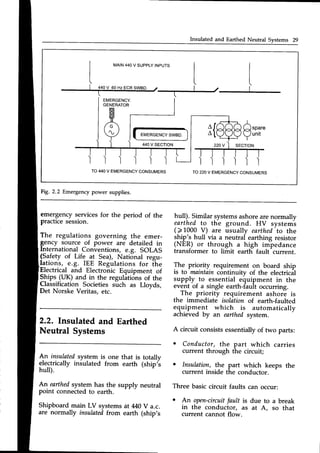
A typical ship's distribution system
is shown in Fig. 2.2. The system in-
corporatesemergencypower supplies.
There is no standardelectrical supply
arrangement, all ships differing in some
respect. It will be seen that both the
main and the emergencyconsumers' are
supplied by the main service generators
during normal operating conditions. In
the event of an emergency, only the
emergency services are supplied by the
emergencygenerator.
The emergency power system must be
ready and available at all times. Such
reliability requires special care and
maintenance. At regular intervals it
must be tested to confirm that it does
operate correctly. The testing is normally
carried out during the weekly emergency
fire and boat drill practice sessions.The
main generators are not shut down
but the emergency power sources are
energised and connected to supply the
Insulated and Earthed Neutral Systems 29
MAIN440V SUPPLY
INPUTS
t
EMERGENCY
GENERATOR
EMERGENCY
SWBD.
Qsp"re
!unit
440V 60 Hz ECRSWBD.
{(
220
l ) ) ) ) l
TO220V EMERGENCY
CONSUMERS
) t t ) l
TO440V EMERGENCY
CONSUMERS
Fig. 2.2 Emergencypower supplies.
emergencyservicesfor the period of the
practicesession.
The regulations governing the emer-
gency source of power are detailed in
International Conventions, e.g. SOLAS
-(Safetyof Life_1t Sea), Nati6nal regu-
lations, e.g. IEE Regulations for t"he
Electrical and Electronic Equipment of
Qhips (UK) and in the regulitidns of the
Classification Societies such as Lloyds,
Det Norske Veritas, etc.
2.2. Insulated and Earthed
Neutral Systems
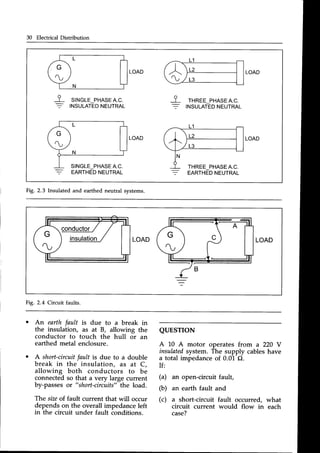
An insulafedsystem is one that is totallv
electrically insulated from earth (shipis
hull).
An earthedsystem has the supply neutral
point connectedto earth.
Shipboardmain LV systemsat M0 V a.c.
are normally insulatedfuom earth (ship,s
hull). Similar systemsashoreare normally
earthed to the ground. HV systems
( > L000 V) are usually earthedto the
ship's hull via a neutrai earthing resistor
(NER) or through a high im-pedance
transformer to limit eartli fault-current.
The priority requirement on board ship
is to maintain continuity of the electricil
supply to essential eiluipment in the
event of a single earth-fault occurring.
The priority requirement ashore is
the immediate isolationof earth-faulted
equipment which is automatically
achieved by an earthedsystem.
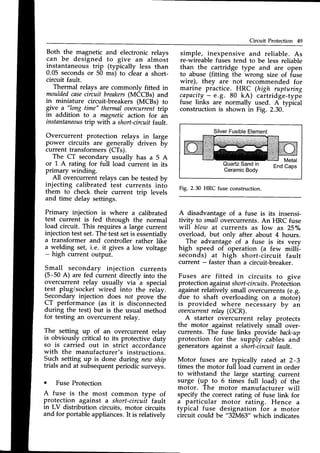
A circuit consistsessentiallyof two parts:
o Conductor,the part which carries
current through the circuit;
o Insulation, the part which keeps the
current inside the conductor.
Three basic circuit faults can occur:
o An open-circuit
fault is
in the conductor, as
current cannot flow.
due to
at A,
a break
so that
30 Electrical Distribution
L1
LOAD
-9- sTNGLE-PHASE
A.c.
= INSULATED
NEUTRAL
e
-:- THREE_PHASE
A.C.
INSULATED
NEUTRAL
I
SINGLE_PHASE
A.C.
EARTHED
NEUTRAL
THREE_PHASE
A.C.
EARTHED
NEUTRAL
Fig. 2.3 Insulated and earthed neutral systems.
Fig. 2.4 Circuit faults.
An earth fault is due to a break in
the insulation, as at B, allowing the
conductor to touch the hull or an
earthed metal enclosure.
A short-circuitfault is due to a double
break in the- insulation, as at C,
allowing both conductors to be
connectedso that a very large current
by-passesor "short-circuits"
the load.
The sizeof fault current that will occur
dependson the overall impedanceleft
in the circuit under fault conditions.
QUESTION
A 10 A motor operates from a 220 Y
insulatedsystem. The supply cableshave
a total impedanceof 0.01 O.
If:
(a) an open-circuit fault,
(b) an earth fault and
(c) a short-circuit fault occurred, what
circuit current would flow in each
case?
Significance of Earth Faults 31
ANSWER
(a) the open-circuit fault has infinite
impedance, so:
- 22ov : ZER}
oQ
(b) the earth fault has NO effect on
the circuit current,
so I remains at 10 A. (becausethis
is an INSULATED system)
(c) the short-circuit fault impedance is
limited onlv by the 0.01 O of the
cables,so:
-
. v 220v
lsc : : 22.000
A or 22kAlt
z 0.01f)
The majority of earth faults occur within
electricalequipment due to an insulation
failure or a loose wire, which allows a
live conductor to come into contact with
its earthed metal enclosure.
To protect against the dangers of electric
shock and fire that may result from
earth faults, the metal enclosures and
other non-current carrying metal parts
of electricalequipment must be earthed.
The earthing conductor connects the
metal enclosureto earth (the ship's hull)
to prevent it from attaining a dangerous
voltage with respect to earth. Such earth
bonding of equipment ensures that it
always remains at zero volts.
2.3. Significanceof Earth
Faults
If a single earth fault occurs on the live
line of an eartheddistribution svstem it
would be equivalent to a short-circuit
fault across the generator through the
ship's hull. The resulting large earth
fault current would immediately cause
the line protective device (fuse or circuit
breaker) to trip out the faulty circuit.
The faulted electrical equipment would
be immediately isolated from the supply
and so rendered safe. However, the
loss of power supply could create a
hazardous situation, especially if the
equipment was classed essential,e.g.
steering gear. The large fault current
could also cause arcing damage at the
fault location.
In contrast, a single earth fault " A"
occurring on one line of an insulated
distribution system will not cause any
protective trip to operateand the system
would continue to function normallv.
SeeFig. 2.5. This is the important point:
equipment continues to operate with a
single earth fault as it does not provide
a complete circuit so no earth fault
current will flow.
If a second earth fault at "B" occurred
on another line in the insulatedsystem,
the two earth faults together woirld be
equivalent to a short-circuit fault (via
the ship's hull) and the resulting large
current would operate protection devices
and cause disconnection of perhaps
essential services creating a risk to the
safety of the ship.
An insulateddistribution systemtherefore
requires two earth faults on tuto different
lines to cause an earth fault current to
flow.
In contrast, an earthed distribution
system requires only one earth fault on
the line conductor to createan earth fault
current which will trip out the faulty
circuit.
An insulatedsystemis, therefore, more
effective than an earthed system in
maintaining continuity of supply to
essentialservices.Hence its adoption for
most marine electricalsystems.
Note: Double-pole
switches with fuses in
both lines are necessaryin an insulated
single-phasecircuit.
High voltage systems (3.3 kV and
above)on board ship arenormally earthed.
t : !
Z
32 Electrical Distribution
FUSES
LOADS
FUSES
LOADS
-=.
FAULT -
w-l
Fig. 2.5 Double earth faults in an insulated system.
Fig.2.6 Neutral earthing in HV system.
Such systems are usually earthed via a
resistor connecting the generator neutrals
to earth as shown in Fig. 2.6.
The ohmic value of each earthing resistor
is usually chosen so as to limit the
maximum earth fault current to not
more than the generator full load current.
Such a Neutral Earthing Resistor (NER)
is usually assembledfrom metallicplates.
The use of such an earthed HV svstem
means that a single earth fault will cause
current to flow in the neutral connection
wire. This is monitored by an earth fault
(E/F) relay to create aiarm and trip
functions.
QUESTTON
What would be the ohmic value of an
NER to limit the earth fault current to
the full load rating of a 2 MW, 0.8 pf,
3.3 kV, 3-phasea.c. generator?
ANSWER
In a 3-phasesystem;P :,'/5.Vulr.cos{
where V7 is line voltage (3.3 kV),
/r is the line current and cos@is the
power factor.
Significance of Earth Faults 33
The generatorfull load current is:
t _
I L _
2,000,000 : 4 3 7 A
EXAI,IPLEINDICATION
o o o
EARTH FAULTON LINE 3
F  t t r 5 l
L-
-]
lwtrcH
Fig.2.7 Earth fault monitoring with lamps.
Earth indication lamps in a 3-phasea.c.
systemare arrangedasshown inFig. 2.7.
When the system is healthy (no earth
faults) then the lamps glow with equal
half brilliance. If an earth fault occurs
on one line, the lamp connected to that
line goes dim or extinguished. The other
lamps experience an increased voltage
so will glow brighter than before. Earth
indication lamps have been the most
common method used for many years,
being an inexpensive installation which
is easy to understand. Their major
disadvantage is that they are not very
sensitive and will fail to indicate the
presence of a high impedance earth
fault. This has led to the development
of instrument type earth fault indicators
which are being increasinglyused.
One common type of earth fault
instrument-type monitor connectsa small
d.c. aoltageto the distribution system.
Any resulting d.c. currentis a measureof
the insulation resistanceof the system.
The injection-type instrument limits the
maximum earth fault monitoring current
to only 1 mA (compared with about
60 mA for earth lamps), and the meter
indicates insulation resistance directly
in kO or MO. The monitor triggers an
alarm when its set value is reached.
This type of arrangement has been
developed to meet regulations which
demand that on tankers, for circuits in or
passing through hazardous zones, there
must be continuous monitoring of the
system insulation resistance.Visual and
v3. 3,300
. 0.8
Under EiF conditions a phase voltage of:
VpH:
=q
: 1905Vdrives the fault current
V 3
through the NER. So its ohmic value
has to b"r
1905
v : 4.4Q
437A
Certainessentialloads(e.g. steeringgear)
can be supplied via a transformer with
its secondary unearthed to maintain
security of supply in the event of a
sinele-earth fault.
Regulations insist that tankers have
ly insulated distribution syslems. This
intended to reduce danger from earth
ult currents circulating in the hull
ithin hazardous zones which may
use an explosion of the flammable
stem does not extend
gine room bulkhead
area.
ical supplies forward of the engine
bulkhead are usually 3-phaseM0 V
'r.oomDulKneaqare usuaily J-pnase++u v
insulatedand obtained from a 3-phase
3.3 kVlM0 V transformer.
Regulations require that an earth fault
monitor is fitted to the main switchboard
to indicate the presenceof an earth fault
on each isolatedsection of a distribution
system, e.g. on the 440 V and 220 Y
sections. An earth fault monitor can be
either a set of indicator lamps or an
instrument (calibrated in kf) or MO) to
show the system IR value to earth.
forward of the
and into the
34 Electrical Distribution
Measurement of the
in an earthedsystem
varlous means; one
in Fig. 2.10.
earth fault current
can be provided by
method is shown
Fig. 2.8 Earth fault monitoring by d.c. injection.
audible alarms are given if the insulation
resistancefalls below a pre-setvalue.
An HV system (1 kV - 11 kV) is usually
earthed at the generator neutral point
via a neutralearthingresistor(NER). This
arrangement allows the neutral (and
henceearthfault) current to be monitored
for alarm/trip by a current transformer
(CT) and E/F relay.
3-PHASE
BUS-BARS
Fig,2,9 NER circuit.
STARTER
MAGNETIC
CORE
Fig. 2.10 Core-balance
CT.
Here the current transformer (CT)
measuresthe phasor sum of the 3 line
currents supplied to the motor. If the
motor is healthy (no earth faults) the
phasor sum of the currents measured
by the CT is zero.
-
If an earth fault (E/F) occurs in the
motor, an earth fault current flows and
the phasor sum of the currents is now
not zero. The current monitored bv the
E/F relay is used to trip the coniactor
in the starter to isolate the faulty motor
circuit.
The earth fault monitor on the switch-
board shows the presence of an earth
fault on the distribution svstem. It is
up to the maintenance staff to trace
(searchfor) the exactlocation of the fault
and then to clearit as quickly aspossible.
Fig. 2.11 Earth fault monitors in a distribution
system.
Alternatively, a special three-phase
earthing transformeris connected to the
HV systembus-bars.This high impedance
earthing transformer is arranged to limit
the maximum permitted E/F current and
initiate an alarm/trip voltage signal to a
connectedprotection relay.
'l u_
ad
ll/-*-' Arocnr-
Llt_ ?ALARM
tofi ,l ,lTo
(mn))/-l--lexrenul
CURRENTrlR| |ALARM
LIMITER
U''
SHIP'S
LOAD
V 6 O H Z M A I N S W E D ) I 2 2 O V
l o l ' T O I t c l o l t
E/F MONITOR E/F MONITOR
Significance of Earth Faults 35
I
]
I
t
An apparently simple method would
be to open the circuit-breakersfeeding
loads A, B, C, etc. one at a time and by
watching the earth fault monitor while
observing which circuit-breaker, when
tripped, clears the earth fault. The earth
fault must then be on that particular
circuit.
In practice, circuits cannot be dis-
connectedat random in this way. Some
vital service may be interrupted causing
the main enginesto stop ... perhapsin
dangerousnarrow waters.
Tracing the earth fault must be
co-ordinated with the operational
quirements of the ship's electrical
rvices. The method of earth fault
rancewill be described fullv for a
ting distribution circuit shown in
2.12.
2.12 Threephaseto singlephasedistribution.
the earth fault monitor on the
lighting distribution board (d.b.)
the presenceof an earth fault.
witches A, B, C, are sequentially
pened and closed in turn until the earth
t monitor indicates the earth faulted
circuit. Supposethis is switch B.
Circuit B supplies a distribution fuse-
board (d.f.b.) located near its lighting
circuits. Here there is no earth fault
monitor so an IR (megger) tester must
be used.
Fig. 2.13 TR testing at distribution fuse board.
At this d.f.b. fuse-pairNo. L is removed
to isolatethe supply to the load. (Fig.2.13)
The IR tester (megger) is now
connected with one lead to earth (hull)
and the other lead to "b" (the outgoing
terminal as shown), and a test applied.
If healthy (IR> 1 MO), connect the test
lead to
" a" arrd repeat the test. If both
" a" arrd "b" are healthy, circuit 1 is
healthy and fuse-pair 1 can be replaced.
Fuse-pair2 is now removed and tested
at " a" and "b" . If an earth fault is
indicated (IR : low) then the faulted
circuit has been located
All fuse-pairs are checked in turn to
confirm whether healthy or faulted.
At the faulted circuit, the fuses should
be removed, all switches should be
opened, and all lamps taken out as
shown in Fig. 2.14.
ccr 2 FUSESREMOVED SWITCH '
EFcleaLcdr
Fig. 2.14 IR test on a lighting circuit.
This breaks the circuit into several
isolated conductor sections.
36 Electrical Distribution
At the supply distribution board, test
a! "a" and then at "b". If both have an
IR> 1 MO then the conductorsconnected
to "a" and "b" are clear and healthv.
Close the switch and re-test at " a".
If the IR is low then the earth fault lies
on the conductorsbevond the switch.
At lamp L remove the fitting and
disconnect the conductors as shown to
further break down the circuit. Use the
IR tester on each of these disconnected
leads. If one conductor is indicated as
having an earth fault (suppose it is the
conductor between Lr and L) then
the earth fault lies at lamp 1.or lamp 2
or on the conductor.
Both lamp fittings must now be
opened and visually inspected to trace
the exact location of earth fault.
The method of tracing the earth fault
is essentially that of continually breaking
down the circuit into smaller and smaller
sections until it is finally located.
When located, the damaged insulation
must be repaired. The method of
repairing the earth fault depends upon
the cause of the earth fault and this is
determined bv visual examination.
A lamp fitiing that is damaged must
be replaced. Dampness in insulation
must be dried out by gentle heat and
then some precaution must be taken to
prevent the future ingress of moisture.
Insulation that has been mechanically
damaged or weakened by overheating
must be made good again. If surface
dirt is the cause, a thorough cleaning
will probably cure the fault.
2.4. Distribution Circuit
Breakers
Details of.main circuit-breakers for main
generators and main feeder circuits are
included in Chapter 3.
The function of anv circuit-breaker
is to safely make onto and break open
the prospectiae
short-circuit fault current
expected at that point in the circuit. The
main contacts must open rapidly while
the resulting arc is transferred to special
arcing contacts above the main contacts.
Arc chutes with arc-splittersquickly
stretch and cool the arc until it snaps.The
CB is openwhen the arc is quenched.
Feeder and distribution circuits are
usually protected by the moulded-case
(MCCB) type or the miniature (MCB)
type of circuit-breakers.
o MCCBs
These are small, compact air circuit-
breakersfitted in a moulded plastic case.
They have a lower normal current rating
(50-1500 A) than main breakers and a
Iowerbreaking
capacity. SeeFig. 2.15.
Fig. 2.15 MCCB outline construction.
They usually have an adjustable thermal
overcurrent setting and an adjustable
or fixed magnetic overcurrent trip for
short-circuit protection built into the
case.An undervoltage trip coil may also
be included within the case.
Operation to close is usually by a
hand operated lever but motor-charged
spring closing can also be fitted. MCCBs
are reliable, trouble free and require
negligible maintenance. If the breaker
operates in the ON position for long
periods it should be tripped and closed
a few times to free the mechanism
and cleanthe contacts.Terminals should
be checked for tightness otherwise
overheating damage will develop.
G
iNd
v
Withdrawableversion
M
Fixedversion Plug-inversion
Transformers 37
e
e
)
The front cover of larger MCCBs
(around 1000 A rating) can usually be
removed for visual inspection and
MCBs must be replacedif faults develop
- no maintenanceis possible.
Electrical generation on board ship is
typically at 3-phase a.c./ M0 V, 60 Hz,
while fixed lighting and other low
power loads are supplied with 220 V
a.c. single-phase from very efficient
(typically > 90"/") static transformer
units. Ships with HV generation require
3-phase transformers to supply the LV
engine-room and accommodation sub-
switchboardse.g. using 66001M0
V units.
SeeFig. 2.17.
The principle of operation of a single-
phase transformer is simple. An applied
a.c. voltage Vr to the primary winding
sets up an alternating magnetic flux in
the laminated steel core.
The flux induces an emf in the
secondary
whose size is fixed by the ratio
of primary and secondary turns in the
pair of phase windings (N1 and N2) to
aning. Following tripping under a
rt-circuit fault, the breaker should be
ted for damage,checkedfor correct
2.5. Transformers
tion, and its insulation resistance
ured. A test result of at least 5 MO
usually required. Any other faulty
eration usually requires replacement
overhaul bv the manufacturer.
MCCBs can be used for every appli-
ion on board ship from generator
to small distribution breakers.
g
I
limited breakingcapacitymay demand
back-upfuses be fitted for very
prospective short-circuit fault levels.
MCBs
are very small air circuit-breakers
in moirlded plastic cases. See
2.16. They have current ratings of
100 A and generally thermal over-
rent and magnetic short-circuit
tection. Thev have a verv limited
*ing capaciiy (about 3006 A) and
*ing capacity (about 3000 A) and
commonlv used in final distribution
rds instead of fuses. The d.b. is
lied via a fuse or MCCB with the
ired breaking capacity.
The secondary voltage Vz is available to
drive current through a load.
It is the load connected to the
secondary that sets the size and power
factor angle of the load current 12. This
is matched on the primary side from:
Transformers arerated in apparent power
(VA or kVA) units.
giu",
fi
: Nl
Nz
tl
e
)r
e
o
a
d
is
e
!r
t
d
n
d
e
V t _ l z
V2 11
QUESTTON
A 4401110V single
supplies a load of 5
factor load.
phase transformer
kW at 0.8 power
lnH'.
Fig.2.16 MCB outline construction.
38 Electrical Distribution
Calculate secondary and primary
currents (ignoring transformer power
losses).
ANSWER
From: P2: V2.l2.cos{,Ir: -J2-
-
V't.cos6
- 5ooo : s6.Bz
A
110x 0.8 :
I 1 : 1 2 x
Vz
V1
/ . l 1 n 
= 56.82
t |
"'
l:
'14.2
A
lM}) :
or, check
from P1: V1.I1.cosQ
The transformers are generally air cooled,
being mounted in sheet steel enclosures
which are often located adjacent to the
main switchboard. Alternatively, they
may be fitted within the switchboard sb
transformer enclosuresare not required.
Three-phase 4401220
V lighting trans-
formers are usually composed of three
separate single-phase units inter-
connectedto form a 3-phasearrangement.
This enables easy replacement of a
single-phaseunit if it develops a fault.
The alternative is to use a single 3-phase
unit with all windings mounted on a
common magneticcore. This type has to
be completely isolated in the event of a
fault on one phase only.
Transformersfor use on 3-phaseinsulated
systems are generally interconnected in
a delta-deltacircuit configuration using
copperlinks betweenthe phasewindings.
SeeFig. 2.18.
If a fault develops on one phase of
such an arrangement,the faulty unit can
be disconnected(via the links) creating
an open-delta
or "V" connection and a
3-phase supply will still be available,
although at a reduced power capacity.
This is obviously a useful safeguard.
In some cases,a spare4th transformer
is available to replace the faulty unit.
Transformersfor use on 3-phaseHViLV
earthedsystems ashore are generally
connecteddelta-starto provide a 3-phase,
--r-
_JIE-
SINGLE
PHASE tf
u'{Du,
Typical
Laminated
Magnetic
Cores
Primary
andSecondary
Phase
Windings
Mounted
onCoreLimbs
Alternative
Transformer
Symbols
ffim
u,€&u,
IHISEu,€&u,
Sample3-PH
Connections
Fig. 2.L7 Transformerarrangements.
lnstrument Transformers 39
3-PH220V
-
-
'--  
iltflt ilrflr tll||l
ul ul |]i rlr rlr rlr
t t t t t l
i t t i i i
----1'NGL;;F.AS,
u."l-
LIGHTING
AND
LOWPOWERSUPPLIES
3 x 1-PHASE
TRANSFORMERS
CONNECTEDAS:
A-A
R 3-PH440V MAINSWITCHBOARD
Fig. 2.18 Delta-deltatransformerconnection.
4-wire LV supply, e.g. a 6600/400V
ratio gives a secondary line voltage of
400V plus a line-neutral phase
voltage of
400/V3:230 V. An earth fault occurring
on a such neutral-earthed system will
immediately operate the prot-ective fuse
or circuit-breaker. This interruption of
supply leads to rapid identification of
the faulty circuit.
Transformers are static items of equip-
ment which are usually very reliable and
trouble-free. However, like all electrical
equipment, transformers must be sub-
jected to the usual maintenancechecks.
At regular specified intervals, trans-
formers must be disconnected, covers
removed and all accumulated dust and
deposits removed by " vacuum cleaner
and suitable brushes. Windings must
be inspected for any signs of damage
or over-heating. Winding continuity
resistancevalues are measured,recorded
and compared with each other for
balance. Anv differences in continuitv
readings will-indicate winding faults such
as short-circuited turns. The insulation
resistance of all windings must be
measured both with respect to earth and
to the other phase windings. The cause
of any low insulation resistance reading
must be investigated and rectified.
Cable connections must be checked for
tightness. Covers must be securely
replaced and the transformers re-
commissioned.
All testresultsand observationsshould
then be recorded for future reference.
2.6. Instrument Transformers
Transformers are used to supply
instruments and protection relays with
proportionally smallcurrents and voltages
derived from the large currents and
voltages in a high power network. See
Fig.2.19.
40 Electrical Distribution
MAINBUS-BARS
C-T_
e.g.1000/5A
e.g.
6600/110V
Fig.2.L9 Instrumentconnections
with CT and W.
Voltage transformers (Ws) supply volt-
meters and the voltage operated coils
of instruments and relays. A standard
secondary voltage of 110V is used.
Current transformers (CTs) supply
ammeters and the current operated
coils of instruments and relays with a
s t a n d a r d i s e d 5 A o r l A .
The use of VTs and CTs allows
standardised instruments and relays
to be used. They also improve safety by
providing low voltage and low current
isolated supplies for monitoring instru-
ments and protection relays.
VTs are built like small power
transformers.They arenot normally used
at voltageslessthan 3 kV. CTs can be of
the wound primary or bar primary tyPe.
The bar primary type CT is used with
very high primary current ratings the
wound primary type being used for
small step-down ratios, e.g. 1000/5A
bar primary; 50/5 A wound primary.
The ratio specified on a VT details its
input and output voltages, e.g. 3.3 kV/
110 V is used on a 3.3 kV mains circuit
Fi1.2.20 BarprimaryCT.
and steps the voltage down to 110
The associated instrument will have
scale calibrated 0-3.3 kV and will
marked "3.3 kV/110 V VT ratio".
The ratio specified on a CT similarly
detailsits input and output currents, €.8.
150/5 A CT is used on a 150 A mains
circuit and steps the current down to
5 A. The associated
instrument will have
its scale calibrated
"0-L50 A" and will
be marked "15015A CT ratio".
The use of instrument transformers does
not eliminate danger to operators. The
110 V output from a VT will apply a
severe, possibly lethal shock to un-
suspecting fingers! The secondary circuit
of a CT must neuer be opened while
mains primary load current is flowing.
Excessiveheating will be developed in an
V.
its
be
Shore Supply Connection 41
ope-n-circuited
CT with an extremely high
voltage, ar_isingat the open sec6ndaiy
terminals.If an ammeteris to be removed
from circuit, the CT secondary output
terminal must be first short-circuiied,
with the primary circuit switched off.
The secondary short circuit will not
damagethe CT when the primary current
is switched on. For further s#ety, one
end of the secondary winding of a CT
or VT is connectedto earth.
Status indicator lamps on switchboards
are .commonly of the transformer type,
having a small transformer built into
the lamp fitting. The transformer provides
a 6 Y or 12 V output. The lamp is of
!9ry watla,ge with small bayon-et cap
fitting. Although not an accuiate instrui-
ment transformer, the lamp transformer
is similar in function to a VT.
the shore supply cable. A voltmeter is
fitted to indicate polarity of.a d.c. shore
supply.
For an a.c. shore supply a phase-sequence
indicator is fitted to indicate correct
supply phase sequence. This indicator
may be arranged as two lamps connected
as an unbalanced load acrossthe three
phases via resistors and capacitors.The
sequenceis "right" (or correct)when the
ight side lamp is bright and the other
is dark. An alternative P.S.I. indicator
is a rotary pointer driven by u small
3-phaseinduction motor.
At the main switchboard an indicator
is provided, usually a lamp, to indicate
that the shore supply is available for
connection to the bus-bars via a con-
necting switch or circuit-breaker. It is
not normally possible to parallel the
shore supply with the ship's generators.
The ship's generators must, therefore,
be disconnected before the shore
supply can be connected to the main
switchboard. Normally, the shore supply
switch on the main switchboard- is
interlocked with the generator circuit-
breakers so that it cannot be closed if
the generators are still connected.
QUESTTON
A/hy is it essential to know if the phase
sequence of the incoming shore supply
is "correct"?
ANSWER
By "correct"
we mean that it is the same
sequence as the ship's supply (red-
yellow-blue). A reversedphase sequence
(red-blue-yellow) will produce a reaersed
shaft rotation in all 3-phase motors
because the direction of their rotating
magnetic fields will be reversed with
disastrousresults.
This fault is remedied by interchanging
any_two conductors of the shore supply
cableat the connectionbox.
A shore-supply is required so that the
ship's generatorsand their prime-movers
can be shut down for major overhaul
during a dry-docking period.
There must be a suitable connection
box conveniently located to accept the
shore supply ca6le. The connection box
is often located at the entrance to the
accommodation or in the emergency
generatorroom.
The connectionbox must have suitable
terminals to accept the shore supply
cable, including an earthing termihdl
to earth the ship's hull to the shore
earth.
The connection box must have a circuit-
breaker or an isolator switch and fuses to
protect the cable linking the connection
box to the main switchboard, with a
data plate giving details of the ship's
electrrcalsystem (voltage and frequency)
and showing the method for connecting
42 Electrical Distribution
VOLTMETER
[r;{
l ( .  l l
fo{HoRE o'l
I SUPPLYI
lcoNNEcTtoN
I
G___q9r_3
Fig. 2.21.Shore connectionbox and indicators.
Fi9.2.21,showsa typical shoreconnection
arrangement but some variations occur.
For example, the shore supply may be
connected directly to the emergency
board which then back-feeds
to the main
switchboard.
The shore supply may have a different
frequency and/or voltage to that of the
ship's system.
A higher frequency
will causemotors to
run faster, be overloaded and overheat.
A higher aoltagewill generally cause
equipment to take excesscurrent and
overheat. It will also cause motors to
acceleratemore rapidly and this. may
overstressthe driven loads.
A lower voltage is generally not so
serious but mav cause motors to run
slower and overheat, and may cause
motors to stall.
If the shore supply frequency differs
from the ship's normal frequency then,
ideally, the shore supply voltage should
differ in the same proportion.
QUESTTON
If your ship is designed for
440 V - what value should
supply voltage be if operating
60 Hz at
the shore
at 50 Hz?
ANSWER
Supply voltage should be reduced to
about 380 V.
Circuit Protection 43
2.8. Circuit Protection
Many forms of electrical protection are
availablewhich aredesignedto protect the
distribution system when a fault occurs.
Protection relays are used to monitor
overcurrent, over/under voltage, over/
under frequency, earth leakage, un-
balanced loading, over-temperature,
reverse power (for generators)etc. The
HV power system shown in Fig. 2.22
lists typical protective relay functions.
As most protection relays monitor
current and/or voltage, we will limit
our examination to ooercurrentand under-
voltage protection together with an
appreciation of protectiaediscrimination.
(Reversepower protection is included
with generator protection in Chapter
Three)
No matter how well designed and
operated, there is always the possibility
of faults developing on electrical equip-
ment. Faults can develop due to natural
wear and tear, incorrect operation,
accidentaldamageand by neglect.
The breakdown of essentialequipment
may endanger the ship, but probably the
most serious hazard is FIRE. Overcurrent
(I2R resistive heating effect) in cables
and equipment will cause overheating
and possibly fire.
The size of conductor used in cables
and equipment is such that with rated
full load current flowing, the heat
developeddoesnot raisethe temperature
beyond about 80'C (i.e. 35'C rise above
an ambientof 45'C).
A copper conductor can withstand
very high temperatures(meltsat 1083"C),
but its insulation (generally organic
materials such as cotton or plastic com-
pounds) cannot withstand temperatures
much in excessof 100'C. At higher
A A
[V [v
A
[v
440V 60HzECRSWBD. t I t
d l
I
?
Overcurrent(lnst.)
Overcurrent(l/t)
Undervoltage
Unbalanced
Load
ReversePower
EarthLeakage
Overcurrent
(lnst.)
Overcurrent
(l/t)
Undervoltage
Unbalanced
Load
EarthLeakage
Overcurrent
(lnst.)
Overcurrent
(l/t)
EarthLeakage
Overtemperature
6.6kV 60 Hz MAINSWBD 7
t t +
.l.
d
Overcurrent
(lnst.)
Undervoltage
Overfrequency
Underfrequency.
Overcurrent
(lnst.)
ThermalOverload
LockedRotor
EarthLeakage
{
{
LI A
/ M 
* F-,,
Fig. 2.22 HV protection scheme.
M Electrical Distribution
QUESTION
Suggest three reasons
equipment is essential
distribution svstem.
why protection
in an electrical
temperatures the insulation suffers
irreversible chemical changes, loses its
insulation properties and becomesburnt
out. Short-circuit and overload currents
must, therefore, be detectedand rapidly
clearedbefore damageoccurs.
fault current. An overcurrent relay
detects the fault current and initiates
the trip action.
The circuit-breaker or fuse must be
capable of safely and rapidly inter-
rupting a short-circuit current. They must
be mechanically strong enough to
withstand the thermal and magnetic
forces produced by the fault current.
The size (strength) of the circuit-breaker
or fuse is specified by its breaking
capacitywhich is the maximum fault
current it can safely interrupt.
For example, an MCCB may be con-
tinuouslv rated at 440 V with a rated
current
-of
OOO
A. Its breaking capacity
mav be 12.5 MVA which means it
can safely interrupt a fault current
of 1.6,400
A (from 12.5x106143.440:
1,6,400
A).
The prospectiae
fault current level at
a point in a circuit is the current
that arises due to a short-circuit at that
point. SeeFig. 2.23.
The size of this short-circuit fault current
is determined by the total impedance
of generators,cablesand transfoimers in
the circuit between the generator and
the fault. See Fig. 2.24. This total
impedance is generally very small so
the maximum fault current (called the
prospectioe
fault current) can be very
large.
ANSWER
t/ To disconnect and isolate faultv
equipment in order to maintain th-e
power supply to the remaining
healthy circuits in the system
,/ To prevent damage to equipment
from the thermal and magnetic forces
that occur during short circuit and
overload faults
,/ To protect personnel from electric
shock
The protection schemeconsistsof circuit-
breakers, fuses, contactors, overcurrent
and undervoltage relays. A circuit-
breaker, fuse or contactor interrupts the
r TRANSFORMER
GENERATOR r - - - - - - l
MAIN
SWITCHBOARD
Fig. 2.23 Short-circuit fault location.
Circuit Protection 45
I
0.025
o i r Shortcircuit
I faultlocation
i oqqr
I
Fig. 2.24 Fault circuit.
A 440 V, 5 kW, 0.8 pf 3-phase load is
supplied as shown in Fig. 2.24.
The normal full load POAtrER
is
P: Ji.Vr.ly.cosgwatts
Example
So the load full load current is
5,000
T _
T L _
rEvr.cosd G.++o. o.s
Suppose now a short-circuitfault occurs
at the load terminals
The total impedance is
Zr:0.025 + 0.01+
0.015
: 0.05
O
and the prospective short-circuit fault
current is tr: ! : Mo v : 8.800
A
'
ZP 0'05O :'- -
So the prospective fault current level at
the load is 8800A
and, for a short-circuit at the d.b. the
fault level is:
M 0 v
(0.025
+ 0.01)c)
:2,fl1 !
Note that the fault level increases, the
nearer the fault occurs to the generator.
The circuit-breaker or fuse must have
a breaking-current
capacityin excessof the
prospectioe
fault current level expected at
the point at which it is fitted.
If less, the circuit breaker (or fuse) is
liable to explode and causefire.
The ability of a protection system to
disconneci onlv
'the
faulted circuits
and to maintain the electrical supplies
to healthy circuits is called proleitiae
discimination.
Discrimination is achieved bv co-
ordinating the current ratings and- time
settings of the fuses and overcurrent
relays used between the generator and
the load as shown in Fig. 2.25. The
protective devices nearest the load
having the lowest current rating and
shortest operating time. Those nearest
the generator having the highest current
rating and longest operating time.
If a short-circuit fault occurs in the
lampholder in Fig. 2.25, the fault current
will be large enough to operate all
protection devices from the generators
to the fault. However, the 5 A fuse
protecting the lamp circuit has the lowest
current rating and shortest operating time
in the system so will be the quickest to
operate. This action will clear the f.ault
and leave all other healthv circuits still
connected.
: 8 . 2 A
for a short-circuit at the main switchboard
the fault levelis: .yo' :17.600A
0.025
f,
46 Electrical Distribution
Fig. 2,25 Protective discrimination scheme.
In the case of fuses, it is generally
accepted that discrimination will be
achievedif consecutivefuseshave a ratio
of about 2:1. The shipbuilder specifies
the current ratings of fuses, together with
the current and time settings of relays,
in the protection scheme.
It is important that the original settings
are maintained to achieve correct
discrimination.
D OvercurrentProtection
The general term "overcurrent" applies
to a relatively small increaseover the full
load current (FLC) rating (e.g. due to
mechanical overloading of a motor)
rather than the massivecurrent increase
causedby a short-circuit
fault.
Generally, an overcurrent, supplied
from a CT, is detected by a relay with
an appropriate time-delay to match the
protected circuit.
Short-circuitfaults in LV distribution
circuits are mainlv detected and cleared
almostinstantaneoitslyby
fuses,MCCBsor
MCBs.
Main supply feeders are usually
protected against short-circuits by circuit
breakers with instantaneous magnetic
trip action.
Overcurrent relay types:
Magnetic
Thermal
Electronic
Fig. 2.26 Inverse current/time (I/t) curve.
All relay types have an inverse current-
time characteristic called OCIT (over-
current inverse time), i.e. the bigger the
current the faster it will operate. See
Fig. 2.26. The basic inoerseI/t curve
would tend towards zero time for the
highest currents. To make the relay
action more precise at very high fault
currents the action is arranged to operate
at a definife minimum time which is
fixed by the design. This type is called
an OCIDMT (overcurrent inverse and
Circuit Protection 47
definite minimum time) relay action.
The OCIDMT can also be combined
with an instantaneozs
(high set) trip to
give the fastest action agiinst extremely
high currents due to I short circuit
fault.
A magneticrelay, as shown in Fig,.2.27,
directly converts the current into an
electromagnetic force to operate a trip
switch. One type is tfie attracted
armature action
-similar
in construction
to a ,simple signalling relay but with
an adjustment for the current setting.
Th" time of operation is fixed at
-a
definite minimum time which'is usuallv
less than 0.2 seconds.This is regarded
as instantaneous
i.e. with no deliberate
time-delay.
To obtain a magnetic inverse-time action,
9.8-. for motor overload protection, an
induction disc movement is usuallv
employed. This construction is similar tb
a kWh energy meter used in a house
but the disc movement is constrained
by a spring so is not allowed to actually
rotate. The disc travel is verv small
but sufficient to_operate a set of trip
switch contacts. Bolh current and tim^e
settingsare adjustable.A combinedrelay
including an attracted armature element
Adjusting
Screw
Contacts
Attracted
Armature
Fig. 2.27 Magnetic overcurrentrelay
(instantaneousaction).
and induction disc element will give an
instantaneous action (high set current)
and an inverse/timecharacteristic.
Fig. 2.28 shows a thermal rcIay which
utilises the bending action of a bimetallic
b.ar(gn9 p^erphase) to open a normally-
closed (NC) contact whith then trips-a
Fig. 2.28 Bimetallicthermal relay
48 Electrical Distribution
contactor or circuit-breaker. A small
circuit current will be allowed to flow
directly through the bimetallic strip but
larger
-currents
will be directed through
a lieater coil surrounding the strip. The
three bimetal strips in a three phase
relay, all bend in the same direction
with balanced overcurrents to cause
a trip. A mechanical bell-crank trip
arrarigement can also operate with
unbalinced (differential)currents. This
is particularly effective with a single-
phising motor fault. In this case,two of
^the
Uimetal strips bend further in the
normal direction with increased line
current, while the other cools down
allowing this strip to move relatively
backwards (differentialaction).
The time iaken to heat the bimetal
strip to cause sufficient bending fix-es
the^required time to trip. Resetling the
relay cin only be achieved after the_strip
has-cooled down back to the ambient
temperature. The inaerseI/t overcurrent
characteristic of a thermal relay is very
useful for the indirett temperature
protection of motors. Its thermal time.
delay is, however, far too long for a
shori-circuit fault so back-up instantaneous
protection must also be used in the form
-of
fuses or a circuit breaker.
An electronicovercurrent relay usually
converts the measured current into
a proportional voltage. This is then
compared with a set voltage lfvel within
the
-monitoring
unit which may be
digital or analogue.In an_analogueunit
(aJ shown in F1g. 2.29) the time delay
is obtained by the time taken to charge
up a capacitor. This type of relay has
separate adjustments for overcurrent
and time settings together with an
instantaneous trip. The electronic
amplifiers within the relay require a low
voliaged.c. power supply,e.g.24 V d.c.
deriv:ed from a 110 V a.c. auxiliary
supply.
Here, the input from a line current
transformer (CT) is rectified to produce
a d.c. voltage which is proportional to
the line curlent. This voltage charges
capacitorC2 at a rate sel 4 conjunction
wilh potentiometer R5 which determines
the inverse-time characteristic for the
relay. When this capacitor voltage
exceedsthe predetermined level (set
by R2) the detector circuit drives Power
tiansistor T2 to operate the output
electromagneticrelay RLA which switches
trip and ilarm contacts in the external
circuits.
operation is
output of the
to the input
An instantaneous triP
obtained by applying the
bridge rectifier directlY
voltage set b
of tlie amplifier with a voltage 9el b-y
R4 Hence--for hisher values of fault
R4. Hence, for higher
current, the inverse--timedelay circuit is
by-passed.
/R5
Time
Setting
R3
R7 *ve
c3
Trip
&
Alarm
lF""
Fig. 2.29 Electronic overcurrent relay circuit.
Circuit Protection 49
Both _the _magneticand electronic relays
can be designed to give an almost
instantaneous trip (typically less than
0.05 secondsor 50 ms) to clear a short-
circuit fault.
Thermal relays are commonlv fitted in
mouldedcaseciicuit breakers
(MiCns) and
in miniature circuit-breakers (MCBs) to
give 9-'ll9ng time" thermalovercurrenttrip
in addition to a magneticaction for an
instantaneous
trip with a short-circuitfault.
Overcurrent protection relays in large
power circuits are generally driven by
current transformers(CTs).
The CT secondary usuallv has a 5 A
or L A rating for full load iurrent in its
primary winding.
All overcurrent relays can be tested bv
injecting calibrated iest currents into
them to check their current trip levels
and time delay settings.
Primary injection is where a calibrated
test current is fed through the normal
load circuit. This requires a large current
injectiontestset.The testsetis 6ssentially
a transformer and controller rather lik-e
a welding set, i.e. it gives a low voltage
- high current output.
Small secondary injection currents
(5-50 A) are fed current directly into the
overcurrent relay usually via
-a
special
test plug/socket wired into the ielay.
Secondary injection does not prove the
CT performance (as it is disionnected
during the test) but is the usual method
for testing an overcurrent relay.
The- setting up of an overcurrent relay
is obviously critical to its protective duty
so is carried out in strict accordance
with the manufacturer's instructions.
Syqh setting up is done during new ship
trials and at subsequentperiodic surveys.
o Fuse Protection
A fuse is the most common type of
protection against a short-circuit fault
in LV distribution circuits, motor circuits
and for portable appliances.It is relatively
simple, inexpensive and reliable. As
re-wireablefuses tend to be less reliable
than the cartridge type and are open
to abuse (fitting the wrong stze of fuse
wire), they are not recommended for
marine practice. HRC (high rupturing
c-apacity
- e.g. 80 kA) cartridge-type
fuse links are normally used. A tyfiiat
constructionis shown in Fig. 2.30,
Silver
Fusible
Element
Metal
QuartzSandin
CeramicBody
Fig. 2.30 HRC fuse construction.
A disadvantage of a fuse is its insensi-
tivity to smallovercurrents.An HRC fuse
wiII blow at currents as low as 25olo
overload, but only after about 4 hours.
- .Th" advantage-of a fuse is its very
high speed of operation (a few milli-
seconds) at high short-circuit fault
current - faster than a circuit-breaker.
Fuses are fitted in circuits to give
protectionagainstshort
-circuifs.Protection
againstrelatively small overcurrents(e.g.
due to shaft overloading on a motoi)
is provided where necessary by an
oaercurrentrelay (OCR).
A starter overcurrent relav protects
the motor against relatively tr"itt over-
currents. The fuse links provide back-up
protection for the supply cables and
generators against a short-circuit fault.
Motor fuses are typically rated at 2-3
times the motor full load current in order
to withstand the large starting current
surge (up to 6 times full load) of the
motor. The motor manufacturer will
specify the correct rating of fuse link for
a particular motor rating. Hence a
typical fuse designation for a motor
circuit could be "32M63"
which indicates
50 Electrical Distribution
a continuous rating of 32 A but a rating
of 63 A for the brief starting period.
Important points to note concerning
fuses are:
o In the event of a fuse blowing, the
cause of the fault must be located
close the wrong circuit-breaker e.g.
the breaker of a stoPPed and dead
generator. If this circuit-breaker was
flosed, the dead generator would be
the equivalent of
-a
short-circuit fault
on the bus-bars and cause a blackout.
The undervoltage relay prevents the
closure of the cirEuit-breike^rof the dead
generator.
QUESTTON
A 3-phase short-circuit occurs on the
main- bus-bars and the short-circuit trip
of the running generator breaker fails
to operate. Explain how the undervoltage
relay provides a back-uP
triP.
MainBus-bars
Fig, 2.3L Under-voltageprotection.
The reference symbols used on an
HRC fuse link are devised bY the
particular manufacturer. They include
the current rating, voltage, application
(e.g. motor, transformer, diode, ge-neral
use), physical size, and type of fixing
arrangement.
tr Undervoltage Protection
An undervoltage(U/V) releasemechanism
is fitted to all generator breakers and
some main feeder circuit-breakers.Its
main function is to trip the breaker
when a severevoltage dip (around 50o/o)
occurs. This is achieved by lifting
the mechanical latch (which keeps the
contactsclosed)to allow the trip spring
to function which oPens the breaker
contacts.The U/V releaseon a generator
circuit-breaker also prevents it being
closed when the generator voltage is
very low or absent.
As shown in Fig. 2.31,,an undervoltage
relay, which may be magnetic or elec-
tronic, also provides back-upprotection
to short-circuitprotection.As an example,
suppose during generator paralleling
proCedures, an attempt was made to
and repaired beforethe fuse link is
replaced.
The replacement fuse link must be
of the correct current rating, grade
and type. Usually this means the
rephc6ment fuse iink is identical to
th-eblown fuse link.
Replaceall three fuses in a 3-phase
suppty even if only one is found
bl<iwn after a fault. The others may
be seriously weakened which makes
them unreliable for future use.
ANSWER
The short-circuit reduces the
voltage to zero which causes
releaseto trip the breaker.
bus-bar
the U/V
Undervoltage protection is also required
for motor starters. The starter contactor
normally provides this protectio_nas it
drops ouf when the supply _voltage is
losCor is drasticallyreduced. The starter
circuit will not normally allow the motor
Electric Cables 51
to re-start when the voltage supply is
restored except when special automatic
re-startingfacilities are provided.
Undervoltageprotectioncanbe electro-
magnetic or electronic.
Checking and calibration of generator
undervoltage relays can only be done
accurately by calibrated aoltageinjection.
A known variable voltage is directly
applied to the undervoltage relay to
check:
o The voltageat which the relay pulls-in
o The voltage at which the relay
drops-out
GeneratorU/V relays are usually slugged
to allow a time-delay which prevents
spurious tripping during transient voltage
dips (typically 15"/") caused by large
motor starting currents.
2.9. ElectricCables
Ship wiring cables have to withstand a
wide variety of environmental conditions,
e.g. extremes of ambient temperature,
humidity and salinity. Improved materials
have led to ship wiring cablesof a fairly
standard design that are safe, durable
and efficient under all conditions.
The normal distribution voltage on
ships is 440 V and cables for use at
this voltage are designated 600i1000V,
i.e. 600 V to earth or 1000 V between
conductors.
Higher voltage systemsrequire cables
with appropriate ratings, e.g. for a
3.3 kV 3-phase earthedneutral system
the required cable rating is 1900/3300
V.
For 3-phase insulatedsystems the cable
rating would be 3300/3300
V.
Cablesare constructedof severalbasic
parts:
Conductors are of annealed stranded
copper which may be circulr,ror shaped.
Cableswith shapedconductorsand cores
are usually smaller and lighter than
cableswith circular cores.
Fig, 2.32 XLPE cableconstruction.
Cable insulation has a thickness
appropriate to the systemvoltage rating.
Insulation materials are generally organic
plastic compounds. Butyl rubber, which
is tough and resilient, has good heat,
ozone and moisture resistance. These
excellent properties enable butyl rubber
to replace natural rubber as an insulant.
Even so, butyl rubber has now been
largely supersededby ethylenepropylene
rubber (EPR)insulation. EPR has similar
electrical and physical properties to
roundcomoacted
stranded
conductors
XLPEinsulation
coldeasystripsemi-conducting
screenextruded
withthe insulation
coppertape
coreslaiduo with
polypropylene
fillers
extrudedPVCbedding
steel
wirearmour
blackPVCoversheath
52 Electrical Distribution
butvl rubber but with better resistance
to moisture and ozone. It should not,
however, be exposedto oils and gteases.
Cross-linked polyethylene (XLPE) as
shown in Fig. 2.32, is also used as an
insulant but has inferior mechanical and
thermal properties when compared with
EPR. Polyvinyl chloride (PVC) is not
generally used for ships' cables, even
[houeh it is very common ashore. PVC
tend"s to soften and flow at high
temperatures (melts at L50'C), and
hardens and cracks at low temperatures
( - 8'C). Even at normal temperatures
PVC tends to flow and become distorted
under mechanical stress- for example
neckingoccurs at cable glands causing
the gland to loseits watertight properties.
Multicore shipwiring cables have the
cores identified by either colour, printed
numerals on untaped coresor numbered
tapes on taped cores.
Extra mechanical protection is provided
by armouring with basket-woven wire
biaid of eithei galvanisedsteel or tinned
phosphor bronze. The non-magnetic
properties of phosphor bronze are pre-
ierr'edfor singie-coiecables.A protective
outer sheath-of CSP compound covers
the wire braid. The wire braiding also
acts as a screen to reduce interference
(caused by magnetic fields) in adjacent
communication and instrumentation
circuits.
QUESTION
Will cable materials burn?
QUESTION
What is the purPose of the sheathon a
cable?
ANSWER
The sheath of a cable Protects the
insulation from damage and injury - it
is not classed as an insulant. Sheath
materials are required to be heat, oil and
chemical resistant and flame retardant
(HOFR). The sheath must also be tough
and flexible.
ANSWER
Yes, all organic materials will eventually
burn in i severe fire. Cable sheath
materials commonly in use are organic
plastic compounds that are classed as
ilame retardant, i.e. will not sustaina
fire. Most cable materials now achieve
this property by developing chlorine gas
and
^acid
ftimes to smother the flame.
PVC is notorious for its releaseof deadly
acid fumes, but PCP and CSP do the
same.EPR and XLPE do not. Some new
materials do not produce acid _fumes
when burning - an important feature
for fire-fighting personnel. However,
burning Cable
-materials
still tend to
produce denseblack smoke.
Polychloroprene (PCP or neoPrene)is a
cornmon sheath material but has been
largely supersededby chlorosulphonated
pol-yethyl-ene
(CSP or hypalon). CSP-
kOfn sheathing compound is well
suited to shipboard conditions. It offers
good resistance to cuts and abrasions,
iesists weather and ozone, acid fumes
and alkalis, and is flexible.
. MIMS cables:
Mineral Insulated, Metal Sheathedcables
are very useful in high temperature,
fire-risk-areas.Thesecableshave a mag-
nesium oxide powder asinsulation with a
metal sheath - usually coPPer(MICC -
Mineral Insulated, Copper Covered)
which is further covered with PVC for
weatherproofing where necessary_.
A
special termination is used with MIMS
cibles to provide a moisture-proof seal
for the hygroscopic insulation powder.
For an MieC cable this is achieved by
Electric Cables 53
screw-on
brasspot
PVCsleeve
copper
sheath.
compound
copper
conductor
cablesheath
screwto pot
Fig. 2.33 MICC cabletermination.
a compound filled brass pot screwed
directly on to the copper sheath as
shown in Fig. 2.33.
The current rating oI a cable is the
current the cable can carrv continuouslv
without the conductor eiceeding 80'C
with an ambient air temperatureof 45"C
(i.e. a 35oC rise). This rating must be
reduced(de-rated)if the ambient exceeds
45"C, or when cables are bunched
together or enclosed in a pipe or
trunking which reduces the effective
cooling.
MICC cable current ratings are based
upon a copper sheath temperature of
150rc maximum.
For all types of cable the size of
conductors required for a particular
installation is estimated from current
rating tables issued by suppliers. These
tables show current ratings for a range
of cable types, conductor area and
volt-dropiamp/metre.
The volt drop in cables from the main
switchboard to the appliance must not
exceed6"/" (in practice it is about 2"/o).
The cables installed must comply with
both the current rating and the volt-drop
limitation. Cable volt drop only becomes
a problem in very long cables.
QUESTTON
What is the purpose of a cable gland?
ANSWER
Cables are insulated, mechanically
protected and watertight. They may be
armoured and suitable for installation
in a hazardous explosive area. A cable
gland maintains these properties where
the cable is terminated at an appliance,
e.g. at a motor terminal box.
The cable gland is screwed into the
appliance terminal box. Nuts on the
gland compress sealing rings to maintain
watertight seals on the inner and outer
sheaths and to clamp the armour
braiding. The gland must be matched
to the size and type of cable. A typical
Ex-protected gland construction (which
54 Electrical Distribution
C o b l e C l o m p
Fig. 2.34 Exd cablegland.
is more complicated than an equivalent
industrial type) is shown in Fig. 2.34.
In most cases earthing of the cable
armouring is done by the cable gland.
Where cables pass through watertight
bulkheads and fire-stop barriers they
must be specially glanded to maintain
the integrity of such bulkheads.
Conductor termination sockets can be
solderedto the conductors but are more
frequently cimped onto each wire by a
compressiontool.
Cablesocketsmust be securelvattached
to the appliance terminal screw by nuts
and shakeproof
washers A loose terminal
will invariably become a source of
localised overheating. Periodic main-
tenance should always include checking
the tightness of terminal connections.
Small cablesare terminated in terminal
blocks of various designs.
Cablesshould be periodicallyinspected
and tested, ideally
^when
chectinf their
connected appliances. Cable insulation
resistanceshould be measured and the
value recorded. Cables in exposed and
damp situations, E.g. for deck lighting,
may develop a low insulation resistance.
Usually this is a result of mechanical
damage or a faulty gland permitting
the ingressof water. Cablescan be dried
out by injecting a heating current from
a current injection set or a welding
transformer as shown in Fig. 2.35.
The procedure requires care not to
overheat the cables which could cause
further damage. The cable should be
disconnected at both ends from equip-
ment, and connected as shown. The
injection cables must have good
connections at each end. Current flow
and cabletemperature should be carefully
monitored. When satisfactorv insulation
values have been restored, a final check
should be made with the cable at normal
ambient temperature.
The injected heating current must
neoerexceed the rated current for the
cable - it is advisableto use an ammeter
Electric Cables 55
Supply
from
Welding
Set
Short-circuit
Link Two-coreCable
Supply
from
Welding
Set
Fig. 2.35 Cabledry-out connections.
and to start at the lowest availablesetting
on the injection set. The voltage should
be in the region of 30 to 55 V depending
upon the current setting. The cable
temperature can be measured with a
contact thermometer secured to the
cable or with an infra-red sensor and
should not be allowed to exceed a
temperaturerise of 30'C.
Temperature and insulation resistance
should be measuredand recorded every
hour.
When the insulationresistance
becomes
steady the heating should be carried out
for a further four hours before switching
off.
Final readings of at least 20 MO to
earth and 100MQ between coresshould
be expected.
Mechanical damage to cables must be
made good either by repairing the
damage or replacing that section of
cable. Unprotected metal armouring
and insulation material are vulnerable
to attack by moisture, chemicals and
corrosive gases, while exposed live
conductors are obviously dangerous.
A temporary repair may be effected by
preparing and binding the damaged
section with a suitable adhesive plastic
electrical insulating tape.
Such a repair wtll not be acceptablein
a hazardouszone on a tanker. Permanent
cable repairs must be made as soon as
possible.
5 /
Chapter Three
Generatorsand
Main Circuit Breakers
3.0 Inhoduction
3.L AC Generator Operation
3.2 Generator Construction and Cooling
3.3 Excitation Methods
3.4 Automatic Voltage Regulation
3.5 Generatorsin Parallel
3.6 EmergencyGenerators
3.7 Generator Protection
3.8 GeneratorMaintenance
3.9 Main Switchboard
3.1,0 Main Circuit Breakers
Page
57
57
51.
65
68
70
75
76
78
79
80
3.0. Introduction
The electricalpower demand aboard ship
will vary according to the ship type
(tanker, bulk carrier, ro-ro, container,
fercy, cruise liner, offshore support etc.)
and its day-to-day operational needs
(at sea or in port). To meet the power
demand, two or more main generators
are used which are backed rp by an
emergencygenerator and an emergency
battery service.
The construction, operation, protection
and maintenance of generators is
describedtogether with a review of main
circuitbreakersand the main switchboard.
3.L. AC GeneratorOperation
Main generator power ratings range
from, typically, 100 kW to 2 MW at
440V, 60 Hz a.c. or 380 V, 50 Hz a.c.
driven by diesel, steam turbine, gas
turbine or propulsion shaft-driven prime
movers. As the demand for increased
electrical power installations arise (e.g.
for specialistoffshore vesselsand cruise
liners) it is necessaryto generate at
high voltage (HV) with voltages typically
at 6.6kV, 60Hzbut 3.3 kV and Ll,kV are
alsoused.
An emergency generator, typically
20 kW to 200 kW at 440 V or 220 Y,
58 Generators and Main Circuit Breakers
Fig. 3.1 Principle of generatoroperation.
will be diesel driven and fitted with an
automatic start facility.
Battery supplies
-from
lead-acid or
alkaline cells, usually rated at 24 V d.c.,
provide sufficieni power for the
emergency alarm and communication
systemstogether with some lighting and
power essentialfor safety during a main
power failure.
As the vast majority of ships use alter-
nating current (a.c.) generators (some
times called alternators), the principles
and operational features will cover this
type only, and ignore the direct current
(d.c.)type.
The basic principle of an a.c. generator
is very simple. Pairs of electromagnetic
poles are driven (by the prime mover)
past fixed coils of wire on the stator as
shown in Fig. 3.1.
An alternating electromotive f.orce (emfl
which, ideally, has a sinusoidal
waveform,
is induced
into eachstatorphasewinding.
useful emf level (E) is called the
mean square(rms) value and all
equipment is rated in rms terms..A peak,
or maximum, level is 1.4L4 (V2) times
larger than the rms level. e.g. if E
i s 4 4 0 V , t h e n E m e x : L . 4 L 4 x 4 4 0 :
622ztolts.
The size of emf generateddepends on
the strength of magnetic flux (@)and the
rate at which this flux cuts the coils, so
ai@where n is the rotational
speed of the rotor poles in rev/s. The
voltage available at the generator ter-
minals is V: E - (l.Z) [phasorcalculationl
where I is the load current flowing in
the stator phase windings. An internal
phase volt-drop of (l.Z) occurs due to
the impedance Z of a phase winding
which is made up from its resistance
and reactance.
The frequencyf (measured in Hertz) of
the emf is the number of waveform
cyclesper second.This obviouslydepends
on the rotational speed and the number
of poles,so Fi4 or f : (N/60).p
where n: speed
in rea/s,N : rea/minand
p: pairs of poles.Related speeds and
The
root
AC GeneratorOperation Sg
pole-pairs
(p)
for 60 Hz
rea/min(N)
for 50 Hz
rea/min(N)
1 3600 3000
2 1800 1500
J 1200 1000
4 900 750
frequencieswith
F,"."yqber of pole_pairs
are given in the table below:
r The ratedvalues of a machine always
refer to line conditions 1us stuted or,
rating plate).
_.Angle @ is the phase angle between
Vpp and lpa which'is deternii""J Uy tnu
!yp"r_of electricalload on the generator
(e.g. lighting, motors, galley efrurpment
etc.).
,
C.ordi-slhe poToer
factorof the electrical
rolg.and is typically about 0.g laeeine
whrch means that the current *urrif6rrfi
lags about 37. behind the voltage.
QUESTION
Il^" t9*"r,fu.l9r.metershownin Fig.3.2
nas rts scale divided into /or.rrsegments
- each calibrated0-1.0.'What'i, th"
significance of each segment?
ANSWER
An indication in the top half of the scale
shows that the .ma;h.ihe is _gin;rating.
The bottom half of the scale indicat8s
11"j
.*, generator is motoring.noth top
and bottom halves are fu-rther split
1119.
tug8ing and leading po*", factor
sections.
These two basic relationships for emf
a,nd frequency dictate how'to control
tne voltage and frequency output of a
generator. In practice ine speed is
maintained praciically constani bv the
generator's prime_mover whicn fixds ifre
.o;^?n^t,,11!uency.
The constant speed
rnen ailows the size of generated'emf
to,be directly controlled 6V tn" size of
pole ilux (excitation)
A- practical a.c. generator has three sets
of coils, called fhase windings, located
in slots in the stator surrou"nding the
rotating magneticpoles. The emf induced
rn each phase is 120" out of phase with
tne other two
.phas-es.Three_phase
windings
-are lab-elled as U_V_irywith
colour coding of red, yellow and blue
used on terminals and bus_bars.One
end of each of the three-phase*i"ai"g,
are joined together to form the neutral
potntor a starconnection.
The other ends of the phase windinss
are connected to outgoing conductois
called lines.
The three output line. voltages (repre_
sented by V.) and the 3 Sitput tine
currents (representedby l1) corirbine to
create the three_phaseelectrical power
output of:
P : J3.Vr.Ir.cos6watts
Fig. 3.2 Power factor meter.
Vy is m3deup from two p
In a star connection, arryline voltage
:]-:
-,1d" "gjlg- two pirase voltages,
voltage
whereVr: J3.Vpu.Th; Vs r;.?-i,
due to the 120. diiplacem"rrtb"t*""r,
phasevoltages.
e.g. if Vr:iiO-i, thrn
Vpu: 254V.
60 Generators and Main Circuit Breakers
A three-phase a.c. generator rated at
500 kW, M0 V at 0.83 lag will deliver a
full load line current of:
P
- = - :
-
J5. vr.cos|
This means that the phase windings,
cable conductors and generator circuit
breaker must be capable of carrying this
full load current (FLC) continuously
without exceeding their temperature
limits.
QUESTION
If the above 500 kW generator circuit-
breaker is protected by an over-current
relay (OCR) setting oi 25"/o what will
be the actual minimum tripping current
level?
ANSWER
The full load line current
the generator overcurrent
at: 1.250/"
x 790.5: 988A
is 790.5A so
relay will trip
500,000
J3.440.0.83
: 790.5A
The speed of an auxiliary diesel driven
generitor (DG) is accurately manqgei
6y an electronic fuel governor which
maintains an almost constant output
frequency over its load range.
A propulsion-shaft driven (9G)
generaior-can be an efficient method
ior extracting electric power from the
ship's main engine as the Power is
derived from lower cost fuel than that
used for an auxiliary DG unit. The SG
mav be fitted directly inJine with the
slow speed propulsion shaft or, more
commonly, be gear-driven uP to a
higher speed.
440V
60Hz
Shaft
Generator
three-phase
bridge
rectifier
three-phase
controlled
inverter
d.c.
link P
----*
Ship's
Load
B - O
frequency
:"::,=d-'L
-xvn,
---
3 -rt)rr""n
;iif
control -
| | comPensator
l l
Fig. 3.3 Shaft-driven generator control.
Generator Construction and Cooling 61
Also, by using a shaft generator as
the main source of electric power during
long seapassages,the DG units operate
for short periods only with a reduced
maintenancerequirement.
An apparent disadvantage of a shaft
generator is that it has no direct frequency
control as this is determined by the
main engine which is set for the ship's
full-away speed range (e.g. 70-100"/0).
This means that the frequency must be
separatelyregulated at the output of the
shaft generator to maintain a constant
60 Hz to the ship's electric power
consumers. Such a frequency regulator
utilisesan electrica.c.-d.c.-a.c.
converter
as shown in Fig. 3.3.
At the three-phase rectifier stage the
a.c. generator frequency is converted to
a d.c. voltage.The three-phasecontrolled
inverter converts the d.c. back to a ftxed
output frequency by sequencedthyristor
switching. A d.c. link inductor coil is
interposed between the rectifier and in-
verter to smooththe normal current flow
and act as a current-limiter in the event
of a short circuit fault.
An inverter thyristor switch is turned-
on by a positive current pulse to its gate
when its anode is positive with respect
to its cathode. The thyristor is onlv
turned-off when its curreht is reduced tb
(approximately) zero. This is a problem
for the inverter thyristors when driving
into the ship's inductive load (typically
about 0.8 power factor lagging). In this
case the current continues to flow in a
thyristor after its voltage has gone
through a zero point causing disruption
of the inverter switching sequence.
To overcome this problem it is
necessary to have the thwistor current
in-phase-with its voltage so that turn-
off is automatically achieved (line
commutation) at the end of each a.c.
half-cycle. The addition of leadingkVAr
compensation to the power system to
create an overall unity power factor
solves the problem. Hence, the SG/
converter must only supply true power
P (kW). At every instant the leading
kVAr ( + Q) must exactly match the
lagging kVAr ( -
a) of the ship's load so
the compensation must be automatically
controlled. The practical solution is to
include a synchronous motor, operating
as a synchronous compensator, whose
operating power factor is controlled by
regulating its d.c. field current.
Overall, the bus-bar voltage is fixed
by the field flux in the shaft generator
and the bus-bar frequency is regulated
by the controlled inverter.
3.2. GeneratorConstruction
and Cooling
o Construction
The two main parts of any rotating a.c.
machine are its stator and rotor.
The fabricated steel stator frame supports
the stator core and its three phase
windings as shown in Fig. 3.4.
The stator core is assembled from
laminated steelwith the windings housed
in slots around the inner periphery of
the cvlindrical core.
Th"e stator coils are interconnected
(in the end-winding regions) to form
three separate phase windings with six
ends.Thesephase ends are found in the
stator terminal box as shown in Fig. 3.5.
In some casesonly three terminals are
available in the terminal box. In this
case,the neutral or star point connection
is an internal part of the stator winding
arrangement.
The main outgoing cables connected
to theseterminalsconductthe generator's
electric power to its circuit-breaker at
the main switchboard.
The rotor of a main a.c. generator
provides the field excitation from its
electromagneticpoles.
Two constructional forms of rotor are
availableas shown in Fig. 3.6.
62 Generators and Main Circuit Breakers
Emergency
AirInletPanel
Stator
Core
(With
AirDucts)
Emergency
AirOutlet
Doors
PilotExciter
Main
Exciter
Diode
Plate
HeatExchanger
Stator
Endshield
AirFlow
Fanshield
Fig. 3.4 Generatorconstruction.
TO GEN.
CIRCUIT
BREAKER
Fig. 3.5 Generatorterminal box.
. salientpoletype
. cylindricaltype
The salient pole type
poles bolted or keyed
hub. Field excitation windings are fitted
around each pole. This type of rotor is
used with medium and slow shaft speeds
(1800rpm and below) and is the most
common arrangement for marine
generators.
has projecting
onto the shaft
Generator Construction and Cooling 63
Inter-pole
Connector
Exciting
Winding
PoleShoe
RotorBody
Exciting
Winding
in Slot
SALIENT
POLE
(4 - POLE)
EndWindings
Fig. 3.6 Generator rotors, salient and cylindrical construction.
Cylindrical type rotors are generally
used with large power, high speed
(1500-3600 rpm) steam/gas turbine
drives. The excitation windings are
wedged into axial slots around the steel
rotor. Unwound sectionsof the rotor form
the pole facesbetweenthe winding slots.
The shaft bearings of large generators
(and motors) are usually insulated to
prevent stray currents from circulating
through. Unbalanced(stray)end-winding
magnetic flux induces an eml along the
steel shaft. This will cause a current to
circulate through the shaft, bearings and
bedplate to produce arcing across the
bearing surfacesand degradation of the
oil layer. Under generator unbalanced
fault conditions the bearing problem
mav be severe.
To prevent the flow of shaft current,
one bearing (usually the non-drive end)
is electricallv isolated from earth bv a
thin layer of insulating material beneath
the bearing pedestal. The pedestal
holding-down boltsmust alsobeinsulated
by suitable sleeving.
In normal operation the effectiveness
of the pedestalinsulation can be checked
by measuring its voltage to earth which
may show as a few volts.
The rotor poles are supplied with direct
current (d.c.) from an exciter. If the
exciter equipment is a conventional d.c.
generator or is static (see section on
excitation methods), the d.c. excitation
current is fed into the field windings
via carbon brushes on a pair of shaft-
mounted slip-rings.
To eliminate the maintenanceproblems
associated with rotating contacts, a
brushless
arrangementis usual for marine
generators.All brush gear,commutators
64 Generators and Main Circuit Breakers
Diode
Flexible
leads
DIODE
PLATE
Fig. 3.7 Rotor diode plate,
and slip rings are eliminated by using
an a.c. exciter with its output being
rectified by shaft-mounted silicon diodes
as shown in Fig. 3.7. The diodes are
connected as a three phase a.c./d.c.
bridge circuit.
The six diodes, mounted on the shaft,
convert the a.c. exciter output to d.c.
which is then fed directly into the main
generatorrotor field windings.
Note, the a.c. exciter has its own d.c.
field poles fitted on its stator while the
rotor carries its three-phase a.c. exciter
output windings. This construction
layout is inverted compared with that
of the main generator.
o Cooling
Power losses, typically 10"/" of the
generator rating, cause internal heating
in the windings and magnetic cores of
both rotor and stator. This heat must
be continuously transferred out of
the generator io prevent excessive
temperature rise causing breakdown of
winding insulation.
Forced air circulation in a closed
circuit (to prevent ingress of dirt) via an
air cooler is pressurisedby a fan on the
rotor shaft:
Cooling air is forced through ventilation
ducts in the stator core, between rotor
poles and through the air gap (a few
millimetres) between stator and rotor.
Water cooling of the circulating air
may also be used for generators with
a large power rating. Temperature
detectors (resistancetype, thermistors
or thermocouples) are used to monitor
the temperature of stator windings,
bearings and the cooling air/water
of the generator. Single or grouped
temperature alarms are activated at the
main watchkeeping position.
While the generator is stopped during
standby or maintenance periods, low
power electric heaters within the
machine prevent internal condensation
forming on the winding insulation. These
heaters may be switched on manually or
automaticailv from auxiliarv contacts on
the generaior circuit-bre-aker.Heater
power supplies are normally 220 V a.c.
single-phasesupplied from a distribution
box local to the generator.
QUESTTON
The water cooling system on a large
generator is out of service due to a faulty
inlet valve. How will this affect the
generatoroperation?
ANSWER
The generator can only be used to
supply a much reduced electricalpower
output to keep the machine temperatures
below their maximum permitted levels.
External emergency doors in the
generator's air cooling ducts may be
opened in such cases. The penalty is
that the normally closed air circuit of
the generator is now open to the engine
room atmosphere.
Excitation Methods 65
3.3. Excitation Methods
The two factors essential for the
production of a generated emf in an
a.c. generator are rotational speed (n)
and magnetic flux (@). Field windings
on the rotor create strong magnetic field
poles when direct current is passed
through them. Various methods have
been devised to supply the correct d.c.
field (excitation) current to produce the
required a.c. output voltage from the
stator terminals. The excitation must
be continually regulated to maintain the
generator output voltage as the load
power demand fluctuates.
Broadly, the excitation methods are
either rotary or static. A rotary method
utilises an a.c. or d.c. exciter which is
shaft-mounted and rotates with the
main generator rotor. Traditionally,
rotary exciterswere d.c. generatorswith
stationary field poles, rotating armature,
commutator and brushgear. Now the
most common arrangement is to use a
shaft mounted a.c. exciter.
In some applications, a small additional
rotary pilot excitermay be used to supply
current to the main exciter field. A pilot
exciter is a small permanentmagnet a.c.
generator which is driven from the
generator shaft. Its output voltage is
generally at a high frequency (e.9.
1000Hz) but this is rectifiedto d.c. before
being fed into the main exciter field.
A "brushless" excitation schemeis shown
in Fig. 3.8. The absenceof brushes,
brushgear and carbon dust improves
reliabilitv and considerablv reduces
generatof maintenance. Rectification of
the a.c. exciter voltage is achieved by
six shaft-mounted silicon diodes. The
suppressionresistorconnectedacrossthe
main generator field protects the diodes
against voltage surges arising from
sudden changesin excitationcurrent.
QUESTTON
What is likely to happen if one of
rotating diodes fails and becomes:
(a) an open circuit? and
(b) a short-circuit?
the
GeneratorFrame
RotatingElements
Fig. 3.8 Brushlessexcitationscheme.
66 Generators and Main Circuit Breakers
(a)
ANSWER
the remaining healthy diodes would
continue to supply the main field.
In manual (hand) control the total
field current, and hence generator
voltage, will be slightly reduced.
Under AVR control, the exciter field
current would be automatically
boosted to maintain the correit
generator voltage while the diode
failure would probably be un-
detected. The exciter will gradually
overheat.
a short-circuited diode is more
seriousasit leadsto a short-circuited
exciter. Rapid overheating of the
exciterwill occur.
Although diode failures are rare, some
generator field systems are fitted with
an electronic detector relay to give an
alarm and/or trip signal should such a
fault occur.Usually, the detectormonitors
the exciter field current whose size and
shape are noticeably affectedby a diode
failure.
Generators with rotary exciters, con-
ventional or brushless, have a relatively
sluggish response to sudden load
changes. For example, it may take
typically up to one second to correct a
15"/" aoltagedip caused by the start-up
of a large pump motor.
Inductance of main rotor field winding
Inductance of exciter field winding
Regulator (manual or automatic)
resPonse
(b)
QUESTTON
What factors govern the overall
response of a generator to
(transient)load changes?
The transient voltage response of a
generator can be improved by eliminat-
ing the rotary exciter in favour of
a static excitation method. In this
arrangement, the generator field draws
its d.c. current via a static excitation
transformer/rectifier unit fed directly
from the generator voltage and current
output. This arrangement is known as
compounding
as it is controlled by voltage
(shunt effect) and current (series effect)
feedback.
Responsetimes as low as 0.1 second
to correct a 15o/o
voltage dip are common
with static excited compound
generators.
This fast response is most desirable on
general/bulk cargo ships where heavy
and frequent load surgesarisefrom deck
cranesand winch gear.
Such static excitation equipment may
be located within the generator casing
or inside the main switchboard. This
type of generatorhas two shaft slip-rings
and brushgear to connect the static
excitation equipment to the rotor field
winding.
The basic scheme of a self-excited
compounded
generatoris shown in Fig. 3.9
(single-phaseoperation is shown for
simplicity).
Note, compoundedmeans that the
excitation is derived from the generator
output voltage and its current.
On no-load, the generator excitation
is provided by the PRI.1 winding of the
exiitation transformer. On load, the
generator current injects an additional
excitation current via PRI.2 of the
transformer to maintain a constant output
voltage. If the excitation components
are carefully designed, the generator
voltage of a compounded generator can
voltage
sudden
ANSWER
The main opposition to
field current required
generatoroutput voltage
changes in
to correct
are:
the
the
Excitation Methods 67
Stator
A
U
Main
Breaker
i SlipRings :
& Brushes ;
i v
I -
r SEC.
i A
Fig. 3.9 Single-phasecompound excitation circuit.
Reactor
Coils
Capacitors
islip Rings :
& Brushes i
Fig. 3.10 Three-phasecompound excitation circuit.
68 Generators and Main Circuit Breakers
be closely maintained at all loads without
the use of an AVR or manual voltage
trimmer. However, some generator
manufacturers do include an AVR and
a manual trimmer rheostat in such a
compounded static excitation scheme.
This addition may provide closer voltage
regulation over the-load range and allo"w
manual control of the generator voltage,
e.g. for synchronising and kVAr load
balancingbetween generators.
A practical 3-phase static excitation
schemehas additional components such
as reactors and capacitors. The circuit in
Fig. 3.10has no AVR or manual trimmer
regulator. A load current surge will
automaticallyfeed back an adjustment to
the field excitation to correct the resulting
voltage surge so quickly that the output
voltage remains practically constant.
Compound excitation systems require
the static components to be designed to
closelymatch its associatedgenerator.
3.4. Automatic Voltage
Regulation
Sudden load current surges (e.g. due to
motor starting) on a generator cause a
corresponding change in its output
voltage. This is due to an internal
voltage drop in the generator windings
and the effect is usually called voltagedip.
Similarly, load shedding will produce
an oaervoltage
at the bus-bars. An un-
regulated or non-compounded generator
excitation svstem would not be realistic
on board ship due to the varying voltage
causedby the fluctuating load demand.
Automatic voltage regulation (AVR)
equipment is necessaryto rapidly correct
such voltage changes.SeeFig. 3.11.
An AVR will control the generator's
voltage to +2.5"/o (or better) of its set
value over the full load range. This is
its steady
-stntev oltageregulation.Transient
voltage dip is usually limited to 15% for
a specified sudden load change with
recovery back to rated voltage within
1.5 seconds. In special cases where
unusually large surges are expected
(e.g. from heavy-duty cargo cranes)the
generator/AvR performance limits may
be extended.
The AVR senses the generator output
voltage and acts to alter the field current
to maintain the voltage at its set value.
A manual trimmerregulator may be fitted
on the generator control panel to set the
voltage level e.g. 440 V. More usually,
the voltage trimmer potentiometer is
voltage
-*:fl{
 unregulated
(noAVR)
time
100o/o
+l- 25%
Fig. 3.11 Generator/AVRvoltage response.
Automatic Voltage Regulation 69
a
,r-
-,/-r, external
manual
',-7 - -
i "trimmer"
(iffitted)
f - - - - { - . -
Thyristor
"set"voltage
AVRUNIT
Control
o
t "... supply
from
I rotary
orstatic
I exciter
d.c.field
current
440V,
60 Hz
3-pha.c.
output
Fig. 3.12 AVR block diagram.
on the control card of the AVR so is not
accessible
to an operator.
The control circuit for a modern AVR
consists of transformers, rectifiers, zener
diodes, transistors and thyristors. These
are mounted on one of more circuit
cards fitted either within the switchboard
or local to the generator.
Although the_AVR control circuit design
varies with the manufacturer
scheme contains the following
shown in Fig. 3.12.
A thyristor is a fast-acting electronic
switch controlled by a voltage signal at
its gate terminal. This device rectifies
and regulates the generator field current.
Additional components and sub-circuits
are included in the AVR to ensure:
o Rapld response time with voltage
stability
o Fair current (and kVAr) sharing when
generators are to be operated in
parallel
o Quick voltage build-up during
generator run-up
o Overvoltage/undervoltage alarm/trip
protection
The complete AVR circuit is fairly com-
plex and includes a few pre-set variable
resistors for the control of sensitivity,
offset-error and stability (proportional,
integral and differential- cohtrot;. These
the basic
elements
The voltage sensing unit transforms
d.own,rectifiesand smoothsthe generator
output voltage. This produces a low
voltage d.c. signal tha[ is proportional
t-othe a.c. generatorvoltage. This actual
d.c. signal is compared with a set d.c.
value produced by ^ reference circuit
of zener diodes and resistors. An ercor
signal output from the comparator is
then amplified and made stiitable for
driving
.the field circuit regulating
thyristor(s).
70 Generators and Main Circuit Breakers
are adjusted and set during generator
trials to achieve an optimum and stable
performance. It is recommended that
you resist the temptation to fiddle with
such pre-set controls unless fully
competent with such a feedbackcontrol
system.
AVR running checks, as guided by the
manufacturer, consist of a.c. and d.c.
voltage measurements at installed test
points. These are compared with values
found acceptable during previous
generator trials. The test voltmeter type
and its range are usually specified for
eachtest.
Most ships will carry a spare AVR
unit or spare cards which may be
interchanged after a suspected failure.
An AVR changeover should only be
attempted when its generatoris stopped
and locked off. Checksat the test pbints
on the new AVR excitation field current
level and the manual regulator operation
(if fitted) should be proven with the
generator running on no-load before
attempting to synchronise on to the
bus-bars.
When generators are load sharing in
parallel, check for approximately equal
current (or kVAr) sharing between the
machines. This will indicate correct
operation of their AVRs.
QUESTION
What precaution must be taken when
testing the insulation of generatorcables
and wiring connectedto an AVR unit?
ANSWER
Electroniccomponentssuchastransistors,
integrated circuit chips, thyristors, etc.
generator and its cables to earth and
protect the electronicparts, either:
Short-circuit all outgoing cable
terminals during the IR test
Remove electroniccard(s)
Disconnectall cablesat both ends and
test separately
3.5. Generatorsin Parallel
Main generator units (gas-turbine, steam
turbine or diesel drives) have to be
run in parallel to share a total load that
exceedsthe capacityof a single machine.
Changeover of main and standby
generator units requires a brief parallel
running period to achieve a smooth
transition without blackout.For simplicity
and security it is not normally possible
to run a main generator in parallel
with either the emergency generator
or a shore supply. Circuit breaker
interlocks are used to prevent such an
arrangement.
Essentially, parallel running is achieved
in the two stagesof:
. Synchronisingthen LoadShaing
Both operations are, of course, usually
carried out automaticallv but manual
control is still in common use and is
generally provided as a back-upto the
auto control.
The generator already on-the-bars
is
called the running machine and the
generator to be brought into service is
the incomingmachine.
are likely to be damaged during a high
voltage (500V) megger test. To test the To smoothly parallel the incomino
generator, it must be synchronisedwith
the live bus-bars.
Generators in Parallel 7'1.
ANSWER
At the instant of closing the breaker, the
voltage phase difference causes a large
circulating current between the machines
which produces a large magnetic force
to pull the generator voltages (and field
poles) into synchronism. This means
rapid acceleration of one rotor and
decelerationof the other. The largeforces
may physically damage the generators
and their prime-movers and the large
circulating current may trip eachgenerator
breaker.
Result?
Blackout, danger and embarrassment!
To achievesmoothmanual synchronising,
the incomer must be brought up to
speed to obtain approximately the same
frequency as shown on the bus-bar
frequency meter e.g. 60 Hz.
Fig. 3.13 Two generatorsto be synchronised.
QUESTTON
What are the likely consequencesof
attempting to close the incomer's circuit
breaker when the generatorvoltages are
not in svnchronism?
R
B
incomer bus-bar
volts
synchroscope
tncomer
frequency
incoming
generator
bus-bar
frequency
SYNCPANEL
o
l-sT[C-lI H= I
|""i"Illl ll"r".I
l(fi;t)llVll(.'iil)l
i{t5_ffimsffi,
l o l
EIF
Monitor
t-;l
ffi l===l
& d 1 " " " 1
Gen Alarms
Selector o
Switch
Fig. 3.14 Synchronising instruments.
72 Generators and Main Circuit Breakers
The incoming generator voltage is set
by its AVR or manually trimmed (if
available) to be equal to the bus-bar
voltage.
Fine tuning of the speed can now be
observed on the synchroscope
or syn-
chronisinglamps.The incomer is adjusted
so that the synchroscopeindicator rotates
slowly clockwise (fast direction) at about
4 secondsper indicator revolution.
The circuit-breaker should be closed
as the indicator approachesthe 12 o'clock
(in-phase) position. Breaker closing
between S-to and S-pastthe 12 o'clock
synchroscopeposition is satisfactory as
long as the pointer rotation is fairly
slow.
o Lamps bright method (2 lamps)
. Sequence
method (3 lamps)
In each case the lamps are connected
between the incoming generator and
the bus-bars. The sequence
method, as
shown in Fig. 3.15, is preferred as it
displays a rotation of lamp brightness
which indicates whether the incoming
machine is running fast (clockwise) or
slow (anti-clockwise). As with the
synchroscope,the lamp sequencemust
appear to rotate slowly clockwise. Correct
synchronisation occurs when the top
or key lamp is dark and the two bottom
lamps are equallybright.
QUESTION
What indication is available to show the
optimum synchronised condition?
ANSWER
The incoming generator ammeter pointer
will show very little kick when correctlv
svnchronised.'
A traditional pointer-type synchroscope
is usually short-time rated (e.9. up to
20 minutes) to avoid overheatirg -
do not forget to switch it off after a
paralleling procedure.
Modern synchroscope indicators use a
circular set of LED's (light emitting
diodes) which sequentially light up to
show the phase difference between the
generatorvoltages.
As a back-up, or alternative, to the
synchroscope a set of lamps may be
used. The correct synchronised position
may be shown by either of the following
methods:
o Lamps dark rrrethod (2 lamps)
Fig. 3.L5 Synchronising with three lamps.
QUESTTON
How could vou monitor the correct
instant for synchronising without the
aid of a synchroscope or synchronising
lamps?
ANSWER
Connectavoltmeterasshown in Fig. 3.16,
(expectup to 500 V on a 440 V system)
R
Y
B
Generators in Parallel 73
A check-synchronisingunit has an
electronic circuit to monitor the voltage,
phase angle and frequency of the
incoming generator with respect to the
bus-bars. Circuit breaker operation is
initiated by the watchkeeper but the
check-synchronising monitor only allows
a permit-to-close
signal when all the
synchronising conditions are within
acceptablelimits. This method provides
a useful safeguard against operator error
but retains overall watchkeeper control
for adjusting the voltage and frequency.
Auto-synchronising of an incoming
generator does everything an operator
would do - senses and controls the
voltage and frequency then initiates a
circuit-breaker closesignal at the correct
instant. The auto-synchronising equip-
ment uses electronic circuits to monitor
the size of voltage, frequency and phase
angle difference, then acts to regulate
them until they are equal to the existing
bus-bar conditions.
Usually, the checkor auto synchroniser
units are switched between a set of
generatorsas and when required.
When an incoming generator has
been successfully synchronised the
synchronising equipment should be
switched off.
Fig. 3.L6 Synchronising with a voltmeter.
across one pole of the open incoming
generator circuit breaker. This procedure
is more easily (and safelv)performed at
the synchroscope terminals behind the
door of the synchronising panel at the
front of the main switchboard. Check the
circuit diagrams before such testing.
Adjust the generator speed until the
voltmeter oery slowly fluctuates from
zero to maximurn.
Close the breaker when the voltmeter
indication passes through zero. Note,
for this operation, an analogue (pointer
and scale)meter is easier to follow than
a digital type.
bus-bar
-------:
loadsharingand
powerfactors
Fig. 3.17 Generatorload-sharing.
74 Generators and Main Circuit Breakers
The total bus-bar load can now be
shared between generators or totally
transferred to the new machine. In
parallel operation, a generator governor
directly controls Power (kW) while its
AVR trimmer or manual voltage regulator
controls ReactiaeVolt Amps (kVAr) or
poroer
factor.
Manual kW load sharing is achieved
by raising the governor setting of the
incoming machine while lowering the
setting on the running machine. The
balanceof power sharing is dictated
by the goaernor (speed)droop of each
generator prime mover. Current (or
kVAr) sharing is set by the aoltagedroop
of each generatorAVR. SeeFig. 3.17.
For equal load sharing of kW and
kVAr, each machine must have similar
droop characteristics which are typically
2-4o/obetween no-load and full-load
values.
An overall balance of load sharing for
kW and kVAr can be seenby comparing
the powerfactor (cosg) meters of each
generator.
QUESTTON
Two generators are load sharing in
parallel:
rb) tandr - Q' - 350 : 0.875
P2 400
so 6z: 41.2"
then,p.f2: cosrf2: cos41.2"
:0.75 Lagging
TotalP:500+400:ry
andTotalQ : 375+ 350: 725kVAr
(c) : 0.8L
andQ: 38.9"
so,oaerall
loadp.f. : cos38.9"
:0.78 Lagging
Auto-loadsharing equipment is yet again
more black-boxelectronics. The circuits
compare
the kW loading of each generator
(via CTs and VTs) and any difference
is used to provide an error signal to
raise/lower the governor setting of each
prime mover as necessary.Such equip-
ment is usually trouble-free, requiring
little maintenance other than an occa-
sional visual inspection, cleaning and
checking the tightness of connections.
Manual load sharing is the obvious
fallback if the auto-control equipment
fails.
QUESTTON
Two generatorsare load sharing equally
in parallel when a total loss of excitation
occurs in No. 2 machine. What is the
likely outcome?
ANSWER
Generator No. 2 will run as an induction
generatordrawing its excitation kVAr
from No. 1. Both generatorcurrents will
rise rapidly with No. 1 becoming more
lagging while No. 2 runs with a leading
p.f. (indicated on cosS meter). A loss
o 725
OaeraII
tan@: = : -
' P 9 0 0
Generator 1 delivers
power factor lag, and
Generator 2 delivers
350 kVAr lag.
Calculate:
(a) the kVAr loading of Generator 1
(b) the p.f. of Generator2
(c) the total bus-bar loading in kW,
kVAr and power factor
ANSWER
(a) cos$1:0.8 so 6r:36.9"
now (fromPQSpozner
tiangle):
Q: P.tanbr: 500.tan36.9"
: 375kVAr
500 kW at 0.8
400 kW and
Emergency Generators 75
of excitation trip (if fitted) or the over-
current relay should trip No. 2 generator
probably causing an overload on No. 1.
Alternatively, No. 1 trips on overcurrent
which deprives No. 2 of excitation and
its breaker trips out on undervoltage.
Result - total power failure !
3.6. EmergencyGenerators
The power rating of an emergency
generator is determined by the size and
role of the ship. On some small vessels
a few kW will suffice for emergency
lighting only. Larger and more com-
plicated vessels, e.g. LPG carriers,
passenger liners, etc., may require
hundreds of kW for emergency lighting,
re-starting of the main engine auxiliaries
and to supply fire-fighting pumps.
The construction and operation of an
emergency generator is similar to that
of a main generator.Excitation supplies,
either static or rotary, will usually be
governed by an automatic voltage
regulator. In some caseswhere a static
compounded exciter provides a reason-
ably constant generator voltage, the AVR
may be omitted.
Generally, the emergency generator
output voltage is at the same level as
that of the main generators,€.8. 440V,
60Hz,3-phase a.c..In an HV/LV system
e.g. 6.6 kVl440 V, the emergency
generator will usually operate at 440 V
and the emergency switchboard will be
interconnected with the Engine Room
M0 V switchboard in normal operation.
However, smaller emergencygenerator
sets may deliver power at 220 V
3-phasea.c. or even single-phasea.c.
for lighting and essential navigation
aids only. An emergency generator is
connected to its own emergency switch-
board and they are located together in a
compartment above the water-line, e.g.
on the boat deck. In normal operation
the emergency board is supplied from
the main board by u cable called the
interconnector.
It is not normally possible to syn-
chronise the emergency and main
generators. Special interlocks in the
control circuits of the circuit-breakers,
at each end of the interconnector,
prevent
parallel running.
Starting of the emergency generator
prime mover is generally automatic.The
run-up is initiated by an electrical relay
which monitors the normal voltage
supply (e.g. aaOQ.
Falling mains frequency or voltage causes
the start-up relay to operate the engine
starting equipment. The prime mover
may be electrically cranked from its
own 24 V battery ind starter motor or
air started from its own air reservoir
fitted local to the generatorengine.
A manual start-up may be initiated
by push buttons in the main control
room and in the emergency generator
room. Small generator prime movers
can usually be manually cranked with a
starting handle.
Correct functioning of the auto-start
equipment is obviously vital to the
production of emergencypower. Weekly
testing of the emergency generator
should include simulation of the loss of
normal power. The start-up equipment
may provide a push button to interrupt
the normal voltage supply to the control
panel which then triggers the start-up
sequence.Loss of main power supply
can easilybe simulated by pulling a fuse
in the auto start panel which supplies
the under-voltage or under-frequency
relay.
Emergency generators should be
regularly checked and run up to speed
for short test runs to comply with safety
regulations. These no-load running
checks should, when practicable, be
supplemented occasionally by an actual
76 Generators and Main Circuit Breakers
load test. This requires the disconnec-
tion of normal mains power from the
emergency board while the emergency
generator is loaded up to near its rated
value. Only a proper load test will
prove the performanceof the emergency
generator, its prime-mover, and the
circuit-breaker operation.
3.7. GeneratorProtection
Apart from direct temperature measure-
ment of the stator windings and the
internal air, the protection of a generator
is largely basedon the sensingof current
and voltage from CTs and VTs. The
number and type of protective relay
functions increases with the generator
kVA rating and voltage level. Protective
relays are electromagnetic(traditional) or
electronic (increasingly more common)
which are mounted on the generator
front panel of the main switchhoard.
Some protective functions may be
grouped together within a single relay
case. Settings for level and time-delay
must be periodically checkedby injecting
currents and/or voltages directly into
the relay (usually via a specialmulti-pole
socketadjacentto the relay and internally
wired to it). Also see Chapter Two for
generalcircuit protection methods. Some
typical relay types employed for generator
protection are outlined in Fig. 3.18.
tr ocrT
The Over Current Inverse Time relay
function monitors general balanced
overloading and has current/time settings
determined by the overall protective
discrimination scheme.
NER
(HV system)
>lD|FF.
I
Generator
Circuit
Breaker Fault
Trips
Fig. 3.18 Generatorprotection scheme.
Generator Protection 77
Typical setting rangesfor current (I)
and time (t) are:
I>:0.7-2.In, (In : normal
or rated
generatorcurrent) and t: 1-10s
o oc(rNsr.)
"Instantaneous" trip to protect against
extremely high overcurrent caused by a
short-circuit fault. Typical setting ranges
are:
I > : 2-10.In,and t: 0.1-1s
D NPS
A Negative Phase Sequencerelay deter-
mines the amount of unbalancein the
stator currents which is an indirect
measure of the generator stator and
rotor temperature. A relatively small
degreeof unbalancecausesa significantly
increased temperature rise so the NPS
current setting is low at around 0.2.In.
D DIFF
This is a differential measurement of
current at eachend of a stator phase
winding. This comparison of current is
to detect an internal fault in the stator
windings which may be caused by
partially short-circuited coil turns and/or
earth faults.
Current settings for this very serious
fault are very low e.g. about 0.1.In.
t r E L
An Earth Leakage relay (sometimes
called Zero Phase Sequence)detects an
earth fault current returning back
through the earthed neutral connection.
In a ship's HV generator system the
earth fault current is limited by a high
impedanceNER (neutral earthing resistor)
or earthing transformer so the pick-up
current setting is very low, e.g. 1-5A
with a time delay of 0.1-0.5 s.
D UViOV
Under Voltage and Over Voltage func-
tions are monitored by these relays with
settings of around 0.8.Un and 1.2.Un
respectively (Un : rated voltage) with
time delays of about 2s. An overvoltage
function may not be required in many
protection schemes.
D UF/OF
Under and Over Frequency settings are
typically 58 Hz and 62 Hz for a 60 Hz
system.
t r L O
This is the master Lock Out or tripi
hand-resetrelay responsiblefor tripping
the generator circuit breaker. Its action
is instantaneous when triggered by ^
protective relay. It can also be used
to trip the generator prime-mover and
initiate generator field suppression
together with the signalling of an
alarm.
A R P
Generators intended to operate in
parallel must have reaerse
poToer
protection
(RP).
A reverse power relay monitors the
direction of power flowing between the
generator and the load. If a prime-mover
failure occurred the generator would act
as a motor. The reverse power relay
detects this fault and acts to trip the
generator circuit-breaker.
The pick-up power level setting and
time-delay setting are adjustable and are
pre-set to suit the prime-mover. If the
prime mover is a turbine, very little
power is absorbed when motoring and
a reverse-powerpick-up setting of 2-3o/o
is usual. If the prime mover is a diesel
then a setting range of 5-15% is usually
adopted. A time delay range of about
0.5-3 s is usual.
The RP relay operation is easily
checked during a generator changeover.
The outgoing generator is gradually
throttled down so that it motorscausing
the reverse power relay to trip its
generator circuit-breaker.
78 Generators and Main Circuit Breakers
3.8. GeneratorMaintenance
Regular inspection and the correct
maintenance of generators and their
associatedcontrol gear is essential to
prevent failure and inefficient operation.
CAUTION; Always ensure that the
generatorprime-mover is shut down and
locked off before you begin any main-
tenance. Also ensure that the generator
circuit breaker is locked off, auto-start
circuits are disabled and electric heaters
are switched off and isolated.
All wiring to the generator should be
inspected for damageor frayed insulation
and tightness of terminal connections.
Particularly check for signs of oil and
water contamination of cable insulation
within terminal boxes.
Check that the cooling air intake and
exhaust openings are not blocked and
are free of dirt and dust.
Inspect and clean the generator rotor
and stator windings by removing dust
with a dry lint-free cloth. Low pressure,
dry compressedair may be used to
dislodge heavier dirt but be careful not
to drive the dirt deeperinto the windings.
An industrial type vacuum cleaner is
very effective for removing dirt from
the windings. Use a rubber or plastic
coated nozzle on the vacuum cleaner
tube to prevent abrasive damage to the
sensitive winding insulation. Oil on
the surface of winding insulation will
reduce the insulation resistance and
shorten its life. The oily deposits can
be removed by washing the windings
with special degreasant liquids. Minor
abrasions to winding insulation can be
repaired, after cleaning,by the application
of a suitable air-drying varnish.
Rotor sliprings must be checked for
uniform (even)wear and that the carbon
brushes have free movement in their
boxes. Correct brush pressure can be
checkedusing a pull-type spring balance
and compared with the manufacturer's
instructions. A pull of around 1-1.5 kg is
usual. If the brushes become too short
(below about 2 cm) the reduced spring
pressure will cause sparking at the
slipring contact. Replace brushes with
the correct type and bed them to the
curvature of the slip rings. This can be
done by placing a thin strip of glass
paper (not emery paper) over the slip
ring with its cutting surface under the
carbonbrush. Pull the glasspaper around
the slip ring until the brush surface has
the same contour as the ring. The last
few passes of the glass paper should
be made in the same direction as the
normal rotor direction. Removeall traces
of carbon dust with a vacuum cleaner.
Generator excitation transformers, AVR
components and rotating diodes must
be kept free of dirt, oil and dampness.
A specialcontactgreaseis used between
the diode connectionsto prevent electro-
lytic action occurring between dissimilar
metals. Check such contactsfor tightness
but do not disturb them unnecessarily.
Measure the insulation of the stator and
rotor windings to earth and between
stator phases (assumingthat the neutral
point is available for disconnection at
the terminal box).
Rememberto disconnector short-circuit
any electronic circuit components which
are likely to be damaged by u high
voltage insulation test. Consult the
wiring diagrams and the manufacturer's
instructions before testing. Record the
IR values and note the prevailing
temperature and humidity. Compare
with previous test results. A minimum
IR value is usuallv taken to be 1 MO
but a lower value may be acceptable
to a surveyor based on 1 kO/volt,
e.g. 450 kO or 0.45 MO for a 450 V
generator. However, it is the historical
trend of the machine IR values which
will give a better picture of the insulation
condition.
Generators with very low IR values
(less than 0.5 MO) should be given a
Main Switchboard 79
thorough cleaning then dried out. If the
IR has recovered to a reasonablevalue
which has become steady during the
drying period, its windings should be
covered with high-quality air-drying
insulating varnish. Should the IR value
remain low during a dry-out, the machine
insulation needs to be completely re-
impregnated or rewound (generallyby a
specialistcontractor).
After maintenance, no-load running
checks should precede synchronising
and loading. On load, particularly check
for excesstemperature rise and load-
sharing stability when running in
parallel.
Finally, if a generator is to be left
idle or a long time, make sure that its
windings are suitably heated to prevent
internal condensation forming on its
insulation. As with all electrical equip-
ment - dirt, overheating and dampness
are the enemy!
3.9. Main Switchboard
The central section of the main switch-
board is used for the control of the
main generators.The switchgearcubicles
on either side of the generator panels
are used for essential services and
flanking these are the grouped motor
starter panels.
Handles for opening the doors on
switchboard cubicles are usuallv linked
(or interlocked) to an isolating-switch.
This ensuresthat suppliesto components
in the cubicle are switched off before
the door can be opened.
Fused isolators are isolating switches
that incorporate fuses. The action of
opening the switch isolates the fuses
so that they can be replacedsafely.
Fused isolatorscan also be interlocked
with the cubicle door handle. Motor
starters frequently incorporate this
arrangement.
One type of interlocked fused isolator
can be completely withdrawn and
removed to ensurecompletesafetywhen
carrying out maintenanceon equipment.
Maintenanceon fused isolatorsconsists
of periodically checking the operating
mechanism. Contacts must be inspected
for damage and lightly greased with
an electrical lubricant. The interlock
mechanism (if fitted) should also be
examined for correct and safe operation.
A typical layout of
switchboard is shown
a ship's main
in Fig. 3.19.
440V MainSwitchboard
Outline
nuutlo
Ut]U!
I
FF A-
- - - - l
l l
l l
l l
l -
- - - l
STARTERSSHORE TO
& FEEDERSSUPPY
EMERG
PORT SWBD
GEN1 BUS-TIEGEN2
(MAIN
BREAKERS
BEHIND)
TO SHORE
22OV SUPPY
SECT. STBD
STARTERS
& FEEDERS
220V
SECTION
FEEDERS
Fig. 3.19 Main switchboardlayout.
80 Generators and Main Circuit Breakers
A separate section switches the three
phase 220V a.c. low power and lighting
services. Check vour own switchboard
and particularly note the controls and
instruments on the generator panels;
the link to the emergency switchboard;
steering gear supplies (duplicated); other
essential services to the engine-room;
navigation equipment supplies and
sectionboard feeders.
Note the alarms and insulation
resistance (earth fault) monitors on both
the 440 V and the 220V sections.
The 4J:01220
V lighting transformers may
be located inside the main switchboard
or, more likely, will be separately
mounted nearby.
The main generator supply cables are
connected directly to their respective
circuit-breakers.Short copper bars from
each generator circuit breaker connect it
to the three bus-bars which run through
the length of the switchboard. The
bus-bars-mavbe seenif the rear doors of
the switchboard cubicle are opened, but
they may be in a special enclosedbus-
bar duct acting as an internal fire barrier.
Take care when opening doors on
switchboards, live parts are exPosed-
you are in danger.
The ship's electrical diagrams will
include drawings of the front, and
perhapsthe rear, of the main switchboard
showing the as-fittedequipment.
The electrical distribution diagrams will
follow the physical arrangement of the
main switchboard lavout.
You should studv the electrical circuit
and layout diagrams for your ship to
identify, locate and appreciate the role
of each key component in the scheme.
Efficient fault-finding on a distribution
network can only be achieved by a
thorough understahding of the scheme
and its normaloperation.
Switchboard instruments and controls
for particular functions are grouped
together.
For example, the generator synchronis-
ing panel has all the instruments, relays
and switches necessary for generator
paralleling.
Each generator panel has all the
instruments, relays, switches, controls
and status lamps-necessaryfor control
of the generators.
The instruments on panels of outgoing
circuits are usuallv limited to an
ammeter, status 1amp6,function switches
(e.g. manual/offlauto) and push buttons.
Low power control and instrument
wiring is of relatively small cross-
sectioh, with multicoloured plastic
insulation which is clearly identified
against the larger main power cables.
The instrumentation and control wiring
is supplied from fuses which are located
behina the appropriate panel. Green
and yellow striped earth wiring from
instruments and panel doors etc., is
connected to a common coPper earth-
bonding bar running the length of the
switchboard at its rear. This earth bar
is electricallybonded to the ship's steel
hull.
3.L0. Main Circuit Breakers
LV generator circuit-breakers and other
large distribution circuit-breakers
(600-6000 A) on board ship are
traditionally of the air break type called
ACB (air circuit breaker).This means that
the circuit-breaker contacts separate in
air. An ACB outline is shown in Fig. 3.20.
High voltage (HV) installations e.g. ,at
6.6 kV and L1 kV generally use the
vacuum interrupter type or gas-filled
(sulphur hexafluoride - SF6) breakers.
Outlines shown in Fig. 3.21.
In a vacuum interrupter the contacts
only need to be separated by a few
miliimetres as the insulation level of a
vacuum is extremely high. The quality of
the vacuum in the sealed interrupter
Main Circuit Breakers 81
tio;
i'.c"i
*---- -- __i
InternalStructure
. Motor
charging
type
Storedenergytype
1 Overcurrent
tripdevice(Solid-state)
2 Arc chutes
3 lsolating
contactsof controlcircuits
4 Line-side
maincircuitterminals
5 Draw-out
mouldedbase
6 Load-side
maincircuitterminals
7 lsolating
contactsof maincircuits
8 Fixedarcingcontacts
9 Movingarcingcontacts
10 Fixedmaincontacts
11 Movingmaincontacts
12 Closingmechanism
13 Tripbar
14 Inst.tripdevices(formarineuse)
15 CT (forovercurrent
tripdevice)
16 Chargingmotor
17 Closinglatchrelease
18 Closing
spring
19 Charging
handle
20 Quick-close/Slow-close
selectorlever
21 Auxiliary
switches
Fig. 3.20 Circuit breakercomponents.
contacts
invacuum
chamber
metal
bellows
fixed
contact
bolt ceramic
insulator
movrng
contact
bolt
ceramtc
insulator
Vacuum
lnterrupter
(onephase) SF6Interrupter
(onephase)
Fig. 3.21 Vacuum and SF6interrupter units.
82 Generators and Main Circuit Breakers
Connected
Position TestPosition
lsolated
Position RemovePosition
Fig. 3.22 Circuit breakerpositions.
chamber is checkedby applying a short
duration HV pulse (e.g. 10 kV for a
6.6 kV breaker)acrossthe open contacts.
In the gas breaker the contacts
separatein a specialinterrupter chamber
containing SF6 gas typically at 500 kPa
(5 bar) at 20oC.
The operating mechanism for vacuum
and SF6 breakers is similar to that
employed for an ACB.
Fig. 3.22 shows how each main circuit
breaker is mounted on guide rails inside
a main switchboard cubicle from which
it must be withdrawn and isolated from
the bus-barsfor maintenanceand testing.
The breaker and its guide rails are
usually mounted in a special cassette
bolted into the switchboard cubicle and
electrically connected to the bus-bars.
If repair *ork demands that the breaker
is to be completely removed from its
cassettethen usually a special hoist or
fork-lift is required for large, heavy-duty
units.
The action of withdrawing the circuit
breaker causesa safetv shutter to cover
the live bus-bar contacis at the rear of its
cubicle.
The mechanical linkage in a circuit-
breaker is quite complex and should not
be interfered with exceptfor maintenance
and lubrication as specified by the
manufacturer.
The main fixed and moving contacts
are of copper (sometimes of special
arc-resistantalloy or silver tipped) and
usually silver-alloycoated.Main contacts
shouli not be siraped or filed. If the
main contacts suffer severeburning they
will probably require realignment as
specifiedby the manufacturer.
Main Circuit Breakers 83
Arcing contacts normally suffer burning
and may be dressed by a smooth file
as recommended bv the manufacturer.
Carborundum and- emery should not
be used - the hard particies can embed
themselves in the soft contacts and
causefuture trouble.
The arc chutes or arc splitter boxes
confine and control the inevitable arc
to rapidly accelerate
its extinction. These
must be removed and inspected for
broken parts and erosion of the splitter
plates.
Various types of circuit breaker closing
mechanismmay be fitted:
o Independent Manual Spring
The spring charge is directly applied by
manual depressionof the closinghandle.
The last few centimetresof handle move-
ment releasesthe spring to close the
breaker. Closing speed is independent
of the operator.
WARNING: Circuit breakers store energy
in their springs for:
o Store-chargemechanisms in the
closing springs.
o Contact and kick-off springs.
Extreme care must be exercised when
handling circuit breakers with the closing
springs charged, or when the circuit
breaker is in the ON position.
Isolated circuit-breakers racked out
for maintenance should be left with the
closing springs dischargedand in the
OFF position.
Circuit-breakers are held in the closed
or ON position by u mechanical latch.
The breaker is tripped by releasing this
latch allowing the kick-off springs and
contact pressure to force the contacts
oPen.
Tripping can be initiated:
o Manually - a push button with
mechanicallinkage trips the latch.
Undervoltage trip coil or relay (trips
when de-energised).
Overcurrent/short-circuit trip device
or relay (trips when energised).
Solenoid trip coil - when energised
by 1 remote push-button or relay
(such as an electronic overcurrent
relay).
Mechanical interlocks are fitted to main
circuit breakers to prevent racking-out
if still in the ON position.
Care must be taken not to exert
undueforcert the breaker will not move,
otherwise damagemay be causedto the
interlocks and other mechanicalparts.
Electrical interlock switches are
connected into circuit-breaker control
circuits to prevent incorrect sequence
-operation,
,e.9.-when a shore-supply
breaker is closedonto a switchboard-.-
The ship's generator breakers are
usually interlocked OFF to prevent
parallel running of a ship's generator
and the shore supply.
o Motor Driven Stored Charge Spring
(most common type for marine
applications)
Closing springs are charged by a
motor-gearbox unit. Spring recharging
is automatic following closure of the
breaker which is initiated by a push-
button. This may be a direct mechlnical
release of the charged spring, or more
usually, it will be releasedelectricallyvia
a solenoid latch.
a
This
ManualWound StoredChargeSpring
is similar to above method but with
manually chargedclosing springs.
o Solenoid
The breaker is closed by a d.c. solenoid
energisedfrom the generatoror bus-bars
via a transformer/rectifier unit, contactor,
push button and, sometimes, a timing
relay.
85
Chapter Four
Motors and Starters
4.0
4.1.
4.2
4.3
4.4
4.5
4.6
4.7
4.8
4.9
4.10
Introduction
Motor Construction
Enclosures and Ratings
Induction Motor Operation
Control Equipment
Direct-on-Line Starting
Reduced Voltage Starting
SpeedControl
Motor Protection
Single PhaseMotors
Maintenance
Page
85
85
87
90
92
93
95
100
105
712
114
4.0. Introduction
The drive power for compressors,pumps
and fans aboard ship comes from electric
motors. By far the most common type
of motor is the 3-phase a.c. cage-rotor
induction motor. It is popular because
it is simple, tough and requires very
little attention. Another advantage is
that starting and stopping these motors
can be done with simple and reliable
direct-on-line contactor starters. Three
phase induction motors are usually
supplied at 440 Y, 60 Hz, but 3.3 kV
and 5.5 kV, 60 Hz are sometimesused
for very large drives such as bow
thrusters, cargo pumps, air compressors
and gas compressors.
Special types of motor can also be
found on board ships. DC commutator
motors are sometimes used for driving
deck machinery where speed control is
important. Single-phasea.c. motors are
used in low power drives such as galley
equipment and domestictools.
High power synchronous a.c. motors
are frequently used for electricpropulsion
drives, see Chapter Eight.
This Chapter will deal principally with
the three-phasea.c. cagerotor induction
motor, together with its control and
protection. Additionally, the more
common types of motor speed control
methods are outlined, followed by
maintenance procedures for motors and
starters.
86 Motors and Starters
4.1. Motor Construction
The induction motor has two main
components,the statorand the rotor.The
stator carries three separate insulated
phase windings which are spaced I20"
(electrical)apart and lying in slots cut into
a laminated steel magnetic core. This
type of stator winding is similar to the
construction used for an a.c. generator.
The ends of the stator windings are ter-
minated in the stator terminal box where
they are connectedto the incoming cable
from the three-phasea.c. power supply.
The rotorconsistsof copper or aluminium
conductor bars which are connected
together at their ends by short-circuiting
rings to form a cage winding. The
conductor bars are set in a laminated
steel magnetic core. The essential
reliability of the induction motor comes
from having this type of simple, robust
rotor which usually has no insulation
on the conductor
-bars
and does not
have any troublesome rotary contacts
like brushes, commutator or sliprings.
The diagram in Fig. 4.'l-.and the
following component list identifies the
main items used in the construction of
a typical totally enclosed, fan ventilated
(TEFV)induction motor.
Fig. 4.L Induction motor components.
Enclosuresand Ratings 87
No. Component No. Component No Component
1 endshield, driving end 11 stator frame 21 terminal box cover
2 greasenipple 12 eyebolt 22 terminal box gasket
J greaserelief screw 13 inside cap 23 terminal board
4 end securing bolt 14 ball bearing 24 terminal box
5 anti-bump nuts 15 circlip 25 terminal box gasket
6 ball bearing, drive end 16 endshield 26 raceway plate
7 false bearing shoulder 17 inside cap screws 27 raceway gasket
8 flume 18 fan 28 "D"
flantge
9 cage rotor 19 fan cover 29 "C" faceflange
1.0 drain plug 20 lubricator extension pipe
4.2. Enclosuresand Ratings
D Motor Enclosures
Enclosure protection for electrical
equipment is defined in terms of its
opposition to the ingressof solid particles
and liquids. The enclosure protection
is defined by the IngressProtection(lP)
Code where a two-figure number is used
to indicate the degree of protection
against the ingress of solids and liquids
as shown below.
Drip-proof open ventilated motors are
used where the risk of liquids leaking
from overhead pipes and valves may be
a problem. Air is drawn into the machine
by an internal fan to provide cooling.
The ventilation ducts are fitted with
mesh screens to prevent any objects
from entering the motor and causing
damage. These screensmust always be
kept clean and free from dust otherwise
the motor will overheat due to inadequate
ventilation.
When a greater degree of protection is
required the enclosure is made Totally
EnclosedFan Ventilated(TEFY) and jet-
proof. No external at is allowed inside
the motor. To improve heat transfer the
motor casing is finned
surface area, and airflow
is achievedby means of
and cowl arrangement.
to increase the
acrossthe fins
an external fan
Fig. 4.2 TEFV motor enclosure.
Motors located outside on weatherdecks
have deck watertight enclosuresbut the
external fan is omitted because of the
possibility of ice formation.
Deck watertight motors (IP56) have
sealedbearings and a watertight terminal
box. They can be completely immersed
in shallow water for short periods.
Sealing washers are fitted under all
screws and a coat of special corrosion
resisting paint is generally applied to
all external and internal surfaces.
88 Motors and Starters
"
1st
numeral
Degree of Protection
of persons against contact with live or
moving parts inside the enclosure and
protection of equipment against ingress of
solid bodies
2nd
numeral
Degree of Protection
againstingressof
liquids
0
No protection of persons against contact
with live or moving parts inside the
enclosure.
No protection of equipment against
ingress of solid foreign bodies.
0 No protection
1
Protection against accidentalor
inadvertent contact with live or moving
parts inside the enclosureby a large
surfaceof the human body, for example, a
hand but not protection against deliberate
accessto such parts.
Protection against ingress of large solid
foreign bodies.
1
Protection against drops of condensedwater:
Drops of condensed water falling on the
enclosure shall have no harmful effect.
2
Protection against contact with live or
moving parts inside the enclosureby
fingers.
Protection against ingress of medium size
solid foreign bodies.
2
Protection against drops of liquid:
Drops of falling liquid shall have no harmful
effect when the enclosure is tilted at any
angle up to 15 " from the vertical.
3
Protection against contact with live or
moving parts inside the enclosure by tools,
wires or such objects of thickness greater
than 2.5 mm.
Protection against ingress of small solid
foreign bodies.
3
Protection against rain:
Water falling in rain at an angle up to 50"
with respect to the vertical shall have no
harmful effect.
4
Protection against contact with live or
moving parts inside the enclosureby tools,
wires or such objects of thickness greater
than 1 mm.
Protection against Ingress of small solid
foreign bodies.
4
Protection against splashing:
Liquid splashed from any direction shall
have no harmful effect.
5
Complete protection against contact with
live or moving parts inside the enclosure.
Protection against harmful deposits of
dust. The ingress of dust is not totally
prevented, but dust cannot enter in an
amount sufficient to interfere with
satisfactoryoperation of the equipment
enclosed.
5
Protection again water-jets:
Water projected by a nozzle from any
direction under stated conditions shall have
no harmful effect.
6
Complete protection against contact with
live or moving parts inside the enclosure.
Protection against ingress of dust.
6
Protectionagainstconditionson ships'decks
(deck watertight equipment):
Water from heavy seasshall not enter the
enclosure under prescribed conditions.
Notethat the higherthe numeralof the l.st and 2nd
characteristic.
thegreaterdegree
of protection
theenclosure
offers:
e.g.lelproof lP55 meets
all the lessonerous
degrees
suchas1P22,1P23,lP34 and1P54.
7
Protection against immersion in water:
It must not be possible for water to enter the
enclosure under stated conditions of pressure
and time.
8
Protection against indefinite immersion in
water under specified pressure.
It must not be possible for water to enter the
enclosure.
Enclosuresand Ratings 89
Insulation
Class
Maximum
Temp. ("C)
Typical Materials
A 105 Cotton, natural silk, synthetic silk, presspan
E 120
Wire enamels with a base of polyvinyl acetyl,
epoxy or polyamide resins
B 130
Mica products, wire enamelswith a base of
polyterephthalate, laminated glass-fibre materials
F 155
Mica products, glassfibre, wire enamelswith a
base of imide-polyester and esterimide
H 180
Mica products, glassfibre, wire enamelswith a
base of pure polyimide
Deck motors for tankers must have a
flameproof (Exd) enclosure if they are
within 3m (4.5m for some ships) of an
oil tank outlet.
D Motor Ratings
The motor converts electrical energy
taken from the electric power supply
into rotational mechanical energy at the
motor shaft. Power lossesoccur during
the energy conversion which results in
the production of heat in the motor.
These lossesincreasewhen the load on
the motor increasesbecause the motor
takes more current from the supply.
The life of the insulating materials
used on motor windings depends on the
temperature at which it is operated.
Insulating materials are selected for
marine practice based on an ambient
temperature of 45oC. An adequate
life-span for the insulation is based on
the assumption that the maximum
temperaturelimit is not exceeded.
Motor nameplatedefinitions:
o RatedFuIl LoadCurrent (FLC)
This is the maximum value of current
that the motor can continuouslv take
from the supply without exceedingthe
temperature limit for the insulating
materialsused.
o RatedVoltage
The motor has been designedto operate
successfullv when connected to this
value of supply voltage. If the rated
voltage is not applied, overheating,
stalling and burn-out can result.
o RatedFrequency
The motor speed is directly affected by
the supply frequency; so are the motor
losses.If the motor is operated at other
than rated frequency overheating can
occur.
o PowerRating
This is the shaft power output of the
motor when it is connected to rated
voltage and frequency when drawing its
rated current from the supply.
o RatedSpeed
This is the full load speed of the motor
when connected to rated voltage and
frequency.
. lP Number
Indicates the degree of protection given
by the motor enclosure.
The motor rating details are shown on
the motor nameplate as in the example
in Fig. 4.3.
90 Motors and Starters
3 PhaseInduction
Motor
180-306DriveEnd
180-306N/DriveEnd
Ser.No.2238J 420
Fig. 4.3 Motor rating label.
Standard three-phase a.c. induction
motors are manufactured in about 60
frame sizeswith power ratingsfrom about
0.37 kW to 500 kW. A sample selection
of output power ratings and their
average full load current (FLC) for
A-pole, 440V motors are listed below:
4.3. Induction Motor Operation
When the 3-phase a.c. supply voltages
are connected to the three stator phase
windings, the resulting phase currents
produce a multi-pole magnetic flux (@).
This flux is physically rotatedaround the
stator core by the switched sequenceof
the R-Y-B currents at a speed called
synchronous
speed(n,). The value of
synchronous speed depends on how
many magnetic pole-pairs (p) fixed by
the stator winding arrangement and by
the frequency (/) of the voltage supply
connectedto the stator winding.
f.60
or N.:Lrea/min
p
QUESTION
What is the synchronous speed of a
6-pole motor supplied at 60 Hz?
ANSWER
20 rev/s or 1200revimin
The stator rotating magnetic flux cuts
through the rotor conductors to induce
an alternating emf into them. Since the
rotor conductors are connected together
at the ends, the induced emf's set up
rotor currents.
The rotor currents also produce a
magnetic flux which interacts with the
stator rotating flux which produces a
torque (T) on the rotor conductor bars
as shown in Fig. 4.4.
n, : f rea/s
p
kw 0.5: 1.5 4.0 11 22 37 55 / J 100 200 500
A 1..4 J . I 7.9 20.1 39 64 90 125 162 32 780
twisting
force
(torque=Fxradius
onrotorbars
stator
coreand
phasewindings
ri))
!/.,1*,
stator
flux
'rotating
stator
flux
Fig. 4.4Induction motor action.
Induction Motor Operaton 91
Rotor torque size is determined as:
TaQJp.cos@where @is the stator flux,
Ia is the rotor cunent and @is the angle
between @ and Ip. The rotor reactance
varies with the rateof cutting flux which
depends on the rotor speed. Hence
cos@(power factor) will vary during
motor start-up as it acceleratesup to
its rated speed. lf. cosf is ignored (for
simplicity) then the shaft torque is
approximately given by: TeV2 (as Q a
V and /p c @).
The directionof the rotor torque causes
the rotor to rotate in the same direction
as the rotating magnetic field.
QUESTTON
How is the rotor direction reversed?
ANSWER
Simply by swapping over any two
supply line connections at the stator
terminal box. This reversesthe direction
of the rotating magnetic field.
An induction motor cannotrun normallv
at synchronous speed. This is becaus-e
the rotor conductors would then be
stationary with respect to the rotating
magneticfield. No emf would be induced
in the rotor and there would be no
rotor current and no torque developed.
Even when the motor is on no-load the
rotor speed has to be slightly less than
the synchronous speed fl.5so that current
can be inducedinto the rotor conductors
to produce the torque to overcome the
mechanical rotational losses of friction
and windage.
Slip speed is the difference
between the
synchronous speed (nr) of the rotating
magneticflux and actualrotor speed(np).
Slip is usually expressedas a percentage
of the synchronous speed:
': l*#l'roov'
QUESTTON
If a 6-pole motor is supplied at 60 Hz
and runs with a slip of 57o, what is the
actual rotor speed?
ANSWER
The synchronousspeedis 1200rpm, and
the rotor slips by 5% of 1200, i.e. by
60 rpm so the rotor runs at 1140rpm.
If the load torque on the motor shaft
is increased,the rotor will tend to slow
down (increasing the slip) which allows
the rotor conductors to cut the flux at
an increased rate. This causes more
current to flow in the rotor which is
matched by more stator supply current
to meet the increased shaft torque
demand. The motor will now run at
this new, slightly reduced, speed. The
fall of motor speedbetween no-load and
full-load is very small (between 1.o/o
and
5%) so induction motors are considered
to be almostconstant speed machines.
The characteristicin Fig. 4.5 shows the
variation of torque with slip for a
standardcage-typeinduction motor. Also
shown is a typical load characteristic
which indicates the torque necessaryto
drive the load at different speeds.
At start-up the motor develops more
torque than is necessaryto turn the load
so the motor and load accelerate.The
speed increasesuntil, at the intersection
oT the two characteristics,the torque
developed by the motor is the same as
the torque required by the load at that
speed. The motor and load will then
run at this steady speed as the torque
supplied exactlymatchesthe demand.
92 Motors and Starters
2.5
max.torque
point
(stalling
orpull-out)
Example:
A4 pole,60 Hz motorhasa
statorflux speedof:
n" = f/p = 6012= 30 rev/s
or 1800rpm.
On fullloadwitha typicalslip
of 4%, the actualrotorspeed
willbe 96%of n"
whichis 1728rpm.
On lightloadthe slipis
typically
1%
so the rotorspeedrises
to 1782rpm.
Hence,overthe loadrangethe
shaftspeedis almost constant.
2.0
1 . 5
1 . 0 lfull
load
I running
I point
a t 3 - 5 %
slip
0.25
0.75
0.5
0.5
0.75
0.25
.1.0p.u.
speed
Fig. 4.5 Motor torque/speedcurve and shaft loading.
4.4. Control Equipment
When an induction motor is connected
directly to its three-phase a.c. supply
voltage, a very large stator current of
5-8 x full-load current (FLC) is taken.
This is due to the maximum rate of flux
cutting (s : 100%) in the rotor, creating
large inducedrotor currents.
The corresponding supply
can match the supply voltage to the
start-up and load conditions. Such a
controller aims to maintain the operating
power factor as high as possible to
minimise supply current and power
losses.Note, this type of.aoltage
controller
does not control shaft speed (which is
controlled by frequency).
Most induction motors are Direct-on-Line
(DOL) switch-started because such
starters are inexpensive and simple to
operate and maintain. The high starting
current surge will not cause serious
heating damage to the motor unless
the motor is repeatedly started and
stopped in a short time period.
When very large motors are started
DOL they causea significant disturbance
of voltage (aoltagedip) on the supply
lines due to the large starting current
surge.
This voltage disturbance may result
in the malfunction of other electrical
equipment connectedto the supply e.g.
lighting dip and flickering effects.
To limit the starting current some large
induction motors are started at reduced
voltage and then have the full supply
factor at start-up is very low,
about 0.2 lagging, which rises
0.5 lagging on no-load then
0.85 lagging on full-load.
This starting surge current reduces as
the motor acceleratesup to its running
speed.
Operating on light loads at low power
factor is inefficient as the supply current
is relatively high causing significant I2R
resistive(copper)losses.The only way to
improve the power factor of the motor
on light loads is to reduce the supply
voltage. This can be achieved with an
electronic voltage controller called a
soft-starterand/or energy managerwhich
Power
typically
to about
to about
Direct-on-Line Starting 93
Fastening
panel
Fixed
section
ofelectromagnet
Phase
shift
nng
Coil
Block
containing
thefixedandmoving
contacts
Fig. 4.6 Contactorconstruction.
voltage reconnected when they have
acceleratedclose to their rated sireeds.
Reduced
yoltagestarting is used for large
motors driving loads like cargo pumps
and bow thrusters.
Two methods of reduced voltage
starting by switching are called star-delta
starting and autotransformer
starting but
an electrortic "soft"starting option is also
used.
Contactors,asshown in Fig. 4.6, perform
the switching actionin startersto-connect
and disconnectthe power supply to the
motor.
and/or remote stop/startpush buttons. If
the current goes above the rated current
for the motor, its contactorwill be tripped
out automatically by an overcurrent
relay (OCR) to disconnect the motor
from the supply (seemotor protection).
4.5. Direct-on-Line Starting
In the examplecircuit shown inFig. 4.7,
the induction motor is directlv sutitched
onto the three-phasea.c. po#er supply
lines. This is
^a
very sirirple stariin!
arrangement which is used for the
majority of induction motor drives.
l
The contactor is an_electromagnetically
operated3-poleswitch initiated from locdl
94 Motors and Starters
${i.
DOL
STARTER
t- powen
I
t crRc,gll_f
stop&
reset
@ E---
T - - -
I stop
 r r
-
F ocRtrip
ocR
t O
i t r
rremote
lcontrol
I station
control
transformer
runnrng
lamp
Q 1 : 6
Fig. 4.7 DOL startercircuit.
The switching sequencefor this starter circuit is as follows:
power circuit operation control circuit operation
manual closing of fused-isolator Q1
closing of line contactor KML
KM1 contactor "holds-in"
KM1 contactor drops out, motor stops
control circuit voltage available
(e.9. 110V from control transformer)
press start button
"I" (local or remote)
auxiliary contact on KM1
"latches" contactor
remote indicator lamp "on"
press stop button
"O" (local or remote)
on overload the OCR trips out the stop button
OCR must be manually reset
(after thermal time delay)
Reduced Voltage Starting 95
Further circuit additions can be made
for remote control (e.g. by liquid level
switch) and motor reversing
-(with
an
extra contactor).
DOL switching demandsa short duration
(a few seconds) but large starting
current, typically 5 x FLC fixed by the
motor impedance. This is generally
acceptableto the supply generator as
long as the corresponding boltagedip is
not greater than 10-15o/owithin the
run-up period. For large motor drives
this starting surge will cause an un-
acceptable uoltagedip at the supply
bus-bars with likely malfunctions^of
other consumerse.g.-lighting flicker and
possible drop-out of supply contactors.
The voltage dip is further compounded
as all the other connected motors com-
pensate by demanding an increased
current to maintain their original power
output. If prolonged, this sudden current
loading may cause supply line and
generatorprotection to trip. Hence large
motors (e.g. bow and stern thrusters)
require_a more complicated starting
method to limit the size of startinf
current and so protect the generatoi
supply and other consumers. This
means applying a reduced voltage at
start-up.
4.6. ReducedVoltageStarting
During the run-up period the size of
motor starting current can be limited
by applying a reduced supply voltage
or inserting some additional circuit
impedance. The most common arrange-
ment is to apply reduced voltage which
is sub-divided into the methods of
star-deltaswitching, auto-transformer
starting and "soft"
starting.
tr Star-DeltaStarting
If a motor is direct-on-line started with
the stator winding star connected,it will
only take one-thirdof the starting current
that it would take if the windings were
delta connected. The starting iurrent
of a motor which is designed t6 run delta
connected can be reduced in this way.
Star-deltastarters for small motors rnav
be operated by a manual changeover
switch. For largepower motors,thephase
windings are automatically switched
us-rngcontactors controlled by u timing
relay as shown in Fig. 4.8. A choice oT
time delay relays are available whose
action is governed by thermal, pneumatic,
mechanicalor electroniccontrol devices.
The switching sequencefor this starter circuit is as follows:
power circuit operation control circuit operation
manual closing of fused-isolator Q1
closing of contactor KM1: star connection
closing of KM2: motor supply
opening of KM1: star connection opens
closing of KM3: delta connection
KM2 & KM3 contactors drops out, motor stops
control circuit voltage available
(e.g. 110Vfrom control transformer)
pressstart button 52 to closeKM1
KM1 closesKM2
"hold-in" of KM1 - KM2 by KM2 auxiliary
opening of KM1 by KM2 auxiliary
closing of KM3 by KM1 auxiliary
Stop by 51 button or OCR trip F1
Note: KM2 has a pair of auxiliary contacts with a time delay action (typically 40 ms)
between the opening of the N/C and the closing of the N/o contacti
96 Motors and Starters
l:,
u
STAR-DELTA
STARTER
Fig. 4.8 Star-deltastartercircuit.
QUESTION
Whv is the time delav necessary
between
the'KM2 auxiliary contacts?
ANSWER
To provide an electricalinterlock between
contactors KM1 and KM3. This is to
prevent a full short-circuitfault acrossthe
supply lines during the changeover from
star to delta.
supply voltage (V) and the impedance
of the motor phase windings (Zpn).
Compare the starting current when
star connected to the starting current
when deltaconnectedas in Fig. 4.9.
Fig. 4.9 Star-deltaconnections.
At the instant of starting when the
supply has just been switched on and
the motor has not yet started to rotate,
there is no mechanical output from the
motor. The onlv factors which determine
the current ta(en bv the motor are the
"/*.,
ratio of:
Ir(Y) :
Ir(a)
_ 1
3
6V
Reduced Voltage Starting 97
This shows that the starting current of
a deltaconnectedmotor can be reduced
to one thfud if the motor is starconnected
for starting. The shaft torque is also
reduced to one-third which reduces the
shaft acceleration and increases the
run-up time for the drive but this is not
usually a problem.
When an induction motor is running on
load it is converting electrical energy
input to mechanicalenergy output. The
input current is now determined by the
load on the motor shaft.
An induction motor will run at the
same speed when it is star connectedas
when it is delta connected becausethe
flux speed is the same in both cases
being set by the supply frequency.
This meansthat the power output from
the motor is the same when the motor
is star connected as when the motor
is delta connected, so the power inputs
and line currents must be the samewhen
running in either connection.
If the motor is designed to run in delta
but is run as star connected, and on full
load, then eachstatorphasewinding will
be carrying an oaercurrent
of ",13
xrated
phase current. This is because phase
and line currents are equal in a star
connection.
This will cause overheating and
eventual burnout unless tripped by the
overcurrent relay. Remember that the
motor copper losses are produced by
the 12&heating effect so the motor will
run (V3)2: 3 times hotter if left to run
in the star connection when designed for
deltarunning. This malfunction may occur
if the control timing sequence is not
completed or the star contactor remains
closed while a mechanical interlock
prevents the deltacontactorfrom closing.
For correct overcurrent protection, the
overcurrent relays must be fitted in
the phaseconnections and not in the line
connections. Check the position of the
overcurrent devices in the previous
schematic diagram, Fig. 4.8, for an
automatic star-delta
starter.
tl Autotransformer Starting
Starting a large motor with a long run-up
period will demand a very high current
surge from the supply generator for a
few seconds. This causes a severe
voltage dip which affects every load on
the system.Reducedvoltage starting will
limit the starting surge current. One
way to reduce the initial voltage supplied
to the motor is to step it down using
a transformer. Then, when the motor
has acceleratedup to almost full speed,
the reduced voltage is replaced by the
full mains voltage. The transformer
used in this starter is not the usual type
with separate primary and secondary
windings. It is an autotransformerwhich
uses only one winding for both input
and output. This arrangementis cheaper,
smaller and lighter than an equivalent
double-wound transformer and it is onlv
in operation during the short starting
period. For induction motor starting, the
autotransformer is a 3-phase unit, and,
becauseof expense,this method is only
used with large motor drives, e.g. electric
cargo PumPs.
Fig. 4.10 shows the supply voltage is
connected across the complete winding
and the motor is connected to the
reduced voltage tapping. A number of
tappings are usually available on the
transformer winding, giving voltage
outputs ranging from about 50% to
80% of the mains supply voltage.
e.g. a 60"/" tap on an autotransformer
supplied at 440 V would provide a
voltage output of.60"/" of M0 : 264Y.
The autotransformer usuallv has a
few tapping points to give i set of
reduced voltages (e.g. 40"/", 50o/oand
65"/") which help to match the motor
current demand to the supply capability.
As with the star-delta starter, the auto-
transformer mav use what is called an
open-transitioniwitching sequence or a
closed-transitionswitching sequence
98 Motors and Starters
t
x%.Vrl
to motor
I
t * z
100%
tlv,
lsupply
1*.
1
l'""l
x%"
v'
1 -phase
unit
tapping
star
point
tapping
points
x = Nr/ N.,
Fig. 4.L0 Autotransformer connections.
between the start and run conditions.
In the former, the reduced voltage is
supplied to the motor at start then
disconnectedand the full supply voltage
rapidly reconnectedto the motor.
The problem with open-transition
is that a
very large surge current canflow after the
transition from reduced to full voltage.
QUESTION
What causesthe large current surge in
gpen transition starterswhen going from
the start to the run condition?-
ry11ing induction motor the magnetic
field does not immediately colhpse.
The motor begins to slow down but-still
generatesan emf. When reconnectedin
open transition, the supply voltage and
motor emf are not necessarilyin- phase
(the condition is similar to synchronising
a generatoronto the bus-bais). An addi--
tional current surge is therefore likely at
the changeover stage, causing furiher
voltagedip and soaffectother cohsumers.
Closedtransition starters overcome this
because the motor is never actuallv
disconnectedfrom the supply during th"e
starting cycle. Most autotransformer
startersusedthe closedtransitionmethod.
ANSWER
A typical circuit closedtransition starter
All motors generate a back emf against circuit is shown in Fig. 4.11.
llj
t"pp.ty voltagewhen they arerunning. The switching sequence for this starter
when the supply is removed from a circuit is as fjllowi:
power circuit operation control circuit operation
manual closing of fused-isolator QL
closing KM1: star connection of transformer
closing of KM2: motor supply via transformer
opening of KML: star connection opens
closing of KM3: direct supply to motor
(Note the mechanical interlock of KM1-KM3)
KM3 contactors drops out, motor stop
control circuit voltage available
(e.g. 110V from control transformer)
press start button 52 to close KML
interlocking of KM3 by KM1
closing of KA1 by KM1
closing of KM2 by KA1
hold-in of KM2
opening of KM1 by KA1 (after time delay)
closing of KM3 by KM1
interlocking of KM1 by KM3
hold-in of KM3
opening of KM2 by KA1
Stop by 51 button or OCR trip F1
Reduced Voltage Starting 99
f r AUTOTRANSFORMER
STARTER
Q 1
F1
2 4
Fig. 4.1L Autotransformer startercircuit.
3 phasea.c.
suppty,
e.g.
440V,60Hz a.c.voltagecontrolby delayed
switchingonboth half-cycles
motor
voltage."
l j
V
nsrng
rms
voltage
Fig. 4.12 "Soft"
starterblock diagram.
tr
"Soft"
Starting
This method of supplying a gradually
increasing a.c. voltale grlinf start_uir
generally refers to an efficienl electronic
switching technique.
A basic method shown in Fig. 4.I2, is
to use back-to-backconnected thuristors
or triacs in the supply lines whiih are
"gated"
to delay "lurn-on,,
within each
a.c. half-cycle. This delayed switching
100 Motors and Starters
applies a reduced average a.c. voltage
to the motor.
The applied motor voltage is gradually
ramped up by the starter sciftware
program until the full voltage level is
reached. To achieve maximum efficiency,
the electronic switching circuit can now
be bypassedfor normal running.
A "soft" starter may be further adapted
to become a voltage controller over the
motgl operating load range. In this type
of efficient "energy
mnnager"application,
the controller monitors the motor power
factor which is a measure of the motor
loading. On light load and full voltage,
the power factor is low so the controller
reducesthe motor voltage which reduces
current while improving power factor
and efficiency. Note, this type of "soft-
start/energy manager" is not a speed
controller. To electrically change the
speed of an induction motor it is
necessaryto vary the applied frequency.
Motor speedcontrol methodsareoutlined
in a later section.
The DOL starter is simple and cheap
but causes a large starting surge. Star-
delta starting reduces the surge but
is somewhat more complex, requiring
three contactors and a timer. The
autotransformermethod can be arranged
to match the motor surge current and
run-up period to meet the supply
limitations by a suitable choice of voltage
tapping. This starteris considerablymore
expensive than the other two starter
types.
4.7. SpeedControl
The standard cage-rotor a.c. induction
motor operates as an almost constant
speed drive over its load range. This
feature is satisfactorv for most of the
ship's auxiliary servicessupplying power
to ventilation fans and circulating pumps.
Variable speed control is necessaryfor
cranes, winches, windlass, capstans,
forced-draught fans etc. Ship's electric
propulsion with electronicspeed control
mav use d.c. motors or a.c. induction
moiors for low/medium power applica-
tions. Large power electric propulsion,
e.g. for a passengercruise ship, will
use a.c. svnchronous motors - see
Chapter Eight.
Two main forms of speedchange/control
are available:
o Pole-changing for induction motors
to give two or more fixed speeds,
e.g. 2-speed forced-draught fans
and 3-speedwinches
o Continuously variable speed control,
e.g. smooth control of deck cranes,
winches and electric ship propulsion
using variable frequency
Fixed set speeds can be obtained from
a cage-rotor induction motor by using
a dual wound stator winding, each
winding being designed to create a
different number of magnetic poles.
QUESTTON
Estimate and compare the likely starting
current surges for a motor that takes
200 A on full load when started:
(a) DOL
(b) Star-Delta
(c) Autotransformerwith a 50% tapping.
ANSWER
(a) When starting DOL the initial surge
current is about 5 x FLC,i.e. 1000A.
(b) A star-deltastarter reduces the initial
starting surge to one-third of the
equivalent DOL value, i.e. to about
330A in this case.
(c) The autotransformermethod reduces
the initial starting surge to (r)2.Ipe1
where r: tapping point.
In this examplex: 0.5, so the surge
current level is 0.52.1000
: 250 A.
-
Speedcontrol L01
u1,
v1,
w1
u1.
v1.
w1 u3.v3.w3
double
star
(highspeed)
Fig. 4.13 Star-doublestar connections.
QUESTION
A dual-wound induction motor is
arranged to create 6 pole and 10 pole
stator magneticfields. Estimatethe rated
speeds assuming that the rotor slips by
57oand the power supply is at afrequency
of 60 Hz.
to give medium speed (8-pole)and high
speed (4-pole)outputs.
Speed control and drive direction are
achieved by u set of switching and
reversing contactors operated from the
winch control pedestal. Remember that
to reverse the rotation of an induction
motor it is necessaryto switch over two
of the supply lines to the stator winding.
An alternative method giving two fixed
speeds in a 2:1 ratio from a cage-rotor
induction motor is to use a single
stator winding which has centre-tap
connections available on each phase.
This method uses a starter with a set of
contactorsto switch the phase windings
into either single-star(low speed) or
double-star
(high speed).The supply lines
to the stator windings are shown in
Fig. 4.13.
Note that two of the supply lines are
interchanged in the double-star
connection
- this is to maintain the same direction
of rotation asin the low speedconnection.
A continuously variable speed range of
motor control involves more complication
and expensethan that required tb obtain
a couple of set speeds.Various methods
are available which include:
ANSWER
From f
: nr . p we get nr: f/p
[raheren, is the synchronous
speedof the
rotating magnetic
fluxl
so, at high speed(6 poles, p : 3),
nr: 60/3 : 20 rea/sor 1200rpm
but rotor runs at
np: 95Y".20: 19 rea/sor 1L40rpm
and, at low speed(10 pole, p :5),
nr: 60/5: 12 rea/sor 720rpm
but rotor runs at
nn: 95o/o.12
: 11.4rea/sor 684rpm
A 3-speedpole-changewinch motor can
be arranged by having two cage rotors
mounted on the same drive shaft. One
stator winding (usually 2[-pole) gives a
low speedwhile the other is dual wound
702 Motors and Starters
o
o
Electro-hydraulicdrive.
Wound-rotor resistance control of
induction motors-
Ward-Leonard d.c. motor drive.
o Variable-frequency induction or
synchronousmotor control.
The electro-hydraulic drive, often used
for deck crane control, has a relatively
simpleelectricalsection.This is a constant
single-speedinduction motor supplied
from a DOL or star-delta starter. The
motor runs continuouslv to maintain oil
pressure to the variable-speedhydraulic
motors.
A crude form of speed control is
provided by the wound rotor induction
motor. The rotor has a 3-phasewinding
(similar to its stator winding) which is
connectedto 3 sliprings mounted on the
shaft as shown in Fig. 4.'1,4.
An external
3-phase resistor bank is connected to
brushes on the rotor sliprings. A set of
contactors or a slide wiper (for small
motors) varies the amount of resistance
added to the rotor circuit.
Increasingthe value of externalresistance
decreases
the rotor speed. Generally, the
starters of wound-rotor motors are
interlocked to allow start-up only when
Laminated
rotor
Brushes Windings
External
resistance
banks
maximum rotor resistanceis in circuit.
This has the benefits of reducing the
starting current surge while providing
a high starting torque.
The wound-rotor arrangement is more
expensive than an equivalent cage-rotor
machine. It requires more maintenance
on account of the sliprings and the
external resistor bank which may require
specialcooling facilities.
Where continuously variable speed has
to be combined with high torque, smooth
acceleration, including inching control
and regenerative braking, it is necessary
to consider the merits of a d.c. motor
drive. Speedand torque control of a d.c.
motor is basically simple requiring the
variation of armature voltage and field
current.
The problem is: where does the
necessaryd.c. power supply come from
on a ship with an a.c. electricalsystem?
A traditional method for lifts, cranes
and winches is found in the Ward-Leonard
drive as shown in Fig. 4.15. Here a
constant speed induction motor drives
a d.c. generator which in turn supplies
one or more d.c. motors. The generator
output voltage is controlled by adjusting
its small excitation current via the speed
regulator.The d.c. motor speedis directly
controlled by the generatorvoltage.
Fig. 4.14 Wound rotor construction.
Speed Control 103
A ^ A ^
u . u .
generator motor
Fig. 4.15 Ward Leonard speedcontrol method.
I
-H-
fieldrectifier
(+') I
L
(
NI
T
a.c.- d.c.
thyristor
controller
f+)
( ' -
3-phasea.c.
supply
speed
control
T
0."-7 load
shaft
t motor
Fig. 4.16 Electroniccontrol for a d.c. motor.
Obviously the motor-generator (M-G)
set requires spaceand maintenance.An
alternative is to replace the rotary M-G
set with a static^electronic thizristor
controller which is supplied with constant
a.c. voltage but delivers a variable d.c.
output voltage to the drive motor as
shown in Fig. 4.16.
Although the Ward-Leonard scheme
provides an excellent power drive,
practical commutators are limited to
104 Motors and Starters
trt
trn
trtr
bridge
recifier
I
-l(roar
I
controlled
inverter
d.c.link
capacitor
fixed
3-phasea.c.
supply
r variablefrequency
| 3-phasea.c.supply
r to motor
e.g.
440 V 60 Hz i".s. -/
i 0.5Hz- 120Hz
Fig. 4.L7 ElectronicVSD controller.
about 750 V d.c. maximum which also
limits the upper power range. The
commutators on the d.c. machines also
demand an increased maintenance
requirement.
To eliminate these problems means
returning to the simplicity of the
cage-rotor induction motor. However,
the only way to achieve a continuously
variable speedoutput by electricalcontrol
is to vary the supply frequencyto the
motor. A static electronic transistoror
thyristor (high power) controller can be
used to generatesuch a variable frequency
output to directly control the speedof
the motor as in the example diagram
in Fig. 4.17.
In an electronic variable speed drive
(VSD), the fixed a.c. input is rectified
and smoothedby a capacitorto a steady
d.c. link voltage (about 600V d.c. from a
440V rms a.c. supply). The d.c. voltage
is then choppedinto aariable-width,but
constant level, voltage pulses in the
computer controlled inverter section
using IGBTs (insulated gate bipolar
transistors). This process is called pulse
width modulationor PWM. SeeFig. 4.18.
By varying the pulse widths and polarity
of the d.c. voltage it is possible to
generate an aaeraged
sinusoidala.c. output
over a wide range of frequencies. Due
to the smoothing effect of the motor
inductance, the motor currentsappear to
be approximately sinusoidal in shape.
By directing the currents in sequence
into the three stator winding a reversible
rotating magnetic field is produced at
a frequency set by the PWM modulator.
Accurate control of shaft torque, acce-
leration time and braking are a few of
the many operational parameters that
can be programmed into the VSD,
usuallv via a hand-held unit. The VSD
can b-e closelv tuned to the connected
motor drive to achieve optimum control
and protection features for the overall
drive. Speed regulation against load
changesis very good and can be made
very preciseby the addition of feedback
from a shaft speed encoder.
VSDs, being digitally controlled/ can
be easily networked to other computer
devices e.g. programmable logic con-
trollers (PLCs) for the overall control of
a complex process.
A disadvantageof choppinglarge currents
with such a drive createsharmonicaoltnges
Motor Protection L05
I
--1(rcer
I
PWM
inverter
PWMprinciple
(one-phase
onlyshown)
Fig. 4.18 PWM control method.
back into the power supply network. A
harmonic voltage waveform is a distorted
sinusoidal waveshape.
The analysis (not covered here) of a
distorted waveshape reveals a set of
sinusoidal harmonic voltages super-
imposed upon the base(or fundamental)
frequency. Harmonic frequencies are
integer (whole number) multiples of
the fundamental frequency. In an a.c.
system, even numbered harmonics are
conveniently self-cancelling as are multi-
ples of threein a 3-phase network. This
leaves harmonic numbered frequencies
of.5, 7, 1'1,,
13, 17, 19 etc. Fortunately, the
higher the harmonic number the lower
is the amplitudeof the harmonic voltage.
For a 60 Hz fundamental (L't harmonic),
a 5th harmonic would be at a frequency
of 300 Hz and a 7th harmonic would
be at 420 Hz. The amplitude of a 5th
harmonic may be up to about 20o/oof
the fundamental while the 7th will be
down to about 14o/oand so on.
Such harmonic voltage disturbances
causedby current switching can interfere
with other equipment connected to
the power system. - e.g. progressive
insulation breakdown due to high voltage
spikes, flickering of the lighting,
malfunction of low current devices such
as electronic computers and instru-
mentation/control circuits.
Minimising harmonic disturbance
involves good circuit design and the
fitting of harmonicfilters adjacent to the
VSD drive. A harmonic filter is a com-
bination of inductance and capacitance
units tuned to absorb the unwanted
frequencies.
Be guided by the manufacturers'
installation notes regarding the need for
filters, acceptablecablerating and length,
earthing and bonding etc. before fitting
such a drive.
Very large drives use thyristor
converters and synchronous
motors, e.g.
for ship's electricpropulsion as outlined
in Chapter Eight.
4.8. Motor Protection
The circuits in Fig. 4.19 show typical
motor control circuits on LV and HV
supplies.
In the HV motor protection scheme
above, the back-up fuses are the tigger
type. This type of fuse releasesa trigger
actuated by u spring held in tension
until the element melts. When released,
106 Motors and Starters
HV
e.g.6.6k V
isolating
VT
6600/110V
fused
isolator
contactor
OCRwith
single-phasing
(differential)
protection
W
3i:x$
fi'irr;;,dLE[?,"
ilil; :
t + : '
. d Trin .' lockout
I
I
I
I
I
I
contactor..
''lP..I r-olt iri")i"."t
)
| l<" '.
r."i"y
;:5'iln.1, ; :
LVmotorwith
thermal
OCR
;";1J Y
ararms:
I
* r focrrl
cr slit . . . >l
or r r l
e.q.
5oo/5A
I I EF I
-
| combined
motorrelaywith:
I ouercurrent
inversetime
I differential(single-phasing)
at
earthraurt
I I HVmotor
with
 3 rV
/combined
 , /
p r o t e c t i o n
r e l a y
Fig. 4.19 LV and HV motor protection scheme.
the trigger may be used to indicate a
blown fuse or to trip a circuit breaker or
contactor.Trigger fuses are an additional
protection against a single-phasingfault
so that the motor is definitely tripped
out when a single fuse blows.
Protecting an electric motor basically
involves preventing the motor from
getting too hot. Remember, every L0'C
above the maximum recommended
temperature of the insulation can reduce
its working life by half. Obviously, the
best way to protect a motor against
overheating is to directly monitor the
temperature of the motor windings. If
the temperature exceedsthe maximum
set value for the motor insulation its
contactor is tripped to stop the rnotor
and allow it to cool down.
Three main types of direct temperature
sensorscan be used. Theseare:
o
a
o Thermocouple
Resistancetemperature device (RTD)
Thermistor
Tlnethermistorsensor
is probably the most
common as its thermal characteristic
more closelv matches that of a motor
than the other types. Thermistors are
small pellets of semiconductor material
Motor Protection 107
which are embedded into the insulation
of all three motor stator windings during
manufacture. When a thermistor gets
hot its resistancechanges dramatically.
They are connected so that if the motor
temperature gets too high the starter
contactor will be tripped by an electronic
protection relay to stop the motor.
Direct thermistor protection is usually
only fitted to large motors, e.g. bow
thrusters, FD fans, air conditioning
compressors,etc.
Most motors are protectedby monitoring
the temperature indirectlyby measuring
the current flowing in the supply lines.
This method uses electronic, thermal or
electromagnetictime-delayedovercurrent
relays (OCRs) in the motor starter. The
system is designed so that if the motor
takes too much current because it is
mechanically overloaded, the OCR will
trip out the contactorcoil, after a pre-set
time delay, beforesevere overheating
can occur.
The largest oaercurrentpossible is the
current taken when the motor has stalled.
This, of course, is the starting current
of the motor which will be about five
times the full load current. The contactor
is capable of tripping this stalled current
quickly and safely.
lf a short-circuit occurs in the motor,
the starter, or the supply cable, then a
huge fault current will flow. If the
tripping
time(t)
A
' 1 6
a
c)
E 4
2
1_
, _ t _
inverse/time
graphs
have
log/log
scales
a
o
C
o
o
o
a
10 current
x FLC
overloads
- tripped
byOCR -faults- tripped
byfuses
Fig. 4.20 Motor protection curves.
108 Motors and Starters
contactor tries to open under short-circuit
conditions, serious arcing will occur at
its contacts such that it mav fail to
interruptthe fault current. The prolonged
short-circuit current will cause serious
damage to the motor, starter and cable
with the attendant risk of an electrical
fire. To prevent this, a set of fuses or a
circuit breaker is fitted upstream of the
contactor which will trip out almost
instantaneously thereby protecting the
contactorduring a short-circuitf.auIt.
It is important that the tripping
characteristics,as shown in Fig. 4.20,
of the OCR and fuses/circuit breaker
are co-ordinated so that the contactor
trips on thermal oaercurrentwhile the
fuses/circuit breaker interrupt short-
circuit fault currents. This contactor
+ fuse arrangement is usually called
back-up
protection.
QUESTION
At what value of current should the
OCR be set?
ANSWER
To protect a modern CMR (Continuous
Maximum Rating) motor the thermal OCR
should be set at the full-load current
(FLC) rating of the motor. This will
ensure that tripping will not occur within
2 hours at
'1.05o/o
FLC. At 120"/" FLC
tripping will occur within 2 hours.
capacity to allow for short duration
DOL starting currents without blowing.
Consequently they do not protect against
normal overloads but do protect the
motor and supply system against a
short-circuit fault. Fuses designed for
motor circuit back-upprotection have a
restricted continuous current rating
(called "M" tating) as compared with
their fusing characteristic.
Hence a typical fuse designation for
motor circuits could be "32M63" which
indicates a continuous rating of 32 A but
a rating of 63 A for the starting period.
QUESTTON
A motor is protected by a thermal OCR
and back-up fuses.Can the motor exceed
its rated temperature without being
tripped by the protection?
ANSWER
Yes!
Although overheating is usually indicated
by the current drawn by the motor
rising above its rated value, a number of
other situations can contribute to motor
overheating.
For example: very high ambient
temperature; inadequate ventilation; a
star-deltastarter stuck in the star con-
nection; stopping and starting too often;
worn or dry shaft bearings.
The motor windings can only
protected against these conditions
using directthermalprotection.
be
by
It must be emphasised that the motor
fuses are not chosen for their rated
current but for then inaersecurrent/time
(I/t) characteristic.This means that the
current rating of fuses used to protect
a motor does not appear to have any
direct relationship to the FLC rating of
the motor.
Fusesused for back-up protection for
motor circuits have a specialtime/current
characteristic.They are generally carrying
steady currents well below their rated
There are three types of overcurrent
relay (OCR) used for motor protection:
Electronic
Thermal
Electromagnetic
Electronic OCIT (overcurrent inverse
time) relays have largely superseded
Motor Protection 109
A
I
r 8
. ^ l
0 ) l
3 t 4
. s l
E r ^
1 Z
t 4
t l
-a-
I
I
I
I
o t 2 0
E I
$ r
o l
$ r
r . 1 0
I
I
r 5
I
I
I
I
I
CURRENT
SETTING
3 4 5 6 ( x F L C ) I
Fig. 4.21,Electronicovercurrentrelay and I/t curves.
electromagnetic types as they have no
moving parts (except for their output
trip relay) and their very reliable tripping
characteristicscan be closely matched to
the motor circuit. Such relais are robust,
smaller and lighter than the equivalent
electromagnetictype.
A block diagram of such an electronic
OCR is shown in Fig. 4.21..
The block diagram of the electronic
OCIT relav shows that the current and
time settings can be adjusted over a
limited range to match the motor FLC
and run-up time. A self-testof the OCR
performance can usually be applied with
a fixed setting of, typically, 6 x FLC and
the tripping-time can be measured and
compared against the manufacturers
current/time characteristics.
Although electromagnetic devices with
time delays can give adequate protection
against large, sustained overloads to
motors which are operated well below
their maximum output and temperature,
they have been found to be inadequate
for continuous maximum rated (CMR)
motors.
Most LV motors are protected by less
expensive thermal OCRs. Inverse-time
thermal OCRs usuallv work with bi-metal
strips as shown in Fig. 4.22. The strips
are heated bv the motor current and
bend depending on the temperature.
If the motor takes an overload current,
the strips operate a normally-closed
(NC) contact which trips out the line
contactorto stop the motor.
The minimum tripping current of such
a device can be adjusted over a small
range. This adjustment alters the distance
the strips have to bend before operating
the trip contact.
For larger motors, the heaters do not
carry the full motor current. They are
supplied from current transformers
(CTs) which proportionally step-down
the motor current so that smaller heater
componentsmay be used.
110 Motors and Starters
Hot
Indirectly
Heated
Fig. 4.22 Bi-metallic overcurrent action action.
fAt
t f
,,
causingshaft
vibration
unbalanced
statorcurrents
Fig. 4.23 Single-phasingfault.
To operate correctly, induction motors
must be connectedto a three phase a.c.
supply. Once started they may continue
to run even if one of the three supply
lines becomes disconnected. This is
called single-phasingand can result in
motor burn-out.
Single-phasing,as shown in Fig. 4.23,
is usuallv causedwhen one of the three
back-up fuses blows or if one of the
contactor contacts is open-circuited.
The effect of single-phasing is to increase
the current in the two remaining lines
and cause the motor to become very
noisy due to the uneven torque produced
in the rotor.
An increase in line current due to
single-phasing will be detected by the
Motor Protection 111
protective OCR. The three thermal
elements of an OCR are arranged in
such a way that unequalheatingbf the
bi-metal strips causes a differential
bi-metal strips causes a diffe
Healthy conditior,
(balanced)
Single-phasing
t'aultcondition
(unbalanced)
o/oof rated FLC
o/" of rated FLC
lp and I6 Ia and I3 I6
60 102 62 131
70 130 79 161
100 243 129 185
levels of motor
phasing fault as
a single-
4.23.
loading
shown
during
in Fig.
of the
movement which operates the OCR
switch contacts to trip out the motor
contactor.
- For large HV machines a separate
device, called a negatiaephasesequence
(NPS) relay, is used to measure the
amount of unbalance
in the motor currents.
For star connected motor windings the
phase and line currents are equalio the
line connectedOCR is correctly sensing
the winding current. If the overcurrent
setting is exceededduring a single-phase
fault the motor will be tripped off.
The situation is not so simple with a
delta connected motor. Normally the
line current divides phasorally beiween
two phasesof the motor windings.
The phase current is just over half the
line current as
l p H : + : 0 . 5 7 7 1 r .
V3
When one of the lines becomes open-
circuiteda balancedthree phasecondition
no longer exists.Now the-setsof line and
phagecurrents are no longer balanced.
The table below shows typical values
of line and phase currents at various
Particularly note that the current in
winding C is considerably higher than
that in the other two windings.
Look at the condition where the motor
is at 50% of full load when single-phasing
occurs: the line currents are 102"/"of the
full-load value but the current in winding
C is 131% of its full-load value. The
102o/oline current will probably not
activate a line connected OCR and the
motor remains connected.However, the
local overheating in winding C of the
motor will quickly result in dhmage.
Motors can he protected against this
conditio_n by using a differential type
relay which trips out with unbalaiied
currents. In fact, most modern thermal
OCRs for motors have this protection
against single-phasingincorporated as a
normal feature. A differential action is
shown in Fig. 4.24.
bimetal
3 bimetalscoldposition 3 bimetals
hot(balanced) 2 bimetalshot, lcold (differential)
Fig' 4'24 Bi-metallic single-phasing protection (differential action).
L12 Motors and Starters
If single-phasing occurs when in
operation on light load, the motor keeps
on running unless the protection trips
the contactor. If the motor is stopped,
it will not restart. When the contactor
is closed, the motor will take a large
starting current but develop no rotating
torque. The OCR is set to allow the
starting current to flow long enough for
the motor, under normal conditions, to
run up to speed. With no ventilation
on the stationary motor, this time delav
will result in iapid and sever" olr"i-
heating. Worse still, if the operator
makes several attempts to restart the
motor, it will burn out. If a motor fails
to start after two attempts, you must
investigatethe cause.
Undervoltage protection is necessaryin
a distribution system that supplies
motors. If there is a total voltage loss
or black-out,all the motors must be
disconnected from the supply. This is to
prevent all the motors restarting together
which would result in a huge current
surge, tripping out the generator again.
Motors must be restarted in a controlled
sequenceafter a supply failure.
Undervoltage (UV) protection for LV
motors is simply provided by the spring-
loaded motor contactor because it will
drop out when the supply voltageis lost.
For large HV motor the UV protection
function will be covered bv a relav
separate from the OCR funciion or it
may be part of a special motor relay
which incorporates all of the necessary
protection functions.
When the supply voltage becomes
available, the motor will not restart until
its contactor coil is energised. This will
usually require the operator to press the
stop/reset
button before initiating the start
sequence.
For essential loads, the restart may
be performed automatically by a sequenie
restart system. This svstem ensures
that essbntial servicei are restarted
automatically on restoration of supply
following a blackout. Timer relays in
the starters of essentialmotor circuits are
set to initiate start-up in a controlled
sequence.
4.9. Single PhaseMotors
Low power motors for power tools,
domestic equipment, refrigerators,
vacuum cleanersetc aretypically supplied
at 220V a.c. 50160
Hz.
Common types are:
. Split-phase induction motor
. Capacitor start/run induction motor
o Shaded pole induction motor
. a.c. commutator motor
. Split-phaseinduction motor:
A single phase induction motor has a
cagerotor similar to that used in a three
phase type. A single stator winding
producesa pulsatingmagneticfield when
energisedwith single-phasea.c. current.
This field cannot exert a rotating force
on the cagerotor.
One method used to produce a
rotational force is to employ two stator
windings fitted 90o to each other with
both connectedacrossthe same supply.
This is the split-phase motor. To get
the effect of a shifting magnetic field
(and hence induce a rotating force into
the rotor), one winding is electrically
phase-shifted
by adding capacitance in
serieswith one of the windings.
o Capacitor start/run induction motor:
When the motor has started to run, the
additional phase winding circuit may
be disconnected and the rotor will
continue to be pulsed around by the
magnetic flux. This is called a capacitor
start motor which is onlv useful for
driving a very light load.
Single PhaseMotors 113
M 7-,A
/6t 19,
/f ^  caqe
f g  t t @ l
b /- J/ roror
+ centrifugal
----{_l
switch
stator
windings
S
C
start
C
run
Fig. 4.25 Capacitor-startmotor circuit.
For starting and running, two
capacitors are used in circuit as shown
in Fig. 4.25.
During the starting period the two
paralleledcapacitorscreatea large phase
angle to the "S" winding current. As
the rotor runs up to speed a switch cuts
out one of the capacitors. The switch
may be a centrifugal type on the rotor
shaft or a current-operated time-delay
relay in the motor terminal box. This
typd of motor gives good starting and
running torque with reasonable power
factor. Most split phase motors are
arranged for a 4-pole stator winding so
at 50 Hz its synchronous (flux) speed
will be 25 rev/s or L500 rpm. As with
all induction motors, the rotor wrTl slip
causing the shaft speed to be about
24revls or 14/:0rpm on no-load. On-load,
a single-phase induction motor will run
with greater slip and operate with less
efficiency, than a three phase version.
o Shaded pole induction motor:
This is a low torque machine useful for
low power drives such as small cooling
fans in ovens and electronicequipment.
Fig. 4.26 shows how the face of each
salient stator pole is partially split with
one side carrying a thick copper wire
called a shadingring. The pulsating a.c.
flux divides into each half of the pole
but is time delayed in the part with the
shading
nng
Fig. 4.26 Shaded-polemotor construction.
sshadingring. This is due to an induced
current in the ring which opposes flux
change in the shaded
part. To the rotor,
this delay appears as a flux shift across
the overall pole face which drags the
rotor with it bv the normal induction
motor action. Obviously, the developed
torque is small and the machine is not
very efficient but is an inexpensive drive
for very low power applications. As
with all induction motors the shaft base
speed is fixed by the supply frequency,
so at 50 Hz the maximum speed is
3000 rpm and shaft loading will cause
the rotor to slip below this value.
. a.c. commutatormotor:
This is basicallv a d.c. series motor
construction dedigned to operate very
effectively on an a.c. voltage supply.
SeeFig. 4.27.
Fig. 4.27 Commutator motor construction.
I
114 Motors and Starters
The shaft torque produced is given by
TxQJ where @is the flux produced by
the seriesconnectedstator winding and
I is the armature (and supply) current
in the rotor. As @ is produced by the
same current the torque is essentially
Tq12 which makesthis singlephasea.c.
motor more powerful than the induction
types.
At 220V a.c. the shaft speed on light
load is typically 12,000 to 18,000 rpm
and is easily controlled by an additional
seriesresistanceor an electronicvoltage
regulator. The speed falls rapidly with
increasedload torque.
This type of motor is mainly used
intermittently in equipment's rated
up to a few hundreds of watts. Typical
examples would include power drills,
sanders, jig-saws, food-mixers and
vacuum cleaners.
The commutator and brush contacts
will cause some sparking in normal
operationwhich cancauseradio/television
interference so a high frequency voltage
suppressor is usually fitted to this type
of motor.
4.L0. Maintenance
QUESTION
What is the most common cause of
induction motor failure?
ANSWER
Failure of stator insulation due to
dampness is a major problem with
marine motors.
Open ventilated motors are most at
risk, particularly when they are not
used for long periods.
Anti-condensation heaters should be
regularly checked to see that they are
actually working and keeping the motor
drv.
For all motors, cleanliness is next to
godliness. A regular cleaning routine is
required to remove harmful deposits of
dust, dirt, greaseand oil from both inside
and outside the motor. The cleaning
of the external surface is especially
important for totally enclosed motors
which run continuouslv. The heat
generated in these motois is removed
through the external surface. A thick
laver of dust will reduce the heat
dissipation and result in very high
temperatures. Internal dust and dirt in
open ventilated motors must be regularly
removed by blowing or extraction and
ventilation screensand ducts clearedout.
If motors are to be blown out, the
air used must be absolutelv drv and
the pressure should not be more than
'1..75
bar. If the pressure is higher than
this it forces the dust into the winding
insulation rather than removing it.
When blowing out a motor remember
to cover up other machines in the area
to protect them from flying dust. Suction
cleaning is better than blowing out.
QUESTTON
How often should a motor be cleaned?
The maintenance requirements for
cage-rotor induction motors are very
simple:
. Keep insulation resistance high and
contactresistancelow
Lubricate correctlv and maintain a
uniform air gap
Ensure both the interior and exterior
are always clean and dry
Provided these requirements are met,
an induction motor should give trouble-
free service during its long life.
Maintenance LL5
ANSWER
Basically this will be determined by
the local conditions and the type of
ventilation. Onlv the external surfaces
of totally enclosed motors will require
regular cleaning. But both the outside
and inside of open ventilated motors
will require routine attention. The inside
of a totally enclosedmotor canbe cleaned
if the mbtor has been dismantled for
bearing replacement. Motors in areas
where considerableamounts of air-borne
dust are expected, hatch-cover motors
are an example, will obviously require
more frequent cleaning.
Contamination by oil and grease from
motor bearings is often a cause of
insulation failure. The insulation should
be cleanedby brushing or spraying with
one of the many proprietary brands of
cleaning fluid which are available.Badly
contaminated motors may require total
immersion of the stator windings in
cleaning fluid.
Broken or missing bearing covers
must be repaired or replaced to prevent
greaseescaping.
When a motor has been dismantled
for cleaning and overhaul it should be
thoroughly inspected.In this way, faults
can be detected beforethey evolve into
a major breakdown.
. Stator
Look at the stator windings for damaged
insulation causedby careless
replacement
of the rotor into the stator. Discoloured
insulation is an indication that the
winding has been overheated.The cause
of overheating must be found and
corrected before allowing the motor back
into service.
Carefullv examine the stator core for
signs of rubbingwith the rotor, usually
caused by u worn bearing. Even slight
rubbing of the rotor againstthe stator will
generateenoughheatto destroythe stator
insulation. Replace the bearings before
putting the motor back into service.
Laminated steel core plates which
have been badly scored may cause a
local hot spot to be generated when
the motor is running. This is because
the Fe (iron) losses will increase in the
damagedarea. After the motor has been
put back into service with new bearings,
check the motor running temperature.
After a short period of service dismantle
the motor and check for discolouration
at the core damage which will indicate
local heating. If you suspect core hot
spotsthen the motor corewill need to be
dismantled for the laminations to be
cleaned and re-insulated - definitelaa
shorejob.
The insulation resistance reading is
the best indication as to the presenceof
moisture in the motor windings. Break-
downs due to insulation failure usuallv
result in an earth fault, short-circuitei
turns in a phaseor phase-to-phase
faults.
QUESTTON
How do vou check
resistance
-
between
induction motor?
the insulation
phases on an
ANSWER
Larger motors are usually six-terminal,
which means that all six ends of the
stator windings are brought out to the
terminal block. Links between the
terminals are used to staror deltaconnect
the motor. Disconnect the supply leads
and remove the links. Test between
phases with an insulation resistance
testeras shown in Fig. 4.28.
116 Motors and Starters
view. The best policy is to renew the
bearingsaspart of a planned maintenance
programme.If this is not possiblebecause
of cost or a shortage of replacements,
then bearings should be removed,
cleaned and inspected for signs of
damage before a decision to refit or
renew is taken.
Before opening up a bearing, make sure
that the complete area around the
housing is clean and dry. Manufacturers
recommend that bearings should be
removed from the shaft as seldom as
possible, but cleaning and inspection is
best done with the bearing off the shaft.
If the correct size of wedges or pullers
is used, then removal should not cause
any damage.Bearingsshould be cleaned
by immersion in a solvent such as clean
white spirit or clean paraffin, then
thoroughly dried in a jet of clean, dry
compressedair. Bearings should not be
spun by the air jet because skidding
can damage the rolling elements and
racewavs.
Once dry, the bearing must be lightly
oiled. Any tracesof metal particles,such
as brass, indicate cage wear and the
bearing must be replaced. If there is no
evidence of metal particles, carefully
examine the raceways and rolling ele-
ments for signs of wear or damage.Hold
the inner race in one hand and slowlv
turn the outer race. Any sticking or
unevenness in the rotation requires a
re-washof the bearingand rotation in the
cleaning fluid. If the sticking persists
the bearing must be rejected. Similarly,
bearings with visible signs of corrosion,
overheating or damage, and those with
a noticeable degree of roughness in
rotation should also be replaced.
When fitting a bearing to a shaft, first
clean the shaft and apply a thin film
of light oil. Set the bearing square on
the shaft and, with a tubular drfit (pipe),
force the bearing against the shaft
shoulder. The drift should bear on the
inner race as close to the shaft as
possible. Large bearings can be heated
for 10-15 minutes in clean mineral oil
Fig. 4.28 Motor IR test.
A problem can arise on small, three-
terminal motors where the star or delta
connection is made inside the motor.
Only one end of eachwinding is available
at the terminal block. Phase-to-phase
insulation resistancecannotbe checked.
If a three terminal motor is to be
rewound, ask the repairer to convert it
to a six terminal arrangement.
o Bearings
Induction motors are fitted with ball
andior roller bearings. These bearings
are robust and reliable and should give
very little trouble provided they are
properly fitted, kept absolutely clean
and lubricated correctly. Many engineers
argue that if a bearing seems to be
operating correctly it should not be
tampered with.
Portable vibration detection results,
sampledperiodicallyand analysedcanbe
a very useful way to recognisethe onset
of a bearingfailure. Bearingtemperature,
e.g. using embedded detectors or with
portable Infra Red (IR) spot checks, is
another indicator the general health of
a shaft bearing.
Otherwise, it is not easy to predict
(with any degree of certainty) the un-
expired life of bearings that have already
run for some time. Also, inspection
may not show damage to raceways and
rolling elements in areas hidden from
Maintenance 717
up to 80'C to facilitate fitting. Lubricate
the bearings with the correct type and
quantity of grease as recommended by
the manufacturer. Fill the bearing about
one third to one half full with grease.
Overgreasingcauseschurning and friction
which results in heating, oxidation of
the greaseand possible leakagethrough
the seals.
On account of the high ambient
temperature and excessive vibration
which many marine motors endure,
greaselife cdn be short and fresh grease
should be applied at regular intervals.
Unless the bearing housing has a vent
hole to allow excess grease to escape,
it will be necessary to clean out the
bearing housing bef6re charging it with
fresh grease. Becauseof the vibration
on ships, bearings can be damaged
when the motor is not running.
The shafts of stationarymotors should
be periodically rotated a quarter turn
to minimise vibration damage to the
bearings.
o Rotor
As you will have gathered, maintenance
of cage-rotor induction motors tends to
mainly involve the stator windings and
bearings. Cage-rotorsrequire little or no
specialcarein normal service.Inspectfor
signs of damage and overheating in the
cagewinding and its laminatedsteelcore.
Make sure that all core ventilating ducts
are clean and clear. If an internal fan is
fitted it must be in good condition if it
is to provide adequatecooling.
QUESTION
A cage-rotor induction motor has been
flooded with seawater and its insulation
resistance is down to zero MO. What
is the procedure for putting the motor
back into service?
ANSWER
The main problem is to restore the
insulation resistanceof the stator winding
to a high value. This is achieved in three
stages:
o Cleaning
. Drying
o Re-varnishing
Salt contamination can be removed bv
washing with clean, fresh water. Any
greaseor oil on the windings has to be
removed using a degreasant liquid such
as Armaclean.
Dry the stator windings with low
power electric heaters or lamps with
plenty of ventilation to allow the damp-
nessto escape.
Alternatively, the windings can be
heated by current injection from a
welding set or from a special injection
transformer. Be sure to keep the injected
current level weII belowthe motor's full
load rating.
With the windings clean and dry,
and if the IR test remains high over a
few hours, apply a couple of coats of
good quality air-drying insulating varnish.
The motor starter and other control
equipment should be regularly inspected
to check and maintain the following
items:
,, Enclosure:
Check for accumulations of dirt and
rust. Any corrodedparts must be cleaned
and repainted. Examine the starter fixing
bolts and its earth bonding connection -
particularly where high vibration is
present, e.g. in the steering flat and the
forecastle.
r Contactors and relays:
Check for any signs of overheating and
loose connections. Remove anv dust
and grease from insulating components
to prevent voltage breakdown by
surfacetracking. Ensure that the magnet
armature of contactors moves freely.
Remove any dirt or rust from magn-et
faceswhich may prevent correct closing.
118 Motors and Starters
z Contacts:
Examinefor excessive
pitting and rough-
ness due to burning. Copper contacts
may be smoothed using a fine file.
Copper oxide, which acts as a high
resistance,can be removed using glass-
paper. Do not file silver alloy contacts
or remove silver oxide as it acts as
a good conductor. A thin smear of
electrical contact lubrication helps to
prolong the life of all contacts. When
contacts have to be replaced, always
replace both fixed and moving contacts
m Pars.
Check contact spring pressure and
compare adjacent contact sets for equal
pressure.Examinepower and controlfuse
contacts for signs of overheati.g -
lubricate the contact blades on fuse-
holders.
,z Connections:
Examine all power and control con-
nections for tightness and signs of
overheating. Check flexible leads for
fraying and brittleness.
tz Overcurrent relays:
Check for proper
motor FLC).
settings (relate to
grease and corrosion
of movement (not
electronic type of
Inspect for dirt,
and for freedom
possible with an
ocR).
A thorough OCR performance
test can
only be carried out by calibrated current
injection.
r Control operation:
Observe the sequence of operation
during a normal start-up, control and
shut-down of the motor. Particularly
look for excessivecontact sparking (only
possible with open-type contactors).
Remember to check the operation
of emergency stop and auto-restart
functions.
119
Chapter Five
Ancillary Electrical Services
5.0 Introduction
5.1, Ships'Lighting
5.2 IncandescentLamps
5.3 Discharge Lamps
5.4 Voltage Effects on Lighting
5.5 Navigation and Signal Lights
5.5 EmergencyLighting
5.7 Maintenance of Lighting Fittings
5.8 Refrigeration and Air Conditioning
5.9 Galley and Laundry
5.1.0 Cathodic Protection
5.LL Battery Supplies
Page
119
779
120
r22
127
128
130
737
132
137
140
143
5.0. Introduction
To ensure a safe working environment,
together with off duty comfort in the
accommodation quarters on board your
ship, a considerable proportion of the
generated electric power is absorbed in
the ancillarysensices.
Lighting of the ship's deck areas,
engine room and accommodation to
meet specified levels of illumination is
provided by various light fittings
(Iuminaires)designed to work safely in
their particular locations.
The hotel services for food storage,
preparation and cooking, together with
accommodation air-conditioning and
laundry services, are essential for the
general maintenance of the mariner.
This chapter will examine ships'
lighting and refrigeration/air conditioning
togetherwith galleyand laundry services.
Additionally, hull protection by the
impressed current cathodic protection
method and battery supplies are also
included.
5.L. Ships' Lighting
Historically, the original application of
electricity in ships was for lighting. Oil
lanterns were a definite fire risk and
the ship's lamp trimmer had great
120 Ancillary Electrical Services
difficulty in maintaining his navigation
lights in stormy weather.
To meet the safety and comfort levels
of illumination required throughout
your ship a wide range of lighting fittings
(Iuminaires)
are used. The power ratings
of the lamps used will vary from a few
watts for alarm indicator lamps to a few
kW for deck floodlights and searchlights
(e.9. a Suez Canal Projector Light).
The amount of light falling on a
particular area can be checked with a
luminancemeter which is calibrated in
lux (lx). One lux is the illumination of
one lumen/sq. metre (lm/m2) where a
lumenis the unit of luminousflux.
For example, container loading requires
a minimum illumination level of 50 lx
while a main engine control room may
be illuminated to a level of 500 lx.
The minimum illumination standards
for crew spacesin UK registered ships
are specifiedin "The Merchant Shipping
(Crew Accommodation)Regulations".
The luminous efficiencyof a light
fitting is defined as the ratio of lumens/
watt. This efficiencv reduces in time
mainly becausethe limp deterioratesas
the lumens emitted gradually get less
while the watts input remains constant.
Dirt on the lamp reflectorand lamp-glass
will also reduce its luminous efficiencv.
Group replacement of lamps is often
considere
d by shipping companies to
be more economic and convenient than
individual replacement following lamp
failure. Cleaning of the fittings can also
be carried out during group lamp
replacement so maintaining a high
luminous efficiency.
Lamp end caps are many and various
but the most common types are screlo
and bayonef
fittings. The old names, €.9.
Goliath Edison Screw(GES)and Bayonet
Cup (BC) are now re-designated to
indicate the cap type and its dimensions.
A selection of old names and the current
codesare listed below.
The first letter of the current code
indicates the cap type (Edison or
Bayonet). The first number indicatesthe
nominal outer diameter of the cap barrel
or screw in millimetres (rntrr). The next
number gives the overall length and the
final number (if listed) is the diameter
of the flange.
Broadly, the luminaires employ one of
two generallamp types classifiedas:
o lncandescent
. Discharge
5.2. IncandescentLamps
The most common lamp used for general
lighting is the simple filament type as
shown in Fig. 5.1. A current is passed
through the thin tungsten wire filament
which raises its temperature to around
3000'C when it becomes incandescent
(it glows).
The glass bulb is filled with an inert
gas such as nitrogen or argon which
helps to reduce filament evaporation to
allow an operating life expectancy of
about 1000 hours. Lamp power ratings
are available from 15 W to 1000W.
Old Code Description Current Code
ES Edison Screw 827t27
GES Goliath Edison Screw E40t45
SES Small Edison Screw E14123x15
MES Miniature Edison Screw E10/13
LES Lilliput Edison Screw E5/9
BC BayonetCap 8.22125x26
SBC Small Bayonet Cap 815124x17
MCC Miniature Centre Contact BA 9s/14
IncandescentLamps 121
arcquenching
foamfilling
supportwires
wirefilament
highinternal
gaspressure
Fig. 5.L Incandescentlamp construction.
The ordinary filament lamp is called
a GLS (general lighting service) lamp.
One variation of the basic lamp design
has a special coiled-coilfilament which
increases the life expectancy of low
power (up to 150 watt) lamps and are
referred to as double-life
lamps. Specially
reinforced construction lamps (called
rough-seruice)
have a tough filament for
use in areaswhere shock and vibration
are expected - this type is useful with
portable handlamps.
Other variations include: clear glass
bulb, inside frosted glass bulb (pearl)
to reduce glare, tubular construction,
internal reflectorlamps, decorativelamps
(e.9. candle shape)and heating lamps.
Typical lamp power ratings and average
light outputs (for a 240V supply):
QUESTTON
Estimatethe luminous efficiencv of 100W
single-coiland coiled-coillamps.
ANSWER
Efficiency: Output lumensiinput watts
: 1'1.601100
: 1'1..6
lm/W and 12.6 lm/W
A popular variation of the incandescent
lamp is the tungsten-halogen
type. This
lamp construction has a gas-filled quartz
tube or bulb which also includes a
halogen vapour such as iodine or
bromine. When the filament is heated,
evaporated tungsten particles combine
with the halogen vapour to form a
tungsten-halide. At the high filament
temperature, the tungsten vapour re-
forms onto the filament. This regenerative
process continues repeatedly creating a
self-cleaning action on the inner surface
of the glass tube or bulb. In an ordinary
GLS lamp the tungsten evaporation
from the filament causes an internal
blackening of the glass bulb which is
eliminated in the tungsten-halogenlamp.
Two basiclamp forms for the tungsten-
halogen design are the lineardouble-ended
lamp (K class) and the single-ended
lamp
(M class)as shown in Fig. 5.2.
Fig. 5.2 K & M lamp construction.
Linear tungsten-halogenlamps must be
used in the horizontal position otherwise
the halogen vapour will concentrate at
its lower end which results in rapid
blackening of the tube and a reduced
single-coil type double-coil type
Power(W) Light (lm) Power(W) Light (Im)
t5 150
25 200
40 325 40 390
60 5/5 60 665
/ 3 885
100 1160 100 1250
150 1960 150 2075
200 2720
For high vibration areas,
single coil lamps are
preferred as they are
more robust than the
double-coil type
300 4300
500 7700
750 12,400
1000 17,3W
M type
(single-ended)
122 Ancillary Electrical Services
operating life. Both the linear and bulb
type are particularly useful for display,
floodlighting and spotlighting.
Examples of tungsten-halogen lamp
details:
o Linear double-ended(240V rated and
life expectancyof 2000hours):
. Single-ended:
Tungsten-halogen lamps must be care-
fully handled when being fitted. If the
outside surfaceof the quartz tube or bulb
is touched with dirty or greasy hands,
premature failure can occur due to fine
surface cracks in the glass. Handle the
tube by its ends only, or use a paper
sleeve over the lamp during fitting. If
accidentally handled, the lamp glassmay
be cleaned with a spirit solvent, carbon
tetrachloride or trichlorethvlene.
5.3. DischargeLamps
The light output from a discharge lamp
is generated by the flow of current in an
electric arc between two electrodes
through a gas and metal vapour inside
a sealedglassbulb or tube.
The most common metal vapours
employed in dischargelamps are:
f Mercury (as used in a fluorescent
tube) and
B Sodium
Low and high-pressuretypesof mercury
and sodiumlamps are available.
A suitable voltage applied between
the electrodesof a dischargelamp causes
an arc discharge through the gas. This
ionisation of the gas either createsvisible
light directly or by secondary emission
from a phosphor coating on the inside
wall of the lamp glass.
The discharge lamp current must be
carefully controlled to maintain the
desired iignt output and some form of
current limiting ballast is required. This
ballast is often an iron-cored inductor
(chokecoil) but special transformers and
electronic regulator ballast circuits are
also used. The ballast must match tlrre
lamp (e.9. a 20 W fluorescenttube must
have a matching 20 W ballast unit) to
ensure correct lamp operation for high
luminous efficiency and long life.
D Mercury Fluorescent
These are manufactured as low pressure
and high pressurelamp types.
. Low-pressure
mercury fluorescent Wpe
The most obvious example of this type
is the popular fluorescenttube as shown
in Fig. 5.3.
It is classified as an MCF lamp
(M:mercury, C:low pressure,
F-
fluorescentcoating).
Type Power (W) Light output (lm)
K9 300 5000
K1 500 9500
K 2 & K 3 750 15000
K4 1000 21000
K5 1500 33000
K 6 & K 8 2000 44000
TyPe Voltage
(v)
Power
(!v)
Life
(hours)
Light outpul
(lm)
}J.t29 6 10 100 210
M30 6 20 100 420
M34 6 20 2000 350
M28 12 100 2000 2150
M32 12 50 2000 900
M35 12 20 250 450
M36 za 250 2000 s750
M38 240 300 2000 5000
M40 AO 300 2000 8500
Discharge Lamps 123
glasstubewithinner coating
bi-pin
cap mercury bi-pin
cap
cathode argonandmercury
vapour cathode
andshield andshield
Fig. 5.3 Fluorescentlamp construction.
chokecoil
(ballast)
Fig. 5.4 Fluorescentlamp circuit and glow starter.
The inside surface of the glass tube is
coated with a fluorescent phosphor
which emits white light.
Variations of phosphor material create
different light colours of which the most
common are called:
o Warm White Colour 29
o Warm White de luxe Colour 32
o Daylight Colour 33
o White Colour 35
Fluorescenttubes are available in lengths
from 150 mm to 2400 mm with power
ratings from 4 W to I25 W. The tube
ends are usually fitted with bi-pin lamp
caps or miniature bi-pin for the small
tubes. Typical luminous efficiency for
a fluorescent tube is about 70 lm/W with
an average operating life of 5000 hours.
To stike a fluorescent tube, its gas filling
(usually argon or krypton) must be
ionised by a voltagebetween its cathodes
that is slightly higher than that required
to maintain the normal discharge. Two
common methods are used to strike the
tube:
o the switch-start circuit
o the transformer quick-start circuit.
The circuit in Fig. 5.4 shows a typical
switch-start circuit.
The starting action is initiated by a glow
type starter switch which is connected
between opposite ends of the tube.
When the supply voltage is applied to
the circuit, the full mains voltage appears
across the starter switch. A glow
124 Ancillary Electrical Services
-
chokecoil
(ballast)
Fig. 5.5 Transformer-startfluorescentlamp circuit.
discharge occurs between the starter
contactswhich quickly heat up, bend and
touch each other. This allows current to
flow through the lamp cathodes which
will cause the tube ends to heat up
and glow beforethe tube actuallystrikes.
The tube strikes when the starter switch
re-opens as it cools down during its
closed (non-glow) period. When the
starter switch opens it interrupts an
inductive coil (choke) circuit which
producesa surge voltage acrossthe tube
which then strikes.
The tube is now full-araay and the
reduced arc voltage across it is not
sufficient to re-start the glow dischargein
the starter so its contacts remain open.
In fact, in the normal running condiiion,
the starter switch can be unplugged from
its bayonet cap base and the lamp will
function normally. The tube will not, of
course, re-strike after switch off without
the starter action-
Two or three stikes may be required
to get the lamp running normally as the
starter contacts may open before the
cathodes are sufficiently heated. Such
cold-striking reduces the lamp life by
erosion of the cathode material which
causesirregular lamp flashing.
In normal operation
as a series reactance
the choke coil acts
to limit the lamp
discharge current.
Severeblackening at the tube ends is a
sure sign that its useful life is finished.
Each time the starter switch closes, a
large current surges through the choke
coil which increasesits temperature.
Excessivelamp flickering must, therefore,
be swiftly corrected by lamp or starter
replacement.Most choke coils are potted
in a thermosetting polyester compound
within a steel case.
While an earth fault is unlikely to
occur within a choke, an open-circuit is
possibleand canbe simply checkedusing
an ohmmeter. No repair of a choke-coii
is feasible so it must be completely
replaced with an identically rated unit.
Similarly, glow starters should only be
replaced with an equivalent which
matches the size of tube it is to be used
with.
An example of a transformer quick-start
circuit is shown in Fig. 5.5.
The lamp discharge begins as soon as
the cathodes reach their operating
temperature. A capacitiveeffect between
the cathodesand the earthed metalwork
of the fitting ionises the gas and the
tube stikes very quickly.
Most tubes have a conducting path
through the phosphor coating ot,
alternatively, a special metal earth strip
running between the end caps which
assists the starting process. The trans-
former ballast gives an immediate start
but some difficultv can occur with low
ambient temperatures, low supply voltage
Discharge Lamps 125
and poor earthing. Many other variations
of quick-start circuits using transformers
and resonant effectsare used.
Capacitorsare used with dischargetubes
for:
Power factor correction (PFC)
Radio interferencesuppression(RIS).
The PFC capacitor is used to raise the
supplypower factorto around 0.9lagging.
Without this capacitor the power factor
may be as low as 0.2 lagging due to the
high choke-coil inductance to cause the
supply current to be 4 to 5 times larger
than normal. For a 25 W tube a PFC
value of about 7.2 pF is typical.
Radio interference from discharge tubes
is caused by the ionisation process of
the discharge through the tube. This is
suppressed by a capacitor fitted across
the tube ends. In glow-switch circuits,
the RIS capacitor is actually fitted within
the starter. Typical RIS capacitorvalues
are around 0.0005pF.
Starter switches with an electronic
time-delay can be used to eliminate
flicker at iwitch on.
An electronic
ballastcircuit can be used
to improve luminaire efficiency and
supply power factor by increasing the
lamp frequency to around 30 kHz.
QUESTION
What would happen if
in a glow-switch failed
the RIS capacitor
to a short-circuit?
a
a
ANSWER
The tube would not strike but would
glow at its ends while the choke may
overheat and eventuallv fail. A similar
result would occur if tlie bi-metal strips
of the starter welded together.
. High-pressure
mercury fluorescent type
A typical high-pressure lamp and its
circuit is shown in Fig. 5.6.
This type of lamp is coded as MBF
(M:Mercury, B:high pressure,F:
fluorescentcoating).
An additional suffix to lamp codes
may be lU or lV meaning that the
lamp is designed for fitting in a Uniaersal
or Verticalposition respectively, e.g.
MBF/U.
The high-pressure mercury lamp comes
in sizes ranging from 50 to 1000W and
is fitted with Edison screw (ES) or
Goliath Edison screw (GES) lamp caps.
Its luminous efficiency is in the range
of 40-60 lmiW with an average life of
secondary
electrode
quartz
discharge
tube
seriesresistor
inertgasfilling
of argon&
mercuryvapour
internallycoated
outerjacket
MBF lampcircuit
Fig. 5.6 HP mercury lamp and circuit.
126 Ancillary Electrical Services
around 7500 hours. The lamp takes
severalminutes to reach full brightness.
It will not immediatelv re-strike when
rapidly switched off then back on
becausethe vapour pressure prevents
this happening.
Re-striking will occur when the
discharge tube has sufficiently cooled
down.
Lamp gas ionisation is obtained between
a secondaryelectrodefitted closeto one
of the main electrodeswhich warms
up the tube and an arc strikes between
the main electrodes.Mercury, which was
condensedon the tube will now vaporise
and the main arc passesthrough it. The
secondary electrode ceasesoperation as
the lamp pressurebuilds up.
tr Sodium Vapour
These, like the mercury lamps, come in
low-pressureand high pressureversions.
o Low-pressure sodium vapour type
A low-pressure sodium lamp is coded
as SOX (SO : sodium vapour, X -
standard single-ended lamp of integral
construction).
A typical lamp shape and its circuit is
shown in Fig. 5.7.
The lamp has a U-shaped arc tube
containing metallic sodium and an inert
gas such as neon. Common lamp power
ratings are 35 W, 55 W, 90 W, 135 W
and 180 W with luminous efficiencies in
the range of
'1.20-175
lm/W with an
averageoperating life of 6000hours.
The low-pressure sodium lamp needs
a high voltage(480-650V) which requires
a specialtransformer ballast or electronic
ballast circuit.
When first ignited the SOX lamp gives
a red glow as the discharge is initially
through the neon gas. As the lamp
warms up the sodium beginsto evaporate
to take over the dischargefrom the neon
causing the lamp colour to change from
red to yellow. The time taken to reach
full brightness is between 6-15 minutes.
. High-pressuresodium vapour type
A typical lamp and its circuit is shown
in Fig. 5.8.
The basic lamp type is coded as
SON (SO : Sodium vapour, N : high
pressure), but two other variations are
labelled as SON-T (a tubular clear glass
type) and SON-TD (a tubular double-
ended clear quartz type).
The SON lamp gives a wide spread
of illumination with a golden-white
light. Lamp starting is achieved by a
high voltage pulse from an electronic
igniter circuit which ceases to function
once the main arc has been struck.
SOXlampcircuit
"U"
arctubewithdimpleformation
for sodiumretention
Fig. 5.7 SOX lamp and circuit.
Voltage Effects on Lighting 127
sintered
aluminium isothermalouterjacketwith
oxide white internal
support
rods
andconductors
SON lampcircuit
Fig. 5.8 SON lamp and circuit.
A start-up delay of about 5 minutes is
required for the lamp to reach full
brightness but will uiually re-strike
within 1 minute of extinction from the
hot condition.
, PON -F-p. pgy_e1 ratings range
between70 and 1000W with corresponE_
i1S t"*i1ous efficiencies being beiween
80 and 120lm/W.
5.4.VoltageEffectson Lighting
Naturally, all lamps are designed to
produce their rated luminous" output
at their rated voltage-.An overvolt'age
on an incandescentlamp produces a
b.righter and whiter ligh't b'ecausethe
filament temperature i-s increased. Its
operating
.lif_e
.is, however, drastically
reduced. A 5"/" increase over its ratei
voltage will reduce the lamp life by 50"/o.
Co,nversely,a- supply voltage reduction
wrll rncreasethe operating life of a GLS
lamp but it produces a iuller, reddish
light. Lamps-rated at 240 V are often
".t:1^i13
:llp" lighting systemoperating
at 220V. This under-runniTg
shoujd *orE
than double the lamp life."
Similar effects on lieht output and
operating life apply to-discharge lamps
but if the supply-voltage is d"rastical'ly
reduced (below 50%) the arc discharge
ceases and will not re-strike until tfre
voltage is raised to nearly its normal
value. A fluorescent tube will begin to
flicker noticeablyasthe voltageis re"cluced
below its rated-value.
The normal sinusoidal a.c. voltage wave-
form causesdischargelampsto eitinguish
at the end of every half iycle, i.e. every
10 ms at 50 Hz or-every6.7 ms at 60 Hi.
Altho-ugh this rapid light fluctuation is
not detectable by the human eye, it
can cause a stroboscopiceffect whereby
rotating shafts in the vicinity of discharg'e
t9mp9 may appear stationary or rotating
.r.lorylywhich could be i dangerous
illusion to operators.
QUESTION
Give 3 methods to alleviate a stroboscobic
problem.
ANSWER
o Usea combinationof incandescent
and
discharge lighting in the same area.
o Use twin dischargelamp fittines with
each lamp wired"as a fead-Iag"circuit,
r-e. -the_lamp currents are phase
displaced-.so
-that
they go thiough
zero at different times,-hence t[e
ov.erall.tigt output is never fully
extinguished.
128 Ancillary Electrical Services
o Where a 3-phase supply is available,
connectadjacentdischargeluminaires
to different phases(Red,Yellow, Blue)
so the light in a given area is never
extinguished.
5.5. Navigation and Signal
Lights
The number, position and visible range
of navigation lights aboard ships are
prescribed by the International Maritime
Organization(IMO) in their "International
Regulations for Preventing Collisions at
Sea". In the UK, the National Authority
for maintaining marine safety standardi
is the MCA (Maritime and Coastguard
Authority).
By far the most common arrangement
is to have five specially designed
navigation running lights referred to as
Foremast,Mainmast (or Aftmast), Port,
Starboard
and Stern SeeFig. 5.9.
Two anchorlights, fitted forward and aft,
may alsobe switched from the Navigation
Light Panel on the bridge. The side
lights are red for Port and green f.or
Starboard while the other lights are
uthite. For vessels length more than
50 metres, the masthead light(s) must
be visible from a range of six nautical
miles and the other navigation lights
from three nautical miles.
To achieve such visibility, special
incandescent filament lamps are used
each with a typical power rating of 65 W
but 60 W and 40 W ratings are also
permitted in some cases.
Due to the essential safety requirement
for navigation lights it is common
practice to have two fittings at each
position, or two lamps and lampholders
within a special dual fitting.
Each light is separately supplied,
switched, fused and monitored from a
Naaigation
Light Panelin the wheelhouse.
The electric power is provided usually
at 220 V a.c. with a main supply fed
from the essential services section of
the main switchboard.
AFT
STERN SIDE
LrGHT(S)
FWD
ANCHOR
FORE
MASTHEAD
ANCHOR
Fig. 5.9 Ship navigation lights arrangement.
Navigation and Signal Lights 129
ALARMAND
-------L
/l BUzzER
INDICATION
' --r
SUPPLIES r? INDICATOR
KY
L.,Vtr,K
SWtTcHf-1il To orHER
l____;PNAV.
LrGHr
L_*J CTRCUtTS NAV.16ATHON,
Ll€HTr'PAN,€L
EMERGENC
MAINLIGHT
FOREMAST
AUXILIARY
POWER
SUPPLIES
Fig. 5.10 Navigation light panel.
An alternatiae
or standbypower supply
is fed from the emergency switchboard.
A changeoverswitch on the Navigation
Light Panel selectsthe main or standby
power supply.
The Navigation Light Panel has indicator
lamps and an audible alarm to warn of
any lamp or lamp-circuit failure. Each
lamp circuit has an alarm relay which
monitors the lamp current. The relay
may be electromagnetic or electronic.
A basic double navigation light scheme
with alternative power supplies is shown
in Fig. 5.10.
Various signal lights with redr gr€€n,
white and blue colours are arranged on
the signal mast as shown in Fig. 5.11.
These lights are switched to give
particular combinations to signal states
relating to various international and
national regulations.
Pilotage requirements, health, dangerous
cargo conditions, etc., are signalledwith
these lights. White Morse-Codeflashing
lights may also be fitted on the signal
mast.
EXAMPLE
OF
SIGNAL
LIGHTS
(XMASTREE)
Fig. 5.1L Signallights arrangement.
The NUC (Nof
signalled using
Under Command)state is
two all-round red lights
130 Ancillary Electrical Services
vertically mounted at least 2 m apart.
Such important lights are fed from the
24 Y d.c. emergency supply but some
ships may also have an additional
NUC light-pair fed from the 220 V a.c.
emergencypower supply.
5.6. EmergencyLighting
Depending on the ship's classification,
e.g. ferry, ro-ro, gas carrier, etc., and
tonnagethe Safetyof Life at Sea(SOLAS)
Convention prescribesminimum require-
ments for emergencylighting throughout
the vessel.
Emergency light fittings are specially
identified, often with a red disc, to
indicate their function. Most of the
emergency lighting is continually
powered from the ship's emergency
switchboard at 220Y a.c.
A few emergency lights may be
supplied from the ship's 24 V d.c.
battery, e.g. at the radio-telephone
position in the wheelhouse, the main
machinery spacesand the steering flat.
Some shipping companiesnow fit special
battery-supported lighting fittings along
main escaperoutes in the engine room,
accommodation and at the lifeboat
positions on deck. Generally, such
emergency lights in the accommodation
are arranged to produce light immediately
on mains failure.
Boat station emergency lights are
switched on when required. Inside the
fitting a maintenance-freebattery, usually
nickel-cadmium, is continually trickle-
chargedfrom the normal main-ssupply
power
supply
and
battery
unit
mains
supply
24V
220V LED
modules
LLLsystem
outline
extruded
to house
metal
channel
LEDmodules
Fig. 5.12 Low location lighting (LLL).
Maintenance of Lighting Fittings 13L
via a transformer/rectifier circuit. The
battery is then available to supply the
lamp via a d.c. to a.c. inverter when
the main power is absent. Usually the
battery will only function for a few hours.
This power supply arrangement is called
an uniterruptiblepoTner
supply or UPS.
Such battery supported light fittings can
be simply tested by switching off the
normal mains power supply or, in some
cases, by u test switch on the actual
fitting.
Periodic inspection and testing of all
emergencylights is an essentialrequire-
ment on all ships.
A visible, illuminated escape route
reduces uncertainty and assists orderly
evacuation.
Passengerships carrying more than
36 passengersare required by IMO
resolution A752(18)to be fitted with Lora
Location
Lighting (LLL) to identify escape
routes where normal emergencylighting
is less effective due to the presence of
smoke. An LLL system must function
for at least 50 minutes after activation
and it should indicate a line along the
corridors of an escaperoute.
The installation of LLL should be on
at leastone side of the corridor, either on
the bulkhead within 300mm of the deck
or on the deck within 150 mm of the
bulkhead. In corridors more than 2m
wide, it should be installedon both sides.
The LLL light sources may be low
power LED's, incandescentlamps or a
photoluminescent material containing
a chemical that stores energy when
illuminated by visible light. Of these
sources,the LED and incandescentlamp
are the most effective. For hazardous
areas such as car decks on a ferry, an
intrinsically safe (Exia) version can be
installed.
Fig. 5.12 indicatesthe main components
of an LLL system where the LED's are
wired onto a printed circuit board within
a clear polycarbonate rectangular tube
with connectors at each end. A similar
5.7. Maintenance of Lighting
Fittings
The performance of electric lamps will
deteriorate with time. Eventually thev
fail and the lamps must be replaced.
Simple lamp replacement becomes the
most obvious maintenancetask. When a
luminaire fails to light-up when switched
on, it is natural to suspectlamp failure.
If this does not solve the problem,
checks on the lamp control equipment
and power supply must follow.
An incandescentlamp may be checked
(out of circuit) for low-ohm continuity
using a multimeter. If the lamp appears
intact then the fault must lie in the
supply or its connections. Voltage and
continuity checks of the supply, fuse/
MCB and ballast circuit must be applied.
Remember that a single earth fault on
an insulated two-wire lighting supply
will not blow a fuse. However, a similar
earth fault on an earthed supply system
(as used for a 110V transformer supply
to deck sockets for portable tools and
handlamps) will blow a fuse.
QUESTTON
Why will a singleearth fault blow a fuse
in an earthedsupply system?
ANSWER
Fig. 5.L3 Earth fault effect in an
system.
22011
10Vtransformer
(55V to earth)
.--llF - - (
'l
lll
) ( t earth
fault
ilr,
- - ____-ElF_p_"I[
_- _- -'
arrangement is available using low power
incandescent lamps.
earthed supply
132 Ancillary Electrical Services
The singleE/F completesa low resistance
path back to the neutral or centrepoint
of the supply with a resulting large
fault current to rupture the fuse.
A maintenancecheck list:
,z Remember that it is good practice
to replace both tuses after clearing a
fault which has ruptured only one of
them.
,z Cleaning of the lamp glass and
reflectors is essential for safety and
necessaryto maintain the luminous
efficiency of the luminaire.
r Particular care should be paid to the
maintenanceof the watertight integrity
of exposed luminaires (e.9. for
navigation, signal and deck lighting)
at their flanged joints and cablegland
entry. Similarly, a regular inspection
of all portable handlamps and portable
cargo light fittings, together with
their flexible cablesand supply plugs,
should be undertaken.
When replacing a lamp, ensure that
the circuit is dead and isolatedwhrle
removing the old lamp and inserting
the new one. The glassbulb or tube
of an old and corroded fitting may
break loose from its end-cap while
attempting to remove the lamp. If the
supply is still connected,it is relatively
easy to cause an accidental short-
circuit during the removal processand
the correspondingarcflash may cause
blindness, burns and fire.
Always replacea lamp with the correct
size, voltage and power rating for the
fitting it is housed in. Overheating
and fire can easily result by using
a higher powered incandescent
lamp than the fitting was designed
for. Check the lampholder wire
connections behind the lampholder
for signs of overheating (hard, brittle
insulation on the wires) and replace
if necessary.
Take care when disposing of lamps,
particularly discharge tubes, which
should be broken (outdoors) into a
container (e.g. a strong plastic bag)
to avoid handling the debris.
Remember that in a fluorescent lamp
circuit the capacitor may remain
charged for a while after switch off
unlessfitted with a dischargeresistor.
Play safe, discharge the capacitor
with a screwdriver blade before
touching its terminals.
Maintenance of flameproof(Exd) lighting
equipment (e.9. in tanker pumprooms)
is covered in Chapter Six.
5.8. Refrigeration and Air
Conditioning
The basic electric power and control
elements for refrigeration and air-
conditioning are outlined below:
. Refrigeration
The safe storage of food necessitates
that it is maintained at low temperatures
which requires the process of refrigera-
tion. For bulk foods one large industrial
refrigeration plant will serve separate
cold rooms for the storage of meat, fruit
and vegetables, dairy products, etc.
Smaller domestic sized refrigerators are
used to meet the daily catering needs
in the galley, pantries, duty messrooms
and in cabins. The refrigeration process
is also utilised in deep-freezers,water-
chillers and air-conditioning plant. Large
scale cargo space refrigeration is also
necessaryfor the transportation of foods
and certain liquid chemicalsand gases.
Whatever the size or role of the ship's
refrigerators, the basic principle is
Refrigeration and Air Conditioning 133
discharge
(hotgas)line
solenoid
valve
suction
line
evaporator
in coldroom
Fig. 5.14 Refrigeratorschemeand main components.
common to them all. Each will have an
evaporator (cooling unit), a refrigerant
compressorand a condenser.
The refrigerant is generally Freon-12
(CCI2F2)or Freon-22, but ammonia is
also used in large systems. Freon re-
frigerants in general use are colourless
and almost odourless, while also being
non-toxic, non-corrosive and non-
flammable. However, when exposed to
an open flame, a highly toxic phosgene
gas is produced.
Additional components to the basic
refrigerant cycle may include filter-driers,
heat exchangers, accumulators and
pre-coolers. Also required are the
operating and protective controls such
as thermostats, relays, defrost controls
and overcurrent trips.
Above the domestic sized refrigerator,
the compressor motor will invariably be
a 3-phase type driving a reciprocating
compressor. The domestic version will
usually be a single-phase motor driving
a rotary compressor.
The basic refrigerant circuit of a direct
(or primary) expansion system used for
the cooling of meat and vegetablerooms
is outlined in Fig. 5.14.
Eachcold room is fitted with a thermostat
which operatesa solenoid valve between
set temperature limits. The quantity of
refrigerant flowing in the system is
regulated by the expansion valve. This
valve is controlled by a liquid phial
connected by u capillary tube attached
to the vapour return pipe at the outlet
of the evaporator.
When the room temperature falls
to the pre-set level, the thermostat
de-energisesthe solenoid valve to stop
134 Ancillary Electrical Services
common
control
relay
V a.c. R
rotor
Fig. 5.15 Basiccompressormotor control.
circulation of the refrigerant. The resulting
pressure drop in the compressorsuction
line will operate a low-pressure cut-out
valve and stop the compressor.
The rooms or compartmentsare cooled
by natural air circulation through the
evaporator coils or by forced-air from a
fan blowing across a bank of cooling
tubes.
In a domestic refrigerator the cooling
effort is controlled by using a control
thermostat to switch the compressoron
or off.
The hermetically sealed compressor
motor is the split-phase type having two
separate windings - start and run as
shown in Fig. 5.15.
The motor is acceleratedby connecting
both start and run phase windings to
the supply. When the motor reaches
about 80% of its rated speed, the start
winding is tripped out of circuit. For
compressor drives, this switch is
usually in the form of a current-operated
relay which is fitted adjacent to the
comPressor.
QUESTION
If the motor terminal markings are
unknown, how could you identifv
the start, run and common terminal
connections?
ANSWER
The start winding (being short-time
rated) has a higher resistancethan the
run winding so a resistancecheckshould
identifv the terminals as follows:
Using a multimeter on the low
resistance range, find the two terminals
that have the highest resistancebetween
them. These are the start and run
terminals. The remaining terminal must
be the "common".
Connect one lead of the meter onto
the common terminal and touch the
other meter lead onto the other terminals
in turn and note the readings.
The highest reading indicates the
start winding terminal. The other
remaining terminal is the run cor:rrtection.
Typically, the run winding is 1.5-6 Q
and the start winding is 6-22 O.
Refrigeration and Air Conditioning 135
door
switch
F
V a.c.
cabinet
ti
I
heatvia I ocR
- - - . i - - - - - +
capilrary i _rL
thermostat
i |
- l
Fig. 5.16 Domesticrefrigeratorelectriccircuit.
The main temperature control device in
the refrigerator is the thermostat which
sensesthe evaporator temperature via a
capillary-tube_ The sef temperature is
adjusted by a control kriob which
tensions the control spring against the
pressureof the bellows.
For motor protection a bimetallic
overcurrent relay (OCR) trip is included
as part of the contiol reiay ifo"jria" tn"
compressor. The motor supply current
either passesdirectly throueli i bi-metal
strip or disc or the bi-melal is heated
indirectly from a small resistanceheater
alongside it. A motor overcurrent will
cause the bi-metal to deflect and cause
a snap-actionswitch to open.
-Fig. .5.16 shows the cbmplete circuit
of..3 simple domestic refrigerator (i.e.
wrthout timers, automatic defrost or
air-circulation fans).
Wh"l the evaporator temperature rises,
the thermostat switch clbses allowing
current to flow through the motor run
qinding and the reliy solenoid coil.
I nls current is
.initially ligh causing
The motor will now begin to accelerate
from standstill causing ils run winding
current to reduce to a level where thE
start-relay will drop off. The motor will
now run continuously on the run_phase
only. When the evaporator reach^es
its
set temperature the thermostat resets
and the motor is switched off.
The most common way to achieve
automatic defrosting of the evaporator
is to use a time-switch to cut out the
refrigeration circuit and initiate a defrost
heater circuit. The timer may be a small
motor with a cam driven
-changeover
switch or an electronic timer witfr relav
changeovercontacts.
J
A bimetallic defrost thermostat controls
the defrost heater in or below the eva-
porator. Most defrostthermostatscloseat
20oF+ 5o and open at 55o+ 5o.Defrost
periods may vary from 15 to 45 minutes
with up to four defrost cyclesin 24 hours
depending
.onthe fridgeTfreezer
design.
,
Some refrigerators lnd freezers may
have electric heaters fitted for varioui
duties such as a dewpoint heater (to
prevent sweating on the cabinet in the
treezer area) and a compartment divider
panel or stileheater (to prevent sweating
on the panel).
the solenoid to clos-e
th6 rel{, switch-t8
Lr.L ovrLrrvru r(J LruDe [Irg rglav swl
allow current into the start windintg.
136 Ancillary Electrical Services
Additionallv there may be condenser
and evaporaiot fans which are driven
by single-phaseshaded-pole
type motors.
o Air Conditioning
Air conditioning is a process which
heats, cools, cleans and circulates air
together with the control of its moisture
content. The air must be delivered to a
room with a definite temperature and
specified relative humidity.
For summerduty, the usual method is
to cool the incoming air to a temperature
below the deus
pointto allow condensation
to occur until the mixture has the desired
specific humidity then heating the air
to the required delivery temperature
and relative humidity. In winter, the
incoming air may have to be heated
and have water added to achieve the
correct inlet conditions. In most plants
the bulk of the mixture is re-circulating
air with fresh air intake forming about
one third of the total required. The
amount of make-up air is a statutory
requirement which is typically between
17 mslhr and 28 m3/hr.
The electrical aspects of accommodation
air conditioning (A/C) comprises the
power equipment of motors and starters
for the compressor(s),
fans and sea-water
cooling pumps. Associatedcontrol equip-
ment will include electric solenoid valves,
high and low-pressure and temperature
switches together with safety cut-outs
for overcurrent, loss of refrigerant, low
compressoroil pressure, etc.
The usual air-conditioningsystemused
for the accommodation spacesof cargo
ships is the central single-duct type,
shown in Fig. 5.17.ln its simplestform a
single compressor serves the whole
accommodation.
fresh f
fli,,f + _=__>
I rooms
-.->
re-circ
f
+
AIRCONDITIONING
PLANTOUTLINE
starter
board
compressor
Fig. 5.17 Air-conditioning scheme and main components.
Gallev and Laundrv 137
The compressor is generally a multi-
cylinder reciprocating type with a
power rating in the range of 50-200 kW,
although rotary-vane or screw-action
compressors may also be encountered.
Large passenger vessels may have a
total power requirement of more than
5 MW for the AC compressor drives
to maintain air delivery to the hotel and
staff accommodation areas. Capacity
control of the reciprocating compressor
is by automatic unloading of cylinders
by
-valve
control usin-"g seivo oil
Pressure.
The compr€ssorr air fan and sea water
pump are driven by simple fixed speed,
3-phase a.c. induction motors each
with its own starter and supplied from
a distribution board fitted in the
air-conditioning plant room.
Routine electrical maintenance and fault
finding on the motors and starters will
involve cleaning,checkingof connections,
IR (megger)/continuitytests and running
tests as describedin Chapter Four.
Inspection of connections and correct
operation of any electric heaters must
_alsobe performed. Such heaters may
be used for heating the compressor
crankcase oil and f-or separating the
refrigerant (Freon R12 or R22) from the
oil in an oil reservoir.
Regular inspection and testing of control
and safety thermostatsand pressurestats
should be carried out in accordance
with the manufacturer's instructions.
In particular the compressor's low oil
pressure alarm and trip circuit should be
tested periodically for correct operation.
5.9. Galley and Laundry
The following section outlines the basic
power and control units utilised for
galley and laundry services:
o Galley
The electrical power in a galley is largely
absorbedin producing heat.
Ovens, deep fryer pans, water boilers
and the hotplates on the galley range all
employ resistive heating elements which
are usuallv controlled bv bimetallic
thermostats. Other miscellaneouselec-
trical galley equipment may include oven
air circulating and range exhaust fans,
meat slicers, food mixers and grinders,
dishwashers,potato peelersand garbage
disposal units. Most of this equipment
will utilise small electric motors together
with the necessary control switches,
safety interlocks and indicator lamps.
Becauseof the large power requirement
for food preparation and cooking, the
major galley items are supplied from
the 3-phase a.c. M0 V system. Smaller
galleys may be supplied from the low-
voltage 220V a.c. system. The electrical
equipment has to work safely in the
usual galley atmosphere of high humidity
and high temperature.
Catering staff have been known to
wash down ovens and ranges with an
enthusiasm that demonstrates a scant
regard for Ohm's Law! All in all, the
galley electrics work in a tough area so
be prepared for faults caused by the
environmental hazards of grease, dust
and dampness.
Heating elements are usually formed
from Nichrome-wire insulated with a
magnesium-oxide(MgO) powder within
an inconel tube which forms the outer
sheath. Power ratings vary from 1 kW
to about 4 kW and some elements are
arranged to be switched to give varying
levels of heat.
The simplest arrangement is obtained
using a 3-heat, 4-position switch to
control 2 elements within a single hot-
plate on a single-phasesupply. The two
resistanceelements are interconnected
by the switch to give a choice of OFF,
LOW, MEDIUM and HIGH settings as
shown in Fig. 5.18.
138 Ancillary Electrical Services
and hot-plates. Be careful not to megger
test low-voltage electronic components
during maintenance and fault finding.
Check the manufacturer's instructions
and drawings beforefault chasingaround
electricalcontrol circuits.
The most likely fault in a heating
element is a simple open-circuit. Earth
faults within the element or on the
wires supplying it are also probable.
Loose wire connections cause localised
overheating with the wire burning away
to leave an open-circuit at least, but
the possibility of a short-circuit or earth
fault also arises.
The connecting wires lying close to
heating elements should be covered
with high-temperature silicone or fibre
glass sleeving or with ceramicbeads.
QUESTION
What would be the continuitv resistance
of a healthy 2kW,220V heatingelement?
ANSWER
The element current is:
Fig. 5.18 Three-heatswitching circuit.
For larger heating power control using
M}V 3-phase
a.c.,threeheatingelements
can be interconnected into star and delta
configurations.
Closer control of heating elements is
obtained by using simmerstafswitches
and electronicswitching. The simmerstat
switch type shown in Fig. 5.19, houses
a bi-metallic switch which cltclesthe
heating element on and off at a rate
determinedby the switch setting.Average
hot-plate temperature is fixed by the
ratio of time that the element is on to
the time it is off. Circuit current heats
the bi-metal which operates the control
switch.
Fig. 5.19 Simmerstatcontroller circuit.
Oven simmerstat controls have a similar
switching action but a temperature
sensing capillary tube, located in the
oven, deflects a diaphragm or bellows
which activatesthe switch.
Electronic switching devices such as
transistors,thyristors and triacs may also
be used for temperaturecontrol of bvens
, P 2000w
v 220v
and P: I2.R so,
:2:14
D
R : ' : :
lt
: 24.2Q
:
9.12
When measured cold, the resistance
value may be lower than the calculated
value. High power ovens and hotplate
ranges are often supplied from the
3-phase, 440V a.c. supply. Thermostats
control the on-off heating cycle. A
simple oven circuit is shown in Fig. 5.20
as an exampleof contactorcontrol. Many
and varied circuits occur in practice and
the manufacturer's drawings must be
checkedin a particular case.
Microwave ovensprovide rapid defrosting
and cooking of foods.
Galley and Laundry 139
LP2
! 1 2
3 4 ul
6 7
elements
1 A
; € (top)
ll' "rl;"Jnt
'il
fl, positions
5ll
U 1 4 2 U
o
o
1 A
Fig. 5.20 Basicoven temperaturecontrol.
The microwaves are produced by a
specialvalvecalled a magnetron
operating
at around 4000 V with a frequ-ency o-f
2450 MHz. Specialised knowledg-e is
required Jor the repair of this type of
oven and internal Tault finding
-is
not
recommendedwithout the manuficturer's
guidance.
Inspection and maintenance of galley
equipment is most important. The main
objective is to keep the electrical parts
clean and free of water, oil, dust and
grease. Pay particular attention to all
connectionpoints in high current heating
circuits where loose connections cause
overheating and future problems. For
operator safety, all enclosure metalwork
must be earthed and regular checks of
earthing straps must be given priority.
Insulation resistance (IR) tests on
heating elements,when cold, may reveal
surprisingly low values (10-100kh) even
with new elements. This is becausethe
element insulation (magnesium-oxide
powder) is somewhat hygroscopic (ab-
sorbsmoisture). The insulation reiistance
value of a healthy heating element
should_
rise rapidly after being operated
for a few minutes. Obviously, if the
IR value of an element remiins low
when hot it is defective and must be
replaced.
o Laundry
Washing machines, spin dryers and
tumble dryers utilise heat and mechanical
rotation during their laundry processes.
The sequenceof events is controlled
by timers which are often simple electric
timer motors driving cam-operated
switches. Alternatively, electronlc timers
with relay switching or solid state
electronic switching using thyristors or
triacsmay be employed.
Small washing machines operating on a
single-phasesupply have motors which
are usually the split-phase type of the
capacitor-start,
capacitor-run
variety.
140 Ancillary Electrical Services
Larger washing machines operate
from the 3-phasea.c. power supply with
a 3-phaseinduction motor drive.
Control items in a washing machine
include water level switches,temperature
switches (bi-metallic) and solenoid valves
in the inlet and outlet water lines. Lid
and door switches interrupt the main
power supply if operated after the
washing sequencehas begun.
Spin dryers have a safety door interlock
that prevents it being opened while the
drum is still revolving. Tumble dryers
often only have one motor with a double-
ended shaft for drum and blower fan
drives.
Lint and fluff collects on the motor
and wiring which causes no trouble
while it remains drv and in small
quantities. Periodic removal of the fluff
will help prevent faults arising where
dampness may combine with the fluff
to cause conductive tracking between
live conductors and to earth. Small
single-phase motors are sometimes
protected by a thermal cut-out attached
to the stator end windings.
5.L0. Cathodic Protection
The outer surface of a ship's hull is
subjected to electro-chemical attack by
corrosive currents that flow between
areas of the hull which are at slightly
different electricnotentials.
Dissimilar metlls, variations in struc-
tural and chemical uniformity in hull
plates and welding, differences in paint
thicknessand quality, water temperature,
salinity and aeration all combine to
causeireas of the hull to become either
anodic(positive) or cathodic
(negative).
Fig. 5.21shows that in the hull, electrons
flow from anode to cathode leaving
positively charged iron ions at the
anodic area. At the cathodethe effect of
the arrival of electrons is to produce
negatively charged hydroxyl ions (OH)
by electrolysis of the sea water. These
negative ions flow through the sea to
the anodic area where thev combine
Fig. 5.21, Cathodic protective action.
Cathodic Protection 141
with the positive iron ions to form
ferrous hydroxide Fe(OH)2. This ferrous
hydroxide is further oxidisedbv dissolved
oxyg-ento form ferric hydroxide Fe(OH)3
which is rust. Thus the anodic area is
gradually corroded away whilst no corro_
sion takes place at the iathodic area.
This naturally corrosive action can be
overcome if the complete hull is made
cathodic, i.e. electrohs are allowed to
arrive at the hull surface and produce
,negativehydroxyl ions but no eiectrons
leave the hull to produce positive iron
ions. This is achiev-ed
by fittins insulated
lead or platinised titanium inodes to
the hull and _applying a positive d.c.
potential to them with reipect to the
hull.
The.negatively charged hydroxyl ions
(OH) now pass to the insulated lead
a-nodescausing the lead surface to
changeto lead peroxidepbo2.
The potentia[ is of such J value that
it just overcomes the original corrosion
current and gives rise to an impressed
protection current which flows-in the
complete circuit. The value of protection
current must be critically conlrolled to
just prevent corrosion, is beyond this
value the increasein the rate bf release
of hydroxyl i-o1s will cause sponginess
and flaking of the anti-fouling paint.
Initially the electrolytic action will form
lead peroxide (PbO2) on the surface
of the anodes and when this skin is
formed the action reduces. The anodes
take on a rich brown appearance
(positive
lead-acid battery plate) and in service
are expectedto last 7-10 years.
The correctvalue of protection current
can be determined bv reference elec-
trodes. These are either of zinc or silver
attached to the hull, but insulated from
it, below the waterline.
The voltage measured between the
hull and re-ferenceelectrodes of an
unprotected ship with sea water as an
electrolvteis:
c Zinc electrode (450mV negatioe
to hull)
o Silverelectrode (600mV positiae
to hull)
When satisfactorily ptot"cted, the pro-
tection current will make the hull 200^mV
more negative, i.e. a zinc reference
electrodewill register250mV negativeto
hull and silver 800 mV positive"to hull
as shown in Fig. 5.22.-The reference
electrode voltage may, therefore, be
used to monitor the protection, but
more important, is used as the signal
source to automatically regulate the
value of protection current.
Cathodic protection systems fitted in
thry.r c.onsist
of a number of anodes(lead
or platinised titanium) fitted to the hull at
selectedplacesbelow the waterline, and
control. equipment which automatically
regulates the anode current to thi)
required value. Direct current is supplied
to the anodes, after transformatio^n-
and
rectification, from the ship's M0 V 60 Hz
3-phase a.c. distributio^nsystem. The
control_equipment comprises reference
electrodes,an amplifier assemblyand one
or more transformer rectifier units.
_ neoative
l l l
, r r l l
l_ positive
, -
l l l t l
r r t l l r
I
n
IJ
fL_ t-l
U 250mV U 800mV
Fig. 5.22 Protectionvoltages.
142 Ancillary Electrical Services
I
I
I
I
I
I
I
I
I
I
I
;
I
L
d.c.power
supply
+ .
"hand/
:
eleGlronlC auto I protective
anodes
regulator I
rectifier
to reference
anodes
protective
anodes
basiccircuitarrangements
for cathodicprotection
"set"
fi,r hand
valuef reg.
;
I
I
Fig. 5.23 Ship anodesand impressedcurrent control system.
The anode current control is usuallv
regulated by electronic thyristor con-
trollers and the diagram in Fig. 5.23
outlines a typical scheme.
The control equipment automatically
monitors the size of anode current
required which will vary with the ship's
speed, water temperature and salinity,
condition of paint work etc.Typicalanode
current densities range from 10 mAim2
to 40 mA/m2 for the protection of painted
surfacesand 100 to 150 mA/m2 fbr bare
steel surfaces.
The total impressed current for a hull
in good condition may be aslow as 20A.
Maximum controller outputs may be up
to about 600A at 8 V.
Cathodic protection does not appear
to deter molluscular growth on the ships
hull, so a top coatof anti-foul (poisonous)
paint is still necessary.
Typical referenceand main anodeoutlines
are shown in Fig. 5.24.
Monitoring facilities in the cathodic
protection control cabinet may provide
measurementsof:
o Reference electrode voltage (hull
potential)
o Amplifier output voltage
o Total anode current
o Individual anode current
Measurementsshould be regularlylogged
together with the ship operating con-
ditions, e.g. location, draught, water
Battery Supplies 143
fibreglass
cover
smallholes
to silver-chloride
lead-alloy
stripsmountedin a
glassfibreinsulating
moulding
mainanode
o . , , o
o
Fig. 5.24 Referenceand main anode construction outlines.
temperature,etc. Changesin underwater
hull area, speed, water temperature/
salinity and paint condition will all
cause the anode currents to vary. The
hull potential should, however, remain
cons_tant
in a properly regulated system.
Although the reference elecirodes
and the monitoring facilities give a
reasonableday to day check they are
gnly_measuring in the vicinity oi the
fitted electrodes.
When the ship is moored singly or
stgppel at sea, voltage readings iah be
taken between a portable silver or zinc
test electrode and the ship's hull. This
portable electrodeis lowered 2-3 metres
below the water surface and as close as
possibleto the hull at specifiedpositions
around the ship.
Check the manufacturer's instructions
regarding-the storage and setting up of
the portable electrode. Some fiave to
be immersed in a plastic bucket of sea
water for about 4 hours before the hull
test. With the cathodic protection
switched on and working noimally, the
voltage measured between hull ind a
silver/silver chloride portable electrode
should be 750-850 mV using a high
resistancemultimeter (e.g. analogue or
digital type); the electrode being p-ositive
with respectto hull.
When dry docked, ensure that the
main anodes and reference electrodes
are covered with paper tape to prevent
paint contamination.
To ensure that the rudder, propeller
screw and stabiliserfins receivethe same
degreeof cathodic protection as the hull
it is necessaryto electricallv earth-bond
theseitems to the hull. The iudder stock
may be bo-ndedby a wire braid linking
the top of the stock to the deckhead
directly above it. Carbon brushes rubbing
on the rotating main propulsion shaft
effectively bond the shaft to the hull.
A periodic inspection of such earthing
is worthwhile as the brushes wear awav
and may occasionallystick in their brush
holders.
5.LL.BatterySupplies
A.-properly maintained storage battery
will instantly supply electric power wheir
required. This feature makes a battery
the key element in the provision of
essentialand emergencypower supplies
on board ships.
Essentialroutine power supplies, e.g.
for radio equipment,-telephone
-exchang6,
fire detection, generalalarm circuits etc.,
are often supplied from two sets of
batteries worked on a regular chargei
dischargecycle.
Emergency battery supplies, e.g. for
emergency, generator start-up and
emergency lighting, are used in a standby
IM Ancillary Electrical Services
role to give power when the main
supply fails.
Ships' batteries are usually rated at a
nominal voltage of 24 V d.c. In some
casesa battery system of 110Y or 220Y
d.c. may be used where a large amount
of emergency lighting and power is vital
or where a battery is the only source of
emergencypower.
The two main types of rechargeable
battery cell are:
o Lead-acid
o Alkaline
The nominal cell voltages of each type
are2Y for lead-acid
and'1,.2V
for alkaline.
Hence, twelve lead-acid cells or twenty
alkaline cells must be connected in serie-s
to produce a nominal 24 V. More cells
may be connectedin parallel to increase
the battery capacity which is rated in
Ampere-hours (Ah). The battery capacity
is usually rated in terms of its discharge
at the l-0 hour rate. A 350 Ah battery
would be expectedto provide 35 A for
10 hours. However, the battery will
generally have a lower capacity at a
shorterdischargerate.Themanufacturer's
discharge curves must be checked for
such details.
After a 10 hour discharge a lead-acid
cell voltage will have fallen to ap-
proximately 1,.73
V. The equivalentfigure
for an alkaline cell is 1,.14V.
Battery installations for both types of
battery are similar in that the battery
room
-should
be well ventilated, clean
and dry. Both types generate hydrogen
gas during charging so smoking and
naked flames must be prohibited in the
vicinity of the batteries.
Steelwork and decks adjacent to
lead-acid batteries should be covered
with acid-resisting paint and alkali
resisting paint used near Ni-cad cells.
Acid cells must never be placed near
alkaline cells otherwise rapid electrolytic
corrosion to metalwork and damage to
both batteries is certain For similar
reasons, neaer use lead-acid battery
maintenance gear (e.g. hydrometer,
topping up bottles, etc.) on an alkaline
installation or vice-versa.
Battery maintenance includes keeping
the cell tops clean and dry, checking
the tightness of terminal nuts and
applying a smear of petroleum jelly to
such connections to prevent corrosion.
Be most careful when handling the
battery electrolyte (e.9. when using a
hydrometer to check its specific gravity).
Use protective rubber gloves and eye
goggles when handling electrolyte.
Insulated spanners should be available
for use on cell connections to prevent
accidental short-circuiting of battery
terminals. Such a short-circuit acrossthe
terminals of just one cell of a battery will
causea blinding flash with the probability
of the cell being seriously damaged.
QUESTION
An alkaline cell has an electrolvte of
potassium hydroxide while a lead-acid
cell uses sulphuric acid. Both are diluted
with distilled water.
What first aid treatment would vou
apply should you be splashedwith eiiher
electrolyte?
ANSWER
In both casesrapidly wash eyesand skin
with plenty of fresh water. The electrolyte
of alkaline cells causesskin burns which
should be treated with boracic powder
and the eyeswashed out with a solution
of boracic power - one teaspoonful to a
pint of water.
Sulphuric acid splashescan be washed
with a salinesolution - two teaspoonfuls
of household salt to one pint of water.
For both types of battery first aid
equipment should be in the battery
compartment.
BatterySupplies 145
Negative
Terminal
Positive
Terminal
Positive
Plate
Negative
Plate
Separator
Fig. 5.25 Lead-acidcell construction.
The diagram in Fig. 5.25 outlines the
principal features of a lead-acidcell.
The state of charge held by a lead-acid
battery is best indicated by a test on
the el-ectrolyte specific gravity (SG) by
using a hydrometer
as shown in Fig. 5.26.
A fully chargedlead-acidcell has an SG
of about 1..27-1..285
(often written as
'1.270-1285)
which falls to about 1.1
(or 1100) when fully discharged. The
cell voltage also falls during discharge
and its value can also be used as an
indication of the state of charge.
A lead-acid battery may be safely
discharged until the cell voltage drops
to approximately 1,.73
V (measuredwhile
delivering load current).
float in dilute acid liquid
within glass syringe
high float = high SG
low float = low SG
rubber
tubeto
withdraw
liquid
frombattery
Fig. 5.26 Hydrometer testing.
1,46 Ancillarv Electrical Services
Positive
Terminal
Negative
Terminal
Filler
Cap
GasRelease
Valve
Positive
Plate
Negative
Plate
Positive
Active
Material
Negative
Active
Material
Insulating
Rods
EdgeInsulator
Steel
Container
Finely
Perforated
Pocket
Envelopes
Fig. 5.27 Alkaline cell construction.
The open-circuit (no-load) battery
voltage readings can be misleading as
a high value doesnot necessarilyindicate
that the cells are in a healthy charged
state.
Note, the SG values quoted above for
lead-acid cells are based on an ambient
temperature of 15'C. Correctionsto the
SG value at any other ambient tempera-
ture are as follows:
o Add 0.007 to reading for each 10oC
above15'C
o Subtract0.007 from reading for each
10"C below 15"C.
e.g. a hydrometer reading taken during
an ambient temperature of 25"C is'1,.27.
The equivalent SG value at LSoC is
1,.27
+ 0.007: 1..277
(or 1277)
Fig. 5.27 outlines the principal features
of an alkaline cell.
The state of charge of an alkalinebattery
cell cannof be determined from its SG
value. The electrolyte density does not
change during chirge/dischirge cycles
but gradually falls during the lifetime of
the battery.
New alkaline cells have an SG of
around 1190. When this reduces to
Battery Supplies 147
about 1145(which may take 5-10 years
depending on the duty cycle) the
electrolyte must be completely renewed
or the battery replaced. Discharge of
alkaline cells should be discontinued
when the cell voltage has fallen to
about 1.1 V.
Battery charging equipment uses a
transformer/rectifier arrangement to
supply the required d.c. voltage to the
cells. The size of voltage depends on
the battery type (lead-acid or alkaline)
and the mode of charging,e.g.charge/
discharge cycle, boost charge, trickle or
float charge. Check the manufacturer's
instructions for details of the required
charging voltages.
Do not allow electrolyte temperatures
to exceedabout 45'C during charging.
A lead-acid cell will gas freely when
fully charged but an alkaline cell gases
throughouf the charging period. The
only indication of a fully charged
alkaline cell is when its voltage remains
at a steady maximum value of about
1.6-1.8
V.
Generally, alkaline cells are more robust,
mechanically and electrically, than lead-
acid cells.Nickel cadmium cellswill hold
their charge for long periods without
recharging so are ideal for standby
duties. Also they operate well with a
float-charge
to provide areliableemergency
supply when the main power fails.
For all rechargeable batteries (other
than the sealed type) it is essential to
replacelost water (causedduring gassing
and by normal evaporation) with the
addition of distilled water to the correct
level above the plates. Exposure of the
cell plates to air will rapidly reduce the
life of the battery.
On all ships and offshore platforms
there are particular essential services
which are vital during a complete loss
of main power. Such services include
switchgear operation, navigation lights,
foghorns, fire and gas detection, internal
communications,someradio communica-
tions, alarm systems. To avoid the loss
of essential servicesthey are supported
by an uninterruptiblepower supply or
UPS. Thesecan be for battery supported
d.c. supplies or A.c. supplies both of
which can be configured as continuous
UPS or standbyUPS. Fig. 5.28 shows an
a.c. supported UPS arrangement:
continuous
UPSsystem
standby
UPSsystem
a.c a.c
Fig. 5.28 UPS systems.
148 Ancillary Electrical Services
44OV mainswitchboard T 440v emergency
board ./ ./ ./
3-phasetransformer
bridgerectifier
blocking
diodes
blocking
diodes
1 1 0
V
or
24V
d.c.
battery
No.1
110V or 24V d.c. battery
N o . 2
d.c.services
__=_
I
_:_
Fig. 5.29 UPS d.c. battery charger.
The arrangement shown in Fig. 5.29 is
typical of.a continuous
UPS d.c. supported
supply system.
The essential d.c. servicesare normally
supplied from the 440 V main power
system through charger 1 which con-
tinuously trickle chargesits battery.
During a loss of main power, battery 1
maintains a transitional supply while the
emergency generator restores power to
the emergency board and hence to
charger 2. Either battery is available for
a few hours if both main and emergency
generatorsare unavailable.
Some critical emergency lights have an
internal battery supported UPS within
the luminaire where its battery charge
is continuously maintained during non-
emergencyconditions.
r49
Chapter Six
SpecialElectrical Practicefor Oil,
Gas and ChemicalTankers
6.0 Introduction
6.1. Tanker Classification
6.2 Hazardous Zones
6.3 Electrical lgnition of Gas
5.4 Apparatus Gas Groups
6.5 Temperature Class
6.6 Types of Explosion Protection
6.7 Exd Flameproof Enclosure
5.8 Exi Intrinsic Safety
6.9 Exe IncreasedSafety
6.1,0 Exn Non-Sparking
6.11, Exp PressurisedEnclosure
6.2 Exs Special Protection
6.13 Certification and Identification
6.14 Electrical Testing in Hazardous Areas
6.15 Maintenance of Ex-protectedApparatus
Page
149
L50
153
1,53
1,54
155
L55
L56
1"58
150
161,
161.
162
163
164
164
6.0. Introduction
Ships and offshore installations that
transport, process and store bulk
quantities of oil, gas and liquid chemicals
are subject to special codes of practice
regarding their electrical installations.
Statutory authorities and classification
societies generally base their recom-
mendations on Publication 92 of the
International ElectrotechnicalCommission
(rEC).
The object of all such guidance is to
prevent the hazardsof fire and explosion
occurring on board these tank ships.
Spacesin tankerswhere explosivegas-air
mixtures may be expectedto be present
are called dangerous
or hazardous.
AII other
areasbeing regarded as safe.
The best way to avoid explosions
caused by electrical equipment is simply
not to install such equipment in the
150 Special Electrical Practicefor Oil, Gas and Chemical Tankers
hazardous areas. However, special
electrical equipment is permitteii and
this chapter will provide a guide to the
range and maintenance of such explosion
(Ex) protected equipment.
D Type D
Tankers for the carriage in bulk of other
flammable liquid cargoes.
This includes those cargoes which
are potentially more dangerous than
those conveyed by Type A and Type C
tankers,and thoseproductswhich exhibit
chemical instabilitv.
D Type A Tankers
Dangerous
* Cargo
5.1. Tanker Classification
Shore practice f.or hazardous areas is
to divide the areas into three zones
(0,1,2) which recognisesthe degree of
hazard by indicating the likelihood of an
explosive gas-air mixture being present.
This practice is not used on tankers.
However, electrical equipment is manu-
factured on the basis of such zones.
On tankers, areas are designated as
either dangerous
or normally-safe
spaces.
A dangerousspace is defined as an
area where flammable gas-air mixtures
would normally be expected to occur.
The degreeof hazardor dangerpresented
by ^ dangerous space is determined,
initially, by the nature of the flammable
cargo of the tanker.
On this basis,four types of tanker are
recognisedas:
tr TypeA
Oil tankers intended for the carriage in
bulk of non-boiling oil cargoes having
a flash point (closed test) of 60'C oi
less. These include crude oil carriers,
gasolinecarriers,etc.
O TypeB
Oil tankers intended for carriage in bulk
of non-boiling oil cargoeshaving a flash
point (closed test) in excessof 60'C.
These include tankers for carrying
bituminous or asphalt products, oi foi
carrying diesel or fuel oils.
D Type C
Gas carriers intended for the carriage
*
*
tanks.
width of the vesselplus 3 m
*
*
*
* Compartmentsfor cargo hoses.
* Enclosed or semi-enclosed
having a direct opening into
the spacesor areasmentioned
and aft on open deck, up to
of 2.4 m above the deck.
sPaces
any of
above.
the full
forward
a height
in bulk of liquefied petroleum gas (LPG) only be
Electrical equipment and cables should
onlv be located in daneerous sDaces
dangerous spaces
* Cofferdamsadjoining cargo tanks.
Cargo pump rooms.
Enclosed or semi-enclosedspaces
immediately above cargo tanks, or
having bulkheads above and in line
with the cargo tank bulkheads.
Enclosed or semi-enclosedspaces
immediately abovecargopumprooms,
or abovevertical cofferdamsadjoining
cargo tanks, unless separated by u
gastight deck and suitably mechani-
cally ventilated.
Spaces, other than cofferdams,
adjoining and below the top of the
cargotanks, e.g. trunks, passageways
and holds.
Areason open deck,or semi-enclosed
spaceson open deck, within at least
3 m of any cargo oil tank outlet or
gas or vapour outlet.
* Areas on open deck over all cargo
tanks, including all ballast tanks
within the cargo tank block and to
or liquefied natural gas (LNG). when it is absolutelynecessary.
Tanker Classification 151
Only intrinsically safe (Exi) electrical
equipment is allowed inside cargo tanks.
Electric motors are not perniitted in
cargo PumP rooms.
.
Fl.ameproof
(Exd) or pressurised(Exp)
luminaires may be used in pumprooms.
The switchesand fusesfor the luminaires
must be locatedin a normally safe space
outside the pumproom. Ai least 1wo
independent circuits must be provided
for the lighting. If maintenanceis carried
out on the luminaires of one circuit this
circuit must be de-energised while the
other circuit provides su-fficientlight for
the work to be safely completed.
-
or semi-enclosedspaces immediately
above a cargo tank, above a cargo pump
room and in compartments foi storing
cargo hoses. The switches and fusei
must be located in a normally safe area
and must switch both lines of the circuit
(i.e. double pole switching).
D Type B Tankers
Dangerous spaces are not defined for
vesselsof this type,but it is recommended
that care be exercisedso that potential
sourcesof ignition are reduced is far as
possible. Also, the following practices
should be followed:
* Use intrinsically safe (Exi) for any
monitoring or instrumentation equip-
ment which is in direct contact wiih
oil in the cargo tanks or in the oil
circuits.
* Cargo pump motors should be
inueasedsafety(Exe) type if they are
located in the cargo pump room.
* All portable electricalequipment used
in the cargo tanks must be suitably
explosion
protected
(Ex).
D Type C Tankers (Gas Caniers)
Dangerous Spaces:
* A space in the cargo area which is
not equipped with approved arrange-
ments to ensure that its atmosphere
is at all times maintained in a safe
condition.
* An enclosed space outside the
cargo areathrough which any piping
terminates,unless approved arrange-
ments are installed to prevent any
escape of product vapour into th-e
atmosphereof that space.
* A cargo containment system with
cargo piping:
(a) a hold space where cargo is
carried in a cargo containment
!/stem requiring a secondary
barrier;
QUESTTON
Tanker pumprooms require two separate
lighting circuits. How Canthe circriits be
arranged so that the luminaires can onlv
be opened rp when the correct circuit
has been isolated?
ANSWER
Many tankers use the following
arrangement:
The luminaires on one of the circuits
have bolts with a different size or type
of head to those on the luminair'es
slPplied by- the other circuit. Typically,
these would be two different types bf
triangular bolt head
The keys to remove the bolts are
actually the operating handles of the
circuit isolators. A key can onlv be
removed from its trapped positiotr or,
the switch after the
^iircui?
has been
isolated. This key can only open up
those luminaires connected to the circuit
which has been isolated.
Cable runs are permitted through most
ctang.erous
-spaces except cargo tanks,
provrcted they are continuously moni_
tored for earth leakage.
.
Flameprool(Exd) or pressurised(Exp)
luminaires are permitied in enclosdd
152 Special Electrical Practicefor Oil, Gas and Chemical Tankers
(b) a hold space where cargo is
carried in a cargo containment
system not requiring a secondary
barrier.
* A spaceseparatedfrom a hold space
described in (a) above by u single
gastight steelboundary.
* A cargo pump room and cargo
compressorroom.
* A zone on open deck, or semi-
enclosedspaceon open deck, within
3 m of any cargo tank outlet, gas or
vapour outlet, cargo piped flange,
cargo valve or of entrances and
ventilation openings to a cargo
pumproom and cargo compressor
rooms.
* The open deck over the cargo area
and 3 m forward and aft of the cargo
area on open deck up to a height of
2.4 m above the weather deck.
* A zone within 2.4 m of the outer
surface of a cargo containment
systemwhere such surfaceis exposed
to the weather.
* An enclosedor semi-enclosedspace
in which pipes containing products
are located.
* A compartment for cargo hoses.
* An enclosedor semi-enclosedspace
having a direct opening into any
dangerousspaceor area.
The recommendations for the use of
electricalequipment in dangerousspaces
are the same for this type of vessel
as they are for Type A tankers. There
are, however, two important additional
recommendationsfor gas carriers:
* Cargo Pump Motor
Submerged cargo pump motors and
their cablesare permitted in cargo tanks
subject to the atmosphere of the tank
being controlled to prevent presenceof
a gas-air mixture when the motors are
energised.
* Gas CompressorMotors
These motors are allowed, under certain
circumstances,to be sited in the same
space as the compressors. In these
instancesthe motors are required to be
pressurised (Exp) with air, inert gas or
water.
Alternatively, an increased
safety (Exe)
motor within a flameprool(Exd) enclosure
may be used and marked overall as
Exe d.
D Type D Chemical Carriers
The products carried in these vessels
may produce explosive gas-air mixtures
and can also be intenselv corrosive.
In caseslike this elecirical equipment
must not only be explosion protected
but alsodesignedto withstand corrosion.
These products are categorised as
follows in order to give guidance on the
electrical equipment which would be
suitable.
Types of chemicalproduct:
* Products which have similar proper-
ties to those carried by vessel types
A, B and C. The recommendations
given for those vesselswould apply.
* Products which are consideredto be
more hazardous than those above.
The extent of dangerous areas is
increasedfrom 3 m to 4.5 m.
* Products which are susceptible to
chemical instabilitv which creates
flammable gases.
-Special
arrange-
ments would be required for this
type of product.
* Products which will damage any
electrical equipment with which they
come into contact. Materials and
enclosuresmust resist the corrosive
effect of these products.
Electrical Ignition of Gas 153
Hazardous areas ashore are classified
into zoneswhich indicate the probability
of an explosive gas-air mixture being
present and, therefore, the likelihood of
an explosion occurring.
* Zone 0
In which an explosive gas-air mixture is
continuously present, or present for long
periods.
* Zone 1
In which an explosive gas-air mixture is
likely to occur in normal operation.
* Zone 2
In which an explosive gas-air mixture is
not likely to occur in normal operation
and, if it occurs, will exist for only a
short time.
6.2. Hazatdous Zones
An area which is not classified Zone 0,
'L
or 2 is assumedto be a non-hamrdous
or safe area. Examples of this zoning
applied to ships could be:
* Zone 0
Interior spacesof oil cargo tanks, pipes,
pumps, etc.
* Zone 1
Enclosedor semi-enclosedspaceson the
deck of a tanker, the boiler firing area
on a gas carrier using methane boil-off
as a fuel and battery rooms.
* Zone 2
Open spaces on the deck of a tanker.
The cargopump rooms of tankers are,at
present,consideredas falling somewhere
between Zone 0 and Zone 1.
5.3. ElectricalIgnition of Gas
In practice, three essential components
must be presentto start a fire or causean
explosion:
* A flammable gas or vapour (hazard)
* Air or oxygen to support combustion
(oxidiser)
* Something to start the explosion
(source of ignition)
When all three of these components are
brought together ignition can take place,
often with devastatingresults.
ISOURCE
OFIGNITION
I
Fig. 6.1 Fire triangle.
The occurrence of a fire or ignition
depends on the probability of the
simultaneous occurrence of all three
components shown in the fire triangle
diagramshown in Fig. 6.1.
Gases, when concentrated above the
LouterFlammableLimit (LFL), can be
ignited by heat generated from various
electricalsourcese.g.:
* Arcing between switch contacts.
154 Special Electrical Practicefor Oil, Gas and Chemical Tankers
* Arcing between a live conductor and
earth.
* An internal arcing fault within an
electricalenclosure.
* Overheating causing hot spots.
* An electrostatic spark discharge
between charged bodies or between
a chargedbody and earth.
* Chemical action.
* Lightning strikes.
As might be expected,the flammabilityof
a gas/air mixture is dependent upon the
ratio of.gas to air. A ratio of 100o/ogasl
air concentration will not burn and, as
can be expected,0% will also not burn.
Furthermore, eachgasis quite different
and the flammabilityrangedependson the
gas type as shown in the table below:
The above table shows that hydrogen
has a very low ignition enerry, but a very
high ignition temperature.Acetylene,
however has a low ignition energy and
low ignition temperature (beware, it is
very easy to ignite). Methane with its
very high ignition temperature and high
ignition energy canprove quite difficult to
ignite. (Natural gas igniters are di{ficult
to design!)
On the other hand, the amount of energy
released
(in MJ/m3) by a given volume
of gas does vary, methane containing
three times as much energy as Hydrogen
and Butane eleven times as much (see
table below). A medium size camping
gas cylinder of butane can contain
more than enough energy to destroy an
average-sized
household garage.
The terms used to describethese limits
are called: LFL, lowerflammable
limit, and
UFL, upperflammablelimit (previously
called LEL and UEL, lower and upper
explosioe
limits).
This is still not all that must taken into
consideration; there is also the amount
of minimum ignition enerry required to
ignite the gas, and the temperature
at
which the gas automaticallyignites. Some
examplesare shown in the table below:
6.4. Apparatus Gas Groups
The flammable gasesin which explosion
protected electrical equipment may have
to operate are grouped according to the
amountof electrical energy,in the form of
an arc, which is neededto ignite the gas.
Gases associated with the mining
industry are fire-classedas GROUP I, all
other industrial gases are classed as
GROUP II which are listed in three
sub-groups according to their ease of
ignition.
It should be noted that equipment
certified for use in group IIC may also
be used for IIA and IIB. Equipment
certified for IIB mav be used for IIA.
Equipment certifi-edfor IIA may be used
with no other group.
Gas Flammable Limits
Lower o/"
I Higher %
Acetylene 1.5 100
Hydrogen 4 75.6
Methane 5 15
Butane 1.5 8.5
Gas
Net Calorific Value
M|/m3
Acetylene 51
Butane 112.4
Hydrogen 10.2
Methane 34
Gas
Auto-
Ignition
Tenperature
("c)
Minimum
ignition
energy
(mI)
Acetylene 305 0.02
Butane 365 0.25
Hydrogen 560 0.02
Methane (firedamp) 595 0.29
Types of Explosion Protection 155
Gas or Vapour
Methane (Firedamp)
Ammonia
Industrial methane
Blast furnace gas
Carbon monoxide
Propane
Butane
Pentane
Hexane
Heptane
iso OctaneDecane
Benzene
Xylene
Cyclohexane
Acetone
Ethyl methyl ketone
Methvl acetate
Ethyl acetate
n-Propyl acetateButyl
acetate
Amyl acetate
Chloroethylene
Methanol
Ethanol
iso Butanol
n-Butanol
Amyl alcohol
Ethyl nitrite
Buta-1,3 diene
Ethylene
Diethylether
Ethylene oxide
Town gas
The gas grouping can affect the design
and construction of some types of
explosionprotectedequipment (Exd and
Exi)
6.5. TemperatureClass
This defines the maximumsurfacetemp-
erature of the components in the
electrical equipment under normal and
fault conditions. This maximum surface
temperature must not exceed the gas
ignition temperature.
The temperature class is stated with
reference to a maximum ambient
temperature of 40"C, should any other
reference temperature be adopted,
regulations require that this temperature
be shown on the equipment.
It is important to note that the
apparatus gas grouping and temperature
class are not related. For instance,
hydrogen requires very little spark
energy to ignite, but the surface
temperature necessary for ignition is
very high (560'C).
The following table relates the tem-
perature class to the maximum surface
temperature under fault conditions.
Temperature
Class
Maximum
surface
temperature
T1 450"c
T2 300"c
T3 200"c
T4 135"C
T5 100"c
T6 95"c
For example, an electric motor may have
a maximum surfacetemperatureof 120'C
and would be classedasT4. Temperature
Classifications and Apparatus Groups
for all Group II gases can be found in
BS 5345Part L.
6.6. Types of Explosion
Protection
There are a number of different
constructional techniques employed in
preventing electrical equipment causing
explosions in hazardous areas. Some
techniques, such asflameproolenclosures,
have long been establishedbut others,
such as intinsic safetyand increased
safety,
156 Special Electrical Practicefor Oil, Gas and Chemical Tankers
Fig. 6.2 Ex identification marks.
are the result of developments in material
and electrical/electroniccircuit design.
UK Test House
6.7. Exd FlameproofEnclosure
Type 'd' protection, code EExd, uses
a flameproof enclosure to contain
the electrical apparatus. The internal
apparatus may include parts which arc
and surfaceswhich become hot. Gas
may be inside the enclosure so it must
fulfil three conditions:
The enclosure must be strong enough
to withstand an internal explosion
without suffering damage.
The enclosure must prevent the flame
and hot gasesfrom being transmitted
to the external flammable atmosphere.
The external surface temperature of
the enclosure must remain below
the ignition temperature of the
surrounding gas under all operating
conditions.
The transmissionof flame and hot gases
from a flameproof enclosure is prevented
because all joints, such as flanges,
spigots, shafts and bearings are closely
machined to achieve a small gap which
is less than a defined maximum. The
pressure of an internal explosion is
then released through the small g"p
between machined faces which coolsthe
gas sufficiently to prevent it from igniting
any external flammable atmosphere.
The maximum permitted gap depends
upon three factors:
o The type of gas with which the
apparatus is safe for use. This is
indicated by ApparatusGroup.
o The width of the joint (L).
o The volume of the enclosure(V).
It has been internationally agreed that
explosion protected equipment be identi-
fied by the symbol "Ex" followed by u
letter indicating the type of protection
employed.
The following table lists the types ot
protection:
Some equipment may use more than
one of these types of protection in its
construction. In this case, the primary
type of protection is quoted first. For
example, an increased
safety motor with
a flameprool terminal box would be
marked Exe d. Equipment may also be
marked with a prefix "E" which denotes
compliance with European Standards
e.g. EExed.
Symbol Type of Protection
Exd flameproof enclosure
Exi intrinsic safetv
Exe increased safety
Exn non-sparking
Exq powder filled
(not applicable
to ships)
Exo oil immersed
(not applicable
to ships)
E*P pressurisation
Exs special protection
Exd Flameproof Enclosure 157
FlangeJoint SpigotJoint ScrewedJoint
Fig. 6.3 Exd flamepaths.
These factors are illustrated in Fig. 6.3 designed for use in apparatus gas
for a flanged enclosure: group IIC. The ignition t-emperature of
QUESTTON
A ship's battery room is fitted with a
flameproof luminaire marked Exd IIC T4.
Is this luminaire certified for use in the
battery room?
560'C and the tenperature
of the luminaire is T4. This
it's surface temperature will
135", so the temperature
classificatiois satisfactorv.
The cable entrv into an Exd enclosure
must also be maintained flameprooby
using a certified Exd gland. This type of
gland, shownin Fig. 6.4, has a compound
filling which forms a barrier between
theindiaidualconductors
andpreaents
entryof
explosiae products f rom the
enclosure
enteringthe cable.
hydrogen is
classification
means that
not exceed
ANSWER
Yes.
The hazard is hydrogen gas
batteries which requires
from the
apparatus
Fig. 6.4 Exd cablegland.
158 Special Electrical Practicefor Oil, Gas and Chemical Tankers
5.8. Exi Intrinsic Safety
These are circuits in which no spark
nor any thermal effect produced uhder
prescribedtest conditions (which include
normal operation and specified fault
conditions) is capable of causing igni-
tion of a given explosive atmosphere.
Generally, this means limiting the circuit
conditions to less than 30 V and 50 mA.
Naturally, this restricts the use of Exi
protection to low power instrumentation,
alarm and communication circuits.
The design of the circuit will depend
on the type of gaspresent(gasgrouping).
In the UK, two grades of intrinsic safety
are recognisedbasedon the safetyfactor
of the equipment involved:
* Exia
the highest categorybasedon a safety
factor of 1.5 with two faults on the
circuit.
* Exib
based on a safety factor of 1.5 with
onef.ault on the circuit.
In addition to apparatusin the hazardous
area being rated as intrinsically safe, an
electrical safetv barrier mav also be fitted
to the circuit.
The purpose of such a barrier is to limit
ooltagesand currents in the hazardous
area when faults occur on the circuit.
A separatebarrier is required for each
Exi circuit and thev must be fitted outside
the hazardous arei. SeeFig. 6.5.
A safety (or zener) barrier comprises:
,z A fuse to limit the maximum current
through the shunt (zener) diodes.
,z A setof resistorsto limit the maximum
current into the hazardous area.
r A setof shunt connectedzener diodes
to limit the maximum voltage appear-
ing on the circuit within the hazardous
area.
hazardous
location
terminals
internal
layout
of barrier
Fig. 6.5 Exi barrier construction.
Exi Intrinsic Safatv 159
All components are sealed into a
compact package with clearly marked
terminals at each end of the barrier.
The circuit in Fig. 6.6 shows a single-
channel zener barrier. It illustrates the
preventive action in the event of a high
voltage being accidentally applied to the
non-hazardousterminals.
The zener diode characteristic shows
that when connected with reverse bias
it has an approximately constant voltage
across it irrespective of the size of
current flow. In normal operation the
instrumentation circuit has a supply
voltage lower than the U" voltage rating
of the zener diodes so no current flows
through them.
IA/henan accidental high voltage appears
at the input to the barrier, the diodes
conduct to clamp their voltages to their
U" rating. This then limits the maximum
F u s e
3
H a z
Area
Terminals
1
Safe
Area
T e r m i n a l s
2
Z e n e rD i o d e
Characteristic
3
H a z
Area
Terminals
1
E x a m p l e :
overvoltage
d u et o a n
external
faultl
2
voltage
Fig. 5.5 Exi barrier operation.
160 Special Electrical Practicefor Oil, Gas and Chemical Tankers
Screens
Armour
Earth
Structural
Earths
Fig. 6.7 Exi cableterminations.
voltage appearing on the hazardousarea
wiring. While the zeners are conducting,
the current level is designed to blow the
fuse which now isolates the circuit to
maintain safetv in the hazardous area.
In the eveni of a short-circuit on the
hazardous area wiring or equipment, the
inJine resistors within the barrier will
limit the size of fault current while the
fuse blows. Two or three zener-resistor
combinations are used within a barrier
to provide back-up voltage anchorswhile
the fuse is blowing.
After clearing a fault, the complete
zener barrier must be replacedwith an
identical unit. No alterations to the
original is allowed - remember this is a
certifiedEx safety device.
Cables for intrinsicallv safe circuits
aboard ships should be separatedfuom
power cables and the crossing over of
such cablesshould be at 90". This is to
minimise electromagnetic interference
from the power cables affecting the
intrinsicallv safe circuits.
The metallic cable screensof intrinsically
safe ckcuits should be earthed at the
power supply end only to prevent
circulating currents within the sheath.
SeeFig. 6.7.
Power and intrinsicallv safe cable runs
should be separately
identified. i.e. by
labelsor by using cableswith a distinctive
colour (typically blue for Exi).
6.9. Exe IncreasedSafety
Increased safety equipment is based
primarily on the elimination of open
sparking as at relay and switch contacts
or on the commutators or slip-rings of
motors and generators,and on the close
control of surfacetemperatures.
Also, the construction of the equipment
is to a very high standard to prevent
faults developing. Extra insulation is
used, creepage distances between bare
Exp PressurisedEnclosure 16L
Creepage Clearance
Distance
acrosssurface
of insulating
material
Distance
in air
Fig. 6.8 Creepage and clearance distances.
terminals are made longer and special
enclosures to protect against damage
due to entrv of moisture and mechanical
damage are also specified. See Fig. 6.8.
The enclosure is made to withstand
impact and to prevent ingress of solids
and liquids.
Applications include cage-rotorinduc-
tion motors, luminaires and connection
boxes. Special Exe cable glands, metal
or plastic, are used with Exe apparatus.
6.L0. Exn Non-Sparking
Similar to Exe, the designation Exn
applies to equipment which has no
arcing contacts or hot surfaces which
could causeignition.
The Exn requirements are less
stringent than for Exe, and designs are
very close to that of normal electrical
apparatus.
The main consideration is extra care
to ensure locking of terminal connections
to avoid any risk of electric sparking or
flashover.
6.11,.
Exp PressurisedEnclosure
Clean, dry air or an inert gas is
supplied to the equipment slightly above
atmospheric pressure to prevent entry
of the external flammable gas. This
method is sometimes used for motors,
instrumentation enclosures and lighting.
The diagrams in Fig. 6.9 show that the
internal pressure may be maintained by
leakage compensation or by continuous
circulation. A pressurisation system
requires a purge flow before the internal
electrical equipment is permitted to
operate. Also, the pressurisedenclosure
must be fitted with alarm and trip
162 Special Electrical Practicefor Oil, Gas and Chemical Tankers
Safe
Area
Protective
G a s l n l e t
Leakaoe
Haz ProtectiJe
Area 4.i ,{t
l l U
of
G a s
4l
U
e
/-
+
+
Outlet
Valve
(Shut)
Spark
Arreste
r
_
<-
( O P e n
- for
+ Purge)
Protective
G a s O u t l e t
n
v 0 '.&
Safe
Area
H a z
Area
+
€=
t f f Choke to
restrictexit
of
'---2'
Protective
E=> Gas
S p a r k
Arrester
<-
e
+ choke Protective
+ creates GasOulet
overpressure
i n
theenclosure
n sysf,em)
n
'.il,..tl''{l
Pressurised
Enclosure
(with leakage
comp€nsation)
Pressurised
Enclosure
circulation
Fig. 6.9 Exp (pressurised)enclosurearrangements.
signalling for a reduction of pressure
which in turn will switch-off the enclosed
electricalcircuits.
6.12. Exs Special Protection
This includesprecautionstakento prevent
explosions which are not specifically
coveredby the previous designations.
The table below shows the type of
protection which is allowed in the three
hazardouszones:
Zone Type Of Protection
0
Exia
Exs (specially certified for use
in Zone 0)
1
Any type of protection
suitable for Zone 0 and:
Exd
Exib
ExP
Exe
Exs
2
Any type of protection
suitable for Zone O or L and:
Exn, Exo, Exq
Certification and Identification 163
6.13. Certification and
Identification
When a manufacturer produces an
item of explosion protected equipment,
it must be tested and inspected to
ensure that it complies with the required
standards relating to that type of
protection.
In the UK this work is carried out
by BASEEFA (British Approvals
Service for Electrical Equipment in
Flammable Atmospheres) and SCS
(SIRA Certification Service).
BASEEFA/SCS issue a certificate
for each explosion protected device
they test.
The BASEEFA certificate number is
shown on the equipment name plate.
Some other national certification
authorities:
USA: There is no national certifying
body in the USA. Two separate
insurance based organisations
carry out tests on equipment
and issue approvals (listings)
of apparatus and equipment
acceptable to their published
standards. The organisations
are:
FM Factorv Mutual Research
Corporation.
UL Underwriters Laboratories.
South Africa: South African Bureau of
SABS Standards.
The Canadian Standards
Association is the national
body responsible for certify-
ing equipment for hazardous
areas.
CSA have an affangement
with BSI to allow U.K. equip-
ment which has a BASEEFA
approval to be certified to
CSA Standardsin the U.K.
The Standards Association of
Australia is responsible for
certification in Australia. SAA
has an arrangement with BSI
to help U.K. organisationsto
obtain SAA Approval.
PTB are the testing and certi-
fication authority, certifying
either to CENELEC Standards
or to VDE Standards. (VDE
is the German equivalent of
BSr).
Danmarks Eleclriske Material-
Kontrol.
Denmark also recognises the
CENELEC Standards.
Det Norske Veritas: an
approvals body similar to
Lloyds.
Canada:
CSA
Australia:
SAA
Germany:
PTB
Denmark:
DEMKO
Norway:
DNV
The following example gives a reminder
of the meaning of the Ex identification
marks on a rating label for an item of
explosion-protectedapparatus:
Example: EExia IIC T4 No. BASEEFA Ex 78229X
E Ex ta nc T4 No.
to
European
Standard
EN50 020
Explosion
Protection
Type of
protection
Apparatus
Group
Temperature
Class
Certifying
Authority
and
Certificate
Number
164 special Electrical Practicefor oil, Gas and Chemical Tankers
QUESTTON
Explain the meaning of the Ex labellisted
above
ANSWER
Intrinsically safe (Exi) to the highest
safety factor (a) which is suitable for
installation in Zone 0. Apparatus group
(IIC) is suitable for hydrogen. Temp-
erature class (T4) allows a maximuh
surfacetemperature of 135'C.
The certifying authority is the UK test
house BASEEFA.
5.14. ElectricalTesting in
Hazardous Areas
All electrical apparatus and associated
circuits are required to be tested
periodically in accordancewith a definite
testing routine with recordedtest results.
Insulationresistance,
earthloop resistance
and earth continuity resistanie tests are
required to be made, the last two in
relation to the setting or rating of the
protective devices associated with the
apparatus and its circuitry.
It is important that insulation resistance
tests are NOT made in such a way that
the safety devices and insulation- used
in intrinsically safeapparatus and circuits
are damagedby excesstest voltages.
No apparatus should be opened in a
danger areauntil it has been made dead
and effective measures (e.g. locking-off
the isolating switch) have been tiken
to prevent- its being made live again
inadvertently.
Where, for the purpose of electrical
testing, it is necessary to restore the
power supply before the apparatus is
reassembled,testsshould be made using
a suitable gas detectorand continueii
during the operation to ensure that the
combustible does not approach the
explosive limit.
Unless the hazardous area can be
made gas-freeor otherwise safe, or the
electrical equipment is removed from the
area, then insulation resistance testing
should be carried out using a 500 V d.c]
t_esterof certified intrinsicilly safe (Exi)
design.
The.testing and maintenance of flameproof
or intinsically safeequipment shoulit be
entrusted only to competent persons
who have reieived ins^truction'in the
specialtechniquesinvolved.
The body material of instruments and
tools_qe_quired
for maintenancepurposes
should be designed so that they will not
make a hot spark when dropped.
The energyoutput of all intinsically safe
instruments should be so small that thdv
do not produce hot sparks.An insulation
tester has a droopingcharacteristic to
prevent -high currents and may be
intrinsically safe when applied to circuits
of small iriductance or ciairacitance
but a
risk may arise when suckienergy-storing
properties of a circuit have an aiirreciablE
value.
Where such instruments are used the
test leads should be firmly connected
throughout and on compl6tion of the
test they should not be detached until
the circuit has been discharged through
the testing instrument (leavi the testrer
for one minute after test is finished).
5.L5. Maintenance of
Ex-protectedApparatus
The previous sections covering zoning,
gas grouping, temperature classification
and the various types of protection
methodsshow that the designbf electrical
Maintenance of Ex-protected Apparatus 165
equipment for hazardous areas is very
special.
Maintenance of such
not, in any way, cause
be less safe than in its
state.
This most important point means that
the maintenance must be carried out by
a competentperson. Temporary lash-ups,
refitting with wrong sized components
(e.9. lamps), failing to employ the correct
number of cover bolts etc., is absolutely
forbidden.
apparatus must
its operation to
original certified
t/ Bolts
Make sure that there are no missing
bolts. This is particularly important on
flameproof luminaires becausea missing
bolt will invalidate the certification.
Replacementbolts must be of equivalent
strength as originals (usually high tensile
steel).
t/ Mountings
Ensure all mountings are secure. Corro-
sion and vibration are severe on ships
and can causepremature failure.
,/ Flamepaths
Examine the flamepath for signs of
corrosion or pitting. If the flamepath
needs cleaning, this should be done
with a non-metallic scraper and/or a
suitable non-corrosive cleaning fluid.
,/ Cement
Examine the cement used around lamp-
glassassemblies
both inside and outside.
If the cement is eroded, softened or
damaged in any way, advice should be
sought from the manufacturer regarding
repair. If deterioration of the cement
has occurred, a complete new lampglass
assemblyshould be fitted.
,/ Lampglass
Check lampglass;if crackedor broken a
completenew lampglassassemblyshould
be fitted. Clean the lampglass.
When re-assemblingan Exd enclosure
you
must ensure that the following points are
covered:
'/ Lightly grease all flamepaths and
threaded components with an ap-
proved form of non-setting silicone
grease.Care must be taken to ensure
that blind tapped holes are free from
accumulated dirt or excessivegrease
Fig. 6.10 Exd (flameproof) motor construction.
The inspection and maintenanceof Exd
(flameprooflenclosures for luminaires,
switches, junction boxes, push-buttons,
etc., requires meticulous care.
The following example gives a guide to
the inspection and maintenance points
as applied to a flameproofluminaire:
t/ Corrosion
This will reduce the enclosure strength.
To ascertain the extent of corrosion,
remove dirt, loose paint and surface
corrosion with a wire brush. If only the
paintwork is deteriorating, the enclosure
should be repainted to prevent further
166 Special Electrical Practicefor Oil, Gas and Chemical Tankers
which can prevent the correct closure
o{ flamepaths, or cause damage to
the tapped components. Fit new
lamp of the correct rating.
Ensurebolts arenot over-tightened as
this can distort flamepaths, cause
excessivestress on lampglassesor
distort weather proofing gaskets, if
fitted, allowing the ingress of liquids
and dusts.
Check the luminaire is installed in
accordancewith the requirements
of the installation, particularly the
classification of th^earea if
-
it is
hazardous and that the correct rating
of lamp is fitted.
,/ Remove any build-up of dust on the
luminaire, this can cause overheat-
ing as well as acting as a corrosive
agent.
Before attempting any maintenance
work on Exd equipment check for any
particular inspection and overhaul
instructions given by the manufacturer.
167
Chapter Seven
Electrical Survey Requirements
7.0 Introduction
7.'t solAs
7.2 ClassificationSocieties
7.3 Main Electrical Survey Items
7.4 Generatorsand Governors
7.5 Circuit Breakers
7.6 Switchboards and Fittings
7.7 Cables
7.8 Insulation Resistance
7.9 Motors and Starters
7.10 EmergencyPower and Associated
7.17 Parts of Steering Gear
7.2 Navigation Light Indicators
7,13 UMS Operation
7.14 Tankers
Equipment
Page
767
767
L58
169
169
171.
172
173
174
175
176
177
178
179
180
Introduction
The electrical equipment aboard ship is
inspectedand tested.duringthe complete
engine survey which occurs every four
years. Such a survey is prescribedunder
the Rules and Regulations for the
Classification of the Ship.
The electrical survey guidance given in
this chapter is based on the periodical
Survey regulations of Lloyds Register of
Shipping, London. Other classification
societieshave their own rules which,
although similar to Lloyds, should be
consulted prior to an electrical survey.
7.1..SOLAS
The International Maritime Organization
(IMO), which met for the first time in
1959, is a specialised agency of the
United Nations devoted to maritime
affairs. Its main interests can be summed
L68 Electrical Survey Requirements
up in the phrase "safershippingandcleaner
oceLns".
Of all the international conventions
dealing with maritime safety, the most
important is the International Convention
for the Safety of Life at Sea, better
known as SOLAS, which covers a wide
range of measuresdesigned to improve
the safety of shipping.
The Convention
oldest of its kind:
adopted in 19'J.4
of the Titanic with
1,500lives.
is also one of the
the first version was
following the sinking
the loss of more than
Since then there have been four more
versions of SOLAS. The present version
was adopted in 1974 and entered into
force in 1980.
The Convention in its consolidated
edition dated 1997has eleven chapters.
Electrical regulations are part of
Chapter II-1 which outlines the require-
ments for Ship construction
- sub-diaision
and stability, machineryand electrical
installations.
This Chapter has five Parts as follows:
+ Part A General
+ Part B Sub-dioision
andstability
+ Part C Machinery
installations
+ Part D Electicalinstallations
+ PartE Additionalrequirements
for
peiodicallyunattended
machinery
spaces
The electrical installations (Part D) is
sub-divided into regulations as:
+ Regulation40 General
+ Regulation41 Main sourceof electrical
pozoer
andlightingsystems
+ Regulation42 Emergency
source
of
electicalpowerin
passenger
ships
+ Regulation42-1Supplementary
effiergency
Iighting
forro-ropassenger
ships
+ Regulation43 Emergency
source
of
electrical
poToer
in cargo
ships
M
45
+
+
Regulation
Regulation
Starting arrangements
for
emergency
generatorsets
Precautions
againstshock,
fire and other hamrds of
electical oigin
7.2. Classification Societies
Some of the main Classification Societies
for ships are:
o American Bureau of Shipping, New
York.
o Bureau Veritas, Paris.
o GermanischerLloyd, Hamburg.
o Nippon Kaiji Kyokai, Tokyo.
o Det Norske Veritas, Oslo.
o Registro Italiano Navale, Genoa
Electrical equipment and services aboard
ship must also meet the minimum
standards specified by various national
and international organisations.
For British registered ships in particular,
it is necessaryto comply, with:
o Regulations for the Electrical and
Electronic Equipment of Ships -
Institution of Electrical Engineers
(IEE). In conjunction with the British
Standards Institute (BSI) these
Regulations are being combined with
the Recommendationsfor the Electrical
and Electronic Equipment of Offshore
Installations.
o The Merchant Shipping Rules -
Maritime and Coastguard Agency
(MCA)
o Safetyof Life at Sea(SOLAS) - IMO
Convention
British Standards(BS)
International Electrotechnical
Commission (IEC).
a
o
Generators and Governors 169
Generators and Governors
Circuit-Breakers
Switchboards and Fittings
Emergency Power Equipment
Navigation Light Indicators
The standards specified by the above
organisatio,nsare met when the ship is
designed,built, approved and classified.
It is for the shipowner and the
operating staff to maintain the vesseland
its electrical installation to the require-
ments of the Classification Societv
throughout the ship's lifetime.
Th" periodical electrical survey is,
therefore, to check that the instaliation
is maintained to the Rules of the
ClassificationSociety.
7.3. Main Electrical Survey
Items
The following survey items apply
general to all ships:
ln
For UMS operation, a survey of the
associated alarms, controls and fire
detection is required.
For tankers/gascarriers and other ships
transporting flammable cargo, an adcli-
tional survey of all electrical equipment
in hazardous areas is carried out iiuring
each docking survey and annual survey.
This means that hazardous area electric-al
equipment is surveyed every year.
7.4. Generators and
Governors
The surveyor will require that main
and emergency generators are clean,
respond correctly to controls and load
changes, and show stable operation
when required to run in parallel with
other generators.
Generator windings on stator and rotor
must be free of dust, oil and moisture.
SeeFig. 7.'1..
A visual checkwill be made
for any obvious deterioration, abrasion
or cracking of the insulation around the
end winding coils on the stator.
An insulation test to earth and between
stator phase windings (if the neutral
point can be disconnectedat the terminal
box) should be carried out while the
machine is still hot after running on
load. SeeFig. 7.2.
170 Electrical Survey Requirements
Emergency
AirInletPanel
Stator
Core
(With
AirDucts)
PilotExciter
HeatExchanger
Fanshield
Fig. 7.1 Generatorconstruction.
Insulation resistance(IR) test.
U1 V1 W1
@ @ @
@ @ @
u2 v2 w2
Fig.7.2
Circuit Breakers 171
QUESTION
Would an IR test result of 0.5 MO to
earth be acceptable for a 440 V main
generator?
ANSWER
Although a minimum of 1.5 MO is
generally specified for new equipment,
Lloyds rules suggest that 0.1 MO is
acceptablein special cases. However,
most surveyors would insist on at least
1 kO/volt, i.e. M0 kf), say, 0.5 MO as a
reasonable minimum value for a M0 V
generator. For HV equipment the usual
recommended minimum IR level is
(kV + 1) MO. e.g. for a 6.6 kV motor,
the acceptable minimum IR would be
7.6 i0/.{O.
Remember to disconnect all AVR equip-
ment, instrument connections and
generator heater supplies when testing
for IR.
The rotor circuits must also be tested
for insulation value, taking care to short
out the rotating shaft diodes of a
brushless
excitation system as the diodes
usually have a low- PIV (Peak Inverse
Voltage) rating.
Special attention to the contact surface
of any commutator or slip-rings is
required. The contact surfaces must be
smooth and concentric without any
signs of pitting or deep grooves. Carboir
brushes must be of adequate length,
maintained at the correctspring pressure
and properly contoured onto its rotating
commutator or slip-ring. Be sure to
remove any excesscarbon dust in the
vicinity of the brush gear and around
rotor coils.
Generatorrunning tests, on load, should
confirm the proper operation of governor
and AVR controls with correct voltage,
frequency and current values indicated
on the generator control panel. Governor
droop and its response to sudden load
changes must be within the declared
specification for the prime mover/
generator combination. Stability of load
sharing of kW and kVAr (or load
current/power factor) between two or
more generators running in parallel
must be demonstrated.
7.5, Circuit Breakers
A visual examination of circuit-breakers
(e.g. as shown in Fig. 7.3) in main,
emergency and section boards will
usually precede operational tests. The
surveyor will particularly check the
condition of main, arcing and auxiliary
contactsfor signs of wear, misalignment
and overheating. A similar inspection
of fixed and moving isolator contacts at
the rear of a circuit-breakerwill be made.
Arc chutes must be clean, free of arc
debris and correctly aligned. All internal
wiring should be in good condition and
its end connections must be tight. All
mechanicallinkages will be checked for
any signs of wear or stress.
Fig. 7.3 Air-break circuit breaker outlines.
Tests on a circuit-breaker will include
close and trip operations while in its
isolatedposition (i.e. not connected in
circuit). The racking mechanism for
172 Electrical Survey Requirements
moving the breaker from the service to
the isolated
position must be demonstrated
to be free moving and the fixed main
terminals must be seen to be shuttered
off when the breaker is withdrawn.
Emergency hand charging (if fitted) of
the closing spring will be tested. Correct
operation of the mechanical indicators
to show whether the breaker is open,
closed
or isolated,
is required.
The underaoltage
release mechanism
and oaercurrenttrip settings for level and
time delay may have to be demonstrated
to the surveyor's satisfaction. An
overcurrent trip for a generator breaker
is typically set for 130% of full load
current (FLC) with a typical time delay
of 3 s, but this has to suit the thermal
capacity of the generator and be
co-ordinated with the overall protection
schemefor the power system.
Although the overcurrent and time delay
settings on the breaker can be seen to
be correctly adjusted to the desired
values, only a proper currentinjectiontest
will prove these settings against the
manufacturer's I/t characteristics.In this
test the circuit-breaker is isolated from
the bus-bar and a set of calibrated
currents from a current injection set
are fed directly through the closed
circuit-breaker (primary injection) or
(more usually) through the overcurrent
relay (secondary
injection).
This is generally
a specialisttask for an outside contractor.
Circuit-breaker time delav mechanisms
with oil dash pots must have the pots
filled to the correct level with clean
oil of a type recommended by the
manufacturer.
7.6. Switchboards and
Fittings
An obvious survey requirement for
any switchboard (as in Fig. 7.4), section
board or distribution board is that they
are clean. This includes all internal
surfaces as well as the external panel
surfaces, instrument faces and control
switches. A thorough cleaning job on
the inside of the main switchboard
can only be safely carried out when
the boird is completely dead (all
generators stopped and prime movers
locked-offl.
All the main bus-bar and auxiliarv
connections throughout the boardi
should be checked for tightness during
the deadperiod of a major internal clean
up. Overheating signs at a connection
junction are probably due to a loose
joint. Direct heat testing on load with an
infra-red thermal camera is now a very
useful technique for locating hot-spots.
440V MainSwitchboard
Outline
NUUU(]
"tr?!
E O =
I :,.:.,::i,:
l . l l . , ' . 1
" ' J
t,.
I .,....',
,:.,1
L : : : : , : , : : . . : : . . . 1
li ..: ii-4...1
N o
troo
N o
E o o
STARTERS SHORE TO
& FEEDERS SUPPYEMERG
PORT SWBD
GEN1 BUS-TIE GEN2
(MAIN
BREAKERS
BEHIND)
TO
220V
SECT.
SHORE
SUPPY
STBD
STARTERS
& FEEDERS
220V
SECTION
FEEDERS
Fig. 7.4 Main switchboard arrangement.
Cables 173
Bus-bar supports will be examined for
surface tracking and damage to the
insulation material. All internal wiring
within the switchboard panels must be
securely fixed. Cable entries at the
bottom of the switchboard should be
sealed with a non-flammable material to
exclude dirt and act as a fire stop.
The main switchboatd earth bar must be
securely bonded to both the frame of
the board and, of course, to the ship's
hull. One secondary terminal of each
current transformer (Cf; and the metal
casesof instruments and relavs should
be wired to the main earth bar. Hinged
panel doors should be bonded with-an
earth strap to the main switchboard
trame.
QUESTTON
What is the reasonfor earthing one end
of the secondary winding of a CT?
ANSWER
Should the insulation between primary
and secondarybreakdown, the seiondary
circuit can be raised to full primary
voltage; e.g. M0 V above earth which
could damage the secondary insulation
with a serious risk to personnel. By
earthing one end of the CT, the circuit
is anchoredto zero volts. As a bonus,
the earth connection will allow such a
fault to be detected on the earth fault
monitor.
Feeder isolator and fuse holder contacts
must be checked for anv mechanical
wear or damage due to overheating or
arcing at the contacts.A slight smeal of
a proprietary electrical contact lubricant
on such moving contacts is usually
recommended.
Operational tests on a main switchboard
under this heading will focus on the
synchronising controls and generator
protection relays such as reverse power
and preferential load shedding trips.
Typical reverse power trip settings may
range between 5-150/" of the generator
power rating, with a time delay of
0.5-2.5 s for a diesel drive. Equivalent
settings for a turbo-generator may be
2-5"/oand 5 s.
Such time delay settings must allow
for the operating practice on the ship.
For example, cargo winches and cranes
may, at times, feed power back into
network. Under light load
such regenerative feedback
a generator to trip on reverse
time delay was set too short.
the supply
conditions
may cause
power if its
7.7. Cables
Apart from an IR (megger)
test on
cable run (e.g. along the flying
a maln
bridge
Fig. 7.5 Cable construction outlines.
174 Electrical Survey Requirements
of a tanker) the survey of cables and
their installation is largely based on a
close visual examination. Inspection
would search for any external damage
of a cable'E outer sheath and wire or
basket weave armouring (if fitted). The
cable must, of course, be adequately
supported along horizontal and verticil
runs by suitable cableclips or ties.
Where cable-runsalong an open deck
have expansion loops, these must be
examined for abrasionand wear.
Where cables pass though fire check
bulkheadsthey must be correctlyglanded
or pass through stopper boxes which
prevent the passage of fire between
compartments.
Probably the most common ship-board
cableinsulations used are EPR (ethylene
propylene rubber) or butyl rubber which
is sheathed with either PCP (poly-
chloroprene) or CSP (chlorosulphonated
polyethelene).
mechanical damage. In normal operation
a flexible cablemay be repeatedly dragged
and chafed so reducing its safety. If in
doubt replaceflexible cables.
A copper strap or flexible earthing
braid/wire is used to bond the steel
frame of all electrical motors and other
equipment to the ship's hull.
QUESTTON
A/hy is such an earth bond required?
ANSWER
Without an earth strap, a loose internal
wire may touch the frame causing it to
become liae at mains voltage with
obvious danger to operators. The earth
strap electrically anchorsthe frame to the
ship's hull (zero volts) to eliminate the
shock hazard to personnel.
7.8. Insulation Resistance
The surveyor will require a list which
shows the results of recent insulation
tests on all main 440 V and 220 V
circuits.
Such a list should also indicate the
test date's, weather conditions (hot,
humid, etc.) togetherwith any comments
relevant to the test conditions (e.g.
machine hot or cold).
An example of an IR log and its
graphical trend for a motor is shown
in Fig. 7.6.
For essential items such as generators
and main motors, the surveyor will be
more interested in the IR trend, so a set
of past results showing the insulation
history of such machines may be
requested.
QUESTION
What are the functions of EPR
and PCP or CSP?
or butyl
ANSWER
EPR or butyl rubber are good electrical
insulators but are not mechanicallv
stro,ng o_rresistant to oil. This is why
a sheath of PCP or CSP (which is
stronger and has greater oil and fire
resistance) is fitted around the inner
insulation.
Where EPR/butyl cable terminations mav
be subjectedto oil vapour it is usual t6
tape or sleevethe cable ends to prevent
deterioration of the insulation. Check
that such taping is secure.
Flexible cables to light fittings, power
tools, etc., should be inspected for
Motors and Starters 175
AC Gompressor Motor No. 1
rR(MO)
ER cold (dry-dock)
Fig.7.6 IR log and trend.
7.9. Motors and Starters
After checkingthrough the IR test results
list, a surveyor may ask to witness a
repeat test on selectedmotors. A visual
examination of a motor frame and
terminal box will reveal any damaged
or missing parts. General neglectwill be
suspectedif the motor is covered with
dirt, oil or rust.
Totally enclosed fan ventilated (TEFV)
induction motors require little attention
as their windings are protected against
the external atmosphere. The surveyor
will be more likelv to concentrate on
motors with drip proof, weatherproofand
deck-watertight
enclosures. It may be
necessaryto open up such motors to
check for ingress of oil and water which
could damage insulation and cause
internal corrosion.
Specialmachinessuchasd.c. commutator
or a.c. slip-ring types used, for example,
on an electricwindlass, must have their
rotary contactsand brush gear checked.
Cargo cranes and winches are not
strictly part of a survey as they are not
consideredessentialto the safety of the
ship.
Fig. 7.7 Motor construction.
A running test on a motor will reveal any
vibration problems, undue noise and
176 Electrical Survey Requirements
worn out bearings. OnJoad, the motor
running current (shown on the ammeter
at the starter) should be checked against
the value indicated on the motor rating
plate.
With starters and associated control
gear such as remote stop/start buttons,
regulating resistors etc., an inspection
will check mainly for badly burned
and misaligned contacts. The general
condition of starter equipment will also
be examined. This would include an
inspection for loose connections, worn
pigtails on moving contacts, badly
carbonised arc-chutes and signs of
overheating on coils, transformers and
resistors.Dust and weather-proof sealing
features on a starter must be in place and
in a serviceablecondition.
Functional checks will test the normal
operation of the starter from its local,
remote and emergency control (if
applicable)positions. Signal statuslamps
showing the motoristarter condition,
e.g. running, off, tr@ed, etc., must be
demonstrated as working correctly.
Overcurrent trip settings should be
comparedwith the motor full-load current
(FLC) rating. Motor starter back-up fuse
size and type may be checked against
the ship's/manufacturer's drawings and
the motor rating.
7.10. Emergency Power and
AssociatedEquipment
This section surveys the operationof
the emergency generator andior battery
power equipment (inspection of the
emergency generator itself is covered
under the heading of Generators and
Governors).
The emergency generator must be
started, manually or automatically, while
the initiation sequenceand operation of
starting equipment is observed.
Electrical supplies taken from the
emergency switchboard should be
checked as receiving their rated voltage,
current and frequency when powered
from the emergency generator.
Emergency lighting, fire pump and other
emergency electrical equipment must be
functioning correctly-.Electrical interlock-
ing arrangements between main and
emergencyswitchboard must be checked.
Auto-start initiation relays, whether
voltage or frequency operited, will be
examined and tested.
The ship's emergency battery installa-
tion and its charging rectifier will be
examined. In particular the battery
environment must be dty and well
ventilated. The battery tops must be
cleanwith terminal posts and connections
appearing free from corrosion. A typical
lead-acidcell outline is shown in Fig. 7.8.
Grease all connections with petroleum
jelly. Battery electrolyte should be at its
proper level and have the correct value
of specific gravity (SG) as checked on a
hydrometer. Safetynoticesand personnel
safety clothes (gloves, apron and goggles)
should be available adjacent to the
batteries. The ventilation arrangements
for the battery locker will be checked.
Battery charging equipment should be
given the normal checks for dirt, over-
heating, loose connections and correct
functioning of indicators, instruments
and alarms.
Parts of Steering Gear 177
Negative
Terminal
Vent/ FillerCap
Positive
Terminal
Positive
Plate
Negative
Plate
Separator
Fig. 7.8 Lead-acidcell outline.
7.11..Parts of Steering Gear
Fig.7.9 indicateshow an electrohydraulic
steering gear system can be envisaged
from the surveyor's viewpoint as being
in three parts:
o Power unit
o Steeringcontrol
o Indications and alarms
The power unit comprises duplicate
electricmotors and starterssupplied from
either side of the main switchboard.
jq 'TEERTNG
<|}
coNrRoL
INDICATIONS
and
ALARMS
PARTS
OFSTEERING
GEAR
Fig. 7.9 Main steering-gear
components.
178 Electrical Survey Requirements
On many ships one of the steering gear
motors will be supplied via the
emergencyswitchboardas recommended
by the SOLAS requirements for certain
vessel types, e.g. passengerships and
ferries.
The motors, starters and any
changeover supply switch units will b-e
inspected under the same criteria out-
lined earlier in the section on Motors
and Starters.
Rudder controlfrom the bridge position
may be via an hydraulic telemotor or via
an electric controller or both. Main and
alternative electric supplies, including
any changeover facilities for the electric
control from the steering wheel and for
the auto pilot, must be tested
The steering gear and its control must
be functionally tested for its response.
This is generally specifiedto be that the
rudder must be swung from 32o port
to 32" starboard in 28 seconds. Nbte,
a fully loaded response can only be
obtained when the ship is loaded and
under way at sea. Steering gear status
indications must be operating correctly
in the steering flat, main control room
and on the bridge. The rudder position
indicators on the bridge may be checked
during the functional testing of the
steering gear. The bridge indication
should be compared with the direct
mechanical indicator on the rudder stock
in the steering flat.
Motor overcurrent alarms can be
initiated by simulating the action of the
overcurrent relay. Remember that a
steering gear mbtor does not have
overcurrent trip protection; the only
main circuit protection being from the
back-up fuses which are essential for
short-circuit protection. Hydraulic fluid
low level alarms, if fitted, must be
checked for correct initiation by the oil
level sensors.
7.12. Navigation Light
Indicators
Essentialll, the surveyor will expect to
prove that the navigation light indicator
operates correctly and gives the ap-
propriate alarms. A broken wire or
lamp can be simulated by pulling the
appropriate fuse.
The power supply for the navigation
lights must be duplicated (usually the
alternative supply is obtained from
the emergency switchboard) and the
changeover facilities must be checked.
SeeFig. 7.10.
ALARMAND
___---R
/J BUZZER
|ND|CAT|oN
'.-l
SUPPLIES ________{? |ND|CATOR
KY
CHANGE
OVER
SWITCH
NAVIGATION
LIGHTPANEL
MAINLIGHT
EMERGENCY
POWER
SUPPLIES AUXILIARY
Fig. 7.10 Navigation light indicator panel.
UMS Operation 179
Although the actual light fittings for
navigation are part of the Safety
Equipment Survey, the electrical survey
will naturallv include a check on the
supply cablesto the lights.
7.13. UMS Operation
If your ship is classifiedfor Unattended
Machinery Space (UMS) operation, the
electrical survev will be extended to
include all the
-alarms,
fire detection,
controls and fail-safe features of such
an installation.
All alarms associatedwith the main
engine, auxiliary machines, lubrication
and cooling are to be tested for correct
operation.Testingof the electricalcircuits
from the various sensors is relatively
straightforward. This can be achievei
by operating the sensor switch by hand
or by simulating the switch action under
the expected alarm condition. To prove
that the overall sensor (pressurestat,
flow switch, level switch, temperature
switch, etc.) is functioning correctly is
obviouslymore involved. Often, specialist
contractors may be called upon to
service and cahbrate the sensdrs and
alarm annunciators.
Particular attention will be paid to the
main engine and auxiliary generators in
respect of their alarms for lubrication
and cooling. Initiation and action of
automatic shut-down features will be
tested. Essential drives for lubrication,
cooling and fuel supply are duplicated
and arranged so that one pump-can be
selected on a duty/standby basis. Loss
of pressure at the duty pump should
automatically start up the standby unit.
Automatic start-up of the emergency
generator must be demonstrated. The
initiation of the undervoltage or
under-frequency relay can usually be
accomplishedby pulling the fuses in the
detection unit. The emergencygenerator
should then run up to speed and supply
voltage to the emergency switchboard.
UMS requirements demand that a
standby main generator starts auto-
matically on loss of the duty generator.
The standby generator is to start and
close onto the dead bus-bars within
45 seconds.
This is followed by automatic se-
quential re-starting of essentialauxiliaries
for lubrication, cooling, fuel and steering.
The correct functioning of the system
will be tested. The duplicate bilge level
alarms together with automatic bilge
pumping must be proven to the
surveyor's satisfaction.
The main and standby electric power
supplies to the overall alarm monitoring
system must be inspected and tested.
The standby power arrangement usually
includes battery back-up. It will be
necessaryto insp-ect
the generalcondition
of the battery and its trickle-charger.
Tests are made on the UMS alarm
system to verify:
r that alarms displayed on the main
console in the engine control room
are relayed to the smaller group alarm
panel on the bridge;
r that the duty engineer call system is
operating in the accommodation
areas,i.e. in the cabin of the selected
duty engineer and in the duty mess
and lounges;
r that the selected duty engineer is
allowed 2-3 minutes to respond to a
machinery alarm. If the engineer has
not reached the control room and
accepted the alarm within this time,
a deadman alarrn should be sounded
generally in the alleyway adjacent to
the engineers'accommodation.
A completeinspectionand test of the fire
detection apparatusmust be performed.
All smoke, heat and flame sensors
must function correctly to initiate the
appropriate audible arid visual alarms
180 Electrical Survey Requirements
on the bridge, in the main control room
and in the accommodation.
Hand operated fire-alarm switches of
the break-glass
type must alsobe examined
and tested to be in proper working
order.
Fig. 7.11 Break-glass
switch.
7.14. Tankers
Electrical equipment in the hazardous
areas of oil/gas carriers and other ships
carryringpotentially dangerous cargo will
be surveyed during the normal engine
survey (every four years) and during
docking and annual surveys.
Consequently, the haznrdousarea
electricalequipmentis effectively surveyed
every yeat.
The most common form of hazardous
area electrical equipment is the flameproof
enclosure type (marked Exd on the
equipment certification label). This type
of enclosure will be found on light
fittings, motors, starters, push-buttons
and alarm bells within the hazardous
zones.
The flameproof enclosure will be
inspected for surface cleanliness (which
affectsthe surfacetemperature), corrosion
and secure mountings. On lighting
fittings the cement that bonds the
lamp glass to its frame must be closely
inspected for cracks or indentations.
All bolts must be in place, evenly
torqued-up and of the correct type.
The edges of flamepath flanged joints
must not be painted over or impeded in
any way. Exposed flameproof equipment
on deck must be adjudged weatherproof
with the correct (approved) gaskets or
"O" rings in place.
An Exd fitting may be opened up to
check the condition of its flamepath
surfaces for corrosion, pitting or scratch
marks as shown in Fig. 7.L2.
Main engine controls must function
correctly and will be tested from the
bridge position, local position (engine
control room) and at the emergency
position alongsidethe engine.
The operational features of the
electrical equipment for main engine
control and indication will be best
demonstrated during a full engine test
during an engine survey. Such electrical
equipment and connections associated
with engine control will be examined
as usual for wear and tear, insulation
level, cleanliness,loose connectionsand
overheating.
Tankers 181
Flange
Joint Spigot
Joint Screwed
Joint
Fig. 7.12 Exd flamepaths.
The Ex Certification label and
equipment rating label must not be
painted over.
Remember that no alterations to the
Exd equipment are allowed without per-
mission from the Certification Authoritv.
This applies also to the lamp size aid
its rating for a particular light fitting -
it must have the correct lamp fitted.
rooms have pressurised
(marked Exp on the
areasmust be intrinsicallysafe(marked Exi
on the Certificationlabel). In most cases/
zener barriers, as shown in Fig. 7.13,
are connected in line with intrinsically
s#e circuits and are fitted in a safe area
just outside the hazardous area.
The surveyor cannot easily test zener
barriers in situ as this would involve
special equipment and it is generally
acceptedthat such protection equipment
will function correctlv when circuit fault
conditions arise. Thii is no different to
accepting that a fuse will blow when a
short-circuit occurs.
However, the surveyor will visually
inspect the zener barrier installation The
barriers must have secure connections
and be properly bolted to an earth strap,
which in turn, must be solidly bonded
to the ship's hull.
Some pump
light fittings
Certification label). Here it is necessary
to confirm that the fittings are purged
and pressuisedbef.orethe light is allowed
to be switched on. Similarly the lights
should automaticallv be switched off rt
the air pressure drofs below its set value.
Electrical instrumentation and communi-
cation equipment used in hazardous
Fuse
3
H a z
Area
Terminals
1
Safe
Area
Terminals
2
Fig. 7.1,3Exi barrier circuit.
183
Chapter Eight
Electric Propulsion and High Voltage Practice
8.0 Introduction
8.1 Elechic Propulsion Scheme
8.2 Power Supply Network
8.3 Review of Motor Operation
8.4 Controlled Rectification and Inversion
8.5 Converter Types
8.5 Propulsion System Operation
8.7 Harmonics
8.8 Propulsion Auxiliaries and Protection
8.9 High Voltage on Ships
8.10 High Voltage Safety
8.1,L High Voltage Equipment Testing
Page
183
784
189
19't
194
196
20
204
208
217
273
216
8.0. Introduction
The earliest electric propulsion for ships
was demonstrated in Russia in 1832
with a d.c. motor powered from a
battery. In 1886an electricallypropelled
vesselcalledthe Voltacrossedthe English
Channel. By 1888 the improvements to
batteries and motors led to the first
commercial applications in passenger
launcheson the River Thamesin London.
As with road transport, electric river
boats were soon eclipsed by the arrival
of the internal combustion engine.
Electric propulsion for many new ships
is now re-established as the popular
choice where the motor thrust is
governed by electronic switching under
computer control.
The high power required for electric
propulsion usually demands a high
voltage (HV) power plant with its
associatedsafety and testing procedures.
L&l Electric Propulsion and High Voltage Practice
6 i E @ @ 6 t 6 E i E @ E A E E E F F A q & A B q A S A q E @ 6 s @ g E q l g t @ @ @ G t @ @ @
@ E l E I E I E @ E g I G E & I @ E E I E I E I E @ B
" t , a q c a . l ' a . a u l u . c r 6 a q Q @ & d r a 6 r g a t r a q @ @ a a a 6 8 e q * . E E r * a ' E E q e q s g o n € e e 
;ee-";;;;;;;*=*=*m=r#"'=*"""
EaErqE
_Erg6E|E|a6eE
D E D . } l t B ' i } F D . } ! & s } D D ! D . ' F s s ' ' E r D . s } D E s . r f f i
ercrElorrbBlsllE 'ffi'HrttnEEsathffiDlrtsrhwm
Fig. 8.L Passengercruise ship with electric propulsion.
8.1-.Electric Propulsion
Scheme
services has obvious advantages, but
this would have to be a fixed voltage
and frequency system to satisfy the
requirements of the ship service loads.
The provision of high power variable
speed drives from a fixed voltage and
frequency supply has always presented
problems. Also, when the required
propulsion power was beyond the
capacity of a single d.c. motor there
was the complication of multiple motors
per shaft.
Developments in high power static
converter equipment have-presented
a very convenient means of providing
oariablespeeda.c. and d.c. drives at the
largest ratings likely to be required in a
marine propulsion system.
The electric propulsion of ships
requires electric motors to drive the
propellers and generator sets to supply
the electric power. It may seem rather
illogical to use electric generators,
switchgear and motors between the
prime-movers (e.9. diesel engines) and
propeller when a gearbox or length of
shaft could be all that is required.
There are obviously sound reasons
why, for some installations, it is possible
to justify the complication of
-electric
propulsion and some of the reasons
advancedare:
o Flexibility of layout
o Load diversity between ship service
load and propulsion
Electric propulsion of ships has a long
but somewhat chequered history. There
have been periods when it has enjoyed
popularity, with a significant number
of installations being undertaken, whilst
at other times it has been virtually
ignored as a drive system.
Passengerships have always been
the largest commercial vessels with
electric propulsion and, by their nature,
the most glamorous. This should not,
however, obscure the fact that a very
wide variety of vesselshave been, ani
are, built with electricpropulsion.
Early largepassengervesselsemployed
the turboelectric system which involves
the use of variable speed, and therefore
aariablefrequency,turbo-generator sets
for the supply of electric power to
the propulsion motors directly coupled
to the propeller shafts. Hence, the
generator/motor system was acting as
a speed reducing transmission system.
Electric power for auxiliary ship services
required the use of separate constant
frequency generatorsets.
A system that has generating sets
which can be used to provide power
to both the propulsion system and ship
Electric Propulsion Scheme L85
a
o
a
Economical part-load running
Easeof control
Low noiseand vibration characteristics
Flexibility of layout
The advantageof an electric transmission
is that the prime-movers, and their
generators, are not constrained to have
any particular relationship with the
load as a cable run is a very versatile
transmission medium. In a ship pro-
pulsion system it is possible to mount
the diesel engines, gas turbines etc.,
in locations best suited for them and
their associatedservices,so they can be
ECR
HVmimic
-l
I tr r:-r n l
engineconsole
propulsion
computer
localcontrol
position
propulsion
computer
PEMl
6.6kV (HV)
switchboard
440V
engineroom
switchboard
DECK4
DECK3
DECK2
Engine
Control
Room
- - t
converterl I
transformer
@
"onu"rt"r[l]l
"onu"rt"'.lLlltj
transformer
Cf)
o.c.
O
coilsO
propulsion
electric
motors
transformer
converter d'.,O a7r|
6qilsrl )L/
transformer
diesel- gensets
Fig. 8.2 Propulsion plant layout.
186 Electric Propulsion and High Voltage Practice
remote from the propeller shaft. Diesel
generator sets in containers located on
the vessel main deck have been used
to provide propulsion power and some
other vesselshavehad a 10MW generator
for ship propulsion duty mounted in a
block at the stern of the vessel above
the ro-ro deck. An example of an
electric propulsion plant layout (for a
large cruise ship) is shown in Fig. 8.2.
Another example of the flexibility
provided by an electric propulsion
system is in a semi-submersible, with
the generators on the main deck and the
propulsion motors in the pontoons at
the bottom of the support legs.
Load diversity
Certain types of vessels have a re-
quirement for substantial amounts of
electric power for ship services when
the demands of the propulsion system
are low. Tankers are one instance of
this situation and anv vessel with a
substantial cargo discharging load also
qualifies. Passenger vessels have a
substantialelectricalload which, although
relatively constant, does involve a
significant size of generator plant. There
are advantages in having a single
central power generation facility which
can service the propulsion and all other
ship loads as required.
Economical part-load running
Again this is a concept that is best
achieved when there is a central power
generation system feeding propulsion
and ship services,with passengervessels
being a good example.
It is likely that a typical installation
would have between4-8 dieselgenerator
sets and with parallel operation of all
the sets it becomesvery easy to match
the available generating capacity to the
load demand. In a four engineinstallation
for example, increasing the number of
sets in operation from two that are fully
loaded to three partially loaded will
result in the three sets operating at a
67"/" load factor which is not ideal but
also not a serious operating condition.
It is not necessaryto operate generating
sets at partJoad to provide the spare
capacity to be able to cater for the
sudden loss of a set, becausepropulsion
load reduction rl:.avbe available instant-
aneously, and in- most vessels a short
time reduction in propulsion power does
not constitute a hazard.
The propulsion regulator will con-
tinuously monitor the present generator
capability and any generator overload
will immediately result in controlled
power limitation to the propulsion
motors. During manoeuvring, propulsion
power requirements are below system
capacity and failure of one generator
is not likely to present a hazardous
situation.
Easeof control
The widespread use of controllable
pitch propellers (cpp) has meant that
the control facilities that were so readily
availablewith electricdrives are no longer
able to command the same premium.
Electric drives are capable of the most
exactingdemands with regard to dynamic
performance which, in general, exceed
by a very wide margin anything that is
required of a ship propulsion system.
Low noise
An electric motor is able to provide a
drive with verv low vibration character-
istics and this is of importance in
warships, oceanographicsurvey vessels
and cruise ships where, for different
reasons,a low noisesignatureis required.
With warships and survey vessels it is
noise into the water which is the critical
factor whilst with cruise ships it is
structure borne noise and vibration to
the passenger spaces that has to be
minimised.
An overview of practical electric drive
options is shown in Fig. 8.3.
Electric Propulsion Scheme 187
driving
a.c.
0-20Hz
synchronous
Fig. 8.3 Electricpropulsion options.
For very high power, the most favoured
option is to use a pair of high efficiency,
high voltage a.c. synchronous
motorswith
fixed pitch propellers (FPP) driven at
variable speed by frequencycontrol from
electronicconverters.A few installations
have the combination of controllable
pitch propellers (CPP) and a variable
speed motor. Low/medium power pro-
pulsion (1-5 MW) may be delivered
bv a.c. induction motors with variable
fiequency converters or by d.c. motors
with variable voltage converters.
The prime-movers are conventionally
constant speed dieselenginesdriving
a.c. generators to give a fixed output
frequency. Gas turbine driven prime-
movers for the generators are likely to
challenge the diesel option in the future.
Conventionally, the propeller drive
shaft is directly- driven- from the pro-
pulsion electricmotor (PEM) from inside
the ship. From experience obtained
from smaller external drives, notably
from ice-breakers, some very large
propulsion motors are being fitted within
rotating pods mounted outside of the
ships hull. These are generally referred
to as azipods,as shown in Fig. 8.4, as
the whole pod unit can be rotated
through 360o to apply the thrust in any
horizontal direction, i.e. in azimuth.This
means that a conventional steering plate
and stern side-thrustersare not required.
Ship manoeuvrability is significantly
enhanced by using azipods and the
external propulsion unit releases some
internal spacefor more cargo/passengers
while further reducing hull vibration.
Gradual progress in the science and
application of superconductivity suggests
that future generatorsand motors could
be super-cooledto extremely low temp-
eratures to cause electricalresistanceto
become zero. In this condition, the
electrical power losses (I'R) are also
zero so it is possible to drive extremely
large currents (> 100,000
A) through very
thin wire coils to create an exceptionally
large magnetic field. The combination of
a large current and a large magnetic field
will produce a very large electromagnetic
188 Electric Propulsion and High Voltage Practice
hydraulic
steering
unit
slipring
unit
for power
andcontrol
ventilation
andcooling
installation
block
azipodunit
fixedpitch
propeller
(FPP)
variable
speed/direction
synchronous
motor
Fig. 8.4 Azipod drive unit.
Fig. 8.5 Linear electric propulsion.
Power Supply Network L89
force as F ocO.I. One way of applying
such a direct force into the water for
ship propulsion (a long-term ongoing
experiment in Japan) is outlined in
Fig. 8.5.
A large d.c. current is driven between
metal plates mounted in a open tube
below the hull. The conductor for this
current is the sea water. Coils of wire
at a superconducting temperature (e.g
- 269"C cooled by helium) are fitted
around the propulsion tube to create a
magnetic field 90' to the current flow.
The combination of current and magnetic
field produces a direct mechanical force
on the conductor (water) to create a
linear thrust without the need for a
rotating propeller. By dividing port
and starboard thrust tubes into short
sections along the hull, the size and
location of thrust can be distributed so
that conventional steering and side
thrusters are not required. This is a
very interesting experiment into the
direct application of electromagnetic
force for ship propulsion.
8.2. Power Supply Network
As the demand for electrical power
increaseson ships (particularlypassenger
ferries, cruise liners, and specialist off-
shore vesselsand platforms) the supply
current rating becomes too high at
440V. To reduce the size of both steadv
state and fault current levels, it i;
necessaryto increasethe system voltage
at high power ratings.
Note: In marine practice,
1000V are consideredLV
HV (high voltage) is any
are 3.3 kV or 6.6 kV but 11 kV is used
on someoffshoreplatforms and specialist
oil/gas production ships e.g on some
FPSO (floating production, storage and
offloading) vessels.
By generating electricalpower at 6.6 kV
instead of 440 V the distribution and
switching of power above about 6 MW
becomesmore manageable.
e.g. A three phase 6 MW ships load on
a M0 V system supplied by 3 x 2 NNV,
0.8 pf diesel-generator
units requires
the switchboard fault leaelto be about
90 kA and each generator circuit breaker
and system cabling has to handle a
full-load current (FLC) of:
I :2,000,000w/v3.440. 0.8 : 3300A
The same system al 6.6 kV requires the
HV switchboard and cablesto be rated
for a fault level of about 9 kA with
generator circuit breakers rated only for
an FLC of 220A.
The component parts of an HV supply
system are now standard equipment
with HV diesel generator sets feeding
an HV main switchboard. Large power
consumerssuch as thrusters, propulsion
motors, air-conditioning (A/C) com-
pressors and HV transformers are fed
directly from the HV switchboard.
An economical HV svstem must be
simple to operate, reasonably priced and
require a minimum of maintenance over
the life of the ship. Experience shows
that a 9 MW svstem at 6.6 kV would
be about 20% more expensive for
installation costs. The principal parts of
a ships electrical system operated at
HV would be the main generators, HV
switchboard, F{V cables,HV transformers
and HV motors.
voltages below
(low voltage).
voltage above An example of a high voltage power
LV. Typical marine HV system voltages systemis shown in Fig. 8.6.
190 Electric Propulsion and High Voltage Practice
ffi
/;
[V
MAIN GENERATORS
/e
v
)
440V 60 HzEMERGENCY
SWBD.
A
l.l
V
)
2 2 O V6 0 H z E C R S U B
6.6 kV 60 Hz MAINSWBD
l /
 r
I
l l
t [ r l
I
I
I
I
I
I
I
I
I
t l
I
440V 60 Hz ECRSWBD.
Fig. 8.6 HV power system.
In the exampleshown the HV generators
form a central power station for all
of the ship's electrical services. On
a large passenger ship with electric
propulsion, each generatormay be rated
at about 10 MW or more and producing
6.6 kV, 60 Hz three-phasea.c. voltages.
The principal consumers are the two
synchronous a.c. propulsion electric
motors (PEMs) which may each demand
12 MW or more in the full away con-
dition. EachPEM hastwo statorwindings
supplied separately from the main
HV switchboard via transformers and
frequency converters. In an emergency
a PEM may therefore be operated as a
half-motorwith a reduced power output.
A few large induction motors are
supplied at 6.6 kV from the main board
with the circuit breaker acting as a
direct-on-line (DOL) starting switch.
Thesemotors are:
o Two forward thrusters and one aft
thruster, and
o Three air conditioning compressors
Other main feeders supply the 440 V
engine room sub-station (ER sub) switch-
board via step-down transformers. An
interconnector cable links the ER sub
to the emergency switchboard. Other
440 V sub-stations (accommodation,
galley etc.) around the ship are supplied
from the ER sub. Some installations
may feed the ships sub stations directly
with HV and step-down to M0 V locally.
Review of Motor Operation L91
The PEM drives in this example are
synchronous motors which require a
controlled low voltage excitation supply
current to magnetise the rotor poles.
This supply is obtained from the HV
switchboardvia a step-down transformer
but an alternative arrangement would
be to obtain the excitation supply from
the 440 V ER sub switchboard.
a.c. versions mav be the induction or
synchronou.s
modeis. The following is a
brief review of the basic action and
control possibilities for the various
types.
o d.c. motors
The d.c. motor drive is still used where
very high torque and/or precise speed
control is acquired. Traction drives such
aselectrictrains, submarinesand offshore
drilling rigs use d.c. motors. The torque
is governed by: T c O.Ia and the speed
is due to: n a V/O where O is the
magnetic field flux and Ia is the armature
current. SeeFig. 8.7.
As the armature current and field flux
can be independently controlled, the
d.c. motor is able to provide very useful
torque/speed characteristicsfor power
drives.
The major drawback of a d.c. motor is
that the necessary switching of the
armature current is achieved bv a
mechanical
"commutator"
on the rotaiing
shaft. Apart from the maintenance
required for the commutator and its
carbon brushes, the applied voltage for
the armature is limited to about 750 V
d.c. Many regional"Metro" train systems
run at 1500V d.c. where two d.c. motors
are connectedin seriesacrossthe supply
voltage.
QUESTTON
Assuming 100"/" efficiency, calculatethe
FLC then estimatethe DOL starting
current for a three phase, 100 kW;
0.9 p.f. induction motbr supplied at:
(a) M0 Y;
(b) 6.6 kv
ANSWER
(a) 145.8
A;729 A
(b) 9.7 A; 49 A (assuming
lps;: 5 x lgc)
Review of Motor
Operation
Electric motors
may be of the
for ship propulsion duty
d.c. or a.c. type. The
statorcorewith
projecting
fieldpoles
DC
MOTOR
ACTION
armature
withconductors,
commutator
andbrushes
d.c.motorcircuits
Fig. 8.7 d.c.
192 Electric Propulsion and High Voltage Practice
statorcoreand
3-phase
a.c. phasewindings
input
currents INDUCTION
MOTOR
force(F)
L1

r l
r l
I
I
/
twisting
force
(torque=Fxradius)
on rotorbars
L2
'rotating
statorflux
Fig. 8.8 Induction motor action.
. a.c. motors
* induction type
The most common motor drive is a
three phase a.c. induction motor with a
cage-rotorbecauseit is extremely.robust
as-there are no electricalconnectionsto
the rotor. SeeFig. 8.8.
Three time-displaced supply currents
to the three stalor windings produce a
rotating magnetic field which induces
currenti into the cage winding on the
rotor. The interaction of stator flux O
and rotor current Ip produces a torque
on the shaft from TaO.In.cost' where
@ is the phase angle between O and
In. To be able to induce currents into
the rotor, its running speed must be
slightly lower than that of the stator
rotating field. This difference is called
the slip speed and ranges between about
L-S"/o'overthe load range for a standard
induction motor.
The speed n, (synchrono-usspeed) of
the rotating flux produced by the stator
is fixed U"ythe'number 5f wlnding
pole-pairs
"p" and the supply frequency
"f" asin, : f/P (rev/s).
An example:
for a motor designed for 4-poles (P : 2)
to run on a 50 Hz suPPlY with a
full-load slip of 4o/o, the speed of the
rotating flux is n": $Ql/ : 25 rev/s
(1500r&imin; but the actual rotor speed
will be 1n:96o/o of 25:24 rev/s or
1440rev/min.
A/hile the cage-type induction motor is
simple and low-c-os.t
it has some-practical
disddvantages.When supplied with a
fixed voltage and frequency the motor
runs at an almost constant speed and
has a high starting current of typically
6 times its full load value.
If the motor in the above examPle
is designed for M0 V with a full load
rated output of 100kW with an efficiency
of.90"/"and a power factor of 0.8 lagging,
its full load supply current will be found
from the three-phase power formula:
P: V3.Vr.Ir.cosd
So,the electricPowerinPut is
100/90%: L11.1kW and
l7: Q11.1x103)h/3.440.0.8
: 1.82.2
A
then the initial startingcurrentsurgeis
about911-
A!
,.! synchronous
type
This is a three phasemotor that produces
a magnetic field rotating at a speed of
n,: f1p (rev/s) just like the induction
motor type.
The rotor has a set of magnetic poles
with d.c. excitationwhich locksin syn-
chronism with the stator rotating flux-
Review of Motor Operation 193
statorcoreand
3-phase
input
currents
L1
a.c. phasewindings
force (F)
SYNCHRONOUS
MOTOR
L2
)^"'"'
/rotating fbrce{F)
statorflux
twisting
force
(torque=Fxradius)
rotorpoles
locked
insync.
with
statorflux
Fig. 8.9 Synchronousmotor action.
This means that the shaft is always
running at the synchronous speed det
by the supply frequency. SeeFig. 8.9.
To start the motor from standstill can
be a problem - it is either:
. Pulsedforward at a very low frequency
with the rotor poles excited, or
o Dragged up to slip speed as an
induction motor with an embedded
cage rotor then locked into syn-
chronism by energisingthe d.c. rotor
field.
For normal running, the operating power
factor of a synchronous motor c-anbe
lagging or leading as this is determined
by the size of the d.c. excitation field
current.
o Basicspeedcontrol of motors
Many industrial installations can benefit
from direct and smooth speed control
of a drive which is moving the process
material (water, compressed air, oil,
conveyor belts, lifts etc.). Smooth,
controlled accelerationand deceleration
alsoreducesshockloading in the system.
For a d.c. motor on a fixed voltage
supply, this is easily achieved by using
resistance in the armature or field
circuits to control the armature current
or field flux (or both). The disadvantage
is the overall loss of efficiency due to
the power lossesin the external control
resistance(s).
For an a.c. induction motor or
synchronous motor on a fixed voltage
and frequency supply, resistancecontrol
would only affect the size of operating
current but the speed is constant due
to the fixed supply frequency. This can
only be overcome by changing the
frequencyof the stator supply currents.
To prevent overheating (by over-fluxing)
of the motor while frequency changing,
the supply voltage must be changed ih
direct proportion.
o Advanced speed control
Computer controlled variable speed
drives (VSDs) are now applied to d.c.
and a.c. motor types of all sizes. The
most popular application is for induction
motors for the main industrial power
range but synchronous motors are used
in large installations e.g. marine electric
propulsion.
The a.c. motor drives produce a
variable frequency output by fast voltage
switching from a transistor or thyristor
converter which may be ac-dc-ac
(PWM and synchroconverter) or ac-ac
(cycloconverter). These drives use a
mathematical model of the motor and
the computer controls the converter
output to precisely match the set
194 Electric Propulsion and High Voltage Practice
inputs for speed, torque, acceleration,
deceleration,power limits etc.
Such drives mav even be tuned to
create optimum cohditions for run-up/
down, braking and energy savings
againstthe connectedshaft load.
o Problems arising
The fast switching (or chopping)of the
voltagesto VSDs *ilI produce a distorted
waveform which includes high frequency
harmoniccomponents whose frequencies
are exact multiples of the fundamental
(basefrequency)value.
For example a 7th harmonic of a 60 Hz
fundamental will be at 420 Hz. Such
harmonics create additional heating in
equipment and possibleinterference(often
calledradio frequencyinterferenceor RFI).
Practical solutions to a harmonic
problem include good initial system
design, filtering and suppression. See
later section on harmonics.
8.4. Controlled Rectification
and Inversion
voltage and frequency. This is generally
at M0 V and 60 Hz but for high power
demands it is likelv to be 6.6 kV and
60 Hz.
Speed control for a propulsion motor
requires variable voltage for a d.c. drive
and variable frequency * voltage for an
a.c. drive. The set bus-bar a.c. voltage
must be converted by controlled recti-
fication (a.c.*d.c.) and/or controlled
inversion (d.c.-*a.c.) to match the
propulsion motor type.
A basic rectifier uses semiconductor
diodes which can onlv conduct current
in the direction of anode (A) to cathode
(K) and this is automatic when A is
more positive than K. The diode turns-off
automaticallywhen its current falls to zero.
Hence, in a single-phase a.c. circuit
a single diode will conduct only on every
other half-cycleand this is called half-taaoe
rectification.Other single-phase circuits
using a bi-phase arrangement with two
diodes and a centre-tappedtransformer
will createfull-waaerectification Similarly,
four diodes in a bridge formation will
also produce a full-wave d.c. voltage
output. An equivalent three phase
bridge requires six diodes for full-wave
operation. A diode, having only two
terminals, cannotcontrol the size of the
d.c. output from the rectifier.
The generated three
power supply on a
phase a.c. electrical
ship has a fixed
THYRISTOR
CURRENT
CONTROL
a.c.- d.c.
"puck"
K thyristor
construction
forlargecurrents
Half-waverectifiedd.c
by delayedswitching
. < - - }
delayangle:
c[
Fig. 8.10 Single-phasecontrolled rectification.
Controlled Rectification and Inversion 195
(current T
smoothing)
^DC
Fig. 8.11 Three-phasecontrolled rectifier bridge circuit.
o controlled rectification process
For controlledrectificationit is necessary
to use a set of ihree-terminal devicei
such as thyristors (for high currents) or
transistors(for low - medium currents).
A basic a.c.*d.c. control circuit using
a thyristor switch is shown in Fig. 8.10.
Compared with a diode, a thyristor has
an extra (control) terminal called the gate
(G). The thyristor will only conductwhen
the anode is positive with respectto the
cathode and a brief trigger voltage pulse
is applied betweengateand cathode(gate
must be more positive than cathode).
Gate voltage pulses are provided by ^
separate electronic circuit and the pulse
timing decides the switch-on point for
the main (load) current. The load current
is therefore rectifiedto d.c. (by diode
action) and controlledby delayed switch-
irg. In this circuit an inductor coil
(choke)smooths
the d.c. Ioadcurrenfeven
though the d.c. voltageis severelychopped
by the thyristor switching action. An
alternative to the choke coil is to use a
capacitoracrossthe rectifier output which
smoothsthe d.c. aoltage.
Full wave controlled rectification from
a three-phasea.c. supply is achievedin
a bridge Circuit with six thyristors a
shown in Fig. 8.11.
For a M0 V (r.m.s.) a.c..line voltagethe
peak voltage is 440x"J2:622 Y. The
equivalent maximum d.c. aaerage
voltage
output is taken to be about 600 V as it
has a six-pulse ,ipple effect due to the
three-phaseinput waveform.
o controlled inversion process
A d.c. voltage can be inverted (switched)
repeatedly from positive to negative to
form an alternating (a.c.) voltage by
using a set of thyristor (or transistor)
switches. A controlled three-phase
thyristor bridge inverter is shown in
Fig. 8.12.
The inverter bridge circuit arrangement
is exactlvthe sameasthat for the rectifier.
Here, the d.c. voltage is sequentially
switched onto the three output lines.
The rate of switching determines the
output frequency.
For a.c. motor control,
the line currents are directed into (and
out of) the windings to produce a
rotating stator flux wave which interacts
with the rotor to produce torque.
196 Electric Propulsion and High Voltage Practice
Fig. 8.12 Three-phaseinverter circuit and a.c. synchronous motor.
8.5. Converter Types
The processes of controlled rectification
and inversion are used in conaerters
that
are designed to match the drive motor.
The principal types of motor control
convertersare:
. a.c.-*d.c. (controlledrectifierfor d.c.
motors)
a.c.*d.c.+a.c. (PWM for induction
motors)
a.c.*d.c. +a.c. (synchroconverter
synchronous motors)
o a-.c.+a.c. (cycloconverterfor syn-
chronous motors)
Theseare examinedbelow.
o a.c.-'d.c. converter
This is a three phase a.c. controlled
rectification circuit for a d.c. motor
drive. Two converters of different power
ratings are generally used for the separate
control of the armature current (Ia) and
for
the field current
magnetic flux (O).
have a fixed field
which produces the
Some systems may
current which means
that the field supply only requires an
uncontrolled diode bridge as shown in
Fig. 8.13.
Motor torque is determined from T c
O.Ie and the speed is controlled from
N c Ve/O. Shaft rotation canbe achieved
by reversing either the field current or
the armature current direction. Ship
applications for such a drive would
include cable-laying, offshore drilling,
i .
diving
.and supply, ocean survey and
suDmarrnes.
o a.c.-'d.c.->a.c.PWM converter
This type of converter is used for
induction motor drives and uses transis-
tors as the switching devices. Unlike
thyristors, a transistor can be turned on
and olf by a control signal and at a high
switching rate (e.9. at 20 kHz in a PWM
converter).SeeFig. 8.14.
The input rectifier stage is not
controlled so is simpler and cheaper
but the converter will not be able to
allow power from the motor load to be
Converter Types 197
+
" l '
a.c.- cl.c.
thyristor
controlled
rectifier
Fig. 8.L3 Controlled rectification converter and d.c. motor.
programmrng
unit
fixed
3-phasea.c.
supply
r variablefrequency
| 3-phase
a.c.supply
rto motor -^-
440V 60 Hz i".s. -/
i 0.5Hz- 120Hz
averagedhigh
frequency
PWMprinciple
(one-phase
onlyshown)
-H-
bridge
recifier
-r(,n,,
controlled
inverter
d.c.link
capacitor
t t /
-[tear
I
PWM
inverter
bridge
Fig. 8.14 PWM converterand a.c. induction motor.
L98 Electric Propulsion and High Voltage Practice
regenerated back into the mains supply
during a braking operation. From a
440 V a.c. supply, the rectified d.c.
(link) voltage will be smoothed by the
capacitorto approximately 600V.
The d.c. voltage is choppedinto aariable-
utidth, but constant level, voltage pulses
in the computer controlled inverter
section using IGBTs (insulated gate
bipolar transistors). This process is
called pulse utidth modulationor PWM.
By varying the pulse widths and polarity
of the d.c. voltage it is possible to
generatean aaeraged
sinusoidala.c. output
over a wide range of frequenciestypically
0.5-120H2. Due to the smoothing effect
of the motor inductance, the motor
currentsappear to be nearly sinusoidal
in shape. By sequentially directing the
currents into the three stator windings,
a reversible rotating magnetic field is
produced with its speed set by the
output frequency of the PWM converter.
Accurate control of shaft torque, acce-
leration time and resistive braking are a
few of the many operational parameters
that can be programmed into the VSD,
usually via a hand-held unit. The VSD
can be closely tuned to the connected
motor drive to achieve optimum control
and protection limits for the overall
drive. Speed regulation against load
changesis very good and can be made
very precise by the addition of feedback
from a shaft speed encoder.
VSDs, being digitally controlled, can
be easily networked to other computer
devices e.g. programmable logic
controllers (PLCs) for overall control of
a complex process.
o a.c.*d.c.-+a.c. synchroconverter
This type of converter is used for large
a.c. synchronous motor drives (called
a synchrodrive) and is applied very
successfullyto marine electricpropulsion.
A synchroconverter, as shown in
Fig. 8.L5, has controlled rectifier and
inverter stages which both rely on
natural turn-off (line commutation) for
the thyristors by the three phase a.c.
voltages at either end of the converter.
Between the rectification and inversion
stagesis a current-smoothing reactor coil
forming the d.c. link.
An operational similarity existsbetween
a synchrodrive and a d.c. motor drive.
SYNCHRO.
CONVERTER
controlled
current
source frequency
controller
Fig. 8.15 Synchroconverter circuit.
Converter Types 199
I
I
I
I
I
I
I
I
I
'DC
- +
rc
rr,/$1ffi----@ffi1
w
Fig. 8.L6 Inverter current switching sequence.
This view considers the rectifier stage
as a controlled d.c. supply and the
inverterisvnchronous motor combination
as a d.c. motor. The switching inverter
acting as a static commutator.
The combination of controlled rectifier
and d.c. link is considered to be a
currentsourcefor the inverter whose task
is then to sequentially direct blocksof
the current into the motor windings
as shown in Fig. 8.16.
T]l.e size of the d.c. current is set bv
the controlled switching of the rectifier
thyristors. Motor supply frequency(and
hence its speed) is set by the rate of
inverter switching. The six inverter
thyristors provide six current pulses
per cycle (known as a six-pulse
converter).
A simplified understanding of syn-
chroconverter control is that the current
source (controlled rectification stage)
provides the required motor torque and
the inverter stage controls the required
speed.To provide the motor e.m.f. which
is necessary for natural commutation
of the inverter thyristors, the synchronous
motor must have rotation and magnetic
flux in its rotor poles. During normal
running, the synchronous motor is
operated with a power factor of about
0.9 leading (by field excitation control)
to assist the line commutation of the
200 Electric Propulsion and High Voltage Practice
inverter thvristors. The d.c. rotor field
excitation is obtained from a separate
controlled thvristor rectification circuit.
As the supply (network) and machine
bridges are identical and are both
connected to a three-phase a.c. voltage
source, thell" roles can be switched into
reaerse.This is useful to allow the
regeneration
of motor poarerback into the
mains power supply which provides an
electric braking torque during a crashstop
of the ship.
. a.c.+a.c. cycloconverter
While a synchroconverter is able to
provide an output frequency range
typically up to twice that of the mains
input (e.g. up to 1.20Hz), a cyclo-
converter is restricted to a much lower
L1
L2
L3
bridge"A" conducting bridge"B"conducting
synthesis
of a singlelowfrequency
froma three-phase
higherfrequency
(veryapproximate
!)
Fig. 8.17 Cycloconverter circuit and output voltage waveform.
Converter Types 201
range. This is limited to less than one
third of the supply frequency (e.g. up to
20 Hz) which is due to the way in
which this type of converter produces
the a.c. output voltage wavefoim. Ship
propulsion shaft speeds are typically in
the range of 0-145 rev/min which can
easily be achieved by the low frequency
output range of a cycloconverter to a
multi-pole synchronous motor. Power
regeneration from the motor back into
the main power supply is available.
A conventional three phase converter
from a.c.to d.c. canbe controlledso that
the average output voltage can be
increased and decreasedfrom zero to
maximum within a half-cycle period of
the sinusoidal a.c. input. By connecting
two similar converters back-to-back in
each line art a.c. output frequency is
obtained. The switching pattern for the
thyristors varies over the frequency
rangewhich requiresa complexcoinputer
program for converter control.
The diagram in Fig. 8.17 gives a basic
circuit arrangement for a cycloconverter
together with an approximate aoltage
zoqaeform
for the low frequency output.
The corresponding current waveform
shape (not shown) will be more sinu-
soidal due to the smoothing effect of
motor and line inductance.
The output voltage has a significant
ripple content which gets larger (worse)
as the output frequency is raised and
it is this feature that limits the maximum
useful frequency.
There is no connection between the
three motor windings because the line
convertershave to be isolated from each
other to operate correctly to obtain line
commutation (natural) switching of the
thyristors.
The convertersmay be directly supplied
from the HV line but it is more usual
to interpose step-down transformers.
This reduces the motor voltage and its
required insulation level while also
providing additional line impedance to
limit the size of prospective fault current
and harmonic voltage distortion at the
main supply bus-bar.
8.6. Propulsion System
Operation
This section describes the overall
operation of a propulsion system and is
based on a diesel-electric arrangement
with synchroconaerter
frequency control.
For a large ship, the power system will
employ high voltage (HV) generation as
in the diagram in Fig. 8.18.
In this example each L2 MW, 3 kV
propulsion motor has two separate6 MW
stator windings and each half winding
is supplied from a 6.613.0kV propul-
sion transformer and a static six-pulse
synchroconverter. The 24 pole motors
have a shaft speed range of 0-145 rev/
min controlled from the converter output
frequency range of 0-29 Hz.
By using two converters feeding two
separate stator windings fitted 30o
apart, a 12-pulse shaft torqueis achieved
to minimise shaft vibration. A more
complicated arrangement of supply
transformersand converterscan produce
a 24-pulseshaft torque.
Motor brushlessexcitation is also
obtained from the HV bus-bars via a
6.610.MkV statictransformer, a thyristor
controller,an a.c.+a.c. rotary transformer
(inside the motor) and a set of shaft
mounted diodes for the final conversion
to d.c. A third (standby) static excitation
supply and controller is available but
not shown in the diagram.
The related physical arrangement of the
main components in the propulsion
system are shown in Fig. 8.19.
Control throttle stations for both shafts
areinstalledon the bridge (in wheelhouse
and on the wings), engine control room
and local (in HV switchboard room)
positions. At sea the shaft speed
commands are set from the bridge and
repeatedin the ECR. In port the control
position is transferred to the ECR. The
local control position is mainly used for
202 Electric Propulsion and High Voltage Practice
6.6 kV 60 Hz MAINSWBD ,/
PROPULSION I
POWERSUPPLIESI
transformers ;
6.6/3kV I
I
synchroconverteri
controllers I
I
fieldcontrollers :
I
I
I
I
rotary
transformersi
and diodes I
I
2x12 MW 3 kV I
I
synchronous
motors 
Fig. 8.18 HV propulsion power system.
propulsion
transformer
a.c.-d.c.-a.c.
converter
a.c.-d.c.-a.c.
converter
propulsion
transformer
excitation
transformer
excitation
transformer
propulsion
transformer
a.c.-d.c.-a.c.
converter
propulsion
transformer
a.c.-d.c.-a.c.
converter
tp,,G-l
I firins
I
------I-
d.c. field i
nq diodes
, @ _ _ "
r f f i t
* ; * : * i I
I PMSI t_q!999j
IEcR| ltocat
| '
rotating
transformer
rotating
control
stations
r___l_
I outse
;
| firingI
rotatingdiodes
d.c.field
Fig. 8.L9 Interconnection of main propulsion components.
Propulsion System Operation 203
COMPUTER
CONTROL
REGULATOR
P M S
SHAFTPOSITION
SPEED
INPUT
SHAFTSPEED:
i
3-pha.c.
3kV 60Hz
3-pha.c.0-3kV
0-29
0-145
RPM
PROPULSION
MOTOR
NETWORK
BRIDGE
CONTROL,LED
RECTIFIER
MACHINE
BR.]DGE.
CONTROLLED
INVERTER
SYNCHRODRIVE
CONVERTER
Fig. 8.20 Propulsion motor control scheme.
testing and maintenanceduties but also
acts as an emergency control station.
Selection of the command position is
determinedby a switch on the propulsion
consolein the ECR.
An emergency push-button telegraph
giving sef speed commands (dead-slow,
half-ahead etc.) is available at each
control station. The ship propulsion
regulator and side-thrusterregulatorscan
be combined into a master iou-stick
controller to give overall direitional
control for accurate manoeuvring in
port.
In a synchrodrive system as shown
in Fig. 8.20, the computer receivesa
command (set speed) input and many
feedbacksignals(voltage,current, power,
frequencyetc.)but the obviousregulating
item is the actual shaft speed feedback
forming a closedcontrol loop. The prin-
cipal parameters to be controlled are
the size of motor stator current (to set
motor torque) and the motor frequency
to set the shaft speed. In addition,
the d.c. motor field current has to be
continually controlled from the pro-
pulsion regulator via the excitation
converter.
In normal running and full-away with
both propulsion motor speeds within
5o/oof each other, the bridge can select
a shaftsynchro-phasing
mode which applies
momentary acceleration/decelerationto
bring the propeller blades into an align-
ment which minimises shaft vibration
into the hull.
Speed and position are derived from
detectors on the non-drive end of the
motor shaft.
At speedsof lessthan 10%, the motor
does not generate sufficient backe.rn.f.
to cause automatic thvristor switch-off
(line commutation) Remember that a
thvristor can only switch off when its
current becomes zero. This problem is
overcome by pulse-mode
operation where
the current is momentarilv forced to zero
by the thyristors in ine controlled
rectifier stage. This allows the inverter
204 Electric Propulsion and High Voltage Practice
thyristors to turn-off so that the controller
can regain control. The decision is now
which thyristor and which sequence
of.
switching is required to maintain the
required shaft direction of rotati6n. It is
necessary to know exactly the position
of the rotor poles and this is provided by
the shaft position encoder for low-speed,
pulse-mode
operation. When kickedabove
10% speed,the motor e.m.f. will be large
enough to allow the converter to revert
to its normal line-commutation mode for
synchronous
operation
QUESTION
If the individual inverter thwistors are
not switched off (commutaied) at the
necessary instant a serious problem
arises.Explain the likely consequences.
ANSWER
If two or more inverter thyristors are
unable to be switched-off nalurally they
will apply a full short-circuit fauft path
acrossthe d.c. link.
For normal running, above about l-0%
speed, the operation is switched to
synchronous
modewhere the thyristors in
both bridges are switched off naturally
(line commutated) by their live a.c.
voltages from supply and motor
To reversethe shaft rotation the forward/
ahead phasesequence
of motor supply
currents is reversed by the inverter
thyristors. This reverses'the directionof
stator flux rotation and hence shaft di-
rection to astern. The rate of deceleration
to zero speedmust be carefully controlled
before a shaft reversal to avoid large
power surgesin the system.
For a motor braking operation, the
inverter bridge can be considered as a
rectifier bridge when viewed from the
lioe a.c. supply produced by the motor
emf. If the network (rectifier) bridge
tr
o
a
o
o
thvristors are switched with a delav
angle greater than 90o the d.c. hnk
voltage rsoerses
causing power flow from
the motor back to the supply (motor
braking). In this mode the roles of
the network and machine bridges are
swapped over.
Overall system power control is provided
by a computer controlled power manage-
ment system (PMS) which effectively
co-ordinates power demand with its
supply.
Broadly, the PMS functions are:
Control of:
Automatic power limitation for pro-
pulsion motors
Auto-start, synchronising and load
sharing of standby generators
Control of re-generation from the
propulsion motors during braking and
reversmg manoeuvres
Power limitation for main generators
Load shedding by preferential tripping
Dynamic limitation of propulsion
motor acceleration
Monitoring of:
Load sharing
Diesel performance
Proposalto start/stop a generator
Running time for generators and
propulsion motors
Status and data display
8.7. Harmonics
tr
a
o
o
o
The input current to a static power con-
verter has, in general, a high harmonic
content due to the wav the current
is switched (chopped)from phase to
phase. Harmonic currents are important
Harmonics 205
typicalsynchroconverter
waveforms
Fig. 8.21 Waveforms for synchrodrive converter.
because thev cause distortion of the
supply aoltage waveform which may
result in the malfunction and additional
heating of other equipment connected
to the supply system.
The size and frequencies of the
harmonic currents and voltages depend
on the converter Wpe, the pulse number
and method of control (e.g. synchro-
converter, cycloconverter or PWM).
Typical waveforms for a six-pulse
synchroconverteris shown in Fig. 8.21.
In general, harmonic
frequencies
are integer
multiples (e.g. 3, 5, 7, 11, L3, etc.) of
the fundamental (supply) frequency.
Hence, a 7th harmonic in a 60 Hz a.c.
voltage has a frequency of 420 Hz and
an l-Lth has a frequency of 660 Hz.
Harmonic amplitudes are roughly the
reciprocal of the harmonic number, i.e.
20"/" (1/5) for the fifth, 1,4.30/"
for the
seventh, 9.'l,o/"for the eleventh, etc. The
particular shape of the resulting supply
voltage will depend on harmonic currents
causing additional harmonic voltages in
the supply reactance (inductive and/or
capacitive).See example in Fig. 8.22.
Some harmonics are eliminated by
careful system design e.g. by adding
more circuit inductance, using phase-
shifting transformers (star-star and
star-delta) and increasing the converter
pulse number. The 30" phase-shifted
transformers effectivelv double the
current pulses drawn by the motor so
a 6-pulse converter system appears to
be 12 pulse as viewed from the supply
point.
For a generatorsinusoidal a.c. voltage
waveform with identical positive and
negative shapes, all even numbered
harmonics are cancelled out. In a
three-phase a.c. system, all harmonics
that are a multiple of three are also
automaticallv cancelled. That leaves
harmonic numbers of Sth, 7th, 1'1-th,
!3th,
17th,etc.aspotential problems.For a pair
of six-pulse synchroconverters supplied
by ^ pair of phase-shifted transformers
the significant harmonic problem is
reducedto the sth, 11thand 17th.
The actual voltage waveshape can
be examined with an oscilloscope or
calculated into its harmonic content
with a harmonic/spectrum analyser.
To accurately measure the useful level
of voltage of current in a non-sinusoidal
a.c. supply it is necessary to use
true rms (root-mean-square) indicating
instruments.
The harmonic content of the a.c.
input to a synchroconverter also has
components that are related to the motor
operatingfrequency.The d.c. link reactor
coil reduces the ripple in the link current
so that the effect on the a.c. supply side
is reduced.
206 Electric Propulsion and High Voltage Practice
approximate
overallwaveform
asthesumof
fundamental
+ 3rdand7thharmonics
harmonic
analysis
ofrepresenting
a complex
waveform
as
separate
harmonic
sinewaves
Fig. 8.22 Harmonic analysis of waveforms.
The total heating effect of distorted
(non-sinusoidal) current waveform is
calculated from the rms sum of all
harmonics including the fundamental (or
1't harmonic). e.g. total rms value is:
l:ffi for a waveform
with three significant harmonics.
The % total harmonic distortion (THD)
is found from the ratio of the sum of
rms harmonics to the rms value of the
fundamental.
Determine the rms
harmonic voltage and the
size of each
overall THD.
ANSWER
The 1't harmonic rms level is 440 V.
The 5th harmonic is 20"/" of 440: 88 V.
Similarlv the 11thharmonic is 40 V and
the LTtr harmonic is 26 Y.
The overall rms value of the three
harmonics is
vu : "188' + 40' + 26, : 100V
So the THD :1001440:0.227 per unit
or 22.70/"
QUESTION
A distorted 440Y, 60 Hz
form is found to include
20o/" Sth; 9"/" IIth; and 6o/o
voltage wave-
harmonics of:
17rh.
Most ship classification
that the THD of the
societies demand
mains voltage is
Harmonics 207
less than 10% but in practice this is
usually less than 57".
To minimise the size of.voltage distortion
it is necessaryto connect filters which
are tunedto the troublesomeharmonics.
The filters are combination sets of
inductance (L) and capacitance(C) each
resonantlytuned to a particularfrequency
in a series/parallelcircuit. Additionally,
some resistance(R) is included to act as
a harmonic current limiting (damping)
effect.
The simplest way to view the overall
svstem is to consider that the converter
injects harmonics while the filter absorbs
them. Filtering is not perfect over the
variable frequency range so the harmonic
problem is not completely solved but is
minimised.
Practical harmonic installations in
power systems are physically large and
will createpower lossesand heat in the
components.
A cycloconverter drive employs complex
thyristor switching to create a variable
low frequency output. The associated
harmonics range is wide, variable and
difficult to predict so static filtering is
difficult. With large cycloconverter drives
(e.9. on a cruise ship) it is usual to
employ a pair of motor-generator sets
(instead of transformers) between the
6.6 kV and 440 V switchboards. This
arrangement provides a clean(harmonic-
free) supply which does not transmit
HV voltage variations to the LV side
due to the rotational mechanical inertia
of the M-G sets.
Where cleanLY supplies are essential
(e.9. 230 V, 50 Hz and 110V, 60 Hz for
instrument power on ocean survey
ships with d.c. converters) it is usual
to provide separate diesel-generator
sets for that purpose. In this case, the
main power system would probably not
employ harmonic filters but is likely to
use capacitivevoltage surge suppression
to minimise over-voltage spikeson the
main bus-bar supply.
The general problem of interference
(noise) in electrical systems is how to
minimise it at source and/or limit its
transmission into adjacent susceptible
equipment to prevent circuit malfunction.
Considerthe interferenceto TV reception
caused by the nearby operation of an
electric power tool or unsuppressed
motor bike ignition. The coupling
between source and reception devices
can be inductive (magnetic), electric
(capacitive) or conductive (directly
through the conductors).A11
of this is the
subject of electromagneticcompatibility
or EMC which is a complicated analysis
due to the wide range of possibilities
for interference coupling. Manufacturers
of electrical/communicationequipment
have to test their designs to prove and
declare acceptablelevels of compatibility.
Harmonic filtering and circuit screening
are two methods of limiting interference
effects but no single method can be
perfect.
The most important factor that
compromisesa screenperformanceis its
coverageof the circuit. Think of radiated
noise as visible light. A light bulb that
is enclosed in a full metal box with no
holesor gapsin any of the seamsensures
that no light escapes from the box,
(in electrical terms this is a faradaycage
or fully screened room). If any holes
exist in the box for cable entry/exit or
the box seams are not perfect then light
energywill escape.The amount of energy
which can escapeis dependent on the
maximum linear dimension (L) of any
aperture and the wavelength () of the
radiation (which is the principle used in
microwave oven doors where visible
light which has a short wavelength can
pass through the door but microwaves
with a longer wavelength cannot).
Apertures can occur in door fittings,
gaskets, ventilation holes, spacesfor
instruments, seamson boxes, cableentry
and exit points etc.
An important issue for interference
is the coverageof screenedand armoured
208 Electric Propulsion and High Voltage Practice
cables,which is often far from ideal and
allows leakageof radiation from the
effective apertures caused by the braid
knitting, and by the connection at either
end of the screeniarmour. The more
expensive screened/armouredcables do
have a better coverage and are to be
preferred, but the effect can be negated
by poor screen/armourtermination.
8.8. Propulsion Auxiliaries
and Protection
The electric propulsion motors and its
shaft bearings, converters, control re-
gulators, transformers reactor coils and
harmonic filters all generate heat which
must be continually removed bv auxiliarv
cooling services. An over-temperature
condition must be managed by load
limitation or disconnection.
High current electrical components
are generally cooled by forced air or by
forced air/water circulation. In a large
propulsion motor, see Fig. 8.23, an
internal shaft mounted fan circulates air
through the rotor and stator spaces.This
air is forced bv electric fans to flow
through a fres6 water cooler, usually
mounted on top of the machine, which
removes the heat into the main cooling
svstem.
-
The motor enclosure will be typically
rated as IP56 up to the shaft line ani
IP44 above.
Stator winding, cooling air and water
temperatures are monitored for display
in the ECR. It is essential that general
and hot-spot temperature limits are not
exceeded.
Fig. 8.23 Propulsion motor construction outline.
Propulsion Auxiliaries and Protection 209
QUESTTON
Which major feature of
machine is principally
over-temperature?
Semiconductorcomponentsare particular-
ly sensitive to temperature. In particular,
the temperature of large-current switching
thvristors in the converters must be
caiefully managed. A perfect
closedswitch
has no voltage drop acrossit so its power
lossis zero when conducting.A thyristor,
however, develops a small voltage drop
(typically up to 2 V) when conducting
its current. For a thyristor carrying an
averagecurrent of, say,2000A its power
loss could be up to 4000W which would
rapidly destroy the device unless the
internal heat is efficiently removeC.
Fig. 8.24 shows how large power
thyristors are clamped between large
area metal heat sinks which conduct the
internal heat away from the device. The
heat sink is itself iooled by clean and dry
forced air which is circulated through the
convertet cubicle, air filters and an air/
water heat exchanger. A more effective
method is to pump de-mineralised fresh
water directly through the thyristor heat
sinks and then circulate it through an
external water/water heat exchanger.
an electrical
degraded by
ANSWER
The insulation around the stator and
rotor windings. Large HV machines are
generally insulated with classF materials
which have a maximum permitted temp-
erature of 130'C but will be normally
operated well below this limit.
Large motors and generators have
internal electric heaters that are activated
when the machine is disconnected.The
requirement is to raise the internal
temperatureto about 3oC above ambient
which will prevent condensation settling
on the motor insulation. Typically, an
anti-condensationheater rated at about
4 kW at 220V would be fitted in a large
HV machine.
insulated
waterpipe
"Puck"
K thyristor
construction
forlargecurrents
forcedair
orwatercooled
double-sided
metal-alloy
heatsink
clamped
to thyristor
anode-cathode
faces
A
ceramtc
insulation
Fig, 8.24 Thyristor cooling arrangements.
210 Electric Propulsion and High Voltage Practice
QUESTTON
The water usedfor heat sink coolingmust
be of exceptionally high purity. Why?
ANSWER
The metal alloy heat sinks form the
electrical conn-ectionsto anode and
cathode so are lioe at a high voltage
level. Insulated, plastic, piping is used
and the electricalresistanceof the water
must be extremelyhigh to avoid accidental
connection between adjacent thyristors
via the cooling medium.
The instrument used to measure the
conductivity is similar to that used in
a salinometer. Conductiaifvis measured
in the units of micro-Sieiren (pS) with
acceptablevalues of less than 5 prSfor
thyristor cooling duty. If the set con-
ductivity limit is exceeded the test
instrument will signal alarm and trip
conditions depending on the severity of
the fault.
Protectionof electricalpower components
requires that they be operated within
their normal current, voltage and temp-
erature ratings. A specialcasearisesfor
the protection of large semiconductors,
e.g. thyristors, which can additionally
be destroyed by a fast rate-of-change
of
voltage and current caused by rapid
switching. Fig. 8.25 shows thyristor
protection.
To suppress a rapid overvoltage rise
(dv/dt) acrossa thyristor an R-C snubber
circuit is used. Its action is based on
the fact that aoltage cannot change
instantaneously across a capacitor. The
series resistor limits the corresponding
current surge through the capacitor
while it is limiting the voltage across
the thyristor. Significant heat will be
produced by the resistor which, in some
applications, is directly cooled by u
water jacket.
An inJine inductive effect will limit
the rate-of-change of current (di/dt)
through the thyristor. Special fast-acting
line fuses may be used as back-upover-
current protection for the thyristors.
Circuit protection for the electric pro-
pulsion units (including excitation and
harmonic filters) principally employs
co-ordinated protectiaerelays which
current
rise
(di/dt)limiter
inductance
coil
voltage
rise
(dv/dt)limiter
or"snubber"
or inductive
effect
fromferrite
rings
around
conductor
High Voltage on Ships 2L1
monitor current, voltage, earth leakage
and temperature. See Chapter Two for
protective relay functions and operation.
-
The settings of relay parameter level
(overcurrent,undervoltageetc.) and their
tripping times are critical to the circuit
protection under fault conditions. Such
settings have been very carefully matched
to the circuit and its components.
Confirmation testing of protective relays
requires calibrated current and voltage
injection which is generally regarded as a
specialist task for an outside contractor.
8.9. High Voltage on Ships
For ships with a large electrical Power
demand it is necessary to utilise the
benefits of a high voltage (FIV) installa-
tion. For marine practice, HV means
> 1000 V. The design benefits relate to
the simple ohms law relationship that
current size (for a given power) is
reduced as the voltage is increased.
Working at high voltage significantly
reduces the relative overall size and
weight of electricalpower equipment. HV
Such testing is normally performed
durine a maior survev durine a drv-
during a major survey g a dry-
docking period.
MAIN GENERATORS
6.6kV 60HzMAIN
SWBD
A
tv
A A
tv [v
)l
I'
I
A
T
I
I
E-t
l - r - l
armonic
Filter
A
/ ')
EMERG..
GEN.
440V 60 Hz EMERGENCY
SWBD.
Fig. 8.26 HV/LV power supply system.
212 Electric Propulsion and High Voltage Practice
levels of 3.3 kV, 6.6 kV and 11 kV are
regularly employed ashore for regional
power distribution and industrial motor
drives.
The main disadvantage perceived by
the user/maintainer, when working iir
an HV installation, is the very necessary
adherenceto stringent safety frocedurei.
In the ships power network shown in
Fig. 8.26, all of the equipment indicated
above the dotted line is considered as
HV. For the purposes of safety, this
includes the LV field system for a
propulsion motor as it is an integrated
part of the overall HV equipment. From
lhe HV generators, the network supplies
HV motors (for propulsion, side thrusters
and air conditioning compressors) and
the main transformer feeders to the
M0 V switchboard. Further distribution
links are made to interconnect with the
emergencyswitchboard.
o Fil/ Circuit breakers and contactors
Probably the main difference between
a HV and an LV svstem occurs at the
HV main switchboard. For HV, the
circuit breaker types may be air-break,
oil-break, gas-break using SF6 (sutphur
hexafluoride) or vacuum-break. Of these
types, the most popular and reliable
are the vacuum interrupters, which may
also be used as contactors in FfV motor
starters.SeeFig. 8.27.
Each phase of a vacuum circuit breaker
or contactor consists of a fixed and
moving contactwithin a sealed,evacuated
envelopeof borosilicateglass.The moving
contact is operated via flexible metal
bellows by ^ charging motor/spring or
solenoid operating mechanism. The high
electric strength of a vacuum allows a
very short contact separation, and a
rapid restrike-free interruption of the
arc is achieved.
When an alternating current is inter-
rupted by the separating contacts, an arc
is formed by u metal vapour from the
material on the contact surfacesand this
continues to flow until a current zero
is approachedin the a.c. wave form. At
contacts
invacuum
chamber
metal
bellows
ceramic
insulator
ceramtc
insulator
Vacuum
Interrupter
(onephase)
SF6Interrupter
(onephase)
Fig. 8.27 Vacuum and SF6interrupters and circuit breaker positions.
High Voltage Safety 213
this instant the arc is replaced by ^
region of high dielectric strength which
is capable of withstanding a high
recovery voltage. Most of the metal
vapour condensesback on to the contacts
and is available for subsequent arcing.
A small amount is deposited on the
shield placed around the contacts which
protects the insulation of the enclosure.
As the arcing period is very short
(typically about 15 ms), the arc energy
is verv much lower than that in air-break
circuit-breakers so vacuum contacts
suffer considerablv less wear.
Becauseof its very short contact travel
a vacuum interrupter has the following
advantages:
,/ compact quiet unit
,/ minimum maintenance
t/ non-flammable and non-toxic
The life of the unit is governed by contact
erosion but could be up to 20 years.
In the gas-type circuit breaker, the
contactsare separatedin an SF6(sulphur
hexafluoride) gas which is typically at a
sealed pressure chamber at 500 kPa or
5 bar (when testedat 20'C).
. HV Insulation Requirements
The HV winding arrangements for
generators, transformers and motors are
similar to those at LV except for the
need for better insulating materials such
as Micalastic or similar.
The HV windings for transformers
are generally insulated with an epgxy
resinTpowdered quartz compound. This
is a iron-hazard6us material which is
maintenance free, humidity resistant and
tropicalised.
Conductor insulation for an HV cable
requires a more complicated design than
is necessaryfor an LV tyPe. However,
less copper area is required for HV
conductors which allows a significant
saving in spaceand weight for an easier
cable insta[lation. Atrherethe insulation
is air (e.g. between bare-metallive parts
and earth within switchboards and
in terminal boxes) greater clearanceand
creepagedistancesare necessaryin HV
equipment.
QUESTION
Would a 500 V
to determine the
a 6.6 kV motor?
meggertest be suitable
insulation integrity of
QUESTTON
Some HV systems have the
point of a generator earthed to
hull via a neutral earthing
(NER). What is this connection
ANSWER
No. It would give a rough guide to the
IR value but at 500 V, the tester is not
properly stressing the insulation. For
6.6
-kV
equipment, a 5000V IR tester is
required.
8.10. High Voltage Safety
Making personal contact with any
electric voltage is potentially dangerous.
At high voltage (> 1000 V) levels the
electrii shock potential is lethal. Body
resistance decreases with increased
neutral
the ships
resistor
for?
ANSWER
To minimise the size of earth fault
current. A hard (zero resistance) earth
fault causes a short-circuit across a
generator phase winding, so the fault
current is VpH/RNrn.e.8. in a 6.6 kV
systemwith a 200C)NER, ER, the VpH:
6600113: 3810V and the maximum E/F
current is 3810/200: 19 A.
214 Electric Propulsion and High Voltage Practice
voltage level which enhancesthe current
flow. Remember that an electric shock
current as low as 15 mA can be fatal.
Fig. 8.28 HV warning notice.
DANGER
HighVoltage
* EPTW
The format of a permit will vary for
different companies and organisations.
The broad guidelines for the necessary
declarations and procedures are outlined
below:
Before work is commenced on HV
equipment an EPTW must be issued.
This permit is usually the last stage
of a planned maintenance task which has
been discussed,prepared and approved
by the authorisingofficer to be carried
out by the responsibleperson. The
carbon-copied permit, signed by the
responsible person, usually has at least
five sections with the first stating the
work to be carried out. The next section
is a risk assessment
declaring where
electrical isolation and earthing has
been applied and where danger/caution
notices have been displayed then the
permit is signed as authorised by the
Chief Electrotechnical Officer (CETO) or
Chief Engineer. In the third section,
the person responsible for the work
(as named in section one) signs to
declare that he/she is satisfied with the
safety precautions and that the HV
circuit has been isolated and earthed.
Section four relates to the suspension
or completion of the designated work.
Finally, the last section cancelsthe permit
w-!th a signature from the authorising
officer. A Permit-to-Work is usually valid
onlv for 24 hours.
Some marine and offshore companies
will also require an associated Electrical
lsolation Certificateto declare and record
exactly whefe the circuit isolation and
earthing has been applied before the
EPTW can be authorised. A Sanction-
to-Testsafety certificate may also be
required when an electricaltest (e.g. an
electricalinsulation test) is to be applied.
This is necessarv as the circuif earth
generally has to be removed during such
testing.
Before earthing-downthe particular circuit
or equipment declared in the EPTW
The risk to people working in HV areas
is g,reatly minimised by the diligent
application of sensible general and
company safety regulations and pro-
cedures. Personnel who are required
to routinely test and maintain HV
equipment should be trained in the
necessarypracticalsafety procedures and
certified _as qualified for this duty.
Approved safety clothing, footwear, eye
protection and hard hat should be used
where danger may arise from arcs, hot
surfacesand high voltage etc.
The accessto HV switchboards and
equipment must be strictly controlled
by using a permit-to-work scheme and
isolation procedurestogether with liae-line
tests and earthing-doan beforeany work
is started. The electrical permit require-
ments and procedures are similar to
permits used to control accessin any
hot-worksituation, e.g. welding, cutting,
burning etc. in a potentially hazardous
area.
All work to be carried out on HV
equipment is subject to an Electrical
Permit to Work (EPTW).
High Voltage Safety 215
longinsulated
shaft
finger
guard
@ o HV
indicator
handle
 - -
testproving
unit
withpushbutton
andindicator large"croc-clip"
for earthconnection
Fig. 8.29 HV live-line testing components.
it must be tested and proaeddead after
disconnection and isolation. This can
only be carried out by using an approved
live-line tester as shown in Fig. 8.29.The
tester itself must be proaenbefore and
after such a test. This is checked bv
connecting the tester to a known HV
source (supplied either as a separate
battery operated unit or included as an
internal self-test facility).
Two people should always be together
when working on HV equipment.
* Earthing-down
Beforework canbe allowed to commence
on HV equipment it must be earthedto
the hull for operator safety.
As an example, consider the earthing
arrangements at an HY switchboard.
Here, the earthing-down method is of
two types:
V Circuit Earthing:
After disconnection from the live supply,
an incoming or outgoing feeder cable
is connected by a manually operated
switch to connect all three conductors
to earth. This action then releasesa
permissiae-key
to allow the circuit breaker
to be withdrawn to the TEST position.
The circuit breaker cannot be re-inserted
until the earth has been removed and
the key restored to its normal position.
V Bus-barEarthing:
When it is necessary to work on a
section of the HV switchboard bus-bars,
they must be isolated from all possible
electrical sources. This will include
generator incomers, section or bus-tie
breakers and transformers (which could
back-feed)
on that bus-bar section.Earthing
down is carried out at a bus-section
breaker compartment after satisfying
the permissive key exchanges.In some
installations the application of a bus-bar
earth is by a special earthing circuit
breaker which is temporarily inserted
into the switchboard solelv for the
bus-bar earthing duty.
For extra confidence and operator safety,
additionalearthing can be connectedlocal
to the work task with approved portable
earthing strapsand an insulated extension
tool, e.g. at the terminals of an HV motor
as shown in Fig. 8.30.
216 Electric Propulsion and High Voltage Practice
threephase
earthing
straps
e.g.rated
foruse
upto 11kV
witha current
withstand
of6 kAfor1second
Fig. 8.30 Portable earthing connectors.
Rememberto always connectthe common
wire to earth fiist before connecting
the other wires to the three phase
connections.lzVhenremoving the earthing
straps, always remove the earth connec-
tion last.
QUESTTON
il/hy is earthingdownconsidered essential
during HV maintenance?
ANSWER
So that the worker can be assured that
the equipment (".{-himself) cannot
experience any accidentally applied
voltage because the earth connection
bondsthe circuit to earth (zero volts).
8.LL. High Voltage Equipment
Testing
The high voltage (e.g.6.6 kV) installation
covers the generation, main supply
cables, switchgear, transformers, electric
propulsion (if fitted) and a few large
motors e.g. for side-thrusters and air
conditioning compressors. For all elec-
trical equipment the key indicator to
High Voltage Equipment Testing 217
its safety and general condition is its
insulation resistance (IR) and this is
particularly so for HV apparatus. The
IR must be tested periodically between
phases and between phases and earth.
HV equipment that is well designed and
maintained, operated within its power
and temperature ratings should have a
useful insulation life of 20 years.
An IR test is applied with a high d.c.
voltage which applies a reasonablestress
to the dielectric material (insulation).
For 6.5 kV rated equipment, a periodical
5000V d.c. insulation resistance(megger)
test is recommended. The IR test
should be applied for one minute and
temperature corrected to a standard of
40oC. The minimum IR value is usually
recommended as (kV + 1) MO where
kV is the equipment voltage rating. e.g.
7.6 MO would be an acceptableIR
value for a 6.6 kV machine. For machines
with healthy insulation, an IR test result
may indicate a value up to L00 times
greaterthan the recommended minimum.
A more involved IR test (the polarisation
indexor P.I.) is used when the insulation
value may be suspector recorded during
an annual suwey. The P.I. value is the
ratio of the IR result after 10 minutes
of testing to the value recorded after
one minute. For class F insulation
materials the recommended P.I. value
is 2.0. To apply a P.I. test over a ten
minute period requires a special IR
tester that has a motor-driven generator
or an electronic converter powered from
a local 220V a.c. supply.
The condition of HV insulation is
governed by many factors such as
temperature, humidity, surface condition
and operating voltage level. Be guided
bv the manufacturers recommendations
#hen testing and maintaining HV
insulation.
Before applying an IR test to HV
equipment its power supply must be
switched off, isolated, confirmed dead
by an approved live-line tester and
then earthed for complete safety in
accordance with the current EPTW
regulations.
The correct procedure is to connect
the IR tester to the circuit under test
with the safety earth connection ON.
The safety earth may be applied through
a switch connection at the supply
circuit breaker or by a temporary earth
connection local to the test point. This
is to ensure that the operator never
touches a unearthed conductor. With
the IR tester now connected, the s#ety
earth is disconnected (using an insulated
extension tool for the temporary earth).
Now the IR test is applied and recorded.
The safety earth is now reconnected
beforethe IR tester is disconnected.
This safety routine must be applied for
each separateIR test.
Large currents flowing through machine
windings, cables, bus-bars and main
circuit breaker contacts will cause a
temperature rise due to I2R resistive
heating. Where overheating is suspected,
e.g. at a bolted bus-bar joint in the
main switchboard, the local continuity
resistancemav be measured and checked
against the manufacturers recommenda-
tions or compared with similar equipment
that is known to be satisfactory.A normal
ohmmeter is not suitable as it will
only drive a few mA through the test
circuit. A special low resistance tester
or micro-ohmmeter (traditionally called a
ducter) must be used which drives a
calibrated current (usually I : 10 A)
through the circuit while measuring the
volt-drop (V) across the circuit. The
meter calculatesR from V/I and displays
the test result. For a healthy bus-barjoint
a continuitv of a few mO would be
expected.
Normally the safe testing of HV equip-
ment requires that it is disconnected
from its power supply. Unfortunately,
it is very difficult, impossible and unsafe
to closely observe the on-load operation
of internal components within HV
enclosures. This is partly resolved by
temperature measurement with an
recoiding infra-red camera from a safe
218 Electric Propulsion and High Voltage Practice
Fig. 8.31 Infrared image testing.
distance.The camerais used to scan an
area and the recorded infra-red image
is then processed by a computer
program to display hot-spots and a ther-
mal profile across the equipment. To
examine internal components, e.g. bus-
bar joints, a camera recording can be
made immediately after the equipment
has been switched off and isolated
in accordance with an EPTW safety
procedure. Alternatively, some essential
equipment, e.g. a main switchboard, can
be monitored on-lineusing speciallyfitted
and approved enclosure windorpssuitable
for infra-red testing. These windows are
small apertures with a permanently fixed
steel mesh through which the camera
can view the internal temperature from
a safeposition. An outer steel plate fixed
over the window mesh maintains the
overall enclosure performance during
normal operation.
A conventional photograph of the
equipment is taken simultaneously to
match the infra-red image and both are
used aspart of a test report. Such testing
is usually performed by a specialist
contractor who will prepare the test
report and propose recommendation/
repair advice to the ship operator.
Fig. 8.31 (unfortunately not in colour
like the original) gives typical results
from an infra-red camera test on a
bus-bar connection.
In this on-line test, the camerarecorded
hot-spot temperaturesup to L00oC and
the report recommended that this copper
connection is checked for tightness as
High Voltage Equipment Testing 219
it is running very hot compared to that
on the neighbouring copper-work.
To test the insulating integrity of an
HV vacuum-type circuit breaker requires
a special high voltage impulse test. The
tester produces a short duration voltage
pulse, of typically 10 kV for a 6.6 kV
circuit, which is connected across the
open breaker contacts.Any weaknessin
the insulating strength of the vacuum
in the interrupter chamber will be
detected as a current flow and the tester
will display the condition as a pass or
fail.
Gas (SF6) HV circuit breakers rely on
the quality and pressure of the gas
acting as the insulation between the
contacts. A falling gas pressure can be
arranged to initiate an alarm from
pressure switches fitted to eachswitching
chamber. Normal gas pressures are
typically 500 kPa or 5 bar.
Overall circuit protection of HV equip-
ment is supervised by co-ordinated
protective relays. These must be
periodically tested to confirm their level
settings (for current, voltage, frequency
etc.) and their tripping times. This
requires the injection of calibrated values
of current and voltage into the protective
relays which is usually performed by u
specialist contractor during a main ship
survey while in dry-dock.
221
Index
A
Air Conditioning 136
Alarm Monitonng 779
Alkaline Battery 146
Apparatus Gas Groups 154
Automatic Voltage Regulation (AVR) 6,8
Autotransformer Starter 97
Azipod Thruster L88
B
Battery Supplies and Maintenance 143,775
Battery Types and Charging 1t14
Bearings 116
Brushless Generator 53, 65
Bus-bar Earthing 215
c
Cable Types and Testing 51
Cables Survey 173
Capacitor-startMotors 112
Cathodic Protection 140
Circuit BreakersSurvey 171
Circuit Breakers 80
Circuit Calculations 3
Circuit Diagrams 5
Circuit Earthing 215
Circuit Faults 30
Circuit Protection 43
Circuit Testing 12
Classification Societies 168
Commutator Motors 113
Compound Excitation 66
Condition Monitoring 21
Continuity Testing 15
Controlled Rectification and Inversion 194
Converter Types 193, 196
Current Clampmeter 18
Current Injection Testing 49, 772, 217, 219
Current Transformer (CD n, 773
Cycloconverter196,2N
D
Diode Tests 18
Direct-on-Line (DOL) Starter 93
Discharge Lamps 122
Distribution Circuit Breakers 36
Distribution System 25
E
Earth Fault Monitoring 33
Earth Faults 31
Earthed Neutral System 29
Earthing Down 215
Electric Cables 51
Electric Propulsion Auxiliaries 208
Electric Propulsion Options 184
Electric Propulsion System Operation 201
Electric Shock 10, 213
Electrical Diagrams 5
Electrical Maintenance 20
Electrical Permit to Work (EPTW) 214
Electrical Safety 9, 213
Electrical Survey 169
Electrical Testing in Hazardous Areas 164
EMC 207
Emergency Generator 75, 179
Emergency Lighting 130
Emergency Power Survey 175, 779
Emergenry Supplies 28
Ex Certification 163, 180
Ex Temperature Class L55
Explosion Protection Types 155
F
Fault Finding 22
Fire Triangle 153
Flameproof Enclosure Exd 156, 180
Fluorescent Lighting 122
Frequency Control 104, 193
Fuse Protection 49
G
Galley Equipment 137
Gas Groups 154
Gas Ignition 153
Generator Construction and Cooling 61
Generator Excitation Methods 55
Generator Maintenance 78
Generator Operation 57
Generator Protection 75
Generators and Governors Survey 169
Generators in Parallel 70
H
Harmonic Filtet 207
Harmonics 705, 794,2M
Hazardous Area Testing 164
Hazardous Zones 153
HV Circuit Breakers 212
HV Insulation 213
HV on Ships 211
HV Protection Scheme 43
FIV Safety 213
FIV Testing 216
I
IGBT 104, 198
Impressed Current Cathodic Protection 142
222 Index
| (contd.)
IncandescentLamps 120
IncreasedSafety Exe 150
Induction Motor Operation 90
Infra Red Image Testing 116, 172, 217
Ingress Protection (IP Code) 88
Instrument Transformers 39
Insulated Neutral System 29
Insulation Class 12
Insulation Resistance(IR) Survey 174
Insulation ResistanceLL
Insulation Testing 13
Interference (Noise) 207
Intrinsic Safety Exi 158, 181
Inversion 195
L
Lamp Types 120
Laundry Equipment 139
Lead-acidBattery 145
Live-Line Testers 19. 215
Load Sharing between Generators 74
Low Location Lighting (LLL) 131
M
Main Circuit Breakers 80, 17L
Main Supply 26
Main Switchboard 79, 172
Maintenance of Ex Apparatus 164
Maintenance of Generators 78
Maintenance of Lighting Fittings 131
MCCBs and MCBs 36
Micro-ohmmeter 217
Motor and Starter Maintenance 114
Motor Braking 204
Motor Construction 86
Motor Enclosuresand Ratings 87
Motor Operation 90, 19L
Motor Protection 105, 210
Motor Speed Control 100, 193
Motor Starting 92, 793
Motors and Starters Survey 175
Multimeters 16
N
Navigation and Signal Lights 128
Navigation Lights Survey 178
Non-Sparking Exn 161
o
Overcurrent Protection (OCR) 45, 707,270
P
P.I. (PolarisationIndex) 217
Parallel Operation of Generators 70
Permit to Work 214
Planned Maintenance 20
Power Distribution System 25
Power Factor 59
Power Management System (PMS) 204
Power Supply for Electric Propulsion 189
PreferenceTripping 28
PressurisedEnclosure Exp 761, 787
Propulsion Motor Types and Operation 191
Protection of Motors 105. 210
Protection of Generators 75
Protective Discrimination 45
Pulse-mode Operation 204
PWM Converter 198
R
Rectification 194
Reduced Voltage Starting 95
Refrigeration Equipment 132
RegenerativeBraking 204
ReversePower Protection Z
s
Safety 9, 213
Shaded-poleMotor 113
Shaft Generator Operation 60
Ship Electric Propulsion Scheme 184
Ships Electrical System 1
Ships Lighting 119
Shore Supply Connection 41
Simmerstat Control 138
Single PhaseMotor Types 112
Single-phasing Protection 1L0
Smoke and Fire Detection 179
Sodium Vapour Lamps 126
Soft Starting of Motors 99
SOLAS Regulations 167
Special Protection Exs 162
Split-phase Motor 112
Star-Delta Starter 95
Steering Gear Survey 177
Superconductivity 189
Survey (Electrical)Items 169
Switchboards Suwey 172
Synchroconverter 198
Synchronising of Generators 70
Synchronous Motor Operation 192, 201
T
Tanker Classification 150
Tanker Suwey (Electrical) 180
Temperature Sensors 109
Testing in Hazardous Areas 164
THD 206
Three-heat Switching 137
Thyristor Cooling and Protection 209
Thyristor 704,795
Transformers 37
Transistor ].04' 198
U
LIMS Operation Survey 179
Undervoltage Protection 50
UPS Systems 737, 747
v
Vacuum and SF6Intemrpters 80,272
Index 223
Y contd,)
Vacuum Intemrpter Testing 212
Variable Frequenry Control 1:04,193
Voltage Effects on Lighting 127
Voltage Regulation 68
Voltage Transformer (VT) 40
VSD (Motor Control) l0/'193,198
w
Ward-Leonard Speed Control 102
Wiring Diagrams 7
Wound-rotor Motor Control 102
z
Zener Barrier 158, 181

Practical Marine Electrical Knowledge 2ed 1999

  • 1.
    PRACTICAL MARINE ELECTRICAL KNOWLEDGE SecondEdition Dennis T. HallB.A. (Honsl,G. Eng., M.|.E.E.' M.l.Mar.E 15l tol r9 rT1n. / U v / MAIN GENERATORS t l Ar"-*n.. I $y'ceH I ) ) ;;A qrrarrrcrs g sl g a - ! t r - - - r E - l t ! a E a t r ! r - t t t t t t g l E & r c a r g r g g E E E g E E l E E S t ! a a t t ! l l t r t r l l t E t a q g E t l ! a E t a r t t E B E E E r E l B E E E 6 E e E E s E t g t t a c - F ! atsle'qa'tln*mra.|{l$4@t{ 6.6 kV 60 Hz i/tqlN S /BD r.if;*f.:::,:::*: WITIIERBY
  • 2.
    20 PRACTICALMARINE ELECTRICAL KNOVVLEDGE DennisT. Hall BA (Hons),CEng MIEE, MIMaTE PruAF t?ot{Pu "r1 /t/zo o'r AA*J--,.._*N4 Stolt-Niclsel Atlantic Flcet :r!?rffir*
  • 3.
    First Published 1984 SecondEdition1999 ISBN 1 85609182 1. @ Dennis T. Hall 1999 Witherby & Co Ltd 32-36 Aylesbury Street London ECIR OET Tel No: 02072515341 FaxNo: 02072511296 International Tel No: +44 2O7251 5341 Internationaf Fax No: +44 2O7251 1296 Email: books@witherbys.co.uk www.witherbys.com British Library Cataloguing in Publication Hall, Dennis T. PracticalMarine ElectricalKnowledge - SecondEdition 1. Title ISBN 1 856091821 WITHERBY I mn-l twl PUBUSHERS : All rights reserved,Nq.p-aft-of this publication may be reproduced, stored in a retrieval system, or transmitted, in any form or by any means, electronic, mechanical, photocopying, recording or otherwise, without the prior permission of the publisher and copyright owner. While the principles discussed and the details given in this book are the product of careful consideration, the author and the publisher cannot in any way guarantee the suitability of recommendations made in this book for individual problems or situations, and they shall not be under any legal liability of any kind in respect of or arising out of the form or contents of this book or any error therein, or the reliance of any person thereon. Data t l I I I I I ) i I $. B I ! &, ts F I r : - ' J ' l ' ' _ . n J ; : ' t , . ; ; -
  • 4.
    This book isdesigned to assist sea-going personnel in their understanding of testing and maintenance of ships electrical equipment and services. The publication also supports a series of eight film/video cassettes(with the which examine practical electrical maintenance and fault-finding procedures on types. Further details of the film/video cassettescan be obtained from the producers: Videotel Productions. 84 Newman Street, London W1P 3LD, U.K. Telephone: +44 207 299 1800 Fax: + 44 207 299 1818 E-mail:mail@videotelmail.com Website:http://www.videotel.co. uk the safe operation, same chapter titles) board various ship ; t i Videotel Productions and Witherby Publishers would like to thank the following organisations for their contribution and assistancein the production of PracticalMarine Electrical Knowledge: South Tyneside College P & O Cruises(UK) Ltd. Atlantic Power PGS Offshore Technology BP Shipping Ltd. Shell Tankers (UK) Ltd. Mobil Shipping Co. Ltd. Lothian Shipping R & B Switchgear ServicesLtd. The Institute of Marine Engineers International Maritime Organisation (IMO) We wish to thank the following authors and publishers for permission to use some of the illustrations in this book: M.L. Lewis, Electrical Installation Technology 2 (Hutchinson) M. Neidle, Electrical Installations and Regulations (Macmillan) M. Neidle, BasicElectrical Installation Principles (Macmillan)
  • 5.
    v Preface This book describesup-to-dateelectrical practice employed in international shipping. The chapters have the same titles as eight electrical training videos within a seriesalso entitled Practical Marine Electrical Knowledge. The content of the book has been designed to be complete in itself but is also arranged to give training support to the practical video material. It has been particularly written to assist marine engineer and electrical officer personnel in their understanding of electrical systems, equipment and its maintenance. A ship's electrical power system is explained in terms of its main and emergency generation plant and the distribution network. Electrical safety and safe working practice is stressed throughout. The types and significance of circuit faults are examined together with the various forms of protection methods and switchgear operation. An appreciation of generator construction and its control is followed by a guide to its protection and maintenance. Motor and starter construction, operation and protection are explained. A survey of variable speed control methods for motors applicable to ships is also included. A wide range of ancillary electrical services for ships lighting, catering, refrigeration, air- conditioning, laundry equipment and cathodic protection are described together with battery support, care and maintenance. The special design and maintenance for electrical equipment used in potentially hazardous areas is reviewed in relation to oil, gas and chemical tankers. Various explosion-protected (Ex) methods are outlined along with electrical testing in hazardous areas. Specific parts of the electrical network together with its UMS requirements, are examined in relation to the electrical survey by a classification society. correct operation and safety, including standards to be met for a successful The application and operation of electrical propulsion for ships is explained, together with high voltage practice, safety procedures and testing methods. About the author: Dennis Hall has a long experience with the marine industry. His initial training in shipbuilding was followed by practical experience in the merchant navy as an electrical officer. This was followed by design and inspection work for large power industrial electrical systems around the world. Further experience and knowledge was acquired in the Royal Navy where he was introduced to the requirements and effective delivery methods for the training of engineering personnel. At South Tyneside College, as lecturer and manager, his cumulative knowledge has been very usefully applied to the training of merchant navy electrical and engineering candidates from cadet to senior officer level. As Head of Electrical Power Systems at the college, he has examined many ship types and visited many marine colleges in Europe, USA and fapan in his drive to meet the training and education needs of the marine industry.
  • 6.
    V Contents Chapter Two Chapter OneShips' Electrical Systems, Safety and Maintenance Introduction - Ships' Electrical System- Circuit Calculations- Electrical Diagrams- Electrical Safety- Electric Shock- Insulation Resistance - Circuit Testing- Insulation Testing- Continuity Testing- Multimeters - Diode Tests- Current Clampmeters- Live-line Testers- General Electrical Maintenance- Fault Finding. Electrical Distribution Introduction - Power Distribution System- Insulated and Earthed Neutral Systems- Significance of Earth Faults- Distribution Circuit Breakers - Transformers- Instrument Transformers- Shore Supply Connection- Circuit Protection- Electric Cables. Generatorsand Main Circuit Breakers Introduction - AC Generator Operation - Generator Construction and Cooling- Excitation Methods - Automatic Voltage Regulation- Generators in Parallel- Emergency Generators- Generator Protection - Generator Maintenance- Main Switchboard- Main Circuit Breakers. Motors and Starters Introduction - Motor Construction- Enclosuresand Ratings- Induction Motor Operation- Control Equipment- Direct on-Line Starting- Reduced Voltage Starting- Speed Control - Motor Protection- Single PhaseMotors - Maintenance. Ancillary Electrical Services Introduction - Ships' Lighting - IncandescentLamps- DischargeLamps - Voltage Effects on Lighting - Navigation and Signal Lights - Emergency Lighting - Maintenance of Lighting Fittings - Refrigeration and Air Conditioning - Galley and Laundry - Cathodic Protection- Battery Supplies. Page L ttg Chemical Tankers l4g Introduction - Tanker Classification - Hazrdous Zones - Electrical Igintion of Gas - Apparatus Gas Groups - Temperature Class - Types of Explosion Protection - Exd Flameproof Enclosure - Exi Intrinsic Safety - Exe Increased Safety - Exn Non-Sparking - Exp Pressurised Enclosure - Exs Special Protection - Certification and Identification - Electrical Testing in Hazardous Areas - Maintenance of Ex-protected Apparatus. 25 57 85 Chapter Three Chapter Four Chapter Five Chapter Six Special Electrical Practicefor Oil, Gas and
  • 7.
    VI Contents Chapter SevenElectrical Survey Requirements Introduction - SOLAS - Classification Societies- Main Electrical Survey Items- Generators and Governors- Circuit Breakers- Switchboards and Fittings - Cables- Insulation Resistance- Motors and Starters- Emergency Power and Associated Equipment - Parts of Steering Gear - Navigation Light Indicators- tlMS Operation - Tankers. Page 167 Chapter Eight Electric Propulsion and High Voltage Practice Introduction-Electric Propulsion Scheme-Power Supply Network- Review of Motor Operation - Controlled Rectification and Inversion - Converter Types- Propulsion System Operation- Harmonics- Propulsion Auxiliaries and Protection- High Voltage on Ships- High Voltage Safety- High Voltage Equipment Testing. Index
  • 8.
    Chapter One Ships' ElectricalSystems, Safety and Maintenance L.0 1..1 1.2 1.3 7.4 1,.5 't.6 1.7 1..8 1..9 1.10 1..1L 1..12 1.L3 1.14 1,.15 Introduction Ships' Electrical System Circuit Calculations Electrical Diagrams Electrical Safety Electric Shock Insulation Resistance Circuit Testing Insulation Testing Continuity Testing Multimeters Diode Tests Current Clampmeters Live-Line Testers General Elechical Maintenance Fault Finding Page 1. 1. 3 4 9 L0 1L 72 13 1.5 76 18 18 t9 20 22 1-.0.Introduction L.1..Ships' Electrical System An overview of a ship's electrical system is-presentedand describesvarious types of circuit diagrams used in electrital work. Electrical calculations, safety prec_autions, circuit diagrams and testing methods are outlined together with a description of general electrical maintenanceand fault finding techniques. Auxiliary services on board ship range from engine room pumps, compressors and fans, deck winches and windlasses, to general lighting, catering and air conditioning. Electricalpower is used to drive the majority of these auxiliary services. The electrical power system on board ship is designed to provide a
  • 9.
    2 Ships'Electrical Systems,SafetyandMaintenance securesupply to all loads with adequate built-in protection for the equipment and operating personnel. The general schemeof a ship's electrical power system is common to nearly all ships. The main a.c. generators (sometimes called alternators)produce the electrical power. It is supplied to the main switchboard and then distributed to the various auxiliary servicescomprising the electricalload. An emergency generatorand emergency switchboardmaintain supplies in the event of a main power failure. Compare this general layout in Fig. 1.1 with the system on your ship. Note the great similarities and also note the differences - all ships' systems differ in some respect. The generators may be driven by u dieselengine, by a steam or gas turbine, or by the main propulsion engine as a shaft generator.The type of prime mover is determined by the design of the ship and by economicfactors. The combined power rating of the generators is determined by the overall demand of the ship's electrical load. FI ffi /-: / r lv trH KH A [V ffi /G [v ffi /G [v A / ') 60 Hz ECRSWBD 440V 60 Hz EMERGENCY SWBD. Fig. 1.1 Electricpower system.
  • 10.
    Circuit Calculations 3 Largepassenger ships usually have four large generatorsrated at L0 MW or more to supply the electric propulsion motors and the extensive hotel services on board. A cargo ship may have two main generatorstypically rated from 350 to 1000kW which are sufficient to supply the engine room auxiliaries while at sea and the winches or cranes for handling cargo while in port. The limited load required during an emergency requires that an emergency generator may be rated from about 10 kW for a small coaster to about 300 kW or more for a cargo liner. The shipbuilder must estimate the number and power rating of the required generatorsby assessing the power demand of the load for all situations whether at seaor in port. Electrical power on board ship is commonly generated at 440 V, 60 Hz (sometimes380 V, 50 Hz). Ships with a very large electricalpower demand will require generators that operate at a high aoltage (3.3kV, 6.6 kV or 11 kV) to limit the size of normal load current and the prospectivefault current. The British Standard (BS) and Inter- national ElectrotechnicalCommission [EC) definition of.Iow aoltage is 50 V a.c. to 1000V a.c. (the IEC give this definition to harmonise British and European standards). Lighting and other low power ancillary services usually operate at 110 V or 220 V, single-phase a.c. Transformers are used to reduce the 440 V svstem voltage to these lower voltage leveis. Where portable equipment is to be used in dangerous, hot and damp locations, it is advisable to operate at 55 V or even 24 V supplied again by a step-down transformer. Occasionally, transformers are also used to step-up voltages, e.g. supplying a large 3.3 kV bow thruster motor from a 440 V switchboard supply. Batteriesfor various essentialservices operate at 1.2 V or 24 V d.c. but sometimes higher voltages are used if such loads require a large power supply. L.2. Circuit Calculations The following gives d.c. and a.c. circuits a brief revision of and calculations. d.c. circuit Rr = Rr + R2+ Re* . .., (in series) 1 1 * _ * - +. .. (in parallel) R2 R3 Y: /.R (Ohms Law) Zemfs: Zpd's(Kirchhffi Xlnv: Elour Kirchhffi P : V . l : 1 2 . R l = 1 , + 1 , Example: Using the above circuit with a 110 V d.c. supply and R1 : 6 Q, Rz : 5 O, R3 : 5.5 O: Calculate all currents, supply power and p.d. acrossthe 6 O resistor. Determineas. 11: 11.0/(6 + 5) : 70A andlz : 110/5.5 : 20A sosupplycurrenti, f- SOA,. Supply poweris P : V.I : 1"L0 . 30 : 3.3kW fcheckutithP:Z(I'R)] p.d. across6 Cl resistoris 11.6:1-0 . 6 : 60 V
  • 11.
    4 Ships' ElectricalSystems, Safety and Maintenance Example: Using the above circuit with a 220 V, 60 Hz a.c. supply and R1 : 6 A, Rz : 5 O, L : 0.1 H, C : 100lF: Calculate all currents, supply power, overall power factor and p.d. acrossthe 6 O resistor. Determineas, Xy:2.n.f.L= 37.7Q and X6= 7/2.n.f.C:26.5A Then 21 : 38.2 Q at 81" Aagging) and 22: 27 A at 79.3" (leading) So, 11 : 220/38.2 : 5.76 A lagging V by 81" and l, = 220/27: 8.1,5A leadingV by 79.3" The total suryIy current is the phasorsum of 11and 12 which must be resoktedinto "in-phase" (hoizontal) and "quadrature" (aertical) components beforeadding, the result (for you to check)is l: 3.34 A at 43.8" leading Supply PowerisP : 220.3.34.cos43.8" : 531W lcheckwith P: Z(l2R)] OaeraIIpowerfactor is cos43.8": 0.72 leading p.d. across6O : Ir . 6 : 5J6 . 6 -- 34.56V three phase a.c. circuit V7 : .l3.Vpp and ly : lpu 0n ST14R) Vt: Vpu and Iy: '/3.1p11 Gn DELTA) Ppu = Vp11.Ip11.cosS : lr&.R Balanced 3-phase: P :'/ 3.VL.ly.cosg Example: Using the above circuit with a M0 V, 3-phase, 60 Hz a.c. supply and Za1: 10 O at p.f. = 0.8 lagging (balanced load) Calculate phase and line currents and supply power when connected as: (a) STAR and (b) DELTA Determineas, (a) in Star, Vpu : 440/J3 : 254 V so Ippl'J : 254/1-0: 25.4 A and ly: lpu : 25.4A also P : J3 .440 .2s.4 .0.8:1s.49 kw (b) in Delta, Vpn: VL: 440 V so lpp: 440/10 : 44 A and l7: '/S.lE: 76.2A P : "/3 . 440. 7G.2. 0.8 : 46.46 kw (noticethis power is three times the aalue in star) L.3 Electrical Diagrams of diagram an electrical Singlephase a.c. circuit I = l, ! l, (phasoraddition) Xy: 2nfL @) X6: 1/2nfC@) z : J R 4 x J o r z : J N + x j l = V / Z powerfactor : cosQ: R/Z : PlS (lag or lead) P : V.l.cos6or P : l2R (W) Q: V.l.sinfor Q: l2x UAr) S : V . l o r S : l 2 Z U A ) I yr,l V I ' t v,l I There are various types which attempt to show how
  • 12.
    Electrical Diagrams 5 circuitoperates. Symbols are used to representthe various items of equipment. The shipbuilder provides a complete set of ships'electrical diagrams. It is important that you study these diagrams to be able to read and understand them competently, and to use them as an aid in locating electrical faults. A blockdiagramshows in simplified form the main inter-relationships of the elementsin a system,and how the system works or may be operated.Suchdiagrams are often used to depict control systems and other complex relationships. The block diagram in Fig. 1.2 describesthe main functions of an overcurrent relay (OCR) used for protection. lts circuit diagramshows one way of realising the overall OCR function. Diagrams like this state the function of each block but usually do not give any information about the components in eachblock or how the blocks are actually interconnected. A systemdiagram,as in Fig. 1.3, shows the main features of a system and its bounds, without necessarily showing cause-to-effect. Its main useis to illustrate the ways of operating the system. Detail is omitted in order to make the diagram as clear as possible, and s0, easily understood. A circuit diagram shows, in full, the functioning of a circuit. A1l essentialparts and connections are depicted by means of graphical symbols arranged to show the operation as clearly as possible but TRIP & ALARM RLA INSTANTANEOUS TRIP ELECTRONTC OVERCURRENT RELAY(BLOCKDTAGRAM) Ro D3 R7 -c3 Trip & Alarm t l -r t l +ve -ve ELECTRONIC OVERCURRENT RELAY CIRCUIT DIAGRAM Time Setting R3 Fig. 1..2 Block and circuit diagrams.
  • 13.
    6 Ships'Electrical Systems,SafetyandMaintenance I I A I M ain Distri bution Transformer Har m onic rirterll ? I I I Excitation S u p p l i e s 3 - P H ,6 0 H z , a . c . Fig. 1.3 Power systemdiagram. STARDELTA CIRCUITDIAGRAM L3 L2 Fig. 1.4 Power and control circuit diagram.
  • 14.
    ElectricalDiagrams 7 without regardto the physical layout of the various items, their parts or connections. The electricalconnectionsin Fig. 1.4 for a motor starter are clearly shown in the simplest possibleway. A most important point is that no attempt is made to show the moving contacts of a relay or contactoralongsidethe coil that operates them (where they are actually physically located).Instead, the coil and its related contacts are identified bv a common number or letter. Although there are international agreements as to the symbol to be used to represent electrical components you must be prepared to meet various different symbolsrepresent- ing the samecomponent. The use of a circuit diagram is to enable the reader to understand the operation of the circuit, to follow each sequence in the operation from the moment of initiating the operation (e.g. by pressing a start button) to the final act (e.9. starting of the motor). If the equipment fails to operate correctly, the reader can follow the sequenceof operations until he comes to the operation that has failed. The components involved in that faulty operation can then be examined to locate the suspect item. There is no need to examine other components that are known to function correctlv and have no influence on the fault, io the work is simplified. A circuit diagram is an essentialtool for fault finding. A wiring diagram shows the detailed connections between components or items of equipment, and in some cases the routeing of these connections. An equipment wiring diagram shows the components in their approximate positions occupied within the actual enclosure.The componentmay be shown complete (e.9. a contactor coil together with all the contacts it drives) or may be simply representedby a block with the necessaryterminals clearly marked. A different'thicknessof line cln be used to differentiate between power and control circuit connections. The wiring diagram in Fig. 1.5 is of the same starter shown for the circuit diagram of Fig. 1.4. A wiring diagram may be of a fairly simple circuit, but its layout makes it quite difficult to use and to understand the sequential operation of the circuit. The purpose of a wiring diagram is mainly to instruct the wiring installer how to construct and connect the equipment. It is of little use in trouble shooting apart from identifying the exact position of suspect components, terminals and wires.
  • 15.
    8 Ships' ElectricalSystems, Safety and Maintenance STAR DELTA STARTER WIRING DIAGRAM (on door pffid) t - - - - - - - - - r STOP START 3 - P H A S E A . C . 4l 5V.50Hz AMMEIER CT OCR CT s 3 6 O C R U N I T t 0 l l 0 7 0 8 0 9 L I L 2 L 3 cl To MoToR Fig. 1.5 Power and control wiring diagram.
  • 16.
    Electrical Safety 9 ANSWER Itmay well save time and trouble to convert the wiring diagram into a much simpler and more useful circuit diagram. When converting a wiring diagram into a circuit diagram certain basic rules and conventions should be followed. o Every sequence should be drawn from left to right and from top to bottom (where possible). o Each stage should be in order of occurrencefrom left to right. . A11contacts and components which are in series should be drawn in a straight line (where possible) with the component they control. All contacts and components which are in parallel should be drawn side by side and at the same level to emphasisetheir parallel function. All major components operating at bus-bar voltage should be drawn at the same level (or aligned horizontally) to help identify the required components quickly. All contacts should be shown open ot closedas in their normal or de- energisedcondition. QUESTION What are vou to do if difficulties arise in locating a'fault on an item of equipment and only a wiring diagramis available? There are other conventions but these cover the main points of good systematic diagrams. Block,system,circuitand wiing diagrnmsare the main types in general use for electrical work. Other types of diagram are sometimes used to give information for which the basic types are unsuitable (e.g. a pictorial view of a component). You should study the ship's electrical diagrams to gain an understanding of equipment operation prior to carrying out maintenance or fault finding. Diagrams should be regarded as an essential tool when carrying out work on electricalequipment. 1,.4.Electrical Safety Large power equipment and processes utilise high forces.Electrical,mechanical, thermal and chemical changes produce the desired operation. Very high values of voltage, current, power, temperature, force, pressure etc. createthe possibility of danger in an engineering system. To minimise the safetyrisk to personnel and equipment a system must be designed and manufactured to the latest high standardsand be correctlyinstalled. During its working life the equipment must be continuously monitored and correctly maintained by professionally qualified personnel who understand its operation and safety requirements. Before attempting any electrical work, there are some basic safety precautions you must bear in mind. The possible dangers arising from the misuse of electrical equipment are well known. Electric shock and fire can causeloss of life and damage to equipment. Regulations exist to control the construction, installation, operation and maintenance of electrical equipment so that danger is eliminated as f.ar as possible. Minimum acceptablestandards of safety are issued bv various bodies including national governments, inter- national governmental conventions (e.9. SOLAS), national and international standardsassociations(e.g. BS and IEC), learned societies(e.9. IEE), classification societies(e.g. Lloyds), etc. Where danger arises it is usually due to accident, neglect or some other contravention of the regulations.
  • 17.
    10 Ships' ElectricalSystems, Safety and Maintenance Ships' staff must operate equipment in a safe manner and maintain it in a safe condition at all times. Failure to do so will cause danger with serious consequencesarising. Keep in mind an essential list of DO's and DO NOT's when working with electricalequipment: ,/ DO get to know the ship's electrical system and equipment. Study the ship's diagrams to pinpoint the location of switches and protection devicessupplying distribution boards and essential items of equipment. Write down this information in a note book. Become familiar with the normalindications on switchboard instruments so that abnormal operation can be quickly detected. / DO operate equipment according to the manufacturer's recommen- dations. DO maintain equipment accordingto the manufacturer's recommendations or the shipowner's maintenance procedures. DO ensure that all guards, covers and doors are securelyfitted and that all bolts and fixings ire in place and tight. DO inform the Officer of the Watch before shutting down equipment for maintenance. DO switch off and lock-off supplies, remove fuses, and display warning notices before removing covers of equipment for maintenance. DO confirm that circuits are DEAD (by using an approved voltage tester) before touching conductors and terminals. x DO NOT touch live conductorsunder any pretext x DO NOT touch rotating parts. x DO NOT leave live conductors or rotating parts exposed. x DO NOT overload equipment. x DO NOT neglector abuseequipment. You should think SAFETY at all times and so develop a safetyconscious attitude. This may well save your life and the lives of others. Most atcidents occur due to a momentary loss of concentrationor attempts to short-circuit standard safety procedures. DO NOT let this happento YOU. L.5 Electric Shock Nearly everyone electric shock at it is an unpleasant it is fatal. has experienced an some time. At best experience,at worst DAN.'G.ER r:fla6l1pig Fig. 1.6 Electricalsafetywarning.
  • 18.
    Insulation Resistance 11 Anyonewho has accessto live electrical equipment must be fully aware of first-aid and safety proceduresrelated to electric shock as described in relevant safetv acts. Copies of these safety procedurei should be displayed on board ship. Electric shock is due to the flow of current through your body. This is often from hand to hand or from hand to foot. A shock current as low as 15 mA a.c. or d.c. mav be fatal. Obviouslv the size of shock current is related to tlie applied voltage and your body resistance. Unfortunately, your body resistancegoes down as the applied voltage goes up. This means that the shock current is further increased at high voltages. The size of your bodv resistance also depends on other factors such as your state of health, the degree of contact with live wires and the perspiration or dampness on your skin. Typical dry full-contact body resistance is about 5000 O at 25 V falling to about 2000 O at 250V. QUESTION What would the equivalent shock current levels be at 25 V and 250 V? ANSWER 5 mA and 125mA. Voltages of about 60 V and below are regarded as reasonablysafe for portable hand tools. This is why special step- down isolatingtransformers are used with portable tools and handlamps. These transformers supply the tool or lamp at l,L0 V a.c. but becausethe secondary winding is centre-tapped to earth, the maximum shock voltage to earth is 55 V a.c. Electric shock is often accompanied by falling, which may cause additional physical injury and require first-aid action. If the shock victim is unconscious, resuscitation must take priority over first aid methods. Check the resuscitation techniques described on the electric shock posters displayed on your ship. L.6. Insulation Resistance A11electrical equipment has insulation. The purpose of the insulation is to keep electric currents in the conductors and to prevent contact with live wires. The electrical resistance of insulation must be very high (MO) to prevent current leakingaway from conductors. Insulation resistanceis measuredbetween: o Conductors and Earth o Conductors. The insulation resistance includes the resistance of the insulation material and also the resistanceof any surfacedeposits of dirt, oil, moisture, etc. Surfacedeposits can reduce the insulation resistance. The flow of leakage currents through such surface deposits is called tracking which is also affected by the creepage nnd clearance distances between terminals as shown in Fig. 1,.7.Equipment must be maintained in a clean condition to prevent tracking and to maintain a high value of insulation resistance (usually at least 1,MO). Insulation materials are non-metallic and have very few of the generally good physical properties associated with metals. Insulation is adverselv affected by many factors such as iumidity, temperature, electrical and mechanical stress, vibration, chemicals, oil, dirt and, of course, old age. Traditional insulation materials include cotton, silk, paper, etc. They may be either dry or treated with suitable varnishes or resins to exclude moisture and other harmful substances. Other
  • 19.
    12 Ships' ElectricalSystems, Safety and Maintenance Creepage C l e a r a n c e Distanceacrosssurface o f i n s u l a t i n g m a t e r i a l D i s t a n c e i n a i r Fig. 1.7 Creepage and clearance distances. materials include mica, glass fibre, etc., and more modern materialssuch as PVC and other plastics and compounds. An extensively used medium not normallv considered as an insulation material is the air surrounding the electrical components. . The majority of insulation materials in common use cannot withstand temperatures much in excessof 100"C. All electrical equipment heats up when carrying load current with the consequent rise in temperature. This temperature rise is above that of the ambient cooling air temperature. All marine electrical equipment is con- structed and rated to work satisfactorilv in a maximum ambient air temperatur-e of 45"C (Lloyds). Under theseconditions the expected temperature rise will not exceed the permitted temperature limit set for the insulation material. It is therefore the insulation material that dictates the maximum permitted operating temperature of the electrical equipment. For this purpose, insulation is classified according to the maximum temperature at which it is safe to operate. Various classes of insulation are listed in British Standards (BS) and classes A, E, B and F are used for marine electrical equipment. The maximum temperature allowed for each of these classes is: These are steady surface temperatures measured with equipment stofped and no flow of cooling air. Hot-spot temperaturesof 105'C (Class A) and 130'C (Class B) are generally accepted as normal at the centre of coils and windings of machines with these surface temperatures. A machine operating continuously with these hot-spot temperatures would have an expected life of 15 to 20 vears before the insulation failed compleiely. However, the life expectancy would be halved for every 10'C above these allowed hot-spot temperatures. 1.7. Circuit Testing This section looks at the various electrical circuit testing operations you lnsulation Class A E B F H C Max. Temp. 55"C 70"c 80"c 105t 130t >130t
  • 20.
    Insulation Testing 13 InsulationResistance (IR) Using a (megger) tester (at 500 V d.c. for a 440Y circuit) Do not use a multimeter for this task Continuity Resistance (Low O) Typically using a multimeter Component Resistance (O or kO) Voltage (a.c. or d.c.) Current Using a clampmeter (or multimeter for small currents) may need to carry out, and at the instruments you will need. The main tests are for: f..8. Insulation Testing A measurement of the insulation resistance (IR) gives one of the best guides to the state of health of electrical equipment. The resistanceshould be measured between insulated conductors and earth, and between conductors. An insulation tester is a high reading resistance meter using a high test voltage - usually 500 V d.c. The test voltage is produced either by an internal hand-driven generator or by u battery and electronic voltage charger. A test voltage of 500 V d.c. is suitable for testing ships' equipment rated at M0 Y a.c. Test voltages of 1000V and 5000V are used for high voltage (Fry systems on board ship. There are several manufacturers of insulation testers available but the Megger trade name is known worldwide. To prove the basic operation of the tester, short the two probes together, TEST Fig. 1.8 Insulation resistance(IR) tester. switch to t'lll{{2" and press the test button or rockerswitch. The pointer should indicate approximately "0e2". Beforeapplying the test, the equipment to be tested must be disconnectedfrom the live power supply and locked-off accordingto standard safety procedures. A meggertype IR tester can be used to check whether the circuit to be tested is liae. Switch the instrument to "MO" and connect the probes to pairs of equipment terminals. DO NOT press the button. The meter will now indicate that the circuit is liae or not. If the circuit is dendit is then safe to press the test button. Confirm that a reliable earth connection is obtained by connecting the probes to two separate earth points on the equipment frame while testing for low resistancecontinuitv. For an IR test on a - three-phase machine, measure and log the phase- to-phase insulation resistance values. Three readings should be measured as U-V, V-W, W-U as shown in Fig. 1.9.
  • 21.
    1,4 Ships' ElectricalSystems, Safety and Maintenance Fig. 1.9 IR test connections. AC Compressor Motor No. 1 IR TREND ERcold(dry-dock) Fig. 1.10 IR log and trend. Measure and log the phase-to-earth insulation resistance values. Three readings should be measured as U-E, V-E, W-E: Note: Insulation resistancedecreases with increaseof temperature. QUESTTON Whv should the measurement of the insulation resistanceof a machine ideally be made while the machine is hot?
  • 22.
    Continuity Testing 15 ANSWER Insulationbecomes more leaky (its IR value falls) at high temperatures. So testing while hot shows the realistic IR value dt, or near, its working temperature. Insulation resistancecan vary considerably with changing atmos- pheric conditions. A single reading gives little information. However, the regular recording of test results may show a downward trend which indicates impending troublewhich canbe remedied by preventive maintenance. An example of an IR log for a motor is shown in Fig. 1.10 together with its graphical trend. 1.9. Continuity Testing An insulation tester normally also incorporates a low voltage continuity test facilitv. This is a low resistance instrument-for measuring the continuity (or otherwise) of conductors. It can be used to measure the low resistance of cables, motor windings, transformer windings, earthing straps, etc. The procedure for use is similar to that for the insulation tester. 'z PROVE the correct operation of the instrument. r ISOMTE and lock off the equipment to be tested. ,z PROVEthe equipment to be dead. ,/ Switch the instrument to "Cl" or "continuity". ,, Connect the probes to the circuit. r Operate the test the indication on all readings. switch and check the "C2" scale.Log Fig. 1.L1 Continuity test connections. In the case of three-phase motors and transformers, etc. the comparison between readings is usually more important than the absolutevalue of the readings. All readings should be identical. If one reading is significantly smaller than the others this could indicate the possibility of short-circuited turns in that winding. Conversely, a high continuity resistance valueindicatesahigh resistance fault or an open-circuit (e.9. a loose connection). Some models of insulation/continuitv testers also provide facilities to measur-e resistancein the ttk(2" range and "a.c. voltage" (acV). To measureverv low continuitv resistance values such as those betwe'en bus-bar joints and circuit breaker contacts it is necessaryto use a micro-ohmmeter. This type of iester drives a set d.c. current, e.g. l-0 A, through the circuit while measuring the resulting volt-drop across it. A set of four test leads are used - two to apply the current and two to measure the volt-drop directly at the current injection points. The meter then calculatesR: V/I (Ohms Law), and displays the result as a digital readout in milli-ohms (mO) or micro-ohms (pO).
  • 23.
    16 Ships'Electrical Systems,SafetyandMaintenance L.L0. Multimeters Routine electrical test work involves measuringcurrent, voltageand resistance i.e. Amps, Volts and Ohms. This is most conveniently done using a multimeter with all the necessarv functions and ranges. The instrument may be the traditional switched-range analogue type (pointer and scale)or the more common digital type with auto-ranging and numerical display. Digital meters have a clear numeric readout which may be supported by a bar-graph display. Where distorted voltage waveforms are likely (e.g. with variable frequency motor drives) it is necessaryto use a "true-rms" meter for accuracy.Digital meters are also available which displaythe test voltage waveform shape with a storageoscilloscopefacility on the LCD screen. In all instrument models an internal battery is fitted for use when measuring resistance. Before measuring the resistanceof a component it is essential that the circuit is switched off, locked off, and any capacitorsdischarged.The instrument is likely to be damagedotherwise. r l l l r l l l r l l The multimeter should be proaed for correct operation before use. The manufacturer's instructions should be carefully followed for this but a general procedure is as follows: Use the correctprobe leads and insert into the correct socketson the meter. If the multimeter is an analogue type: Ensure the pointer indicates zero - adjust if necessary.Set selectorswitches to "{2" and connect probe tips together. Pointer should deflect to indicate 0 O. If not at the zero point adjust trimming controls. Check each resistancerange in this way. Set selector switch to " acY" (highest range). Connect probes to a suitable known live supply (with CARE) such as the electricalworkshop testpanel. Pointer should indicate correctvoltage. Very special care is necessary when using a multimeter to check for a live voltage. If the multimeter has been accidentallv set to the currentor resistance range the instrument acts as a low resistanceacross the live supply. The resulting short-circuif current may easily causethe meter to explode with local fire damage and very serious consequences for the operator. Fusedprobe leads are therefore highly recommended for use with a multimeter. Instrument batterv failure is checked when the instrument is set to read "C2" with the probe tips connectedtogether. If the pointer fails to reach "0 {1" after adjustment of the resistance range trimmer, the battery must be replaced. The instrument should be switched-off when not in use to preservebattery life. If the multimeter is a digital type: Switch on and connect the two probe tips together. Set selector switches to "dcY" (highest range). Display should indicate zero (000). Repeat for all " dcY" selector switch positions and note the shift of the decimal point. Separate the probe tips. Set selectorswitches to "C2"(highest range). Fig. 1.12 Digital multimeter.
  • 24.
    Multimeters 17 "0L" (over-range) model).Connect display should Repeat for all "C)" selector switch positions and note movement of the decimal point. Set selector switches to " acY" (highest range). Connect probes to a suitable known live supply. Display should indicate correctvoltage. Testthe d.c.voltagerangealsoand note the polarity indication on the meter. Instrument battery failure is usuallv indicated by the numeric display. Thi) display may include "BT" or the decimal- point may blink, or some other display effect mav be used. The initrument should be switched off when not in use to preservebattery life. These simple proving tests should be performed el)ery time bef.ore using the instrument for real. It is obviously very dangerous to touch conductors beiievini; them to be deadhaving checked them with a faulty instrument. o To measure resistance: Display should indicate ot "100" (dependsupon probe tips together - indicate zero (000). r PROVE the correct instrument r ISOMTE and lock to be tested ,z CONNECTthe probes to the terminals being tested. Take grentcarenot to touch the probetips and remember that the equipment beingtestedis LIVE. r NOTE the voltage reading. lf a lowervoltage range would give a more accuratereading, adjust the selector switches accordingly to shift the decimal point. However, most digital meters have an auto-ranging facility. No harm will be caused to the instrument by operating the selector range switcheswhile still connectedto a live supply. But GREAT CAREmust be taken not to switch into either the current or resistance mode. This would almost certainly operate the instrument overload device and mav causeseveredamageto the instrument and dangerto yourself.Takeyour time to operatethe selectorswitches during the operation and THINK about what you are doing. Fusedprobe leads are highly recommended. ,z Disconnect the probes and switch the instrument to OFF. r To measurecurrent: Most test instruments can only measure up to afew amps(usually 10A maximum). The current measuring facility is intended only for small-current components, and in particular, for electronic circuits. The instrument will almost certainly be damaged if it is used to measure the current to motors and other Dower circuits. The basic current range can be extendedby using external shunts (d.c.) and current transformers (a.c.). These accessoriesare generally purchased separately from the instrument manufacturers. The procedure to be used to measure current in a small-current circuit: r PROVE the correct instrument operation. operation of the off the equipment ,z PROVEthe equipment to be dead ,z SWITCH the instrument to the appropriate resistancerange, connect the probes to the equipment and note the resistancevalue ,z Disconnect the probes and switch the instrument to OFF. o To measureooltage: r PROVE the correct instrument operation r SWITCHthe instrument to the highest voltage range (either acV or dcV as appropriate)
  • 25.
    18 Ships'Electrical Systems,SafetyandMaintenance ,z SWITCHthe instrument to the highest current range (either acA or dcA as appropriate). ,z TURN OFF the power to the circuit to be tested and discharge all capacitors. 'z OPEN the circuit in which current is to be measured - removing a fuse-link often gives a convenient point for current measurement. Securely connect the probes in SER/ES with the load in which current is to be measured. Turn ON the power to the circuit being tested. Note the current size on the meter display. Turn OFF the power to the circuit being tested and dischargeall capacitors. Disconnectthe test probes and switch the instrument to OFF. Reconnect the circuit that was being tested. Often, the most convenient way to measure current is to use a clamp-meter which is simply clamped around an insulated conductor. through the diode/p-n junction while it also acts as a voltmeter to measure the volt-drop acrossit. ,/ CONNECT the two probes acrossthe diode. READ the forward volt-drop across the diode. This should be between 500 mV and 900 mV (0.5-0.8 V) for a healthy silicon diode or p-n junction. REYERSE the probe connections and the display should indicate oaer-range. If the display indicates over-range in both directions the diode is open- circuitfaulted. If the display indicates less than 1 V in both directions, the diode may be short-circulf faulted. The associateddiode circuitrv mav be giving false readings so the"diod"e must be disconnectedfrom the circuit then re-tested. 1..12.Current Clampmeters I L.LL.DiodeTests -++- I Electronic diodes, and other semi- conductor devices with p-n junctions (e.g. the base-emitterof a transistor)can be tested using a digital type instrument using the following procedure: ,z PROVE the correct instrument operation. 'z SWITCHthe instrument to diode test. If the diode is still in circuit, turn off the power to the circuit, dischargeall capacitors and remove fuses. In this test the instrument drives a small d.c. current (a few mA) Power currents (a.c.) can be measured simply by means of a clampmeter which acts as a current transformer. The instrument tongs are clipped round a single insulated conductor - the circuit is not interrupted. The value of current is obtained from the magnetic flux strength around the conductor and is usually displayed on a digital display. Direct current (d.c.) measurement is also available with clampmeters having a flux-voltage transducer known as a "Hall-effect" device. Many modern clampmeters are virtually multimeters with the addition of facilities to measure voltage and resistance as well as measuring currents up to 1000A.
  • 26.
    Live-Line Testers 19 whichis produced by the current. In a balanced3-core(or 2-corefor that matter) cable, the net flux is zero - hence no indication. This is why the clampmeter is only connected around a single conductor. L.L3. Live-Line Testers When equipment is to be inspected for maintenance it is important that supplies be switched OFF and locked OFF. The equipment must then be PROVED to be dead to eliminate the danger of electric shock. A live-line (or voltage) tester is a simple device to check only whether or not a voltage existsat terminals. Live-line testers, up to 500 V, are of various types. Some light up (e.g. screwdriver type with a neon indicator), some make a noise, others operate LED's or mechanical indicators (flags) to indicate the approximate value of voltage. It is important that voltage testers themselves be PROVED to operate correctlv before use. This can be convenientlv carried out at the electrical workshop t-estpanel. Home-made test lamps should not be used as they can be dangerousbecause protective equipment, e.g. fuses and finger guards, are not fitted. Great care is required with high voltage circuits where a special HV test probe must be used, see Chapter Eight. Fig. 1.13 Current clampmeter. CARE must be taken when measuring the current in uninsulated conductors. More advanced clamp-type meters can indicate power and power factor in single and three phase a.c. circuits by using additional connections to measure voltage. QUESTION What would a clampmeter indicate if clipped around a 3-core cable which is known to be carrying 100 A a.c. to a motor? ANSWER Zero. This is becausethe clampmeter monitors the magnetic flux around the cable
  • 27.
    20 Ships'Electrical Systems,SafetyandMaintenance LEDINDICATORS Fig. 1.14 Live-line testers. 1..14.General Electrical Maintenance and optimum economy in order to help keep operational costs to a minimum to maintain financial competitiveness. Nearly all equipment needsmain- tenance. An efficient maintenance engineer must get to know the power system and its equiprnent. The ship's drawings and circuit diagrams must be checked and updated to relate them to the actual equipment. Electrical servicesand equip- ment must be kept under continuous observation so that normal healthy operating conditions become known, and abnormal operation becomesquickly apparent. Faults can then be pin-pbinted and corrected before a breakdown occurs. Maintenancecan be classifiedas: o Breakdownmaintenance o Planned maintenance o Condition monitoring All equipment is subject to wear and tear, eventually reaching the end of its useful life when it must be replaced. As equipment nears the end of its safe working life its condition can deteriorate to such an extent as to be a danger to personnel and other plant. The purpose of maintenance, therefore, is to extend the useful life by repair and/or replacement of defective p-arts and to maintain it in a safe and serviceablecondition. The marine environment is particularly arduous for electrical equipment du-e to the damp, salt-laden atmosphere, extremes of temperature and constant vibration. Shipboard equipment is in particular need of correct maintenance. The continuousoperationof equipment on board ship demands high effitiency
  • 28.
    General Electrical Maintenance21 Breakdownmaintenance(corrective main- tenance) is when equipment is left untouched until a breakdown occurs. At this time the equipment is repaired or replaced and any other specified maintenanceprocedure carried out. Plannedmaintenance (preventive main- tenance) is when equipment is regularly inspected and maintained according to a fixed timetable and set of procedures specifying the actual work to be done to prevent equipment failure. Condition monitoring (another form of preventive maintenance) is when equipment is regularly monitored and tested. When monitoring indicates that a breakdown is imminent, the equipment is repaired or replaced and any other specified maintenance procedures are carried out. Regular insulation testing and aibration testins are two forms of condition monitoring. There are several disadaantagesin breakdown maintenance: X A serious breakdown of equipment may cause sufficient down-time to put the ship out of commission until it is repaired. X If several breakdowns occur simul- taneously the available manpower on board ship may not be able to cope adequately,resulting in delays. X Some items of equipment may need the specialist services of the manu- facturer to carry out repairs which may causefurther delays. Planned maintenance is carried out at fixed regular intervals whether the equipment needs it or not and the aim is to prevent breakdown. This type of maintenance has the following adaantages: z Fewer breakdowns and reduced down time produces higher levels of operating efficiency. Maintenance is carried out at times favourable to the operation of the plant. More effective labour utilisation because maintenance is carried out at times favourable to the ship's staff. Replacement equipment can be ordered in advance. Equipment is maintained in a safe condition with reduced possible dangers. Where a specialist manufacturer's services are required these can be obtained at convenient times to suit the ship operation. z Replacementof short-life components at scheduledintervals. Condition monitoring is also carried out. at fixed regular intervals. The aim is to forestall breakdown by predicting probable failure from the TREND shown by the monitoring results. The advantageof this type of maintenance is that equipment is not subjected to unnecessarymarntenance. Equipment is regularly condition- monitored according to a monitoring schedule. Measurements are taken of insulation resistance, temperature and vibration (of motors). Contacts and other parts subject to deterioration are inspected. All findings are recorded in an historical record file. No maintenanceis carried out until the trend of test results indicate that it has become necessarv. The equipment is then either replacei, repaired or subjectedto a major overhaul as specifiedon a job card. A maintenance records svstem is required. The recorded measurements of insulation resistance may show a falling trend indicating a piogressive degradation of insulation. The equipment should be inspected and repaired before
  • 29.
    22 Ships'Electrical Systems,SafetyandMaintenance the insulation resistance falls to a dangerouslylow value. Hot-spot temperaturesemitted from live electrical equipment can be monitored from a safe distance using an infra-red detectoror camera. The recorded measurements of the vibration of a motor may follow a rising trend indicating progressive bearing deterioration.Bearingsshouldbereplaced before failure occurs. Immediate repair or maintenanceis probably not necessary but should be put in hand at the earliest convenient moment. L.L5. Fault Finding Generally, fault finding is not an easy task. It is essentialto have a good under- standing of the operation of the particular n equipment and general insight into some of the diagnostic skills used to solve the problem. Here is a list of the general techniques used: z Planning A good fault-finder has a mentally planned strategy. The evidence is carefully considered before deciding what action to take. In contrast, the "muddler" actson impulse. A good diagnosticianwill use most of the following mental abilities: I Memory I Logical thinking I Percepliog._.,, . ^ ' ; r Y l , t - . - . t : : . ' - - tr Spatiahnrec,lqrieat iUitity' f, Socialskills;, _, ,,' I Persistence.,,i.:- . . Backgroun d (underpinning) knowledge Together with the mental abilities above,knowledge and experienceare essential. This is wide ranging and includes knowledge of components, methods and systems together with their operational characteristics.The combination of knowledge and direct practical experience with the equip- ment is a powerful aid to fault finding. Diagnostic performance In addition to the necessarv skills of the diagnostician, systematic use of " job aids" will improve fault finding method. Examplesare: Fault charts A list of typical symptoms and faults for a particular equipment plus suggestedremedies. These lists should be updated according to experienceto show the most probablefaults. FACERAP The seven letters of the mnemonic "FACERAP" are the key steps to logical fault finding: D F (fault) A (appearance) C (cause) E (effect) the name and classi- fication of a fault; the description of the fault or its related symptom; the operational reason for the fault; the consequentialeffect of the fault; R (responsibility)the correct person to take remedial action; A (action) the standardprocedure adopted to rectify the fauLt; (preoention) the procedure to avoid reoetition of the fault.
  • 30.
    Fault Finding 23 zSearch strategy Once the diagnostician can visualise the circuit or machine as a series of functions and/or use a job aid, a search strategy can be applied to locate the fault in the minimum time. A "six step approach" is sum- marised as: 1. Collect evidence (stop and think). 2. Analyse evidence (checkassumptions). 3. Locatefault (inspect and test). 4. Determine and remove cause. 5. Rectify fault. 6. Check system. Conclusion? Fault finding is not easy! However, a logicalapproach supported by knowledgeand experience will certainly help.
  • 31.
    25 Chapter Two Electrical Distribution 2.0 2.1 2.2 2.3 2.4 2.5 2.6 2.7 2.8 2.9 Introduction PowerDishibution System Insulated and Earthed Neutral Systems Significance of Earth Faults Distribution Circuit Breakers Transformers Instrument Transformers Shore Supply Connection Circuit Protection Electric Cables Page 25 25 29 3L 36 37 39 4't 43 51 This chapter examines a ship's electrical distribution network in detail. Particular attention is paid to earth faults and their detection together with a survey of the ralg,e and purpose of the various types of electrical switchgear and proteition equipment. Ships' electric cables with their glanding, terminations and testing are reviewed. 2.0. Introduction 2.1-.Power Distribution System The function of a ship's electrical distribution system is to safely convey the generated electrical power to every item of consumerequipment connected to it. Probably the most obvious element in the system is the main distribution centre, i.e. the ship's main switchboard. The main board supplies bulk power to qotor group starter boards (often part of the main board), section boards -and distribution boards. Protection, e.g. circuit-breakers and fuses, strategically placed throughout the system auto- matically disconnects a faulty circuit within the network. Transformers inter- c-onnectthe high voltage and low voltage distribution sectionsof the svstem. The operational state of a-distribution system is indicated by the monitors for power, voltage, current and by protection relays for overcurrents and earth-faults at each main control centre. Study the electrical power diagrams for your own ship to see if you can relate them to the actual equipment they represent. The vast majority of ships have an alternating current (a.c.) distribution
  • 32.
    26 Electrical Distribution systemin preference to a direct current (d.c.)system. The required electrical services are broadlv considered as main and emetgehcysupplies. o Main supply An a.c. network is cheaper to install and operate than a d.c. system. In particular, d.c. offers a higher power/ weight ratio for the generation, distribu- tion and utilisation of electricity. Simple transformers efficiently step-up or step-down a.c. voltages where required. Three-phasea.c. is effectively converted into rotary mechanicalpower in simple and efficient induction motors. A ship's electrical distribution scheme generally follows shore practice. This allows normal industrial equipment to be usedon boardship afterbeing"mtrinised" , where necessary,to withstand the rigours of a sea-life (e.g. it must withstand the vibration, humidity, high temperature/ ozone, sea-water, etc. encountered in various parts of the ship). The majority of ships have a 3-phase d.c., 3-wire, 440 V insulated-neutral svstem. This means that the neutral pbint of star-connectedgeneratorsis not earthed to the ship's hull. For continental European vessels, a 380 V, 3-phase system is common. Ships with very large electrical loads havegeneratorsoperatingathigh voltages (HV) of 3.3 kV, 6.6 kV and even 11 kV. Such high voltages are economically necessary in high power systems to reduce the size of current, and hence reduce the size of conductorsand equip- ment required. Operating at such high voltages is becoming more common as ship sizeand complexityincrease,e.g. for large cruise liners. Offshore oil and gas production platforms operate at up to 13.8kV, where equipment weight saving is important. Distribution systems at these high voltages usually have their neutral points earthed through a resistor or earthingtransformerto the ship's hull. The frequency of an a.c. power system can be 50 Hz or 60 Hz. In Europe and most of the world the national frequency is 50 Hz but is 60 Hz in North America and in a few other countries. The most common power frequency adopted for useon board shipsand offshoreplatforms is 60 Hz. This higher frequency means that motors and generatorsrun at higher speeds with a consequent reduction in size for a given power rating. Lighting and low power single-phase supplies usually operate at the lower voltage o1220V a.c. although 1L0V a.c. is alsb used. These voltages are derived from step-down transformers connected to the M0 V system. The distribution system is the means by which the electrical power produced by the generators is delivered to the various motors, lighting, galley services, navigation aids, etc. which comprise the ship's electricalload. The electrical energy is routed through the main switchboard, then distributed via cables to section and distribution boards then ultimately to the final load consumers. The circuit-breakers and switches are the means of interrupting the flow of electriccurrent, and the fuses and relays protect the distribution system from the damaging effects of large fault currents. Fig. 2.1 shows an HV/LV layout of a ship's distribution system. The system is called a radial or branchirg system. This distribution system has a simple and logical structure. Each item of load is supplied at its rated voltage via the correct size of cable and is protected by the correctly rated protection device. The main electrical load is divided into essentialand non-essential services. Essentialservices are those required for the safety of personnel and for the safe navigation and propulsion of the ship. They include certain supplies to navigational aids, communications, machinery spaces, control stations and
  • 33.
    Power Distribution System27 fH A [V l_ E l L+-J Harmonic Filter a Y ') 22OV 60HzECRSUB ffi fa ffi [a A / ') 440V 60 Hz EMERGENCY SWBD. Fig.2.1 HV/LV power system. teering gear. The essential services breaker which is typically high set at 150"/"with a 20 seconds delay. In addition, each generaior has its 9wn preference overload trip, this being low set generally at 110"/" current, instantaneousoperation. If a generator overload condition dev,elops,its preference overload trip will operate to energise the timing relay. The timing relay then operates to disconnect non-essential services in a definite order at set time intervals, e.g. o 1st trip - air conditioning and ventilation - 5 seconds may be supplied directly from the main switchboard or via section boards or distribution boards. Emergency supplies are necessaryfor loads r,inic6 are required to handle a potentially dangeroussituation. To maintain generator operation during an overload, a preferentialload shedding arrangement is employed. This is ac-bie-ved by u special overload relay, called a preference trip relay. If a generator overload develops, the preference trip relay sets an alarm and actsto trip selectednon-essential loads. This reducesthe generatorload so that it may continue to supply essential circuits. Each generator has its own normal overcurrent relay to trip its own circuit- o 2nd trip - refrigerated cargo plant - l-0 seconds o 3rd trip - deck equipment - L5 seconds
  • 34.
    28 ElectrirralDistribution This orderof tripping obviously varies with the ship type. When sufficient non-essential load has been disconnected, the preference overload trip resets and no further load is disconnected. The generator preference trip system can also be initiated by low generator frequency or by low speed at the generatorprime-mover. In many cases the preference trip protection is incorporated in a combined electronic relay which also monitors generatorovercurrentand reversepower. To maintain the preference relay trip settings as originally specified they must be periodically tested by calibrated current injection. Preferential load shedding, generator scheduling and load sharing is usually part of an overall pout)er management system (PMS)under computer control. o Emergency supply An emergency electrical power service must be provided on board in the event of a main power failure. Such a supply is required f.or emergency lighting, alarms, communications, watertight doors and other services necessary to maintain safety and to permit saf-e evacuationof the ship. Regulations require that the emergency power source be a generator, or batteries,or both. The emergencypower source must be self-contained and not dependent upon any other engine room power supply. A battery when fully charged is obviously self-contained. An emergency generator must have an internal combustion engine as prime mover and have its own fuel supply tank, starting equipment and switchboard in the near vicinity. The emergencypower sourcemust come into action following a total mains failure. Emergency batteries can be arranged to be switched into service immediately following a main power failure. Emergency generators can be hand cranked, but are usually auto- matically started by compressed air or a battery to ensure immediate run-up following a main power failure. Although regulations may permit a battery to be the solesourceof emergency power, in practice a suitable battery may be physically very large and hence a dieseldriven generatoris usually installed with its own small starting battery or air-start supply. Other small batteries may also be installed to locally supply control and communication equipment. On passenger ships, regulations require that the primary emergency power supply be provided by a diesel driven generator for up to 36 hours (18 hours for non-passenger vessels). In addition, an emergency transitional batterymust also be installed to maintain vital services (mainly lighting) for a short period - typically a minimum of 3 hours. This emergency battery is to ensure that a total blackout cannot occur in the transitional period between loss of main power and the connection of the emergencygenerator. A typical ship's distribution system is shown in Fig. 2.2. The system in- corporatesemergencypower supplies. There is no standardelectrical supply arrangement, all ships differing in some respect. It will be seen that both the main and the emergencyconsumers' are supplied by the main service generators during normal operating conditions. In the event of an emergency, only the emergency services are supplied by the emergencygenerator. The emergency power system must be ready and available at all times. Such reliability requires special care and maintenance. At regular intervals it must be tested to confirm that it does operate correctly. The testing is normally carried out during the weekly emergency fire and boat drill practice sessions.The main generators are not shut down but the emergency power sources are energised and connected to supply the
  • 35.
    Insulated and EarthedNeutral Systems 29 MAIN440V SUPPLY INPUTS t EMERGENCY GENERATOR EMERGENCY SWBD. Qsp"re !unit 440V 60 Hz ECRSWBD. {( 220 l ) ) ) ) l TO220V EMERGENCY CONSUMERS ) t t ) l TO440V EMERGENCY CONSUMERS Fig. 2.2 Emergencypower supplies. emergencyservicesfor the period of the practicesession. The regulations governing the emer- gency source of power are detailed in International Conventions, e.g. SOLAS -(Safetyof Life_1t Sea), Nati6nal regu- lations, e.g. IEE Regulations for t"he Electrical and Electronic Equipment of Qhips (UK) and in the regulitidns of the Classification Societies such as Lloyds, Det Norske Veritas, etc. 2.2. Insulated and Earthed Neutral Systems An insulafedsystem is one that is totallv electrically insulated from earth (shipis hull). An earthedsystem has the supply neutral point connectedto earth. Shipboardmain LV systemsat M0 V a.c. are normally insulatedfuom earth (ship,s hull). Similar systemsashoreare normally earthed to the ground. HV systems ( > L000 V) are usually earthedto the ship's hull via a neutrai earthing resistor (NER) or through a high im-pedance transformer to limit eartli fault-current. The priority requirement on board ship is to maintain continuity of the electricil supply to essential eiluipment in the event of a single earth-fault occurring. The priority requirement ashore is the immediate isolationof earth-faulted equipment which is automatically achieved by an earthedsystem. A circuit consistsessentiallyof two parts: o Conductor,the part which carries current through the circuit; o Insulation, the part which keeps the current inside the conductor. Three basic circuit faults can occur: o An open-circuit fault is in the conductor, as current cannot flow. due to at A, a break so that
  • 36.
    30 Electrical Distribution L1 LOAD -9-sTNGLE-PHASE A.c. = INSULATED NEUTRAL e -:- THREE_PHASE A.C. INSULATED NEUTRAL I SINGLE_PHASE A.C. EARTHED NEUTRAL THREE_PHASE A.C. EARTHED NEUTRAL Fig. 2.3 Insulated and earthed neutral systems. Fig. 2.4 Circuit faults. An earth fault is due to a break in the insulation, as at B, allowing the conductor to touch the hull or an earthed metal enclosure. A short-circuitfault is due to a double break in the- insulation, as at C, allowing both conductors to be connectedso that a very large current by-passesor "short-circuits" the load. The sizeof fault current that will occur dependson the overall impedanceleft in the circuit under fault conditions. QUESTION A 10 A motor operates from a 220 Y insulatedsystem. The supply cableshave a total impedanceof 0.01 O. If: (a) an open-circuit fault, (b) an earth fault and (c) a short-circuit fault occurred, what circuit current would flow in each case?
  • 37.
    Significance of EarthFaults 31 ANSWER (a) the open-circuit fault has infinite impedance, so: - 22ov : ZER} oQ (b) the earth fault has NO effect on the circuit current, so I remains at 10 A. (becausethis is an INSULATED system) (c) the short-circuit fault impedance is limited onlv by the 0.01 O of the cables,so: - . v 220v lsc : : 22.000 A or 22kAlt z 0.01f) The majority of earth faults occur within electricalequipment due to an insulation failure or a loose wire, which allows a live conductor to come into contact with its earthed metal enclosure. To protect against the dangers of electric shock and fire that may result from earth faults, the metal enclosures and other non-current carrying metal parts of electricalequipment must be earthed. The earthing conductor connects the metal enclosureto earth (the ship's hull) to prevent it from attaining a dangerous voltage with respect to earth. Such earth bonding of equipment ensures that it always remains at zero volts. 2.3. Significanceof Earth Faults If a single earth fault occurs on the live line of an eartheddistribution svstem it would be equivalent to a short-circuit fault across the generator through the ship's hull. The resulting large earth fault current would immediately cause the line protective device (fuse or circuit breaker) to trip out the faulty circuit. The faulted electrical equipment would be immediately isolated from the supply and so rendered safe. However, the loss of power supply could create a hazardous situation, especially if the equipment was classed essential,e.g. steering gear. The large fault current could also cause arcing damage at the fault location. In contrast, a single earth fault " A" occurring on one line of an insulated distribution system will not cause any protective trip to operateand the system would continue to function normallv. SeeFig. 2.5. This is the important point: equipment continues to operate with a single earth fault as it does not provide a complete circuit so no earth fault current will flow. If a second earth fault at "B" occurred on another line in the insulatedsystem, the two earth faults together woirld be equivalent to a short-circuit fault (via the ship's hull) and the resulting large current would operate protection devices and cause disconnection of perhaps essential services creating a risk to the safety of the ship. An insulateddistribution systemtherefore requires two earth faults on tuto different lines to cause an earth fault current to flow. In contrast, an earthed distribution system requires only one earth fault on the line conductor to createan earth fault current which will trip out the faulty circuit. An insulatedsystemis, therefore, more effective than an earthed system in maintaining continuity of supply to essentialservices.Hence its adoption for most marine electricalsystems. Note: Double-pole switches with fuses in both lines are necessaryin an insulated single-phasecircuit. High voltage systems (3.3 kV and above)on board ship arenormally earthed. t : ! Z
  • 38.
    32 Electrical Distribution FUSES LOADS FUSES LOADS -=. FAULT- w-l Fig. 2.5 Double earth faults in an insulated system. Fig.2.6 Neutral earthing in HV system. Such systems are usually earthed via a resistor connecting the generator neutrals to earth as shown in Fig. 2.6. The ohmic value of each earthing resistor is usually chosen so as to limit the maximum earth fault current to not more than the generator full load current. Such a Neutral Earthing Resistor (NER) is usually assembledfrom metallicplates. The use of such an earthed HV svstem means that a single earth fault will cause current to flow in the neutral connection wire. This is monitored by an earth fault (E/F) relay to create aiarm and trip functions. QUESTTON What would be the ohmic value of an NER to limit the earth fault current to the full load rating of a 2 MW, 0.8 pf, 3.3 kV, 3-phasea.c. generator? ANSWER In a 3-phasesystem;P :,'/5.Vulr.cos{ where V7 is line voltage (3.3 kV), /r is the line current and cos@is the power factor.
  • 39.
    Significance of EarthFaults 33 The generatorfull load current is: t _ I L _ 2,000,000 : 4 3 7 A EXAI,IPLEINDICATION o o o EARTH FAULTON LINE 3 F t t r 5 l L- -] lwtrcH Fig.2.7 Earth fault monitoring with lamps. Earth indication lamps in a 3-phasea.c. systemare arrangedasshown inFig. 2.7. When the system is healthy (no earth faults) then the lamps glow with equal half brilliance. If an earth fault occurs on one line, the lamp connected to that line goes dim or extinguished. The other lamps experience an increased voltage so will glow brighter than before. Earth indication lamps have been the most common method used for many years, being an inexpensive installation which is easy to understand. Their major disadvantage is that they are not very sensitive and will fail to indicate the presence of a high impedance earth fault. This has led to the development of instrument type earth fault indicators which are being increasinglyused. One common type of earth fault instrument-type monitor connectsa small d.c. aoltageto the distribution system. Any resulting d.c. currentis a measureof the insulation resistanceof the system. The injection-type instrument limits the maximum earth fault monitoring current to only 1 mA (compared with about 60 mA for earth lamps), and the meter indicates insulation resistance directly in kO or MO. The monitor triggers an alarm when its set value is reached. This type of arrangement has been developed to meet regulations which demand that on tankers, for circuits in or passing through hazardous zones, there must be continuous monitoring of the system insulation resistance.Visual and v3. 3,300 . 0.8 Under EiF conditions a phase voltage of: VpH: =q : 1905Vdrives the fault current V 3 through the NER. So its ohmic value has to b"r 1905 v : 4.4Q 437A Certainessentialloads(e.g. steeringgear) can be supplied via a transformer with its secondary unearthed to maintain security of supply in the event of a sinele-earth fault. Regulations insist that tankers have ly insulated distribution syslems. This intended to reduce danger from earth ult currents circulating in the hull ithin hazardous zones which may use an explosion of the flammable stem does not extend gine room bulkhead area. ical supplies forward of the engine bulkhead are usually 3-phaseM0 V 'r.oomDulKneaqare usuaily J-pnase++u v insulatedand obtained from a 3-phase 3.3 kVlM0 V transformer. Regulations require that an earth fault monitor is fitted to the main switchboard to indicate the presenceof an earth fault on each isolatedsection of a distribution system, e.g. on the 440 V and 220 Y sections. An earth fault monitor can be either a set of indicator lamps or an instrument (calibrated in kf) or MO) to show the system IR value to earth. forward of the and into the
  • 40.
    34 Electrical Distribution Measurementof the in an earthedsystem varlous means; one in Fig. 2.10. earth fault current can be provided by method is shown Fig. 2.8 Earth fault monitoring by d.c. injection. audible alarms are given if the insulation resistancefalls below a pre-setvalue. An HV system (1 kV - 11 kV) is usually earthed at the generator neutral point via a neutralearthingresistor(NER). This arrangement allows the neutral (and henceearthfault) current to be monitored for alarm/trip by a current transformer (CT) and E/F relay. 3-PHASE BUS-BARS Fig,2,9 NER circuit. STARTER MAGNETIC CORE Fig. 2.10 Core-balance CT. Here the current transformer (CT) measuresthe phasor sum of the 3 line currents supplied to the motor. If the motor is healthy (no earth faults) the phasor sum of the currents measured by the CT is zero. - If an earth fault (E/F) occurs in the motor, an earth fault current flows and the phasor sum of the currents is now not zero. The current monitored bv the E/F relay is used to trip the coniactor in the starter to isolate the faulty motor circuit. The earth fault monitor on the switch- board shows the presence of an earth fault on the distribution svstem. It is up to the maintenance staff to trace (searchfor) the exactlocation of the fault and then to clearit as quickly aspossible. Fig. 2.11 Earth fault monitors in a distribution system. Alternatively, a special three-phase earthing transformeris connected to the HV systembus-bars.This high impedance earthing transformer is arranged to limit the maximum permitted E/F current and initiate an alarm/trip voltage signal to a connectedprotection relay. 'l u_ ad ll/-*-' Arocnr- Llt_ ?ALARM tofi ,l ,lTo (mn))/-l--lexrenul CURRENTrlR| |ALARM LIMITER U'' SHIP'S LOAD V 6 O H Z M A I N S W E D ) I 2 2 O V l o l ' T O I t c l o l t E/F MONITOR E/F MONITOR
  • 41.
    Significance of EarthFaults 35 I ] I t An apparently simple method would be to open the circuit-breakersfeeding loads A, B, C, etc. one at a time and by watching the earth fault monitor while observing which circuit-breaker, when tripped, clears the earth fault. The earth fault must then be on that particular circuit. In practice, circuits cannot be dis- connectedat random in this way. Some vital service may be interrupted causing the main enginesto stop ... perhapsin dangerousnarrow waters. Tracing the earth fault must be co-ordinated with the operational quirements of the ship's electrical rvices. The method of earth fault rancewill be described fullv for a ting distribution circuit shown in 2.12. 2.12 Threephaseto singlephasedistribution. the earth fault monitor on the lighting distribution board (d.b.) the presenceof an earth fault. witches A, B, C, are sequentially pened and closed in turn until the earth t monitor indicates the earth faulted circuit. Supposethis is switch B. Circuit B supplies a distribution fuse- board (d.f.b.) located near its lighting circuits. Here there is no earth fault monitor so an IR (megger) tester must be used. Fig. 2.13 TR testing at distribution fuse board. At this d.f.b. fuse-pairNo. L is removed to isolatethe supply to the load. (Fig.2.13) The IR tester (megger) is now connected with one lead to earth (hull) and the other lead to "b" (the outgoing terminal as shown), and a test applied. If healthy (IR> 1 MO), connect the test lead to " a" arrd repeat the test. If both " a" arrd "b" are healthy, circuit 1 is healthy and fuse-pair 1 can be replaced. Fuse-pair2 is now removed and tested at " a" and "b" . If an earth fault is indicated (IR : low) then the faulted circuit has been located All fuse-pairs are checked in turn to confirm whether healthy or faulted. At the faulted circuit, the fuses should be removed, all switches should be opened, and all lamps taken out as shown in Fig. 2.14. ccr 2 FUSESREMOVED SWITCH ' EFcleaLcdr Fig. 2.14 IR test on a lighting circuit. This breaks the circuit into several isolated conductor sections.
  • 42.
    36 Electrical Distribution Atthe supply distribution board, test a! "a" and then at "b". If both have an IR> 1 MO then the conductorsconnected to "a" and "b" are clear and healthv. Close the switch and re-test at " a". If the IR is low then the earth fault lies on the conductorsbevond the switch. At lamp L remove the fitting and disconnect the conductors as shown to further break down the circuit. Use the IR tester on each of these disconnected leads. If one conductor is indicated as having an earth fault (suppose it is the conductor between Lr and L) then the earth fault lies at lamp 1.or lamp 2 or on the conductor. Both lamp fittings must now be opened and visually inspected to trace the exact location of earth fault. The method of tracing the earth fault is essentially that of continually breaking down the circuit into smaller and smaller sections until it is finally located. When located, the damaged insulation must be repaired. The method of repairing the earth fault depends upon the cause of the earth fault and this is determined bv visual examination. A lamp fitiing that is damaged must be replaced. Dampness in insulation must be dried out by gentle heat and then some precaution must be taken to prevent the future ingress of moisture. Insulation that has been mechanically damaged or weakened by overheating must be made good again. If surface dirt is the cause, a thorough cleaning will probably cure the fault. 2.4. Distribution Circuit Breakers Details of.main circuit-breakers for main generators and main feeder circuits are included in Chapter 3. The function of anv circuit-breaker is to safely make onto and break open the prospectiae short-circuit fault current expected at that point in the circuit. The main contacts must open rapidly while the resulting arc is transferred to special arcing contacts above the main contacts. Arc chutes with arc-splittersquickly stretch and cool the arc until it snaps.The CB is openwhen the arc is quenched. Feeder and distribution circuits are usually protected by the moulded-case (MCCB) type or the miniature (MCB) type of circuit-breakers. o MCCBs These are small, compact air circuit- breakersfitted in a moulded plastic case. They have a lower normal current rating (50-1500 A) than main breakers and a Iowerbreaking capacity. SeeFig. 2.15. Fig. 2.15 MCCB outline construction. They usually have an adjustable thermal overcurrent setting and an adjustable or fixed magnetic overcurrent trip for short-circuit protection built into the case.An undervoltage trip coil may also be included within the case. Operation to close is usually by a hand operated lever but motor-charged spring closing can also be fitted. MCCBs are reliable, trouble free and require negligible maintenance. If the breaker operates in the ON position for long periods it should be tripped and closed a few times to free the mechanism and cleanthe contacts.Terminals should be checked for tightness otherwise overheating damage will develop. G iNd v Withdrawableversion M Fixedversion Plug-inversion
  • 43.
    Transformers 37 e e ) The frontcover of larger MCCBs (around 1000 A rating) can usually be removed for visual inspection and MCBs must be replacedif faults develop - no maintenanceis possible. Electrical generation on board ship is typically at 3-phase a.c./ M0 V, 60 Hz, while fixed lighting and other low power loads are supplied with 220 V a.c. single-phase from very efficient (typically > 90"/") static transformer units. Ships with HV generation require 3-phase transformers to supply the LV engine-room and accommodation sub- switchboardse.g. using 66001M0 V units. SeeFig. 2.17. The principle of operation of a single- phase transformer is simple. An applied a.c. voltage Vr to the primary winding sets up an alternating magnetic flux in the laminated steel core. The flux induces an emf in the secondary whose size is fixed by the ratio of primary and secondary turns in the pair of phase windings (N1 and N2) to aning. Following tripping under a rt-circuit fault, the breaker should be ted for damage,checkedfor correct 2.5. Transformers tion, and its insulation resistance ured. A test result of at least 5 MO usually required. Any other faulty eration usually requires replacement overhaul bv the manufacturer. MCCBs can be used for every appli- ion on board ship from generator to small distribution breakers. g I limited breakingcapacitymay demand back-upfuses be fitted for very prospective short-circuit fault levels. MCBs are very small air circuit-breakers in moirlded plastic cases. See 2.16. They have current ratings of 100 A and generally thermal over- rent and magnetic short-circuit tection. Thev have a verv limited *ing capaciiy (about 3006 A) and *ing capacity (about 3000 A) and commonlv used in final distribution rds instead of fuses. The d.b. is lied via a fuse or MCCB with the ired breaking capacity. The secondary voltage Vz is available to drive current through a load. It is the load connected to the secondary that sets the size and power factor angle of the load current 12. This is matched on the primary side from: Transformers arerated in apparent power (VA or kVA) units. giu", fi : Nl Nz tl e )r e o a d is e !r t d n d e V t _ l z V2 11 QUESTTON A 4401110V single supplies a load of 5 factor load. phase transformer kW at 0.8 power lnH'. Fig.2.16 MCB outline construction.
  • 44.
    38 Electrical Distribution Calculatesecondary and primary currents (ignoring transformer power losses). ANSWER From: P2: V2.l2.cos{,Ir: -J2- - V't.cos6 - 5ooo : s6.Bz A 110x 0.8 : I 1 : 1 2 x Vz V1 / . l 1 n = 56.82 t | "' l: '14.2 A lM}) : or, check from P1: V1.I1.cosQ The transformers are generally air cooled, being mounted in sheet steel enclosures which are often located adjacent to the main switchboard. Alternatively, they may be fitted within the switchboard sb transformer enclosuresare not required. Three-phase 4401220 V lighting trans- formers are usually composed of three separate single-phase units inter- connectedto form a 3-phasearrangement. This enables easy replacement of a single-phaseunit if it develops a fault. The alternative is to use a single 3-phase unit with all windings mounted on a common magneticcore. This type has to be completely isolated in the event of a fault on one phase only. Transformersfor use on 3-phaseinsulated systems are generally interconnected in a delta-deltacircuit configuration using copperlinks betweenthe phasewindings. SeeFig. 2.18. If a fault develops on one phase of such an arrangement,the faulty unit can be disconnected(via the links) creating an open-delta or "V" connection and a 3-phase supply will still be available, although at a reduced power capacity. This is obviously a useful safeguard. In some cases,a spare4th transformer is available to replace the faulty unit. Transformersfor use on 3-phaseHViLV earthedsystems ashore are generally connecteddelta-starto provide a 3-phase, --r- _JIE- SINGLE PHASE tf u'{Du, Typical Laminated Magnetic Cores Primary andSecondary Phase Windings Mounted onCoreLimbs Alternative Transformer Symbols ffim u,€&u, IHISEu,€&u, Sample3-PH Connections Fig. 2.L7 Transformerarrangements.
  • 45.
    lnstrument Transformers 39 3-PH220V - - '-- iltflt ilrflr tll||l ul ul |]i rlr rlr rlr t t t t t l i t t i i i ----1'NGL;;F.AS, u."l- LIGHTING AND LOWPOWERSUPPLIES 3 x 1-PHASE TRANSFORMERS CONNECTEDAS: A-A R 3-PH440V MAINSWITCHBOARD Fig. 2.18 Delta-deltatransformerconnection. 4-wire LV supply, e.g. a 6600/400V ratio gives a secondary line voltage of 400V plus a line-neutral phase voltage of 400/V3:230 V. An earth fault occurring on a such neutral-earthed system will immediately operate the prot-ective fuse or circuit-breaker. This interruption of supply leads to rapid identification of the faulty circuit. Transformers are static items of equip- ment which are usually very reliable and trouble-free. However, like all electrical equipment, transformers must be sub- jected to the usual maintenancechecks. At regular specified intervals, trans- formers must be disconnected, covers removed and all accumulated dust and deposits removed by " vacuum cleaner and suitable brushes. Windings must be inspected for any signs of damage or over-heating. Winding continuity resistancevalues are measured,recorded and compared with each other for balance. Anv differences in continuitv readings will-indicate winding faults such as short-circuited turns. The insulation resistance of all windings must be measured both with respect to earth and to the other phase windings. The cause of any low insulation resistance reading must be investigated and rectified. Cable connections must be checked for tightness. Covers must be securely replaced and the transformers re- commissioned. All testresultsand observationsshould then be recorded for future reference. 2.6. Instrument Transformers Transformers are used to supply instruments and protection relays with proportionally smallcurrents and voltages derived from the large currents and voltages in a high power network. See Fig.2.19.
  • 46.
    40 Electrical Distribution MAINBUS-BARS C-T_ e.g.1000/5A e.g. 6600/110V Fig.2.L9Instrumentconnections with CT and W. Voltage transformers (Ws) supply volt- meters and the voltage operated coils of instruments and relays. A standard secondary voltage of 110V is used. Current transformers (CTs) supply ammeters and the current operated coils of instruments and relays with a s t a n d a r d i s e d 5 A o r l A . The use of VTs and CTs allows standardised instruments and relays to be used. They also improve safety by providing low voltage and low current isolated supplies for monitoring instru- ments and protection relays. VTs are built like small power transformers.They arenot normally used at voltageslessthan 3 kV. CTs can be of the wound primary or bar primary tyPe. The bar primary type CT is used with very high primary current ratings the wound primary type being used for small step-down ratios, e.g. 1000/5A bar primary; 50/5 A wound primary. The ratio specified on a VT details its input and output voltages, e.g. 3.3 kV/ 110 V is used on a 3.3 kV mains circuit Fi1.2.20 BarprimaryCT. and steps the voltage down to 110 The associated instrument will have scale calibrated 0-3.3 kV and will marked "3.3 kV/110 V VT ratio". The ratio specified on a CT similarly detailsits input and output currents, €.8. 150/5 A CT is used on a 150 A mains circuit and steps the current down to 5 A. The associated instrument will have its scale calibrated "0-L50 A" and will be marked "15015A CT ratio". The use of instrument transformers does not eliminate danger to operators. The 110 V output from a VT will apply a severe, possibly lethal shock to un- suspecting fingers! The secondary circuit of a CT must neuer be opened while mains primary load current is flowing. Excessiveheating will be developed in an V. its be
  • 47.
    Shore Supply Connection41 ope-n-circuited CT with an extremely high voltage, ar_isingat the open sec6ndaiy terminals.If an ammeteris to be removed from circuit, the CT secondary output terminal must be first short-circuiied, with the primary circuit switched off. The secondary short circuit will not damagethe CT when the primary current is switched on. For further s#ety, one end of the secondary winding of a CT or VT is connectedto earth. Status indicator lamps on switchboards are .commonly of the transformer type, having a small transformer built into the lamp fitting. The transformer provides a 6 Y or 12 V output. The lamp is of !9ry watla,ge with small bayon-et cap fitting. Although not an accuiate instrui- ment transformer, the lamp transformer is similar in function to a VT. the shore supply cable. A voltmeter is fitted to indicate polarity of.a d.c. shore supply. For an a.c. shore supply a phase-sequence indicator is fitted to indicate correct supply phase sequence. This indicator may be arranged as two lamps connected as an unbalanced load acrossthe three phases via resistors and capacitors.The sequenceis "right" (or correct)when the ight side lamp is bright and the other is dark. An alternative P.S.I. indicator is a rotary pointer driven by u small 3-phaseinduction motor. At the main switchboard an indicator is provided, usually a lamp, to indicate that the shore supply is available for connection to the bus-bars via a con- necting switch or circuit-breaker. It is not normally possible to parallel the shore supply with the ship's generators. The ship's generators must, therefore, be disconnected before the shore supply can be connected to the main switchboard. Normally, the shore supply switch on the main switchboard- is interlocked with the generator circuit- breakers so that it cannot be closed if the generators are still connected. QUESTTON A/hy is it essential to know if the phase sequence of the incoming shore supply is "correct"? ANSWER By "correct" we mean that it is the same sequence as the ship's supply (red- yellow-blue). A reversedphase sequence (red-blue-yellow) will produce a reaersed shaft rotation in all 3-phase motors because the direction of their rotating magnetic fields will be reversed with disastrousresults. This fault is remedied by interchanging any_two conductors of the shore supply cableat the connectionbox. A shore-supply is required so that the ship's generatorsand their prime-movers can be shut down for major overhaul during a dry-docking period. There must be a suitable connection box conveniently located to accept the shore supply ca6le. The connection box is often located at the entrance to the accommodation or in the emergency generatorroom. The connectionbox must have suitable terminals to accept the shore supply cable, including an earthing termihdl to earth the ship's hull to the shore earth. The connection box must have a circuit- breaker or an isolator switch and fuses to protect the cable linking the connection box to the main switchboard, with a data plate giving details of the ship's electrrcalsystem (voltage and frequency) and showing the method for connecting
  • 48.
    42 Electrical Distribution VOLTMETER [r;{ l( . l l fo{HoRE o'l I SUPPLYI lcoNNEcTtoN I G___q9r_3 Fig. 2.21.Shore connectionbox and indicators. Fi9.2.21,showsa typical shoreconnection arrangement but some variations occur. For example, the shore supply may be connected directly to the emergency board which then back-feeds to the main switchboard. The shore supply may have a different frequency and/or voltage to that of the ship's system. A higher frequency will causemotors to run faster, be overloaded and overheat. A higher aoltagewill generally cause equipment to take excesscurrent and overheat. It will also cause motors to acceleratemore rapidly and this. may overstressthe driven loads. A lower voltage is generally not so serious but mav cause motors to run slower and overheat, and may cause motors to stall. If the shore supply frequency differs from the ship's normal frequency then, ideally, the shore supply voltage should differ in the same proportion. QUESTTON If your ship is designed for 440 V - what value should supply voltage be if operating 60 Hz at the shore at 50 Hz? ANSWER Supply voltage should be reduced to about 380 V.
  • 49.
    Circuit Protection 43 2.8.Circuit Protection Many forms of electrical protection are availablewhich aredesignedto protect the distribution system when a fault occurs. Protection relays are used to monitor overcurrent, over/under voltage, over/ under frequency, earth leakage, un- balanced loading, over-temperature, reverse power (for generators)etc. The HV power system shown in Fig. 2.22 lists typical protective relay functions. As most protection relays monitor current and/or voltage, we will limit our examination to ooercurrentand under- voltage protection together with an appreciation of protectiaediscrimination. (Reversepower protection is included with generator protection in Chapter Three) No matter how well designed and operated, there is always the possibility of faults developing on electrical equip- ment. Faults can develop due to natural wear and tear, incorrect operation, accidentaldamageand by neglect. The breakdown of essentialequipment may endanger the ship, but probably the most serious hazard is FIRE. Overcurrent (I2R resistive heating effect) in cables and equipment will cause overheating and possibly fire. The size of conductor used in cables and equipment is such that with rated full load current flowing, the heat developeddoesnot raisethe temperature beyond about 80'C (i.e. 35'C rise above an ambientof 45'C). A copper conductor can withstand very high temperatures(meltsat 1083"C), but its insulation (generally organic materials such as cotton or plastic com- pounds) cannot withstand temperatures much in excessof 100'C. At higher A A [V [v A [v 440V 60HzECRSWBD. t I t d l I ? Overcurrent(lnst.) Overcurrent(l/t) Undervoltage Unbalanced Load ReversePower EarthLeakage Overcurrent (lnst.) Overcurrent (l/t) Undervoltage Unbalanced Load EarthLeakage Overcurrent (lnst.) Overcurrent (l/t) EarthLeakage Overtemperature 6.6kV 60 Hz MAINSWBD 7 t t + .l. d Overcurrent (lnst.) Undervoltage Overfrequency Underfrequency. Overcurrent (lnst.) ThermalOverload LockedRotor EarthLeakage { { LI A / M * F-,, Fig. 2.22 HV protection scheme.
  • 50.
    M Electrical Distribution QUESTION Suggestthree reasons equipment is essential distribution svstem. why protection in an electrical temperatures the insulation suffers irreversible chemical changes, loses its insulation properties and becomesburnt out. Short-circuit and overload currents must, therefore, be detectedand rapidly clearedbefore damageoccurs. fault current. An overcurrent relay detects the fault current and initiates the trip action. The circuit-breaker or fuse must be capable of safely and rapidly inter- rupting a short-circuit current. They must be mechanically strong enough to withstand the thermal and magnetic forces produced by the fault current. The size (strength) of the circuit-breaker or fuse is specified by its breaking capacitywhich is the maximum fault current it can safely interrupt. For example, an MCCB may be con- tinuouslv rated at 440 V with a rated current -of OOO A. Its breaking capacity mav be 12.5 MVA which means it can safely interrupt a fault current of 1.6,400 A (from 12.5x106143.440: 1,6,400 A). The prospectiae fault current level at a point in a circuit is the current that arises due to a short-circuit at that point. SeeFig. 2.23. The size of this short-circuit fault current is determined by the total impedance of generators,cablesand transfoimers in the circuit between the generator and the fault. See Fig. 2.24. This total impedance is generally very small so the maximum fault current (called the prospectioe fault current) can be very large. ANSWER t/ To disconnect and isolate faultv equipment in order to maintain th-e power supply to the remaining healthy circuits in the system ,/ To prevent damage to equipment from the thermal and magnetic forces that occur during short circuit and overload faults ,/ To protect personnel from electric shock The protection schemeconsistsof circuit- breakers, fuses, contactors, overcurrent and undervoltage relays. A circuit- breaker, fuse or contactor interrupts the r TRANSFORMER GENERATOR r - - - - - - l MAIN SWITCHBOARD Fig. 2.23 Short-circuit fault location.
  • 51.
    Circuit Protection 45 I 0.025 oi r Shortcircuit I faultlocation i oqqr I Fig. 2.24 Fault circuit. A 440 V, 5 kW, 0.8 pf 3-phase load is supplied as shown in Fig. 2.24. The normal full load POAtrER is P: Ji.Vr.ly.cosgwatts Example So the load full load current is 5,000 T _ T L _ rEvr.cosd G.++o. o.s Suppose now a short-circuitfault occurs at the load terminals The total impedance is Zr:0.025 + 0.01+ 0.015 : 0.05 O and the prospective short-circuit fault current is tr: ! : Mo v : 8.800 A ' ZP 0'05O :'- - So the prospective fault current level at the load is 8800A and, for a short-circuit at the d.b. the fault level is: M 0 v (0.025 + 0.01)c) :2,fl1 ! Note that the fault level increases, the nearer the fault occurs to the generator. The circuit-breaker or fuse must have a breaking-current capacityin excessof the prospectioe fault current level expected at the point at which it is fitted. If less, the circuit breaker (or fuse) is liable to explode and causefire. The ability of a protection system to disconneci onlv 'the faulted circuits and to maintain the electrical supplies to healthy circuits is called proleitiae discimination. Discrimination is achieved bv co- ordinating the current ratings and- time settings of the fuses and overcurrent relays used between the generator and the load as shown in Fig. 2.25. The protective devices nearest the load having the lowest current rating and shortest operating time. Those nearest the generator having the highest current rating and longest operating time. If a short-circuit fault occurs in the lampholder in Fig. 2.25, the fault current will be large enough to operate all protection devices from the generators to the fault. However, the 5 A fuse protecting the lamp circuit has the lowest current rating and shortest operating time in the system so will be the quickest to operate. This action will clear the f.ault and leave all other healthv circuits still connected. : 8 . 2 A for a short-circuit at the main switchboard the fault levelis: .yo' :17.600A 0.025 f,
  • 52.
    46 Electrical Distribution Fig.2,25 Protective discrimination scheme. In the case of fuses, it is generally accepted that discrimination will be achievedif consecutivefuseshave a ratio of about 2:1. The shipbuilder specifies the current ratings of fuses, together with the current and time settings of relays, in the protection scheme. It is important that the original settings are maintained to achieve correct discrimination. D OvercurrentProtection The general term "overcurrent" applies to a relatively small increaseover the full load current (FLC) rating (e.g. due to mechanical overloading of a motor) rather than the massivecurrent increase causedby a short-circuit fault. Generally, an overcurrent, supplied from a CT, is detected by a relay with an appropriate time-delay to match the protected circuit. Short-circuitfaults in LV distribution circuits are mainlv detected and cleared almostinstantaneoitslyby fuses,MCCBsor MCBs. Main supply feeders are usually protected against short-circuits by circuit breakers with instantaneous magnetic trip action. Overcurrent relay types: Magnetic Thermal Electronic Fig. 2.26 Inverse current/time (I/t) curve. All relay types have an inverse current- time characteristic called OCIT (over- current inverse time), i.e. the bigger the current the faster it will operate. See Fig. 2.26. The basic inoerseI/t curve would tend towards zero time for the highest currents. To make the relay action more precise at very high fault currents the action is arranged to operate at a definife minimum time which is fixed by the design. This type is called an OCIDMT (overcurrent inverse and
  • 53.
    Circuit Protection 47 definiteminimum time) relay action. The OCIDMT can also be combined with an instantaneozs (high set) trip to give the fastest action agiinst extremely high currents due to I short circuit fault. A magneticrelay, as shown in Fig,.2.27, directly converts the current into an electromagnetic force to operate a trip switch. One type is tfie attracted armature action -similar in construction to a ,simple signalling relay but with an adjustment for the current setting. Th" time of operation is fixed at -a definite minimum time which'is usuallv less than 0.2 seconds.This is regarded as instantaneous i.e. with no deliberate time-delay. To obtain a magnetic inverse-time action, 9.8-. for motor overload protection, an induction disc movement is usuallv employed. This construction is similar tb a kWh energy meter used in a house but the disc movement is constrained by a spring so is not allowed to actually rotate. The disc travel is verv small but sufficient to_operate a set of trip switch contacts. Bolh current and tim^e settingsare adjustable.A combinedrelay including an attracted armature element Adjusting Screw Contacts Attracted Armature Fig. 2.27 Magnetic overcurrentrelay (instantaneousaction). and induction disc element will give an instantaneous action (high set current) and an inverse/timecharacteristic. Fig. 2.28 shows a thermal rcIay which utilises the bending action of a bimetallic b.ar(gn9 p^erphase) to open a normally- closed (NC) contact whith then trips-a Fig. 2.28 Bimetallicthermal relay
  • 54.
    48 Electrical Distribution contactoror circuit-breaker. A small circuit current will be allowed to flow directly through the bimetallic strip but larger -currents will be directed through a lieater coil surrounding the strip. The three bimetal strips in a three phase relay, all bend in the same direction with balanced overcurrents to cause a trip. A mechanical bell-crank trip arrarigement can also operate with unbalinced (differential)currents. This is particularly effective with a single- phising motor fault. In this case,two of ^the Uimetal strips bend further in the normal direction with increased line current, while the other cools down allowing this strip to move relatively backwards (differentialaction). The time iaken to heat the bimetal strip to cause sufficient bending fix-es the^required time to trip. Resetling the relay cin only be achieved after the_strip has-cooled down back to the ambient temperature. The inaerseI/t overcurrent characteristic of a thermal relay is very useful for the indirett temperature protection of motors. Its thermal time. delay is, however, far too long for a shori-circuit fault so back-up instantaneous protection must also be used in the form -of fuses or a circuit breaker. An electronicovercurrent relay usually converts the measured current into a proportional voltage. This is then compared with a set voltage lfvel within the -monitoring unit which may be digital or analogue.In an_analogueunit (aJ shown in F1g. 2.29) the time delay is obtained by the time taken to charge up a capacitor. This type of relay has separate adjustments for overcurrent and time settings together with an instantaneous trip. The electronic amplifiers within the relay require a low voliaged.c. power supply,e.g.24 V d.c. deriv:ed from a 110 V a.c. auxiliary supply. Here, the input from a line current transformer (CT) is rectified to produce a d.c. voltage which is proportional to the line curlent. This voltage charges capacitorC2 at a rate sel 4 conjunction wilh potentiometer R5 which determines the inverse-time characteristic for the relay. When this capacitor voltage exceedsthe predetermined level (set by R2) the detector circuit drives Power tiansistor T2 to operate the output electromagneticrelay RLA which switches trip and ilarm contacts in the external circuits. operation is output of the to the input An instantaneous triP obtained by applying the bridge rectifier directlY voltage set b of tlie amplifier with a voltage 9el b-y R4 Hence--for hisher values of fault R4. Hence, for higher current, the inverse--timedelay circuit is by-passed. /R5 Time Setting R3 R7 *ve c3 Trip & Alarm lF"" Fig. 2.29 Electronic overcurrent relay circuit.
  • 55.
    Circuit Protection 49 Both_the _magneticand electronic relays can be designed to give an almost instantaneous trip (typically less than 0.05 secondsor 50 ms) to clear a short- circuit fault. Thermal relays are commonlv fitted in mouldedcaseciicuit breakers (MiCns) and in miniature circuit-breakers (MCBs) to give 9-'ll9ng time" thermalovercurrenttrip in addition to a magneticaction for an instantaneous trip with a short-circuitfault. Overcurrent protection relays in large power circuits are generally driven by current transformers(CTs). The CT secondary usuallv has a 5 A or L A rating for full load iurrent in its primary winding. All overcurrent relays can be tested bv injecting calibrated iest currents into them to check their current trip levels and time delay settings. Primary injection is where a calibrated test current is fed through the normal load circuit. This requires a large current injectiontestset.The testsetis 6ssentially a transformer and controller rather lik-e a welding set, i.e. it gives a low voltage - high current output. Small secondary injection currents (5-50 A) are fed current directly into the overcurrent relay usually via -a special test plug/socket wired into the ielay. Secondary injection does not prove the CT performance (as it is disionnected during the test) but is the usual method for testing an overcurrent relay. The- setting up of an overcurrent relay is obviously critical to its protective duty so is carried out in strict accordance with the manufacturer's instructions. Syqh setting up is done during new ship trials and at subsequentperiodic surveys. o Fuse Protection A fuse is the most common type of protection against a short-circuit fault in LV distribution circuits, motor circuits and for portable appliances.It is relatively simple, inexpensive and reliable. As re-wireablefuses tend to be less reliable than the cartridge type and are open to abuse (fitting the wrong stze of fuse wire), they are not recommended for marine practice. HRC (high rupturing c-apacity - e.g. 80 kA) cartridge-type fuse links are normally used. A tyfiiat constructionis shown in Fig. 2.30, Silver Fusible Element Metal QuartzSandin CeramicBody Fig. 2.30 HRC fuse construction. A disadvantage of a fuse is its insensi- tivity to smallovercurrents.An HRC fuse wiII blow at currents as low as 25olo overload, but only after about 4 hours. - .Th" advantage-of a fuse is its very high speed of operation (a few milli- seconds) at high short-circuit fault current - faster than a circuit-breaker. Fuses are fitted in circuits to give protectionagainstshort -circuifs.Protection againstrelatively small overcurrents(e.g. due to shaft overloading on a motoi) is provided where necessary by an oaercurrentrelay (OCR). A starter overcurrent relav protects the motor against relatively tr"itt over- currents. The fuse links provide back-up protection for the supply cables and generators against a short-circuit fault. Motor fuses are typically rated at 2-3 times the motor full load current in order to withstand the large starting current surge (up to 6 times full load) of the motor. The motor manufacturer will specify the correct rating of fuse link for a particular motor rating. Hence a typical fuse designation for a motor circuit could be "32M63" which indicates
  • 56.
    50 Electrical Distribution acontinuous rating of 32 A but a rating of 63 A for the brief starting period. Important points to note concerning fuses are: o In the event of a fuse blowing, the cause of the fault must be located close the wrong circuit-breaker e.g. the breaker of a stoPPed and dead generator. If this circuit-breaker was flosed, the dead generator would be the equivalent of -a short-circuit fault on the bus-bars and cause a blackout. The undervoltage relay prevents the closure of the cirEuit-breike^rof the dead generator. QUESTTON A 3-phase short-circuit occurs on the main- bus-bars and the short-circuit trip of the running generator breaker fails to operate. Explain how the undervoltage relay provides a back-uP triP. MainBus-bars Fig, 2.3L Under-voltageprotection. The reference symbols used on an HRC fuse link are devised bY the particular manufacturer. They include the current rating, voltage, application (e.g. motor, transformer, diode, ge-neral use), physical size, and type of fixing arrangement. tr Undervoltage Protection An undervoltage(U/V) releasemechanism is fitted to all generator breakers and some main feeder circuit-breakers.Its main function is to trip the breaker when a severevoltage dip (around 50o/o) occurs. This is achieved by lifting the mechanical latch (which keeps the contactsclosed)to allow the trip spring to function which oPens the breaker contacts.The U/V releaseon a generator circuit-breaker also prevents it being closed when the generator voltage is very low or absent. As shown in Fig. 2.31,,an undervoltage relay, which may be magnetic or elec- tronic, also provides back-upprotection to short-circuitprotection.As an example, suppose during generator paralleling proCedures, an attempt was made to and repaired beforethe fuse link is replaced. The replacement fuse link must be of the correct current rating, grade and type. Usually this means the rephc6ment fuse iink is identical to th-eblown fuse link. Replaceall three fuses in a 3-phase suppty even if only one is found bl<iwn after a fault. The others may be seriously weakened which makes them unreliable for future use. ANSWER The short-circuit reduces the voltage to zero which causes releaseto trip the breaker. bus-bar the U/V Undervoltage protection is also required for motor starters. The starter contactor normally provides this protectio_nas it drops ouf when the supply _voltage is losCor is drasticallyreduced. The starter circuit will not normally allow the motor
  • 57.
    Electric Cables 51 tore-start when the voltage supply is restored except when special automatic re-startingfacilities are provided. Undervoltageprotectioncanbe electro- magnetic or electronic. Checking and calibration of generator undervoltage relays can only be done accurately by calibrated aoltageinjection. A known variable voltage is directly applied to the undervoltage relay to check: o The voltageat which the relay pulls-in o The voltage at which the relay drops-out GeneratorU/V relays are usually slugged to allow a time-delay which prevents spurious tripping during transient voltage dips (typically 15"/") caused by large motor starting currents. 2.9. ElectricCables Ship wiring cables have to withstand a wide variety of environmental conditions, e.g. extremes of ambient temperature, humidity and salinity. Improved materials have led to ship wiring cablesof a fairly standard design that are safe, durable and efficient under all conditions. The normal distribution voltage on ships is 440 V and cables for use at this voltage are designated 600i1000V, i.e. 600 V to earth or 1000 V between conductors. Higher voltage systemsrequire cables with appropriate ratings, e.g. for a 3.3 kV 3-phase earthedneutral system the required cable rating is 1900/3300 V. For 3-phase insulatedsystems the cable rating would be 3300/3300 V. Cablesare constructedof severalbasic parts: Conductors are of annealed stranded copper which may be circulr,ror shaped. Cableswith shapedconductorsand cores are usually smaller and lighter than cableswith circular cores. Fig, 2.32 XLPE cableconstruction. Cable insulation has a thickness appropriate to the systemvoltage rating. Insulation materials are generally organic plastic compounds. Butyl rubber, which is tough and resilient, has good heat, ozone and moisture resistance. These excellent properties enable butyl rubber to replace natural rubber as an insulant. Even so, butyl rubber has now been largely supersededby ethylenepropylene rubber (EPR)insulation. EPR has similar electrical and physical properties to roundcomoacted stranded conductors XLPEinsulation coldeasystripsemi-conducting screenextruded withthe insulation coppertape coreslaiduo with polypropylene fillers extrudedPVCbedding steel wirearmour blackPVCoversheath
  • 58.
    52 Electrical Distribution butvlrubber but with better resistance to moisture and ozone. It should not, however, be exposedto oils and gteases. Cross-linked polyethylene (XLPE) as shown in Fig. 2.32, is also used as an insulant but has inferior mechanical and thermal properties when compared with EPR. Polyvinyl chloride (PVC) is not generally used for ships' cables, even [houeh it is very common ashore. PVC tend"s to soften and flow at high temperatures (melts at L50'C), and hardens and cracks at low temperatures ( - 8'C). Even at normal temperatures PVC tends to flow and become distorted under mechanical stress- for example neckingoccurs at cable glands causing the gland to loseits watertight properties. Multicore shipwiring cables have the cores identified by either colour, printed numerals on untaped coresor numbered tapes on taped cores. Extra mechanical protection is provided by armouring with basket-woven wire biaid of eithei galvanisedsteel or tinned phosphor bronze. The non-magnetic properties of phosphor bronze are pre- ierr'edfor singie-coiecables.A protective outer sheath-of CSP compound covers the wire braid. The wire braiding also acts as a screen to reduce interference (caused by magnetic fields) in adjacent communication and instrumentation circuits. QUESTION Will cable materials burn? QUESTION What is the purPose of the sheathon a cable? ANSWER The sheath of a cable Protects the insulation from damage and injury - it is not classed as an insulant. Sheath materials are required to be heat, oil and chemical resistant and flame retardant (HOFR). The sheath must also be tough and flexible. ANSWER Yes, all organic materials will eventually burn in i severe fire. Cable sheath materials commonly in use are organic plastic compounds that are classed as ilame retardant, i.e. will not sustaina fire. Most cable materials now achieve this property by developing chlorine gas and ^acid ftimes to smother the flame. PVC is notorious for its releaseof deadly acid fumes, but PCP and CSP do the same.EPR and XLPE do not. Some new materials do not produce acid _fumes when burning - an important feature for fire-fighting personnel. However, burning Cable -materials still tend to produce denseblack smoke. Polychloroprene (PCP or neoPrene)is a cornmon sheath material but has been largely supersededby chlorosulphonated pol-yethyl-ene (CSP or hypalon). CSP- kOfn sheathing compound is well suited to shipboard conditions. It offers good resistance to cuts and abrasions, iesists weather and ozone, acid fumes and alkalis, and is flexible. . MIMS cables: Mineral Insulated, Metal Sheathedcables are very useful in high temperature, fire-risk-areas.Thesecableshave a mag- nesium oxide powder asinsulation with a metal sheath - usually coPPer(MICC - Mineral Insulated, Copper Covered) which is further covered with PVC for weatherproofing where necessary_. A special termination is used with MIMS cibles to provide a moisture-proof seal for the hygroscopic insulation powder. For an MieC cable this is achieved by
  • 59.
    Electric Cables 53 screw-on brasspot PVCsleeve copper sheath. compound copper conductor cablesheath screwtopot Fig. 2.33 MICC cabletermination. a compound filled brass pot screwed directly on to the copper sheath as shown in Fig. 2.33. The current rating oI a cable is the current the cable can carrv continuouslv without the conductor eiceeding 80'C with an ambient air temperatureof 45"C (i.e. a 35oC rise). This rating must be reduced(de-rated)if the ambient exceeds 45"C, or when cables are bunched together or enclosed in a pipe or trunking which reduces the effective cooling. MICC cable current ratings are based upon a copper sheath temperature of 150rc maximum. For all types of cable the size of conductors required for a particular installation is estimated from current rating tables issued by suppliers. These tables show current ratings for a range of cable types, conductor area and volt-dropiamp/metre. The volt drop in cables from the main switchboard to the appliance must not exceed6"/" (in practice it is about 2"/o). The cables installed must comply with both the current rating and the volt-drop limitation. Cable volt drop only becomes a problem in very long cables. QUESTTON What is the purpose of a cable gland? ANSWER Cables are insulated, mechanically protected and watertight. They may be armoured and suitable for installation in a hazardous explosive area. A cable gland maintains these properties where the cable is terminated at an appliance, e.g. at a motor terminal box. The cable gland is screwed into the appliance terminal box. Nuts on the gland compress sealing rings to maintain watertight seals on the inner and outer sheaths and to clamp the armour braiding. The gland must be matched to the size and type of cable. A typical Ex-protected gland construction (which
  • 60.
    54 Electrical Distribution Co b l e C l o m p Fig. 2.34 Exd cablegland. is more complicated than an equivalent industrial type) is shown in Fig. 2.34. In most cases earthing of the cable armouring is done by the cable gland. Where cables pass through watertight bulkheads and fire-stop barriers they must be specially glanded to maintain the integrity of such bulkheads. Conductor termination sockets can be solderedto the conductors but are more frequently cimped onto each wire by a compressiontool. Cablesocketsmust be securelvattached to the appliance terminal screw by nuts and shakeproof washers A loose terminal will invariably become a source of localised overheating. Periodic main- tenance should always include checking the tightness of terminal connections. Small cablesare terminated in terminal blocks of various designs. Cablesshould be periodicallyinspected and tested, ideally ^when chectinf their connected appliances. Cable insulation resistanceshould be measured and the value recorded. Cables in exposed and damp situations, E.g. for deck lighting, may develop a low insulation resistance. Usually this is a result of mechanical damage or a faulty gland permitting the ingressof water. Cablescan be dried out by injecting a heating current from a current injection set or a welding transformer as shown in Fig. 2.35. The procedure requires care not to overheat the cables which could cause further damage. The cable should be disconnected at both ends from equip- ment, and connected as shown. The injection cables must have good connections at each end. Current flow and cabletemperature should be carefully monitored. When satisfactorv insulation values have been restored, a final check should be made with the cable at normal ambient temperature. The injected heating current must neoerexceed the rated current for the cable - it is advisableto use an ammeter
  • 61.
    Electric Cables 55 Supply from Welding Set Short-circuit LinkTwo-coreCable Supply from Welding Set Fig. 2.35 Cabledry-out connections. and to start at the lowest availablesetting on the injection set. The voltage should be in the region of 30 to 55 V depending upon the current setting. The cable temperature can be measured with a contact thermometer secured to the cable or with an infra-red sensor and should not be allowed to exceed a temperaturerise of 30'C. Temperature and insulation resistance should be measuredand recorded every hour. When the insulationresistance becomes steady the heating should be carried out for a further four hours before switching off. Final readings of at least 20 MO to earth and 100MQ between coresshould be expected. Mechanical damage to cables must be made good either by repairing the damage or replacing that section of cable. Unprotected metal armouring and insulation material are vulnerable to attack by moisture, chemicals and corrosive gases, while exposed live conductors are obviously dangerous. A temporary repair may be effected by preparing and binding the damaged section with a suitable adhesive plastic electrical insulating tape. Such a repair wtll not be acceptablein a hazardouszone on a tanker. Permanent cable repairs must be made as soon as possible.
  • 62.
    5 / Chapter Three Generatorsand MainCircuit Breakers 3.0 Inhoduction 3.L AC Generator Operation 3.2 Generator Construction and Cooling 3.3 Excitation Methods 3.4 Automatic Voltage Regulation 3.5 Generatorsin Parallel 3.6 EmergencyGenerators 3.7 Generator Protection 3.8 GeneratorMaintenance 3.9 Main Switchboard 3.1,0 Main Circuit Breakers Page 57 57 51. 65 68 70 75 76 78 79 80 3.0. Introduction The electricalpower demand aboard ship will vary according to the ship type (tanker, bulk carrier, ro-ro, container, fercy, cruise liner, offshore support etc.) and its day-to-day operational needs (at sea or in port). To meet the power demand, two or more main generators are used which are backed rp by an emergencygenerator and an emergency battery service. The construction, operation, protection and maintenance of generators is describedtogether with a review of main circuitbreakersand the main switchboard. 3.L. AC GeneratorOperation Main generator power ratings range from, typically, 100 kW to 2 MW at 440V, 60 Hz a.c. or 380 V, 50 Hz a.c. driven by diesel, steam turbine, gas turbine or propulsion shaft-driven prime movers. As the demand for increased electrical power installations arise (e.g. for specialistoffshore vesselsand cruise liners) it is necessaryto generate at high voltage (HV) with voltages typically at 6.6kV, 60Hzbut 3.3 kV and Ll,kV are alsoused. An emergency generator, typically 20 kW to 200 kW at 440 V or 220 Y,
  • 63.
    58 Generators andMain Circuit Breakers Fig. 3.1 Principle of generatoroperation. will be diesel driven and fitted with an automatic start facility. Battery supplies -from lead-acid or alkaline cells, usually rated at 24 V d.c., provide sufficieni power for the emergency alarm and communication systemstogether with some lighting and power essentialfor safety during a main power failure. As the vast majority of ships use alter- nating current (a.c.) generators (some times called alternators), the principles and operational features will cover this type only, and ignore the direct current (d.c.)type. The basic principle of an a.c. generator is very simple. Pairs of electromagnetic poles are driven (by the prime mover) past fixed coils of wire on the stator as shown in Fig. 3.1. An alternating electromotive f.orce (emfl which, ideally, has a sinusoidal waveform, is induced into eachstatorphasewinding. useful emf level (E) is called the mean square(rms) value and all equipment is rated in rms terms..A peak, or maximum, level is 1.4L4 (V2) times larger than the rms level. e.g. if E i s 4 4 0 V , t h e n E m e x : L . 4 L 4 x 4 4 0 : 622ztolts. The size of emf generateddepends on the strength of magnetic flux (@)and the rate at which this flux cuts the coils, so ai@where n is the rotational speed of the rotor poles in rev/s. The voltage available at the generator ter- minals is V: E - (l.Z) [phasorcalculationl where I is the load current flowing in the stator phase windings. An internal phase volt-drop of (l.Z) occurs due to the impedance Z of a phase winding which is made up from its resistance and reactance. The frequencyf (measured in Hertz) of the emf is the number of waveform cyclesper second.This obviouslydepends on the rotational speed and the number of poles,so Fi4 or f : (N/60).p where n: speed in rea/s,N : rea/minand p: pairs of poles.Related speeds and The root
  • 64.
    AC GeneratorOperation Sg pole-pairs (p) for60 Hz rea/min(N) for 50 Hz rea/min(N) 1 3600 3000 2 1800 1500 J 1200 1000 4 900 750 frequencieswith F,"."yqber of pole_pairs are given in the table below: r The ratedvalues of a machine always refer to line conditions 1us stuted or, rating plate). _.Angle @ is the phase angle between Vpp and lpa which'is deternii""J Uy tnu !yp"r_of electricalload on the generator (e.g. lighting, motors, galley efrurpment etc.). , C.ordi-slhe poToer factorof the electrical rolg.and is typically about 0.g laeeine whrch means that the current *urrif6rrfi lags about 37. behind the voltage. QUESTION Il^" t9*"r,fu.l9r.metershownin Fig.3.2 nas rts scale divided into /or.rrsegments - each calibrated0-1.0.'What'i, th" significance of each segment? ANSWER An indication in the top half of the scale shows that the .ma;h.ihe is _gin;rating. The bottom half of the scale indicat8s 11"j .*, generator is motoring.noth top and bottom halves are fu-rther split 1119. tug8ing and leading po*", factor sections. These two basic relationships for emf a,nd frequency dictate how'to control tne voltage and frequency output of a generator. In practice ine speed is maintained praciically constani bv the generator's prime_mover whicn fixds ifre .o;^?n^t,,11!uency. The constant speed rnen ailows the size of generated'emf to,be directly controlled 6V tn" size of pole ilux (excitation) A- practical a.c. generator has three sets of coils, called fhase windings, located in slots in the stator surrou"nding the rotating magneticpoles. The emf induced rn each phase is 120" out of phase with tne other two .phas-es.Three_phase windings -are lab-elled as U_V_irywith colour coding of red, yellow and blue used on terminals and bus_bars.One end of each of the three-phase*i"ai"g, are joined together to form the neutral potntor a starconnection. The other ends of the phase windinss are connected to outgoing conductois called lines. The three output line. voltages (repre_ sented by V.) and the 3 Sitput tine currents (representedby l1) corirbine to create the three_phaseelectrical power output of: P : J3.Vr.Ir.cos6watts Fig. 3.2 Power factor meter. Vy is m3deup from two p In a star connection, arryline voltage :]-: -,1d" "gjlg- two pirase voltages, voltage whereVr: J3.Vpu.Th; Vs r;.?-i, due to the 120. diiplacem"rrtb"t*""r, phasevoltages. e.g. if Vr:iiO-i, thrn Vpu: 254V.
  • 65.
    60 Generators andMain Circuit Breakers A three-phase a.c. generator rated at 500 kW, M0 V at 0.83 lag will deliver a full load line current of: P - = - : - J5. vr.cos| This means that the phase windings, cable conductors and generator circuit breaker must be capable of carrying this full load current (FLC) continuously without exceeding their temperature limits. QUESTION If the above 500 kW generator circuit- breaker is protected by an over-current relay (OCR) setting oi 25"/o what will be the actual minimum tripping current level? ANSWER The full load line current the generator overcurrent at: 1.250/" x 790.5: 988A is 790.5A so relay will trip 500,000 J3.440.0.83 : 790.5A The speed of an auxiliary diesel driven generitor (DG) is accurately manqgei 6y an electronic fuel governor which maintains an almost constant output frequency over its load range. A propulsion-shaft driven (9G) generaior-can be an efficient method ior extracting electric power from the ship's main engine as the Power is derived from lower cost fuel than that used for an auxiliary DG unit. The SG mav be fitted directly inJine with the slow speed propulsion shaft or, more commonly, be gear-driven uP to a higher speed. 440V 60Hz Shaft Generator three-phase bridge rectifier three-phase controlled inverter d.c. link P ----* Ship's Load B - O frequency :"::,=d-'L -xvn, --- 3 -rt)rr""n ;iif control - | | comPensator l l Fig. 3.3 Shaft-driven generator control.
  • 66.
    Generator Construction andCooling 61 Also, by using a shaft generator as the main source of electric power during long seapassages,the DG units operate for short periods only with a reduced maintenancerequirement. An apparent disadvantage of a shaft generator is that it has no direct frequency control as this is determined by the main engine which is set for the ship's full-away speed range (e.g. 70-100"/0). This means that the frequency must be separatelyregulated at the output of the shaft generator to maintain a constant 60 Hz to the ship's electric power consumers. Such a frequency regulator utilisesan electrica.c.-d.c.-a.c. converter as shown in Fig. 3.3. At the three-phase rectifier stage the a.c. generator frequency is converted to a d.c. voltage.The three-phasecontrolled inverter converts the d.c. back to a ftxed output frequency by sequencedthyristor switching. A d.c. link inductor coil is interposed between the rectifier and in- verter to smooththe normal current flow and act as a current-limiter in the event of a short circuit fault. An inverter thyristor switch is turned- on by a positive current pulse to its gate when its anode is positive with respect to its cathode. The thyristor is onlv turned-off when its curreht is reduced tb (approximately) zero. This is a problem for the inverter thyristors when driving into the ship's inductive load (typically about 0.8 power factor lagging). In this case the current continues to flow in a thyristor after its voltage has gone through a zero point causing disruption of the inverter switching sequence. To overcome this problem it is necessary to have the thwistor current in-phase-with its voltage so that turn- off is automatically achieved (line commutation) at the end of each a.c. half-cycle. The addition of leadingkVAr compensation to the power system to create an overall unity power factor solves the problem. Hence, the SG/ converter must only supply true power P (kW). At every instant the leading kVAr ( + Q) must exactly match the lagging kVAr ( - a) of the ship's load so the compensation must be automatically controlled. The practical solution is to include a synchronous motor, operating as a synchronous compensator, whose operating power factor is controlled by regulating its d.c. field current. Overall, the bus-bar voltage is fixed by the field flux in the shaft generator and the bus-bar frequency is regulated by the controlled inverter. 3.2. GeneratorConstruction and Cooling o Construction The two main parts of any rotating a.c. machine are its stator and rotor. The fabricated steel stator frame supports the stator core and its three phase windings as shown in Fig. 3.4. The stator core is assembled from laminated steelwith the windings housed in slots around the inner periphery of the cvlindrical core. Th"e stator coils are interconnected (in the end-winding regions) to form three separate phase windings with six ends.Thesephase ends are found in the stator terminal box as shown in Fig. 3.5. In some casesonly three terminals are available in the terminal box. In this case,the neutral or star point connection is an internal part of the stator winding arrangement. The main outgoing cables connected to theseterminalsconductthe generator's electric power to its circuit-breaker at the main switchboard. The rotor of a main a.c. generator provides the field excitation from its electromagneticpoles. Two constructional forms of rotor are availableas shown in Fig. 3.6.
  • 67.
    62 Generators andMain Circuit Breakers Emergency AirInletPanel Stator Core (With AirDucts) Emergency AirOutlet Doors PilotExciter Main Exciter Diode Plate HeatExchanger Stator Endshield AirFlow Fanshield Fig. 3.4 Generatorconstruction. TO GEN. CIRCUIT BREAKER Fig. 3.5 Generatorterminal box. . salientpoletype . cylindricaltype The salient pole type poles bolted or keyed hub. Field excitation windings are fitted around each pole. This type of rotor is used with medium and slow shaft speeds (1800rpm and below) and is the most common arrangement for marine generators. has projecting onto the shaft
  • 68.
    Generator Construction andCooling 63 Inter-pole Connector Exciting Winding PoleShoe RotorBody Exciting Winding in Slot SALIENT POLE (4 - POLE) EndWindings Fig. 3.6 Generator rotors, salient and cylindrical construction. Cylindrical type rotors are generally used with large power, high speed (1500-3600 rpm) steam/gas turbine drives. The excitation windings are wedged into axial slots around the steel rotor. Unwound sectionsof the rotor form the pole facesbetweenthe winding slots. The shaft bearings of large generators (and motors) are usually insulated to prevent stray currents from circulating through. Unbalanced(stray)end-winding magnetic flux induces an eml along the steel shaft. This will cause a current to circulate through the shaft, bearings and bedplate to produce arcing across the bearing surfacesand degradation of the oil layer. Under generator unbalanced fault conditions the bearing problem mav be severe. To prevent the flow of shaft current, one bearing (usually the non-drive end) is electricallv isolated from earth bv a thin layer of insulating material beneath the bearing pedestal. The pedestal holding-down boltsmust alsobeinsulated by suitable sleeving. In normal operation the effectiveness of the pedestalinsulation can be checked by measuring its voltage to earth which may show as a few volts. The rotor poles are supplied with direct current (d.c.) from an exciter. If the exciter equipment is a conventional d.c. generator or is static (see section on excitation methods), the d.c. excitation current is fed into the field windings via carbon brushes on a pair of shaft- mounted slip-rings. To eliminate the maintenanceproblems associated with rotating contacts, a brushless arrangementis usual for marine generators.All brush gear,commutators
  • 69.
    64 Generators andMain Circuit Breakers Diode Flexible leads DIODE PLATE Fig. 3.7 Rotor diode plate, and slip rings are eliminated by using an a.c. exciter with its output being rectified by shaft-mounted silicon diodes as shown in Fig. 3.7. The diodes are connected as a three phase a.c./d.c. bridge circuit. The six diodes, mounted on the shaft, convert the a.c. exciter output to d.c. which is then fed directly into the main generatorrotor field windings. Note, the a.c. exciter has its own d.c. field poles fitted on its stator while the rotor carries its three-phase a.c. exciter output windings. This construction layout is inverted compared with that of the main generator. o Cooling Power losses, typically 10"/" of the generator rating, cause internal heating in the windings and magnetic cores of both rotor and stator. This heat must be continuously transferred out of the generator io prevent excessive temperature rise causing breakdown of winding insulation. Forced air circulation in a closed circuit (to prevent ingress of dirt) via an air cooler is pressurisedby a fan on the rotor shaft: Cooling air is forced through ventilation ducts in the stator core, between rotor poles and through the air gap (a few millimetres) between stator and rotor. Water cooling of the circulating air may also be used for generators with a large power rating. Temperature detectors (resistancetype, thermistors or thermocouples) are used to monitor the temperature of stator windings, bearings and the cooling air/water of the generator. Single or grouped temperature alarms are activated at the main watchkeeping position. While the generator is stopped during standby or maintenance periods, low power electric heaters within the machine prevent internal condensation forming on the winding insulation. These heaters may be switched on manually or automaticailv from auxiliarv contacts on the generaior circuit-bre-aker.Heater power supplies are normally 220 V a.c. single-phasesupplied from a distribution box local to the generator. QUESTTON The water cooling system on a large generator is out of service due to a faulty inlet valve. How will this affect the generatoroperation? ANSWER The generator can only be used to supply a much reduced electricalpower output to keep the machine temperatures below their maximum permitted levels. External emergency doors in the generator's air cooling ducts may be opened in such cases. The penalty is that the normally closed air circuit of the generator is now open to the engine room atmosphere.
  • 70.
    Excitation Methods 65 3.3.Excitation Methods The two factors essential for the production of a generated emf in an a.c. generator are rotational speed (n) and magnetic flux (@). Field windings on the rotor create strong magnetic field poles when direct current is passed through them. Various methods have been devised to supply the correct d.c. field (excitation) current to produce the required a.c. output voltage from the stator terminals. The excitation must be continually regulated to maintain the generator output voltage as the load power demand fluctuates. Broadly, the excitation methods are either rotary or static. A rotary method utilises an a.c. or d.c. exciter which is shaft-mounted and rotates with the main generator rotor. Traditionally, rotary exciterswere d.c. generatorswith stationary field poles, rotating armature, commutator and brushgear. Now the most common arrangement is to use a shaft mounted a.c. exciter. In some applications, a small additional rotary pilot excitermay be used to supply current to the main exciter field. A pilot exciter is a small permanentmagnet a.c. generator which is driven from the generator shaft. Its output voltage is generally at a high frequency (e.9. 1000Hz) but this is rectifiedto d.c. before being fed into the main exciter field. A "brushless" excitation schemeis shown in Fig. 3.8. The absenceof brushes, brushgear and carbon dust improves reliabilitv and considerablv reduces generatof maintenance. Rectification of the a.c. exciter voltage is achieved by six shaft-mounted silicon diodes. The suppressionresistorconnectedacrossthe main generator field protects the diodes against voltage surges arising from sudden changesin excitationcurrent. QUESTTON What is likely to happen if one of rotating diodes fails and becomes: (a) an open circuit? and (b) a short-circuit? the GeneratorFrame RotatingElements Fig. 3.8 Brushlessexcitationscheme.
  • 71.
    66 Generators andMain Circuit Breakers (a) ANSWER the remaining healthy diodes would continue to supply the main field. In manual (hand) control the total field current, and hence generator voltage, will be slightly reduced. Under AVR control, the exciter field current would be automatically boosted to maintain the correit generator voltage while the diode failure would probably be un- detected. The exciter will gradually overheat. a short-circuited diode is more seriousasit leadsto a short-circuited exciter. Rapid overheating of the exciterwill occur. Although diode failures are rare, some generator field systems are fitted with an electronic detector relay to give an alarm and/or trip signal should such a fault occur.Usually, the detectormonitors the exciter field current whose size and shape are noticeably affectedby a diode failure. Generators with rotary exciters, con- ventional or brushless, have a relatively sluggish response to sudden load changes. For example, it may take typically up to one second to correct a 15"/" aoltagedip caused by the start-up of a large pump motor. Inductance of main rotor field winding Inductance of exciter field winding Regulator (manual or automatic) resPonse (b) QUESTTON What factors govern the overall response of a generator to (transient)load changes? The transient voltage response of a generator can be improved by eliminat- ing the rotary exciter in favour of a static excitation method. In this arrangement, the generator field draws its d.c. current via a static excitation transformer/rectifier unit fed directly from the generator voltage and current output. This arrangement is known as compounding as it is controlled by voltage (shunt effect) and current (series effect) feedback. Responsetimes as low as 0.1 second to correct a 15o/o voltage dip are common with static excited compound generators. This fast response is most desirable on general/bulk cargo ships where heavy and frequent load surgesarisefrom deck cranesand winch gear. Such static excitation equipment may be located within the generator casing or inside the main switchboard. This type of generatorhas two shaft slip-rings and brushgear to connect the static excitation equipment to the rotor field winding. The basic scheme of a self-excited compounded generatoris shown in Fig. 3.9 (single-phaseoperation is shown for simplicity). Note, compoundedmeans that the excitation is derived from the generator output voltage and its current. On no-load, the generator excitation is provided by the PRI.1 winding of the exiitation transformer. On load, the generator current injects an additional excitation current via PRI.2 of the transformer to maintain a constant output voltage. If the excitation components are carefully designed, the generator voltage of a compounded generator can voltage sudden ANSWER The main opposition to field current required generatoroutput voltage changes in to correct are: the the
  • 72.
    Excitation Methods 67 Stator A U Main Breaker iSlipRings : & Brushes ; i v I - r SEC. i A Fig. 3.9 Single-phasecompound excitation circuit. Reactor Coils Capacitors islip Rings : & Brushes i Fig. 3.10 Three-phasecompound excitation circuit.
  • 73.
    68 Generators andMain Circuit Breakers be closely maintained at all loads without the use of an AVR or manual voltage trimmer. However, some generator manufacturers do include an AVR and a manual trimmer rheostat in such a compounded static excitation scheme. This addition may provide closer voltage regulation over the-load range and allo"w manual control of the generator voltage, e.g. for synchronising and kVAr load balancingbetween generators. A practical 3-phase static excitation schemehas additional components such as reactors and capacitors. The circuit in Fig. 3.10has no AVR or manual trimmer regulator. A load current surge will automaticallyfeed back an adjustment to the field excitation to correct the resulting voltage surge so quickly that the output voltage remains practically constant. Compound excitation systems require the static components to be designed to closelymatch its associatedgenerator. 3.4. Automatic Voltage Regulation Sudden load current surges (e.g. due to motor starting) on a generator cause a corresponding change in its output voltage. This is due to an internal voltage drop in the generator windings and the effect is usually called voltagedip. Similarly, load shedding will produce an oaervoltage at the bus-bars. An un- regulated or non-compounded generator excitation svstem would not be realistic on board ship due to the varying voltage causedby the fluctuating load demand. Automatic voltage regulation (AVR) equipment is necessaryto rapidly correct such voltage changes.SeeFig. 3.11. An AVR will control the generator's voltage to +2.5"/o (or better) of its set value over the full load range. This is its steady -stntev oltageregulation.Transient voltage dip is usually limited to 15% for a specified sudden load change with recovery back to rated voltage within 1.5 seconds. In special cases where unusually large surges are expected (e.g. from heavy-duty cargo cranes)the generator/AvR performance limits may be extended. The AVR senses the generator output voltage and acts to alter the field current to maintain the voltage at its set value. A manual trimmerregulator may be fitted on the generator control panel to set the voltage level e.g. 440 V. More usually, the voltage trimmer potentiometer is voltage -*:fl{ unregulated (noAVR) time 100o/o +l- 25% Fig. 3.11 Generator/AVRvoltage response.
  • 74.
    Automatic Voltage Regulation69 a ,r- -,/-r, external manual ',-7 - - i "trimmer" (iffitted) f - - - - { - . - Thyristor "set"voltage AVRUNIT Control o t "... supply from I rotary orstatic I exciter d.c.field current 440V, 60 Hz 3-pha.c. output Fig. 3.12 AVR block diagram. on the control card of the AVR so is not accessible to an operator. The control circuit for a modern AVR consists of transformers, rectifiers, zener diodes, transistors and thyristors. These are mounted on one of more circuit cards fitted either within the switchboard or local to the generator. Although the_AVR control circuit design varies with the manufacturer scheme contains the following shown in Fig. 3.12. A thyristor is a fast-acting electronic switch controlled by a voltage signal at its gate terminal. This device rectifies and regulates the generator field current. Additional components and sub-circuits are included in the AVR to ensure: o Rapld response time with voltage stability o Fair current (and kVAr) sharing when generators are to be operated in parallel o Quick voltage build-up during generator run-up o Overvoltage/undervoltage alarm/trip protection The complete AVR circuit is fairly com- plex and includes a few pre-set variable resistors for the control of sensitivity, offset-error and stability (proportional, integral and differential- cohtrot;. These the basic elements The voltage sensing unit transforms d.own,rectifiesand smoothsthe generator output voltage. This produces a low voltage d.c. signal tha[ is proportional t-othe a.c. generatorvoltage. This actual d.c. signal is compared with a set d.c. value produced by ^ reference circuit of zener diodes and resistors. An ercor signal output from the comparator is then amplified and made stiitable for driving .the field circuit regulating thyristor(s).
  • 75.
    70 Generators andMain Circuit Breakers are adjusted and set during generator trials to achieve an optimum and stable performance. It is recommended that you resist the temptation to fiddle with such pre-set controls unless fully competent with such a feedbackcontrol system. AVR running checks, as guided by the manufacturer, consist of a.c. and d.c. voltage measurements at installed test points. These are compared with values found acceptable during previous generator trials. The test voltmeter type and its range are usually specified for eachtest. Most ships will carry a spare AVR unit or spare cards which may be interchanged after a suspected failure. An AVR changeover should only be attempted when its generatoris stopped and locked off. Checksat the test pbints on the new AVR excitation field current level and the manual regulator operation (if fitted) should be proven with the generator running on no-load before attempting to synchronise on to the bus-bars. When generators are load sharing in parallel, check for approximately equal current (or kVAr) sharing between the machines. This will indicate correct operation of their AVRs. QUESTION What precaution must be taken when testing the insulation of generatorcables and wiring connectedto an AVR unit? ANSWER Electroniccomponentssuchastransistors, integrated circuit chips, thyristors, etc. generator and its cables to earth and protect the electronicparts, either: Short-circuit all outgoing cable terminals during the IR test Remove electroniccard(s) Disconnectall cablesat both ends and test separately 3.5. Generatorsin Parallel Main generator units (gas-turbine, steam turbine or diesel drives) have to be run in parallel to share a total load that exceedsthe capacityof a single machine. Changeover of main and standby generator units requires a brief parallel running period to achieve a smooth transition without blackout.For simplicity and security it is not normally possible to run a main generator in parallel with either the emergency generator or a shore supply. Circuit breaker interlocks are used to prevent such an arrangement. Essentially, parallel running is achieved in the two stagesof: . Synchronisingthen LoadShaing Both operations are, of course, usually carried out automaticallv but manual control is still in common use and is generally provided as a back-upto the auto control. The generator already on-the-bars is called the running machine and the generator to be brought into service is the incomingmachine. are likely to be damaged during a high voltage (500V) megger test. To test the To smoothly parallel the incomino generator, it must be synchronisedwith the live bus-bars.
  • 76.
    Generators in Parallel7'1. ANSWER At the instant of closing the breaker, the voltage phase difference causes a large circulating current between the machines which produces a large magnetic force to pull the generator voltages (and field poles) into synchronism. This means rapid acceleration of one rotor and decelerationof the other. The largeforces may physically damage the generators and their prime-movers and the large circulating current may trip eachgenerator breaker. Result? Blackout, danger and embarrassment! To achievesmoothmanual synchronising, the incomer must be brought up to speed to obtain approximately the same frequency as shown on the bus-bar frequency meter e.g. 60 Hz. Fig. 3.13 Two generatorsto be synchronised. QUESTTON What are the likely consequencesof attempting to close the incomer's circuit breaker when the generatorvoltages are not in svnchronism? R B incomer bus-bar volts synchroscope tncomer frequency incoming generator bus-bar frequency SYNCPANEL o l-sT[C-lI H= I |""i"Illl ll"r".I l(fi;t)llVll(.'iil)l i{t5_ffimsffi, l o l EIF Monitor t-;l ffi l===l & d 1 " " " 1 Gen Alarms Selector o Switch Fig. 3.14 Synchronising instruments.
  • 77.
    72 Generators andMain Circuit Breakers The incoming generator voltage is set by its AVR or manually trimmed (if available) to be equal to the bus-bar voltage. Fine tuning of the speed can now be observed on the synchroscope or syn- chronisinglamps.The incomer is adjusted so that the synchroscopeindicator rotates slowly clockwise (fast direction) at about 4 secondsper indicator revolution. The circuit-breaker should be closed as the indicator approachesthe 12 o'clock (in-phase) position. Breaker closing between S-to and S-pastthe 12 o'clock synchroscopeposition is satisfactory as long as the pointer rotation is fairly slow. o Lamps bright method (2 lamps) . Sequence method (3 lamps) In each case the lamps are connected between the incoming generator and the bus-bars. The sequence method, as shown in Fig. 3.15, is preferred as it displays a rotation of lamp brightness which indicates whether the incoming machine is running fast (clockwise) or slow (anti-clockwise). As with the synchroscope,the lamp sequencemust appear to rotate slowly clockwise. Correct synchronisation occurs when the top or key lamp is dark and the two bottom lamps are equallybright. QUESTION What indication is available to show the optimum synchronised condition? ANSWER The incoming generator ammeter pointer will show very little kick when correctlv svnchronised.' A traditional pointer-type synchroscope is usually short-time rated (e.9. up to 20 minutes) to avoid overheatirg - do not forget to switch it off after a paralleling procedure. Modern synchroscope indicators use a circular set of LED's (light emitting diodes) which sequentially light up to show the phase difference between the generatorvoltages. As a back-up, or alternative, to the synchroscope a set of lamps may be used. The correct synchronised position may be shown by either of the following methods: o Lamps dark rrrethod (2 lamps) Fig. 3.L5 Synchronising with three lamps. QUESTTON How could vou monitor the correct instant for synchronising without the aid of a synchroscope or synchronising lamps? ANSWER Connectavoltmeterasshown in Fig. 3.16, (expectup to 500 V on a 440 V system) R Y B
  • 78.
    Generators in Parallel73 A check-synchronisingunit has an electronic circuit to monitor the voltage, phase angle and frequency of the incoming generator with respect to the bus-bars. Circuit breaker operation is initiated by the watchkeeper but the check-synchronising monitor only allows a permit-to-close signal when all the synchronising conditions are within acceptablelimits. This method provides a useful safeguard against operator error but retains overall watchkeeper control for adjusting the voltage and frequency. Auto-synchronising of an incoming generator does everything an operator would do - senses and controls the voltage and frequency then initiates a circuit-breaker closesignal at the correct instant. The auto-synchronising equip- ment uses electronic circuits to monitor the size of voltage, frequency and phase angle difference, then acts to regulate them until they are equal to the existing bus-bar conditions. Usually, the checkor auto synchroniser units are switched between a set of generatorsas and when required. When an incoming generator has been successfully synchronised the synchronising equipment should be switched off. Fig. 3.L6 Synchronising with a voltmeter. across one pole of the open incoming generator circuit breaker. This procedure is more easily (and safelv)performed at the synchroscope terminals behind the door of the synchronising panel at the front of the main switchboard. Check the circuit diagrams before such testing. Adjust the generator speed until the voltmeter oery slowly fluctuates from zero to maximurn. Close the breaker when the voltmeter indication passes through zero. Note, for this operation, an analogue (pointer and scale)meter is easier to follow than a digital type. bus-bar -------: loadsharingand powerfactors Fig. 3.17 Generatorload-sharing.
  • 79.
    74 Generators andMain Circuit Breakers The total bus-bar load can now be shared between generators or totally transferred to the new machine. In parallel operation, a generator governor directly controls Power (kW) while its AVR trimmer or manual voltage regulator controls ReactiaeVolt Amps (kVAr) or poroer factor. Manual kW load sharing is achieved by raising the governor setting of the incoming machine while lowering the setting on the running machine. The balanceof power sharing is dictated by the goaernor (speed)droop of each generator prime mover. Current (or kVAr) sharing is set by the aoltagedroop of each generatorAVR. SeeFig. 3.17. For equal load sharing of kW and kVAr, each machine must have similar droop characteristics which are typically 2-4o/obetween no-load and full-load values. An overall balance of load sharing for kW and kVAr can be seenby comparing the powerfactor (cosg) meters of each generator. QUESTTON Two generators are load sharing in parallel: rb) tandr - Q' - 350 : 0.875 P2 400 so 6z: 41.2" then,p.f2: cosrf2: cos41.2" :0.75 Lagging TotalP:500+400:ry andTotalQ : 375+ 350: 725kVAr (c) : 0.8L andQ: 38.9" so,oaerall loadp.f. : cos38.9" :0.78 Lagging Auto-loadsharing equipment is yet again more black-boxelectronics. The circuits compare the kW loading of each generator (via CTs and VTs) and any difference is used to provide an error signal to raise/lower the governor setting of each prime mover as necessary.Such equip- ment is usually trouble-free, requiring little maintenance other than an occa- sional visual inspection, cleaning and checking the tightness of connections. Manual load sharing is the obvious fallback if the auto-control equipment fails. QUESTTON Two generatorsare load sharing equally in parallel when a total loss of excitation occurs in No. 2 machine. What is the likely outcome? ANSWER Generator No. 2 will run as an induction generatordrawing its excitation kVAr from No. 1. Both generatorcurrents will rise rapidly with No. 1 becoming more lagging while No. 2 runs with a leading p.f. (indicated on cosS meter). A loss o 725 OaeraII tan@: = : - ' P 9 0 0 Generator 1 delivers power factor lag, and Generator 2 delivers 350 kVAr lag. Calculate: (a) the kVAr loading of Generator 1 (b) the p.f. of Generator2 (c) the total bus-bar loading in kW, kVAr and power factor ANSWER (a) cos$1:0.8 so 6r:36.9" now (fromPQSpozner tiangle): Q: P.tanbr: 500.tan36.9" : 375kVAr 500 kW at 0.8 400 kW and
  • 80.
    Emergency Generators 75 ofexcitation trip (if fitted) or the over- current relay should trip No. 2 generator probably causing an overload on No. 1. Alternatively, No. 1 trips on overcurrent which deprives No. 2 of excitation and its breaker trips out on undervoltage. Result - total power failure ! 3.6. EmergencyGenerators The power rating of an emergency generator is determined by the size and role of the ship. On some small vessels a few kW will suffice for emergency lighting only. Larger and more com- plicated vessels, e.g. LPG carriers, passenger liners, etc., may require hundreds of kW for emergency lighting, re-starting of the main engine auxiliaries and to supply fire-fighting pumps. The construction and operation of an emergency generator is similar to that of a main generator.Excitation supplies, either static or rotary, will usually be governed by an automatic voltage regulator. In some caseswhere a static compounded exciter provides a reason- ably constant generator voltage, the AVR may be omitted. Generally, the emergency generator output voltage is at the same level as that of the main generators,€.8. 440V, 60Hz,3-phase a.c..In an HV/LV system e.g. 6.6 kVl440 V, the emergency generator will usually operate at 440 V and the emergency switchboard will be interconnected with the Engine Room M0 V switchboard in normal operation. However, smaller emergencygenerator sets may deliver power at 220 V 3-phasea.c. or even single-phasea.c. for lighting and essential navigation aids only. An emergency generator is connected to its own emergency switch- board and they are located together in a compartment above the water-line, e.g. on the boat deck. In normal operation the emergency board is supplied from the main board by u cable called the interconnector. It is not normally possible to syn- chronise the emergency and main generators. Special interlocks in the control circuits of the circuit-breakers, at each end of the interconnector, prevent parallel running. Starting of the emergency generator prime mover is generally automatic.The run-up is initiated by an electrical relay which monitors the normal voltage supply (e.g. aaOQ. Falling mains frequency or voltage causes the start-up relay to operate the engine starting equipment. The prime mover may be electrically cranked from its own 24 V battery ind starter motor or air started from its own air reservoir fitted local to the generatorengine. A manual start-up may be initiated by push buttons in the main control room and in the emergency generator room. Small generator prime movers can usually be manually cranked with a starting handle. Correct functioning of the auto-start equipment is obviously vital to the production of emergencypower. Weekly testing of the emergency generator should include simulation of the loss of normal power. The start-up equipment may provide a push button to interrupt the normal voltage supply to the control panel which then triggers the start-up sequence.Loss of main power supply can easilybe simulated by pulling a fuse in the auto start panel which supplies the under-voltage or under-frequency relay. Emergency generators should be regularly checked and run up to speed for short test runs to comply with safety regulations. These no-load running checks should, when practicable, be supplemented occasionally by an actual
  • 81.
    76 Generators andMain Circuit Breakers load test. This requires the disconnec- tion of normal mains power from the emergency board while the emergency generator is loaded up to near its rated value. Only a proper load test will prove the performanceof the emergency generator, its prime-mover, and the circuit-breaker operation. 3.7. GeneratorProtection Apart from direct temperature measure- ment of the stator windings and the internal air, the protection of a generator is largely basedon the sensingof current and voltage from CTs and VTs. The number and type of protective relay functions increases with the generator kVA rating and voltage level. Protective relays are electromagnetic(traditional) or electronic (increasingly more common) which are mounted on the generator front panel of the main switchhoard. Some protective functions may be grouped together within a single relay case. Settings for level and time-delay must be periodically checkedby injecting currents and/or voltages directly into the relay (usually via a specialmulti-pole socketadjacentto the relay and internally wired to it). Also see Chapter Two for generalcircuit protection methods. Some typical relay types employed for generator protection are outlined in Fig. 3.18. tr ocrT The Over Current Inverse Time relay function monitors general balanced overloading and has current/time settings determined by the overall protective discrimination scheme. NER (HV system) >lD|FF. I Generator Circuit Breaker Fault Trips Fig. 3.18 Generatorprotection scheme.
  • 82.
    Generator Protection 77 Typicalsetting rangesfor current (I) and time (t) are: I>:0.7-2.In, (In : normal or rated generatorcurrent) and t: 1-10s o oc(rNsr.) "Instantaneous" trip to protect against extremely high overcurrent caused by a short-circuit fault. Typical setting ranges are: I > : 2-10.In,and t: 0.1-1s D NPS A Negative Phase Sequencerelay deter- mines the amount of unbalancein the stator currents which is an indirect measure of the generator stator and rotor temperature. A relatively small degreeof unbalancecausesa significantly increased temperature rise so the NPS current setting is low at around 0.2.In. D DIFF This is a differential measurement of current at eachend of a stator phase winding. This comparison of current is to detect an internal fault in the stator windings which may be caused by partially short-circuited coil turns and/or earth faults. Current settings for this very serious fault are very low e.g. about 0.1.In. t r E L An Earth Leakage relay (sometimes called Zero Phase Sequence)detects an earth fault current returning back through the earthed neutral connection. In a ship's HV generator system the earth fault current is limited by a high impedanceNER (neutral earthing resistor) or earthing transformer so the pick-up current setting is very low, e.g. 1-5A with a time delay of 0.1-0.5 s. D UViOV Under Voltage and Over Voltage func- tions are monitored by these relays with settings of around 0.8.Un and 1.2.Un respectively (Un : rated voltage) with time delays of about 2s. An overvoltage function may not be required in many protection schemes. D UF/OF Under and Over Frequency settings are typically 58 Hz and 62 Hz for a 60 Hz system. t r L O This is the master Lock Out or tripi hand-resetrelay responsiblefor tripping the generator circuit breaker. Its action is instantaneous when triggered by ^ protective relay. It can also be used to trip the generator prime-mover and initiate generator field suppression together with the signalling of an alarm. A R P Generators intended to operate in parallel must have reaerse poToer protection (RP). A reverse power relay monitors the direction of power flowing between the generator and the load. If a prime-mover failure occurred the generator would act as a motor. The reverse power relay detects this fault and acts to trip the generator circuit-breaker. The pick-up power level setting and time-delay setting are adjustable and are pre-set to suit the prime-mover. If the prime mover is a turbine, very little power is absorbed when motoring and a reverse-powerpick-up setting of 2-3o/o is usual. If the prime mover is a diesel then a setting range of 5-15% is usually adopted. A time delay range of about 0.5-3 s is usual. The RP relay operation is easily checked during a generator changeover. The outgoing generator is gradually throttled down so that it motorscausing the reverse power relay to trip its generator circuit-breaker.
  • 83.
    78 Generators andMain Circuit Breakers 3.8. GeneratorMaintenance Regular inspection and the correct maintenance of generators and their associatedcontrol gear is essential to prevent failure and inefficient operation. CAUTION; Always ensure that the generatorprime-mover is shut down and locked off before you begin any main- tenance. Also ensure that the generator circuit breaker is locked off, auto-start circuits are disabled and electric heaters are switched off and isolated. All wiring to the generator should be inspected for damageor frayed insulation and tightness of terminal connections. Particularly check for signs of oil and water contamination of cable insulation within terminal boxes. Check that the cooling air intake and exhaust openings are not blocked and are free of dirt and dust. Inspect and clean the generator rotor and stator windings by removing dust with a dry lint-free cloth. Low pressure, dry compressedair may be used to dislodge heavier dirt but be careful not to drive the dirt deeperinto the windings. An industrial type vacuum cleaner is very effective for removing dirt from the windings. Use a rubber or plastic coated nozzle on the vacuum cleaner tube to prevent abrasive damage to the sensitive winding insulation. Oil on the surface of winding insulation will reduce the insulation resistance and shorten its life. The oily deposits can be removed by washing the windings with special degreasant liquids. Minor abrasions to winding insulation can be repaired, after cleaning,by the application of a suitable air-drying varnish. Rotor sliprings must be checked for uniform (even)wear and that the carbon brushes have free movement in their boxes. Correct brush pressure can be checkedusing a pull-type spring balance and compared with the manufacturer's instructions. A pull of around 1-1.5 kg is usual. If the brushes become too short (below about 2 cm) the reduced spring pressure will cause sparking at the slipring contact. Replace brushes with the correct type and bed them to the curvature of the slip rings. This can be done by placing a thin strip of glass paper (not emery paper) over the slip ring with its cutting surface under the carbonbrush. Pull the glasspaper around the slip ring until the brush surface has the same contour as the ring. The last few passes of the glass paper should be made in the same direction as the normal rotor direction. Removeall traces of carbon dust with a vacuum cleaner. Generator excitation transformers, AVR components and rotating diodes must be kept free of dirt, oil and dampness. A specialcontactgreaseis used between the diode connectionsto prevent electro- lytic action occurring between dissimilar metals. Check such contactsfor tightness but do not disturb them unnecessarily. Measure the insulation of the stator and rotor windings to earth and between stator phases (assumingthat the neutral point is available for disconnection at the terminal box). Rememberto disconnector short-circuit any electronic circuit components which are likely to be damaged by u high voltage insulation test. Consult the wiring diagrams and the manufacturer's instructions before testing. Record the IR values and note the prevailing temperature and humidity. Compare with previous test results. A minimum IR value is usuallv taken to be 1 MO but a lower value may be acceptable to a surveyor based on 1 kO/volt, e.g. 450 kO or 0.45 MO for a 450 V generator. However, it is the historical trend of the machine IR values which will give a better picture of the insulation condition. Generators with very low IR values (less than 0.5 MO) should be given a
  • 84.
    Main Switchboard 79 thoroughcleaning then dried out. If the IR has recovered to a reasonablevalue which has become steady during the drying period, its windings should be covered with high-quality air-drying insulating varnish. Should the IR value remain low during a dry-out, the machine insulation needs to be completely re- impregnated or rewound (generallyby a specialistcontractor). After maintenance, no-load running checks should precede synchronising and loading. On load, particularly check for excesstemperature rise and load- sharing stability when running in parallel. Finally, if a generator is to be left idle or a long time, make sure that its windings are suitably heated to prevent internal condensation forming on its insulation. As with all electrical equip- ment - dirt, overheating and dampness are the enemy! 3.9. Main Switchboard The central section of the main switch- board is used for the control of the main generators.The switchgearcubicles on either side of the generator panels are used for essential services and flanking these are the grouped motor starter panels. Handles for opening the doors on switchboard cubicles are usuallv linked (or interlocked) to an isolating-switch. This ensuresthat suppliesto components in the cubicle are switched off before the door can be opened. Fused isolators are isolating switches that incorporate fuses. The action of opening the switch isolates the fuses so that they can be replacedsafely. Fused isolatorscan also be interlocked with the cubicle door handle. Motor starters frequently incorporate this arrangement. One type of interlocked fused isolator can be completely withdrawn and removed to ensurecompletesafetywhen carrying out maintenanceon equipment. Maintenanceon fused isolatorsconsists of periodically checking the operating mechanism. Contacts must be inspected for damage and lightly greased with an electrical lubricant. The interlock mechanism (if fitted) should also be examined for correct and safe operation. A typical layout of switchboard is shown a ship's main in Fig. 3.19. 440V MainSwitchboard Outline nuutlo Ut]U! I FF A- - - - - l l l l l l l l - - - - l STARTERSSHORE TO & FEEDERSSUPPY EMERG PORT SWBD GEN1 BUS-TIEGEN2 (MAIN BREAKERS BEHIND) TO SHORE 22OV SUPPY SECT. STBD STARTERS & FEEDERS 220V SECTION FEEDERS Fig. 3.19 Main switchboardlayout.
  • 85.
    80 Generators andMain Circuit Breakers A separate section switches the three phase 220V a.c. low power and lighting services. Check vour own switchboard and particularly note the controls and instruments on the generator panels; the link to the emergency switchboard; steering gear supplies (duplicated); other essential services to the engine-room; navigation equipment supplies and sectionboard feeders. Note the alarms and insulation resistance (earth fault) monitors on both the 440 V and the 220V sections. The 4J:01220 V lighting transformers may be located inside the main switchboard or, more likely, will be separately mounted nearby. The main generator supply cables are connected directly to their respective circuit-breakers.Short copper bars from each generator circuit breaker connect it to the three bus-bars which run through the length of the switchboard. The bus-bars-mavbe seenif the rear doors of the switchboard cubicle are opened, but they may be in a special enclosedbus- bar duct acting as an internal fire barrier. Take care when opening doors on switchboards, live parts are exPosed- you are in danger. The ship's electrical diagrams will include drawings of the front, and perhapsthe rear, of the main switchboard showing the as-fittedequipment. The electrical distribution diagrams will follow the physical arrangement of the main switchboard lavout. You should studv the electrical circuit and layout diagrams for your ship to identify, locate and appreciate the role of each key component in the scheme. Efficient fault-finding on a distribution network can only be achieved by a thorough understahding of the scheme and its normaloperation. Switchboard instruments and controls for particular functions are grouped together. For example, the generator synchronis- ing panel has all the instruments, relays and switches necessary for generator paralleling. Each generator panel has all the instruments, relays, switches, controls and status lamps-necessaryfor control of the generators. The instruments on panels of outgoing circuits are usuallv limited to an ammeter, status 1amp6,function switches (e.g. manual/offlauto) and push buttons. Low power control and instrument wiring is of relatively small cross- sectioh, with multicoloured plastic insulation which is clearly identified against the larger main power cables. The instrumentation and control wiring is supplied from fuses which are located behina the appropriate panel. Green and yellow striped earth wiring from instruments and panel doors etc., is connected to a common coPper earth- bonding bar running the length of the switchboard at its rear. This earth bar is electricallybonded to the ship's steel hull. 3.L0. Main Circuit Breakers LV generator circuit-breakers and other large distribution circuit-breakers (600-6000 A) on board ship are traditionally of the air break type called ACB (air circuit breaker).This means that the circuit-breaker contacts separate in air. An ACB outline is shown in Fig. 3.20. High voltage (HV) installations e.g. ,at 6.6 kV and L1 kV generally use the vacuum interrupter type or gas-filled (sulphur hexafluoride - SF6) breakers. Outlines shown in Fig. 3.21. In a vacuum interrupter the contacts only need to be separated by a few miliimetres as the insulation level of a vacuum is extremely high. The quality of the vacuum in the sealed interrupter
  • 86.
    Main Circuit Breakers81 tio; i'.c"i *---- -- __i InternalStructure . Motor charging type Storedenergytype 1 Overcurrent tripdevice(Solid-state) 2 Arc chutes 3 lsolating contactsof controlcircuits 4 Line-side maincircuitterminals 5 Draw-out mouldedbase 6 Load-side maincircuitterminals 7 lsolating contactsof maincircuits 8 Fixedarcingcontacts 9 Movingarcingcontacts 10 Fixedmaincontacts 11 Movingmaincontacts 12 Closingmechanism 13 Tripbar 14 Inst.tripdevices(formarineuse) 15 CT (forovercurrent tripdevice) 16 Chargingmotor 17 Closinglatchrelease 18 Closing spring 19 Charging handle 20 Quick-close/Slow-close selectorlever 21 Auxiliary switches Fig. 3.20 Circuit breakercomponents. contacts invacuum chamber metal bellows fixed contact bolt ceramic insulator movrng contact bolt ceramtc insulator Vacuum lnterrupter (onephase) SF6Interrupter (onephase) Fig. 3.21 Vacuum and SF6interrupter units.
  • 87.
    82 Generators andMain Circuit Breakers Connected Position TestPosition lsolated Position RemovePosition Fig. 3.22 Circuit breakerpositions. chamber is checkedby applying a short duration HV pulse (e.g. 10 kV for a 6.6 kV breaker)acrossthe open contacts. In the gas breaker the contacts separatein a specialinterrupter chamber containing SF6 gas typically at 500 kPa (5 bar) at 20oC. The operating mechanism for vacuum and SF6 breakers is similar to that employed for an ACB. Fig. 3.22 shows how each main circuit breaker is mounted on guide rails inside a main switchboard cubicle from which it must be withdrawn and isolated from the bus-barsfor maintenanceand testing. The breaker and its guide rails are usually mounted in a special cassette bolted into the switchboard cubicle and electrically connected to the bus-bars. If repair *ork demands that the breaker is to be completely removed from its cassettethen usually a special hoist or fork-lift is required for large, heavy-duty units. The action of withdrawing the circuit breaker causesa safetv shutter to cover the live bus-bar contacis at the rear of its cubicle. The mechanical linkage in a circuit- breaker is quite complex and should not be interfered with exceptfor maintenance and lubrication as specified by the manufacturer. The main fixed and moving contacts are of copper (sometimes of special arc-resistantalloy or silver tipped) and usually silver-alloycoated.Main contacts shouli not be siraped or filed. If the main contacts suffer severeburning they will probably require realignment as specifiedby the manufacturer.
  • 88.
    Main Circuit Breakers83 Arcing contacts normally suffer burning and may be dressed by a smooth file as recommended bv the manufacturer. Carborundum and- emery should not be used - the hard particies can embed themselves in the soft contacts and causefuture trouble. The arc chutes or arc splitter boxes confine and control the inevitable arc to rapidly accelerate its extinction. These must be removed and inspected for broken parts and erosion of the splitter plates. Various types of circuit breaker closing mechanismmay be fitted: o Independent Manual Spring The spring charge is directly applied by manual depressionof the closinghandle. The last few centimetresof handle move- ment releasesthe spring to close the breaker. Closing speed is independent of the operator. WARNING: Circuit breakers store energy in their springs for: o Store-chargemechanisms in the closing springs. o Contact and kick-off springs. Extreme care must be exercised when handling circuit breakers with the closing springs charged, or when the circuit breaker is in the ON position. Isolated circuit-breakers racked out for maintenance should be left with the closing springs dischargedand in the OFF position. Circuit-breakers are held in the closed or ON position by u mechanical latch. The breaker is tripped by releasing this latch allowing the kick-off springs and contact pressure to force the contacts oPen. Tripping can be initiated: o Manually - a push button with mechanicallinkage trips the latch. Undervoltage trip coil or relay (trips when de-energised). Overcurrent/short-circuit trip device or relay (trips when energised). Solenoid trip coil - when energised by 1 remote push-button or relay (such as an electronic overcurrent relay). Mechanical interlocks are fitted to main circuit breakers to prevent racking-out if still in the ON position. Care must be taken not to exert undueforcert the breaker will not move, otherwise damagemay be causedto the interlocks and other mechanicalparts. Electrical interlock switches are connected into circuit-breaker control circuits to prevent incorrect sequence -operation, ,e.9.-when a shore-supply breaker is closedonto a switchboard-.- The ship's generator breakers are usually interlocked OFF to prevent parallel running of a ship's generator and the shore supply. o Motor Driven Stored Charge Spring (most common type for marine applications) Closing springs are charged by a motor-gearbox unit. Spring recharging is automatic following closure of the breaker which is initiated by a push- button. This may be a direct mechlnical release of the charged spring, or more usually, it will be releasedelectricallyvia a solenoid latch. a This ManualWound StoredChargeSpring is similar to above method but with manually chargedclosing springs. o Solenoid The breaker is closed by a d.c. solenoid energisedfrom the generatoror bus-bars via a transformer/rectifier unit, contactor, push button and, sometimes, a timing relay.
  • 89.
    85 Chapter Four Motors andStarters 4.0 4.1. 4.2 4.3 4.4 4.5 4.6 4.7 4.8 4.9 4.10 Introduction Motor Construction Enclosures and Ratings Induction Motor Operation Control Equipment Direct-on-Line Starting Reduced Voltage Starting SpeedControl Motor Protection Single PhaseMotors Maintenance Page 85 85 87 90 92 93 95 100 105 712 114 4.0. Introduction The drive power for compressors,pumps and fans aboard ship comes from electric motors. By far the most common type of motor is the 3-phase a.c. cage-rotor induction motor. It is popular because it is simple, tough and requires very little attention. Another advantage is that starting and stopping these motors can be done with simple and reliable direct-on-line contactor starters. Three phase induction motors are usually supplied at 440 Y, 60 Hz, but 3.3 kV and 5.5 kV, 60 Hz are sometimesused for very large drives such as bow thrusters, cargo pumps, air compressors and gas compressors. Special types of motor can also be found on board ships. DC commutator motors are sometimes used for driving deck machinery where speed control is important. Single-phasea.c. motors are used in low power drives such as galley equipment and domestictools. High power synchronous a.c. motors are frequently used for electricpropulsion drives, see Chapter Eight. This Chapter will deal principally with the three-phasea.c. cagerotor induction motor, together with its control and protection. Additionally, the more common types of motor speed control methods are outlined, followed by maintenance procedures for motors and starters.
  • 90.
    86 Motors andStarters 4.1. Motor Construction The induction motor has two main components,the statorand the rotor.The stator carries three separate insulated phase windings which are spaced I20" (electrical)apart and lying in slots cut into a laminated steel magnetic core. This type of stator winding is similar to the construction used for an a.c. generator. The ends of the stator windings are ter- minated in the stator terminal box where they are connectedto the incoming cable from the three-phasea.c. power supply. The rotorconsistsof copper or aluminium conductor bars which are connected together at their ends by short-circuiting rings to form a cage winding. The conductor bars are set in a laminated steel magnetic core. The essential reliability of the induction motor comes from having this type of simple, robust rotor which usually has no insulation on the conductor -bars and does not have any troublesome rotary contacts like brushes, commutator or sliprings. The diagram in Fig. 4.'l-.and the following component list identifies the main items used in the construction of a typical totally enclosed, fan ventilated (TEFV)induction motor. Fig. 4.L Induction motor components.
  • 91.
    Enclosuresand Ratings 87 No.Component No. Component No Component 1 endshield, driving end 11 stator frame 21 terminal box cover 2 greasenipple 12 eyebolt 22 terminal box gasket J greaserelief screw 13 inside cap 23 terminal board 4 end securing bolt 14 ball bearing 24 terminal box 5 anti-bump nuts 15 circlip 25 terminal box gasket 6 ball bearing, drive end 16 endshield 26 raceway plate 7 false bearing shoulder 17 inside cap screws 27 raceway gasket 8 flume 18 fan 28 "D" flantge 9 cage rotor 19 fan cover 29 "C" faceflange 1.0 drain plug 20 lubricator extension pipe 4.2. Enclosuresand Ratings D Motor Enclosures Enclosure protection for electrical equipment is defined in terms of its opposition to the ingressof solid particles and liquids. The enclosure protection is defined by the IngressProtection(lP) Code where a two-figure number is used to indicate the degree of protection against the ingress of solids and liquids as shown below. Drip-proof open ventilated motors are used where the risk of liquids leaking from overhead pipes and valves may be a problem. Air is drawn into the machine by an internal fan to provide cooling. The ventilation ducts are fitted with mesh screens to prevent any objects from entering the motor and causing damage. These screensmust always be kept clean and free from dust otherwise the motor will overheat due to inadequate ventilation. When a greater degree of protection is required the enclosure is made Totally EnclosedFan Ventilated(TEFY) and jet- proof. No external at is allowed inside the motor. To improve heat transfer the motor casing is finned surface area, and airflow is achievedby means of and cowl arrangement. to increase the acrossthe fins an external fan Fig. 4.2 TEFV motor enclosure. Motors located outside on weatherdecks have deck watertight enclosuresbut the external fan is omitted because of the possibility of ice formation. Deck watertight motors (IP56) have sealedbearings and a watertight terminal box. They can be completely immersed in shallow water for short periods. Sealing washers are fitted under all screws and a coat of special corrosion resisting paint is generally applied to all external and internal surfaces.
  • 92.
    88 Motors andStarters " 1st numeral Degree of Protection of persons against contact with live or moving parts inside the enclosure and protection of equipment against ingress of solid bodies 2nd numeral Degree of Protection againstingressof liquids 0 No protection of persons against contact with live or moving parts inside the enclosure. No protection of equipment against ingress of solid foreign bodies. 0 No protection 1 Protection against accidentalor inadvertent contact with live or moving parts inside the enclosureby a large surfaceof the human body, for example, a hand but not protection against deliberate accessto such parts. Protection against ingress of large solid foreign bodies. 1 Protection against drops of condensedwater: Drops of condensed water falling on the enclosure shall have no harmful effect. 2 Protection against contact with live or moving parts inside the enclosureby fingers. Protection against ingress of medium size solid foreign bodies. 2 Protection against drops of liquid: Drops of falling liquid shall have no harmful effect when the enclosure is tilted at any angle up to 15 " from the vertical. 3 Protection against contact with live or moving parts inside the enclosure by tools, wires or such objects of thickness greater than 2.5 mm. Protection against ingress of small solid foreign bodies. 3 Protection against rain: Water falling in rain at an angle up to 50" with respect to the vertical shall have no harmful effect. 4 Protection against contact with live or moving parts inside the enclosureby tools, wires or such objects of thickness greater than 1 mm. Protection against Ingress of small solid foreign bodies. 4 Protection against splashing: Liquid splashed from any direction shall have no harmful effect. 5 Complete protection against contact with live or moving parts inside the enclosure. Protection against harmful deposits of dust. The ingress of dust is not totally prevented, but dust cannot enter in an amount sufficient to interfere with satisfactoryoperation of the equipment enclosed. 5 Protection again water-jets: Water projected by a nozzle from any direction under stated conditions shall have no harmful effect. 6 Complete protection against contact with live or moving parts inside the enclosure. Protection against ingress of dust. 6 Protectionagainstconditionson ships'decks (deck watertight equipment): Water from heavy seasshall not enter the enclosure under prescribed conditions. Notethat the higherthe numeralof the l.st and 2nd characteristic. thegreaterdegree of protection theenclosure offers: e.g.lelproof lP55 meets all the lessonerous degrees suchas1P22,1P23,lP34 and1P54. 7 Protection against immersion in water: It must not be possible for water to enter the enclosure under stated conditions of pressure and time. 8 Protection against indefinite immersion in water under specified pressure. It must not be possible for water to enter the enclosure.
  • 93.
    Enclosuresand Ratings 89 Insulation Class Maximum Temp.("C) Typical Materials A 105 Cotton, natural silk, synthetic silk, presspan E 120 Wire enamels with a base of polyvinyl acetyl, epoxy or polyamide resins B 130 Mica products, wire enamelswith a base of polyterephthalate, laminated glass-fibre materials F 155 Mica products, glassfibre, wire enamelswith a base of imide-polyester and esterimide H 180 Mica products, glassfibre, wire enamelswith a base of pure polyimide Deck motors for tankers must have a flameproof (Exd) enclosure if they are within 3m (4.5m for some ships) of an oil tank outlet. D Motor Ratings The motor converts electrical energy taken from the electric power supply into rotational mechanical energy at the motor shaft. Power lossesoccur during the energy conversion which results in the production of heat in the motor. These lossesincreasewhen the load on the motor increasesbecause the motor takes more current from the supply. The life of the insulating materials used on motor windings depends on the temperature at which it is operated. Insulating materials are selected for marine practice based on an ambient temperature of 45oC. An adequate life-span for the insulation is based on the assumption that the maximum temperaturelimit is not exceeded. Motor nameplatedefinitions: o RatedFuIl LoadCurrent (FLC) This is the maximum value of current that the motor can continuouslv take from the supply without exceedingthe temperature limit for the insulating materialsused. o RatedVoltage The motor has been designedto operate successfullv when connected to this value of supply voltage. If the rated voltage is not applied, overheating, stalling and burn-out can result. o RatedFrequency The motor speed is directly affected by the supply frequency; so are the motor losses.If the motor is operated at other than rated frequency overheating can occur. o PowerRating This is the shaft power output of the motor when it is connected to rated voltage and frequency when drawing its rated current from the supply. o RatedSpeed This is the full load speed of the motor when connected to rated voltage and frequency. . lP Number Indicates the degree of protection given by the motor enclosure. The motor rating details are shown on the motor nameplate as in the example in Fig. 4.3.
  • 94.
    90 Motors andStarters 3 PhaseInduction Motor 180-306DriveEnd 180-306N/DriveEnd Ser.No.2238J 420 Fig. 4.3 Motor rating label. Standard three-phase a.c. induction motors are manufactured in about 60 frame sizeswith power ratingsfrom about 0.37 kW to 500 kW. A sample selection of output power ratings and their average full load current (FLC) for A-pole, 440V motors are listed below: 4.3. Induction Motor Operation When the 3-phase a.c. supply voltages are connected to the three stator phase windings, the resulting phase currents produce a multi-pole magnetic flux (@). This flux is physically rotatedaround the stator core by the switched sequenceof the R-Y-B currents at a speed called synchronous speed(n,). The value of synchronous speed depends on how many magnetic pole-pairs (p) fixed by the stator winding arrangement and by the frequency (/) of the voltage supply connectedto the stator winding. f.60 or N.:Lrea/min p QUESTION What is the synchronous speed of a 6-pole motor supplied at 60 Hz? ANSWER 20 rev/s or 1200revimin The stator rotating magnetic flux cuts through the rotor conductors to induce an alternating emf into them. Since the rotor conductors are connected together at the ends, the induced emf's set up rotor currents. The rotor currents also produce a magnetic flux which interacts with the stator rotating flux which produces a torque (T) on the rotor conductor bars as shown in Fig. 4.4. n, : f rea/s p kw 0.5: 1.5 4.0 11 22 37 55 / J 100 200 500 A 1..4 J . I 7.9 20.1 39 64 90 125 162 32 780 twisting force (torque=Fxradius onrotorbars stator coreand phasewindings ri)) !/.,1*, stator flux 'rotating stator flux Fig. 4.4Induction motor action.
  • 95.
    Induction Motor Operaton91 Rotor torque size is determined as: TaQJp.cos@where @is the stator flux, Ia is the rotor cunent and @is the angle between @ and Ip. The rotor reactance varies with the rateof cutting flux which depends on the rotor speed. Hence cos@(power factor) will vary during motor start-up as it acceleratesup to its rated speed. lf. cosf is ignored (for simplicity) then the shaft torque is approximately given by: TeV2 (as Q a V and /p c @). The directionof the rotor torque causes the rotor to rotate in the same direction as the rotating magnetic field. QUESTTON How is the rotor direction reversed? ANSWER Simply by swapping over any two supply line connections at the stator terminal box. This reversesthe direction of the rotating magnetic field. An induction motor cannotrun normallv at synchronous speed. This is becaus-e the rotor conductors would then be stationary with respect to the rotating magneticfield. No emf would be induced in the rotor and there would be no rotor current and no torque developed. Even when the motor is on no-load the rotor speed has to be slightly less than the synchronous speed fl.5so that current can be inducedinto the rotor conductors to produce the torque to overcome the mechanical rotational losses of friction and windage. Slip speed is the difference between the synchronous speed (nr) of the rotating magneticflux and actualrotor speed(np). Slip is usually expressedas a percentage of the synchronous speed: ': l*#l'roov' QUESTTON If a 6-pole motor is supplied at 60 Hz and runs with a slip of 57o, what is the actual rotor speed? ANSWER The synchronousspeedis 1200rpm, and the rotor slips by 5% of 1200, i.e. by 60 rpm so the rotor runs at 1140rpm. If the load torque on the motor shaft is increased,the rotor will tend to slow down (increasing the slip) which allows the rotor conductors to cut the flux at an increased rate. This causes more current to flow in the rotor which is matched by more stator supply current to meet the increased shaft torque demand. The motor will now run at this new, slightly reduced, speed. The fall of motor speedbetween no-load and full-load is very small (between 1.o/o and 5%) so induction motors are considered to be almostconstant speed machines. The characteristicin Fig. 4.5 shows the variation of torque with slip for a standardcage-typeinduction motor. Also shown is a typical load characteristic which indicates the torque necessaryto drive the load at different speeds. At start-up the motor develops more torque than is necessaryto turn the load so the motor and load accelerate.The speed increasesuntil, at the intersection oT the two characteristics,the torque developed by the motor is the same as the torque required by the load at that speed. The motor and load will then run at this steady speed as the torque supplied exactlymatchesthe demand.
  • 96.
    92 Motors andStarters 2.5 max.torque point (stalling orpull-out) Example: A4 pole,60 Hz motorhasa statorflux speedof: n" = f/p = 6012= 30 rev/s or 1800rpm. On fullloadwitha typicalslip of 4%, the actualrotorspeed willbe 96%of n" whichis 1728rpm. On lightloadthe slipis typically 1% so the rotorspeedrises to 1782rpm. Hence,overthe loadrangethe shaftspeedis almost constant. 2.0 1 . 5 1 . 0 lfull load I running I point a t 3 - 5 % slip 0.25 0.75 0.5 0.5 0.75 0.25 .1.0p.u. speed Fig. 4.5 Motor torque/speedcurve and shaft loading. 4.4. Control Equipment When an induction motor is connected directly to its three-phase a.c. supply voltage, a very large stator current of 5-8 x full-load current (FLC) is taken. This is due to the maximum rate of flux cutting (s : 100%) in the rotor, creating large inducedrotor currents. The corresponding supply can match the supply voltage to the start-up and load conditions. Such a controller aims to maintain the operating power factor as high as possible to minimise supply current and power losses.Note, this type of.aoltage controller does not control shaft speed (which is controlled by frequency). Most induction motors are Direct-on-Line (DOL) switch-started because such starters are inexpensive and simple to operate and maintain. The high starting current surge will not cause serious heating damage to the motor unless the motor is repeatedly started and stopped in a short time period. When very large motors are started DOL they causea significant disturbance of voltage (aoltagedip) on the supply lines due to the large starting current surge. This voltage disturbance may result in the malfunction of other electrical equipment connectedto the supply e.g. lighting dip and flickering effects. To limit the starting current some large induction motors are started at reduced voltage and then have the full supply factor at start-up is very low, about 0.2 lagging, which rises 0.5 lagging on no-load then 0.85 lagging on full-load. This starting surge current reduces as the motor acceleratesup to its running speed. Operating on light loads at low power factor is inefficient as the supply current is relatively high causing significant I2R resistive(copper)losses.The only way to improve the power factor of the motor on light loads is to reduce the supply voltage. This can be achieved with an electronic voltage controller called a soft-starterand/or energy managerwhich Power typically to about to about
  • 97.
    Direct-on-Line Starting 93 Fastening panel Fixed section ofelectromagnet Phase shift nng Coil Block containing thefixedandmoving contacts Fig.4.6 Contactorconstruction. voltage reconnected when they have acceleratedclose to their rated sireeds. Reduced yoltagestarting is used for large motors driving loads like cargo pumps and bow thrusters. Two methods of reduced voltage starting by switching are called star-delta starting and autotransformer starting but an electrortic "soft"starting option is also used. Contactors,asshown in Fig. 4.6, perform the switching actionin startersto-connect and disconnectthe power supply to the motor. and/or remote stop/startpush buttons. If the current goes above the rated current for the motor, its contactorwill be tripped out automatically by an overcurrent relay (OCR) to disconnect the motor from the supply (seemotor protection). 4.5. Direct-on-Line Starting In the examplecircuit shown inFig. 4.7, the induction motor is directlv sutitched onto the three-phasea.c. po#er supply lines. This is ^a very sirirple stariin! arrangement which is used for the majority of induction motor drives. l The contactor is an_electromagnetically operated3-poleswitch initiated from locdl
  • 98.
    94 Motors andStarters ${i. DOL STARTER t- powen I t crRc,gll_f stop& reset @ E--- T - - - I stop r r - F ocRtrip ocR t O i t r rremote lcontrol I station control transformer runnrng lamp Q 1 : 6 Fig. 4.7 DOL startercircuit. The switching sequencefor this starter circuit is as follows: power circuit operation control circuit operation manual closing of fused-isolator Q1 closing of line contactor KML KM1 contactor "holds-in" KM1 contactor drops out, motor stops control circuit voltage available (e.9. 110V from control transformer) press start button "I" (local or remote) auxiliary contact on KM1 "latches" contactor remote indicator lamp "on" press stop button "O" (local or remote) on overload the OCR trips out the stop button OCR must be manually reset (after thermal time delay)
  • 99.
    Reduced Voltage Starting95 Further circuit additions can be made for remote control (e.g. by liquid level switch) and motor reversing -(with an extra contactor). DOL switching demandsa short duration (a few seconds) but large starting current, typically 5 x FLC fixed by the motor impedance. This is generally acceptableto the supply generator as long as the corresponding boltagedip is not greater than 10-15o/owithin the run-up period. For large motor drives this starting surge will cause an un- acceptable uoltagedip at the supply bus-bars with likely malfunctions^of other consumerse.g.-lighting flicker and possible drop-out of supply contactors. The voltage dip is further compounded as all the other connected motors com- pensate by demanding an increased current to maintain their original power output. If prolonged, this sudden current loading may cause supply line and generatorprotection to trip. Hence large motors (e.g. bow and stern thrusters) require_a more complicated starting method to limit the size of startinf current and so protect the generatoi supply and other consumers. This means applying a reduced voltage at start-up. 4.6. ReducedVoltageStarting During the run-up period the size of motor starting current can be limited by applying a reduced supply voltage or inserting some additional circuit impedance. The most common arrange- ment is to apply reduced voltage which is sub-divided into the methods of star-deltaswitching, auto-transformer starting and "soft" starting. tr Star-DeltaStarting If a motor is direct-on-line started with the stator winding star connected,it will only take one-thirdof the starting current that it would take if the windings were delta connected. The starting iurrent of a motor which is designed t6 run delta connected can be reduced in this way. Star-deltastarters for small motors rnav be operated by a manual changeover switch. For largepower motors,thephase windings are automatically switched us-rngcontactors controlled by u timing relay as shown in Fig. 4.8. A choice oT time delay relays are available whose action is governed by thermal, pneumatic, mechanicalor electroniccontrol devices. The switching sequencefor this starter circuit is as follows: power circuit operation control circuit operation manual closing of fused-isolator Q1 closing of contactor KM1: star connection closing of KM2: motor supply opening of KM1: star connection opens closing of KM3: delta connection KM2 & KM3 contactors drops out, motor stops control circuit voltage available (e.g. 110Vfrom control transformer) pressstart button 52 to closeKM1 KM1 closesKM2 "hold-in" of KM1 - KM2 by KM2 auxiliary opening of KM1 by KM2 auxiliary closing of KM3 by KM1 auxiliary Stop by 51 button or OCR trip F1 Note: KM2 has a pair of auxiliary contacts with a time delay action (typically 40 ms) between the opening of the N/C and the closing of the N/o contacti
  • 100.
    96 Motors andStarters l:, u STAR-DELTA STARTER Fig. 4.8 Star-deltastartercircuit. QUESTION Whv is the time delav necessary between the'KM2 auxiliary contacts? ANSWER To provide an electricalinterlock between contactors KM1 and KM3. This is to prevent a full short-circuitfault acrossthe supply lines during the changeover from star to delta. supply voltage (V) and the impedance of the motor phase windings (Zpn). Compare the starting current when star connected to the starting current when deltaconnectedas in Fig. 4.9. Fig. 4.9 Star-deltaconnections. At the instant of starting when the supply has just been switched on and the motor has not yet started to rotate, there is no mechanical output from the motor. The onlv factors which determine the current ta(en bv the motor are the "/*., ratio of: Ir(Y) : Ir(a) _ 1 3 6V
  • 101.
    Reduced Voltage Starting97 This shows that the starting current of a deltaconnectedmotor can be reduced to one thfud if the motor is starconnected for starting. The shaft torque is also reduced to one-third which reduces the shaft acceleration and increases the run-up time for the drive but this is not usually a problem. When an induction motor is running on load it is converting electrical energy input to mechanicalenergy output. The input current is now determined by the load on the motor shaft. An induction motor will run at the same speed when it is star connectedas when it is delta connected becausethe flux speed is the same in both cases being set by the supply frequency. This meansthat the power output from the motor is the same when the motor is star connected as when the motor is delta connected, so the power inputs and line currents must be the samewhen running in either connection. If the motor is designed to run in delta but is run as star connected, and on full load, then eachstatorphasewinding will be carrying an oaercurrent of ",13 xrated phase current. This is because phase and line currents are equal in a star connection. This will cause overheating and eventual burnout unless tripped by the overcurrent relay. Remember that the motor copper losses are produced by the 12&heating effect so the motor will run (V3)2: 3 times hotter if left to run in the star connection when designed for deltarunning. This malfunction may occur if the control timing sequence is not completed or the star contactor remains closed while a mechanical interlock prevents the deltacontactorfrom closing. For correct overcurrent protection, the overcurrent relays must be fitted in the phaseconnections and not in the line connections. Check the position of the overcurrent devices in the previous schematic diagram, Fig. 4.8, for an automatic star-delta starter. tl Autotransformer Starting Starting a large motor with a long run-up period will demand a very high current surge from the supply generator for a few seconds. This causes a severe voltage dip which affects every load on the system.Reducedvoltage starting will limit the starting surge current. One way to reduce the initial voltage supplied to the motor is to step it down using a transformer. Then, when the motor has acceleratedup to almost full speed, the reduced voltage is replaced by the full mains voltage. The transformer used in this starter is not the usual type with separate primary and secondary windings. It is an autotransformerwhich uses only one winding for both input and output. This arrangementis cheaper, smaller and lighter than an equivalent double-wound transformer and it is onlv in operation during the short starting period. For induction motor starting, the autotransformer is a 3-phase unit, and, becauseof expense,this method is only used with large motor drives, e.g. electric cargo PumPs. Fig. 4.10 shows the supply voltage is connected across the complete winding and the motor is connected to the reduced voltage tapping. A number of tappings are usually available on the transformer winding, giving voltage outputs ranging from about 50% to 80% of the mains supply voltage. e.g. a 60"/" tap on an autotransformer supplied at 440 V would provide a voltage output of.60"/" of M0 : 264Y. The autotransformer usuallv has a few tapping points to give i set of reduced voltages (e.g. 40"/", 50o/oand 65"/") which help to match the motor current demand to the supply capability. As with the star-delta starter, the auto- transformer mav use what is called an open-transitioniwitching sequence or a closed-transitionswitching sequence
  • 102.
    98 Motors andStarters t x%.Vrl to motor I t * z 100% tlv, lsupply 1*. 1 l'""l x%" v' 1 -phase unit tapping star point tapping points x = Nr/ N., Fig. 4.L0 Autotransformer connections. between the start and run conditions. In the former, the reduced voltage is supplied to the motor at start then disconnectedand the full supply voltage rapidly reconnectedto the motor. The problem with open-transition is that a very large surge current canflow after the transition from reduced to full voltage. QUESTION What causesthe large current surge in gpen transition starterswhen going from the start to the run condition?- ry11ing induction motor the magnetic field does not immediately colhpse. The motor begins to slow down but-still generatesan emf. When reconnectedin open transition, the supply voltage and motor emf are not necessarilyin- phase (the condition is similar to synchronising a generatoronto the bus-bais). An addi-- tional current surge is therefore likely at the changeover stage, causing furiher voltagedip and soaffectother cohsumers. Closedtransition starters overcome this because the motor is never actuallv disconnectedfrom the supply during th"e starting cycle. Most autotransformer startersusedthe closedtransitionmethod. ANSWER A typical circuit closedtransition starter All motors generate a back emf against circuit is shown in Fig. 4.11. llj t"pp.ty voltagewhen they arerunning. The switching sequence for this starter when the supply is removed from a circuit is as fjllowi: power circuit operation control circuit operation manual closing of fused-isolator QL closing KM1: star connection of transformer closing of KM2: motor supply via transformer opening of KML: star connection opens closing of KM3: direct supply to motor (Note the mechanical interlock of KM1-KM3) KM3 contactors drops out, motor stop control circuit voltage available (e.g. 110V from control transformer) press start button 52 to close KML interlocking of KM3 by KM1 closing of KA1 by KM1 closing of KM2 by KA1 hold-in of KM2 opening of KM1 by KA1 (after time delay) closing of KM3 by KM1 interlocking of KM1 by KM3 hold-in of KM3 opening of KM2 by KA1 Stop by 51 button or OCR trip F1
  • 103.
    Reduced Voltage Starting99 f r AUTOTRANSFORMER STARTER Q 1 F1 2 4 Fig. 4.1L Autotransformer startercircuit. 3 phasea.c. suppty, e.g. 440V,60Hz a.c.voltagecontrolby delayed switchingonboth half-cycles motor voltage." l j V nsrng rms voltage Fig. 4.12 "Soft" starterblock diagram. tr "Soft" Starting This method of supplying a gradually increasing a.c. voltale grlinf start_uir generally refers to an efficienl electronic switching technique. A basic method shown in Fig. 4.I2, is to use back-to-backconnected thuristors or triacs in the supply lines whiih are "gated" to delay "lurn-on,, within each a.c. half-cycle. This delayed switching
  • 104.
    100 Motors andStarters applies a reduced average a.c. voltage to the motor. The applied motor voltage is gradually ramped up by the starter sciftware program until the full voltage level is reached. To achieve maximum efficiency, the electronic switching circuit can now be bypassedfor normal running. A "soft" starter may be further adapted to become a voltage controller over the motgl operating load range. In this type of efficient "energy mnnager"application, the controller monitors the motor power factor which is a measure of the motor loading. On light load and full voltage, the power factor is low so the controller reducesthe motor voltage which reduces current while improving power factor and efficiency. Note, this type of "soft- start/energy manager" is not a speed controller. To electrically change the speed of an induction motor it is necessaryto vary the applied frequency. Motor speedcontrol methodsareoutlined in a later section. The DOL starter is simple and cheap but causes a large starting surge. Star- delta starting reduces the surge but is somewhat more complex, requiring three contactors and a timer. The autotransformermethod can be arranged to match the motor surge current and run-up period to meet the supply limitations by a suitable choice of voltage tapping. This starteris considerablymore expensive than the other two starter types. 4.7. SpeedControl The standard cage-rotor a.c. induction motor operates as an almost constant speed drive over its load range. This feature is satisfactorv for most of the ship's auxiliary servicessupplying power to ventilation fans and circulating pumps. Variable speed control is necessaryfor cranes, winches, windlass, capstans, forced-draught fans etc. Ship's electric propulsion with electronicspeed control mav use d.c. motors or a.c. induction moiors for low/medium power applica- tions. Large power electric propulsion, e.g. for a passengercruise ship, will use a.c. svnchronous motors - see Chapter Eight. Two main forms of speedchange/control are available: o Pole-changing for induction motors to give two or more fixed speeds, e.g. 2-speed forced-draught fans and 3-speedwinches o Continuously variable speed control, e.g. smooth control of deck cranes, winches and electric ship propulsion using variable frequency Fixed set speeds can be obtained from a cage-rotor induction motor by using a dual wound stator winding, each winding being designed to create a different number of magnetic poles. QUESTTON Estimate and compare the likely starting current surges for a motor that takes 200 A on full load when started: (a) DOL (b) Star-Delta (c) Autotransformerwith a 50% tapping. ANSWER (a) When starting DOL the initial surge current is about 5 x FLC,i.e. 1000A. (b) A star-deltastarter reduces the initial starting surge to one-third of the equivalent DOL value, i.e. to about 330A in this case. (c) The autotransformermethod reduces the initial starting surge to (r)2.Ipe1 where r: tapping point. In this examplex: 0.5, so the surge current level is 0.52.1000 : 250 A. -
  • 105.
    Speedcontrol L01 u1, v1, w1 u1. v1. w1 u3.v3.w3 double star (highspeed) Fig.4.13 Star-doublestar connections. QUESTION A dual-wound induction motor is arranged to create 6 pole and 10 pole stator magneticfields. Estimatethe rated speeds assuming that the rotor slips by 57oand the power supply is at afrequency of 60 Hz. to give medium speed (8-pole)and high speed (4-pole)outputs. Speed control and drive direction are achieved by u set of switching and reversing contactors operated from the winch control pedestal. Remember that to reverse the rotation of an induction motor it is necessaryto switch over two of the supply lines to the stator winding. An alternative method giving two fixed speeds in a 2:1 ratio from a cage-rotor induction motor is to use a single stator winding which has centre-tap connections available on each phase. This method uses a starter with a set of contactorsto switch the phase windings into either single-star(low speed) or double-star (high speed).The supply lines to the stator windings are shown in Fig. 4.13. Note that two of the supply lines are interchanged in the double-star connection - this is to maintain the same direction of rotation asin the low speedconnection. A continuously variable speed range of motor control involves more complication and expensethan that required tb obtain a couple of set speeds.Various methods are available which include: ANSWER From f : nr . p we get nr: f/p [raheren, is the synchronous speedof the rotating magnetic fluxl so, at high speed(6 poles, p : 3), nr: 60/3 : 20 rea/sor 1200rpm but rotor runs at np: 95Y".20: 19 rea/sor 1L40rpm and, at low speed(10 pole, p :5), nr: 60/5: 12 rea/sor 720rpm but rotor runs at nn: 95o/o.12 : 11.4rea/sor 684rpm A 3-speedpole-changewinch motor can be arranged by having two cage rotors mounted on the same drive shaft. One stator winding (usually 2[-pole) gives a low speedwhile the other is dual wound
  • 106.
    702 Motors andStarters o o Electro-hydraulicdrive. Wound-rotor resistance control of induction motors- Ward-Leonard d.c. motor drive. o Variable-frequency induction or synchronousmotor control. The electro-hydraulic drive, often used for deck crane control, has a relatively simpleelectricalsection.This is a constant single-speedinduction motor supplied from a DOL or star-delta starter. The motor runs continuouslv to maintain oil pressure to the variable-speedhydraulic motors. A crude form of speed control is provided by the wound rotor induction motor. The rotor has a 3-phasewinding (similar to its stator winding) which is connectedto 3 sliprings mounted on the shaft as shown in Fig. 4.'1,4. An external 3-phase resistor bank is connected to brushes on the rotor sliprings. A set of contactors or a slide wiper (for small motors) varies the amount of resistance added to the rotor circuit. Increasingthe value of externalresistance decreases the rotor speed. Generally, the starters of wound-rotor motors are interlocked to allow start-up only when Laminated rotor Brushes Windings External resistance banks maximum rotor resistanceis in circuit. This has the benefits of reducing the starting current surge while providing a high starting torque. The wound-rotor arrangement is more expensive than an equivalent cage-rotor machine. It requires more maintenance on account of the sliprings and the external resistor bank which may require specialcooling facilities. Where continuously variable speed has to be combined with high torque, smooth acceleration, including inching control and regenerative braking, it is necessary to consider the merits of a d.c. motor drive. Speedand torque control of a d.c. motor is basically simple requiring the variation of armature voltage and field current. The problem is: where does the necessaryd.c. power supply come from on a ship with an a.c. electricalsystem? A traditional method for lifts, cranes and winches is found in the Ward-Leonard drive as shown in Fig. 4.15. Here a constant speed induction motor drives a d.c. generator which in turn supplies one or more d.c. motors. The generator output voltage is controlled by adjusting its small excitation current via the speed regulator.The d.c. motor speedis directly controlled by the generatorvoltage. Fig. 4.14 Wound rotor construction.
  • 107.
    Speed Control 103 A^ A ^ u . u . generator motor Fig. 4.15 Ward Leonard speedcontrol method. I -H- fieldrectifier (+') I L ( NI T a.c.- d.c. thyristor controller f+) ( ' - 3-phasea.c. supply speed control T 0."-7 load shaft t motor Fig. 4.16 Electroniccontrol for a d.c. motor. Obviously the motor-generator (M-G) set requires spaceand maintenance.An alternative is to replace the rotary M-G set with a static^electronic thizristor controller which is supplied with constant a.c. voltage but delivers a variable d.c. output voltage to the drive motor as shown in Fig. 4.16. Although the Ward-Leonard scheme provides an excellent power drive, practical commutators are limited to
  • 108.
    104 Motors andStarters trt trn trtr bridge recifier I -l(roar I controlled inverter d.c.link capacitor fixed 3-phasea.c. supply r variablefrequency | 3-phasea.c.supply r to motor e.g. 440 V 60 Hz i".s. -/ i 0.5Hz- 120Hz Fig. 4.L7 ElectronicVSD controller. about 750 V d.c. maximum which also limits the upper power range. The commutators on the d.c. machines also demand an increased maintenance requirement. To eliminate these problems means returning to the simplicity of the cage-rotor induction motor. However, the only way to achieve a continuously variable speedoutput by electricalcontrol is to vary the supply frequencyto the motor. A static electronic transistoror thyristor (high power) controller can be used to generatesuch a variable frequency output to directly control the speedof the motor as in the example diagram in Fig. 4.17. In an electronic variable speed drive (VSD), the fixed a.c. input is rectified and smoothedby a capacitorto a steady d.c. link voltage (about 600V d.c. from a 440V rms a.c. supply). The d.c. voltage is then choppedinto aariable-width,but constant level, voltage pulses in the computer controlled inverter section using IGBTs (insulated gate bipolar transistors). This process is called pulse width modulationor PWM. SeeFig. 4.18. By varying the pulse widths and polarity of the d.c. voltage it is possible to generate an aaeraged sinusoidala.c. output over a wide range of frequencies. Due to the smoothing effect of the motor inductance, the motor currentsappear to be approximately sinusoidal in shape. By directing the currents in sequence into the three stator winding a reversible rotating magnetic field is produced at a frequency set by the PWM modulator. Accurate control of shaft torque, acce- leration time and braking are a few of the many operational parameters that can be programmed into the VSD, usuallv via a hand-held unit. The VSD can b-e closelv tuned to the connected motor drive to achieve optimum control and protection features for the overall drive. Speed regulation against load changesis very good and can be made very preciseby the addition of feedback from a shaft speed encoder. VSDs, being digitally controlled/ can be easily networked to other computer devices e.g. programmable logic con- trollers (PLCs) for the overall control of a complex process. A disadvantageof choppinglarge currents with such a drive createsharmonicaoltnges
  • 109.
    Motor Protection L05 I --1(rcer I PWM inverter PWMprinciple (one-phase onlyshown) Fig.4.18 PWM control method. back into the power supply network. A harmonic voltage waveform is a distorted sinusoidal waveshape. The analysis (not covered here) of a distorted waveshape reveals a set of sinusoidal harmonic voltages super- imposed upon the base(or fundamental) frequency. Harmonic frequencies are integer (whole number) multiples of the fundamental frequency. In an a.c. system, even numbered harmonics are conveniently self-cancelling as are multi- ples of threein a 3-phase network. This leaves harmonic numbered frequencies of.5, 7, 1'1,, 13, 17, 19 etc. Fortunately, the higher the harmonic number the lower is the amplitudeof the harmonic voltage. For a 60 Hz fundamental (L't harmonic), a 5th harmonic would be at a frequency of 300 Hz and a 7th harmonic would be at 420 Hz. The amplitude of a 5th harmonic may be up to about 20o/oof the fundamental while the 7th will be down to about 14o/oand so on. Such harmonic voltage disturbances causedby current switching can interfere with other equipment connected to the power system. - e.g. progressive insulation breakdown due to high voltage spikes, flickering of the lighting, malfunction of low current devices such as electronic computers and instru- mentation/control circuits. Minimising harmonic disturbance involves good circuit design and the fitting of harmonicfilters adjacent to the VSD drive. A harmonic filter is a com- bination of inductance and capacitance units tuned to absorb the unwanted frequencies. Be guided by the manufacturers' installation notes regarding the need for filters, acceptablecablerating and length, earthing and bonding etc. before fitting such a drive. Very large drives use thyristor converters and synchronous motors, e.g. for ship's electricpropulsion as outlined in Chapter Eight. 4.8. Motor Protection The circuits in Fig. 4.19 show typical motor control circuits on LV and HV supplies. In the HV motor protection scheme above, the back-up fuses are the tigger type. This type of fuse releasesa trigger actuated by u spring held in tension until the element melts. When released,
  • 110.
    106 Motors andStarters HV e.g.6.6k V isolating VT 6600/110V fused isolator contactor OCRwith single-phasing (differential) protection W 3i:x$ fi'irr;;,dLE[?," ilil; : t + : ' . d Trin .' lockout I I I I I I contactor.. ''lP..I r-olt iri")i"."t ) | l<" '. r."i"y ;:5'iln.1, ; : LVmotorwith thermal OCR ;";1J Y ararms: I * r focrrl cr slit . . . >l or r r l e.q. 5oo/5A I I EF I - | combined motorrelaywith: I ouercurrent inversetime I differential(single-phasing) at earthraurt I I HVmotor with 3 rV /combined , / p r o t e c t i o n r e l a y Fig. 4.19 LV and HV motor protection scheme. the trigger may be used to indicate a blown fuse or to trip a circuit breaker or contactor.Trigger fuses are an additional protection against a single-phasingfault so that the motor is definitely tripped out when a single fuse blows. Protecting an electric motor basically involves preventing the motor from getting too hot. Remember, every L0'C above the maximum recommended temperature of the insulation can reduce its working life by half. Obviously, the best way to protect a motor against overheating is to directly monitor the temperature of the motor windings. If the temperature exceedsthe maximum set value for the motor insulation its contactor is tripped to stop the rnotor and allow it to cool down. Three main types of direct temperature sensorscan be used. Theseare: o a o Thermocouple Resistancetemperature device (RTD) Thermistor Tlnethermistorsensor is probably the most common as its thermal characteristic more closelv matches that of a motor than the other types. Thermistors are small pellets of semiconductor material
  • 111.
    Motor Protection 107 whichare embedded into the insulation of all three motor stator windings during manufacture. When a thermistor gets hot its resistancechanges dramatically. They are connected so that if the motor temperature gets too high the starter contactor will be tripped by an electronic protection relay to stop the motor. Direct thermistor protection is usually only fitted to large motors, e.g. bow thrusters, FD fans, air conditioning compressors,etc. Most motors are protectedby monitoring the temperature indirectlyby measuring the current flowing in the supply lines. This method uses electronic, thermal or electromagnetictime-delayedovercurrent relays (OCRs) in the motor starter. The system is designed so that if the motor takes too much current because it is mechanically overloaded, the OCR will trip out the contactorcoil, after a pre-set time delay, beforesevere overheating can occur. The largest oaercurrentpossible is the current taken when the motor has stalled. This, of course, is the starting current of the motor which will be about five times the full load current. The contactor is capable of tripping this stalled current quickly and safely. lf a short-circuit occurs in the motor, the starter, or the supply cable, then a huge fault current will flow. If the tripping time(t) A ' 1 6 a c) E 4 2 1_ , _ t _ inverse/time graphs have log/log scales a o C o o o a 10 current x FLC overloads - tripped byOCR -faults- tripped byfuses Fig. 4.20 Motor protection curves.
  • 112.
    108 Motors andStarters contactor tries to open under short-circuit conditions, serious arcing will occur at its contacts such that it mav fail to interruptthe fault current. The prolonged short-circuit current will cause serious damage to the motor, starter and cable with the attendant risk of an electrical fire. To prevent this, a set of fuses or a circuit breaker is fitted upstream of the contactor which will trip out almost instantaneously thereby protecting the contactorduring a short-circuitf.auIt. It is important that the tripping characteristics,as shown in Fig. 4.20, of the OCR and fuses/circuit breaker are co-ordinated so that the contactor trips on thermal oaercurrentwhile the fuses/circuit breaker interrupt short- circuit fault currents. This contactor + fuse arrangement is usually called back-up protection. QUESTION At what value of current should the OCR be set? ANSWER To protect a modern CMR (Continuous Maximum Rating) motor the thermal OCR should be set at the full-load current (FLC) rating of the motor. This will ensure that tripping will not occur within 2 hours at '1.05o/o FLC. At 120"/" FLC tripping will occur within 2 hours. capacity to allow for short duration DOL starting currents without blowing. Consequently they do not protect against normal overloads but do protect the motor and supply system against a short-circuit fault. Fuses designed for motor circuit back-upprotection have a restricted continuous current rating (called "M" tating) as compared with their fusing characteristic. Hence a typical fuse designation for motor circuits could be "32M63" which indicates a continuous rating of 32 A but a rating of 63 A for the starting period. QUESTTON A motor is protected by a thermal OCR and back-up fuses.Can the motor exceed its rated temperature without being tripped by the protection? ANSWER Yes! Although overheating is usually indicated by the current drawn by the motor rising above its rated value, a number of other situations can contribute to motor overheating. For example: very high ambient temperature; inadequate ventilation; a star-deltastarter stuck in the star con- nection; stopping and starting too often; worn or dry shaft bearings. The motor windings can only protected against these conditions using directthermalprotection. be by It must be emphasised that the motor fuses are not chosen for their rated current but for then inaersecurrent/time (I/t) characteristic.This means that the current rating of fuses used to protect a motor does not appear to have any direct relationship to the FLC rating of the motor. Fusesused for back-up protection for motor circuits have a specialtime/current characteristic.They are generally carrying steady currents well below their rated There are three types of overcurrent relay (OCR) used for motor protection: Electronic Thermal Electromagnetic Electronic OCIT (overcurrent inverse time) relays have largely superseded
  • 113.
    Motor Protection 109 A I r8 . ^ l 0 ) l 3 t 4 . s l E r ^ 1 Z t 4 t l -a- I I I I o t 2 0 E I $ r o l $ r r . 1 0 I I r 5 I I I I I CURRENT SETTING 3 4 5 6 ( x F L C ) I Fig. 4.21,Electronicovercurrentrelay and I/t curves. electromagnetic types as they have no moving parts (except for their output trip relay) and their very reliable tripping characteristicscan be closely matched to the motor circuit. Such relais are robust, smaller and lighter than the equivalent electromagnetictype. A block diagram of such an electronic OCR is shown in Fig. 4.21.. The block diagram of the electronic OCIT relav shows that the current and time settings can be adjusted over a limited range to match the motor FLC and run-up time. A self-testof the OCR performance can usually be applied with a fixed setting of, typically, 6 x FLC and the tripping-time can be measured and compared against the manufacturers current/time characteristics. Although electromagnetic devices with time delays can give adequate protection against large, sustained overloads to motors which are operated well below their maximum output and temperature, they have been found to be inadequate for continuous maximum rated (CMR) motors. Most LV motors are protected by less expensive thermal OCRs. Inverse-time thermal OCRs usuallv work with bi-metal strips as shown in Fig. 4.22. The strips are heated bv the motor current and bend depending on the temperature. If the motor takes an overload current, the strips operate a normally-closed (NC) contact which trips out the line contactorto stop the motor. The minimum tripping current of such a device can be adjusted over a small range. This adjustment alters the distance the strips have to bend before operating the trip contact. For larger motors, the heaters do not carry the full motor current. They are supplied from current transformers (CTs) which proportionally step-down the motor current so that smaller heater componentsmay be used.
  • 114.
    110 Motors andStarters Hot Indirectly Heated Fig. 4.22 Bi-metallic overcurrent action action. fAt t f ,, causingshaft vibration unbalanced statorcurrents Fig. 4.23 Single-phasingfault. To operate correctly, induction motors must be connectedto a three phase a.c. supply. Once started they may continue to run even if one of the three supply lines becomes disconnected. This is called single-phasingand can result in motor burn-out. Single-phasing,as shown in Fig. 4.23, is usuallv causedwhen one of the three back-up fuses blows or if one of the contactor contacts is open-circuited. The effect of single-phasing is to increase the current in the two remaining lines and cause the motor to become very noisy due to the uneven torque produced in the rotor. An increase in line current due to single-phasing will be detected by the
  • 115.
    Motor Protection 111 protectiveOCR. The three thermal elements of an OCR are arranged in such a way that unequalheatingbf the bi-metal strips causes a differential bi-metal strips causes a diffe Healthy conditior, (balanced) Single-phasing t'aultcondition (unbalanced) o/oof rated FLC o/" of rated FLC lp and I6 Ia and I3 I6 60 102 62 131 70 130 79 161 100 243 129 185 levels of motor phasing fault as a single- 4.23. loading shown during in Fig. of the movement which operates the OCR switch contacts to trip out the motor contactor. - For large HV machines a separate device, called a negatiaephasesequence (NPS) relay, is used to measure the amount of unbalance in the motor currents. For star connected motor windings the phase and line currents are equalio the line connectedOCR is correctly sensing the winding current. If the overcurrent setting is exceededduring a single-phase fault the motor will be tripped off. The situation is not so simple with a delta connected motor. Normally the line current divides phasorally beiween two phasesof the motor windings. The phase current is just over half the line current as l p H : + : 0 . 5 7 7 1 r . V3 When one of the lines becomes open- circuiteda balancedthree phasecondition no longer exists.Now the-setsof line and phagecurrents are no longer balanced. The table below shows typical values of line and phase currents at various Particularly note that the current in winding C is considerably higher than that in the other two windings. Look at the condition where the motor is at 50% of full load when single-phasing occurs: the line currents are 102"/"of the full-load value but the current in winding C is 131% of its full-load value. The 102o/oline current will probably not activate a line connected OCR and the motor remains connected.However, the local overheating in winding C of the motor will quickly result in dhmage. Motors can he protected against this conditio_n by using a differential type relay which trips out with unbalaiied currents. In fact, most modern thermal OCRs for motors have this protection against single-phasingincorporated as a normal feature. A differential action is shown in Fig. 4.24. bimetal 3 bimetalscoldposition 3 bimetals hot(balanced) 2 bimetalshot, lcold (differential) Fig' 4'24 Bi-metallic single-phasing protection (differential action).
  • 116.
    L12 Motors andStarters If single-phasing occurs when in operation on light load, the motor keeps on running unless the protection trips the contactor. If the motor is stopped, it will not restart. When the contactor is closed, the motor will take a large starting current but develop no rotating torque. The OCR is set to allow the starting current to flow long enough for the motor, under normal conditions, to run up to speed. With no ventilation on the stationary motor, this time delav will result in iapid and sever" olr"i- heating. Worse still, if the operator makes several attempts to restart the motor, it will burn out. If a motor fails to start after two attempts, you must investigatethe cause. Undervoltage protection is necessaryin a distribution system that supplies motors. If there is a total voltage loss or black-out,all the motors must be disconnected from the supply. This is to prevent all the motors restarting together which would result in a huge current surge, tripping out the generator again. Motors must be restarted in a controlled sequenceafter a supply failure. Undervoltage (UV) protection for LV motors is simply provided by the spring- loaded motor contactor because it will drop out when the supply voltageis lost. For large HV motor the UV protection function will be covered bv a relav separate from the OCR funciion or it may be part of a special motor relay which incorporates all of the necessary protection functions. When the supply voltage becomes available, the motor will not restart until its contactor coil is energised. This will usually require the operator to press the stop/reset button before initiating the start sequence. For essential loads, the restart may be performed automatically by a sequenie restart system. This svstem ensures that essbntial servicei are restarted automatically on restoration of supply following a blackout. Timer relays in the starters of essentialmotor circuits are set to initiate start-up in a controlled sequence. 4.9. Single PhaseMotors Low power motors for power tools, domestic equipment, refrigerators, vacuum cleanersetc aretypically supplied at 220V a.c. 50160 Hz. Common types are: . Split-phase induction motor . Capacitor start/run induction motor o Shaded pole induction motor . a.c. commutator motor . Split-phaseinduction motor: A single phase induction motor has a cagerotor similar to that used in a three phase type. A single stator winding producesa pulsatingmagneticfield when energisedwith single-phasea.c. current. This field cannot exert a rotating force on the cagerotor. One method used to produce a rotational force is to employ two stator windings fitted 90o to each other with both connectedacrossthe same supply. This is the split-phase motor. To get the effect of a shifting magnetic field (and hence induce a rotating force into the rotor), one winding is electrically phase-shifted by adding capacitance in serieswith one of the windings. o Capacitor start/run induction motor: When the motor has started to run, the additional phase winding circuit may be disconnected and the rotor will continue to be pulsed around by the magnetic flux. This is called a capacitor start motor which is onlv useful for driving a very light load.
  • 117.
    Single PhaseMotors 113 M7-,A /6t 19, /f ^ caqe f g t t @ l b /- J/ roror + centrifugal ----{_l switch stator windings S C start C run Fig. 4.25 Capacitor-startmotor circuit. For starting and running, two capacitors are used in circuit as shown in Fig. 4.25. During the starting period the two paralleledcapacitorscreatea large phase angle to the "S" winding current. As the rotor runs up to speed a switch cuts out one of the capacitors. The switch may be a centrifugal type on the rotor shaft or a current-operated time-delay relay in the motor terminal box. This typd of motor gives good starting and running torque with reasonable power factor. Most split phase motors are arranged for a 4-pole stator winding so at 50 Hz its synchronous (flux) speed will be 25 rev/s or L500 rpm. As with all induction motors, the rotor wrTl slip causing the shaft speed to be about 24revls or 14/:0rpm on no-load. On-load, a single-phase induction motor will run with greater slip and operate with less efficiency, than a three phase version. o Shaded pole induction motor: This is a low torque machine useful for low power drives such as small cooling fans in ovens and electronicequipment. Fig. 4.26 shows how the face of each salient stator pole is partially split with one side carrying a thick copper wire called a shadingring. The pulsating a.c. flux divides into each half of the pole but is time delayed in the part with the shading nng Fig. 4.26 Shaded-polemotor construction. sshadingring. This is due to an induced current in the ring which opposes flux change in the shaded part. To the rotor, this delay appears as a flux shift across the overall pole face which drags the rotor with it bv the normal induction motor action. Obviously, the developed torque is small and the machine is not very efficient but is an inexpensive drive for very low power applications. As with all induction motors the shaft base speed is fixed by the supply frequency, so at 50 Hz the maximum speed is 3000 rpm and shaft loading will cause the rotor to slip below this value. . a.c. commutatormotor: This is basicallv a d.c. series motor construction dedigned to operate very effectively on an a.c. voltage supply. SeeFig. 4.27. Fig. 4.27 Commutator motor construction.
  • 118.
    I 114 Motors andStarters The shaft torque produced is given by TxQJ where @is the flux produced by the seriesconnectedstator winding and I is the armature (and supply) current in the rotor. As @ is produced by the same current the torque is essentially Tq12 which makesthis singlephasea.c. motor more powerful than the induction types. At 220V a.c. the shaft speed on light load is typically 12,000 to 18,000 rpm and is easily controlled by an additional seriesresistanceor an electronicvoltage regulator. The speed falls rapidly with increasedload torque. This type of motor is mainly used intermittently in equipment's rated up to a few hundreds of watts. Typical examples would include power drills, sanders, jig-saws, food-mixers and vacuum cleaners. The commutator and brush contacts will cause some sparking in normal operationwhich cancauseradio/television interference so a high frequency voltage suppressor is usually fitted to this type of motor. 4.L0. Maintenance QUESTION What is the most common cause of induction motor failure? ANSWER Failure of stator insulation due to dampness is a major problem with marine motors. Open ventilated motors are most at risk, particularly when they are not used for long periods. Anti-condensation heaters should be regularly checked to see that they are actually working and keeping the motor drv. For all motors, cleanliness is next to godliness. A regular cleaning routine is required to remove harmful deposits of dust, dirt, greaseand oil from both inside and outside the motor. The cleaning of the external surface is especially important for totally enclosed motors which run continuouslv. The heat generated in these motois is removed through the external surface. A thick laver of dust will reduce the heat dissipation and result in very high temperatures. Internal dust and dirt in open ventilated motors must be regularly removed by blowing or extraction and ventilation screensand ducts clearedout. If motors are to be blown out, the air used must be absolutelv drv and the pressure should not be more than '1..75 bar. If the pressure is higher than this it forces the dust into the winding insulation rather than removing it. When blowing out a motor remember to cover up other machines in the area to protect them from flying dust. Suction cleaning is better than blowing out. QUESTTON How often should a motor be cleaned? The maintenance requirements for cage-rotor induction motors are very simple: . Keep insulation resistance high and contactresistancelow Lubricate correctlv and maintain a uniform air gap Ensure both the interior and exterior are always clean and dry Provided these requirements are met, an induction motor should give trouble- free service during its long life.
  • 119.
    Maintenance LL5 ANSWER Basically thiswill be determined by the local conditions and the type of ventilation. Onlv the external surfaces of totally enclosed motors will require regular cleaning. But both the outside and inside of open ventilated motors will require routine attention. The inside of a totally enclosedmotor canbe cleaned if the mbtor has been dismantled for bearing replacement. Motors in areas where considerableamounts of air-borne dust are expected, hatch-cover motors are an example, will obviously require more frequent cleaning. Contamination by oil and grease from motor bearings is often a cause of insulation failure. The insulation should be cleanedby brushing or spraying with one of the many proprietary brands of cleaning fluid which are available.Badly contaminated motors may require total immersion of the stator windings in cleaning fluid. Broken or missing bearing covers must be repaired or replaced to prevent greaseescaping. When a motor has been dismantled for cleaning and overhaul it should be thoroughly inspected.In this way, faults can be detected beforethey evolve into a major breakdown. . Stator Look at the stator windings for damaged insulation causedby careless replacement of the rotor into the stator. Discoloured insulation is an indication that the winding has been overheated.The cause of overheating must be found and corrected before allowing the motor back into service. Carefullv examine the stator core for signs of rubbingwith the rotor, usually caused by u worn bearing. Even slight rubbing of the rotor againstthe stator will generateenoughheatto destroythe stator insulation. Replace the bearings before putting the motor back into service. Laminated steel core plates which have been badly scored may cause a local hot spot to be generated when the motor is running. This is because the Fe (iron) losses will increase in the damagedarea. After the motor has been put back into service with new bearings, check the motor running temperature. After a short period of service dismantle the motor and check for discolouration at the core damage which will indicate local heating. If you suspect core hot spotsthen the motor corewill need to be dismantled for the laminations to be cleaned and re-insulated - definitelaa shorejob. The insulation resistance reading is the best indication as to the presenceof moisture in the motor windings. Break- downs due to insulation failure usuallv result in an earth fault, short-circuitei turns in a phaseor phase-to-phase faults. QUESTTON How do vou check resistance - between induction motor? the insulation phases on an ANSWER Larger motors are usually six-terminal, which means that all six ends of the stator windings are brought out to the terminal block. Links between the terminals are used to staror deltaconnect the motor. Disconnect the supply leads and remove the links. Test between phases with an insulation resistance testeras shown in Fig. 4.28.
  • 120.
    116 Motors andStarters view. The best policy is to renew the bearingsaspart of a planned maintenance programme.If this is not possiblebecause of cost or a shortage of replacements, then bearings should be removed, cleaned and inspected for signs of damage before a decision to refit or renew is taken. Before opening up a bearing, make sure that the complete area around the housing is clean and dry. Manufacturers recommend that bearings should be removed from the shaft as seldom as possible, but cleaning and inspection is best done with the bearing off the shaft. If the correct size of wedges or pullers is used, then removal should not cause any damage.Bearingsshould be cleaned by immersion in a solvent such as clean white spirit or clean paraffin, then thoroughly dried in a jet of clean, dry compressedair. Bearings should not be spun by the air jet because skidding can damage the rolling elements and racewavs. Once dry, the bearing must be lightly oiled. Any tracesof metal particles,such as brass, indicate cage wear and the bearing must be replaced. If there is no evidence of metal particles, carefully examine the raceways and rolling ele- ments for signs of wear or damage.Hold the inner race in one hand and slowlv turn the outer race. Any sticking or unevenness in the rotation requires a re-washof the bearingand rotation in the cleaning fluid. If the sticking persists the bearing must be rejected. Similarly, bearings with visible signs of corrosion, overheating or damage, and those with a noticeable degree of roughness in rotation should also be replaced. When fitting a bearing to a shaft, first clean the shaft and apply a thin film of light oil. Set the bearing square on the shaft and, with a tubular drfit (pipe), force the bearing against the shaft shoulder. The drift should bear on the inner race as close to the shaft as possible. Large bearings can be heated for 10-15 minutes in clean mineral oil Fig. 4.28 Motor IR test. A problem can arise on small, three- terminal motors where the star or delta connection is made inside the motor. Only one end of eachwinding is available at the terminal block. Phase-to-phase insulation resistancecannotbe checked. If a three terminal motor is to be rewound, ask the repairer to convert it to a six terminal arrangement. o Bearings Induction motors are fitted with ball andior roller bearings. These bearings are robust and reliable and should give very little trouble provided they are properly fitted, kept absolutely clean and lubricated correctly. Many engineers argue that if a bearing seems to be operating correctly it should not be tampered with. Portable vibration detection results, sampledperiodicallyand analysedcanbe a very useful way to recognisethe onset of a bearingfailure. Bearingtemperature, e.g. using embedded detectors or with portable Infra Red (IR) spot checks, is another indicator the general health of a shaft bearing. Otherwise, it is not easy to predict (with any degree of certainty) the un- expired life of bearings that have already run for some time. Also, inspection may not show damage to raceways and rolling elements in areas hidden from
  • 121.
    Maintenance 717 up to80'C to facilitate fitting. Lubricate the bearings with the correct type and quantity of grease as recommended by the manufacturer. Fill the bearing about one third to one half full with grease. Overgreasingcauseschurning and friction which results in heating, oxidation of the greaseand possible leakagethrough the seals. On account of the high ambient temperature and excessive vibration which many marine motors endure, greaselife cdn be short and fresh grease should be applied at regular intervals. Unless the bearing housing has a vent hole to allow excess grease to escape, it will be necessary to clean out the bearing housing bef6re charging it with fresh grease. Becauseof the vibration on ships, bearings can be damaged when the motor is not running. The shafts of stationarymotors should be periodically rotated a quarter turn to minimise vibration damage to the bearings. o Rotor As you will have gathered, maintenance of cage-rotor induction motors tends to mainly involve the stator windings and bearings. Cage-rotorsrequire little or no specialcarein normal service.Inspectfor signs of damage and overheating in the cagewinding and its laminatedsteelcore. Make sure that all core ventilating ducts are clean and clear. If an internal fan is fitted it must be in good condition if it is to provide adequatecooling. QUESTION A cage-rotor induction motor has been flooded with seawater and its insulation resistance is down to zero MO. What is the procedure for putting the motor back into service? ANSWER The main problem is to restore the insulation resistanceof the stator winding to a high value. This is achieved in three stages: o Cleaning . Drying o Re-varnishing Salt contamination can be removed bv washing with clean, fresh water. Any greaseor oil on the windings has to be removed using a degreasant liquid such as Armaclean. Dry the stator windings with low power electric heaters or lamps with plenty of ventilation to allow the damp- nessto escape. Alternatively, the windings can be heated by current injection from a welding set or from a special injection transformer. Be sure to keep the injected current level weII belowthe motor's full load rating. With the windings clean and dry, and if the IR test remains high over a few hours, apply a couple of coats of good quality air-drying insulating varnish. The motor starter and other control equipment should be regularly inspected to check and maintain the following items: ,, Enclosure: Check for accumulations of dirt and rust. Any corrodedparts must be cleaned and repainted. Examine the starter fixing bolts and its earth bonding connection - particularly where high vibration is present, e.g. in the steering flat and the forecastle. r Contactors and relays: Check for any signs of overheating and loose connections. Remove anv dust and grease from insulating components to prevent voltage breakdown by surfacetracking. Ensure that the magnet armature of contactors moves freely. Remove any dirt or rust from magn-et faceswhich may prevent correct closing.
  • 122.
    118 Motors andStarters z Contacts: Examinefor excessive pitting and rough- ness due to burning. Copper contacts may be smoothed using a fine file. Copper oxide, which acts as a high resistance,can be removed using glass- paper. Do not file silver alloy contacts or remove silver oxide as it acts as a good conductor. A thin smear of electrical contact lubrication helps to prolong the life of all contacts. When contacts have to be replaced, always replace both fixed and moving contacts m Pars. Check contact spring pressure and compare adjacent contact sets for equal pressure.Examinepower and controlfuse contacts for signs of overheati.g - lubricate the contact blades on fuse- holders. ,z Connections: Examine all power and control con- nections for tightness and signs of overheating. Check flexible leads for fraying and brittleness. tz Overcurrent relays: Check for proper motor FLC). settings (relate to grease and corrosion of movement (not electronic type of Inspect for dirt, and for freedom possible with an ocR). A thorough OCR performance test can only be carried out by calibrated current injection. r Control operation: Observe the sequence of operation during a normal start-up, control and shut-down of the motor. Particularly look for excessivecontact sparking (only possible with open-type contactors). Remember to check the operation of emergency stop and auto-restart functions.
  • 123.
    119 Chapter Five Ancillary ElectricalServices 5.0 Introduction 5.1, Ships'Lighting 5.2 IncandescentLamps 5.3 Discharge Lamps 5.4 Voltage Effects on Lighting 5.5 Navigation and Signal Lights 5.5 EmergencyLighting 5.7 Maintenance of Lighting Fittings 5.8 Refrigeration and Air Conditioning 5.9 Galley and Laundry 5.1.0 Cathodic Protection 5.LL Battery Supplies Page 119 779 120 r22 127 128 130 737 132 137 140 143 5.0. Introduction To ensure a safe working environment, together with off duty comfort in the accommodation quarters on board your ship, a considerable proportion of the generated electric power is absorbed in the ancillarysensices. Lighting of the ship's deck areas, engine room and accommodation to meet specified levels of illumination is provided by various light fittings (Iuminaires)designed to work safely in their particular locations. The hotel services for food storage, preparation and cooking, together with accommodation air-conditioning and laundry services, are essential for the general maintenance of the mariner. This chapter will examine ships' lighting and refrigeration/air conditioning togetherwith galleyand laundry services. Additionally, hull protection by the impressed current cathodic protection method and battery supplies are also included. 5.L. Ships' Lighting Historically, the original application of electricity in ships was for lighting. Oil lanterns were a definite fire risk and the ship's lamp trimmer had great
  • 124.
    120 Ancillary ElectricalServices difficulty in maintaining his navigation lights in stormy weather. To meet the safety and comfort levels of illumination required throughout your ship a wide range of lighting fittings (Iuminaires) are used. The power ratings of the lamps used will vary from a few watts for alarm indicator lamps to a few kW for deck floodlights and searchlights (e.9. a Suez Canal Projector Light). The amount of light falling on a particular area can be checked with a luminancemeter which is calibrated in lux (lx). One lux is the illumination of one lumen/sq. metre (lm/m2) where a lumenis the unit of luminousflux. For example, container loading requires a minimum illumination level of 50 lx while a main engine control room may be illuminated to a level of 500 lx. The minimum illumination standards for crew spacesin UK registered ships are specifiedin "The Merchant Shipping (Crew Accommodation)Regulations". The luminous efficiencyof a light fitting is defined as the ratio of lumens/ watt. This efficiencv reduces in time mainly becausethe limp deterioratesas the lumens emitted gradually get less while the watts input remains constant. Dirt on the lamp reflectorand lamp-glass will also reduce its luminous efficiencv. Group replacement of lamps is often considere d by shipping companies to be more economic and convenient than individual replacement following lamp failure. Cleaning of the fittings can also be carried out during group lamp replacement so maintaining a high luminous efficiency. Lamp end caps are many and various but the most common types are screlo and bayonef fittings. The old names, €.9. Goliath Edison Screw(GES)and Bayonet Cup (BC) are now re-designated to indicate the cap type and its dimensions. A selection of old names and the current codesare listed below. The first letter of the current code indicates the cap type (Edison or Bayonet). The first number indicatesthe nominal outer diameter of the cap barrel or screw in millimetres (rntrr). The next number gives the overall length and the final number (if listed) is the diameter of the flange. Broadly, the luminaires employ one of two generallamp types classifiedas: o lncandescent . Discharge 5.2. IncandescentLamps The most common lamp used for general lighting is the simple filament type as shown in Fig. 5.1. A current is passed through the thin tungsten wire filament which raises its temperature to around 3000'C when it becomes incandescent (it glows). The glass bulb is filled with an inert gas such as nitrogen or argon which helps to reduce filament evaporation to allow an operating life expectancy of about 1000 hours. Lamp power ratings are available from 15 W to 1000W. Old Code Description Current Code ES Edison Screw 827t27 GES Goliath Edison Screw E40t45 SES Small Edison Screw E14123x15 MES Miniature Edison Screw E10/13 LES Lilliput Edison Screw E5/9 BC BayonetCap 8.22125x26 SBC Small Bayonet Cap 815124x17 MCC Miniature Centre Contact BA 9s/14
  • 125.
    IncandescentLamps 121 arcquenching foamfilling supportwires wirefilament highinternal gaspressure Fig. 5.LIncandescentlamp construction. The ordinary filament lamp is called a GLS (general lighting service) lamp. One variation of the basic lamp design has a special coiled-coilfilament which increases the life expectancy of low power (up to 150 watt) lamps and are referred to as double-life lamps. Specially reinforced construction lamps (called rough-seruice) have a tough filament for use in areaswhere shock and vibration are expected - this type is useful with portable handlamps. Other variations include: clear glass bulb, inside frosted glass bulb (pearl) to reduce glare, tubular construction, internal reflectorlamps, decorativelamps (e.9. candle shape)and heating lamps. Typical lamp power ratings and average light outputs (for a 240V supply): QUESTTON Estimatethe luminous efficiencv of 100W single-coiland coiled-coillamps. ANSWER Efficiency: Output lumensiinput watts : 1'1.601100 : 1'1..6 lm/W and 12.6 lm/W A popular variation of the incandescent lamp is the tungsten-halogen type. This lamp construction has a gas-filled quartz tube or bulb which also includes a halogen vapour such as iodine or bromine. When the filament is heated, evaporated tungsten particles combine with the halogen vapour to form a tungsten-halide. At the high filament temperature, the tungsten vapour re- forms onto the filament. This regenerative process continues repeatedly creating a self-cleaning action on the inner surface of the glass tube or bulb. In an ordinary GLS lamp the tungsten evaporation from the filament causes an internal blackening of the glass bulb which is eliminated in the tungsten-halogenlamp. Two basiclamp forms for the tungsten- halogen design are the lineardouble-ended lamp (K class) and the single-ended lamp (M class)as shown in Fig. 5.2. Fig. 5.2 K & M lamp construction. Linear tungsten-halogenlamps must be used in the horizontal position otherwise the halogen vapour will concentrate at its lower end which results in rapid blackening of the tube and a reduced single-coil type double-coil type Power(W) Light (lm) Power(W) Light (Im) t5 150 25 200 40 325 40 390 60 5/5 60 665 / 3 885 100 1160 100 1250 150 1960 150 2075 200 2720 For high vibration areas, single coil lamps are preferred as they are more robust than the double-coil type 300 4300 500 7700 750 12,400 1000 17,3W M type (single-ended)
  • 126.
    122 Ancillary ElectricalServices operating life. Both the linear and bulb type are particularly useful for display, floodlighting and spotlighting. Examples of tungsten-halogen lamp details: o Linear double-ended(240V rated and life expectancyof 2000hours): . Single-ended: Tungsten-halogen lamps must be care- fully handled when being fitted. If the outside surfaceof the quartz tube or bulb is touched with dirty or greasy hands, premature failure can occur due to fine surface cracks in the glass. Handle the tube by its ends only, or use a paper sleeve over the lamp during fitting. If accidentally handled, the lamp glassmay be cleaned with a spirit solvent, carbon tetrachloride or trichlorethvlene. 5.3. DischargeLamps The light output from a discharge lamp is generated by the flow of current in an electric arc between two electrodes through a gas and metal vapour inside a sealedglassbulb or tube. The most common metal vapours employed in dischargelamps are: f Mercury (as used in a fluorescent tube) and B Sodium Low and high-pressuretypesof mercury and sodiumlamps are available. A suitable voltage applied between the electrodesof a dischargelamp causes an arc discharge through the gas. This ionisation of the gas either createsvisible light directly or by secondary emission from a phosphor coating on the inside wall of the lamp glass. The discharge lamp current must be carefully controlled to maintain the desired iignt output and some form of current limiting ballast is required. This ballast is often an iron-cored inductor (chokecoil) but special transformers and electronic regulator ballast circuits are also used. The ballast must match tlrre lamp (e.9. a 20 W fluorescenttube must have a matching 20 W ballast unit) to ensure correct lamp operation for high luminous efficiency and long life. D Mercury Fluorescent These are manufactured as low pressure and high pressurelamp types. . Low-pressure mercury fluorescent Wpe The most obvious example of this type is the popular fluorescenttube as shown in Fig. 5.3. It is classified as an MCF lamp (M:mercury, C:low pressure, F- fluorescentcoating). Type Power (W) Light output (lm) K9 300 5000 K1 500 9500 K 2 & K 3 750 15000 K4 1000 21000 K5 1500 33000 K 6 & K 8 2000 44000 TyPe Voltage (v) Power (!v) Life (hours) Light outpul (lm) }J.t29 6 10 100 210 M30 6 20 100 420 M34 6 20 2000 350 M28 12 100 2000 2150 M32 12 50 2000 900 M35 12 20 250 450 M36 za 250 2000 s750 M38 240 300 2000 5000 M40 AO 300 2000 8500
  • 127.
    Discharge Lamps 123 glasstubewithinnercoating bi-pin cap mercury bi-pin cap cathode argonandmercury vapour cathode andshield andshield Fig. 5.3 Fluorescentlamp construction. chokecoil (ballast) Fig. 5.4 Fluorescentlamp circuit and glow starter. The inside surface of the glass tube is coated with a fluorescent phosphor which emits white light. Variations of phosphor material create different light colours of which the most common are called: o Warm White Colour 29 o Warm White de luxe Colour 32 o Daylight Colour 33 o White Colour 35 Fluorescenttubes are available in lengths from 150 mm to 2400 mm with power ratings from 4 W to I25 W. The tube ends are usually fitted with bi-pin lamp caps or miniature bi-pin for the small tubes. Typical luminous efficiency for a fluorescent tube is about 70 lm/W with an average operating life of 5000 hours. To stike a fluorescent tube, its gas filling (usually argon or krypton) must be ionised by a voltagebetween its cathodes that is slightly higher than that required to maintain the normal discharge. Two common methods are used to strike the tube: o the switch-start circuit o the transformer quick-start circuit. The circuit in Fig. 5.4 shows a typical switch-start circuit. The starting action is initiated by a glow type starter switch which is connected between opposite ends of the tube. When the supply voltage is applied to the circuit, the full mains voltage appears across the starter switch. A glow
  • 128.
    124 Ancillary ElectricalServices - chokecoil (ballast) Fig. 5.5 Transformer-startfluorescentlamp circuit. discharge occurs between the starter contactswhich quickly heat up, bend and touch each other. This allows current to flow through the lamp cathodes which will cause the tube ends to heat up and glow beforethe tube actuallystrikes. The tube strikes when the starter switch re-opens as it cools down during its closed (non-glow) period. When the starter switch opens it interrupts an inductive coil (choke) circuit which producesa surge voltage acrossthe tube which then strikes. The tube is now full-araay and the reduced arc voltage across it is not sufficient to re-start the glow dischargein the starter so its contacts remain open. In fact, in the normal running condiiion, the starter switch can be unplugged from its bayonet cap base and the lamp will function normally. The tube will not, of course, re-strike after switch off without the starter action- Two or three stikes may be required to get the lamp running normally as the starter contacts may open before the cathodes are sufficiently heated. Such cold-striking reduces the lamp life by erosion of the cathode material which causesirregular lamp flashing. In normal operation as a series reactance the choke coil acts to limit the lamp discharge current. Severeblackening at the tube ends is a sure sign that its useful life is finished. Each time the starter switch closes, a large current surges through the choke coil which increasesits temperature. Excessivelamp flickering must, therefore, be swiftly corrected by lamp or starter replacement.Most choke coils are potted in a thermosetting polyester compound within a steel case. While an earth fault is unlikely to occur within a choke, an open-circuit is possibleand canbe simply checkedusing an ohmmeter. No repair of a choke-coii is feasible so it must be completely replaced with an identically rated unit. Similarly, glow starters should only be replaced with an equivalent which matches the size of tube it is to be used with. An example of a transformer quick-start circuit is shown in Fig. 5.5. The lamp discharge begins as soon as the cathodes reach their operating temperature. A capacitiveeffect between the cathodesand the earthed metalwork of the fitting ionises the gas and the tube stikes very quickly. Most tubes have a conducting path through the phosphor coating ot, alternatively, a special metal earth strip running between the end caps which assists the starting process. The trans- former ballast gives an immediate start but some difficultv can occur with low ambient temperatures, low supply voltage
  • 129.
    Discharge Lamps 125 andpoor earthing. Many other variations of quick-start circuits using transformers and resonant effectsare used. Capacitorsare used with dischargetubes for: Power factor correction (PFC) Radio interferencesuppression(RIS). The PFC capacitor is used to raise the supplypower factorto around 0.9lagging. Without this capacitor the power factor may be as low as 0.2 lagging due to the high choke-coil inductance to cause the supply current to be 4 to 5 times larger than normal. For a 25 W tube a PFC value of about 7.2 pF is typical. Radio interference from discharge tubes is caused by the ionisation process of the discharge through the tube. This is suppressed by a capacitor fitted across the tube ends. In glow-switch circuits, the RIS capacitor is actually fitted within the starter. Typical RIS capacitorvalues are around 0.0005pF. Starter switches with an electronic time-delay can be used to eliminate flicker at iwitch on. An electronic ballastcircuit can be used to improve luminaire efficiency and supply power factor by increasing the lamp frequency to around 30 kHz. QUESTION What would happen if in a glow-switch failed the RIS capacitor to a short-circuit? a a ANSWER The tube would not strike but would glow at its ends while the choke may overheat and eventuallv fail. A similar result would occur if tlie bi-metal strips of the starter welded together. . High-pressure mercury fluorescent type A typical high-pressure lamp and its circuit is shown in Fig. 5.6. This type of lamp is coded as MBF (M:Mercury, B:high pressure,F: fluorescentcoating). An additional suffix to lamp codes may be lU or lV meaning that the lamp is designed for fitting in a Uniaersal or Verticalposition respectively, e.g. MBF/U. The high-pressure mercury lamp comes in sizes ranging from 50 to 1000W and is fitted with Edison screw (ES) or Goliath Edison screw (GES) lamp caps. Its luminous efficiency is in the range of 40-60 lmiW with an average life of secondary electrode quartz discharge tube seriesresistor inertgasfilling of argon& mercuryvapour internallycoated outerjacket MBF lampcircuit Fig. 5.6 HP mercury lamp and circuit.
  • 130.
    126 Ancillary ElectricalServices around 7500 hours. The lamp takes severalminutes to reach full brightness. It will not immediatelv re-strike when rapidly switched off then back on becausethe vapour pressure prevents this happening. Re-striking will occur when the discharge tube has sufficiently cooled down. Lamp gas ionisation is obtained between a secondaryelectrodefitted closeto one of the main electrodeswhich warms up the tube and an arc strikes between the main electrodes.Mercury, which was condensedon the tube will now vaporise and the main arc passesthrough it. The secondary electrode ceasesoperation as the lamp pressurebuilds up. tr Sodium Vapour These, like the mercury lamps, come in low-pressureand high pressureversions. o Low-pressure sodium vapour type A low-pressure sodium lamp is coded as SOX (SO : sodium vapour, X - standard single-ended lamp of integral construction). A typical lamp shape and its circuit is shown in Fig. 5.7. The lamp has a U-shaped arc tube containing metallic sodium and an inert gas such as neon. Common lamp power ratings are 35 W, 55 W, 90 W, 135 W and 180 W with luminous efficiencies in the range of '1.20-175 lm/W with an averageoperating life of 6000hours. The low-pressure sodium lamp needs a high voltage(480-650V) which requires a specialtransformer ballast or electronic ballast circuit. When first ignited the SOX lamp gives a red glow as the discharge is initially through the neon gas. As the lamp warms up the sodium beginsto evaporate to take over the dischargefrom the neon causing the lamp colour to change from red to yellow. The time taken to reach full brightness is between 6-15 minutes. . High-pressuresodium vapour type A typical lamp and its circuit is shown in Fig. 5.8. The basic lamp type is coded as SON (SO : Sodium vapour, N : high pressure), but two other variations are labelled as SON-T (a tubular clear glass type) and SON-TD (a tubular double- ended clear quartz type). The SON lamp gives a wide spread of illumination with a golden-white light. Lamp starting is achieved by a high voltage pulse from an electronic igniter circuit which ceases to function once the main arc has been struck. SOXlampcircuit "U" arctubewithdimpleformation for sodiumretention Fig. 5.7 SOX lamp and circuit.
  • 131.
    Voltage Effects onLighting 127 sintered aluminium isothermalouterjacketwith oxide white internal support rods andconductors SON lampcircuit Fig. 5.8 SON lamp and circuit. A start-up delay of about 5 minutes is required for the lamp to reach full brightness but will uiually re-strike within 1 minute of extinction from the hot condition. , PON -F-p. pgy_e1 ratings range between70 and 1000W with corresponE_ i1S t"*i1ous efficiencies being beiween 80 and 120lm/W. 5.4.VoltageEffectson Lighting Naturally, all lamps are designed to produce their rated luminous" output at their rated voltage-.An overvolt'age on an incandescentlamp produces a b.righter and whiter ligh't b'ecausethe filament temperature i-s increased. Its operating .lif_e .is, however, drastically reduced. A 5"/" increase over its ratei voltage will reduce the lamp life by 50"/o. Co,nversely,a- supply voltage reduction wrll rncreasethe operating life of a GLS lamp but it produces a iuller, reddish light. Lamps-rated at 240 V are often ".t:1^i13 :llp" lighting systemoperating at 220V. This under-runniTg shoujd *orE than double the lamp life." Similar effects on lieht output and operating life apply to-discharge lamps but if the supply-voltage is d"rastical'ly reduced (below 50%) the arc discharge ceases and will not re-strike until tfre voltage is raised to nearly its normal value. A fluorescent tube will begin to flicker noticeablyasthe voltageis re"cluced below its rated-value. The normal sinusoidal a.c. voltage wave- form causesdischargelampsto eitinguish at the end of every half iycle, i.e. every 10 ms at 50 Hz or-every6.7 ms at 60 Hi. Altho-ugh this rapid light fluctuation is not detectable by the human eye, it can cause a stroboscopiceffect whereby rotating shafts in the vicinity of discharg'e t9mp9 may appear stationary or rotating .r.lorylywhich could be i dangerous illusion to operators. QUESTION Give 3 methods to alleviate a stroboscobic problem. ANSWER o Usea combinationof incandescent and discharge lighting in the same area. o Use twin dischargelamp fittines with each lamp wired"as a fead-Iag"circuit, r-e. -the_lamp currents are phase displaced-.so -that they go thiough zero at different times,-hence t[e ov.erall.tigt output is never fully extinguished.
  • 132.
    128 Ancillary ElectricalServices o Where a 3-phase supply is available, connectadjacentdischargeluminaires to different phases(Red,Yellow, Blue) so the light in a given area is never extinguished. 5.5. Navigation and Signal Lights The number, position and visible range of navigation lights aboard ships are prescribed by the International Maritime Organization(IMO) in their "International Regulations for Preventing Collisions at Sea". In the UK, the National Authority for maintaining marine safety standardi is the MCA (Maritime and Coastguard Authority). By far the most common arrangement is to have five specially designed navigation running lights referred to as Foremast,Mainmast (or Aftmast), Port, Starboard and Stern SeeFig. 5.9. Two anchorlights, fitted forward and aft, may alsobe switched from the Navigation Light Panel on the bridge. The side lights are red for Port and green f.or Starboard while the other lights are uthite. For vessels length more than 50 metres, the masthead light(s) must be visible from a range of six nautical miles and the other navigation lights from three nautical miles. To achieve such visibility, special incandescent filament lamps are used each with a typical power rating of 65 W but 60 W and 40 W ratings are also permitted in some cases. Due to the essential safety requirement for navigation lights it is common practice to have two fittings at each position, or two lamps and lampholders within a special dual fitting. Each light is separately supplied, switched, fused and monitored from a Naaigation Light Panelin the wheelhouse. The electric power is provided usually at 220 V a.c. with a main supply fed from the essential services section of the main switchboard. AFT STERN SIDE LrGHT(S) FWD ANCHOR FORE MASTHEAD ANCHOR Fig. 5.9 Ship navigation lights arrangement.
  • 133.
    Navigation and SignalLights 129 ALARMAND -------L /l BUzzER INDICATION ' --r SUPPLIES r? INDICATOR KY L.,Vtr,K SWtTcHf-1il To orHER l____;PNAV. LrGHr L_*J CTRCUtTS NAV.16ATHON, Ll€HTr'PAN,€L EMERGENC MAINLIGHT FOREMAST AUXILIARY POWER SUPPLIES Fig. 5.10 Navigation light panel. An alternatiae or standbypower supply is fed from the emergency switchboard. A changeoverswitch on the Navigation Light Panel selectsthe main or standby power supply. The Navigation Light Panel has indicator lamps and an audible alarm to warn of any lamp or lamp-circuit failure. Each lamp circuit has an alarm relay which monitors the lamp current. The relay may be electromagnetic or electronic. A basic double navigation light scheme with alternative power supplies is shown in Fig. 5.10. Various signal lights with redr gr€€n, white and blue colours are arranged on the signal mast as shown in Fig. 5.11. These lights are switched to give particular combinations to signal states relating to various international and national regulations. Pilotage requirements, health, dangerous cargo conditions, etc., are signalledwith these lights. White Morse-Codeflashing lights may also be fitted on the signal mast. EXAMPLE OF SIGNAL LIGHTS (XMASTREE) Fig. 5.1L Signallights arrangement. The NUC (Nof signalled using Under Command)state is two all-round red lights
  • 134.
    130 Ancillary ElectricalServices vertically mounted at least 2 m apart. Such important lights are fed from the 24 Y d.c. emergency supply but some ships may also have an additional NUC light-pair fed from the 220 V a.c. emergencypower supply. 5.6. EmergencyLighting Depending on the ship's classification, e.g. ferry, ro-ro, gas carrier, etc., and tonnagethe Safetyof Life at Sea(SOLAS) Convention prescribesminimum require- ments for emergencylighting throughout the vessel. Emergency light fittings are specially identified, often with a red disc, to indicate their function. Most of the emergency lighting is continually powered from the ship's emergency switchboard at 220Y a.c. A few emergency lights may be supplied from the ship's 24 V d.c. battery, e.g. at the radio-telephone position in the wheelhouse, the main machinery spacesand the steering flat. Some shipping companiesnow fit special battery-supported lighting fittings along main escaperoutes in the engine room, accommodation and at the lifeboat positions on deck. Generally, such emergency lights in the accommodation are arranged to produce light immediately on mains failure. Boat station emergency lights are switched on when required. Inside the fitting a maintenance-freebattery, usually nickel-cadmium, is continually trickle- chargedfrom the normal main-ssupply power supply and battery unit mains supply 24V 220V LED modules LLLsystem outline extruded to house metal channel LEDmodules Fig. 5.12 Low location lighting (LLL).
  • 135.
    Maintenance of LightingFittings 13L via a transformer/rectifier circuit. The battery is then available to supply the lamp via a d.c. to a.c. inverter when the main power is absent. Usually the battery will only function for a few hours. This power supply arrangement is called an uniterruptiblepoTner supply or UPS. Such battery supported light fittings can be simply tested by switching off the normal mains power supply or, in some cases, by u test switch on the actual fitting. Periodic inspection and testing of all emergencylights is an essentialrequire- ment on all ships. A visible, illuminated escape route reduces uncertainty and assists orderly evacuation. Passengerships carrying more than 36 passengersare required by IMO resolution A752(18)to be fitted with Lora Location Lighting (LLL) to identify escape routes where normal emergencylighting is less effective due to the presence of smoke. An LLL system must function for at least 50 minutes after activation and it should indicate a line along the corridors of an escaperoute. The installation of LLL should be on at leastone side of the corridor, either on the bulkhead within 300mm of the deck or on the deck within 150 mm of the bulkhead. In corridors more than 2m wide, it should be installedon both sides. The LLL light sources may be low power LED's, incandescentlamps or a photoluminescent material containing a chemical that stores energy when illuminated by visible light. Of these sources,the LED and incandescentlamp are the most effective. For hazardous areas such as car decks on a ferry, an intrinsically safe (Exia) version can be installed. Fig. 5.12 indicatesthe main components of an LLL system where the LED's are wired onto a printed circuit board within a clear polycarbonate rectangular tube with connectors at each end. A similar 5.7. Maintenance of Lighting Fittings The performance of electric lamps will deteriorate with time. Eventually thev fail and the lamps must be replaced. Simple lamp replacement becomes the most obvious maintenancetask. When a luminaire fails to light-up when switched on, it is natural to suspectlamp failure. If this does not solve the problem, checks on the lamp control equipment and power supply must follow. An incandescentlamp may be checked (out of circuit) for low-ohm continuity using a multimeter. If the lamp appears intact then the fault must lie in the supply or its connections. Voltage and continuity checks of the supply, fuse/ MCB and ballast circuit must be applied. Remember that a single earth fault on an insulated two-wire lighting supply will not blow a fuse. However, a similar earth fault on an earthed supply system (as used for a 110V transformer supply to deck sockets for portable tools and handlamps) will blow a fuse. QUESTTON Why will a singleearth fault blow a fuse in an earthedsupply system? ANSWER Fig. 5.L3 Earth fault effect in an system. 22011 10Vtransformer (55V to earth) .--llF - - ( 'l lll ) ( t earth fault ilr, - - ____-ElF_p_"I[ _- _- -' arrangement is available using low power incandescent lamps. earthed supply
  • 136.
    132 Ancillary ElectricalServices The singleE/F completesa low resistance path back to the neutral or centrepoint of the supply with a resulting large fault current to rupture the fuse. A maintenancecheck list: ,z Remember that it is good practice to replace both tuses after clearing a fault which has ruptured only one of them. ,z Cleaning of the lamp glass and reflectors is essential for safety and necessaryto maintain the luminous efficiency of the luminaire. r Particular care should be paid to the maintenanceof the watertight integrity of exposed luminaires (e.9. for navigation, signal and deck lighting) at their flanged joints and cablegland entry. Similarly, a regular inspection of all portable handlamps and portable cargo light fittings, together with their flexible cablesand supply plugs, should be undertaken. When replacing a lamp, ensure that the circuit is dead and isolatedwhrle removing the old lamp and inserting the new one. The glassbulb or tube of an old and corroded fitting may break loose from its end-cap while attempting to remove the lamp. If the supply is still connected,it is relatively easy to cause an accidental short- circuit during the removal processand the correspondingarcflash may cause blindness, burns and fire. Always replacea lamp with the correct size, voltage and power rating for the fitting it is housed in. Overheating and fire can easily result by using a higher powered incandescent lamp than the fitting was designed for. Check the lampholder wire connections behind the lampholder for signs of overheating (hard, brittle insulation on the wires) and replace if necessary. Take care when disposing of lamps, particularly discharge tubes, which should be broken (outdoors) into a container (e.g. a strong plastic bag) to avoid handling the debris. Remember that in a fluorescent lamp circuit the capacitor may remain charged for a while after switch off unlessfitted with a dischargeresistor. Play safe, discharge the capacitor with a screwdriver blade before touching its terminals. Maintenance of flameproof(Exd) lighting equipment (e.9. in tanker pumprooms) is covered in Chapter Six. 5.8. Refrigeration and Air Conditioning The basic electric power and control elements for refrigeration and air- conditioning are outlined below: . Refrigeration The safe storage of food necessitates that it is maintained at low temperatures which requires the process of refrigera- tion. For bulk foods one large industrial refrigeration plant will serve separate cold rooms for the storage of meat, fruit and vegetables, dairy products, etc. Smaller domestic sized refrigerators are used to meet the daily catering needs in the galley, pantries, duty messrooms and in cabins. The refrigeration process is also utilised in deep-freezers,water- chillers and air-conditioning plant. Large scale cargo space refrigeration is also necessaryfor the transportation of foods and certain liquid chemicalsand gases. Whatever the size or role of the ship's refrigerators, the basic principle is
  • 137.
    Refrigeration and AirConditioning 133 discharge (hotgas)line solenoid valve suction line evaporator in coldroom Fig. 5.14 Refrigeratorschemeand main components. common to them all. Each will have an evaporator (cooling unit), a refrigerant compressorand a condenser. The refrigerant is generally Freon-12 (CCI2F2)or Freon-22, but ammonia is also used in large systems. Freon re- frigerants in general use are colourless and almost odourless, while also being non-toxic, non-corrosive and non- flammable. However, when exposed to an open flame, a highly toxic phosgene gas is produced. Additional components to the basic refrigerant cycle may include filter-driers, heat exchangers, accumulators and pre-coolers. Also required are the operating and protective controls such as thermostats, relays, defrost controls and overcurrent trips. Above the domestic sized refrigerator, the compressor motor will invariably be a 3-phase type driving a reciprocating compressor. The domestic version will usually be a single-phase motor driving a rotary compressor. The basic refrigerant circuit of a direct (or primary) expansion system used for the cooling of meat and vegetablerooms is outlined in Fig. 5.14. Eachcold room is fitted with a thermostat which operatesa solenoid valve between set temperature limits. The quantity of refrigerant flowing in the system is regulated by the expansion valve. This valve is controlled by a liquid phial connected by u capillary tube attached to the vapour return pipe at the outlet of the evaporator. When the room temperature falls to the pre-set level, the thermostat de-energisesthe solenoid valve to stop
  • 138.
    134 Ancillary ElectricalServices common control relay V a.c. R rotor Fig. 5.15 Basiccompressormotor control. circulation of the refrigerant. The resulting pressure drop in the compressorsuction line will operate a low-pressure cut-out valve and stop the compressor. The rooms or compartmentsare cooled by natural air circulation through the evaporator coils or by forced-air from a fan blowing across a bank of cooling tubes. In a domestic refrigerator the cooling effort is controlled by using a control thermostat to switch the compressoron or off. The hermetically sealed compressor motor is the split-phase type having two separate windings - start and run as shown in Fig. 5.15. The motor is acceleratedby connecting both start and run phase windings to the supply. When the motor reaches about 80% of its rated speed, the start winding is tripped out of circuit. For compressor drives, this switch is usually in the form of a current-operated relay which is fitted adjacent to the comPressor. QUESTION If the motor terminal markings are unknown, how could you identifv the start, run and common terminal connections? ANSWER The start winding (being short-time rated) has a higher resistancethan the run winding so a resistancecheckshould identifv the terminals as follows: Using a multimeter on the low resistance range, find the two terminals that have the highest resistancebetween them. These are the start and run terminals. The remaining terminal must be the "common". Connect one lead of the meter onto the common terminal and touch the other meter lead onto the other terminals in turn and note the readings. The highest reading indicates the start winding terminal. The other remaining terminal is the run cor:rrtection. Typically, the run winding is 1.5-6 Q and the start winding is 6-22 O.
  • 139.
    Refrigeration and AirConditioning 135 door switch F V a.c. cabinet ti I heatvia I ocR - - - . i - - - - - + capilrary i _rL thermostat i | - l Fig. 5.16 Domesticrefrigeratorelectriccircuit. The main temperature control device in the refrigerator is the thermostat which sensesthe evaporator temperature via a capillary-tube_ The sef temperature is adjusted by a control kriob which tensions the control spring against the pressureof the bellows. For motor protection a bimetallic overcurrent relay (OCR) trip is included as part of the contiol reiay ifo"jria" tn" compressor. The motor supply current either passesdirectly throueli i bi-metal strip or disc or the bi-melal is heated indirectly from a small resistanceheater alongside it. A motor overcurrent will cause the bi-metal to deflect and cause a snap-actionswitch to open. -Fig. .5.16 shows the cbmplete circuit of..3 simple domestic refrigerator (i.e. wrthout timers, automatic defrost or air-circulation fans). Wh"l the evaporator temperature rises, the thermostat switch clbses allowing current to flow through the motor run qinding and the reliy solenoid coil. I nls current is .initially ligh causing The motor will now begin to accelerate from standstill causing ils run winding current to reduce to a level where thE start-relay will drop off. The motor will now run continuously on the run_phase only. When the evaporator reach^es its set temperature the thermostat resets and the motor is switched off. The most common way to achieve automatic defrosting of the evaporator is to use a time-switch to cut out the refrigeration circuit and initiate a defrost heater circuit. The timer may be a small motor with a cam driven -changeover switch or an electronic timer witfr relav changeovercontacts. J A bimetallic defrost thermostat controls the defrost heater in or below the eva- porator. Most defrostthermostatscloseat 20oF+ 5o and open at 55o+ 5o.Defrost periods may vary from 15 to 45 minutes with up to four defrost cyclesin 24 hours depending .onthe fridgeTfreezer design. , Some refrigerators lnd freezers may have electric heaters fitted for varioui duties such as a dewpoint heater (to prevent sweating on the cabinet in the treezer area) and a compartment divider panel or stileheater (to prevent sweating on the panel). the solenoid to clos-e th6 rel{, switch-t8 Lr.L ovrLrrvru r(J LruDe [Irg rglav swl allow current into the start windintg.
  • 140.
    136 Ancillary ElectricalServices Additionallv there may be condenser and evaporaiot fans which are driven by single-phaseshaded-pole type motors. o Air Conditioning Air conditioning is a process which heats, cools, cleans and circulates air together with the control of its moisture content. The air must be delivered to a room with a definite temperature and specified relative humidity. For summerduty, the usual method is to cool the incoming air to a temperature below the deus pointto allow condensation to occur until the mixture has the desired specific humidity then heating the air to the required delivery temperature and relative humidity. In winter, the incoming air may have to be heated and have water added to achieve the correct inlet conditions. In most plants the bulk of the mixture is re-circulating air with fresh air intake forming about one third of the total required. The amount of make-up air is a statutory requirement which is typically between 17 mslhr and 28 m3/hr. The electrical aspects of accommodation air conditioning (A/C) comprises the power equipment of motors and starters for the compressor(s), fans and sea-water cooling pumps. Associatedcontrol equip- ment will include electric solenoid valves, high and low-pressure and temperature switches together with safety cut-outs for overcurrent, loss of refrigerant, low compressoroil pressure, etc. The usual air-conditioningsystemused for the accommodation spacesof cargo ships is the central single-duct type, shown in Fig. 5.17.ln its simplestform a single compressor serves the whole accommodation. fresh f fli,,f + _=__> I rooms -.-> re-circ f + AIRCONDITIONING PLANTOUTLINE starter board compressor Fig. 5.17 Air-conditioning scheme and main components.
  • 141.
    Gallev and Laundrv137 The compressor is generally a multi- cylinder reciprocating type with a power rating in the range of 50-200 kW, although rotary-vane or screw-action compressors may also be encountered. Large passenger vessels may have a total power requirement of more than 5 MW for the AC compressor drives to maintain air delivery to the hotel and staff accommodation areas. Capacity control of the reciprocating compressor is by automatic unloading of cylinders by -valve control usin-"g seivo oil Pressure. The compr€ssorr air fan and sea water pump are driven by simple fixed speed, 3-phase a.c. induction motors each with its own starter and supplied from a distribution board fitted in the air-conditioning plant room. Routine electrical maintenance and fault finding on the motors and starters will involve cleaning,checkingof connections, IR (megger)/continuitytests and running tests as describedin Chapter Four. Inspection of connections and correct operation of any electric heaters must _alsobe performed. Such heaters may be used for heating the compressor crankcase oil and f-or separating the refrigerant (Freon R12 or R22) from the oil in an oil reservoir. Regular inspection and testing of control and safety thermostatsand pressurestats should be carried out in accordance with the manufacturer's instructions. In particular the compressor's low oil pressure alarm and trip circuit should be tested periodically for correct operation. 5.9. Galley and Laundry The following section outlines the basic power and control units utilised for galley and laundry services: o Galley The electrical power in a galley is largely absorbedin producing heat. Ovens, deep fryer pans, water boilers and the hotplates on the galley range all employ resistive heating elements which are usuallv controlled bv bimetallic thermostats. Other miscellaneouselec- trical galley equipment may include oven air circulating and range exhaust fans, meat slicers, food mixers and grinders, dishwashers,potato peelersand garbage disposal units. Most of this equipment will utilise small electric motors together with the necessary control switches, safety interlocks and indicator lamps. Becauseof the large power requirement for food preparation and cooking, the major galley items are supplied from the 3-phase a.c. M0 V system. Smaller galleys may be supplied from the low- voltage 220V a.c. system. The electrical equipment has to work safely in the usual galley atmosphere of high humidity and high temperature. Catering staff have been known to wash down ovens and ranges with an enthusiasm that demonstrates a scant regard for Ohm's Law! All in all, the galley electrics work in a tough area so be prepared for faults caused by the environmental hazards of grease, dust and dampness. Heating elements are usually formed from Nichrome-wire insulated with a magnesium-oxide(MgO) powder within an inconel tube which forms the outer sheath. Power ratings vary from 1 kW to about 4 kW and some elements are arranged to be switched to give varying levels of heat. The simplest arrangement is obtained using a 3-heat, 4-position switch to control 2 elements within a single hot- plate on a single-phasesupply. The two resistanceelements are interconnected by the switch to give a choice of OFF, LOW, MEDIUM and HIGH settings as shown in Fig. 5.18.
  • 142.
    138 Ancillary ElectricalServices and hot-plates. Be careful not to megger test low-voltage electronic components during maintenance and fault finding. Check the manufacturer's instructions and drawings beforefault chasingaround electricalcontrol circuits. The most likely fault in a heating element is a simple open-circuit. Earth faults within the element or on the wires supplying it are also probable. Loose wire connections cause localised overheating with the wire burning away to leave an open-circuit at least, but the possibility of a short-circuit or earth fault also arises. The connecting wires lying close to heating elements should be covered with high-temperature silicone or fibre glass sleeving or with ceramicbeads. QUESTION What would be the continuitv resistance of a healthy 2kW,220V heatingelement? ANSWER The element current is: Fig. 5.18 Three-heatswitching circuit. For larger heating power control using M}V 3-phase a.c.,threeheatingelements can be interconnected into star and delta configurations. Closer control of heating elements is obtained by using simmerstafswitches and electronicswitching. The simmerstat switch type shown in Fig. 5.19, houses a bi-metallic switch which cltclesthe heating element on and off at a rate determinedby the switch setting.Average hot-plate temperature is fixed by the ratio of time that the element is on to the time it is off. Circuit current heats the bi-metal which operates the control switch. Fig. 5.19 Simmerstatcontroller circuit. Oven simmerstat controls have a similar switching action but a temperature sensing capillary tube, located in the oven, deflects a diaphragm or bellows which activatesthe switch. Electronic switching devices such as transistors,thyristors and triacs may also be used for temperaturecontrol of bvens , P 2000w v 220v and P: I2.R so, :2:14 D R : ' : : lt : 24.2Q : 9.12 When measured cold, the resistance value may be lower than the calculated value. High power ovens and hotplate ranges are often supplied from the 3-phase, 440V a.c. supply. Thermostats control the on-off heating cycle. A simple oven circuit is shown in Fig. 5.20 as an exampleof contactorcontrol. Many and varied circuits occur in practice and the manufacturer's drawings must be checkedin a particular case. Microwave ovensprovide rapid defrosting and cooking of foods.
  • 143.
    Galley and Laundry139 LP2 ! 1 2 3 4 ul 6 7 elements 1 A ; € (top) ll' "rl;"Jnt 'il fl, positions 5ll U 1 4 2 U o o 1 A Fig. 5.20 Basicoven temperaturecontrol. The microwaves are produced by a specialvalvecalled a magnetron operating at around 4000 V with a frequ-ency o-f 2450 MHz. Specialised knowledg-e is required Jor the repair of this type of oven and internal Tault finding -is not recommendedwithout the manuficturer's guidance. Inspection and maintenance of galley equipment is most important. The main objective is to keep the electrical parts clean and free of water, oil, dust and grease. Pay particular attention to all connectionpoints in high current heating circuits where loose connections cause overheating and future problems. For operator safety, all enclosure metalwork must be earthed and regular checks of earthing straps must be given priority. Insulation resistance (IR) tests on heating elements,when cold, may reveal surprisingly low values (10-100kh) even with new elements. This is becausethe element insulation (magnesium-oxide powder) is somewhat hygroscopic (ab- sorbsmoisture). The insulation reiistance value of a healthy heating element should_ rise rapidly after being operated for a few minutes. Obviously, if the IR value of an element remiins low when hot it is defective and must be replaced. o Laundry Washing machines, spin dryers and tumble dryers utilise heat and mechanical rotation during their laundry processes. The sequenceof events is controlled by timers which are often simple electric timer motors driving cam-operated switches. Alternatively, electronlc timers with relay switching or solid state electronic switching using thyristors or triacsmay be employed. Small washing machines operating on a single-phasesupply have motors which are usually the split-phase type of the capacitor-start, capacitor-run variety.
  • 144.
    140 Ancillary ElectricalServices Larger washing machines operate from the 3-phasea.c. power supply with a 3-phaseinduction motor drive. Control items in a washing machine include water level switches,temperature switches (bi-metallic) and solenoid valves in the inlet and outlet water lines. Lid and door switches interrupt the main power supply if operated after the washing sequencehas begun. Spin dryers have a safety door interlock that prevents it being opened while the drum is still revolving. Tumble dryers often only have one motor with a double- ended shaft for drum and blower fan drives. Lint and fluff collects on the motor and wiring which causes no trouble while it remains drv and in small quantities. Periodic removal of the fluff will help prevent faults arising where dampness may combine with the fluff to cause conductive tracking between live conductors and to earth. Small single-phase motors are sometimes protected by a thermal cut-out attached to the stator end windings. 5.L0. Cathodic Protection The outer surface of a ship's hull is subjected to electro-chemical attack by corrosive currents that flow between areas of the hull which are at slightly different electricnotentials. Dissimilar metlls, variations in struc- tural and chemical uniformity in hull plates and welding, differences in paint thicknessand quality, water temperature, salinity and aeration all combine to causeireas of the hull to become either anodic(positive) or cathodic (negative). Fig. 5.21shows that in the hull, electrons flow from anode to cathode leaving positively charged iron ions at the anodic area. At the cathodethe effect of the arrival of electrons is to produce negatively charged hydroxyl ions (OH) by electrolysis of the sea water. These negative ions flow through the sea to the anodic area where thev combine Fig. 5.21, Cathodic protective action.
  • 145.
    Cathodic Protection 141 withthe positive iron ions to form ferrous hydroxide Fe(OH)2. This ferrous hydroxide is further oxidisedbv dissolved oxyg-ento form ferric hydroxide Fe(OH)3 which is rust. Thus the anodic area is gradually corroded away whilst no corro_ sion takes place at the iathodic area. This naturally corrosive action can be overcome if the complete hull is made cathodic, i.e. electrohs are allowed to arrive at the hull surface and produce ,negativehydroxyl ions but no eiectrons leave the hull to produce positive iron ions. This is achiev-ed by fittins insulated lead or platinised titanium inodes to the hull and _applying a positive d.c. potential to them with reipect to the hull. The.negatively charged hydroxyl ions (OH) now pass to the insulated lead a-nodescausing the lead surface to changeto lead peroxidepbo2. The potentia[ is of such J value that it just overcomes the original corrosion current and gives rise to an impressed protection current which flows-in the complete circuit. The value of protection current must be critically conlrolled to just prevent corrosion, is beyond this value the increasein the rate bf release of hydroxyl i-o1s will cause sponginess and flaking of the anti-fouling paint. Initially the electrolytic action will form lead peroxide (PbO2) on the surface of the anodes and when this skin is formed the action reduces. The anodes take on a rich brown appearance (positive lead-acid battery plate) and in service are expectedto last 7-10 years. The correctvalue of protection current can be determined bv reference elec- trodes. These are either of zinc or silver attached to the hull, but insulated from it, below the waterline. The voltage measured between the hull and re-ferenceelectrodes of an unprotected ship with sea water as an electrolvteis: c Zinc electrode (450mV negatioe to hull) o Silverelectrode (600mV positiae to hull) When satisfactorily ptot"cted, the pro- tection current will make the hull 200^mV more negative, i.e. a zinc reference electrodewill register250mV negativeto hull and silver 800 mV positive"to hull as shown in Fig. 5.22.-The reference electrode voltage may, therefore, be used to monitor the protection, but more important, is used as the signal source to automatically regulate the value of protection current. Cathodic protection systems fitted in thry.r c.onsist of a number of anodes(lead or platinised titanium) fitted to the hull at selectedplacesbelow the waterline, and control. equipment which automatically regulates the anode current to thi) required value. Direct current is supplied to the anodes, after transformatio^n- and rectification, from the ship's M0 V 60 Hz 3-phase a.c. distributio^nsystem. The control_equipment comprises reference electrodes,an amplifier assemblyand one or more transformer rectifier units. _ neoative l l l , r r l l l_ positive , - l l l t l r r t l l r I n IJ fL_ t-l U 250mV U 800mV Fig. 5.22 Protectionvoltages.
  • 146.
    142 Ancillary ElectricalServices I I I I I I I I I I I ; I L d.c.power supply + . "hand/ : eleGlronlC auto I protective anodes regulator I rectifier to reference anodes protective anodes basiccircuitarrangements for cathodicprotection "set" fi,r hand valuef reg. ; I I Fig. 5.23 Ship anodesand impressedcurrent control system. The anode current control is usuallv regulated by electronic thyristor con- trollers and the diagram in Fig. 5.23 outlines a typical scheme. The control equipment automatically monitors the size of anode current required which will vary with the ship's speed, water temperature and salinity, condition of paint work etc.Typicalanode current densities range from 10 mAim2 to 40 mA/m2 for the protection of painted surfacesand 100 to 150 mA/m2 fbr bare steel surfaces. The total impressed current for a hull in good condition may be aslow as 20A. Maximum controller outputs may be up to about 600A at 8 V. Cathodic protection does not appear to deter molluscular growth on the ships hull, so a top coatof anti-foul (poisonous) paint is still necessary. Typical referenceand main anodeoutlines are shown in Fig. 5.24. Monitoring facilities in the cathodic protection control cabinet may provide measurementsof: o Reference electrode voltage (hull potential) o Amplifier output voltage o Total anode current o Individual anode current Measurementsshould be regularlylogged together with the ship operating con- ditions, e.g. location, draught, water
  • 147.
    Battery Supplies 143 fibreglass cover smallholes tosilver-chloride lead-alloy stripsmountedin a glassfibreinsulating moulding mainanode o . , , o o Fig. 5.24 Referenceand main anode construction outlines. temperature,etc. Changesin underwater hull area, speed, water temperature/ salinity and paint condition will all cause the anode currents to vary. The hull potential should, however, remain cons_tant in a properly regulated system. Although the reference elecirodes and the monitoring facilities give a reasonableday to day check they are gnly_measuring in the vicinity oi the fitted electrodes. When the ship is moored singly or stgppel at sea, voltage readings iah be taken between a portable silver or zinc test electrode and the ship's hull. This portable electrodeis lowered 2-3 metres below the water surface and as close as possibleto the hull at specifiedpositions around the ship. Check the manufacturer's instructions regarding-the storage and setting up of the portable electrode. Some fiave to be immersed in a plastic bucket of sea water for about 4 hours before the hull test. With the cathodic protection switched on and working noimally, the voltage measured between hull ind a silver/silver chloride portable electrode should be 750-850 mV using a high resistancemultimeter (e.g. analogue or digital type); the electrode being p-ositive with respectto hull. When dry docked, ensure that the main anodes and reference electrodes are covered with paper tape to prevent paint contamination. To ensure that the rudder, propeller screw and stabiliserfins receivethe same degreeof cathodic protection as the hull it is necessaryto electricallv earth-bond theseitems to the hull. The iudder stock may be bo-ndedby a wire braid linking the top of the stock to the deckhead directly above it. Carbon brushes rubbing on the rotating main propulsion shaft effectively bond the shaft to the hull. A periodic inspection of such earthing is worthwhile as the brushes wear awav and may occasionallystick in their brush holders. 5.LL.BatterySupplies A.-properly maintained storage battery will instantly supply electric power wheir required. This feature makes a battery the key element in the provision of essentialand emergencypower supplies on board ships. Essentialroutine power supplies, e.g. for radio equipment,-telephone -exchang6, fire detection, generalalarm circuits etc., are often supplied from two sets of batteries worked on a regular chargei dischargecycle. Emergency battery supplies, e.g. for emergency, generator start-up and emergency lighting, are used in a standby
  • 148.
    IM Ancillary ElectricalServices role to give power when the main supply fails. Ships' batteries are usually rated at a nominal voltage of 24 V d.c. In some casesa battery system of 110Y or 220Y d.c. may be used where a large amount of emergency lighting and power is vital or where a battery is the only source of emergencypower. The two main types of rechargeable battery cell are: o Lead-acid o Alkaline The nominal cell voltages of each type are2Y for lead-acid and'1,.2V for alkaline. Hence, twelve lead-acid cells or twenty alkaline cells must be connected in serie-s to produce a nominal 24 V. More cells may be connectedin parallel to increase the battery capacity which is rated in Ampere-hours (Ah). The battery capacity is usually rated in terms of its discharge at the l-0 hour rate. A 350 Ah battery would be expectedto provide 35 A for 10 hours. However, the battery will generally have a lower capacity at a shorterdischargerate.Themanufacturer's discharge curves must be checked for such details. After a 10 hour discharge a lead-acid cell voltage will have fallen to ap- proximately 1,.73 V. The equivalentfigure for an alkaline cell is 1,.14V. Battery installations for both types of battery are similar in that the battery room -should be well ventilated, clean and dry. Both types generate hydrogen gas during charging so smoking and naked flames must be prohibited in the vicinity of the batteries. Steelwork and decks adjacent to lead-acid batteries should be covered with acid-resisting paint and alkali resisting paint used near Ni-cad cells. Acid cells must never be placed near alkaline cells otherwise rapid electrolytic corrosion to metalwork and damage to both batteries is certain For similar reasons, neaer use lead-acid battery maintenance gear (e.g. hydrometer, topping up bottles, etc.) on an alkaline installation or vice-versa. Battery maintenance includes keeping the cell tops clean and dry, checking the tightness of terminal nuts and applying a smear of petroleum jelly to such connections to prevent corrosion. Be most careful when handling the battery electrolyte (e.9. when using a hydrometer to check its specific gravity). Use protective rubber gloves and eye goggles when handling electrolyte. Insulated spanners should be available for use on cell connections to prevent accidental short-circuiting of battery terminals. Such a short-circuit acrossthe terminals of just one cell of a battery will causea blinding flash with the probability of the cell being seriously damaged. QUESTION An alkaline cell has an electrolvte of potassium hydroxide while a lead-acid cell uses sulphuric acid. Both are diluted with distilled water. What first aid treatment would vou apply should you be splashedwith eiiher electrolyte? ANSWER In both casesrapidly wash eyesand skin with plenty of fresh water. The electrolyte of alkaline cells causesskin burns which should be treated with boracic powder and the eyeswashed out with a solution of boracic power - one teaspoonful to a pint of water. Sulphuric acid splashescan be washed with a salinesolution - two teaspoonfuls of household salt to one pint of water. For both types of battery first aid equipment should be in the battery compartment.
  • 149.
    BatterySupplies 145 Negative Terminal Positive Terminal Positive Plate Negative Plate Separator Fig. 5.25Lead-acidcell construction. The diagram in Fig. 5.25 outlines the principal features of a lead-acidcell. The state of charge held by a lead-acid battery is best indicated by a test on the el-ectrolyte specific gravity (SG) by using a hydrometer as shown in Fig. 5.26. A fully chargedlead-acidcell has an SG of about 1..27-1..285 (often written as '1.270-1285) which falls to about 1.1 (or 1100) when fully discharged. The cell voltage also falls during discharge and its value can also be used as an indication of the state of charge. A lead-acid battery may be safely discharged until the cell voltage drops to approximately 1,.73 V (measuredwhile delivering load current). float in dilute acid liquid within glass syringe high float = high SG low float = low SG rubber tubeto withdraw liquid frombattery Fig. 5.26 Hydrometer testing.
  • 150.
    1,46 Ancillarv ElectricalServices Positive Terminal Negative Terminal Filler Cap GasRelease Valve Positive Plate Negative Plate Positive Active Material Negative Active Material Insulating Rods EdgeInsulator Steel Container Finely Perforated Pocket Envelopes Fig. 5.27 Alkaline cell construction. The open-circuit (no-load) battery voltage readings can be misleading as a high value doesnot necessarilyindicate that the cells are in a healthy charged state. Note, the SG values quoted above for lead-acid cells are based on an ambient temperature of 15'C. Correctionsto the SG value at any other ambient tempera- ture are as follows: o Add 0.007 to reading for each 10oC above15'C o Subtract0.007 from reading for each 10"C below 15"C. e.g. a hydrometer reading taken during an ambient temperature of 25"C is'1,.27. The equivalent SG value at LSoC is 1,.27 + 0.007: 1..277 (or 1277) Fig. 5.27 outlines the principal features of an alkaline cell. The state of charge of an alkalinebattery cell cannof be determined from its SG value. The electrolyte density does not change during chirge/dischirge cycles but gradually falls during the lifetime of the battery. New alkaline cells have an SG of around 1190. When this reduces to
  • 151.
    Battery Supplies 147 about1145(which may take 5-10 years depending on the duty cycle) the electrolyte must be completely renewed or the battery replaced. Discharge of alkaline cells should be discontinued when the cell voltage has fallen to about 1.1 V. Battery charging equipment uses a transformer/rectifier arrangement to supply the required d.c. voltage to the cells. The size of voltage depends on the battery type (lead-acid or alkaline) and the mode of charging,e.g.charge/ discharge cycle, boost charge, trickle or float charge. Check the manufacturer's instructions for details of the required charging voltages. Do not allow electrolyte temperatures to exceedabout 45'C during charging. A lead-acid cell will gas freely when fully charged but an alkaline cell gases throughouf the charging period. The only indication of a fully charged alkaline cell is when its voltage remains at a steady maximum value of about 1.6-1.8 V. Generally, alkaline cells are more robust, mechanically and electrically, than lead- acid cells.Nickel cadmium cellswill hold their charge for long periods without recharging so are ideal for standby duties. Also they operate well with a float-charge to provide areliableemergency supply when the main power fails. For all rechargeable batteries (other than the sealed type) it is essential to replacelost water (causedduring gassing and by normal evaporation) with the addition of distilled water to the correct level above the plates. Exposure of the cell plates to air will rapidly reduce the life of the battery. On all ships and offshore platforms there are particular essential services which are vital during a complete loss of main power. Such services include switchgear operation, navigation lights, foghorns, fire and gas detection, internal communications,someradio communica- tions, alarm systems. To avoid the loss of essential servicesthey are supported by an uninterruptiblepower supply or UPS. Thesecan be for battery supported d.c. supplies or A.c. supplies both of which can be configured as continuous UPS or standbyUPS. Fig. 5.28 shows an a.c. supported UPS arrangement: continuous UPSsystem standby UPSsystem a.c a.c Fig. 5.28 UPS systems.
  • 152.
    148 Ancillary ElectricalServices 44OV mainswitchboard T 440v emergency board ./ ./ ./ 3-phasetransformer bridgerectifier blocking diodes blocking diodes 1 1 0 V or 24V d.c. battery No.1 110V or 24V d.c. battery N o . 2 d.c.services __=_ I _:_ Fig. 5.29 UPS d.c. battery charger. The arrangement shown in Fig. 5.29 is typical of.a continuous UPS d.c. supported supply system. The essential d.c. servicesare normally supplied from the 440 V main power system through charger 1 which con- tinuously trickle chargesits battery. During a loss of main power, battery 1 maintains a transitional supply while the emergency generator restores power to the emergency board and hence to charger 2. Either battery is available for a few hours if both main and emergency generatorsare unavailable. Some critical emergency lights have an internal battery supported UPS within the luminaire where its battery charge is continuously maintained during non- emergencyconditions.
  • 153.
    r49 Chapter Six SpecialElectrical PracticeforOil, Gas and ChemicalTankers 6.0 Introduction 6.1. Tanker Classification 6.2 Hazardous Zones 6.3 Electrical lgnition of Gas 5.4 Apparatus Gas Groups 6.5 Temperature Class 6.6 Types of Explosion Protection 6.7 Exd Flameproof Enclosure 5.8 Exi Intrinsic Safety 6.9 Exe IncreasedSafety 6.1,0 Exn Non-Sparking 6.11, Exp PressurisedEnclosure 6.2 Exs Special Protection 6.13 Certification and Identification 6.14 Electrical Testing in Hazardous Areas 6.15 Maintenance of Ex-protectedApparatus Page 149 L50 153 1,53 1,54 155 L55 L56 1"58 150 161, 161. 162 163 164 164 6.0. Introduction Ships and offshore installations that transport, process and store bulk quantities of oil, gas and liquid chemicals are subject to special codes of practice regarding their electrical installations. Statutory authorities and classification societies generally base their recom- mendations on Publication 92 of the International ElectrotechnicalCommission (rEC). The object of all such guidance is to prevent the hazardsof fire and explosion occurring on board these tank ships. Spacesin tankerswhere explosivegas-air mixtures may be expectedto be present are called dangerous or hazardous. AII other areasbeing regarded as safe. The best way to avoid explosions caused by electrical equipment is simply not to install such equipment in the
  • 154.
    150 Special ElectricalPracticefor Oil, Gas and Chemical Tankers hazardous areas. However, special electrical equipment is permitteii and this chapter will provide a guide to the range and maintenance of such explosion (Ex) protected equipment. D Type D Tankers for the carriage in bulk of other flammable liquid cargoes. This includes those cargoes which are potentially more dangerous than those conveyed by Type A and Type C tankers,and thoseproductswhich exhibit chemical instabilitv. D Type A Tankers Dangerous * Cargo 5.1. Tanker Classification Shore practice f.or hazardous areas is to divide the areas into three zones (0,1,2) which recognisesthe degree of hazard by indicating the likelihood of an explosive gas-air mixture being present. This practice is not used on tankers. However, electrical equipment is manu- factured on the basis of such zones. On tankers, areas are designated as either dangerous or normally-safe spaces. A dangerousspace is defined as an area where flammable gas-air mixtures would normally be expected to occur. The degreeof hazardor dangerpresented by ^ dangerous space is determined, initially, by the nature of the flammable cargo of the tanker. On this basis,four types of tanker are recognisedas: tr TypeA Oil tankers intended for the carriage in bulk of non-boiling oil cargoes having a flash point (closed test) of 60'C oi less. These include crude oil carriers, gasolinecarriers,etc. O TypeB Oil tankers intended for carriage in bulk of non-boiling oil cargoeshaving a flash point (closed test) in excessof 60'C. These include tankers for carrying bituminous or asphalt products, oi foi carrying diesel or fuel oils. D Type C Gas carriers intended for the carriage * * tanks. width of the vesselplus 3 m * * * * Compartmentsfor cargo hoses. * Enclosed or semi-enclosed having a direct opening into the spacesor areasmentioned and aft on open deck, up to of 2.4 m above the deck. sPaces any of above. the full forward a height in bulk of liquefied petroleum gas (LPG) only be Electrical equipment and cables should onlv be located in daneerous sDaces dangerous spaces * Cofferdamsadjoining cargo tanks. Cargo pump rooms. Enclosed or semi-enclosedspaces immediately above cargo tanks, or having bulkheads above and in line with the cargo tank bulkheads. Enclosed or semi-enclosedspaces immediately abovecargopumprooms, or abovevertical cofferdamsadjoining cargo tanks, unless separated by u gastight deck and suitably mechani- cally ventilated. Spaces, other than cofferdams, adjoining and below the top of the cargotanks, e.g. trunks, passageways and holds. Areason open deck,or semi-enclosed spaceson open deck, within at least 3 m of any cargo oil tank outlet or gas or vapour outlet. * Areas on open deck over all cargo tanks, including all ballast tanks within the cargo tank block and to or liquefied natural gas (LNG). when it is absolutelynecessary.
  • 155.
    Tanker Classification 151 Onlyintrinsically safe (Exi) electrical equipment is allowed inside cargo tanks. Electric motors are not perniitted in cargo PumP rooms. . Fl.ameproof (Exd) or pressurised(Exp) luminaires may be used in pumprooms. The switchesand fusesfor the luminaires must be locatedin a normally safe space outside the pumproom. Ai least 1wo independent circuits must be provided for the lighting. If maintenanceis carried out on the luminaires of one circuit this circuit must be de-energised while the other circuit provides su-fficientlight for the work to be safely completed. - or semi-enclosedspaces immediately above a cargo tank, above a cargo pump room and in compartments foi storing cargo hoses. The switches and fusei must be located in a normally safe area and must switch both lines of the circuit (i.e. double pole switching). D Type B Tankers Dangerous spaces are not defined for vesselsof this type,but it is recommended that care be exercisedso that potential sourcesof ignition are reduced is far as possible. Also, the following practices should be followed: * Use intrinsically safe (Exi) for any monitoring or instrumentation equip- ment which is in direct contact wiih oil in the cargo tanks or in the oil circuits. * Cargo pump motors should be inueasedsafety(Exe) type if they are located in the cargo pump room. * All portable electricalequipment used in the cargo tanks must be suitably explosion protected (Ex). D Type C Tankers (Gas Caniers) Dangerous Spaces: * A space in the cargo area which is not equipped with approved arrange- ments to ensure that its atmosphere is at all times maintained in a safe condition. * An enclosed space outside the cargo areathrough which any piping terminates,unless approved arrange- ments are installed to prevent any escape of product vapour into th-e atmosphereof that space. * A cargo containment system with cargo piping: (a) a hold space where cargo is carried in a cargo containment !/stem requiring a secondary barrier; QUESTTON Tanker pumprooms require two separate lighting circuits. How Canthe circriits be arranged so that the luminaires can onlv be opened rp when the correct circuit has been isolated? ANSWER Many tankers use the following arrangement: The luminaires on one of the circuits have bolts with a different size or type of head to those on the luminair'es slPplied by- the other circuit. Typically, these would be two different types bf triangular bolt head The keys to remove the bolts are actually the operating handles of the circuit isolators. A key can onlv be removed from its trapped positiotr or, the switch after the ^iircui? has been isolated. This key can only open up those luminaires connected to the circuit which has been isolated. Cable runs are permitted through most ctang.erous -spaces except cargo tanks, provrcted they are continuously moni_ tored for earth leakage. . Flameprool(Exd) or pressurised(Exp) luminaires are permitied in enclosdd
  • 156.
    152 Special ElectricalPracticefor Oil, Gas and Chemical Tankers (b) a hold space where cargo is carried in a cargo containment system not requiring a secondary barrier. * A spaceseparatedfrom a hold space described in (a) above by u single gastight steelboundary. * A cargo pump room and cargo compressorroom. * A zone on open deck, or semi- enclosedspaceon open deck, within 3 m of any cargo tank outlet, gas or vapour outlet, cargo piped flange, cargo valve or of entrances and ventilation openings to a cargo pumproom and cargo compressor rooms. * The open deck over the cargo area and 3 m forward and aft of the cargo area on open deck up to a height of 2.4 m above the weather deck. * A zone within 2.4 m of the outer surface of a cargo containment systemwhere such surfaceis exposed to the weather. * An enclosedor semi-enclosedspace in which pipes containing products are located. * A compartment for cargo hoses. * An enclosedor semi-enclosedspace having a direct opening into any dangerousspaceor area. The recommendations for the use of electricalequipment in dangerousspaces are the same for this type of vessel as they are for Type A tankers. There are, however, two important additional recommendationsfor gas carriers: * Cargo Pump Motor Submerged cargo pump motors and their cablesare permitted in cargo tanks subject to the atmosphere of the tank being controlled to prevent presenceof a gas-air mixture when the motors are energised. * Gas CompressorMotors These motors are allowed, under certain circumstances,to be sited in the same space as the compressors. In these instancesthe motors are required to be pressurised (Exp) with air, inert gas or water. Alternatively, an increased safety (Exe) motor within a flameprool(Exd) enclosure may be used and marked overall as Exe d. D Type D Chemical Carriers The products carried in these vessels may produce explosive gas-air mixtures and can also be intenselv corrosive. In caseslike this elecirical equipment must not only be explosion protected but alsodesignedto withstand corrosion. These products are categorised as follows in order to give guidance on the electrical equipment which would be suitable. Types of chemicalproduct: * Products which have similar proper- ties to those carried by vessel types A, B and C. The recommendations given for those vesselswould apply. * Products which are consideredto be more hazardous than those above. The extent of dangerous areas is increasedfrom 3 m to 4.5 m. * Products which are susceptible to chemical instabilitv which creates flammable gases. -Special arrange- ments would be required for this type of product. * Products which will damage any electrical equipment with which they come into contact. Materials and enclosuresmust resist the corrosive effect of these products.
  • 157.
    Electrical Ignition ofGas 153 Hazardous areas ashore are classified into zoneswhich indicate the probability of an explosive gas-air mixture being present and, therefore, the likelihood of an explosion occurring. * Zone 0 In which an explosive gas-air mixture is continuously present, or present for long periods. * Zone 1 In which an explosive gas-air mixture is likely to occur in normal operation. * Zone 2 In which an explosive gas-air mixture is not likely to occur in normal operation and, if it occurs, will exist for only a short time. 6.2. Hazatdous Zones An area which is not classified Zone 0, 'L or 2 is assumedto be a non-hamrdous or safe area. Examples of this zoning applied to ships could be: * Zone 0 Interior spacesof oil cargo tanks, pipes, pumps, etc. * Zone 1 Enclosedor semi-enclosedspaceson the deck of a tanker, the boiler firing area on a gas carrier using methane boil-off as a fuel and battery rooms. * Zone 2 Open spaces on the deck of a tanker. The cargopump rooms of tankers are,at present,consideredas falling somewhere between Zone 0 and Zone 1. 5.3. ElectricalIgnition of Gas In practice, three essential components must be presentto start a fire or causean explosion: * A flammable gas or vapour (hazard) * Air or oxygen to support combustion (oxidiser) * Something to start the explosion (source of ignition) When all three of these components are brought together ignition can take place, often with devastatingresults. ISOURCE OFIGNITION I Fig. 6.1 Fire triangle. The occurrence of a fire or ignition depends on the probability of the simultaneous occurrence of all three components shown in the fire triangle diagramshown in Fig. 6.1. Gases, when concentrated above the LouterFlammableLimit (LFL), can be ignited by heat generated from various electricalsourcese.g.: * Arcing between switch contacts.
  • 158.
    154 Special ElectricalPracticefor Oil, Gas and Chemical Tankers * Arcing between a live conductor and earth. * An internal arcing fault within an electricalenclosure. * Overheating causing hot spots. * An electrostatic spark discharge between charged bodies or between a chargedbody and earth. * Chemical action. * Lightning strikes. As might be expected,the flammabilityof a gas/air mixture is dependent upon the ratio of.gas to air. A ratio of 100o/ogasl air concentration will not burn and, as can be expected,0% will also not burn. Furthermore, eachgasis quite different and the flammabilityrangedependson the gas type as shown in the table below: The above table shows that hydrogen has a very low ignition enerry, but a very high ignition temperature.Acetylene, however has a low ignition energy and low ignition temperature (beware, it is very easy to ignite). Methane with its very high ignition temperature and high ignition energy canprove quite difficult to ignite. (Natural gas igniters are di{ficult to design!) On the other hand, the amount of energy released (in MJ/m3) by a given volume of gas does vary, methane containing three times as much energy as Hydrogen and Butane eleven times as much (see table below). A medium size camping gas cylinder of butane can contain more than enough energy to destroy an average-sized household garage. The terms used to describethese limits are called: LFL, lowerflammable limit, and UFL, upperflammablelimit (previously called LEL and UEL, lower and upper explosioe limits). This is still not all that must taken into consideration; there is also the amount of minimum ignition enerry required to ignite the gas, and the temperature at which the gas automaticallyignites. Some examplesare shown in the table below: 6.4. Apparatus Gas Groups The flammable gasesin which explosion protected electrical equipment may have to operate are grouped according to the amountof electrical energy,in the form of an arc, which is neededto ignite the gas. Gases associated with the mining industry are fire-classedas GROUP I, all other industrial gases are classed as GROUP II which are listed in three sub-groups according to their ease of ignition. It should be noted that equipment certified for use in group IIC may also be used for IIA and IIB. Equipment certified for IIB mav be used for IIA. Equipment certifi-edfor IIA may be used with no other group. Gas Flammable Limits Lower o/" I Higher % Acetylene 1.5 100 Hydrogen 4 75.6 Methane 5 15 Butane 1.5 8.5 Gas Net Calorific Value M|/m3 Acetylene 51 Butane 112.4 Hydrogen 10.2 Methane 34 Gas Auto- Ignition Tenperature ("c) Minimum ignition energy (mI) Acetylene 305 0.02 Butane 365 0.25 Hydrogen 560 0.02 Methane (firedamp) 595 0.29
  • 159.
    Types of ExplosionProtection 155 Gas or Vapour Methane (Firedamp) Ammonia Industrial methane Blast furnace gas Carbon monoxide Propane Butane Pentane Hexane Heptane iso OctaneDecane Benzene Xylene Cyclohexane Acetone Ethyl methyl ketone Methvl acetate Ethyl acetate n-Propyl acetateButyl acetate Amyl acetate Chloroethylene Methanol Ethanol iso Butanol n-Butanol Amyl alcohol Ethyl nitrite Buta-1,3 diene Ethylene Diethylether Ethylene oxide Town gas The gas grouping can affect the design and construction of some types of explosionprotectedequipment (Exd and Exi) 6.5. TemperatureClass This defines the maximumsurfacetemp- erature of the components in the electrical equipment under normal and fault conditions. This maximum surface temperature must not exceed the gas ignition temperature. The temperature class is stated with reference to a maximum ambient temperature of 40"C, should any other reference temperature be adopted, regulations require that this temperature be shown on the equipment. It is important to note that the apparatus gas grouping and temperature class are not related. For instance, hydrogen requires very little spark energy to ignite, but the surface temperature necessary for ignition is very high (560'C). The following table relates the tem- perature class to the maximum surface temperature under fault conditions. Temperature Class Maximum surface temperature T1 450"c T2 300"c T3 200"c T4 135"C T5 100"c T6 95"c For example, an electric motor may have a maximum surfacetemperatureof 120'C and would be classedasT4. Temperature Classifications and Apparatus Groups for all Group II gases can be found in BS 5345Part L. 6.6. Types of Explosion Protection There are a number of different constructional techniques employed in preventing electrical equipment causing explosions in hazardous areas. Some techniques, such asflameproolenclosures, have long been establishedbut others, such as intinsic safetyand increased safety,
  • 160.
    156 Special ElectricalPracticefor Oil, Gas and Chemical Tankers Fig. 6.2 Ex identification marks. are the result of developments in material and electrical/electroniccircuit design. UK Test House 6.7. Exd FlameproofEnclosure Type 'd' protection, code EExd, uses a flameproof enclosure to contain the electrical apparatus. The internal apparatus may include parts which arc and surfaceswhich become hot. Gas may be inside the enclosure so it must fulfil three conditions: The enclosure must be strong enough to withstand an internal explosion without suffering damage. The enclosure must prevent the flame and hot gasesfrom being transmitted to the external flammable atmosphere. The external surface temperature of the enclosure must remain below the ignition temperature of the surrounding gas under all operating conditions. The transmissionof flame and hot gases from a flameproof enclosure is prevented because all joints, such as flanges, spigots, shafts and bearings are closely machined to achieve a small gap which is less than a defined maximum. The pressure of an internal explosion is then released through the small g"p between machined faces which coolsthe gas sufficiently to prevent it from igniting any external flammable atmosphere. The maximum permitted gap depends upon three factors: o The type of gas with which the apparatus is safe for use. This is indicated by ApparatusGroup. o The width of the joint (L). o The volume of the enclosure(V). It has been internationally agreed that explosion protected equipment be identi- fied by the symbol "Ex" followed by u letter indicating the type of protection employed. The following table lists the types ot protection: Some equipment may use more than one of these types of protection in its construction. In this case, the primary type of protection is quoted first. For example, an increased safety motor with a flameprool terminal box would be marked Exe d. Equipment may also be marked with a prefix "E" which denotes compliance with European Standards e.g. EExed. Symbol Type of Protection Exd flameproof enclosure Exi intrinsic safetv Exe increased safety Exn non-sparking Exq powder filled (not applicable to ships) Exo oil immersed (not applicable to ships) E*P pressurisation Exs special protection
  • 161.
    Exd Flameproof Enclosure157 FlangeJoint SpigotJoint ScrewedJoint Fig. 6.3 Exd flamepaths. These factors are illustrated in Fig. 6.3 designed for use in apparatus gas for a flanged enclosure: group IIC. The ignition t-emperature of QUESTTON A ship's battery room is fitted with a flameproof luminaire marked Exd IIC T4. Is this luminaire certified for use in the battery room? 560'C and the tenperature of the luminaire is T4. This it's surface temperature will 135", so the temperature classificatiois satisfactorv. The cable entrv into an Exd enclosure must also be maintained flameprooby using a certified Exd gland. This type of gland, shownin Fig. 6.4, has a compound filling which forms a barrier between theindiaidualconductors andpreaents entryof explosiae products f rom the enclosure enteringthe cable. hydrogen is classification means that not exceed ANSWER Yes. The hazard is hydrogen gas batteries which requires from the apparatus Fig. 6.4 Exd cablegland.
  • 162.
    158 Special ElectricalPracticefor Oil, Gas and Chemical Tankers 5.8. Exi Intrinsic Safety These are circuits in which no spark nor any thermal effect produced uhder prescribedtest conditions (which include normal operation and specified fault conditions) is capable of causing igni- tion of a given explosive atmosphere. Generally, this means limiting the circuit conditions to less than 30 V and 50 mA. Naturally, this restricts the use of Exi protection to low power instrumentation, alarm and communication circuits. The design of the circuit will depend on the type of gaspresent(gasgrouping). In the UK, two grades of intrinsic safety are recognisedbasedon the safetyfactor of the equipment involved: * Exia the highest categorybasedon a safety factor of 1.5 with two faults on the circuit. * Exib based on a safety factor of 1.5 with onef.ault on the circuit. In addition to apparatusin the hazardous area being rated as intrinsically safe, an electrical safetv barrier mav also be fitted to the circuit. The purpose of such a barrier is to limit ooltagesand currents in the hazardous area when faults occur on the circuit. A separatebarrier is required for each Exi circuit and thev must be fitted outside the hazardous arei. SeeFig. 6.5. A safety (or zener) barrier comprises: ,z A fuse to limit the maximum current through the shunt (zener) diodes. ,z A setof resistorsto limit the maximum current into the hazardous area. r A setof shunt connectedzener diodes to limit the maximum voltage appear- ing on the circuit within the hazardous area. hazardous location terminals internal layout of barrier Fig. 6.5 Exi barrier construction.
  • 163.
    Exi Intrinsic Safatv159 All components are sealed into a compact package with clearly marked terminals at each end of the barrier. The circuit in Fig. 6.6 shows a single- channel zener barrier. It illustrates the preventive action in the event of a high voltage being accidentally applied to the non-hazardousterminals. The zener diode characteristic shows that when connected with reverse bias it has an approximately constant voltage across it irrespective of the size of current flow. In normal operation the instrumentation circuit has a supply voltage lower than the U" voltage rating of the zener diodes so no current flows through them. IA/henan accidental high voltage appears at the input to the barrier, the diodes conduct to clamp their voltages to their U" rating. This then limits the maximum F u s e 3 H a z Area Terminals 1 Safe Area T e r m i n a l s 2 Z e n e rD i o d e Characteristic 3 H a z Area Terminals 1 E x a m p l e : overvoltage d u et o a n external faultl 2 voltage Fig. 5.5 Exi barrier operation.
  • 164.
    160 Special ElectricalPracticefor Oil, Gas and Chemical Tankers Screens Armour Earth Structural Earths Fig. 6.7 Exi cableterminations. voltage appearing on the hazardousarea wiring. While the zeners are conducting, the current level is designed to blow the fuse which now isolates the circuit to maintain safetv in the hazardous area. In the eveni of a short-circuit on the hazardous area wiring or equipment, the inJine resistors within the barrier will limit the size of fault current while the fuse blows. Two or three zener-resistor combinations are used within a barrier to provide back-up voltage anchorswhile the fuse is blowing. After clearing a fault, the complete zener barrier must be replacedwith an identical unit. No alterations to the original is allowed - remember this is a certifiedEx safety device. Cables for intrinsicallv safe circuits aboard ships should be separatedfuom power cables and the crossing over of such cablesshould be at 90". This is to minimise electromagnetic interference from the power cables affecting the intrinsicallv safe circuits. The metallic cable screensof intrinsically safe ckcuits should be earthed at the power supply end only to prevent circulating currents within the sheath. SeeFig. 6.7. Power and intrinsicallv safe cable runs should be separately identified. i.e. by labelsor by using cableswith a distinctive colour (typically blue for Exi). 6.9. Exe IncreasedSafety Increased safety equipment is based primarily on the elimination of open sparking as at relay and switch contacts or on the commutators or slip-rings of motors and generators,and on the close control of surfacetemperatures. Also, the construction of the equipment is to a very high standard to prevent faults developing. Extra insulation is used, creepage distances between bare
  • 165.
    Exp PressurisedEnclosure 16L CreepageClearance Distance acrosssurface of insulating material Distance in air Fig. 6.8 Creepage and clearance distances. terminals are made longer and special enclosures to protect against damage due to entrv of moisture and mechanical damage are also specified. See Fig. 6.8. The enclosure is made to withstand impact and to prevent ingress of solids and liquids. Applications include cage-rotorinduc- tion motors, luminaires and connection boxes. Special Exe cable glands, metal or plastic, are used with Exe apparatus. 6.L0. Exn Non-Sparking Similar to Exe, the designation Exn applies to equipment which has no arcing contacts or hot surfaces which could causeignition. The Exn requirements are less stringent than for Exe, and designs are very close to that of normal electrical apparatus. The main consideration is extra care to ensure locking of terminal connections to avoid any risk of electric sparking or flashover. 6.11,. Exp PressurisedEnclosure Clean, dry air or an inert gas is supplied to the equipment slightly above atmospheric pressure to prevent entry of the external flammable gas. This method is sometimes used for motors, instrumentation enclosures and lighting. The diagrams in Fig. 6.9 show that the internal pressure may be maintained by leakage compensation or by continuous circulation. A pressurisation system requires a purge flow before the internal electrical equipment is permitted to operate. Also, the pressurisedenclosure must be fitted with alarm and trip
  • 166.
    162 Special ElectricalPracticefor Oil, Gas and Chemical Tankers Safe Area Protective G a s l n l e t Leakaoe Haz ProtectiJe Area 4.i ,{t l l U of G a s 4l U e /- + + Outlet Valve (Shut) Spark Arreste r _ <- ( O P e n - for + Purge) Protective G a s O u t l e t n v 0 '.& Safe Area H a z Area + €= t f f Choke to restrictexit of '---2' Protective E=> Gas S p a r k Arrester <- e + choke Protective + creates GasOulet overpressure i n theenclosure n sysf,em) n '.il,..tl''{l Pressurised Enclosure (with leakage comp€nsation) Pressurised Enclosure circulation Fig. 6.9 Exp (pressurised)enclosurearrangements. signalling for a reduction of pressure which in turn will switch-off the enclosed electricalcircuits. 6.12. Exs Special Protection This includesprecautionstakento prevent explosions which are not specifically coveredby the previous designations. The table below shows the type of protection which is allowed in the three hazardouszones: Zone Type Of Protection 0 Exia Exs (specially certified for use in Zone 0) 1 Any type of protection suitable for Zone 0 and: Exd Exib ExP Exe Exs 2 Any type of protection suitable for Zone O or L and: Exn, Exo, Exq
  • 167.
    Certification and Identification163 6.13. Certification and Identification When a manufacturer produces an item of explosion protected equipment, it must be tested and inspected to ensure that it complies with the required standards relating to that type of protection. In the UK this work is carried out by BASEEFA (British Approvals Service for Electrical Equipment in Flammable Atmospheres) and SCS (SIRA Certification Service). BASEEFA/SCS issue a certificate for each explosion protected device they test. The BASEEFA certificate number is shown on the equipment name plate. Some other national certification authorities: USA: There is no national certifying body in the USA. Two separate insurance based organisations carry out tests on equipment and issue approvals (listings) of apparatus and equipment acceptable to their published standards. The organisations are: FM Factorv Mutual Research Corporation. UL Underwriters Laboratories. South Africa: South African Bureau of SABS Standards. The Canadian Standards Association is the national body responsible for certify- ing equipment for hazardous areas. CSA have an affangement with BSI to allow U.K. equip- ment which has a BASEEFA approval to be certified to CSA Standardsin the U.K. The Standards Association of Australia is responsible for certification in Australia. SAA has an arrangement with BSI to help U.K. organisationsto obtain SAA Approval. PTB are the testing and certi- fication authority, certifying either to CENELEC Standards or to VDE Standards. (VDE is the German equivalent of BSr). Danmarks Eleclriske Material- Kontrol. Denmark also recognises the CENELEC Standards. Det Norske Veritas: an approvals body similar to Lloyds. Canada: CSA Australia: SAA Germany: PTB Denmark: DEMKO Norway: DNV The following example gives a reminder of the meaning of the Ex identification marks on a rating label for an item of explosion-protectedapparatus: Example: EExia IIC T4 No. BASEEFA Ex 78229X E Ex ta nc T4 No. to European Standard EN50 020 Explosion Protection Type of protection Apparatus Group Temperature Class Certifying Authority and Certificate Number
  • 168.
    164 special ElectricalPracticefor oil, Gas and Chemical Tankers QUESTTON Explain the meaning of the Ex labellisted above ANSWER Intrinsically safe (Exi) to the highest safety factor (a) which is suitable for installation in Zone 0. Apparatus group (IIC) is suitable for hydrogen. Temp- erature class (T4) allows a maximuh surfacetemperature of 135'C. The certifying authority is the UK test house BASEEFA. 5.14. ElectricalTesting in Hazardous Areas All electrical apparatus and associated circuits are required to be tested periodically in accordancewith a definite testing routine with recordedtest results. Insulationresistance, earthloop resistance and earth continuity resistanie tests are required to be made, the last two in relation to the setting or rating of the protective devices associated with the apparatus and its circuitry. It is important that insulation resistance tests are NOT made in such a way that the safety devices and insulation- used in intrinsically safeapparatus and circuits are damagedby excesstest voltages. No apparatus should be opened in a danger areauntil it has been made dead and effective measures (e.g. locking-off the isolating switch) have been tiken to prevent- its being made live again inadvertently. Where, for the purpose of electrical testing, it is necessary to restore the power supply before the apparatus is reassembled,testsshould be made using a suitable gas detectorand continueii during the operation to ensure that the combustible does not approach the explosive limit. Unless the hazardous area can be made gas-freeor otherwise safe, or the electrical equipment is removed from the area, then insulation resistance testing should be carried out using a 500 V d.c] t_esterof certified intrinsicilly safe (Exi) design. The.testing and maintenance of flameproof or intinsically safeequipment shoulit be entrusted only to competent persons who have reieived ins^truction'in the specialtechniquesinvolved. The body material of instruments and tools_qe_quired for maintenancepurposes should be designed so that they will not make a hot spark when dropped. The energyoutput of all intinsically safe instruments should be so small that thdv do not produce hot sparks.An insulation tester has a droopingcharacteristic to prevent -high currents and may be intrinsically safe when applied to circuits of small iriductance or ciairacitance but a risk may arise when suckienergy-storing properties of a circuit have an aiirreciablE value. Where such instruments are used the test leads should be firmly connected throughout and on compl6tion of the test they should not be detached until the circuit has been discharged through the testing instrument (leavi the testrer for one minute after test is finished). 5.L5. Maintenance of Ex-protectedApparatus The previous sections covering zoning, gas grouping, temperature classification and the various types of protection methodsshow that the designbf electrical
  • 169.
    Maintenance of Ex-protectedApparatus 165 equipment for hazardous areas is very special. Maintenance of such not, in any way, cause be less safe than in its state. This most important point means that the maintenance must be carried out by a competentperson. Temporary lash-ups, refitting with wrong sized components (e.9. lamps), failing to employ the correct number of cover bolts etc., is absolutely forbidden. apparatus must its operation to original certified t/ Bolts Make sure that there are no missing bolts. This is particularly important on flameproof luminaires becausea missing bolt will invalidate the certification. Replacementbolts must be of equivalent strength as originals (usually high tensile steel). t/ Mountings Ensure all mountings are secure. Corro- sion and vibration are severe on ships and can causepremature failure. ,/ Flamepaths Examine the flamepath for signs of corrosion or pitting. If the flamepath needs cleaning, this should be done with a non-metallic scraper and/or a suitable non-corrosive cleaning fluid. ,/ Cement Examine the cement used around lamp- glassassemblies both inside and outside. If the cement is eroded, softened or damaged in any way, advice should be sought from the manufacturer regarding repair. If deterioration of the cement has occurred, a complete new lampglass assemblyshould be fitted. ,/ Lampglass Check lampglass;if crackedor broken a completenew lampglassassemblyshould be fitted. Clean the lampglass. When re-assemblingan Exd enclosure you must ensure that the following points are covered: '/ Lightly grease all flamepaths and threaded components with an ap- proved form of non-setting silicone grease.Care must be taken to ensure that blind tapped holes are free from accumulated dirt or excessivegrease Fig. 6.10 Exd (flameproof) motor construction. The inspection and maintenanceof Exd (flameprooflenclosures for luminaires, switches, junction boxes, push-buttons, etc., requires meticulous care. The following example gives a guide to the inspection and maintenance points as applied to a flameproofluminaire: t/ Corrosion This will reduce the enclosure strength. To ascertain the extent of corrosion, remove dirt, loose paint and surface corrosion with a wire brush. If only the paintwork is deteriorating, the enclosure should be repainted to prevent further
  • 170.
    166 Special ElectricalPracticefor Oil, Gas and Chemical Tankers which can prevent the correct closure o{ flamepaths, or cause damage to the tapped components. Fit new lamp of the correct rating. Ensurebolts arenot over-tightened as this can distort flamepaths, cause excessivestress on lampglassesor distort weather proofing gaskets, if fitted, allowing the ingress of liquids and dusts. Check the luminaire is installed in accordancewith the requirements of the installation, particularly the classification of th^earea if - it is hazardous and that the correct rating of lamp is fitted. ,/ Remove any build-up of dust on the luminaire, this can cause overheat- ing as well as acting as a corrosive agent. Before attempting any maintenance work on Exd equipment check for any particular inspection and overhaul instructions given by the manufacturer.
  • 171.
    167 Chapter Seven Electrical SurveyRequirements 7.0 Introduction 7.'t solAs 7.2 ClassificationSocieties 7.3 Main Electrical Survey Items 7.4 Generatorsand Governors 7.5 Circuit Breakers 7.6 Switchboards and Fittings 7.7 Cables 7.8 Insulation Resistance 7.9 Motors and Starters 7.10 EmergencyPower and Associated 7.17 Parts of Steering Gear 7.2 Navigation Light Indicators 7,13 UMS Operation 7.14 Tankers Equipment Page 767 767 L58 169 169 171. 172 173 174 175 176 177 178 179 180 Introduction The electrical equipment aboard ship is inspectedand tested.duringthe complete engine survey which occurs every four years. Such a survey is prescribedunder the Rules and Regulations for the Classification of the Ship. The electrical survey guidance given in this chapter is based on the periodical Survey regulations of Lloyds Register of Shipping, London. Other classification societieshave their own rules which, although similar to Lloyds, should be consulted prior to an electrical survey. 7.1..SOLAS The International Maritime Organization (IMO), which met for the first time in 1959, is a specialised agency of the United Nations devoted to maritime affairs. Its main interests can be summed
  • 172.
    L68 Electrical SurveyRequirements up in the phrase "safershippingandcleaner oceLns". Of all the international conventions dealing with maritime safety, the most important is the International Convention for the Safety of Life at Sea, better known as SOLAS, which covers a wide range of measuresdesigned to improve the safety of shipping. The Convention oldest of its kind: adopted in 19'J.4 of the Titanic with 1,500lives. is also one of the the first version was following the sinking the loss of more than Since then there have been four more versions of SOLAS. The present version was adopted in 1974 and entered into force in 1980. The Convention in its consolidated edition dated 1997has eleven chapters. Electrical regulations are part of Chapter II-1 which outlines the require- ments for Ship construction - sub-diaision and stability, machineryand electrical installations. This Chapter has five Parts as follows: + Part A General + Part B Sub-dioision andstability + Part C Machinery installations + Part D Electicalinstallations + PartE Additionalrequirements for peiodicallyunattended machinery spaces The electrical installations (Part D) is sub-divided into regulations as: + Regulation40 General + Regulation41 Main sourceof electrical pozoer andlightingsystems + Regulation42 Emergency source of electicalpowerin passenger ships + Regulation42-1Supplementary effiergency Iighting forro-ropassenger ships + Regulation43 Emergency source of electrical poToer in cargo ships M 45 + + Regulation Regulation Starting arrangements for emergency generatorsets Precautions againstshock, fire and other hamrds of electical oigin 7.2. Classification Societies Some of the main Classification Societies for ships are: o American Bureau of Shipping, New York. o Bureau Veritas, Paris. o GermanischerLloyd, Hamburg. o Nippon Kaiji Kyokai, Tokyo. o Det Norske Veritas, Oslo. o Registro Italiano Navale, Genoa Electrical equipment and services aboard ship must also meet the minimum standards specified by various national and international organisations. For British registered ships in particular, it is necessaryto comply, with: o Regulations for the Electrical and Electronic Equipment of Ships - Institution of Electrical Engineers (IEE). In conjunction with the British Standards Institute (BSI) these Regulations are being combined with the Recommendationsfor the Electrical and Electronic Equipment of Offshore Installations. o The Merchant Shipping Rules - Maritime and Coastguard Agency (MCA) o Safetyof Life at Sea(SOLAS) - IMO Convention British Standards(BS) International Electrotechnical Commission (IEC). a o
  • 173.
    Generators and Governors169 Generators and Governors Circuit-Breakers Switchboards and Fittings Emergency Power Equipment Navigation Light Indicators The standards specified by the above organisatio,nsare met when the ship is designed,built, approved and classified. It is for the shipowner and the operating staff to maintain the vesseland its electrical installation to the require- ments of the Classification Societv throughout the ship's lifetime. Th" periodical electrical survey is, therefore, to check that the instaliation is maintained to the Rules of the ClassificationSociety. 7.3. Main Electrical Survey Items The following survey items apply general to all ships: ln For UMS operation, a survey of the associated alarms, controls and fire detection is required. For tankers/gascarriers and other ships transporting flammable cargo, an adcli- tional survey of all electrical equipment in hazardous areas is carried out iiuring each docking survey and annual survey. This means that hazardous area electric-al equipment is surveyed every year. 7.4. Generators and Governors The surveyor will require that main and emergency generators are clean, respond correctly to controls and load changes, and show stable operation when required to run in parallel with other generators. Generator windings on stator and rotor must be free of dust, oil and moisture. SeeFig. 7.'1.. A visual checkwill be made for any obvious deterioration, abrasion or cracking of the insulation around the end winding coils on the stator. An insulation test to earth and between stator phase windings (if the neutral point can be disconnectedat the terminal box) should be carried out while the machine is still hot after running on load. SeeFig. 7.2.
  • 174.
    170 Electrical SurveyRequirements Emergency AirInletPanel Stator Core (With AirDucts) PilotExciter HeatExchanger Fanshield Fig. 7.1 Generatorconstruction. Insulation resistance(IR) test. U1 V1 W1 @ @ @ @ @ @ u2 v2 w2 Fig.7.2
  • 175.
    Circuit Breakers 171 QUESTION Wouldan IR test result of 0.5 MO to earth be acceptable for a 440 V main generator? ANSWER Although a minimum of 1.5 MO is generally specified for new equipment, Lloyds rules suggest that 0.1 MO is acceptablein special cases. However, most surveyors would insist on at least 1 kO/volt, i.e. M0 kf), say, 0.5 MO as a reasonable minimum value for a M0 V generator. For HV equipment the usual recommended minimum IR level is (kV + 1) MO. e.g. for a 6.6 kV motor, the acceptable minimum IR would be 7.6 i0/.{O. Remember to disconnect all AVR equip- ment, instrument connections and generator heater supplies when testing for IR. The rotor circuits must also be tested for insulation value, taking care to short out the rotating shaft diodes of a brushless excitation system as the diodes usually have a low- PIV (Peak Inverse Voltage) rating. Special attention to the contact surface of any commutator or slip-rings is required. The contact surfaces must be smooth and concentric without any signs of pitting or deep grooves. Carboir brushes must be of adequate length, maintained at the correctspring pressure and properly contoured onto its rotating commutator or slip-ring. Be sure to remove any excesscarbon dust in the vicinity of the brush gear and around rotor coils. Generatorrunning tests, on load, should confirm the proper operation of governor and AVR controls with correct voltage, frequency and current values indicated on the generator control panel. Governor droop and its response to sudden load changes must be within the declared specification for the prime mover/ generator combination. Stability of load sharing of kW and kVAr (or load current/power factor) between two or more generators running in parallel must be demonstrated. 7.5, Circuit Breakers A visual examination of circuit-breakers (e.g. as shown in Fig. 7.3) in main, emergency and section boards will usually precede operational tests. The surveyor will particularly check the condition of main, arcing and auxiliary contactsfor signs of wear, misalignment and overheating. A similar inspection of fixed and moving isolator contacts at the rear of a circuit-breakerwill be made. Arc chutes must be clean, free of arc debris and correctly aligned. All internal wiring should be in good condition and its end connections must be tight. All mechanicallinkages will be checked for any signs of wear or stress. Fig. 7.3 Air-break circuit breaker outlines. Tests on a circuit-breaker will include close and trip operations while in its isolatedposition (i.e. not connected in circuit). The racking mechanism for
  • 176.
    172 Electrical SurveyRequirements moving the breaker from the service to the isolated position must be demonstrated to be free moving and the fixed main terminals must be seen to be shuttered off when the breaker is withdrawn. Emergency hand charging (if fitted) of the closing spring will be tested. Correct operation of the mechanical indicators to show whether the breaker is open, closed or isolated, is required. The underaoltage release mechanism and oaercurrenttrip settings for level and time delay may have to be demonstrated to the surveyor's satisfaction. An overcurrent trip for a generator breaker is typically set for 130% of full load current (FLC) with a typical time delay of 3 s, but this has to suit the thermal capacity of the generator and be co-ordinated with the overall protection schemefor the power system. Although the overcurrent and time delay settings on the breaker can be seen to be correctly adjusted to the desired values, only a proper currentinjectiontest will prove these settings against the manufacturer's I/t characteristics.In this test the circuit-breaker is isolated from the bus-bar and a set of calibrated currents from a current injection set are fed directly through the closed circuit-breaker (primary injection) or (more usually) through the overcurrent relay (secondary injection). This is generally a specialisttask for an outside contractor. Circuit-breaker time delav mechanisms with oil dash pots must have the pots filled to the correct level with clean oil of a type recommended by the manufacturer. 7.6. Switchboards and Fittings An obvious survey requirement for any switchboard (as in Fig. 7.4), section board or distribution board is that they are clean. This includes all internal surfaces as well as the external panel surfaces, instrument faces and control switches. A thorough cleaning job on the inside of the main switchboard can only be safely carried out when the boird is completely dead (all generators stopped and prime movers locked-offl. All the main bus-bar and auxiliarv connections throughout the boardi should be checked for tightness during the deadperiod of a major internal clean up. Overheating signs at a connection junction are probably due to a loose joint. Direct heat testing on load with an infra-red thermal camera is now a very useful technique for locating hot-spots. 440V MainSwitchboard Outline NUUU(] "tr?! E O = I :,.:.,::i,: l . l l . , ' . 1 " ' J t,. I .,....', ,:.,1 L : : : : , : , : : . . : : . . . 1 li ..: ii-4...1 N o troo N o E o o STARTERS SHORE TO & FEEDERS SUPPYEMERG PORT SWBD GEN1 BUS-TIE GEN2 (MAIN BREAKERS BEHIND) TO 220V SECT. SHORE SUPPY STBD STARTERS & FEEDERS 220V SECTION FEEDERS Fig. 7.4 Main switchboard arrangement.
  • 177.
    Cables 173 Bus-bar supportswill be examined for surface tracking and damage to the insulation material. All internal wiring within the switchboard panels must be securely fixed. Cable entries at the bottom of the switchboard should be sealed with a non-flammable material to exclude dirt and act as a fire stop. The main switchboatd earth bar must be securely bonded to both the frame of the board and, of course, to the ship's hull. One secondary terminal of each current transformer (Cf; and the metal casesof instruments and relavs should be wired to the main earth bar. Hinged panel doors should be bonded with-an earth strap to the main switchboard trame. QUESTTON What is the reasonfor earthing one end of the secondary winding of a CT? ANSWER Should the insulation between primary and secondarybreakdown, the seiondary circuit can be raised to full primary voltage; e.g. M0 V above earth which could damage the secondary insulation with a serious risk to personnel. By earthing one end of the CT, the circuit is anchoredto zero volts. As a bonus, the earth connection will allow such a fault to be detected on the earth fault monitor. Feeder isolator and fuse holder contacts must be checked for anv mechanical wear or damage due to overheating or arcing at the contacts.A slight smeal of a proprietary electrical contact lubricant on such moving contacts is usually recommended. Operational tests on a main switchboard under this heading will focus on the synchronising controls and generator protection relays such as reverse power and preferential load shedding trips. Typical reverse power trip settings may range between 5-150/" of the generator power rating, with a time delay of 0.5-2.5 s for a diesel drive. Equivalent settings for a turbo-generator may be 2-5"/oand 5 s. Such time delay settings must allow for the operating practice on the ship. For example, cargo winches and cranes may, at times, feed power back into network. Under light load such regenerative feedback a generator to trip on reverse time delay was set too short. the supply conditions may cause power if its 7.7. Cables Apart from an IR (megger) test on cable run (e.g. along the flying a maln bridge Fig. 7.5 Cable construction outlines.
  • 178.
    174 Electrical SurveyRequirements of a tanker) the survey of cables and their installation is largely based on a close visual examination. Inspection would search for any external damage of a cable'E outer sheath and wire or basket weave armouring (if fitted). The cable must, of course, be adequately supported along horizontal and verticil runs by suitable cableclips or ties. Where cable-runsalong an open deck have expansion loops, these must be examined for abrasionand wear. Where cables pass though fire check bulkheadsthey must be correctlyglanded or pass through stopper boxes which prevent the passage of fire between compartments. Probably the most common ship-board cableinsulations used are EPR (ethylene propylene rubber) or butyl rubber which is sheathed with either PCP (poly- chloroprene) or CSP (chlorosulphonated polyethelene). mechanical damage. In normal operation a flexible cablemay be repeatedly dragged and chafed so reducing its safety. If in doubt replaceflexible cables. A copper strap or flexible earthing braid/wire is used to bond the steel frame of all electrical motors and other equipment to the ship's hull. QUESTTON A/hy is such an earth bond required? ANSWER Without an earth strap, a loose internal wire may touch the frame causing it to become liae at mains voltage with obvious danger to operators. The earth strap electrically anchorsthe frame to the ship's hull (zero volts) to eliminate the shock hazard to personnel. 7.8. Insulation Resistance The surveyor will require a list which shows the results of recent insulation tests on all main 440 V and 220 V circuits. Such a list should also indicate the test date's, weather conditions (hot, humid, etc.) togetherwith any comments relevant to the test conditions (e.g. machine hot or cold). An example of an IR log and its graphical trend for a motor is shown in Fig. 7.6. For essential items such as generators and main motors, the surveyor will be more interested in the IR trend, so a set of past results showing the insulation history of such machines may be requested. QUESTION What are the functions of EPR and PCP or CSP? or butyl ANSWER EPR or butyl rubber are good electrical insulators but are not mechanicallv stro,ng o_rresistant to oil. This is why a sheath of PCP or CSP (which is stronger and has greater oil and fire resistance) is fitted around the inner insulation. Where EPR/butyl cable terminations mav be subjectedto oil vapour it is usual t6 tape or sleevethe cable ends to prevent deterioration of the insulation. Check that such taping is secure. Flexible cables to light fittings, power tools, etc., should be inspected for
  • 179.
    Motors and Starters175 AC Gompressor Motor No. 1 rR(MO) ER cold (dry-dock) Fig.7.6 IR log and trend. 7.9. Motors and Starters After checkingthrough the IR test results list, a surveyor may ask to witness a repeat test on selectedmotors. A visual examination of a motor frame and terminal box will reveal any damaged or missing parts. General neglectwill be suspectedif the motor is covered with dirt, oil or rust. Totally enclosed fan ventilated (TEFV) induction motors require little attention as their windings are protected against the external atmosphere. The surveyor will be more likelv to concentrate on motors with drip proof, weatherproofand deck-watertight enclosures. It may be necessaryto open up such motors to check for ingress of oil and water which could damage insulation and cause internal corrosion. Specialmachinessuchasd.c. commutator or a.c. slip-ring types used, for example, on an electricwindlass, must have their rotary contactsand brush gear checked. Cargo cranes and winches are not strictly part of a survey as they are not consideredessentialto the safety of the ship. Fig. 7.7 Motor construction. A running test on a motor will reveal any vibration problems, undue noise and
  • 180.
    176 Electrical SurveyRequirements worn out bearings. OnJoad, the motor running current (shown on the ammeter at the starter) should be checked against the value indicated on the motor rating plate. With starters and associated control gear such as remote stop/start buttons, regulating resistors etc., an inspection will check mainly for badly burned and misaligned contacts. The general condition of starter equipment will also be examined. This would include an inspection for loose connections, worn pigtails on moving contacts, badly carbonised arc-chutes and signs of overheating on coils, transformers and resistors.Dust and weather-proof sealing features on a starter must be in place and in a serviceablecondition. Functional checks will test the normal operation of the starter from its local, remote and emergency control (if applicable)positions. Signal statuslamps showing the motoristarter condition, e.g. running, off, tr@ed, etc., must be demonstrated as working correctly. Overcurrent trip settings should be comparedwith the motor full-load current (FLC) rating. Motor starter back-up fuse size and type may be checked against the ship's/manufacturer's drawings and the motor rating. 7.10. Emergency Power and AssociatedEquipment This section surveys the operationof the emergency generator andior battery power equipment (inspection of the emergency generator itself is covered under the heading of Generators and Governors). The emergency generator must be started, manually or automatically, while the initiation sequenceand operation of starting equipment is observed. Electrical supplies taken from the emergency switchboard should be checked as receiving their rated voltage, current and frequency when powered from the emergency generator. Emergency lighting, fire pump and other emergency electrical equipment must be functioning correctly-.Electrical interlock- ing arrangements between main and emergencyswitchboard must be checked. Auto-start initiation relays, whether voltage or frequency operited, will be examined and tested. The ship's emergency battery installa- tion and its charging rectifier will be examined. In particular the battery environment must be dty and well ventilated. The battery tops must be cleanwith terminal posts and connections appearing free from corrosion. A typical lead-acidcell outline is shown in Fig. 7.8. Grease all connections with petroleum jelly. Battery electrolyte should be at its proper level and have the correct value of specific gravity (SG) as checked on a hydrometer. Safetynoticesand personnel safety clothes (gloves, apron and goggles) should be available adjacent to the batteries. The ventilation arrangements for the battery locker will be checked. Battery charging equipment should be given the normal checks for dirt, over- heating, loose connections and correct functioning of indicators, instruments and alarms.
  • 181.
    Parts of SteeringGear 177 Negative Terminal Vent/ FillerCap Positive Terminal Positive Plate Negative Plate Separator Fig. 7.8 Lead-acidcell outline. 7.11..Parts of Steering Gear Fig.7.9 indicateshow an electrohydraulic steering gear system can be envisaged from the surveyor's viewpoint as being in three parts: o Power unit o Steeringcontrol o Indications and alarms The power unit comprises duplicate electricmotors and starterssupplied from either side of the main switchboard. jq 'TEERTNG <|} coNrRoL INDICATIONS and ALARMS PARTS OFSTEERING GEAR Fig. 7.9 Main steering-gear components.
  • 182.
    178 Electrical SurveyRequirements On many ships one of the steering gear motors will be supplied via the emergencyswitchboardas recommended by the SOLAS requirements for certain vessel types, e.g. passengerships and ferries. The motors, starters and any changeover supply switch units will b-e inspected under the same criteria out- lined earlier in the section on Motors and Starters. Rudder controlfrom the bridge position may be via an hydraulic telemotor or via an electric controller or both. Main and alternative electric supplies, including any changeover facilities for the electric control from the steering wheel and for the auto pilot, must be tested The steering gear and its control must be functionally tested for its response. This is generally specifiedto be that the rudder must be swung from 32o port to 32" starboard in 28 seconds. Nbte, a fully loaded response can only be obtained when the ship is loaded and under way at sea. Steering gear status indications must be operating correctly in the steering flat, main control room and on the bridge. The rudder position indicators on the bridge may be checked during the functional testing of the steering gear. The bridge indication should be compared with the direct mechanical indicator on the rudder stock in the steering flat. Motor overcurrent alarms can be initiated by simulating the action of the overcurrent relay. Remember that a steering gear mbtor does not have overcurrent trip protection; the only main circuit protection being from the back-up fuses which are essential for short-circuit protection. Hydraulic fluid low level alarms, if fitted, must be checked for correct initiation by the oil level sensors. 7.12. Navigation Light Indicators Essentialll, the surveyor will expect to prove that the navigation light indicator operates correctly and gives the ap- propriate alarms. A broken wire or lamp can be simulated by pulling the appropriate fuse. The power supply for the navigation lights must be duplicated (usually the alternative supply is obtained from the emergency switchboard) and the changeover facilities must be checked. SeeFig. 7.10. ALARMAND ___---R /J BUZZER |ND|CAT|oN '.-l SUPPLIES ________{? |ND|CATOR KY CHANGE OVER SWITCH NAVIGATION LIGHTPANEL MAINLIGHT EMERGENCY POWER SUPPLIES AUXILIARY Fig. 7.10 Navigation light indicator panel.
  • 183.
    UMS Operation 179 Althoughthe actual light fittings for navigation are part of the Safety Equipment Survey, the electrical survey will naturallv include a check on the supply cablesto the lights. 7.13. UMS Operation If your ship is classifiedfor Unattended Machinery Space (UMS) operation, the electrical survev will be extended to include all the -alarms, fire detection, controls and fail-safe features of such an installation. All alarms associatedwith the main engine, auxiliary machines, lubrication and cooling are to be tested for correct operation.Testingof the electricalcircuits from the various sensors is relatively straightforward. This can be achievei by operating the sensor switch by hand or by simulating the switch action under the expected alarm condition. To prove that the overall sensor (pressurestat, flow switch, level switch, temperature switch, etc.) is functioning correctly is obviouslymore involved. Often, specialist contractors may be called upon to service and cahbrate the sensdrs and alarm annunciators. Particular attention will be paid to the main engine and auxiliary generators in respect of their alarms for lubrication and cooling. Initiation and action of automatic shut-down features will be tested. Essential drives for lubrication, cooling and fuel supply are duplicated and arranged so that one pump-can be selected on a duty/standby basis. Loss of pressure at the duty pump should automatically start up the standby unit. Automatic start-up of the emergency generator must be demonstrated. The initiation of the undervoltage or under-frequency relay can usually be accomplishedby pulling the fuses in the detection unit. The emergencygenerator should then run up to speed and supply voltage to the emergency switchboard. UMS requirements demand that a standby main generator starts auto- matically on loss of the duty generator. The standby generator is to start and close onto the dead bus-bars within 45 seconds. This is followed by automatic se- quential re-starting of essentialauxiliaries for lubrication, cooling, fuel and steering. The correct functioning of the system will be tested. The duplicate bilge level alarms together with automatic bilge pumping must be proven to the surveyor's satisfaction. The main and standby electric power supplies to the overall alarm monitoring system must be inspected and tested. The standby power arrangement usually includes battery back-up. It will be necessaryto insp-ect the generalcondition of the battery and its trickle-charger. Tests are made on the UMS alarm system to verify: r that alarms displayed on the main console in the engine control room are relayed to the smaller group alarm panel on the bridge; r that the duty engineer call system is operating in the accommodation areas,i.e. in the cabin of the selected duty engineer and in the duty mess and lounges; r that the selected duty engineer is allowed 2-3 minutes to respond to a machinery alarm. If the engineer has not reached the control room and accepted the alarm within this time, a deadman alarrn should be sounded generally in the alleyway adjacent to the engineers'accommodation. A completeinspectionand test of the fire detection apparatusmust be performed. All smoke, heat and flame sensors must function correctly to initiate the appropriate audible arid visual alarms
  • 184.
    180 Electrical SurveyRequirements on the bridge, in the main control room and in the accommodation. Hand operated fire-alarm switches of the break-glass type must alsobe examined and tested to be in proper working order. Fig. 7.11 Break-glass switch. 7.14. Tankers Electrical equipment in the hazardous areas of oil/gas carriers and other ships carryringpotentially dangerous cargo will be surveyed during the normal engine survey (every four years) and during docking and annual surveys. Consequently, the haznrdousarea electricalequipmentis effectively surveyed every yeat. The most common form of hazardous area electrical equipment is the flameproof enclosure type (marked Exd on the equipment certification label). This type of enclosure will be found on light fittings, motors, starters, push-buttons and alarm bells within the hazardous zones. The flameproof enclosure will be inspected for surface cleanliness (which affectsthe surfacetemperature), corrosion and secure mountings. On lighting fittings the cement that bonds the lamp glass to its frame must be closely inspected for cracks or indentations. All bolts must be in place, evenly torqued-up and of the correct type. The edges of flamepath flanged joints must not be painted over or impeded in any way. Exposed flameproof equipment on deck must be adjudged weatherproof with the correct (approved) gaskets or "O" rings in place. An Exd fitting may be opened up to check the condition of its flamepath surfaces for corrosion, pitting or scratch marks as shown in Fig. 7.L2. Main engine controls must function correctly and will be tested from the bridge position, local position (engine control room) and at the emergency position alongsidethe engine. The operational features of the electrical equipment for main engine control and indication will be best demonstrated during a full engine test during an engine survey. Such electrical equipment and connections associated with engine control will be examined as usual for wear and tear, insulation level, cleanliness,loose connectionsand overheating.
  • 185.
    Tankers 181 Flange Joint Spigot JointScrewed Joint Fig. 7.12 Exd flamepaths. The Ex Certification label and equipment rating label must not be painted over. Remember that no alterations to the Exd equipment are allowed without per- mission from the Certification Authoritv. This applies also to the lamp size aid its rating for a particular light fitting - it must have the correct lamp fitted. rooms have pressurised (marked Exp on the areasmust be intrinsicallysafe(marked Exi on the Certificationlabel). In most cases/ zener barriers, as shown in Fig. 7.13, are connected in line with intrinsically s#e circuits and are fitted in a safe area just outside the hazardous area. The surveyor cannot easily test zener barriers in situ as this would involve special equipment and it is generally acceptedthat such protection equipment will function correctlv when circuit fault conditions arise. Thii is no different to accepting that a fuse will blow when a short-circuit occurs. However, the surveyor will visually inspect the zener barrier installation The barriers must have secure connections and be properly bolted to an earth strap, which in turn, must be solidly bonded to the ship's hull. Some pump light fittings Certification label). Here it is necessary to confirm that the fittings are purged and pressuisedbef.orethe light is allowed to be switched on. Similarly the lights should automaticallv be switched off rt the air pressure drofs below its set value. Electrical instrumentation and communi- cation equipment used in hazardous Fuse 3 H a z Area Terminals 1 Safe Area Terminals 2 Fig. 7.1,3Exi barrier circuit.
  • 186.
    183 Chapter Eight Electric Propulsionand High Voltage Practice 8.0 Introduction 8.1 Elechic Propulsion Scheme 8.2 Power Supply Network 8.3 Review of Motor Operation 8.4 Controlled Rectification and Inversion 8.5 Converter Types 8.5 Propulsion System Operation 8.7 Harmonics 8.8 Propulsion Auxiliaries and Protection 8.9 High Voltage on Ships 8.10 High Voltage Safety 8.1,L High Voltage Equipment Testing Page 183 784 189 19't 194 196 20 204 208 217 273 216 8.0. Introduction The earliest electric propulsion for ships was demonstrated in Russia in 1832 with a d.c. motor powered from a battery. In 1886an electricallypropelled vesselcalledthe Voltacrossedthe English Channel. By 1888 the improvements to batteries and motors led to the first commercial applications in passenger launcheson the River Thamesin London. As with road transport, electric river boats were soon eclipsed by the arrival of the internal combustion engine. Electric propulsion for many new ships is now re-established as the popular choice where the motor thrust is governed by electronic switching under computer control. The high power required for electric propulsion usually demands a high voltage (HV) power plant with its associatedsafety and testing procedures.
  • 187.
    L&l Electric Propulsionand High Voltage Practice 6 i E @ @ 6 t 6 E i E @ E A E E E F F A q & A B q A S A q E @ 6 s @ g E q l g t @ @ @ G t @ @ @ @ E l E I E I E @ E g I G E & I @ E E I E I E I E @ B " t , a q c a . l ' a . a u l u . c r 6 a q Q @ & d r a 6 r g a t r a q @ @ a a a 6 8 e q * . E E r * a ' E E q e q s g o n € e e ;ee-";;;;;;;*=*=*m=r#"'=*""" EaErqE _Erg6E|E|a6eE D E D . } l t B ' i } F D . } ! & s } D D ! D . ' F s s ' ' E r D . s } D E s . r f f i ercrElorrbBlsllE 'ffi'HrttnEEsathffiDlrtsrhwm Fig. 8.L Passengercruise ship with electric propulsion. 8.1-.Electric Propulsion Scheme services has obvious advantages, but this would have to be a fixed voltage and frequency system to satisfy the requirements of the ship service loads. The provision of high power variable speed drives from a fixed voltage and frequency supply has always presented problems. Also, when the required propulsion power was beyond the capacity of a single d.c. motor there was the complication of multiple motors per shaft. Developments in high power static converter equipment have-presented a very convenient means of providing oariablespeeda.c. and d.c. drives at the largest ratings likely to be required in a marine propulsion system. The electric propulsion of ships requires electric motors to drive the propellers and generator sets to supply the electric power. It may seem rather illogical to use electric generators, switchgear and motors between the prime-movers (e.9. diesel engines) and propeller when a gearbox or length of shaft could be all that is required. There are obviously sound reasons why, for some installations, it is possible to justify the complication of -electric propulsion and some of the reasons advancedare: o Flexibility of layout o Load diversity between ship service load and propulsion Electric propulsion of ships has a long but somewhat chequered history. There have been periods when it has enjoyed popularity, with a significant number of installations being undertaken, whilst at other times it has been virtually ignored as a drive system. Passengerships have always been the largest commercial vessels with electric propulsion and, by their nature, the most glamorous. This should not, however, obscure the fact that a very wide variety of vesselshave been, ani are, built with electricpropulsion. Early largepassengervesselsemployed the turboelectric system which involves the use of variable speed, and therefore aariablefrequency,turbo-generator sets for the supply of electric power to the propulsion motors directly coupled to the propeller shafts. Hence, the generator/motor system was acting as a speed reducing transmission system. Electric power for auxiliary ship services required the use of separate constant frequency generatorsets. A system that has generating sets which can be used to provide power to both the propulsion system and ship
  • 188.
    Electric Propulsion SchemeL85 a o a Economical part-load running Easeof control Low noiseand vibration characteristics Flexibility of layout The advantageof an electric transmission is that the prime-movers, and their generators, are not constrained to have any particular relationship with the load as a cable run is a very versatile transmission medium. In a ship pro- pulsion system it is possible to mount the diesel engines, gas turbines etc., in locations best suited for them and their associatedservices,so they can be ECR HVmimic -l I tr r:-r n l engineconsole propulsion computer localcontrol position propulsion computer PEMl 6.6kV (HV) switchboard 440V engineroom switchboard DECK4 DECK3 DECK2 Engine Control Room - - t converterl I transformer @ "onu"rt"r[l]l "onu"rt"'.lLlltj transformer Cf) o.c. O coilsO propulsion electric motors transformer converter d'.,O a7r| 6qilsrl )L/ transformer diesel- gensets Fig. 8.2 Propulsion plant layout.
  • 189.
    186 Electric Propulsionand High Voltage Practice remote from the propeller shaft. Diesel generator sets in containers located on the vessel main deck have been used to provide propulsion power and some other vesselshavehad a 10MW generator for ship propulsion duty mounted in a block at the stern of the vessel above the ro-ro deck. An example of an electric propulsion plant layout (for a large cruise ship) is shown in Fig. 8.2. Another example of the flexibility provided by an electric propulsion system is in a semi-submersible, with the generators on the main deck and the propulsion motors in the pontoons at the bottom of the support legs. Load diversity Certain types of vessels have a re- quirement for substantial amounts of electric power for ship services when the demands of the propulsion system are low. Tankers are one instance of this situation and anv vessel with a substantial cargo discharging load also qualifies. Passenger vessels have a substantialelectricalload which, although relatively constant, does involve a significant size of generator plant. There are advantages in having a single central power generation facility which can service the propulsion and all other ship loads as required. Economical part-load running Again this is a concept that is best achieved when there is a central power generation system feeding propulsion and ship services,with passengervessels being a good example. It is likely that a typical installation would have between4-8 dieselgenerator sets and with parallel operation of all the sets it becomesvery easy to match the available generating capacity to the load demand. In a four engineinstallation for example, increasing the number of sets in operation from two that are fully loaded to three partially loaded will result in the three sets operating at a 67"/" load factor which is not ideal but also not a serious operating condition. It is not necessaryto operate generating sets at partJoad to provide the spare capacity to be able to cater for the sudden loss of a set, becausepropulsion load reduction rl:.avbe available instant- aneously, and in- most vessels a short time reduction in propulsion power does not constitute a hazard. The propulsion regulator will con- tinuously monitor the present generator capability and any generator overload will immediately result in controlled power limitation to the propulsion motors. During manoeuvring, propulsion power requirements are below system capacity and failure of one generator is not likely to present a hazardous situation. Easeof control The widespread use of controllable pitch propellers (cpp) has meant that the control facilities that were so readily availablewith electricdrives are no longer able to command the same premium. Electric drives are capable of the most exactingdemands with regard to dynamic performance which, in general, exceed by a very wide margin anything that is required of a ship propulsion system. Low noise An electric motor is able to provide a drive with verv low vibration character- istics and this is of importance in warships, oceanographicsurvey vessels and cruise ships where, for different reasons,a low noisesignatureis required. With warships and survey vessels it is noise into the water which is the critical factor whilst with cruise ships it is structure borne noise and vibration to the passenger spaces that has to be minimised. An overview of practical electric drive options is shown in Fig. 8.3.
  • 190.
    Electric Propulsion Scheme187 driving a.c. 0-20Hz synchronous Fig. 8.3 Electricpropulsion options. For very high power, the most favoured option is to use a pair of high efficiency, high voltage a.c. synchronous motorswith fixed pitch propellers (FPP) driven at variable speed by frequencycontrol from electronicconverters.A few installations have the combination of controllable pitch propellers (CPP) and a variable speed motor. Low/medium power pro- pulsion (1-5 MW) may be delivered bv a.c. induction motors with variable fiequency converters or by d.c. motors with variable voltage converters. The prime-movers are conventionally constant speed dieselenginesdriving a.c. generators to give a fixed output frequency. Gas turbine driven prime- movers for the generators are likely to challenge the diesel option in the future. Conventionally, the propeller drive shaft is directly- driven- from the pro- pulsion electricmotor (PEM) from inside the ship. From experience obtained from smaller external drives, notably from ice-breakers, some very large propulsion motors are being fitted within rotating pods mounted outside of the ships hull. These are generally referred to as azipods,as shown in Fig. 8.4, as the whole pod unit can be rotated through 360o to apply the thrust in any horizontal direction, i.e. in azimuth.This means that a conventional steering plate and stern side-thrustersare not required. Ship manoeuvrability is significantly enhanced by using azipods and the external propulsion unit releases some internal spacefor more cargo/passengers while further reducing hull vibration. Gradual progress in the science and application of superconductivity suggests that future generatorsand motors could be super-cooledto extremely low temp- eratures to cause electricalresistanceto become zero. In this condition, the electrical power losses (I'R) are also zero so it is possible to drive extremely large currents (> 100,000 A) through very thin wire coils to create an exceptionally large magnetic field. The combination of a large current and a large magnetic field will produce a very large electromagnetic
  • 191.
    188 Electric Propulsionand High Voltage Practice hydraulic steering unit slipring unit for power andcontrol ventilation andcooling installation block azipodunit fixedpitch propeller (FPP) variable speed/direction synchronous motor Fig. 8.4 Azipod drive unit. Fig. 8.5 Linear electric propulsion.
  • 192.
    Power Supply NetworkL89 force as F ocO.I. One way of applying such a direct force into the water for ship propulsion (a long-term ongoing experiment in Japan) is outlined in Fig. 8.5. A large d.c. current is driven between metal plates mounted in a open tube below the hull. The conductor for this current is the sea water. Coils of wire at a superconducting temperature (e.g - 269"C cooled by helium) are fitted around the propulsion tube to create a magnetic field 90' to the current flow. The combination of current and magnetic field produces a direct mechanical force on the conductor (water) to create a linear thrust without the need for a rotating propeller. By dividing port and starboard thrust tubes into short sections along the hull, the size and location of thrust can be distributed so that conventional steering and side thrusters are not required. This is a very interesting experiment into the direct application of electromagnetic force for ship propulsion. 8.2. Power Supply Network As the demand for electrical power increaseson ships (particularlypassenger ferries, cruise liners, and specialist off- shore vesselsand platforms) the supply current rating becomes too high at 440V. To reduce the size of both steadv state and fault current levels, it i; necessaryto increasethe system voltage at high power ratings. Note: In marine practice, 1000V are consideredLV HV (high voltage) is any are 3.3 kV or 6.6 kV but 11 kV is used on someoffshoreplatforms and specialist oil/gas production ships e.g on some FPSO (floating production, storage and offloading) vessels. By generating electricalpower at 6.6 kV instead of 440 V the distribution and switching of power above about 6 MW becomesmore manageable. e.g. A three phase 6 MW ships load on a M0 V system supplied by 3 x 2 NNV, 0.8 pf diesel-generator units requires the switchboard fault leaelto be about 90 kA and each generator circuit breaker and system cabling has to handle a full-load current (FLC) of: I :2,000,000w/v3.440. 0.8 : 3300A The same system al 6.6 kV requires the HV switchboard and cablesto be rated for a fault level of about 9 kA with generator circuit breakers rated only for an FLC of 220A. The component parts of an HV supply system are now standard equipment with HV diesel generator sets feeding an HV main switchboard. Large power consumerssuch as thrusters, propulsion motors, air-conditioning (A/C) com- pressors and HV transformers are fed directly from the HV switchboard. An economical HV svstem must be simple to operate, reasonably priced and require a minimum of maintenance over the life of the ship. Experience shows that a 9 MW svstem at 6.6 kV would be about 20% more expensive for installation costs. The principal parts of a ships electrical system operated at HV would be the main generators, HV switchboard, F{V cables,HV transformers and HV motors. voltages below (low voltage). voltage above An example of a high voltage power LV. Typical marine HV system voltages systemis shown in Fig. 8.6.
  • 193.
    190 Electric Propulsionand High Voltage Practice ffi /; [V MAIN GENERATORS /e v ) 440V 60 HzEMERGENCY SWBD. A l.l V ) 2 2 O V6 0 H z E C R S U B 6.6 kV 60 Hz MAINSWBD l / r I l l t [ r l I I I I I I I I I t l I 440V 60 Hz ECRSWBD. Fig. 8.6 HV power system. In the exampleshown the HV generators form a central power station for all of the ship's electrical services. On a large passenger ship with electric propulsion, each generatormay be rated at about 10 MW or more and producing 6.6 kV, 60 Hz three-phasea.c. voltages. The principal consumers are the two synchronous a.c. propulsion electric motors (PEMs) which may each demand 12 MW or more in the full away con- dition. EachPEM hastwo statorwindings supplied separately from the main HV switchboard via transformers and frequency converters. In an emergency a PEM may therefore be operated as a half-motorwith a reduced power output. A few large induction motors are supplied at 6.6 kV from the main board with the circuit breaker acting as a direct-on-line (DOL) starting switch. Thesemotors are: o Two forward thrusters and one aft thruster, and o Three air conditioning compressors Other main feeders supply the 440 V engine room sub-station (ER sub) switch- board via step-down transformers. An interconnector cable links the ER sub to the emergency switchboard. Other 440 V sub-stations (accommodation, galley etc.) around the ship are supplied from the ER sub. Some installations may feed the ships sub stations directly with HV and step-down to M0 V locally.
  • 194.
    Review of MotorOperation L91 The PEM drives in this example are synchronous motors which require a controlled low voltage excitation supply current to magnetise the rotor poles. This supply is obtained from the HV switchboardvia a step-down transformer but an alternative arrangement would be to obtain the excitation supply from the 440 V ER sub switchboard. a.c. versions mav be the induction or synchronou.s modeis. The following is a brief review of the basic action and control possibilities for the various types. o d.c. motors The d.c. motor drive is still used where very high torque and/or precise speed control is acquired. Traction drives such aselectrictrains, submarinesand offshore drilling rigs use d.c. motors. The torque is governed by: T c O.Ia and the speed is due to: n a V/O where O is the magnetic field flux and Ia is the armature current. SeeFig. 8.7. As the armature current and field flux can be independently controlled, the d.c. motor is able to provide very useful torque/speed characteristicsfor power drives. The major drawback of a d.c. motor is that the necessary switching of the armature current is achieved bv a mechanical "commutator" on the rotaiing shaft. Apart from the maintenance required for the commutator and its carbon brushes, the applied voltage for the armature is limited to about 750 V d.c. Many regional"Metro" train systems run at 1500V d.c. where two d.c. motors are connectedin seriesacrossthe supply voltage. QUESTTON Assuming 100"/" efficiency, calculatethe FLC then estimatethe DOL starting current for a three phase, 100 kW; 0.9 p.f. induction motbr supplied at: (a) M0 Y; (b) 6.6 kv ANSWER (a) 145.8 A;729 A (b) 9.7 A; 49 A (assuming lps;: 5 x lgc) Review of Motor Operation Electric motors may be of the for ship propulsion duty d.c. or a.c. type. The statorcorewith projecting fieldpoles DC MOTOR ACTION armature withconductors, commutator andbrushes d.c.motorcircuits Fig. 8.7 d.c.
  • 195.
    192 Electric Propulsionand High Voltage Practice statorcoreand 3-phase a.c. phasewindings input currents INDUCTION MOTOR force(F) L1 r l r l I I / twisting force (torque=Fxradius) on rotorbars L2 'rotating statorflux Fig. 8.8 Induction motor action. . a.c. motors * induction type The most common motor drive is a three phase a.c. induction motor with a cage-rotorbecauseit is extremely.robust as-there are no electricalconnectionsto the rotor. SeeFig. 8.8. Three time-displaced supply currents to the three stalor windings produce a rotating magnetic field which induces currenti into the cage winding on the rotor. The interaction of stator flux O and rotor current Ip produces a torque on the shaft from TaO.In.cost' where @ is the phase angle between O and In. To be able to induce currents into the rotor, its running speed must be slightly lower than that of the stator rotating field. This difference is called the slip speed and ranges between about L-S"/o'overthe load range for a standard induction motor. The speed n, (synchrono-usspeed) of the rotating flux produced by the stator is fixed U"ythe'number 5f wlnding pole-pairs "p" and the supply frequency "f" asin, : f/P (rev/s). An example: for a motor designed for 4-poles (P : 2) to run on a 50 Hz suPPlY with a full-load slip of 4o/o, the speed of the rotating flux is n": $Ql/ : 25 rev/s (1500r&imin; but the actual rotor speed will be 1n:96o/o of 25:24 rev/s or 1440rev/min. A/hile the cage-type induction motor is simple and low-c-os.t it has some-practical disddvantages.When supplied with a fixed voltage and frequency the motor runs at an almost constant speed and has a high starting current of typically 6 times its full load value. If the motor in the above examPle is designed for M0 V with a full load rated output of 100kW with an efficiency of.90"/"and a power factor of 0.8 lagging, its full load supply current will be found from the three-phase power formula: P: V3.Vr.Ir.cosd So,the electricPowerinPut is 100/90%: L11.1kW and l7: Q11.1x103)h/3.440.0.8 : 1.82.2 A then the initial startingcurrentsurgeis about911- A! ,.! synchronous type This is a three phasemotor that produces a magnetic field rotating at a speed of n,: f1p (rev/s) just like the induction motor type. The rotor has a set of magnetic poles with d.c. excitationwhich locksin syn- chronism with the stator rotating flux-
  • 196.
    Review of MotorOperation 193 statorcoreand 3-phase input currents L1 a.c. phasewindings force (F) SYNCHRONOUS MOTOR L2 )^"'"' /rotating fbrce{F) statorflux twisting force (torque=Fxradius) rotorpoles locked insync. with statorflux Fig. 8.9 Synchronousmotor action. This means that the shaft is always running at the synchronous speed det by the supply frequency. SeeFig. 8.9. To start the motor from standstill can be a problem - it is either: . Pulsedforward at a very low frequency with the rotor poles excited, or o Dragged up to slip speed as an induction motor with an embedded cage rotor then locked into syn- chronism by energisingthe d.c. rotor field. For normal running, the operating power factor of a synchronous motor c-anbe lagging or leading as this is determined by the size of the d.c. excitation field current. o Basicspeedcontrol of motors Many industrial installations can benefit from direct and smooth speed control of a drive which is moving the process material (water, compressed air, oil, conveyor belts, lifts etc.). Smooth, controlled accelerationand deceleration alsoreducesshockloading in the system. For a d.c. motor on a fixed voltage supply, this is easily achieved by using resistance in the armature or field circuits to control the armature current or field flux (or both). The disadvantage is the overall loss of efficiency due to the power lossesin the external control resistance(s). For an a.c. induction motor or synchronous motor on a fixed voltage and frequency supply, resistancecontrol would only affect the size of operating current but the speed is constant due to the fixed supply frequency. This can only be overcome by changing the frequencyof the stator supply currents. To prevent overheating (by over-fluxing) of the motor while frequency changing, the supply voltage must be changed ih direct proportion. o Advanced speed control Computer controlled variable speed drives (VSDs) are now applied to d.c. and a.c. motor types of all sizes. The most popular application is for induction motors for the main industrial power range but synchronous motors are used in large installations e.g. marine electric propulsion. The a.c. motor drives produce a variable frequency output by fast voltage switching from a transistor or thyristor converter which may be ac-dc-ac (PWM and synchroconverter) or ac-ac (cycloconverter). These drives use a mathematical model of the motor and the computer controls the converter output to precisely match the set
  • 197.
    194 Electric Propulsionand High Voltage Practice inputs for speed, torque, acceleration, deceleration,power limits etc. Such drives mav even be tuned to create optimum cohditions for run-up/ down, braking and energy savings againstthe connectedshaft load. o Problems arising The fast switching (or chopping)of the voltagesto VSDs *ilI produce a distorted waveform which includes high frequency harmoniccomponents whose frequencies are exact multiples of the fundamental (basefrequency)value. For example a 7th harmonic of a 60 Hz fundamental will be at 420 Hz. Such harmonics create additional heating in equipment and possibleinterference(often calledradio frequencyinterferenceor RFI). Practical solutions to a harmonic problem include good initial system design, filtering and suppression. See later section on harmonics. 8.4. Controlled Rectification and Inversion voltage and frequency. This is generally at M0 V and 60 Hz but for high power demands it is likelv to be 6.6 kV and 60 Hz. Speed control for a propulsion motor requires variable voltage for a d.c. drive and variable frequency * voltage for an a.c. drive. The set bus-bar a.c. voltage must be converted by controlled recti- fication (a.c.*d.c.) and/or controlled inversion (d.c.-*a.c.) to match the propulsion motor type. A basic rectifier uses semiconductor diodes which can onlv conduct current in the direction of anode (A) to cathode (K) and this is automatic when A is more positive than K. The diode turns-off automaticallywhen its current falls to zero. Hence, in a single-phase a.c. circuit a single diode will conduct only on every other half-cycleand this is called half-taaoe rectification.Other single-phase circuits using a bi-phase arrangement with two diodes and a centre-tappedtransformer will createfull-waaerectification Similarly, four diodes in a bridge formation will also produce a full-wave d.c. voltage output. An equivalent three phase bridge requires six diodes for full-wave operation. A diode, having only two terminals, cannotcontrol the size of the d.c. output from the rectifier. The generated three power supply on a phase a.c. electrical ship has a fixed THYRISTOR CURRENT CONTROL a.c.- d.c. "puck" K thyristor construction forlargecurrents Half-waverectifiedd.c by delayedswitching . < - - } delayangle: c[ Fig. 8.10 Single-phasecontrolled rectification.
  • 198.
    Controlled Rectification andInversion 195 (current T smoothing) ^DC Fig. 8.11 Three-phasecontrolled rectifier bridge circuit. o controlled rectification process For controlledrectificationit is necessary to use a set of ihree-terminal devicei such as thyristors (for high currents) or transistors(for low - medium currents). A basic a.c.*d.c. control circuit using a thyristor switch is shown in Fig. 8.10. Compared with a diode, a thyristor has an extra (control) terminal called the gate (G). The thyristor will only conductwhen the anode is positive with respectto the cathode and a brief trigger voltage pulse is applied betweengateand cathode(gate must be more positive than cathode). Gate voltage pulses are provided by ^ separate electronic circuit and the pulse timing decides the switch-on point for the main (load) current. The load current is therefore rectifiedto d.c. (by diode action) and controlledby delayed switch- irg. In this circuit an inductor coil (choke)smooths the d.c. Ioadcurrenfeven though the d.c. voltageis severelychopped by the thyristor switching action. An alternative to the choke coil is to use a capacitoracrossthe rectifier output which smoothsthe d.c. aoltage. Full wave controlled rectification from a three-phasea.c. supply is achievedin a bridge Circuit with six thyristors a shown in Fig. 8.11. For a M0 V (r.m.s.) a.c..line voltagethe peak voltage is 440x"J2:622 Y. The equivalent maximum d.c. aaerage voltage output is taken to be about 600 V as it has a six-pulse ,ipple effect due to the three-phaseinput waveform. o controlled inversion process A d.c. voltage can be inverted (switched) repeatedly from positive to negative to form an alternating (a.c.) voltage by using a set of thyristor (or transistor) switches. A controlled three-phase thyristor bridge inverter is shown in Fig. 8.12. The inverter bridge circuit arrangement is exactlvthe sameasthat for the rectifier. Here, the d.c. voltage is sequentially switched onto the three output lines. The rate of switching determines the output frequency. For a.c. motor control, the line currents are directed into (and out of) the windings to produce a rotating stator flux wave which interacts with the rotor to produce torque.
  • 199.
    196 Electric Propulsionand High Voltage Practice Fig. 8.12 Three-phaseinverter circuit and a.c. synchronous motor. 8.5. Converter Types The processes of controlled rectification and inversion are used in conaerters that are designed to match the drive motor. The principal types of motor control convertersare: . a.c.-*d.c. (controlledrectifierfor d.c. motors) a.c.*d.c.+a.c. (PWM for induction motors) a.c.*d.c. +a.c. (synchroconverter synchronous motors) o a-.c.+a.c. (cycloconverterfor syn- chronous motors) Theseare examinedbelow. o a.c.-'d.c. converter This is a three phase a.c. controlled rectification circuit for a d.c. motor drive. Two converters of different power ratings are generally used for the separate control of the armature current (Ia) and for the field current magnetic flux (O). have a fixed field which produces the Some systems may current which means that the field supply only requires an uncontrolled diode bridge as shown in Fig. 8.13. Motor torque is determined from T c O.Ie and the speed is controlled from N c Ve/O. Shaft rotation canbe achieved by reversing either the field current or the armature current direction. Ship applications for such a drive would include cable-laying, offshore drilling, i . diving .and supply, ocean survey and suDmarrnes. o a.c.-'d.c.->a.c.PWM converter This type of converter is used for induction motor drives and uses transis- tors as the switching devices. Unlike thyristors, a transistor can be turned on and olf by a control signal and at a high switching rate (e.9. at 20 kHz in a PWM converter).SeeFig. 8.14. The input rectifier stage is not controlled so is simpler and cheaper but the converter will not be able to allow power from the motor load to be
  • 200.
    Converter Types 197 + "l ' a.c.- cl.c. thyristor controlled rectifier Fig. 8.L3 Controlled rectification converter and d.c. motor. programmrng unit fixed 3-phasea.c. supply r variablefrequency | 3-phase a.c.supply rto motor -^- 440V 60 Hz i".s. -/ i 0.5Hz- 120Hz averagedhigh frequency PWMprinciple (one-phase onlyshown) -H- bridge recifier -r(,n,, controlled inverter d.c.link capacitor t t / -[tear I PWM inverter bridge Fig. 8.14 PWM converterand a.c. induction motor.
  • 201.
    L98 Electric Propulsionand High Voltage Practice regenerated back into the mains supply during a braking operation. From a 440 V a.c. supply, the rectified d.c. (link) voltage will be smoothed by the capacitorto approximately 600V. The d.c. voltage is choppedinto aariable- utidth, but constant level, voltage pulses in the computer controlled inverter section using IGBTs (insulated gate bipolar transistors). This process is called pulse utidth modulationor PWM. By varying the pulse widths and polarity of the d.c. voltage it is possible to generatean aaeraged sinusoidala.c. output over a wide range of frequenciestypically 0.5-120H2. Due to the smoothing effect of the motor inductance, the motor currentsappear to be nearly sinusoidal in shape. By sequentially directing the currents into the three stator windings, a reversible rotating magnetic field is produced with its speed set by the output frequency of the PWM converter. Accurate control of shaft torque, acce- leration time and resistive braking are a few of the many operational parameters that can be programmed into the VSD, usually via a hand-held unit. The VSD can be closely tuned to the connected motor drive to achieve optimum control and protection limits for the overall drive. Speed regulation against load changesis very good and can be made very precise by the addition of feedback from a shaft speed encoder. VSDs, being digitally controlled, can be easily networked to other computer devices e.g. programmable logic controllers (PLCs) for overall control of a complex process. o a.c.*d.c.-+a.c. synchroconverter This type of converter is used for large a.c. synchronous motor drives (called a synchrodrive) and is applied very successfullyto marine electricpropulsion. A synchroconverter, as shown in Fig. 8.L5, has controlled rectifier and inverter stages which both rely on natural turn-off (line commutation) for the thyristors by the three phase a.c. voltages at either end of the converter. Between the rectification and inversion stagesis a current-smoothing reactor coil forming the d.c. link. An operational similarity existsbetween a synchrodrive and a d.c. motor drive. SYNCHRO. CONVERTER controlled current source frequency controller Fig. 8.15 Synchroconverter circuit.
  • 202.
    Converter Types 199 I I I I I I I I I 'DC -+ rc rr,/$1ffi----@ffi1 w Fig. 8.L6 Inverter current switching sequence. This view considers the rectifier stage as a controlled d.c. supply and the inverterisvnchronous motor combination as a d.c. motor. The switching inverter acting as a static commutator. The combination of controlled rectifier and d.c. link is considered to be a currentsourcefor the inverter whose task is then to sequentially direct blocksof the current into the motor windings as shown in Fig. 8.16. T]l.e size of the d.c. current is set bv the controlled switching of the rectifier thyristors. Motor supply frequency(and hence its speed) is set by the rate of inverter switching. The six inverter thyristors provide six current pulses per cycle (known as a six-pulse converter). A simplified understanding of syn- chroconverter control is that the current source (controlled rectification stage) provides the required motor torque and the inverter stage controls the required speed.To provide the motor e.m.f. which is necessary for natural commutation of the inverter thyristors, the synchronous motor must have rotation and magnetic flux in its rotor poles. During normal running, the synchronous motor is operated with a power factor of about 0.9 leading (by field excitation control) to assist the line commutation of the
  • 203.
    200 Electric Propulsionand High Voltage Practice inverter thvristors. The d.c. rotor field excitation is obtained from a separate controlled thvristor rectification circuit. As the supply (network) and machine bridges are identical and are both connected to a three-phase a.c. voltage source, thell" roles can be switched into reaerse.This is useful to allow the regeneration of motor poarerback into the mains power supply which provides an electric braking torque during a crashstop of the ship. . a.c.+a.c. cycloconverter While a synchroconverter is able to provide an output frequency range typically up to twice that of the mains input (e.g. up to 1.20Hz), a cyclo- converter is restricted to a much lower L1 L2 L3 bridge"A" conducting bridge"B"conducting synthesis of a singlelowfrequency froma three-phase higherfrequency (veryapproximate !) Fig. 8.17 Cycloconverter circuit and output voltage waveform.
  • 204.
    Converter Types 201 range.This is limited to less than one third of the supply frequency (e.g. up to 20 Hz) which is due to the way in which this type of converter produces the a.c. output voltage wavefoim. Ship propulsion shaft speeds are typically in the range of 0-145 rev/min which can easily be achieved by the low frequency output range of a cycloconverter to a multi-pole synchronous motor. Power regeneration from the motor back into the main power supply is available. A conventional three phase converter from a.c.to d.c. canbe controlledso that the average output voltage can be increased and decreasedfrom zero to maximum within a half-cycle period of the sinusoidal a.c. input. By connecting two similar converters back-to-back in each line art a.c. output frequency is obtained. The switching pattern for the thyristors varies over the frequency rangewhich requiresa complexcoinputer program for converter control. The diagram in Fig. 8.17 gives a basic circuit arrangement for a cycloconverter together with an approximate aoltage zoqaeform for the low frequency output. The corresponding current waveform shape (not shown) will be more sinu- soidal due to the smoothing effect of motor and line inductance. The output voltage has a significant ripple content which gets larger (worse) as the output frequency is raised and it is this feature that limits the maximum useful frequency. There is no connection between the three motor windings because the line convertershave to be isolated from each other to operate correctly to obtain line commutation (natural) switching of the thyristors. The convertersmay be directly supplied from the HV line but it is more usual to interpose step-down transformers. This reduces the motor voltage and its required insulation level while also providing additional line impedance to limit the size of prospective fault current and harmonic voltage distortion at the main supply bus-bar. 8.6. Propulsion System Operation This section describes the overall operation of a propulsion system and is based on a diesel-electric arrangement with synchroconaerter frequency control. For a large ship, the power system will employ high voltage (HV) generation as in the diagram in Fig. 8.18. In this example each L2 MW, 3 kV propulsion motor has two separate6 MW stator windings and each half winding is supplied from a 6.613.0kV propul- sion transformer and a static six-pulse synchroconverter. The 24 pole motors have a shaft speed range of 0-145 rev/ min controlled from the converter output frequency range of 0-29 Hz. By using two converters feeding two separate stator windings fitted 30o apart, a 12-pulse shaft torqueis achieved to minimise shaft vibration. A more complicated arrangement of supply transformersand converterscan produce a 24-pulseshaft torque. Motor brushlessexcitation is also obtained from the HV bus-bars via a 6.610.MkV statictransformer, a thyristor controller,an a.c.+a.c. rotary transformer (inside the motor) and a set of shaft mounted diodes for the final conversion to d.c. A third (standby) static excitation supply and controller is available but not shown in the diagram. The related physical arrangement of the main components in the propulsion system are shown in Fig. 8.19. Control throttle stations for both shafts areinstalledon the bridge (in wheelhouse and on the wings), engine control room and local (in HV switchboard room) positions. At sea the shaft speed commands are set from the bridge and repeatedin the ECR. In port the control position is transferred to the ECR. The local control position is mainly used for
  • 205.
    202 Electric Propulsionand High Voltage Practice 6.6 kV 60 Hz MAINSWBD ,/ PROPULSION I POWERSUPPLIESI transformers ; 6.6/3kV I I synchroconverteri controllers I I fieldcontrollers : I I I I rotary transformersi and diodes I I 2x12 MW 3 kV I I synchronous motors Fig. 8.18 HV propulsion power system. propulsion transformer a.c.-d.c.-a.c. converter a.c.-d.c.-a.c. converter propulsion transformer excitation transformer excitation transformer propulsion transformer a.c.-d.c.-a.c. converter propulsion transformer a.c.-d.c.-a.c. converter tp,,G-l I firins I ------I- d.c. field i nq diodes , @ _ _ " r f f i t * ; * : * i I I PMSI t_q!999j IEcR| ltocat | ' rotating transformer rotating control stations r___l_ I outse ; | firingI rotatingdiodes d.c.field Fig. 8.L9 Interconnection of main propulsion components.
  • 206.
    Propulsion System Operation203 COMPUTER CONTROL REGULATOR P M S SHAFTPOSITION SPEED INPUT SHAFTSPEED: i 3-pha.c. 3kV 60Hz 3-pha.c.0-3kV 0-29 0-145 RPM PROPULSION MOTOR NETWORK BRIDGE CONTROL,LED RECTIFIER MACHINE BR.]DGE. CONTROLLED INVERTER SYNCHRODRIVE CONVERTER Fig. 8.20 Propulsion motor control scheme. testing and maintenanceduties but also acts as an emergency control station. Selection of the command position is determinedby a switch on the propulsion consolein the ECR. An emergency push-button telegraph giving sef speed commands (dead-slow, half-ahead etc.) is available at each control station. The ship propulsion regulator and side-thrusterregulatorscan be combined into a master iou-stick controller to give overall direitional control for accurate manoeuvring in port. In a synchrodrive system as shown in Fig. 8.20, the computer receivesa command (set speed) input and many feedbacksignals(voltage,current, power, frequencyetc.)but the obviousregulating item is the actual shaft speed feedback forming a closedcontrol loop. The prin- cipal parameters to be controlled are the size of motor stator current (to set motor torque) and the motor frequency to set the shaft speed. In addition, the d.c. motor field current has to be continually controlled from the pro- pulsion regulator via the excitation converter. In normal running and full-away with both propulsion motor speeds within 5o/oof each other, the bridge can select a shaftsynchro-phasing mode which applies momentary acceleration/decelerationto bring the propeller blades into an align- ment which minimises shaft vibration into the hull. Speed and position are derived from detectors on the non-drive end of the motor shaft. At speedsof lessthan 10%, the motor does not generate sufficient backe.rn.f. to cause automatic thvristor switch-off (line commutation) Remember that a thvristor can only switch off when its current becomes zero. This problem is overcome by pulse-mode operation where the current is momentarilv forced to zero by the thyristors in ine controlled rectifier stage. This allows the inverter
  • 207.
    204 Electric Propulsionand High Voltage Practice thyristors to turn-off so that the controller can regain control. The decision is now which thyristor and which sequence of. switching is required to maintain the required shaft direction of rotati6n. It is necessary to know exactly the position of the rotor poles and this is provided by the shaft position encoder for low-speed, pulse-mode operation. When kickedabove 10% speed,the motor e.m.f. will be large enough to allow the converter to revert to its normal line-commutation mode for synchronous operation QUESTION If the individual inverter thwistors are not switched off (commutaied) at the necessary instant a serious problem arises.Explain the likely consequences. ANSWER If two or more inverter thyristors are unable to be switched-off nalurally they will apply a full short-circuit fauft path acrossthe d.c. link. For normal running, above about l-0% speed, the operation is switched to synchronous modewhere the thyristors in both bridges are switched off naturally (line commutated) by their live a.c. voltages from supply and motor To reversethe shaft rotation the forward/ ahead phasesequence of motor supply currents is reversed by the inverter thyristors. This reverses'the directionof stator flux rotation and hence shaft di- rection to astern. The rate of deceleration to zero speedmust be carefully controlled before a shaft reversal to avoid large power surgesin the system. For a motor braking operation, the inverter bridge can be considered as a rectifier bridge when viewed from the lioe a.c. supply produced by the motor emf. If the network (rectifier) bridge tr o a o o thvristors are switched with a delav angle greater than 90o the d.c. hnk voltage rsoerses causing power flow from the motor back to the supply (motor braking). In this mode the roles of the network and machine bridges are swapped over. Overall system power control is provided by a computer controlled power manage- ment system (PMS) which effectively co-ordinates power demand with its supply. Broadly, the PMS functions are: Control of: Automatic power limitation for pro- pulsion motors Auto-start, synchronising and load sharing of standby generators Control of re-generation from the propulsion motors during braking and reversmg manoeuvres Power limitation for main generators Load shedding by preferential tripping Dynamic limitation of propulsion motor acceleration Monitoring of: Load sharing Diesel performance Proposalto start/stop a generator Running time for generators and propulsion motors Status and data display 8.7. Harmonics tr a o o o The input current to a static power con- verter has, in general, a high harmonic content due to the wav the current is switched (chopped)from phase to phase. Harmonic currents are important
  • 208.
    Harmonics 205 typicalsynchroconverter waveforms Fig. 8.21Waveforms for synchrodrive converter. because thev cause distortion of the supply aoltage waveform which may result in the malfunction and additional heating of other equipment connected to the supply system. The size and frequencies of the harmonic currents and voltages depend on the converter Wpe, the pulse number and method of control (e.g. synchro- converter, cycloconverter or PWM). Typical waveforms for a six-pulse synchroconverteris shown in Fig. 8.21. In general, harmonic frequencies are integer multiples (e.g. 3, 5, 7, 11, L3, etc.) of the fundamental (supply) frequency. Hence, a 7th harmonic in a 60 Hz a.c. voltage has a frequency of 420 Hz and an l-Lth has a frequency of 660 Hz. Harmonic amplitudes are roughly the reciprocal of the harmonic number, i.e. 20"/" (1/5) for the fifth, 1,4.30/" for the seventh, 9.'l,o/"for the eleventh, etc. The particular shape of the resulting supply voltage will depend on harmonic currents causing additional harmonic voltages in the supply reactance (inductive and/or capacitive).See example in Fig. 8.22. Some harmonics are eliminated by careful system design e.g. by adding more circuit inductance, using phase- shifting transformers (star-star and star-delta) and increasing the converter pulse number. The 30" phase-shifted transformers effectivelv double the current pulses drawn by the motor so a 6-pulse converter system appears to be 12 pulse as viewed from the supply point. For a generatorsinusoidal a.c. voltage waveform with identical positive and negative shapes, all even numbered harmonics are cancelled out. In a three-phase a.c. system, all harmonics that are a multiple of three are also automaticallv cancelled. That leaves harmonic numbers of Sth, 7th, 1'1-th, !3th, 17th,etc.aspotential problems.For a pair of six-pulse synchroconverters supplied by ^ pair of phase-shifted transformers the significant harmonic problem is reducedto the sth, 11thand 17th. The actual voltage waveshape can be examined with an oscilloscope or calculated into its harmonic content with a harmonic/spectrum analyser. To accurately measure the useful level of voltage of current in a non-sinusoidal a.c. supply it is necessary to use true rms (root-mean-square) indicating instruments. The harmonic content of the a.c. input to a synchroconverter also has components that are related to the motor operatingfrequency.The d.c. link reactor coil reduces the ripple in the link current so that the effect on the a.c. supply side is reduced.
  • 209.
    206 Electric Propulsionand High Voltage Practice approximate overallwaveform asthesumof fundamental + 3rdand7thharmonics harmonic analysis ofrepresenting a complex waveform as separate harmonic sinewaves Fig. 8.22 Harmonic analysis of waveforms. The total heating effect of distorted (non-sinusoidal) current waveform is calculated from the rms sum of all harmonics including the fundamental (or 1't harmonic). e.g. total rms value is: l:ffi for a waveform with three significant harmonics. The % total harmonic distortion (THD) is found from the ratio of the sum of rms harmonics to the rms value of the fundamental. Determine the rms harmonic voltage and the size of each overall THD. ANSWER The 1't harmonic rms level is 440 V. The 5th harmonic is 20"/" of 440: 88 V. Similarlv the 11thharmonic is 40 V and the LTtr harmonic is 26 Y. The overall rms value of the three harmonics is vu : "188' + 40' + 26, : 100V So the THD :1001440:0.227 per unit or 22.70/" QUESTION A distorted 440Y, 60 Hz form is found to include 20o/" Sth; 9"/" IIth; and 6o/o voltage wave- harmonics of: 17rh. Most ship classification that the THD of the societies demand mains voltage is
  • 210.
    Harmonics 207 less than10% but in practice this is usually less than 57". To minimise the size of.voltage distortion it is necessaryto connect filters which are tunedto the troublesomeharmonics. The filters are combination sets of inductance (L) and capacitance(C) each resonantlytuned to a particularfrequency in a series/parallelcircuit. Additionally, some resistance(R) is included to act as a harmonic current limiting (damping) effect. The simplest way to view the overall svstem is to consider that the converter injects harmonics while the filter absorbs them. Filtering is not perfect over the variable frequency range so the harmonic problem is not completely solved but is minimised. Practical harmonic installations in power systems are physically large and will createpower lossesand heat in the components. A cycloconverter drive employs complex thyristor switching to create a variable low frequency output. The associated harmonics range is wide, variable and difficult to predict so static filtering is difficult. With large cycloconverter drives (e.9. on a cruise ship) it is usual to employ a pair of motor-generator sets (instead of transformers) between the 6.6 kV and 440 V switchboards. This arrangement provides a clean(harmonic- free) supply which does not transmit HV voltage variations to the LV side due to the rotational mechanical inertia of the M-G sets. Where cleanLY supplies are essential (e.9. 230 V, 50 Hz and 110V, 60 Hz for instrument power on ocean survey ships with d.c. converters) it is usual to provide separate diesel-generator sets for that purpose. In this case, the main power system would probably not employ harmonic filters but is likely to use capacitivevoltage surge suppression to minimise over-voltage spikeson the main bus-bar supply. The general problem of interference (noise) in electrical systems is how to minimise it at source and/or limit its transmission into adjacent susceptible equipment to prevent circuit malfunction. Considerthe interferenceto TV reception caused by the nearby operation of an electric power tool or unsuppressed motor bike ignition. The coupling between source and reception devices can be inductive (magnetic), electric (capacitive) or conductive (directly through the conductors).A11 of this is the subject of electromagneticcompatibility or EMC which is a complicated analysis due to the wide range of possibilities for interference coupling. Manufacturers of electrical/communicationequipment have to test their designs to prove and declare acceptablelevels of compatibility. Harmonic filtering and circuit screening are two methods of limiting interference effects but no single method can be perfect. The most important factor that compromisesa screenperformanceis its coverageof the circuit. Think of radiated noise as visible light. A light bulb that is enclosed in a full metal box with no holesor gapsin any of the seamsensures that no light escapes from the box, (in electrical terms this is a faradaycage or fully screened room). If any holes exist in the box for cable entry/exit or the box seams are not perfect then light energywill escape.The amount of energy which can escapeis dependent on the maximum linear dimension (L) of any aperture and the wavelength () of the radiation (which is the principle used in microwave oven doors where visible light which has a short wavelength can pass through the door but microwaves with a longer wavelength cannot). Apertures can occur in door fittings, gaskets, ventilation holes, spacesfor instruments, seamson boxes, cableentry and exit points etc. An important issue for interference is the coverageof screenedand armoured
  • 211.
    208 Electric Propulsionand High Voltage Practice cables,which is often far from ideal and allows leakageof radiation from the effective apertures caused by the braid knitting, and by the connection at either end of the screeniarmour. The more expensive screened/armouredcables do have a better coverage and are to be preferred, but the effect can be negated by poor screen/armourtermination. 8.8. Propulsion Auxiliaries and Protection The electric propulsion motors and its shaft bearings, converters, control re- gulators, transformers reactor coils and harmonic filters all generate heat which must be continually removed bv auxiliarv cooling services. An over-temperature condition must be managed by load limitation or disconnection. High current electrical components are generally cooled by forced air or by forced air/water circulation. In a large propulsion motor, see Fig. 8.23, an internal shaft mounted fan circulates air through the rotor and stator spaces.This air is forced bv electric fans to flow through a fres6 water cooler, usually mounted on top of the machine, which removes the heat into the main cooling svstem. - The motor enclosure will be typically rated as IP56 up to the shaft line ani IP44 above. Stator winding, cooling air and water temperatures are monitored for display in the ECR. It is essential that general and hot-spot temperature limits are not exceeded. Fig. 8.23 Propulsion motor construction outline.
  • 212.
    Propulsion Auxiliaries andProtection 209 QUESTTON Which major feature of machine is principally over-temperature? Semiconductorcomponentsare particular- ly sensitive to temperature. In particular, the temperature of large-current switching thvristors in the converters must be caiefully managed. A perfect closedswitch has no voltage drop acrossit so its power lossis zero when conducting.A thyristor, however, develops a small voltage drop (typically up to 2 V) when conducting its current. For a thyristor carrying an averagecurrent of, say,2000A its power loss could be up to 4000W which would rapidly destroy the device unless the internal heat is efficiently removeC. Fig. 8.24 shows how large power thyristors are clamped between large area metal heat sinks which conduct the internal heat away from the device. The heat sink is itself iooled by clean and dry forced air which is circulated through the convertet cubicle, air filters and an air/ water heat exchanger. A more effective method is to pump de-mineralised fresh water directly through the thyristor heat sinks and then circulate it through an external water/water heat exchanger. an electrical degraded by ANSWER The insulation around the stator and rotor windings. Large HV machines are generally insulated with classF materials which have a maximum permitted temp- erature of 130'C but will be normally operated well below this limit. Large motors and generators have internal electric heaters that are activated when the machine is disconnected.The requirement is to raise the internal temperatureto about 3oC above ambient which will prevent condensation settling on the motor insulation. Typically, an anti-condensationheater rated at about 4 kW at 220V would be fitted in a large HV machine. insulated waterpipe "Puck" K thyristor construction forlargecurrents forcedair orwatercooled double-sided metal-alloy heatsink clamped to thyristor anode-cathode faces A ceramtc insulation Fig, 8.24 Thyristor cooling arrangements.
  • 213.
    210 Electric Propulsionand High Voltage Practice QUESTTON The water usedfor heat sink coolingmust be of exceptionally high purity. Why? ANSWER The metal alloy heat sinks form the electrical conn-ectionsto anode and cathode so are lioe at a high voltage level. Insulated, plastic, piping is used and the electricalresistanceof the water must be extremelyhigh to avoid accidental connection between adjacent thyristors via the cooling medium. The instrument used to measure the conductivity is similar to that used in a salinometer. Conductiaifvis measured in the units of micro-Sieiren (pS) with acceptablevalues of less than 5 prSfor thyristor cooling duty. If the set con- ductivity limit is exceeded the test instrument will signal alarm and trip conditions depending on the severity of the fault. Protectionof electricalpower components requires that they be operated within their normal current, voltage and temp- erature ratings. A specialcasearisesfor the protection of large semiconductors, e.g. thyristors, which can additionally be destroyed by a fast rate-of-change of voltage and current caused by rapid switching. Fig. 8.25 shows thyristor protection. To suppress a rapid overvoltage rise (dv/dt) acrossa thyristor an R-C snubber circuit is used. Its action is based on the fact that aoltage cannot change instantaneously across a capacitor. The series resistor limits the corresponding current surge through the capacitor while it is limiting the voltage across the thyristor. Significant heat will be produced by the resistor which, in some applications, is directly cooled by u water jacket. An inJine inductive effect will limit the rate-of-change of current (di/dt) through the thyristor. Special fast-acting line fuses may be used as back-upover- current protection for the thyristors. Circuit protection for the electric pro- pulsion units (including excitation and harmonic filters) principally employs co-ordinated protectiaerelays which current rise (di/dt)limiter inductance coil voltage rise (dv/dt)limiter or"snubber" or inductive effect fromferrite rings around conductor
  • 214.
    High Voltage onShips 2L1 monitor current, voltage, earth leakage and temperature. See Chapter Two for protective relay functions and operation. - The settings of relay parameter level (overcurrent,undervoltageetc.) and their tripping times are critical to the circuit protection under fault conditions. Such settings have been very carefully matched to the circuit and its components. Confirmation testing of protective relays requires calibrated current and voltage injection which is generally regarded as a specialist task for an outside contractor. 8.9. High Voltage on Ships For ships with a large electrical Power demand it is necessary to utilise the benefits of a high voltage (FIV) installa- tion. For marine practice, HV means > 1000 V. The design benefits relate to the simple ohms law relationship that current size (for a given power) is reduced as the voltage is increased. Working at high voltage significantly reduces the relative overall size and weight of electricalpower equipment. HV Such testing is normally performed durine a maior survev durine a drv- during a major survey g a dry- docking period. MAIN GENERATORS 6.6kV 60HzMAIN SWBD A tv A A tv [v )l I' I A T I I E-t l - r - l armonic Filter A / ') EMERG.. GEN. 440V 60 Hz EMERGENCY SWBD. Fig. 8.26 HV/LV power supply system.
  • 215.
    212 Electric Propulsionand High Voltage Practice levels of 3.3 kV, 6.6 kV and 11 kV are regularly employed ashore for regional power distribution and industrial motor drives. The main disadvantage perceived by the user/maintainer, when working iir an HV installation, is the very necessary adherenceto stringent safety frocedurei. In the ships power network shown in Fig. 8.26, all of the equipment indicated above the dotted line is considered as HV. For the purposes of safety, this includes the LV field system for a propulsion motor as it is an integrated part of the overall HV equipment. From lhe HV generators, the network supplies HV motors (for propulsion, side thrusters and air conditioning compressors) and the main transformer feeders to the M0 V switchboard. Further distribution links are made to interconnect with the emergencyswitchboard. o Fil/ Circuit breakers and contactors Probably the main difference between a HV and an LV svstem occurs at the HV main switchboard. For HV, the circuit breaker types may be air-break, oil-break, gas-break using SF6 (sutphur hexafluoride) or vacuum-break. Of these types, the most popular and reliable are the vacuum interrupters, which may also be used as contactors in FfV motor starters.SeeFig. 8.27. Each phase of a vacuum circuit breaker or contactor consists of a fixed and moving contactwithin a sealed,evacuated envelopeof borosilicateglass.The moving contact is operated via flexible metal bellows by ^ charging motor/spring or solenoid operating mechanism. The high electric strength of a vacuum allows a very short contact separation, and a rapid restrike-free interruption of the arc is achieved. When an alternating current is inter- rupted by the separating contacts, an arc is formed by u metal vapour from the material on the contact surfacesand this continues to flow until a current zero is approachedin the a.c. wave form. At contacts invacuum chamber metal bellows ceramic insulator ceramtc insulator Vacuum Interrupter (onephase) SF6Interrupter (onephase) Fig. 8.27 Vacuum and SF6interrupters and circuit breaker positions.
  • 216.
    High Voltage Safety213 this instant the arc is replaced by ^ region of high dielectric strength which is capable of withstanding a high recovery voltage. Most of the metal vapour condensesback on to the contacts and is available for subsequent arcing. A small amount is deposited on the shield placed around the contacts which protects the insulation of the enclosure. As the arcing period is very short (typically about 15 ms), the arc energy is verv much lower than that in air-break circuit-breakers so vacuum contacts suffer considerablv less wear. Becauseof its very short contact travel a vacuum interrupter has the following advantages: ,/ compact quiet unit ,/ minimum maintenance t/ non-flammable and non-toxic The life of the unit is governed by contact erosion but could be up to 20 years. In the gas-type circuit breaker, the contactsare separatedin an SF6(sulphur hexafluoride) gas which is typically at a sealed pressure chamber at 500 kPa or 5 bar (when testedat 20'C). . HV Insulation Requirements The HV winding arrangements for generators, transformers and motors are similar to those at LV except for the need for better insulating materials such as Micalastic or similar. The HV windings for transformers are generally insulated with an epgxy resinTpowdered quartz compound. This is a iron-hazard6us material which is maintenance free, humidity resistant and tropicalised. Conductor insulation for an HV cable requires a more complicated design than is necessaryfor an LV tyPe. However, less copper area is required for HV conductors which allows a significant saving in spaceand weight for an easier cable insta[lation. Atrherethe insulation is air (e.g. between bare-metallive parts and earth within switchboards and in terminal boxes) greater clearanceand creepagedistancesare necessaryin HV equipment. QUESTION Would a 500 V to determine the a 6.6 kV motor? meggertest be suitable insulation integrity of QUESTTON Some HV systems have the point of a generator earthed to hull via a neutral earthing (NER). What is this connection ANSWER No. It would give a rough guide to the IR value but at 500 V, the tester is not properly stressing the insulation. For 6.6 -kV equipment, a 5000V IR tester is required. 8.10. High Voltage Safety Making personal contact with any electric voltage is potentially dangerous. At high voltage (> 1000 V) levels the electrii shock potential is lethal. Body resistance decreases with increased neutral the ships resistor for? ANSWER To minimise the size of earth fault current. A hard (zero resistance) earth fault causes a short-circuit across a generator phase winding, so the fault current is VpH/RNrn.e.8. in a 6.6 kV systemwith a 200C)NER, ER, the VpH: 6600113: 3810V and the maximum E/F current is 3810/200: 19 A.
  • 217.
    214 Electric Propulsionand High Voltage Practice voltage level which enhancesthe current flow. Remember that an electric shock current as low as 15 mA can be fatal. Fig. 8.28 HV warning notice. DANGER HighVoltage * EPTW The format of a permit will vary for different companies and organisations. The broad guidelines for the necessary declarations and procedures are outlined below: Before work is commenced on HV equipment an EPTW must be issued. This permit is usually the last stage of a planned maintenance task which has been discussed,prepared and approved by the authorisingofficer to be carried out by the responsibleperson. The carbon-copied permit, signed by the responsible person, usually has at least five sections with the first stating the work to be carried out. The next section is a risk assessment declaring where electrical isolation and earthing has been applied and where danger/caution notices have been displayed then the permit is signed as authorised by the Chief Electrotechnical Officer (CETO) or Chief Engineer. In the third section, the person responsible for the work (as named in section one) signs to declare that he/she is satisfied with the safety precautions and that the HV circuit has been isolated and earthed. Section four relates to the suspension or completion of the designated work. Finally, the last section cancelsthe permit w-!th a signature from the authorising officer. A Permit-to-Work is usually valid onlv for 24 hours. Some marine and offshore companies will also require an associated Electrical lsolation Certificateto declare and record exactly whefe the circuit isolation and earthing has been applied before the EPTW can be authorised. A Sanction- to-Testsafety certificate may also be required when an electricaltest (e.g. an electricalinsulation test) is to be applied. This is necessarv as the circuif earth generally has to be removed during such testing. Before earthing-downthe particular circuit or equipment declared in the EPTW The risk to people working in HV areas is g,reatly minimised by the diligent application of sensible general and company safety regulations and pro- cedures. Personnel who are required to routinely test and maintain HV equipment should be trained in the necessarypracticalsafety procedures and certified _as qualified for this duty. Approved safety clothing, footwear, eye protection and hard hat should be used where danger may arise from arcs, hot surfacesand high voltage etc. The accessto HV switchboards and equipment must be strictly controlled by using a permit-to-work scheme and isolation procedurestogether with liae-line tests and earthing-doan beforeany work is started. The electrical permit require- ments and procedures are similar to permits used to control accessin any hot-worksituation, e.g. welding, cutting, burning etc. in a potentially hazardous area. All work to be carried out on HV equipment is subject to an Electrical Permit to Work (EPTW).
  • 218.
    High Voltage Safety215 longinsulated shaft finger guard @ o HV indicator handle - - testproving unit withpushbutton andindicator large"croc-clip" for earthconnection Fig. 8.29 HV live-line testing components. it must be tested and proaeddead after disconnection and isolation. This can only be carried out by using an approved live-line tester as shown in Fig. 8.29.The tester itself must be proaenbefore and after such a test. This is checked bv connecting the tester to a known HV source (supplied either as a separate battery operated unit or included as an internal self-test facility). Two people should always be together when working on HV equipment. * Earthing-down Beforework canbe allowed to commence on HV equipment it must be earthedto the hull for operator safety. As an example, consider the earthing arrangements at an HY switchboard. Here, the earthing-down method is of two types: V Circuit Earthing: After disconnection from the live supply, an incoming or outgoing feeder cable is connected by a manually operated switch to connect all three conductors to earth. This action then releasesa permissiae-key to allow the circuit breaker to be withdrawn to the TEST position. The circuit breaker cannot be re-inserted until the earth has been removed and the key restored to its normal position. V Bus-barEarthing: When it is necessary to work on a section of the HV switchboard bus-bars, they must be isolated from all possible electrical sources. This will include generator incomers, section or bus-tie breakers and transformers (which could back-feed) on that bus-bar section.Earthing down is carried out at a bus-section breaker compartment after satisfying the permissive key exchanges.In some installations the application of a bus-bar earth is by a special earthing circuit breaker which is temporarily inserted into the switchboard solelv for the bus-bar earthing duty. For extra confidence and operator safety, additionalearthing can be connectedlocal to the work task with approved portable earthing strapsand an insulated extension tool, e.g. at the terminals of an HV motor as shown in Fig. 8.30.
  • 219.
    216 Electric Propulsionand High Voltage Practice threephase earthing straps e.g.rated foruse upto 11kV witha current withstand of6 kAfor1second Fig. 8.30 Portable earthing connectors. Rememberto always connectthe common wire to earth fiist before connecting the other wires to the three phase connections.lzVhenremoving the earthing straps, always remove the earth connec- tion last. QUESTTON il/hy is earthingdownconsidered essential during HV maintenance? ANSWER So that the worker can be assured that the equipment (".{-himself) cannot experience any accidentally applied voltage because the earth connection bondsthe circuit to earth (zero volts). 8.LL. High Voltage Equipment Testing The high voltage (e.g.6.6 kV) installation covers the generation, main supply cables, switchgear, transformers, electric propulsion (if fitted) and a few large motors e.g. for side-thrusters and air conditioning compressors. For all elec- trical equipment the key indicator to
  • 220.
    High Voltage EquipmentTesting 217 its safety and general condition is its insulation resistance (IR) and this is particularly so for HV apparatus. The IR must be tested periodically between phases and between phases and earth. HV equipment that is well designed and maintained, operated within its power and temperature ratings should have a useful insulation life of 20 years. An IR test is applied with a high d.c. voltage which applies a reasonablestress to the dielectric material (insulation). For 6.5 kV rated equipment, a periodical 5000V d.c. insulation resistance(megger) test is recommended. The IR test should be applied for one minute and temperature corrected to a standard of 40oC. The minimum IR value is usually recommended as (kV + 1) MO where kV is the equipment voltage rating. e.g. 7.6 MO would be an acceptableIR value for a 6.6 kV machine. For machines with healthy insulation, an IR test result may indicate a value up to L00 times greaterthan the recommended minimum. A more involved IR test (the polarisation indexor P.I.) is used when the insulation value may be suspector recorded during an annual suwey. The P.I. value is the ratio of the IR result after 10 minutes of testing to the value recorded after one minute. For class F insulation materials the recommended P.I. value is 2.0. To apply a P.I. test over a ten minute period requires a special IR tester that has a motor-driven generator or an electronic converter powered from a local 220V a.c. supply. The condition of HV insulation is governed by many factors such as temperature, humidity, surface condition and operating voltage level. Be guided bv the manufacturers recommendations #hen testing and maintaining HV insulation. Before applying an IR test to HV equipment its power supply must be switched off, isolated, confirmed dead by an approved live-line tester and then earthed for complete safety in accordance with the current EPTW regulations. The correct procedure is to connect the IR tester to the circuit under test with the safety earth connection ON. The safety earth may be applied through a switch connection at the supply circuit breaker or by a temporary earth connection local to the test point. This is to ensure that the operator never touches a unearthed conductor. With the IR tester now connected, the s#ety earth is disconnected (using an insulated extension tool for the temporary earth). Now the IR test is applied and recorded. The safety earth is now reconnected beforethe IR tester is disconnected. This safety routine must be applied for each separateIR test. Large currents flowing through machine windings, cables, bus-bars and main circuit breaker contacts will cause a temperature rise due to I2R resistive heating. Where overheating is suspected, e.g. at a bolted bus-bar joint in the main switchboard, the local continuity resistancemav be measured and checked against the manufacturers recommenda- tions or compared with similar equipment that is known to be satisfactory.A normal ohmmeter is not suitable as it will only drive a few mA through the test circuit. A special low resistance tester or micro-ohmmeter (traditionally called a ducter) must be used which drives a calibrated current (usually I : 10 A) through the circuit while measuring the volt-drop (V) across the circuit. The meter calculatesR from V/I and displays the test result. For a healthy bus-barjoint a continuitv of a few mO would be expected. Normally the safe testing of HV equip- ment requires that it is disconnected from its power supply. Unfortunately, it is very difficult, impossible and unsafe to closely observe the on-load operation of internal components within HV enclosures. This is partly resolved by temperature measurement with an recoiding infra-red camera from a safe
  • 221.
    218 Electric Propulsionand High Voltage Practice Fig. 8.31 Infrared image testing. distance.The camerais used to scan an area and the recorded infra-red image is then processed by a computer program to display hot-spots and a ther- mal profile across the equipment. To examine internal components, e.g. bus- bar joints, a camera recording can be made immediately after the equipment has been switched off and isolated in accordance with an EPTW safety procedure. Alternatively, some essential equipment, e.g. a main switchboard, can be monitored on-lineusing speciallyfitted and approved enclosure windorpssuitable for infra-red testing. These windows are small apertures with a permanently fixed steel mesh through which the camera can view the internal temperature from a safeposition. An outer steel plate fixed over the window mesh maintains the overall enclosure performance during normal operation. A conventional photograph of the equipment is taken simultaneously to match the infra-red image and both are used aspart of a test report. Such testing is usually performed by a specialist contractor who will prepare the test report and propose recommendation/ repair advice to the ship operator. Fig. 8.31 (unfortunately not in colour like the original) gives typical results from an infra-red camera test on a bus-bar connection. In this on-line test, the camerarecorded hot-spot temperaturesup to L00oC and the report recommended that this copper connection is checked for tightness as
  • 222.
    High Voltage EquipmentTesting 219 it is running very hot compared to that on the neighbouring copper-work. To test the insulating integrity of an HV vacuum-type circuit breaker requires a special high voltage impulse test. The tester produces a short duration voltage pulse, of typically 10 kV for a 6.6 kV circuit, which is connected across the open breaker contacts.Any weaknessin the insulating strength of the vacuum in the interrupter chamber will be detected as a current flow and the tester will display the condition as a pass or fail. Gas (SF6) HV circuit breakers rely on the quality and pressure of the gas acting as the insulation between the contacts. A falling gas pressure can be arranged to initiate an alarm from pressure switches fitted to eachswitching chamber. Normal gas pressures are typically 500 kPa or 5 bar. Overall circuit protection of HV equip- ment is supervised by co-ordinated protective relays. These must be periodically tested to confirm their level settings (for current, voltage, frequency etc.) and their tripping times. This requires the injection of calibrated values of current and voltage into the protective relays which is usually performed by u specialist contractor during a main ship survey while in dry-dock.
  • 223.
    221 Index A Air Conditioning 136 AlarmMonitonng 779 Alkaline Battery 146 Apparatus Gas Groups 154 Automatic Voltage Regulation (AVR) 6,8 Autotransformer Starter 97 Azipod Thruster L88 B Battery Supplies and Maintenance 143,775 Battery Types and Charging 1t14 Bearings 116 Brushless Generator 53, 65 Bus-bar Earthing 215 c Cable Types and Testing 51 Cables Survey 173 Capacitor-startMotors 112 Cathodic Protection 140 Circuit BreakersSurvey 171 Circuit Breakers 80 Circuit Calculations 3 Circuit Diagrams 5 Circuit Earthing 215 Circuit Faults 30 Circuit Protection 43 Circuit Testing 12 Classification Societies 168 Commutator Motors 113 Compound Excitation 66 Condition Monitoring 21 Continuity Testing 15 Controlled Rectification and Inversion 194 Converter Types 193, 196 Current Clampmeter 18 Current Injection Testing 49, 772, 217, 219 Current Transformer (CD n, 773 Cycloconverter196,2N D Diode Tests 18 Direct-on-Line (DOL) Starter 93 Discharge Lamps 122 Distribution Circuit Breakers 36 Distribution System 25 E Earth Fault Monitoring 33 Earth Faults 31 Earthed Neutral System 29 Earthing Down 215 Electric Cables 51 Electric Propulsion Auxiliaries 208 Electric Propulsion Options 184 Electric Propulsion System Operation 201 Electric Shock 10, 213 Electrical Diagrams 5 Electrical Maintenance 20 Electrical Permit to Work (EPTW) 214 Electrical Safety 9, 213 Electrical Survey 169 Electrical Testing in Hazardous Areas 164 EMC 207 Emergency Generator 75, 179 Emergency Lighting 130 Emergency Power Survey 175, 779 Emergenry Supplies 28 Ex Certification 163, 180 Ex Temperature Class L55 Explosion Protection Types 155 F Fault Finding 22 Fire Triangle 153 Flameproof Enclosure Exd 156, 180 Fluorescent Lighting 122 Frequency Control 104, 193 Fuse Protection 49 G Galley Equipment 137 Gas Groups 154 Gas Ignition 153 Generator Construction and Cooling 61 Generator Excitation Methods 55 Generator Maintenance 78 Generator Operation 57 Generator Protection 75 Generators and Governors Survey 169 Generators in Parallel 70 H Harmonic Filtet 207 Harmonics 705, 794,2M Hazardous Area Testing 164 Hazardous Zones 153 HV Circuit Breakers 212 HV Insulation 213 HV on Ships 211 HV Protection Scheme 43 FIV Safety 213 FIV Testing 216 I IGBT 104, 198 Impressed Current Cathodic Protection 142
  • 224.
    222 Index | (contd.) IncandescentLamps120 IncreasedSafety Exe 150 Induction Motor Operation 90 Infra Red Image Testing 116, 172, 217 Ingress Protection (IP Code) 88 Instrument Transformers 39 Insulated Neutral System 29 Insulation Class 12 Insulation Resistance(IR) Survey 174 Insulation ResistanceLL Insulation Testing 13 Interference (Noise) 207 Intrinsic Safety Exi 158, 181 Inversion 195 L Lamp Types 120 Laundry Equipment 139 Lead-acidBattery 145 Live-Line Testers 19. 215 Load Sharing between Generators 74 Low Location Lighting (LLL) 131 M Main Circuit Breakers 80, 17L Main Supply 26 Main Switchboard 79, 172 Maintenance of Ex Apparatus 164 Maintenance of Generators 78 Maintenance of Lighting Fittings 131 MCCBs and MCBs 36 Micro-ohmmeter 217 Motor and Starter Maintenance 114 Motor Braking 204 Motor Construction 86 Motor Enclosuresand Ratings 87 Motor Operation 90, 19L Motor Protection 105, 210 Motor Speed Control 100, 193 Motor Starting 92, 793 Motors and Starters Survey 175 Multimeters 16 N Navigation and Signal Lights 128 Navigation Lights Survey 178 Non-Sparking Exn 161 o Overcurrent Protection (OCR) 45, 707,270 P P.I. (PolarisationIndex) 217 Parallel Operation of Generators 70 Permit to Work 214 Planned Maintenance 20 Power Distribution System 25 Power Factor 59 Power Management System (PMS) 204 Power Supply for Electric Propulsion 189 PreferenceTripping 28 PressurisedEnclosure Exp 761, 787 Propulsion Motor Types and Operation 191 Protection of Motors 105. 210 Protection of Generators 75 Protective Discrimination 45 Pulse-mode Operation 204 PWM Converter 198 R Rectification 194 Reduced Voltage Starting 95 Refrigeration Equipment 132 RegenerativeBraking 204 ReversePower Protection Z s Safety 9, 213 Shaded-poleMotor 113 Shaft Generator Operation 60 Ship Electric Propulsion Scheme 184 Ships Electrical System 1 Ships Lighting 119 Shore Supply Connection 41 Simmerstat Control 138 Single PhaseMotor Types 112 Single-phasing Protection 1L0 Smoke and Fire Detection 179 Sodium Vapour Lamps 126 Soft Starting of Motors 99 SOLAS Regulations 167 Special Protection Exs 162 Split-phase Motor 112 Star-Delta Starter 95 Steering Gear Survey 177 Superconductivity 189 Survey (Electrical)Items 169 Switchboards Suwey 172 Synchroconverter 198 Synchronising of Generators 70 Synchronous Motor Operation 192, 201 T Tanker Classification 150 Tanker Suwey (Electrical) 180 Temperature Sensors 109 Testing in Hazardous Areas 164 THD 206 Three-heat Switching 137 Thyristor Cooling and Protection 209 Thyristor 704,795 Transformers 37 Transistor ].04' 198 U LIMS Operation Survey 179 Undervoltage Protection 50 UPS Systems 737, 747 v Vacuum and SF6Intemrpters 80,272
  • 225.
    Index 223 Y contd,) VacuumIntemrpter Testing 212 Variable Frequenry Control 1:04,193 Voltage Effects on Lighting 127 Voltage Regulation 68 Voltage Transformer (VT) 40 VSD (Motor Control) l0/'193,198 w Ward-Leonard Speed Control 102 Wiring Diagrams 7 Wound-rotor Motor Control 102 z Zener Barrier 158, 181