1
Professor: Saady Abdel Hamid
}‫توفيقي‬ ‫وما‬‫ﺇ‬‫و‬ ‫توكلت‬ ‫عليه‬ ‫باهلل‬ ‫ال‬‫ﺇ‬‫أنيب‬‫ليه‬{
‫ميحرلا نمحرلا هللا مسب‬
Lecture 2
Classical TYPES OF PROTECTION SYSTEM
A number of busbar protection systems have been devised:
1- System protection used to cover busbars
2-Frame-earth protection
3- Differential protection
4- Phase comparison protection
5- Directional blocking protection
Of these, (1) is suitable for small substations only, while
(4) and (5) are obsolete. Detailed discussion of types (2)
and (3) occupies most of this chapter.
1-System protection used to cover busbars
In systems where over-current or distance protection
systems are present, busbars will be protected.
It should be noted that over-current protection will
only be applied to relatively simple distribution
systems, or as a back-up protection, which gives a
considerable time delay, whereas distance protection
provides cover for busbar faults in its second and
possibly subsequent zones.
In Any case, the protection acquired
is slow and unsuitable.
2- Frame-Earth Protection
This method has been extensively used in the past.
Various schemes are available for this type of
protection each having a certain capability.
Many of them are still in existence and each can
provide good service for a particular situation.
However, the need to insulate the switchboard frame
and provide cable gland insulation and the
availability of alternative schemes using numerical
relays, has contributed to a decline in use of
frame leakage systems.
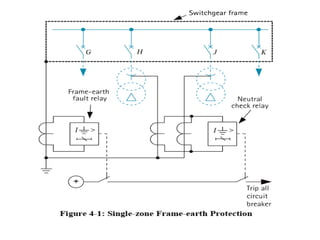
Frame-Earth Protection (Single-Busbar)
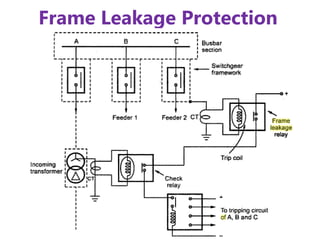
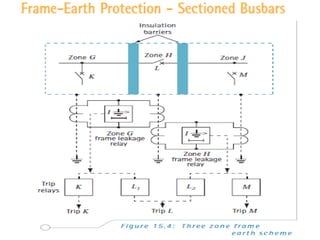
This protection scheme is basically an earth fault
system which simply measures the fault current
flowing from the switchgear frame to earth. A CT is
mounted on the earthing conductor and is used to
energize a simple instantaneous relay as shown in
Figure. Meanwhile, no other earth connections of any
type, including incidental connections to structural
steelwork are allowed. This guarantees that:
1. The principal earth connection and current
transformer are not shunted, thereby raising the
effective setting. An increased effective setting gives
rise to the possibility of relay maloperation. This risk
is small in practice.
2. Earth current flowing to a fault elsewhere on
the system cannot flow into or out of the
switchgear frame via two earth connections, as
this might lead to a spurious operation.
Careful construction of the system is of most
importance in this case, as the switchgear must
be insulated from ground, usually by standing it
on concrete and the foundation bolts must not
touch the steel reinforcement.
Frame Leakage Protection
Note:- The switchgear must be insulated as a
whole, usually by standing it on concrete. Care
must be taken that the foundation bolts do not
touch the steel reinforcement; sufficient
concrete must be cut away at each hole to
permit grouting-in with no risk of touching
metalwork.
The insulation to earth finally achieved will not
be high, a value of 10 ohms being satisfactory.
(very important)
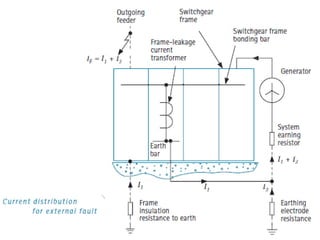
Under external fault conditions
the current I1 flows through the frame-
leakage current transformer. If the
insulation resistance is too low, sufficient
current may flow to operate the frame-
leakage relay.
The earth resistance between the
earthing electrode and true earth is
seldom greater than 1Ω , So
.
so with 10Ω insulation resistance the
current I1 is limited to 10% of the total
earth fault current I1 and I2.
For this reason, the recommended
minimum setting for the scheme is
about 30% of the minimum earth fault
current.
14
CT CB
Busbar
CT CB
CT CB
CT CB
Busbar protection
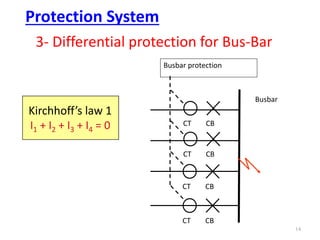
Kirchhoff’s law 1
I1 + I2 + I3 + I4 = 0
Protection System
3- Differential protection for Bus-Bar
A busbar protection system will trip all
breakers of the connected objects if there
is a fault on the busbar.
The CTs of all connected objects give
signal to the protection system, and it will
be activated if the sum of the currents
flowing to the busbar is not zero.
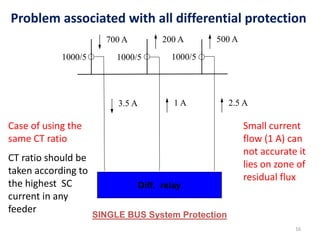
Diff. relay
1000/5 1000/5 1000/5
3.5 A 2.5 A1 A
500 A200 A700 A
SINGLE BUS System Protection
16
Case of using the
same CT ratio
CT ratio should be
taken according to
the highest SC
current in any
feeder
Problem associated with all differential protection
Small current
flow (1 A) can
not accurate it
lies on zone of
residual flux
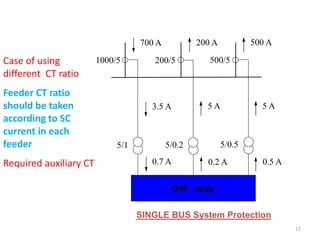
Diff. relay
1000/5 200/5 500/5
3.5 A 5 A5 A
500 A200 A700 A
0.7 A 0.2 A 0.5 A
5/1 5/0.2 5/0.5
SINGLE BUS System Protection
17
Case of using
different CT ratio
Feeder CT ratio
should be taken
according to SC
current in each
feeder
Required auxiliary CT
This type of protection is mainly accomplished by
different schemes such as:-
Circulating Current Differential Protection Scheme,
Biased Percentage Differential Protection Scheme,
High Impedance Voltage Scheme,
Moderately High Impedance Scheme and
Protection using Liner Couplers.
Each of this method is discussed
Differential protection for Bus-Bar
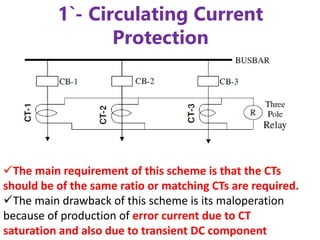
The main requirement of this scheme is that the CTs
should be of the same ratio or matching CTs are required.
The main drawback of this scheme is its maloperation
because of production of error current due to CT
saturation and also due to transient DC component
1`- Circulating Current
Protection
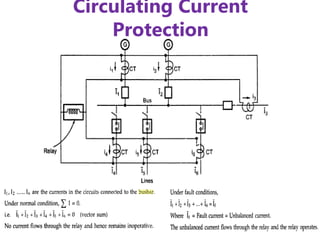
Circulating Current
Protection
The main requirement of this scheme is
that the CTs should be of the same ratio or
matching CTs are required.
The main drawback of this scheme is its
maloperation because of production of error
current due to CT saturation and also due to
transient DC component
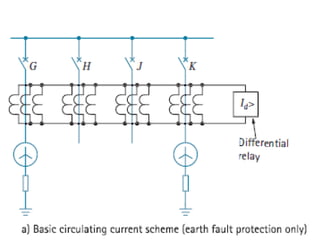
The scheme may consist of a single relay connected to
the bus wires connecting all the current transformers in
parallel, one set per circuit, associated with a particular
zone, as shown in Figure (a). This will give earth fault
protection for the busbar. This arrangement has often been
thought to be adequate.
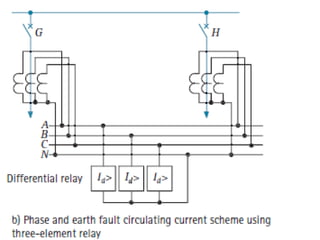
If the current transformers are connected as a balanced
group for each phase together with a three-element relay, as
shown in Figure (b), additional protection for phase faults
can be obtained.
The phase and earth fault settings are identical, and this
scheme is recommended for its ease of application and good
performance.
Circulating Differential Protection Scheme,
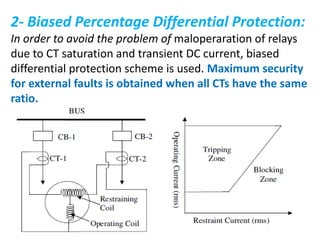
2- Biased Percentage Differential Protection:
In order to avoid the problem of maloperaration of relays
due to CT saturation and transient DC current, biased
differential protection scheme is used. Maximum security
for external faults is obtained when all CTs have the same
ratio.
Biased Percentage Differential
• Percent characteristic used
to cope with CT saturation
and other errors
• Restraining signal can be
formed in a number of
ways
• No dedicated CTs needed
• Used for protection of re-
configurable buses
possible
The main advantages of this scheme are:-
 high tolerance against substantial CT
saturation,
reduced requirement of dedicated CTs and
its use where comparatively high speed
tripping is required.
The most important limitation of the said
scheme is that the relay may maloperate in
case of a close-in external fault due to
complete saturation of CT.
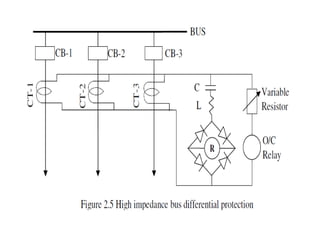
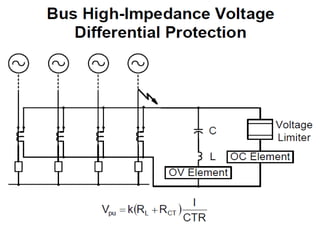
3- High Impedance Voltage Scheme:
This scheme is used to overcome the problem of
spill current due to CT saturation in case of
external fault.
The effect of saturation is controlled by
keeping CT secondary & lead resistance low
& by adding resistance into relay circuit.
Here, full wave bridge rectifier adds
substantial resistance to that leg of circuit.
The series L-C circuit is turned to 50 Hz
fundamental frequency in order to
respond only fundamental component of
current and make over voltage relay
immune to DC offset and harmonics.
This scheme discriminates between
internal and external faults by the relative
magnitudes of the voltage across the
differential junction points.
High Impedance Differential
–Operating signal created by connecting all
•CTs must all have the same ratio
•Must have dedicated CTs
–Overvoltage element operates on voltage
developed across resistor connected in
secondary circuit
•Requires varistors or AC shorting relays
to limit energy during faults
–Accuracy dependent on secondary circuit
resistance
•Usually requires larger CT cables to
reduce errors  higher cost
High Impedance Voltage Scheme(cont.)
The main merits of the said scheme are
stability against transient DC component due to tuned
circuit
improved CT saturation characteristics because of
stabilizing resistors
Faster operating time.
The disadvantages of this scheme are.
• requirement of dedicated CTs (cost increases),
• maloperation of relay in case when the secondary leakage
reactance is present
• inapplicability of the scheme to re-configurable busbars.
4- Moderately High Impedance Scheme:
This scheme is a combination of high
impedance voltage relay and the
percentage differential relay.
But the prime limitation of this scheme is
that it requires special type of auxiliary
transformer.
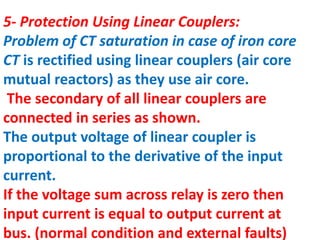
5- Protection Using Linear Couplers:
Linear coupler is a special device which
requires low energy relay.
This may create problems with change in
bus configuration.
However, the need of extra equipments in
order to achieve benefits of
microprocessor based relays and high cost
are the main drawbacks of this scheme
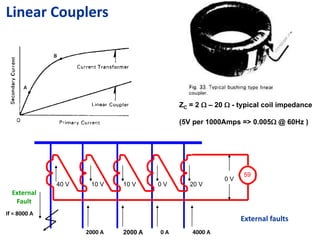
5- Protection Using Linear Couplers:
Problem of CT saturation in case of iron core
CT is rectified using linear couplers (air core
mutual reactors) as they use air core.
The secondary of all linear couplers are
connected in series as shown.
The output voltage of linear coupler is
proportional to the derivative of the input
current.
If the voltage sum across relay is zero then
input current is equal to output current at
bus. (normal condition and external faults)
59
Linear Couplers
ZC = 2  – 20  - typical coil impedance
(5V per 1000Amps => 0.005 @ 60Hz )
If = 8000 A
40 V 10 V 10 V 0 V 20 V
2000 A 2000 A 4000 A0 A
0 V
External
Fault
External faults
59
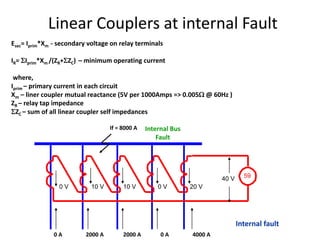
Linear Couplers at internal Fault
Esec= Iprim*Xm - secondary voltage on relay terminals
IR= Iprim*Xm /(ZR+ZC) – minimum operating current
where,
Iprim – primary current in each circuit
Xm – liner coupler mutual reactance (5V per 1000Amps => 0.005 @ 60Hz )
ZR – relay tap impedance
ZC – sum of all linear coupler self impedances
If = 8000 A
0 A
0 V 10 V 10 V 0 V 20 V
40 V
2000 A 2000 A 4000 A0 A
Internal Bus
Fault
Internal fault
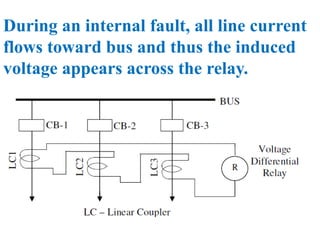
During an internal fault, all line current
flows toward bus and thus the induced
voltage appears across the relay.
• Fast, secure and proven
• Require dedicated air gap CTs, which may
not be used for any other protection
• Cannot be easily applied to reconfigurable
buses
• The scheme uses a simple voltage detector
– it does not provide benefits of a
microprocessor-based relay (e.g.
oscillography, breaker failure protection,
other functions)
Linear Couplers
43
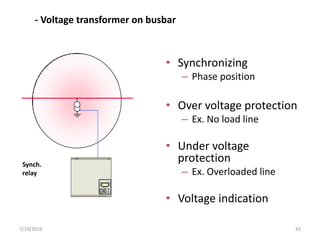
- Voltage transformer on busbar
• Synchronizing
– Phase position
• Over voltage protection
– Ex. No load line
• Under voltage
protection
– Ex. Overloaded line
• Voltage indication
E
C
Synch.
relay
7/19/2016
Digital Differential Algorithm Goals
– Improve the main differential algorithm operation
• Better filtering
• Faster response
• Better restraint techniques
• Switching transient blocking
– Provide dynamic bus replica for reconfigurable bus bars
– Dependably detect CT saturation in a fast and reliable
manner, especially for external faults
– Implement additional security to the main differential
algorithm to prevent incorrect operation
• External faults with CT saturation
• CT secondary circuit trouble (e.g. short circuits)
P-based Low Impedance Differential
(Distributed)
– Data Acquisition Units (DAUs)
installed in bays
– Central Processing Unit (CPU)
processes all data from DAUs
– Communications between
DAUs and CPU over fiber using
proprietary protocol
– Sampling synchronisation
between DAUs is required
– Perceived less reliable (more
hardware needed)
– Difficult to apply in retrofit
applications
P-based Low Impedance Differential
(Centralized)
– All currents applied to a single
central processor
– No communications, external
sampling synchronisation
necessary
– Perceived more reliable (less
hardware needed)
– Well suited to both new and
retrofit applications.
Busbar protection LEC 2.pptx

Busbar protection LEC 2.pptx

  • 1.
    1 Professor: Saady AbdelHamid }‫توفيقي‬ ‫وما‬‫ﺇ‬‫و‬ ‫توكلت‬ ‫عليه‬ ‫باهلل‬ ‫ال‬‫ﺇ‬‫أنيب‬‫ليه‬{ ‫ميحرلا نمحرلا هللا مسب‬ Lecture 2
  • 2.
    Classical TYPES OFPROTECTION SYSTEM A number of busbar protection systems have been devised: 1- System protection used to cover busbars 2-Frame-earth protection 3- Differential protection 4- Phase comparison protection 5- Directional blocking protection Of these, (1) is suitable for small substations only, while (4) and (5) are obsolete. Detailed discussion of types (2) and (3) occupies most of this chapter.
  • 3.
    1-System protection usedto cover busbars In systems where over-current or distance protection systems are present, busbars will be protected. It should be noted that over-current protection will only be applied to relatively simple distribution systems, or as a back-up protection, which gives a considerable time delay, whereas distance protection provides cover for busbar faults in its second and possibly subsequent zones. In Any case, the protection acquired is slow and unsuitable.
  • 4.
    2- Frame-Earth Protection Thismethod has been extensively used in the past. Various schemes are available for this type of protection each having a certain capability. Many of them are still in existence and each can provide good service for a particular situation. However, the need to insulate the switchboard frame and provide cable gland insulation and the availability of alternative schemes using numerical relays, has contributed to a decline in use of frame leakage systems.
  • 5.
    Frame-Earth Protection (Single-Busbar) Thisprotection scheme is basically an earth fault system which simply measures the fault current flowing from the switchgear frame to earth. A CT is mounted on the earthing conductor and is used to energize a simple instantaneous relay as shown in Figure. Meanwhile, no other earth connections of any type, including incidental connections to structural steelwork are allowed. This guarantees that: 1. The principal earth connection and current transformer are not shunted, thereby raising the effective setting. An increased effective setting gives rise to the possibility of relay maloperation. This risk is small in practice.
  • 6.
    2. Earth currentflowing to a fault elsewhere on the system cannot flow into or out of the switchgear frame via two earth connections, as this might lead to a spurious operation. Careful construction of the system is of most importance in this case, as the switchgear must be insulated from ground, usually by standing it on concrete and the foundation bolts must not touch the steel reinforcement.
  • 8.
  • 9.
    Note:- The switchgearmust be insulated as a whole, usually by standing it on concrete. Care must be taken that the foundation bolts do not touch the steel reinforcement; sufficient concrete must be cut away at each hole to permit grouting-in with no risk of touching metalwork. The insulation to earth finally achieved will not be high, a value of 10 ohms being satisfactory. (very important)
  • 11.
    Under external faultconditions the current I1 flows through the frame- leakage current transformer. If the insulation resistance is too low, sufficient current may flow to operate the frame- leakage relay. The earth resistance between the earthing electrode and true earth is seldom greater than 1Ω , So .
  • 12.
    so with 10Ωinsulation resistance the current I1 is limited to 10% of the total earth fault current I1 and I2. For this reason, the recommended minimum setting for the scheme is about 30% of the minimum earth fault current.
  • 14.
    14 CT CB Busbar CT CB CTCB CT CB Busbar protection Kirchhoff’s law 1 I1 + I2 + I3 + I4 = 0 Protection System 3- Differential protection for Bus-Bar
  • 15.
    A busbar protectionsystem will trip all breakers of the connected objects if there is a fault on the busbar. The CTs of all connected objects give signal to the protection system, and it will be activated if the sum of the currents flowing to the busbar is not zero.
  • 16.
    Diff. relay 1000/5 1000/51000/5 3.5 A 2.5 A1 A 500 A200 A700 A SINGLE BUS System Protection 16 Case of using the same CT ratio CT ratio should be taken according to the highest SC current in any feeder Problem associated with all differential protection Small current flow (1 A) can not accurate it lies on zone of residual flux
  • 17.
    Diff. relay 1000/5 200/5500/5 3.5 A 5 A5 A 500 A200 A700 A 0.7 A 0.2 A 0.5 A 5/1 5/0.2 5/0.5 SINGLE BUS System Protection 17 Case of using different CT ratio Feeder CT ratio should be taken according to SC current in each feeder Required auxiliary CT
  • 18.
    This type ofprotection is mainly accomplished by different schemes such as:- Circulating Current Differential Protection Scheme, Biased Percentage Differential Protection Scheme, High Impedance Voltage Scheme, Moderately High Impedance Scheme and Protection using Liner Couplers. Each of this method is discussed Differential protection for Bus-Bar
  • 19.
    The main requirementof this scheme is that the CTs should be of the same ratio or matching CTs are required. The main drawback of this scheme is its maloperation because of production of error current due to CT saturation and also due to transient DC component 1`- Circulating Current Protection
  • 20.
  • 21.
    The main requirementof this scheme is that the CTs should be of the same ratio or matching CTs are required. The main drawback of this scheme is its maloperation because of production of error current due to CT saturation and also due to transient DC component
  • 22.
    The scheme mayconsist of a single relay connected to the bus wires connecting all the current transformers in parallel, one set per circuit, associated with a particular zone, as shown in Figure (a). This will give earth fault protection for the busbar. This arrangement has often been thought to be adequate. If the current transformers are connected as a balanced group for each phase together with a three-element relay, as shown in Figure (b), additional protection for phase faults can be obtained. The phase and earth fault settings are identical, and this scheme is recommended for its ease of application and good performance. Circulating Differential Protection Scheme,
  • 25.
    2- Biased PercentageDifferential Protection: In order to avoid the problem of maloperaration of relays due to CT saturation and transient DC current, biased differential protection scheme is used. Maximum security for external faults is obtained when all CTs have the same ratio.
  • 26.
    Biased Percentage Differential •Percent characteristic used to cope with CT saturation and other errors • Restraining signal can be formed in a number of ways • No dedicated CTs needed • Used for protection of re- configurable buses possible
  • 27.
    The main advantagesof this scheme are:-  high tolerance against substantial CT saturation, reduced requirement of dedicated CTs and its use where comparatively high speed tripping is required. The most important limitation of the said scheme is that the relay may maloperate in case of a close-in external fault due to complete saturation of CT.
  • 28.
    3- High ImpedanceVoltage Scheme: This scheme is used to overcome the problem of spill current due to CT saturation in case of external fault. The effect of saturation is controlled by keeping CT secondary & lead resistance low & by adding resistance into relay circuit. Here, full wave bridge rectifier adds substantial resistance to that leg of circuit.
  • 29.
    The series L-Ccircuit is turned to 50 Hz fundamental frequency in order to respond only fundamental component of current and make over voltage relay immune to DC offset and harmonics. This scheme discriminates between internal and external faults by the relative magnitudes of the voltage across the differential junction points.
  • 31.
    High Impedance Differential –Operatingsignal created by connecting all
  • 32.
    •CTs must allhave the same ratio •Must have dedicated CTs –Overvoltage element operates on voltage developed across resistor connected in secondary circuit •Requires varistors or AC shorting relays to limit energy during faults –Accuracy dependent on secondary circuit resistance •Usually requires larger CT cables to reduce errors  higher cost
  • 33.
    High Impedance VoltageScheme(cont.) The main merits of the said scheme are stability against transient DC component due to tuned circuit improved CT saturation characteristics because of stabilizing resistors Faster operating time. The disadvantages of this scheme are. • requirement of dedicated CTs (cost increases), • maloperation of relay in case when the secondary leakage reactance is present • inapplicability of the scheme to re-configurable busbars.
  • 36.
    4- Moderately HighImpedance Scheme: This scheme is a combination of high impedance voltage relay and the percentage differential relay. But the prime limitation of this scheme is that it requires special type of auxiliary transformer.
  • 37.
    5- Protection UsingLinear Couplers: Linear coupler is a special device which requires low energy relay. This may create problems with change in bus configuration. However, the need of extra equipments in order to achieve benefits of microprocessor based relays and high cost are the main drawbacks of this scheme
  • 38.
    5- Protection UsingLinear Couplers: Problem of CT saturation in case of iron core CT is rectified using linear couplers (air core mutual reactors) as they use air core. The secondary of all linear couplers are connected in series as shown. The output voltage of linear coupler is proportional to the derivative of the input current. If the voltage sum across relay is zero then input current is equal to output current at bus. (normal condition and external faults)
  • 39.
    59 Linear Couplers ZC =2  – 20  - typical coil impedance (5V per 1000Amps => 0.005 @ 60Hz ) If = 8000 A 40 V 10 V 10 V 0 V 20 V 2000 A 2000 A 4000 A0 A 0 V External Fault External faults
  • 40.
    59 Linear Couplers atinternal Fault Esec= Iprim*Xm - secondary voltage on relay terminals IR= Iprim*Xm /(ZR+ZC) – minimum operating current where, Iprim – primary current in each circuit Xm – liner coupler mutual reactance (5V per 1000Amps => 0.005 @ 60Hz ) ZR – relay tap impedance ZC – sum of all linear coupler self impedances If = 8000 A 0 A 0 V 10 V 10 V 0 V 20 V 40 V 2000 A 2000 A 4000 A0 A Internal Bus Fault Internal fault
  • 41.
    During an internalfault, all line current flows toward bus and thus the induced voltage appears across the relay.
  • 42.
    • Fast, secureand proven • Require dedicated air gap CTs, which may not be used for any other protection • Cannot be easily applied to reconfigurable buses • The scheme uses a simple voltage detector – it does not provide benefits of a microprocessor-based relay (e.g. oscillography, breaker failure protection, other functions) Linear Couplers
  • 43.
    43 - Voltage transformeron busbar • Synchronizing – Phase position • Over voltage protection – Ex. No load line • Under voltage protection – Ex. Overloaded line • Voltage indication E C Synch. relay 7/19/2016
  • 44.
    Digital Differential AlgorithmGoals – Improve the main differential algorithm operation • Better filtering • Faster response • Better restraint techniques • Switching transient blocking – Provide dynamic bus replica for reconfigurable bus bars – Dependably detect CT saturation in a fast and reliable manner, especially for external faults – Implement additional security to the main differential algorithm to prevent incorrect operation • External faults with CT saturation • CT secondary circuit trouble (e.g. short circuits)
  • 45.
    P-based Low ImpedanceDifferential (Distributed) – Data Acquisition Units (DAUs) installed in bays – Central Processing Unit (CPU) processes all data from DAUs – Communications between DAUs and CPU over fiber using proprietary protocol – Sampling synchronisation between DAUs is required – Perceived less reliable (more hardware needed) – Difficult to apply in retrofit applications
  • 46.
    P-based Low ImpedanceDifferential (Centralized) – All currents applied to a single central processor – No communications, external sampling synchronisation necessary – Perceived more reliable (less hardware needed) – Well suited to both new and retrofit applications.