WELCOMES YOU
ABOUT US – ALFREDKIM PROFILE

We are a professionally managed Company engaged in
manufacturing of chemical pipe earthing systems at our
works at Faridabad, Haryana (India). The Company is
aggressively persuing the cause of safety and protection
of People, Property & Equipments in Industrial,
Commerical and Domestic Installations in the country. In
the short period of our 1 Year experience, we have
exported reasonable quantities of chemical pipe earthing
systems for a Cement Plant in Jordon & 6.6 KV Sub-
Station in Kabul (Afghanistan).
BIOGRAPHY OF ELECTRICITY
 I am Electricity. My home is in wires and conductors. My Father is Volta. My mother is Magnet 
and I ma a very important source of energy in modern times. I have a son called “Electron” If you
 want to know about me you can consult my subordinate “Voltmeter” I have a brother called 
     Voltage.  I am very useful. Without me your life is very difficult. I am mostly used in Industries ;  
     Agriculture etc.
 Without me no “ SUPER COMPUTER” can work. I would like to summarize myself as follows :-
 I am an electric current
 And not very tolerant
 I am extremely useful
 If you are careful
 The moment you become careless
 I also become senseless
 And I become the cause of tragedy
 Whether it is “a Man” or “a Lady”
The quality products offered by us are being well-
accepted by most of the leading electrical consultants in
India.

The Company is Promoted by Sh. Anil Kumar and his
family who have vision for the growth of electrical
industry and infra-structure. The dynamic leadership and
the foresight of Sh. Anil Kumar will lead the company
successfully in the years to come to attain a leadership
position in the earthing/grounding system and solutions
in the country.
Electrical Earthing is most neglected part of the electrical safety
                             for people and property
                   Let us discuss What is Earthing?
   Application of Earthing
• Allow zero potential to supply system
• Provide zero connection for Neutral
• Protect human against lightning and earth fault condition
• Protect the premises against lightning and earth fault
  condition
• Provide low resistance and safe path for lightning and fault
  current
• All metallic enclosure and extraneous conductive parts are
  at equipotential
• LV System Earth
• Equipment Earth
• Clean Earth for signaling and noise
• Create equipotential platform
EXTENSIVE APPLICATIONS
  Alfredkim Systems & Solutions Pvt. Limited
  specializes in full range of professional services from
  engineering, manufacturing, installation and testing of
  sealed maintenance free chemical filled earth
  electrodes for grounding system. The grounding
  system we offer is permanent & completely
  maintenance free, no need for periodic watering of
  the ground pit sand, thoroughly tested product even
  in unfavorable soil conditions with specified
  international norms.
Alfredkim exceeds all the design code and safety
   standards developed to protect personnel property &
   sensitive equipments which includes all capital
   equipments and sensitive electronics at Radio & TV
   broadcast facilities, airports, air traffic control centers,
    railways infrastructure & network, hotels &
   hospitals, power generating units, electrical utility
   substations, metrological data sites, fuel depots,
   refineries, chemical plants, telecommunication
   centers, computer data centers, amusement parks
   and domestic, residential, commercial & Industrial
   establishments
Hospitals         Hotels             Airports


Communication Towers   Residential colonies     Ammusement parks
Railways              Data centers   Refineries


Commercial Establishments   Fuel Depots           Industries
Glossary


• Reference to IS3043 – 1987 Reaffirmed 2006
• “Earth” means the Ground, reference zero potential
• Rely on the system earth to maintain the system voltage and
normal voltage supply
• Equipment earth connects all non-conductive parts to protect
human against electric shock
• Class I protection – use of barrier/insulation and connection of
protective conductor to equipment metallic enclosure in order to
protect against electric shock
• Class II protection – beside of the basic insulation, addition layer
of insulation apply to the enclosure. Therefore no extraneous
conductive part. The additional layer is independent to the basic
insulation so that under failure of basic insulation, it offers
additional protection
Types of Earthing


• Supply System – Neutral Earth
• System Earth
• Electrical Safety Earth
• Lightning Earth
• Generator Earth
• Protection Earth (i.e. surge arrestor)
• Telecom / Computer Earth
• Shielding Earth
• Integrated Earthing System (Advocated)
• Electrostatic Earth (Clean Room / Hospital)
• Cathodic protection (prevent rusty)
Functions of Earthing


• Equipment Earth : Path for fault
current, lower touch voltage,
protection against electric shock
• Lighting Earth : Low resistance path to
diverse the current under lightning
attrack
• Telecom Earth : Signal Earth,reduce
noise and interference, stabilize DC
supply voltage and prevent electric
shock
• Computer Earth : reduce interference,
maintain supply voltages
Earthing System


• Two Alphabetic system description
• First Alphabet – arrangement at Supply side
– T represents system directly earthed, multi-earthed
– I represents live part and earth path are separated, single point
earthed through high impedance
• Second Alphabet – arrangement at Consumer side
– T represents extraneous parts directly earthed, the earth point
independent from Supply side
– N represents extraneous parts connected to the protective
conductor of supply
• TN systems have two category:
–S protective conductor and neutral conductor are two wires
– C protective conductor and neutral conductor are the same
conductor
Earthing System


TN-S
‧protective conductor and neutral conductor are independent
• All exposed metallic part connected with protective
conductor PE
• System Characteristics:
– Low earth fault loop impedance
– High earth fault current
• Advantages: earth fault protection device operates faster;
allow multi point earth, better earthing continuity; minimize
the use of earth fault relay because of low earth fault loop
impedance
• Disadvantages: high earth fault level; under earth fault
condition, low power factor (high inductance of long cable)
Earthing System


TN-C
‧protective conductor and neutral conductor are combined
into one
• All exposed conductive parts connected to PEN
• System Characteristics :
– Low earth fault loop impedance
– High earth fault current
– More than one earth fault loops
• Advantages : no earth wire required; allow of multi-point
earth, better earthing continuity; neutral never have float
voltage; impedance of earth fault loop could be predicted
• Disadvantages : If not multi-point earthed, and the neutral
earth broken, the exposed metallic part may have float
voltage; high earth fault level, intervenue the operation of
earth fault protective device, current operated type device is
not appropriated, voltage detected type could be employed
Earthing System
Earthing System


TT
• Supply side has one point earthing only
• Exposed metal connected to consumer earth system
• System characteristics :
– High earth fault loop impedance
– Low earth fault current
– Utility company need not to provide earth for
consumer
• Advantages : Under earth fault condition, higher
power factor; save earth wires
• Disadvantages : high demand of E/F relays,
individual earth system need higher investment,
higher touch voltage; induce Potential gradient
Earthing System
Earthing System


IT

 • System not connected with the earth (high
impedance earth or isolated earth), all exposed
conductive part connect to earth
• Neutral is totally isolated
• Infinity earth fault loop impedance
• Deemed less chance of electric shock
• Many disadvantages: phase current equal to live
voltage (because of floating Neutral); no zero
reference, may cause arcing when earth fault occurs;
to small of earth fault level, current type earth fault
detector cannot work properly
Earthing System


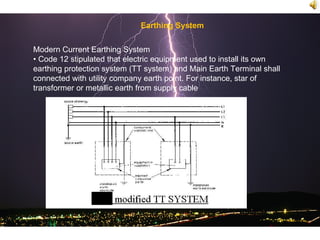
Modern Current Earthing System
• Code 12 stipulated that electric equipment used to install its own
earthing protection system (TT system) and Main Earth Terminal shall
connected with utility company earth point. For instance, star of
transformer or metallic earth from supply cable
Earthing System
Earthing System
FACT ABOUT SOIL RESISTIVITY - The resistivity of earth may
vary over extremely wide limits, depending on the composition of
the soil and the moisture content. Representative values are:


General average                          100 ohm-meters
Swampy ground                            10-100 ohm-meters
Sea water                                0.01-1 ohm-meters
Dry earth                                1000 ohm-meters
Pure slate                               107 ohm-meters
Sandstone                                108 ohm-meters
Earthing System


Earth Electrode
• Design concerns:
• Resistance/impedance to earth
• Heat capacity (during earth fault,max 40kA)
• The potential gradient around the electrode during faults
• Mechanical strength and ability in anti-corrosion
• Earth electrode shall be rod / pipe, tape, buried copper plate,
re-bar and superstructure
• More than one electrode could be connected, the electrode
could be a mixed system
• Long electrode generally effective than short one. However
electrode too long does not have significant effects; larger
size do not have great effects in earthing impedance
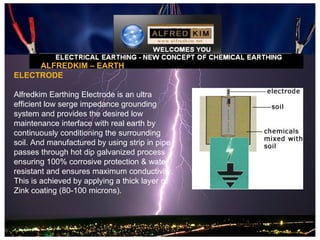
ALFREDKIM – EARTH
ELECTRODE

Alfredkim Earthing Electrode is an ultra
efficient low serge impedance grounding
system and provides the desired low
maintenance interface with real earth by
continuously conditioning the surrounding
soil. And manufactured by using strip in pipe
passes through hot dip galvanized process
ensuring 100% corrosive protection & water
resistant and ensures maximum conductivity.
This is achieved by applying a thick layer of
Zink coating (80-100 microns).
Earthing System


Electric Shock Protection
• Every premises shall have basic consideration to its
electric equipment’s safety – Electric Shock Protection
• Means of electric shock – Direct contact or indirect
contact
• Direct contact means direct touch to the live parts
• Indirect Contact means human contact to non-conductive
metal, of which the extraneous part becomes live during
faults
• Electric Shock Protection shall meet the requirements in
Code 11B including equipotential zones and automatic
disconnection under fault
• IEC report 479-1(1984) had studied “The effects in inject
of current into human and concerns on the current
magnitude, duration and flowing path
INDIAN ELECTRICITY RULES-
Let us review the important rules to get proper
insight into safety aspects
Rule 29 : Construction, installation, protection,
operation and maintenance of electric supply lines
and apparatus.
All electric supply lines and apparatus shall be sufficient
rating for power, insulation and estimated fault current
and of sufficient mechanical strength for the duty which
they may be required to perform under the
environmental conditions of installation and shall be
constructed, installed, protected, worked and maintained
in such a manner as to ensure safety of human beings,
animals and property.
1. Save as otherwise provided in these rules, the
    relevant code of practice of the Bureau of Indian
    Standards including National Electrical Code, if any,
    may also be followed to carry out the purposes of this
    rule and in the event of any inconsistency the
    provision of these rules shall prevail.

2. The material and apparatus used shall conform to the
    relevant specifications of the Bureau o Indian
    Standards where such specifications have already
    been laid down.
Rule 30 : Service lines and apparatus on consumer’s
   premises.
The supplier shall ensure that all electric supply lines,
   wires, fittings and apparatus belonging to him or
   under his control which are on consumer’s premises,
   are in a safe condition and in all respects fit for
   supplying energy and the supplier shall take due
   precautions to avoid danger arising on such premises
   from such supply lines, wires, fittings and apparatus.
2. Service-lines placed by the supplier on the premises
   of a consumer which are underground or which are
   accessible shall be so insulated and protectetd by the
   supplier as to be secure under all ordinary conditions
   against electrical, mechanical, chemical or other
   injury to the insulation.

3.The consumer shall, as far as circumstances permit,
   take precautions for the safe custody of the
   equipment on his premises belonging to the supplier.

4. The consumer shall also ensure that the installation
   under his control is maintained in a safe condition.
Rule 31 : Cut-out on consumer’s premises :

1. The supplier shall provide a suitable cutout in each
    conductor of every service-line other than an earthed
    or earthed neutral conductor or the earthed external
    conductor of a concentric cable within a consumer’s
    premises, in an accessible position. Such cut-out
    shall be contained within an adequately enclosed
    fireproof receptacle.
     where move than one consumer is supplied through
    a common service-line, each such consumer shall
    be provided with an independent cut-out at the point
    of junction to the common service.
2.    Every electric supply line other than the earth or
     earthed neutral conductor of any system or the
     earthed external conductor of a concentric cable shall
     be protected by its owner.
Rule 32 : Identification of earthed and earthed
neutral conductors
  and Positions of switches therein.
Where the conductors include an earthed conductor of a
two-wire system or a conductor which is to be connected
thereto, the following conditions shall be compiled with :
1. An indication of a permanent nature shall be provided
by the owner of the earthed neutral conductor, or the
conductor which is to be connected thereto, to enable
such conductor to be distinguished from any live
conductor. Such indication shall be provided –
a. where the earthed or earthed neutral conductor is the
property of the supplier, at or near the point of
commencement of supply;
b. where a conductor forming part of a consumer’s
    system is to be connected to the supplier’s earthed or
    earthed neutral conductor, at the point where such
    connection is to be made;
c. in all other cases, at a point corresponding to the point
    of commencement of supply or at such other points
    as may be approved by an inspector or any officer
    appointed to assist the inspector and authorized
    under sub-rule (2) of rule 4A.
2. No cut-out, link or switch other than a linked switch
arranged to operate simultaneously on the earthed or
earthed neutral conductor and live conductors shall be
inserted or remain inserted or remain inserted in any
earthed or neutral earthed neutral conductor of a two-
wire system or any earthed or earthed neutral conductor
of a multi-wire system or in any conductor connected
thereto with the following exceptions :
A link for testing purposes, or
B. switch for use in controlling a generator or
transformer.
Rule 33 : Earthed terminal on consumer’s Premises :
1. The supplier shall provide and maintain on the
consumer’s premises for the consumer’s use a suitable
earthed terminal in an accessible position at or near the
point of commencement of supply as defined under rule
58.
           Provided that in the case of medium, high or
extra-high voltage installation the consumer shall, in
addition to the aforementioned earthing arrangements,
provide his own earthing system with an independent
electrode.
           Provided further that the supplier may not
provide any earthed terminal in the case of installations
already connected to his system on or before the date to
be specified by the State Government in this behalf if he
is satisfied
2. The consumer shall take all reasonable precautions to
    prevent mechanical damage to the earthed terminal
    and its lead belonging to the supplier
3. The supplier may recover from consumer the cost of
    installation on the basis of schedule of charges
    notified in advance and where such schedule of
    charges is not notified, the procedure prescribed, in
    sub-rule (5) of rule 82 will apply.
Rule 34 : Accessibility of bare conductors.

Where bare conductors are used in a building, the owner
    of such conductors Shall.
a. ensure that they are inaccessible;
b. provide in readily accessible position switches for
    rendering them dead b. whenever necessary; and
c. take such other safety measures as are considered
    necessary by the inspector.
Rule 35 : Danger Notices :
The owner of every medium, high and extra-high voltage
   installation shall affix permanently in a conspicuous
   position a danger notice in Hindi or English and the
   local language of the district, with a sign of skull and
   bones of a design as per the relevant ISS No. 2551
   on –

a. every motor, generator, transformer and other
    electrical plant and equipment together with
    apparatus used for controlling or regulating the same;
b. all supports of high and extra-high voltage overhead
    lines which can be easily climbed upon without the
    aid of ladder or special appliances;
Explanation :- Rails, tubular poles, wooden supports,
    reinforced cement concrete poles without steps, I-
    sections and channels, shall be deemed as supports
    which cannot be easily climbed upon for the
    purposes of this clause.
c. Luminous tube sign requiring high voltage supply, X-
    ray and similar high-frequency installations;
Provided that where it is not possible to affix such
   notices on any generator, motor, transformer or other
   apparatus, they shall be affixed as near as possible
   thereto; or the Word ‘Danger’ and the voltage of the
   apparatus concerned shall be permanently painted
   on it.

Provided further that where the generator, motor,
   transformer or other apparatus is within an enclosure
   one notice affixed to the said enclosure shall be
   sufficient for the purposes of this rule.
RULE 36 : Handling of electric supply lines and apparatus :
1. Before any conductor or apparatus is handled, adequate
precautions shall be taken by earthing or other suitable means,
to discharge electrically such conductor or apparatus, and any
adjacent conductor or apparatus if there is danger there from,
and to prevent any conductor or apparatus from being
accidentally or inadvertently electrically charged when persons
are working thereon.
Every person who is working on an electric supply line or
apparatus or both shall be provided with tools and devices such
as gloves, rubber shoes, safety belts, ladders, earthing devices,
helmets, line testers, hand lines and the like for protecting him
from mechanical and electrical injury. Such tools and devices
shall always be maintained in sound and efficient working
conditions.
2. No person shall work on any live electric supply line or
    apparatus and no person shall assist such person on
    such work, unless he is authorized in that behalf, and
    take the safety measures approved by the Inspector.
3. Every telecommunication on supports carrying a high
    or extra-high voltage line shall, for the purpose of
    working thereon, be deemed to be a high voltage
    line.
RULE 37 : Rules 37 to 41A :
  These appertain to provisions in respect of supply to
  vehicles, cranes etc, cables for portable or
  transportable apparatus, cables protected by
  bituminous materials, street boxes and distinction of
  different and multiple feed installations.
RULE 37 : Rules 43 to 46 :
  These concern stipulations regarding protective
  equipment like fire buckets, fire extinguishers, First-
  aid boxes, gas masks, Instructions for restoration of
  persons suffering from electric shock, intimation of
  accidents, precautions to be adopted by consumers,
  owner occupiers, electrical contractors, electrical
  workmen and suppliers along with provisions for
  periodical inspection and testing of installations.
RULE 61 : Connection with earth.
  These rules lay down the requirements of connection
  with earth of systems at low voltage in cases where
  the voltage exceeds 125 volts and of systems at
  medium voltage.
RULE 61A : Earth leakage protective device
  The supply of energy to every electrical installation
  other than low voltage installation below 5 KW and
  those low voltage installations which do not attract
  provisions of Section 30 of the Indian Electricity Act,
  1910, shall be controlled by an earth leakage
  protective device so as to disconnect the supply
  instantly on the occurrence or earth fault or leakage
  of current.
  Provided that the above shall not apply to overhead
  supply lines having protective devices which are
  effectively bonded to the neutral of supply
  transformers and conforming to Rule 91 of IE
  Rules,1956.
DISCARD PIT TYPE EARTHING–SWITCH TO CHEMICAL PIPE EARTHING!
 The conventional copper pit type earthing is out of date because:-
1. The water level is going down at most of the geographical areas & 
therefore one has to dig deep holes may be to the extent of 20-50
mtr.
2. The commonly used substances in pit type earthing were sodium
Chloride known as common salt, soft coke & charcoal.
3. The common salt (sodium chloride) is a hygroscopic substance & it 
gets dissolved in water & losses its hygroscopic properties when
become water itself.
4. The salt is known to be a corrosive electrolyte which decays the 
pipe and the conductor used for earthing. Due to decay one does not
get the consistent ohmic values.
5. The soft coke & charcoal tend to become ash due to heavy heat
generated by heavy electric fault currents generated in the system 
especially at higher voltages at 1.1kv, 3.3kv, 6.6kv, 11kv, 33kv, 66kv
&133kv transmission distribution line & at substation.
6. The heat generated is proportional to I2Rt (Time in seconds) e.g. if the fault
current of 10,000amps in the system with an earth resistance 2 ohms as
permitted by IS in 0.01 seconds is given as under.
H=I2Rt H=10,000x10, 000x2x0.01=20, 00,000 calories =1053 °C
This much heat generated in one fault. Assuming 6 faults in a year. Then in a
period of four year -24 fault occur , each fault generating 1053 °C & Above.
7. Each fault of this magnitude will turn the soft coke/ charcoal into ash
gradually in a period of 3-4 years. The earth system will deteriorate and give
larger value of ohmic resistance thereby endangering the entire installation
consequently people & property.
8. If the ohmic values goes up from 2 to 3 ohms because of faulty earth
systems heat generated will be 30,00,000 calories (i.e. 1600 °C )this results that
the pit type earthing is inefficient , not reliable & cause serious damage to life &
property in a period of 3-4 years .
9. It is therefore observed that separate watering arrangement required to be 
made for maintaining moisture through a separate pipe dug along the earthing
system.
10. Instead of water producing the moisture in the earth pit the additional 
quantity of water poured in with a natural rain fall will wash away the charcoal
& the soft coke from its main position thereby it will further deteriorate the 
functioning of the earth system. 
Why install chemical earthing:
The above points conclude that pit type earthing is out of
date and it is being replaced and preferred over chemical
pipe earthing for reasons given below:-
1. The pipe for the chemical earthing are generally 2 mtr or 
3mtr in length therefore the earth bore need not more than
the 250 to 300mm dia & maximum depth of 3mtr.
2. The moisture is maintained at a small depth of 3mtr by
using ground enhancement material, commonly known as
GBFC (Grounding Back Fill Compound).
3. The efficacy of the chemical earthing to maintain the 
moisture which is essential for low ohmic values of earthing 
resistance is due to use of hygroscopic chemical like
aluminum silicate etc. which absorb the moisture but doesn’t 
get dissolved in the water unlike salt.
4. The heat generated due to electric faults developing heat
of 1060 °C and above is resisted by CCM (Crystalline
Conducive Material) which can withstand upto 2500°C.
5. The CCM is filled in the pipe of appropriate dimension of
50mm or 80mm dia and sealed at both ends. It incorporates
the earth conductor of GI strip of suitable size of 30x6mm or
40x6mm depending upon the individual design of
manufacturer.  
6. The CCM filled in the pipe being a good conductor increases the fault current 
capacity of the system because the pipe is hollow but when filled with CCM it
behaves like almost solid pipe.
7. The CCM resists cracking, warping, shrinking, or distortion even when
temperature exceed 2500 °C due to severe repeated electric faults which may 
happen in operations over the year. 
8. The GI pipe used are adequately galvanized (80-100 microns) as per IS
-3047 1987. 
9. Zinc oxide will be formed during the use of the earth system. Zinc oxide has
following advantages over the conventional earthing which uses the copper
plate or copper conductors:-
a) Zinc oxide so formed is insoluble in water.
b) Zinc oxide has a unique Dielectric strength that exhibits semiconducting &
piezoelectric dual properties. (Unlike in copper where the copper oxide is a
bad conductor of electricity & becomes powdered Red Oxide (Copper Oxide)
under high fault current that generate high temperatures)
c) ZnO finds application in Varistors which are used to
prevent voltage surges in the electronic devices like mobile
phone.
d) ZnO is not combustible & used as a fire extinguishant
material.

CONCLUTION:- The industry, project managers & the
electrical consultants find it very convincing to use & specify
the chemical pipe earthing which is convenient to install, no
maintenance what so ever with a long life of over 15 years.
a) Sub: Install ALFREDKIM CHEMICAL EARTHING. Prevent
Electrical Hazards!!

Need for Protection!
 To protect Industrial, commercial, and residential Buildings with
proper electrical earthing
Reasons:
1. Lightening Damage
2. Electrical leakages
 3. Short circuits between phases / between phase and Neutral
4. Surges in Supply line
Why Earthing?

Effective Earthing in the building protects People, Property and
Equipments.
Result: Protection of persons within the building
who are occupants as owners or tenants or
employees or visitors or residents
Type Of Hazards:
Electric fires resulting in loss of Property and loss of
Human lives in these divesting tragic fires.
 Good Earthing: ALFREDKIM chemical earthing is
like an insurance for protection of property , people
and equipments.
Any compromise on quality or absence of earthing
is willful act of inviting electric hazards in the
installation
B. Why Electrical /Electronic fail to perform to
optimum in industry and commercial buildings.
The electrical /electronic equipment e.g UPS system,
Computers, cfl lamps Eapbx , ac/dc VFd ,Speed
Drives, CNC Machines, Printing Machines , Machine
tools with electronic controls, Welding machines
.Lifts ,EOT cranes and all such devices fitted with
PCB/electronic cards have tendency to distort the
sine wave of AC supply there by causing the
resultant unbalanced voltage leading to Higher
Voltage between Neutral and earth which lead to
higher neutral currents which sometimes are 1.73
times of the phase currents
Hazards Prevented:
 Poor performance of the above equipment resulting in loss
of production and loss of man hours i.e idle man hours due
to equipment failure or inefficient operation and additional
rupee expense on maintenance
Malfunctioning of equipments: Why electronic Equipment
Malfunction Specially in the IT Industry e.g. call centers,
BPO`s and similar industries in particular.
The electronic circuits in this equipment are operating at
different switching voltages as per the design of the individual
manufacturers therefore it is essential that voltages between
neutral and earth are maintained to minimum level so that the
PCB`s/electronic cards are not damaged due to high
neutral currents and unbalanced voltages.
INSTALLATION OF ALFREDKIM CHEMICAL EARTHING
   b) Why watering is required for New Earth bore?
   When the pipe earthing /chemical earthing/maintenance
   free earthing/Gel earthing or whatever name it is called by
   various manufacturers the watering of the bore is necessary
   for the following reasons.
   a. Unlike pit earthing where the salt (Nacl) & coal is used
   with copper plate, the pit is dug very deep approximately
   40ft to 70 ft. depending on soil conditions where the
   dampness/moisture is achieved at various level of depth.
b. In case of the modern type of earthing which is free from
future maintenance .The watering of the bore prior to
installation is necessary for the following reasons.
1. The depth of the bore is either 2m/3m (6ft/10ft) which is
much less than the normal depth required in pit earthing.
2. The diameter of the bore is also limited to 200/300mm
against the pit earthing which is almost in square meters.
3.Unlike salt which is used in pit earthing which dissolves in
water and salt it self becomes water in the course of time
and dries it self, thereby loosing the conductivity in
surrounding of the pit. Salt itself reacts with copper &
makes copper chloride & other corrosive chemicals which
corrode the copper plates.
4. The GEM used by us absorbs the water upto 13 to 15
times its weight & dosen’t dissolve in the water therefore it
retains its moisture property upto the lifetime of the
electrode which is more than 25 years as it contains soil
friendly materials.
5. Since there is no need to recharge the pit as the GEM will
remains moist through out the life, therefore it is desirable
and absolutely necessary to keep watering the bore for
three to four days continuously before installing the
electrode and filling it with GEM so that the GEM will have
moist bore available with enough water soaked in the bore
due to continuous watering before installation.
6. After the installation no watering is necessary for future
maintenance in whatever soil condition it has been installed
either indoor or outdoor installation.
7. The earthing is quite successful in the normal climatic
condition where the average rain fall in a year may not
exceed 250mm. This will give enough moisture to the soil.
8. This earthing is being recommended by most of the
consultant in desert areas where there is scanty rain fall in
desert areas where the water level to achieve the normal
dampness is very-very deep.
9. Since we are able to achieve required dampness in a
depth of 2 to 3meters with continuous watering of the bore
&adequate quantity of the GEM filled at the time of
earthing which remains moist for the rest of life & maintains
the good ohmic values of earth resistance.
10.To conclude the old copper pit type earthing is out of
date & maintenance free earthing is easy to install, occupies
less space & economical in the long run.

CONCLUSION:- The industry, project managers & the
electrical consultants find it very convincing to use & specify
the chemical pipe earthing which is convenient to install, no
maintenance what so ever with a long life of over 15 years.
c) Subject: - Location of Earthing?
Question: Should it be near to the point of
application/Equipment or away from it?
Answer: It must be near to the point of application.
Reason:
Please read on!
1. OLD TRADITIONAL SYSTEM:-
 I) The conventional pit type copper plate Earthing with
large Quantity of Charcoal & Salt was requiring large
area of about 4’x3’or 6’x4’ & depth used to be 20’ to60’
(7 to 20 mtr)depending on the soil condition.
II) This much area was conveniently available in the
factories/office premises in earlier days when the
space was not constraint.
III)The distance between the earth pit & the point of
application used to be few meters may be
50-100mtrs & therefore to maintain the low resistance of
the earthing wire from the earth pit to the machinery the
copper wire of 8/10 swg was used.
IV) The copper wire thus used was cash & carry item for
professional wire cutters who used to cut the wire at the
first opportunity there by disconnecting the earthing
system & causing an electrical danger to the system.
2. PRESENT MODERN SYSTEM:-
 I) The space is become expensive & in short supply.
II) The conventional pit type earthings is very cumbersome, laborious &
occupies more space in term of sq. mtr & it is being replaced with chemical
pipe earthings.
III) The advantages of pipe earthing are:-
a) It needs a bore of 250-300mm dia & the depth of 2 to 3 mtr.
b) It is a neat & clean installation.
c) Doesn’t spoil the look of the office or factory.
d) It is conveniently covered up which can be flagged showing the location of
the earthing.
e) The pipe earthing is a compact unit & can be installed very near to the
equipment hardly 2-5 mtr away from the equipment.
f) The closeness of the earthing has a advantage of providing very low
resistance value to the system which requires less length of the wire (AS
resistance is directly proportional to the length i.e. the smaller the length,
it is better for earthing)
g) Since the length of the earthing is required is very small in the
installation of pipe earthings due to nearness to the equipment.
h) The G.I. strip of cross section area of 10x3mm or more are used for
connecting the pipe electrode to the equipment.
I) G.I. wire is not favorite of wire cutters so there are no chances of
disconnection of wire cutting or theft.
j) The copper wire of 8/10 swg which was used earlier were subjected
to more mechanical damages because of very low cross section area &
the round wire is more subjected to more cross sectional damage
than the rectangular strip of 10x3 mm or aboave.
CONCLUSION:- In view of above application the earthing electrode
close to the point of application or equipment are more desirable for
electrical & electronics equipment which demand low value of ohmic
resistance through out the year under all working condition i.e.
extreme dry ,extremely cold or wet climates.
 
d) Why Neutral Earthing /Grounding
 1 All Neutral should have Zero Potential Difference.
2. Why Neutral Voltage is Noticed Now a Days.
Reasons for Neutral voltage.
A. The use of electronic equipment /ups/computers /CFL lamps/Speed drives 
etc. These devices on operate at different cut off voltages in the  sine wave 
cycle and hence the sine wave is distorted resulting in the higher   PD in the 
Neutral and cause  the flow of currents in the Neutral Circuit which results in
the damage of PCB cards and other sensitive components in the electronic
circuit/equipments
B) The Industrial loads are in general Not Balanced Loads and therefore the line 
voltages are spill over to Neutral   which results into stray currents thereby
damaging the electronic equipments/ PCB cards
Why Neutral Grounding.
A. To maintain the ZERO PD between the Neutral and earth and to ground the 
Spill over voltages the Neutral is   grounded.
It is therefore very necessary to immediately
connect Neutral to the Earth by Solid Permanent
contact so that there is no possibility of loose
connection /disconnection at any stage OF
OPERATION to prevent any electrical mishaps.
Method of testing the New Earth Electrode
A) Connect the New Electrode to the Neutral of
Supply Line by very Good secure Connection
Either Bolted or soldered.
B) Connect the Volt meter as shown in the Picture
(P1) below.,
C) When the Neutral is properly grounded and the
earthing is Successful the voltmeter should give
Nearly ZERO voltage between Earth and Neutral
D) Electricity finds always easier path to flow therefore the 
spill over voltage in the neutral will go to the newly installed 
earth electrode. In case earthing is not successful or has 
higher ohmic value of resistance or loose contact/ 
disconnection in the earthing circuit the voltmeter will show 
the undesirable voltage. In case the earthing is ok and 
correctly done the voltmeter will show almost Zero Volts.

Kindly follow the above testing methods and ensure the 
testing is properly done.

CONCLUTION:- The industry, project managers & the
electrical consultants find it very convincing to use & specify
the chemical pipe earthing which is convenient to install, no
maintenance what so ever with a long life of over 15 years.
SYSTEMS OF GRID EARTHING
Reasons of Grid Earthing: -

1. To manage very high fault currents So that the low
ohmic value of earth resistance will reduce the effective
watt loss thereby controlling the heat generated in the
system.
2. To maintain very low level of ohmic values of earth
resistance like 0.1 etc. so that the sensitive electrical
protective devices& relays used in substations & power
houses.
System at Substations/Power Houses:-
1. The connected loads at your power Houses are heavy & at an extra high
voltage as well.
2. The reason for maintaining the value of resistance appears to us for
preventing the malfunction of the protective devices & Relays.
 How can we maintain the low ohmic earth resistance:-
The examples are given below:-
Formula to calculate the Resistance in Parallel:-
If there is n resistance connected in parallel. Than
1/R=1/R1+1/R2+1/R3+1/R4+--------------------------------------------+1/Rn.
A.) GRID of 12 EARTHING ELECTRODE:
Case-I
Earthing R1 R2 R3 R4 R5 R6 R7 R8 R9 R10 R11
R12
hmic      0.6 0.7 0.7 0.8 0.8 0.8 0.9 0.9 0.9 1.0 1.0
1.0
Value 
 
On applying formula of Resistance:-
1/R=1/R1+1/R2+1/R3+1/R4+1/R5+1/R6+1/R7+1/R8+1/
R9+1/R10+1/R11+1/R12
1/R=1/0.6+1/0.7+1/0.7+1/0.8+1/0.8+1/0.8+1/0.9+1/0.9+1
/0.9+1/1.0+1/1.0+1/1.0
1/R=1.67+1.43+1.43+1.25+1.25+1.25+1.11+1.11+1.11+
1.0+1.0+1.0
1/R=14.61
R=0.068 Ω
Case-II
In case the earthing no.1 & 12 after some time become
Out of order due to some reason like
I) Accidently disconnected
II) Loose Electrical Contacts.
III) Any type of cut in the distribution system due to
Mechanical stress
III) Any type of cut in the distribution system due to
Mechanical stress
Earthing R1 R2 R3 R4 R5 R6 R7 R8 R9 R10 R11 R12
Ohmic 0.0 0.7 0.7 0.8 0.8 0.8 0.9 0.9 0.9 1.0 1.0 0.0
 Value

On applying formula of Resistance:-
1/R=1/R1+1/R2+1/R3+1/R4+1/R5+1/R6+1/R7+1/R8+1/
R9+1/R10+1/R11+1/R12
1/R=1/0.0+1/0.7+1/0.7+1/0.8+1/0.8+1/0.8+1/0.9+1/0.9+1
/0.9+1/1.0+1/1.0+1/0.0
1/R=0.0+1.43+1.43+1.25+1.25+1.25+1.11+1.11+1.11+1.
0+1.0+0.0
1/R=11.94

R=0.08 Ω
B.)GRID of 15 EARTHING ELECTRODE:
Case-I
Earthing     R1 R2 R3 R4 R5 R6 R7 R8 R9 R10 R11 R12 R13 R14 R15
Ohmic Value 0.6 0.7 0.7 0.8 0.8 0.8 0.8 0.9 0.9 0.9 0.9 1.0 1.0 1.0 1.0
 
 
On applying formula of Resistance:-
1/R=1/R1+1/R2+1/R3+1/R4+1/R5+1/R6+1/R7+1/R8+1/R9+1/R10+1/R11+1/R12
+1/R13+1/R14+1/R15
1/R=1/0.6+1/0.7+1/0.7+1/0.8+1/0.8+1/0.8+1/0.8+1/0.9+1/0.9+1/0.9+1/0.9+1/1.0
+1/1.0+1/1.0+1/1.0
1/R=1.67+1.43+1.43+1.25+1.25+1.25+1.25+1.11+1.11+1.11+1.11+1.0+1.0+1.0
+1.0
1/R=17.97
R=0.056 Ω
Case-II
In case the earthing no.1, 8 & 14 after some time become Out of order due to
some reason like
I) Accidently disconnected.
II) Loose Electrical Contacts.
III) Any type of cut in the distribution system due to Mechanical damage.
Earthing        R1 R2 R3 R4 R5 R6 R7 R8 R9 R10 R11 R12 R13 R14 R15
Ohmic Value 0.0 0.7 0.7 0.8 0.8 0.8 0.8 0.0 0.9 0.9 0.0 1.0 1.0 0.0 1.0
 
On applying formula of Resistance:-
1/R=1/R1+1/R2+1/R3+1/R4+1/R5+1/R6+1/R7+1/R8+1/R9+1/R10+1/R11+1/R12
+1/R13+1/R14+1/R15
1/R=1/0.0+1/0.7+1/0.7+1/0.8+1/0.8+1/0.8+1/0.8+1/0.0+1/0.9+1/0.9+1/0.0+1/1.0
+1/1.0+1/0.0+1/1.0
1/R=0.0+1.43+1.43+1.25+1.25+1.25+1.25+0.0+1.11+1.11+0.0+1.0+1.0+0.0+1.
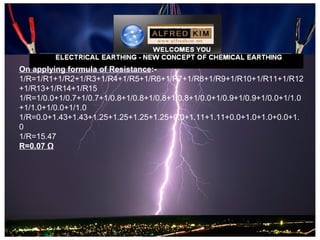
0
1/R=15.47
R=0.07 Ω
We have given two cases for each type of grid earthing i.e. twelve earth
systems & fifteen Earth systems.
Our recommendations are for fifteen earth systems to maintain a long term
low ohmic values because of the following factors:-
 1. Change of a soil condition for a period of a time is choosing a different
location for the earthing system in the same premise.
2. Change of CLIMATE CONDITION:
a. Extremely dry climate- SUMMER
b. Extremely cold climate- WINTER
c. Extremely humid climate-RAINS
CONCLUSION:- In view of above application the earthing electrode
close to the point of application or equipment are more desirable for
electrical & electronics equipment which demand low value of ohmic
resistance through out the year under all working condition i.e.
extreme dry ,extremely cold or wet climates.
CORE FEATURES OF ALFREDKIM CHEMICAL
  EARTHNG
•   Ultra low resistance grounding electrode.
• Make certain maximum safety from electrical system
  faults.
• Maintenance free system, no need to dispense water
  recurrently.
• Maintains dependable & unfailing earth resistance.
• Limits the system-to-ground or system-to-frame
  voltage to values safe for personnel.
• Offer a relatively firm & secure system with a
  minimum of transient over voltages.
• Authorize any system fault to ground to be quickly
  isolated.
• Protection against static electricity from friction.
• Prevents static charge & stray current accidents.
•   Endow with good grounds for electric process control
    and communication circuits.
•   Conductive compound constructs a conductive zone
    and offers much increased area for peak current
    dissipation
•   Low earth resistance. High conductive.
•   Transmits high peak current repeatedly. Endlessly
    sustain almost the identical earth resistance value
    regardless of soil & climate conditions.
•   Multi-directional dissipation of current.
•   Stabilize circuit potential with respect to ground and
    limit overall potential rise.
•   Eco Friendly, safe, reliable and anti corrosive.
•   Much stretched life.
•   Straight forward & trouble free to mount.
CHEMICALS USED - BENTONITE
Bentonite is naturally occuring hydrated Aluminium Silicate. The most important
    use of Bentonite is based on its natural swelling property.one can surely say
    that bentonite is most economic natural thickner available to industries.
It has ability to absorb water several (15) times its weight and give thickstropic
    fluid.
Chemically Bentonite is HYDRATED ALUMINIUM SILICATE.
Chemical Formula : Al2O34SiO2H2O
Physical Properties :
Sp. Gravity         : 2.4
Bulk density        : 0.6
PH of 10% Aqueous solution            : 8 to 8.8
Chemical Composition :
Silica     : 54.26
Aluminium           : 18.34
Ferric Oxide        : 10.91
TiO2       : 01.25
The Exceptional Nature of Graphite - Graphite - Properties
   The most significant property of graphite is its dimensional
  strength and stability at ultra-high temperatures. It resists
  cracking, warping, shrinking, or distortion even when
  temperatures exceed 2500oC.

   Graphite is resistant to both thermal shock and chemical
   attack, and can act as either a thermal conductor or insulator,
   depending on the application. At the same time, it is
   electrically conductive and naturally lubricating. Essentially
   inert, graphite is considered to be environmentally safe and
   non-toxic. While standard synthetic graphite is quite pure,
   extremely pure grades are available for special applications
   such as research and elemental analysis.

   It can also be processed into a variety of forms from felts and
   foils to composites and precisely machined components.
Uses of Graphite Application - Why Graphite Works

Crucibles : High purity. Excellent resistance to thermal shock
and chemical attack. Non-wetting by most molten
metals.
Electrical Heating Elements : With electrical properties falling
between those
of metals and ceramics, the electrical resistivity can be varied over a
considerable range.
Bushings : Self-lubrication and durability in the absence of
petroleum-based lubricants, at temperatures to 1,200 F
Sintering Trays and Boats : Thermal stability, low wettability and
low specific heat.
EDM Electrodes : Electrical conductivity, resistance to wear from
electrical arcing and excellent machinability into complex shapes.
Molds : Dimensional stability, low wettability
and high purity.
Seal Faces : Self-lubrication, dimensional stability
and resistance to chemical attack.
Continuous Casting Dies : Dimensional stability,
excellent machinability
high thermal conductivity and self-lubrication.
UTTRAKHAND ELECTRICITY REGULATORY COMMISSION

In the matter of:
UPCL not inspecting and testing applicant’s installation and
maintaining record
of test results obtained in the specified format, in accordance with
provisions of UERC
(Release of New LT connection, Enhancement and Reduction of
Loads) Regulations,
2007 read with Rules 47 & 48 of IE Rules, 1956.

                              Coram
V.J. Talwar                                       Chairman
                                           Anand Kumar
                         Member

                              Date of Order: October 27, 2008
UTTRAKHAND ELECTRICITY REGULATORY COMMISSION
The Order is based on
 Rule 67(1-A)
 
“the neutral point of every generator and transformer shall be earthed by
connecting it to the earthing system as defined in Rules 61 (4) and
hereinabove by not less than two separate and distinct connections”
Rule 61(4) defines earthing system as:
 
“All earthing systems shall –
 (a) consist of equipotential bonding conductors capable of carrying the
prospective earth fault current and a group of pipe/rod/plate electrodes for
dissipating the current to the general mass of earth without exceeding
the allowable temperature limits as per relevant Indian Standards in
order to maintain all non-current carrying metal works reasonably at earth
 potential and to avoid dangerous contact potentials being developed
on such metal works;
(b) Limit earth resistance sufficiently low to permit adequate fault
current for the operation of proactive devices in time and to reduce
neutral shifting.
(c) Be mechanically strong, withstand corrosion and retain electrical
continuity during the life of the installation. All earthing systems shall be
tested to ensure efficient earthing, before the electric supply lines or
apparatus are energised.”
UTTRAKHAND ELECTRICITY REGULATORY COMMISSION

22. Concluding the order, the following action is required to be taken
up by the licensee.
•To complete the works for providing proper earting in lines in
accordance with Rule 90 of IE Rules 1956- by 31st March 2010.
•To provide protective device in accordance with Rule 91(1) and anti
climbing. Device in accordance with Rule 91(2) in electrical lines –by
31st March 2010.
     Proposal along with Action Plan to achieve the above, giving
milestones for geographical areas/ activities, to reach the
Commission within one month of this order i.e. 27.11.2008
7.To submit a detailed report, after investing the matter of accident in
village Syali as given at para 19 of this order, within one month of
this order i.e. 27.11.2008.

9.Detailed Order given in your folders
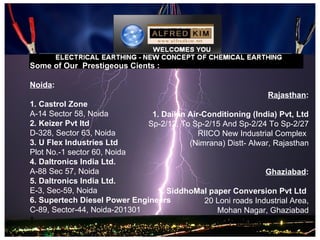
Some of Our Prestigeous Cients :

Faridabad:                                            9. Prime Electronics
                                            14/3, Mathura Road, Faridabad
1. Pyramid Control System pvt Ltd                             10. Fine Turn
14/4, Mathura Road, Faridabad                    240, Sector -24, Faridabad
2. Havells India Pvt Ltd                               11. S. R. Engineers
14/3, Mathura road, Faridabad                   A-150 Sector-31, Faridabad
3. Laroiya Medicare Centre Pvt Ltd            12. Saraswati Sishu School
 997/7C, Faridabad                          Tegoan, Ballabgarh, Faridabad
4. Siya Ram Engineers                                13. Dev tech Printers
Shed No. 150 Type-A, HSIIDC Sec-31, Faridabad14/3 Mathura Road, Faridabad
5. Joneja Bright Steel Pvt Ltd                              14. Iskan India,
Plot No.239&244, sec-24, Faridabad Gandhi Colony, Railway Road, Faridabad
6. Vijay Engineering & Metal Works                    15. SPCP Industries,
Plot no.165/66, Sec-24, Faridabad                A-50, 16/5, Mathura Road,
7. Sawatik Automatics                              Kakhanabag, Faridabad
S.G.M Nagar, Faridabad             16. Malhotra Shaving Products Pvt Ltd
8. Asha Telecom Pvt ltd                   Factory-23/7, Sec-59, Ballabgarh,
17/3, Mathura Road, Faridabad                             Faridabad-121004
Some of Our Prestigeous Cients :
                                                                          Delhi:-
Faridabad:
                                      1. Tri Square Switchgears Private Limited
1. Lakhani India Limited                         A-8, DSIDC Sheds, Narera, Delhi
Plot No.131, Sec-24, Ballabgarh, Faridabad
2. Krishna Grover Private Limited      2. Control & Switchgear Private Limited
13/7, Inside G.D.Industries, Mathura Road,      (For Installation at South Block)
Faridabad-121003, Haryana                              222, Okhla Industrial area,
3. Super Lamnicote Private Limited                           Phase-III, ND-110020
13/7, G.D. Industrial Engineers Compound,
Mathura Road, Faridabad-121003
4. Heena Off-set Priter                                                 Gurgaon:-
Plot No.44, Sec-58, Ballabhgad Faridabad
5. SP Industries                                          1. Nutek India Limited
Plot No.80 Sec-25 Ballabhgad Faridabad (AIRCEL Tower, Baljeet Nagar, Delhi)
                                              B-27, Sector-34, Info city, Gurgaon
Some of Our Prestigeous Cients :

Noida:
                                                                Rajasthan:
1. Castrol Zone
A-14 Sector 58, Noida          1. Daikin Air-Conditioning (India) Pvt, Ltd
2. Keizer Pvt ltd             Sp-2/12, To Sp-2/15 And Sp-2/24 To Sp-2/27
D-328, Sector 63, Noida                     RIICO New Industrial Complex
3. U Flex Industries Ltd                 (Nimrana) Distt- Alwar, Rajasthan
Plot No.-1 sector 60, Noida
4. Daltronics India Ltd.
A-88 Sec 57, Noida                                             Ghaziabad:
5. Daltronics India Ltd.
E-3, Sec-59, Noida              1. SiddhoMal paper Conversion Pvt Ltd
6. Supertech Diesel Power Engineers           20 Loni roads Industrial Area,
C-89, Sector-44, Noida-201301                    Mohan Nagar, Ghaziabad
 
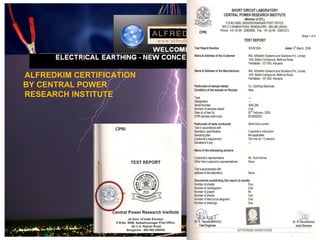
ALFREDKIM CERTIFICATION
BY CENTRAL POWER
RESEARCH INSTITUTE
LIGHTER MOOD - VACANCY FOR AN ELECTRICIAN IN INDIA!

Immediate requirement, No previous experience

necessary.

All gear supplied, pliers and screwdriver available at depot.

No overtime restrictions,

Salary: negotiable

Working hours: till the job is done

Essential requirement - fault finding skills!

IMPORTANT: To get an idea of your first assignment
Don’t let the earthing faults happen!


                                        ...simply doesn’t work!!
THANKS
MANAGEMENT & STAFF OF
ALFREDKIM SYSTEMS AND SOLUTIONS (PVT) LTD.
14/3, Bolton Compound, Matura Road,
Faridabad-121003 (Haryana), India
Ph : 0129 – 4158603
Mobile : +91 9810531603, 8800797774

Alfredkim electrical earthing

  • 1.
  • 2.
    ABOUT US –ALFREDKIM PROFILE We are a professionally managed Company engaged in manufacturing of chemical pipe earthing systems at our works at Faridabad, Haryana (India). The Company is aggressively persuing the cause of safety and protection of People, Property & Equipments in Industrial, Commerical and Domestic Installations in the country. In the short period of our 1 Year experience, we have exported reasonable quantities of chemical pipe earthing systems for a Cement Plant in Jordon & 6.6 KV Sub- Station in Kabul (Afghanistan).
  • 3.
    BIOGRAPHY OF ELECTRICITY  I am Electricity. My home is in wires and conductors. My Father is Volta. My mother is Magnet  and I ma a very important source of energy in modern times. I have a son called “Electron” If you  want to know about me you can consult my subordinate“Voltmeter” I have a brother called  Voltage.  I am very useful. Without me your life is very difficult. I am mostly used in Industries ;   Agriculture etc.  Without me no “ SUPER COMPUTER” can work. I would like to summarize myself as follows :-  I am an electric current  And not very tolerant  I am extremely useful  If you are careful  The moment you become careless  I also become senseless  And I become the cause of tragedy  Whether it is “a Man” or “a Lady”
  • 4.
    The quality productsoffered by us are being well- accepted by most of the leading electrical consultants in India. The Company is Promoted by Sh. Anil Kumar and his family who have vision for the growth of electrical industry and infra-structure. The dynamic leadership and the foresight of Sh. Anil Kumar will lead the company successfully in the years to come to attain a leadership position in the earthing/grounding system and solutions in the country.
  • 5.
    Electrical Earthing ismost neglected part of the electrical safety for people and property Let us discuss What is Earthing? Application of Earthing • Allow zero potential to supply system • Provide zero connection for Neutral • Protect human against lightning and earth fault condition • Protect the premises against lightning and earth fault condition • Provide low resistance and safe path for lightning and fault current • All metallic enclosure and extraneous conductive parts are at equipotential • LV System Earth • Equipment Earth • Clean Earth for signaling and noise • Create equipotential platform
  • 6.
    EXTENSIVE APPLICATIONS Alfredkim Systems & Solutions Pvt. Limited specializes in full range of professional services from engineering, manufacturing, installation and testing of sealed maintenance free chemical filled earth electrodes for grounding system. The grounding system we offer is permanent & completely maintenance free, no need for periodic watering of the ground pit sand, thoroughly tested product even in unfavorable soil conditions with specified international norms.
  • 7.
    Alfredkim exceeds allthe design code and safety standards developed to protect personnel property & sensitive equipments which includes all capital equipments and sensitive electronics at Radio & TV broadcast facilities, airports, air traffic control centers, railways infrastructure & network, hotels & hospitals, power generating units, electrical utility substations, metrological data sites, fuel depots, refineries, chemical plants, telecommunication centers, computer data centers, amusement parks and domestic, residential, commercial & Industrial establishments
  • 8.
    Hospitals Hotels Airports Communication Towers Residential colonies Ammusement parks
  • 9.
    Railways Data centers Refineries Commercial Establishments Fuel Depots Industries
  • 10.
    Glossary • Reference toIS3043 – 1987 Reaffirmed 2006 • “Earth” means the Ground, reference zero potential • Rely on the system earth to maintain the system voltage and normal voltage supply • Equipment earth connects all non-conductive parts to protect human against electric shock • Class I protection – use of barrier/insulation and connection of protective conductor to equipment metallic enclosure in order to protect against electric shock • Class II protection – beside of the basic insulation, addition layer of insulation apply to the enclosure. Therefore no extraneous conductive part. The additional layer is independent to the basic insulation so that under failure of basic insulation, it offers additional protection
  • 11.
    Types of Earthing •Supply System – Neutral Earth • System Earth • Electrical Safety Earth • Lightning Earth • Generator Earth • Protection Earth (i.e. surge arrestor) • Telecom / Computer Earth • Shielding Earth • Integrated Earthing System (Advocated) • Electrostatic Earth (Clean Room / Hospital) • Cathodic protection (prevent rusty)
  • 12.
    Functions of Earthing •Equipment Earth : Path for fault current, lower touch voltage, protection against electric shock • Lighting Earth : Low resistance path to diverse the current under lightning attrack • Telecom Earth : Signal Earth,reduce noise and interference, stabilize DC supply voltage and prevent electric shock • Computer Earth : reduce interference, maintain supply voltages
  • 13.
    Earthing System • TwoAlphabetic system description • First Alphabet – arrangement at Supply side – T represents system directly earthed, multi-earthed – I represents live part and earth path are separated, single point earthed through high impedance • Second Alphabet – arrangement at Consumer side – T represents extraneous parts directly earthed, the earth point independent from Supply side – N represents extraneous parts connected to the protective conductor of supply • TN systems have two category: –S protective conductor and neutral conductor are two wires – C protective conductor and neutral conductor are the same conductor
  • 14.
    Earthing System TN-S ‧protective conductorand neutral conductor are independent • All exposed metallic part connected with protective conductor PE • System Characteristics: – Low earth fault loop impedance – High earth fault current • Advantages: earth fault protection device operates faster; allow multi point earth, better earthing continuity; minimize the use of earth fault relay because of low earth fault loop impedance • Disadvantages: high earth fault level; under earth fault condition, low power factor (high inductance of long cable)
  • 16.
    Earthing System TN-C ‧protective conductorand neutral conductor are combined into one • All exposed conductive parts connected to PEN • System Characteristics : – Low earth fault loop impedance – High earth fault current – More than one earth fault loops • Advantages : no earth wire required; allow of multi-point earth, better earthing continuity; neutral never have float voltage; impedance of earth fault loop could be predicted • Disadvantages : If not multi-point earthed, and the neutral earth broken, the exposed metallic part may have float voltage; high earth fault level, intervenue the operation of earth fault protective device, current operated type device is not appropriated, voltage detected type could be employed
  • 17.
  • 18.
    Earthing System TT • Supplyside has one point earthing only • Exposed metal connected to consumer earth system • System characteristics : – High earth fault loop impedance – Low earth fault current – Utility company need not to provide earth for consumer • Advantages : Under earth fault condition, higher power factor; save earth wires • Disadvantages : high demand of E/F relays, individual earth system need higher investment, higher touch voltage; induce Potential gradient
  • 19.
  • 20.
    Earthing System IT •System not connected with the earth (high impedance earth or isolated earth), all exposed conductive part connect to earth • Neutral is totally isolated • Infinity earth fault loop impedance • Deemed less chance of electric shock • Many disadvantages: phase current equal to live voltage (because of floating Neutral); no zero reference, may cause arcing when earth fault occurs; to small of earth fault level, current type earth fault detector cannot work properly
  • 21.
    Earthing System Modern CurrentEarthing System • Code 12 stipulated that electric equipment used to install its own earthing protection system (TT system) and Main Earth Terminal shall connected with utility company earth point. For instance, star of transformer or metallic earth from supply cable
  • 22.
  • 23.
  • 24.
    FACT ABOUT SOILRESISTIVITY - The resistivity of earth may vary over extremely wide limits, depending on the composition of the soil and the moisture content. Representative values are: General average 100 ohm-meters Swampy ground 10-100 ohm-meters Sea water 0.01-1 ohm-meters Dry earth 1000 ohm-meters Pure slate 107 ohm-meters Sandstone 108 ohm-meters
  • 25.
    Earthing System Earth Electrode •Design concerns: • Resistance/impedance to earth • Heat capacity (during earth fault,max 40kA) • The potential gradient around the electrode during faults • Mechanical strength and ability in anti-corrosion • Earth electrode shall be rod / pipe, tape, buried copper plate, re-bar and superstructure • More than one electrode could be connected, the electrode could be a mixed system • Long electrode generally effective than short one. However electrode too long does not have significant effects; larger size do not have great effects in earthing impedance
  • 26.
    ALFREDKIM – EARTH ELECTRODE AlfredkimEarthing Electrode is an ultra efficient low serge impedance grounding system and provides the desired low maintenance interface with real earth by continuously conditioning the surrounding soil. And manufactured by using strip in pipe passes through hot dip galvanized process ensuring 100% corrosive protection & water resistant and ensures maximum conductivity. This is achieved by applying a thick layer of Zink coating (80-100 microns).

  • 27.
    Earthing System Electric ShockProtection • Every premises shall have basic consideration to its electric equipment’s safety – Electric Shock Protection • Means of electric shock – Direct contact or indirect contact • Direct contact means direct touch to the live parts • Indirect Contact means human contact to non-conductive metal, of which the extraneous part becomes live during faults • Electric Shock Protection shall meet the requirements in Code 11B including equipotential zones and automatic disconnection under fault • IEC report 479-1(1984) had studied “The effects in inject of current into human and concerns on the current magnitude, duration and flowing path
  • 28.
    INDIAN ELECTRICITY RULES- Letus review the important rules to get proper insight into safety aspects Rule 29 : Construction, installation, protection, operation and maintenance of electric supply lines and apparatus. All electric supply lines and apparatus shall be sufficient rating for power, insulation and estimated fault current and of sufficient mechanical strength for the duty which they may be required to perform under the environmental conditions of installation and shall be constructed, installed, protected, worked and maintained in such a manner as to ensure safety of human beings, animals and property.
  • 29.
    1. Save asotherwise provided in these rules, the relevant code of practice of the Bureau of Indian Standards including National Electrical Code, if any, may also be followed to carry out the purposes of this rule and in the event of any inconsistency the provision of these rules shall prevail. 2. The material and apparatus used shall conform to the relevant specifications of the Bureau o Indian Standards where such specifications have already been laid down.
  • 30.
    Rule 30 :Service lines and apparatus on consumer’s premises. The supplier shall ensure that all electric supply lines, wires, fittings and apparatus belonging to him or under his control which are on consumer’s premises, are in a safe condition and in all respects fit for supplying energy and the supplier shall take due precautions to avoid danger arising on such premises from such supply lines, wires, fittings and apparatus.
  • 31.
    2. Service-lines placedby the supplier on the premises of a consumer which are underground or which are accessible shall be so insulated and protectetd by the supplier as to be secure under all ordinary conditions against electrical, mechanical, chemical or other injury to the insulation. 3.The consumer shall, as far as circumstances permit, take precautions for the safe custody of the equipment on his premises belonging to the supplier. 4. The consumer shall also ensure that the installation under his control is maintained in a safe condition.
  • 32.
    Rule 31 :Cut-out on consumer’s premises : 1. The supplier shall provide a suitable cutout in each conductor of every service-line other than an earthed or earthed neutral conductor or the earthed external conductor of a concentric cable within a consumer’s premises, in an accessible position. Such cut-out shall be contained within an adequately enclosed fireproof receptacle. where move than one consumer is supplied through a common service-line, each such consumer shall be provided with an independent cut-out at the point of junction to the common service.
  • 33.
    2. Every electric supply line other than the earth or earthed neutral conductor of any system or the earthed external conductor of a concentric cable shall be protected by its owner.
  • 34.
    Rule 32 :Identification of earthed and earthed neutral conductors and Positions of switches therein. Where the conductors include an earthed conductor of a two-wire system or a conductor which is to be connected thereto, the following conditions shall be compiled with : 1. An indication of a permanent nature shall be provided by the owner of the earthed neutral conductor, or the conductor which is to be connected thereto, to enable such conductor to be distinguished from any live conductor. Such indication shall be provided – a. where the earthed or earthed neutral conductor is the property of the supplier, at or near the point of commencement of supply;
  • 35.
    b. where aconductor forming part of a consumer’s system is to be connected to the supplier’s earthed or earthed neutral conductor, at the point where such connection is to be made; c. in all other cases, at a point corresponding to the point of commencement of supply or at such other points as may be approved by an inspector or any officer appointed to assist the inspector and authorized under sub-rule (2) of rule 4A.
  • 36.
    2. No cut-out,link or switch other than a linked switch arranged to operate simultaneously on the earthed or earthed neutral conductor and live conductors shall be inserted or remain inserted or remain inserted in any earthed or neutral earthed neutral conductor of a two- wire system or any earthed or earthed neutral conductor of a multi-wire system or in any conductor connected thereto with the following exceptions : A link for testing purposes, or B. switch for use in controlling a generator or transformer.
  • 37.
    Rule 33 :Earthed terminal on consumer’s Premises : 1. The supplier shall provide and maintain on the consumer’s premises for the consumer’s use a suitable earthed terminal in an accessible position at or near the point of commencement of supply as defined under rule 58. Provided that in the case of medium, high or extra-high voltage installation the consumer shall, in addition to the aforementioned earthing arrangements, provide his own earthing system with an independent electrode. Provided further that the supplier may not provide any earthed terminal in the case of installations already connected to his system on or before the date to be specified by the State Government in this behalf if he is satisfied
  • 38.
    2. The consumershall take all reasonable precautions to prevent mechanical damage to the earthed terminal and its lead belonging to the supplier 3. The supplier may recover from consumer the cost of installation on the basis of schedule of charges notified in advance and where such schedule of charges is not notified, the procedure prescribed, in sub-rule (5) of rule 82 will apply.
  • 39.
    Rule 34 :Accessibility of bare conductors. Where bare conductors are used in a building, the owner of such conductors Shall. a. ensure that they are inaccessible; b. provide in readily accessible position switches for rendering them dead b. whenever necessary; and c. take such other safety measures as are considered necessary by the inspector.
  • 40.
    Rule 35 :Danger Notices : The owner of every medium, high and extra-high voltage installation shall affix permanently in a conspicuous position a danger notice in Hindi or English and the local language of the district, with a sign of skull and bones of a design as per the relevant ISS No. 2551 on – a. every motor, generator, transformer and other electrical plant and equipment together with apparatus used for controlling or regulating the same; b. all supports of high and extra-high voltage overhead lines which can be easily climbed upon without the aid of ladder or special appliances;
  • 41.
    Explanation :- Rails,tubular poles, wooden supports, reinforced cement concrete poles without steps, I- sections and channels, shall be deemed as supports which cannot be easily climbed upon for the purposes of this clause. c. Luminous tube sign requiring high voltage supply, X- ray and similar high-frequency installations;
  • 42.
    Provided that whereit is not possible to affix such notices on any generator, motor, transformer or other apparatus, they shall be affixed as near as possible thereto; or the Word ‘Danger’ and the voltage of the apparatus concerned shall be permanently painted on it. Provided further that where the generator, motor, transformer or other apparatus is within an enclosure one notice affixed to the said enclosure shall be sufficient for the purposes of this rule.
  • 43.
    RULE 36 :Handling of electric supply lines and apparatus : 1. Before any conductor or apparatus is handled, adequate precautions shall be taken by earthing or other suitable means, to discharge electrically such conductor or apparatus, and any adjacent conductor or apparatus if there is danger there from, and to prevent any conductor or apparatus from being accidentally or inadvertently electrically charged when persons are working thereon. Every person who is working on an electric supply line or apparatus or both shall be provided with tools and devices such as gloves, rubber shoes, safety belts, ladders, earthing devices, helmets, line testers, hand lines and the like for protecting him from mechanical and electrical injury. Such tools and devices shall always be maintained in sound and efficient working conditions.
  • 44.
    2. No personshall work on any live electric supply line or apparatus and no person shall assist such person on such work, unless he is authorized in that behalf, and take the safety measures approved by the Inspector. 3. Every telecommunication on supports carrying a high or extra-high voltage line shall, for the purpose of working thereon, be deemed to be a high voltage line.
  • 45.
    RULE 37 :Rules 37 to 41A : These appertain to provisions in respect of supply to vehicles, cranes etc, cables for portable or transportable apparatus, cables protected by bituminous materials, street boxes and distinction of different and multiple feed installations.
  • 46.
    RULE 37 :Rules 43 to 46 : These concern stipulations regarding protective equipment like fire buckets, fire extinguishers, First- aid boxes, gas masks, Instructions for restoration of persons suffering from electric shock, intimation of accidents, precautions to be adopted by consumers, owner occupiers, electrical contractors, electrical workmen and suppliers along with provisions for periodical inspection and testing of installations. RULE 61 : Connection with earth. These rules lay down the requirements of connection with earth of systems at low voltage in cases where the voltage exceeds 125 volts and of systems at medium voltage.
  • 47.
    RULE 61A :Earth leakage protective device The supply of energy to every electrical installation other than low voltage installation below 5 KW and those low voltage installations which do not attract provisions of Section 30 of the Indian Electricity Act, 1910, shall be controlled by an earth leakage protective device so as to disconnect the supply instantly on the occurrence or earth fault or leakage of current. Provided that the above shall not apply to overhead supply lines having protective devices which are effectively bonded to the neutral of supply transformers and conforming to Rule 91 of IE Rules,1956.
  • 48.
    DISCARD PIT TYPEEARTHING–SWITCH TO CHEMICAL PIPE EARTHING!  The conventional copper pit type earthing is out of date because:- 1. The water level is going down at most of the geographical areas &  therefore one has to dig deep holes may be to the extent of 20-50 mtr. 2. The commonly used substances in pit type earthing were sodium Chloride known as common salt, soft coke & charcoal. 3. The common salt (sodium chloride) is a hygroscopic substance & it  gets dissolved in water & losses its hygroscopic properties when become water itself. 4. The salt is known to be a corrosive electrolyte which decays the  pipe and the conductor used for earthing. Due to decay one does not get the consistent ohmic values. 5. The soft coke & charcoal tend to become ash due to heavy heat generated by heavy electric fault currents generated in the system  especially at higher voltages at 1.1kv, 3.3kv, 6.6kv, 11kv, 33kv, 66kv &133kv transmission distribution line & at substation.
  • 49.
    6. The heatgenerated is proportional to I2Rt (Time in seconds) e.g. if the fault current of 10,000amps in the system with an earth resistance 2 ohms as permitted by IS in 0.01 seconds is given as under. H=I2Rt H=10,000x10, 000x2x0.01=20, 00,000 calories =1053 °C This much heat generated in one fault. Assuming 6 faults in a year. Then in a period of four year -24 fault occur , each fault generating 1053 °C & Above. 7. Each fault of this magnitude will turn the soft coke/ charcoal into ash gradually in a period of 3-4 years. The earth system will deteriorate and give larger value of ohmic resistance thereby endangering the entire installation consequently people & property. 8. If the ohmic values goes up from 2 to 3 ohms because of faulty earth systems heat generated will be 30,00,000 calories (i.e. 1600 °C )this results that the pit type earthing is inefficient , not reliable & cause serious damage to life & property in a period of 3-4 years .
  • 50.
    9. It is therefore observed that separate watering arrangementrequired to be  made for maintaining moisture through a separate pipe dug along the earthing system. 10. Instead of water producing the moisture in the earth pit the additional  quantity of water poured in with a natural rain fall will wash away the charcoal & the soft coke from its main position thereby it will further deteriorate the  functioning of the earth system. 
  • 51.
    Why install chemicalearthing: The above points conclude that pit type earthing is out of date and it is being replaced and preferred over chemical pipe earthing for reasons given below:- 1. The pipe for the chemical earthing are generally 2 mtr or  3mtr in length therefore the earth bore need not more than the 250 to 300mm dia & maximum depth of 3mtr. 2. The moisture is maintained at a small depth of 3mtr by using ground enhancement material, commonly known as GBFC (Grounding Back Fill Compound). 3. The efficacy of the chemical earthing to maintain the  moisture which is essential for low ohmic values of earthing  resistance is due to use of hygroscopic chemical like aluminum silicate etc. which absorb the moisture but doesn’t  get dissolved in the water unlike salt.
  • 52.
    4. The heat generated dueto electric faults developing heat of 1060 °C and above is resisted by CCM (Crystalline Conducive Material) which can withstand upto 2500°C. 5. The CCM is filled in the pipe of appropriate dimension of 50mm or 80mm dia and sealed at both ends. It incorporates the earth conductor of GI strip of suitable size of 30x6mm or 40x6mm depending upon the individual design of manufacturer.  
  • 53.
    6. The CCM filled in the pipe being a good conductor increases the fault current  capacity of the system because the pipe is hollow but when filledwith CCM it behaves like almost solid pipe. 7. The CCM resists cracking, warping, shrinking, or distortion even when temperature exceed 2500 °C due to severe repeated electric faults which may  happen in operations over the year.  8. The GI pipe used are adequately galvanized (80-100 microns) as per IS -3047 1987.  9. Zinc oxide will be formed during the use of the earth system. Zinc oxide has following advantages over the conventional earthing which uses the copper plate or copper conductors:- a) Zinc oxide so formed is insoluble in water. b) Zinc oxide has a unique Dielectric strength that exhibits semiconducting & piezoelectric dual properties. (Unlike in copper where the copper oxide is a bad conductor of electricity & becomes powdered Red Oxide (Copper Oxide) under high fault current that generate high temperatures)
  • 54.
    c) ZnO findsapplication in Varistors which are used to prevent voltage surges in the electronic devices like mobile phone. d) ZnO is not combustible & used as a fire extinguishant material. CONCLUTION:- The industry, project managers & the electrical consultants find it very convincing to use & specify the chemical pipe earthing which is convenient to install, no maintenance what so ever with a long life of over 15 years.
  • 55.
    a) Sub: InstallALFREDKIM CHEMICAL EARTHING. Prevent Electrical Hazards!! Need for Protection! To protect Industrial, commercial, and residential Buildings with proper electrical earthing Reasons: 1. Lightening Damage 2. Electrical leakages 3. Short circuits between phases / between phase and Neutral 4. Surges in Supply line Why Earthing? Effective Earthing in the building protects People, Property and Equipments.
  • 56.
    Result: Protection ofpersons within the building who are occupants as owners or tenants or employees or visitors or residents Type Of Hazards: Electric fires resulting in loss of Property and loss of Human lives in these divesting tragic fires. Good Earthing: ALFREDKIM chemical earthing is like an insurance for protection of property , people and equipments. Any compromise on quality or absence of earthing is willful act of inviting electric hazards in the installation
  • 57.
    B. Why Electrical/Electronic fail to perform to optimum in industry and commercial buildings. The electrical /electronic equipment e.g UPS system, Computers, cfl lamps Eapbx , ac/dc VFd ,Speed Drives, CNC Machines, Printing Machines , Machine tools with electronic controls, Welding machines .Lifts ,EOT cranes and all such devices fitted with PCB/electronic cards have tendency to distort the sine wave of AC supply there by causing the resultant unbalanced voltage leading to Higher Voltage between Neutral and earth which lead to higher neutral currents which sometimes are 1.73 times of the phase currents
  • 58.
    Hazards Prevented: Poorperformance of the above equipment resulting in loss of production and loss of man hours i.e idle man hours due to equipment failure or inefficient operation and additional rupee expense on maintenance Malfunctioning of equipments: Why electronic Equipment Malfunction Specially in the IT Industry e.g. call centers, BPO`s and similar industries in particular. The electronic circuits in this equipment are operating at different switching voltages as per the design of the individual manufacturers therefore it is essential that voltages between neutral and earth are maintained to minimum level so that the PCB`s/electronic cards are not damaged due to high neutral currents and unbalanced voltages.
  • 59.
    INSTALLATION OF ALFREDKIMCHEMICAL EARTHING b) Why watering is required for New Earth bore? When the pipe earthing /chemical earthing/maintenance free earthing/Gel earthing or whatever name it is called by various manufacturers the watering of the bore is necessary for the following reasons. a. Unlike pit earthing where the salt (Nacl) & coal is used with copper plate, the pit is dug very deep approximately 40ft to 70 ft. depending on soil conditions where the dampness/moisture is achieved at various level of depth.
  • 60.
    b. In caseof the modern type of earthing which is free from future maintenance .The watering of the bore prior to installation is necessary for the following reasons. 1. The depth of the bore is either 2m/3m (6ft/10ft) which is much less than the normal depth required in pit earthing. 2. The diameter of the bore is also limited to 200/300mm against the pit earthing which is almost in square meters. 3.Unlike salt which is used in pit earthing which dissolves in water and salt it self becomes water in the course of time and dries it self, thereby loosing the conductivity in surrounding of the pit. Salt itself reacts with copper & makes copper chloride & other corrosive chemicals which corrode the copper plates.
  • 61.
    4. The GEMused by us absorbs the water upto 13 to 15 times its weight & dosen’t dissolve in the water therefore it retains its moisture property upto the lifetime of the electrode which is more than 25 years as it contains soil friendly materials. 5. Since there is no need to recharge the pit as the GEM will remains moist through out the life, therefore it is desirable and absolutely necessary to keep watering the bore for three to four days continuously before installing the electrode and filling it with GEM so that the GEM will have moist bore available with enough water soaked in the bore due to continuous watering before installation.
  • 62.
    6. After theinstallation no watering is necessary for future maintenance in whatever soil condition it has been installed either indoor or outdoor installation. 7. The earthing is quite successful in the normal climatic condition where the average rain fall in a year may not exceed 250mm. This will give enough moisture to the soil. 8. This earthing is being recommended by most of the consultant in desert areas where there is scanty rain fall in desert areas where the water level to achieve the normal dampness is very-very deep.
  • 63.
    9. Since weare able to achieve required dampness in a depth of 2 to 3meters with continuous watering of the bore &adequate quantity of the GEM filled at the time of earthing which remains moist for the rest of life & maintains the good ohmic values of earth resistance. 10.To conclude the old copper pit type earthing is out of date & maintenance free earthing is easy to install, occupies less space & economical in the long run. CONCLUSION:- The industry, project managers & the electrical consultants find it very convincing to use & specify the chemical pipe earthing which is convenient to install, no maintenance what so ever with a long life of over 15 years.
  • 64.
    c) Subject: -Location of Earthing? Question: Should it be near to the point of application/Equipment or away from it? Answer: It must be near to the point of application. Reason: Please read on! 1. OLD TRADITIONAL SYSTEM:- I) The conventional pit type copper plate Earthing with large Quantity of Charcoal & Salt was requiring large area of about 4’x3’or 6’x4’ & depth used to be 20’ to60’ (7 to 20 mtr)depending on the soil condition. II) This much area was conveniently available in the factories/office premises in earlier days when the space was not constraint.
  • 65.
    III)The distance betweenthe earth pit & the point of application used to be few meters may be 50-100mtrs & therefore to maintain the low resistance of the earthing wire from the earth pit to the machinery the copper wire of 8/10 swg was used. IV) The copper wire thus used was cash & carry item for professional wire cutters who used to cut the wire at the first opportunity there by disconnecting the earthing system & causing an electrical danger to the system.
  • 66.
    2. PRESENT MODERNSYSTEM:- I) The space is become expensive & in short supply. II) The conventional pit type earthings is very cumbersome, laborious & occupies more space in term of sq. mtr & it is being replaced with chemical pipe earthings. III) The advantages of pipe earthing are:- a) It needs a bore of 250-300mm dia & the depth of 2 to 3 mtr. b) It is a neat & clean installation. c) Doesn’t spoil the look of the office or factory. d) It is conveniently covered up which can be flagged showing the location of the earthing. e) The pipe earthing is a compact unit & can be installed very near to the equipment hardly 2-5 mtr away from the equipment. f) The closeness of the earthing has a advantage of providing very low resistance value to the system which requires less length of the wire (AS resistance is directly proportional to the length i.e. the smaller the length, it is better for earthing)
  • 67.
    g) Since thelength of the earthing is required is very small in the installation of pipe earthings due to nearness to the equipment. h) The G.I. strip of cross section area of 10x3mm or more are used for connecting the pipe electrode to the equipment. I) G.I. wire is not favorite of wire cutters so there are no chances of disconnection of wire cutting or theft. j) The copper wire of 8/10 swg which was used earlier were subjected to more mechanical damages because of very low cross section area & the round wire is more subjected to more cross sectional damage than the rectangular strip of 10x3 mm or aboave. CONCLUSION:- In view of above application the earthing electrode close to the point of application or equipment are more desirable for electrical & electronics equipment which demand low value of ohmic resistance through out the year under all working condition i.e. extreme dry ,extremely cold or wet climates.  
  • 68.
    d) Why NeutralEarthing /Grounding 1 All Neutral should have Zero Potential Difference. 2. Why Neutral Voltage is Noticed Now a Days. Reasons for Neutral voltage. A. The use of electronic equipment /ups/computers /CFL lamps/Speed drives  etc. These devices on operate at different cut off voltages in the  sine wave  cycle and hence the sine wave is distorted resulting in the higher   PD in the  Neutral and cause  the flow of currents in the Neutral Circuit which results in the damage of PCB cards and other sensitive components in the electronic circuit/equipments B) The Industrial loads are in general Not Balanced Loads and therefore the line  voltages are spill over to Neutral   which results into stray currents thereby damaging the electronic equipments/ PCB cards Why Neutral Grounding. A. To maintain the ZERO PD between the Neutral and earth and to ground the  Spill over voltages the Neutral is   grounded.
  • 69.
    It is therefore very necessary to immediately connect Neutral tothe Earth by Solid Permanent contact so that there is no possibility of loose connection /disconnection at any stage OF OPERATION to prevent any electrical mishaps. Method of testing the New Earth Electrode A) Connect the New Electrode to the Neutral of Supply Line by very Good secure Connection Either Bolted or soldered. B) Connect the Volt meter as shown in the Picture (P1) below., C) When the Neutral is properly grounded and the earthing is Successful the voltmeter should give Nearly ZERO voltage between Earth and Neutral
  • 70.
    D) Electricity finds always easier path to flow therefore the  spill over voltage in the neutral will go to the newly installed  earth electrode. In case earthing is not successful or has  higher ohmic value of resistance or loose contact/  disconnection in the earthing circuit the voltmeter will show  the undesirable voltage. In case the earthing is ok and  correctly done the voltmeter will show almost Zero Volts. Kindly follow the above testing methods and ensure the  testing is properly done. CONCLUTION:- Theindustry, project managers & the electrical consultants find it very convincing to use & specify the chemical pipe earthing which is convenient to install, no maintenance what so ever with a long life of over 15 years.
  • 71.
    SYSTEMS OF GRIDEARTHING Reasons of Grid Earthing: - 1. To manage very high fault currents So that the low ohmic value of earth resistance will reduce the effective watt loss thereby controlling the heat generated in the system. 2. To maintain very low level of ohmic values of earth resistance like 0.1 etc. so that the sensitive electrical protective devices& relays used in substations & power houses.
  • 72.
    System at Substations/PowerHouses:- 1. The connected loads at your power Houses are heavy & at an extra high voltage as well. 2. The reason for maintaining the value of resistance appears to us for preventing the malfunction of the protective devices & Relays. How can we maintain the low ohmic earth resistance:- The examples are given below:- Formula to calculate the Resistance in Parallel:- If there is n resistance connected in parallel. Than 1/R=1/R1+1/R2+1/R3+1/R4+--------------------------------------------+1/Rn.
  • 73.
    A.) GRID of12 EARTHING ELECTRODE: Case-I Earthing R1 R2 R3 R4 R5 R6 R7 R8 R9 R10 R11 R12 hmic 0.6 0.7 0.7 0.8 0.8 0.8 0.9 0.9 0.9 1.0 1.0 1.0 Value    On applying formula of Resistance:- 1/R=1/R1+1/R2+1/R3+1/R4+1/R5+1/R6+1/R7+1/R8+1/ R9+1/R10+1/R11+1/R12 1/R=1/0.6+1/0.7+1/0.7+1/0.8+1/0.8+1/0.8+1/0.9+1/0.9+1 /0.9+1/1.0+1/1.0+1/1.0 1/R=1.67+1.43+1.43+1.25+1.25+1.25+1.11+1.11+1.11+ 1.0+1.0+1.0 1/R=14.61 R=0.068 Ω
  • 74.
    Case-II In case theearthing no.1 & 12 after some time become Out of order due to some reason like I) Accidently disconnected II) Loose Electrical Contacts. III) Any type of cut in the distribution system due to Mechanical stress
  • 75.
    III) Any typeof cut in the distribution system due to Mechanical stress Earthing R1 R2 R3 R4 R5 R6 R7 R8 R9 R10 R11 R12 Ohmic 0.0 0.7 0.7 0.8 0.8 0.8 0.9 0.9 0.9 1.0 1.0 0.0 Value On applying formula of Resistance:- 1/R=1/R1+1/R2+1/R3+1/R4+1/R5+1/R6+1/R7+1/R8+1/ R9+1/R10+1/R11+1/R12 1/R=1/0.0+1/0.7+1/0.7+1/0.8+1/0.8+1/0.8+1/0.9+1/0.9+1 /0.9+1/1.0+1/1.0+1/0.0 1/R=0.0+1.43+1.43+1.25+1.25+1.25+1.11+1.11+1.11+1. 0+1.0+0.0 1/R=11.94 R=0.08 Ω
  • 76.
    B.)GRID of 15EARTHING ELECTRODE: Case-I Earthing R1 R2 R3 R4 R5 R6 R7 R8 R9 R10 R11 R12 R13 R14 R15 Ohmic Value 0.6 0.7 0.7 0.8 0.8 0.8 0.8 0.9 0.9 0.9 0.9 1.0 1.0 1.0 1.0  
  • 77.
      On applying formulaof Resistance:- 1/R=1/R1+1/R2+1/R3+1/R4+1/R5+1/R6+1/R7+1/R8+1/R9+1/R10+1/R11+1/R12 +1/R13+1/R14+1/R15 1/R=1/0.6+1/0.7+1/0.7+1/0.8+1/0.8+1/0.8+1/0.8+1/0.9+1/0.9+1/0.9+1/0.9+1/1.0 +1/1.0+1/1.0+1/1.0 1/R=1.67+1.43+1.43+1.25+1.25+1.25+1.25+1.11+1.11+1.11+1.11+1.0+1.0+1.0 +1.0 1/R=17.97 R=0.056 Ω
  • 78.
    Case-II In case theearthing no.1, 8 & 14 after some time become Out of order due to some reason like I) Accidently disconnected. II) Loose Electrical Contacts. III) Any type of cut in the distribution system due to Mechanical damage. Earthing R1 R2 R3 R4 R5 R6 R7 R8 R9 R10 R11 R12 R13 R14 R15 Ohmic Value 0.0 0.7 0.7 0.8 0.8 0.8 0.8 0.0 0.9 0.9 0.0 1.0 1.0 0.0 1.0  
  • 79.
    On applying formulaof Resistance:- 1/R=1/R1+1/R2+1/R3+1/R4+1/R5+1/R6+1/R7+1/R8+1/R9+1/R10+1/R11+1/R12 +1/R13+1/R14+1/R15 1/R=1/0.0+1/0.7+1/0.7+1/0.8+1/0.8+1/0.8+1/0.8+1/0.0+1/0.9+1/0.9+1/0.0+1/1.0 +1/1.0+1/0.0+1/1.0 1/R=0.0+1.43+1.43+1.25+1.25+1.25+1.25+0.0+1.11+1.11+0.0+1.0+1.0+0.0+1. 0 1/R=15.47 R=0.07 Ω
  • 80.
    We have giventwo cases for each type of grid earthing i.e. twelve earth systems & fifteen Earth systems. Our recommendations are for fifteen earth systems to maintain a long term low ohmic values because of the following factors:-  1. Change of a soil condition for a period of a time is choosing a different location for the earthing system in the same premise. 2. Change of CLIMATE CONDITION: a. Extremely dry climate- SUMMER b. Extremely cold climate- WINTER c. Extremely humid climate-RAINS CONCLUSION:- In view of above application the earthing electrode close to the point of application or equipment are more desirable for electrical & electronics equipment which demand low value of ohmic resistance through out the year under all working condition i.e. extreme dry ,extremely cold or wet climates.
  • 81.
    CORE FEATURES OFALFREDKIM CHEMICAL EARTHNG • Ultra low resistance grounding electrode. • Make certain maximum safety from electrical system faults. • Maintenance free system, no need to dispense water recurrently. • Maintains dependable & unfailing earth resistance. • Limits the system-to-ground or system-to-frame voltage to values safe for personnel. • Offer a relatively firm & secure system with a minimum of transient over voltages. • Authorize any system fault to ground to be quickly isolated. • Protection against static electricity from friction. • Prevents static charge & stray current accidents.
  • 82.
    Endow with good grounds for electric process control and communication circuits. • Conductive compound constructs a conductive zone and offers much increased area for peak current dissipation • Low earth resistance. High conductive. • Transmits high peak current repeatedly. Endlessly sustain almost the identical earth resistance value regardless of soil & climate conditions. • Multi-directional dissipation of current. • Stabilize circuit potential with respect to ground and limit overall potential rise. • Eco Friendly, safe, reliable and anti corrosive. • Much stretched life. • Straight forward & trouble free to mount.
  • 83.
    CHEMICALS USED -BENTONITE Bentonite is naturally occuring hydrated Aluminium Silicate. The most important use of Bentonite is based on its natural swelling property.one can surely say that bentonite is most economic natural thickner available to industries. It has ability to absorb water several (15) times its weight and give thickstropic fluid. Chemically Bentonite is HYDRATED ALUMINIUM SILICATE. Chemical Formula : Al2O34SiO2H2O Physical Properties : Sp. Gravity : 2.4 Bulk density : 0.6 PH of 10% Aqueous solution : 8 to 8.8 Chemical Composition : Silica : 54.26 Aluminium : 18.34 Ferric Oxide : 10.91 TiO2 : 01.25
  • 84.
    The Exceptional Natureof Graphite - Graphite - Properties The most significant property of graphite is its dimensional strength and stability at ultra-high temperatures. It resists cracking, warping, shrinking, or distortion even when temperatures exceed 2500oC. Graphite is resistant to both thermal shock and chemical attack, and can act as either a thermal conductor or insulator, depending on the application. At the same time, it is electrically conductive and naturally lubricating. Essentially inert, graphite is considered to be environmentally safe and non-toxic. While standard synthetic graphite is quite pure, extremely pure grades are available for special applications such as research and elemental analysis. It can also be processed into a variety of forms from felts and foils to composites and precisely machined components.
  • 85.
    Uses of GraphiteApplication - Why Graphite Works Crucibles : High purity. Excellent resistance to thermal shock and chemical attack. Non-wetting by most molten metals. Electrical Heating Elements : With electrical properties falling between those of metals and ceramics, the electrical resistivity can be varied over a considerable range. Bushings : Self-lubrication and durability in the absence of petroleum-based lubricants, at temperatures to 1,200 F Sintering Trays and Boats : Thermal stability, low wettability and low specific heat. EDM Electrodes : Electrical conductivity, resistance to wear from electrical arcing and excellent machinability into complex shapes.
  • 86.
    Molds : Dimensionalstability, low wettability and high purity. Seal Faces : Self-lubrication, dimensional stability and resistance to chemical attack. Continuous Casting Dies : Dimensional stability, excellent machinability high thermal conductivity and self-lubrication.
  • 87.
    UTTRAKHAND ELECTRICITY REGULATORYCOMMISSION In the matter of: UPCL not inspecting and testing applicant’s installation and maintaining record of test results obtained in the specified format, in accordance with provisions of UERC (Release of New LT connection, Enhancement and Reduction of Loads) Regulations, 2007 read with Rules 47 & 48 of IE Rules, 1956. Coram V.J. Talwar Chairman Anand Kumar Member Date of Order: October 27, 2008
  • 88.
    UTTRAKHAND ELECTRICITY REGULATORYCOMMISSION The Order is based on Rule 67(1-A)   “the neutral point of every generator and transformer shall be earthed by connecting it to the earthing system as defined in Rules 61 (4) and hereinabove by not less than two separate and distinct connections” Rule 61(4) defines earthing system as:   “All earthing systems shall –  (a) consist of equipotential bonding conductors capable of carrying the prospective earth fault current and a group of pipe/rod/plate electrodes for dissipating the current to the general mass of earth without exceeding the allowable temperature limits as per relevant Indian Standards in order to maintain all non-current carrying metal works reasonably at earth potential and to avoid dangerous contact potentials being developed on such metal works;
  • 89.
    (b) Limit earthresistance sufficiently low to permit adequate fault current for the operation of proactive devices in time and to reduce neutral shifting. (c) Be mechanically strong, withstand corrosion and retain electrical continuity during the life of the installation. All earthing systems shall be tested to ensure efficient earthing, before the electric supply lines or apparatus are energised.”
  • 90.
    UTTRAKHAND ELECTRICITY REGULATORYCOMMISSION 22. Concluding the order, the following action is required to be taken up by the licensee. •To complete the works for providing proper earting in lines in accordance with Rule 90 of IE Rules 1956- by 31st March 2010. •To provide protective device in accordance with Rule 91(1) and anti climbing. Device in accordance with Rule 91(2) in electrical lines –by 31st March 2010. Proposal along with Action Plan to achieve the above, giving milestones for geographical areas/ activities, to reach the Commission within one month of this order i.e. 27.11.2008 7.To submit a detailed report, after investing the matter of accident in village Syali as given at para 19 of this order, within one month of this order i.e. 27.11.2008. 9.Detailed Order given in your folders
  • 91.
    Some of OurPrestigeous Cients : Faridabad: 9. Prime Electronics 14/3, Mathura Road, Faridabad 1. Pyramid Control System pvt Ltd 10. Fine Turn 14/4, Mathura Road, Faridabad 240, Sector -24, Faridabad 2. Havells India Pvt Ltd 11. S. R. Engineers 14/3, Mathura road, Faridabad A-150 Sector-31, Faridabad 3. Laroiya Medicare Centre Pvt Ltd 12. Saraswati Sishu School 997/7C, Faridabad Tegoan, Ballabgarh, Faridabad 4. Siya Ram Engineers 13. Dev tech Printers Shed No. 150 Type-A, HSIIDC Sec-31, Faridabad14/3 Mathura Road, Faridabad 5. Joneja Bright Steel Pvt Ltd 14. Iskan India, Plot No.239&244, sec-24, Faridabad Gandhi Colony, Railway Road, Faridabad 6. Vijay Engineering & Metal Works 15. SPCP Industries, Plot no.165/66, Sec-24, Faridabad A-50, 16/5, Mathura Road, 7. Sawatik Automatics Kakhanabag, Faridabad S.G.M Nagar, Faridabad 16. Malhotra Shaving Products Pvt Ltd 8. Asha Telecom Pvt ltd Factory-23/7, Sec-59, Ballabgarh, 17/3, Mathura Road, Faridabad Faridabad-121004
  • 92.
    Some of OurPrestigeous Cients : Delhi:- Faridabad: 1. Tri Square Switchgears Private Limited 1. Lakhani India Limited A-8, DSIDC Sheds, Narera, Delhi Plot No.131, Sec-24, Ballabgarh, Faridabad 2. Krishna Grover Private Limited 2. Control & Switchgear Private Limited 13/7, Inside G.D.Industries, Mathura Road, (For Installation at South Block) Faridabad-121003, Haryana 222, Okhla Industrial area, 3. Super Lamnicote Private Limited Phase-III, ND-110020 13/7, G.D. Industrial Engineers Compound, Mathura Road, Faridabad-121003 4. Heena Off-set Priter Gurgaon:- Plot No.44, Sec-58, Ballabhgad Faridabad 5. SP Industries 1. Nutek India Limited Plot No.80 Sec-25 Ballabhgad Faridabad (AIRCEL Tower, Baljeet Nagar, Delhi) B-27, Sector-34, Info city, Gurgaon
  • 93.
    Some of OurPrestigeous Cients : Noida: Rajasthan: 1. Castrol Zone A-14 Sector 58, Noida 1. Daikin Air-Conditioning (India) Pvt, Ltd 2. Keizer Pvt ltd Sp-2/12, To Sp-2/15 And Sp-2/24 To Sp-2/27 D-328, Sector 63, Noida RIICO New Industrial Complex 3. U Flex Industries Ltd (Nimrana) Distt- Alwar, Rajasthan Plot No.-1 sector 60, Noida 4. Daltronics India Ltd. A-88 Sec 57, Noida Ghaziabad: 5. Daltronics India Ltd. E-3, Sec-59, Noida 1. SiddhoMal paper Conversion Pvt Ltd 6. Supertech Diesel Power Engineers 20 Loni roads Industrial Area, C-89, Sector-44, Noida-201301 Mohan Nagar, Ghaziabad  
  • 94.
    ALFREDKIM CERTIFICATION BY CENTRALPOWER RESEARCH INSTITUTE
  • 95.
    LIGHTER MOOD -VACANCY FOR AN ELECTRICIAN IN INDIA! Immediate requirement, No previous experience necessary. All gear supplied, pliers and screwdriver available at depot. No overtime restrictions, Salary: negotiable Working hours: till the job is done Essential requirement - fault finding skills! IMPORTANT: To get an idea of your first assignment
  • 98.
    Don’t let the earthing faults happen!                                 ...simply doesn’t work!!
  • 100.
    THANKS MANAGEMENT & STAFFOF ALFREDKIM SYSTEMS AND SOLUTIONS (PVT) LTD. 14/3, Bolton Compound, Matura Road, Faridabad-121003 (Haryana), India Ph : 0129 – 4158603 Mobile : +91 9810531603, 8800797774

Editor's Notes

  • #6 To insert this slide into your presentation Save this template as a presentation (.ppt file) on your computer. Open the presentation that will contain the image slide. On the Slides tab, place your insertion point after the slide that will precede the image slide. (Make sure you don't select a slide. Your insertion point should be between the slides.) On the Insert menu, click Slides from Files . In the Slide Finder dialog box, click the Find Presentation tab. Click Browse , locate and select the presentation that contains the image slide, and then click Open . In the Slides from Files dialog box, select the image slide. Select the Keep source formatting check box. If you do not select this check box, the copied slide will inherit the design of the slide that precedes it in the presentation. Click Insert . Click Close .
  • #11 To insert this slide into your presentation Save this template as a presentation (.ppt file) on your computer. Open the presentation that will contain the image slide. On the Slides tab, place your insertion point after the slide that will precede the image slide. (Make sure you don't select a slide. Your insertion point should be between the slides.) On the Insert menu, click Slides from Files . In the Slide Finder dialog box, click the Find Presentation tab. Click Browse , locate and select the presentation that contains the image slide, and then click Open . In the Slides from Files dialog box, select the image slide. Select the Keep source formatting check box. If you do not select this check box, the copied slide will inherit the design of the slide that precedes it in the presentation. Click Insert . Click Close .
  • #12 To insert this slide into your presentation Save this template as a presentation (.ppt file) on your computer. Open the presentation that will contain the image slide. On the Slides tab, place your insertion point after the slide that will precede the image slide. (Make sure you don't select a slide. Your insertion point should be between the slides.) On the Insert menu, click Slides from Files . In the Slide Finder dialog box, click the Find Presentation tab. Click Browse , locate and select the presentation that contains the image slide, and then click Open . In the Slides from Files dialog box, select the image slide. Select the Keep source formatting check box. If you do not select this check box, the copied slide will inherit the design of the slide that precedes it in the presentation. Click Insert . Click Close .
  • #13 To insert this slide into your presentation Save this template as a presentation (.ppt file) on your computer. Open the presentation that will contain the image slide. On the Slides tab, place your insertion point after the slide that will precede the image slide. (Make sure you don't select a slide. Your insertion point should be between the slides.) On the Insert menu, click Slides from Files . In the Slide Finder dialog box, click the Find Presentation tab. Click Browse , locate and select the presentation that contains the image slide, and then click Open . In the Slides from Files dialog box, select the image slide. Select the Keep source formatting check box. If you do not select this check box, the copied slide will inherit the design of the slide that precedes it in the presentation. Click Insert . Click Close .
  • #14 To insert this slide into your presentation Save this template as a presentation (.ppt file) on your computer. Open the presentation that will contain the image slide. On the Slides tab, place your insertion point after the slide that will precede the image slide. (Make sure you don't select a slide. Your insertion point should be between the slides.) On the Insert menu, click Slides from Files . In the Slide Finder dialog box, click the Find Presentation tab. Click Browse , locate and select the presentation that contains the image slide, and then click Open . In the Slides from Files dialog box, select the image slide. Select the Keep source formatting check box. If you do not select this check box, the copied slide will inherit the design of the slide that precedes it in the presentation. Click Insert . Click Close .
  • #15 To insert this slide into your presentation Save this template as a presentation (.ppt file) on your computer. Open the presentation that will contain the image slide. On the Slides tab, place your insertion point after the slide that will precede the image slide. (Make sure you don't select a slide. Your insertion point should be between the slides.) On the Insert menu, click Slides from Files . In the Slide Finder dialog box, click the Find Presentation tab. Click Browse , locate and select the presentation that contains the image slide, and then click Open . In the Slides from Files dialog box, select the image slide. Select the Keep source formatting check box. If you do not select this check box, the copied slide will inherit the design of the slide that precedes it in the presentation. Click Insert . Click Close .
  • #16 To insert this slide into your presentation Save this template as a presentation (.ppt file) on your computer. Open the presentation that will contain the image slide. On the Slides tab, place your insertion point after the slide that will precede the image slide. (Make sure you don't select a slide. Your insertion point should be between the slides.) On the Insert menu, click Slides from Files . In the Slide Finder dialog box, click the Find Presentation tab. Click Browse , locate and select the presentation that contains the image slide, and then click Open . In the Slides from Files dialog box, select the image slide. Select the Keep source formatting check box. If you do not select this check box, the copied slide will inherit the design of the slide that precedes it in the presentation. Click Insert . Click Close .
  • #17 To insert this slide into your presentation Save this template as a presentation (.ppt file) on your computer. Open the presentation that will contain the image slide. On the Slides tab, place your insertion point after the slide that will precede the image slide. (Make sure you don't select a slide. Your insertion point should be between the slides.) On the Insert menu, click Slides from Files . In the Slide Finder dialog box, click the Find Presentation tab. Click Browse , locate and select the presentation that contains the image slide, and then click Open . In the Slides from Files dialog box, select the image slide. Select the Keep source formatting check box. If you do not select this check box, the copied slide will inherit the design of the slide that precedes it in the presentation. Click Insert . Click Close .
  • #18 To insert this slide into your presentation Save this template as a presentation (.ppt file) on your computer. Open the presentation that will contain the image slide. On the Slides tab, place your insertion point after the slide that will precede the image slide. (Make sure you don't select a slide. Your insertion point should be between the slides.) On the Insert menu, click Slides from Files . In the Slide Finder dialog box, click the Find Presentation tab. Click Browse , locate and select the presentation that contains the image slide, and then click Open . In the Slides from Files dialog box, select the image slide. Select the Keep source formatting check box. If you do not select this check box, the copied slide will inherit the design of the slide that precedes it in the presentation. Click Insert . Click Close .
  • #19 To insert this slide into your presentation Save this template as a presentation (.ppt file) on your computer. Open the presentation that will contain the image slide. On the Slides tab, place your insertion point after the slide that will precede the image slide. (Make sure you don't select a slide. Your insertion point should be between the slides.) On the Insert menu, click Slides from Files . In the Slide Finder dialog box, click the Find Presentation tab. Click Browse , locate and select the presentation that contains the image slide, and then click Open . In the Slides from Files dialog box, select the image slide. Select the Keep source formatting check box. If you do not select this check box, the copied slide will inherit the design of the slide that precedes it in the presentation. Click Insert . Click Close .
  • #20 To insert this slide into your presentation Save this template as a presentation (.ppt file) on your computer. Open the presentation that will contain the image slide. On the Slides tab, place your insertion point after the slide that will precede the image slide. (Make sure you don't select a slide. Your insertion point should be between the slides.) On the Insert menu, click Slides from Files . In the Slide Finder dialog box, click the Find Presentation tab. Click Browse , locate and select the presentation that contains the image slide, and then click Open . In the Slides from Files dialog box, select the image slide. Select the Keep source formatting check box. If you do not select this check box, the copied slide will inherit the design of the slide that precedes it in the presentation. Click Insert . Click Close .
  • #21 To insert this slide into your presentation Save this template as a presentation (.ppt file) on your computer. Open the presentation that will contain the image slide. On the Slides tab, place your insertion point after the slide that will precede the image slide. (Make sure you don't select a slide. Your insertion point should be between the slides.) On the Insert menu, click Slides from Files . In the Slide Finder dialog box, click the Find Presentation tab. Click Browse , locate and select the presentation that contains the image slide, and then click Open . In the Slides from Files dialog box, select the image slide. Select the Keep source formatting check box. If you do not select this check box, the copied slide will inherit the design of the slide that precedes it in the presentation. Click Insert . Click Close .
  • #22 To insert this slide into your presentation Save this template as a presentation (.ppt file) on your computer. Open the presentation that will contain the image slide. On the Slides tab, place your insertion point after the slide that will precede the image slide. (Make sure you don't select a slide. Your insertion point should be between the slides.) On the Insert menu, click Slides from Files . In the Slide Finder dialog box, click the Find Presentation tab. Click Browse , locate and select the presentation that contains the image slide, and then click Open . In the Slides from Files dialog box, select the image slide. Select the Keep source formatting check box. If you do not select this check box, the copied slide will inherit the design of the slide that precedes it in the presentation. Click Insert . Click Close .
  • #23 To insert this slide into your presentation Save this template as a presentation (.ppt file) on your computer. Open the presentation that will contain the image slide. On the Slides tab, place your insertion point after the slide that will precede the image slide. (Make sure you don't select a slide. Your insertion point should be between the slides.) On the Insert menu, click Slides from Files . In the Slide Finder dialog box, click the Find Presentation tab. Click Browse , locate and select the presentation that contains the image slide, and then click Open . In the Slides from Files dialog box, select the image slide. Select the Keep source formatting check box. If you do not select this check box, the copied slide will inherit the design of the slide that precedes it in the presentation. Click Insert . Click Close .
  • #24 To insert this slide into your presentation Save this template as a presentation (.ppt file) on your computer. Open the presentation that will contain the image slide. On the Slides tab, place your insertion point after the slide that will precede the image slide. (Make sure you don't select a slide. Your insertion point should be between the slides.) On the Insert menu, click Slides from Files . In the Slide Finder dialog box, click the Find Presentation tab. Click Browse , locate and select the presentation that contains the image slide, and then click Open . In the Slides from Files dialog box, select the image slide. Select the Keep source formatting check box. If you do not select this check box, the copied slide will inherit the design of the slide that precedes it in the presentation. Click Insert . Click Close .
  • #26 To insert this slide into your presentation Save this template as a presentation (.ppt file) on your computer. Open the presentation that will contain the image slide. On the Slides tab, place your insertion point after the slide that will precede the image slide. (Make sure you don't select a slide. Your insertion point should be between the slides.) On the Insert menu, click Slides from Files . In the Slide Finder dialog box, click the Find Presentation tab. Click Browse , locate and select the presentation that contains the image slide, and then click Open . In the Slides from Files dialog box, select the image slide. Select the Keep source formatting check box. If you do not select this check box, the copied slide will inherit the design of the slide that precedes it in the presentation. Click Insert . Click Close .
  • #28 To insert this slide into your presentation Save this template as a presentation (.ppt file) on your computer. Open the presentation that will contain the image slide. On the Slides tab, place your insertion point after the slide that will precede the image slide. (Make sure you don't select a slide. Your insertion point should be between the slides.) On the Insert menu, click Slides from Files . In the Slide Finder dialog box, click the Find Presentation tab. Click Browse , locate and select the presentation that contains the image slide, and then click Open . In the Slides from Files dialog box, select the image slide. Select the Keep source formatting check box. If you do not select this check box, the copied slide will inherit the design of the slide that precedes it in the presentation. Click Insert . Click Close .