

GEAR PUMP
Mohammud Hanif Dewan, Maritme Lecturer &
Trainer, Bangladesh. 1
Introduction
Learning Objective:
- Operation and maintenance of a Gear Pump.
Specific Learning Objective:
- Describe the pump and the types of pumps.
- State of rotary pumps and gear pumps.
- Explain the operation principle of gear pumps.
- Discuss the maintenance of gear pumps and related
safeties.
- Review of uses of gear pumps.
Pumps are used to move any substance which flows
or which can be made to flow.
As a general rule, all pumps are designed to move
fluid substances from one point to another by
pulling, pushing or throwing or by some combination
of these three methods.
A pump is a device that adds energy to the fluid to
enable it to move from one point to another.
What is a pump?
Pumps are used to move any substance which
flows or which can be made to flow.
So, pump is a device that adds energy to the
fluid to enable it to move from one point to another.
What is a pump?
4
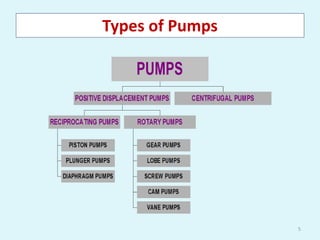
Types of Pumps
5
Rotary Pumps
 Positive displacement type
CHigh pressure, high efficiency
DLiquids must be free of solids
CHandle viscous fluids
6
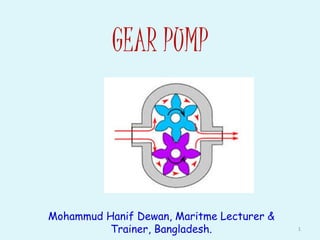
GEAR PUMPS
 A simple gear pump consists of two
spur gears meshing together and
revolving in opposite directions
within a casing.
 Only a few thousandths of an inch
clearance exists between the case
and the gear faces and teeth
extremities .
GEAR PUMPS
LOBE PUMPS
SCREW PUMPS
CAM PUMPS
VANE PUMPS
ROTARY PUMPS
7
Animation of a Gear Pump
8
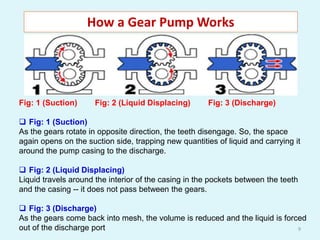
Fig: 1 (Suction) Fig: 2 (Liquid Displacing) Fig: 3 (Discharge)
 Fig: 1 (Suction)
As the gears rotate in opposite direction, the teeth disengage. So, the space
again opens on the suction side, trapping new quantities of liquid and carrying it
around the pump casing to the discharge.
 Fig: 2 (Liquid Displacing)
Liquid travels around the interior of the casing in the pockets between the teeth
and the casing -- it does not pass between the gears.
 Fig: 3 (Discharge)
As the gears come back into mesh, the volume is reduced and the liquid is forced
out of the discharge port
How a Gear Pump Works
9
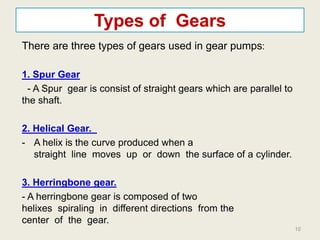
Types of Gears
There are three types of gears used in gear pumps:
1. Spur Gear
- A Spur gear is consist of straight gears which are parallel to
the shaft.
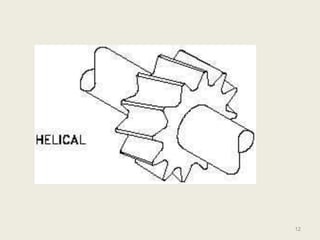
2. Helical Gear.
- A helix is the curve produced when a
straight line moves up or down the surface of a cylinder.
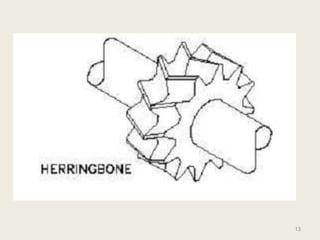
3. Herringbone gear.
- A herringbone gear is composed of two
helixes spiraling in different directions from the
center of the gear.
10
11
12
13
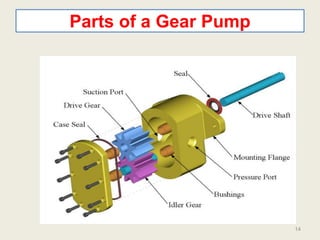
Parts of a Gear Pump
14
Maintenance of Gear Pumps
• Comparing with other pumps, a gear pump need very less
maintenance. Few maintenances are as follows:
1. Checking of back-lash clearances:
- If the back lash clearances become more than the limit, then
need to change the gears. (Limit value is mentioned in
Maker’s manual)
2. Changing of bearings:
according to maker’s instruction/PMS or if found damaged, the
bearings need to change.
3. Gland packings/ mechanical Seal:
- Need to change if oil or liquid leaks from the pump gland.
15
Safeties in Gear Pumps
• As a positive displacement
pump, a RELIEF VALVE is
always fitted with the gear
pump in order to protect from
damage of pump casing or
pipeline fittings due to
accidental closure of pump
discharge valve or any
blockage in discharge
pipelines.
16
Uses of Gear Pumps
• As the pump doesn’t need any valve for pumping
operation, so the gear pump is very effective to pump the
heavy viscus liquids:
• Gear pumps are often used for pumping and
transferring:
- All kind of fuel oils,
- Lub oils
- Gear oils
- Crude oil
- Vegetable oils
- Liquid Chemicals
17
Conclusion
- Can you remember how a gear pump works?
- Can you remember the safety device used in a Gear
Pump?
- Can you tell me about maintenance of Gear Pumps?
Let us do some group discussion 18
References:
1. www.marineengineering.org.uk
2. http://www.pumpschool.com/principles/external.asp
3. www.marinestudy.net
4. Marine Auxiliary Machinery, Seventh Edition Paperback
by H D Mc George
5. General Engineering Knowledge for Marine Engineers
(Reeds-8).
19
Any Question?
Thank you!
20

Gear Pumps

  • 1.
    GEAR PUMP Mohammud HanifDewan, Maritme Lecturer & Trainer, Bangladesh. 1
  • 2.
    Introduction Learning Objective: - Operationand maintenance of a Gear Pump. Specific Learning Objective: - Describe the pump and the types of pumps. - State of rotary pumps and gear pumps. - Explain the operation principle of gear pumps. - Discuss the maintenance of gear pumps and related safeties. - Review of uses of gear pumps.
  • 3.
    Pumps are usedto move any substance which flows or which can be made to flow. As a general rule, all pumps are designed to move fluid substances from one point to another by pulling, pushing or throwing or by some combination of these three methods. A pump is a device that adds energy to the fluid to enable it to move from one point to another. What is a pump?
  • 4.
    Pumps are usedto move any substance which flows or which can be made to flow. So, pump is a device that adds energy to the fluid to enable it to move from one point to another. What is a pump? 4
  • 5.
  • 6.
    Rotary Pumps  Positivedisplacement type CHigh pressure, high efficiency DLiquids must be free of solids CHandle viscous fluids 6
  • 7.
    GEAR PUMPS  Asimple gear pump consists of two spur gears meshing together and revolving in opposite directions within a casing.  Only a few thousandths of an inch clearance exists between the case and the gear faces and teeth extremities . GEAR PUMPS LOBE PUMPS SCREW PUMPS CAM PUMPS VANE PUMPS ROTARY PUMPS 7
  • 8.
    Animation of aGear Pump 8
  • 9.
    Fig: 1 (Suction)Fig: 2 (Liquid Displacing) Fig: 3 (Discharge)  Fig: 1 (Suction) As the gears rotate in opposite direction, the teeth disengage. So, the space again opens on the suction side, trapping new quantities of liquid and carrying it around the pump casing to the discharge.  Fig: 2 (Liquid Displacing) Liquid travels around the interior of the casing in the pockets between the teeth and the casing -- it does not pass between the gears.  Fig: 3 (Discharge) As the gears come back into mesh, the volume is reduced and the liquid is forced out of the discharge port How a Gear Pump Works 9
  • 10.
    Types of Gears Thereare three types of gears used in gear pumps: 1. Spur Gear - A Spur gear is consist of straight gears which are parallel to the shaft. 2. Helical Gear. - A helix is the curve produced when a straight line moves up or down the surface of a cylinder. 3. Herringbone gear. - A herringbone gear is composed of two helixes spiraling in different directions from the center of the gear. 10
  • 11.
  • 12.
  • 13.
  • 14.
    Parts of aGear Pump 14
  • 15.
    Maintenance of GearPumps • Comparing with other pumps, a gear pump need very less maintenance. Few maintenances are as follows: 1. Checking of back-lash clearances: - If the back lash clearances become more than the limit, then need to change the gears. (Limit value is mentioned in Maker’s manual) 2. Changing of bearings: according to maker’s instruction/PMS or if found damaged, the bearings need to change. 3. Gland packings/ mechanical Seal: - Need to change if oil or liquid leaks from the pump gland. 15
  • 16.
    Safeties in GearPumps • As a positive displacement pump, a RELIEF VALVE is always fitted with the gear pump in order to protect from damage of pump casing or pipeline fittings due to accidental closure of pump discharge valve or any blockage in discharge pipelines. 16
  • 17.
    Uses of GearPumps • As the pump doesn’t need any valve for pumping operation, so the gear pump is very effective to pump the heavy viscus liquids: • Gear pumps are often used for pumping and transferring: - All kind of fuel oils, - Lub oils - Gear oils - Crude oil - Vegetable oils - Liquid Chemicals 17
  • 18.
    Conclusion - Can youremember how a gear pump works? - Can you remember the safety device used in a Gear Pump? - Can you tell me about maintenance of Gear Pumps? Let us do some group discussion 18
  • 19.
    References: 1. www.marineengineering.org.uk 2. http://www.pumpschool.com/principles/external.asp 3.www.marinestudy.net 4. Marine Auxiliary Machinery, Seventh Edition Paperback by H D Mc George 5. General Engineering Knowledge for Marine Engineers (Reeds-8). 19
  • 20.