Marine Electrical Standard
     Requiremnent
Lesson overview
• Shore based connection requirement for
  equipment for shipboard equipment
• Electrical system and dynamic marine
  environment- vibration and voltage fluctuation
• SOLAS minimum requirements for electrical
  machinery installation
• Electrical equipments installation on board
  ship - From indicator bulb/lamp up to main
  propulsion
Objectives
• To know general requirements for electrical
  machinery on board ship
• To understand general requirements for
  provision of electrical power and lighting for
  normal & emergency operation
Introduction


• Must meet minimum standards specified by various
  national & international organizations
• For British registered vessel, to comply:
    – Regulations for the Electrical and Electronic Equipment of
      Ships - Institution of Electrical Engineers (IEE)
    – British Standards Institute (BSI) - combined with
      Recommendations for Electrical and Electronic Equipment
      of Offshore Installations
•   The Merchant Shipping Rules - MCA
•   SOLAS – IMO Convention
•   British Standards (BS)
•   International Electrotechnical Commission (IEC)
Introduction
• General requirements - refer to SOLAS requirements
• Chapter II-1 - outlines requirements for Ship
  construction sub-division and stability, machinery
  and electrical installations
• 5 Parts:
   –   Part A General
   –   Part B Sub-division and stability
   –   Part C Machinery installations
   –   Part D Electrical installations
   –   Part E Additional requirements for periodically
        unattended machinery spaces
• Part D:
   – Regulation 40
      • General
   – Regulation 41
      • Main source of electrical power and lighting systems
   – Regulation 42
      • Emergency source of electrical power in passenger ships
   – Regulation 42-1
      • Supplementary emergency lighting for Ro-Ro passenger ships
   – Regulation 43
      • Emergency source of electrical power in cargo ships
   – Regulation 44
      • Starting arrangements for emergency generator sets
   – Regulation 45
      • Precautions against shock, fire and other hazards of electrical origin
• Standards specified met when ship is designed,
  built, approved and classified
• Ship owner & operating staff to maintain
  vessel and its electrical installation to Class
  requirements throughout ship's lifetime
• Periodical survey - to check installation is
  maintained to Class Rules
Items subject to survey
•   Generators and Governors
•   Circuit Breakers
•   Switchboards and Fittings
•   Cables
•   Insulation Resistance
•   Motors and Starters
•   Emergency Power Equipments
•   Parts of Steering Gear
•   Navigation Light Indicators
•   UMS vessels
•   Tankers
• For UMS - survey of associated alarms, controls and
  fire detection is required
• For tankers/gas carriers & others transporting
  flammable cargo - additional survey for electrical
  equipment in hazardous areas
• Carried out during each docking survey & annual
  survey - Means - electrical equipment in hazardous
  area is surveyed every year
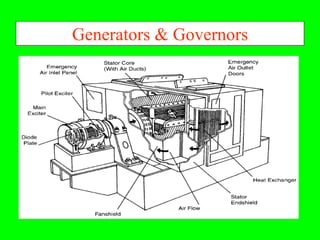
Generators & Governors
•   Clean
•   Respond correctly to controls & load changes
•   Stable operation when running in parallel
•   Windings - free of dust, oil and moisture
•   Visual check - deterioration, abrasion or cracking of insulation
    around winding end coils on stator
•   Insulation test to carry out while machine still hot after
    running on load
•   Minimum 1.5 MΩ for new equipment
•   Surveyor - > 1kΩ/volt min value for 440V genset
•   HV equipment – min IR level (kV + 1) MΩ
•   e.g. for 6.6 kV motor, the acceptable min IR would be 7.6 MΩ
Generators & Governors
• Appropriate action taken before carried out megger test
• Contact surface of commutator or slip-rings
• Contact surfaces – smooth & concentric without signs of
  pitting or deep grooves
• Carbon brushes - adequate length, correct spring pressure and
  properly contoured onto its commutator or slip-ring
• Important to remove excess carbon dust in brush gear &
  around rotor coils
• To run tests, on load, confirm of proper governor & AVR
  operation
• Correct indication – V, f, A, kW, power factor
• Governor response to sudden load changes - within declared
  specification
• Stability of load sharing during parallel operation - clearly
  demonstrated
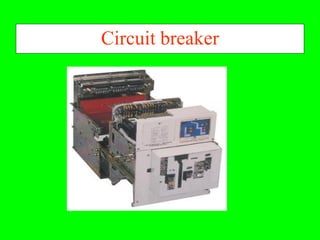
Circuit breaker
Circuit breaker
•   Visual examination - main, arcing and auxiliary contacts for wear, misalignment and
    overheating
•   Similar inspection - fixed and moving isolator contacts at rear of circuit-breaker
•   Arc chutes - clean, free of arc debris and correctly aligned
•   Internal wiring - good condition & end connections tight
•   Mechanical linkages - checked for wear or stress
•   Tests
     – close and trip operations while in isolated position
     – racking mechanism - free moving & fixed main terminals must shuttered off when breaker is
       withdrawn
•   Emergency hand charging (if fitted) - correct operation of mechanical indicators (open,
    closed or isolated)
•   UV release mechanism & OCR settings for level and time delay - clearly set
•   Basically, OCR trip generator breaker - set for 130% of FLC with 3s delay
•   In addition, to suit generator thermal capacity & coordinated with overall protection scheme
    for power system
•   Only proper current injection test – prove manufacturer's I/t characteristics & settings
    (specialist task)
•   CB time delay mechanisms with oil dash pots – to filled to correct level with clean oil of
    maker recommended type
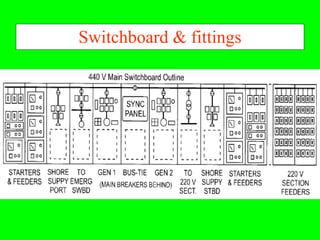
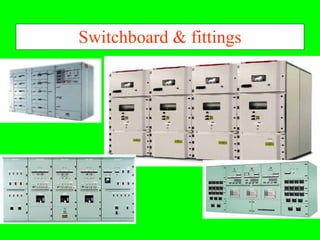
Switchboard & fittings
• Section / distribution board – clean
• Includes all internal / external panel surfaces, instrument faces and control
  switches
• Thorough cleaning inside main swbd carried out only when the board is
  completely dead
• Bus-bar & aux connections checked for tightness during major internal clean
  up
• Overheating signs at connection - loose joint
• Direct heat testing (IR thermal camera) - useful technique for locating hot-
  spots
• Bus-bar supports - examined for surface tracking & damage to insulation
  material
• All internal wiring securely fixed
• Cable entries at bottom of switchboard sealed with non-flammable material –
  prevent dirt & act as fire stop
• Earth bar securely bonded to both board frame (ship's hull)
Switchboard & fittings
• One secondary terminal of each CT) and instruments and relays
  metal cases should wired to main earth bar
• Hinged panel doors bonded with earth strap to swbd frame
• Feeder isolator & fuse holder contacts - checked for mechanical
  wear / damage due overheating / arcing at contacts
• Lightly smear moving contacts with contact lubricant –
  recommended
• Operational tests - synchronising controls & generator protection
  relays (reverse power & preferential tripping)
• Typical reverse power trip settings – 5~15% of generator power
  rating, with 0.5~2.5 sec for diesel drive
• 2~5% and 5 s - turbo-generator settings
• E.g - cargo winches & cranes may feed power back into supply
  network, under light load, such feedback may cause generator to
  trip on reverse power if time delay set too short
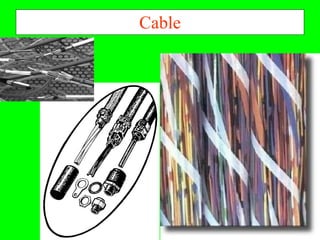
Cable
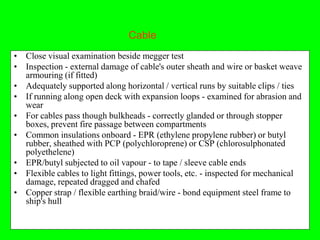
Cable
• Close visual examination beside megger test
• Inspection - external damage of cable's outer sheath and wire or basket weave
  armouring (if fitted)
• Adequately supported along horizontal / vertical runs by suitable clips / ties
• If running along open deck with expansion loops - examined for abrasion and
  wear
• For cables pass though bulkheads - correctly glanded or through stopper
  boxes, prevent fire passage between compartments
• Common insulations onboard - EPR (ethylene propylene rubber) or butyl
  rubber, sheathed with PCP (polychloroprene) or CSP (chlorosulphonated
  polyethelene)
• EPR/butyl subjected to oil vapour - to tape / sleeve cable ends
• Flexible cables to light fittings, power tools, etc. - inspected for mechanical
  damage, repeated dragged and chafed
• Copper strap / flexible earthing braid/wire - bond equipment steel frame to
  ship's hull
Insulation resistance
• Surveyor - results of recent insulation tests on
  all 440V & 220 V
• List indicate test date's, weather conditions
  (hot, humid, etc) & comments (e.g. machine
  hot or cold)
• For generators & main motors - IR trend,
  history of past results
Insulation resistance
Required to test on selected motors
• Visual examination - frame & terminal for damaged or missing
  parts
• General neglect suspected if motor covered with dirt, oil or
  rust
• TEFV induction motors - require less attention as windings
  well protected
• Drip proof, weatherproof & deck water tight – thoroughly
  inspected
• May need to open - check ingress of oil / water, insulation
  damage & internal corrosion
• Commutator / slip-ring - checked for rotary contacts and brush
  gear
• Cargo cranes and winches are not strictly part of a survey as
  they are not considered essential to the safety of the ship.
Insulation resistance
• Running test – vibration, noise, worn out bearings & ampere
  compared to rating plate
• Remote stop/start buttons, regulating resistors etc. - check for
  burned & misaligned contacts
• General condition of starter equipment - loose connections,
  worn pigtails on moving contacts, badly carbonised arc chutes
  & overheating on coils, transformers & resistors
• Dust / weather proof features - in place & serviceable
• Functional checks – starts from local, remote and emergency,
  signal lamp status
• OCR trip settings compared with motor FLC rating
• Fuse size & type for starter - checked against maker's drawings
  & motor rating
Electrical power & associated equipment
• Sequence & operation of emergency generator - manually & automatically
• Emergency switchboard - voltage, current and frequency checked when
  powered by emergency generator
• Functioning of emergency lighting, fire pump & other emergency
  equipment
• Interlocking arrangements between main & emergency switchboard
• Auto-start relays (voltage / frequency operated) examined and tested
• Emergency battery installation & charging rectifier
• Battery – dry, well ventilated, top parts clean, terminal & connections free
  from corrosion & greased, proper electrolyte level & correct SG value
• Safety notices & PPE available adjacent to batteries & proper ventilation
• Battery charging equipment - checks for dirt, overheating, loose
  connections & correct functioning of indicators, instruments and alarms
Steering gear parts
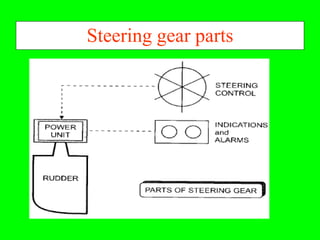
Steering gear parts
•   3 important parts:
     – Power unit
     – Steering control
     – Indications and alarms
•   Power unit - duplicate motors & starters supplied from main swbd
•   SOLAS requirements - one motors to be supplied from emergency swbd
•   Motors, starters & c/o supply switch units to be inspected
•   Rudder control (hydraulic telemotor or electric controller), supplies, changeover
    facilities for steering wheel and auto pilot must tested & well functional
•   Rudder swung from 32° port to 32° stbd in 28 sec with loaded condition
•   SG status indications operate correctly - steering flat, MCR & on bridge
•   Bridge indication should compared with direct mechanical indicator on rudder stock in
    steering flat
•   Motor over current alarms – test by simulating over current relay
•   SG motor does not have OCR protection – fuses only
•   Hydraulic low level alarms - correct initiation by level sensors
Navigation light indicators
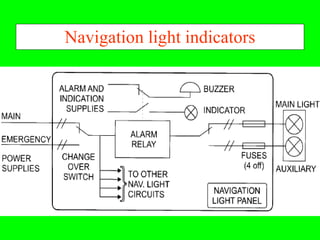
• Indicator operates correctly & shall gives
  appropriate alarms
• Simulation – by pulling the fuse
• Power supply must duplicated & c/o facilities
  checked
• Visual inspection on cable to the lights
• Actual light fittings for navigation - part of
  Safety Equipment Survey
UMS operation
• Apart from basic survey, additional survey required to include
  alarms, fire detection, controls and fail-safe features
• Alarms associated with ME, AE, lubrication & cooling - tested
  for correct operation
• Testing of circuits for sensors – manually by switch or simulate
  to alarm condition - prove function correctly
• Sensor calibration & alarm annunciators – specialist
• Initiation and action of automatic shut down features to be tested
• Essential drives for lubrication, cooling & fuel are duplicated - on
  duty/standby basis, automatically start up standby unit if duty
  pump pressure loss
• Automatic start-up (under voltage & under-frequency relay) of
  emergency generator demonstrated, run up to speed & supply
  voltage to emergency swbd
UMS operation
•   Stby generator starts automatically if loss of duty generator & supplying voltage within
    45 sec
•   Followed by automatic restarting of essential auxiliaries - lubrication, cooling, fuel &
    steering
•   Bilge level alarms with automatic bilge pumping must proven
•   Main & stby power supplies to overall alarm monitoring system - inspected & tested
•   Stby power arrangement - backup battery & its trickle-charger to inspect
•   Tests made on UMS alarm system to verify:
     – alarms displayed on main console relayed to group alarm panel on bridge
     – duty engr call system - duty engineer cabin, duty mess and lounges
     – Allowance of 2-3 minutes to respond to machinery alarm, otherwise dead man alarm sounded
•   Complete inspection / test of fire detection system
•   All smoke, heat & flame sensors - function correctly, giving audible & visual alarms
•   Hand operated fire alarm switches (break glass) - examined & to be tested
•   ME controls functional & tested from bridge, local & emergency position
•   Operational features of ME control & indication - demonstrated during full engine test
•   All equipment & connections associated with engine control - examined for wear & tear,
    insulation level, cleanliness, loose connections and overheating
Tanker
•   Electrical equipment - surveyed every 4 yrs & during docking
•   Hazardous area electrical equipment - surveyed every year
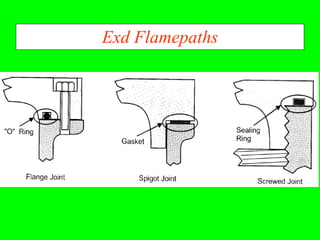
•   Common hazardous area electrical equipment - flameproof enclosure type
    (Exd) - light fittings, motors, starters, push-buttons and alarm bells
•   Inspected for surface cleanliness, corrosion & secure mountings
•   Light fittings – cement, bonds the lamp glass to its frame - inspected for cracks
    or indentations
•   All bolts in place, evenly torqued-up and of correct type
•   Edges of ‘Exd’ flamepath flanged joints - not painted over / impeded
•   Must be adjudged weatherproof with correct (approved) gaskets or O rings in
    place
•   Fittings may opened up - check condition of flamepath surfaces for corrosion,
    pitting or scratches
•   Ex Certification & equipment rating label must not painted over
•   No alterations allow on Exd equipment without permission from Certification
    Authority - lamp size & its rating
Exd Flamepaths
• Pump rooms - pressurized light fittings (Exp)
• To confirm - fittings are purged & pressurized before light is
  switched on
• Lights automatically switched off if air pressure drops
• Instrumentation & communication equipment - must
  intrinsically safe (Exi)
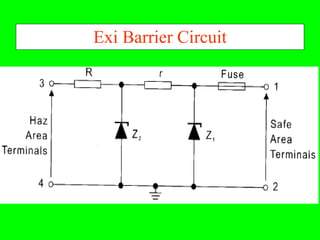
• Most Exi - zener barriers connected in line with IS circuits &
  fitted in safe area, outside hazardous area
• Test zener barriers – uneasy task, accepted if equipment
  function correctly when circuit fault arise
• Visual inspection during installation
• Barriers have secure connections & bolted to earth strap,
  bonded to ship's hull
Exi Barrier Circuit

Standards

  • 1.
  • 2.
    Lesson overview • Shorebased connection requirement for equipment for shipboard equipment • Electrical system and dynamic marine environment- vibration and voltage fluctuation • SOLAS minimum requirements for electrical machinery installation • Electrical equipments installation on board ship - From indicator bulb/lamp up to main propulsion
  • 3.
    Objectives • To knowgeneral requirements for electrical machinery on board ship • To understand general requirements for provision of electrical power and lighting for normal & emergency operation
  • 4.
    Introduction • Must meetminimum standards specified by various national & international organizations • For British registered vessel, to comply: – Regulations for the Electrical and Electronic Equipment of Ships - Institution of Electrical Engineers (IEE) – British Standards Institute (BSI) - combined with Recommendations for Electrical and Electronic Equipment of Offshore Installations • The Merchant Shipping Rules - MCA • SOLAS – IMO Convention • British Standards (BS) • International Electrotechnical Commission (IEC)
  • 5.
    Introduction • General requirements- refer to SOLAS requirements • Chapter II-1 - outlines requirements for Ship construction sub-division and stability, machinery and electrical installations • 5 Parts: – Part A General – Part B Sub-division and stability – Part C Machinery installations – Part D Electrical installations – Part E Additional requirements for periodically unattended machinery spaces
  • 6.
    • Part D: – Regulation 40 • General – Regulation 41 • Main source of electrical power and lighting systems – Regulation 42 • Emergency source of electrical power in passenger ships – Regulation 42-1 • Supplementary emergency lighting for Ro-Ro passenger ships – Regulation 43 • Emergency source of electrical power in cargo ships – Regulation 44 • Starting arrangements for emergency generator sets – Regulation 45 • Precautions against shock, fire and other hazards of electrical origin
  • 7.
    • Standards specifiedmet when ship is designed, built, approved and classified • Ship owner & operating staff to maintain vessel and its electrical installation to Class requirements throughout ship's lifetime • Periodical survey - to check installation is maintained to Class Rules
  • 8.
    Items subject tosurvey • Generators and Governors • Circuit Breakers • Switchboards and Fittings • Cables • Insulation Resistance • Motors and Starters • Emergency Power Equipments • Parts of Steering Gear • Navigation Light Indicators • UMS vessels • Tankers
  • 9.
    • For UMS- survey of associated alarms, controls and fire detection is required • For tankers/gas carriers & others transporting flammable cargo - additional survey for electrical equipment in hazardous areas • Carried out during each docking survey & annual survey - Means - electrical equipment in hazardous area is surveyed every year
  • 10.
  • 11.
    Generators & Governors • Clean • Respond correctly to controls & load changes • Stable operation when running in parallel • Windings - free of dust, oil and moisture • Visual check - deterioration, abrasion or cracking of insulation around winding end coils on stator • Insulation test to carry out while machine still hot after running on load • Minimum 1.5 MΩ for new equipment • Surveyor - > 1kΩ/volt min value for 440V genset • HV equipment – min IR level (kV + 1) MΩ • e.g. for 6.6 kV motor, the acceptable min IR would be 7.6 MΩ
  • 12.
    Generators & Governors •Appropriate action taken before carried out megger test • Contact surface of commutator or slip-rings • Contact surfaces – smooth & concentric without signs of pitting or deep grooves • Carbon brushes - adequate length, correct spring pressure and properly contoured onto its commutator or slip-ring • Important to remove excess carbon dust in brush gear & around rotor coils • To run tests, on load, confirm of proper governor & AVR operation • Correct indication – V, f, A, kW, power factor • Governor response to sudden load changes - within declared specification • Stability of load sharing during parallel operation - clearly demonstrated
  • 13.
  • 14.
    Circuit breaker • Visual examination - main, arcing and auxiliary contacts for wear, misalignment and overheating • Similar inspection - fixed and moving isolator contacts at rear of circuit-breaker • Arc chutes - clean, free of arc debris and correctly aligned • Internal wiring - good condition & end connections tight • Mechanical linkages - checked for wear or stress • Tests – close and trip operations while in isolated position – racking mechanism - free moving & fixed main terminals must shuttered off when breaker is withdrawn • Emergency hand charging (if fitted) - correct operation of mechanical indicators (open, closed or isolated) • UV release mechanism & OCR settings for level and time delay - clearly set • Basically, OCR trip generator breaker - set for 130% of FLC with 3s delay • In addition, to suit generator thermal capacity & coordinated with overall protection scheme for power system • Only proper current injection test – prove manufacturer's I/t characteristics & settings (specialist task) • CB time delay mechanisms with oil dash pots – to filled to correct level with clean oil of maker recommended type
  • 15.
  • 16.
  • 17.
    Switchboard & fittings •Section / distribution board – clean • Includes all internal / external panel surfaces, instrument faces and control switches • Thorough cleaning inside main swbd carried out only when the board is completely dead • Bus-bar & aux connections checked for tightness during major internal clean up • Overheating signs at connection - loose joint • Direct heat testing (IR thermal camera) - useful technique for locating hot- spots • Bus-bar supports - examined for surface tracking & damage to insulation material • All internal wiring securely fixed • Cable entries at bottom of switchboard sealed with non-flammable material – prevent dirt & act as fire stop • Earth bar securely bonded to both board frame (ship's hull)
  • 18.
    Switchboard & fittings •One secondary terminal of each CT) and instruments and relays metal cases should wired to main earth bar • Hinged panel doors bonded with earth strap to swbd frame • Feeder isolator & fuse holder contacts - checked for mechanical wear / damage due overheating / arcing at contacts • Lightly smear moving contacts with contact lubricant – recommended • Operational tests - synchronising controls & generator protection relays (reverse power & preferential tripping) • Typical reverse power trip settings – 5~15% of generator power rating, with 0.5~2.5 sec for diesel drive • 2~5% and 5 s - turbo-generator settings • E.g - cargo winches & cranes may feed power back into supply network, under light load, such feedback may cause generator to trip on reverse power if time delay set too short
  • 19.
  • 20.
    Cable • Close visualexamination beside megger test • Inspection - external damage of cable's outer sheath and wire or basket weave armouring (if fitted) • Adequately supported along horizontal / vertical runs by suitable clips / ties • If running along open deck with expansion loops - examined for abrasion and wear • For cables pass though bulkheads - correctly glanded or through stopper boxes, prevent fire passage between compartments • Common insulations onboard - EPR (ethylene propylene rubber) or butyl rubber, sheathed with PCP (polychloroprene) or CSP (chlorosulphonated polyethelene) • EPR/butyl subjected to oil vapour - to tape / sleeve cable ends • Flexible cables to light fittings, power tools, etc. - inspected for mechanical damage, repeated dragged and chafed • Copper strap / flexible earthing braid/wire - bond equipment steel frame to ship's hull
  • 21.
    Insulation resistance • Surveyor- results of recent insulation tests on all 440V & 220 V • List indicate test date's, weather conditions (hot, humid, etc) & comments (e.g. machine hot or cold) • For generators & main motors - IR trend, history of past results
  • 22.
    Insulation resistance Required totest on selected motors • Visual examination - frame & terminal for damaged or missing parts • General neglect suspected if motor covered with dirt, oil or rust • TEFV induction motors - require less attention as windings well protected • Drip proof, weatherproof & deck water tight – thoroughly inspected • May need to open - check ingress of oil / water, insulation damage & internal corrosion • Commutator / slip-ring - checked for rotary contacts and brush gear • Cargo cranes and winches are not strictly part of a survey as they are not considered essential to the safety of the ship.
  • 23.
    Insulation resistance • Runningtest – vibration, noise, worn out bearings & ampere compared to rating plate • Remote stop/start buttons, regulating resistors etc. - check for burned & misaligned contacts • General condition of starter equipment - loose connections, worn pigtails on moving contacts, badly carbonised arc chutes & overheating on coils, transformers & resistors • Dust / weather proof features - in place & serviceable • Functional checks – starts from local, remote and emergency, signal lamp status • OCR trip settings compared with motor FLC rating • Fuse size & type for starter - checked against maker's drawings & motor rating
  • 24.
    Electrical power &associated equipment • Sequence & operation of emergency generator - manually & automatically • Emergency switchboard - voltage, current and frequency checked when powered by emergency generator • Functioning of emergency lighting, fire pump & other emergency equipment • Interlocking arrangements between main & emergency switchboard • Auto-start relays (voltage / frequency operated) examined and tested • Emergency battery installation & charging rectifier • Battery – dry, well ventilated, top parts clean, terminal & connections free from corrosion & greased, proper electrolyte level & correct SG value • Safety notices & PPE available adjacent to batteries & proper ventilation • Battery charging equipment - checks for dirt, overheating, loose connections & correct functioning of indicators, instruments and alarms
  • 25.
  • 26.
    Steering gear parts • 3 important parts: – Power unit – Steering control – Indications and alarms • Power unit - duplicate motors & starters supplied from main swbd • SOLAS requirements - one motors to be supplied from emergency swbd • Motors, starters & c/o supply switch units to be inspected • Rudder control (hydraulic telemotor or electric controller), supplies, changeover facilities for steering wheel and auto pilot must tested & well functional • Rudder swung from 32° port to 32° stbd in 28 sec with loaded condition • SG status indications operate correctly - steering flat, MCR & on bridge • Bridge indication should compared with direct mechanical indicator on rudder stock in steering flat • Motor over current alarms – test by simulating over current relay • SG motor does not have OCR protection – fuses only • Hydraulic low level alarms - correct initiation by level sensors
  • 27.
  • 28.
    Navigation light indicators •Indicator operates correctly & shall gives appropriate alarms • Simulation – by pulling the fuse • Power supply must duplicated & c/o facilities checked • Visual inspection on cable to the lights • Actual light fittings for navigation - part of Safety Equipment Survey
  • 29.
    UMS operation • Apartfrom basic survey, additional survey required to include alarms, fire detection, controls and fail-safe features • Alarms associated with ME, AE, lubrication & cooling - tested for correct operation • Testing of circuits for sensors – manually by switch or simulate to alarm condition - prove function correctly • Sensor calibration & alarm annunciators – specialist • Initiation and action of automatic shut down features to be tested • Essential drives for lubrication, cooling & fuel are duplicated - on duty/standby basis, automatically start up standby unit if duty pump pressure loss • Automatic start-up (under voltage & under-frequency relay) of emergency generator demonstrated, run up to speed & supply voltage to emergency swbd
  • 30.
    UMS operation • Stby generator starts automatically if loss of duty generator & supplying voltage within 45 sec • Followed by automatic restarting of essential auxiliaries - lubrication, cooling, fuel & steering • Bilge level alarms with automatic bilge pumping must proven • Main & stby power supplies to overall alarm monitoring system - inspected & tested • Stby power arrangement - backup battery & its trickle-charger to inspect • Tests made on UMS alarm system to verify: – alarms displayed on main console relayed to group alarm panel on bridge – duty engr call system - duty engineer cabin, duty mess and lounges – Allowance of 2-3 minutes to respond to machinery alarm, otherwise dead man alarm sounded • Complete inspection / test of fire detection system • All smoke, heat & flame sensors - function correctly, giving audible & visual alarms • Hand operated fire alarm switches (break glass) - examined & to be tested • ME controls functional & tested from bridge, local & emergency position • Operational features of ME control & indication - demonstrated during full engine test • All equipment & connections associated with engine control - examined for wear & tear, insulation level, cleanliness, loose connections and overheating
  • 31.
    Tanker • Electrical equipment - surveyed every 4 yrs & during docking • Hazardous area electrical equipment - surveyed every year • Common hazardous area electrical equipment - flameproof enclosure type (Exd) - light fittings, motors, starters, push-buttons and alarm bells • Inspected for surface cleanliness, corrosion & secure mountings • Light fittings – cement, bonds the lamp glass to its frame - inspected for cracks or indentations • All bolts in place, evenly torqued-up and of correct type • Edges of ‘Exd’ flamepath flanged joints - not painted over / impeded • Must be adjudged weatherproof with correct (approved) gaskets or O rings in place • Fittings may opened up - check condition of flamepath surfaces for corrosion, pitting or scratches • Ex Certification & equipment rating label must not painted over • No alterations allow on Exd equipment without permission from Certification Authority - lamp size & its rating
  • 32.
  • 33.
    • Pump rooms- pressurized light fittings (Exp) • To confirm - fittings are purged & pressurized before light is switched on • Lights automatically switched off if air pressure drops • Instrumentation & communication equipment - must intrinsically safe (Exi) • Most Exi - zener barriers connected in line with IS circuits & fitted in safe area, outside hazardous area • Test zener barriers – uneasy task, accepted if equipment function correctly when circuit fault arise • Visual inspection during installation • Barriers have secure connections & bolted to earth strap, bonded to ship's hull
  • 34.