INDUCTION MOTOR
BY: MUBAREK KURT
Mubarek Kurt
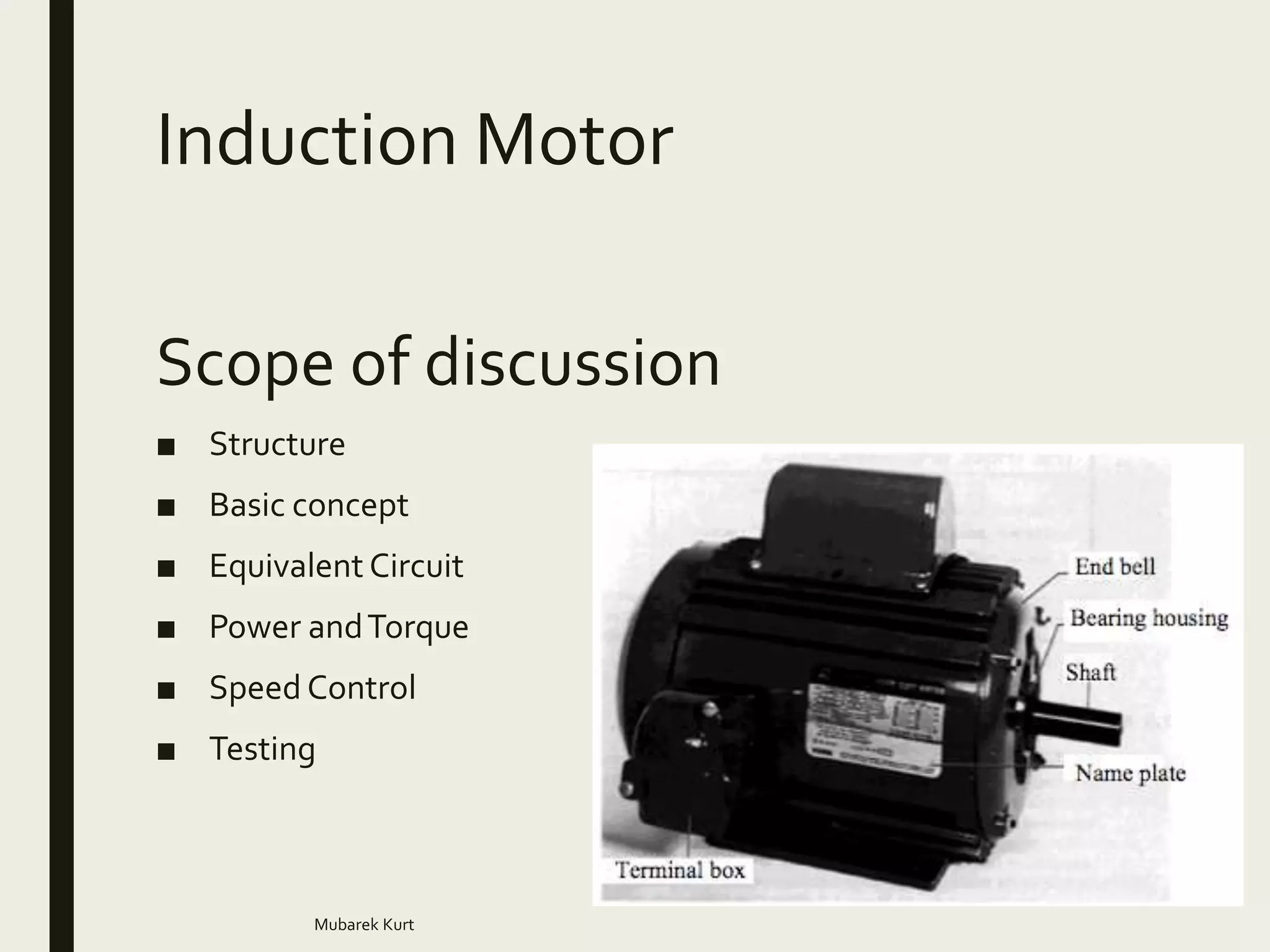
Induction Motor
Scope of discussion
■ Structure
■ Basic concept
■ Equivalent Circuit
■ Power andTorque
■ Speed Control
■ Testing
Mubarek Kurt
Introduction
■ The AC induction motor (IM) is well suited to application
requiring constant speed operation.
■ In general, the induction motor is cheaper and easier to
maintain compared to other alternatives.
■ The IM is made up of the stator, or stationary windings, and the
rotor.
Mubarek Kurt
Induction Motor
- Structure -
Squirrel Cage – no winding and slip
ring
Mubarek Kurt
Wound Rotor – the winding connected to slip rings
Mubarek Kurt
Synchronous Speed
■ The speed with which the stator magnetic field rotates, which
will determine the speed of the rotor, is called the synchronous
speed (SS).
■ The relationship to calculate the SS of an induction motor is
SS=(120 X f)/P
Where SS=Syn. Speed (RPM), f=frequency (Hz) and P number of
poles.
Mubarek Kurt
Example 1
■ Determine syn. Speed for 2 pole & 8 pole motor. Assume
f=50Hz.
Mubarek Kurt
Motor/Rotor Speed
■ The rotor in an induction motor can not turn at the syn. Speed.
In order to induce an emf in the rotor, the rotor must slower
than the Syn. Speed (SS).
■ The relationship between the rotor speed and the SS is called
the Slip (S). Typically, the slip expressed as a percentage of the
SS.
Mubarek Kurt
Slip
■ The equation for the motor slip is:
■ If you were sitting on the rotor, you would find that the rotor was slipping
behind the rotating field by the slip rpm = SS-RS=S(SS).
■ At stand still, S=1, that is RS=0.At the synchronous speed, RS=SS, S=0.
■ The mechanical speed of the rotor, in terms of slip and syn. speed.
  %100% x
SS
RSSS
S


SSRS S
SSSRS
 )1(
)1(


Mubarek Kurt
Example 2
■ Find Slip in percentage for SS=900 RPM and RS 885 RPM.
Mubarek Kurt
The Electrical Freq. on the
Rotor
■ An induction motor works by inducing voltages and currents in
the rotor of the machine, and for that reason it has sometimes
been called a rotating transformer.
■ If the rotor of a motor is locked so that it cannot move, then the
rotor will have the same freq. as the stator.
■ On the other hand, if the rotor turns at sync. Speed, the freq.
on the rotor will be zero.
Mubarek Kurt
Motor/Rotor Speed cont.
■ The frequency fre of the induced voltage and current in the rotor circuit
will correspond to this slip rpm, because this is the relatives speed
between the rotating field and the rotor winding.Thus,
sere Sff 
Mubarek Kurt
Example 3
■ A 3phase, 20hp, 208 V, 60Hz, 6 pole, wye connected induction
motor delivers 15kW at a slip 5%. Determines
a) Syn. Speed
b) Rotor Speed
c) Freq. of the rotor current
Mubarek Kurt
Example 4
■ A 3 phase, 460 V, 100 hp, 60 Hz, four pole induction machine
delivers rated output power at a slip of 0.05. Determine the
a) Syn. Speed and motor speed.
b) Speed of the rotating air gap field.
c) Frequency of the rotor circuit.
d) Slip RPM.
Mubarek Kurt
Example 5
A 208V, 10hp, 4 pole, 50 Hz,Y-connected induction motor has a
full-load slip of 5%.
a) What is the synchronous speed of this motor?
b) What is the rotor speed of this motor at the rated load?
c) What is the rotor frequency of this motor at the rated load?
d) What is the shaft torque of this motor at the rated load?
Mubarek Kurt
Example 6
A 220-V, three-phase, two-pole, 50-Hz induction motor is
running at a slip of 5 percent. Find:
(a) The speed of the magnetic fields in revolutions per minute
(b) The speed of the rotor in revolutions per minute
(c) The slip speed of the rotor
(d) The rotor frequency in hertz
Mubarek Kurt
Example 7
A 480-V, three-phase, four-pole, 60-Hz induction motor running
at a slip of 0.035. Find;
(a) The speed of the magnetic fields in revolutions per minute
(b) The speed of the rotor in revolutions per minute
(c) The slip speed of the rotor
(d) The rotor frequency in hertz
Mubarek Kurt
Example 8
A three-phase, 60-Hz induction motor runs at 890 r/min at no
load and at 840 r/min at full load.
(a) How many poles does this motor have?
(b) What is the slip at rated load?
(c) What is the speed at one-quarter of the rated load?
(d) What is the rotor’s electrical frequency at one-quarter of the
rated load?
Mubarek Kurt
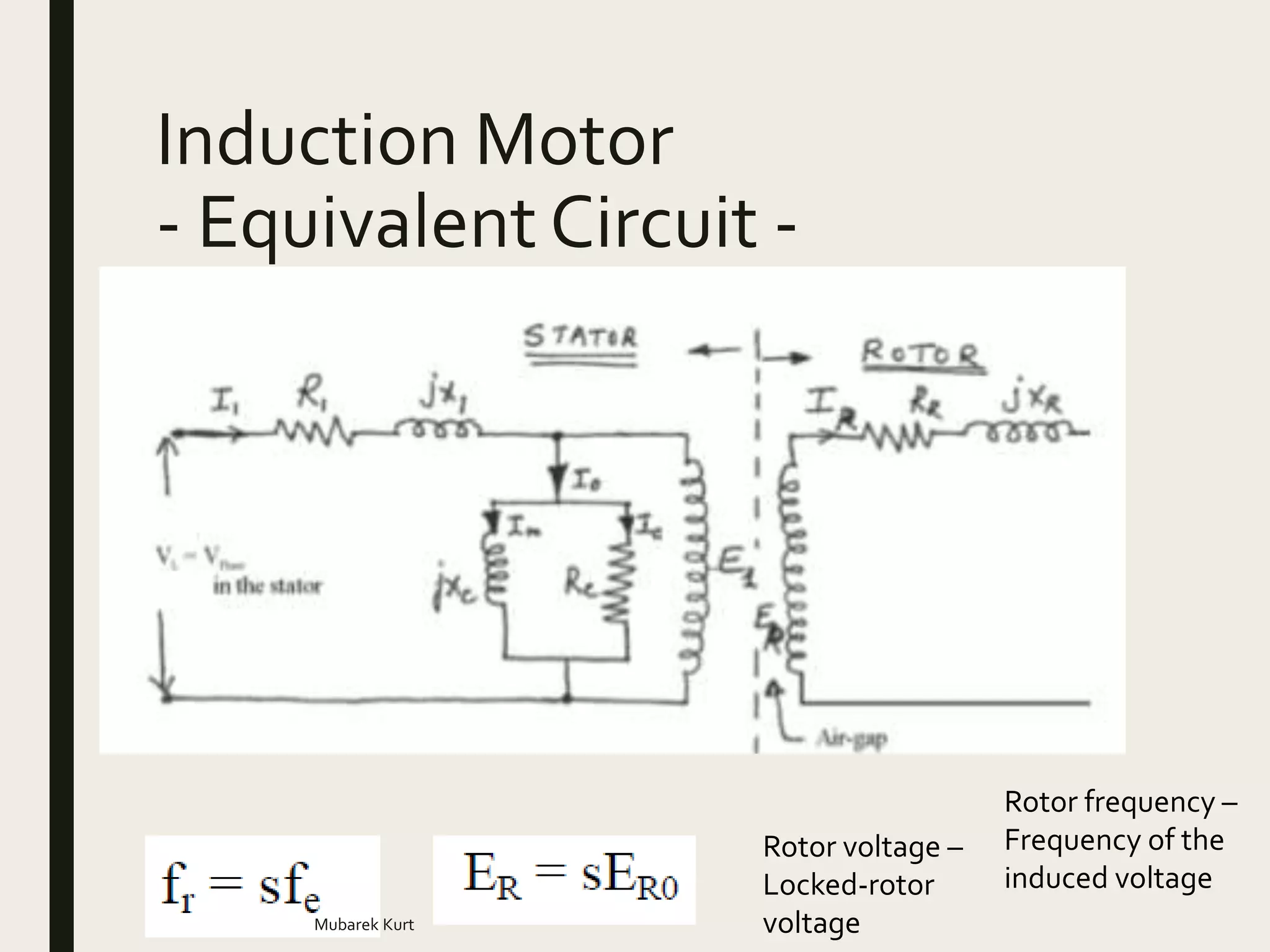
Equivalent Circuit
■ An induction motor relies for its operation on the induction of voltages
and currents in its rotor circuit from stator circuit (transformer action).
■ Because the induction of voltages and currents in the rotor circuit of an
induction motor is essentially a transformer operation, the equivalent
circuit of an induction motor will turn out to very similar to the equivalent
circuit of transformer.
Mubarek Kurt
Induction Motor
- Equivalent Circuit -
Rotor voltage –
Locked-rotor
voltage
Rotor frequency –
Frequency of the
induced voltage
Mubarek Kurt
RR is constant but XR
depend on S
Rotor current
flow
Overall rotor impedance
considered S
Referring to stator side,
considered turn ratio – new
Rotor voltage
Induction Motor – Equi. Circuit
XR is known as
blocked-rotor rotor
reactance
Mubarek Kurt
Induction Motor – Basic
Concept
Rotor
current
Rotor
impedance
If,
Final per-
phase
equivalent
circuit
Mubarek Kurt
Induction Motor
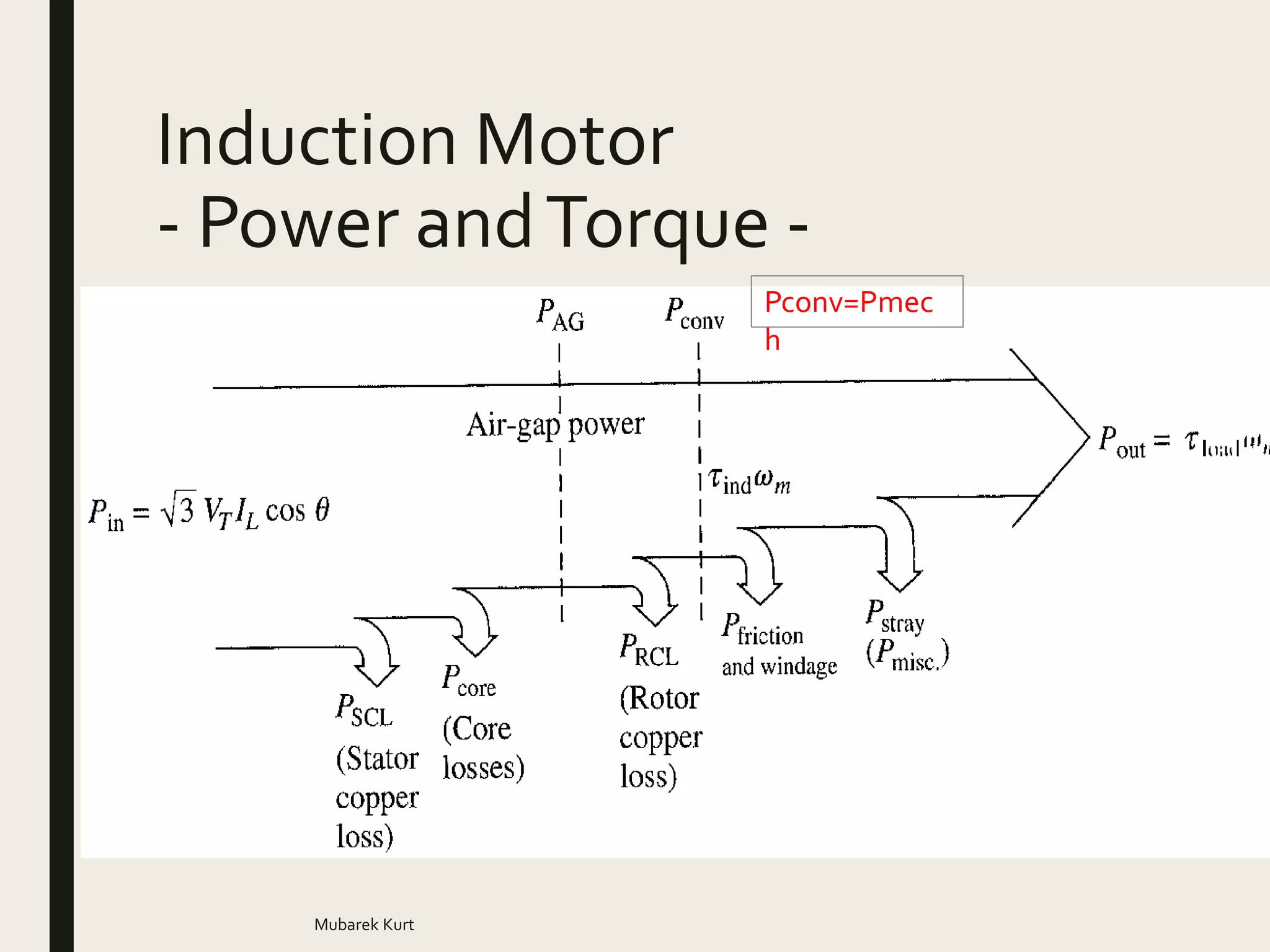
- Power andTorque -
Pconv=Pmec
h
Mubarek Kurt
Induction Motor
- Power andTorque -
Mubarek Kurt
Induction Motor
- Power andTorque -
Mubarek Kurt
Induction Motor
- Power andTorque -
Mubarek Kurt
Induction Motor
- Power andTorque -
Mubarek Kurt
Relationship Pag, Pconv &
Pmech
■ Power across the air gap is includes the rotor copper loss (RCL) and
mechanical power developed.
SSPPP
SPRIP
P
S
S
P
PSP
S
S
R
IP
S
R
IP
S
S
R
RIP
mechRCLag
agRCL
RCLmech
agmech
mech
ag
ag




















1::1::
)1(
)1(
)1(
)1(
2
2
2
22
2
22
2
2
2
2
2
Mubarek Kurt
Example 9
■ A 480 V, 60 Hz, 50 Hp, 3 phase induction motor is
drawing 60 A at 0.85 PF lagging. The stator copper
losses are 2 kW and the rotor copper losses are 700
W. The friction and windage losses are 600 W, the
core losses are 1800 W, and the stray losses are
negligible. Find the following quantities:
a) The air gap power
b) The converted power
c) The output power
d) The efficiency of the motor.
Mubarek Kurt
Example 10
■ A 3phase, 15 hp, 460 V, 4 pole, 60 Hz, 1728 rpm induction motor
delivers full output power to a load connected to its shaft. The
windage and friction loss of the motor is 750W. Determine the
a) Mechanical power developed (=Output Shaft power
+Windage and friction loss)
b) Air gap power
c) Rotor copper loss.
Mubarek Kurt
Induction Motor
- Power andTorque -
wsync =
4p f1
P
wm = (1- S)wsyn
Mubarek Kurt
Induction Motor
- Power andTorque -
Air gap needs R2/S and rotor copper loss needs R2
Stator Core Losses
Rotor Core Losses
Mechanical @ Converted Power
Mubarek Kurt
Example 11
A 480V, 60Hz, 50hp, 3 phase induction motor is drawing 60A at
0.85 Pf lagging.The stator copper losses are 2 kW, and the rotor
losses are 700W.The friction and windage losses is 600W, the core
losses are 1800W, and the stray losses are negligible. Find:
a) The air gap power PAG
b) The power converted Pconv
c) The output power Pout
d) The efficiency of the motor
Mubarek Kurt
Example 11
A 460V, 25hp, 50Hz, 4 pole,Y-connected induction motor has the following
impedances in ohms per phase referred to stator circuit:
The total rotational losses are 1100W and are assumed to be constant.The
core loss is lumped in with the rotational losses. For a rotor slip of 2.2% at
rated voltage and rated frequency, find the motor’s
a) speed d) Pconv and Pout
b) stator current e) ind and load
c) power factor f ) efficiency
Mubarek Kurt
Example 12
A 208-V, two-pole, 60-HzY-connected wound-rotor induction motor is
rated at 15 hp. Its equivalent circuit components are
R1 = 0.200 Ω R2 = 0.120 Ω XM = 15.0 Ω
X1= 0.410 Ω X2 = 0.410 Ω
Pmech = 250W Pmisc ≈ 0 Pcore = 180W
For a slip of 0.05, find
(a) The line current IL
(b) The stator copper losses PSCL
(c) The air-gap power PAG
(d) The power converted from electrical to mechanical form Pconv
(e) The induced torque τind
(f) The load torque load τload
(g) The overall machine efficiency
(h) The motor speed in revolutions per minute and radians per secondMubarek Kurt
Example 13
A 50-kW, 440-V, 50-Hz, six-pole induction motor has a slip of 6
percent when operating at full-load conditions.At full-load
conditions, the friction and windage losses are 300W, and the core
losses are 600W. Find the following values for full-load conditions:
(a) The shaft speed nm
(b) The output power in watts
(c) The load torque τload in newton-meters
(d) The induced torque τind in newton-meters
(e) The rotor frequency in hertz
Mubarek Kurt
Induction Motor
- Speed Control -
■ Two methods
a) Varying stator and rotor magnetic field speed
- electrical frequency or changing the number of
poles
b) Varying slip
- varying rotor resistance or terminal voltage
Mubarek Kurt
Created two poles, N and S
Created an extra poles by
changing current polarity
(only 2 speeds)
Induction Motor
- Speed Control (pole changing)-
Mubarek Kurt
Induction Motor
- Speed Control (Frequency) -
With or without adjustment to the terminal voltage:
a) Vary frequency, stator voltage adjusted – generally vary speed
and maintain operating torque.
b) Vary frequency, stator voltage maintained – able to achieve
higher speeds but a reduction of torque.
Could be combined together, easy way by introducing power
electronic fields.
Mubarek Kurt
Induction Motor
- Speed Control (terminal voltage) -
Mubarek Kurt
Induction Motor
- Speed Control (rotor resistance)
-
Mubarek Kurt
Testing of Induction Motor
■ The parameters of the equivalent circuit Rc, Xm, R1, X1, R2 and X2, can
be determined from the results of a no-load test, a blocked-rotor test
and from measurement of the DC resistance of the stator winding.
■ No-load test is like the open-circuit test on a transformer, gives
information about exciting current and rotational losses.
■ The small power loss in the machine at no-load is due to the core loss
and the friction and windage loss.
Mubarek Kurt
Testing of Induction Motor
cont.
■ The blocked-rotor test on an induction machine, like the short-
circuit test on transformer, gives information about leakage
impedances.
■ In this test the rotor is blocked so that so that the motor cannot
rotate.
Mubarek Kurt
Induction Motor
-Testing (no loadTest) -
Measuring rotational losses and providing
info about its magnetizing current (X1 + XM)
Mubarek Kurt
Due to the
rotor speed
close to
sync speed,
S small and
higher
rotational
losses
Mubarek Kurt
Induction Motor
-Testing (no load test) -
Mubarek Kurt
Induction Motor
-Testing (DC test) -
To find R1 (stator resistance).
a) Dc voltage is applied and adjusted to rated
condition.
b) Voltage and current flow are recorded.
Mubarek Kurt
Induction Motor
-Testing (Locked rotor)-
Steps:
1- locked
2- AC voltage is applied and currents flow is
adjusted to full load condition
3- Measure voltage, current and power flow
Mubarek Kurt
Induction Motor
-Testing (Locked rotor)-
Mubarek Kurt
Induction Motor
-Testing (Locked rotor)-
Mubarek Kurt
Example 14
The following test data were taken on a 7.5 hp, 4-pole, 208V, 60Hz, design star
connected induction motor having a rated current of 28A
(a) Sketch the per-phase equivalent circuit for this motor.
Mubarek Kurt
Example 151) No LoadTest
Supply Freq. =60Hz
LineVoltage = 2200V
Line Current= 4.5 A
Input Power=1600 W
2) Blocked-rotorTest
Freq. =15Hz
LineVoltage = 270V
Line Current= 25 A
Input Power=9000W
3) Average DC resistance per stator phase
R1=2.8 ohm
a) Determine the no-load rotational loss
b) Determine all parameters
Mubarek Kurt

Electrical Power Systems Induction motor

  • 1.
    INDUCTION MOTOR BY: MUBAREKKURT Mubarek Kurt
  • 2.
    Induction Motor Scope ofdiscussion ■ Structure ■ Basic concept ■ Equivalent Circuit ■ Power andTorque ■ Speed Control ■ Testing Mubarek Kurt
  • 3.
    Introduction ■ The ACinduction motor (IM) is well suited to application requiring constant speed operation. ■ In general, the induction motor is cheaper and easier to maintain compared to other alternatives. ■ The IM is made up of the stator, or stationary windings, and the rotor. Mubarek Kurt
  • 4.
    Induction Motor - Structure- Squirrel Cage – no winding and slip ring Mubarek Kurt
  • 5.
    Wound Rotor –the winding connected to slip rings Mubarek Kurt
  • 6.
    Synchronous Speed ■ Thespeed with which the stator magnetic field rotates, which will determine the speed of the rotor, is called the synchronous speed (SS). ■ The relationship to calculate the SS of an induction motor is SS=(120 X f)/P Where SS=Syn. Speed (RPM), f=frequency (Hz) and P number of poles. Mubarek Kurt
  • 7.
    Example 1 ■ Determinesyn. Speed for 2 pole & 8 pole motor. Assume f=50Hz. Mubarek Kurt
  • 8.
    Motor/Rotor Speed ■ Therotor in an induction motor can not turn at the syn. Speed. In order to induce an emf in the rotor, the rotor must slower than the Syn. Speed (SS). ■ The relationship between the rotor speed and the SS is called the Slip (S). Typically, the slip expressed as a percentage of the SS. Mubarek Kurt
  • 9.
    Slip ■ The equationfor the motor slip is: ■ If you were sitting on the rotor, you would find that the rotor was slipping behind the rotating field by the slip rpm = SS-RS=S(SS). ■ At stand still, S=1, that is RS=0.At the synchronous speed, RS=SS, S=0. ■ The mechanical speed of the rotor, in terms of slip and syn. speed.   %100% x SS RSSS S   SSRS S SSSRS  )1( )1(   Mubarek Kurt
  • 10.
    Example 2 ■ FindSlip in percentage for SS=900 RPM and RS 885 RPM. Mubarek Kurt
  • 11.
    The Electrical Freq.on the Rotor ■ An induction motor works by inducing voltages and currents in the rotor of the machine, and for that reason it has sometimes been called a rotating transformer. ■ If the rotor of a motor is locked so that it cannot move, then the rotor will have the same freq. as the stator. ■ On the other hand, if the rotor turns at sync. Speed, the freq. on the rotor will be zero. Mubarek Kurt
  • 12.
    Motor/Rotor Speed cont. ■The frequency fre of the induced voltage and current in the rotor circuit will correspond to this slip rpm, because this is the relatives speed between the rotating field and the rotor winding.Thus, sere Sff  Mubarek Kurt
  • 13.
    Example 3 ■ A3phase, 20hp, 208 V, 60Hz, 6 pole, wye connected induction motor delivers 15kW at a slip 5%. Determines a) Syn. Speed b) Rotor Speed c) Freq. of the rotor current Mubarek Kurt
  • 14.
    Example 4 ■ A3 phase, 460 V, 100 hp, 60 Hz, four pole induction machine delivers rated output power at a slip of 0.05. Determine the a) Syn. Speed and motor speed. b) Speed of the rotating air gap field. c) Frequency of the rotor circuit. d) Slip RPM. Mubarek Kurt
  • 15.
    Example 5 A 208V,10hp, 4 pole, 50 Hz,Y-connected induction motor has a full-load slip of 5%. a) What is the synchronous speed of this motor? b) What is the rotor speed of this motor at the rated load? c) What is the rotor frequency of this motor at the rated load? d) What is the shaft torque of this motor at the rated load? Mubarek Kurt
  • 16.
    Example 6 A 220-V,three-phase, two-pole, 50-Hz induction motor is running at a slip of 5 percent. Find: (a) The speed of the magnetic fields in revolutions per minute (b) The speed of the rotor in revolutions per minute (c) The slip speed of the rotor (d) The rotor frequency in hertz Mubarek Kurt
  • 17.
    Example 7 A 480-V,three-phase, four-pole, 60-Hz induction motor running at a slip of 0.035. Find; (a) The speed of the magnetic fields in revolutions per minute (b) The speed of the rotor in revolutions per minute (c) The slip speed of the rotor (d) The rotor frequency in hertz Mubarek Kurt
  • 18.
    Example 8 A three-phase,60-Hz induction motor runs at 890 r/min at no load and at 840 r/min at full load. (a) How many poles does this motor have? (b) What is the slip at rated load? (c) What is the speed at one-quarter of the rated load? (d) What is the rotor’s electrical frequency at one-quarter of the rated load? Mubarek Kurt
  • 19.
    Equivalent Circuit ■ Aninduction motor relies for its operation on the induction of voltages and currents in its rotor circuit from stator circuit (transformer action). ■ Because the induction of voltages and currents in the rotor circuit of an induction motor is essentially a transformer operation, the equivalent circuit of an induction motor will turn out to very similar to the equivalent circuit of transformer. Mubarek Kurt
  • 20.
    Induction Motor - EquivalentCircuit - Rotor voltage – Locked-rotor voltage Rotor frequency – Frequency of the induced voltage Mubarek Kurt
  • 21.
    RR is constantbut XR depend on S Rotor current flow Overall rotor impedance considered S Referring to stator side, considered turn ratio – new Rotor voltage Induction Motor – Equi. Circuit XR is known as blocked-rotor rotor reactance Mubarek Kurt
  • 22.
    Induction Motor –Basic Concept Rotor current Rotor impedance If, Final per- phase equivalent circuit Mubarek Kurt
  • 23.
    Induction Motor - PowerandTorque - Pconv=Pmec h Mubarek Kurt
  • 24.
    Induction Motor - PowerandTorque - Mubarek Kurt
  • 25.
    Induction Motor - PowerandTorque - Mubarek Kurt
  • 26.
    Induction Motor - PowerandTorque - Mubarek Kurt
  • 27.
    Induction Motor - PowerandTorque - Mubarek Kurt
  • 28.
    Relationship Pag, Pconv& Pmech ■ Power across the air gap is includes the rotor copper loss (RCL) and mechanical power developed. SSPPP SPRIP P S S P PSP S S R IP S R IP S S R RIP mechRCLag agRCL RCLmech agmech mech ag ag                     1::1:: )1( )1( )1( )1( 2 2 2 22 2 22 2 2 2 2 2 Mubarek Kurt
  • 29.
    Example 9 ■ A480 V, 60 Hz, 50 Hp, 3 phase induction motor is drawing 60 A at 0.85 PF lagging. The stator copper losses are 2 kW and the rotor copper losses are 700 W. The friction and windage losses are 600 W, the core losses are 1800 W, and the stray losses are negligible. Find the following quantities: a) The air gap power b) The converted power c) The output power d) The efficiency of the motor. Mubarek Kurt
  • 30.
    Example 10 ■ A3phase, 15 hp, 460 V, 4 pole, 60 Hz, 1728 rpm induction motor delivers full output power to a load connected to its shaft. The windage and friction loss of the motor is 750W. Determine the a) Mechanical power developed (=Output Shaft power +Windage and friction loss) b) Air gap power c) Rotor copper loss. Mubarek Kurt
  • 31.
    Induction Motor - PowerandTorque - wsync = 4p f1 P wm = (1- S)wsyn Mubarek Kurt
  • 32.
    Induction Motor - PowerandTorque - Air gap needs R2/S and rotor copper loss needs R2 Stator Core Losses Rotor Core Losses Mechanical @ Converted Power Mubarek Kurt
  • 33.
    Example 11 A 480V,60Hz, 50hp, 3 phase induction motor is drawing 60A at 0.85 Pf lagging.The stator copper losses are 2 kW, and the rotor losses are 700W.The friction and windage losses is 600W, the core losses are 1800W, and the stray losses are negligible. Find: a) The air gap power PAG b) The power converted Pconv c) The output power Pout d) The efficiency of the motor Mubarek Kurt
  • 34.
    Example 11 A 460V,25hp, 50Hz, 4 pole,Y-connected induction motor has the following impedances in ohms per phase referred to stator circuit: The total rotational losses are 1100W and are assumed to be constant.The core loss is lumped in with the rotational losses. For a rotor slip of 2.2% at rated voltage and rated frequency, find the motor’s a) speed d) Pconv and Pout b) stator current e) ind and load c) power factor f ) efficiency Mubarek Kurt
  • 35.
    Example 12 A 208-V,two-pole, 60-HzY-connected wound-rotor induction motor is rated at 15 hp. Its equivalent circuit components are R1 = 0.200 Ω R2 = 0.120 Ω XM = 15.0 Ω X1= 0.410 Ω X2 = 0.410 Ω Pmech = 250W Pmisc ≈ 0 Pcore = 180W For a slip of 0.05, find (a) The line current IL (b) The stator copper losses PSCL (c) The air-gap power PAG (d) The power converted from electrical to mechanical form Pconv (e) The induced torque τind (f) The load torque load τload (g) The overall machine efficiency (h) The motor speed in revolutions per minute and radians per secondMubarek Kurt
  • 36.
    Example 13 A 50-kW,440-V, 50-Hz, six-pole induction motor has a slip of 6 percent when operating at full-load conditions.At full-load conditions, the friction and windage losses are 300W, and the core losses are 600W. Find the following values for full-load conditions: (a) The shaft speed nm (b) The output power in watts (c) The load torque τload in newton-meters (d) The induced torque τind in newton-meters (e) The rotor frequency in hertz Mubarek Kurt
  • 37.
    Induction Motor - SpeedControl - ■ Two methods a) Varying stator and rotor magnetic field speed - electrical frequency or changing the number of poles b) Varying slip - varying rotor resistance or terminal voltage Mubarek Kurt
  • 38.
    Created two poles,N and S Created an extra poles by changing current polarity (only 2 speeds) Induction Motor - Speed Control (pole changing)- Mubarek Kurt
  • 39.
    Induction Motor - SpeedControl (Frequency) - With or without adjustment to the terminal voltage: a) Vary frequency, stator voltage adjusted – generally vary speed and maintain operating torque. b) Vary frequency, stator voltage maintained – able to achieve higher speeds but a reduction of torque. Could be combined together, easy way by introducing power electronic fields. Mubarek Kurt
  • 40.
    Induction Motor - SpeedControl (terminal voltage) - Mubarek Kurt
  • 41.
    Induction Motor - SpeedControl (rotor resistance) - Mubarek Kurt
  • 42.
    Testing of InductionMotor ■ The parameters of the equivalent circuit Rc, Xm, R1, X1, R2 and X2, can be determined from the results of a no-load test, a blocked-rotor test and from measurement of the DC resistance of the stator winding. ■ No-load test is like the open-circuit test on a transformer, gives information about exciting current and rotational losses. ■ The small power loss in the machine at no-load is due to the core loss and the friction and windage loss. Mubarek Kurt
  • 43.
    Testing of InductionMotor cont. ■ The blocked-rotor test on an induction machine, like the short- circuit test on transformer, gives information about leakage impedances. ■ In this test the rotor is blocked so that so that the motor cannot rotate. Mubarek Kurt
  • 44.
    Induction Motor -Testing (noloadTest) - Measuring rotational losses and providing info about its magnetizing current (X1 + XM) Mubarek Kurt
  • 45.
    Due to the rotorspeed close to sync speed, S small and higher rotational losses Mubarek Kurt
  • 46.
    Induction Motor -Testing (noload test) - Mubarek Kurt
  • 47.
    Induction Motor -Testing (DCtest) - To find R1 (stator resistance). a) Dc voltage is applied and adjusted to rated condition. b) Voltage and current flow are recorded. Mubarek Kurt
  • 48.
    Induction Motor -Testing (Lockedrotor)- Steps: 1- locked 2- AC voltage is applied and currents flow is adjusted to full load condition 3- Measure voltage, current and power flow Mubarek Kurt
  • 49.
  • 50.
  • 51.
    Example 14 The followingtest data were taken on a 7.5 hp, 4-pole, 208V, 60Hz, design star connected induction motor having a rated current of 28A (a) Sketch the per-phase equivalent circuit for this motor. Mubarek Kurt
  • 52.
    Example 151) NoLoadTest Supply Freq. =60Hz LineVoltage = 2200V Line Current= 4.5 A Input Power=1600 W 2) Blocked-rotorTest Freq. =15Hz LineVoltage = 270V Line Current= 25 A Input Power=9000W 3) Average DC resistance per stator phase R1=2.8 ohm a) Determine the no-load rotational loss b) Determine all parameters Mubarek Kurt