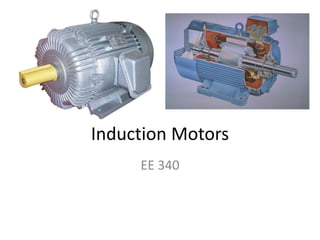
Induction Motors
EE 340
Where does the power generated go?
• The electric energy generated purchased by
consumers for different needs. This energy is
converted to different forms:
– Lighting (indoor/outdoor – CFL, incandescent,
LED, Halogen…)
– Heating (electric water heaters, clothes dryers,
electric stoves and ovens)
– power supply of electronic devices (computers,
TV, DVD, battery chargers, home automation,
etc…)
– Industrial (arc furnaces, welders, manufacturing
processes….)
– Conversion to mechanical power by motors
(pumps, fans, HVAC, refrigeration – compressors,
power tools, food processors, escalators,
elevators, ….)
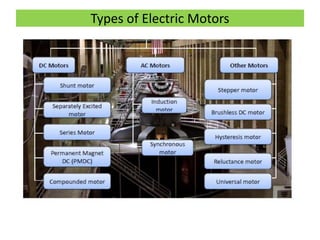
Types of Electric Motors
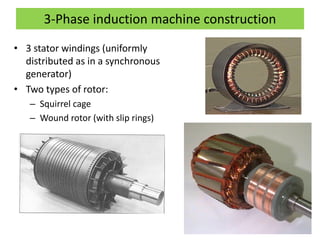
3-Phase induction machine construction
• 3 stator windings (uniformly
distributed as in a synchronous
generator)
• Two types of rotor:
– Squirrel cage
– Wound rotor (with slip rings)
The rotating magnetic field
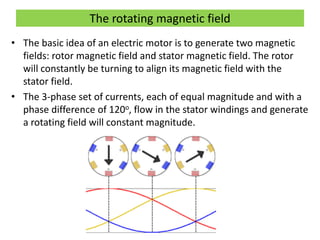
• The basic idea of an electric motor is to generate two magnetic
fields: rotor magnetic field and stator magnetic field. The rotor
will constantly be turning to align its magnetic field with the
stator field.
• The 3-phase set of currents, each of equal magnitude and with a
phase difference of 120o, flow in the stator windings and generate
a rotating field will constant magnitude.
The rotating magnetic field
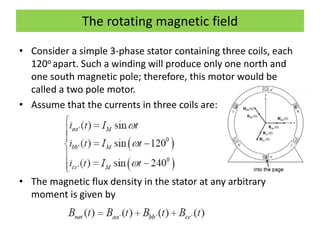
• Consider a simple 3-phase stator containing three coils, each
120o apart. Such a winding will produce only one north and
one south magnetic pole; therefore, this motor would be
called a two pole motor.
• Assume that the currents in three coils are:
• The magnetic flux density in the stator at any arbitrary
moment is given by
The rotating magnetic field
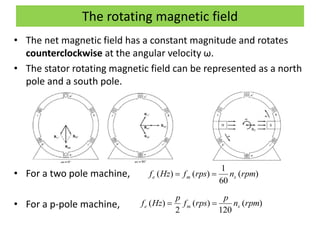
• The net magnetic field has a constant magnitude and rotates
counterclockwise at the angular velocity ω.
• The stator rotating magnetic field can be represented as a north
pole and a south pole.
• For a two pole machine,
• For a p-pole machine,
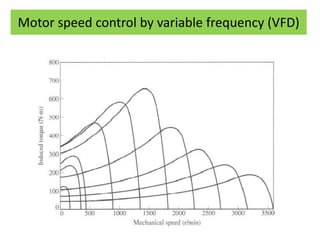
)(
60
1
)()( rpmnrpsfHzf sme 
)(
120
)(
2
)( rpmn
p
rpsf
p
Hzf sme 
Principle of operation
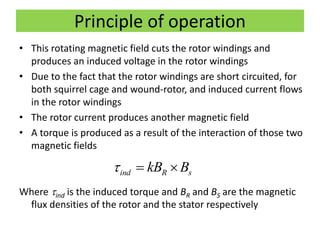
• This rotating magnetic field cuts the rotor windings and
produces an induced voltage in the rotor windings
• Due to the fact that the rotor windings are short circuited, for
both squirrel cage and wound-rotor, and induced current flows
in the rotor windings
• The rotor current produces another magnetic field
• A torque is produced as a result of the interaction of those two
magnetic fields
Where ind is the induced torque and BR and BS are the magnetic
flux densities of the rotor and the stator respectively
ind R skB B  
Induction motor speed
• At what speed will the induction motor run?
– Can the induction motor run at the synchronous speed,
why?
– If rotor runs at the synchronous speed, then it will appear
stationary to the rotating magnetic field and the rotating
magnetic field will not cut the rotor. So, no induced
current will flow in the rotor and no rotor magnetic flux
will be produced so no torque is generated and the rotor
speed will fall below the synchronous speed.
– When the speed falls, the rotating magnetic field will cut
the rotor windings and a torque is produced.
Induction motor speed
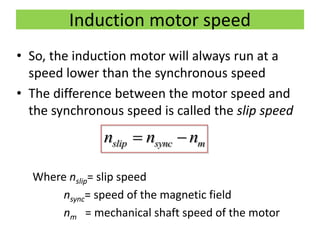
• So, the induction motor will always run at a
speed lower than the synchronous speed
• The difference between the motor speed and
the synchronous speed is called the slip speed
Where nslip= slip speed
nsync= speed of the magnetic field
nm = mechanical shaft speed of the motor
slip sync mn n n 
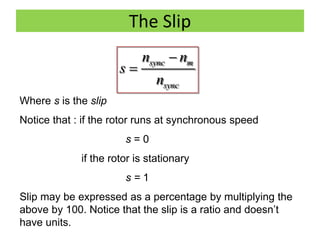
The Slip
sync m
sync
n n
s
n


Where s is the slip
Notice that : if the rotor runs at synchronous speed
s = 0
if the rotor is stationary
s = 1
Slip may be expressed as a percentage by multiplying the
above by 100. Notice that the slip is a ratio and doesn’t
have units.
Induction Motors and Transformers
• Both induction motor and transformer works on
the principle of induced voltage
– Transformer: voltage applied to the primary windings
produce an induced voltage in the secondary windings
– Induction motor: voltage applied to the stator windings
produce an induced voltage in the rotor windings
– The difference is that, in the case of the induction
motor, the secondary windings can move
– Due to the rotation of the rotor, the induced voltage in
it does not have the same frequency of the stator
voltage.
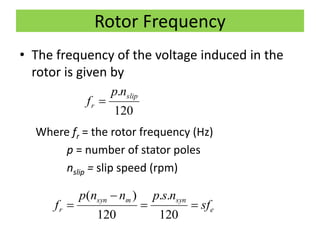
Rotor Frequency
• The frequency of the voltage induced in the
rotor is given by
Where fr = the rotor frequency (Hz)
p = number of stator poles
nslip = slip speed (rpm)
120
. slip
r
np
f 
e
synmsyn
r sf
nspnnp
f 


120
..
120
)(
Rotor Frequency
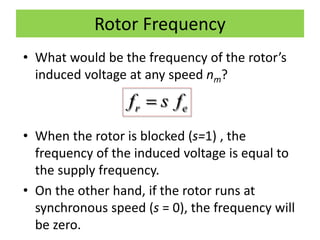
• What would be the frequency of the rotor’s
induced voltage at any speed nm?
• When the rotor is blocked (s=1) , the
frequency of the induced voltage is equal to
the supply frequency.
• On the other hand, if the rotor runs at
synchronous speed (s = 0), the frequency will
be zero.
r ef s f
Torque
• While the input to the induction motor is electrical
power, its output is mechanical power and for that
we should know some terms and quantities related
to mechanical power.
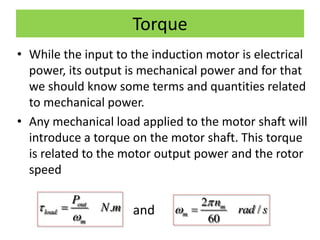
• Any mechanical load applied to the motor shaft will
introduce a torque on the motor shaft. This torque
is related to the motor output power and the rotor
speed
and.out
load
m
P
N m

 2
/
60
m
m
n
rad s

 
Horse power
• Another unit used to measure mechanical power
is the horse power.
• It is used to refer to the mechanical output power
of the motor.
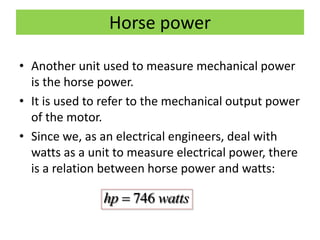
• Since we, as an electrical engineers, deal with
watts as a unit to measure electrical power, there
is a relation between horse power and watts:
746hp watts
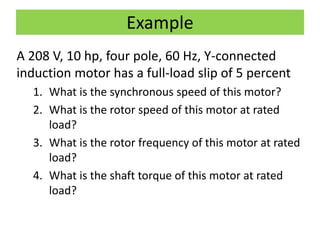
Example
A 208 V, 10 hp, four pole, 60 Hz, Y-connected
induction motor has a full-load slip of 5 percent
1. What is the synchronous speed of this motor?
2. What is the rotor speed of this motor at rated
load?
3. What is the rotor frequency of this motor at rated
load?
4. What is the shaft torque of this motor at rated
load?
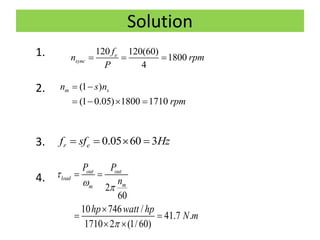
Solution
1.
2.
3.
4.
120 120(60)
1800
4
e
sync
f
n rpm
P
  
(1 )
(1 0.05) 1800 1710
m sn s n
rpm
 
   
0.05 60 3r ef sf Hz   
2
60
10 746 /
41.7 .
1710 2 (1/60)
out out
load
mm
P P
n
hp watt hp
N m

 

 

 
 
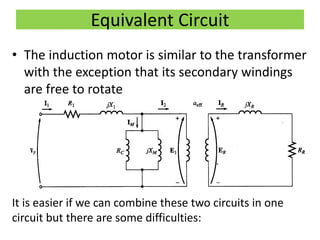
Equivalent Circuit
• The induction motor is similar to the transformer
with the exception that its secondary windings
are free to rotate
It is easier if we can combine these two circuits in one
circuit but there are some difficulties:
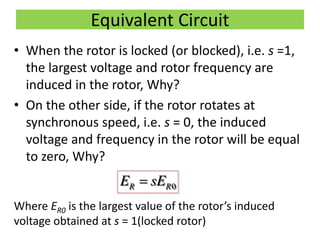
Equivalent Circuit
• When the rotor is locked (or blocked), i.e. s =1,
the largest voltage and rotor frequency are
induced in the rotor, Why?
• On the other side, if the rotor rotates at
synchronous speed, i.e. s = 0, the induced
voltage and frequency in the rotor will be equal
to zero, Why?
Where ER0 is the largest value of the rotor’s induced
voltage obtained at s = 1(locked rotor)
0R RE sE
Equivalent Circuit
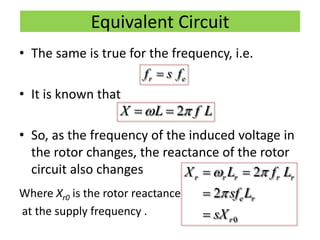
• The same is true for the frequency, i.e.
• It is known that
• So, as the frequency of the induced voltage in
the rotor changes, the reactance of the rotor
circuit also changes
Where Xr0 is the rotor reactance
at the supply frequency .
r ef s f
2X L f L  
0
2
2
r r r r r
e r
r
X L f L
sf L
sX
 

 


Equivalent Circuit
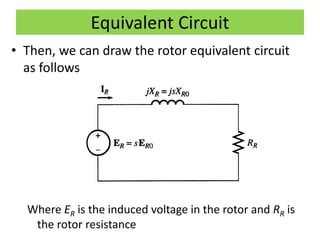
• Then, we can draw the rotor equivalent circuit
as follows
Where ER is the induced voltage in the rotor and RR is
the rotor resistance
Equivalent Circuit
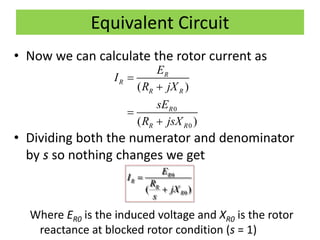
• Now we can calculate the rotor current as
• Dividing both the numerator and denominator
by s so nothing changes we get
Where ER0 is the induced voltage and XR0 is the rotor
reactance at blocked rotor condition (s = 1)
0
0
( )
( )
R
R
R R
R
R R
E
I
R jX
sE
R jsX




0
0( )
R
R
R
R
E
I
R
jX
s


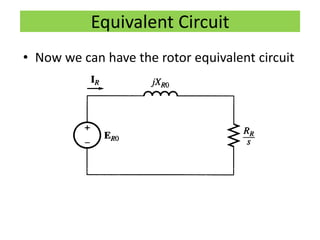
Equivalent Circuit
• Now we can have the rotor equivalent circuit
Equivalent Circuit
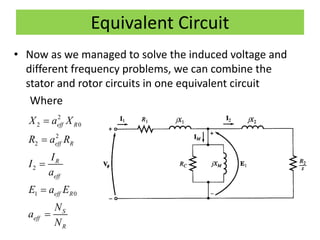
• Now as we managed to solve the induced voltage and
different frequency problems, we can combine the
stator and rotor circuits in one equivalent circuit
Where
2
2 0
2
2
2
1 0
eff R
eff R
R
eff
eff R
S
eff
R
X a X
R a R
I
I
a
E a E
N
a
N





Power losses in Induction machines
• Copper losses
– Copper loss in the stator (PSCL) = I1
2R1
– Copper loss in the rotor (PRCL) = I2
2R2
• Core loss (Pcore)
• Mechanical power loss due to friction and
windage
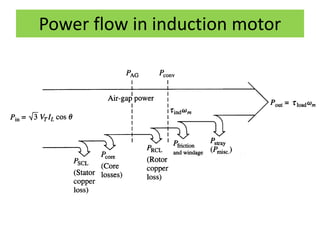
• How this power flow in the motor?
Power flow in induction motor
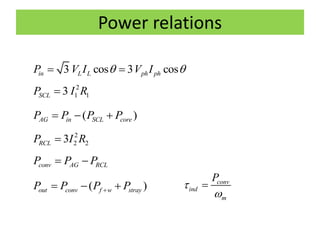
Power relations
3 cos 3 cosin L L ph phP V I V I  
2
1 13SCLP I R
( )AG in SCL coreP P P P  
2
2 23RCLP I R
conv AG RCLP P P 
( )out conv f w strayP P P P   conv
ind
m
P



Equivalent Circuit
• We can rearrange the equivalent circuit as
follows
Actual rotor
resistance
Resistance
equivalent to
mechanical load
Power relations
3 cos 3 cosin L L ph phP V I V I  
2
1 13SCLP I R
( )AG in SCL coreP P P P  
2
2 23RCLP I R
conv AG RCLP P P 
( )out conv f w strayP P P P  
conv RCLP P  2 2
23
R
I
s

2 2
2
(1 )
3
R s
I
s


RCLP
s

(1 )RCLP s
s


(1 )conv AGP s P 
conv
ind
m
P



(1 )
(1 )
AG
s
s P
s 



Example
A 480-V, 60 Hz, 50-hp, three phase induction motor
is drawing 60 A at 0.85 PF lagging. The stator copper
losses are 2 kW, and the rotor copper losses are 700
W. The friction and windage losses are 600 W, the
core losses are 1800 W, and the stray losses are
negligible. Find the following quantities:
1. The air-gap power PAG.
2. The power converted Pconv.
3. The output power Pout.
4. The efficiency of the motor.
Solution
1.
2.
3.
4.
3 cos
3 480 60 0.85 42.4 kW
in L LP V I 
    
42.4 2 1.8 38.6 kW
AG in SCL coreP P P P  
   
700
38.6 37.9 kW
1000
conv AG RCLP P P 
  
&
600
37.9 37.3 kW
1000
out conv F WP P P 
  
37.3
50 hp
0.746
outP  
100%
37.3
100 88%
42.4
out
in
P
P
  
  
Example
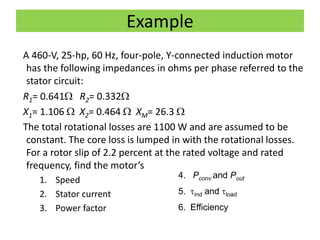
A 460-V, 25-hp, 60 Hz, four-pole, Y-connected induction motor
has the following impedances in ohms per phase referred to the
stator circuit:
R1= 0.641 R2= 0.332
X1= 1.106  X2= 0.464  XM= 26.3 
The total rotational losses are 1100 W and are assumed to be
constant. The core loss is lumped in with the rotational losses.
For a rotor slip of 2.2 percent at the rated voltage and rated
frequency, find the motor’s
1. Speed
2. Stator current
3. Power factor
4. Pconv and Pout
5. ind and load
6. Efficiency
Solution
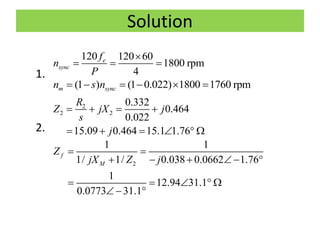
1.
2.
120 120 60
1800 rpm
4
e
sync
f
n
P

  
(1 ) (1 0.022) 1800 1760 rpmm syncn s n     
2
2 2
0.332
0.464
0.022
15.09 0.464 15.1 1.76
R
Z jX j
s
j
   
     
2
1 1
1/ 1/ 0.038 0.0662 1.76
1
12.94 31.1
0.0773 31.1
f
M
Z
jX Z j
 
    
    
 
Solution
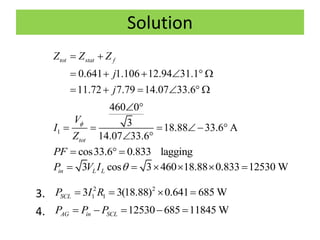
3.
4.
0.641 1.106 12.94 31.1
11.72 7.79 14.07 33.6
tot stat fZ Z Z
j
j
 
     
     
1
460 0
3 18.88 33.6 A
14.07 33.6tot
V
I
Z

 
    
 
cos33.6 0.833 laggingPF   
3 cos 3 460 18.88 0.833 12530 Win L LP V I      
2 2
1 13 3(18.88) 0.641 685 WSCLP I R   
12530 685 11845 WAG in SCLP P P    
Solution
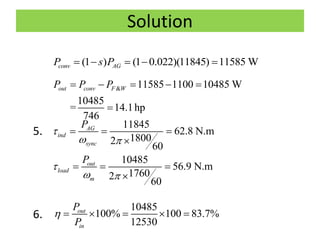
5.
6.
(1 ) (1 0.022)(11845) 11585 Wconv AGP s P    
& 11585 1100 10485 W
10485
= 14.1hp
746
out conv F WP P P    

11845
62.8 N.m
18002
60
AG
ind
sync
P

 
  

10485
56.9 N.m
17602
60
out
load
m
P

 
  

10485
100% 100 83.7%
12530
out
in
P
P
     
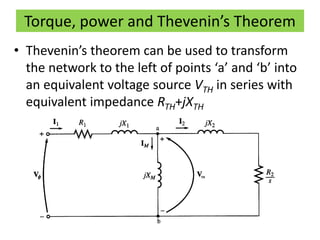
Torque, power and Thevenin’s Theorem
• Thevenin’s theorem can be used to transform
the network to the left of points ‘a’ and ‘b’ into
an equivalent voltage source VTH in series with
equivalent impedance RTH+jXTH
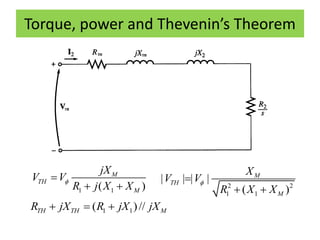
Torque, power and Thevenin’s Theorem
1 1( )
M
TH
M
jX
V V
R j X X

 
1 1( )//TH TH MR jX R jX jX  
2 2
1 1
| | | |
( )
M
TH
M
X
V V
R X X

 
Torque, power and Thevenin’s Theorem
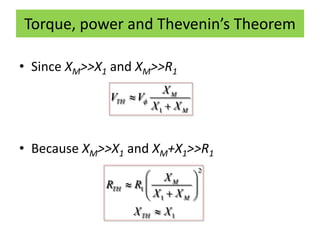
• Since XM>>X1 and XM>>R1
• Because XM>>X1 and XM+X1>>R1
1
M
TH
M
X
V V
X X


2
1
1
1
M
TH
M
TH
X
R R
X X
X X
 
  
 

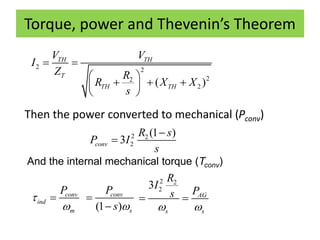
Torque, power and Thevenin’s Theorem
Then the power converted to mechanical (Pconv)
2 2
22
2( )
TH TH
T
TH TH
V V
I
Z R
R X X
s
 
 
   
 
2 2
2
(1 )
3conv
R s
P I
s


And the internal mechanical torque (Tconv)
conv
ind
m
P



(1 )
conv
s
P
s 


2 2
23
AG
s s
R
I
Ps
 
 
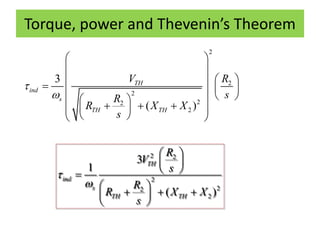
Torque, power and Thevenin’s Theorem
2
2
2
22
2
3
( )
TH
ind
s
TH TH
V R
sR
R X X
s


 
 
   
   
         
2 2
2
22
2
3
1
( )
TH
ind
s
TH TH
R
V
s
R
R X X
s


 
 
 
 
   
 
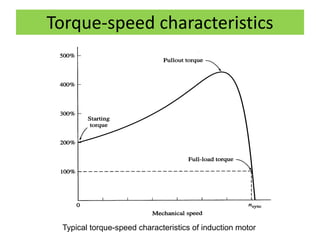
Torque-speed characteristics
Typical torque-speed characteristics of induction motor
Comments
1. The induced torque is zero at synchronous speed.
Discussed earlier.
2. The curve is nearly linear between no-load and full
load. In this range, the rotor resistance is much
greater than the reactance, so the rotor current,
torque increase linearly with the slip.
3. There is a maximum possible torque that can’t be
exceeded. This torque is called pullout torque and is
2 to 3 times the rated full-load torque.
Comments
4. The starting torque of the motor is slightly higher
than its full-load torque, so the motor will start
carrying any load it can supply at full load.
5. The torque of the motor for a given slip varies as
the square of the applied voltage.
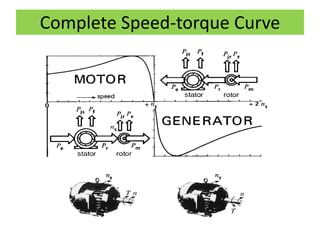
6. If the rotor is driven faster than synchronous speed
it will run as a generator, converting mechanical
power to electric power.
Complete Speed-torque Curve
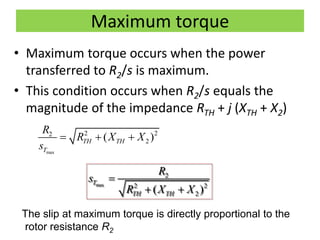
Maximum torque
• Maximum torque occurs when the power
transferred to R2/s is maximum.
• This condition occurs when R2/s equals the
magnitude of the impedance RTH + j (XTH + X2)
max
2 22
2( )TH TH
T
R
R X X
s
  
max
2
2 2
2( )
T
TH TH
R
s
R X X

 
The slip at maximum torque is directly proportional to the
rotor resistance R2
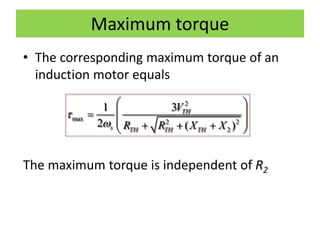
Maximum torque
• The corresponding maximum torque of an
induction motor equals
The maximum torque is independent of R2
2
max 2 2
2
31
2 ( )
TH
s TH TH TH
V
R R X X


 
 
    
Maximum torque
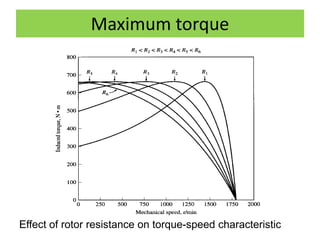
• Rotor resistance can be increased by inserting
external resistance in the rotor of a wound-
rotor induction motor.
• The value of the maximum torque remains
unaffected but the speed at which it occurs
can be controlled.
Maximum torque
Effect of rotor resistance on torque-speed characteristic
Motor speed control by variable frequency (VFD)
Example
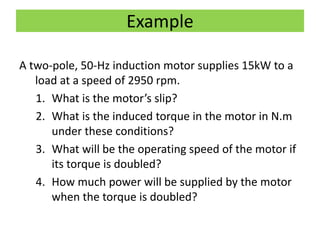
A two-pole, 50-Hz induction motor supplies 15kW to a
load at a speed of 2950 rpm.
1. What is the motor’s slip?
2. What is the induced torque in the motor in N.m
under these conditions?
3. What will be the operating speed of the motor if
its torque is doubled?
4. How much power will be supplied by the motor
when the torque is doubled?
Solution
1.
2.
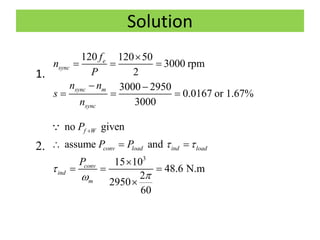
120 120 50
3000 rpm
2
3000 2950
0.0167 or 1.67%
3000
e
sync
sync m
sync
f
n
P
n n
s
n

  
 
  
3
no given
assume and
15 10
48.6 N.m
2
2950
60
f W
conv load ind load
conv
ind
m
P
P P
P
 



  

  

Solution
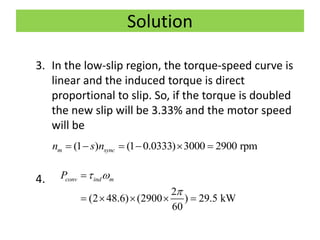
3. In the low-slip region, the torque-speed curve is
linear and the induced torque is direct
proportional to slip. So, if the torque is doubled
the new slip will be 3.33% and the motor speed
will be
4.
(1 ) (1 0.0333) 3000 2900 rpmm syncn s n     
2
(2 48.6) (2900 ) 29.5 kW
60
conv ind mP  


    
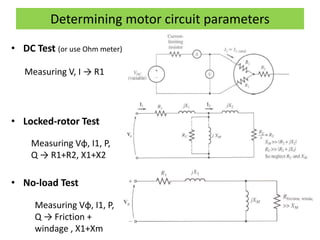
Determining motor circuit parameters
• DC Test (or use Ohm meter)
• Locked-rotor Test
• No-load Test
Measuring Vφ, I1, P,
Q → R1+R2, X1+X2
Measuring V, I → R1
Measuring Vφ, I1, P,
Q → Friction +
windage , X1+Xm
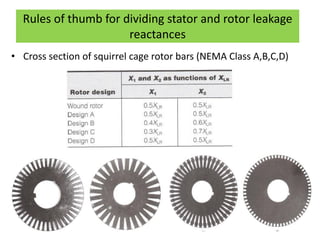
Rules of thumb for dividing stator and rotor leakage
reactances
• Cross section of squirrel cage rotor bars (NEMA Class A,B,C,D)
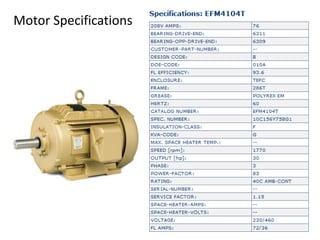
Motor Specifications
Problems
• 7.4
• 7.5
• 7.7*, 7.8, 7.10
• 7.14, 7.15
• 7.18
• 7.19

Induction motors

  • 1.
  • 2.
    Where does thepower generated go? • The electric energy generated purchased by consumers for different needs. This energy is converted to different forms: – Lighting (indoor/outdoor – CFL, incandescent, LED, Halogen…) – Heating (electric water heaters, clothes dryers, electric stoves and ovens) – power supply of electronic devices (computers, TV, DVD, battery chargers, home automation, etc…) – Industrial (arc furnaces, welders, manufacturing processes….) – Conversion to mechanical power by motors (pumps, fans, HVAC, refrigeration – compressors, power tools, food processors, escalators, elevators, ….)
  • 3.
  • 4.
    3-Phase induction machineconstruction • 3 stator windings (uniformly distributed as in a synchronous generator) • Two types of rotor: – Squirrel cage – Wound rotor (with slip rings)
  • 5.
    The rotating magneticfield • The basic idea of an electric motor is to generate two magnetic fields: rotor magnetic field and stator magnetic field. The rotor will constantly be turning to align its magnetic field with the stator field. • The 3-phase set of currents, each of equal magnitude and with a phase difference of 120o, flow in the stator windings and generate a rotating field will constant magnitude.
  • 6.
    The rotating magneticfield • Consider a simple 3-phase stator containing three coils, each 120o apart. Such a winding will produce only one north and one south magnetic pole; therefore, this motor would be called a two pole motor. • Assume that the currents in three coils are: • The magnetic flux density in the stator at any arbitrary moment is given by
  • 7.
    The rotating magneticfield • The net magnetic field has a constant magnitude and rotates counterclockwise at the angular velocity ω. • The stator rotating magnetic field can be represented as a north pole and a south pole. • For a two pole machine, • For a p-pole machine, )( 60 1 )()( rpmnrpsfHzf sme  )( 120 )( 2 )( rpmn p rpsf p Hzf sme 
  • 8.
    Principle of operation •This rotating magnetic field cuts the rotor windings and produces an induced voltage in the rotor windings • Due to the fact that the rotor windings are short circuited, for both squirrel cage and wound-rotor, and induced current flows in the rotor windings • The rotor current produces another magnetic field • A torque is produced as a result of the interaction of those two magnetic fields Where ind is the induced torque and BR and BS are the magnetic flux densities of the rotor and the stator respectively ind R skB B  
  • 9.
    Induction motor speed •At what speed will the induction motor run? – Can the induction motor run at the synchronous speed, why? – If rotor runs at the synchronous speed, then it will appear stationary to the rotating magnetic field and the rotating magnetic field will not cut the rotor. So, no induced current will flow in the rotor and no rotor magnetic flux will be produced so no torque is generated and the rotor speed will fall below the synchronous speed. – When the speed falls, the rotating magnetic field will cut the rotor windings and a torque is produced.
  • 10.
    Induction motor speed •So, the induction motor will always run at a speed lower than the synchronous speed • The difference between the motor speed and the synchronous speed is called the slip speed Where nslip= slip speed nsync= speed of the magnetic field nm = mechanical shaft speed of the motor slip sync mn n n 
  • 11.
    The Slip sync m sync nn s n   Where s is the slip Notice that : if the rotor runs at synchronous speed s = 0 if the rotor is stationary s = 1 Slip may be expressed as a percentage by multiplying the above by 100. Notice that the slip is a ratio and doesn’t have units.
  • 12.
    Induction Motors andTransformers • Both induction motor and transformer works on the principle of induced voltage – Transformer: voltage applied to the primary windings produce an induced voltage in the secondary windings – Induction motor: voltage applied to the stator windings produce an induced voltage in the rotor windings – The difference is that, in the case of the induction motor, the secondary windings can move – Due to the rotation of the rotor, the induced voltage in it does not have the same frequency of the stator voltage.
  • 13.
    Rotor Frequency • Thefrequency of the voltage induced in the rotor is given by Where fr = the rotor frequency (Hz) p = number of stator poles nslip = slip speed (rpm) 120 . slip r np f  e synmsyn r sf nspnnp f    120 .. 120 )(
  • 14.
    Rotor Frequency • Whatwould be the frequency of the rotor’s induced voltage at any speed nm? • When the rotor is blocked (s=1) , the frequency of the induced voltage is equal to the supply frequency. • On the other hand, if the rotor runs at synchronous speed (s = 0), the frequency will be zero. r ef s f
  • 15.
    Torque • While theinput to the induction motor is electrical power, its output is mechanical power and for that we should know some terms and quantities related to mechanical power. • Any mechanical load applied to the motor shaft will introduce a torque on the motor shaft. This torque is related to the motor output power and the rotor speed and.out load m P N m   2 / 60 m m n rad s   
  • 16.
    Horse power • Anotherunit used to measure mechanical power is the horse power. • It is used to refer to the mechanical output power of the motor. • Since we, as an electrical engineers, deal with watts as a unit to measure electrical power, there is a relation between horse power and watts: 746hp watts
  • 17.
    Example A 208 V,10 hp, four pole, 60 Hz, Y-connected induction motor has a full-load slip of 5 percent 1. What is the synchronous speed of this motor? 2. What is the rotor speed of this motor at rated load? 3. What is the rotor frequency of this motor at rated load? 4. What is the shaft torque of this motor at rated load?
  • 18.
    Solution 1. 2. 3. 4. 120 120(60) 1800 4 e sync f n rpm P   (1 ) (1 0.05) 1800 1710 m sn s n rpm       0.05 60 3r ef sf Hz    2 60 10 746 / 41.7 . 1710 2 (1/60) out out load mm P P n hp watt hp N m           
  • 19.
    Equivalent Circuit • Theinduction motor is similar to the transformer with the exception that its secondary windings are free to rotate It is easier if we can combine these two circuits in one circuit but there are some difficulties:
  • 20.
    Equivalent Circuit • Whenthe rotor is locked (or blocked), i.e. s =1, the largest voltage and rotor frequency are induced in the rotor, Why? • On the other side, if the rotor rotates at synchronous speed, i.e. s = 0, the induced voltage and frequency in the rotor will be equal to zero, Why? Where ER0 is the largest value of the rotor’s induced voltage obtained at s = 1(locked rotor) 0R RE sE
  • 21.
    Equivalent Circuit • Thesame is true for the frequency, i.e. • It is known that • So, as the frequency of the induced voltage in the rotor changes, the reactance of the rotor circuit also changes Where Xr0 is the rotor reactance at the supply frequency . r ef s f 2X L f L   0 2 2 r r r r r e r r X L f L sf L sX       
  • 22.
    Equivalent Circuit • Then,we can draw the rotor equivalent circuit as follows Where ER is the induced voltage in the rotor and RR is the rotor resistance
  • 23.
    Equivalent Circuit • Nowwe can calculate the rotor current as • Dividing both the numerator and denominator by s so nothing changes we get Where ER0 is the induced voltage and XR0 is the rotor reactance at blocked rotor condition (s = 1) 0 0 ( ) ( ) R R R R R R R E I R jX sE R jsX     0 0( ) R R R R E I R jX s  
  • 24.
    Equivalent Circuit • Nowwe can have the rotor equivalent circuit
  • 25.
    Equivalent Circuit • Nowas we managed to solve the induced voltage and different frequency problems, we can combine the stator and rotor circuits in one equivalent circuit Where 2 2 0 2 2 2 1 0 eff R eff R R eff eff R S eff R X a X R a R I I a E a E N a N     
  • 26.
    Power losses inInduction machines • Copper losses – Copper loss in the stator (PSCL) = I1 2R1 – Copper loss in the rotor (PRCL) = I2 2R2 • Core loss (Pcore) • Mechanical power loss due to friction and windage • How this power flow in the motor?
  • 27.
    Power flow ininduction motor
  • 28.
    Power relations 3 cos3 cosin L L ph phP V I V I   2 1 13SCLP I R ( )AG in SCL coreP P P P   2 2 23RCLP I R conv AG RCLP P P  ( )out conv f w strayP P P P   conv ind m P   
  • 29.
    Equivalent Circuit • Wecan rearrange the equivalent circuit as follows Actual rotor resistance Resistance equivalent to mechanical load
  • 30.
    Power relations 3 cos3 cosin L L ph phP V I V I   2 1 13SCLP I R ( )AG in SCL coreP P P P   2 2 23RCLP I R conv AG RCLP P P  ( )out conv f w strayP P P P   conv RCLP P  2 2 23 R I s  2 2 2 (1 ) 3 R s I s   RCLP s  (1 )RCLP s s   (1 )conv AGP s P  conv ind m P    (1 ) (1 ) AG s s P s    
  • 31.
    Example A 480-V, 60Hz, 50-hp, three phase induction motor is drawing 60 A at 0.85 PF lagging. The stator copper losses are 2 kW, and the rotor copper losses are 700 W. The friction and windage losses are 600 W, the core losses are 1800 W, and the stray losses are negligible. Find the following quantities: 1. The air-gap power PAG. 2. The power converted Pconv. 3. The output power Pout. 4. The efficiency of the motor.
  • 32.
    Solution 1. 2. 3. 4. 3 cos 3 48060 0.85 42.4 kW in L LP V I       42.4 2 1.8 38.6 kW AG in SCL coreP P P P       700 38.6 37.9 kW 1000 conv AG RCLP P P     & 600 37.9 37.3 kW 1000 out conv F WP P P     37.3 50 hp 0.746 outP   100% 37.3 100 88% 42.4 out in P P      
  • 33.
    Example A 460-V, 25-hp,60 Hz, four-pole, Y-connected induction motor has the following impedances in ohms per phase referred to the stator circuit: R1= 0.641 R2= 0.332 X1= 1.106  X2= 0.464  XM= 26.3  The total rotational losses are 1100 W and are assumed to be constant. The core loss is lumped in with the rotational losses. For a rotor slip of 2.2 percent at the rated voltage and rated frequency, find the motor’s 1. Speed 2. Stator current 3. Power factor 4. Pconv and Pout 5. ind and load 6. Efficiency
  • 34.
    Solution 1. 2. 120 120 60 1800rpm 4 e sync f n P     (1 ) (1 0.022) 1800 1760 rpmm syncn s n      2 2 2 0.332 0.464 0.022 15.09 0.464 15.1 1.76 R Z jX j s j           2 1 1 1/ 1/ 0.038 0.0662 1.76 1 12.94 31.1 0.0773 31.1 f M Z jX Z j              
  • 35.
    Solution 3. 4. 0.641 1.106 12.9431.1 11.72 7.79 14.07 33.6 tot stat fZ Z Z j j               1 460 0 3 18.88 33.6 A 14.07 33.6tot V I Z           cos33.6 0.833 laggingPF    3 cos 3 460 18.88 0.833 12530 Win L LP V I       2 2 1 13 3(18.88) 0.641 685 WSCLP I R    12530 685 11845 WAG in SCLP P P    
  • 36.
    Solution 5. 6. (1 ) (10.022)(11845) 11585 Wconv AGP s P     & 11585 1100 10485 W 10485 = 14.1hp 746 out conv F WP P P      11845 62.8 N.m 18002 60 AG ind sync P        10485 56.9 N.m 17602 60 out load m P        10485 100% 100 83.7% 12530 out in P P      
  • 37.
    Torque, power andThevenin’s Theorem • Thevenin’s theorem can be used to transform the network to the left of points ‘a’ and ‘b’ into an equivalent voltage source VTH in series with equivalent impedance RTH+jXTH
  • 38.
    Torque, power andThevenin’s Theorem 1 1( ) M TH M jX V V R j X X    1 1( )//TH TH MR jX R jX jX   2 2 1 1 | | | | ( ) M TH M X V V R X X   
  • 39.
    Torque, power andThevenin’s Theorem • Since XM>>X1 and XM>>R1 • Because XM>>X1 and XM+X1>>R1 1 M TH M X V V X X   2 1 1 1 M TH M TH X R R X X X X        
  • 40.
    Torque, power andThevenin’s Theorem Then the power converted to mechanical (Pconv) 2 2 22 2( ) TH TH T TH TH V V I Z R R X X s           2 2 2 (1 ) 3conv R s P I s   And the internal mechanical torque (Tconv) conv ind m P    (1 ) conv s P s    2 2 23 AG s s R I Ps    
  • 41.
    Torque, power andThevenin’s Theorem 2 2 2 22 2 3 ( ) TH ind s TH TH V R sR R X X s                         2 2 2 22 2 3 1 ( ) TH ind s TH TH R V s R R X X s                
  • 42.
    Torque-speed characteristics Typical torque-speedcharacteristics of induction motor
  • 43.
    Comments 1. The inducedtorque is zero at synchronous speed. Discussed earlier. 2. The curve is nearly linear between no-load and full load. In this range, the rotor resistance is much greater than the reactance, so the rotor current, torque increase linearly with the slip. 3. There is a maximum possible torque that can’t be exceeded. This torque is called pullout torque and is 2 to 3 times the rated full-load torque.
  • 44.
    Comments 4. The startingtorque of the motor is slightly higher than its full-load torque, so the motor will start carrying any load it can supply at full load. 5. The torque of the motor for a given slip varies as the square of the applied voltage. 6. If the rotor is driven faster than synchronous speed it will run as a generator, converting mechanical power to electric power.
  • 45.
  • 46.
    Maximum torque • Maximumtorque occurs when the power transferred to R2/s is maximum. • This condition occurs when R2/s equals the magnitude of the impedance RTH + j (XTH + X2) max 2 22 2( )TH TH T R R X X s    max 2 2 2 2( ) T TH TH R s R X X    The slip at maximum torque is directly proportional to the rotor resistance R2
  • 47.
    Maximum torque • Thecorresponding maximum torque of an induction motor equals The maximum torque is independent of R2 2 max 2 2 2 31 2 ( ) TH s TH TH TH V R R X X           
  • 48.
    Maximum torque • Rotorresistance can be increased by inserting external resistance in the rotor of a wound- rotor induction motor. • The value of the maximum torque remains unaffected but the speed at which it occurs can be controlled.
  • 49.
    Maximum torque Effect ofrotor resistance on torque-speed characteristic
  • 50.
    Motor speed controlby variable frequency (VFD)
  • 51.
    Example A two-pole, 50-Hzinduction motor supplies 15kW to a load at a speed of 2950 rpm. 1. What is the motor’s slip? 2. What is the induced torque in the motor in N.m under these conditions? 3. What will be the operating speed of the motor if its torque is doubled? 4. How much power will be supplied by the motor when the torque is doubled?
  • 52.
    Solution 1. 2. 120 120 50 3000rpm 2 3000 2950 0.0167 or 1.67% 3000 e sync sync m sync f n P n n s n          3 no given assume and 15 10 48.6 N.m 2 2950 60 f W conv load ind load conv ind m P P P P             
  • 53.
    Solution 3. In thelow-slip region, the torque-speed curve is linear and the induced torque is direct proportional to slip. So, if the torque is doubled the new slip will be 3.33% and the motor speed will be 4. (1 ) (1 0.0333) 3000 2900 rpmm syncn s n      2 (2 48.6) (2900 ) 29.5 kW 60 conv ind mP         
  • 54.
    Determining motor circuitparameters • DC Test (or use Ohm meter) • Locked-rotor Test • No-load Test Measuring Vφ, I1, P, Q → R1+R2, X1+X2 Measuring V, I → R1 Measuring Vφ, I1, P, Q → Friction + windage , X1+Xm
  • 55.
    Rules of thumbfor dividing stator and rotor leakage reactances • Cross section of squirrel cage rotor bars (NEMA Class A,B,C,D)
  • 56.
  • 57.
    Problems • 7.4 • 7.5 •7.7*, 7.8, 7.10 • 7.14, 7.15 • 7.18 • 7.19