 Sometimes, the rotor of a squirrel cage
induction motor refuses to start at all,
 particularly if the supply voltage is low.
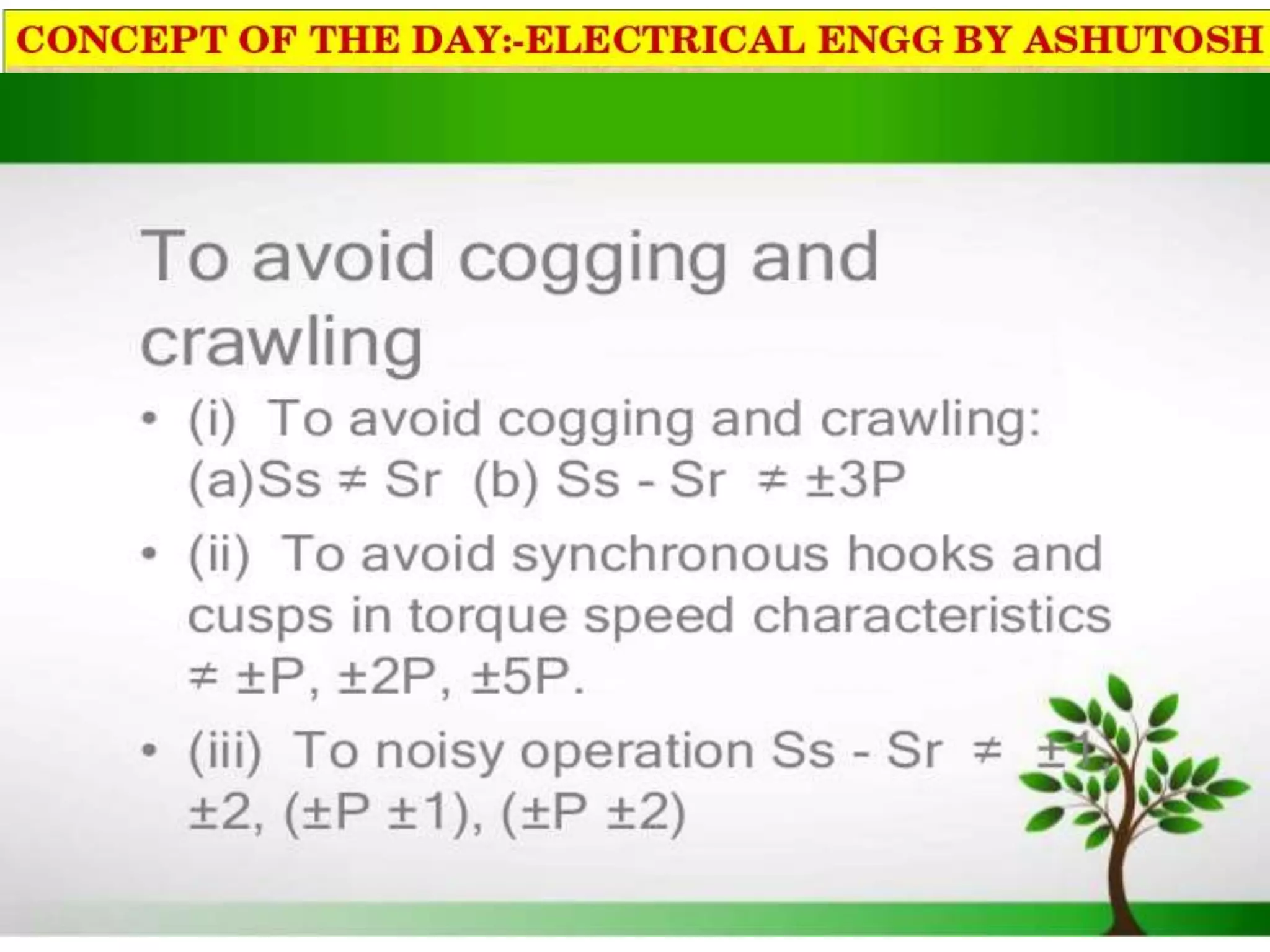
 This happens especially when number of rotor
teeth is equal to number of stator teeth
 Because of magnetic locking between the stator
teeth and the rotor teeth.
 When the rotor teeth and stator teeth face each
other, the reluctance of the magnetic path is
minimum
 that is why the rotor tends to remain fixed.
 This phenomenon is called cogging or magnetic
locking of induction motor.
 Sometimes, squirrel cage induction motors exhibits a tendency to
run at very slow speeds (as low as one-seventh of their
synchronous speed).
 This phenomenon is called as crawling of an induction motor.
 This action is due to the fact that, flux wave produced by a stator
winding is not purely sine wave. Instead, it is a complex wave
consisting a fundamental wave and odd harmonics like 3rd, 5th,
7th etc.
 The fundamental wave revolves synchronously at synchronous
speed Ns whereas 3rd, 5th, 7th harmonics may rotate in forward
or backward direction at Ns/3, Ns/5, Ns/7 speeds respectively.
 Hence, harmonic torques are also developed in addition with
fundamental torque.
 motor will not accelerate upto its normal speed, but it will run at
a speed which is nearly 1/7th of of its normal speed. This
phenomenon is called as crawling in induction motors.
The stator of an induction motor consists of poles carrying supply
current to induce a magnetic field that penetrates the rotor. To
optimize the distribution of the magnetic field, windings are
distributed in slots around the stator, with the magnetic field having
the same number of north and south poles.
COGGING & CRAWLING IN INDUCTION MOTOR

COGGING & CRAWLING IN INDUCTION MOTOR

  • 2.
     Sometimes, therotor of a squirrel cage induction motor refuses to start at all,  particularly if the supply voltage is low.  This happens especially when number of rotor teeth is equal to number of stator teeth  Because of magnetic locking between the stator teeth and the rotor teeth.  When the rotor teeth and stator teeth face each other, the reluctance of the magnetic path is minimum  that is why the rotor tends to remain fixed.  This phenomenon is called cogging or magnetic locking of induction motor.
  • 3.
     Sometimes, squirrelcage induction motors exhibits a tendency to run at very slow speeds (as low as one-seventh of their synchronous speed).  This phenomenon is called as crawling of an induction motor.  This action is due to the fact that, flux wave produced by a stator winding is not purely sine wave. Instead, it is a complex wave consisting a fundamental wave and odd harmonics like 3rd, 5th, 7th etc.  The fundamental wave revolves synchronously at synchronous speed Ns whereas 3rd, 5th, 7th harmonics may rotate in forward or backward direction at Ns/3, Ns/5, Ns/7 speeds respectively.  Hence, harmonic torques are also developed in addition with fundamental torque.  motor will not accelerate upto its normal speed, but it will run at a speed which is nearly 1/7th of of its normal speed. This phenomenon is called as crawling in induction motors.
  • 9.
    The stator ofan induction motor consists of poles carrying supply current to induce a magnetic field that penetrates the rotor. To optimize the distribution of the magnetic field, windings are distributed in slots around the stator, with the magnetic field having the same number of north and south poles.