Introduction to Electricity
• In this unit we will be studying:
• Static electricity
• Current electricity
• Power generation.
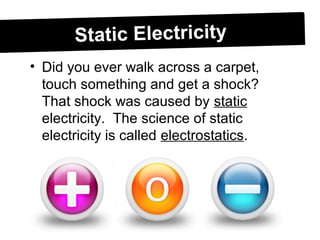
• Did you ever walk across a carpet,
touch something and get a shock?
That shock was caused by static
electricity. The science of static
electricity is called electrostatics.
Static ElectricityStatic Electricity
• The word ‘static’ means not moving
• Static electricity means electrons are
not moving along a path or not flowing
(current electricity).
• Rather electrons are supplied from one
atom and moved onto another atom
resulting in a build-up of charge.
Static ElectricityStatic Electricity
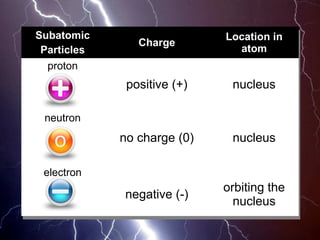
Subatomic
Particles
Charge
Location in
atom
proton
positive (+) nucleus
neutron
no charge (0) nucleus
electron
negative (-)
orbiting the
nucleus
If an object has more
electrons than protons,
it is negatively charged.
Electric ChargeElectric Charge
# protons: 8
# electrons: 12
# protons < # electrons
therefore, overall charge = negative
if an object has more
protons than electrons,
it is positively charged
Electric ChargeElectric Charge
# protons: 8
# electrons: 5
# protons > # electrons
therefore, overall charge = positive
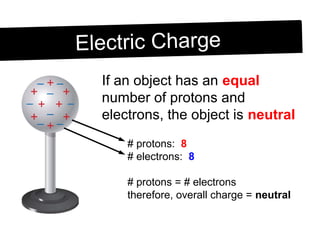
If an object has an equal
number of protons and
electrons, the object is neutral
Electric ChargeElectric Charge
# protons: 8
# electrons: 8
# protons = # electrons
therefore, overall charge = neutral
Electric ChargeElectric Charge
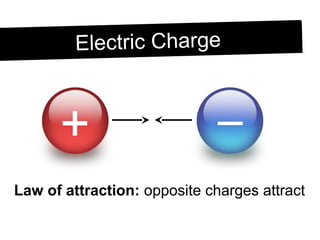
+ —
Law of attraction: opposite charges attract
Electric ChargeElectric Charge
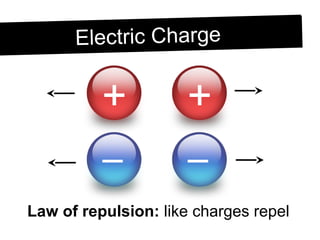
+
—
Law of repulsion: like charges repel
+
—
Electric ChargeElectric Charge
+
—
A charged object and a neutral object
will attract each other
0
0
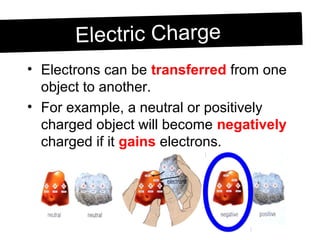
• Electrons can be transferred from one
object to another.
• For example, a neutral or positively
charged object will become negatively
charged if it gains electrons.
Electric ChargeElectric Charge
• Similarly, a neutral or negatively
charged object will become
positively charged if it loses
electrons.
Electric ChargeElectric Charge
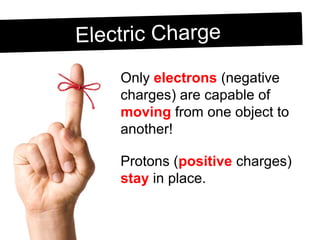
Only electrons (negative
charges) are capable of
moving from one object to
another!
Protons (positive charges)
stay in place.
Electric ChargeElectric Charge
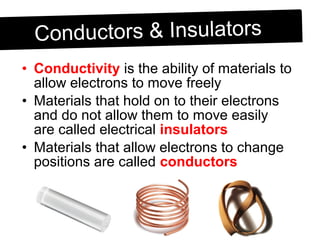
• Conductivity is the ability of materials to
allow electrons to move freely
• Materials that hold on to their electrons
and do not allow them to move easily
are called electrical insulators
• Materials that allow electrons to change
positions are called conductors
Conductors & InsulatorsConductors & Insulators
InsulatorsInsulators
+—
+
—
+
—
+—
+—
+
—
+—
In an insulator, the electrons (-) are bound tightly
to the nuclei (+) so they resist movement
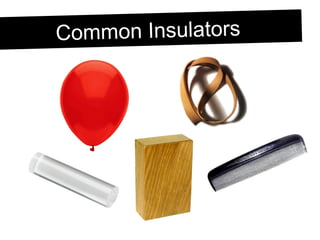
Common InsulatorsCommon Insulators
ConductorsConductors
+
—
+
—
+
—
+
—
+
—
+—
+
—
In a conductor, the electrons are not as tightly bound to
the nuclei and can therefore move away from the nuclei
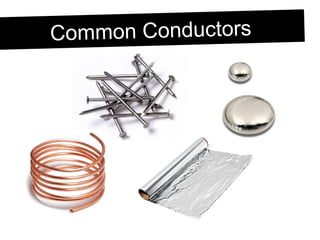
Common ConductorsCommon Conductors
Detecting ChargesDetecting Charges
• There are different instruments used to
detect charged objects:
– Pith Ball Electroscope
– Metal Leaf Electroscope
• In both instruments neutral position of
leaves/ball changes when charged
object is place closeby
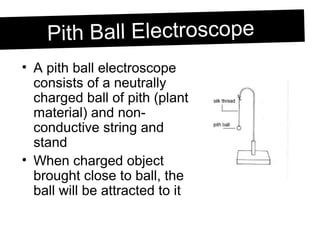
Pith Ball ElectroscopePith Ball Electroscope
• A pith ball electroscope
consists of a neutrally
charged ball of pith (plant
material) and non-
conductive string and
stand
• When charged object
brought close to ball, the
ball will be attracted to it
Metal Leaf ElectroscopeMetal Leaf Electroscope
• A metal leaf electroscope is more sensitive to electric charge
than a pith ball electroscope
• When charged object brought close to metal ball or cap, the
leaves will repel each other and spread apart
Videos and Practice Questions
• https://www.youtube.com/watch?v=yc2-363MIQs
• https://www.youtube.com/watch?v=QxZ6AWLpnUw
• https://www.youtube.com/watch?v=oU8Fe6846d4

Grade 9-U2-L1-Static electricity

  • 1.
    Introduction to Electricity •In this unit we will be studying: • Static electricity • Current electricity • Power generation.
  • 2.
    • Did youever walk across a carpet, touch something and get a shock? That shock was caused by static electricity. The science of static electricity is called electrostatics. Static ElectricityStatic Electricity
  • 3.
    • The word‘static’ means not moving • Static electricity means electrons are not moving along a path or not flowing (current electricity). • Rather electrons are supplied from one atom and moved onto another atom resulting in a build-up of charge. Static ElectricityStatic Electricity
  • 4.
    Subatomic Particles Charge Location in atom proton positive (+)nucleus neutron no charge (0) nucleus electron negative (-) orbiting the nucleus
  • 5.
    If an objecthas more electrons than protons, it is negatively charged. Electric ChargeElectric Charge # protons: 8 # electrons: 12 # protons < # electrons therefore, overall charge = negative
  • 6.
    if an objecthas more protons than electrons, it is positively charged Electric ChargeElectric Charge # protons: 8 # electrons: 5 # protons > # electrons therefore, overall charge = positive
  • 7.
    If an objecthas an equal number of protons and electrons, the object is neutral Electric ChargeElectric Charge # protons: 8 # electrons: 8 # protons = # electrons therefore, overall charge = neutral
  • 8.
    Electric ChargeElectric Charge +— Law of attraction: opposite charges attract
  • 9.
    Electric ChargeElectric Charge + — Lawof repulsion: like charges repel + —
  • 10.
    Electric ChargeElectric Charge + — Acharged object and a neutral object will attract each other 0 0
  • 11.
    • Electrons canbe transferred from one object to another. • For example, a neutral or positively charged object will become negatively charged if it gains electrons. Electric ChargeElectric Charge
  • 12.
    • Similarly, aneutral or negatively charged object will become positively charged if it loses electrons. Electric ChargeElectric Charge
  • 13.
    Only electrons (negative charges)are capable of moving from one object to another! Protons (positive charges) stay in place. Electric ChargeElectric Charge
  • 14.
    • Conductivity isthe ability of materials to allow electrons to move freely • Materials that hold on to their electrons and do not allow them to move easily are called electrical insulators • Materials that allow electrons to change positions are called conductors Conductors & InsulatorsConductors & Insulators
  • 15.
    InsulatorsInsulators +— + — + — +— +— + — +— In an insulator,the electrons (-) are bound tightly to the nuclei (+) so they resist movement
  • 16.
  • 17.
    ConductorsConductors + — + — + — + — + — +— + — In a conductor,the electrons are not as tightly bound to the nuclei and can therefore move away from the nuclei
  • 18.
  • 19.
    Detecting ChargesDetecting Charges •There are different instruments used to detect charged objects: – Pith Ball Electroscope – Metal Leaf Electroscope • In both instruments neutral position of leaves/ball changes when charged object is place closeby
  • 20.
    Pith Ball ElectroscopePithBall Electroscope • A pith ball electroscope consists of a neutrally charged ball of pith (plant material) and non- conductive string and stand • When charged object brought close to ball, the ball will be attracted to it
  • 21.
    Metal Leaf ElectroscopeMetalLeaf Electroscope • A metal leaf electroscope is more sensitive to electric charge than a pith ball electroscope • When charged object brought close to metal ball or cap, the leaves will repel each other and spread apart
  • 22.
    Videos and PracticeQuestions • https://www.youtube.com/watch?v=yc2-363MIQs • https://www.youtube.com/watch?v=QxZ6AWLpnUw • https://www.youtube.com/watch?v=oU8Fe6846d4