electricity
Adapted fromhttp://www.bowlesphysics.com
Electric Charge
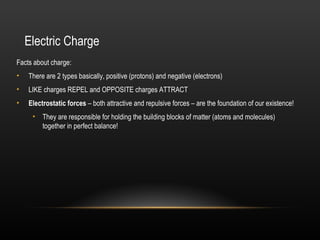
Facts about charge:
•   There are 2 types basically, positive (protons) and negative (electrons)
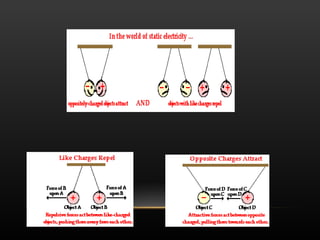
•   LIKE charges REPEL and OPPOSITE charges ATTRACT
•   Electrostatic forces – both attractive and repulsive forces – are the foundation of our existence!
     • They are responsible for holding the building blocks of matter (atoms and molecules)
       together in perfect balance!
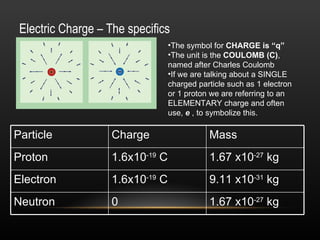
Electric Charge – The specifics
                                   •The symbol for CHARGE is “q”
                                   •The unit is the COULOMB (C),
 Some important constants:         named after Charles Coulomb
                                   •If we are talking about a SINGLE
                                   charged particle such as 1 electron
                                   or 1 proton we are referring to an
                                   ELEMENTARY charge and often
                                   use, e , to symbolize this.

Particle             Charge                   Mass
Proton               1.6x10⁻¹⁹ C              1.67 x10⁻²⁷ kg
Electron             1.6x10⁻¹⁹ C              9.11 x10⁻³¹ kg
Neutron              0                        1.67 x10⁻²⁷ kg
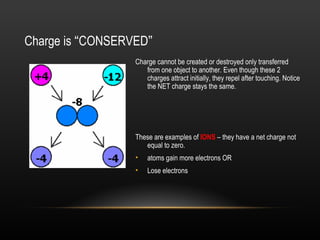
Charge is “CONSERVED”
                  Charge cannot be created or destroyed only transferred
                     from one object to another. Even though these 2
                     charges attract initially, they repel after touching. Notice
                     the NET charge stays the same.


                  These are examples of IONS – they have a net charge not
                     equal to zero.
                  •   atoms gain more electrons OR
                  •   Lose electrons
Conductors and Insulators
The movement of charge is limited by the substance the charge is
  trying to pass through. There are generally 2 types of
  substances.
Conductors: Allow charge to move readily though it.
Insulators: Restrict the movement of the charge
                            Conductor = Copper Wire
                            Insulator = Plastic sheath
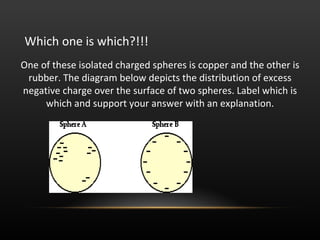
Which one is which?!!!
One of these isolated charged spheres is copper and the other is
 rubber. The diagram below depicts the distribution of excess
negative charge over the surface of two spheres. Label which is
     which and support your answer with an explanation.
Charging and Discharging
There are basically 2 ways you can charge something.
2.     Charge by friction
3.     Induction


                                       “BIONIC is the first-ever ionic formula
                                       mascara. The primary ingredient in
                                       BIONIC is a chain molecule with a
                                       positive charge. The friction caused by
                                       sweeping the mascara brush across
                                       lashes causes a negative charge. Since
                                       opposites attract, the positively charged
                                       formula adheres to the negatively
                                       charged lashes for a dramatic effect that
                                       lasts all day.”
Triboelectric series
                       •   Tells us about the electron affinity (aka
                           an object’s “love”) of electrons
                       •   To the right: objects higher up tend to
                           give up electrons easily
                            • Have lower electron affinity
                       •   So if you rub an object at the top again
                           an object on the bottom, you will get a
                           transfer of charge!
Induction and Grounding
 The second way to charge something is via INDUCTION, which requires NO
                           PHYSICAL CONTACT.
Induction and Grounding
    The second way to charge something is via INDUCTION, which requires NO
                              PHYSICAL CONTACT.


We bring a negatively charged rod near a neutral sphere. The protons in the sphere
localize near the rod, while the electrons are repelled to the other side of the sphere. A
wire can then be brought in contact with the negative side and allowed to touch the
GROUND. The electrons will always move towards a more massive objects to increase
separation from other electrons, leaving a NET positive sphere behind.
Electroscope
• The electroscope typically consists of a conducting plate or
  knob, a conducting base and either a pair of conducting
  leaves or a conducting needle.
   • It can be used to determine charge!
Test your KNOWLEDGE
•    Suppose that a negatively charged balloon is used to charge an electroscope. Explain
     in terms of electron movement what is happening in each step.
Grounding a positively-charged
Electroscope
Electric Force
The electric force between 2 objects is symbolic of the
  gravitational force between 2 objects. RECALL:

              1
  Fgα Mm Fg α 2
             r
                   1       qq
 FE α q1q2   FE α      FEα 1 2 2
                  r2        r
 k = constant of proportionality
                                 Nm 2
 k = Coulomb constant = 8.99 x10⁹ 2
                                 C
       q1q2
 FE = k 2 → Coulomb' s Law
        r
Example: Coulombs Law

•   Two balloons are charged with an identical quantity and type of charge: -6.25 nC. They
    are held apart at a separation distance of 61.7 cm.
     • How many electrons are contained within one of the charged balloons?
     • Determine the magnitude of the electrical force of repulsion between them.

                                                             3.9x10¹⁰ electrons
                                                             9.4x10⁻⁷ N repulsive force
Example
Calculate the separation distance between a 12C charge and a 6C
charge is the electric force between them is 136.5 N

         q1q2       q1q2
   Fe = k 2 → r = k
          r          Fe
               (12)(6)
   r = (8.99 )  9
                       =          68,900.31 m
               (136.5)
Polarization—
Van de Graaff
•    Large voltage, but small currents so safe

Electricity website

  • 1.
  • 3.
    Electric Charge Facts aboutcharge: • There are 2 types basically, positive (protons) and negative (electrons) • LIKE charges REPEL and OPPOSITE charges ATTRACT • Electrostatic forces – both attractive and repulsive forces – are the foundation of our existence! • They are responsible for holding the building blocks of matter (atoms and molecules) together in perfect balance!
  • 4.
    Electric Charge –The specifics •The symbol for CHARGE is “q” •The unit is the COULOMB (C), Some important constants: named after Charles Coulomb •If we are talking about a SINGLE charged particle such as 1 electron or 1 proton we are referring to an ELEMENTARY charge and often use, e , to symbolize this. Particle Charge Mass Proton 1.6x10⁻¹⁹ C 1.67 x10⁻²⁷ kg Electron 1.6x10⁻¹⁹ C 9.11 x10⁻³¹ kg Neutron 0 1.67 x10⁻²⁷ kg
  • 5.
    Charge is “CONSERVED” Charge cannot be created or destroyed only transferred from one object to another. Even though these 2 charges attract initially, they repel after touching. Notice the NET charge stays the same. These are examples of IONS – they have a net charge not equal to zero. • atoms gain more electrons OR • Lose electrons
  • 6.
    Conductors and Insulators Themovement of charge is limited by the substance the charge is trying to pass through. There are generally 2 types of substances. Conductors: Allow charge to move readily though it. Insulators: Restrict the movement of the charge Conductor = Copper Wire Insulator = Plastic sheath
  • 7.
    Which one iswhich?!!! One of these isolated charged spheres is copper and the other is rubber. The diagram below depicts the distribution of excess negative charge over the surface of two spheres. Label which is which and support your answer with an explanation.
  • 8.
    Charging and Discharging Thereare basically 2 ways you can charge something. 2. Charge by friction 3. Induction “BIONIC is the first-ever ionic formula mascara. The primary ingredient in BIONIC is a chain molecule with a positive charge. The friction caused by sweeping the mascara brush across lashes causes a negative charge. Since opposites attract, the positively charged formula adheres to the negatively charged lashes for a dramatic effect that lasts all day.”
  • 9.
    Triboelectric series • Tells us about the electron affinity (aka an object’s “love”) of electrons • To the right: objects higher up tend to give up electrons easily • Have lower electron affinity • So if you rub an object at the top again an object on the bottom, you will get a transfer of charge!
  • 10.
    Induction and Grounding The second way to charge something is via INDUCTION, which requires NO PHYSICAL CONTACT.
  • 11.
    Induction and Grounding The second way to charge something is via INDUCTION, which requires NO PHYSICAL CONTACT. We bring a negatively charged rod near a neutral sphere. The protons in the sphere localize near the rod, while the electrons are repelled to the other side of the sphere. A wire can then be brought in contact with the negative side and allowed to touch the GROUND. The electrons will always move towards a more massive objects to increase separation from other electrons, leaving a NET positive sphere behind.
  • 12.
    Electroscope • The electroscopetypically consists of a conducting plate or knob, a conducting base and either a pair of conducting leaves or a conducting needle. • It can be used to determine charge!
  • 14.
    Test your KNOWLEDGE • Suppose that a negatively charged balloon is used to charge an electroscope. Explain in terms of electron movement what is happening in each step.
  • 15.
  • 16.
    Electric Force The electricforce between 2 objects is symbolic of the gravitational force between 2 objects. RECALL: 1 Fgα Mm Fg α 2 r 1 qq FE α q1q2 FE α FEα 1 2 2 r2 r k = constant of proportionality Nm 2 k = Coulomb constant = 8.99 x10⁹ 2 C q1q2 FE = k 2 → Coulomb' s Law r
  • 17.
    Example: Coulombs Law • Two balloons are charged with an identical quantity and type of charge: -6.25 nC. They are held apart at a separation distance of 61.7 cm. • How many electrons are contained within one of the charged balloons? • Determine the magnitude of the electrical force of repulsion between them. 3.9x10¹⁰ electrons 9.4x10⁻⁷ N repulsive force
  • 18.
    Example Calculate the separationdistance between a 12C charge and a 6C charge is the electric force between them is 136.5 N q1q2 q1q2 Fe = k 2 → r = k r Fe (12)(6) r = (8.99 ) 9 = 68,900.31 m (136.5)
  • 19.
  • 21.
    Van de Graaff • Large voltage, but small currents so safe