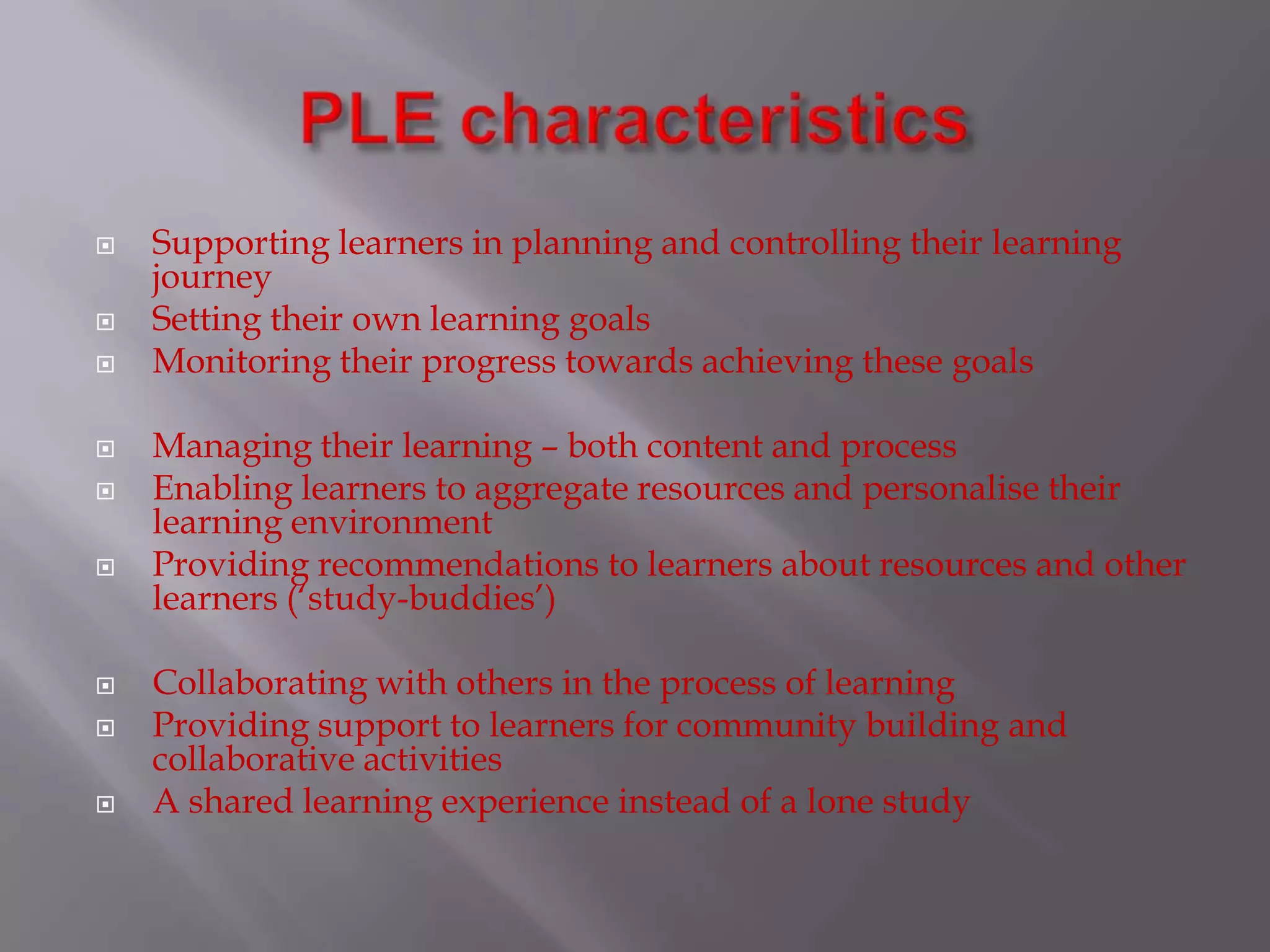
Personal
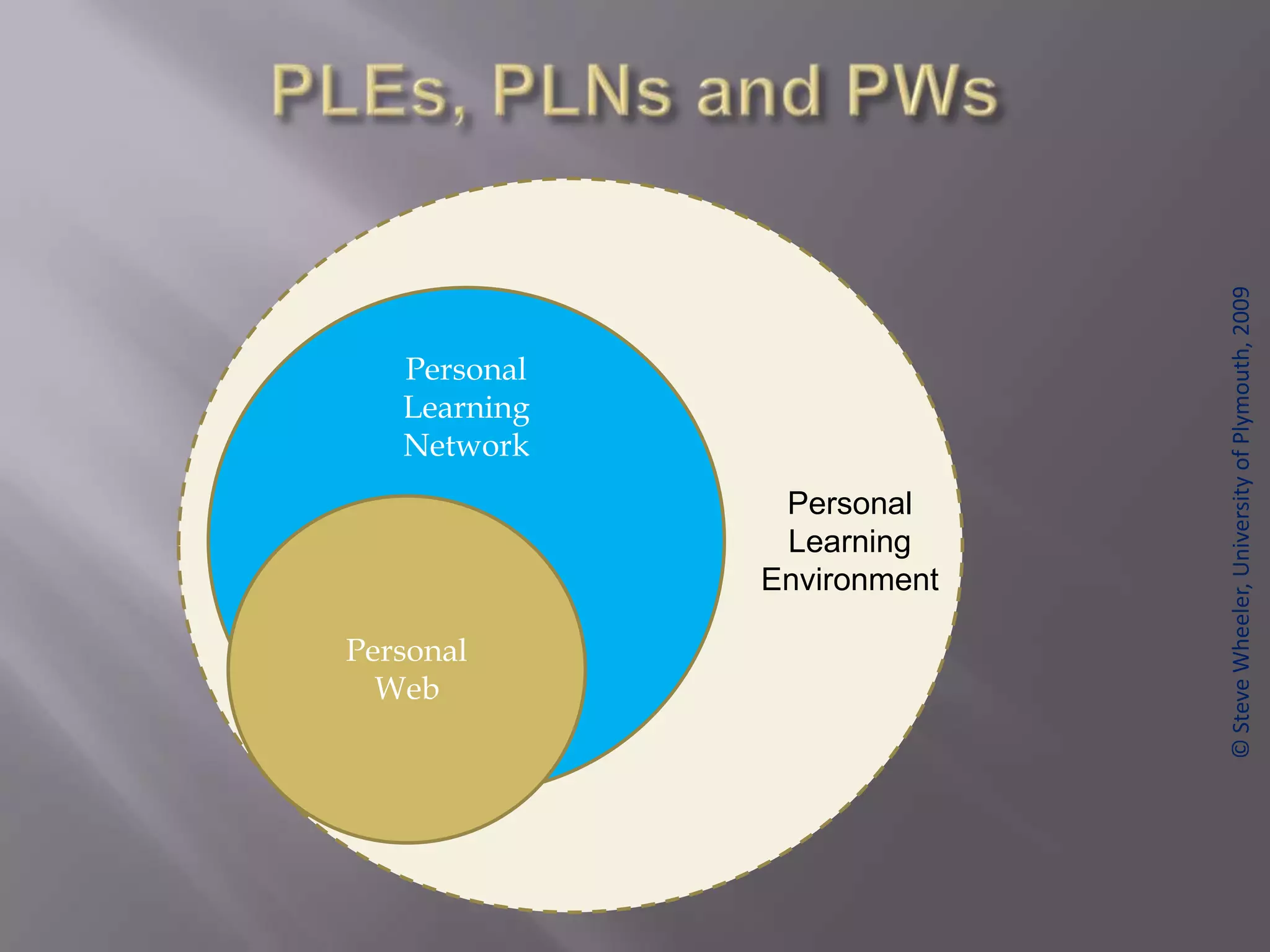
Learning
Network
Personal
Web
Personal
Learning
Environment
©SteveWheeler,UniversityofPlymouth,2009
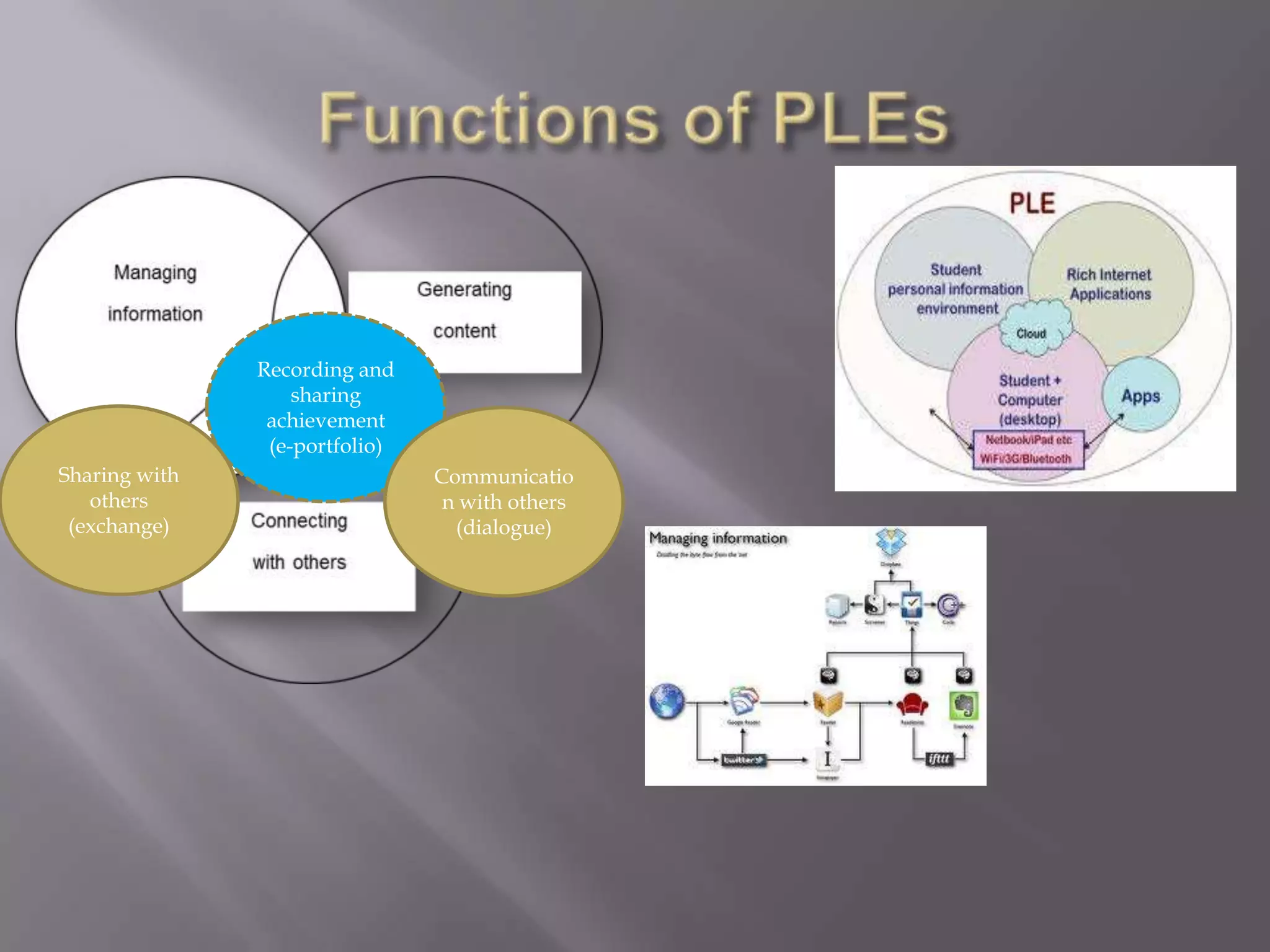
Recording and
sharing
achievement
(e-portfolio)
Communicatio
n with others
(dialogue)
Sharing with
others
(exchange)
 Supporting learners in planning and controlling their learning
journey
 Setting their own learning goals
 Monitoring their progress towards achieving these goals
 Managing their learning – both content and process
 Enabling learners to aggregate resources and personalise their
learning environment
 Providing recommendations to learners about resources and other
learners (‘study-buddies’)
 Collaborating with others in the process of learning
 Providing support to learners for community building and
collaborative activities
 A shared learning experience instead of a lone study
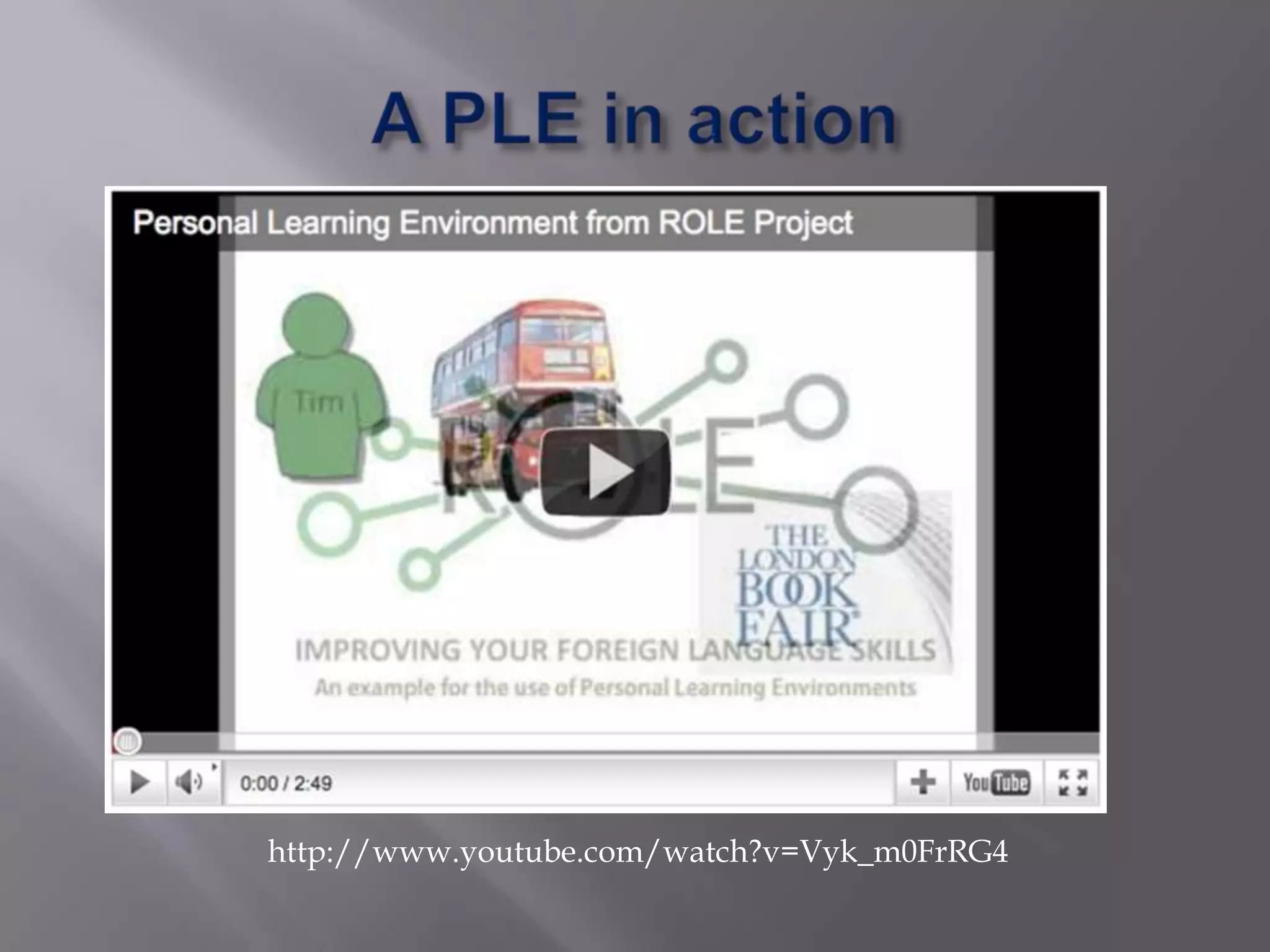
http://www.youtube.com/watch?v=Vyk_m0FrRG4
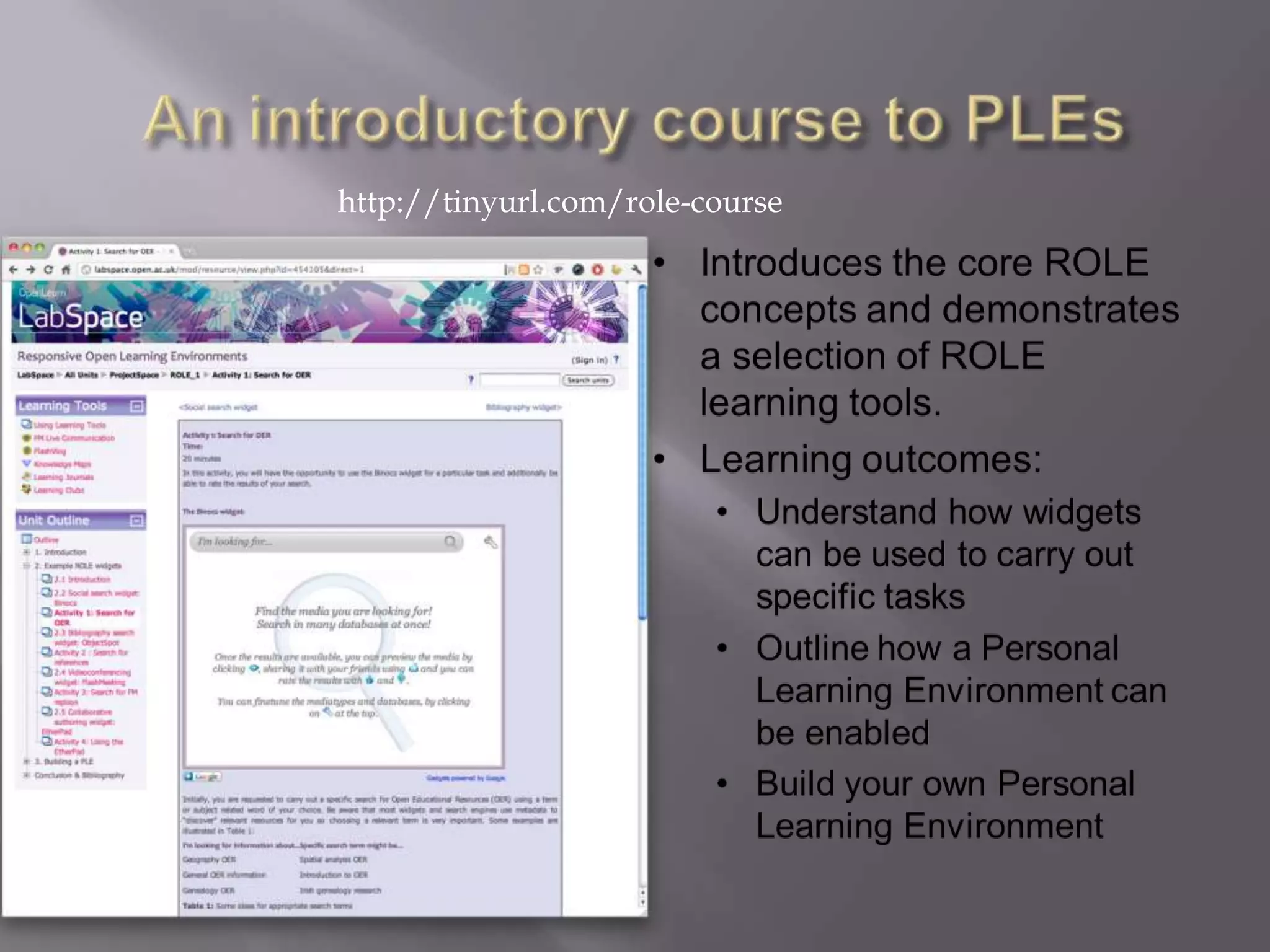
http://tinyurl.com/role-course
 Self-regulated learning (SRL) is a term that describes an individual’s ability to
learn how to learn. In other words, each of us can develop a wide-ranging skill set
that enables us to learn in a number of different ways.
 In some university settings the term SRL is more commonly described as
“independent learning” or “auto-didactic learning”.
 Some examples of how SRL might be assessed:
Having the ability to set learning goals and plan appropriate study strategies
Finding suitable learning materials
 Seeking help from peers and collaborating to gain feedback or assurance
Being able to reflect on their learning progress and adjust their study strategies
accordingly
http://www.youtube.com/watch?v=jTa1vOH6JjA
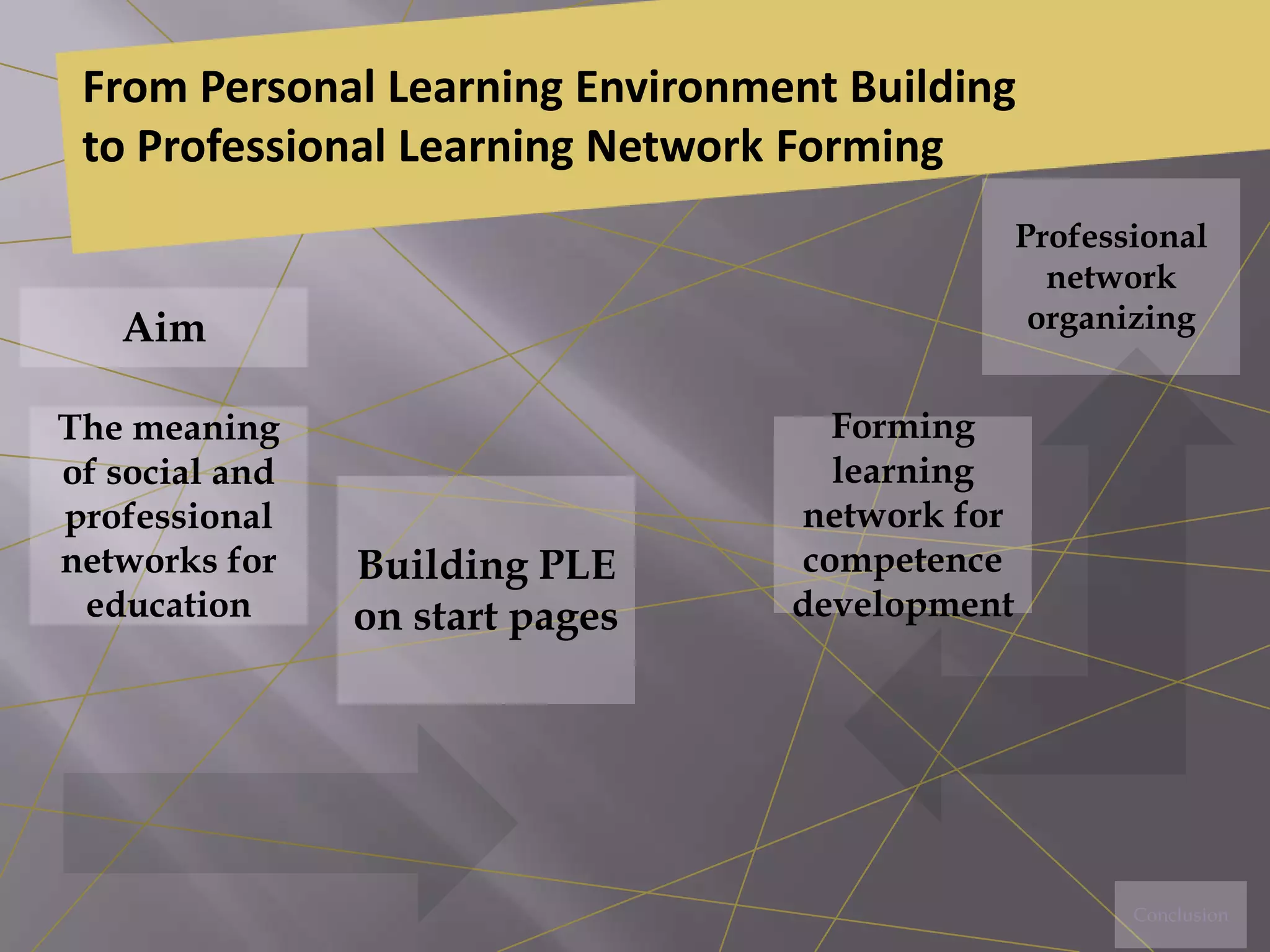
From Personal Learning Environment Building
to Professional Learning Network Forming
Aim
Forming
learning
network for
competence
development
Professional
network
organizing
The meaning
of social and
professional
networks for
education
Building PLE
on start pages
Conclusion
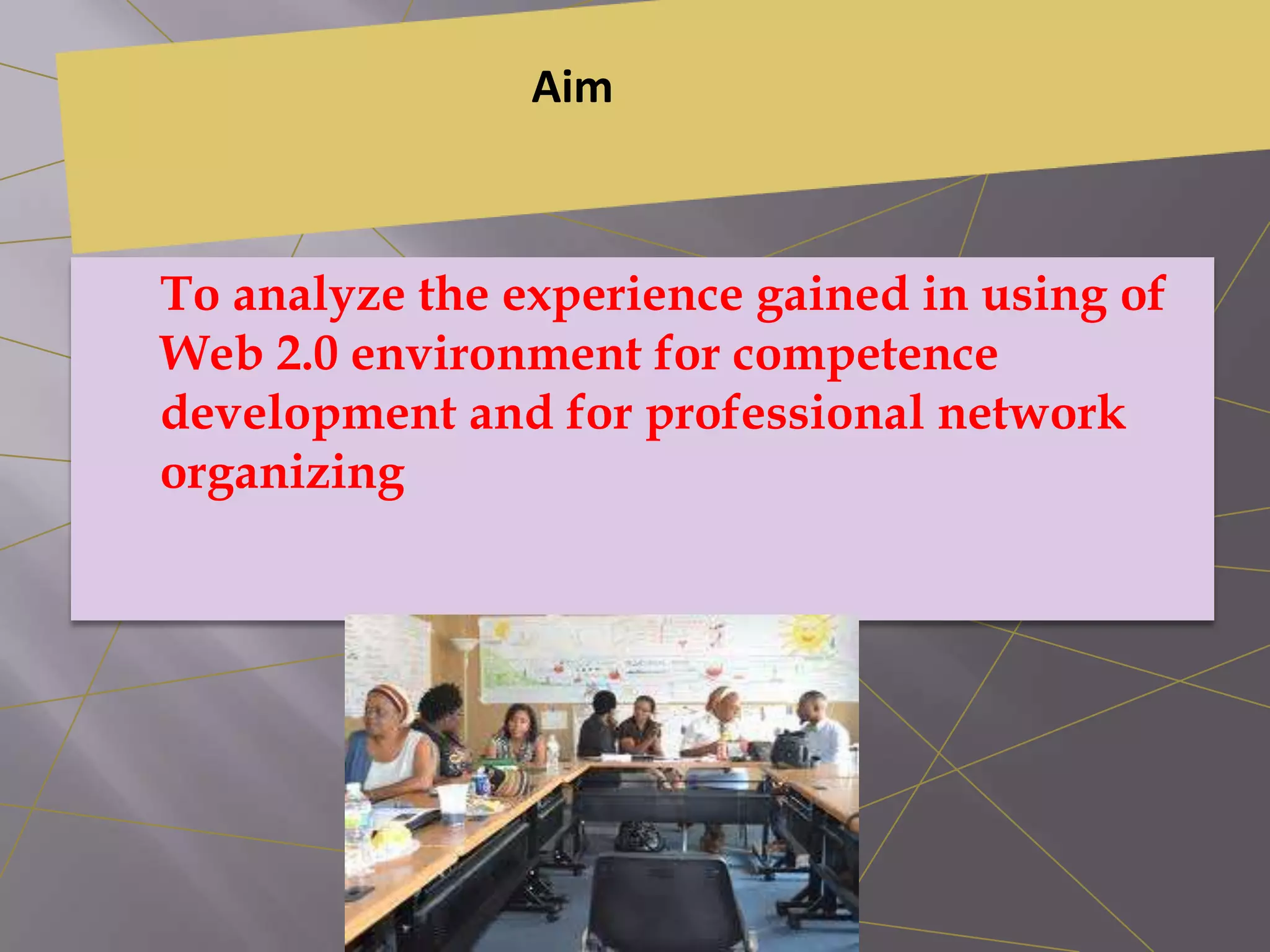
Aim
To analyze the experience gained in using of
Web 2.0 environment for competence
development and for professional network
organizing
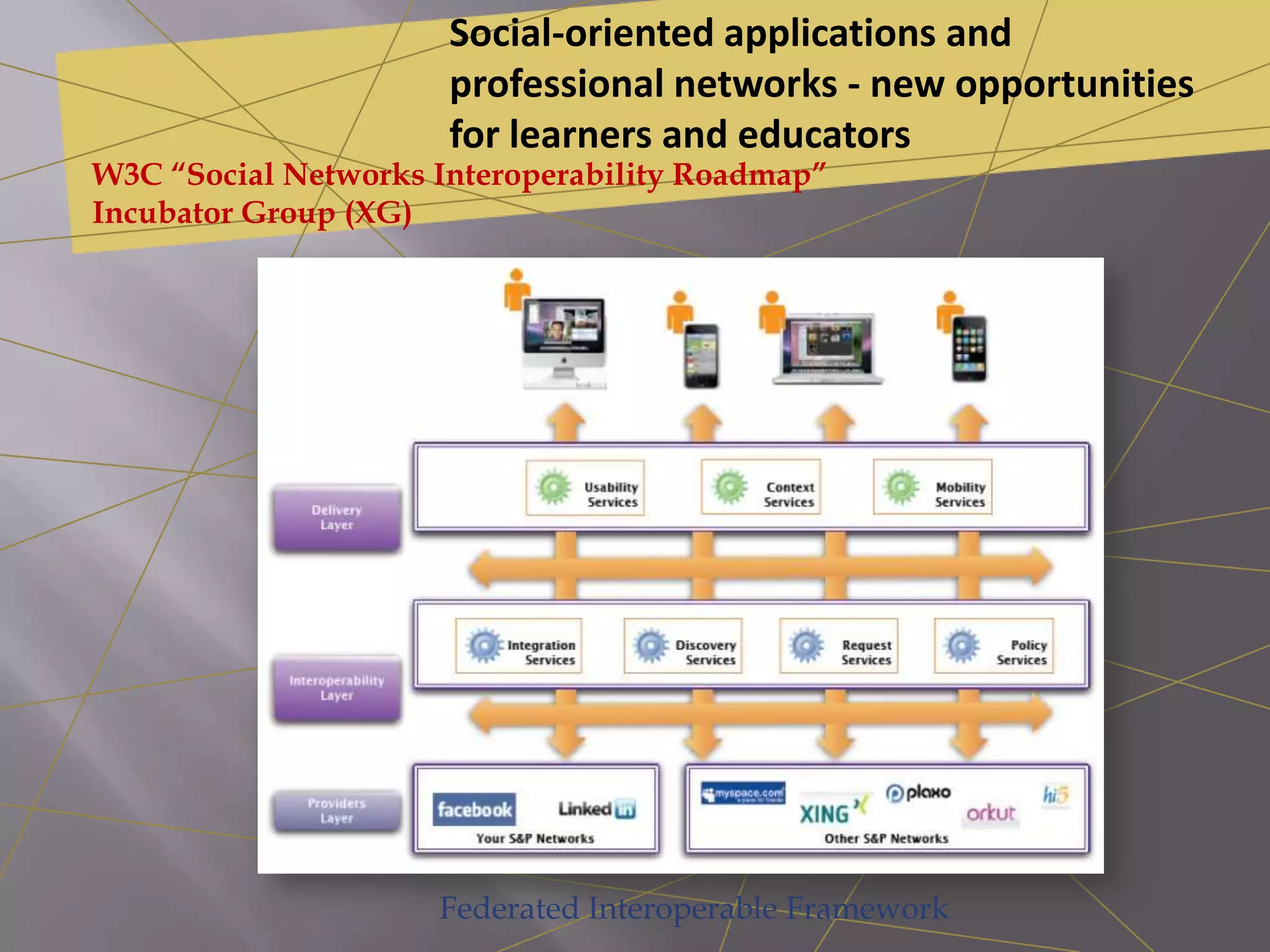
Social-oriented applications and
professional networks - new opportunities
for learners and educators
W3C “Social Networks Interoperability Roadmap”
Incubator Group (XG)
Federated Interoperable Framework
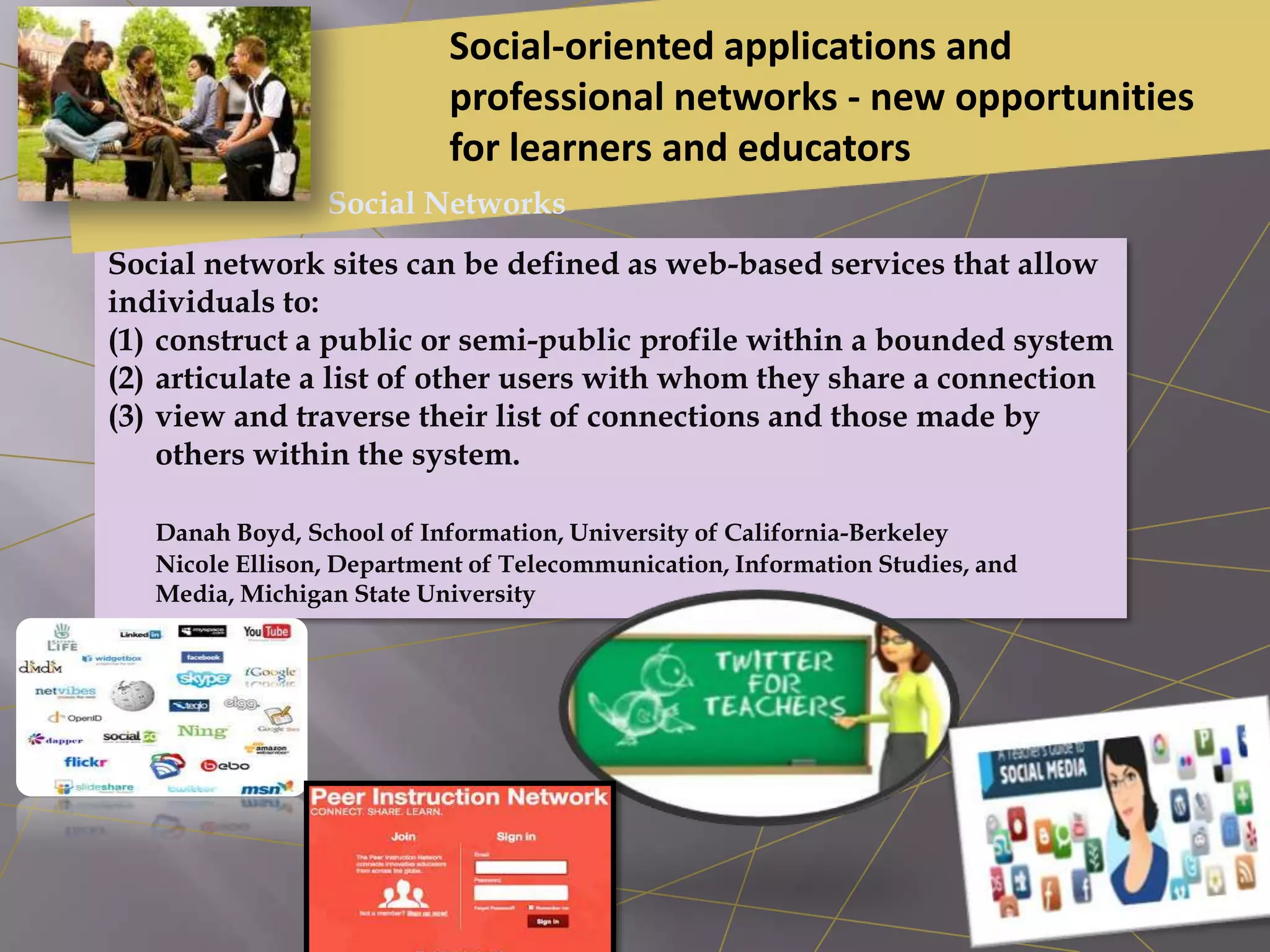
Social network sites can be defined as web-based services that allow
individuals to:
(1) construct a public or semi-public profile within a bounded system
(2) articulate a list of other users with whom they share a connection
(3) view and traverse their list of connections and those made by
others within the system.
Danah Boyd, School of Information, University of California-Berkeley
Nicole Ellison, Department of Telecommunication, Information Studies, and
Media, Michigan State University
Social-oriented applications and
professional networks - new opportunities
for learners and educators
Social Networks
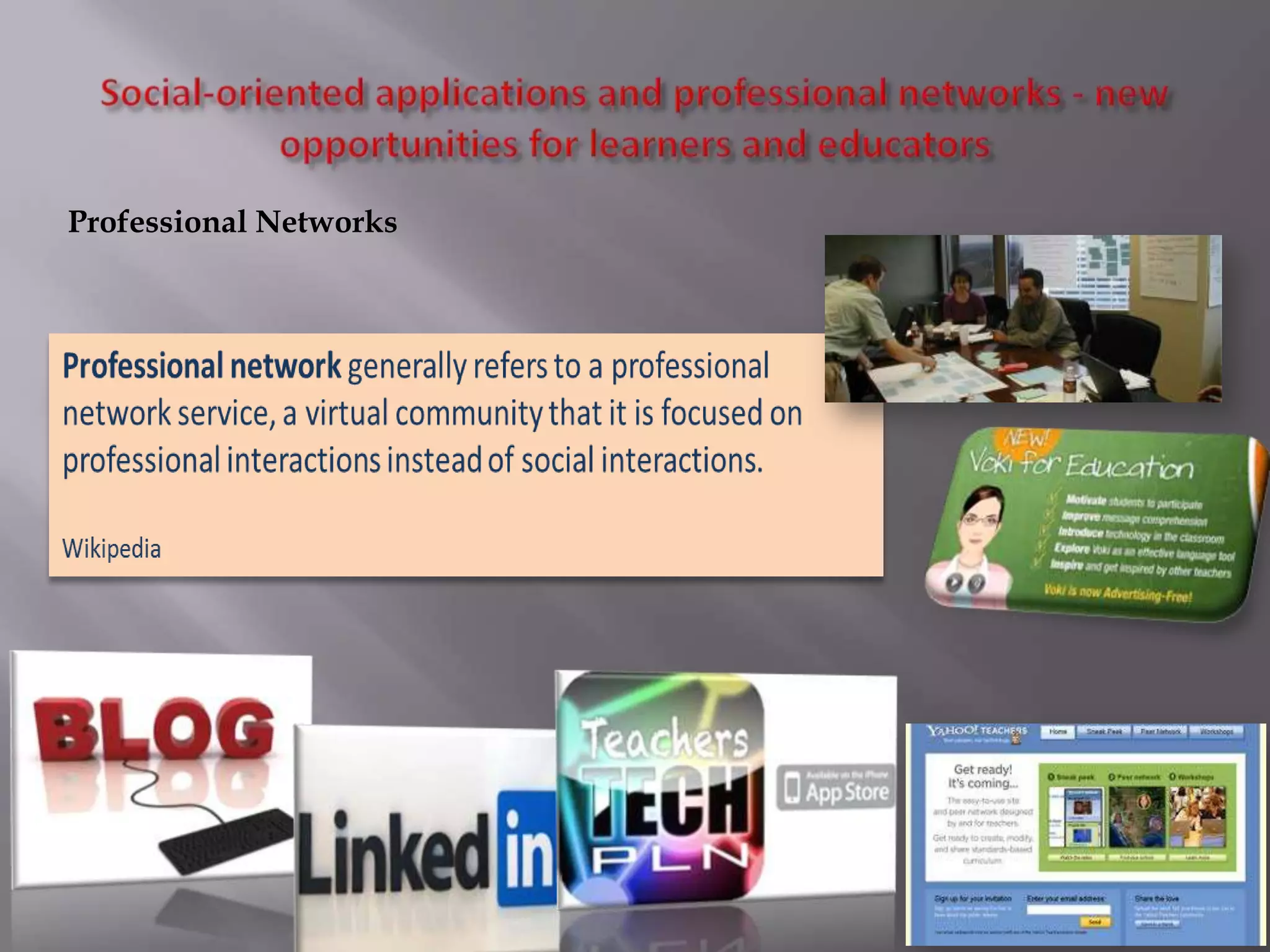
Professional Networks
Special-formed learning
networks for life-long learners
Because of their possibilities for:
 data, information and “knowledge
fusion”
 enhancing accessibility, productivity
and
innovative solutions
 research tools providing
 forming groups of personal and
professional interests
Social-oriented applications and
professional networks - new opportunities
for learners and educators
To be successful at knowledge
creation, analysis and
dissemination, learners need from
network inter-personal and inter-group
interactions
Personal Learning Environment
PLEs building laid the foundations of some main ideas:
learning is an on-going process and tools to support this
learning are needed
the role of the individual in self-organizing learning is
important
learning can take place in different contexts and situations
and cannot be provided by a single learning provider.
PLEs are systems that help learners take control of and
manage their own learning.
This includes providing support for learners to set their
own learning goals, manage their learning;
managing both content and process;
communicate with others in the process of learning and
thereby achieve learning goals.
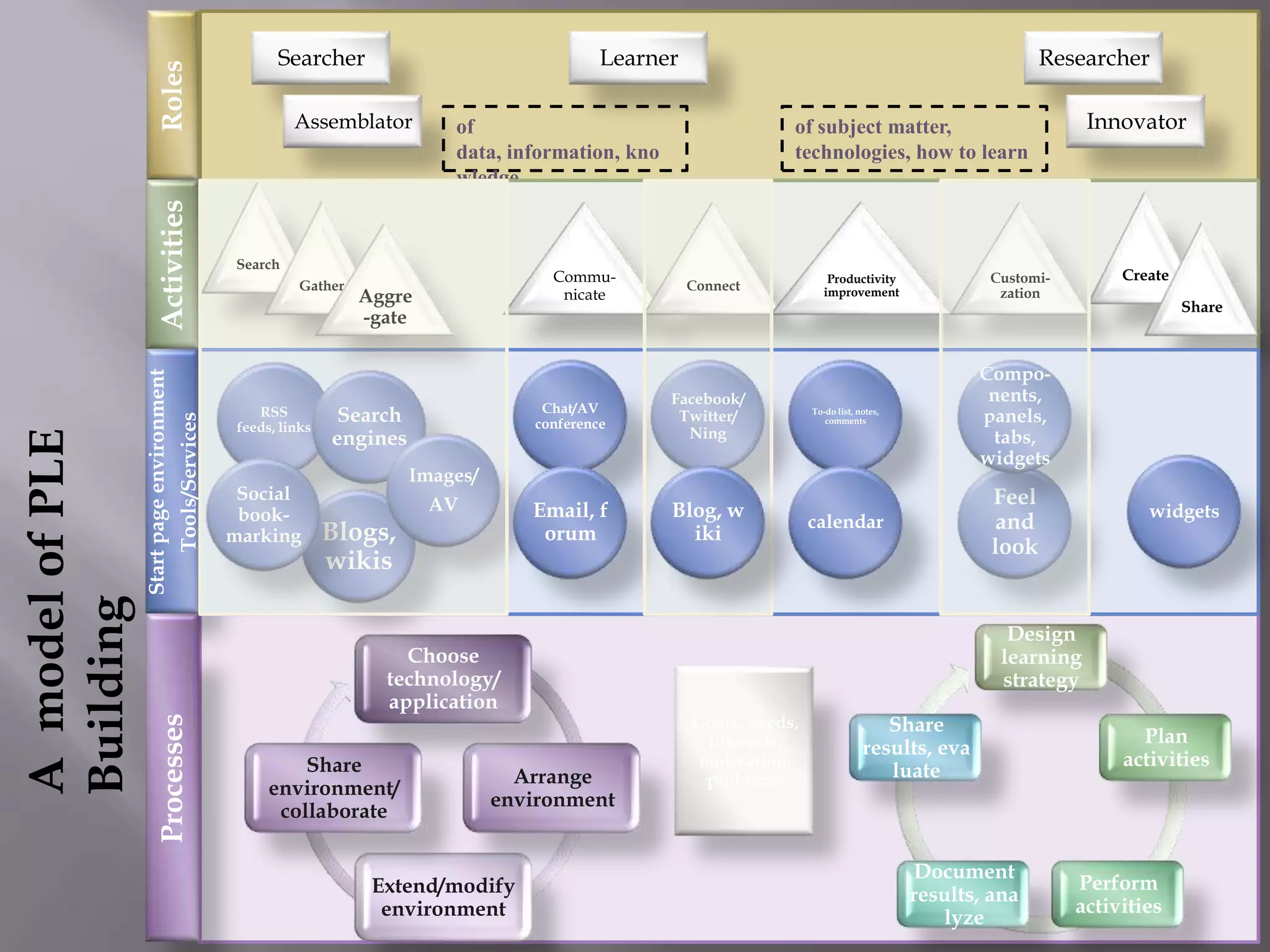
RolesActivities
Startpageenvironment
Tools/Services
Processes
Searcher
Assemblator
Learner Researcher
Innovatorof
data, information, kno
wledge
of subject matter,
technologies, how to learn
Create
Share
Commu-
nicate
Connect
RSS
feeds, links
Search
engines
Blogs,
wikis
Feel
and
look
Social
book-
marking
Images/
AV
Chat/AV
conference
Email, f
orum
Facebook/
Twitter/
Ning
To-do list, notes,
comments
calendar
Design
learning
strategy
Plan
activities
Perform
activities
Document
results, ana
lyze
Share
results, eva
luate
Choose
technology/
application
Arrange
environment
Extend/modify
environment
Share
environment/
collaborate
Search
Gather
Aggre
-gate
Productivity
improvement
Customi-
zation
Compo-
nents,
panels,
tabs,
widgets
widgets
Goals, needs,
interests,
motivation,
problems
Blog, w
iki
AmodelofPLE
Building
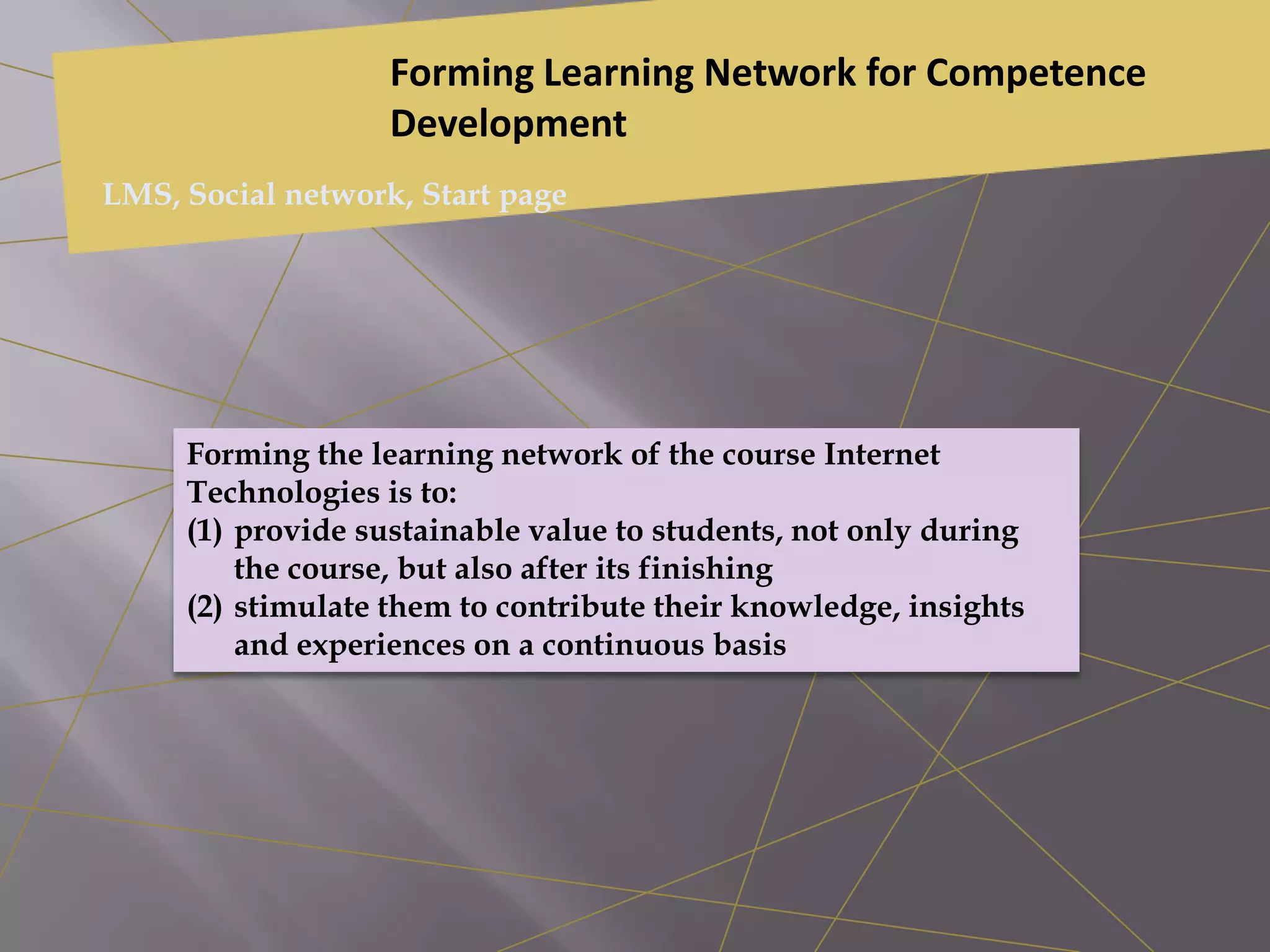
Forming the learning network of the course Internet
Technologies is to:
(1) provide sustainable value to students, not only during
the course, but also after its finishing
(2) stimulate them to contribute their knowledge, insights
and experiences on a continuous basis
Forming Learning Network for Competence
Development
LMS, Social network, Start page
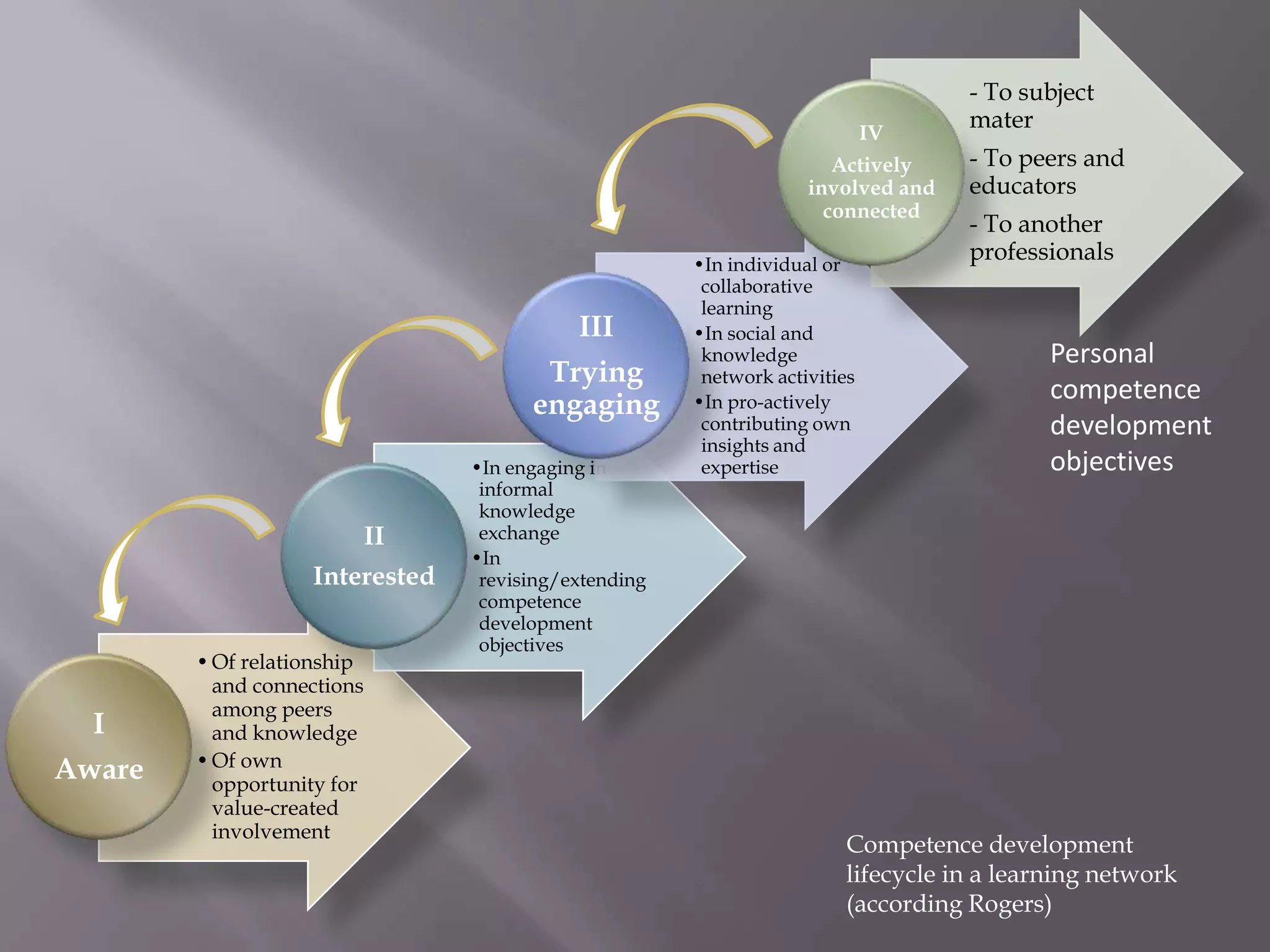
•Of relationship
and connections
among peers
and knowledge
•Of own
opportunity for
value-created
involvement
I
Aware
•In engaging in
informal
knowledge
exchange
•In
revising/extending
competence
development
objectives
II
Interested
•In individual or
collaborative
learning
•In social and
knowledge
network activities
•In pro-actively
contributing own
insights and
expertise
III
Trying
engaging
- To subject
mater
- To peers and
educators
- To another
professionals
IV
Actively
involved and
connected
Personal
competence
development
objectives
Competence development
lifecycle in a learning network
(according Rogers)
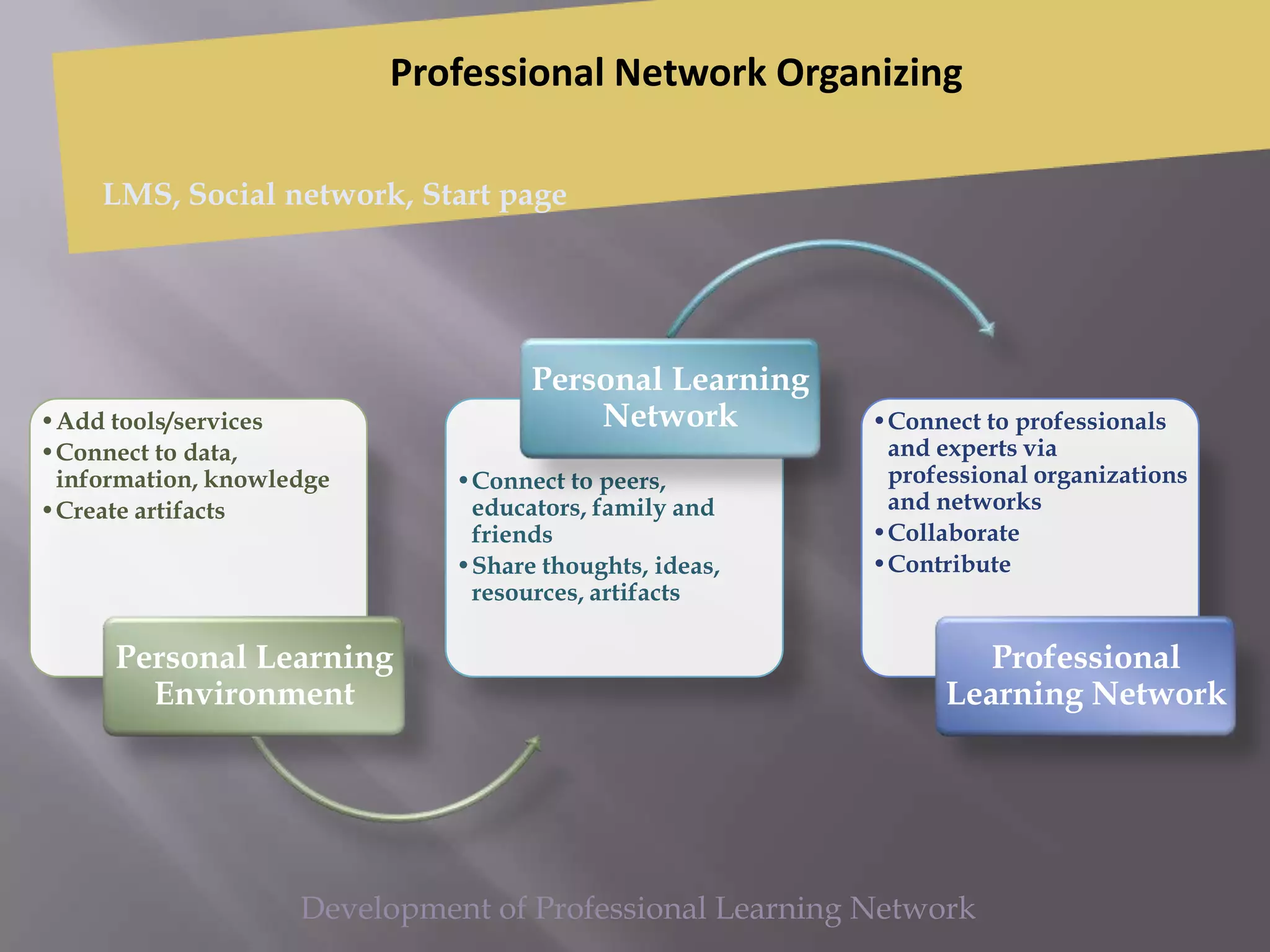
•Add tools/services
•Connect to data,
information, knowledge
•Create artifacts
Personal Learning
Environment
•Connect to peers,
educators, family and
friends
•Share thoughts, ideas,
resources, artifacts
Personal Learning
Network •Connect to professionals
and experts via
professional organizations
and networks
•Collaborate
•Contribute
Professional
Learning Network
Professional Network Organizing
LMS, Social network, Start page
Development of Professional Learning Network
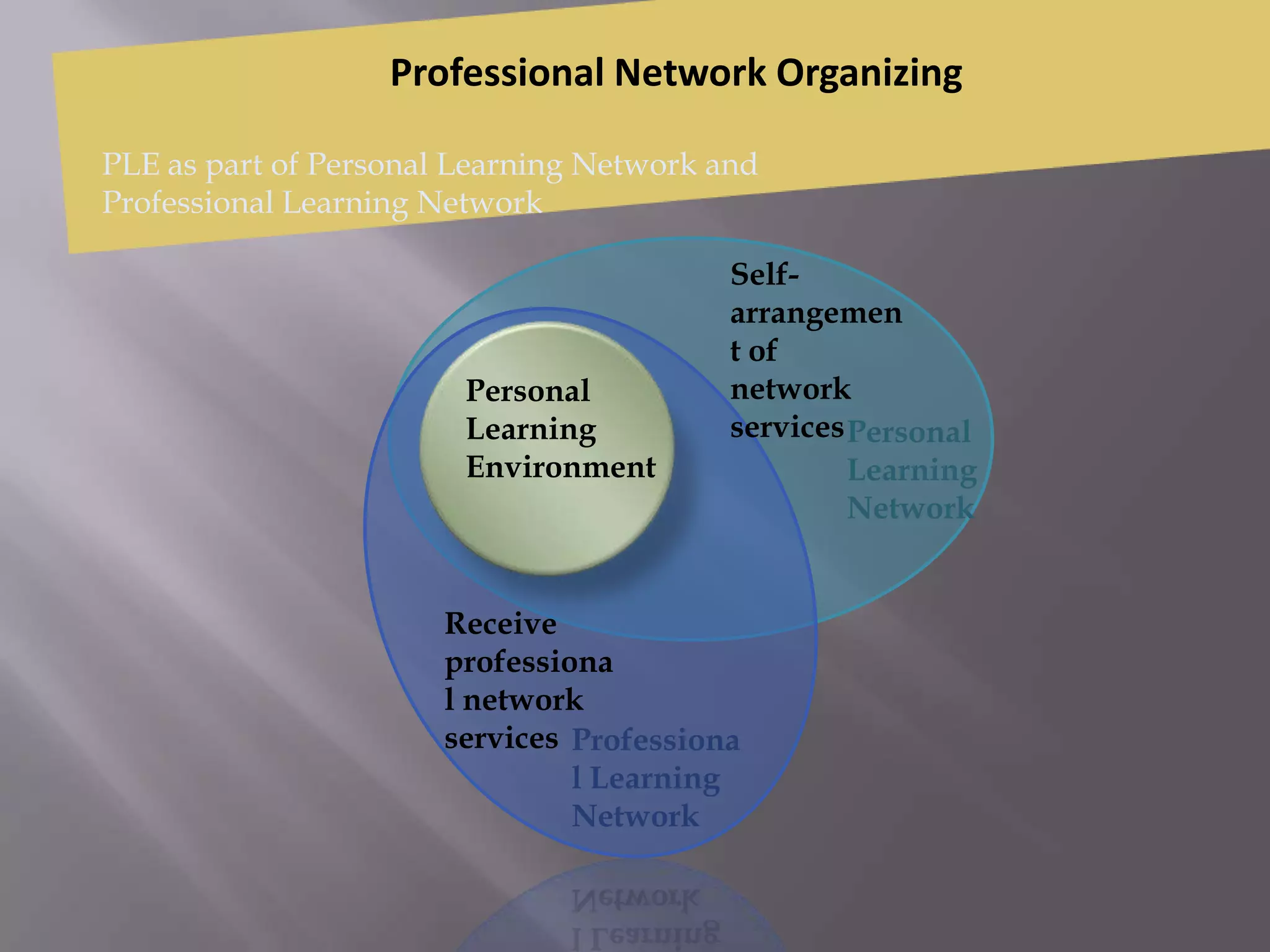
Personal
Learning
Environment
Personal
Learning
Network
Professiona
l Learning
Network
Receive
professiona
l network
services
Self-
arrangemen
t of
network
services
Professional Network Organizing
PLE as part of Personal Learning Network and
Professional Learning Network
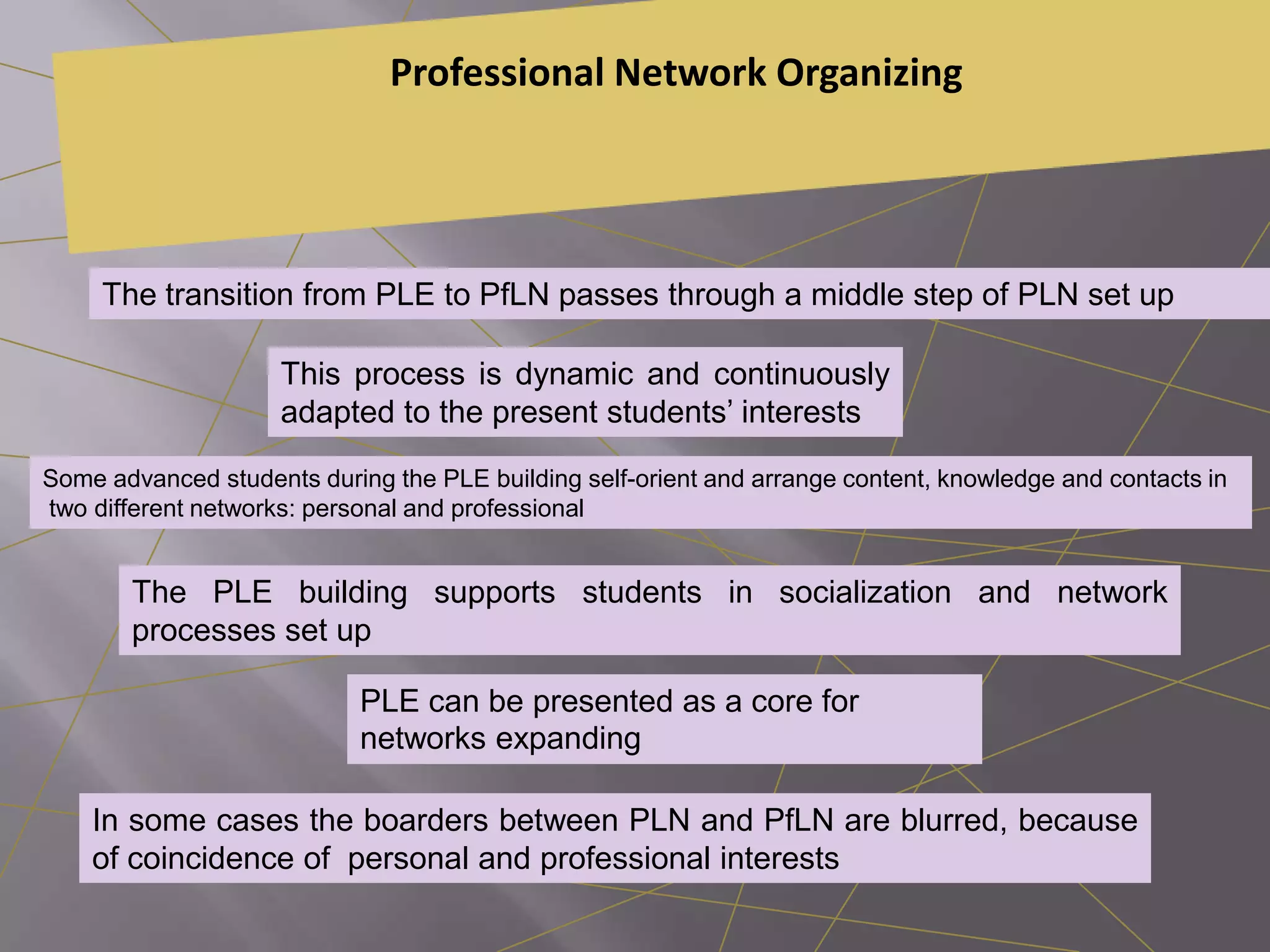
Some advanced students during the PLE building self-orient and arrange content, knowledge and contacts in
two different networks: personal and professional
The transition from PLE to PfLN passes through a middle step of PLN set up
This process is dynamic and continuously
adapted to the present students’ interests
In some cases the boarders between PLN and PfLN are blurred, because
of coincidence of personal and professional interests
PLE can be presented as a core for
networks expanding
The PLE building supports students in socialization and network
processes set up
Professional Network Organizing
Conclusion
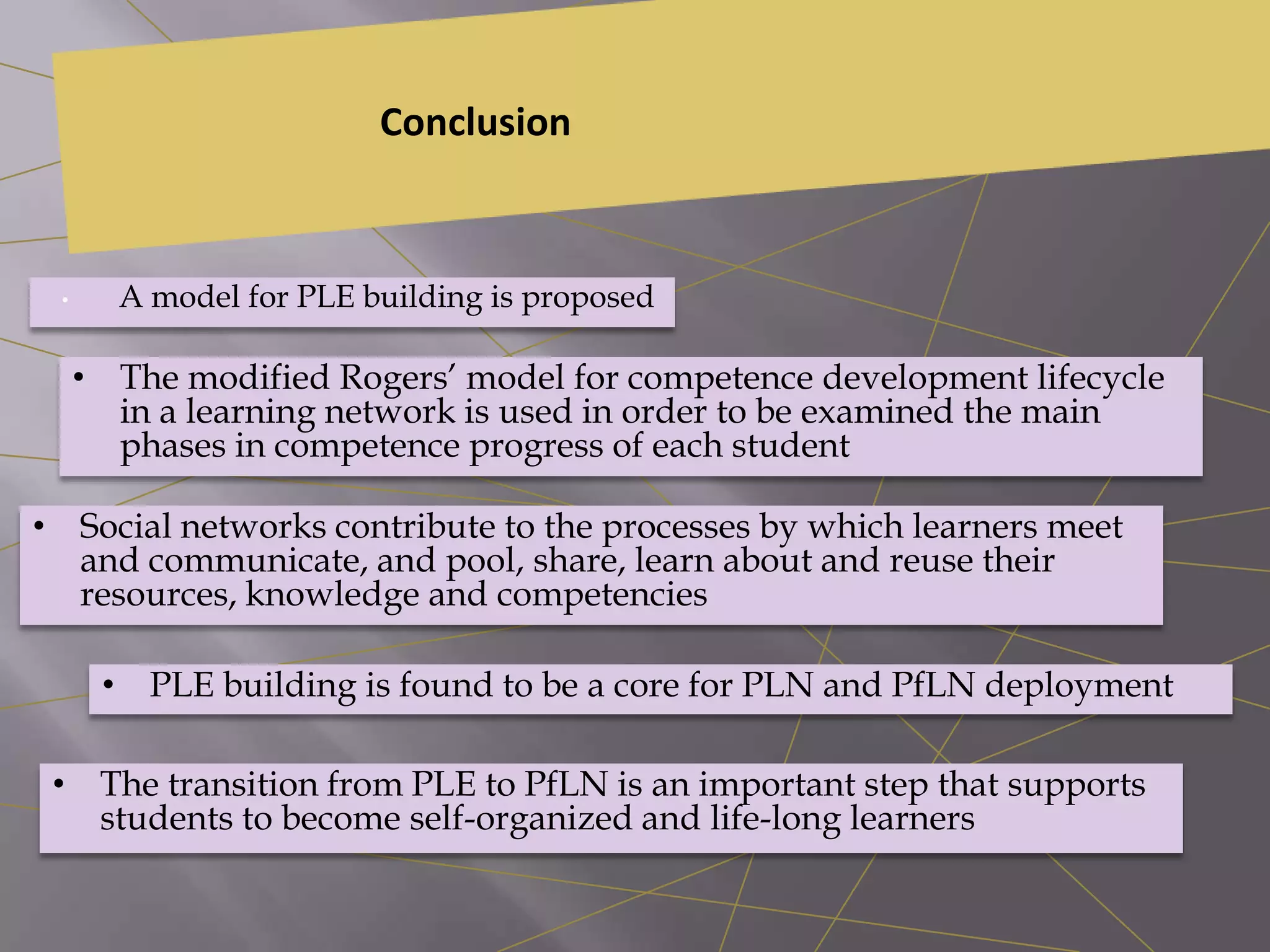
• A model for PLE building is proposed
• The modified Rogers’ model for competence development lifecycle
in a learning network is used in order to be examined the main
phases in competence progress of each student
• Social networks contribute to the processes by which learners meet
and communicate, and pool, share, learn about and reuse their
resources, knowledge and competencies
• PLE building is found to be a core for PLN and PfLN deployment
• The transition from PLE to PfLN is an important step that supports
students to become self-organized and life-long learners
Bibliography
Alssagaff, Z. A. (1992-2012). E-Learning manager. Malaysia: International Medical University
Malaysia.
Connolly, A. M. (No year of publication). Introducing Personal Learning Environments to Informal
Learners: Lessons Learned from the . United Kingdom: The Open University.
Ivanova, M. (April 09-10, 2009). The 5th International Scientific Conference- eLSE - eLearning and
Software for Education . Bulgaria: SofiaTechnical University.
Mikroyannidis, D. A. (n.d.). Build your Personal Learning Environment . United Kingdom: The Open
University.
Wheeler, S. (2009). It’s Personal: Learning Spaces, Learning Webs . Plymouth: University of
Plymouth.

The personal learning environment

  • 2.
  • 3.
    Recording and sharing achievement (e-portfolio) Communicatio n withothers (dialogue) Sharing with others (exchange)
  • 5.
     Supporting learnersin planning and controlling their learning journey  Setting their own learning goals  Monitoring their progress towards achieving these goals  Managing their learning – both content and process  Enabling learners to aggregate resources and personalise their learning environment  Providing recommendations to learners about resources and other learners (‘study-buddies’)  Collaborating with others in the process of learning  Providing support to learners for community building and collaborative activities  A shared learning experience instead of a lone study
  • 6.
  • 7.
  • 8.
     Self-regulated learning(SRL) is a term that describes an individual’s ability to learn how to learn. In other words, each of us can develop a wide-ranging skill set that enables us to learn in a number of different ways.  In some university settings the term SRL is more commonly described as “independent learning” or “auto-didactic learning”.  Some examples of how SRL might be assessed: Having the ability to set learning goals and plan appropriate study strategies Finding suitable learning materials  Seeking help from peers and collaborating to gain feedback or assurance Being able to reflect on their learning progress and adjust their study strategies accordingly
  • 9.
  • 10.
    From Personal LearningEnvironment Building to Professional Learning Network Forming Aim Forming learning network for competence development Professional network organizing The meaning of social and professional networks for education Building PLE on start pages Conclusion
  • 11.
    Aim To analyze theexperience gained in using of Web 2.0 environment for competence development and for professional network organizing
  • 12.
    Social-oriented applications and professionalnetworks - new opportunities for learners and educators W3C “Social Networks Interoperability Roadmap” Incubator Group (XG) Federated Interoperable Framework
  • 13.
    Social network sitescan be defined as web-based services that allow individuals to: (1) construct a public or semi-public profile within a bounded system (2) articulate a list of other users with whom they share a connection (3) view and traverse their list of connections and those made by others within the system. Danah Boyd, School of Information, University of California-Berkeley Nicole Ellison, Department of Telecommunication, Information Studies, and Media, Michigan State University Social-oriented applications and professional networks - new opportunities for learners and educators Social Networks
  • 14.
  • 15.
  • 16.
    Because of theirpossibilities for:  data, information and “knowledge fusion”  enhancing accessibility, productivity and innovative solutions  research tools providing  forming groups of personal and professional interests Social-oriented applications and professional networks - new opportunities for learners and educators To be successful at knowledge creation, analysis and dissemination, learners need from network inter-personal and inter-group interactions
  • 17.
    Personal Learning Environment PLEsbuilding laid the foundations of some main ideas: learning is an on-going process and tools to support this learning are needed the role of the individual in self-organizing learning is important learning can take place in different contexts and situations and cannot be provided by a single learning provider. PLEs are systems that help learners take control of and manage their own learning. This includes providing support for learners to set their own learning goals, manage their learning; managing both content and process; communicate with others in the process of learning and thereby achieve learning goals.
  • 18.
    RolesActivities Startpageenvironment Tools/Services Processes Searcher Assemblator Learner Researcher Innovatorof data, information,kno wledge of subject matter, technologies, how to learn Create Share Commu- nicate Connect RSS feeds, links Search engines Blogs, wikis Feel and look Social book- marking Images/ AV Chat/AV conference Email, f orum Facebook/ Twitter/ Ning To-do list, notes, comments calendar Design learning strategy Plan activities Perform activities Document results, ana lyze Share results, eva luate Choose technology/ application Arrange environment Extend/modify environment Share environment/ collaborate Search Gather Aggre -gate Productivity improvement Customi- zation Compo- nents, panels, tabs, widgets widgets Goals, needs, interests, motivation, problems Blog, w iki AmodelofPLE Building
  • 19.
    Forming the learningnetwork of the course Internet Technologies is to: (1) provide sustainable value to students, not only during the course, but also after its finishing (2) stimulate them to contribute their knowledge, insights and experiences on a continuous basis Forming Learning Network for Competence Development LMS, Social network, Start page
  • 20.
    •Of relationship and connections amongpeers and knowledge •Of own opportunity for value-created involvement I Aware •In engaging in informal knowledge exchange •In revising/extending competence development objectives II Interested •In individual or collaborative learning •In social and knowledge network activities •In pro-actively contributing own insights and expertise III Trying engaging - To subject mater - To peers and educators - To another professionals IV Actively involved and connected Personal competence development objectives Competence development lifecycle in a learning network (according Rogers)
  • 21.
    •Add tools/services •Connect todata, information, knowledge •Create artifacts Personal Learning Environment •Connect to peers, educators, family and friends •Share thoughts, ideas, resources, artifacts Personal Learning Network •Connect to professionals and experts via professional organizations and networks •Collaborate •Contribute Professional Learning Network Professional Network Organizing LMS, Social network, Start page Development of Professional Learning Network
  • 22.
    Personal Learning Environment Personal Learning Network Professiona l Learning Network Receive professiona l network services Self- arrangemen tof network services Professional Network Organizing PLE as part of Personal Learning Network and Professional Learning Network
  • 23.
    Some advanced studentsduring the PLE building self-orient and arrange content, knowledge and contacts in two different networks: personal and professional The transition from PLE to PfLN passes through a middle step of PLN set up This process is dynamic and continuously adapted to the present students’ interests In some cases the boarders between PLN and PfLN are blurred, because of coincidence of personal and professional interests PLE can be presented as a core for networks expanding The PLE building supports students in socialization and network processes set up Professional Network Organizing
  • 24.
    Conclusion • A modelfor PLE building is proposed • The modified Rogers’ model for competence development lifecycle in a learning network is used in order to be examined the main phases in competence progress of each student • Social networks contribute to the processes by which learners meet and communicate, and pool, share, learn about and reuse their resources, knowledge and competencies • PLE building is found to be a core for PLN and PfLN deployment • The transition from PLE to PfLN is an important step that supports students to become self-organized and life-long learners
  • 25.
    Bibliography Alssagaff, Z. A.(1992-2012). E-Learning manager. Malaysia: International Medical University Malaysia. Connolly, A. M. (No year of publication). Introducing Personal Learning Environments to Informal Learners: Lessons Learned from the . United Kingdom: The Open University. Ivanova, M. (April 09-10, 2009). The 5th International Scientific Conference- eLSE - eLearning and Software for Education . Bulgaria: SofiaTechnical University. Mikroyannidis, D. A. (n.d.). Build your Personal Learning Environment . United Kingdom: The Open University. Wheeler, S. (2009). It’s Personal: Learning Spaces, Learning Webs . Plymouth: University of Plymouth.

Editor's Notes

  • #2 PLEs in a variety of educational contexts ranging from formal undergraduate Higher Education to the continual informal learning exhibited by knowledge workers in the workplace. We outlined a couple of scenarios demonstrating how learners in these contexts interact with each other and how the cohesiveness and interdependence learners influences the form of the Personal Learning Environment adopted.In this short presentation I will leave the scenarios aside and will talk about some underlying questions and factors that I think are important if the PLE vision is to become more broadly taken up within the education
  • #4 In contrast, the PLE would focus on the needs of the learner.These tools are meant to give the learner greater control over their learning experience and integrate closely with other tools the learner might utilise in their personal and professional life.
  • #6 The predecessors to PLEs were the VLEs, or virtual learning environments, were developed as a response to institutions’ needs of bringing together different tools required for administration of learning – management of students, of content, grades – and other educational facilities, as well as enabling synchronous and asynchronous interactions to be brought together. The technologies adopted by VLEs are largely standard, with most commercial and Open Source tools exhibiting the same functionality, and overall pedagogical approach.But VLEs are fundamentally a conservative technology; they are a solution to a set of organisational problems.They are less clearly suited to the needs of learners.
  • #8 A Personal Learning environment doesn’t need to be very personal - it might be the same as a hundred others, or look like no other - but it must be social – perhaps it should be called a Social Learning Environment.