
PUTTING ELEARNING INTO PRACTICE Issues and Approaches
What is elearning?  http://what-is- elearning.wikispaces.com / Etraining  Distance Education  Blended or Web Enhanced Learning Type 1  Blended or Web Enhanced Learning Type 2  Virtual Classroom Type 1 (Collaborative)  Virtual Classroom Type 2 (Presentational)
Next/Back Learning Content for whole course prepared and loaded upfront (expensive) Minimal input from instructors; essentially unfacilitated Self-paced; individualised Suitable for compliance or product training, or for highly motivated students
Facilitated Learning Involves processing of content PLUS Communication activities (discussion) with fellow students and facilitator Strong social and/or collaborative component
Where do you put your content? MOODLE,  JANISON,  or RENT A CROWD?
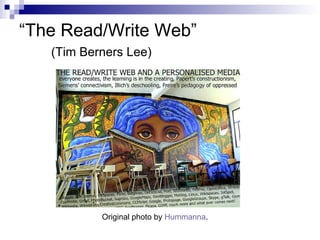
“ The Read/Write Web” (Tim Berners Lee) Original photo by  Hummanna .
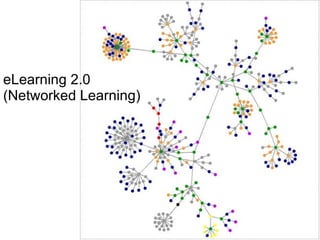
eLearning 2.0/Web 2.0 (Stephen Downes) eLearning 1.0  was static packaged content developed by content developers such as CD-ROMs and courseware. It had little true interactivity and learner input and very little (if any) contact with a tutor. Best represented by Learner Management Systems. (eg WebCT)  Some packaged content and some provided by the teacher. There is more interaction with a teacher and some with peers (through forums and chat). eLearning 2.0  will follow a student-centred model and will be centred around the Personal Learning Environment using social software. Students generate and share content. They interact not only with teachers and their peers, but with anyone in the world they can learn from.
eLearning 2.0 (Networked Learning)
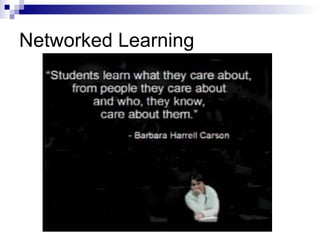
Networked Learning
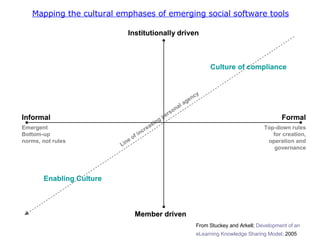
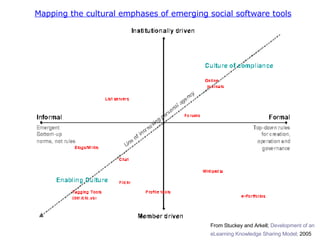
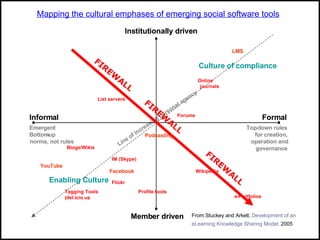
Mapping the cultural emphases of emerging social software tools From Stuckey and Arkell;  Development of an  eLearning Knowledge Sharing Model;  2005
Line of increasing personal agency Institutionally driven Member driven Formal Informal Top - down rules  for creation,  operation and  governance Emergent Bottom - up  norms, not rules Enabling Culture Culture of compliance Institutionally driven Member driven Formal Informal Top - down rules  for creation,  operation and  governance Emergent Bottom  - norms, not rules Mapping the cultural emphases of emerging social software tools Wikipedia e - Portfolios Profile tools Blogs/Wikis Flickr IM (Skype) Tagging Tools  ( del.icio.us ,  List servers Forums Online journals FIREWALL FIREWALL FIREWALL From Stuckey and Arkell;  Development of an  eLearning Knowledge Sharing Model;  2005   YouTube Facebook Podcasting LMS
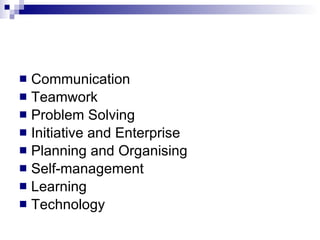
Communication  Teamwork  Problem Solving  Initiative and Enterprise  Planning and Organising  Self-management  Learning  Technology
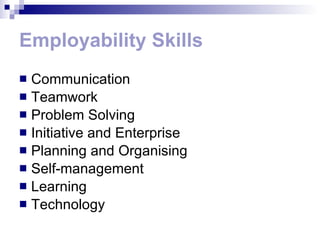
Employability Skills Communication  Teamwork  Problem Solving  Initiative and Enterprise  Planning and Organising  Self-management  Learning  Technology
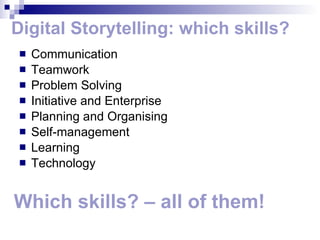
Digital Storytelling: which skills? Communication  Teamwork  Problem Solving  Initiative and Enterprise  Planning and Organising  Self-management  Learning  Technology Which skills? – all of them!
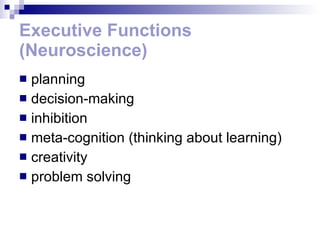
Executive Functions (Neuroscience) planning  decision-making  inhibition  meta-cognition (thinking about learning) creativity problem solving
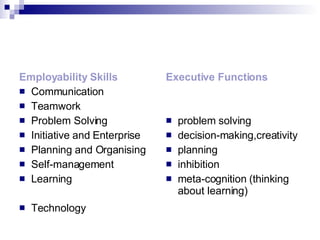
Employability Skills Communication  Teamwork  Problem Solving  Initiative and Enterprise  Planning and Organising  Self-management  Learning  Technology Executive Functions problem solving decision-making,creativity planning inhibition meta-cognition (thinking about learning)
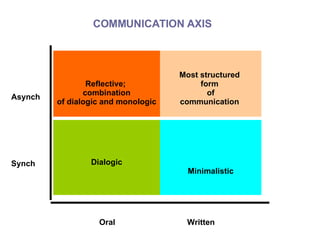
Asynch Synch Oral Written Dialogic Minimalistic Reflective;  combination of dialogic and monologic Most structured  form  of communication   COMMUNICATION   AXIS
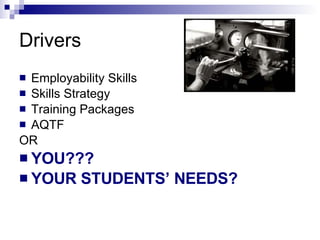
Drivers Employability Skills Skills Strategy Training Packages AQTF OR YOU??? YOUR STUDENTS’ NEEDS?
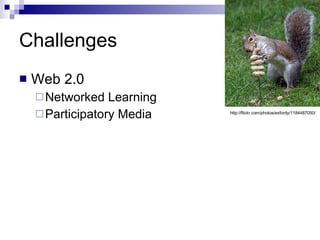
Challenges Web 2.0 Networked Learning Participatory Media http://flickr.com/photos/exfordy/1184487050/
Why Media? Adrian Miles (RMIT): “  make our institution…more porous to the students’ private technologies – their mobile phones, their laptops and their cameras.” Innate human desire/need to  create Ubiquity and ease of participatory media enables  creation  of art, film, documents, course content, assessments, etc
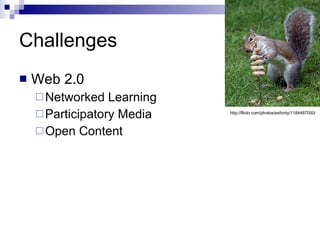
Challenges Web 2.0 Networked Learning Participatory Media Open Content http://flickr.com/photos/exfordy/1184487050/
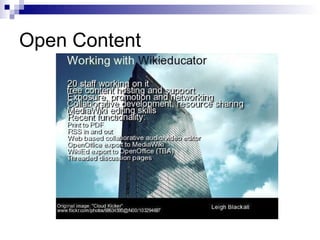
Open Content
Challenges Web 2.0 Networked Learning Participatory Media Open Content Creative Commons Licensing http://flickr.com/photos/exfordy/1184487050/
Creative Commons Licensing from Jeffrey Beall at http://www.flickr.com/photos/denverjeffrey/301014978/
Challenges Web 2.0 Networked Learning Participatory Media Open Content Creative Commons Licensing New Ways of Learning? http://newlearning.wikispaces.com/ Keeping a Media Generation engaged http://flickr.com/photos/exfordy/1184487050/
CONNECTIVISM:  A Learning Theory for the Digital Age     (George Siemens, University of Manitoba, Canada) Principles of Connectivism: Nurturing and maintaining connections  is needed to facilitate  continual learning .  Currency  (accurate, up-to-date knowledge) is the intent of all connectivist learning activities.  Choosing what to learn and the meaning of incoming information is seen through the lens of a shifting reality.  While there is a right answer now, it may be wrong tomorrow  due to alterations in the information climate affecting the decision.
Challenges Keeping abreast  of a field that changes daily Training IT students to  manage the information deluge Can institutional networks survive, and  remain relevant? http://flickr.com/photos/exfordy/1184487050/
What are others doing? Photography  (Croydon) - customised TAA  (Protopage) Stonemasonry  (NSW) Ning Cert IV/Diploma in Business/Bus Admin (Seedwiki) Dental – podcasting Western Institute  (TAFE NSW) - wiki Hospitality –  Appetite for Success Property Services (Panorama) Centra
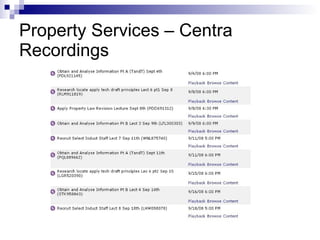
Property Services – Centra Recordings
Practical Resource Peter Shanks (NSW) bluemountains.net
The Future Time-to-Adoption: One Year or Less          Virtual Worlds/Immersive Environments          Cloud-Based Applications Time-to-Adoption: Two to Three Years          Geolocation          Alternative Input Devices Time-to-Adoption: Four to Five Years          Deep Tagging          Next-Generation Mobile From Australian/NZ Horizon Report http:// horizon.nmc.org/australia /

Putting Elearning Into Practice

  • 1.
    PUTTING ELEARNING INTOPRACTICE Issues and Approaches
  • 2.
    What is elearning? http://what-is- elearning.wikispaces.com / Etraining Distance Education Blended or Web Enhanced Learning Type 1 Blended or Web Enhanced Learning Type 2 Virtual Classroom Type 1 (Collaborative) Virtual Classroom Type 2 (Presentational)
  • 3.
    Next/Back Learning Contentfor whole course prepared and loaded upfront (expensive) Minimal input from instructors; essentially unfacilitated Self-paced; individualised Suitable for compliance or product training, or for highly motivated students
  • 4.
    Facilitated Learning Involvesprocessing of content PLUS Communication activities (discussion) with fellow students and facilitator Strong social and/or collaborative component
  • 5.
    Where do youput your content? MOODLE, JANISON, or RENT A CROWD?
  • 6.
    “ The Read/WriteWeb” (Tim Berners Lee) Original photo by Hummanna .
  • 7.
    eLearning 2.0/Web 2.0(Stephen Downes) eLearning 1.0 was static packaged content developed by content developers such as CD-ROMs and courseware. It had little true interactivity and learner input and very little (if any) contact with a tutor. Best represented by Learner Management Systems. (eg WebCT) Some packaged content and some provided by the teacher. There is more interaction with a teacher and some with peers (through forums and chat). eLearning 2.0 will follow a student-centred model and will be centred around the Personal Learning Environment using social software. Students generate and share content. They interact not only with teachers and their peers, but with anyone in the world they can learn from.
  • 8.
  • 9.
  • 10.
    Mapping the culturalemphases of emerging social software tools From Stuckey and Arkell; Development of an eLearning Knowledge Sharing Model; 2005
  • 11.
    Mapping the culturalemphases of emerging social software tools From Stuckey and Arkell; Development of an eLearning Knowledge Sharing Model; 2005
  • 12.
    Line of increasingpersonal agency Institutionally driven Member driven Formal Informal Top - down rules for creation, operation and governance Emergent Bottom - up norms, not rules Enabling Culture Culture of compliance Institutionally driven Member driven Formal Informal Top - down rules for creation, operation and governance Emergent Bottom - norms, not rules Mapping the cultural emphases of emerging social software tools Wikipedia e - Portfolios Profile tools Blogs/Wikis Flickr IM (Skype) Tagging Tools ( del.icio.us , List servers Forums Online journals FIREWALL FIREWALL FIREWALL From Stuckey and Arkell; Development of an eLearning Knowledge Sharing Model; 2005 YouTube Facebook Podcasting LMS
  • 13.
    Communication Teamwork Problem Solving Initiative and Enterprise Planning and Organising Self-management Learning Technology
  • 14.
    Employability Skills Communication Teamwork Problem Solving Initiative and Enterprise Planning and Organising Self-management Learning Technology
  • 15.
    Digital Storytelling: whichskills? Communication Teamwork Problem Solving Initiative and Enterprise Planning and Organising Self-management Learning Technology Which skills? – all of them!
  • 16.
    Executive Functions (Neuroscience)planning decision-making inhibition meta-cognition (thinking about learning) creativity problem solving
  • 17.
    Employability Skills Communication Teamwork Problem Solving Initiative and Enterprise Planning and Organising Self-management Learning Technology Executive Functions problem solving decision-making,creativity planning inhibition meta-cognition (thinking about learning)
  • 18.
    Asynch Synch OralWritten Dialogic Minimalistic Reflective; combination of dialogic and monologic Most structured form of communication COMMUNICATION AXIS
  • 19.
    Drivers Employability SkillsSkills Strategy Training Packages AQTF OR YOU??? YOUR STUDENTS’ NEEDS?
  • 20.
    Challenges Web 2.0Networked Learning Participatory Media http://flickr.com/photos/exfordy/1184487050/
  • 21.
    Why Media? AdrianMiles (RMIT): “ make our institution…more porous to the students’ private technologies – their mobile phones, their laptops and their cameras.” Innate human desire/need to create Ubiquity and ease of participatory media enables creation of art, film, documents, course content, assessments, etc
  • 22.
    Challenges Web 2.0Networked Learning Participatory Media Open Content http://flickr.com/photos/exfordy/1184487050/
  • 23.
  • 24.
    Challenges Web 2.0Networked Learning Participatory Media Open Content Creative Commons Licensing http://flickr.com/photos/exfordy/1184487050/
  • 25.
    Creative Commons Licensingfrom Jeffrey Beall at http://www.flickr.com/photos/denverjeffrey/301014978/
  • 26.
    Challenges Web 2.0Networked Learning Participatory Media Open Content Creative Commons Licensing New Ways of Learning? http://newlearning.wikispaces.com/ Keeping a Media Generation engaged http://flickr.com/photos/exfordy/1184487050/
  • 27.
    CONNECTIVISM: ALearning Theory for the Digital Age (George Siemens, University of Manitoba, Canada) Principles of Connectivism: Nurturing and maintaining connections is needed to facilitate continual learning . Currency (accurate, up-to-date knowledge) is the intent of all connectivist learning activities. Choosing what to learn and the meaning of incoming information is seen through the lens of a shifting reality. While there is a right answer now, it may be wrong tomorrow due to alterations in the information climate affecting the decision.
  • 28.
    Challenges Keeping abreast of a field that changes daily Training IT students to manage the information deluge Can institutional networks survive, and remain relevant? http://flickr.com/photos/exfordy/1184487050/
  • 29.
    What are othersdoing? Photography (Croydon) - customised TAA (Protopage) Stonemasonry (NSW) Ning Cert IV/Diploma in Business/Bus Admin (Seedwiki) Dental – podcasting Western Institute (TAFE NSW) - wiki Hospitality – Appetite for Success Property Services (Panorama) Centra
  • 30.
    Property Services –Centra Recordings
  • 31.
    Practical Resource PeterShanks (NSW) bluemountains.net
  • 32.
    The Future Time-to-Adoption:One Year or Less          Virtual Worlds/Immersive Environments          Cloud-Based Applications Time-to-Adoption: Two to Three Years          Geolocation          Alternative Input Devices Time-to-Adoption: Four to Five Years          Deep Tagging          Next-Generation Mobile From Australian/NZ Horizon Report http:// horizon.nmc.org/australia /