Eurodidaweb 2012
          From e-learning to Web-learning:
      placeless, connected, expansible, flexible,
                   effective learning

                         stefano.lariccia@uniroma1.it

                 2-3-4-5-6 of July 2012
                                               -


Stefano Lariccia – Digilab -                            Alberto Pigliacelli
Noematics                                                     Europaclub
Sapienza Università di Roma
Premises and objectives
• What are the objectives of this course?
   – The main objective of this course is to expose the student to a vast
     body of knowledge and competences on the different uses of ICT
     (information and communication technologies) throughout the globe,
     focusing especially on new learning methods based on the ubiquitous
     worldwideweb. This is what we call web-learning. Much of the class
     focuses on discussion based on readings assigned out of class.
   – Another objective of this course is to give students hands-on
     experience with web 2.0 tools to cope with the complexity of the
     cloud based, ubiquitous, new style of knowledge management; with
     international practices of web-learning through web technology; with
     a critical analysis of what our students are exposed to in their nomadic
     usage of the Web.
   – Throughout the course of the week, we work on globally-based
     projects that leverage the benefits of information and communication
     technologies to positively affect many diverse learning community.
Premises and objectives
•   What are the objectives of this course?
     – The main objective of this course is to expose the student to a vast body of knowledge on the
       different uses of information and communication technologies throughout the globe, focusing
       especially on new learning methods based on the ubiquitous worldwideweb. This is what we
       call web-learning. Much of the class focuses on discussion based on readings assigned out of
       class.
     – Another objective of this course is to give students hands-on experience with international
       practices of web-learning through web technology. Throughout the course of the week, we
       work on globally-based projects that leverage the benefits of information and communication
       technologies to positively affect many diverse learning community.


•   How will be achieved?
premises
  • How will be achieved?
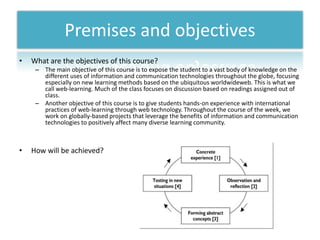
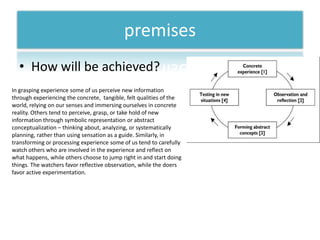
In grasping experience some of us perceive new information
through experiencing the concrete, tangible, felt qualities of the
world, relying on our senses and immersing ourselves in concrete
reality. Others tend to perceive, grasp, or take hold of new
information through symbolic representation or abstract
conceptualization – thinking about, analyzing, or systematically
planning, rather than using sensation as a guide. Similarly, in
transforming or processing experience some of us tend to carefully
watch others who are involved in the experience and reflect on
what happens, while others choose to jump right in and start doing
things. The watchers favor reflective observation, while the doers
favor active experimentation.
premises
   • How will be achieved?
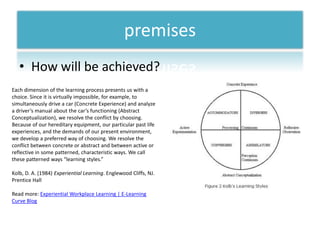
Each dimension of the learning process presents us with a
choice. Since it is virtually impossible, for example, to
simultaneously drive a car (Concrete Experience) and analyze
a driver’s manual about the car’s functioning (Abstract
Conceptualization), we resolve the conflict by choosing.
Because of our hereditary equipment, our particular past life
experiences, and the demands of our present environment,
we develop a preferred way of choosing. We resolve the
conflict between concrete or abstract and between active or
reflective in some patterned, characteristic ways. We call
these patterned ways “learning styles.”

Kolb, D. A. (1984) Experiential Learning. Englewood Cliffs, NJ.
Prentice Hall

Read more: Experiential Workplace Learning | E-Learning
Curve Blog
Web learning: basics
• What is the WorldWideWeb?
• When it was developed?
• Who controls its progress and its evolution?

• Why the web is so fast-growing?
• Why a teacher / learner should learn about
  the WorldWideWeb?
WorldWideWeb=learning
• You are using e-mail: e-mail started since 1970
• You are using e-learning: e-learning started in
  1980
• 2010 and forward: you will probably use web-
  learning: where the web 2.0-3.0 and ease of
  use are bridging together to enhance teaching
  and learning activities
Web-learning 2.0 basics:
let me introduce to you some useful tool
Web-learning 2.0 basics:
      let me introduce to you some useful tool

1. Internet is a safe place… provided you
   behave safely. Once you will begin to use the
   Web 2.0 you will discover soon that a Web
   2.0 user is overwhelmed by many access
   passwords.
2. First of all, then, you need a keychain
3. My suggestion is: Lastpass; Open Source,
   free,
Web-learning 2.0 basics: (cont.)
1. Internet is a safe place… provided you
   behave safely. Once you will begin to use the
   Web 2.0 you will discover soon that a Web
   2.0 user is overwhelmed by many access
   passwords.
2. First of all, then, you need a keychain
3. My suggestion is: LastPass ****; Open
   Source, free,
Web-learning 2.0 basics: (cont.)
1. Internet is a huge place… and you can loose yourself
   in the clouds…
2. Once you will begin to use the Web 2.0 you will
   discover soon that a Web 2.0 user is overwhelmed
   by many bookmarks ...
3. And the right one is ever in the wrong place. Let’s
   transform Bookmarks into “placeless tags”: xmarks
   will do this work for you
Web-learning 2.0 basics: (cont.)
1. Internet is a huge place… and you can loose
   your own teaching material …
2. Once again you will need a placeless safe
   location to save your didactic presentation ...
3. You’ve got thousands of slideshows
   presentation … And the right one is ever in
   the wrong place. Let’s transform PowerPoint
   into “placeless slide repository”: Slideshare
   will do this work for you
Web-learning 2.0 basics: (cont.)
1. Internet is such a huge repository … and you
   can loose your own book reference list …
2. Once again you will need a placeless safe
   location to save your book references...
3. You’ve got thousands of reading list for your
   students … And the right one is ever in the
   wrong place. Let’s transform “Biblioscape”
   into a “placeless references repository”:
   Citeulike will do this work for you
Web-learning 2.0 basics: (cont.)
1. Internet is such a huge repository … and you
   can loose your own Contact List …
2. Once again you will need a placeless safe
   location to save your book references...
3. You’ve got thousands of reading list for your
   students … And the right one is ever in the
   wrong place. Let’s transform “Outlook” into a
   “placeless contact list and calendar”: Plaxo
   will do this work for you
Web-learning 2.0 basics: (cont.)
1. Internet is such a huge repository … and you can
   loose your own Contact List and Calendar …
2. Once again you will need a placeless safe
   location to save your book references...
3. You’ve got thousands of reading list for your
   students … And the right one is ever in the wrong
   place. Let’s transform “Outlook” into a “placeless
   contact list and calendar”: Google Calendar will do
   this work for you as well
Web-learning 2.0 basics: (cont.)
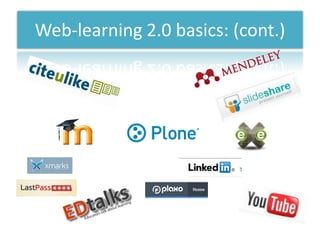
• Social Network
  – Social Network management systems can be a
    support to learning activities
  – You should try to encourage selection and usage
    of a serious social network like environment
  – Linkedin is a generalist yet “professional oriented”
    SN environment
Web-learning 2.0 - Social Networks
 – Edmodo | Secure Social Learning Network for Teachers and Students
      • www.edmodo.com/; Edmodo provides a safe and easy way for your class to connect and
        collaborate, share content, and access homework, grades and school notices. Our goal is
        to ...
 – TeachersRecess - The Teacher Social Network and File Sharing ...
      • www.teachersrecess.com/ The Teachers Social Network. ... Teachers Recess Community.
        Use the Community to: • Make Friends • Find Colleagues • Network • Share Ideas and
        More! FAQs - Wtf911 swaggsec bitchessss - Help - Register now!
 – Home - Teachers Social Network
      • www.teachersn.com/ - Get in touch with other teachers trough this social network site.
        Exchange teaching experiences, ideas and teaching materials with other teachers and
        students. Lesson Plans - Register - Web Site Terms and ... - About
 – NEA - Online Social Networking for Educators
      • www.nea.org/home/20746.htm - The vast majority of educators use social networking
        discreetly and professionally to make connections that can enhance careers, not
        jeopardize them.
 – 25 Excellent Social Media Sites for Teachers | The Digital Learning ...
      • toponlineuniversityreviews.com/.../25-excellent... - 25 Excellent Social Media Sites for
        Teachers. Are you a teacher who wants to increase collaboration and skill development
        to students? Teamwork can increase ...
Web-learning 2.0 - Social Networks
 – http://www.educationalnetworking.com/List+of+Networks
 – Guidelines for Educators Using Social Networking Sites - Home ...
      •   doug-johnson.squarespace.com/.../guidelines-f... -
      •   7 Aug 2009 – The district strongly discourages teachers from accepting invitations to friend students
          within these social networking sites. When students gain ...
 – Free Educational Resources for Educators and Teachers ...
 – www.teachade.com/ - Stati Uniti -
 – The first social networking website designed specifically for educators. Because of the ability
   to harness the online community, Teachade has become one of the ...
 – Teachers and Social Networks: To Facebook Or Not To Facebook?
      •   blogs.gartner.com/.../teachers-and-social-netwo... -
      •   6 Jun 2009 – First of all, there is no clear code of conduct for teachers on social media: some
          automatically accept any student's or parent 's request, some ...
 – Teaching and learning through social networks | TeachingEnglish ...

 – www.teachingenglish.org.uk/.../teaching-learning-thro...
 – In 2007, the British Council conducted market research into how the Internet has affected the
   preferred learning ...
Web-learning 2.0 - Social Networks
 – Impact of Social Networks on learning and
   teaching activities
    • http://ftp.jrc.es/EURdoc/JRC56958.pdf
Web-learning 2.0 basics: (cont.)


      • University of Auckland,
      • The Auckland University of Technology,
Web-learning 2.0 basics: (cont.)
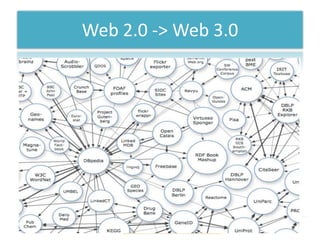
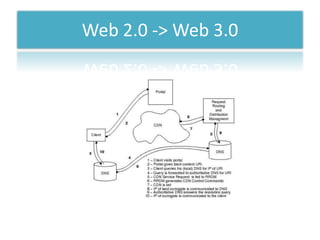
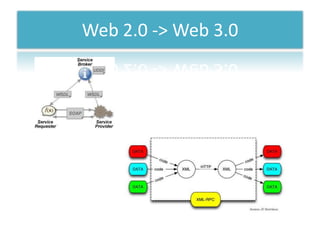
Web 2.0 -> Web 3.0
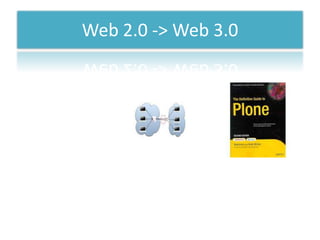
Web 2.0 -> Web 3.0
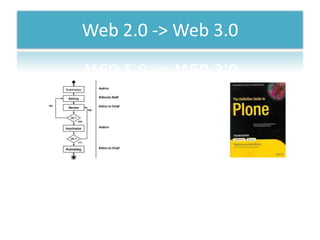
Web 2.0 -> Web 3.0
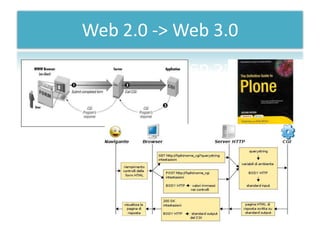
Web 2.0 -> Web 3.0
Web 2.0 -> Web 3.0
Web 2.0 -> Web 3.0
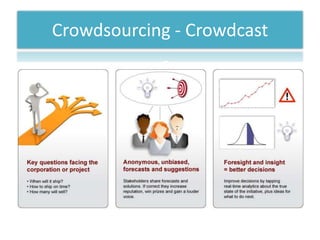
Crowdsourcing - Crowdcast
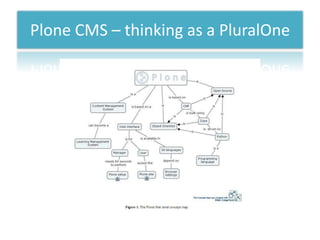
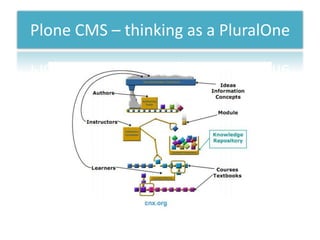
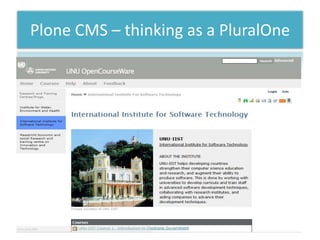
Plone CMS – thinking as a PluralOne
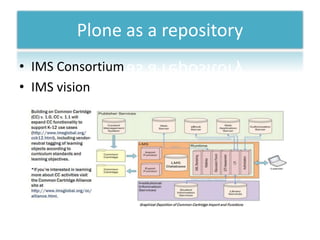
Plone as a repository
• IMS Consortium
• IMS vision
Other educational
          resources on the Web
• Webinars for secondary schools
  – http://www.evobeaker.com/products-k-
    12/Webinars


• Other resources for teachers
  – http://www.ies.be/training/bridging-the-gap
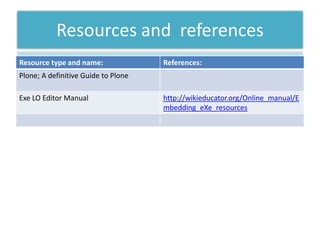
Resources and references
Resource type and name:              References:
Plone; A definitive Guide to Plone

Exe LO Editor Manual                 http://wikieducator.org/Online_manual/E
                                     mbedding_eXe_resources

Eurodidaweb2012 07-02

  • 1.
    Eurodidaweb 2012 From e-learning to Web-learning: placeless, connected, expansible, flexible, effective learning stefano.lariccia@uniroma1.it 2-3-4-5-6 of July 2012 - Stefano Lariccia – Digilab - Alberto Pigliacelli Noematics Europaclub Sapienza Università di Roma
  • 2.
    Premises and objectives •What are the objectives of this course? – The main objective of this course is to expose the student to a vast body of knowledge and competences on the different uses of ICT (information and communication technologies) throughout the globe, focusing especially on new learning methods based on the ubiquitous worldwideweb. This is what we call web-learning. Much of the class focuses on discussion based on readings assigned out of class. – Another objective of this course is to give students hands-on experience with web 2.0 tools to cope with the complexity of the cloud based, ubiquitous, new style of knowledge management; with international practices of web-learning through web technology; with a critical analysis of what our students are exposed to in their nomadic usage of the Web. – Throughout the course of the week, we work on globally-based projects that leverage the benefits of information and communication technologies to positively affect many diverse learning community.
  • 3.
    Premises and objectives • What are the objectives of this course? – The main objective of this course is to expose the student to a vast body of knowledge on the different uses of information and communication technologies throughout the globe, focusing especially on new learning methods based on the ubiquitous worldwideweb. This is what we call web-learning. Much of the class focuses on discussion based on readings assigned out of class. – Another objective of this course is to give students hands-on experience with international practices of web-learning through web technology. Throughout the course of the week, we work on globally-based projects that leverage the benefits of information and communication technologies to positively affect many diverse learning community. • How will be achieved?
  • 4.
    premises •How will be achieved? In grasping experience some of us perceive new information through experiencing the concrete, tangible, felt qualities of the world, relying on our senses and immersing ourselves in concrete reality. Others tend to perceive, grasp, or take hold of new information through symbolic representation or abstract conceptualization – thinking about, analyzing, or systematically planning, rather than using sensation as a guide. Similarly, in transforming or processing experience some of us tend to carefully watch others who are involved in the experience and reflect on what happens, while others choose to jump right in and start doing things. The watchers favor reflective observation, while the doers favor active experimentation.
  • 5.
    premises • How will be achieved? Each dimension of the learning process presents us with a choice. Since it is virtually impossible, for example, to simultaneously drive a car (Concrete Experience) and analyze a driver’s manual about the car’s functioning (Abstract Conceptualization), we resolve the conflict by choosing. Because of our hereditary equipment, our particular past life experiences, and the demands of our present environment, we develop a preferred way of choosing. We resolve the conflict between concrete or abstract and between active or reflective in some patterned, characteristic ways. We call these patterned ways “learning styles.” Kolb, D. A. (1984) Experiential Learning. Englewood Cliffs, NJ. Prentice Hall Read more: Experiential Workplace Learning | E-Learning Curve Blog
  • 6.
    Web learning: basics •What is the WorldWideWeb? • When it was developed? • Who controls its progress and its evolution? • Why the web is so fast-growing? • Why a teacher / learner should learn about the WorldWideWeb?
  • 7.
    WorldWideWeb=learning • You areusing e-mail: e-mail started since 1970 • You are using e-learning: e-learning started in 1980 • 2010 and forward: you will probably use web- learning: where the web 2.0-3.0 and ease of use are bridging together to enhance teaching and learning activities
  • 8.
    Web-learning 2.0 basics: letme introduce to you some useful tool
  • 9.
    Web-learning 2.0 basics: let me introduce to you some useful tool 1. Internet is a safe place… provided you behave safely. Once you will begin to use the Web 2.0 you will discover soon that a Web 2.0 user is overwhelmed by many access passwords. 2. First of all, then, you need a keychain 3. My suggestion is: Lastpass; Open Source, free,
  • 10.
    Web-learning 2.0 basics:(cont.) 1. Internet is a safe place… provided you behave safely. Once you will begin to use the Web 2.0 you will discover soon that a Web 2.0 user is overwhelmed by many access passwords. 2. First of all, then, you need a keychain 3. My suggestion is: LastPass ****; Open Source, free,
  • 11.
    Web-learning 2.0 basics:(cont.) 1. Internet is a huge place… and you can loose yourself in the clouds… 2. Once you will begin to use the Web 2.0 you will discover soon that a Web 2.0 user is overwhelmed by many bookmarks ... 3. And the right one is ever in the wrong place. Let’s transform Bookmarks into “placeless tags”: xmarks will do this work for you
  • 12.
    Web-learning 2.0 basics:(cont.) 1. Internet is a huge place… and you can loose your own teaching material … 2. Once again you will need a placeless safe location to save your didactic presentation ... 3. You’ve got thousands of slideshows presentation … And the right one is ever in the wrong place. Let’s transform PowerPoint into “placeless slide repository”: Slideshare will do this work for you
  • 13.
    Web-learning 2.0 basics:(cont.) 1. Internet is such a huge repository … and you can loose your own book reference list … 2. Once again you will need a placeless safe location to save your book references... 3. You’ve got thousands of reading list for your students … And the right one is ever in the wrong place. Let’s transform “Biblioscape” into a “placeless references repository”: Citeulike will do this work for you
  • 14.
    Web-learning 2.0 basics:(cont.) 1. Internet is such a huge repository … and you can loose your own Contact List … 2. Once again you will need a placeless safe location to save your book references... 3. You’ve got thousands of reading list for your students … And the right one is ever in the wrong place. Let’s transform “Outlook” into a “placeless contact list and calendar”: Plaxo will do this work for you
  • 15.
    Web-learning 2.0 basics:(cont.) 1. Internet is such a huge repository … and you can loose your own Contact List and Calendar … 2. Once again you will need a placeless safe location to save your book references... 3. You’ve got thousands of reading list for your students … And the right one is ever in the wrong place. Let’s transform “Outlook” into a “placeless contact list and calendar”: Google Calendar will do this work for you as well
  • 16.
    Web-learning 2.0 basics:(cont.) • Social Network – Social Network management systems can be a support to learning activities – You should try to encourage selection and usage of a serious social network like environment – Linkedin is a generalist yet “professional oriented” SN environment
  • 17.
    Web-learning 2.0 -Social Networks – Edmodo | Secure Social Learning Network for Teachers and Students • www.edmodo.com/; Edmodo provides a safe and easy way for your class to connect and collaborate, share content, and access homework, grades and school notices. Our goal is to ... – TeachersRecess - The Teacher Social Network and File Sharing ... • www.teachersrecess.com/ The Teachers Social Network. ... Teachers Recess Community. Use the Community to: • Make Friends • Find Colleagues • Network • Share Ideas and More! FAQs - Wtf911 swaggsec bitchessss - Help - Register now! – Home - Teachers Social Network • www.teachersn.com/ - Get in touch with other teachers trough this social network site. Exchange teaching experiences, ideas and teaching materials with other teachers and students. Lesson Plans - Register - Web Site Terms and ... - About – NEA - Online Social Networking for Educators • www.nea.org/home/20746.htm - The vast majority of educators use social networking discreetly and professionally to make connections that can enhance careers, not jeopardize them. – 25 Excellent Social Media Sites for Teachers | The Digital Learning ... • toponlineuniversityreviews.com/.../25-excellent... - 25 Excellent Social Media Sites for Teachers. Are you a teacher who wants to increase collaboration and skill development to students? Teamwork can increase ...
  • 18.
    Web-learning 2.0 -Social Networks – http://www.educationalnetworking.com/List+of+Networks – Guidelines for Educators Using Social Networking Sites - Home ... • doug-johnson.squarespace.com/.../guidelines-f... - • 7 Aug 2009 – The district strongly discourages teachers from accepting invitations to friend students within these social networking sites. When students gain ... – Free Educational Resources for Educators and Teachers ... – www.teachade.com/ - Stati Uniti - – The first social networking website designed specifically for educators. Because of the ability to harness the online community, Teachade has become one of the ... – Teachers and Social Networks: To Facebook Or Not To Facebook? • blogs.gartner.com/.../teachers-and-social-netwo... - • 6 Jun 2009 – First of all, there is no clear code of conduct for teachers on social media: some automatically accept any student's or parent 's request, some ... – Teaching and learning through social networks | TeachingEnglish ... – www.teachingenglish.org.uk/.../teaching-learning-thro... – In 2007, the British Council conducted market research into how the Internet has affected the preferred learning ...
  • 19.
    Web-learning 2.0 -Social Networks – Impact of Social Networks on learning and teaching activities • http://ftp.jrc.es/EURdoc/JRC56958.pdf
  • 20.
  • 21.
    Web-learning 2.0 basics:(cont.) • University of Auckland, • The Auckland University of Technology,
  • 22.
  • 23.
  • 24.
  • 25.
    Web 2.0 ->Web 3.0
  • 26.
    Web 2.0 ->Web 3.0
  • 27.
    Web 2.0 ->Web 3.0
  • 28.
    Web 2.0 ->Web 3.0
  • 29.
    Web 2.0 ->Web 3.0
  • 30.
    Web 2.0 ->Web 3.0
  • 31.
  • 32.
    Plone CMS –thinking as a PluralOne
  • 33.
    Plone CMS –thinking as a PluralOne
  • 34.
    Plone CMS –thinking as a PluralOne
  • 35.
    Plone as arepository • IMS Consortium • IMS vision
  • 36.
    Other educational resources on the Web • Webinars for secondary schools – http://www.evobeaker.com/products-k- 12/Webinars • Other resources for teachers – http://www.ies.be/training/bridging-the-gap
  • 37.
    Resources and references Resourcetype and name: References: Plone; A definitive Guide to Plone Exe LO Editor Manual http://wikieducator.org/Online_manual/E mbedding_eXe_resources