India’s first college-preparatory school


eIndia 2012: Essentials for
Building Visionary Schools in
a Globalised World
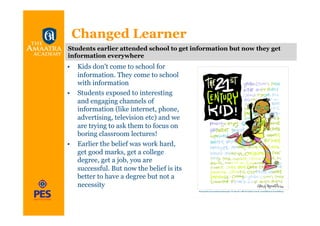
Changed Learner
Students earlier attended school to get information but now they get
information everywhere
•  Kids don't come to school for
   information. They come to school
   with information
•  Students exposed to interesting
   and engaging channels of
   information (like internet, phone,
   advertising, television etc) and we
   are trying to ask them to focus on
   boring classroom lectures!
•  Earlier the belief was work hard,
   get good marks, get a college
   degree, get a job, you are
   successful. But now the belief is its
   better to have a degree but not a
   necessity
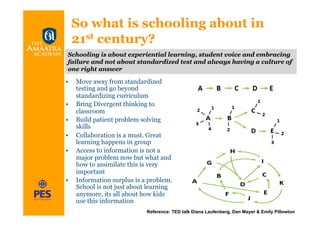
So what is schooling about in
     21st century?
 Schooling is about experiential learning, student voice and embracing
 failure and not about standardized test and always having a culture of
 one right answer

•    Move away from standardized
     testing and go beyond
     standardizing curriculum
•    Bring Divergent thinking to
     classroom
•    Build patient problem solving
     skills
•    Collaboration is a must. Great
     learning happens in group
•    Access to information is not a
     major problem now but what and
     how to assimilate this is very
     important
•    Information surplus is a problem.
     School is not just about learning
     anymore, its all about how kids
     use this information
                             Reference: TED talk Diana Laufenberg, Dan Mayer & Emily Pillowton
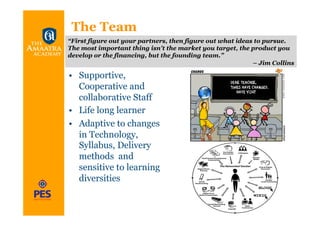
The Team
“First figure out your partners, then figure out what ideas to pursue.
The most important thing isn't the market you target, the product you
develop or the financing, but the founding team.”
                                                           – Jim Collins

•  Supportive,
   Cooperative and
   collaborative Staff
•  Life long learner
•  Adaptive to changes
   in Technology,
   Syllabus, Delivery
   methods and
   sensitive to learning
   diversities
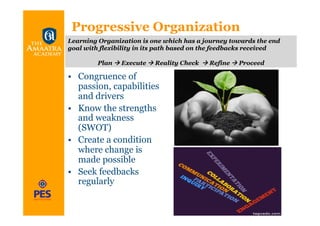
Progressive Organization
Learning Organization is one which has a journey towards the end
goal with flexibility in its path based on the feedbacks received

         Plan  Execute  Reality Check  Refine  Proceed

•  Congruence of
   passion, capabilities
   and drivers
•  Know the strengths
   and weakness
   (SWOT)
•  Create a condition
   where change is
   made possible
•  Seek feedbacks
   regularly
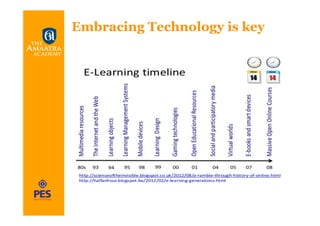
Embracing Technology is key
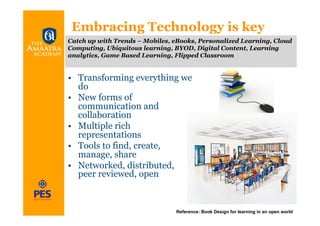
Catch up with Trends – Mobiles, eBooks, Personalized Learning, Cloud
Computing, Ubiquitous learning, BYOD, Digital Content, Learning
analytics, Game Based Learning, Flipped Classroom


•  Transforming everything we
   do
•  New forms of
   communication and
   collaboration
•  Multiple rich
   representations
•  Tools to find, create,
   manage, share
•  Networked, distributed,
   peer reviewed, open


                                Reference: Book Design for learning in an open world
Summary
The mind is not a vessel that needs filling, but wood
that needs igniting – Plutarch
Spend less time filling minds of hungry students with
content by lecturing at them.
Ignite their creativity, their imagination and their problem
solving skills by talking. This is done by doing active
learning in classroom by interacting with students

There is no one size fits all. The design solution for fueling
the Inquisitiveness, expressiveness, Exploration & Self
discovery of a student is dependent on

    –  Student/Teacher background
    –  Infrastructure available
    –  Size of the classroom
    –  Investment (Both time and money by all stakeholders)
Credits

•  TED Talks –Diana Laufenberg, Dan Mayer, Ken Robinson & Emily
   Pillowton
•  Book - Design for learning in an open world
•  Images from
    –  http://skerricks.blogspot.in/2011/02/21st-century-learners.html
    –  http://3.bp.blogspot.com/_ayCytGsy6YE/TUO9jZmOlkI/
       AAAAAAAAA3g/S8HlTXHgp3w/s1600/21st_century_PR_2.jpg
    –  http://cartist.edublogs.org/2011/08/18/what-exactly-does-a-21st-
       century-learner-look-like/
    –  http://promise.smesnews.org/concepts/21st-century-learning/
    –  http://wwpk-3.sharpschool.com/tc_teachers/grade_levels/grade_3/
       mrs__pellicciotti/21st_century_learners/
    –  http://www.microassist.com/custom-e-learning/the-learning-
       dispatch/are-learning-differences-between-generations-myth
Thank You!

shivoo@amaatra.pes.edu
Facebook: shivoo.koteshwar / Twitter: @shivookoteshwar


11

eIndia 2012 Presentation and Panel Discussion -

  • 1.
    India’s first college-preparatoryschool eIndia 2012: Essentials for Building Visionary Schools in a Globalised World
  • 2.
    Changed Learner Students earlierattended school to get information but now they get information everywhere •  Kids don't come to school for information. They come to school with information •  Students exposed to interesting and engaging channels of information (like internet, phone, advertising, television etc) and we are trying to ask them to focus on boring classroom lectures! •  Earlier the belief was work hard, get good marks, get a college degree, get a job, you are successful. But now the belief is its better to have a degree but not a necessity
  • 3.
    So what isschooling about in 21st century? Schooling is about experiential learning, student voice and embracing failure and not about standardized test and always having a culture of one right answer •  Move away from standardized testing and go beyond standardizing curriculum •  Bring Divergent thinking to classroom •  Build patient problem solving skills •  Collaboration is a must. Great learning happens in group •  Access to information is not a major problem now but what and how to assimilate this is very important •  Information surplus is a problem. School is not just about learning anymore, its all about how kids use this information Reference: TED talk Diana Laufenberg, Dan Mayer & Emily Pillowton
  • 4.
    The Team “First figureout your partners, then figure out what ideas to pursue. The most important thing isn't the market you target, the product you develop or the financing, but the founding team.” – Jim Collins •  Supportive, Cooperative and collaborative Staff •  Life long learner •  Adaptive to changes in Technology, Syllabus, Delivery methods and sensitive to learning diversities
  • 5.
    Progressive Organization Learning Organizationis one which has a journey towards the end goal with flexibility in its path based on the feedbacks received Plan  Execute  Reality Check  Refine  Proceed •  Congruence of passion, capabilities and drivers •  Know the strengths and weakness (SWOT) •  Create a condition where change is made possible •  Seek feedbacks regularly
  • 6.
  • 7.
    Embracing Technology iskey Catch up with Trends – Mobiles, eBooks, Personalized Learning, Cloud Computing, Ubiquitous learning, BYOD, Digital Content, Learning analytics, Game Based Learning, Flipped Classroom •  Transforming everything we do •  New forms of communication and collaboration •  Multiple rich representations •  Tools to find, create, manage, share •  Networked, distributed, peer reviewed, open Reference: Book Design for learning in an open world
  • 8.
    Summary The mind isnot a vessel that needs filling, but wood that needs igniting – Plutarch Spend less time filling minds of hungry students with content by lecturing at them. Ignite their creativity, their imagination and their problem solving skills by talking. This is done by doing active learning in classroom by interacting with students There is no one size fits all. The design solution for fueling the Inquisitiveness, expressiveness, Exploration & Self discovery of a student is dependent on –  Student/Teacher background –  Infrastructure available –  Size of the classroom –  Investment (Both time and money by all stakeholders)
  • 9.
    Credits •  TED Talks–Diana Laufenberg, Dan Mayer, Ken Robinson & Emily Pillowton •  Book - Design for learning in an open world •  Images from –  http://skerricks.blogspot.in/2011/02/21st-century-learners.html –  http://3.bp.blogspot.com/_ayCytGsy6YE/TUO9jZmOlkI/ AAAAAAAAA3g/S8HlTXHgp3w/s1600/21st_century_PR_2.jpg –  http://cartist.edublogs.org/2011/08/18/what-exactly-does-a-21st- century-learner-look-like/ –  http://promise.smesnews.org/concepts/21st-century-learning/ –  http://wwpk-3.sharpschool.com/tc_teachers/grade_levels/grade_3/ mrs__pellicciotti/21st_century_learners/ –  http://www.microassist.com/custom-e-learning/the-learning- dispatch/are-learning-differences-between-generations-myth
  • 11.