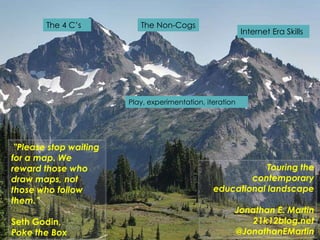
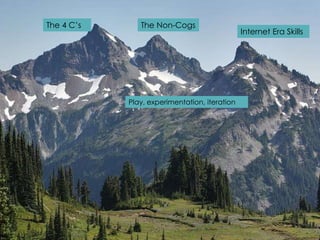
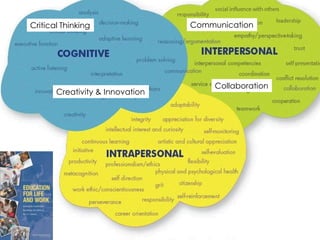
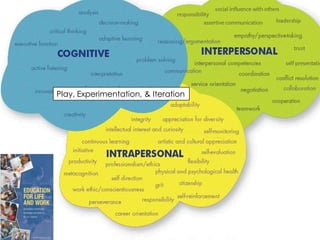
The 4 C’s The Non-Cogs
Internet Era Skills
Play, experimentation, iteration
"Please stop waiting
for a map. We
reward those who
draw maps, not
those who follow
them.”
Seth Godin,
Poke the Box
Touring the
contemporary
educational landscape
Jonathan E. Martin
21k12blog.net
@JonathanEMartin
12
up
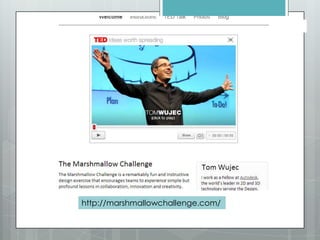
 http://marshmallowchallenge.com
http://marshmallowchallenge.com/
We need an iterative and collaborative
approach to align learning with fast
changing times.
How can we help our students be
Kindergartners, not MBA students?
http://www.justsaypictures.com/im-looking-for-the-mo
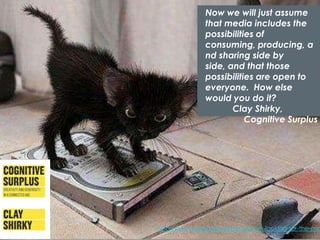
Now we will just assume
that media includes the
possibilities of
consuming, producing, a
nd sharing side by
side, and that those
possibilities are open to
everyone. How else
would you do it?
Clay Shirky,
Cognitive Surplus
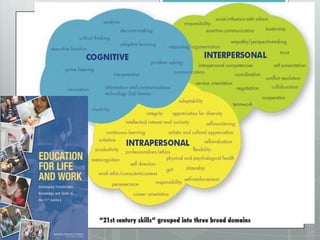
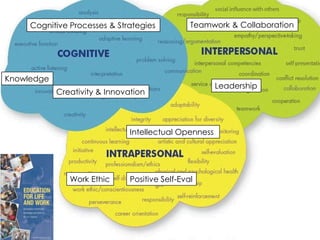
Cognitive Processes & Strategies
Knowledge
Creativity & Innovation
Intellectual Openness
Teamwork & Collaboration
Work Ethic Positive Self-Eval
Leadership
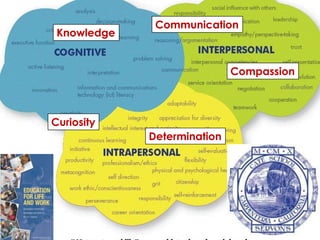
Knowledge
Determination
Compassion
Curiosity
Communication
The 4 C’s The Non-Cogs
Internet Era Skills
Play, experimentation, iteration
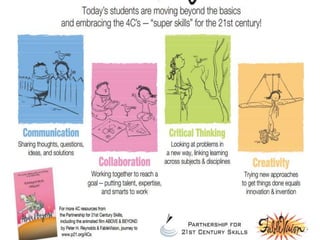
Critical Thinking
Creativity & Innovation
Communication
Collaboration
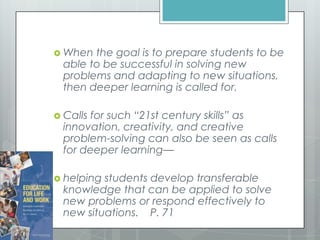
 When the goal is to prepare students to be
able to be successful in solving new
problems and adapting to new situations,
then deeper learning is called for.
 Calls for such “21st century skills” as
innovation, creativity, and creative
problem-solving can also be seen as calls
for deeper learning—
 helping students develop transferable
knowledge that can be applied to solve
new problems or respond effectively to
new situations. P. 71
21st. C. assessments
PISA, CWRA, Grit, Growth Mindset
How do they assess “deeper learning?”
What are the opportunities they suggest for
enhancing the teaching and learning of the
Cate Educational Principles?
PISA test question answers:
tinyurl.com/samplepisaanswers
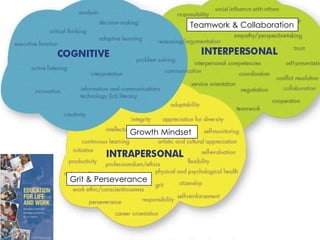
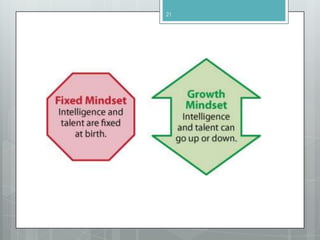
Growth Mindset
Teamwork & Collaboration
Grit & Perseverance
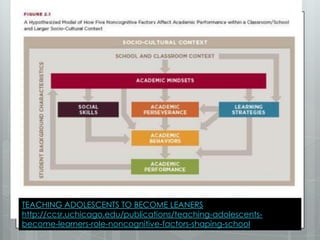
TEACHING ADOLESCENTS TO BECOME LEANERS
http://ccsr.uchicago.edu/publications/teaching-adolescents-
become-learners-role-noncognitive-factors-shaping-school
18
 Angela Duckworth Ted Talk
 http://www.ted.com/talks/angela_lee_du
ckworth_the_key_to_success_grit.html
20
21
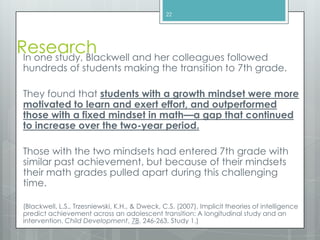
ResearchIn one study, Blackwell and her colleagues followed
hundreds of students making the transition to 7th grade.
They found that students with a growth mindset were more
motivated to learn and exert effort, and outperformed
those with a fixed mindset in math—a gap that continued
to increase over the two-year period.
Those with the two mindsets had entered 7th grade with
similar past achievement, but because of their mindsets
their math grades pulled apart during this challenging
time.
(Blackwell, L.S., Trzesniewski, K.H., & Dweck, C.S. (2007). Implicit theories of intelligence
predict achievement across an adolescent transition: A longitudinal study and an
intervention. Child Development, 78. 246-263, Study 1.)
22
23
24
25
26
27
28
Play, Experimentation, & Iteration
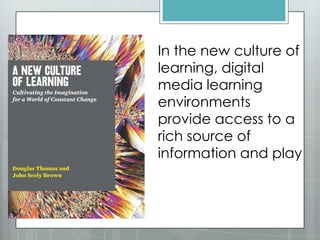
In the new culture of
learning, digital
media learning
environments
provide access to a
rich source of
information and play
http://video.pbs.org/video/1767466213/
John Seely Brown on the future of learning:
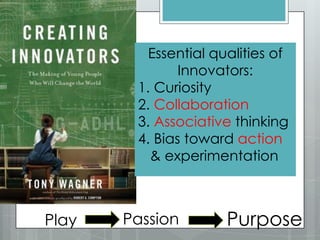
Essential qualities of
Innovators:
1. Curiosity
2. Collaboration
3. Associative thinking
4. Bias toward action
& experimentation
Play Passion Purpose
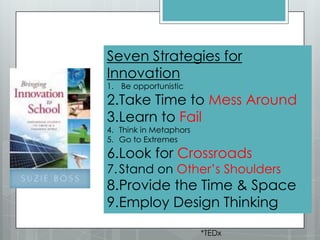
Seven Strategies for
Innovation
1. Be opportunistic
2.Take Time to Mess Around
3.Learn to Fail
4. Think in Metaphors
5. Go to Extremes
6.Look for Crossroads
7.Stand on Other’s Shoulders
8.Provide the Time & Space
9.Employ Design Thinking
*TEDx
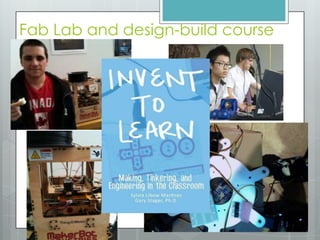
Fab Lab and design-build course
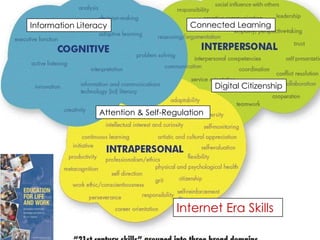
Information Literacy
Attention & Self-Regulation
Connected Learning
Digital Citizenship
Internet Era Skills
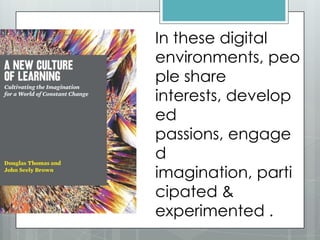
In these digital
environments, peo
ple share
interests, develop
ed
passions, engage
d
imagination, parti
cipated &
experimented .
Connectivism
 Connectivism was introduced as a theory of
learning based on the premise that
knowledge exists in the world rather than in
the head of an individual.
 Connectivism proposes a perspective similar
to the Activity theory of Vygotsky as it
regards knowledge to exist within systems
which are accessed through people
participating in activities.
 wikipedia
At its heart, connectivism is the
thesis that knowledge is distributed
across a network of connections,
and therefore that learning consists
of the ability to construct and
traverse those networks.
Stephen Downes
 xMooc vs. cMooc: What is the argument
about and what does the debate reveal?
 Steven Johnson video,
 Where Good Ideas Come From
 http://www.youtube.com/watch?v=NugR
ZGDbPFU
Twenty-first century readers and writers need to
 Develop proficiency with the tools of technology
 Build relationships with others to pose and solve problems
collaboratively and cross-culturally
 Design and share information for global communities to meet a
variety of purposes
 Manage, analyze and synthesize multiple streams of simultaneous
information
 Create, critique, analyze, and evaluate multi-media texts
 Attend to the ethical responsibilities required by these complex
environments
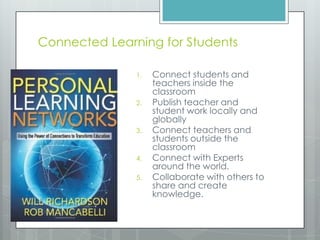
Connected Learning for Students
1. Connect students and
teachers inside the
classroom
2. Publish teacher and
student work locally and
globally
3. Connect teachers and
students outside the
classroom
4. Connect with Experts
around the world.
5. Collaborate with others to
share and create
knowledge.
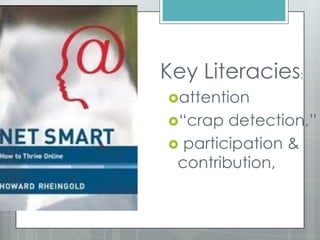
Key Literacies:
attention
“crap detection,”
 participation &
contribution,
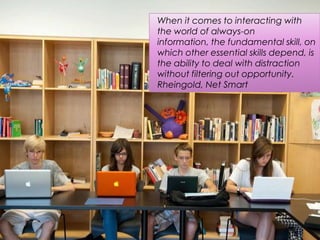
When it comes to interacting with
the world of always-on
information, the fundamental skill, on
which other essential skills depend, is
the ability to deal with distraction
without filtering out opportunity.
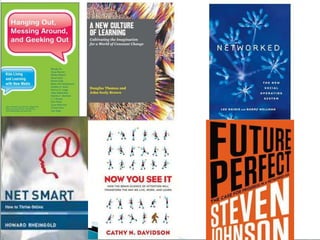
Rheingold, Net Smart
An antidote to our
epidemic distraction
lies in a set of
astonishing
discoveries: attention
can be understood,
strengthened, and
taught.
If focus skills can be
groomed, the
important next
question is whether,
and how, attention
should be integrated
into education.
 Instead of complaining about the
problem of distraction, we need to teach
the skills and habit of attention.
 Meditation, prayer, walk in the woods
 Sustained silent reading, (art or writing)
 Goal-setting, (SMART goals)
 Study Skills, prioritizing, calendaring
 Information Literacy
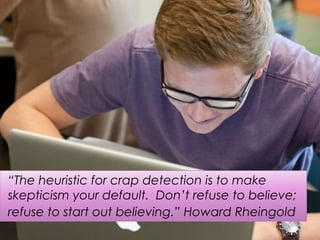
“The heuristic for crap detection is to make
skepticism your default. Don’t refuse to believe;
refuse to start out believing.” Howard Rheingold
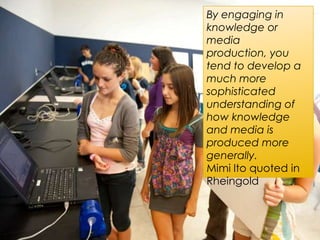
By engaging in
knowledge or
media
production, you
tend to develop a
much more
sophisticated
understanding of
how knowledge
and media is
produced more
generally.
Mimi Ito quoted in
Rheingold
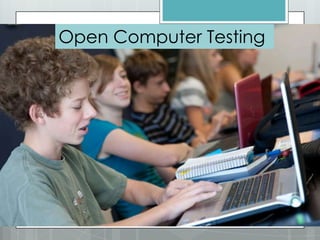
Open Computer Testing
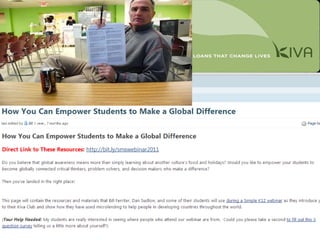
 Ferriter Kiva Project
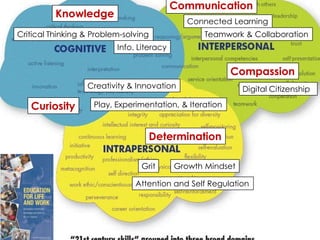
Critical Thinking & Problem-solving
Knowledge
Creativity & Innovation
Growth Mindset
Teamwork & Collaboration
Determination
Attention and Self Regulation
Compassion
Curiosity
Digital Citizenship
Communication
Play, Experimentation, & Iteration
Grit
Info. Literacy
Connected Learning

A 21st century learning landscape

  • 1.
    The 4 C’sThe Non-Cogs Internet Era Skills Play, experimentation, iteration "Please stop waiting for a map. We reward those who draw maps, not those who follow them.” Seth Godin, Poke the Box Touring the contemporary educational landscape Jonathan E. Martin 21k12blog.net @JonathanEMartin
  • 2.
  • 3.
    We need aniterative and collaborative approach to align learning with fast changing times. How can we help our students be Kindergartners, not MBA students?
  • 6.
    http://www.justsaypictures.com/im-looking-for-the-mo Now we willjust assume that media includes the possibilities of consuming, producing, a nd sharing side by side, and that those possibilities are open to everyone. How else would you do it? Clay Shirky, Cognitive Surplus
  • 9.
    Cognitive Processes &Strategies Knowledge Creativity & Innovation Intellectual Openness Teamwork & Collaboration Work Ethic Positive Self-Eval Leadership
  • 10.
  • 11.
    The 4 C’sThe Non-Cogs Internet Era Skills Play, experimentation, iteration
  • 13.
    Critical Thinking Creativity &Innovation Communication Collaboration
  • 14.
     When thegoal is to prepare students to be able to be successful in solving new problems and adapting to new situations, then deeper learning is called for.  Calls for such “21st century skills” as innovation, creativity, and creative problem-solving can also be seen as calls for deeper learning—  helping students develop transferable knowledge that can be applied to solve new problems or respond effectively to new situations. P. 71
  • 15.
    21st. C. assessments PISA,CWRA, Grit, Growth Mindset How do they assess “deeper learning?” What are the opportunities they suggest for enhancing the teaching and learning of the Cate Educational Principles? PISA test question answers: tinyurl.com/samplepisaanswers
  • 16.
    Growth Mindset Teamwork &Collaboration Grit & Perseverance
  • 17.
    TEACHING ADOLESCENTS TOBECOME LEANERS http://ccsr.uchicago.edu/publications/teaching-adolescents- become-learners-role-noncognitive-factors-shaping-school
  • 18.
  • 19.
     Angela DuckworthTed Talk  http://www.ted.com/talks/angela_lee_du ckworth_the_key_to_success_grit.html
  • 20.
  • 21.
  • 22.
    ResearchIn one study,Blackwell and her colleagues followed hundreds of students making the transition to 7th grade. They found that students with a growth mindset were more motivated to learn and exert effort, and outperformed those with a fixed mindset in math—a gap that continued to increase over the two-year period. Those with the two mindsets had entered 7th grade with similar past achievement, but because of their mindsets their math grades pulled apart during this challenging time. (Blackwell, L.S., Trzesniewski, K.H., & Dweck, C.S. (2007). Implicit theories of intelligence predict achievement across an adolescent transition: A longitudinal study and an intervention. Child Development, 78. 246-263, Study 1.) 22
  • 23.
  • 24.
  • 25.
  • 26.
  • 27.
  • 28.
  • 29.
  • 30.
    In the newculture of learning, digital media learning environments provide access to a rich source of information and play
  • 31.
  • 32.
    Essential qualities of Innovators: 1.Curiosity 2. Collaboration 3. Associative thinking 4. Bias toward action & experimentation Play Passion Purpose
  • 33.
    Seven Strategies for Innovation 1.Be opportunistic 2.Take Time to Mess Around 3.Learn to Fail 4. Think in Metaphors 5. Go to Extremes 6.Look for Crossroads 7.Stand on Other’s Shoulders 8.Provide the Time & Space 9.Employ Design Thinking *TEDx
  • 34.
    Fab Lab anddesign-build course
  • 35.
    Information Literacy Attention &Self-Regulation Connected Learning Digital Citizenship Internet Era Skills
  • 36.
    In these digital environments,peo ple share interests, develop ed passions, engage d imagination, parti cipated & experimented .
  • 37.
    Connectivism  Connectivism wasintroduced as a theory of learning based on the premise that knowledge exists in the world rather than in the head of an individual.  Connectivism proposes a perspective similar to the Activity theory of Vygotsky as it regards knowledge to exist within systems which are accessed through people participating in activities.  wikipedia
  • 38.
    At its heart,connectivism is the thesis that knowledge is distributed across a network of connections, and therefore that learning consists of the ability to construct and traverse those networks. Stephen Downes
  • 39.
     xMooc vs.cMooc: What is the argument about and what does the debate reveal?
  • 40.
     Steven Johnsonvideo,  Where Good Ideas Come From  http://www.youtube.com/watch?v=NugR ZGDbPFU
  • 42.
    Twenty-first century readersand writers need to  Develop proficiency with the tools of technology  Build relationships with others to pose and solve problems collaboratively and cross-culturally  Design and share information for global communities to meet a variety of purposes  Manage, analyze and synthesize multiple streams of simultaneous information  Create, critique, analyze, and evaluate multi-media texts  Attend to the ethical responsibilities required by these complex environments
  • 43.
    Connected Learning forStudents 1. Connect students and teachers inside the classroom 2. Publish teacher and student work locally and globally 3. Connect teachers and students outside the classroom 4. Connect with Experts around the world. 5. Collaborate with others to share and create knowledge.
  • 44.
  • 45.
    When it comesto interacting with the world of always-on information, the fundamental skill, on which other essential skills depend, is the ability to deal with distraction without filtering out opportunity. Rheingold, Net Smart
  • 46.
    An antidote toour epidemic distraction lies in a set of astonishing discoveries: attention can be understood, strengthened, and taught. If focus skills can be groomed, the important next question is whether, and how, attention should be integrated into education.
  • 47.
     Instead ofcomplaining about the problem of distraction, we need to teach the skills and habit of attention.  Meditation, prayer, walk in the woods  Sustained silent reading, (art or writing)  Goal-setting, (SMART goals)  Study Skills, prioritizing, calendaring
  • 48.
  • 49.
    “The heuristic forcrap detection is to make skepticism your default. Don’t refuse to believe; refuse to start out believing.” Howard Rheingold
  • 50.
    By engaging in knowledgeor media production, you tend to develop a much more sophisticated understanding of how knowledge and media is produced more generally. Mimi Ito quoted in Rheingold
  • 51.
  • 62.
  • 63.
    Critical Thinking &Problem-solving Knowledge Creativity & Innovation Growth Mindset Teamwork & Collaboration Determination Attention and Self Regulation Compassion Curiosity Digital Citizenship Communication Play, Experimentation, & Iteration Grit Info. Literacy Connected Learning

Editor's Notes

  • #5 My journey began in Summer 2008