Inspiring the next
generation of
leaders, thinkers
and problem-
solvers
derek@futuremakers.nz
@dwenmoth
www.futuremakers.nz
http://www.wenmoth.net
Future Focused Flexible
Education
FLANZ conference, Wellington, 14 April 2021
Walk into the future
with a secure knowledge of the past
Ka mua, Ka muri
Photo by Daoud Abismail on Unsplash
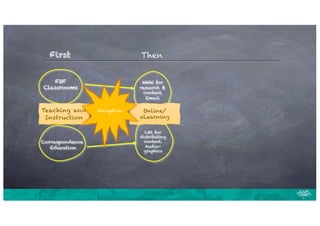
First
F2F
Classrooms
Correspondence
Education
Teaching and
Instruction
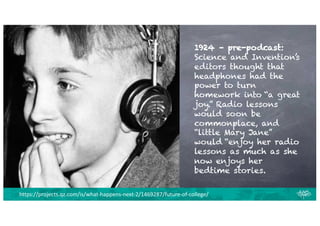
1924 – pre-podcast:
Science and Invention’s
editors thought that
headphones had the
power to turn
homework into “a great
joy.” Radio lessons
would soon be
commonplace, and
“little Mary Jane”
would “enjoy her radio
lessons as much as she
now enjoys her
bedtime stories.
https://projects.qz.com/is/what-happens-next-2/1469287/future-of-college/
First
F2F
Classrooms
Correspondence
Education
WWW for
research &
content,
Email
LMS for
distributing
content.
Audio-
graphics
Teaching and
Instruction
Online/
eLearning
Disruption
Then
http://www.virtuallearning.school.nz
First Then
F2F
Classrooms
Correspondence
Education
WWW for
research &
content,
email
LMS for
distributing
content,
Audio-
graphics
Virtual/
online
Schools
“Flipped
Classroom”
Teaching and
Instruction
Online/
eLearning
Blended
Learning
Disruption
Now
First Then Now
F2F
Classrooms
Correspondence
Education
WWW for
research
& content
LMS for
distributing
content
Virtual/
online
Schools
Knowledge
Building
Communities
“Boundary-less
Organisations”
“Flipped
Classroom”
Teaching and
Instruction
Online/
eLearning
Blended
Learning
Networked/
connected
learning
Disruption
Next
A boundary-less future
Knowledge
Building
Communities
“Boundary-less
Organisations”
Networked/
connected
learning
Ubiquity
Connectedness
Agency
Remote learner
Hybrid teacher
Remote teacher
Tertiary
Home
School, kura
Library
Social
Network
CC Wenmoth, 2020 A boundary-less education system.
CoP
Principle #1
Ubiquity
• Any time, any place, any pace, any device…
• Location not an issue anymore
• Drivers: cloud, wireless, mobile devices
• Principles of Open Learning
Images sourced from Pixabay
Open Learning
Open learning allows
pupils self-determined,
independent and
interest-guided learning.
Ormiston Tate
Correspondence School
Tom Prebble
Massey University
Shona Butterfield
Open Polytechnic
Students in physical
institutions, instruction &
assessment
predominantly on-site
Students access formal
learning online,
instruction and
assessment provided
remotely
Students learning
through their online
personal learning
network, incl. social
networking environments
Students at home, library
or other space, pursuing
own interests individually
or collaboratively
FORMAL
INFORMAL
PHYSICAL
VIRTUAL
e.g. Schools/kura,
classrooms, lecture halls,
playgrounds, outdoor ed
centres etc.
e.g. Virtual schools, online
classrooms, (e.g. Coursera.
Mathletics), virtual field
trips etc.
e.g. PLNs comprising
Facebook, Twitter, Khan
Academy, YouTube,
Reddit etc.
e.g. Community library,
sports organisations, after
school clubs/ music
lessons etc.
Location
Recognising
success
Flexible learning in practice!
• Having a sense of being a part of something that is bigger than
ones self.
• The capacity to benefit from connectivity for personal, social,
work or economic purposes.
• Connecting what we know to what we’re learning, what we
experience today to what we experienced yesterday
Principle #2
Connectedness
Connectedness
• Able to relate well to others
• Effective users of communications tools
• Connected to the land and environment
• Members of communities
• International citizens
Source: NZ Curriculum, 2007
Connectivism
Learning does not simply
happen within an
individual, but within and
across the networks.
Knowledge exists within
systems which are
accessed through people
participating in activities,
the belief that people
learn through contact.
Prof. George Siemens: FLANZ 2018
• Having choices and the ability to act
on them
• Informed, enabled, empowered
learners
• Shifting the ownership of learning
Principles #3
Agency
Student expectations
Washor, E and Mohkowski, C (2013) Leaving to learn
Do my teachers really know about
me and my interests and talents?
Do I find what the school is teaching
relevant to my interests?
Do I have opportunities to apply what
I am learning in real world settings
and contexts?
Do I feel appropriately
challenged in my learning?
Can I pursue my learning out of
the standard sequence?
Do I have sufficient time to
learn at my own pace?
Do I have real choice about
what, where and how I learn?
Do I have opportunities to
explore and make mistakes?
Do I have opportunities to engage
deeply in my learning and to practice
the skills I need to learn?
Experiences from lockdown…
Not-so positive experience for many...
• Lack of digital access, poor
connectivity and/or no device
• Loss of immediate (f2f) engagement
with peers
• Demands placed on many parents
• Family responsibilities – care of siblings
• Focus on content over connection
• Failure of schools and the system to
• address context of learners
• No space to study in peace
• Lack of parent support or feedback
• Variable teacher capability and capacity
• “Edutainment” vs. learning
Students speaking positively about...
• Flexibility of learning
• Freedom to manage themselves and
their time
• Increased use of online learning
platforms and digital tools
• Timetables (lack of)
• More free time to read, think, engage
in own activity
• No (or fewer) distractions
• Being able to learn what/when/where
they wanted to
• More relaxed, comfortable settings &
contexts
• More time to think and do the work
• More time with family
Product
orientation
Student need
orientation
Standardization
Customization
Reconciliation??
www.myinstitution.com
www.mylearning.com
Don Hanna (2002) – Evolution of Programme Design
Certainty
Conformity Compliance
Volatility Complexity
Uncertainty Ambiguity
Agency
Ubiquity Connectedness
Mobile learning
Augmented & virtual reality
Micro-credentials Artificial intelligence
Social/emotional learning Gamification
Adaptive learning
Video learning
Neural transfers
Big data
Chat bots
Poverty
Religious intolerance
Climate change Consumerism
Food/water supply
Nano-technology
Cultural assimilation
Economic collapse
Human rights Global health crisis
War
Extractive industries
Unemployment
Over population
Global emissions
A boundary-less future – are you ready?
• The ‘distance’ has disappeared!
• Where are you in this
ecosystem?
• Where does the organization
you work for fit?
• What are the current barriers
or constraints?
• Where can you start to make
this a reality?
Remote learner
Hybrid teacher
Remote teacher
Tertiary
Home
School, kura
Library
Social
Network
CC Wenmoth, 2020 A boundary-less education system.
CoP
Thank You
derek@futuremakers.nz
@dwenmoth
www.futuremakers.nz
http://www.wenmoth.net

Future Focused Flexible Education

  • 1.
    Inspiring the next generationof leaders, thinkers and problem- solvers derek@futuremakers.nz @dwenmoth www.futuremakers.nz http://www.wenmoth.net Future Focused Flexible Education FLANZ conference, Wellington, 14 April 2021
  • 2.
    Walk into thefuture with a secure knowledge of the past Ka mua, Ka muri Photo by Daoud Abismail on Unsplash
  • 3.
  • 4.
    1924 – pre-podcast: Scienceand Invention’s editors thought that headphones had the power to turn homework into “a great joy.” Radio lessons would soon be commonplace, and “little Mary Jane” would “enjoy her radio lessons as much as she now enjoys her bedtime stories. https://projects.qz.com/is/what-happens-next-2/1469287/future-of-college/
  • 5.
    First F2F Classrooms Correspondence Education WWW for research & content, Email LMSfor distributing content. Audio- graphics Teaching and Instruction Online/ eLearning Disruption Then
  • 7.
  • 9.
    First Then F2F Classrooms Correspondence Education WWW for research& content, email LMS for distributing content, Audio- graphics Virtual/ online Schools “Flipped Classroom” Teaching and Instruction Online/ eLearning Blended Learning Disruption Now
  • 11.
    First Then Now F2F Classrooms Correspondence Education WWWfor research & content LMS for distributing content Virtual/ online Schools Knowledge Building Communities “Boundary-less Organisations” “Flipped Classroom” Teaching and Instruction Online/ eLearning Blended Learning Networked/ connected learning Disruption Next
  • 12.
    A boundary-less future Knowledge Building Communities “Boundary-less Organisations” Networked/ connected learning Ubiquity Connectedness Agency Remotelearner Hybrid teacher Remote teacher Tertiary Home School, kura Library Social Network CC Wenmoth, 2020 A boundary-less education system. CoP
  • 13.
    Principle #1 Ubiquity • Anytime, any place, any pace, any device… • Location not an issue anymore • Drivers: cloud, wireless, mobile devices • Principles of Open Learning Images sourced from Pixabay
  • 14.
    Open Learning Open learningallows pupils self-determined, independent and interest-guided learning. Ormiston Tate Correspondence School Tom Prebble Massey University Shona Butterfield Open Polytechnic
  • 15.
    Students in physical institutions,instruction & assessment predominantly on-site Students access formal learning online, instruction and assessment provided remotely Students learning through their online personal learning network, incl. social networking environments Students at home, library or other space, pursuing own interests individually or collaboratively FORMAL INFORMAL PHYSICAL VIRTUAL e.g. Schools/kura, classrooms, lecture halls, playgrounds, outdoor ed centres etc. e.g. Virtual schools, online classrooms, (e.g. Coursera. Mathletics), virtual field trips etc. e.g. PLNs comprising Facebook, Twitter, Khan Academy, YouTube, Reddit etc. e.g. Community library, sports organisations, after school clubs/ music lessons etc. Location Recognising success Flexible learning in practice!
  • 16.
    • Having asense of being a part of something that is bigger than ones self. • The capacity to benefit from connectivity for personal, social, work or economic purposes. • Connecting what we know to what we’re learning, what we experience today to what we experienced yesterday Principle #2 Connectedness
  • 17.
    Connectedness • Able torelate well to others • Effective users of communications tools • Connected to the land and environment • Members of communities • International citizens Source: NZ Curriculum, 2007
  • 18.
    Connectivism Learning does notsimply happen within an individual, but within and across the networks. Knowledge exists within systems which are accessed through people participating in activities, the belief that people learn through contact. Prof. George Siemens: FLANZ 2018
  • 19.
    • Having choicesand the ability to act on them • Informed, enabled, empowered learners • Shifting the ownership of learning Principles #3 Agency
  • 20.
    Student expectations Washor, Eand Mohkowski, C (2013) Leaving to learn Do my teachers really know about me and my interests and talents? Do I find what the school is teaching relevant to my interests? Do I have opportunities to apply what I am learning in real world settings and contexts? Do I feel appropriately challenged in my learning? Can I pursue my learning out of the standard sequence? Do I have sufficient time to learn at my own pace? Do I have real choice about what, where and how I learn? Do I have opportunities to explore and make mistakes? Do I have opportunities to engage deeply in my learning and to practice the skills I need to learn?
  • 21.
    Experiences from lockdown… Not-sopositive experience for many... • Lack of digital access, poor connectivity and/or no device • Loss of immediate (f2f) engagement with peers • Demands placed on many parents • Family responsibilities – care of siblings • Focus on content over connection • Failure of schools and the system to • address context of learners • No space to study in peace • Lack of parent support or feedback • Variable teacher capability and capacity • “Edutainment” vs. learning Students speaking positively about... • Flexibility of learning • Freedom to manage themselves and their time • Increased use of online learning platforms and digital tools • Timetables (lack of) • More free time to read, think, engage in own activity • No (or fewer) distractions • Being able to learn what/when/where they wanted to • More relaxed, comfortable settings & contexts • More time to think and do the work • More time with family
  • 22.
  • 23.
    Certainty Conformity Compliance Volatility Complexity UncertaintyAmbiguity Agency Ubiquity Connectedness Mobile learning Augmented & virtual reality Micro-credentials Artificial intelligence Social/emotional learning Gamification Adaptive learning Video learning Neural transfers Big data Chat bots Poverty Religious intolerance Climate change Consumerism Food/water supply Nano-technology Cultural assimilation Economic collapse Human rights Global health crisis War Extractive industries Unemployment Over population Global emissions
  • 24.
    A boundary-less future– are you ready? • The ‘distance’ has disappeared! • Where are you in this ecosystem? • Where does the organization you work for fit? • What are the current barriers or constraints? • Where can you start to make this a reality? Remote learner Hybrid teacher Remote teacher Tertiary Home School, kura Library Social Network CC Wenmoth, 2020 A boundary-less education system. CoP
  • 25.