
Dr. Shivananda (Shivoo) R Koteshwar
Design Group Digital Implementation Site Leader and R&D Head
Synopsys India
LINKEDIN : https://in.linkedin.com/in/shivoo2life
FACEBOOK : shivoo.koteshwar
SLIDESHARE : www.slideshare.net/shivoo.koteshwar
IISc, Bengaluru
March 2019
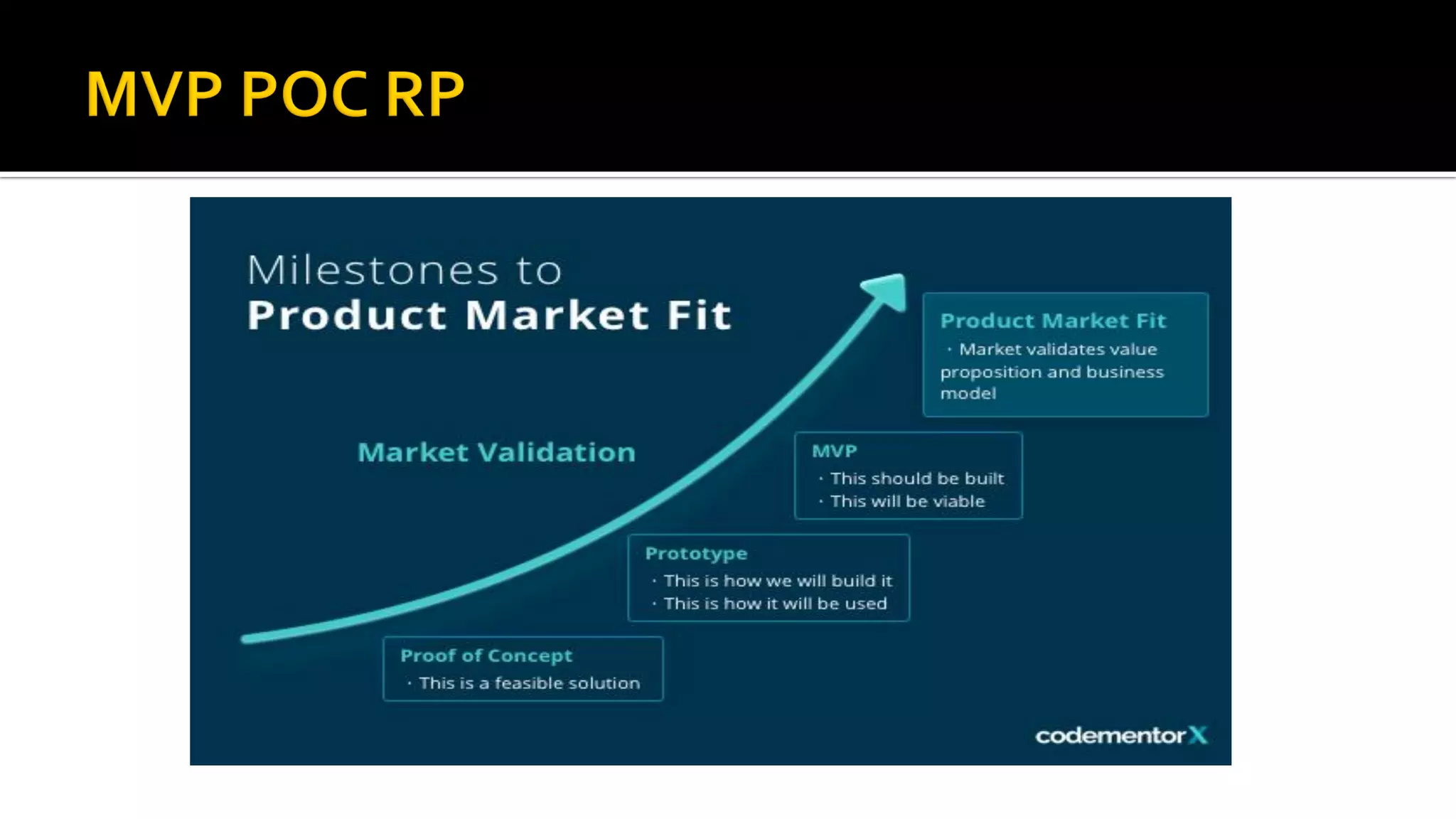
 MinimumViable Product
▪ An MVP is a version of a product that has just enough features to stay viable. In other words, it’s not packed with dozens of cool
features and only has the core functionality. Why would somebody build that, you ask?
▪ Because the main reason startups fail is that they end up launching a product no one needs.
▪ The purpose of building an MVP is to get the minimum version of the product to the market.This way you’ll get to know whether
it has any value at all. And if it does, you can start making money right away from your first customers, the early adopters. Now,
filled with confidence and sufficiently funded, you are ready to pack up your MVP with additional features.
 Proof of Concept (PoC)
▪ PoC is built to verify some minor technical assumptions before getting down to development. When you aren’t sure if your idea
can possibly work, you build a POC, not a minimum viable product
▪ A POC is like a small research that gives you green light to go further with the development of a product
▪ A proof-of-concept will cover a small part, not the entire system, and users will never get to see it because POCs are used inside
the company just to clarify which way to go with the development. But you can also consider building a POC to get the seed-
stage funding
 Prototyping
▪ While a POC offers you a model of just one product’s aspect, a prototype is a working model of several aspects of the product.
▪ The development team usually uses prototyping to discover errors in the system. By building a prototype, they test the product’s
design, usability and often functionality.
▪ With a proof-of-concept, you don’t get to do all of that because it’s smaller and can verify only a single issue.
 Rapid prototyping allows to better plan for executing on the
little details.
 You are working with a limited budget and materials to build
what you must convince your client (or the judges) will one
day be a real, functioning product
 Rapid prototyping allows for an IoT company to take into
consideration client needs, inputs, and wishes and quickly
demonstrate through mockups and wireframes what their
solution would look like
1. Rapid prototyping gives us space to tweak
• RP require a clear vision of the work, as well as space to tweak. This can be finally tested to finally land on a solution that
ultimately works
2. RP enables us to get customer feedback
▪ Almost 60% of IoT projects stall at the PoC stage. PoCs are an important step before a pilot but are tricky in and of themselves
to navigate. To clear blindspots, its important to RP our solution before moving forward
▪ This allows us to share mockups of our solution with the customer, capture their feedback, and make the necessary adjustments
before investing any more resources (Time and Money)
▪ It also gives a potential customer the opportunity to visualize and better understand the solution and opt out if it’s not a fit
3. It’s low risk, high reward
▪ RP doesn’t require expensive hardware, time on site, or extensive buy-in from corporate higher-ups. You’re simply creating a
visual draft of the work that could be done for the solution your client needs
▪ RP allows a provider to better plan for and execute on those often mission-critical details. The process allows both the provider
and the client to assess the relationship and the proposed solution before getting too deeply involved to turn around, protecting
both parties from spending too much time or effort in the event things don’t work out. But it also can lead to a highly successful
deployment that benefits from extensive forethought and upfront agreement on requirements from all involved.
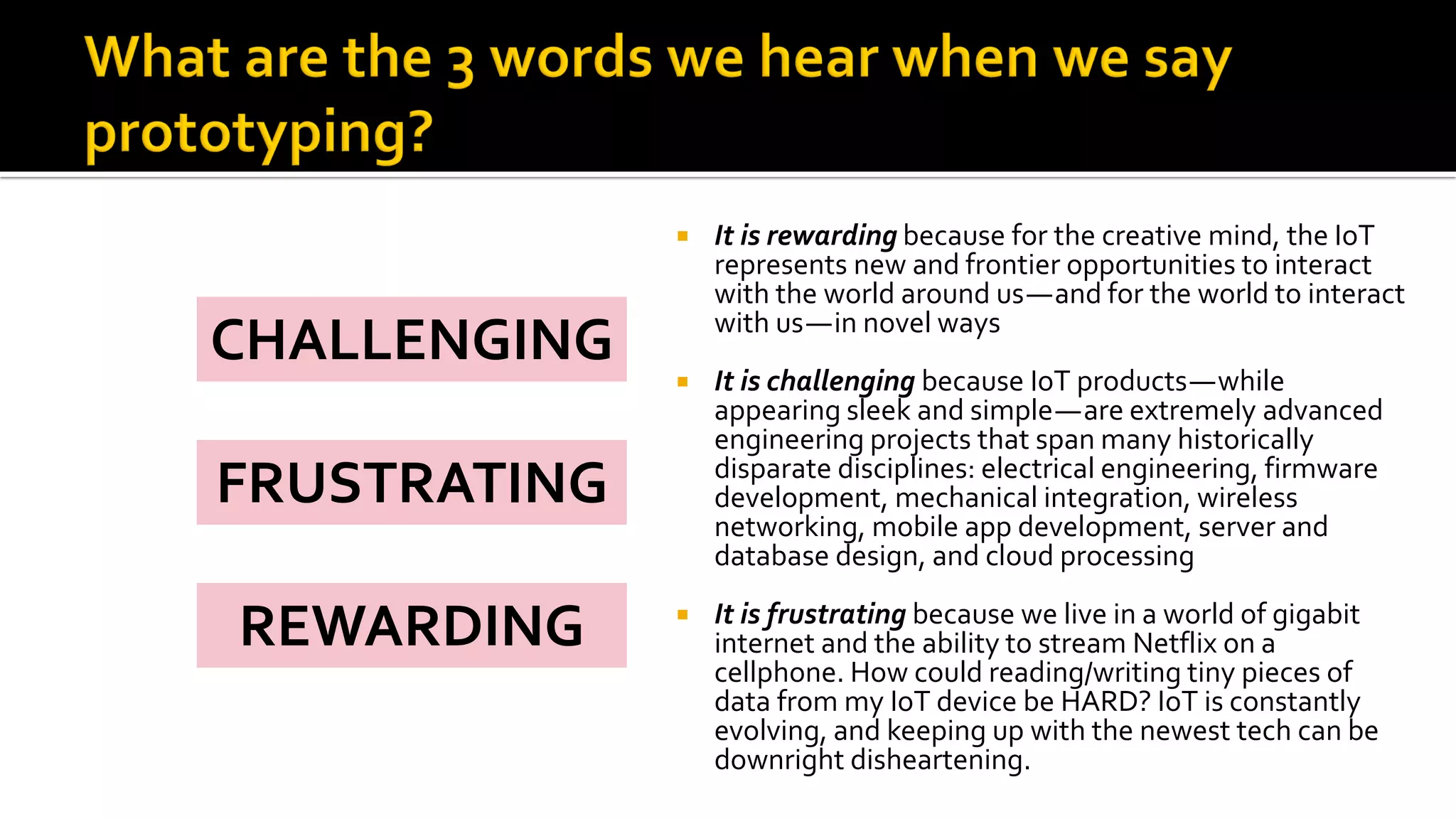
 It is rewarding because for the creative mind, the IoT
represents new and frontier opportunities to interact
with the world around us—and for the world to interact
with us—in novel ways
 It is challenging because IoT products—while
appearing sleek and simple—are extremely advanced
engineering projects that span many historically
disparate disciplines: electrical engineering, firmware
development, mechanical integration, wireless
networking, mobile app development, server and
database design, and cloud processing
 It is frustrating because we live in a world of gigabit
internet and the ability to stream Netflix on a
cellphone. How could reading/writing tiny pieces of
data from my IoT device be HARD? IoT is constantly
evolving, and keeping up with the newest tech can be
downright disheartening.
CHALLENGING
FRUSTRATING
REWARDING
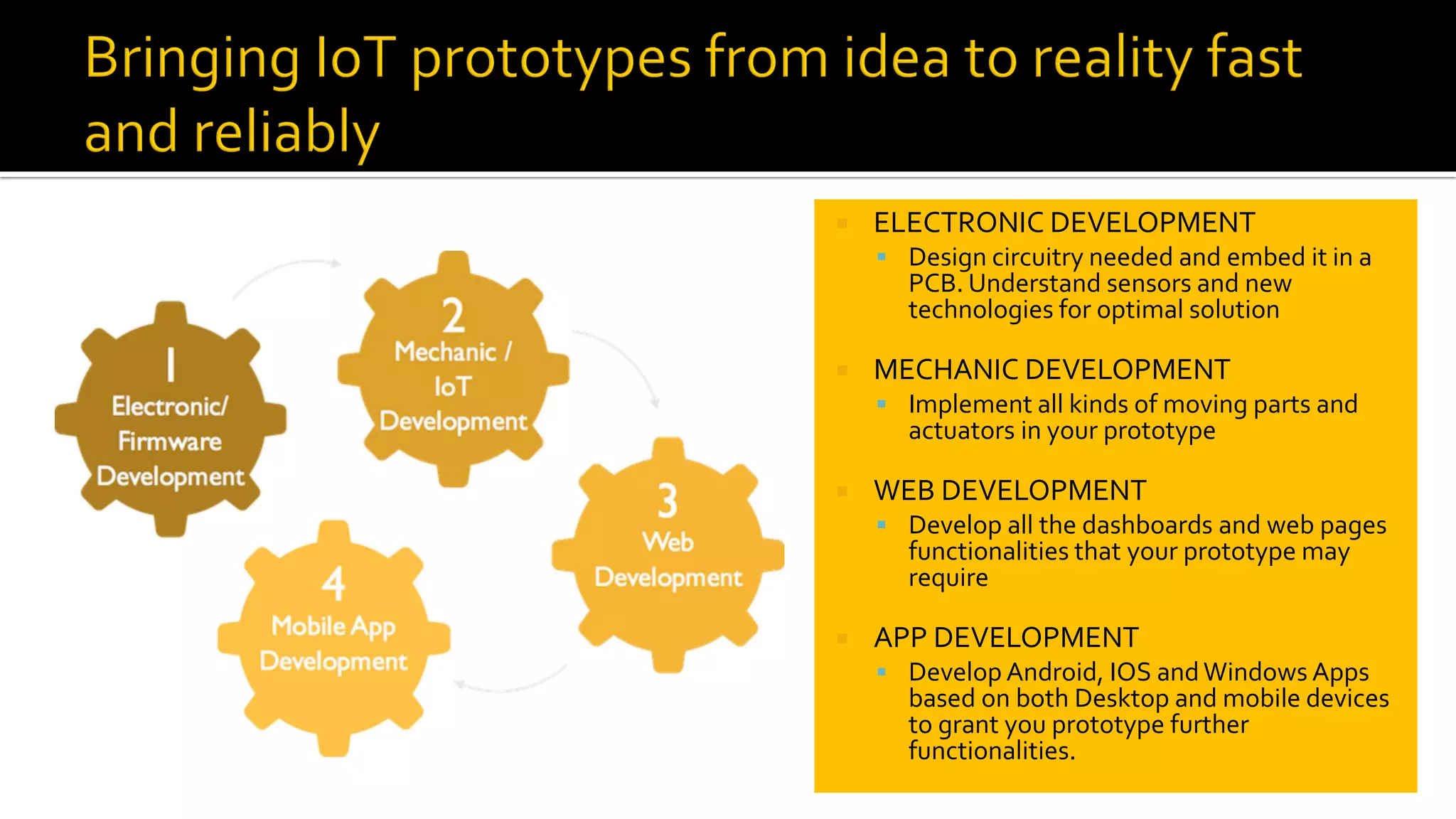
 ELECTRONIC DEVELOPMENT
▪ Design circuitry needed and embed it in a
PCB. Understand sensors and new
technologies for optimal solution
 MECHANIC DEVELOPMENT
▪ Implement all kinds of moving parts and
actuators in your prototype
 WEB DEVELOPMENT
▪ Develop all the dashboards and web pages
functionalities that your prototype may
require
 APP DEVELOPMENT
▪ Develop Android, IOS andWindows Apps
based on both Desktop and mobile devices
to grant you prototype further
functionalities.
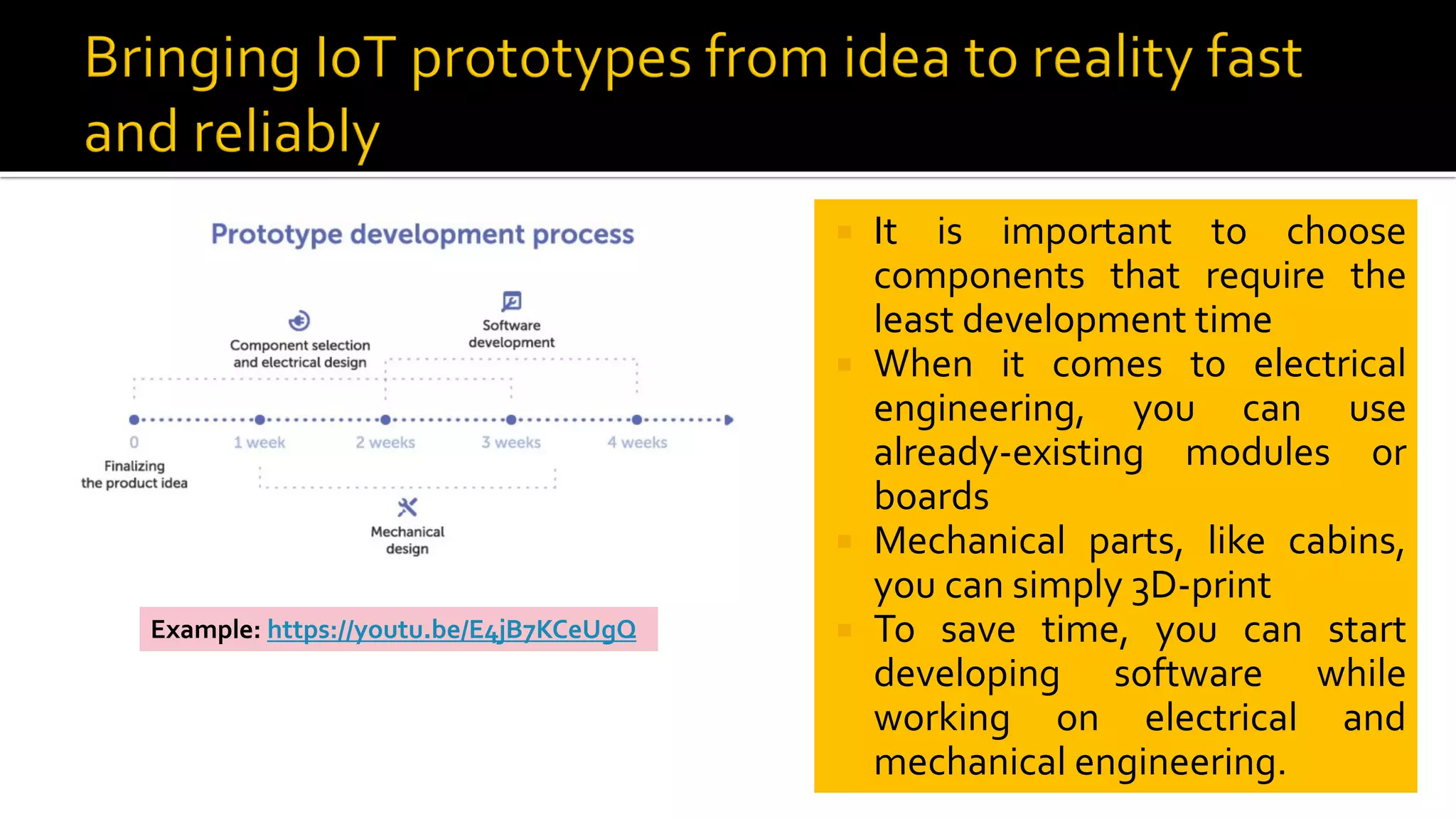
 It is important to choose
components that require the
least development time
 When it comes to electrical
engineering, you can use
already-existing modules or
boards
 Mechanical parts, like cabins,
you can simply 3D-print
 To save time, you can start
developing software while
working on electrical and
mechanical engineering.
Example: https://youtu.be/E4jB7KCeUgQ
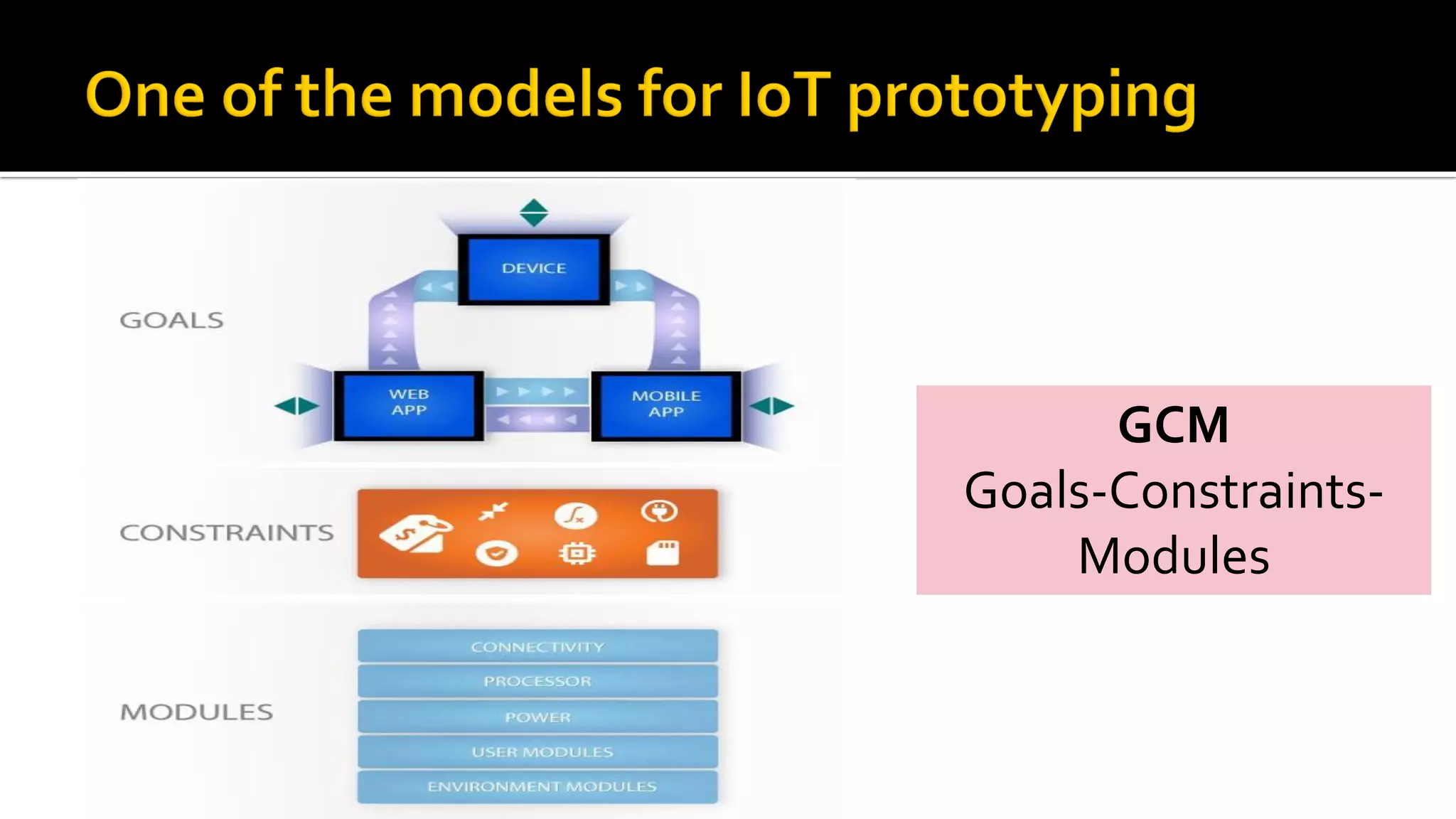
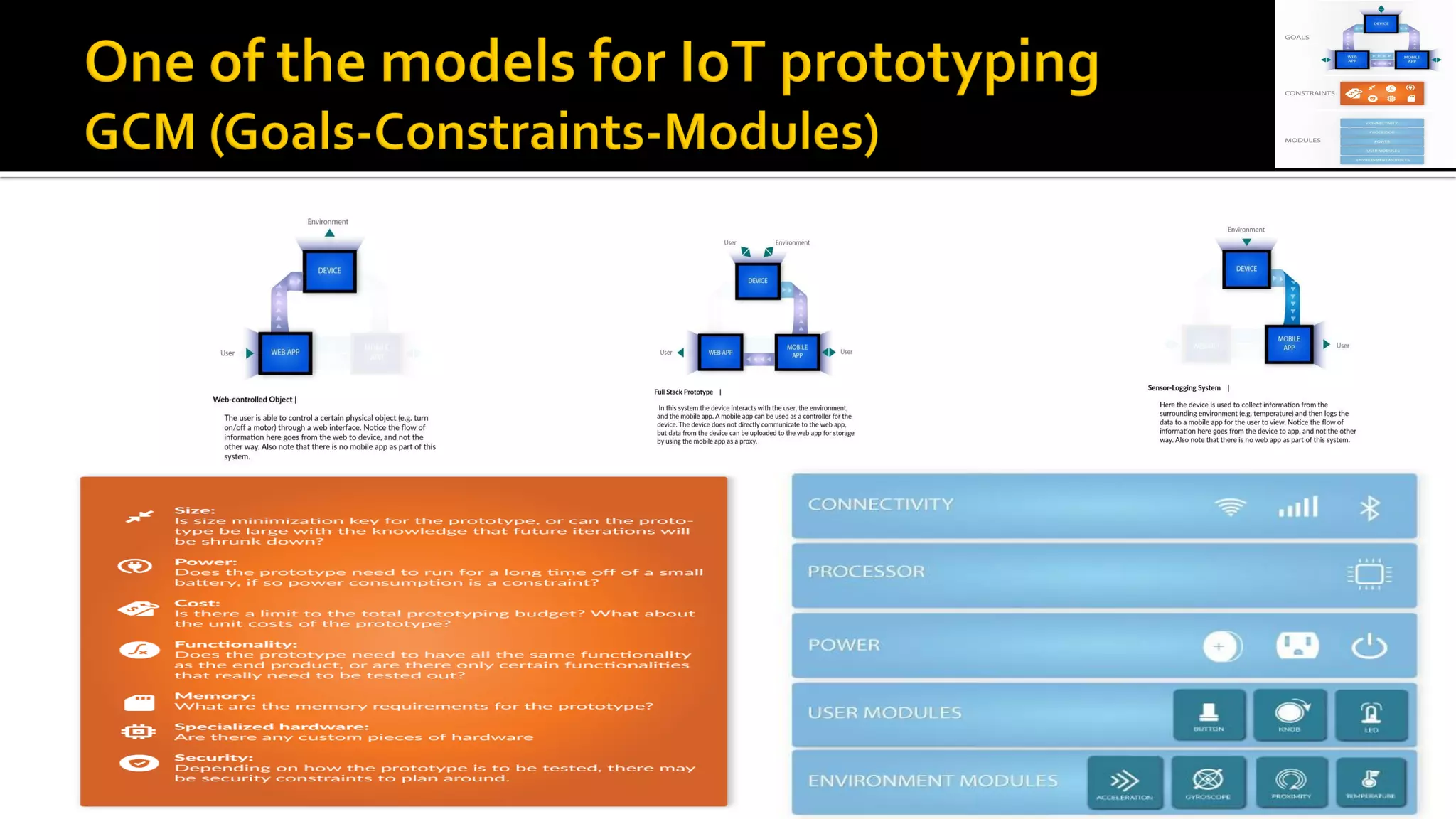
GCM
Goals-Constraints-
Modules
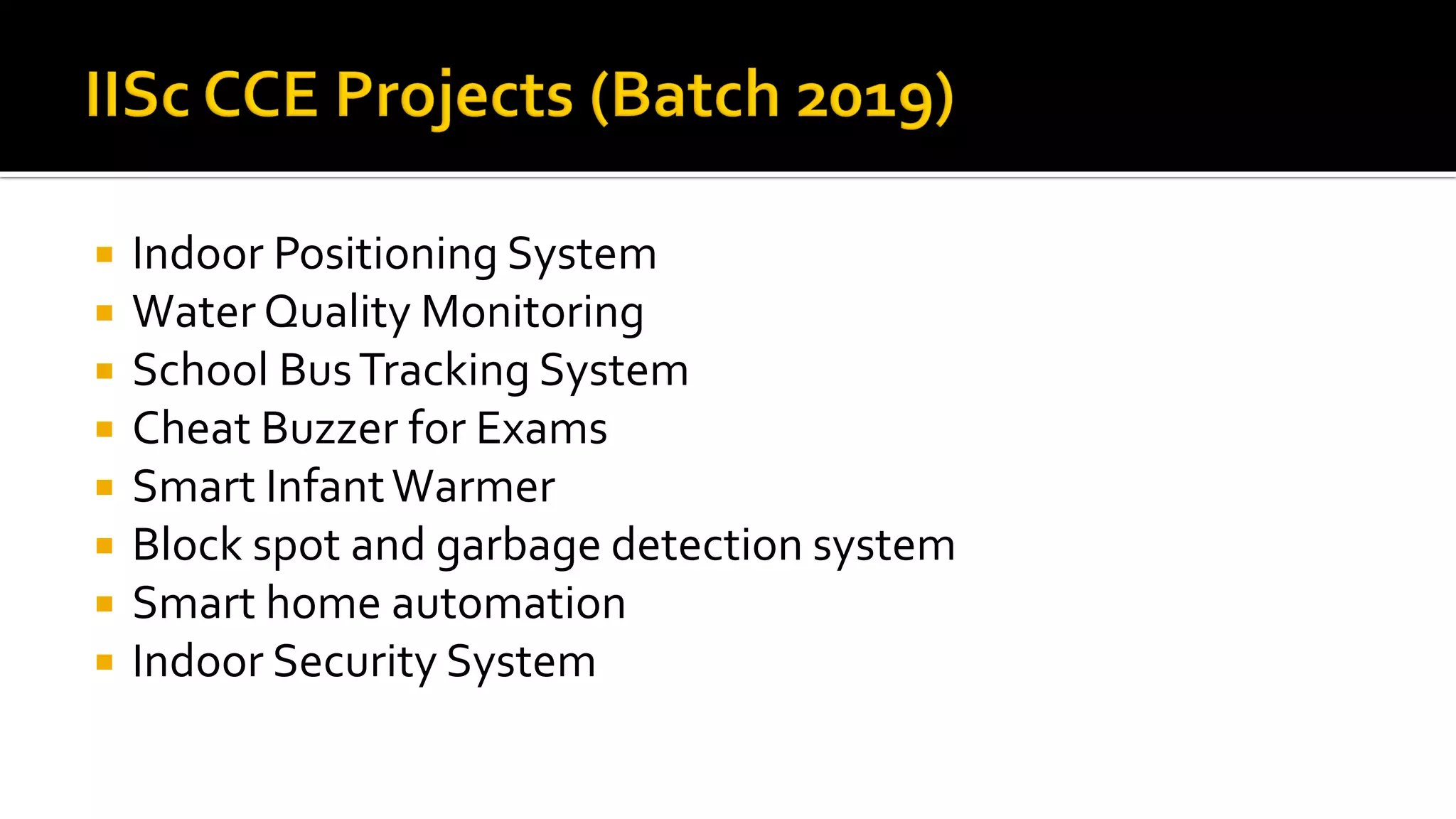
 Indoor Positioning System
 Water Quality Monitoring
 School BusTracking System
 Cheat Buzzer for Exams
 Smart InfantWarmer
 Block spot and garbage detection system
 Smart home automation
 Indoor Security System
1. What problem of the end user are you trying to solve? (4marks)
2. What is the existing solution for the problem you are trying to solve (4marks)
3. What solution do you propose?What are the top three value proposition of the product/Service you are
building? (5marks)
4. Why is IoT required in the solution?(4marks)
5. Which customer segment you are addressing first and second, and why? (Hint: Is it a bleeding problem or
nice to have for the target segment) (4 marks)
6. What government policies would favor the product to flourish in the market? How is technology landscape
favoring your solution? (Hint: Demonetization lead to digital payment flourish, Broadband penetration
lead to the success ofYoutube and other video sharing networks) (5marks)
7. If you were to get Rs. 10Lakh seed fund to build your product and business, how would you utilize the
money? (Please draw a pie chart to answer the question) (5 marks)
8. How would you share responsibilities with your team members in building the solution?What is your role in
building the solution? (Please mention both technical and non-technical roles) (4 marks)
9. What are the potential risks of your solution to not able to deliver the proposed value? (Why could it fail?Any
assumptions that may become invalid?)(5 marks)
10. How many end user interviews have you done so far? How many of them have agreed to buy the solution
once you are ready to sell?And at what price do you think you will plan to sell at? (Please share the pricing
model if the end user is not the financial buyer of the solution) 10 marks
1. What problem of the end user are you trying to solve? (4marks)
2. What is the existing solution for the problem you are trying to solve (4marks)
3. What solution do you propose?What are the top three value proposition of the product/Service you are
building? (5marks)
4. Why is IoT required in the solution?(4marks)
5. Which customer segment you are addressing first and second, and why? (Hint: Is it a bleeding problem or
nice to have for the target segment) (4 marks)
6. What government policies would favor the product to flourish in the market? How is technology landscape
favoring your solution? (Hint: Demonetization lead to digital payment flourish, Broadband penetration
lead to the success ofYoutube and other video sharing networks) (5marks)
7. If you were to get Rs. 10Lakh seed fund to build your product and business, how would you utilize the
money? (Please draw a pie chart to answer the question) (5 marks)
8. How would you share responsibilities with your team members in building the solution?What is your role in
building the solution? (Please mention both technical and non-technical roles) (4 marks)
9. What are the potential risks of your solution to not able to deliver the proposed value? (Why could it fail?Any
assumptions that may become invalid?)(5 marks)
10. How many end user interviews have you done so far? How many of them have agreed to buy the solution
once you are ready to sell?And at what price do you think you will plan to sell at? (Please share the pricing
model if the end user is not the financial buyer of the solution) 10 marksPain killer or a vitamin tablet. Does your solution
has a buyer?
Do you have a “able” buyer?
Pricing strategy
Risk Strategy – Risk Avoidance, Risk Mitigation, Contigency
Money management
Environmental factors?
If chemistry is not right, arithmetic wont work
Is the solution required for the problem?
Is enough research done? Who else ? How am I better?
What is the problem you are solving?
Why should I buy?
Am I overkilling it with advanced technologies?
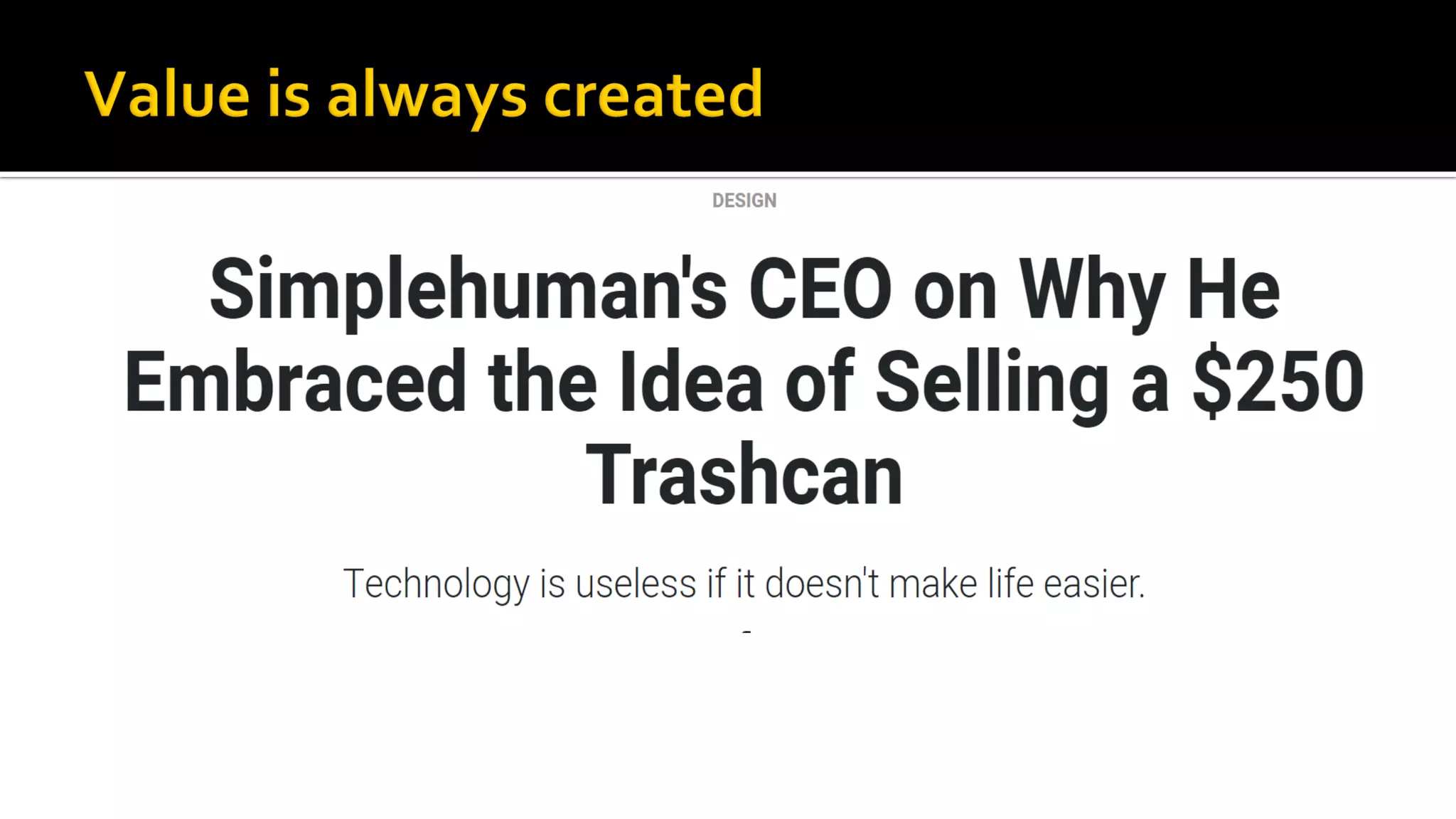
Value is created in market and not in xls sheet
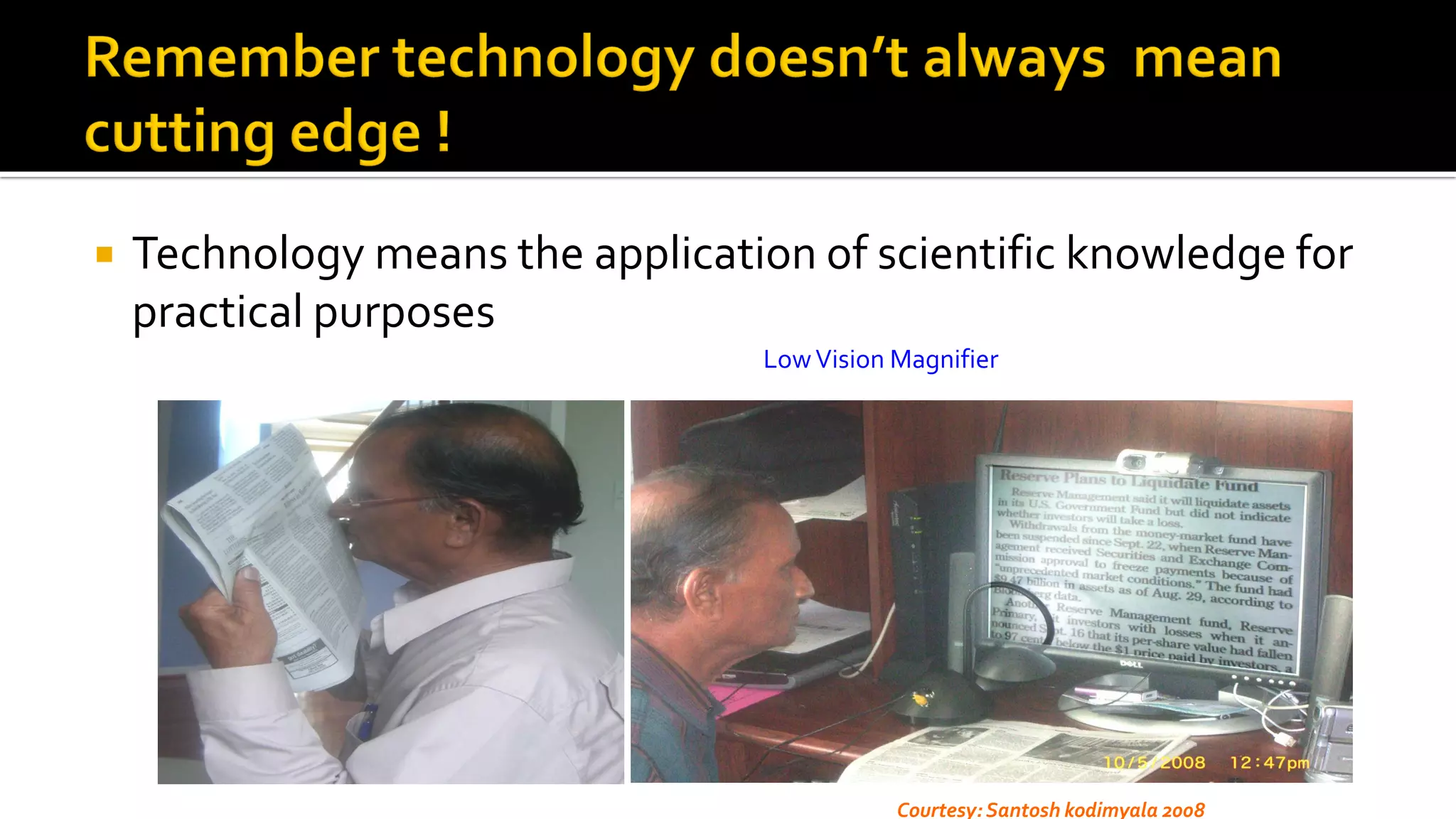
 Technology means the application of scientific knowledge for
practical purposes
LowVision Magnifier
Courtesy: Santosh kodimyala 2008
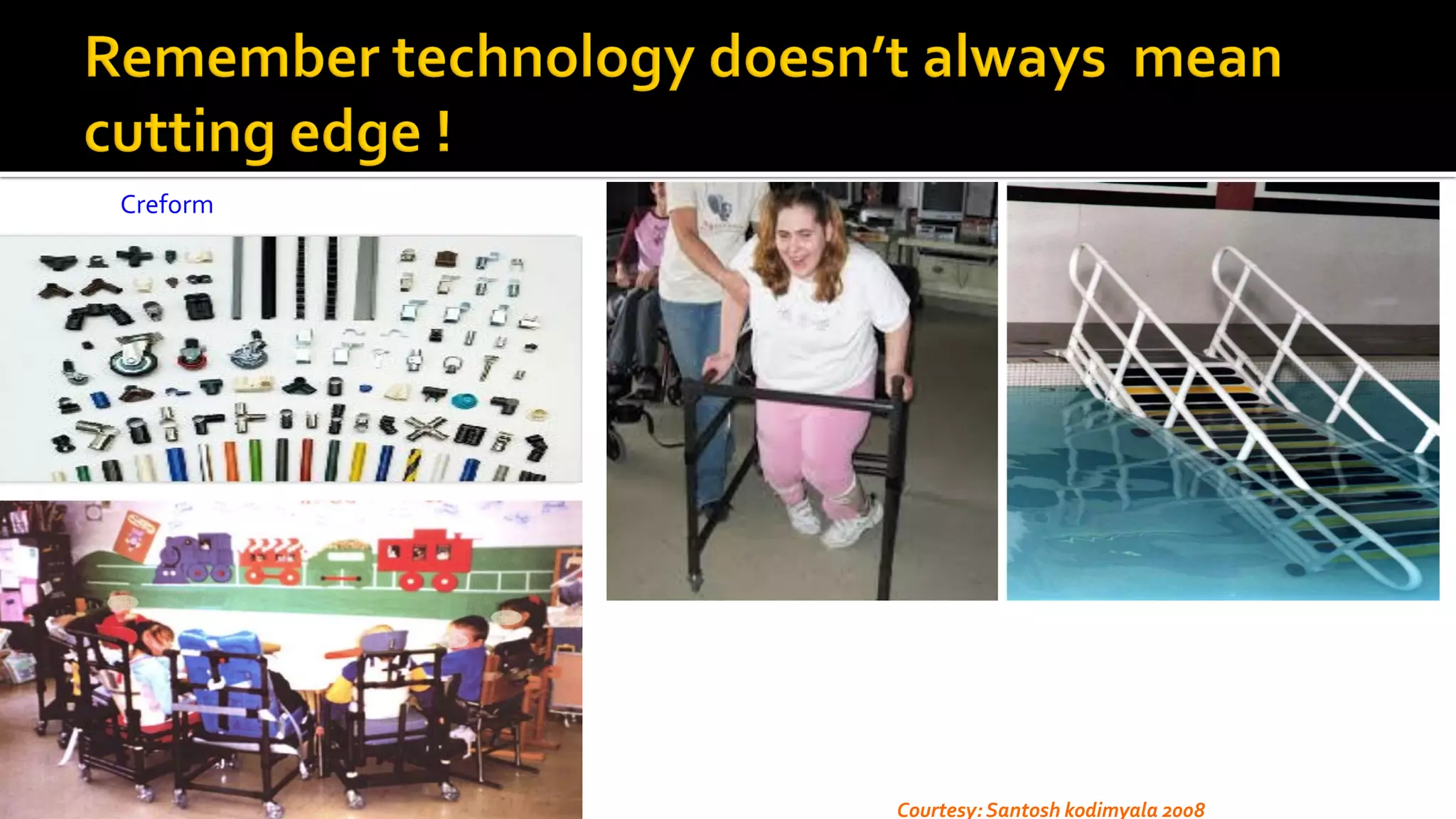
Creform
Courtesy: Santosh kodimyala 2008
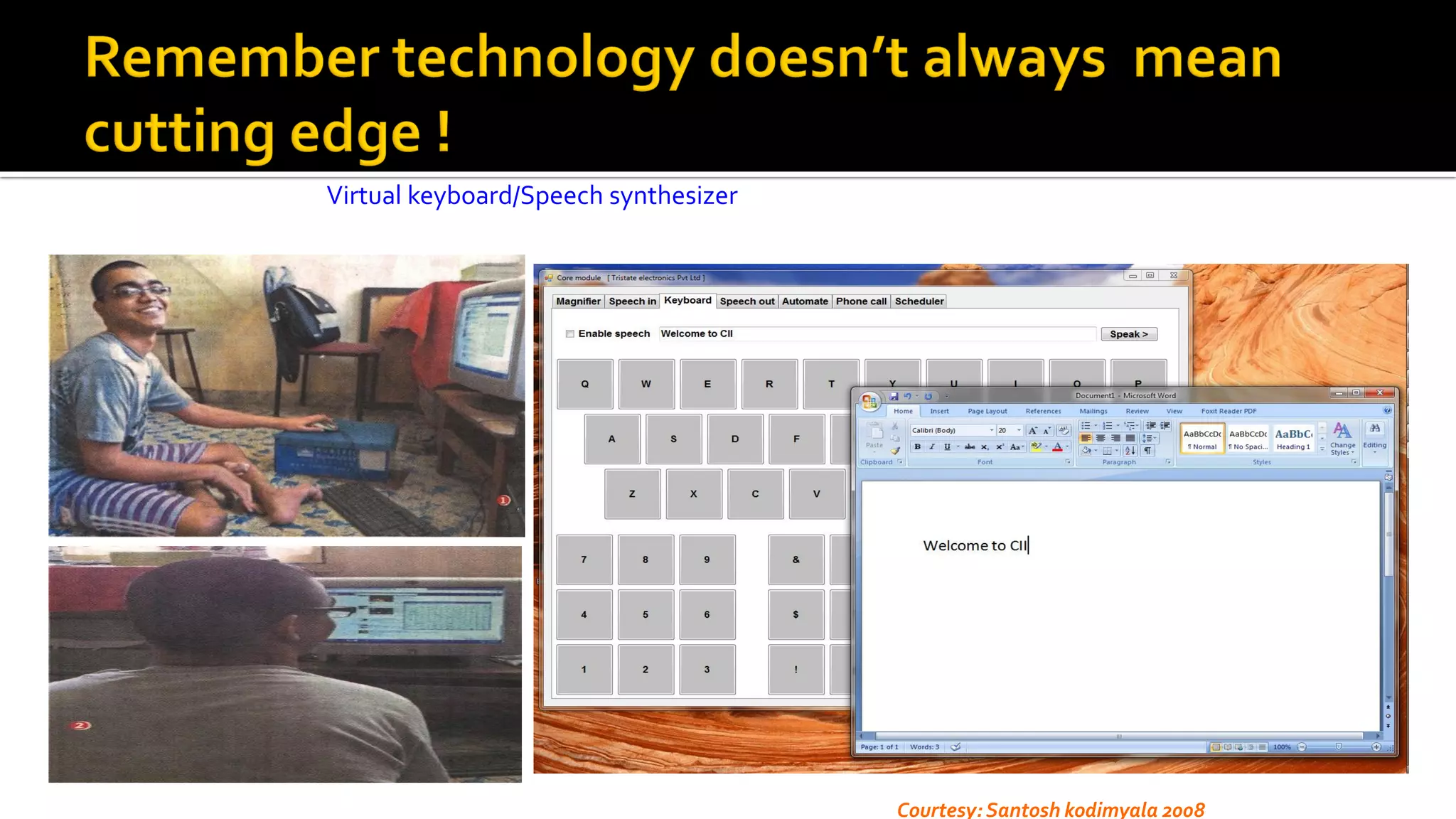
Virtual keyboard/Speech synthesizer
Courtesy: Santosh kodimyala 2008
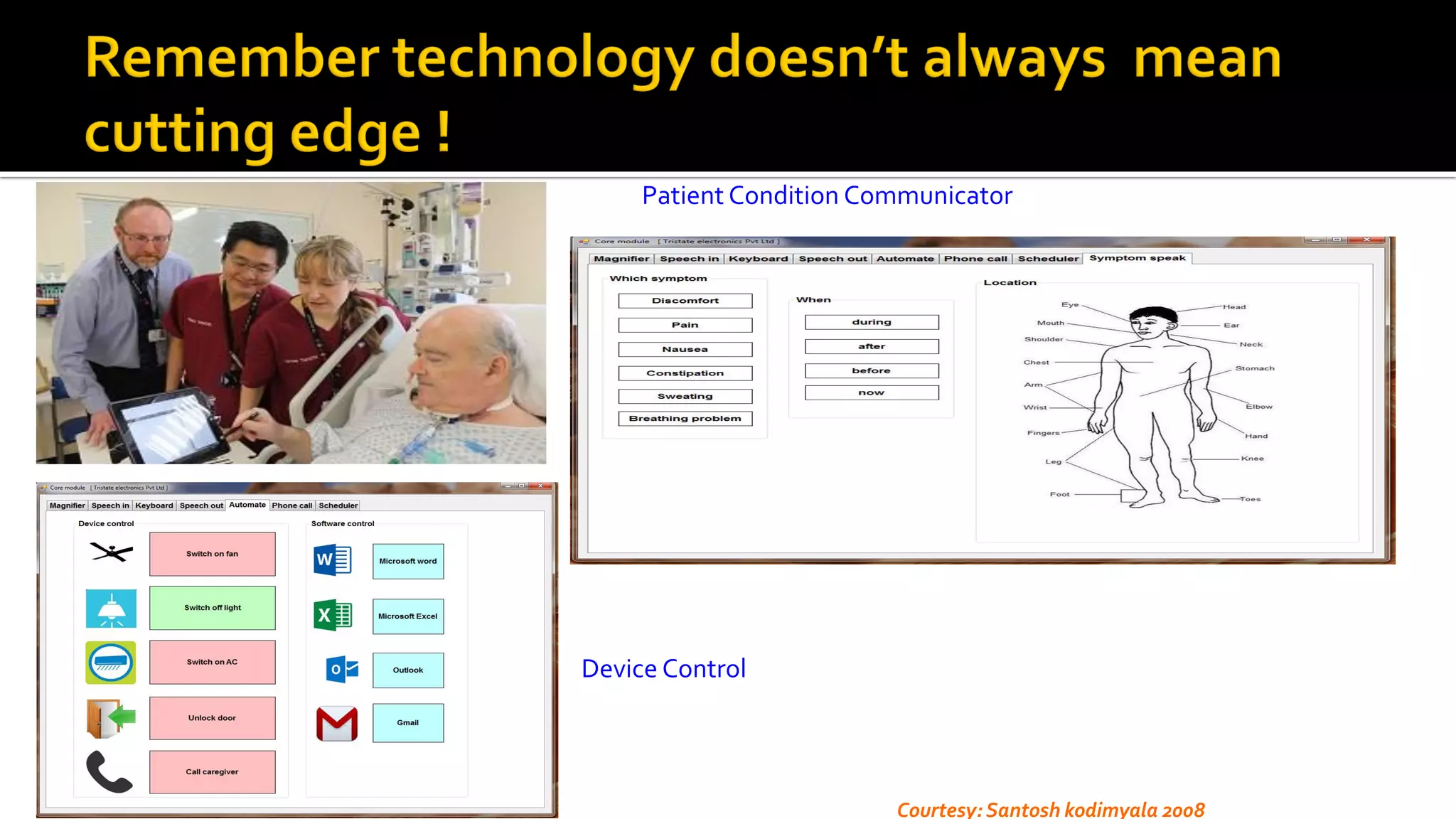
Patient Condition Communicator
Device Control
Courtesy: Santosh kodimyala 2008
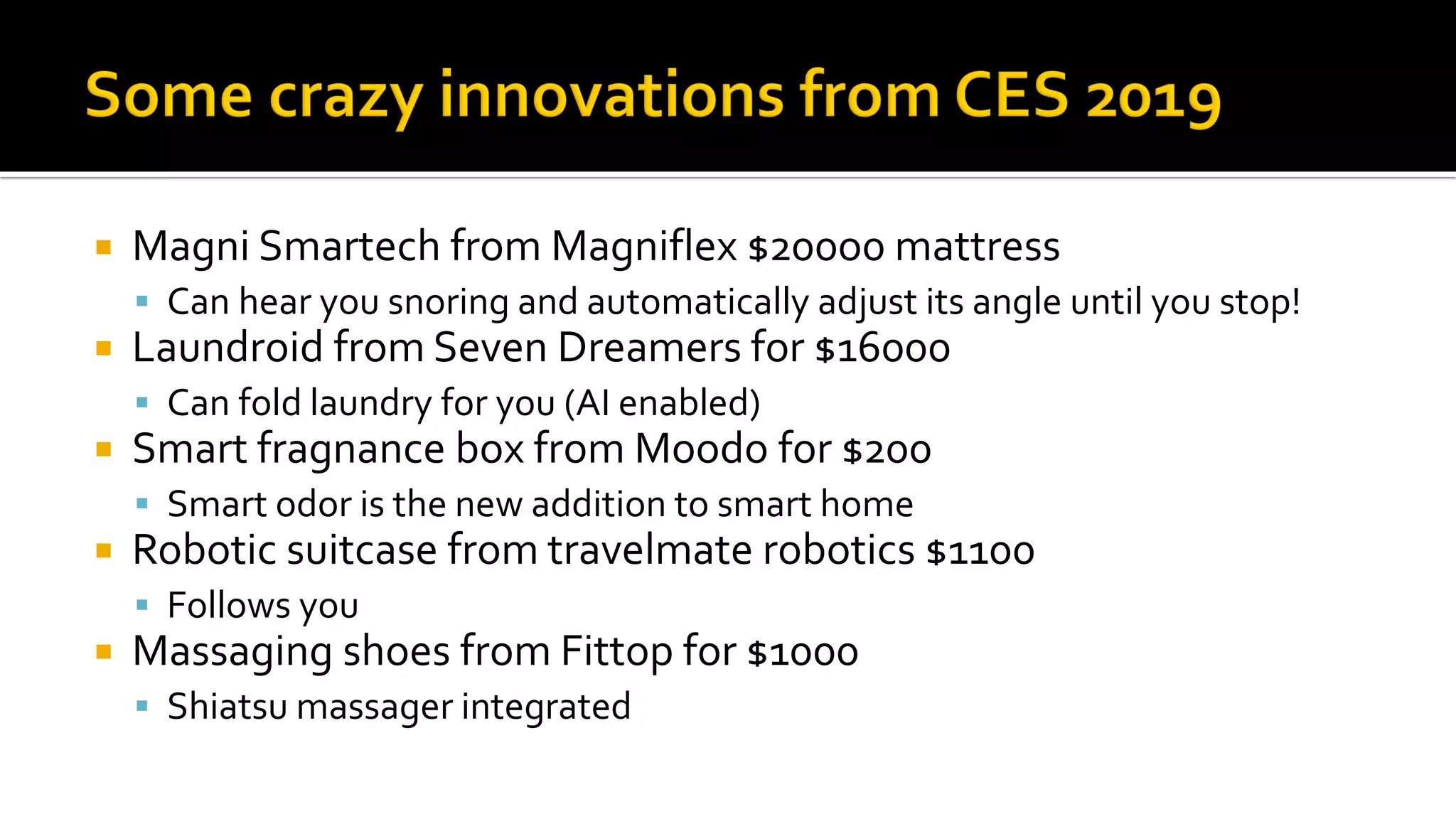
 Magni Smartech from Magniflex $200o0 mattress
▪ Can hear you snoring and automatically adjust its angle until you stop!
 Laundroid from Seven Dreamers for $16000
▪ Can fold laundry for you (AI enabled)
 Smart fragnance box from Moodo for $200
▪ Smart odor is the new addition to smart home
 Robotic suitcase from travelmate robotics $1100
▪ Follows you
 Massaging shoes from Fittop for $1000
▪ Shiatsu massager integrated
1. Have a very high bar for your products. Ask, "Is this a product I
would use myself and be proud to give to my very best friends
and family?"
1. Your product is only as strong as the engineering you put into
it. It's critical to source quality materials from trusted partners-
-never settle for "good enough."
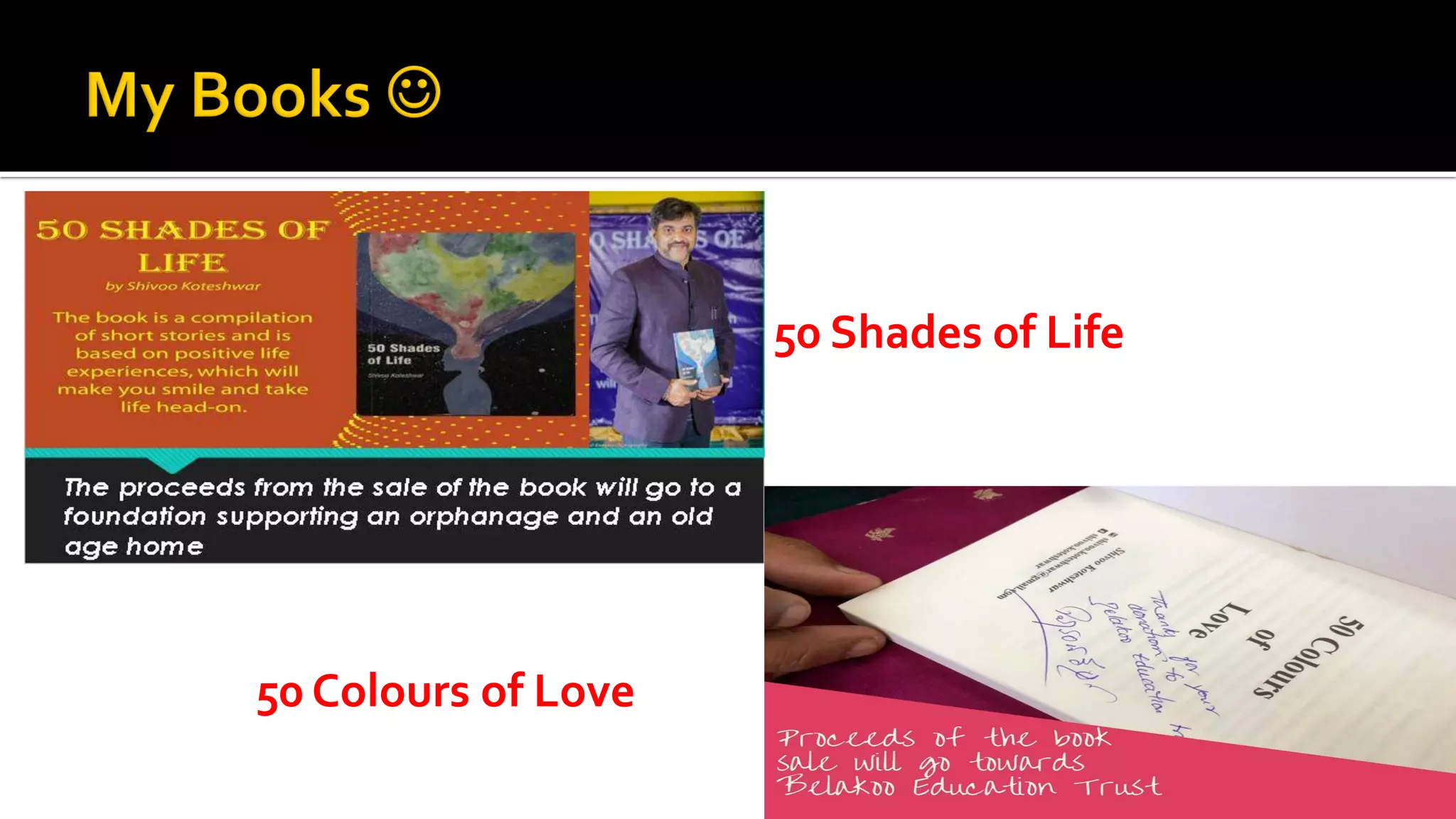
50 Shades of Life
50 Colours of Love
 Belakoo Education Trust offers free quality education for
underprivileged children. We run STEAM programs for
Government School kids substituting their learnings at school.
 We participate in Skill Development Program for students under
various running central/stage level schemes
https://www.facebook.com/belakootrust/
All pictures are from flickr.com with either
copyright or with common creatives
 https://medium.com/iotforall/how-to-be-strategic-about-building-your-iot-
prototype-c8171936ec53
 https://www.codementor.io/blog/MVP-product-market-fit-2lvrzn68b2
 https://skelia.com/articles/mvp-vs-poc-vs-prototype-company-really-need/
 https://hackernoon.com/how-you-can-develop-an-iot-prototype-in-one-
month-8ed93f6c27ba
 https://clearbridgemobile.com/beginners-guide-poc-vs-mvp-vs-prototype/
 https://www.youtube.com/watch?v=ZnfZYRrysDE
 https://www.inc.com/nancy-a-shenker/simplehumans-ceo-on-why-he-
embraced-idea-of-selling-a-250-trash-can.html
 https://www.iotforall.com/rapid-prototype-iot-solution/
 https://www.youtube.com/results?search_query=5+of+the+craziest+new+gadg
ets
 https://www.youtube.com/watch?v=qlfAL3AQbKQ
 https://www.youtube.com/watch?v=M1sTVv6Z3yQ
Visit my slideshare to view all
these presentations
Dr. Shivananda (Shivoo) R Koteshwar
Group Director, Synopsys
LINKEDIN: https://in.linkedin.com/in/shivoo2life
shivoo.koteshwar@gmail.com/ Facebook: shivoo.koteshwar
SLIDESHARE: www.slideshare.net/shivoo.koteshwar

IoT Product Design and Prototyping

  • 1.
    Dr. Shivananda (Shivoo)R Koteshwar Design Group Digital Implementation Site Leader and R&D Head Synopsys India LINKEDIN : https://in.linkedin.com/in/shivoo2life FACEBOOK : shivoo.koteshwar SLIDESHARE : www.slideshare.net/shivoo.koteshwar IISc, Bengaluru March 2019
  • 3.
     MinimumViable Product ▪An MVP is a version of a product that has just enough features to stay viable. In other words, it’s not packed with dozens of cool features and only has the core functionality. Why would somebody build that, you ask? ▪ Because the main reason startups fail is that they end up launching a product no one needs. ▪ The purpose of building an MVP is to get the minimum version of the product to the market.This way you’ll get to know whether it has any value at all. And if it does, you can start making money right away from your first customers, the early adopters. Now, filled with confidence and sufficiently funded, you are ready to pack up your MVP with additional features.  Proof of Concept (PoC) ▪ PoC is built to verify some minor technical assumptions before getting down to development. When you aren’t sure if your idea can possibly work, you build a POC, not a minimum viable product ▪ A POC is like a small research that gives you green light to go further with the development of a product ▪ A proof-of-concept will cover a small part, not the entire system, and users will never get to see it because POCs are used inside the company just to clarify which way to go with the development. But you can also consider building a POC to get the seed- stage funding  Prototyping ▪ While a POC offers you a model of just one product’s aspect, a prototype is a working model of several aspects of the product. ▪ The development team usually uses prototyping to discover errors in the system. By building a prototype, they test the product’s design, usability and often functionality. ▪ With a proof-of-concept, you don’t get to do all of that because it’s smaller and can verify only a single issue.
  • 5.
     Rapid prototypingallows to better plan for executing on the little details.  You are working with a limited budget and materials to build what you must convince your client (or the judges) will one day be a real, functioning product  Rapid prototyping allows for an IoT company to take into consideration client needs, inputs, and wishes and quickly demonstrate through mockups and wireframes what their solution would look like
  • 6.
    1. Rapid prototypinggives us space to tweak • RP require a clear vision of the work, as well as space to tweak. This can be finally tested to finally land on a solution that ultimately works 2. RP enables us to get customer feedback ▪ Almost 60% of IoT projects stall at the PoC stage. PoCs are an important step before a pilot but are tricky in and of themselves to navigate. To clear blindspots, its important to RP our solution before moving forward ▪ This allows us to share mockups of our solution with the customer, capture their feedback, and make the necessary adjustments before investing any more resources (Time and Money) ▪ It also gives a potential customer the opportunity to visualize and better understand the solution and opt out if it’s not a fit 3. It’s low risk, high reward ▪ RP doesn’t require expensive hardware, time on site, or extensive buy-in from corporate higher-ups. You’re simply creating a visual draft of the work that could be done for the solution your client needs ▪ RP allows a provider to better plan for and execute on those often mission-critical details. The process allows both the provider and the client to assess the relationship and the proposed solution before getting too deeply involved to turn around, protecting both parties from spending too much time or effort in the event things don’t work out. But it also can lead to a highly successful deployment that benefits from extensive forethought and upfront agreement on requirements from all involved.
  • 7.
     It isrewarding because for the creative mind, the IoT represents new and frontier opportunities to interact with the world around us—and for the world to interact with us—in novel ways  It is challenging because IoT products—while appearing sleek and simple—are extremely advanced engineering projects that span many historically disparate disciplines: electrical engineering, firmware development, mechanical integration, wireless networking, mobile app development, server and database design, and cloud processing  It is frustrating because we live in a world of gigabit internet and the ability to stream Netflix on a cellphone. How could reading/writing tiny pieces of data from my IoT device be HARD? IoT is constantly evolving, and keeping up with the newest tech can be downright disheartening. CHALLENGING FRUSTRATING REWARDING
  • 8.
     ELECTRONIC DEVELOPMENT ▪Design circuitry needed and embed it in a PCB. Understand sensors and new technologies for optimal solution  MECHANIC DEVELOPMENT ▪ Implement all kinds of moving parts and actuators in your prototype  WEB DEVELOPMENT ▪ Develop all the dashboards and web pages functionalities that your prototype may require  APP DEVELOPMENT ▪ Develop Android, IOS andWindows Apps based on both Desktop and mobile devices to grant you prototype further functionalities.
  • 9.
     It isimportant to choose components that require the least development time  When it comes to electrical engineering, you can use already-existing modules or boards  Mechanical parts, like cabins, you can simply 3D-print  To save time, you can start developing software while working on electrical and mechanical engineering. Example: https://youtu.be/E4jB7KCeUgQ
  • 10.
  • 13.
     Indoor PositioningSystem  Water Quality Monitoring  School BusTracking System  Cheat Buzzer for Exams  Smart InfantWarmer  Block spot and garbage detection system  Smart home automation  Indoor Security System
  • 14.
    1. What problemof the end user are you trying to solve? (4marks) 2. What is the existing solution for the problem you are trying to solve (4marks) 3. What solution do you propose?What are the top three value proposition of the product/Service you are building? (5marks) 4. Why is IoT required in the solution?(4marks) 5. Which customer segment you are addressing first and second, and why? (Hint: Is it a bleeding problem or nice to have for the target segment) (4 marks) 6. What government policies would favor the product to flourish in the market? How is technology landscape favoring your solution? (Hint: Demonetization lead to digital payment flourish, Broadband penetration lead to the success ofYoutube and other video sharing networks) (5marks) 7. If you were to get Rs. 10Lakh seed fund to build your product and business, how would you utilize the money? (Please draw a pie chart to answer the question) (5 marks) 8. How would you share responsibilities with your team members in building the solution?What is your role in building the solution? (Please mention both technical and non-technical roles) (4 marks) 9. What are the potential risks of your solution to not able to deliver the proposed value? (Why could it fail?Any assumptions that may become invalid?)(5 marks) 10. How many end user interviews have you done so far? How many of them have agreed to buy the solution once you are ready to sell?And at what price do you think you will plan to sell at? (Please share the pricing model if the end user is not the financial buyer of the solution) 10 marks
  • 15.
    1. What problemof the end user are you trying to solve? (4marks) 2. What is the existing solution for the problem you are trying to solve (4marks) 3. What solution do you propose?What are the top three value proposition of the product/Service you are building? (5marks) 4. Why is IoT required in the solution?(4marks) 5. Which customer segment you are addressing first and second, and why? (Hint: Is it a bleeding problem or nice to have for the target segment) (4 marks) 6. What government policies would favor the product to flourish in the market? How is technology landscape favoring your solution? (Hint: Demonetization lead to digital payment flourish, Broadband penetration lead to the success ofYoutube and other video sharing networks) (5marks) 7. If you were to get Rs. 10Lakh seed fund to build your product and business, how would you utilize the money? (Please draw a pie chart to answer the question) (5 marks) 8. How would you share responsibilities with your team members in building the solution?What is your role in building the solution? (Please mention both technical and non-technical roles) (4 marks) 9. What are the potential risks of your solution to not able to deliver the proposed value? (Why could it fail?Any assumptions that may become invalid?)(5 marks) 10. How many end user interviews have you done so far? How many of them have agreed to buy the solution once you are ready to sell?And at what price do you think you will plan to sell at? (Please share the pricing model if the end user is not the financial buyer of the solution) 10 marksPain killer or a vitamin tablet. Does your solution has a buyer? Do you have a “able” buyer? Pricing strategy Risk Strategy – Risk Avoidance, Risk Mitigation, Contigency Money management Environmental factors? If chemistry is not right, arithmetic wont work Is the solution required for the problem? Is enough research done? Who else ? How am I better? What is the problem you are solving? Why should I buy? Am I overkilling it with advanced technologies? Value is created in market and not in xls sheet
  • 25.
     Technology meansthe application of scientific knowledge for practical purposes LowVision Magnifier Courtesy: Santosh kodimyala 2008
  • 26.
  • 27.
  • 28.
    Patient Condition Communicator DeviceControl Courtesy: Santosh kodimyala 2008
  • 36.
     Magni Smartechfrom Magniflex $200o0 mattress ▪ Can hear you snoring and automatically adjust its angle until you stop!  Laundroid from Seven Dreamers for $16000 ▪ Can fold laundry for you (AI enabled)  Smart fragnance box from Moodo for $200 ▪ Smart odor is the new addition to smart home  Robotic suitcase from travelmate robotics $1100 ▪ Follows you  Massaging shoes from Fittop for $1000 ▪ Shiatsu massager integrated
  • 37.
    1. Have avery high bar for your products. Ask, "Is this a product I would use myself and be proud to give to my very best friends and family?" 1. Your product is only as strong as the engineering you put into it. It's critical to source quality materials from trusted partners- -never settle for "good enough."
  • 38.
    50 Shades ofLife 50 Colours of Love
  • 39.
     Belakoo EducationTrust offers free quality education for underprivileged children. We run STEAM programs for Government School kids substituting their learnings at school.  We participate in Skill Development Program for students under various running central/stage level schemes https://www.facebook.com/belakootrust/
  • 40.
    All pictures arefrom flickr.com with either copyright or with common creatives
  • 41.
     https://medium.com/iotforall/how-to-be-strategic-about-building-your-iot- prototype-c8171936ec53  https://www.codementor.io/blog/MVP-product-market-fit-2lvrzn68b2 https://skelia.com/articles/mvp-vs-poc-vs-prototype-company-really-need/  https://hackernoon.com/how-you-can-develop-an-iot-prototype-in-one- month-8ed93f6c27ba  https://clearbridgemobile.com/beginners-guide-poc-vs-mvp-vs-prototype/  https://www.youtube.com/watch?v=ZnfZYRrysDE  https://www.inc.com/nancy-a-shenker/simplehumans-ceo-on-why-he- embraced-idea-of-selling-a-250-trash-can.html  https://www.iotforall.com/rapid-prototype-iot-solution/  https://www.youtube.com/results?search_query=5+of+the+craziest+new+gadg ets  https://www.youtube.com/watch?v=qlfAL3AQbKQ  https://www.youtube.com/watch?v=M1sTVv6Z3yQ
  • 42.
    Visit my slideshareto view all these presentations
  • 43.
    Dr. Shivananda (Shivoo)R Koteshwar Group Director, Synopsys LINKEDIN: https://in.linkedin.com/in/shivoo2life shivoo.koteshwar@gmail.com/ Facebook: shivoo.koteshwar SLIDESHARE: www.slideshare.net/shivoo.koteshwar