
Developing the pedagogical vision An overview of virtual learning developments in the schooling sector, and the pedagogical thinking that informs them. Derek Wenmoth Director, eLearning CORE Education Ltd
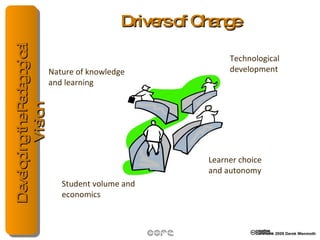
Drivers of Change Student volume and economics Technological development Learner choice  and autonomy Nature of knowledge and learning
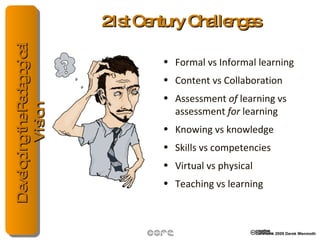
21st Century Challenges Formal vs Informal learning Content vs Collaboration Assessment  of  learning vs assessment  for  learning Knowing vs knowledge Skills vs competencies Virtual vs physical Teaching vs learning
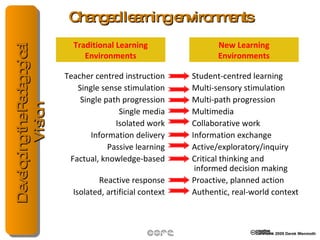
Changed learning environments Teacher centred instruction Single sense stimulation Single path progression Single media Isolated work Information delivery Passive learning Factual, knowledge-based Reactive response Isolated, artificial context New Learning Environments Traditional Learning Environments Student-centred learning Multi-sensory stimulation Multi-path progression Multimedia Collaborative work Information exchange Active/exploratory/inquiry Critical thinking and    informed decision making Proactive, planned action Authentic, real-world context
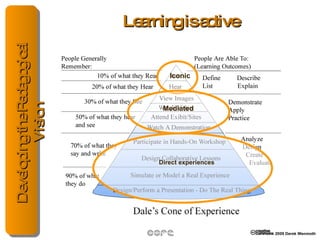
Learning is active Direct experiences Iconic Mediated
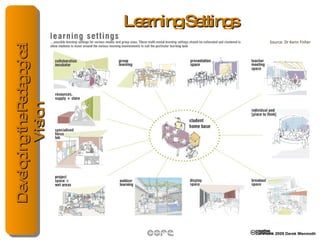
Learning Settings Source: Dr Kenn Fisher
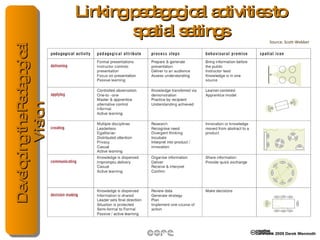
Linking pedagogical activities to spatial settings Source: Scott-Webber
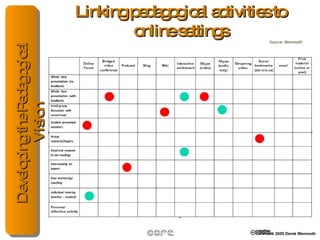
Linking pedagogical activities to online settings Source: Wenmoth
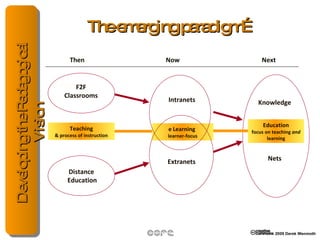
The emerging paradigm… Then Now Next Teaching & process of instruction e Knowledge Nets F2F Classrooms Distance  Education Learning learner-focus Intranets Extranets Education focus on teaching  and  learning
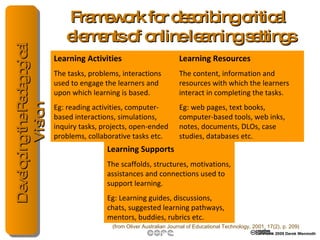
Framework for describing critical  elements of online learning settings (from Oliver Australian Journal of Educational Technology, 2001, 17(2), p. 209) Learning Activities Learning Resources Learning Supports Learning Activities The tasks, problems, interactions used to engage the learners and upon which learning is based. Eg: reading activities, computer-based interactions, simulations, inquiry tasks, projects, open-ended problems, collaborative tasks etc. Learning Resources The content, information and resources with which the learners interact in completing the tasks. Eg: web pages, text books, computer-based tools, web inks, notes, documents, DLOs, case studies, databases etc. Learning Supports The scaffolds, structures, motivations, assistances and connections used to support learning. Eg: Learning guides, discussions, chats, suggested learning pathways, mentors, buddies, rubrics etc.
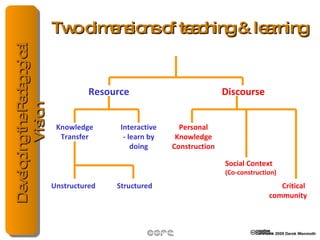
Two dimensions of teaching & learning Structured Personal Knowledge Construction Social Context (Co-construction) Critical  community Resource Discourse Unstructured Interactive - learn by doing Knowledge Transfer
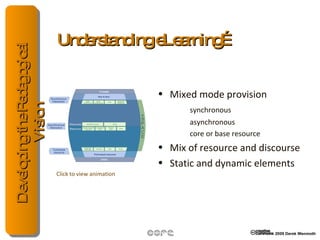
Understanding eLearning… Mixed mode provision synchronous asynchronous core or base resource Mix of resource and discourse Static and dynamic elements Click to view animation
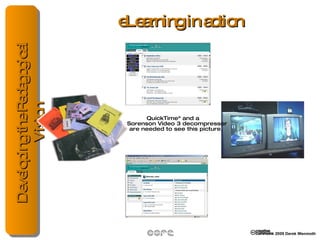
eLearning in action
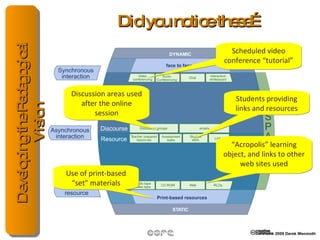
Did you notice these… Use of print-based “set” materials Scheduled video conference “tutorial” Discussion areas used after the online session Students providing links and resources “ Acropolis” learning object, and links to other web sites used
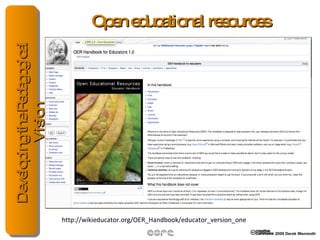
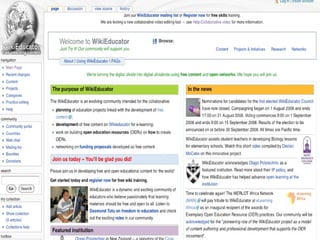
Open educational resources http://wikieducator.org/OER_Handbook/educator_version_one
Learning Content
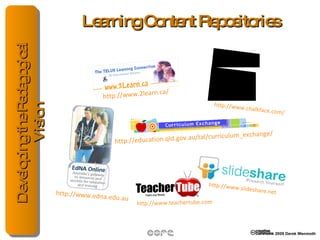
Learning Content Repositories http://www.chalkface.com/ http://www.2learn.ca/ http://www.edna.edu.au http://education. qld .gov. au/tal/curriculum_exchange/ http://www.slideshare.net http://www.teachertube.com
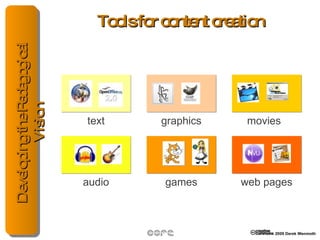
Tools for content creation text graphics movies audio games web pages
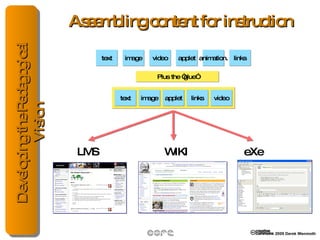
Assembling content for instruction Plus the “glue” text links animation. applet video image text links applet image video LMS WIKI eXe
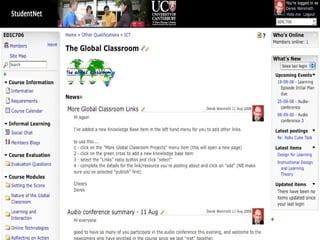
LMS
WIKI
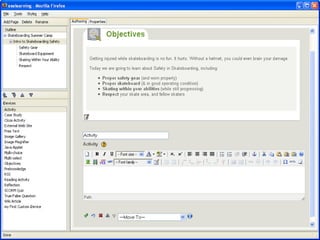
eXe
Wikieducator
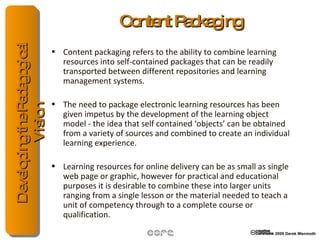
Content Packaging Content packaging refers to the ability to combine learning resources into self-contained packages that can be readily transported between different repositories and learning management systems. The need to package electronic learning resources has been given impetus by the development of the learning object model - the idea that self contained ‘objects’ can be obtained from a variety of sources and combined to create an individual learning experience. Learning resources for online delivery can be as small as single web page or graphic, however for practical and educational purposes it is desirable to combine these into larger units ranging from a single lesson or the material needed to teach a unit of competency through to a complete course or qualification.
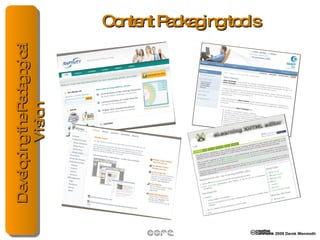
Content Packaging tools
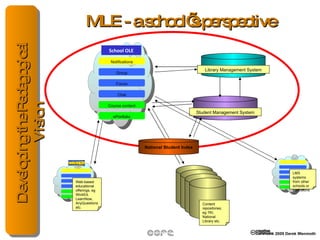
MLE - a school’s perspective Student Management System Library Management System Content repositories, eg TKI, National Library etc. LMS systems from other schools or institutions National Student Index Web-based educational offerings, eg WickEd, LearnNow, AnyQuestions etc. Group Forum Chat Course content ePortfolio Notifications School OLE
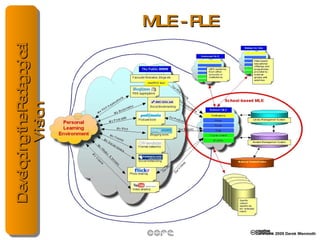
MLE - PLE
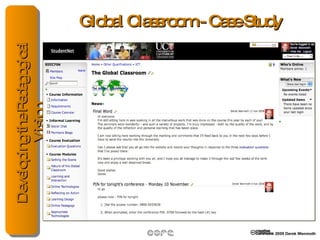
Global Classroom - Case Study
Thankyou Derek Wenmoth Director, eLearning CORE Education Ltd [email_address] http://blog.core-ed.net/derek
 
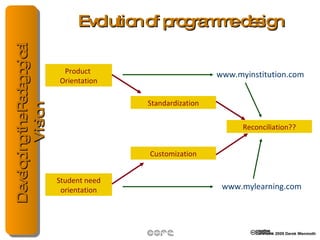
Evolution of programme design Product  Orientation Student need orientation Standardization Customization Reconciliation?? www.myinstitution.com www.mylearning.com

E Principals2009

  • 1.
    Developing the pedagogicalvision An overview of virtual learning developments in the schooling sector, and the pedagogical thinking that informs them. Derek Wenmoth Director, eLearning CORE Education Ltd
  • 2.
    Drivers of ChangeStudent volume and economics Technological development Learner choice and autonomy Nature of knowledge and learning
  • 3.
    21st Century ChallengesFormal vs Informal learning Content vs Collaboration Assessment of learning vs assessment for learning Knowing vs knowledge Skills vs competencies Virtual vs physical Teaching vs learning
  • 4.
    Changed learning environmentsTeacher centred instruction Single sense stimulation Single path progression Single media Isolated work Information delivery Passive learning Factual, knowledge-based Reactive response Isolated, artificial context New Learning Environments Traditional Learning Environments Student-centred learning Multi-sensory stimulation Multi-path progression Multimedia Collaborative work Information exchange Active/exploratory/inquiry Critical thinking and informed decision making Proactive, planned action Authentic, real-world context
  • 5.
    Learning is activeDirect experiences Iconic Mediated
  • 6.
  • 7.
    Linking pedagogical activitiesto spatial settings Source: Scott-Webber
  • 8.
    Linking pedagogical activitiesto online settings Source: Wenmoth
  • 9.
    The emerging paradigm…Then Now Next Teaching & process of instruction e Knowledge Nets F2F Classrooms Distance Education Learning learner-focus Intranets Extranets Education focus on teaching and learning
  • 10.
    Framework for describingcritical elements of online learning settings (from Oliver Australian Journal of Educational Technology, 2001, 17(2), p. 209) Learning Activities Learning Resources Learning Supports Learning Activities The tasks, problems, interactions used to engage the learners and upon which learning is based. Eg: reading activities, computer-based interactions, simulations, inquiry tasks, projects, open-ended problems, collaborative tasks etc. Learning Resources The content, information and resources with which the learners interact in completing the tasks. Eg: web pages, text books, computer-based tools, web inks, notes, documents, DLOs, case studies, databases etc. Learning Supports The scaffolds, structures, motivations, assistances and connections used to support learning. Eg: Learning guides, discussions, chats, suggested learning pathways, mentors, buddies, rubrics etc.
  • 11.
    Two dimensions ofteaching & learning Structured Personal Knowledge Construction Social Context (Co-construction) Critical community Resource Discourse Unstructured Interactive - learn by doing Knowledge Transfer
  • 12.
    Understanding eLearning… Mixedmode provision synchronous asynchronous core or base resource Mix of resource and discourse Static and dynamic elements Click to view animation
  • 13.
  • 14.
    Did you noticethese… Use of print-based “set” materials Scheduled video conference “tutorial” Discussion areas used after the online session Students providing links and resources “ Acropolis” learning object, and links to other web sites used
  • 15.
    Open educational resourceshttp://wikieducator.org/OER_Handbook/educator_version_one
  • 16.
  • 17.
    Learning Content Repositorieshttp://www.chalkface.com/ http://www.2learn.ca/ http://www.edna.edu.au http://education. qld .gov. au/tal/curriculum_exchange/ http://www.slideshare.net http://www.teachertube.com
  • 18.
    Tools for contentcreation text graphics movies audio games web pages
  • 19.
    Assembling content forinstruction Plus the “glue” text links animation. applet video image text links applet image video LMS WIKI eXe
  • 20.
  • 21.
  • 22.
  • 23.
  • 24.
    Content Packaging Contentpackaging refers to the ability to combine learning resources into self-contained packages that can be readily transported between different repositories and learning management systems. The need to package electronic learning resources has been given impetus by the development of the learning object model - the idea that self contained ‘objects’ can be obtained from a variety of sources and combined to create an individual learning experience. Learning resources for online delivery can be as small as single web page or graphic, however for practical and educational purposes it is desirable to combine these into larger units ranging from a single lesson or the material needed to teach a unit of competency through to a complete course or qualification.
  • 25.
  • 26.
    MLE - aschool’s perspective Student Management System Library Management System Content repositories, eg TKI, National Library etc. LMS systems from other schools or institutions National Student Index Web-based educational offerings, eg WickEd, LearnNow, AnyQuestions etc. Group Forum Chat Course content ePortfolio Notifications School OLE
  • 27.
  • 28.
  • 29.
    Thankyou Derek WenmothDirector, eLearning CORE Education Ltd [email_address] http://blog.core-ed.net/derek
  • 30.
  • 31.
    Evolution of programmedesign Product Orientation Student need orientation Standardization Customization Reconciliation?? www.myinstitution.com www.mylearning.com