Lisa Marie Blaschke
ICDE Pre-Conference Workshop
25.10.2015
Heutagogy: Changing the Playing Field
1 What is heutagogy?
2 An example of heutagogical design
3 Why is it set to change the playing field?
4 What do we want to do next?
Topics
Folie 2
What is heutagogy (self-determined
learning)?
Heutagogy defined
Heutagogy is the study of self-
determined learning and applies
a holistic approach to developing
learner capabilities with the
learner serving as “the major
agent in their own learning,
which occurs, as a result of
personal experience
Stewart Hase & Chris Kenyon (2007, p. 112)
Learners at the center
Active and self-
determined in
learning
Reflecting on
what is
learned and
how
Developing
competencies
and capabilities
Assessing
own
development
and progress
“For the teaching and learning experience, for the people who are actually paying tuition
dollars, they have to be at the center of the experience. In the past, we needed the
university to do a lot of the knowledge mediating for us...[now] students can go directly to
the source and they don't need the university to play that mediating role.” - George Siemens
(YouTube interview, October 21, 2013)
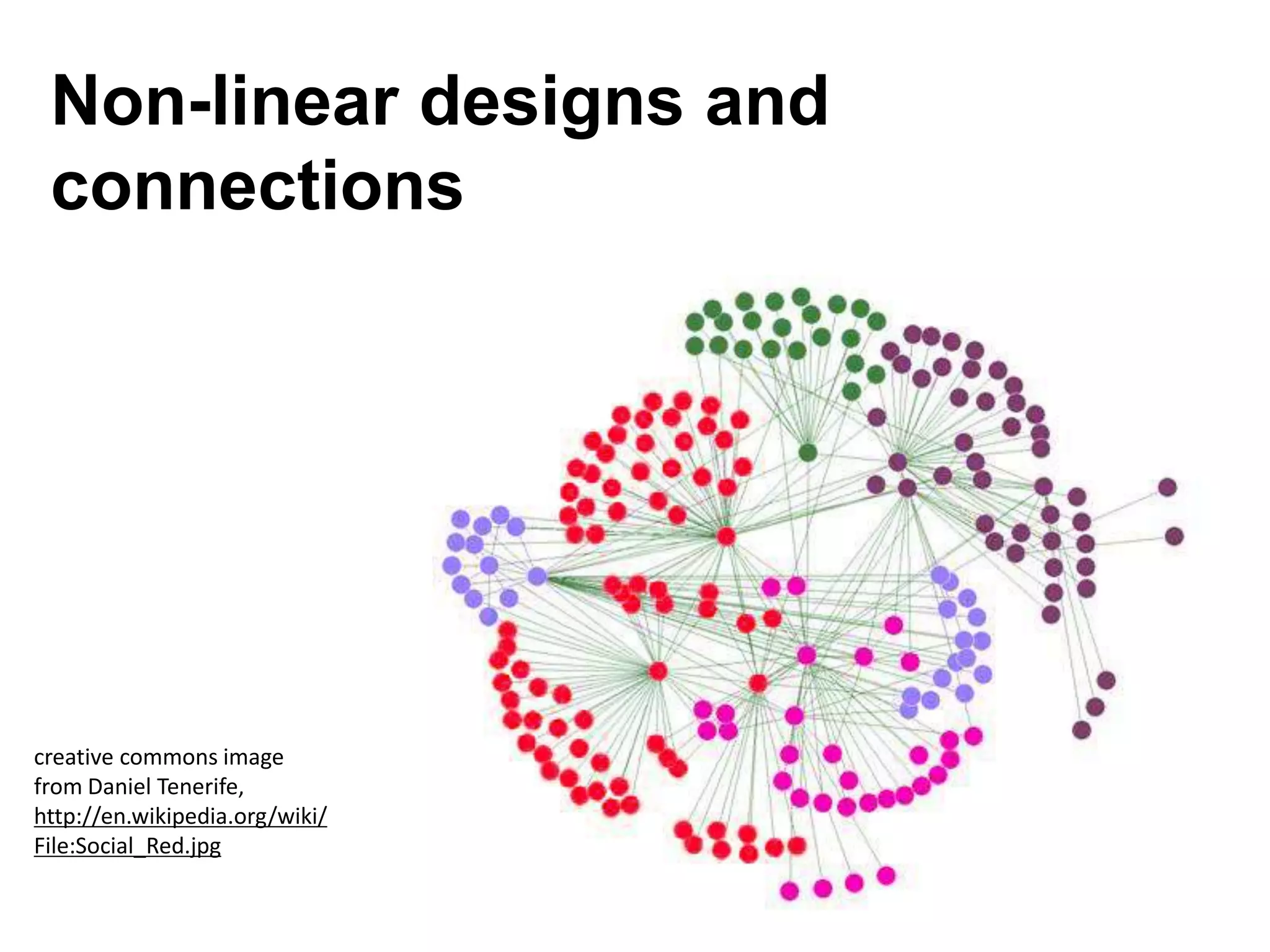
Non-linear designs and
connections
creative commons image
from Daniel Tenerife,
http://en.wikipedia.org/wiki/
File:Social_Red.jpg
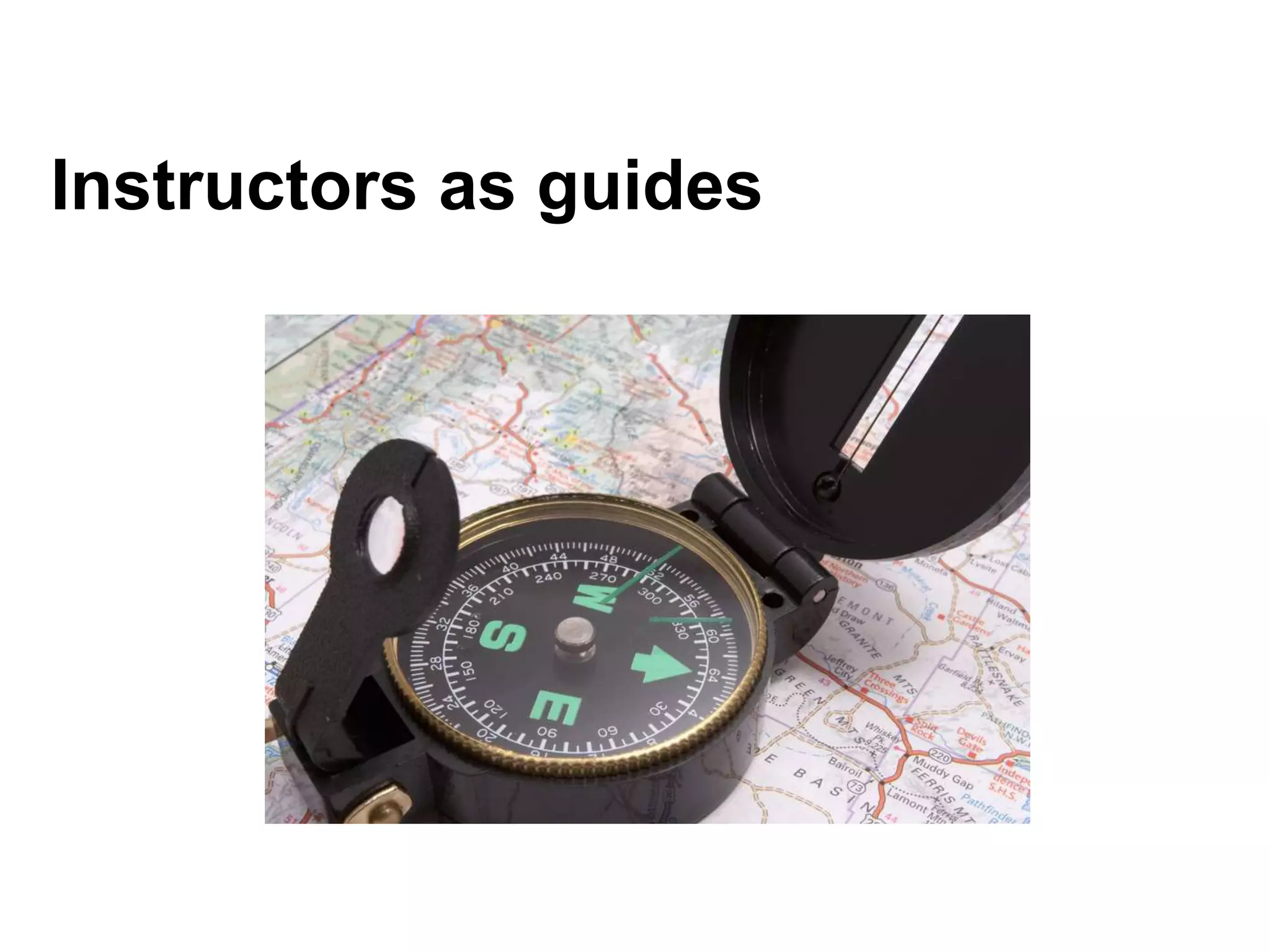
Instructors as guides
Institutions as support networks
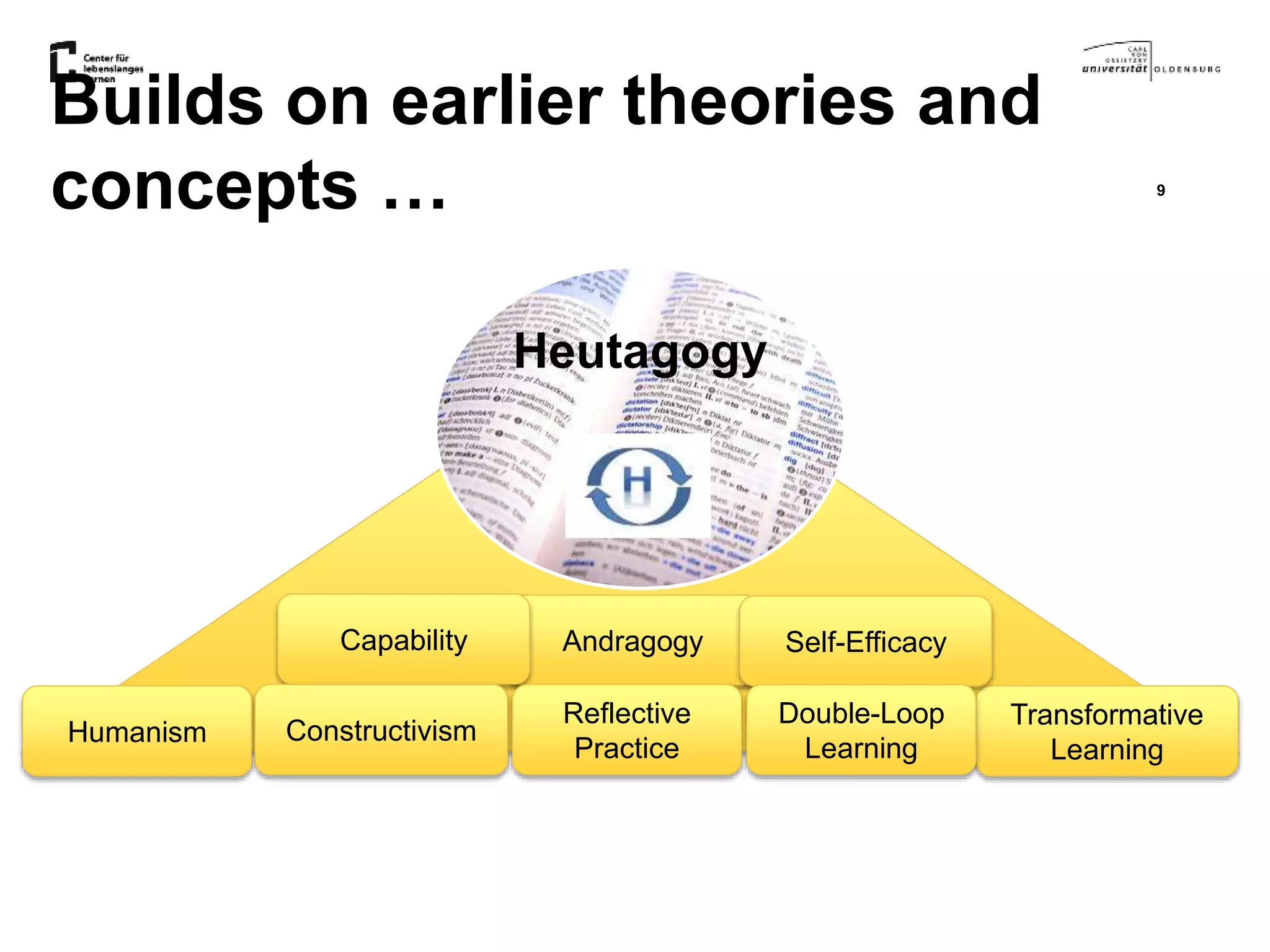
Builds on earlier theories and
concepts … 9
Heutagogy
AndragogyCapability
Transformative
Learning
Self-Efficacy
Humanism
Double-Loop
Learning
Reflective
Practice
Constructivism
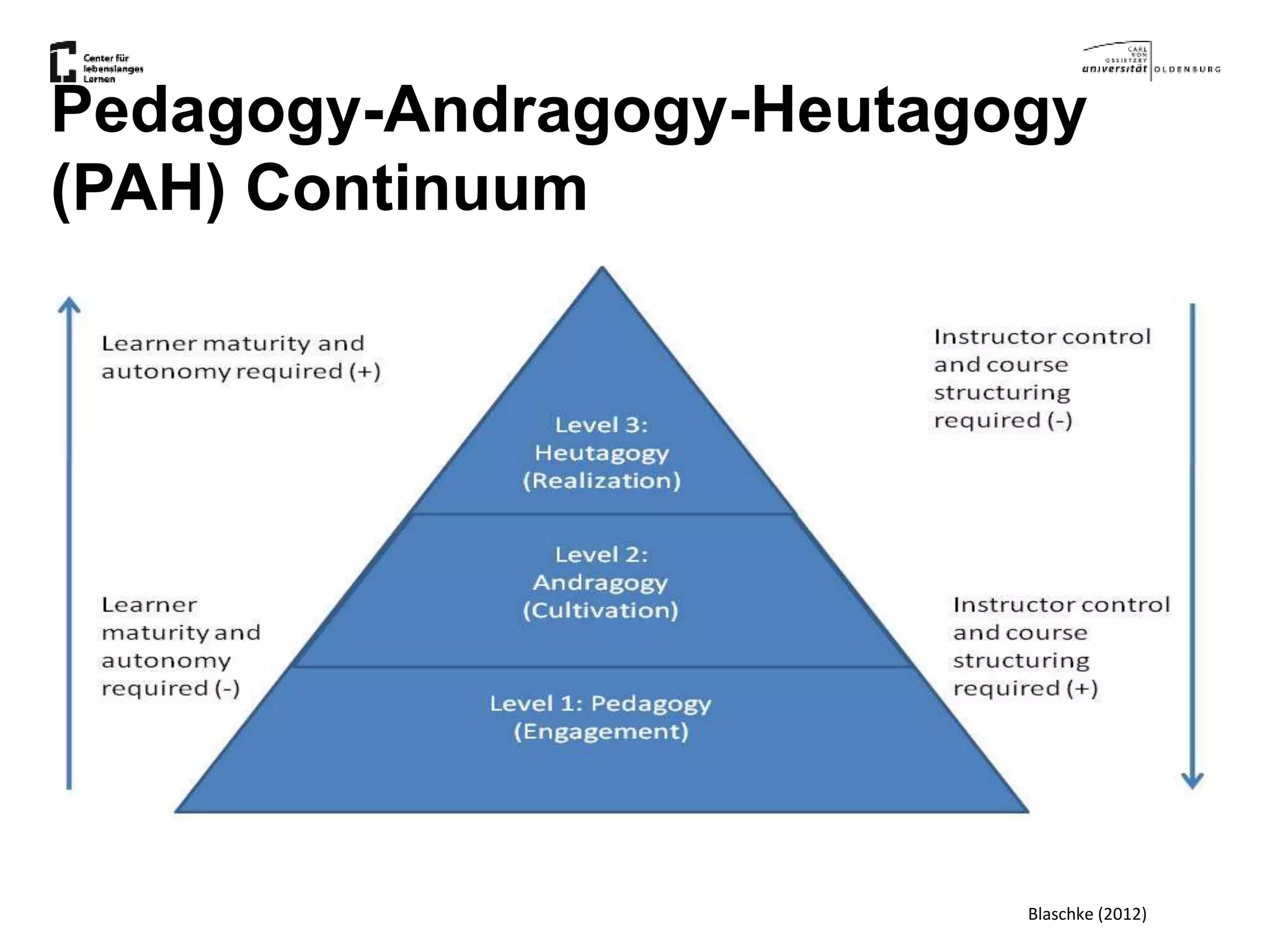
Pedagogy-Andragogy-Heutagogy
(PAH) Continuum
Blaschke (2012)
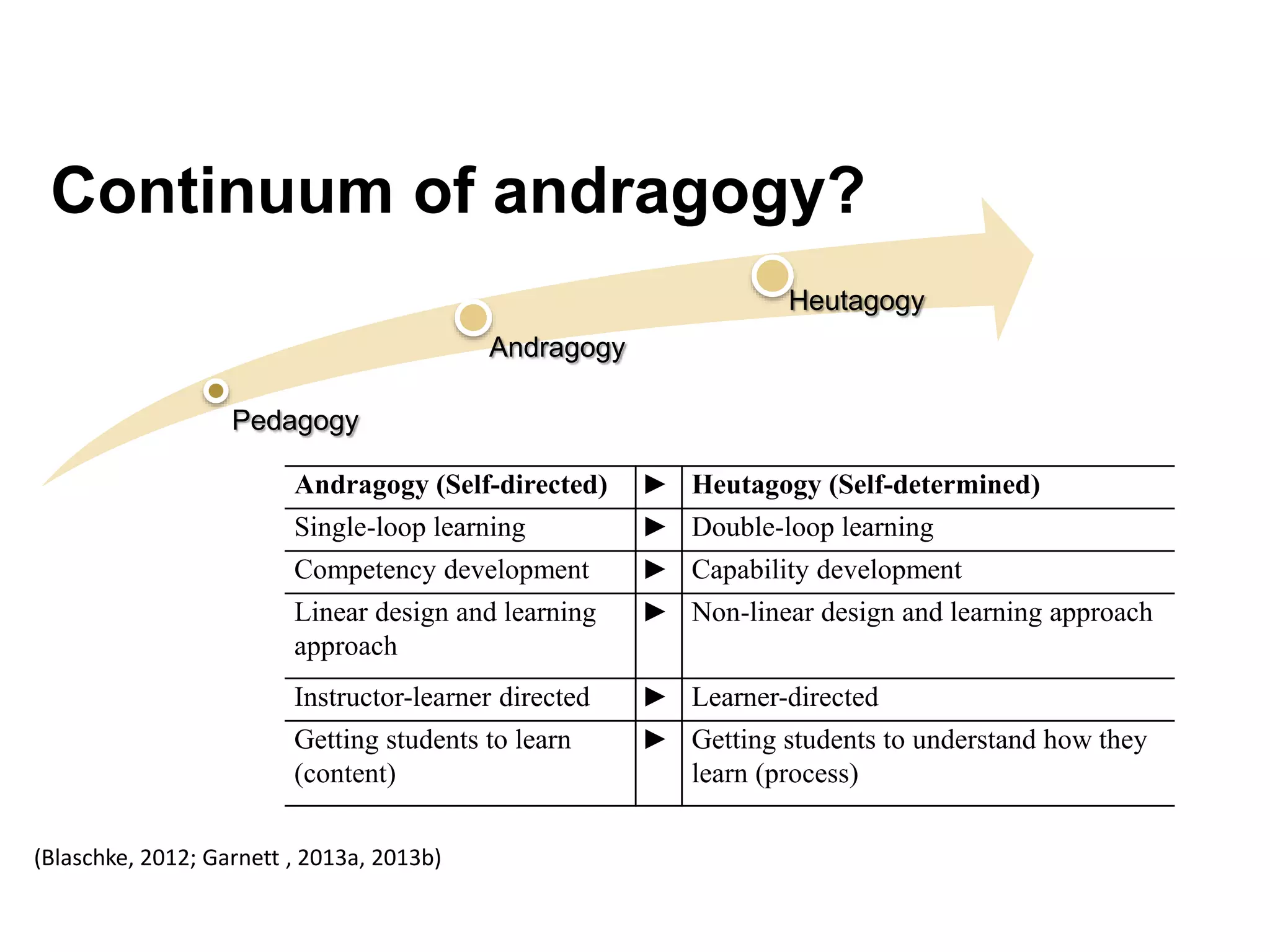
Continuum of andragogy?
Pedagogy
Andragogy
Heutagogy
Andragogy (Self-directed) ► Heutagogy (Self-determined)
Single-loop learning ► Double-loop learning
Competency development ► Capability development
Linear design and learning
approach
► Non-linear design and learning approach
Instructor-learner directed ► Learner-directed
Getting students to learn
(content)
► Getting students to understand how they
learn (process)
(Blaschke, 2012; Garnett , 2013a, 2013b)
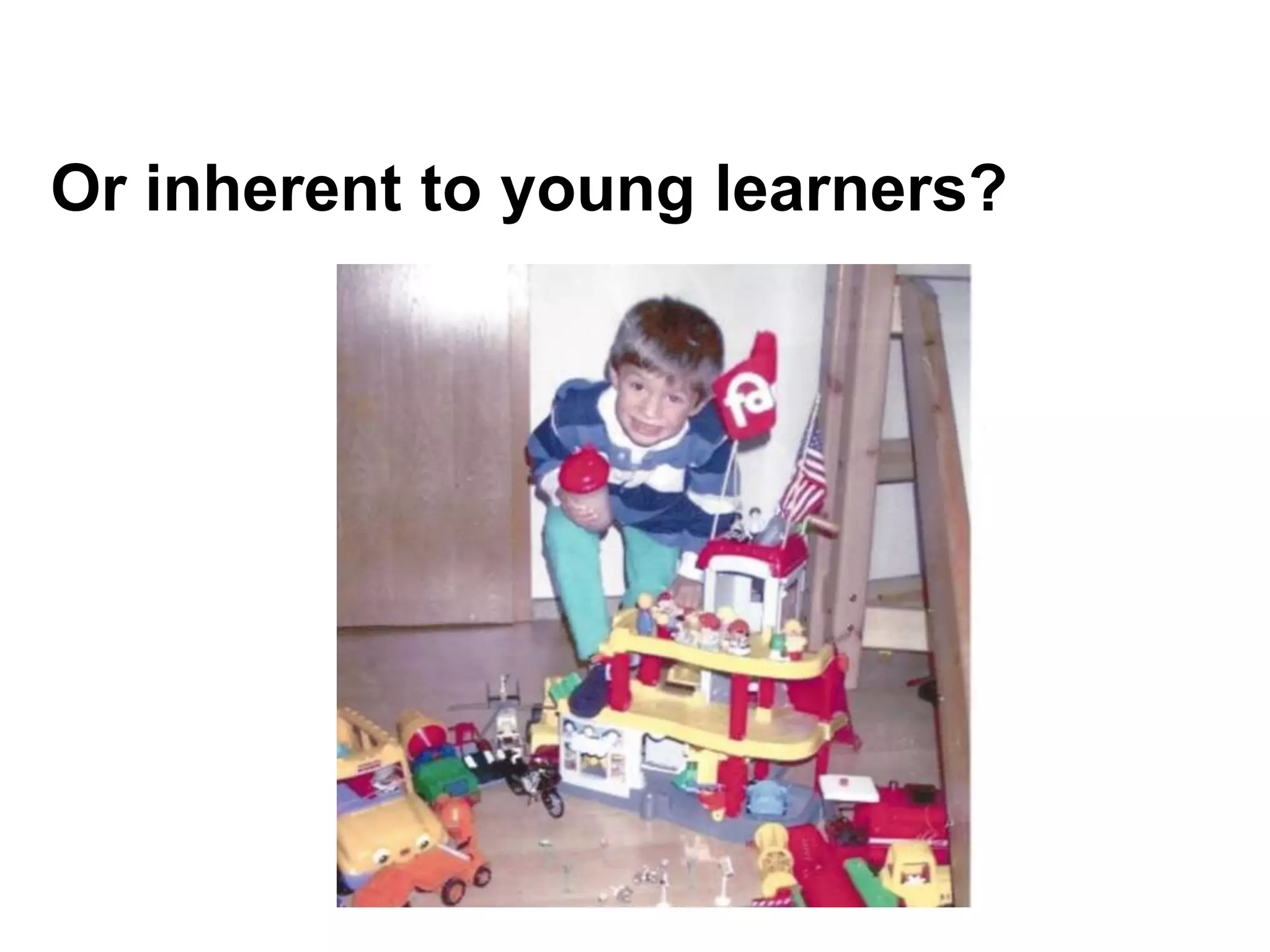
Or inherent to young learners?
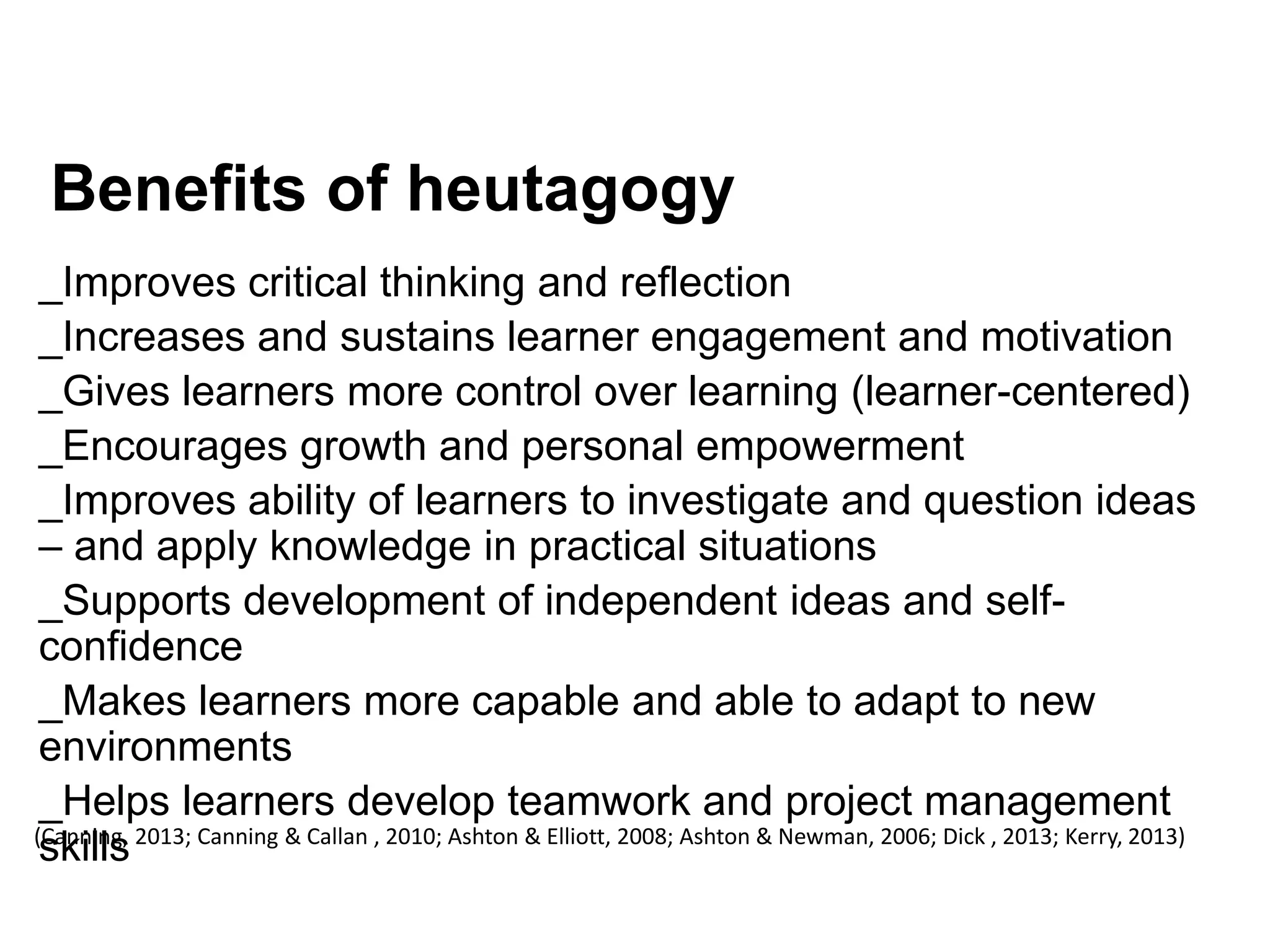
Benefits of heutagogy
_Improves critical thinking and reflection
_Increases and sustains learner engagement and motivation
_Gives learners more control over learning (learner-centered)
_Encourages growth and personal empowerment
_Improves ability of learners to investigate and question ideas
– and apply knowledge in practical situations
_Supports development of independent ideas and self-
confidence
_Makes learners more capable and able to adapt to new
environments
_Helps learners develop teamwork and project management
skills(Canning, 2013; Canning & Callan , 2010; Ashton & Elliott, 2008; Ashton & Newman, 2006; Dick , 2013; Kerry, 2013)
An example of heutagogical
design
Which pedagogical framework?
http://www.flickr.com/photos/oudeschool/6257800770/in/pool-809956@N25/
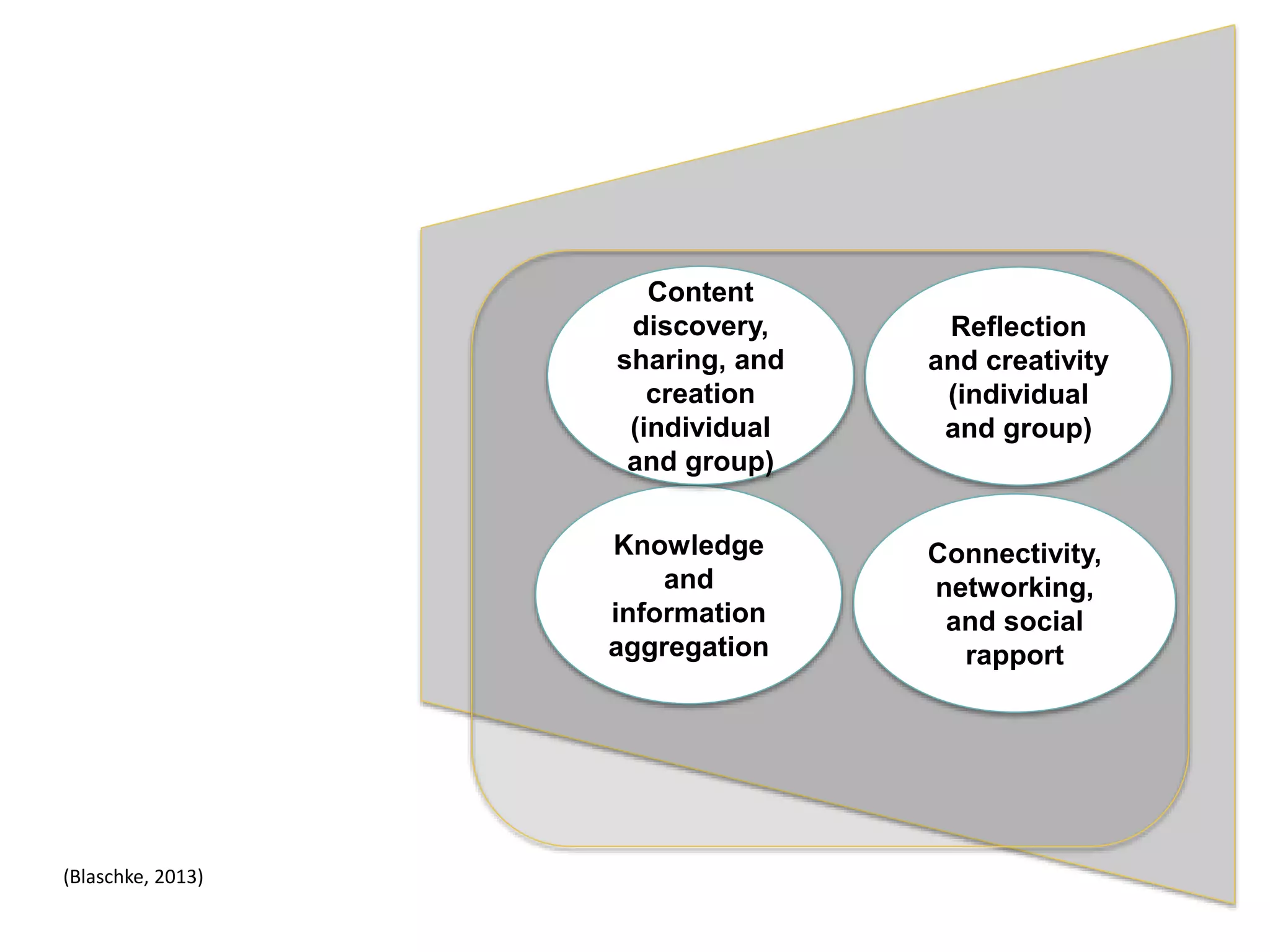
(Blaschke, 2013)
Knowledge
and
information
aggregation
Connectivity,
networking,
and social
rapport
Content
discovery,
sharing, and
creation
(individual
and group)
Reflection
and creativity
(individual
and group)
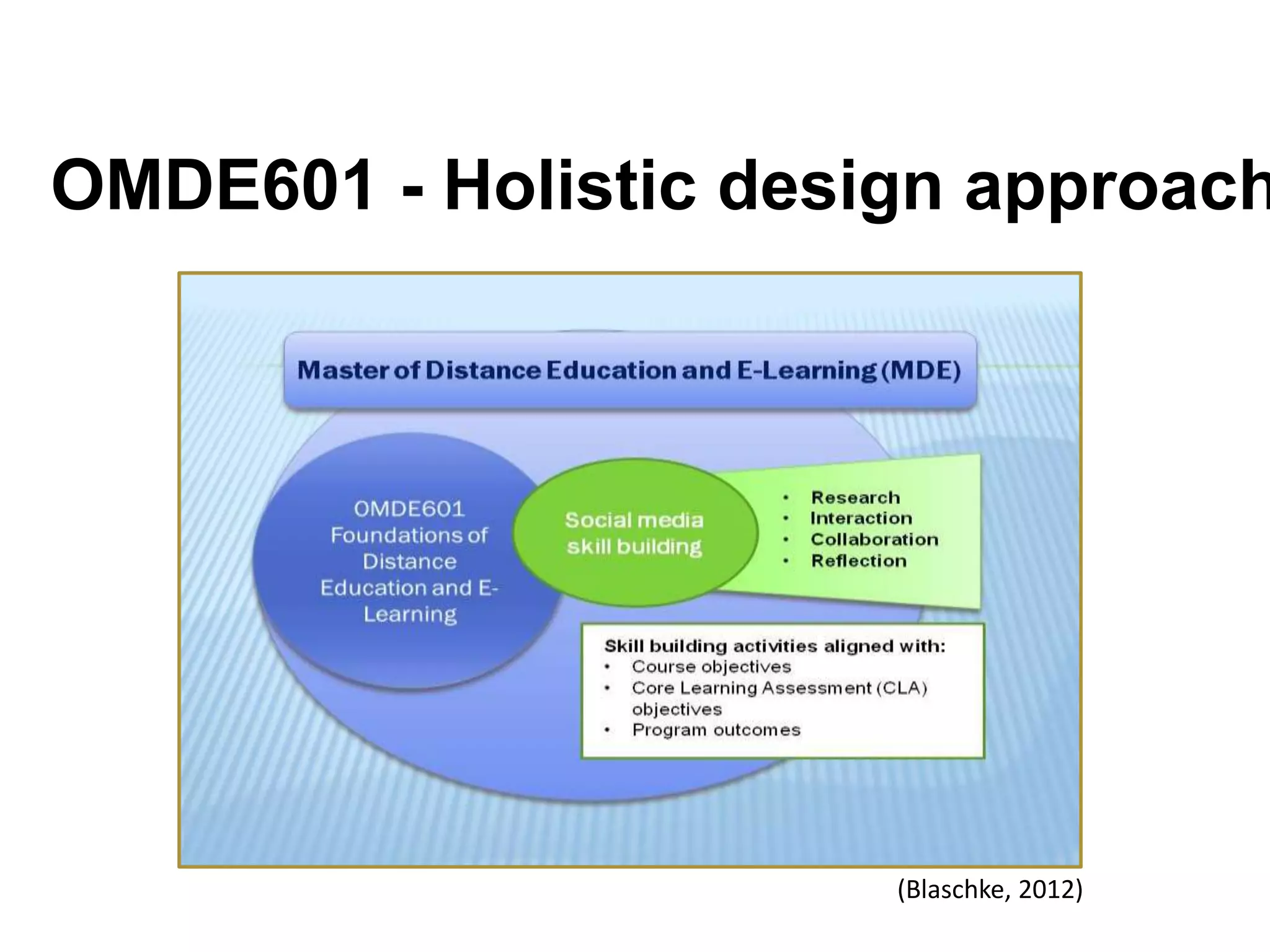
OMDE601 - Holistic design approach
(Blaschke, 2012)
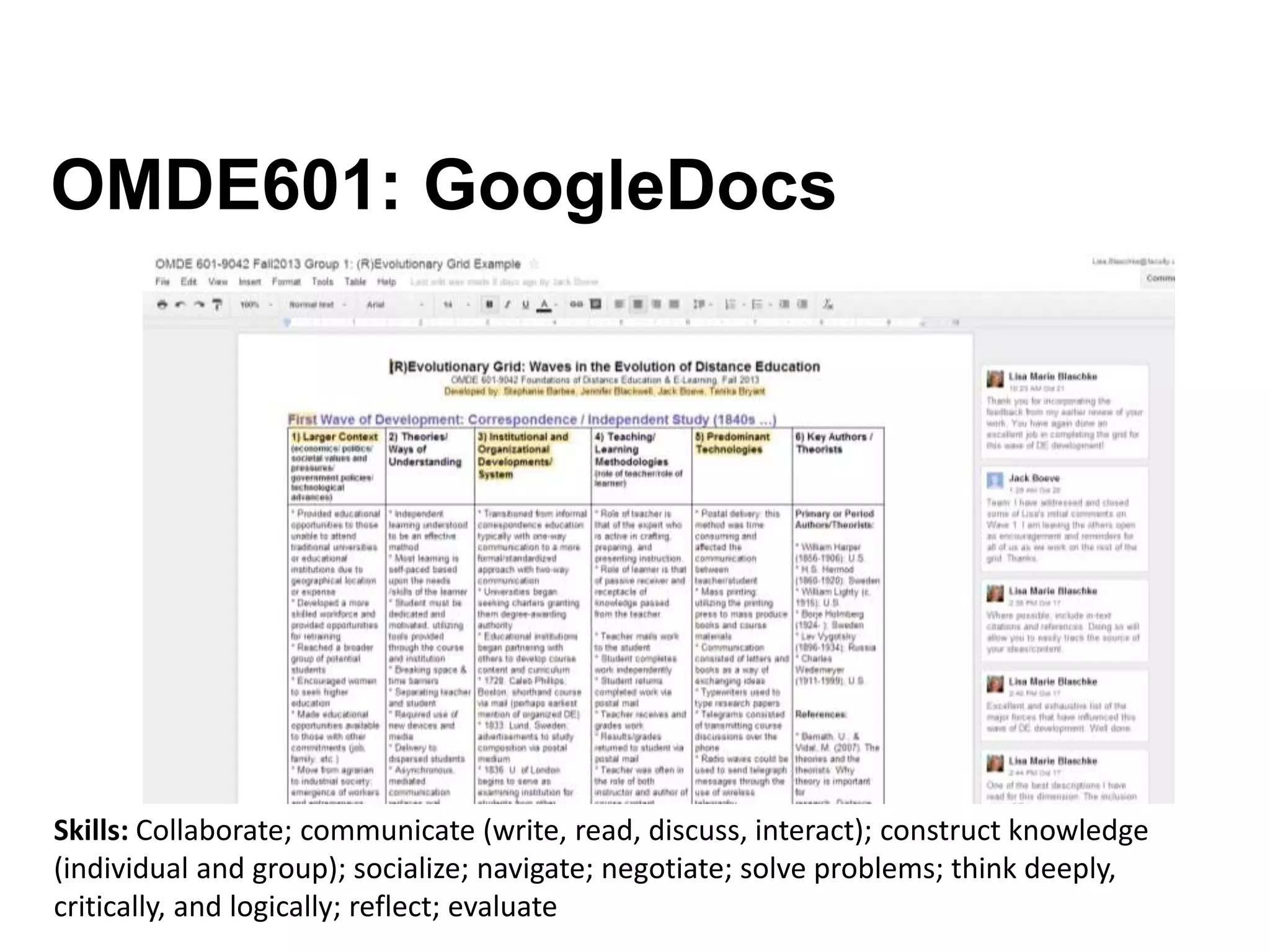
OMDE601: GoogleDocs
Skills: Collaborate; communicate (write, read, discuss, interact); construct knowledge
(individual and group); socialize; navigate; negotiate; solve problems; think deeply,
critically, and logically; reflect; evaluate
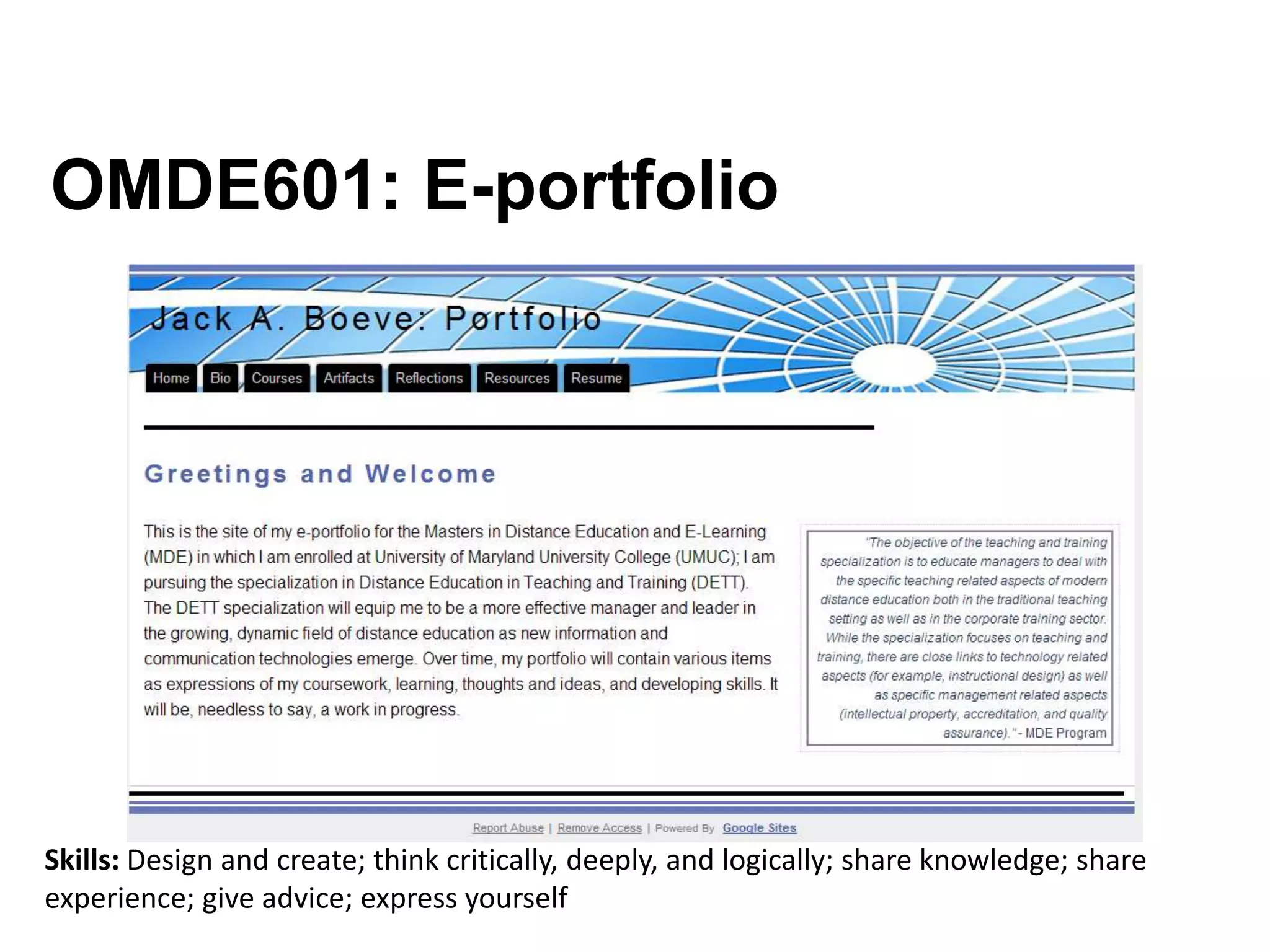
OMDE601: E-portfolio
Skills: Design and create; think critically, deeply, and logically; share knowledge; share
experience; give advice; express yourself
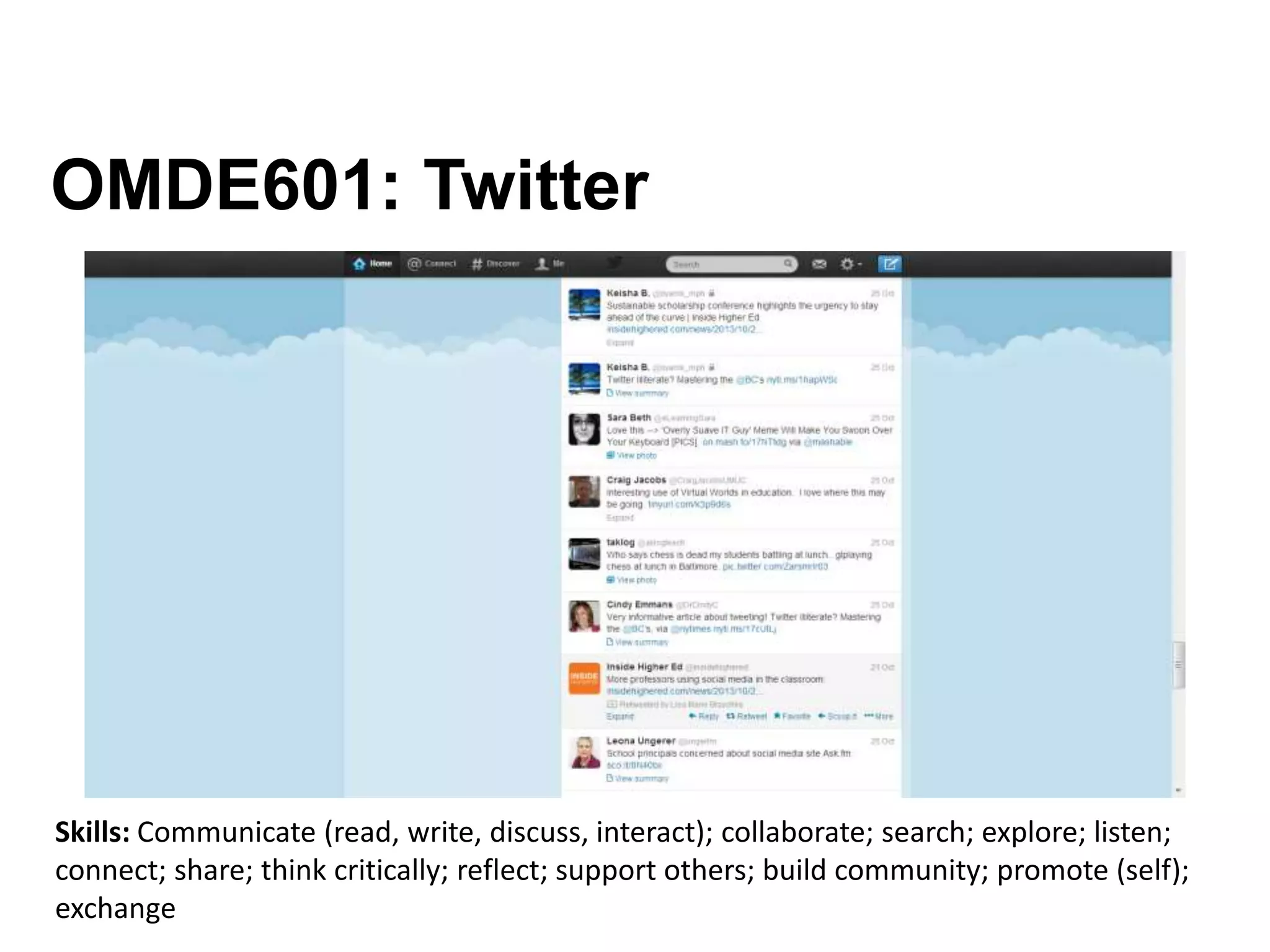
OMDE601: Twitter
Skills: Communicate (read, write, discuss, interact); collaborate; search; explore; listen;
connect; share; think critically; reflect; support others; build community; promote (self);
exchange
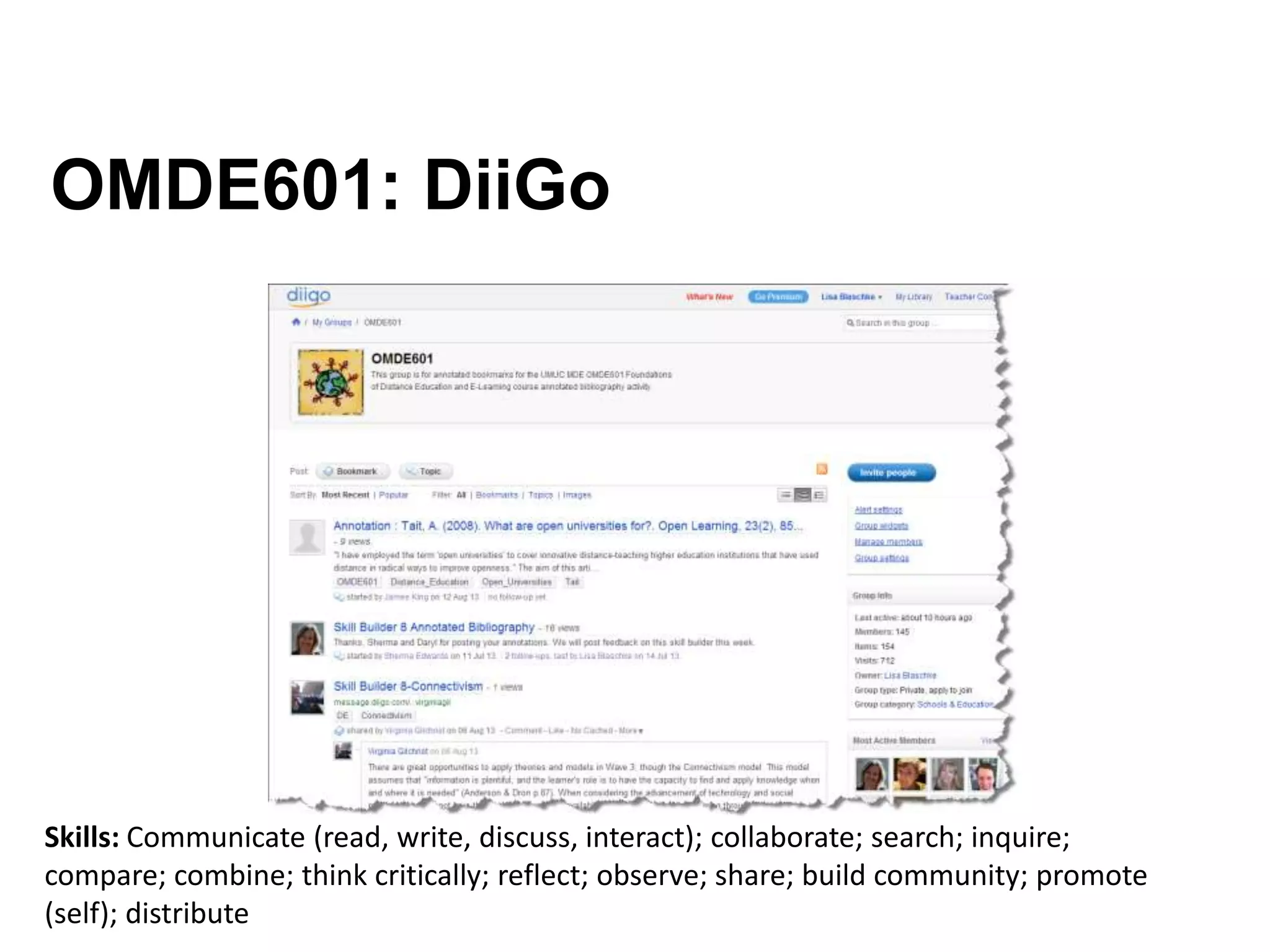
OMDE601: DiiGo
Skills: Communicate (read, write, discuss, interact); collaborate; search; inquire;
compare; combine; think critically; reflect; observe; share; build community; promote
(self); distribute
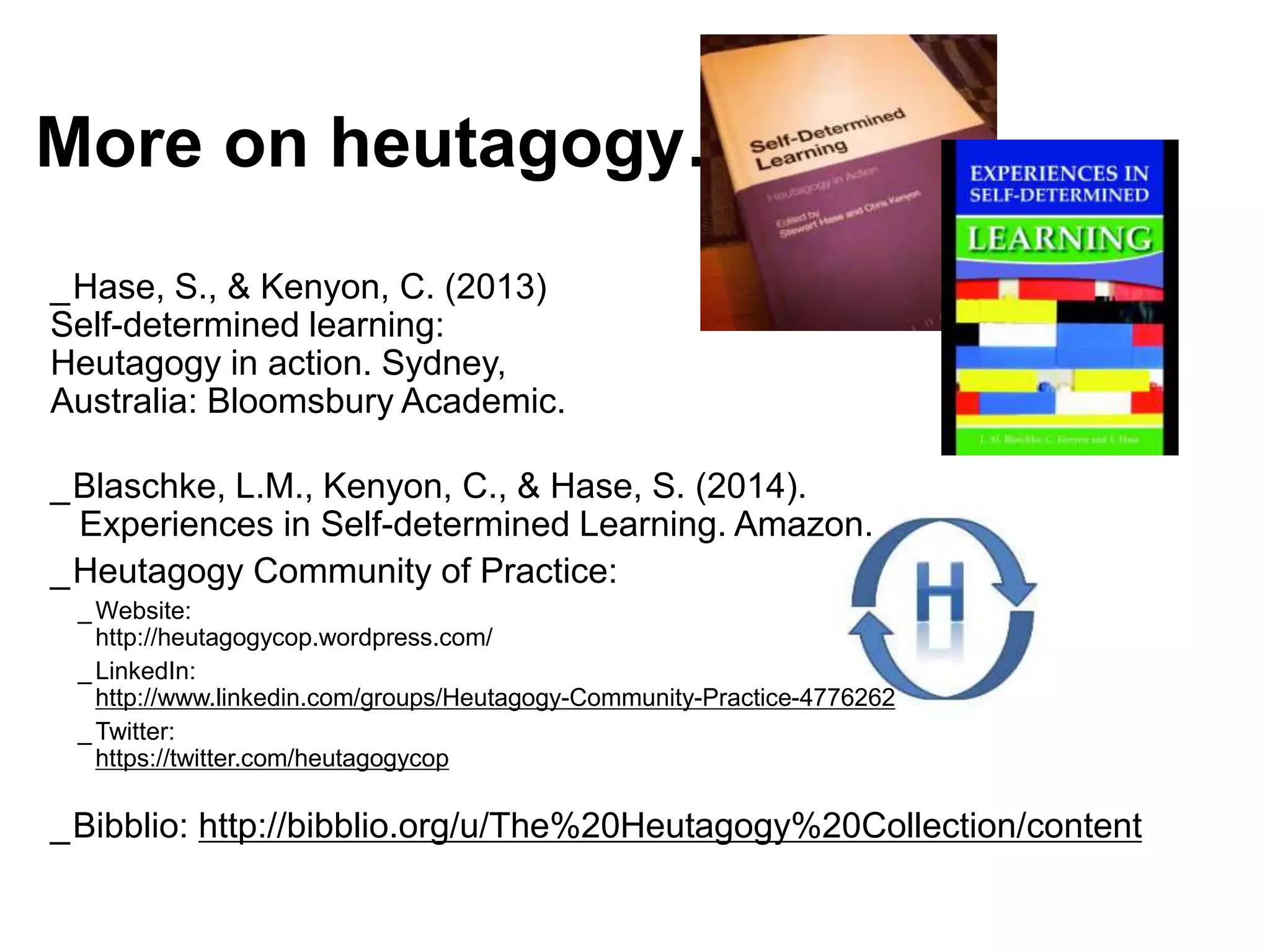
More on heutagogy…
_Hase, S., & Kenyon, C. (2013)
Self-determined learning:
Heutagogy in action. Sydney,
Australia: Bloomsbury Academic.
_Blaschke, L.M., Kenyon, C., & Hase, S. (2014).
Experiences in Self-determined Learning. Amazon.
_Heutagogy Community of Practice:
_ Website:
http://heutagogycop.wordpress.com/
_ LinkedIn:
http://www.linkedin.com/groups/Heutagogy-Community-Practice-4776262
_ Twitter:
https://twitter.com/heutagogycop
_Bibblio: http://bibblio.org/u/The%20Heutagogy%20Collection/content
Why is heutagogy set to change the
playing field?
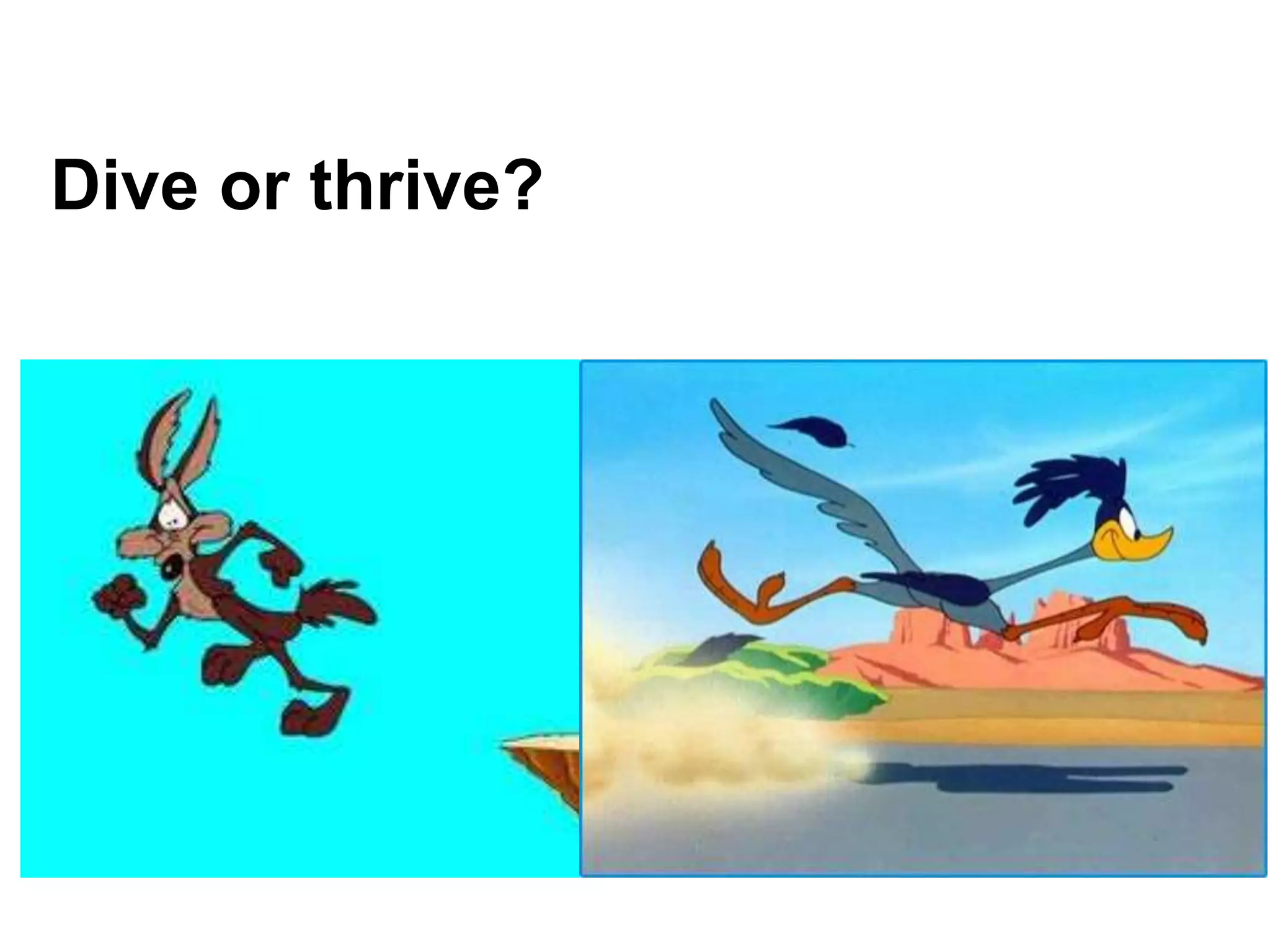
Dive or thrive?
(Prensky, 2010; Partnership for 21st Century Skills (P21), no date;
Thomas & Brown, 2011; Trilling & Fadel, 2009)
What employers want
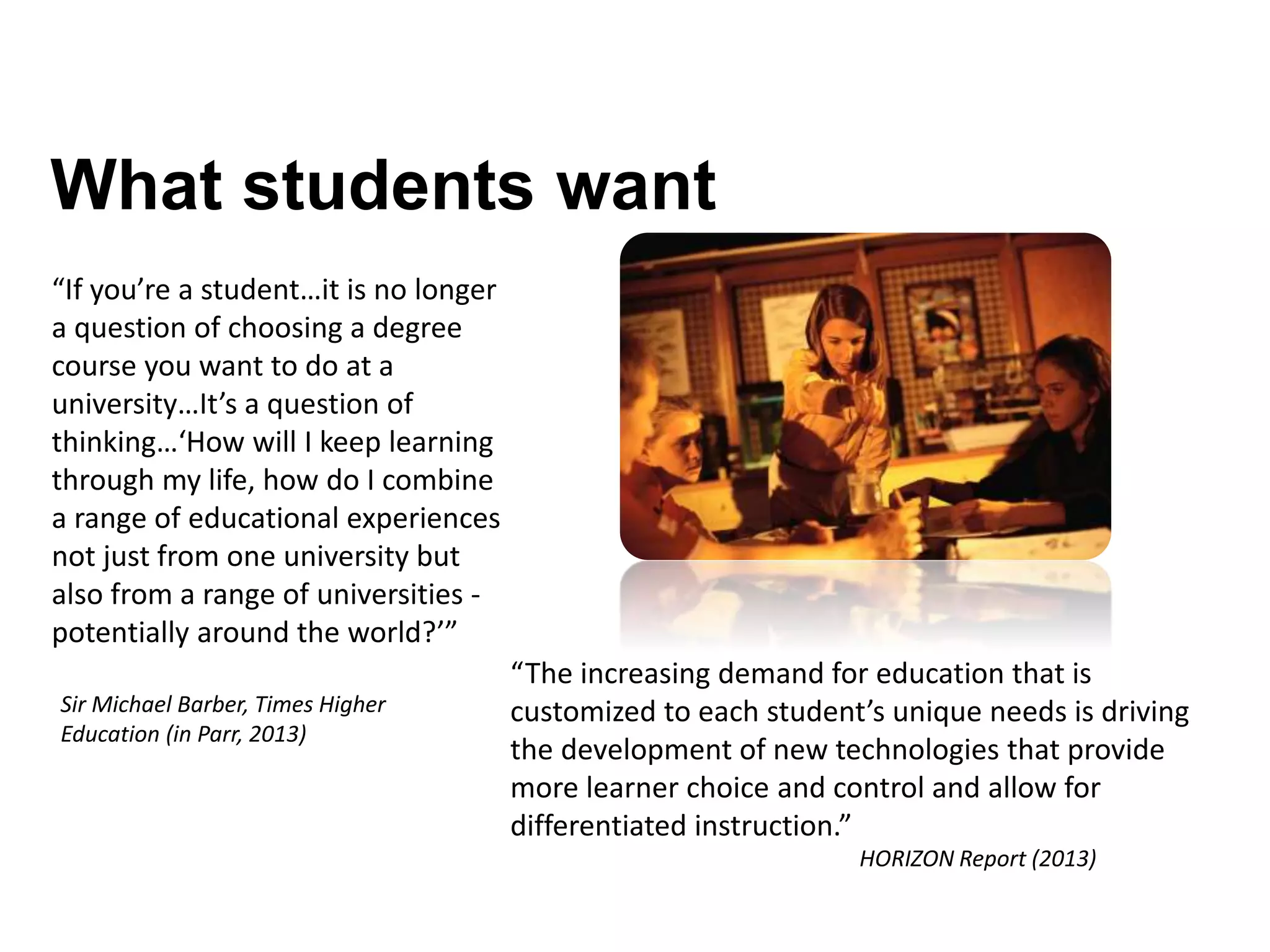
What students want
“If you’re a student…it is no longer
a question of choosing a degree
course you want to do at a
university…It’s a question of
thinking…‘How will I keep learning
through my life, how do I combine
a range of educational experiences
not just from one university but
also from a range of universities -
potentially around the world?’”
Sir Michael Barber, Times Higher
Education (in Parr, 2013)
“The increasing demand for education that is
customized to each student’s unique needs is driving
the development of new technologies that provide
more learner choice and control and allow for
differentiated instruction.”
HORIZON Report (2013)
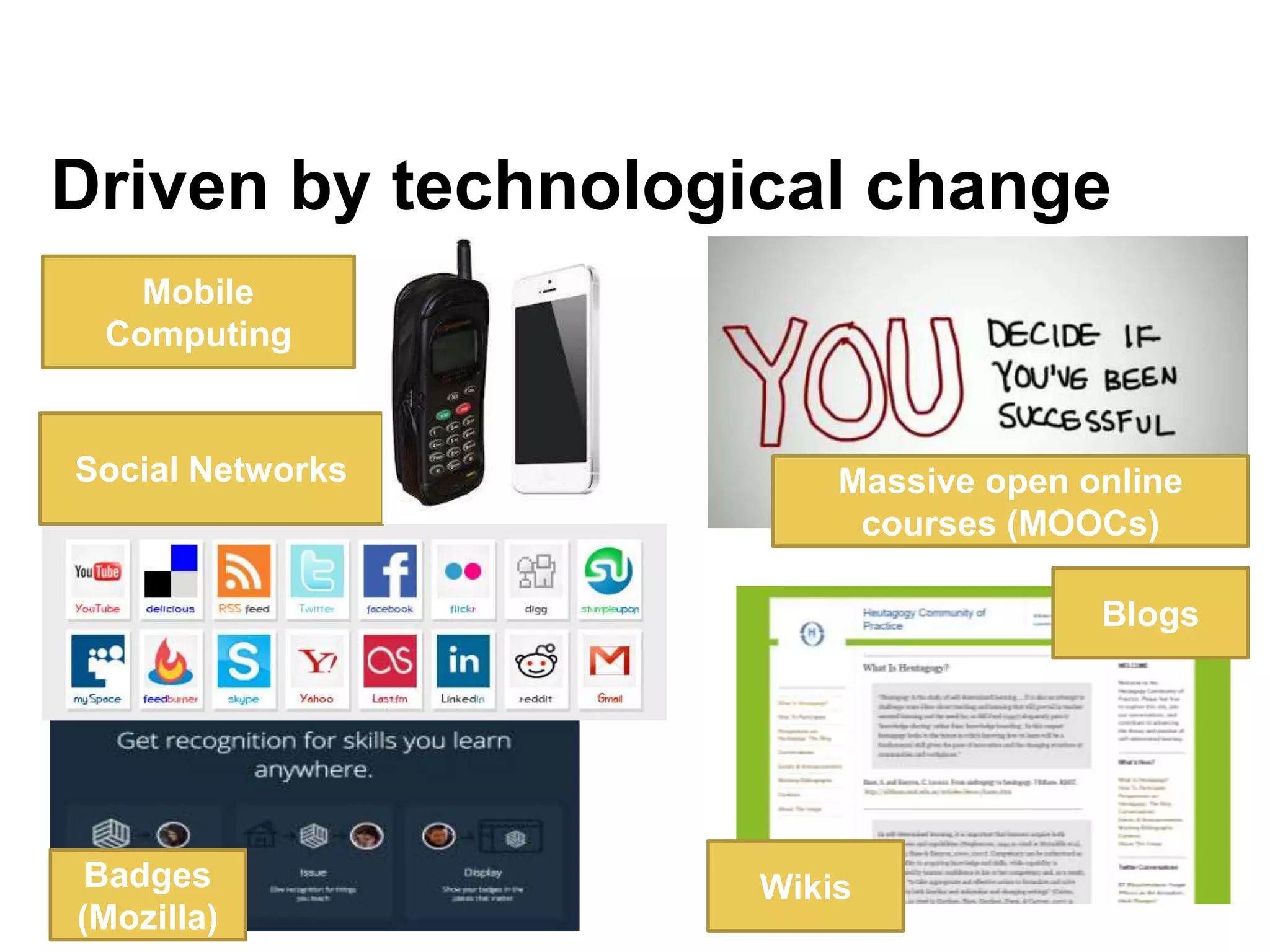
Driven by technological change
Badges
(Mozilla)
Massive open online
courses (MOOCs)
Wikis
Blogs
Mobile
Computing
Social Networks
What do we want to do next?
References
Anderson, T. (2009). The dance of technology and pedagogy in self-paced distance education. AU Space. Retrieved from:
http://auspace.athabascau.ca/handle/2149/2210
Anderson, T. (2010). Theories for learning with emerging technologies. In G. Veletsianos (Ed.),Emerging technologies in
distance education. Edmonton: Athabasca University Press. Retrieved from
http://www.aupress.ca/books/120177/ebook/02_Veletsianos_2010-Emerging_Technologies_in_Distance_Education.pdf
Ashton & Elliott, 2008; Ashton & Newman, 2006; Blaschke, L. (2012). Heutagogy and lifelong learning: A review of
heutagogical practice and self-determined learning. The International Review Of Research In Open And Distance Learning,
13(1), 56-71. Retrieved from http://www.irrodl.org/index.php/irrodl/article/view/1076/2087
Blaschke, L.M. (2012). Using social media to engage and develop online learners. In Proceedings of the Seventh European
Distance and E-learning Network (EDEN) Research Workshop, October 22-23, 2012. Leuven, Belgium. Available
from: http://lisamarieblaschke.pbworks.com/w/file/59193861/Blaschke_EDEN_2012_Leuven_FINAL.pdf
Blaschke, L. (2012). Heutagogy and lifelong learning: A review of heutagogical practice and self-determined learning. The
International Review Of Research In Open And Distance Learning, 13(1), 56-71. Retrieved
from http://www.irrodl.org/index.php/irrodl/article/view/1076/2087
Blaschke, L.M., & Brindley, J. (in press). Using social media in the online classroom. In M. Ally & B. Khan, The international
handbook of e-learning. Athabasca, Canada: Athabasca University Press.
Canning, N. (2013). Practitioner development in early years education. In S. Hase & C. Kenyon, Self-determined learning:
Heutagogy in action. Sydney, Australia: Bloomsbury Academic.

Heutagogy: Changing the Playing Field (ICDE Pre-Conference Workshop)

  • 1.
    Lisa Marie Blaschke ICDEPre-Conference Workshop 25.10.2015 Heutagogy: Changing the Playing Field
  • 2.
    1 What isheutagogy? 2 An example of heutagogical design 3 Why is it set to change the playing field? 4 What do we want to do next? Topics Folie 2
  • 3.
    What is heutagogy(self-determined learning)?
  • 4.
    Heutagogy defined Heutagogy isthe study of self- determined learning and applies a holistic approach to developing learner capabilities with the learner serving as “the major agent in their own learning, which occurs, as a result of personal experience Stewart Hase & Chris Kenyon (2007, p. 112)
  • 5.
    Learners at thecenter Active and self- determined in learning Reflecting on what is learned and how Developing competencies and capabilities Assessing own development and progress “For the teaching and learning experience, for the people who are actually paying tuition dollars, they have to be at the center of the experience. In the past, we needed the university to do a lot of the knowledge mediating for us...[now] students can go directly to the source and they don't need the university to play that mediating role.” - George Siemens (YouTube interview, October 21, 2013)
  • 6.
    Non-linear designs and connections creativecommons image from Daniel Tenerife, http://en.wikipedia.org/wiki/ File:Social_Red.jpg
  • 7.
  • 8.
  • 9.
    Builds on earliertheories and concepts … 9 Heutagogy AndragogyCapability Transformative Learning Self-Efficacy Humanism Double-Loop Learning Reflective Practice Constructivism
  • 10.
  • 11.
    Continuum of andragogy? Pedagogy Andragogy Heutagogy Andragogy(Self-directed) ► Heutagogy (Self-determined) Single-loop learning ► Double-loop learning Competency development ► Capability development Linear design and learning approach ► Non-linear design and learning approach Instructor-learner directed ► Learner-directed Getting students to learn (content) ► Getting students to understand how they learn (process) (Blaschke, 2012; Garnett , 2013a, 2013b)
  • 12.
    Or inherent toyoung learners?
  • 13.
    Benefits of heutagogy _Improvescritical thinking and reflection _Increases and sustains learner engagement and motivation _Gives learners more control over learning (learner-centered) _Encourages growth and personal empowerment _Improves ability of learners to investigate and question ideas – and apply knowledge in practical situations _Supports development of independent ideas and self- confidence _Makes learners more capable and able to adapt to new environments _Helps learners develop teamwork and project management skills(Canning, 2013; Canning & Callan , 2010; Ashton & Elliott, 2008; Ashton & Newman, 2006; Dick , 2013; Kerry, 2013)
  • 14.
    An example ofheutagogical design
  • 15.
  • 16.
    (Blaschke, 2013) Knowledge and information aggregation Connectivity, networking, and social rapport Content discovery, sharing,and creation (individual and group) Reflection and creativity (individual and group)
  • 17.
    OMDE601 - Holisticdesign approach (Blaschke, 2012)
  • 18.
    OMDE601: GoogleDocs Skills: Collaborate;communicate (write, read, discuss, interact); construct knowledge (individual and group); socialize; navigate; negotiate; solve problems; think deeply, critically, and logically; reflect; evaluate
  • 19.
    OMDE601: E-portfolio Skills: Designand create; think critically, deeply, and logically; share knowledge; share experience; give advice; express yourself
  • 20.
    OMDE601: Twitter Skills: Communicate(read, write, discuss, interact); collaborate; search; explore; listen; connect; share; think critically; reflect; support others; build community; promote (self); exchange
  • 21.
    OMDE601: DiiGo Skills: Communicate(read, write, discuss, interact); collaborate; search; inquire; compare; combine; think critically; reflect; observe; share; build community; promote (self); distribute
  • 22.
    More on heutagogy… _Hase,S., & Kenyon, C. (2013) Self-determined learning: Heutagogy in action. Sydney, Australia: Bloomsbury Academic. _Blaschke, L.M., Kenyon, C., & Hase, S. (2014). Experiences in Self-determined Learning. Amazon. _Heutagogy Community of Practice: _ Website: http://heutagogycop.wordpress.com/ _ LinkedIn: http://www.linkedin.com/groups/Heutagogy-Community-Practice-4776262 _ Twitter: https://twitter.com/heutagogycop _Bibblio: http://bibblio.org/u/The%20Heutagogy%20Collection/content
  • 23.
    Why is heutagogyset to change the playing field?
  • 24.
  • 25.
    (Prensky, 2010; Partnershipfor 21st Century Skills (P21), no date; Thomas & Brown, 2011; Trilling & Fadel, 2009) What employers want
  • 26.
    What students want “Ifyou’re a student…it is no longer a question of choosing a degree course you want to do at a university…It’s a question of thinking…‘How will I keep learning through my life, how do I combine a range of educational experiences not just from one university but also from a range of universities - potentially around the world?’” Sir Michael Barber, Times Higher Education (in Parr, 2013) “The increasing demand for education that is customized to each student’s unique needs is driving the development of new technologies that provide more learner choice and control and allow for differentiated instruction.” HORIZON Report (2013)
  • 27.
    Driven by technologicalchange Badges (Mozilla) Massive open online courses (MOOCs) Wikis Blogs Mobile Computing Social Networks
  • 28.
    What do wewant to do next?
  • 29.
    References Anderson, T. (2009).The dance of technology and pedagogy in self-paced distance education. AU Space. Retrieved from: http://auspace.athabascau.ca/handle/2149/2210 Anderson, T. (2010). Theories for learning with emerging technologies. In G. Veletsianos (Ed.),Emerging technologies in distance education. Edmonton: Athabasca University Press. Retrieved from http://www.aupress.ca/books/120177/ebook/02_Veletsianos_2010-Emerging_Technologies_in_Distance_Education.pdf Ashton & Elliott, 2008; Ashton & Newman, 2006; Blaschke, L. (2012). Heutagogy and lifelong learning: A review of heutagogical practice and self-determined learning. The International Review Of Research In Open And Distance Learning, 13(1), 56-71. Retrieved from http://www.irrodl.org/index.php/irrodl/article/view/1076/2087 Blaschke, L.M. (2012). Using social media to engage and develop online learners. In Proceedings of the Seventh European Distance and E-learning Network (EDEN) Research Workshop, October 22-23, 2012. Leuven, Belgium. Available from: http://lisamarieblaschke.pbworks.com/w/file/59193861/Blaschke_EDEN_2012_Leuven_FINAL.pdf Blaschke, L. (2012). Heutagogy and lifelong learning: A review of heutagogical practice and self-determined learning. The International Review Of Research In Open And Distance Learning, 13(1), 56-71. Retrieved from http://www.irrodl.org/index.php/irrodl/article/view/1076/2087 Blaschke, L.M., & Brindley, J. (in press). Using social media in the online classroom. In M. Ally & B. Khan, The international handbook of e-learning. Athabasca, Canada: Athabasca University Press. Canning, N. (2013). Practitioner development in early years education. In S. Hase & C. Kenyon, Self-determined learning: Heutagogy in action. Sydney, Australia: Bloomsbury Academic.

Editor's Notes

  • #5 The pedagogical framework I would like to talk to you about today is called heutagogy, also known as self-determined learning. I stumbled upon heutagogy while doing research into social media and reflective learning journals. Along with Siemens & Downes‘ theory of connectivism, Terry Anderson described heutagogy as a network-centric learning theory. Heutagogy was first defined by Stewart Hase and Chris Kenyon, both from Australia, in 2000. This is their definition. Roots in earlier learning theories such as humanism, constructivism, douple-loop learning, and andragogy, which have contributed to the elements of heutagogy. These elements are…
  • #6 Learner-centered learning. Instructors and institutions are no longer at the center. Learners are – thus creating a whole new dynamic in education. It‘s all about learners being active, self-determined learners. Learners reflecting how they learn in order to better understand their learning processing. It‘s about learner competency and capability – and learner self-assessment in achieving learning goals. Reference: Siemens, G. (2013). Changing schools, changing knowledge. Retrieved from: http://www.youtube.com/watch?v=JR_ziHA_8LY#t=190
  • #7 Paths of learning are not linear, but divergent. It’s also about learners learning what they want to learn and making connections with new guides, new gurus, new learning resources, other learners.
  • #8 In this learner-centered framework, the instructor is no longer the sage on the stage – a concept not unfamiliar to distance education. Heutagogy is about instructors as guides and facilitators. Instructors provide guidance and resources as needed, working together with the learner to define the learning path (road map).
  • #9 Institutions provide platforms and support; use their networks to help learners find their individual learning paths and make connections with guides.
  • #10 Heutagogy is not new. (This was pointed out to me at the RIDE conference in 2013.) On the contrary, heutagogy has its roots in earlier learning theories and concepts such as humanism (Maslow and Rogers), constructivism (Vygotsky), reflective practice (Schön), douple-loop learning (Argyris and Schön), andragogy (Knowles), transformative learning (Mezirow), capabilities (Stephenson), self-efficacy (Bandurra), all of which have contributed to the fundamental principles of heutagogy.
  • #11 The heutagogical approach can be viewed as a progression from pedagogy to andragogy to heutagogy, with learners likewise progressing in maturity and autonomy (Canning, 2010, see Figure 2). More mature learners require less instructor control and course structure and can be more self-directed in their learning, while less mature learners require more instructor guidance and course scaffolding (Canning & Callan, 2010; Kenyon & Hase, 2010). Cognitive development of learners, a requirement for critical reflection and discourse to occur, could also be integrated into this pyramid, with cognitive development progressing in parallel with learner maturity and autonomy (Mezirow, 1997).
  • #12 One way to think of heutagogy is as a continuum of pedagogy and andragogy. (Fred Garnett has called it the PAH continuum). There are two schools of thought among heutagogy activists: One is that heutagogy is placed at the end of the PAH continuum and is only practiced by those with high levels of learner autonomy. References: Blaschke, L. (2012). Heutagogy and lifelong learning: A review of heutagogical practice and self-determined learning. The International Review Of Research In Open And Distance Learning, 13(1), 56-71. Retrieved from http://www.irrodl.org/index.php/irrodl/article/view/1076/2087 Garnett, F. (2013a). Developing creativity. In S. Hase & C. Kenyon, Self-determined learning: Heutagogy in action. Sydney, Australia: Bloomsbury Academic. Garnett, F. (2013b). The PAH Continuum. Retrieved from: http://heutagogycop.wordpress.com/2013/03/04/the-pah-continuum-pedagogy-andragogy-heutagogy/
  • #13 Another is that heutagogy can be practiced at any age, and it is a learning theory applicable to all levels of education (but involves „unschooling“ learners). (The two-year old whose mother wouldn‘t buy him a Playmobile castle.)
  • #14 Based on research by Canning (2013), Canning & Callan (2010), Ashton & Elliott (2008), Ashton & Newman (2006), Dick (2013), & Kerry (2013) here are some of the benefits of a heutagogical approach (see slide) I‘ll let you read through these, but it seems clear that initial results would indicate that a heutagogical approach develops skills in demand by the workforce: critical thinking, reflection, engagement, motivation, personal empowerment, knowledge application, idea evaluation, self-confidence, independence, capability, teamwork, and project management.
  • #16 As educators, we need a pedagogical framework from which to work from. At the same time as distance educators, we need pedagogies that align with the technologies that we use. One of my favorite descriptions of this symbiotic relationship within DE comes from Terry Anderson (2009), where he describes DE as a dance, with pedagogy defining the dance steps and the moves and technology setting the beat and the timing. For quality distance education, these must be in sync. Reference: Anderson, T. (2009). The dance of technology and pedagogy in self-paced distance education. AU Space. Retrieved from: http://auspace.athabascau.ca/handle/2149/2210
  • #17 And what I have found even more interesting, and what struck me as I read more about the theory, is the way in which it aligns with many of the affordances of web 2.0 and social media, our new digital world. (show affordances and alignment) In addition, the learner‘s ability to be self-determined in learning is inherent to the system. Technology gives control of learning back to learners. You‘ve got connecting, reflecting, ICT- and media literacy, communication, teamwork, evaluation, self-direction all workplace skills that can emerge when pairing heutagogy with social media. Excerpt from Blaschke & Brindley (in press): Social media’s shared spaces provide a place where students can learn the collaborative process by working on a project from beginning to end, assess their individual strengths and weaknesses against those of peers, and work to improve the latter while completing a task by pooling complementary strengths. Communication and interaction, essential to online teaching and learning, (Conrad, 2013), can be facilitated and enhanced  using the affordances of shared spaces and social networking, for example, through peer critiquing and feedback and information sharing. The distributed authorship capabilities of social media further support individual and shared user-generated content and knowledge construction (Griesemer, 2012, p. 9)…There is also evidence to suggest that embedding social media tools within courses supports skill development that can lead to learner capability (capacity to use skills with confidence in a variety of situations), as well as stimulate cognitive skills such as critical thinking and reflection on content and one’s individual learning process (Blaschke & Brindley, 2011; Blaschke, Porto, and Kurtz, 2010; Griesemer, (2012).
  • #18 In integrating social media into the OMDE601 course, the backward design, or results-based, approach was integrated (Wiggins & McTighe, 2005). Together with another MDE faculty, Jane Brindley, I identified the desired outcomes at both course and program level and then worked backward in developing learning activities and course content that would support development of those outcomes. Specific aspects of a heutagogical teaching approach were also incorporated into the new design, for example: Considering students’ level of learner autonomy and adjusting accordingly to achieve balance between ability and autonomy (through learner questionnaires) Building learner skills while allowing them to determine and reflect on their learning path (through scaffolding of learning activities and learner-directed questions for reflection) Incorporating activities for self-reflection, self- and information-discovery, and collaborative information creation (through learning journals and collaborative group work) Assessing learner achievement using formative and summative assessment
  • #19 Skills: Collaborate; communicate (write, read, discuss, interact); construct knowledge (individual and group); socialize; navigate; negotiate; solve problems; think deeply, critically, and logically; reflect; evaluate
  • #20 Skills: Design and create; think critically, deeply, and logically; share knowledge; share experience; give advice; express yourself
  • #21 Skills: Communicate (read, write, discuss, interact); collaborate; search; explore; listen; connect; share; think critically; reflect; support others; build community; promote (self); exchange Learners are in class all the time. “With the Twitter hashtag, class is always open…It never ends.” Helen Keegan, EDEN Research Workshop, Leuven, Belgium (October 23, 2012) An example of connections is one from Keegan (2013), where a student wrote a review of audio boo in blog --- which was consequently tweeted by the CEO of audio boo. , Another student wrote a blog post on copyright and licensing in the music industry – and began engaging in a discussion with a leading professional in the industry. Helped to empower both students.
  • #22 Skills: Communicate (read, write, discuss, interact); collaborate; search; inquire; compare; combine; think critically; reflect; observe; share; build community; promote (self); distribute
  • #25 My first career, prior to academia, was working for an international software company, leading design and development of new knowledge products and helping to establish a vision for the future. The company was experiencing explosive growth at the time, and so when I wasn‘t working on vision, I was working on hiring people to help realize the vision. The general policy at this company was that we hire doctors, preferably in the area of physics, but if those weren‘t available, other disciplines could also be considered. What intrigued me as I watched was how some new hires would hit the ground running, while others would take months to ramp up (I‘m sure this is a question that baffles many an HR manager). But what intrigued me most was that these were highly learned and intelligent people – experts in their field. What did the thrivers have over the divers when adjusting to a complex and quickly changing environment? Why is that? It‘s a question that has followed me throughout me career, and when I returned to academia in 2000, and began teaching in the Master of Distance Education and E-learning (or MDE) program, the question took on a new form of: How do I help my students become thrivers?
  • #26 I have a general idea of what they need to thrive: for example, they need to be adaptable, capable people who could „think out of the box“, people who could take their knowledge, and apply it in new environments and in different, creative ways. And they knew how to solve problems, in other words, they knew how to find out who or what they needed in the organization to solve their problems, and they could work with others effectively to solve those problems. The research generally supports that view, along with identifying other important skills, e.g., life and career skills, learning and innovations skills (critical thinking, communication, collaboration, creativity), and information, media, and technology skills References: P21, http://www.p21.org/overview/skills-framework Prensky, M. (2010).  Teaching digital natives: Partnering for real learning.  Thousand Oaks, CA: Corwin Press. http://oetmanhattan.wikispaces.com/file/view/Prensky--Teaching+Digital+Natives-in+press6.pdf Thomas, D., & Brown, J.S. (2011). A new culture of learning: Cultivating the imagination for a world of constant change. Trilling, B., & Fadel, C. (2009). 21st century skills: Learning for life in our times. San Franciso, CA: Jossey-Bass. Wordle: http://www.wordle.net/show/wrdl/7222113/21st_Century_Skills_for_the_Workforce
  • #27 Our learners also have different needs. I think Sir Michael Barber sums it well in saying: [slide]
  • #28 New technologies are influencing, even driving the change. MOOCs are making learning available to anyone with the technology to access them. Social networks: Giving learners an opportunity connect with each other, their professors, scholars in their discipline, sharing and connecting. Blogs and wikis let learners create and collaborate on content, as well as to reflect. Self-publishing on the net. Digital badges: Learners can collect these as they define their pathway of learned skills and competencies. Mobile computing: Makes learning available anytime and anywhere. As educators, how do we address the needs of industry and learners while also navigating the swiftly changing technological landscape? This is of special interest for me in my position at Oldenburg within the Master of Distance Education and E-learning program, as this is exactly what I need to do, that is, ensure that MDE graduates thrive once they leave the program – and do so within a distance education environment that is characterized by complexity and rapid change and development.