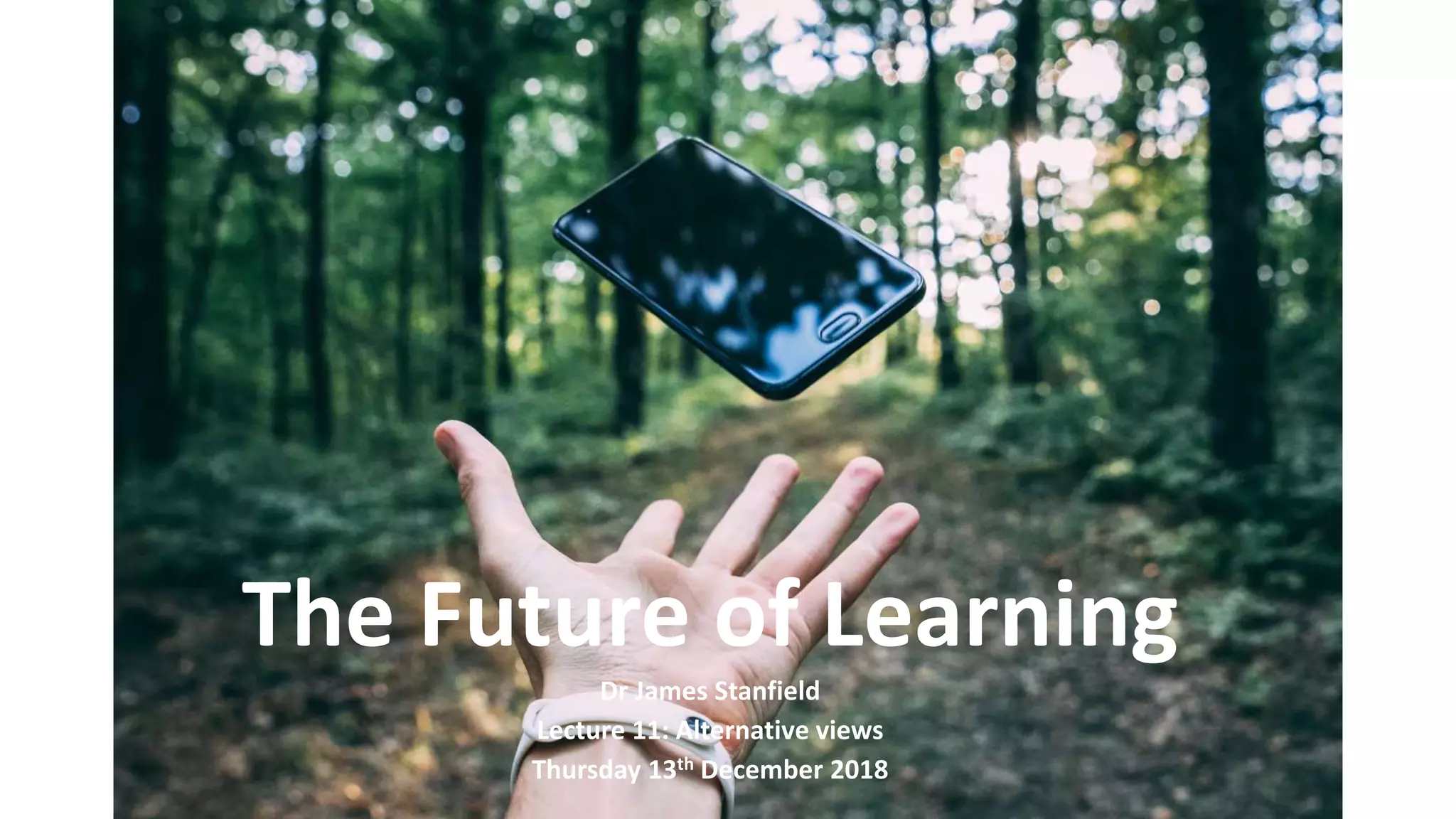
The Future of Learning
Dr James Stanfield
Lecture 11: Alternative views
Thursday 13th December 2018
Plan of Action
Part I: Alternative views
Part 2: OECD Learning Framework
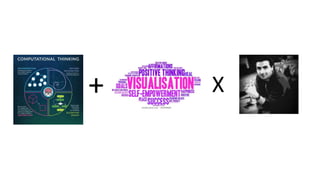
Part 3: Computational Thinking &
Visualisation
Futures thinking offers ways of addressing the future; it is not about
gazing into a crystal ball. It illuminates the ways that policy, strategies and
actions can promote desirable futures and avoid those we consider to be
undesirable. It is about stimulating strategic dialogue, widening our
understanding of the possible, strengthening leadership, and informing
decision-making
It probes beneath the surface of received opinion in order to identify the
dynamics and interactions that are creating the future.
There is a tendency toward short-term thinking in both the public and
the private spheres. In government, election cycles often determine the
time horizon. Futures thinking introduces perspectives to look beyond
the straitjackets of immediate constraints.
Futures thinking can help to create an environment for deeply informed
decision-making, ideally to smooth the transition toward a future with a
sustainable balance between short- and long-term policy goals.
Source: The Starterpack: Futures Thinking in Action (OECD)
Twenty-first-century learning means that students
master content while producing, synthesizing, and
evaluating information from a wide variety of subjects
and sources with an understanding of and respect for
diverse cultures. Students demonstrate the three Rs,
but also the three Cs: creativity, communication, and
collaboration. They demonstrate digital literacy as
well as civic responsibility. Virtual tools and open-
source software create borderless learning territories
for students of all ages, anytime and anywhere
Barnett Berry, Founder and CEO, Center for Teaching Quality
Success in the 21st century requires knowing how
to learn. Students today will likely have several
careers in their lifetime. They must develop strong
critical thinking and interpersonal communication
skills in order to be successful in an increasingly
fluid, interconnected, and complex world.
Karen Cator, Director, Office of Educational Technology, U.S.
Department of Education
It’s no longer enough to “know things.” It’s even more
important to stay curious about finding out things.
The Internet, which has enabled instant global communication
and access to information, likewise holds the key to enacting a
new educational system, where students use information at
their fingertips and work in teams to accomplish more than
what one individual can alone, mirroring the 21st-century
workplace
Milton Chen, Senior Fellow & Executive Director, Emeritus, The
George Lucas Educational Foundation; author of Education Nation: Six
Leading Edges of Innovation in Our Schools
Steve Hargadon, Founder, Classroom 2.0; Social
Learning Consultant, Elluminate
Twenty-first-century learning will ultimately be
“learner-driven.” Our old stories of education (factory-
model, top-down, compliance-driven) are breaking
down or broken, and this is because the Internet is
releasing intellectual energy that comes from our latent
desires as human beings to have a voice, to create, and
to participate.
Loosely governed and highly self-directed, these
teaching and learning activities exist beyond the
sanction or control of formal educational institutions.
Lynne Munson, President and Executive Director,
Common Core
I define 21st-century learning as 20th- (or even 19th!-) century learning
but with better tools. Today’s students are fortunate to have powerful
learning tools at their disposal that allow them to locate, acquire, and
even create knowledge much more quickly than their predecessors. But
being able to Google is no substitute for true understanding. Students
still need to know and deeply understand the history that brought them
and our nation to where we are today. They need to be able to enjoy
man’s greatest artistic and scientific achievements and to speak a
language besides their mother tongue. According to most 21st-century
skills’ advocates, students needn’t actually walk around with such
knowledge in their heads, they need only to have the skills to find it. I
disagree. Twenty-first-century technology should be seen as an
opportunity to acquire more knowledge, not an excuse to know less.
Diane Ravitch, Education Historian; author of The Death
and Life of the Great American School System
To be prepared for the 21st century, our children require the
following skills and knowledge: an understanding of history,
civics, geography, mathematics, and science, so they may
comprehend unforeseen events and act wisely; the ability to
speak, write, and read English well; mastery of a foreign
language; engagement in the arts, to enrich their lives; close
encounters with great literature, to gain insight into timeless
dilemmas and the human condition; a love of learning, so they
continue to develop their minds when their formal schooling
ends; self-discipline, to pursue their goals to completion;
ethical and moral character; the social skills to collaborate
fruitfully with others; the ability to use technology wisely; the
ability to make and repair useful objects, for personal
independence; and the ability to play a musical instrument, for
personal satisfaction.
Susan Rundell Singer, Laurence McKinley Gould
Professor of Natural Sciences, Carleton College
Adaptability, complex communication skills, non-
routine problem solving, self-management, and
systems-thinking are essential skills in the 21st-
century workforce.
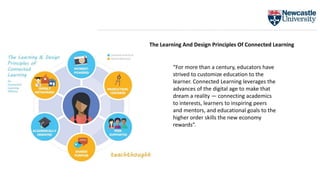
The Learning And Design Principles Of Connected Learning
“For more than a century, educators have
strived to customize education to the
learner. Connected Learning leverages the
advances of the digital age to make that
dream a reality — connecting academics
to interests, learners to inspiring peers
and mentors, and educational goals to the
higher order skills the new economy
rewards”.
1. Interest-Powered - Interests foster the drive to gain knowledge and expertise.
Research has repeatedly shown that when the topic is personally interesting and
relevant, learners achieve much higher-order learning outcomes. Connected
learning views interests and passions that are developed in a social context as
essential elements.
2. Production Centered - learning that comes from actively producing, creating,
experimenting and designing because it promotes skills and dispositions for lifelong
learning and for making meaningful contributions to today’s rapidly changing work
and social conditions.
3. Peer-Supported - Connected learning thrives in a socially meaningful and
knowledge-rich ecology of ongoing participation, self-expression and recognition. In
their everyday exchanges with peers and friends, young people fluidly contribute,
share and give feedback. Powered with possibilities made available by today’s social
media, this peer culture can produce learning that’s engaging and powerful.
6 Design Principles Of Connected Learning
4. Shared Purpose - Today’s social media and web-based communities
provide unprecedented opportunities for caring adults, teachers, parents,
learners and their peers to share interests and contribute to a common
purpose. The potential of cross-generational learning and connection unfolds
when centered on common goals.
5. Academically-Oriented - Connected learning recognizes the importance of
academic success for intellectual growth and as an avenue towards economic
and political opportunity. When academic studies and institutions draw from
and connect to young people’s peer culture, communities and interest-driven
pursuits, learners flourish and realize their true potential.
6. Openly-Networked - Connected learning environments link learning in
school, home and community because learners achieve best when their
learning is reinforced and supported in multiple settings. Online platforms can
make learning resources abundant, accessible and visible across all learner
settings.”
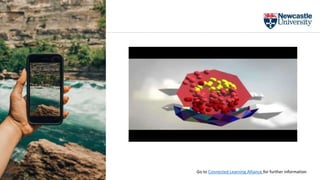
Go to Connected Learning Alliance for further information
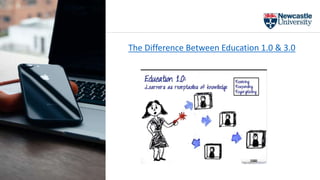
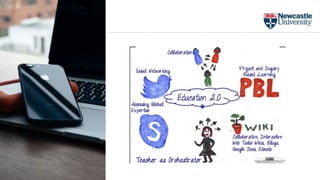
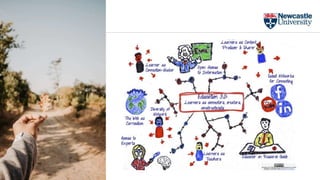
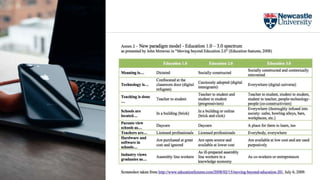
The Difference Between Education 1.0 & 3.0
Derek W. Keats and J. Philipp Schmidt further describe the individual
components of Education 3.0:
Education
• Wide diffusion of eLearning
• Growing interest in alternatives to teacher-centred approaches such as
constructivism (Dewey, 1998), resource-based learning, etc.
• Local, regional, and international collaboration to create repositories of
educational content
• Awareness for the need of recognition of prior learning
• Increasing use of the Internet to find information and just in time learning
Social
• Increasing use of information technologies in daily life and for social purposes
• Increasing social use of online virtual spaces
• A new definition of self and society that includes computer-mediated social
structures, and people outside of one’s immediate physical environment
Technology
• The widespread adoption of personal computers and the Internet
(especially e-mail and the World Wide Web)
• The emergence of Web 2.0, including blogs, podcasts, social
interaction tools, etc.
• E-Learning platforms or learning management systems that
incorporate features of Web 2.0
• Free and open source software
Legal
• The development of alternative licensing mechanisms to
traditional copyright, which promote the use and reuse of
(educational) content without requiring further explicit permission
by the author or copyright holder or payment of royalties.
Students will need to develop curiosity, imagination, resilience and self
regulation; they will need to respect and appreciate the ideas, perspectives
and values of others; and they will need to cope with failure and rejection, and
to move forward in the face of adversity.
Their motivation will be more than getting a good job and a high income; they
will also need to care about the well-being of their friends and families, their
communities and the planet.
Education can equip learners with agency and a sense of purpose, and the
competencies they need, to shape their own lives and contribute to the lives
of others.
OECD Learning Framework 2030
• What knowledge, skills, attitudes and values will today's students need
to thrive and shape their world?
• How can instructional systems develop these knowledge, skills, attitudes
and values effectively?
Offers a vision and
some underpinning
principles for the
future of education
systems
OECD Learning Framework 2030
Need for new solutions in a rapidly changing world
• Environment
• Economic
• Social
Need for broader education goals: Individual and collective well-being
Well being, quality of life, including health, civic engagement, social
connections, education, security, life satisfaction and the environment.
Equitable access to all of these underpins the concept of inclusive
growth.
Education needs to aim to do more than prepare young people for the
world of work; it needs to equip students with the skills they need to
become active, responsible and engaged citizens.
OECD Learning Framework 2030
Learner agency: Navigating through a complex and uncertain world
• personalised learning environment that supports and motivates each
student to nurture his or her passions, make connections between
different learning experiences and opportunities, and design their own
learning projects and processes in collaboration with others. The
second is building
• a solid foundation: literacy and numeracy remain crucial. In the era of
digital transformation and with the advent of big data, digital literacy
and data literacy are becoming increasingly essential, as are physical
health and mental well-being.
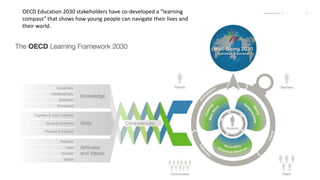
OECD Learning Framework 2030
OECD Education 2030 stakeholders have co-developed a “learning
compass” that shows how young people can navigate their lives and
their world.
OECD Learning Framework 2030
Need for a broad set of knowledge, skills, attitudes and values in action
Students who are best prepared for the future are change agents. They can
have a positive impact on their surroundings, influence the future,
understand others' intentions, actions and feelings, and anticipate the short
and long-term consequences of what they do.
Competencies to transform our society and shape our future
Building on the OECD Key Competencies the OECD Education 2030 project
has identified three further categories of competencies, the "Transformative
Competencies", that together address the growing need for young people to
be innovative, responsible and aware:
• Creating new value
• Reconciling tensions and dilemmas
• Taking
OECD Learning Framework 2030
Concept, content and topic design:
• Student agency. The curriculum should be designed around students to
motivate them and recognise their prior knowledge, skills, attitudes and
values.
• Rigour. Topics should be challenging and enable deep thinking and
reflection.
• Focus. A relatively small number of topics should be introduced in each
grade to ensure the depth and quality of students’ learning. Topics may
overlap in order to reinforce key concepts.
• Coherence. Topics should be sequenced to reflect the logic of the academic
discipline or disciplines on which they draw, enabling progression from basic
to more advanced concepts through stages and age levels.
OECD Learning Framework 2030
• Alignment. The curriculum should be well-aligned with teaching
and assessment practices. While the technologies to assess many
of the desired outcomes do not yet exist, different assessment
practices might be needed for different purposes. New assessment
methods should be developed that value student outcomes and
actions that cannot always be measured.
• Transferability. Higher priority should be given to knowledge, skills,
attitudes and values that can be learned in one context and
transferred to others.
• Choice. Students should be offered a diverse range of topic and
project options, and the opportunity to suggest their own topics
and projects, with the support to make well-informed choices.
OECD Learning Framework 2030
Process design:
• Teacher agency. Teachers should be empowered to use their
professional knowledge, skills and expertise to deliver the curriculum
effectively.
• Authenticity. Learners should be able to link their learning experiences
to the real world and have a sense of purpose in their learning. This
requires interdisciplinary and collaborative learning alongside mastery of
discipline-based knowledge.
OECD Learning Framework 2030
• Inter-relation. Learners should be given opportunities to discover
how a topic or concept can link and connect to other topics or
concepts within and across disciplines, and with real life outside of
school.
• Flexibility. The concept of "curriculum" should be developed from
"predetermined and static" to "adaptable and dynamic". Schools and
teachers should be able to update and align the curriculum to reflect
evolving societal requirements as well as individual learning needs.
• Engagement. Teachers, students and other relevant stakeholders
should be involved early in the development of the curriculum, to
ensure their ownership for implementation.
+ X
#edu8213

Future of Learning - Lecture 11

  • 1.
    The Future ofLearning Dr James Stanfield Lecture 11: Alternative views Thursday 13th December 2018
  • 2.
    Plan of Action PartI: Alternative views Part 2: OECD Learning Framework Part 3: Computational Thinking & Visualisation
  • 3.
    Futures thinking offersways of addressing the future; it is not about gazing into a crystal ball. It illuminates the ways that policy, strategies and actions can promote desirable futures and avoid those we consider to be undesirable. It is about stimulating strategic dialogue, widening our understanding of the possible, strengthening leadership, and informing decision-making It probes beneath the surface of received opinion in order to identify the dynamics and interactions that are creating the future. There is a tendency toward short-term thinking in both the public and the private spheres. In government, election cycles often determine the time horizon. Futures thinking introduces perspectives to look beyond the straitjackets of immediate constraints. Futures thinking can help to create an environment for deeply informed decision-making, ideally to smooth the transition toward a future with a sustainable balance between short- and long-term policy goals. Source: The Starterpack: Futures Thinking in Action (OECD)
  • 4.
    Twenty-first-century learning meansthat students master content while producing, synthesizing, and evaluating information from a wide variety of subjects and sources with an understanding of and respect for diverse cultures. Students demonstrate the three Rs, but also the three Cs: creativity, communication, and collaboration. They demonstrate digital literacy as well as civic responsibility. Virtual tools and open- source software create borderless learning territories for students of all ages, anytime and anywhere Barnett Berry, Founder and CEO, Center for Teaching Quality
  • 5.
    Success in the21st century requires knowing how to learn. Students today will likely have several careers in their lifetime. They must develop strong critical thinking and interpersonal communication skills in order to be successful in an increasingly fluid, interconnected, and complex world. Karen Cator, Director, Office of Educational Technology, U.S. Department of Education
  • 6.
    It’s no longerenough to “know things.” It’s even more important to stay curious about finding out things. The Internet, which has enabled instant global communication and access to information, likewise holds the key to enacting a new educational system, where students use information at their fingertips and work in teams to accomplish more than what one individual can alone, mirroring the 21st-century workplace Milton Chen, Senior Fellow & Executive Director, Emeritus, The George Lucas Educational Foundation; author of Education Nation: Six Leading Edges of Innovation in Our Schools
  • 7.
    Steve Hargadon, Founder,Classroom 2.0; Social Learning Consultant, Elluminate Twenty-first-century learning will ultimately be “learner-driven.” Our old stories of education (factory- model, top-down, compliance-driven) are breaking down or broken, and this is because the Internet is releasing intellectual energy that comes from our latent desires as human beings to have a voice, to create, and to participate. Loosely governed and highly self-directed, these teaching and learning activities exist beyond the sanction or control of formal educational institutions.
  • 8.
    Lynne Munson, Presidentand Executive Director, Common Core I define 21st-century learning as 20th- (or even 19th!-) century learning but with better tools. Today’s students are fortunate to have powerful learning tools at their disposal that allow them to locate, acquire, and even create knowledge much more quickly than their predecessors. But being able to Google is no substitute for true understanding. Students still need to know and deeply understand the history that brought them and our nation to where we are today. They need to be able to enjoy man’s greatest artistic and scientific achievements and to speak a language besides their mother tongue. According to most 21st-century skills’ advocates, students needn’t actually walk around with such knowledge in their heads, they need only to have the skills to find it. I disagree. Twenty-first-century technology should be seen as an opportunity to acquire more knowledge, not an excuse to know less.
  • 9.
    Diane Ravitch, EducationHistorian; author of The Death and Life of the Great American School System To be prepared for the 21st century, our children require the following skills and knowledge: an understanding of history, civics, geography, mathematics, and science, so they may comprehend unforeseen events and act wisely; the ability to speak, write, and read English well; mastery of a foreign language; engagement in the arts, to enrich their lives; close encounters with great literature, to gain insight into timeless dilemmas and the human condition; a love of learning, so they continue to develop their minds when their formal schooling ends; self-discipline, to pursue their goals to completion; ethical and moral character; the social skills to collaborate fruitfully with others; the ability to use technology wisely; the ability to make and repair useful objects, for personal independence; and the ability to play a musical instrument, for personal satisfaction.
  • 10.
    Susan Rundell Singer,Laurence McKinley Gould Professor of Natural Sciences, Carleton College Adaptability, complex communication skills, non- routine problem solving, self-management, and systems-thinking are essential skills in the 21st- century workforce.
  • 11.
    The Learning AndDesign Principles Of Connected Learning “For more than a century, educators have strived to customize education to the learner. Connected Learning leverages the advances of the digital age to make that dream a reality — connecting academics to interests, learners to inspiring peers and mentors, and educational goals to the higher order skills the new economy rewards”.
  • 12.
    1. Interest-Powered -Interests foster the drive to gain knowledge and expertise. Research has repeatedly shown that when the topic is personally interesting and relevant, learners achieve much higher-order learning outcomes. Connected learning views interests and passions that are developed in a social context as essential elements. 2. Production Centered - learning that comes from actively producing, creating, experimenting and designing because it promotes skills and dispositions for lifelong learning and for making meaningful contributions to today’s rapidly changing work and social conditions. 3. Peer-Supported - Connected learning thrives in a socially meaningful and knowledge-rich ecology of ongoing participation, self-expression and recognition. In their everyday exchanges with peers and friends, young people fluidly contribute, share and give feedback. Powered with possibilities made available by today’s social media, this peer culture can produce learning that’s engaging and powerful. 6 Design Principles Of Connected Learning
  • 13.
    4. Shared Purpose- Today’s social media and web-based communities provide unprecedented opportunities for caring adults, teachers, parents, learners and their peers to share interests and contribute to a common purpose. The potential of cross-generational learning and connection unfolds when centered on common goals. 5. Academically-Oriented - Connected learning recognizes the importance of academic success for intellectual growth and as an avenue towards economic and political opportunity. When academic studies and institutions draw from and connect to young people’s peer culture, communities and interest-driven pursuits, learners flourish and realize their true potential. 6. Openly-Networked - Connected learning environments link learning in school, home and community because learners achieve best when their learning is reinforced and supported in multiple settings. Online platforms can make learning resources abundant, accessible and visible across all learner settings.” Go to Connected Learning Alliance for further information
  • 14.
    Go to ConnectedLearning Alliance for further information
  • 15.
    The Difference BetweenEducation 1.0 & 3.0
  • 18.
    Derek W. Keatsand J. Philipp Schmidt further describe the individual components of Education 3.0: Education • Wide diffusion of eLearning • Growing interest in alternatives to teacher-centred approaches such as constructivism (Dewey, 1998), resource-based learning, etc. • Local, regional, and international collaboration to create repositories of educational content • Awareness for the need of recognition of prior learning • Increasing use of the Internet to find information and just in time learning Social • Increasing use of information technologies in daily life and for social purposes • Increasing social use of online virtual spaces • A new definition of self and society that includes computer-mediated social structures, and people outside of one’s immediate physical environment
  • 19.
    Technology • The widespreadadoption of personal computers and the Internet (especially e-mail and the World Wide Web) • The emergence of Web 2.0, including blogs, podcasts, social interaction tools, etc. • E-Learning platforms or learning management systems that incorporate features of Web 2.0 • Free and open source software Legal • The development of alternative licensing mechanisms to traditional copyright, which promote the use and reuse of (educational) content without requiring further explicit permission by the author or copyright holder or payment of royalties.
  • 21.
    Students will needto develop curiosity, imagination, resilience and self regulation; they will need to respect and appreciate the ideas, perspectives and values of others; and they will need to cope with failure and rejection, and to move forward in the face of adversity. Their motivation will be more than getting a good job and a high income; they will also need to care about the well-being of their friends and families, their communities and the planet. Education can equip learners with agency and a sense of purpose, and the competencies they need, to shape their own lives and contribute to the lives of others. OECD Learning Framework 2030 • What knowledge, skills, attitudes and values will today's students need to thrive and shape their world? • How can instructional systems develop these knowledge, skills, attitudes and values effectively? Offers a vision and some underpinning principles for the future of education systems
  • 22.
    OECD Learning Framework2030 Need for new solutions in a rapidly changing world • Environment • Economic • Social Need for broader education goals: Individual and collective well-being Well being, quality of life, including health, civic engagement, social connections, education, security, life satisfaction and the environment. Equitable access to all of these underpins the concept of inclusive growth. Education needs to aim to do more than prepare young people for the world of work; it needs to equip students with the skills they need to become active, responsible and engaged citizens.
  • 23.
    OECD Learning Framework2030 Learner agency: Navigating through a complex and uncertain world • personalised learning environment that supports and motivates each student to nurture his or her passions, make connections between different learning experiences and opportunities, and design their own learning projects and processes in collaboration with others. The second is building • a solid foundation: literacy and numeracy remain crucial. In the era of digital transformation and with the advent of big data, digital literacy and data literacy are becoming increasingly essential, as are physical health and mental well-being.
  • 24.
    OECD Learning Framework2030 OECD Education 2030 stakeholders have co-developed a “learning compass” that shows how young people can navigate their lives and their world.
  • 25.
    OECD Learning Framework2030 Need for a broad set of knowledge, skills, attitudes and values in action Students who are best prepared for the future are change agents. They can have a positive impact on their surroundings, influence the future, understand others' intentions, actions and feelings, and anticipate the short and long-term consequences of what they do. Competencies to transform our society and shape our future Building on the OECD Key Competencies the OECD Education 2030 project has identified three further categories of competencies, the "Transformative Competencies", that together address the growing need for young people to be innovative, responsible and aware: • Creating new value • Reconciling tensions and dilemmas • Taking
  • 26.
    OECD Learning Framework2030 Concept, content and topic design: • Student agency. The curriculum should be designed around students to motivate them and recognise their prior knowledge, skills, attitudes and values. • Rigour. Topics should be challenging and enable deep thinking and reflection. • Focus. A relatively small number of topics should be introduced in each grade to ensure the depth and quality of students’ learning. Topics may overlap in order to reinforce key concepts. • Coherence. Topics should be sequenced to reflect the logic of the academic discipline or disciplines on which they draw, enabling progression from basic to more advanced concepts through stages and age levels.
  • 27.
    OECD Learning Framework2030 • Alignment. The curriculum should be well-aligned with teaching and assessment practices. While the technologies to assess many of the desired outcomes do not yet exist, different assessment practices might be needed for different purposes. New assessment methods should be developed that value student outcomes and actions that cannot always be measured. • Transferability. Higher priority should be given to knowledge, skills, attitudes and values that can be learned in one context and transferred to others. • Choice. Students should be offered a diverse range of topic and project options, and the opportunity to suggest their own topics and projects, with the support to make well-informed choices.
  • 28.
    OECD Learning Framework2030 Process design: • Teacher agency. Teachers should be empowered to use their professional knowledge, skills and expertise to deliver the curriculum effectively. • Authenticity. Learners should be able to link their learning experiences to the real world and have a sense of purpose in their learning. This requires interdisciplinary and collaborative learning alongside mastery of discipline-based knowledge.
  • 29.
    OECD Learning Framework2030 • Inter-relation. Learners should be given opportunities to discover how a topic or concept can link and connect to other topics or concepts within and across disciplines, and with real life outside of school. • Flexibility. The concept of "curriculum" should be developed from "predetermined and static" to "adaptable and dynamic". Schools and teachers should be able to update and align the curriculum to reflect evolving societal requirements as well as individual learning needs. • Engagement. Teachers, students and other relevant stakeholders should be involved early in the development of the curriculum, to ensure their ownership for implementation.
  • 30.
  • 31.