Using a concerns-based
approach to
professional
development
ASK
What do you think are the
characteristics of a successful
PD programme?
• Relevant
• Sustained
• In-depth
• Personalised
• Authentic
• Applied
• In context
• Engaging
• Over time
SOME MODELS TO CONSIDER…
• Whole staff/school wide
• Syndicates
• Mentor teachers
• Trickle down
• Just-in-time
• Reward innovation
• Which have you experienced?
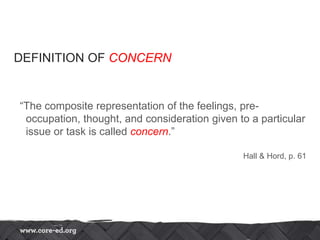
DEFINITION OF CONCERN
“The composite representation of the feelings, pre-
occupation, thought, and consideration given to a particular
issue or task is called concern.”
Hall & Hord, p. 61
OPEN-ENDED STATEMENT
“When you think about [innovation] what
concerns do you have? Please be frank, and
answer in complete sentences.”
Hall & Hord, p. 68
CATERING FOR LEVELS OF CONCERN
• Concerns Based Adoption Model (CBAM)
• 7 levels that cater for the level of concern of
each member of staff
• Awareness
• Informational
• Personal
• Management
• Consequences
• Collaboration
• Refocusing
AWARENESS
• "I don't know anything about ICT and am not interested“
• The main focus for staff development at this level of
concern is raising awareness.
• Strategies include: displays, notice-boards, orientation
programmes, presentations.
INFORMATIONAL
• "I don't know a great deal but would like to know
more".
• The main emphasis at this stage is providing
information
• Strategies include: brochures/pamphlets,
tours/visits, starter kits, newsletters.
PERSONAL
• "I'm not really sure I can do it. How will this affect me?“
• The main focus at this level is establishing relationships
and support.
• Strategies include: one-on-one assistance, functional
relationships with key resource people
MANAGEMENT
• "getting organised takes all my time".
• The main focus at this level is demonstrating procedures
• Strategies include: procedures for accessing software,
hardware, peripherals, technical help etc. Also,
templates, shared files/clipart, policies.
CONSEQUENCES
• "How can I improve my work to increase student
performance?“
• The main focus of this level is clarifying and evaluating
effective teaching techniques
• Strategies include: seminars, workshops, professional
reading, library resources, internal ‘help’ publications
COLLABORATION
• "How can I work with others to make a greater
impact?
• The main focus of this level is disseminating ideas
and working with others
• Strategies include: peer networks (buddies),
seminars, conference presentations, contributions to
staff meetings & newsletters
REFOCUSING
• I know a better way.“
• Those working at this level are able to
concentrate their efforts on new
developments.
• Need to provide background information in
the form of research findings, readings etc.
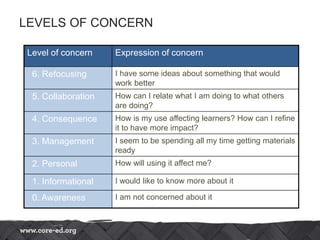
LEVELS OF CONCERN
Level of concern Expression of concern
6. Refocusing I have some ideas about something that would
work better
5. Collaboration How can I relate what I am doing to what others
are doing?
4. Consequence How is my use affecting learners? How can I refine
it to have more impact?
3. Management I seem to be spending all my time getting materials
ready
2. Personal How will using it affect me?
1. Informational I would like to know more about it
0. Awareness I am not concerned about it
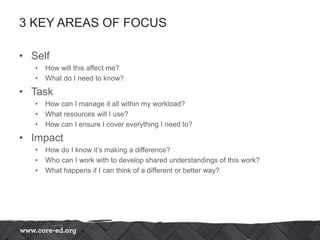
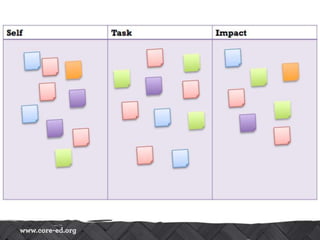
3 KEY AREAS OF FOCUS
• Self
• How will this affect me?
• What do I need to know?
• Task
• How can I manage it all within my workload?
• What resources will I use?
• How can I ensure I cover everything I need to?
• Impact
• How do I know it’s making a difference?
• Who can I work with to develop shared understandings of this work?
• What happens if I can think of a different or better way?
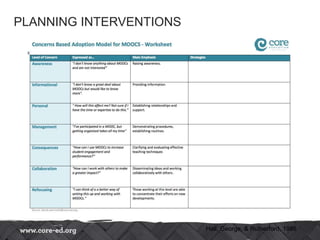
PLANNING INTERVENTIONS
Hall, George, & Rutherford, 1986
Talking Points
Think about planning a professional development
workshop in your organisation. . .
• How were the participants’ concerns identified?
• How did the PD programme match the concerns of
the individuals?
Derek Wenmoth
Email: derek@core-ed.org
Blog: http://blog.core-ed.org/derek
Skype: <dwenmoth>

Cbam outline

  • 1.
    Using a concerns-based approachto professional development
  • 2.
    ASK What do youthink are the characteristics of a successful PD programme? • Relevant • Sustained • In-depth • Personalised • Authentic • Applied • In context • Engaging • Over time
  • 3.
    SOME MODELS TOCONSIDER… • Whole staff/school wide • Syndicates • Mentor teachers • Trickle down • Just-in-time • Reward innovation • Which have you experienced?
  • 4.
    DEFINITION OF CONCERN “Thecomposite representation of the feelings, pre- occupation, thought, and consideration given to a particular issue or task is called concern.” Hall & Hord, p. 61
  • 5.
    OPEN-ENDED STATEMENT “When youthink about [innovation] what concerns do you have? Please be frank, and answer in complete sentences.” Hall & Hord, p. 68
  • 6.
    CATERING FOR LEVELSOF CONCERN • Concerns Based Adoption Model (CBAM) • 7 levels that cater for the level of concern of each member of staff • Awareness • Informational • Personal • Management • Consequences • Collaboration • Refocusing
  • 7.
    AWARENESS • "I don'tknow anything about ICT and am not interested“ • The main focus for staff development at this level of concern is raising awareness. • Strategies include: displays, notice-boards, orientation programmes, presentations.
  • 8.
    INFORMATIONAL • "I don'tknow a great deal but would like to know more". • The main emphasis at this stage is providing information • Strategies include: brochures/pamphlets, tours/visits, starter kits, newsletters.
  • 9.
    PERSONAL • "I'm notreally sure I can do it. How will this affect me?“ • The main focus at this level is establishing relationships and support. • Strategies include: one-on-one assistance, functional relationships with key resource people
  • 10.
    MANAGEMENT • "getting organisedtakes all my time". • The main focus at this level is demonstrating procedures • Strategies include: procedures for accessing software, hardware, peripherals, technical help etc. Also, templates, shared files/clipart, policies.
  • 11.
    CONSEQUENCES • "How canI improve my work to increase student performance?“ • The main focus of this level is clarifying and evaluating effective teaching techniques • Strategies include: seminars, workshops, professional reading, library resources, internal ‘help’ publications
  • 12.
    COLLABORATION • "How canI work with others to make a greater impact? • The main focus of this level is disseminating ideas and working with others • Strategies include: peer networks (buddies), seminars, conference presentations, contributions to staff meetings & newsletters
  • 13.
    REFOCUSING • I knowa better way.“ • Those working at this level are able to concentrate their efforts on new developments. • Need to provide background information in the form of research findings, readings etc.
  • 14.
    LEVELS OF CONCERN Levelof concern Expression of concern 6. Refocusing I have some ideas about something that would work better 5. Collaboration How can I relate what I am doing to what others are doing? 4. Consequence How is my use affecting learners? How can I refine it to have more impact? 3. Management I seem to be spending all my time getting materials ready 2. Personal How will using it affect me? 1. Informational I would like to know more about it 0. Awareness I am not concerned about it
  • 15.
    3 KEY AREASOF FOCUS • Self • How will this affect me? • What do I need to know? • Task • How can I manage it all within my workload? • What resources will I use? • How can I ensure I cover everything I need to? • Impact • How do I know it’s making a difference? • Who can I work with to develop shared understandings of this work? • What happens if I can think of a different or better way?
  • 17.
  • 18.
    Talking Points Think aboutplanning a professional development workshop in your organisation. . . • How were the participants’ concerns identified? • How did the PD programme match the concerns of the individuals?
  • 19.
    Derek Wenmoth Email: derek@core-ed.org Blog:http://blog.core-ed.org/derek Skype: <dwenmoth>

Editor's Notes