


Dr. Shivananda (Shivoo) R Koteshwar
Design Group Digital Implementation Site Leader and R&D Head
Synopsys India
LINKEDIN : https://in.linkedin.com/in/shivoo2life
FACEBOOK : shivoo.koteshwar
SLIDESHARE : www.slideshare.net/shivoo.koteshwar
CFAL, Mangalore
January 2019
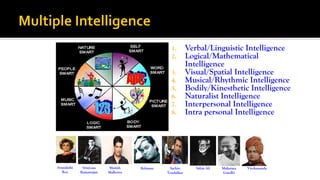
1. Verbal/Linguistic Intelligence
2. Logical/Mathematical
Intelligence
3. Visual/Spatial Intelligence
4. Musical/Rhythmic Intelligence
5. Bodily/Kinesthetic Intelligence
6. Naturalist Intelligence
7. Interpersonal Intelligence
8. Intra personal Intelligence
Arundathi
Roy
Srinivasa
Ramanujan
Manish
Malhotra
Rehman Sachin
Tendulkar
Salim Ali Mahatma
Gandhi
Vivekananda
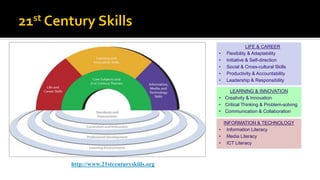
http://www.21stcenturyskills.org
LEARNING & INNOVATION
• Creativity & Innovation
• Critical Thinking & Problem-solving
• Communication & Collaboration
LIFE & CAREER
• Flexibility & Adaptability
• Initiative & Self-direction
• Social & Cross-cultural Skills
• Productivity & Accountability
• Leadership & Responsibility
INFORMATION & TECHNOLOGY
• Information Literacy
• Media Literacy
• ICT Literacy
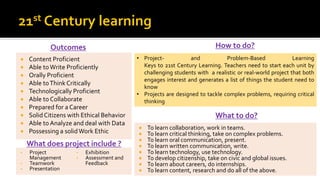
 Content Proficient
 Able toWrite Proficiently
 Orally Proficient
 Able toThinkCritically
 Technologically Proficient
 Able to Collaborate
 Prepared for a Career
 Solid Citizens with Ethical Behavior
 Able to Analyze and deal with Data
 Possessing a solidWork Ethic
Outcomes
• Project- and Problem-Based Learning
Keys to 21st Century Learning. Teachers need to start each unit by
challenging students with a realistic or real-world project that both
engages interest and generates a list of things the student need to
know
• Projects are designed to tackle complex problems, requiring critical
thinking
How to do?
 To learn collaboration, work in teams.
 To learn critical thinking, take on complex problems.
 To learn oral communication, present.
 To learn written communication, write.
 To learn technology, use technology.
 To develop citizenship, take on civic and global issues.
 To learn about careers, do internships.
 To learn content, research and do all of the above.
What to do?
• Project
Management
• Teamwork
• Presentation
• Exhibition
• Assessment and
Feedback
What does project include ?
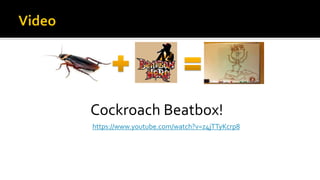
Cockroach Beatbox!
https://www.youtube.com/watch?v=z4jTTyKcrp8
What all do you
learn from this
short video?
 Chemistry
 Biology
 Physics
 Electronics
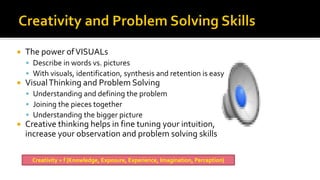
 The power ofVISUALs
▪ Describe in words vs. pictures
▪ With visuals, identification, synthesis and retention is easy
 VisualThinking and Problem Solving
▪ Understanding and defining the problem
▪ Joining the pieces together
▪ Understanding the bigger picture
 Creative thinking helps in fine tuning your intuition,
increase your observation and problem solving skills
Creativity = f {Knowledge, Exposure, Experience, Imagination, Perception}
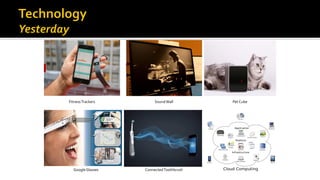
FitnessTrackers SoundWall Pet Cube
Google Glasses ConnectedToothbrush
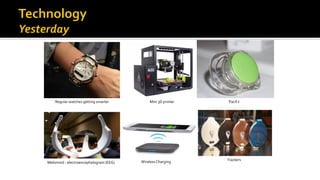
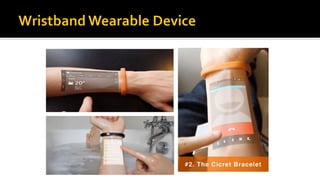
Regular watches getting smarter Mini 3D printer Pacif-I
Melomind - electroencephalogram (EEG)
Trackers
Wireless Charging
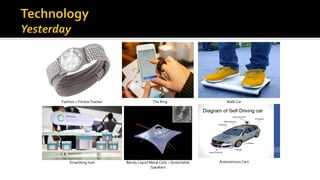
Fashion + FitnessTracker The Ring Walk Car
Smarthing Hub Bendy Liquid Metal Coils – Stretchable
Speakers
Autonomous Cars
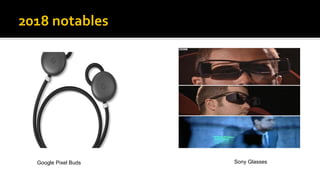
Google Pixel Buds Sony Glasses
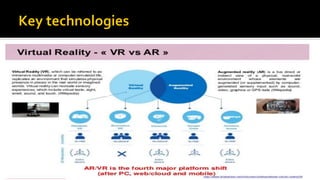
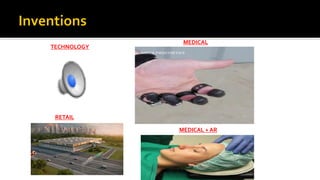
TECHNOLOGY
MEDICAL
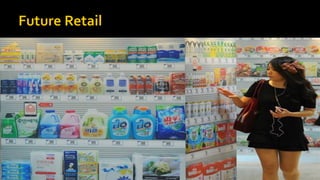
RETAIL
MEDICAL + AR
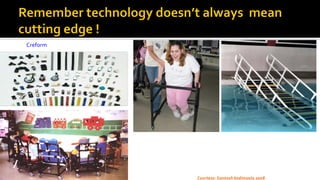
 Technology means the application of scientific knowledge for
practical purposes
LowVision Magnifier
Courtesy: Santosh kodimyala 2008
Creform
Courtesy: Santosh kodimyala 2008
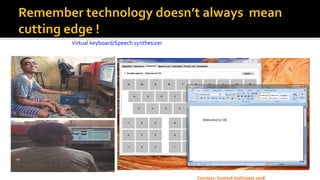
Virtual keyboard/Speech synthesizer
Courtesy: Santosh kodimyala 2008
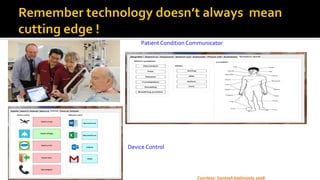
Patient Condition Communicator
Device Control
Courtesy: Santosh kodimyala 2008
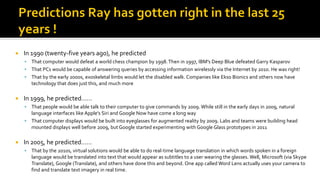
 In 1990 (twenty-five years ago), he predicted
▪ That computer would defeat a world chess champion by 1998.Then in 1997, IBM’s Deep Blue defeated Garry Kasparov
▪ That PCs would be capable of answering queries by accessing information wirelessly via the Internet by 2010. He was right!
▪ That by the early 2000s, exoskeletal limbs would let the disabled walk. Companies like Ekso Bionics and others now have
technology that does just this, and much more
 In 1999, he predicted……
▪ That people would be able talk to their computer to give commands by 2009. While still in the early days in 2009, natural
language interfaces like Apple’s Siri and Google Now have come a long way
▪ That computer displays would be built into eyeglasses for augmented reality by 2009. Labs and teams were building head
mounted displays well before 2009, but Google started experimenting with Google Glass prototypes in 2011
 In 2005, he predicted……
▪ That by the 2010s, virtual solutions would be able to do real-time language translation in which words spoken in a foreign
language would be translated into text that would appear as subtitles to a user wearing the glasses. Well, Microsoft (via Skype
Translate), Google (Translate), and others have done this and beyond. One app called Word Lens actually uses your camera to
find and translate text imagery in real time.
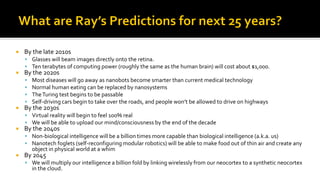
 By the late 2010s
▪ Glasses will beam images directly onto the retina.
▪ Ten terabytes of computing power (roughly the same as the human brain) will cost about $1,000.
 By the 2020s
▪ Most diseases will go away as nanobots become smarter than current medical technology
▪ Normal human eating can be replaced by nanosystems
▪ TheTuring test begins to be passable
▪ Self-driving cars begin to take over the roads, and people won’t be allowed to drive on highways
 By the 2030s
▪ Virtual reality will begin to feel 100% real
▪ We will be able to upload our mind/consciousness by the end of the decade
 By the 2040s
▪ Non-biological intelligence will be a billion times more capable than biological intelligence (a.k.a. us)
▪ Nanotech foglets (self-reconfiguring modular robotics) will be able to make food out of thin air and create any
object in physical world at a whim
 By 2045
▪ We will multiply our intelligence a billion fold by linking wirelessly from our neocortex to a synthetic neocortex
in the cloud.
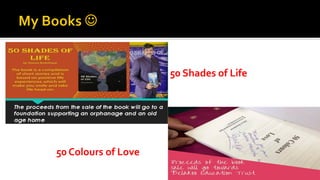
50 Shades of Life
50 Colours of Love
 Belakoo Education Trust offers free quality education for
underprivileged children. We run STEAM programs for
Government School kids substituting their learnings at school.
 We participate in Skill Development Program for students under
various running central/stage level schemes
https://www.facebook.com/belakootrust/
All pictures are from flickr.com with either
copyright or with common creatives
Visit my slideshare to view all
these presentations
Dr. Shivananda (Shivoo) R Koteshwar
FACEBOOK: shivoo.koteshwar
LINKEDIN: https://in.linkedin.com/in/shivoo2life
SLIDESHARE: www.slideshare.net/shivoo.koteshwar

Creating those dots

  • 1.
    Dr. Shivananda (Shivoo)R Koteshwar Design Group Digital Implementation Site Leader and R&D Head Synopsys India LINKEDIN : https://in.linkedin.com/in/shivoo2life FACEBOOK : shivoo.koteshwar SLIDESHARE : www.slideshare.net/shivoo.koteshwar CFAL, Mangalore January 2019
  • 3.
    1. Verbal/Linguistic Intelligence 2.Logical/Mathematical Intelligence 3. Visual/Spatial Intelligence 4. Musical/Rhythmic Intelligence 5. Bodily/Kinesthetic Intelligence 6. Naturalist Intelligence 7. Interpersonal Intelligence 8. Intra personal Intelligence Arundathi Roy Srinivasa Ramanujan Manish Malhotra Rehman Sachin Tendulkar Salim Ali Mahatma Gandhi Vivekananda
  • 4.
    http://www.21stcenturyskills.org LEARNING & INNOVATION •Creativity & Innovation • Critical Thinking & Problem-solving • Communication & Collaboration LIFE & CAREER • Flexibility & Adaptability • Initiative & Self-direction • Social & Cross-cultural Skills • Productivity & Accountability • Leadership & Responsibility INFORMATION & TECHNOLOGY • Information Literacy • Media Literacy • ICT Literacy
  • 5.
     Content Proficient Able toWrite Proficiently  Orally Proficient  Able toThinkCritically  Technologically Proficient  Able to Collaborate  Prepared for a Career  Solid Citizens with Ethical Behavior  Able to Analyze and deal with Data  Possessing a solidWork Ethic Outcomes • Project- and Problem-Based Learning Keys to 21st Century Learning. Teachers need to start each unit by challenging students with a realistic or real-world project that both engages interest and generates a list of things the student need to know • Projects are designed to tackle complex problems, requiring critical thinking How to do?  To learn collaboration, work in teams.  To learn critical thinking, take on complex problems.  To learn oral communication, present.  To learn written communication, write.  To learn technology, use technology.  To develop citizenship, take on civic and global issues.  To learn about careers, do internships.  To learn content, research and do all of the above. What to do? • Project Management • Teamwork • Presentation • Exhibition • Assessment and Feedback What does project include ?
  • 6.
  • 7.
    What all doyou learn from this short video?  Chemistry  Biology  Physics  Electronics
  • 8.
     The powerofVISUALs ▪ Describe in words vs. pictures ▪ With visuals, identification, synthesis and retention is easy  VisualThinking and Problem Solving ▪ Understanding and defining the problem ▪ Joining the pieces together ▪ Understanding the bigger picture  Creative thinking helps in fine tuning your intuition, increase your observation and problem solving skills Creativity = f {Knowledge, Exposure, Experience, Imagination, Perception}
  • 17.
    FitnessTrackers SoundWall PetCube Google Glasses ConnectedToothbrush
  • 18.
    Regular watches gettingsmarter Mini 3D printer Pacif-I Melomind - electroencephalogram (EEG) Trackers Wireless Charging
  • 19.
    Fashion + FitnessTrackerThe Ring Walk Car Smarthing Hub Bendy Liquid Metal Coils – Stretchable Speakers Autonomous Cars
  • 24.
    Google Pixel BudsSony Glasses
  • 26.
  • 27.
     Technology meansthe application of scientific knowledge for practical purposes LowVision Magnifier Courtesy: Santosh kodimyala 2008
  • 28.
  • 29.
  • 30.
    Patient Condition Communicator DeviceControl Courtesy: Santosh kodimyala 2008
  • 32.
     In 1990(twenty-five years ago), he predicted ▪ That computer would defeat a world chess champion by 1998.Then in 1997, IBM’s Deep Blue defeated Garry Kasparov ▪ That PCs would be capable of answering queries by accessing information wirelessly via the Internet by 2010. He was right! ▪ That by the early 2000s, exoskeletal limbs would let the disabled walk. Companies like Ekso Bionics and others now have technology that does just this, and much more  In 1999, he predicted…… ▪ That people would be able talk to their computer to give commands by 2009. While still in the early days in 2009, natural language interfaces like Apple’s Siri and Google Now have come a long way ▪ That computer displays would be built into eyeglasses for augmented reality by 2009. Labs and teams were building head mounted displays well before 2009, but Google started experimenting with Google Glass prototypes in 2011  In 2005, he predicted…… ▪ That by the 2010s, virtual solutions would be able to do real-time language translation in which words spoken in a foreign language would be translated into text that would appear as subtitles to a user wearing the glasses. Well, Microsoft (via Skype Translate), Google (Translate), and others have done this and beyond. One app called Word Lens actually uses your camera to find and translate text imagery in real time.
  • 33.
     By thelate 2010s ▪ Glasses will beam images directly onto the retina. ▪ Ten terabytes of computing power (roughly the same as the human brain) will cost about $1,000.  By the 2020s ▪ Most diseases will go away as nanobots become smarter than current medical technology ▪ Normal human eating can be replaced by nanosystems ▪ TheTuring test begins to be passable ▪ Self-driving cars begin to take over the roads, and people won’t be allowed to drive on highways  By the 2030s ▪ Virtual reality will begin to feel 100% real ▪ We will be able to upload our mind/consciousness by the end of the decade  By the 2040s ▪ Non-biological intelligence will be a billion times more capable than biological intelligence (a.k.a. us) ▪ Nanotech foglets (self-reconfiguring modular robotics) will be able to make food out of thin air and create any object in physical world at a whim  By 2045 ▪ We will multiply our intelligence a billion fold by linking wirelessly from our neocortex to a synthetic neocortex in the cloud.
  • 37.
    50 Shades ofLife 50 Colours of Love
  • 38.
     Belakoo EducationTrust offers free quality education for underprivileged children. We run STEAM programs for Government School kids substituting their learnings at school.  We participate in Skill Development Program for students under various running central/stage level schemes https://www.facebook.com/belakootrust/
  • 39.
    All pictures arefrom flickr.com with either copyright or with common creatives
  • 40.
    Visit my slideshareto view all these presentations
  • 41.
    Dr. Shivananda (Shivoo)R Koteshwar FACEBOOK: shivoo.koteshwar LINKEDIN: https://in.linkedin.com/in/shivoo2life SLIDESHARE: www.slideshare.net/shivoo.koteshwar