
Environment Impact Assessment (EIA):
Process and stages
Presented by,
Kashyap.V
PA-II
ETD
Environmental impact assessment (EIA) - the systematic identification
and evaluation of the potential impacts (effects) of proposed projects,
plans, programs, or legislative actions, relative to the physical–chemical,
biological, cultural, and socioeconomic components of the environment.
- Canter, Larry W. Environmental Impact Assessment, Second Edition. U.S.A: McGraw-Hill, Inc., 1996
What is EIA ?
The process of identifying, predicting, evaluating and mitigating the
biophysical, social and other relevant effects of development
proposals prior to major decisions being taken and commitments
made.
-The International Association of Impact Assessment (IAIA)
That is a very long way to say
Purpose of EIA is to:
Helps the decision making process by
providing information about the
consequences of development.
Promotes sustainable development by
identifying environmentally sound practice
and mitigation measures for developments
History of EIA:
• EIAs began to be used in the 1960s as a part of a rational decision
making process
• EIA was made legislation in the US in the National Environmental
Policy Act (NEPA) 1969.
• The Indian experience with Environmental Impact Assessment began
in 1976-77 when the Planning Commission asked the Department of
Science and Technology to examine the river-valley projects from an
environmental angle
• On 27 January 1994, the Union Ministry of Environment and Forests
(MEF), Government of India, under the Environmental (Protection)
Act 1986, promulgated an EIA notification making Environmental
Clearance (EC) mandatory for expansion or modernization of any
activity or for setting up new projects listed in Schedule 1 of the
notification. Since then there have been 13 amendments made in the
EIA notification of 1994.
• The MoEF notified EIA legislation in September 2006 and latest
amendment was , the notification vide S.O 804 (E) dated 14.03.2017
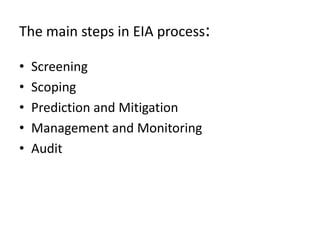
The main steps in EIA process:
• Screening
• Scoping
• Prediction and Mitigation
• Management and Monitoring
• Audit
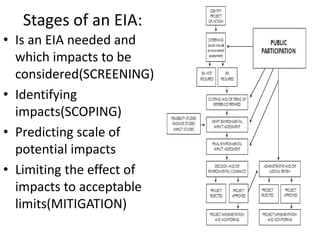
Stages of an EIA:
• Is an EIA needed and
which impacts to be
considered(SCREENING)
• Identifying
impacts(SCOPING)
• Predicting scale of
potential impacts
• Limiting the effect of
impacts to acceptable
limits(MITIGATION)
What do we need to know?
• Base line data-What are the conditions like
now
• What effects do different phases of a project
cause
• Who or What is likely to be affected
Phases of an EIA
Base line data:
This can be thought off as a project description
What are the conditions right now
What does the project plan to do
Description of project,
Physical characteristics- land use both during
construction and operation
Production process
Waste products
Impact Identification :
• Consider all potential environmental impacts whether good
or bad.
• Detail those impacts that are potentially significant
• Impact on ecosystem, people, resources and their integration
EIA Impact Identification Methods:
I. Checklist
II. Matrices
III. Network
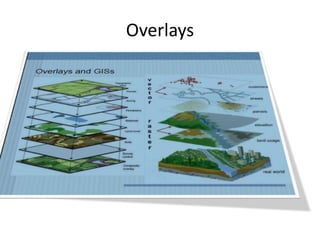
IV. Overlays
V. Expert System
VI. Risk Assessment
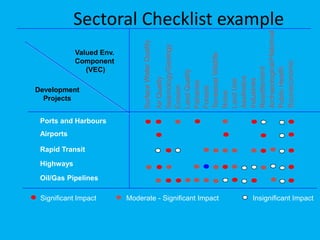
Sectoral Checklist example
Ports and Harbours
Airports
Rapid Transit
Highways
Oil/Gas Pipelines
Development
Projects
Valued Env.
Component
(VEC)
Insignificant ImpactSignificant Impact Moderate - Significant Impact
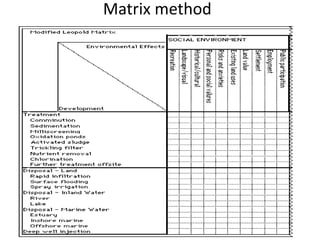
Matrix method
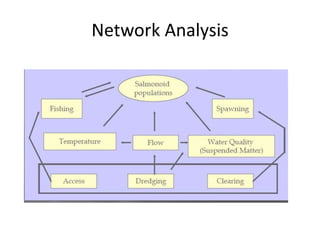
Network Analysis
Overlays
Impact prediction
• The accumulated knowledge of the findings of
the environmental investigations form the basis
for the prediction of impacts.
• Once a potential impact has been determined
during scoping process ,it is necessary to
identify which project activity will cause
impact , and its magnitude and extent.
Prediction of impacts - Models
Physical models – representation of the reality in a reduced
scale, simulating processes. (Exs. Wind tunnels or coastal area
physical models that simulate waves)
Visual models – elaboration of images that represent the
environment before and after the development of a project and its
alternatives. It can also address the timing dimension (e.g.,
seasonal changes, vegetation growth).
Mathematic models- maths or statistic simulations applied to the
deterministic or probabilistic calculation, based on quantitative
values.
Cartographic models- representation of reality that will be
affected by the project through maps or charts. Cartographic
overlaps enable impact predictions
Battelle method:
This method has been identified as one of the most quantitative methods. In the
Battelle method, 78 measurable environmental parameters are divided into four
major categories of ecology, environmental contamination, aesthetics, and human
interest.
The first step includes the conversion of parametric estimates into an
environmental quality (EQ) scale that ranges between 0 and 1, where 0 denotes
extremely bad quality and 1 denotes very good quality.
The next step includes multiplication of EQ values with the respective parameter
importance unit (PIU) values to obtain environmental impact units (EIU) for each
parameter. Addition of EIU values provides a composite score. Total environmental
impact is calculated by evaluating the expected future condition of the
environmental quality with and without the project.
Environmental Impact unit (EIU) = (EQ) * (PIU)
Where, EIU= Environmental Impact Unit for the parameter
EQ = Environmental quality scale factor for the parameter
PIU= Parameter Importance units for the parameter
Environmental Pollution (450)
Paramete
rs
PIU
EQ
value
Existin
g EIU
(EQ*PI
U)
After project
EIU
with
EMP
Change
in EIU
with
EMP
EIU
without
EMP
Chang
e in
EIU
witho
ut
EMP
Air 200 0.80 160 160 0 40 -120
Water 100 0.2 20 40 20 25 -15
Noise 50 0.5 25 20 -5 13 -7
Landuse
pattern
100 0.4 40 50 +10 16 -34
Total 450 255 270 15 94 -176
Next steps: Environmental Management Plan(EMP)
Environmental Monitoring Programme
Cost Analysis
Final Draft EIA
Environmental impact assessment (EIA)

Environmental impact assessment (EIA)

  • 1.
    Environment Impact Assessment(EIA): Process and stages Presented by, Kashyap.V PA-II ETD
  • 2.
    Environmental impact assessment(EIA) - the systematic identification and evaluation of the potential impacts (effects) of proposed projects, plans, programs, or legislative actions, relative to the physical–chemical, biological, cultural, and socioeconomic components of the environment. - Canter, Larry W. Environmental Impact Assessment, Second Edition. U.S.A: McGraw-Hill, Inc., 1996 What is EIA ? The process of identifying, predicting, evaluating and mitigating the biophysical, social and other relevant effects of development proposals prior to major decisions being taken and commitments made. -The International Association of Impact Assessment (IAIA)
  • 3.
    That is avery long way to say Purpose of EIA is to: Helps the decision making process by providing information about the consequences of development. Promotes sustainable development by identifying environmentally sound practice and mitigation measures for developments
  • 4.
    History of EIA: •EIAs began to be used in the 1960s as a part of a rational decision making process • EIA was made legislation in the US in the National Environmental Policy Act (NEPA) 1969. • The Indian experience with Environmental Impact Assessment began in 1976-77 when the Planning Commission asked the Department of Science and Technology to examine the river-valley projects from an environmental angle • On 27 January 1994, the Union Ministry of Environment and Forests (MEF), Government of India, under the Environmental (Protection) Act 1986, promulgated an EIA notification making Environmental Clearance (EC) mandatory for expansion or modernization of any activity or for setting up new projects listed in Schedule 1 of the notification. Since then there have been 13 amendments made in the EIA notification of 1994. • The MoEF notified EIA legislation in September 2006 and latest amendment was , the notification vide S.O 804 (E) dated 14.03.2017
  • 5.
    The main stepsin EIA process: • Screening • Scoping • Prediction and Mitigation • Management and Monitoring • Audit
  • 6.
    Stages of anEIA: • Is an EIA needed and which impacts to be considered(SCREENING) • Identifying impacts(SCOPING) • Predicting scale of potential impacts • Limiting the effect of impacts to acceptable limits(MITIGATION)
  • 7.
    What do weneed to know? • Base line data-What are the conditions like now • What effects do different phases of a project cause • Who or What is likely to be affected
  • 8.
    Phases of anEIA Base line data: This can be thought off as a project description What are the conditions right now What does the project plan to do Description of project, Physical characteristics- land use both during construction and operation Production process Waste products
  • 9.
    Impact Identification : •Consider all potential environmental impacts whether good or bad. • Detail those impacts that are potentially significant • Impact on ecosystem, people, resources and their integration EIA Impact Identification Methods: I. Checklist II. Matrices III. Network IV. Overlays V. Expert System VI. Risk Assessment
  • 10.
    Sectoral Checklist example Portsand Harbours Airports Rapid Transit Highways Oil/Gas Pipelines Development Projects Valued Env. Component (VEC) Insignificant ImpactSignificant Impact Moderate - Significant Impact
  • 11.
  • 12.
  • 13.
  • 14.
    Impact prediction • Theaccumulated knowledge of the findings of the environmental investigations form the basis for the prediction of impacts. • Once a potential impact has been determined during scoping process ,it is necessary to identify which project activity will cause impact , and its magnitude and extent.
  • 15.
    Prediction of impacts- Models Physical models – representation of the reality in a reduced scale, simulating processes. (Exs. Wind tunnels or coastal area physical models that simulate waves) Visual models – elaboration of images that represent the environment before and after the development of a project and its alternatives. It can also address the timing dimension (e.g., seasonal changes, vegetation growth). Mathematic models- maths or statistic simulations applied to the deterministic or probabilistic calculation, based on quantitative values. Cartographic models- representation of reality that will be affected by the project through maps or charts. Cartographic overlaps enable impact predictions
  • 16.
    Battelle method: This methodhas been identified as one of the most quantitative methods. In the Battelle method, 78 measurable environmental parameters are divided into four major categories of ecology, environmental contamination, aesthetics, and human interest. The first step includes the conversion of parametric estimates into an environmental quality (EQ) scale that ranges between 0 and 1, where 0 denotes extremely bad quality and 1 denotes very good quality. The next step includes multiplication of EQ values with the respective parameter importance unit (PIU) values to obtain environmental impact units (EIU) for each parameter. Addition of EIU values provides a composite score. Total environmental impact is calculated by evaluating the expected future condition of the environmental quality with and without the project. Environmental Impact unit (EIU) = (EQ) * (PIU) Where, EIU= Environmental Impact Unit for the parameter EQ = Environmental quality scale factor for the parameter PIU= Parameter Importance units for the parameter
  • 17.
    Environmental Pollution (450) Paramete rs PIU EQ value Existin gEIU (EQ*PI U) After project EIU with EMP Change in EIU with EMP EIU without EMP Chang e in EIU witho ut EMP Air 200 0.80 160 160 0 40 -120 Water 100 0.2 20 40 20 25 -15 Noise 50 0.5 25 20 -5 13 -7 Landuse pattern 100 0.4 40 50 +10 16 -34 Total 450 255 270 15 94 -176
  • 18.
    Next steps: EnvironmentalManagement Plan(EMP) Environmental Monitoring Programme Cost Analysis Final Draft EIA