
127-07-2020
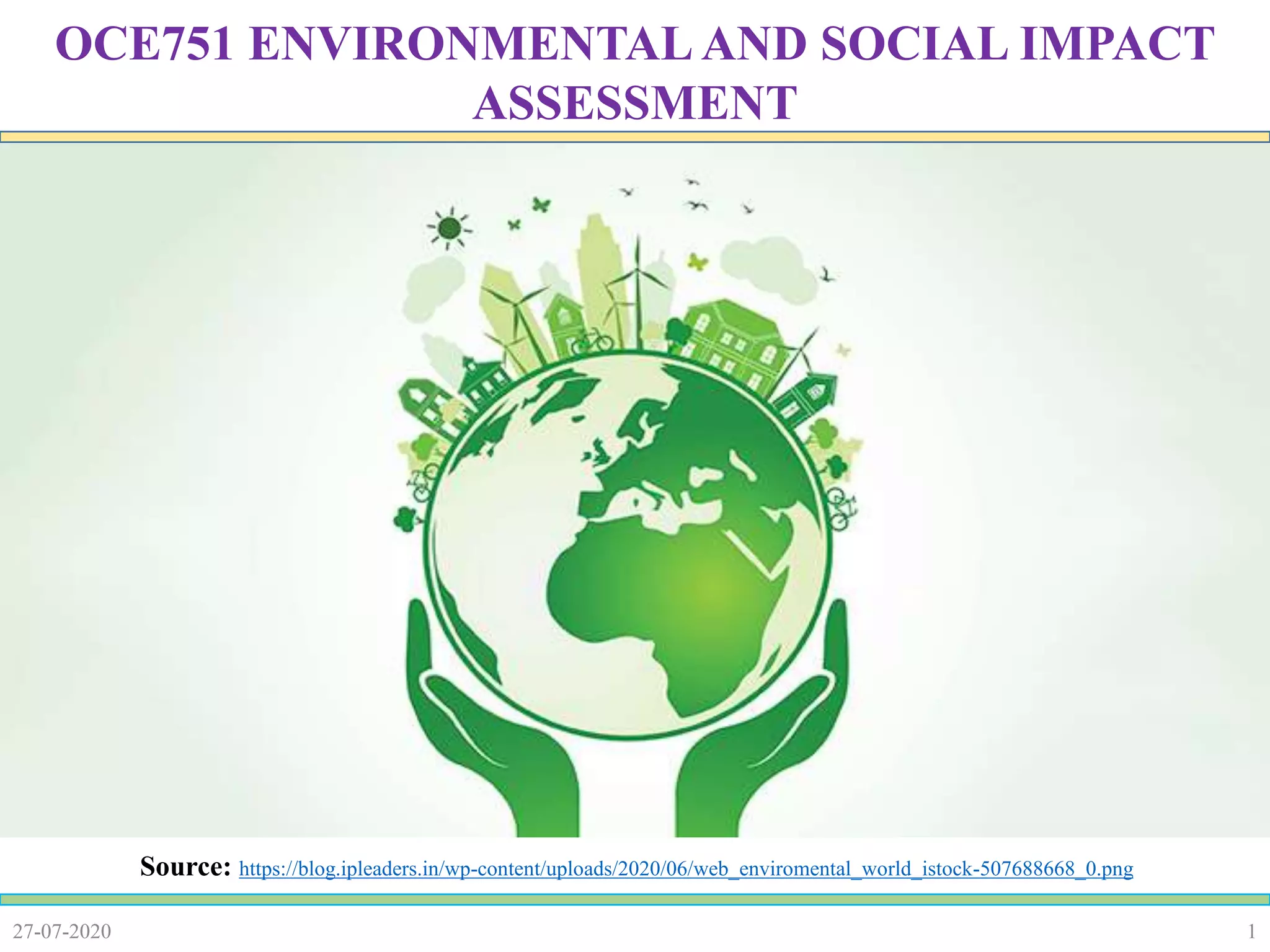
OCE751 ENVIRONMENTAL AND SOCIAL IMPACT
ASSESSMENT
Source: https://blog.ipleaders.in/wp-content/uploads/2020/06/web_enviromental_world_istock-507688668_0.png
227-07-2020
Agenda
 Course Objective
 Course Outcomes
 Overview of Syllabus
 Evolution of Environmental Impact Assessment
 EIA
Source: https://d1tcrpfk632upo.cloudfront.net/wp-
content/uploads/2019/08/06103047/agenda-810x540.jpg
3
To impart the knowledge and skills to identify, assess and mitigate the
environmental and social impacts of developmental projects.
27-07-2020
COURSE OBJECTIVE
Source: https://courses.dcs.wisc.edu/design-teaching/PlanDesign_Fall2016/2-
Online-Course-Design/2_Learning-Objectives-Alignment/images/objective-
puzzle.JPG
4
• Carry out scoping and screening of developmental projects for
environmental and social assessments
• Explain different methodologies for environmental impact prediction and
assessment
• Plan environmental impact assessments and environmental management
plans
• Evaluate environmental impact assessment reports
27-07-2020
COURSE OUTCOMES
Source: https://dlpng.com/png/6917970
5
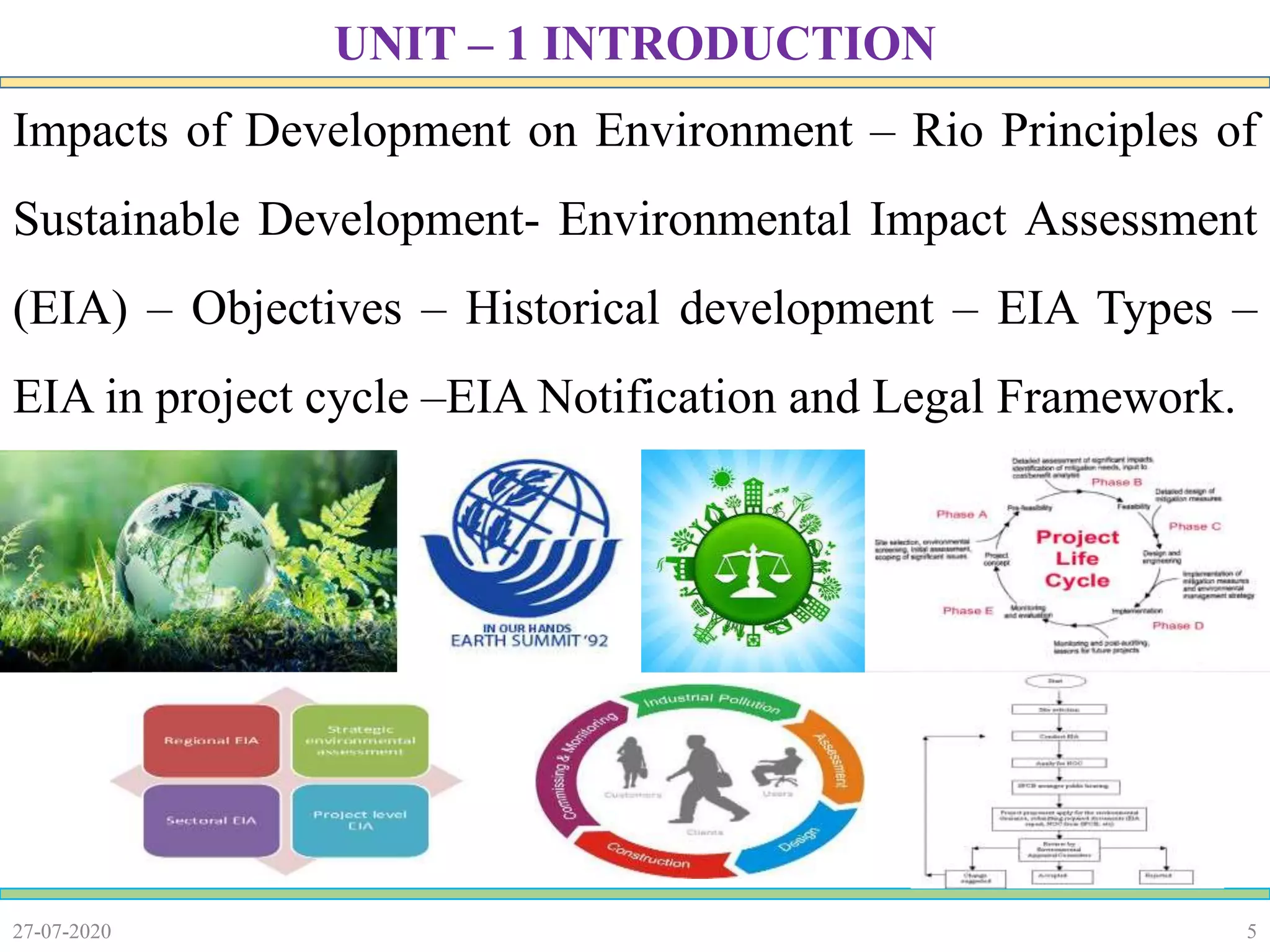
Impacts of Development on Environment – Rio Principles of
Sustainable Development- Environmental Impact Assessment
(EIA) – Objectives – Historical development – EIA Types –
EIA in project cycle –EIA Notification and Legal Framework.
27-07-2020
UNIT – 1 INTRODUCTION
6
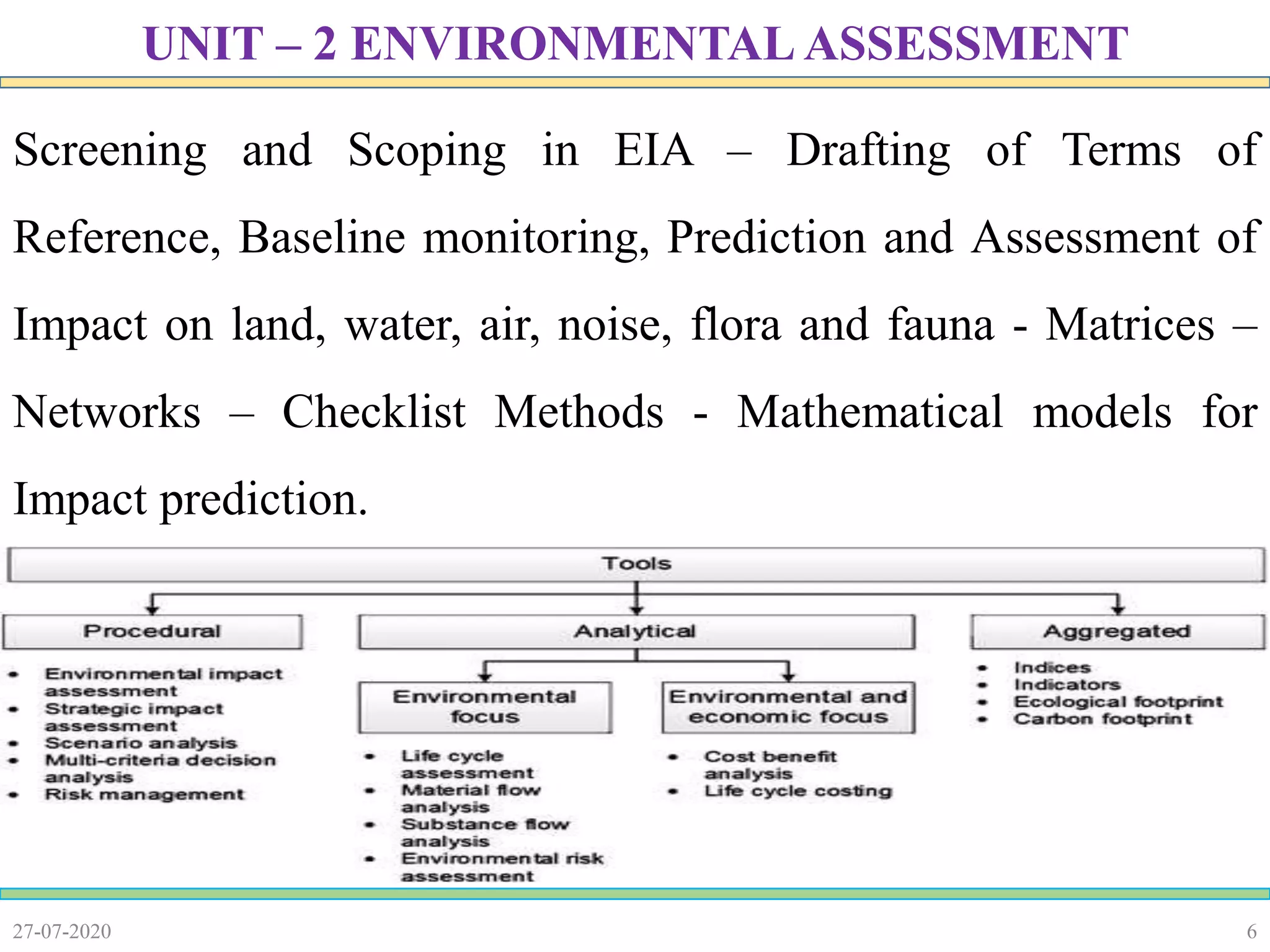
Screening and Scoping in EIA – Drafting of Terms of
Reference, Baseline monitoring, Prediction and Assessment of
Impact on land, water, air, noise, flora and fauna - Matrices –
Networks – Checklist Methods - Mathematical models for
Impact prediction.
27-07-2020
UNIT – 2 ENVIRONMENTAL ASSESSMENT
7
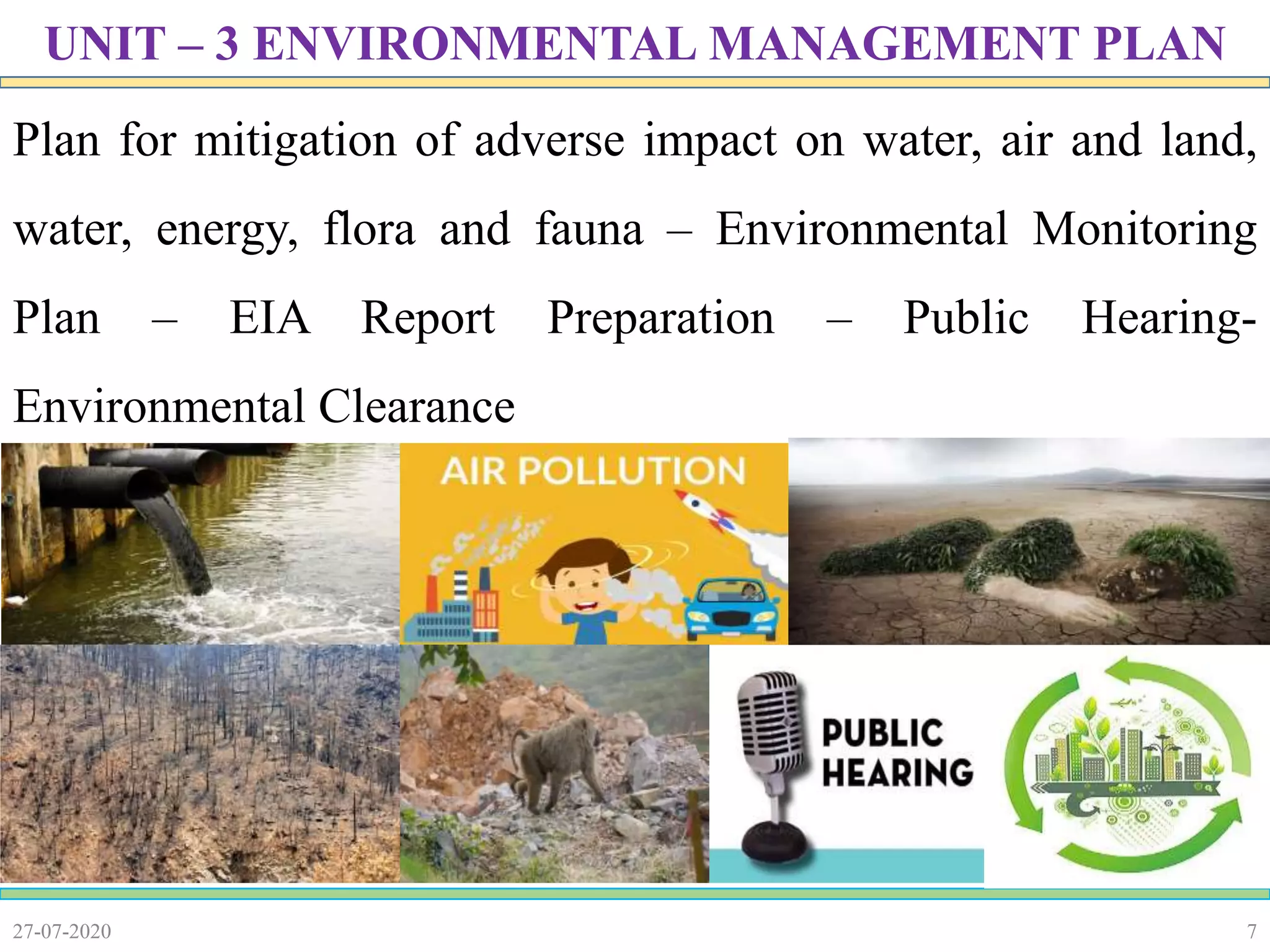
Plan for mitigation of adverse impact on water, air and land,
water, energy, flora and fauna – Environmental Monitoring
Plan – EIA Report Preparation – Public Hearing-
Environmental Clearance
27-07-2020
UNIT – 3 ENVIRONMENTAL MANAGEMENT PLAN
8
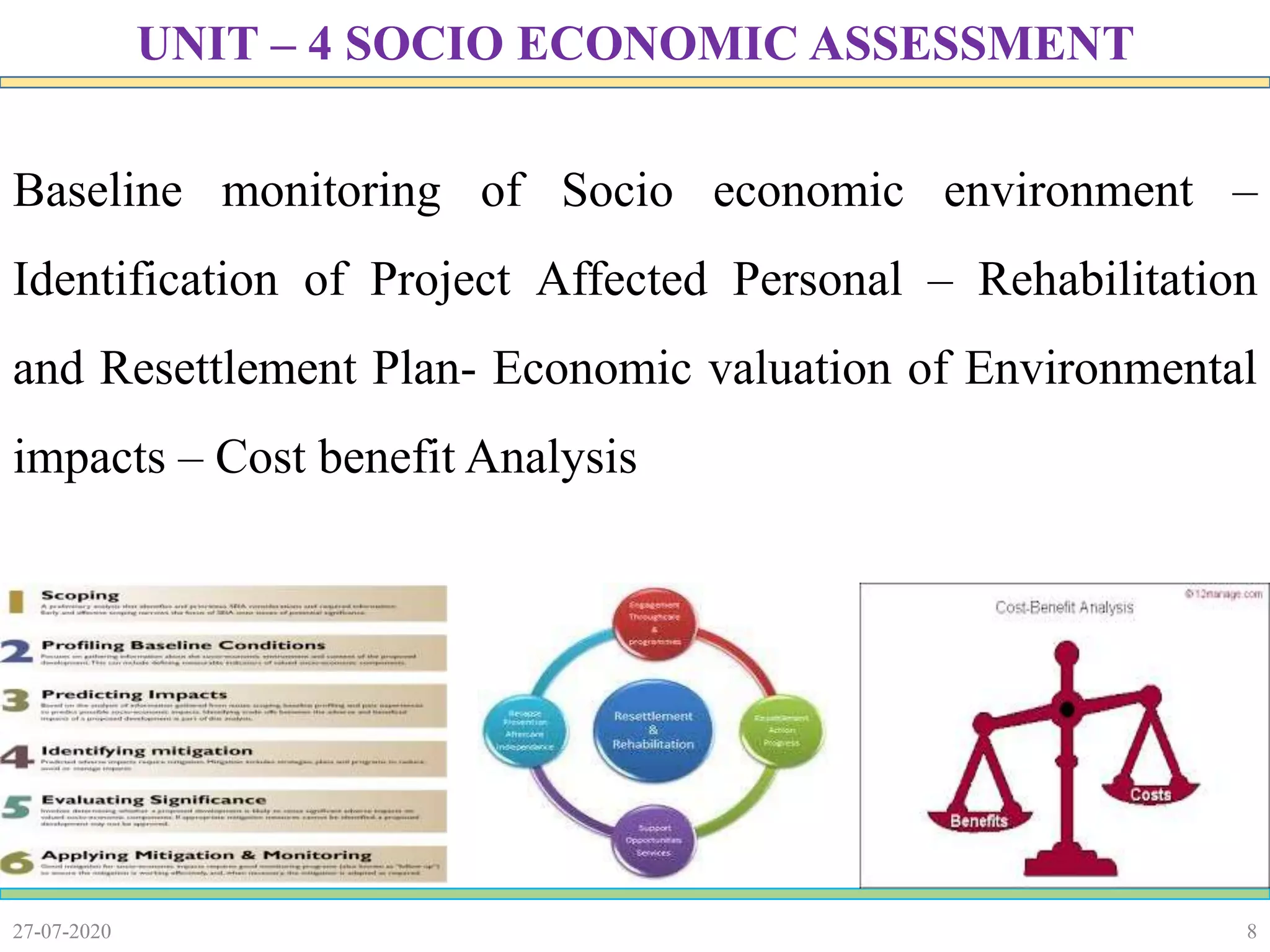
Baseline monitoring of Socio economic environment –
Identification of Project Affected Personal – Rehabilitation
and Resettlement Plan- Economic valuation of Environmental
impacts – Cost benefit Analysis
27-07-2020
UNIT – 4 SOCIO ECONOMIC ASSESSMENT
9
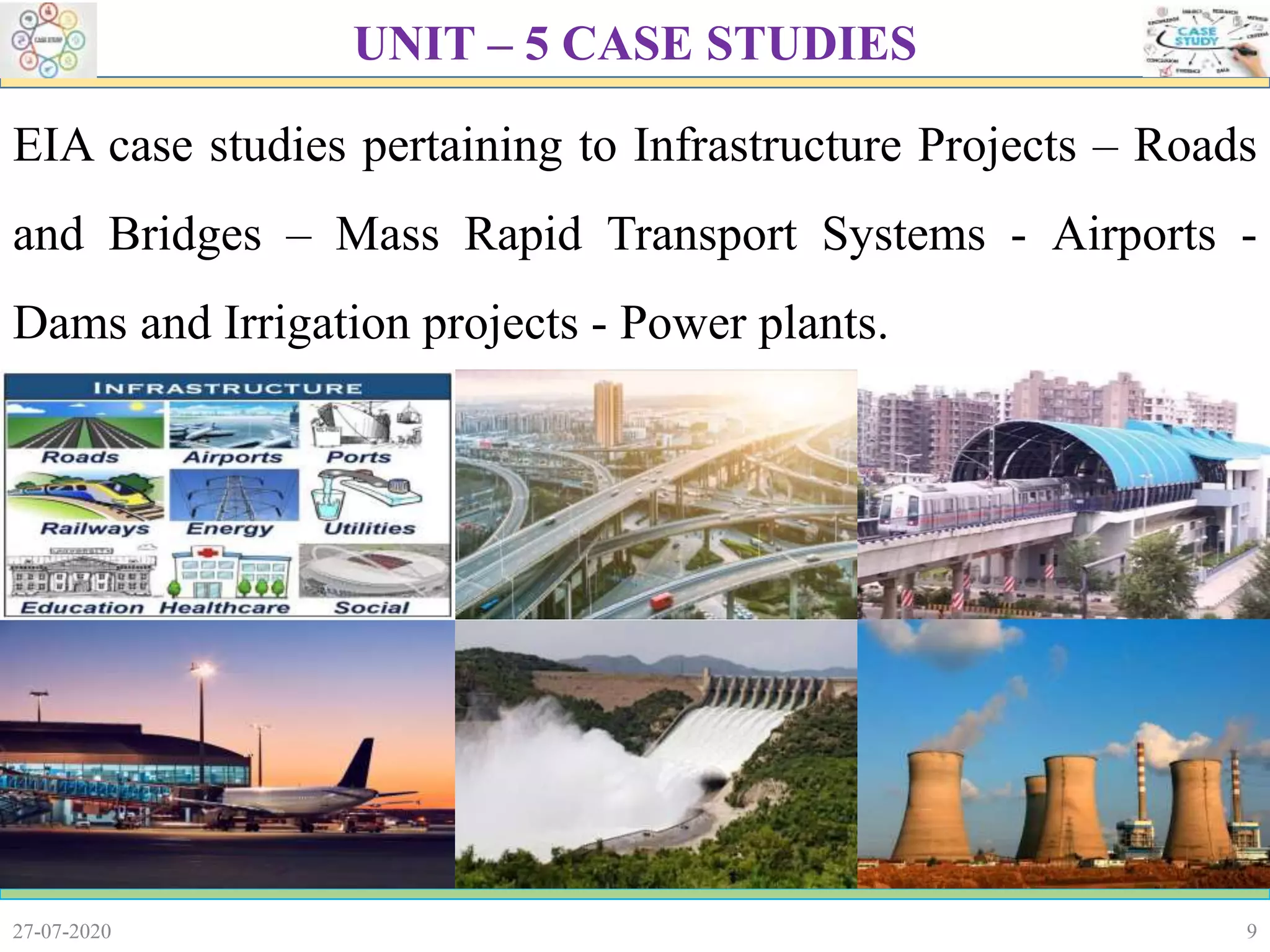
EIA case studies pertaining to Infrastructure Projects – Roads
and Bridges – Mass Rapid Transport Systems - Airports -
Dams and Irrigation projects - Power plants.
27-07-2020
UNIT – 5 CASE STUDIES
27-07-2020 10
11
Environmental Impact Assessment (EIA) is a process of evaluating the
likely environmental impacts of a proposed project or development,
taking into account inter-related socio-economic, cultural and human-
health impacts, both beneficial and adverse.
27-07-2020
Definition of EIA
12
Tool to identify environmental, social and economic impacts of a project
prior to decision making.
27-07-2020
Definition as per UNEP
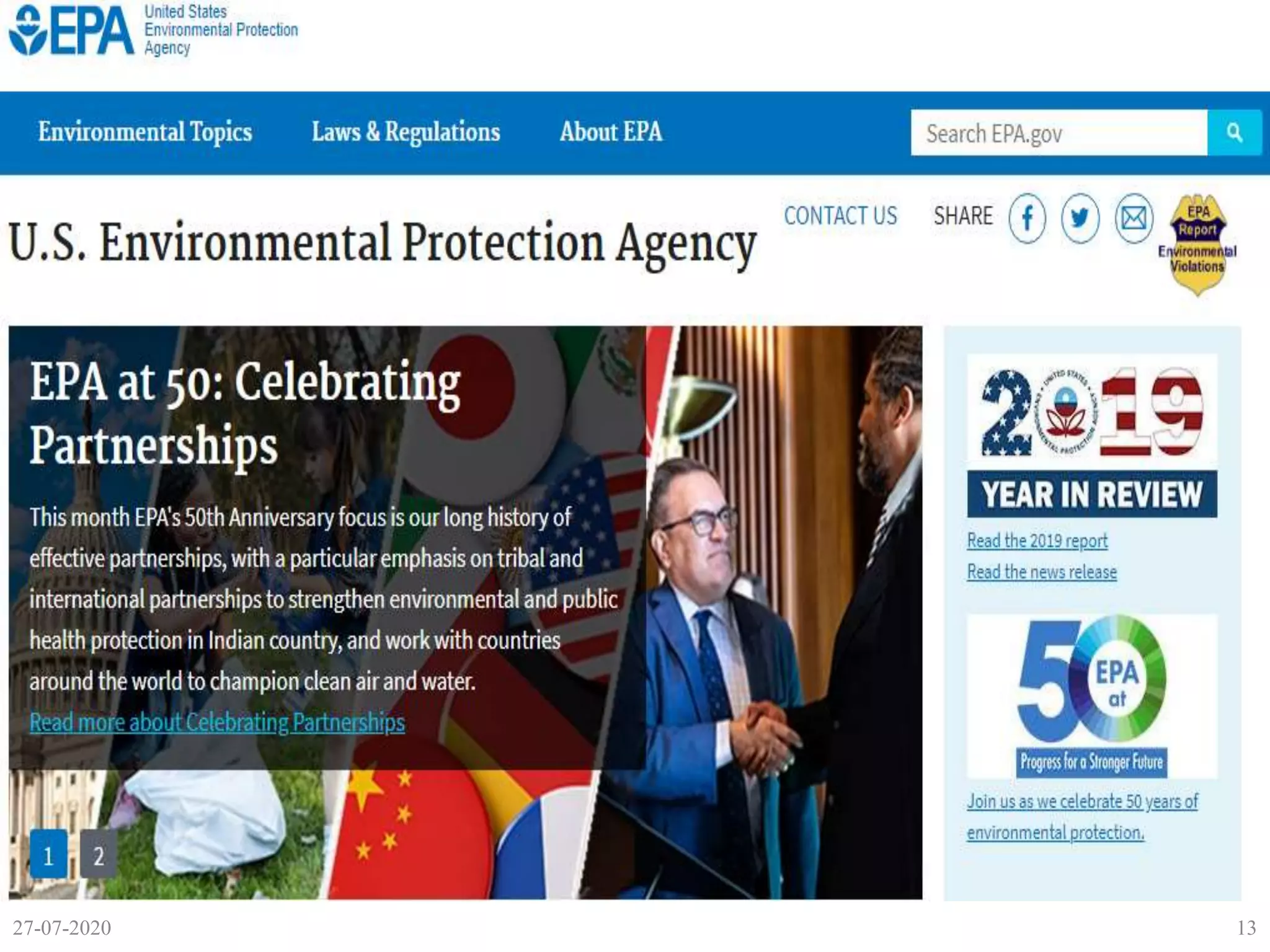
https://www.unenvironment.org/
27-07-2020 13
14
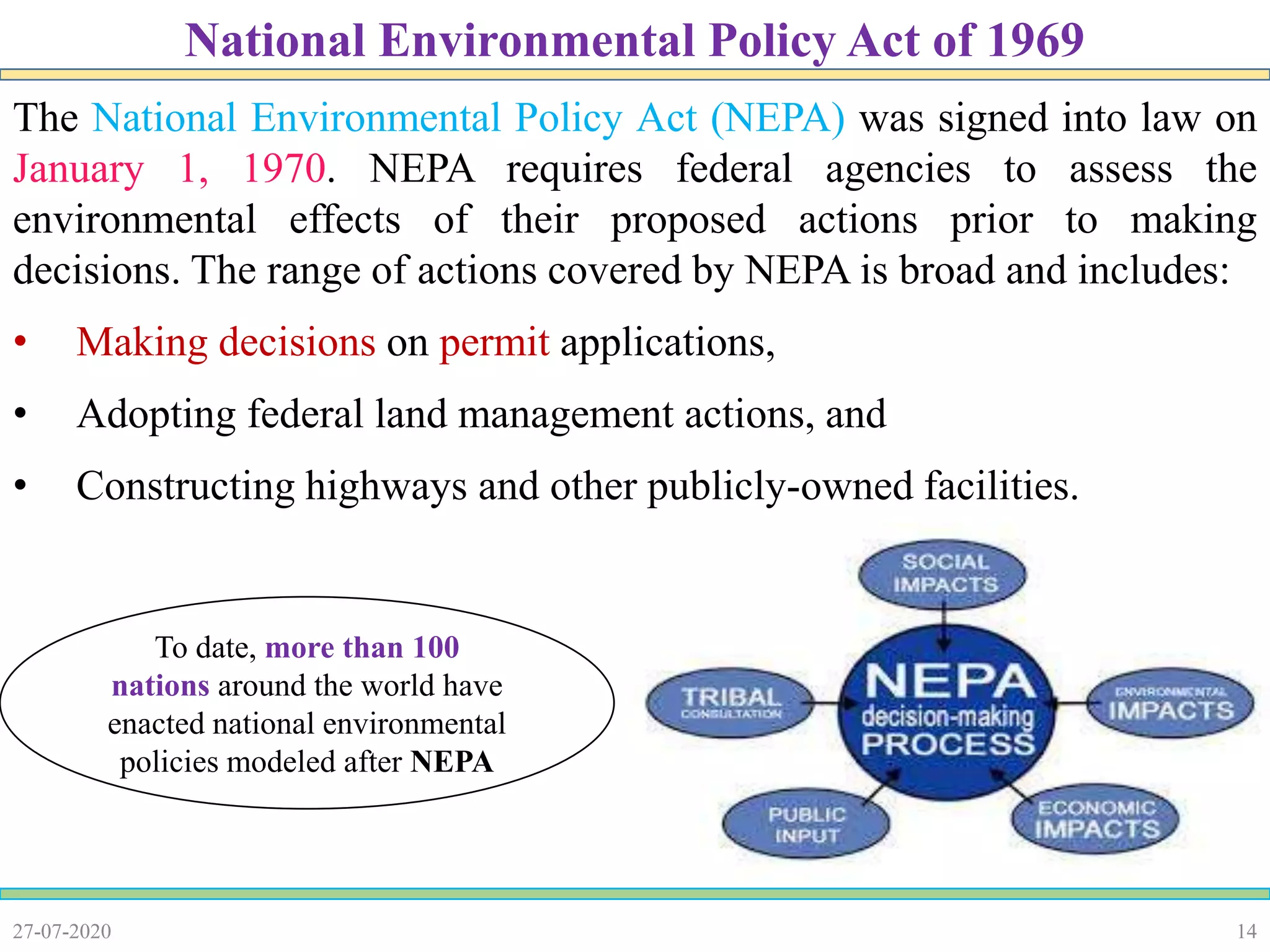
The National Environmental Policy Act (NEPA) was signed into law on
January 1, 1970. NEPA requires federal agencies to assess the
environmental effects of their proposed actions prior to making
decisions. The range of actions covered by NEPA is broad and includes:
• Making decisions on permit applications,
• Adopting federal land management actions, and
• Constructing highways and other publicly-owned facilities.
27-07-2020
National Environmental Policy Act of 1969
To date, more than 100
nations around the world have
enacted national environmental
policies modeled after NEPA
15
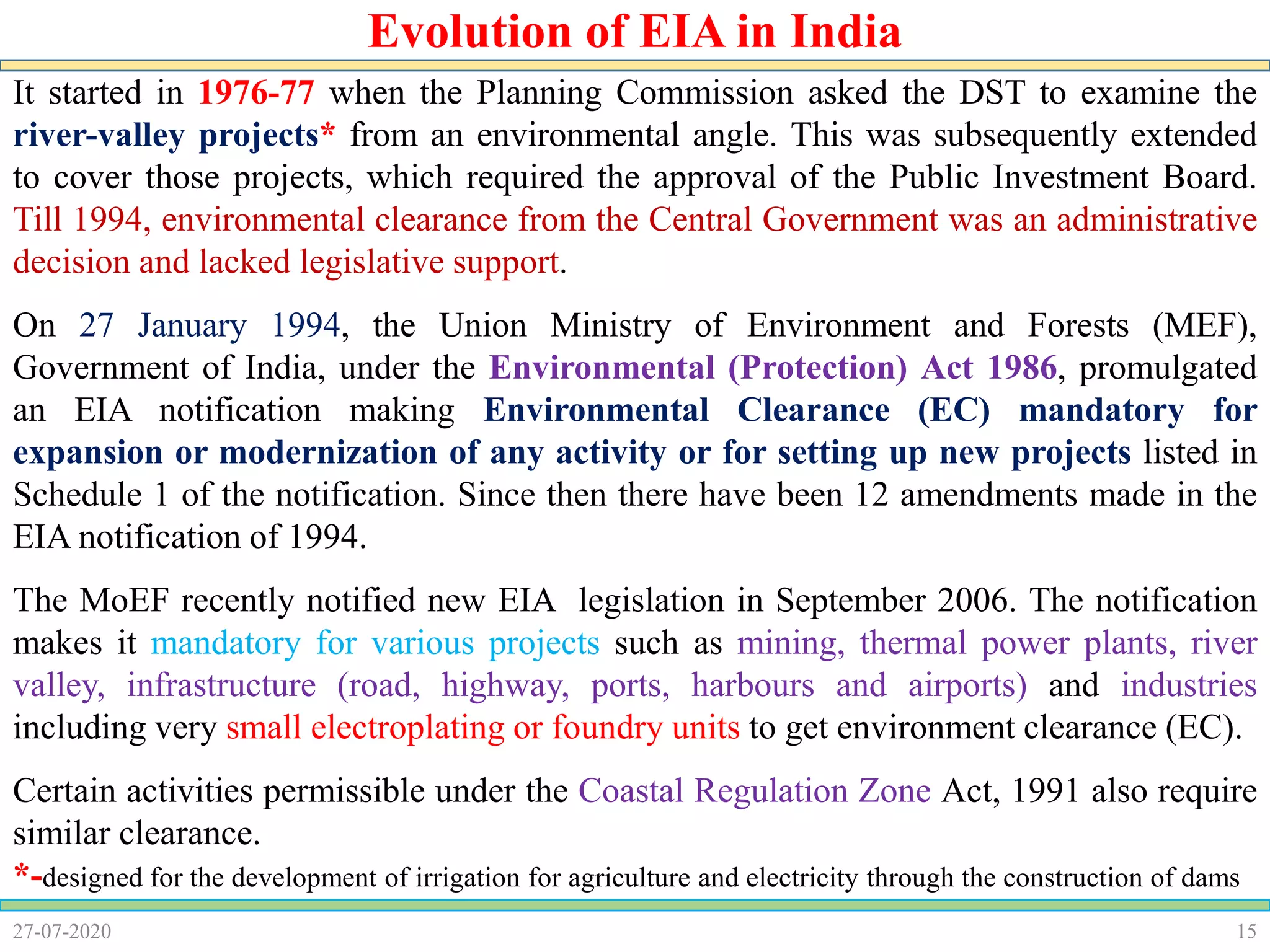
It started in 1976-77 when the Planning Commission asked the DST to examine the
river-valley projects* from an environmental angle. This was subsequently extended
to cover those projects, which required the approval of the Public Investment Board.
Till 1994, environmental clearance from the Central Government was an administrative
decision and lacked legislative support.
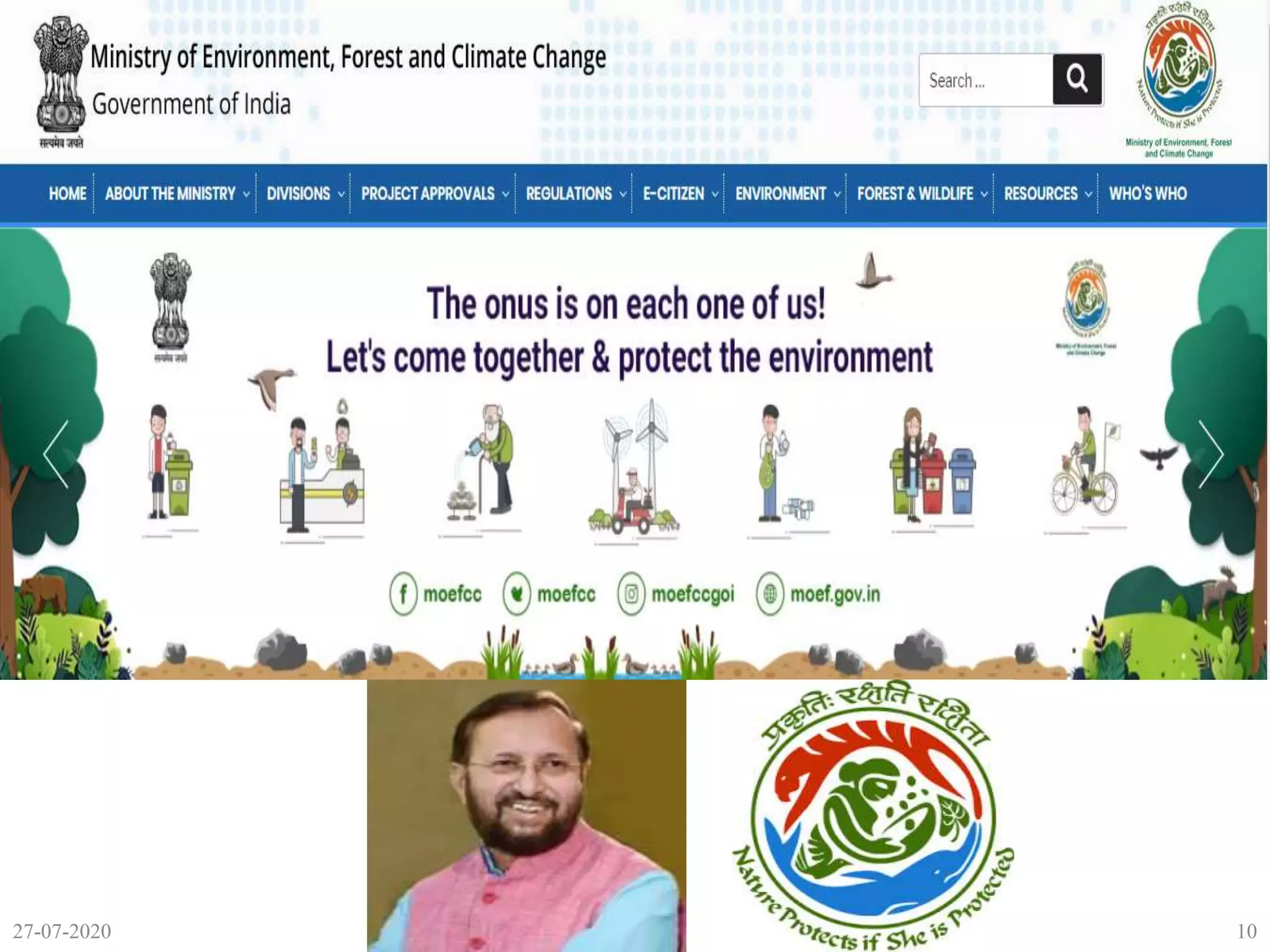
On 27 January 1994, the Union Ministry of Environment and Forests (MEF),
Government of India, under the Environmental (Protection) Act 1986, promulgated
an EIA notification making Environmental Clearance (EC) mandatory for
expansion or modernization of any activity or for setting up new projects listed in
Schedule 1 of the notification. Since then there have been 12 amendments made in the
EIA notification of 1994.
The MoEF recently notified new EIA legislation in September 2006. The notification
makes it mandatory for various projects such as mining, thermal power plants, river
valley, infrastructure (road, highway, ports, harbours and airports) and industries
including very small electroplating or foundry units to get environment clearance (EC).
Certain activities permissible under the Coastal Regulation Zone Act, 1991 also require
similar clearance.
*-designed for the development of irrigation for agriculture and electricity through the construction of dams
27-07-2020
Evolution of EIA in India
16
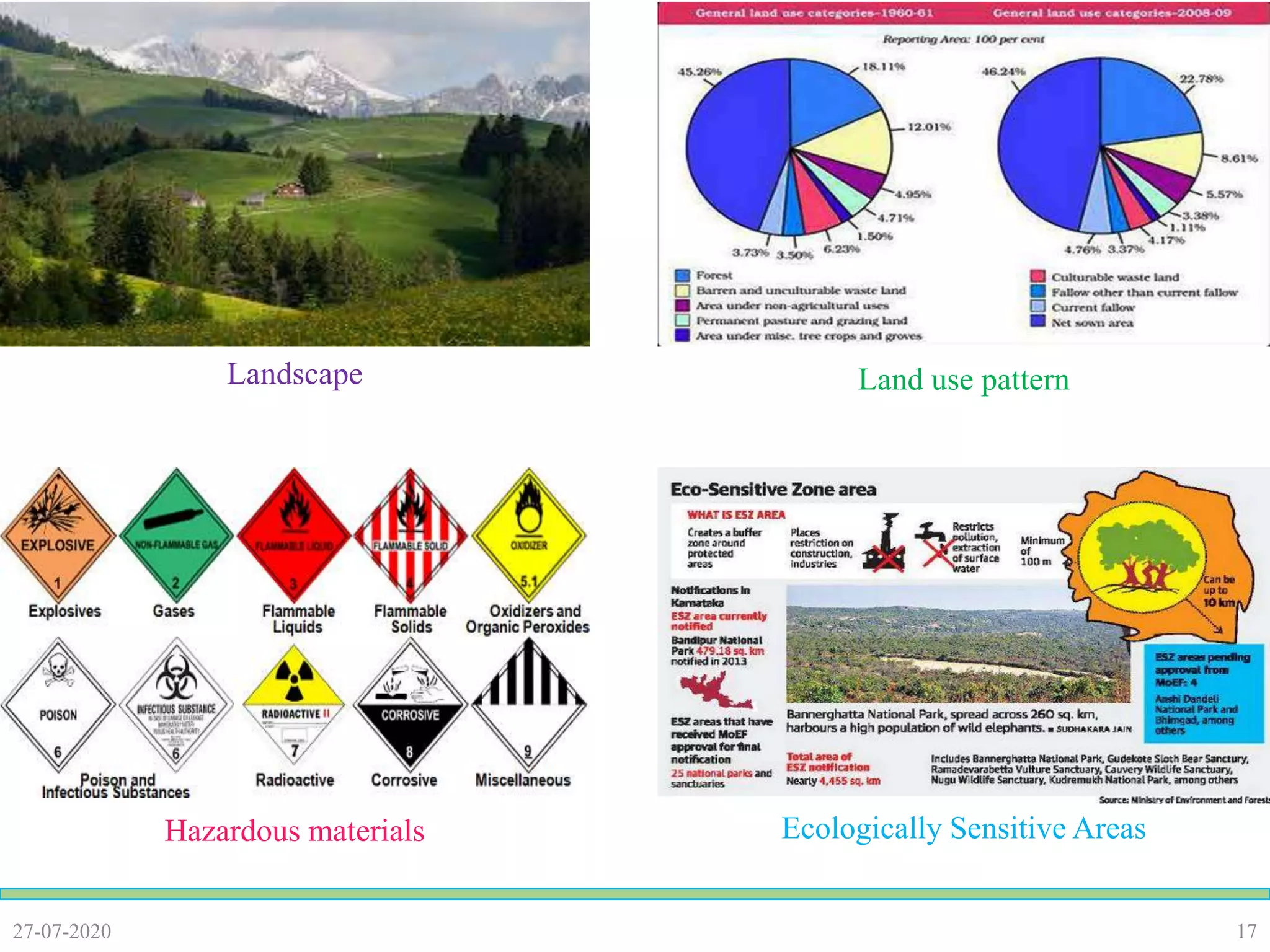
1. Which can significantly alter the landscape, land use pattern & lead to
concentration of working population.
2. Which need upstream development* activity like assured mineral and forest
products supply.
3. Which need downstream* industrial process development
4. Those involving manufacture, handling and use of hazardous materials
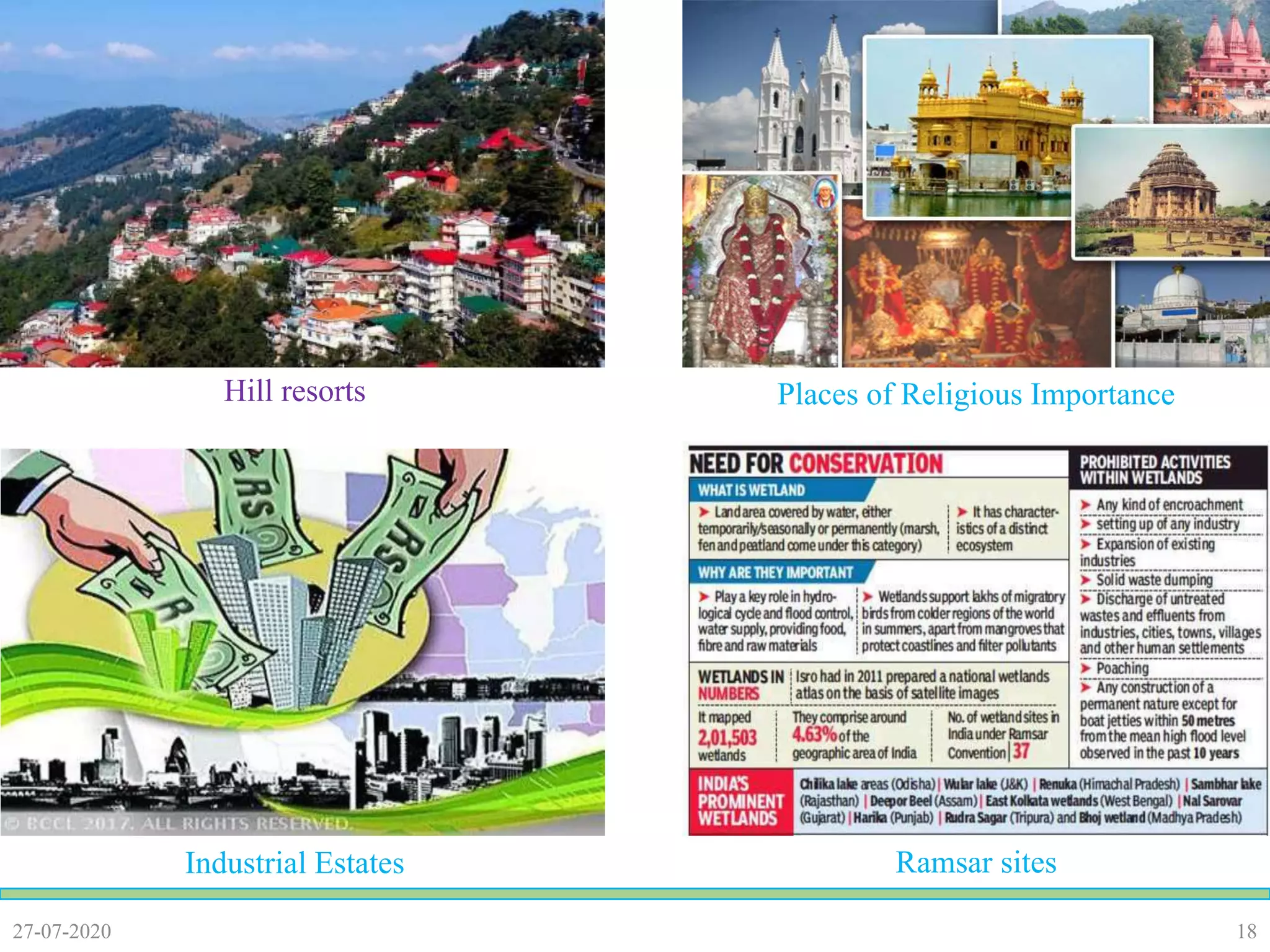
5. Those sites near ecologically sensitive areas, urban centers, hill resorts,
places of scientific and religious importance.
6. Industrial estates which could cumulatively cause significant environmental
damage.
* - Upstream refers to the material inputs needed for production, while downstream is the
opposite end, where products get produced and distributed.
27-07-2020
Which Project falls under EIA???
1727-07-2020
Landscape Land use pattern
Hazardous materials Ecologically Sensitive Areas
1827-07-2020
Hill resorts Places of Religious Importance
Industrial Estates Ramsar sites
19
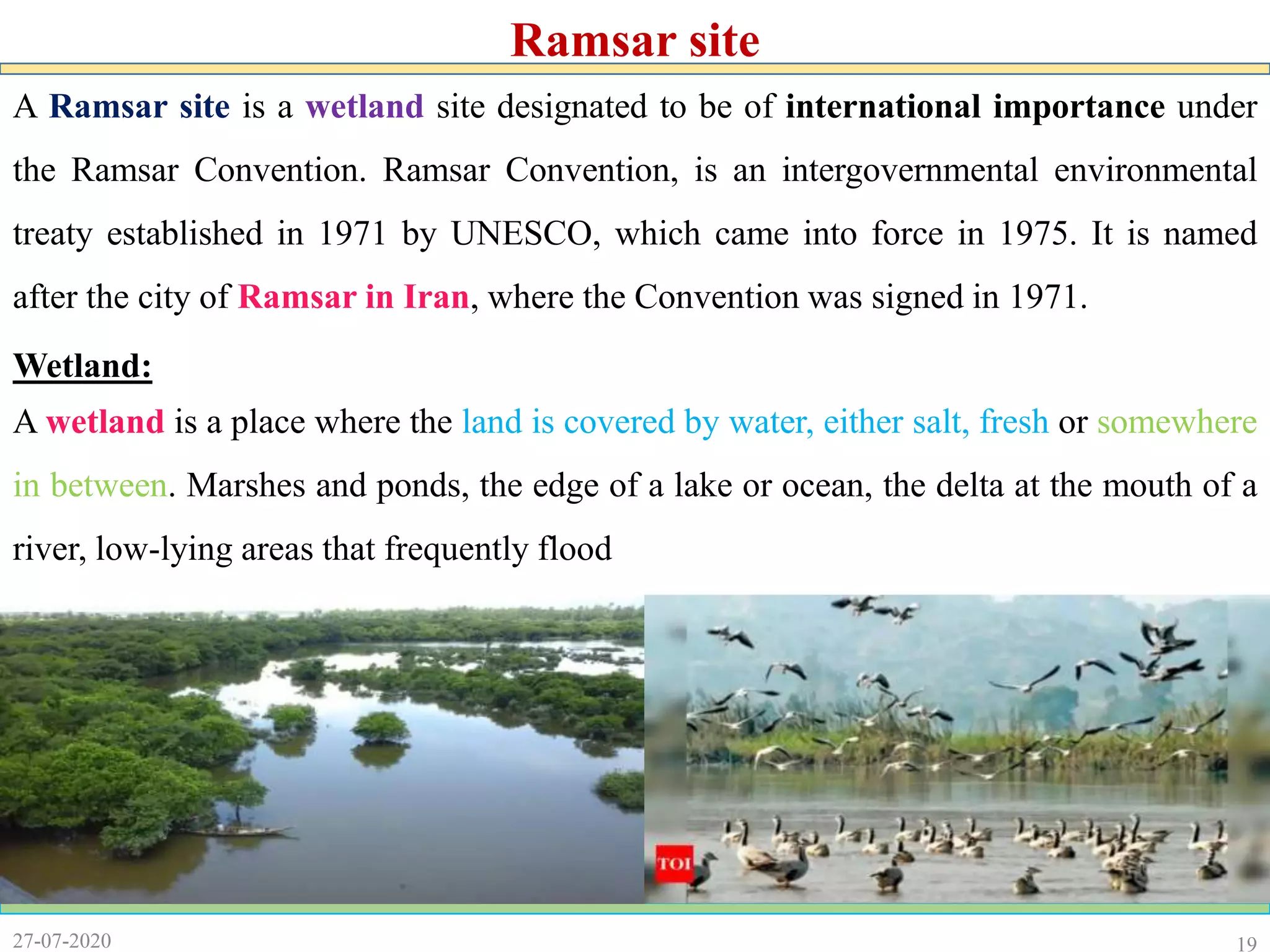
A Ramsar site is a wetland site designated to be of international importance under
the Ramsar Convention. Ramsar Convention, is an intergovernmental environmental
treaty established in 1971 by UNESCO, which came into force in 1975. It is named
after the city of Ramsar in Iran, where the Convention was signed in 1971.
Wetland:
A wetland is a place where the land is covered by water, either salt, fresh or somewhere
in between. Marshes and ponds, the edge of a lake or ocean, the delta at the mouth of a
river, low-lying areas that frequently flood
27-07-2020
Ramsar site
20
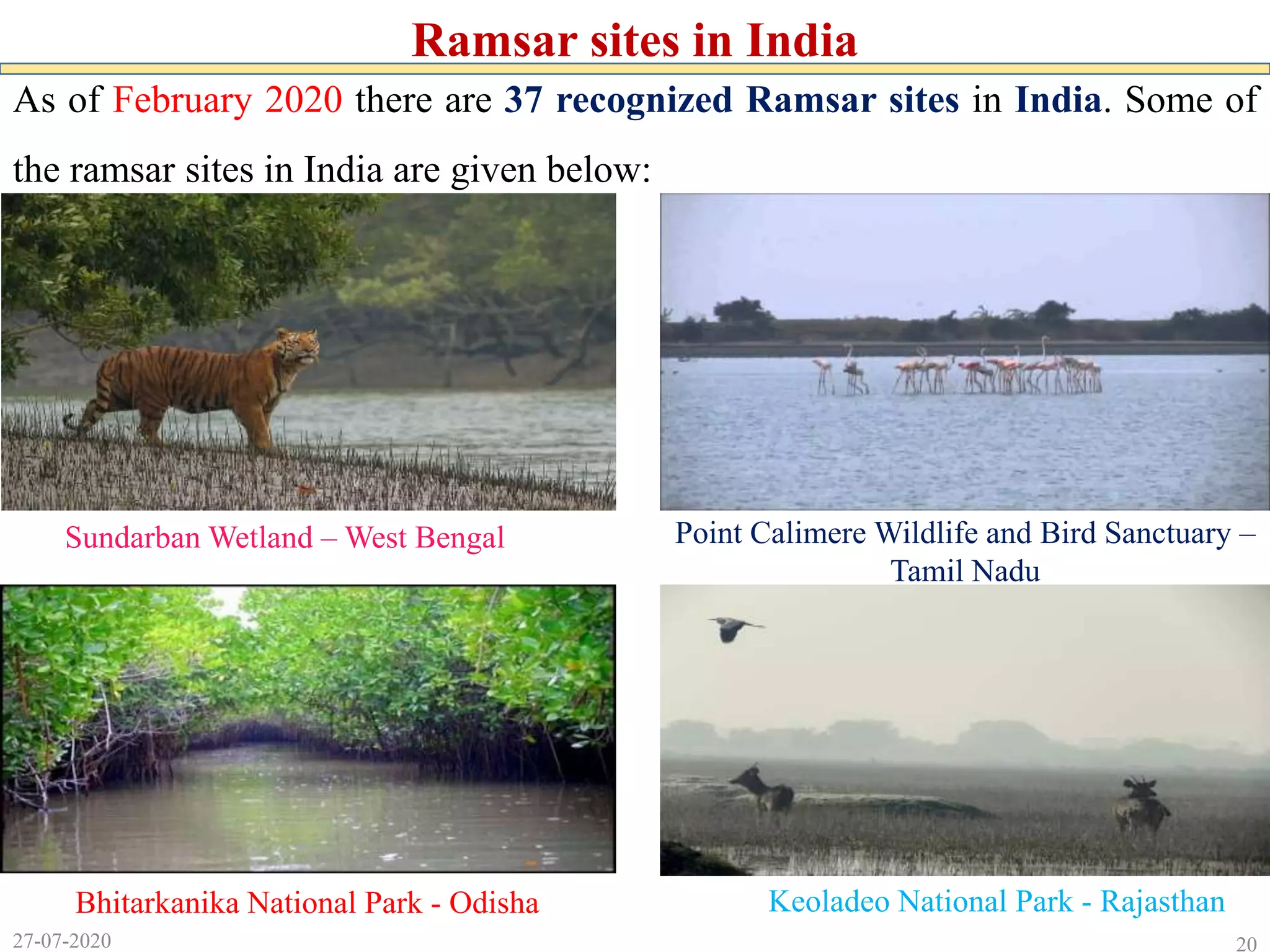
As of February 2020 there are 37 recognized Ramsar sites in India. Some of
the ramsar sites in India are given below:
27-07-2020
Ramsar sites in India
Sundarban Wetland – West Bengal Point Calimere Wildlife and Bird Sanctuary –
Tamil Nadu
Bhitarkanika National Park - Odisha Keoladeo National Park - Rajasthan
21
The following are things to be addressed during the environmental impact
assessment. They are as follows:
 Meteorology and Air quality
 Hydrology and water quality
 Site and its surroundings
 Occupational safety and health
 Details of the treatment and disposal of effluents and methods of alternative
uses
 Transportation of raw materials and details of material handling
 Control equipment and measures proposed to be adopted
27-07-2020
What to address in EIA???
22
The following are the stages involved in environmental impact assessment.
They are as follows:
1. Screening
2. Scoping
3. Assessment & Evaluation
4. Report: Non-Technical summary for the general audience
5. Review: Environmental Impact Statement (EIS)
6. Decision making: Whether to approve projects (or) not
7. Monitoring, Compliance, Enforcement
8. Environmental Auditing
27-07-2020
Stages involved in EIA
23
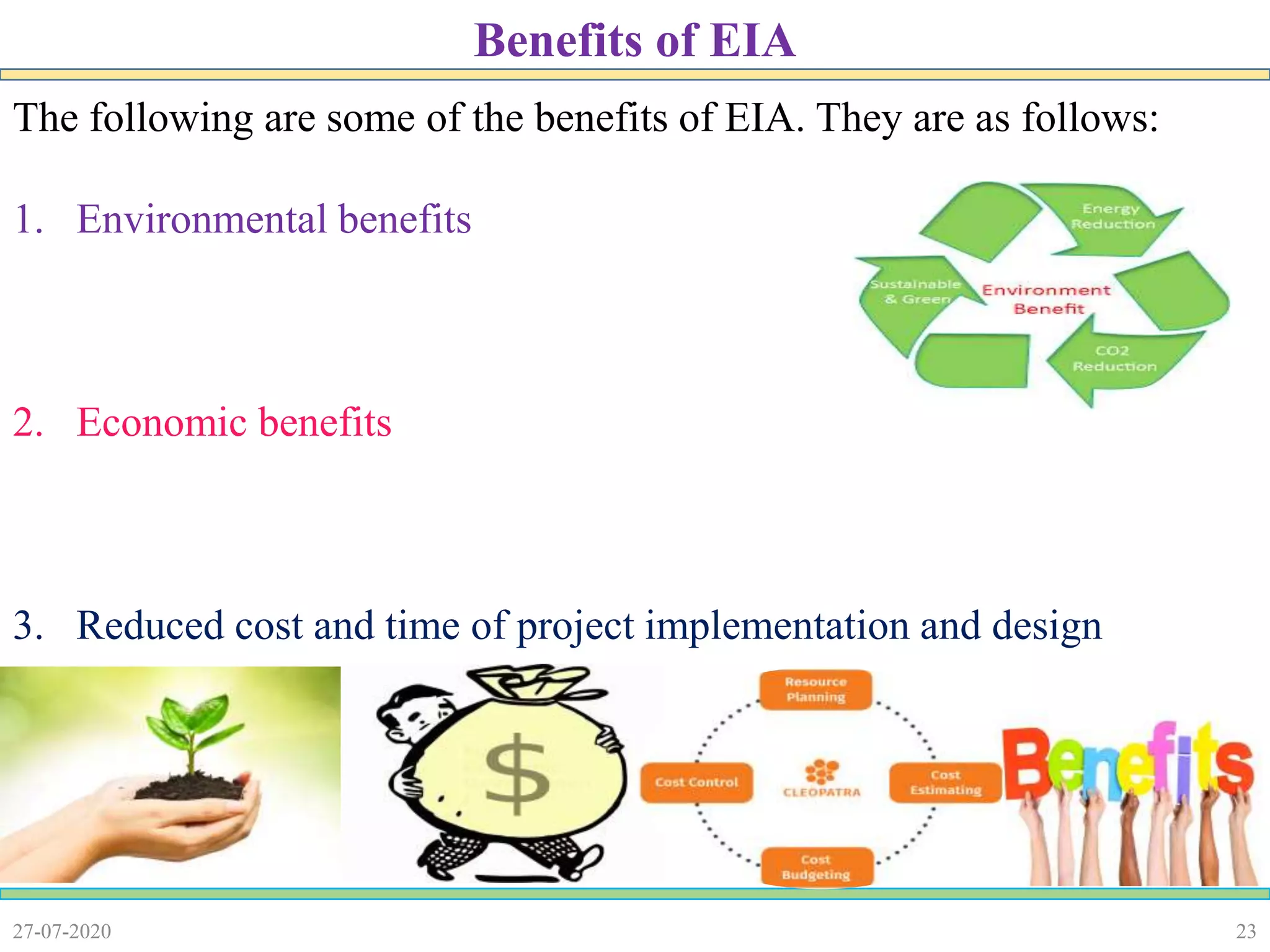
The following are some of the benefits of EIA. They are as follows:
1. Environmental benefits
2. Economic benefits
3. Reduced cost and time of project implementation and design
27-07-2020
Benefits of EIA
2427-07-2020

Introduction - Environmental Impact Assessment

  • 1.
    127-07-2020 OCE751 ENVIRONMENTAL ANDSOCIAL IMPACT ASSESSMENT Source: https://blog.ipleaders.in/wp-content/uploads/2020/06/web_enviromental_world_istock-507688668_0.png
  • 2.
    227-07-2020 Agenda  Course Objective Course Outcomes  Overview of Syllabus  Evolution of Environmental Impact Assessment  EIA Source: https://d1tcrpfk632upo.cloudfront.net/wp- content/uploads/2019/08/06103047/agenda-810x540.jpg
  • 3.
    3 To impart theknowledge and skills to identify, assess and mitigate the environmental and social impacts of developmental projects. 27-07-2020 COURSE OBJECTIVE Source: https://courses.dcs.wisc.edu/design-teaching/PlanDesign_Fall2016/2- Online-Course-Design/2_Learning-Objectives-Alignment/images/objective- puzzle.JPG
  • 4.
    4 • Carry outscoping and screening of developmental projects for environmental and social assessments • Explain different methodologies for environmental impact prediction and assessment • Plan environmental impact assessments and environmental management plans • Evaluate environmental impact assessment reports 27-07-2020 COURSE OUTCOMES Source: https://dlpng.com/png/6917970
  • 5.
    5 Impacts of Developmenton Environment – Rio Principles of Sustainable Development- Environmental Impact Assessment (EIA) – Objectives – Historical development – EIA Types – EIA in project cycle –EIA Notification and Legal Framework. 27-07-2020 UNIT – 1 INTRODUCTION
  • 6.
    6 Screening and Scopingin EIA – Drafting of Terms of Reference, Baseline monitoring, Prediction and Assessment of Impact on land, water, air, noise, flora and fauna - Matrices – Networks – Checklist Methods - Mathematical models for Impact prediction. 27-07-2020 UNIT – 2 ENVIRONMENTAL ASSESSMENT
  • 7.
    7 Plan for mitigationof adverse impact on water, air and land, water, energy, flora and fauna – Environmental Monitoring Plan – EIA Report Preparation – Public Hearing- Environmental Clearance 27-07-2020 UNIT – 3 ENVIRONMENTAL MANAGEMENT PLAN
  • 8.
    8 Baseline monitoring ofSocio economic environment – Identification of Project Affected Personal – Rehabilitation and Resettlement Plan- Economic valuation of Environmental impacts – Cost benefit Analysis 27-07-2020 UNIT – 4 SOCIO ECONOMIC ASSESSMENT
  • 9.
    9 EIA case studiespertaining to Infrastructure Projects – Roads and Bridges – Mass Rapid Transport Systems - Airports - Dams and Irrigation projects - Power plants. 27-07-2020 UNIT – 5 CASE STUDIES
  • 10.
  • 11.
    11 Environmental Impact Assessment(EIA) is a process of evaluating the likely environmental impacts of a proposed project or development, taking into account inter-related socio-economic, cultural and human- health impacts, both beneficial and adverse. 27-07-2020 Definition of EIA
  • 12.
    12 Tool to identifyenvironmental, social and economic impacts of a project prior to decision making. 27-07-2020 Definition as per UNEP https://www.unenvironment.org/
  • 13.
  • 14.
    14 The National EnvironmentalPolicy Act (NEPA) was signed into law on January 1, 1970. NEPA requires federal agencies to assess the environmental effects of their proposed actions prior to making decisions. The range of actions covered by NEPA is broad and includes: • Making decisions on permit applications, • Adopting federal land management actions, and • Constructing highways and other publicly-owned facilities. 27-07-2020 National Environmental Policy Act of 1969 To date, more than 100 nations around the world have enacted national environmental policies modeled after NEPA
  • 15.
    15 It started in1976-77 when the Planning Commission asked the DST to examine the river-valley projects* from an environmental angle. This was subsequently extended to cover those projects, which required the approval of the Public Investment Board. Till 1994, environmental clearance from the Central Government was an administrative decision and lacked legislative support. On 27 January 1994, the Union Ministry of Environment and Forests (MEF), Government of India, under the Environmental (Protection) Act 1986, promulgated an EIA notification making Environmental Clearance (EC) mandatory for expansion or modernization of any activity or for setting up new projects listed in Schedule 1 of the notification. Since then there have been 12 amendments made in the EIA notification of 1994. The MoEF recently notified new EIA legislation in September 2006. The notification makes it mandatory for various projects such as mining, thermal power plants, river valley, infrastructure (road, highway, ports, harbours and airports) and industries including very small electroplating or foundry units to get environment clearance (EC). Certain activities permissible under the Coastal Regulation Zone Act, 1991 also require similar clearance. *-designed for the development of irrigation for agriculture and electricity through the construction of dams 27-07-2020 Evolution of EIA in India
  • 16.
    16 1. Which cansignificantly alter the landscape, land use pattern & lead to concentration of working population. 2. Which need upstream development* activity like assured mineral and forest products supply. 3. Which need downstream* industrial process development 4. Those involving manufacture, handling and use of hazardous materials 5. Those sites near ecologically sensitive areas, urban centers, hill resorts, places of scientific and religious importance. 6. Industrial estates which could cumulatively cause significant environmental damage. * - Upstream refers to the material inputs needed for production, while downstream is the opposite end, where products get produced and distributed. 27-07-2020 Which Project falls under EIA???
  • 17.
    1727-07-2020 Landscape Land usepattern Hazardous materials Ecologically Sensitive Areas
  • 18.
    1827-07-2020 Hill resorts Placesof Religious Importance Industrial Estates Ramsar sites
  • 19.
    19 A Ramsar siteis a wetland site designated to be of international importance under the Ramsar Convention. Ramsar Convention, is an intergovernmental environmental treaty established in 1971 by UNESCO, which came into force in 1975. It is named after the city of Ramsar in Iran, where the Convention was signed in 1971. Wetland: A wetland is a place where the land is covered by water, either salt, fresh or somewhere in between. Marshes and ponds, the edge of a lake or ocean, the delta at the mouth of a river, low-lying areas that frequently flood 27-07-2020 Ramsar site
  • 20.
    20 As of February2020 there are 37 recognized Ramsar sites in India. Some of the ramsar sites in India are given below: 27-07-2020 Ramsar sites in India Sundarban Wetland – West Bengal Point Calimere Wildlife and Bird Sanctuary – Tamil Nadu Bhitarkanika National Park - Odisha Keoladeo National Park - Rajasthan
  • 21.
    21 The following arethings to be addressed during the environmental impact assessment. They are as follows:  Meteorology and Air quality  Hydrology and water quality  Site and its surroundings  Occupational safety and health  Details of the treatment and disposal of effluents and methods of alternative uses  Transportation of raw materials and details of material handling  Control equipment and measures proposed to be adopted 27-07-2020 What to address in EIA???
  • 22.
    22 The following arethe stages involved in environmental impact assessment. They are as follows: 1. Screening 2. Scoping 3. Assessment & Evaluation 4. Report: Non-Technical summary for the general audience 5. Review: Environmental Impact Statement (EIS) 6. Decision making: Whether to approve projects (or) not 7. Monitoring, Compliance, Enforcement 8. Environmental Auditing 27-07-2020 Stages involved in EIA
  • 23.
    23 The following aresome of the benefits of EIA. They are as follows: 1. Environmental benefits 2. Economic benefits 3. Reduced cost and time of project implementation and design 27-07-2020 Benefits of EIA
  • 24.