Environment Impact Assessment
Presented by:
Bimal Antony
II MSW, No. 111
What is EIA?
 an information gathering exercise carried out by the developer
and other bodies
 understand the environmental affects of a development
 a systematic process which leads to a final product, the Environmental
Statement (ES)
EIA Defined
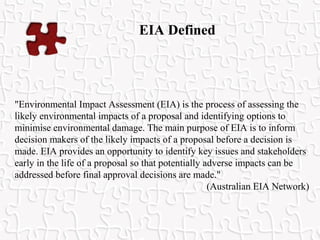
"Environmental Impact Assessment (EIA) is the process of assessing the
likely environmental impacts of a proposal and identifying options to
minimise environmental damage. The main purpose of EIA is to inform
decision makers of the likely impacts of a proposal before a decision is
made. EIA provides an opportunity to identify key issues and stakeholders
early in the life of a proposal so that potentially adverse impacts can be
addressed before final approval decisions are made."
(Australian EIA Network)
Immediate objectives of EIA
 improve the environmental design of the proposal;
 check the environmental acceptability of the proposals compared to the
capacity of the site and the receiving environment;
 ensure that resources are used appropriately and efficiently;
 identify appropriate measures for mitigating the potential impacts of the
proposal; and
 facilitate informed decision making, including setting the environmental
terms and conditions for implementing the proposal.
Long term objectives of EIA
 avoid irreversible changes and serious damage to the environment;
 safeguard valuable resources, natural areas and ecosystem components;
 enhance the social aspects of proposals; and
 protect human health and safety.
History of EIA
 originated in the early 1970s, with the implementation of the National
Environment Policy Act (NEPA) 1969 in the US.
 Canada, Australia, and New Zealand (1973-74).
 Columbia (1974), Philippines (1978).
 in 1989, the World Bank adopted EIA for major development project.
 currently practiced in more than 100 countries.
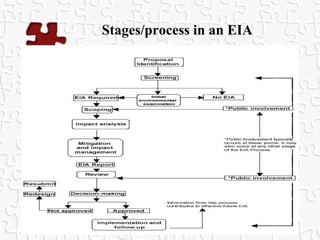
Stages/process in an EIA
Proposal Identification
 the location of the development
 the land uses the development will cater for
 the scale, layout and design of the development
 advantages and disadvantages of the alternatives should be
investigated
Screening
 to decide whether an EIA is required and focus resources on projects
most likely to have significant impacts
 development characteristics
 characteristics of the location
 characteristics of potential effects
Scoping
 key issues that the EIA will address are identified
 consultation with relevant stakeholders and interested parties to provide
them with information on the development proposal and what technically
appear to be the key issues and to find out what their key concerns are
regarding the location and the development proposal;
 analysis of the issues identified during consultation to determine which
are likely to be significant and therefore must be included within the
scope of the EIA; and
 negotiation with the decision makers and other interested parties to
Impact Analysis
 characterising the impact in terms of its likely nature, spatial and temporal
distribution, duration, frequency, reversibility and magnitude
 nature of the environmental media being assessed will determine the most
appropriate impact analysis technique
Mitigation
 mitigation measures are proposed to avoid, reduce and if possible,
remedy environmental impacts
Environmental Statement
 used to communicate the results of the EIA to the decision maker and other
stakeholders in the development process
 should objectively document the EIA process and findings giving equal
prominence to positive and negative impacts relative to their importance
 any necessary technical information should be provided in appendices
Review
 review of the quality of the environmental statement
 the ES has met all the appropriate legal requirements
 the ES contains sufficient information to allow a decision to be made
 the ES is consistent with current good practice
Decision Making
 the development is either granted planning permission or not
 making a decision on the application decision makers are required to
consider all relevant environmental information, including the
environmental statement and the opinions of statutory consultees, the
public and other stakeholders.
 will also consider social and economic information, current planning
policies and the relevant local development framework/local plan
Follow Up
 stage where the mitigation measures proposed within the environmental
statement are actually implemented
 monitoring of impacts is undertaken
EIA in India
 started in 1976-77 when the Planning Commission asked the Department
of Science and Technology to examine the river-valley projects from
environmental angle
 The Ministry of Environment and Forests (MoEF)
 Water Act(1974)
 The Indian Wildlife (Protection) Act (1972)
 The Air (Prevention and Control of Pollution) Act (1981)
 The Environment (Protection) Act (1986)
Draw backs in the Indian system
 It is being found that the team formed for conducting EIA studies is
lacking the expertise in various fields such as Anthropologists and Social
Scientists (to study the social impact of the project) or even wild life experts.
 There is a lack of exhaustive ecological and socio-economic indicators for
impact assessment.
 Public comments are not taken into account at the early stage, which often
leads to conflict at the later stage of project clearance.
 There is always a lack of reliable data sources.
 The secondary data is also not reliable.
Draw backs in the Indian system
contd...
The data collectors do not pay respect to the indigenous knowledge of local
people.
The credibility of the primary data collected by the data collectors is
doubtful.
The detail method used for the prediction and evaluation of the project is
not mentioned in the report. Limited explanations are given both to
quantitative estimation of magnitude of impact and to the assumptions and
judgments used in the evaluation of impacts.
The limited coverage of scoping is confined mainly to direct impacts.
Draw backs in the Indian system
contd...
Details regarding the effectiveness and implementation of mitigation
measures are often not provided.
Often, and more so for strategic industries such as nuclear energy
projected, the EMP s are kept confidential for political and administrative
reasons
Emergency preparedness plans are not discussed in sufficient details and
the information not disseminated to the communities.
Thank You

EIA

  • 1.
    Environment Impact Assessment Presentedby: Bimal Antony II MSW, No. 111
  • 2.
    What is EIA? an information gathering exercise carried out by the developer and other bodies  understand the environmental affects of a development  a systematic process which leads to a final product, the Environmental Statement (ES)
  • 3.
    EIA Defined "Environmental ImpactAssessment (EIA) is the process of assessing the likely environmental impacts of a proposal and identifying options to minimise environmental damage. The main purpose of EIA is to inform decision makers of the likely impacts of a proposal before a decision is made. EIA provides an opportunity to identify key issues and stakeholders early in the life of a proposal so that potentially adverse impacts can be addressed before final approval decisions are made." (Australian EIA Network)
  • 4.
    Immediate objectives ofEIA  improve the environmental design of the proposal;  check the environmental acceptability of the proposals compared to the capacity of the site and the receiving environment;  ensure that resources are used appropriately and efficiently;  identify appropriate measures for mitigating the potential impacts of the proposal; and  facilitate informed decision making, including setting the environmental terms and conditions for implementing the proposal.
  • 5.
    Long term objectivesof EIA  avoid irreversible changes and serious damage to the environment;  safeguard valuable resources, natural areas and ecosystem components;  enhance the social aspects of proposals; and  protect human health and safety.
  • 6.
    History of EIA originated in the early 1970s, with the implementation of the National Environment Policy Act (NEPA) 1969 in the US.  Canada, Australia, and New Zealand (1973-74).  Columbia (1974), Philippines (1978).  in 1989, the World Bank adopted EIA for major development project.  currently practiced in more than 100 countries.
  • 7.
  • 8.
    Proposal Identification  thelocation of the development  the land uses the development will cater for  the scale, layout and design of the development  advantages and disadvantages of the alternatives should be investigated
  • 9.
    Screening  to decidewhether an EIA is required and focus resources on projects most likely to have significant impacts  development characteristics  characteristics of the location  characteristics of potential effects
  • 10.
    Scoping  key issuesthat the EIA will address are identified  consultation with relevant stakeholders and interested parties to provide them with information on the development proposal and what technically appear to be the key issues and to find out what their key concerns are regarding the location and the development proposal;  analysis of the issues identified during consultation to determine which are likely to be significant and therefore must be included within the scope of the EIA; and  negotiation with the decision makers and other interested parties to
  • 11.
    Impact Analysis  characterisingthe impact in terms of its likely nature, spatial and temporal distribution, duration, frequency, reversibility and magnitude  nature of the environmental media being assessed will determine the most appropriate impact analysis technique
  • 12.
    Mitigation  mitigation measuresare proposed to avoid, reduce and if possible, remedy environmental impacts
  • 13.
    Environmental Statement  usedto communicate the results of the EIA to the decision maker and other stakeholders in the development process  should objectively document the EIA process and findings giving equal prominence to positive and negative impacts relative to their importance  any necessary technical information should be provided in appendices
  • 14.
    Review  review ofthe quality of the environmental statement  the ES has met all the appropriate legal requirements  the ES contains sufficient information to allow a decision to be made  the ES is consistent with current good practice
  • 15.
    Decision Making  thedevelopment is either granted planning permission or not  making a decision on the application decision makers are required to consider all relevant environmental information, including the environmental statement and the opinions of statutory consultees, the public and other stakeholders.  will also consider social and economic information, current planning policies and the relevant local development framework/local plan
  • 16.
    Follow Up  stagewhere the mitigation measures proposed within the environmental statement are actually implemented  monitoring of impacts is undertaken
  • 17.
    EIA in India started in 1976-77 when the Planning Commission asked the Department of Science and Technology to examine the river-valley projects from environmental angle  The Ministry of Environment and Forests (MoEF)  Water Act(1974)  The Indian Wildlife (Protection) Act (1972)  The Air (Prevention and Control of Pollution) Act (1981)  The Environment (Protection) Act (1986)
  • 18.
    Draw backs inthe Indian system  It is being found that the team formed for conducting EIA studies is lacking the expertise in various fields such as Anthropologists and Social Scientists (to study the social impact of the project) or even wild life experts.  There is a lack of exhaustive ecological and socio-economic indicators for impact assessment.  Public comments are not taken into account at the early stage, which often leads to conflict at the later stage of project clearance.  There is always a lack of reliable data sources.  The secondary data is also not reliable.
  • 19.
    Draw backs inthe Indian system contd... The data collectors do not pay respect to the indigenous knowledge of local people. The credibility of the primary data collected by the data collectors is doubtful. The detail method used for the prediction and evaluation of the project is not mentioned in the report. Limited explanations are given both to quantitative estimation of magnitude of impact and to the assumptions and judgments used in the evaluation of impacts. The limited coverage of scoping is confined mainly to direct impacts.
  • 20.
    Draw backs inthe Indian system contd... Details regarding the effectiveness and implementation of mitigation measures are often not provided. Often, and more so for strategic industries such as nuclear energy projected, the EMP s are kept confidential for political and administrative reasons Emergency preparedness plans are not discussed in sufficient details and the information not disseminated to the communities.
  • 21.