New developments in computer
assisted language learning

EFKF Support & Teach Conference 2011
Ton Koenraad
Hogeschool Utrecht
Faculty of Education

MFL methodology, in-service training
e-Projects manager, ICT-Coordinator

1990 - 2011

2005

2009

Kennisbasis-ICT
TELLConsult
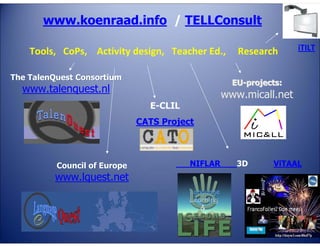
www.koenraad.info / TELLConsult
Tools, CoPs, Activity design, Teacher Ed.,
The TalenQuest Consortium

Research

iTILT

EU-projects:

www.talenquest.nl

www.micall.net
E-CLIL
CATS Project

Council of Europe

www.lquest.net

NIFLAR

3D

ViTAAL
ICT & Infrastructure
in developing countries
• One Laptop per Child

•Hole-in-the-Wall Project

• mobile-driven
transformation of poor
countries
(The Economist, 2011)
Mobile cellular subscriptions growth
2000 - 2010
• NL: 10.755.000 ---------> 19.310.000
• INDIA: 3.577.095 -------> 752.190.000
• NICARAGUA: 90.294 ----> 3.770.510
• UKRAINE: 818.524 -------> 53.928.830
(International Communication Union, 2011)

“the cellphone is poised to become the 'PC of Africa'”
Merryl Ford (2009)
References

Symposium + EU experts

EU: EUROCALL
LT CENTENNIAL (2011)
The FUTURE of LANGUAGE EDUCATION

1) the learning environment
2) the teacher
3) the learner
4) the methodology
5) the technology
The FUTURE of LANGUAGE EDUCATION
The learning environment
• Institution ‘school’ to stay
• Increase of digital component, OER
• Blended learning / Future of Textbooks?
• CMC promotes ‘open classroom’ &
‘telecollaboration’
• Tech development faster than school change
• LEs = teaching, learning and evaluation
models - methodological approach +
related technology
Open Educational Resources (OER)

LINGUA@NET
LMS / VLE + MFL plug-ins
WebSwami for oral/aural skills
Extensive reading support
Telecollaboration
The FUTURE of LANGUAGE EDUCATION
The teacher

•New roles and competences:
– curriculum trajectory design
– project based learning management
–(e)-materials design
– ict tools selection
–open classroom moderation
The FUTURE of LANGUAGE
EDUCATION
Teacher competence development

Experiential learning in initial training
Slow Cont. Prof. development (CPD)
PLNs (lists, twitter, CoP, Delicious)
Experiential Learning
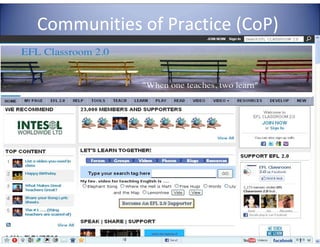
Communities of Practice (CoP)
Personal Learning Network:
Sharing Interests & Resource Finds
The FUTURE of LANGUAGE EDUCATION
The learner

Increased use of social media (e.g Facebook)
More informal learning (e.g. gaming, fan fiction)
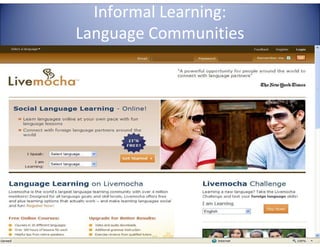
Informal Learning:
Language Communities
The FUTURE of LANGUAGE EDUCATION
The methodology

•Content driven
•Task-supported
•Targeted at Language use
•CLIL
• MFL methodology development:
more input from SLA research & learning theories
needed
The FUTURE of LANGUAGE EDUCATION
The technology

• CMC (synchronous and asynchronous)
• WEB 2.0
• IWBs
• Mobile technologies
•

WEB 3.0

• Adaptive software
Oral synchronous communication
3 D worlds for cultural info and ICC competence development
through encounters and events
Simulations for practice and
assessment of oral skills
Chatterdale
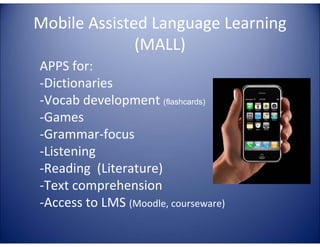
Mobile Assisted Language Learning
(MALL)
APPS for:
-Dictionaries
-Vocab development (flashcards)
-Games
-Grammar-focus
-Listening
-Reading (Literature)
-Text comprehension
-Access to LMS (Moodle, courseware)
Current availability of APPs
Points for discussion/reflection
• Analysis of local needs to define Project
Learning environment
• EFKF’s role in provision of e-facilities
• Skills development of project volunteers and
local staff
• Quality Assurance: e.g. Project evaluation

CALL developments presented at English for Kids Conference, Utrecht

  • 1.
    New developments incomputer assisted language learning EFKF Support & Teach Conference 2011 Ton Koenraad
  • 2.
    Hogeschool Utrecht Faculty ofEducation MFL methodology, in-service training e-Projects manager, ICT-Coordinator 1990 - 2011 2005 2009 Kennisbasis-ICT
  • 3.
  • 4.
    www.koenraad.info / TELLConsult Tools,CoPs, Activity design, Teacher Ed., The TalenQuest Consortium Research iTILT EU-projects: www.talenquest.nl www.micall.net E-CLIL CATS Project Council of Europe www.lquest.net NIFLAR 3D ViTAAL
  • 5.
    ICT & Infrastructure indeveloping countries • One Laptop per Child •Hole-in-the-Wall Project • mobile-driven transformation of poor countries (The Economist, 2011)
  • 6.
    Mobile cellular subscriptionsgrowth 2000 - 2010 • NL: 10.755.000 ---------> 19.310.000 • INDIA: 3.577.095 -------> 752.190.000 • NICARAGUA: 90.294 ----> 3.770.510 • UKRAINE: 818.524 -------> 53.928.830 (International Communication Union, 2011) “the cellphone is poised to become the 'PC of Africa'” Merryl Ford (2009)
  • 7.
    References Symposium + EUexperts EU: EUROCALL
  • 8.
    LT CENTENNIAL (2011) TheFUTURE of LANGUAGE EDUCATION 1) the learning environment 2) the teacher 3) the learner 4) the methodology 5) the technology
  • 9.
    The FUTURE ofLANGUAGE EDUCATION The learning environment • Institution ‘school’ to stay • Increase of digital component, OER • Blended learning / Future of Textbooks? • CMC promotes ‘open classroom’ & ‘telecollaboration’ • Tech development faster than school change • LEs = teaching, learning and evaluation models - methodological approach + related technology
  • 10.
  • 11.
    LMS / VLE+ MFL plug-ins
  • 12.
  • 13.
  • 14.
  • 15.
    The FUTURE ofLANGUAGE EDUCATION The teacher •New roles and competences: – curriculum trajectory design – project based learning management –(e)-materials design – ict tools selection –open classroom moderation
  • 16.
    The FUTURE ofLANGUAGE EDUCATION Teacher competence development Experiential learning in initial training Slow Cont. Prof. development (CPD) PLNs (lists, twitter, CoP, Delicious)
  • 17.
  • 18.
  • 19.
    Personal Learning Network: SharingInterests & Resource Finds
  • 22.
    The FUTURE ofLANGUAGE EDUCATION The learner Increased use of social media (e.g Facebook) More informal learning (e.g. gaming, fan fiction)
  • 23.
  • 24.
    The FUTURE ofLANGUAGE EDUCATION The methodology •Content driven •Task-supported •Targeted at Language use •CLIL • MFL methodology development: more input from SLA research & learning theories needed
  • 25.
    The FUTURE ofLANGUAGE EDUCATION The technology • CMC (synchronous and asynchronous) • WEB 2.0 • IWBs • Mobile technologies • WEB 3.0 • Adaptive software
  • 26.
  • 27.
    3 D worldsfor cultural info and ICC competence development through encounters and events
  • 28.
    Simulations for practiceand assessment of oral skills Chatterdale
  • 29.
    Mobile Assisted LanguageLearning (MALL) APPS for: -Dictionaries -Vocab development (flashcards) -Games -Grammar-focus -Listening -Reading (Literature) -Text comprehension -Access to LMS (Moodle, courseware)
  • 30.
  • 32.
    Points for discussion/reflection •Analysis of local needs to define Project Learning environment • EFKF’s role in provision of e-facilities • Skills development of project volunteers and local staff • Quality Assurance: e.g. Project evaluation