Approaches & resources to promote teacher
competencies development for effective interactive
whiteboard use.
Highlighting 2 EU projects: iTILT and SMARTVET.

Ton Koenraad, Serkan Çelik, Angela Higgins. Emily Hillier
Ton Koenraad - (NL) TELLConsult 

Serkan Çelik - (TR) Kirikkale University
ISNITE 2013, Ankara
Interactive Technologies In Language Teaching:
The IWB in the language classroom
EU Project – LLP Programme 2011-2013
Training language teachers to
use technology...
tools
materials
resources
reflection
pedagogy
learners
teachers
collaboration
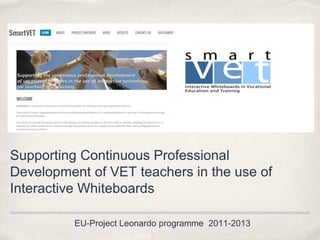
Supporting Continuous Professional
Development of VET teachers in the use of
Interactive Whiteboards
EU-Project Leonardo programme 2011-2013
Needs
Analysis:
Recommendations
• Produce modules for basic IWB functionalities
+ for ordering, structuring, comparing etc.
• Design materials as modular as possible
• Demo IWB potential for a variety of disciplines
• Include IWB page navigation, assessing,
adapting and designing materials
• Include (revision of) general pedagogical topics
like ‘active learning’ and general materials
design principles.
• Foster the ‘added value discussion’
Rationale
(Cutrim Schmid 2009, Gray et al. 2007,
Cutrim Schmid & Whyte, 2012
(Kennewell, 2006; Higgins et al., 2007;
Koenraad, 2008; Thomas & Cutrim
Schmid, 2010)
Clear need for
professional training
and pedagogical
resources to assist
teachers in exploiting
IWB in the foreign
language classroom
Limited uptake in
specific subject areas
and educational sectors
Teacher skills key in
realising added value
IWB underused in Irish
VET sector
Objectives
 Develop:
Needs
Analysis
IWB train-the-
trainers
programme +
materials
 CPD model for
Irish VET
sector
 CoP
Develop
- effective IWB training materials
- a multi-sector CoP, to share
materials & discuss ideas
Inspire teachers with
- “Real Life practice instances”
Project
Phases
IWB
Training
Data
Collection
Website
Needs Analysis
Training
Champions
Workshops /
Teacher content
development
CoP
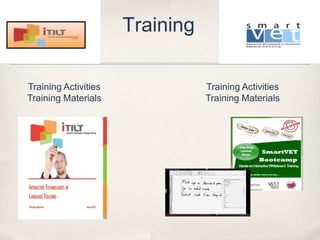
Training
Training Activities
Training Materials
Training Activities
Training Materials
Data
Collection
www.itilt.eu
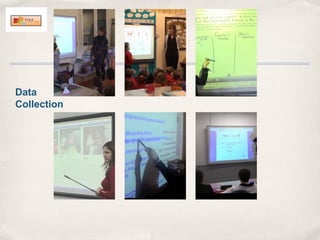
Data Collection
class filming
•2 visits to 6 teachers in 6 partner countries
learner reflections
•group interviews with 4-5 students
teacher interviews
•video stimulated reflection
www.itilt.eu
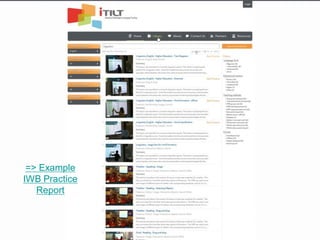
Website – IWB practice reports
IWB practice report
3-4 video clips
per class film
•81 class films
•44 teachers
•267 video clips
excerpts from
transcripts of
•teacher
comments
•learner reactions
related resources
•IWB file
•screenshots of
IWB page
=> Example
IWB Practice
Report
Qualitative
Outcomes
Comments by participating iTILT data partner teachers:
“I recommend teachers attend regular trainings on IWBs. Teacher education must be
given the utmost importance. I think, training must be provided by language
educators rather than technology people, and meaningful uses of IWBs for teaching
must be given with sample activities” (T2).
“First teachers should know how to use the IWB effectively. If it is necessary they
should take training before using it” (T6).
“Teachers should definitely observe their colleagues to discover the range of activities
that can be brought into the classrooms with IWB” (T2).
“Teachers can watch their recorded videos of their lessons and evaluate their
teaching (self-reflection) in order to refine the way they use IWBs” (T3).
iTILT-based research
Whyte, S., Beauchamp, G., & Hillier, E. (2012). Perceptions of the IWB for second language
teaching and learning: the iTILT project. In L. Bradley & S. Thouësny (Eds.), CALL: Using,
Learning, Knowing, EUROCALL Conference, Gothenburg, Sweden, 22-25 August 2012,
Proceedings (pp. 320-6).
Exploring how teachers use IWB for language teaching.
Cutrim Schmid, E. and Whyte, S. (2012) ‘Interactive whiteboards in state school settings:
teacher responses to socio-constructivist hegemonies.’ Language Learning and Technology,
16(2), pp. 65 – 86.
Exploring whether the introduction of new technologies has led to socio-constructivist
pedagogies.
Whyte, S., Cutrim Schmid, E., van Hazebrouck, S., & Oberhofer, M. (in press). Open
educational resources for CALL teacher education: the iTILT interactive whiteboard
project. CALL journal.
Challenges and opportunities arising during the development of OERs
iTILT
Exploitation
July, week 29, Spain August, week 33, Portugal
Courses offered in 2013 in …. & ….?
More info here
17
Thank you for your attention!
Ton Koenraad - (NL) TELLConsult 

Serkan Çelik - (TR) Kirikkale University
Credits: Sanderin van Hazebrouck & Shona Whyte

I tilt smartvet_presentation_ankara_final

  • 1.
    Approaches & resourcesto promote teacher competencies development for effective interactive whiteboard use. Highlighting 2 EU projects: iTILT and SMARTVET.
 Ton Koenraad, Serkan Çelik, Angela Higgins. Emily Hillier Ton Koenraad - (NL) TELLConsult 
 Serkan Çelik - (TR) Kirikkale University ISNITE 2013, Ankara
  • 2.
    Interactive Technologies InLanguage Teaching: The IWB in the language classroom EU Project – LLP Programme 2011-2013
  • 3.
    Training language teachersto use technology... tools materials resources reflection pedagogy learners teachers collaboration
  • 4.
    Supporting Continuous Professional Developmentof VET teachers in the use of Interactive Whiteboards EU-Project Leonardo programme 2011-2013
  • 5.
    Needs Analysis: Recommendations • Produce modulesfor basic IWB functionalities + for ordering, structuring, comparing etc. • Design materials as modular as possible • Demo IWB potential for a variety of disciplines • Include IWB page navigation, assessing, adapting and designing materials • Include (revision of) general pedagogical topics like ‘active learning’ and general materials design principles. • Foster the ‘added value discussion’
  • 6.
    Rationale (Cutrim Schmid 2009,Gray et al. 2007, Cutrim Schmid & Whyte, 2012 (Kennewell, 2006; Higgins et al., 2007; Koenraad, 2008; Thomas & Cutrim Schmid, 2010) Clear need for professional training and pedagogical resources to assist teachers in exploiting IWB in the foreign language classroom Limited uptake in specific subject areas and educational sectors Teacher skills key in realising added value IWB underused in Irish VET sector
  • 7.
    Objectives  Develop: Needs Analysis IWB train-the- trainers programme+ materials  CPD model for Irish VET sector  CoP Develop - effective IWB training materials - a multi-sector CoP, to share materials & discuss ideas Inspire teachers with - “Real Life practice instances”
  • 8.
  • 9.
  • 10.
  • 11.
    www.itilt.eu Data Collection class filming •2visits to 6 teachers in 6 partner countries learner reflections •group interviews with 4-5 students teacher interviews •video stimulated reflection
  • 12.
    www.itilt.eu Website – IWBpractice reports IWB practice report 3-4 video clips per class film •81 class films •44 teachers •267 video clips excerpts from transcripts of •teacher comments •learner reactions related resources •IWB file •screenshots of IWB page
  • 13.
  • 14.
    Qualitative Outcomes Comments by participatingiTILT data partner teachers: “I recommend teachers attend regular trainings on IWBs. Teacher education must be given the utmost importance. I think, training must be provided by language educators rather than technology people, and meaningful uses of IWBs for teaching must be given with sample activities” (T2). “First teachers should know how to use the IWB effectively. If it is necessary they should take training before using it” (T6). “Teachers should definitely observe their colleagues to discover the range of activities that can be brought into the classrooms with IWB” (T2). “Teachers can watch their recorded videos of their lessons and evaluate their teaching (self-reflection) in order to refine the way they use IWBs” (T3).
  • 15.
    iTILT-based research Whyte, S.,Beauchamp, G., & Hillier, E. (2012). Perceptions of the IWB for second language teaching and learning: the iTILT project. In L. Bradley & S. Thouësny (Eds.), CALL: Using, Learning, Knowing, EUROCALL Conference, Gothenburg, Sweden, 22-25 August 2012, Proceedings (pp. 320-6). Exploring how teachers use IWB for language teaching. Cutrim Schmid, E. and Whyte, S. (2012) ‘Interactive whiteboards in state school settings: teacher responses to socio-constructivist hegemonies.’ Language Learning and Technology, 16(2), pp. 65 – 86. Exploring whether the introduction of new technologies has led to socio-constructivist pedagogies. Whyte, S., Cutrim Schmid, E., van Hazebrouck, S., & Oberhofer, M. (in press). Open educational resources for CALL teacher education: the iTILT interactive whiteboard project. CALL journal. Challenges and opportunities arising during the development of OERs
  • 16.
    iTILT Exploitation July, week 29,Spain August, week 33, Portugal Courses offered in 2013 in …. & ….? More info here
  • 17.
    17 Thank you foryour attention! Ton Koenraad - (NL) TELLConsult 
 Serkan Çelik - (TR) Kirikkale University Credits: Sanderin van Hazebrouck & Shona Whyte