ICT IN
CASTILLA LA
MANCHA
STANDING LAW OF EDUCATION (LOE) – 2006
KEY COMPETENCES:
Essential learning at the end of the
compulsory education.

Linguistic competence
Mathematical competence.
Knowledge about and interaction with the real world competence

Competence in processing information and use
of ICT.
Competence in social skills and citizenship.
Cultural and artistic competence.
Learning to learn.
Autonomy and personal initiative.
Standing law of education (LOE) – 2006

Competence in processing
information and use of ICT

This is the ability to search for, obtain,
process and communicate information,
and transform it into knowledge.
Standing law of education (LOE) – 2006
Processing information and
use of ICT

The digital competence is not a skill in itself, but it also helps
the other skills :
 Group work.
 Learning to learn.
 Creativity and innovation encouragement.
 Contribution to intercultural dialogue.
 Improvement of individual learning problems.
La Ley Orgánica de Educación (LOE) – 2006
Processing information and use of ICT

Integration of ICT in schools.

Tools for administrative and tutorial management.
 ITC literacy.
 ITC application to the different subjects.
 Group cooperation tool.
La Ley Orgánica de Educación (LOE) – 2006
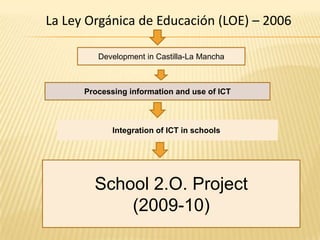
Development in Castilla-La Mancha

Processing information and use of ICT

Integration of ICT in schools.

School 2.O. Project
(2009-10)
SCHOOL 2.0


The programme School 2.0 began in year
2009/2010 as a project of integration of ICT
in schools supported with public funds and
contemplated the use of a personal
notebook by each student. This programme
aims to provide access and connectivity to
students sporadically and to make ICT a
resource for all students on a daily basis.
School 2.O. Project
(2009-10)
• Digital classrooms. Provide ICT resources to schools: Laptops for students
and teachers and digital classrooms.
• Guarantee the internet connection inside the classroom to all computers
and help the internet access at home.
• Provide teachers’ training not only in technological aspects but also in
methodological and social aspects in order to help them on the integration of
ICT resources into their daily teaching practice.
• Facilitate access to digital educational materials.
• Help the learners and families become responsible and confident users of
ICT resources.
School 2.O. Project
Objectives:

1.Transformation into digital classrooms of all 5th and 6th year
classrooms of primary schools and 1st and 2nd year classrooms
of secondary schools. Compulsory on public schools.
2. Supply of computers to all students for personal use.
3. Development of teacher training.

4. Provide teachers with digital education resources.
School 2.O. Project
Resources:

 Interactive whiteboard and projector.
 Laptop for teachers’ use.
 WIFI.
 Cupboard to keep the laptops.
 Netbooks for students.
THE IMPLEMENTATION
The implementation schedule began in 2009
with Primary students in Grade 5 and the
expected outcome was to reach, year by year,
Secondary students in Grade 2 in 2013.
 It was, therefore, a four‐year programme aimed
at students between 10 and 14.
 'School 2.0' was based on the following areas of
intervention:
1. Providing ICT resources to schools,
notebooks for students, laptops for teachers and
effectively standardized digital classrooms.

2. Ensuring Internet connectivity and
interconnectivity within the classroom for all the
computers.
3. Promoting teacher training in both the
technological, social and methodological aspects
related to the integration of these resources in
their daily teaching practice.
4. Generating and providing access to digital
educational materials suitable to the curriculum
needs, both for teachers and students and their
families.
5. Involving students and their families in the
custody and use of these resources.
6. Evaluating and monitoring the implementation.
7. Social networking and disseminating best
practices.
In schools, this plan involved the
development of three concepts:
a) Digital Classrooms: with the consequent
adjustment in the school organization of
schools, their infrastructure and connectivity.
b) Virtual classrooms: as an extension of the
space‐time framework of classrooms
including tutoring and virtual contacts with
families thanks to the platform Papás 2.0 in
Castilla La Mancha.
c) Pedagogical changes: in the
teaching‐learning process and in assessment

PROJECTS








Delphos Project: administrative and academic school
management program, still in use.
Althia Project: during 2004/2005, these Althia
classrooms were media and communication
classrooms and, therefore, were equipped with
computers and Internet access at each school.
Comprehensive Connectivity Plan: a Wi-Fi network was
provided to each school during the year 2004/2005,
which multiplied the possibilities of integration of ICT in
educational daily practice thanks to the simultaneous
use of the Internet by different groups of students. o
Papás Project: this programme started in 2004 and
allowed families to have access to information such as
their children’s grades or truancy. It still in use in a 2.0
version.
ICT IN CASTILLA LA
MANCHA.
99% of households have a computer
99% of households have internet access
85% use the internet to find information
60% use social networks
Schools are equipped with computers and
internet access, which is mostly used for the
tasks of teaching and learning
ICT IN CASTILLA LA MANCHA
Castilla-La Mancha
Year 2011

TOTAL HOUSING
Computer

Lap top
Other computers (PDA, Pocket PC.)
Housing with 2 or 3 kinds of computers

Absolute
value

Spain
Absolute
value

%

%

662.102

100,0

15.494.265

100,0

330.389

49,9

7.576.696

48,9

290.001

43,8

7.561.201

48,8

29.132

4,4

960.644

6,2

165.526

25,0

4.369.383

28,2

380.942

99,1

9.591.296

98,9

310.981

80,9

7.263.783

74,9

Broadband for cable network

40.747

10,6

1.532.280

15,8

Mobile Phones UMTS broadband, 3G, 3.5G

31.137

8,1

1.270.435

13,1

Other broadband (satellite, etc.).

37.287

9,7

834.026

8,6

Households with broadband connection

Broadband ADSL
INTERNET USE
Communication services and access to information
Send or recieve and e-mail

799.375

85,6

20.435.727

88,1

Participate in social networks

469.726

50,3

12.131.538

52,3

Read or download news, newspapers or magazines on line

592.060

63,4

15.587.751

67,2

Find information on health issues

557.508

59,7

13.198.557

56,9

Find information about education, training or other courses

640.620

68,6

14.729.497

63,5

Finding information about goods and services

646.224

69,2

16.376.417

70,6

Download software (excluding games)

252.139

27,0

7.213.974

31,1

Do some online course on any subject

154.085

16,5

3.085.076

13,3

Check wikis (like Wikipedia) or online encyclopedias to gain
insight on any topic

576.185

61,7

13.384.125

57,7

Services related to learning
INFORMATION NET
Use of computers

Administrative
tasks

Teaching or
direct use of
students

Teaching
tasks

Múltiples
tasks

PRIMARY EDUCATION PUBLIC SCHOOL
Castilla-La Mancha

3,6

26,2

69,2

1,0

Spain

5,4

12,3

78,8

3,6

Castilla-La Mancha

6,0

17,8

73,0

3,3

Spain

4,8

16,3

74,5

4,4

SECUNDARY EDUCATION SCHOOLS

Kind of connection

Conections to internet in Schools
TOTAL
Castilla-La Mancha
Spain
PUBLIC SCHOOLS
Castilla-La Mancha
Spain
PRIMARY EDUCATION PUBLIC SCHOOLS
Castilla-La Mancha
Spain
SECUNDARY EDUCATION PUBLIC SCHOOLS
Castilla-La Mancha
Spain

Internet
connection

Telephone
line

ISDN

ADSL

Other
connection

99,5
99,8

10,4
7,6

6,4
5,3

96,4
86,7

12,4
13,4

99,4
99,8

11,7
8,0

6,9
5,6

96,9
84,9

13,0
14,9

99,9
99,4

8,7
12,1

5,6
6,2

84,4
97,6

14,1
9,0

99,5
99,5

10,2
6,2

8,8
5,6

94,9
86,2

25,5
17,0

Modelo tic en clm

  • 1.
  • 2.
    STANDING LAW OFEDUCATION (LOE) – 2006 KEY COMPETENCES: Essential learning at the end of the compulsory education. Linguistic competence Mathematical competence. Knowledge about and interaction with the real world competence Competence in processing information and use of ICT. Competence in social skills and citizenship. Cultural and artistic competence. Learning to learn. Autonomy and personal initiative.
  • 3.
    Standing law ofeducation (LOE) – 2006 Competence in processing information and use of ICT This is the ability to search for, obtain, process and communicate information, and transform it into knowledge.
  • 4.
    Standing law ofeducation (LOE) – 2006 Processing information and use of ICT The digital competence is not a skill in itself, but it also helps the other skills :  Group work.  Learning to learn.  Creativity and innovation encouragement.  Contribution to intercultural dialogue.  Improvement of individual learning problems.
  • 5.
    La Ley Orgánicade Educación (LOE) – 2006 Processing information and use of ICT Integration of ICT in schools. Tools for administrative and tutorial management.  ITC literacy.  ITC application to the different subjects.  Group cooperation tool.
  • 6.
    La Ley Orgánicade Educación (LOE) – 2006 Development in Castilla-La Mancha Processing information and use of ICT Integration of ICT in schools. School 2.O. Project (2009-10)
  • 7.
    SCHOOL 2.0  The programmeSchool 2.0 began in year 2009/2010 as a project of integration of ICT in schools supported with public funds and contemplated the use of a personal notebook by each student. This programme aims to provide access and connectivity to students sporadically and to make ICT a resource for all students on a daily basis.
  • 8.
    School 2.O. Project (2009-10) •Digital classrooms. Provide ICT resources to schools: Laptops for students and teachers and digital classrooms. • Guarantee the internet connection inside the classroom to all computers and help the internet access at home. • Provide teachers’ training not only in technological aspects but also in methodological and social aspects in order to help them on the integration of ICT resources into their daily teaching practice. • Facilitate access to digital educational materials. • Help the learners and families become responsible and confident users of ICT resources.
  • 9.
    School 2.O. Project Objectives: 1.Transformationinto digital classrooms of all 5th and 6th year classrooms of primary schools and 1st and 2nd year classrooms of secondary schools. Compulsory on public schools. 2. Supply of computers to all students for personal use. 3. Development of teacher training. 4. Provide teachers with digital education resources.
  • 10.
    School 2.O. Project Resources: Interactive whiteboard and projector.  Laptop for teachers’ use.  WIFI.  Cupboard to keep the laptops.  Netbooks for students.
  • 11.
    THE IMPLEMENTATION The implementationschedule began in 2009 with Primary students in Grade 5 and the expected outcome was to reach, year by year, Secondary students in Grade 2 in 2013.  It was, therefore, a four‐year programme aimed at students between 10 and 14.  'School 2.0' was based on the following areas of intervention: 1. Providing ICT resources to schools, notebooks for students, laptops for teachers and effectively standardized digital classrooms. 
  • 12.
    2. Ensuring Internetconnectivity and interconnectivity within the classroom for all the computers. 3. Promoting teacher training in both the technological, social and methodological aspects related to the integration of these resources in their daily teaching practice. 4. Generating and providing access to digital educational materials suitable to the curriculum needs, both for teachers and students and their families. 5. Involving students and their families in the custody and use of these resources. 6. Evaluating and monitoring the implementation. 7. Social networking and disseminating best practices.
  • 13.
    In schools, thisplan involved the development of three concepts: a) Digital Classrooms: with the consequent adjustment in the school organization of schools, their infrastructure and connectivity. b) Virtual classrooms: as an extension of the space‐time framework of classrooms including tutoring and virtual contacts with families thanks to the platform Papás 2.0 in Castilla La Mancha. c) Pedagogical changes: in the teaching‐learning process and in assessment 
  • 14.
    PROJECTS     Delphos Project: administrativeand academic school management program, still in use. Althia Project: during 2004/2005, these Althia classrooms were media and communication classrooms and, therefore, were equipped with computers and Internet access at each school. Comprehensive Connectivity Plan: a Wi-Fi network was provided to each school during the year 2004/2005, which multiplied the possibilities of integration of ICT in educational daily practice thanks to the simultaneous use of the Internet by different groups of students. o Papás Project: this programme started in 2004 and allowed families to have access to information such as their children’s grades or truancy. It still in use in a 2.0 version.
  • 15.
    ICT IN CASTILLALA MANCHA. 99% of households have a computer 99% of households have internet access 85% use the internet to find information 60% use social networks Schools are equipped with computers and internet access, which is mostly used for the tasks of teaching and learning
  • 16.
    ICT IN CASTILLALA MANCHA Castilla-La Mancha Year 2011 TOTAL HOUSING Computer Lap top Other computers (PDA, Pocket PC.) Housing with 2 or 3 kinds of computers Absolute value Spain Absolute value % % 662.102 100,0 15.494.265 100,0 330.389 49,9 7.576.696 48,9 290.001 43,8 7.561.201 48,8 29.132 4,4 960.644 6,2 165.526 25,0 4.369.383 28,2 380.942 99,1 9.591.296 98,9 310.981 80,9 7.263.783 74,9 Broadband for cable network 40.747 10,6 1.532.280 15,8 Mobile Phones UMTS broadband, 3G, 3.5G 31.137 8,1 1.270.435 13,1 Other broadband (satellite, etc.). 37.287 9,7 834.026 8,6 Households with broadband connection Broadband ADSL
  • 17.
    INTERNET USE Communication servicesand access to information Send or recieve and e-mail 799.375 85,6 20.435.727 88,1 Participate in social networks 469.726 50,3 12.131.538 52,3 Read or download news, newspapers or magazines on line 592.060 63,4 15.587.751 67,2 Find information on health issues 557.508 59,7 13.198.557 56,9 Find information about education, training or other courses 640.620 68,6 14.729.497 63,5 Finding information about goods and services 646.224 69,2 16.376.417 70,6 Download software (excluding games) 252.139 27,0 7.213.974 31,1 Do some online course on any subject 154.085 16,5 3.085.076 13,3 Check wikis (like Wikipedia) or online encyclopedias to gain insight on any topic 576.185 61,7 13.384.125 57,7 Services related to learning
  • 18.
    INFORMATION NET Use ofcomputers Administrative tasks Teaching or direct use of students Teaching tasks Múltiples tasks PRIMARY EDUCATION PUBLIC SCHOOL Castilla-La Mancha 3,6 26,2 69,2 1,0 Spain 5,4 12,3 78,8 3,6 Castilla-La Mancha 6,0 17,8 73,0 3,3 Spain 4,8 16,3 74,5 4,4 SECUNDARY EDUCATION SCHOOLS Kind of connection Conections to internet in Schools TOTAL Castilla-La Mancha Spain PUBLIC SCHOOLS Castilla-La Mancha Spain PRIMARY EDUCATION PUBLIC SCHOOLS Castilla-La Mancha Spain SECUNDARY EDUCATION PUBLIC SCHOOLS Castilla-La Mancha Spain Internet connection Telephone line ISDN ADSL Other connection 99,5 99,8 10,4 7,6 6,4 5,3 96,4 86,7 12,4 13,4 99,4 99,8 11,7 8,0 6,9 5,6 96,9 84,9 13,0 14,9 99,9 99,4 8,7 12,1 5,6 6,2 84,4 97,6 14,1 9,0 99,5 99,5 10,2 6,2 8,8 5,6 94,9 86,2 25,5 17,0