Experiences with NIFLAR’s  3D virtual worlds  Ton Koenraad & Silvia Canto
Structure NIFLAR 3D worlds Recordings of university student activities
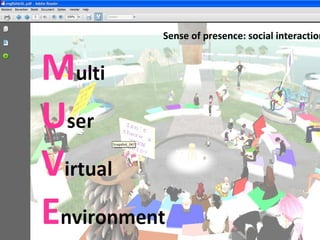
Sense of presence: social interaction
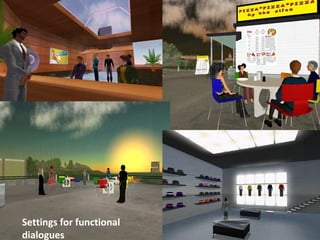
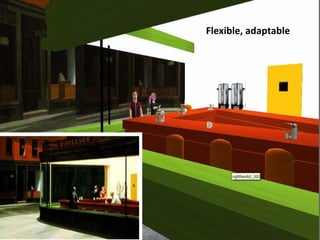
Settings for functional dialogues
Flexible, adaptable
NIFLAR requirements from first ideas to realisation
Design principles for NIFLAR  3D-VLE Objectives for L2 learners  &  (student) teachers  Pedagogical principles:  Pedagogy re ICC-training & assessment  Blended approach Teacher Ed.:  Experiential learning (competence development) Analysis of good practice  ( Warburton, 2009; Molka-Danielsen & Deutchmann, 2009; Sweeney, 2009; Jauregi et al., 2009; 2010) Scalable, sustainable
NIFLAR’s 3D Learning Enviroments: Second Life Open Simulator
SL for adult students:  Access to authentic places &  interaction  (chance meetings)
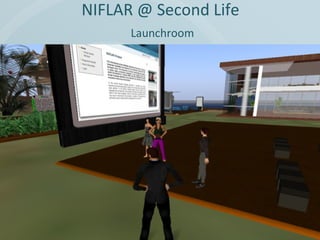
NIFLAR @ Second Life   Launchroom
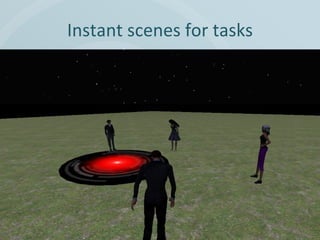
Instant scenes for tasks
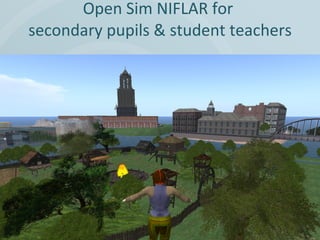
Open Sim NIFLAR for  secondary pupils & student teachers
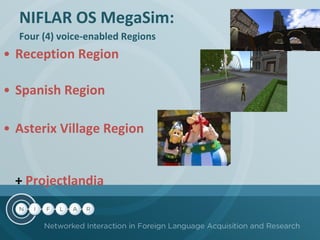
NIFLAR OS MegaSim:  Four (4)  voice-enabled  Regions   Reception Region Spanish Region   Asterix Village Region +  Projectlandia
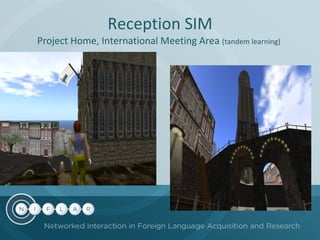
Reception SIM Project Home, International Meeting Area  (tandem learning)
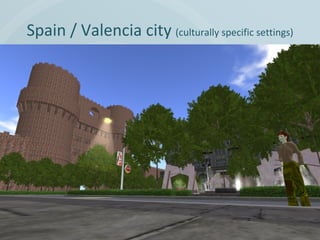
Spain / Valencia city  (culturally specific settings)
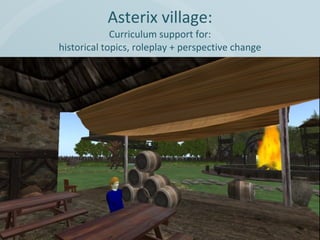
Asterix village: Curriculum support for: historical topics, roleplay + perspective change
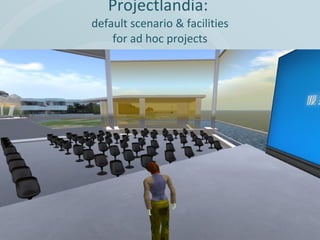
Projectlandia:  default scenario & facilities for ad hoc projects
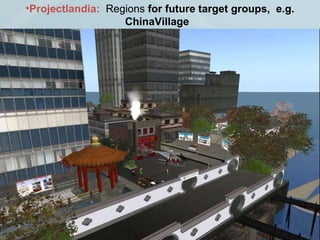
Projectlandia:   Regions  for future target groups,  e.g. ChinaVillage
Tasks & activities for  secondary learners - Treasure Hunt:  find hidden cultural artefacts and discuss use/origin - Guided tour: Guide partner and provide cultural information
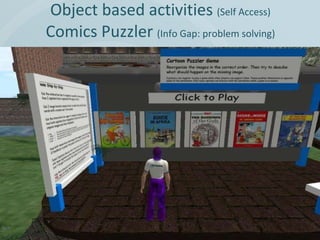
Object based activities  (Self Access) Comics Puzzler  (Info Gap: problem solving)
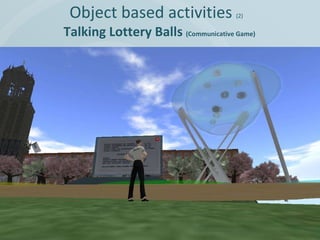
Object based activities  (2)    Talking Lottery Balls  (Communicative Game)

Niflar3 d finalsymposium