Social interaction in virtual worlds:
Designing for ICC in 3D
Ton Koenraad, Mabelle Hermandéz, Lex Hermans
Agenda
•
•
•
•
•

MUVEs?
Design principles for NIFLAR 3D VLE’s
Task and object driven activities
Demo
Hands-on
Main NIFLAR objectives :
• To enrich and innovate academic programs of foreign languages
and make them more rewarding and relevant
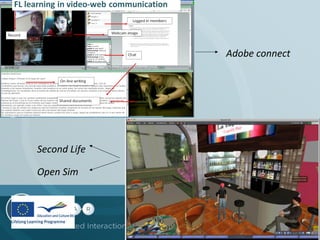
Promoting blended learning by the use of two technologies:
– Video web communication (Adobe Connect)
– 3D Virtual Worlds (Second Life / Open SIM)

• To study the added value of implementing networked
interactions
Three target groups:
– FL learners at secondary and tertiary levels
– Pre- (in) service teachers
Adobe connect

Second Life
Open Sim
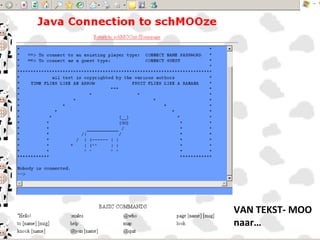
VAN TEKST- MOO
naar…
Educational Potential
• multimedia
• time & place independent
• synchronous & asynchronous, written & oral
interaction
• flexible
• Identity experimentation
d

http://sleducation.wikispaces.c
om/educationaluses
Link
Good Practice Analysis: Design principles for NIFLAR 3D-VLE

• Objectives for (student) teachers + L2 learners
• Pedagogical principles:
– Pedagogy re ICC-training & assessment
– Blended approach
– Teacher Ed.:
Experiential learning (competence development)

• Analysis of good practice (Warburton, 2009; Molka-

Danielsen & Deutchmann, 2009; Sweeney, 2009; Jauregi et al., 2009;
2010)

• Scalable, sustainable
Open Simulator Platform
VLE
C
O
M
P
O
N
E
N
T
S

Reception / Exploratorium

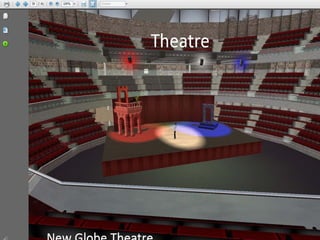
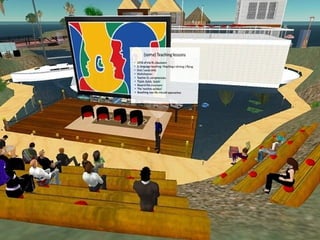
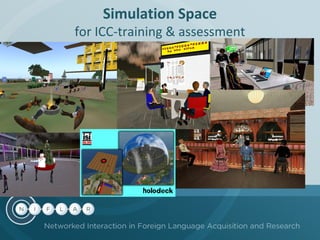
Simulation Space

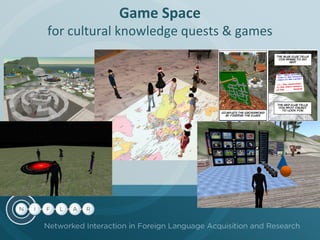
Game Space
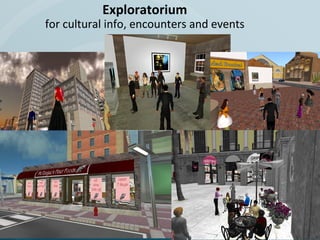
Exploratorium

for cultural info, encounters and events
Simulation Space

for ICC-training & assessment
Game Space

for cultural knowledge quests & games
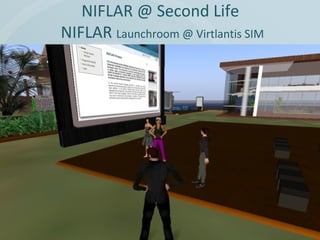
NIFLAR @ Second Life
NIFLAR Launchroom @ Virtlantis SIM
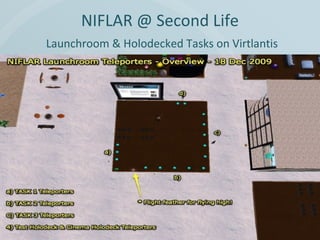
NIFLAR @ Second Life
Launchroom & Holodecked Tasks on Virtlantis
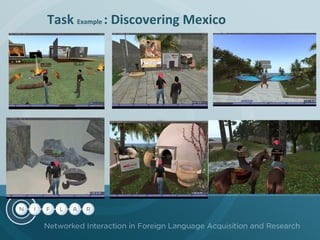
Task Example : Discovering Mexico
NIFLAR OS design process
from first ideas to realisation
Specifications

 Realisations
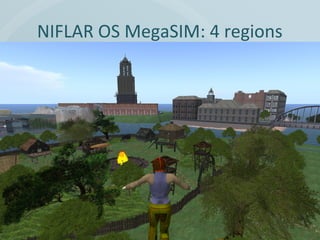
NIFLAR OS MegaSim:
Four (4) voice-enabled Regions

• Reception
• Spanish SIM
• Asterix Village
+ Projectlandia
NIFLAR OS MegaSIM: 4 regions
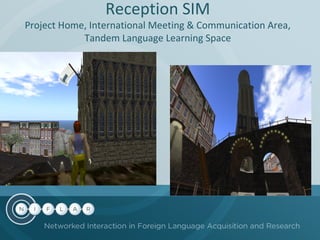
Reception SIM

Project Home, International Meeting & Communication Area,
Tandem Language Learning Space
Cartoon Puzzler
Info Gap: collaborative problem solving
Talking Lottery Balls
Inspired by: Talking Dice

• oral proficiency practice with embedded ICC
development goals through symbols & images
that trigger statements and interactions on
personal lives and cultural topics.
Cultural Knowledge Quiz:

exchange, discuss, convince, move, apologize…
SLOODLE for NIFLAR OpenSim Worlds
• WebIntercom -- links text-chat in-world to a Moodle
chatroom
• Quiz Chair -- students can do a Moodle quiz from inworld, and receive audio-visual feedback on their
progress
• CultureQuest
• Awards system
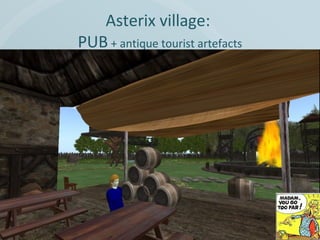
Asterix Village
3D-visualisation of Third Place concept and
historical dimension (ICC pedagogy)
Asterix village:
PUB + antique tourist artefacts
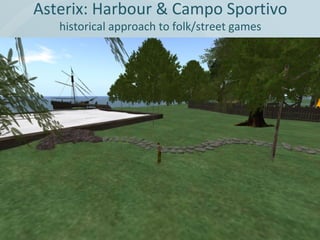
Asterix: Harbour & Campo Sportivo
historical approach to folk/street games
Spain: Urban area

(Valencia design by Nadia Revenga García)
NIFLAR Valencia city
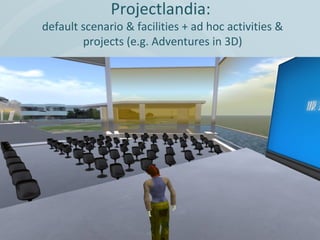
Projectlandia:

default scenario & facilities + ad hoc activities &
projects (e.g. Adventures in 3D)
•Projectlandia: Regions for future target groups, e.g.
ChinaVillage (holodeck approach)
Student involvement & CoP development
• Ownership: student profiles / cultural
knowledge sharing
• Authorable content objects facilitating
blended approach
• Partner consortium
• OS-LingoGrid
Implementation issues.
Prerequisites (Contexts: University / 2
• Technology:
• Computer access
(school / home)
• Installed Viewers +
voice finetuning
• User training

nd

Ed.)

• Partners:
• Projectplanning (!) +
content (3D / tasks)
• Curriculum:
shared & local
learning goals +
assessment
Experiences
• Pilot experiences in Second Life for academic
students (Spanish L2) and student teachers.
• Pilot with secondary pupils in OpenSim
(Spanish & English L2, tandem approach) and
student teachers.
Data sources
•
•
•
•

Recorded interactions
Pre & post oral tests
Surveys (pre, mid and post)
Interviews
Would you like to know more about
the NIFLAR project?
Read about results in our publications
&
Join us at
niflar.ning.com
www.niflar.eu
Thank you for your attention!!

Workshop on NIFLAR project at Coimbra University, Portugal

Editor's Notes

  • #4 Focus on  a specific target group language teachers and how new technologies might be an added value. What makes the difference; what is the impact of using ICT for language teaching; when not to use it, data on impact; etc. Maybe one can address the enormous difficulty of measuring the use and impact of ICT on learning. Focus also on the fact that it is not only about using ICT for language learning but that one learns other competences such as citizenship, intercultural awareness, etc… maybe data on this ? Please finish with some key conclusions, statements, recommendations to get the discussion going.