Different cultures make very different use of ICT   2 case studies on the integration of ICT in teacher education
ICT, Development & Education   And what happens to traditional concepts of classrooms and teaching when we can now learn anything, anywhere, anytime?...In this new interactive Web world, I have become a nomadic learner; I graze on knowledge. I find what I need when I need it...  How, as educators and learners, did we respond? Will Richardson (2006)
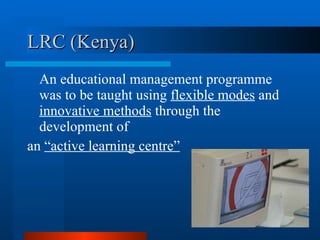
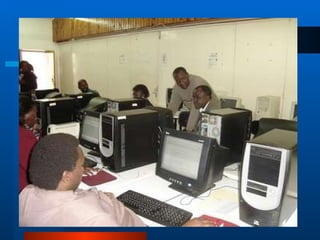
LRC (Kenya) An educational management programme was to be taught using  flexible modes  and  innovative methods  through the development of  an  “active learning centre”
 
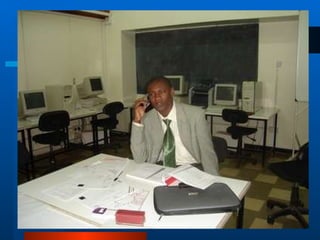
KTTC department for ICT integration and open learning LRC embodies 3 ICT Units comprising of 68 networked computers next to a large Documentation Unit and working space http://www.kttc.ac.ke/
KTTC department for ICT integration and open learning Integration of ICT in teacher education: ICT integration in the curriculum ICT infusion in the open learning manuals ICT exposure in the LRC ICT in education training packages ICT knowledge management competencies ICT support to distance education
 
Open, distance & eLearning Higher Diploma in Educational Management (HDEM) Competency based curriculum Modular (3) approach Integration of ICT in 16 courses Infusion of HIV/AIDS in each course
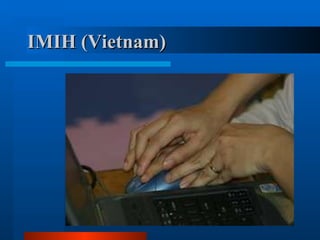
IMIH (Vietnam)
IMIH (Vietnam) Support the process of implementing ICT in 17 schools of Hanoi: Kindergartens Primary schools Lower secondary schools Vocational schools
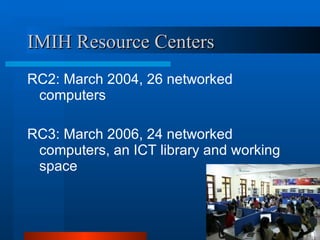
IMIH Resource Centers RC2: March 2004, 26 networked computers RC3: March 2006, 24 networked computers, an ICT library and working space
Capacity Building Programme ‘Three-in-one’ ICT skills E4ICT ICT teachers’ toolkit
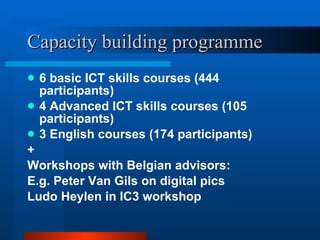
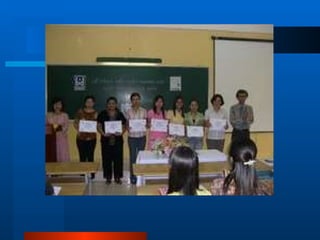
Capacity building programme 6 basic ICT skills courses (444 participants) 4 Advanced ICT skills courses (105 participants) 3 English courses (174 participants) + Workshops with Belgian advisors:  E.g. Peter Van Gils on digital pics Ludo Heylen in IC3 workshop
 
IMIH http://hanoict.blogspot.com/ http://www.hrctem.org/ http://www.glsdewissel.be/etwinning/
Some findings and lessons learned
Some findings and lessons learned Integrate ICT in all subjects Focus on Information AND Communication AND Technology Learn to understand the different ways to use ICT
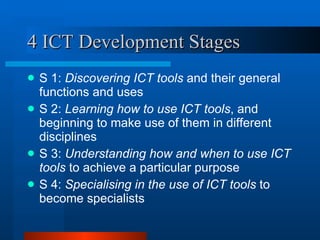
4 ICT Development Stages S 1:  Discovering ICT tools  and their general functions and uses S 2:  Learning how to use ICT tools , and beginning to make use of them in different disciplines S 3:  Understanding how and when to use ICT tools  to achieve a particular purpose S 4:  Specialising in the use of ICT tools  to become specialists
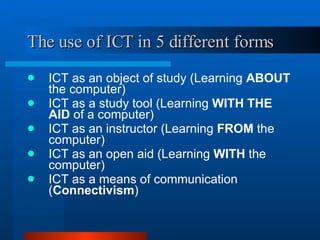
The use of ICT in 5 different forms ICT as an object of study (Learning  ABOUT  the computer) ICT as a study tool (Learning  WITH THE AID  of a computer) ICT as an instructor (Learning  FROM  the computer) ICT as an open aid (Learning  WITH  the computer) ICT as a means of communication ( Connectivism )
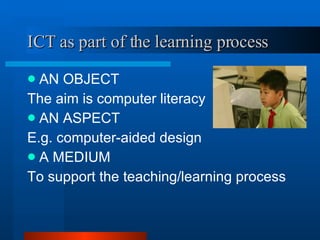
ICT as part of the learning process   AN OBJECT  The aim is computer literacy AN ASPECT E.g. computer-aided design  A MEDIUM  To support the teaching/learning process
A Learning Resource Centre An agent of change A learning community A network of people conducive, well-managed,  well-resourced
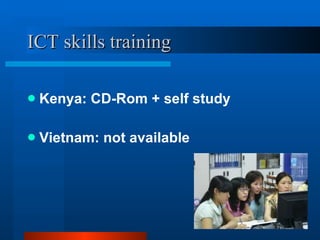
ICT skills training Kenya: CD-Rom + self study Vietnam: not available
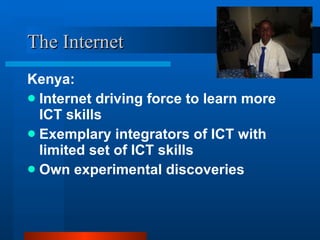
The Internet Kenya:  Internet driving force to learn more ICT skills Exemplary integrators of ICT with limited set of ICT skills Own experimental discoveries
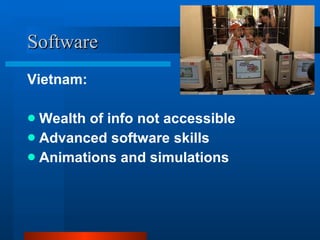
Software Vietnam: Wealth of info not accessible Advanced software skills Animations and simulations
Active learning VIETNAM: Visual stimulation, games, competitions, songs KENYA: Internet research, webquest
Distance learning Kenya: long history with distance education, from correspondence courses E-learning
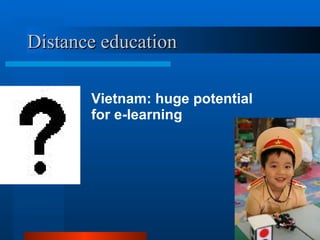
Distance education Vietnam: huge potential  for e-learning
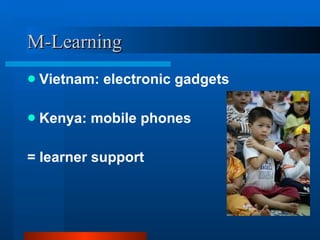
M-Learning Vietnam: electronic gadgets Kenya: mobile phones = learner support
Working in a cross-cultural context Cultural imperialism Not all people thinks the same way Learning has many dimensions Context is central
Conclusion Different cultures make very different use of ICT
Thank you! A mind is like a parachute. It  doesn’t work if it’s not open. (Frank Zappa)  FOR MORE INFORMATION... http://hanoict.blogspot.com/

IMIH.VVOBCegoConference

  • 1.
    Different cultures makevery different use of ICT 2 case studies on the integration of ICT in teacher education
  • 2.
    ICT, Development &Education And what happens to traditional concepts of classrooms and teaching when we can now learn anything, anywhere, anytime?...In this new interactive Web world, I have become a nomadic learner; I graze on knowledge. I find what I need when I need it... How, as educators and learners, did we respond? Will Richardson (2006)
  • 3.
    LRC (Kenya) Aneducational management programme was to be taught using flexible modes and innovative methods through the development of an “active learning centre”
  • 4.
  • 5.
    KTTC department forICT integration and open learning LRC embodies 3 ICT Units comprising of 68 networked computers next to a large Documentation Unit and working space http://www.kttc.ac.ke/
  • 6.
    KTTC department forICT integration and open learning Integration of ICT in teacher education: ICT integration in the curriculum ICT infusion in the open learning manuals ICT exposure in the LRC ICT in education training packages ICT knowledge management competencies ICT support to distance education
  • 7.
  • 8.
    Open, distance &eLearning Higher Diploma in Educational Management (HDEM) Competency based curriculum Modular (3) approach Integration of ICT in 16 courses Infusion of HIV/AIDS in each course
  • 9.
  • 10.
    IMIH (Vietnam) Supportthe process of implementing ICT in 17 schools of Hanoi: Kindergartens Primary schools Lower secondary schools Vocational schools
  • 11.
    IMIH Resource CentersRC2: March 2004, 26 networked computers RC3: March 2006, 24 networked computers, an ICT library and working space
  • 12.
    Capacity Building Programme‘Three-in-one’ ICT skills E4ICT ICT teachers’ toolkit
  • 13.
    Capacity building programme6 basic ICT skills courses (444 participants) 4 Advanced ICT skills courses (105 participants) 3 English courses (174 participants) + Workshops with Belgian advisors: E.g. Peter Van Gils on digital pics Ludo Heylen in IC3 workshop
  • 14.
  • 15.
  • 16.
    Some findings andlessons learned
  • 17.
    Some findings andlessons learned Integrate ICT in all subjects Focus on Information AND Communication AND Technology Learn to understand the different ways to use ICT
  • 18.
    4 ICT DevelopmentStages S 1: Discovering ICT tools and their general functions and uses S 2: Learning how to use ICT tools , and beginning to make use of them in different disciplines S 3: Understanding how and when to use ICT tools to achieve a particular purpose S 4: Specialising in the use of ICT tools to become specialists
  • 19.
    The use ofICT in 5 different forms ICT as an object of study (Learning ABOUT the computer) ICT as a study tool (Learning WITH THE AID of a computer) ICT as an instructor (Learning FROM the computer) ICT as an open aid (Learning WITH the computer) ICT as a means of communication ( Connectivism )
  • 20.
    ICT as partof the learning process AN OBJECT The aim is computer literacy AN ASPECT E.g. computer-aided design A MEDIUM To support the teaching/learning process
  • 21.
    A Learning ResourceCentre An agent of change A learning community A network of people conducive, well-managed, well-resourced
  • 22.
    ICT skills trainingKenya: CD-Rom + self study Vietnam: not available
  • 23.
    The Internet Kenya: Internet driving force to learn more ICT skills Exemplary integrators of ICT with limited set of ICT skills Own experimental discoveries
  • 24.
    Software Vietnam: Wealthof info not accessible Advanced software skills Animations and simulations
  • 25.
    Active learning VIETNAM:Visual stimulation, games, competitions, songs KENYA: Internet research, webquest
  • 26.
    Distance learning Kenya:long history with distance education, from correspondence courses E-learning
  • 27.
    Distance education Vietnam:huge potential for e-learning
  • 28.
    M-Learning Vietnam: electronicgadgets Kenya: mobile phones = learner support
  • 29.
    Working in across-cultural context Cultural imperialism Not all people thinks the same way Learning has many dimensions Context is central
  • 30.
    Conclusion Different culturesmake very different use of ICT
  • 31.
    Thank you! Amind is like a parachute. It doesn’t work if it’s not open. (Frank Zappa) FOR MORE INFORMATION... http://hanoict.blogspot.com/