Learning,
communication
and teachers using
technology
La Salle University
Yamith José Fandiño
Bogotá, Colombia
1. LEARNING
• Computer as tutor, tutee, tool.
• Computer assisted language learning (CALL).
• From CALL to TELL
• Communicative and digital competence.
March 14th, 2017Literacies and ELT - BA in Spanish, English and French 2
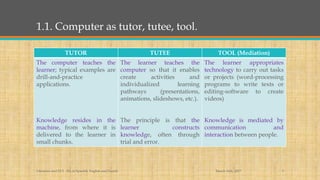
1.1. Computer as tutor, tutee, tool.
TUTOR TUTEE TOOL (Mediation)
The computer teaches the
learner; typical examples are
drill-and-practice
applications.
Knowledge resides in the
machine, from where it is
delivered to the learner in
small chunks.
The learner teaches the
computer so that it enables
create activities and
individualized learning
pathways (presentations,
animations, slideshows, etc.).
The principle is that the
learner constructs
knowledge, often through
trial and error.
The learner appropriates
technology to carry out tasks
or projects (word-processing
programs to write texts or
editing-software to create
videos)
Knowledge is mediated by
communication and
interaction between people.
March 14th, 2017Literacies and ELT - BA in Spanish, English and French 3
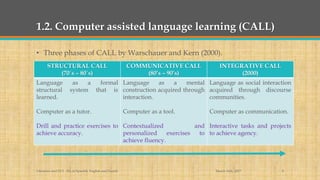
1.2. Computer assisted language learning (CALL)
• Three phases of CALL by Warschauer and Kern (2000).
March 14th, 2017Literacies and ELT - BA in Spanish, English and French 4
STRUCTURAL CALL
(70´s – 80´s)
COMMUNICATIVE CALL
(80’s – 90’s)
INTEGRATIVE CALL
(2000)
Language as a formal
structural system that is
learned.
Computer as a tutor.
Drill and practice exercises to
achieve accuracy.
Language as a mental
construction acquired through
interaction.
Computer as a tool.
Contextualized and
personalized exercises to
achieve fluency.
Language as social interaction
acquired through discourse
communities.
Computer as communication.
Interactive tasks and projects
to achieve agency.
1.2. Computer assisted language learning (CALL)
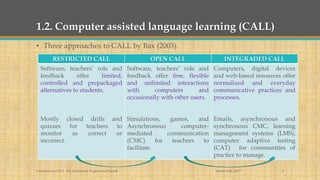
• Three approaches to CALL by Bax (2003).
March 14th, 2017Literacies and ELT - BA in Spanish, English and French 5
RESTRICTED CALL OPEN CALL INTEGRADED CALL
Software, teachers’ role and
feedback offer limited,
controlled and prepackaged
alternatives to students.
Mostly closed drills and
quizzes for teachers to
monitor as correct or
incorrect.
Software, teachers’ role and
feedback offer free, flexible
and unlimited interactions
with computers and
occasionally with other users.
Simulations, games, and
Asynchronous computer-
mediated communication
(CMC) for teachers to
facilitate.
Computers, digital devices
and web-based resources offer
normalized and everyday
communicative practices and
processes.
Emails, asynchronous and
synchronous CMC, learning
management systems (LMS),
computer adaptive testing
(CAT) for communities of
practice to manage.
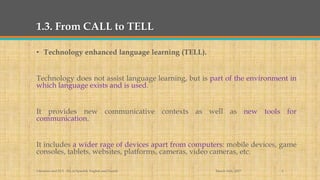
1.3. From CALL to TELL
• Technology enhanced language learning (TELL).
Technology does not assist language learning, but is part of the environment in
which language exists and is used.
It provides new communicative contexts as well as new tools for
communication.
It includes a wider rage of devices apart from computers: mobile devices, game
consoles, tablets, websites, platforms, cameras, video cameras, etc.
March 14th, 2017Literacies and ELT - BA in Spanish, English and French 6
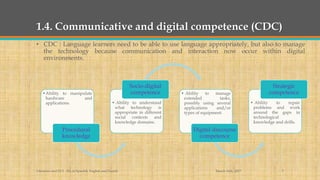
1.4. Communicative and digital competence (CDC)
• CDC : Language learners need to be able to use language appropriately, but also to manage
the technology because communication and interaction now occur within digital
environments.
March 14th, 2017Literacies and ELT - BA in Spanish, English and French 7
•Ability to manipulate
hardware and
applications.
Procedural
knowledge
• Ability to understand
what technology is
appropriate in different
social contexts and
knowledge domains.
Socio-digital
competence • Ability to manage
extended tasks,
possibly using several
applications and/or
types of equipment.
Digital discourse
competence
• Ability to repair
problems and work
around the gaps in
technological
knowledge and drills.
Strategic
competence
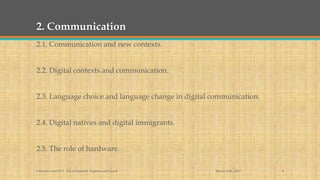
2. Communication
2.1. Communication and new contexts.
2.2. Digital contexts and communication.
2.3. Language choice and language change in digital communication.
2.4. Digital natives and digital immigrants.
2.5. The role of hardware.
March 14th, 2017Literacies and ELT - BA in Spanish, English and French 8
2.1. Communication and new contexts
While it is true that technology enables to communicate with traditional genres (reading newspapers
online or talking to family members via Skype), it is also certain that technology has created new types
of communication such as tweeting and microblogging.
- New communication is available to everyone: anyone can produce a blog, or even publish an e-
book.
- Non-verbal communication, social relations, and new contexts are important when thinking about
the impact of digital technologies on language.
- In new communication, physical settings and participants are unknown. Then, we need to be careful
with choices of language: lexis, structural complexity, formality, speed of delivery, etc.
- In new communication, we need to talk about semiotic social spaces, places (real or virtual) where
people interact (social) and to which people create meaning (semiotic). For example, social networks
such as Facebook or virtual learning environments such as Moodle.
March 14th, 2017Literacies and ELT - BA in Spanish, English and French 9
2.2. Digital contexts and communication
New digital contexts create: (a) new environments in which language use occurs, (b) new types of
interlocutors who might not have other opportunities to interact, and (c) new communicative
purposes.
Strong weak ties: Relationships in which people engage frequently with each other online and
may feel that they “know” each other well over a short space of time.
Flame wars: Situations in which participants become angry and hurl insults at each other easily as
a result of reduced social clues and volatile emotional aspects related to intimacy and personal
space.
From the voice of authority in Web 1.0 (a person or entity who created and controlled content and
communication) to multiple voices in Web 2.0 (communication and interactions depend on user
contributions).
March 14th, 2017Literacies and ELT - BA in Spanish, English and French 10
2.3. Language choice and langue change in digital
communication
The first important language issue is the extent to which the mastery of English is they key to
access information and interaction in digital contexts.
The second important language issue is the extent to which the use of digital technologies is
changing language.
- Technolect: Language used in online social networking is so distinct and particular that it
appears to be a language that learners need to be aware of.
- Vocabulary: Internet words and expressions come into existence quickly and easily.
- Orthography: Abbreviations, simplified (or absent) punctuation, lower-case writing, and
emoticons characterized “netspeak”.
- Discourse threads: They overlap and appear out of sequence as turn-taking rules are
alternative and more dynamic.
March 14th, 2017Literacies and ELT - BA in Spanish, English and French 11
2.4. Digital natives and digital immigrants
Digital natives: Young people have a natural affinity with technology.
Digital immigrants: Adults and older people have a hard time using and working with technology.
Assumptions
- All modern young people are intrinsically interested in, motivated by, and expert with digital technologies.
- Traditional adult people cannot acquire fluency in the use of digital technologies.
- Age is the main reason why people feel more or less confident with new technology.
- Young people are informed and familiar with the wide range of digital tools that are available.
New teaching techniques and strategies are needed to respond to the change in the way that young people’s
brains work as they need more visual stimulus, more use of didactic games, and more use of short- term
rewards.
March 14th, 2017Literacies and ELT - BA in Spanish, English and French 12
2.5. The role of hardware
Mobile and ubiquitous computing: Technologies that give people constant and instant access to digital
technology wherever they are.
Tablet computers: Transportable computer-like devices with medium-size screens and onscreen keyboards that
offer users high-quality hardware and apps.
Smartphones: They are fast and modern phones that incorporate apps and tools for text, audio, visual, and other
types of electronic and real-time messages.
Featurephones: They include some apps –particularly social networking- tools and provide internet access. They
include basic cameras.
Dumbphones: Basic phones for phone calls and text messaging alone.
What technology to use? Think about the context in which communication takes place, the characteristics of the
communicative event, and the language needed for that event.
March 14th, 2017Literacies and ELT - BA in Spanish, English and French 13
3. Teachers using technology
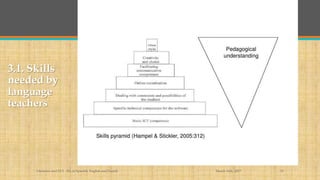
Skills needed by language teachers.
Teacher resistance
Teachers’ roles
March 14th, 2017Literacies and ELT - BA in Spanish, English and French 14
3.1. Skills
needed by
language
teachers
March 14th, 2017Literacies and ELT - BA in Spanish, English and French 15
3.2. Teacher resistance
- Early adopters: Teachers who pioneer in the use of websites and learning software.
- Institutional followers: Teachers who are instructed on the use of audio and video posts,
collaborative tools (discussion boards, wikis and blogs), and online tools (quizzes, surveys,
conferences).
Institutional learning management systems (LMS) or virtual learning environments (VLE)
- Tend to be institution-led rather than teacher-led.
- Promote individualism, superficial communication, and linear reasoning.
- Prevent higher-level skills, such as creativity and choice, and a personal teacher style.
March 14th, 2017Literacies and ELT - BA in Spanish, English and French 16
3. Teacher resistance
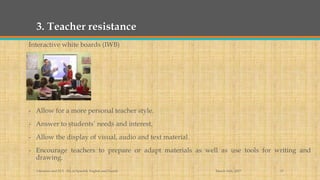
Interactive white boards (IWB)
- Allow for a more personal teacher style.
- Answer to students’ needs and interest.
- Allow the display of visual, audio and text material.
- Encourage teachers to prepare or adapt materials as well as use tools for writing and
drawing.
March 14th, 2017Literacies and ELT - BA in Spanish, English and French 17
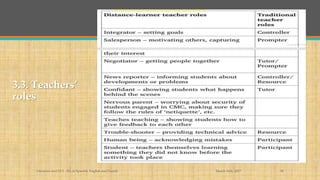
3.3. Teachers’
roles
March 14th, 2017Literacies and ELT - BA in Spanish, English and French 18
References
March 14th, 2017Literacies and ELT - BA in Spanish, English and French 19
Bax, S. (2003). CALL - past, present and future. System, 31(1): 13-28.
Hampel, R. & Stickler, U. (2005). New skills for new classrooms: Training tutors
to teach languages online. Computer Assisted Language Learning, 18(4), 311-326.
Kern, R., & Warschauer, M. (2000). Theory and practice of network-based
language teaching. In M. Warschauer & R. Kern (Eds.), Network-based language
teaching: Concepts and practice (pp. 1-19). New York: Cambridge University Press.
Walker, A., & White, D. (2013). Technology enhanced language learning. Oxford:
Oxford University Press.

Learning, communication and teachers using technology in ELT

  • 1.
    Learning, communication and teachers using technology LaSalle University Yamith José Fandiño Bogotá, Colombia
  • 2.
    1. LEARNING • Computeras tutor, tutee, tool. • Computer assisted language learning (CALL). • From CALL to TELL • Communicative and digital competence. March 14th, 2017Literacies and ELT - BA in Spanish, English and French 2
  • 3.
    1.1. Computer astutor, tutee, tool. TUTOR TUTEE TOOL (Mediation) The computer teaches the learner; typical examples are drill-and-practice applications. Knowledge resides in the machine, from where it is delivered to the learner in small chunks. The learner teaches the computer so that it enables create activities and individualized learning pathways (presentations, animations, slideshows, etc.). The principle is that the learner constructs knowledge, often through trial and error. The learner appropriates technology to carry out tasks or projects (word-processing programs to write texts or editing-software to create videos) Knowledge is mediated by communication and interaction between people. March 14th, 2017Literacies and ELT - BA in Spanish, English and French 3
  • 4.
    1.2. Computer assistedlanguage learning (CALL) • Three phases of CALL by Warschauer and Kern (2000). March 14th, 2017Literacies and ELT - BA in Spanish, English and French 4 STRUCTURAL CALL (70´s – 80´s) COMMUNICATIVE CALL (80’s – 90’s) INTEGRATIVE CALL (2000) Language as a formal structural system that is learned. Computer as a tutor. Drill and practice exercises to achieve accuracy. Language as a mental construction acquired through interaction. Computer as a tool. Contextualized and personalized exercises to achieve fluency. Language as social interaction acquired through discourse communities. Computer as communication. Interactive tasks and projects to achieve agency.
  • 5.
    1.2. Computer assistedlanguage learning (CALL) • Three approaches to CALL by Bax (2003). March 14th, 2017Literacies and ELT - BA in Spanish, English and French 5 RESTRICTED CALL OPEN CALL INTEGRADED CALL Software, teachers’ role and feedback offer limited, controlled and prepackaged alternatives to students. Mostly closed drills and quizzes for teachers to monitor as correct or incorrect. Software, teachers’ role and feedback offer free, flexible and unlimited interactions with computers and occasionally with other users. Simulations, games, and Asynchronous computer- mediated communication (CMC) for teachers to facilitate. Computers, digital devices and web-based resources offer normalized and everyday communicative practices and processes. Emails, asynchronous and synchronous CMC, learning management systems (LMS), computer adaptive testing (CAT) for communities of practice to manage.
  • 6.
    1.3. From CALLto TELL • Technology enhanced language learning (TELL). Technology does not assist language learning, but is part of the environment in which language exists and is used. It provides new communicative contexts as well as new tools for communication. It includes a wider rage of devices apart from computers: mobile devices, game consoles, tablets, websites, platforms, cameras, video cameras, etc. March 14th, 2017Literacies and ELT - BA in Spanish, English and French 6
  • 7.
    1.4. Communicative anddigital competence (CDC) • CDC : Language learners need to be able to use language appropriately, but also to manage the technology because communication and interaction now occur within digital environments. March 14th, 2017Literacies and ELT - BA in Spanish, English and French 7 •Ability to manipulate hardware and applications. Procedural knowledge • Ability to understand what technology is appropriate in different social contexts and knowledge domains. Socio-digital competence • Ability to manage extended tasks, possibly using several applications and/or types of equipment. Digital discourse competence • Ability to repair problems and work around the gaps in technological knowledge and drills. Strategic competence
  • 8.
    2. Communication 2.1. Communicationand new contexts. 2.2. Digital contexts and communication. 2.3. Language choice and language change in digital communication. 2.4. Digital natives and digital immigrants. 2.5. The role of hardware. March 14th, 2017Literacies and ELT - BA in Spanish, English and French 8
  • 9.
    2.1. Communication andnew contexts While it is true that technology enables to communicate with traditional genres (reading newspapers online or talking to family members via Skype), it is also certain that technology has created new types of communication such as tweeting and microblogging. - New communication is available to everyone: anyone can produce a blog, or even publish an e- book. - Non-verbal communication, social relations, and new contexts are important when thinking about the impact of digital technologies on language. - In new communication, physical settings and participants are unknown. Then, we need to be careful with choices of language: lexis, structural complexity, formality, speed of delivery, etc. - In new communication, we need to talk about semiotic social spaces, places (real or virtual) where people interact (social) and to which people create meaning (semiotic). For example, social networks such as Facebook or virtual learning environments such as Moodle. March 14th, 2017Literacies and ELT - BA in Spanish, English and French 9
  • 10.
    2.2. Digital contextsand communication New digital contexts create: (a) new environments in which language use occurs, (b) new types of interlocutors who might not have other opportunities to interact, and (c) new communicative purposes. Strong weak ties: Relationships in which people engage frequently with each other online and may feel that they “know” each other well over a short space of time. Flame wars: Situations in which participants become angry and hurl insults at each other easily as a result of reduced social clues and volatile emotional aspects related to intimacy and personal space. From the voice of authority in Web 1.0 (a person or entity who created and controlled content and communication) to multiple voices in Web 2.0 (communication and interactions depend on user contributions). March 14th, 2017Literacies and ELT - BA in Spanish, English and French 10
  • 11.
    2.3. Language choiceand langue change in digital communication The first important language issue is the extent to which the mastery of English is they key to access information and interaction in digital contexts. The second important language issue is the extent to which the use of digital technologies is changing language. - Technolect: Language used in online social networking is so distinct and particular that it appears to be a language that learners need to be aware of. - Vocabulary: Internet words and expressions come into existence quickly and easily. - Orthography: Abbreviations, simplified (or absent) punctuation, lower-case writing, and emoticons characterized “netspeak”. - Discourse threads: They overlap and appear out of sequence as turn-taking rules are alternative and more dynamic. March 14th, 2017Literacies and ELT - BA in Spanish, English and French 11
  • 12.
    2.4. Digital nativesand digital immigrants Digital natives: Young people have a natural affinity with technology. Digital immigrants: Adults and older people have a hard time using and working with technology. Assumptions - All modern young people are intrinsically interested in, motivated by, and expert with digital technologies. - Traditional adult people cannot acquire fluency in the use of digital technologies. - Age is the main reason why people feel more or less confident with new technology. - Young people are informed and familiar with the wide range of digital tools that are available. New teaching techniques and strategies are needed to respond to the change in the way that young people’s brains work as they need more visual stimulus, more use of didactic games, and more use of short- term rewards. March 14th, 2017Literacies and ELT - BA in Spanish, English and French 12
  • 13.
    2.5. The roleof hardware Mobile and ubiquitous computing: Technologies that give people constant and instant access to digital technology wherever they are. Tablet computers: Transportable computer-like devices with medium-size screens and onscreen keyboards that offer users high-quality hardware and apps. Smartphones: They are fast and modern phones that incorporate apps and tools for text, audio, visual, and other types of electronic and real-time messages. Featurephones: They include some apps –particularly social networking- tools and provide internet access. They include basic cameras. Dumbphones: Basic phones for phone calls and text messaging alone. What technology to use? Think about the context in which communication takes place, the characteristics of the communicative event, and the language needed for that event. March 14th, 2017Literacies and ELT - BA in Spanish, English and French 13
  • 14.
    3. Teachers usingtechnology Skills needed by language teachers. Teacher resistance Teachers’ roles March 14th, 2017Literacies and ELT - BA in Spanish, English and French 14
  • 15.
    3.1. Skills needed by language teachers March14th, 2017Literacies and ELT - BA in Spanish, English and French 15
  • 16.
    3.2. Teacher resistance -Early adopters: Teachers who pioneer in the use of websites and learning software. - Institutional followers: Teachers who are instructed on the use of audio and video posts, collaborative tools (discussion boards, wikis and blogs), and online tools (quizzes, surveys, conferences). Institutional learning management systems (LMS) or virtual learning environments (VLE) - Tend to be institution-led rather than teacher-led. - Promote individualism, superficial communication, and linear reasoning. - Prevent higher-level skills, such as creativity and choice, and a personal teacher style. March 14th, 2017Literacies and ELT - BA in Spanish, English and French 16
  • 17.
    3. Teacher resistance Interactivewhite boards (IWB) - Allow for a more personal teacher style. - Answer to students’ needs and interest. - Allow the display of visual, audio and text material. - Encourage teachers to prepare or adapt materials as well as use tools for writing and drawing. March 14th, 2017Literacies and ELT - BA in Spanish, English and French 17
  • 18.
    3.3. Teachers’ roles March 14th,2017Literacies and ELT - BA in Spanish, English and French 18
  • 19.
    References March 14th, 2017Literaciesand ELT - BA in Spanish, English and French 19 Bax, S. (2003). CALL - past, present and future. System, 31(1): 13-28. Hampel, R. & Stickler, U. (2005). New skills for new classrooms: Training tutors to teach languages online. Computer Assisted Language Learning, 18(4), 311-326. Kern, R., & Warschauer, M. (2000). Theory and practice of network-based language teaching. In M. Warschauer & R. Kern (Eds.), Network-based language teaching: Concepts and practice (pp. 1-19). New York: Cambridge University Press. Walker, A., & White, D. (2013). Technology enhanced language learning. Oxford: Oxford University Press.