National ICT Implementation Initiatives for
Educational Openness
Dr. Vaino Brazdeikis
Centre of Information Technology for Education
Ministry Education and Science
Lithuania
10.11.2017
11
National ICT
Implementati
on Initiatives
for
Educational
Openness
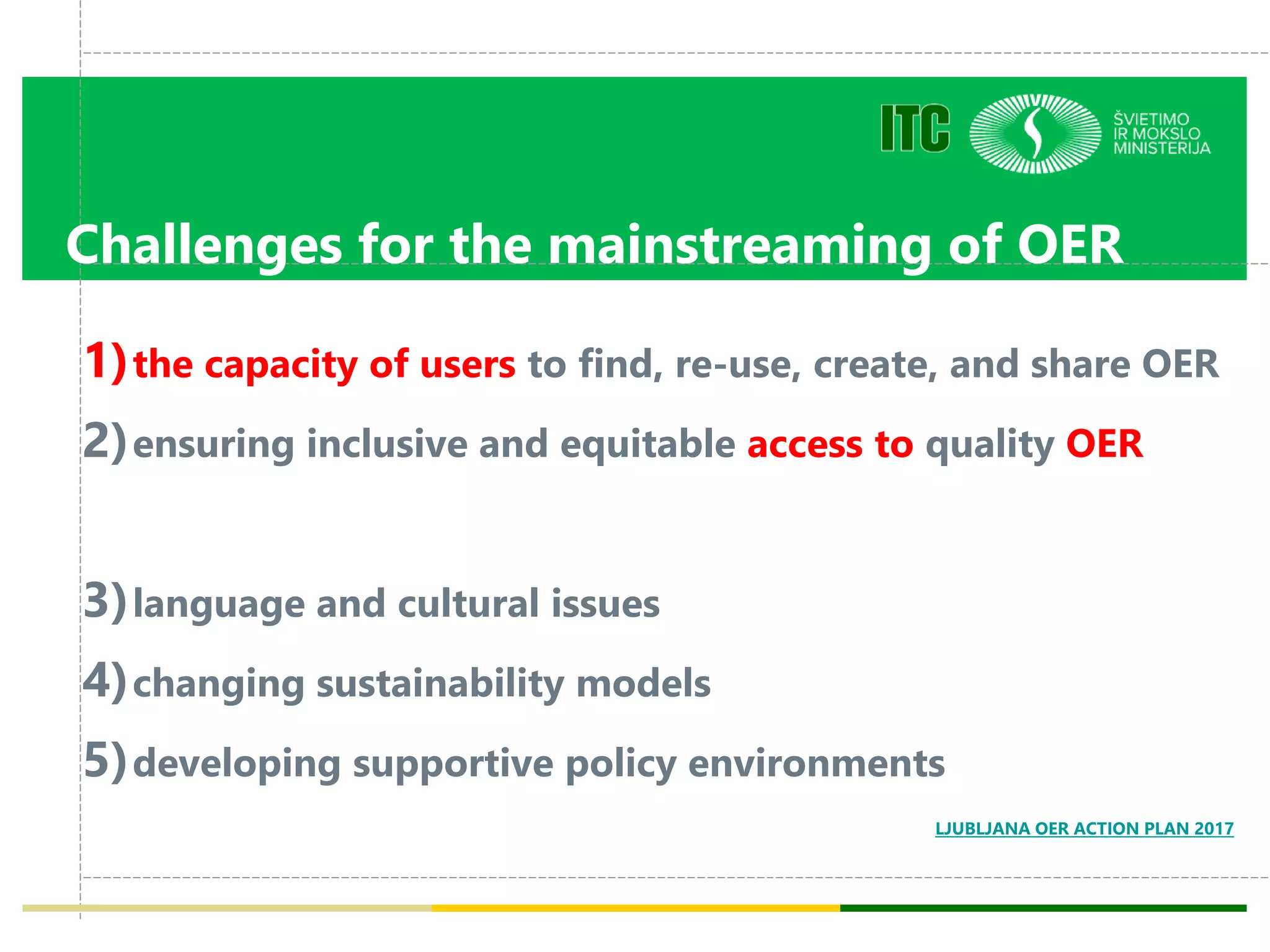
Challenges for the mainstreaming of OER
1)the capacity of users to find, re-use, create, and share OER
2)ensuring inclusive and equitable access to quality OER
3)language and cultural issues
4)changing sustainability models
5)developing supportive policy environments
LJUBLJANA OER ACTION PLAN 2017
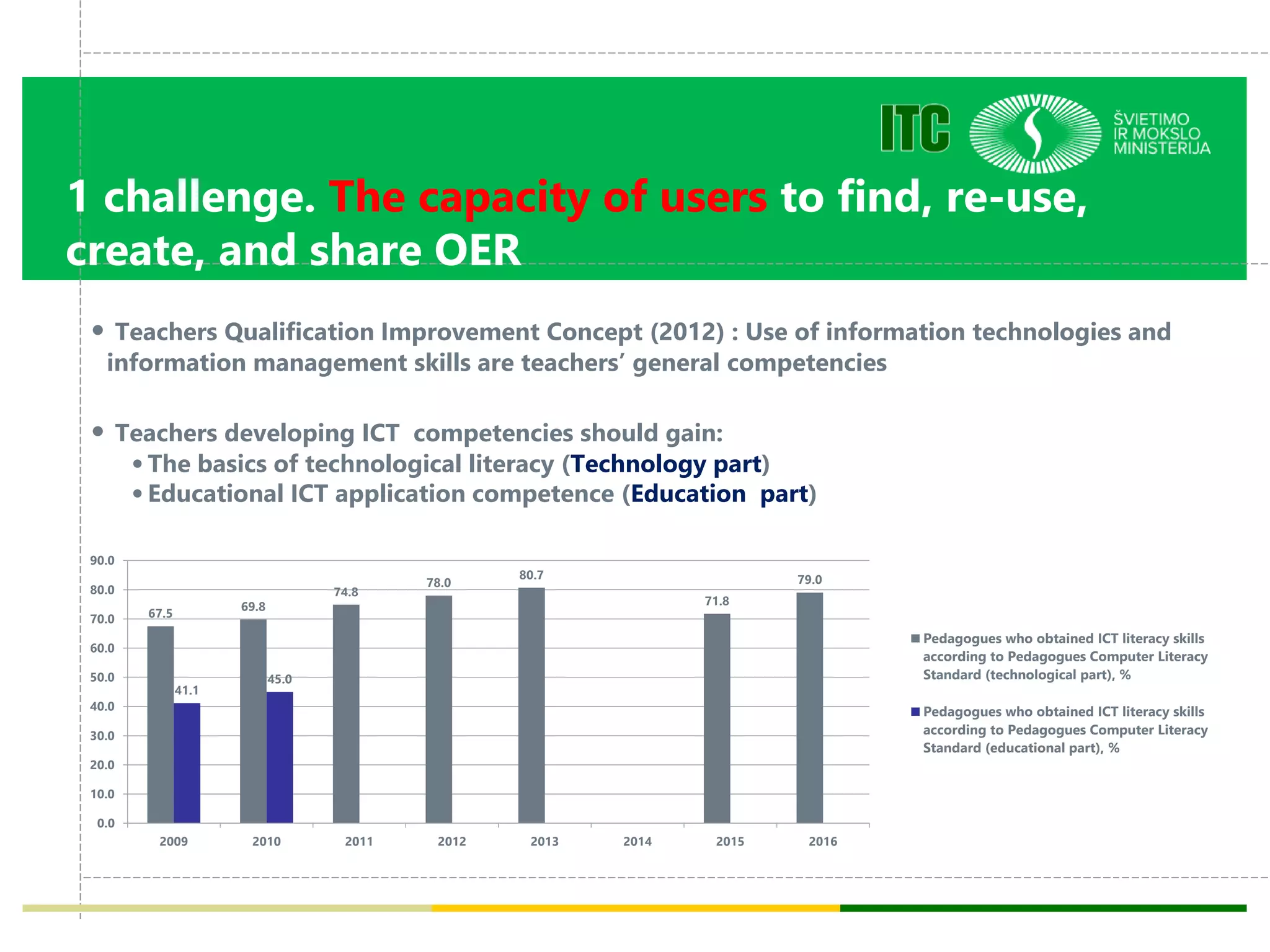
1 challenge. The capacity of users to find, re-use,
create, and share OER
• Teachers Qualification Improvement Concept (2012) : Use of information technologies and
information management skills are teachers’ general competencies
• Teachers developing ICT competencies should gain:
•The basics of technological literacy (Technology part)
•Educational ICT application competence (Education part)
67.5
69.8
74.8
78.0
80.7
71.8
79.0
41.1
45.0
0.0
10.0
20.0
30.0
40.0
50.0
60.0
70.0
80.0
90.0
2009 2010 2011 2012 2013 2014 2015 2016
Pedagogues who obtained ICT literacy skills
according to Pedagogues Computer Literacy
Standard (technological part), %
Pedagogues who obtained ICT literacy skills
according to Pedagogues Computer Literacy
Standard (educational part), %
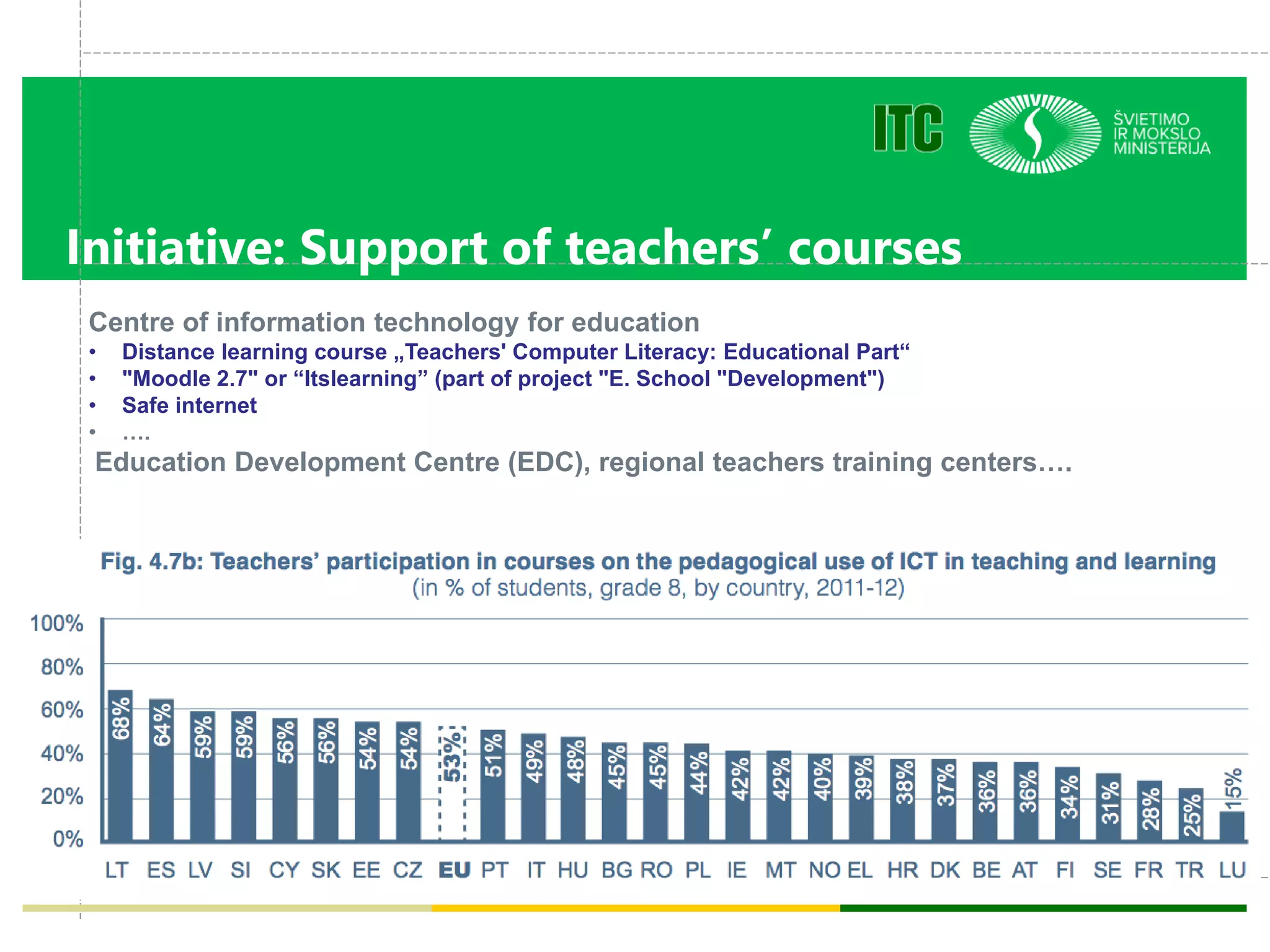
Initiative: Support of teachers’ courses
Centre of information technology for education
• Distance learning course „Teachers' Computer Literacy: Educational Part“
• "Moodle 2.7" or “Itslearning” (part of project "E. School "Development")
• Safe internet
• ….
Education Development Centre (EDC), regional teachers training centers….
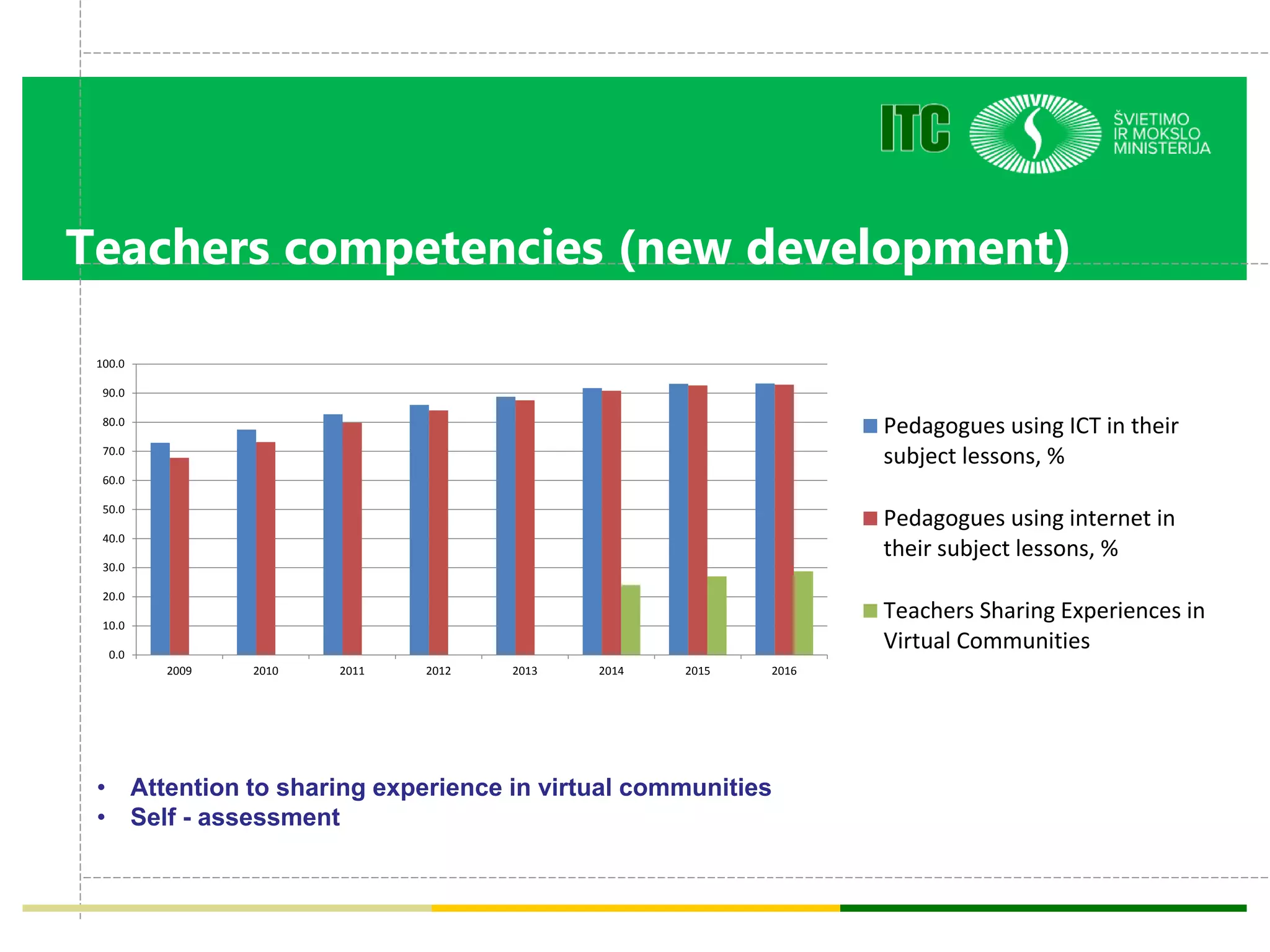
Teachers competencies (new development)
0.0
10.0
20.0
30.0
40.0
50.0
60.0
70.0
80.0
90.0
100.0
2009 2010 2011 2012 2013 2014 2015 2016
Pedagogues using ICT in their
subject lessons, %
Pedagogues using internet in
their subject lessons, %
Teachers Sharing Experiences in
Virtual Communities
• Attention to sharing experience in virtual communities
• Self - assessment
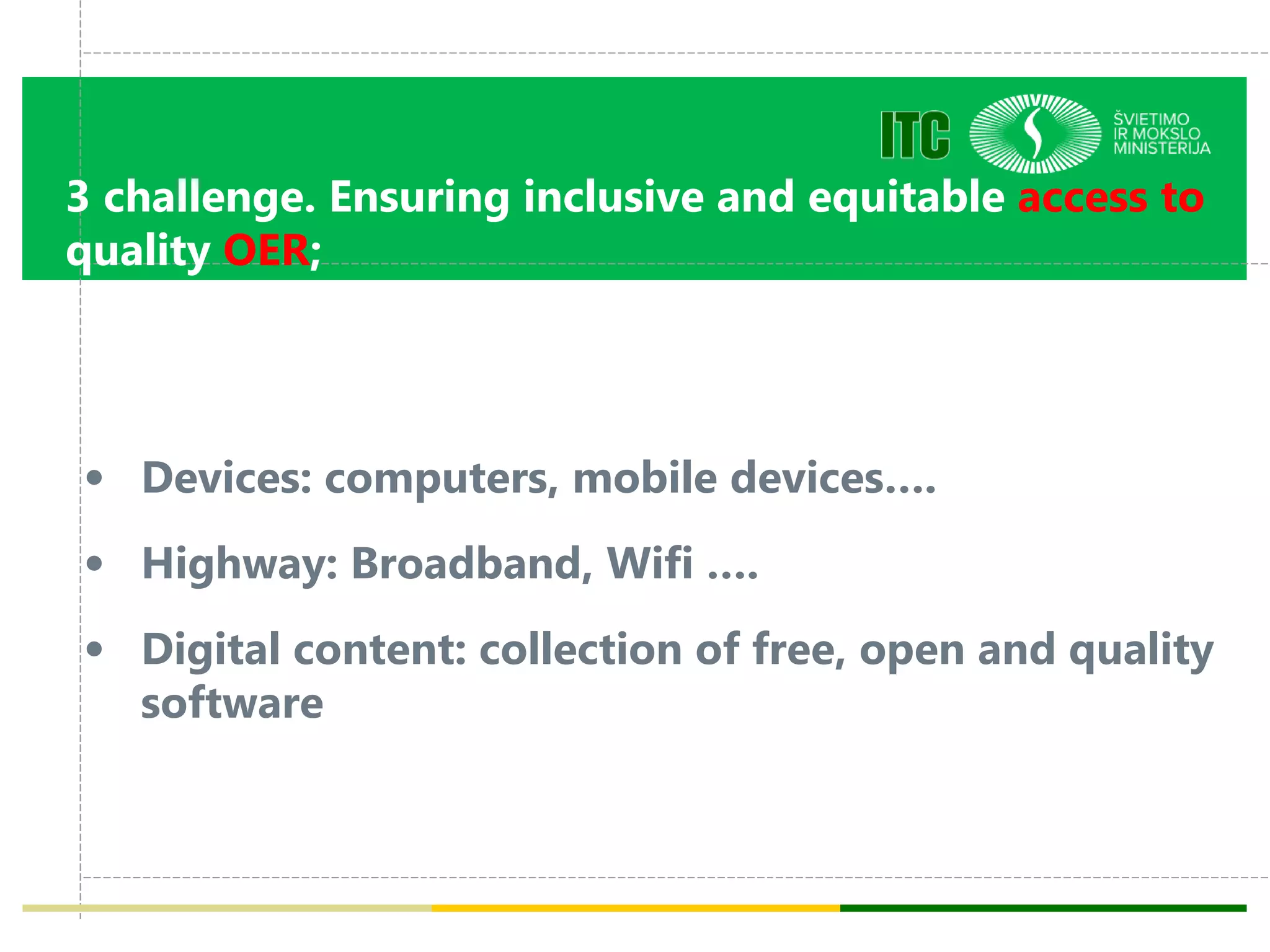
3 challenge. Ensuring inclusive and equitable access to
quality OER;
• Devices: computers, mobile devices….
• Highway: Broadband, Wifi ….
• Digital content: collection of free, open and quality
software
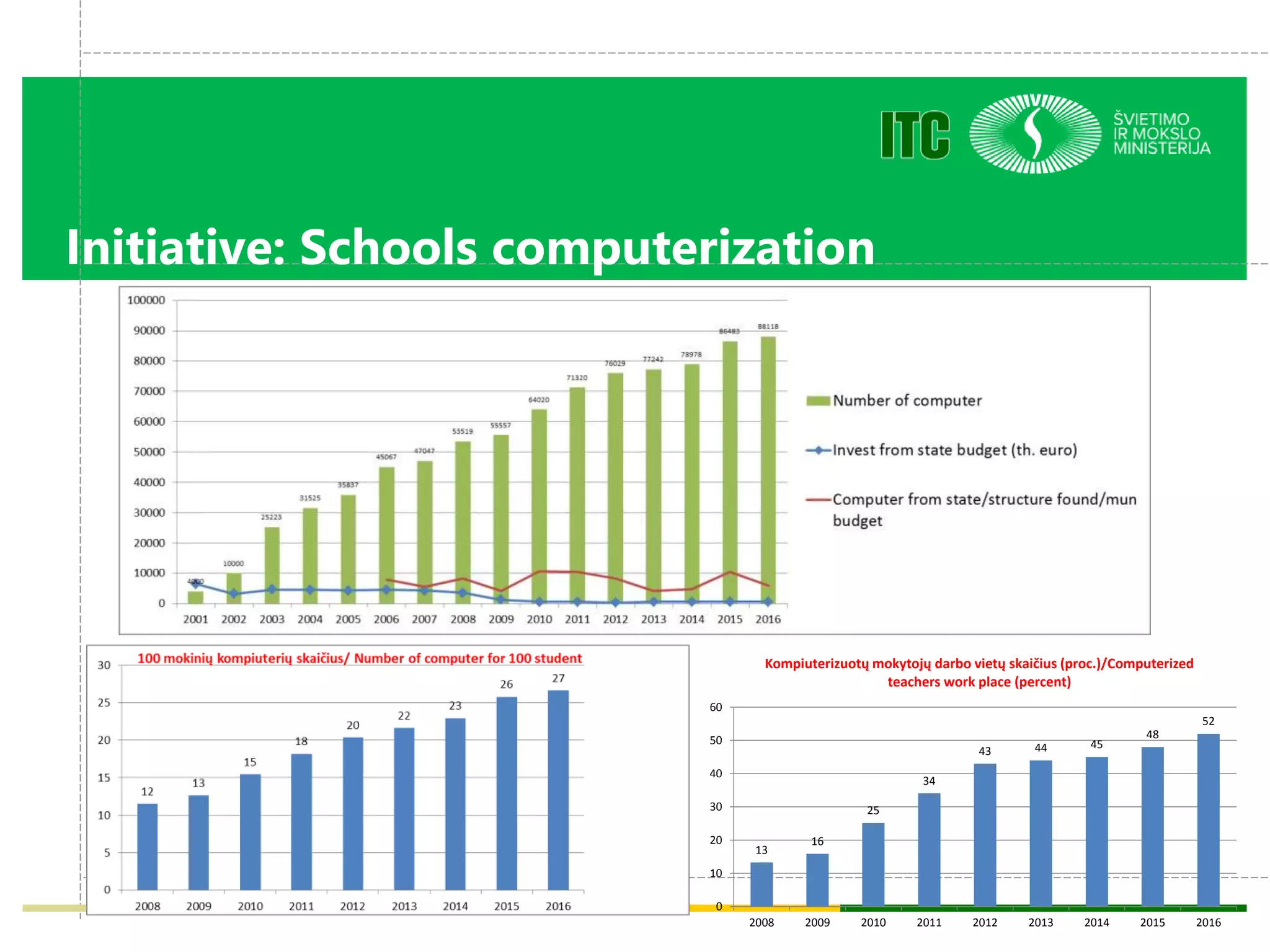
Initiative: Schools computerization
13
16
25
34
43 44 45
48
52
0
10
20
30
40
50
60
2008 2009 2010 2011 2012 2013 2014 2015 2016
Kompiuterizuotų mokytojų darbo vietų skaičius (proc.)/Computerized
teachers work place (percent)
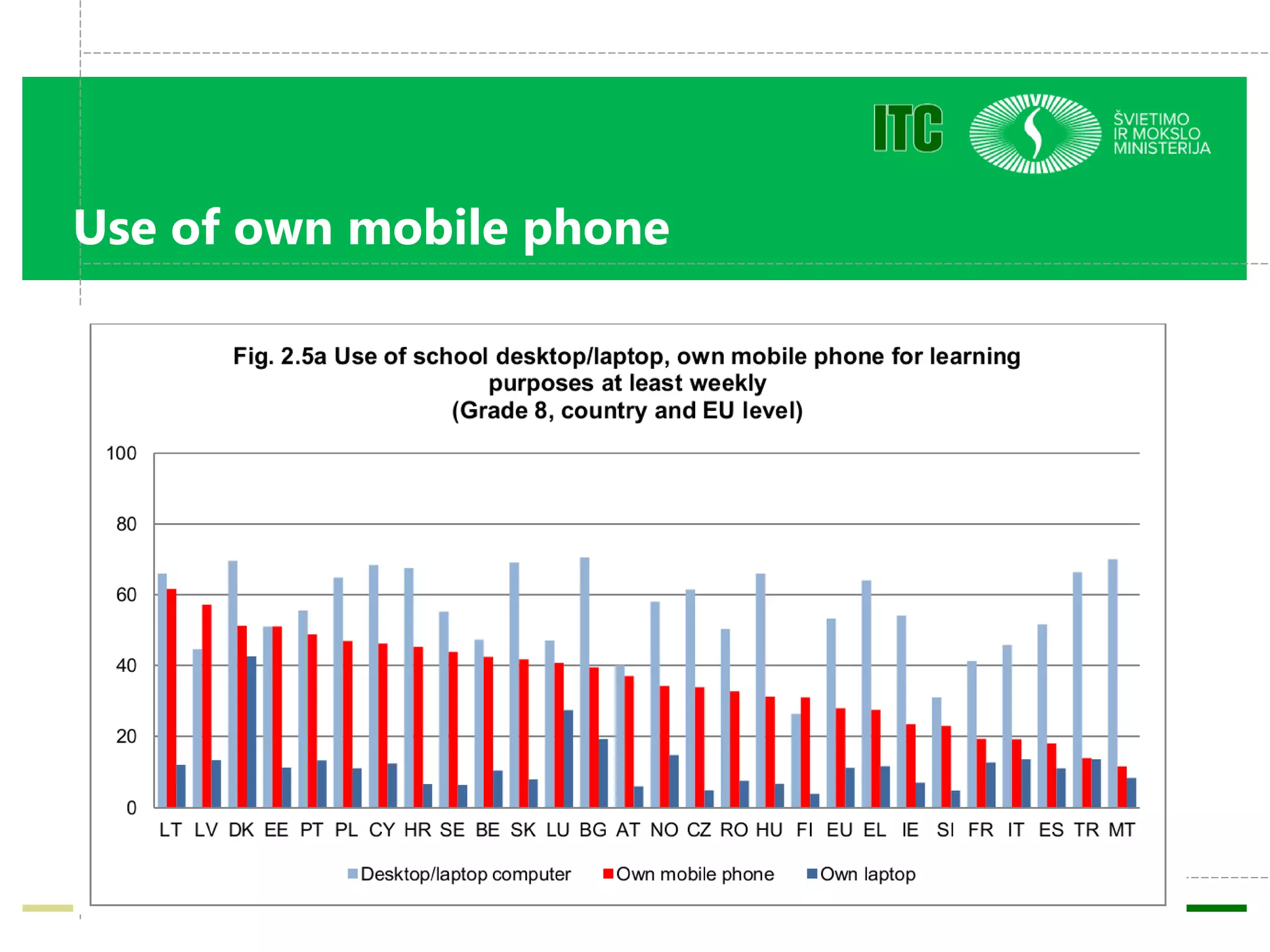
Use of own mobile phone
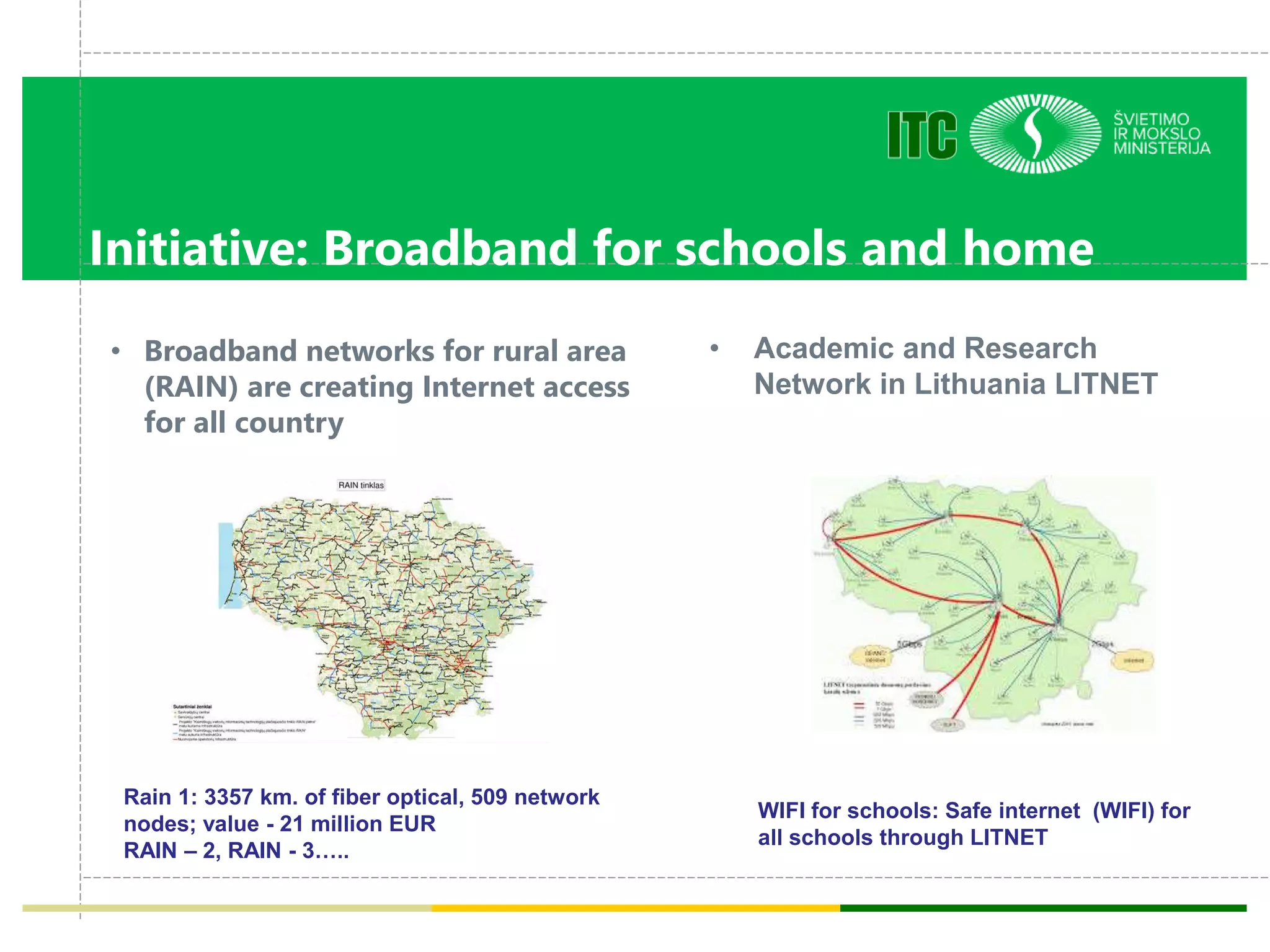
Initiative: Broadband for schools and home
• Broadband networks for rural area
(RAIN) are creating Internet access
for all country
• Academic and Research
Network in Lithuania LITNET
Rain 1: 3357 km. of fiber optical, 509 network
nodes; value - 21 million EUR
RAIN – 2, RAIN - 3…..
WIFI for schools: Safe internet (WIFI) for
all schools through LITNET
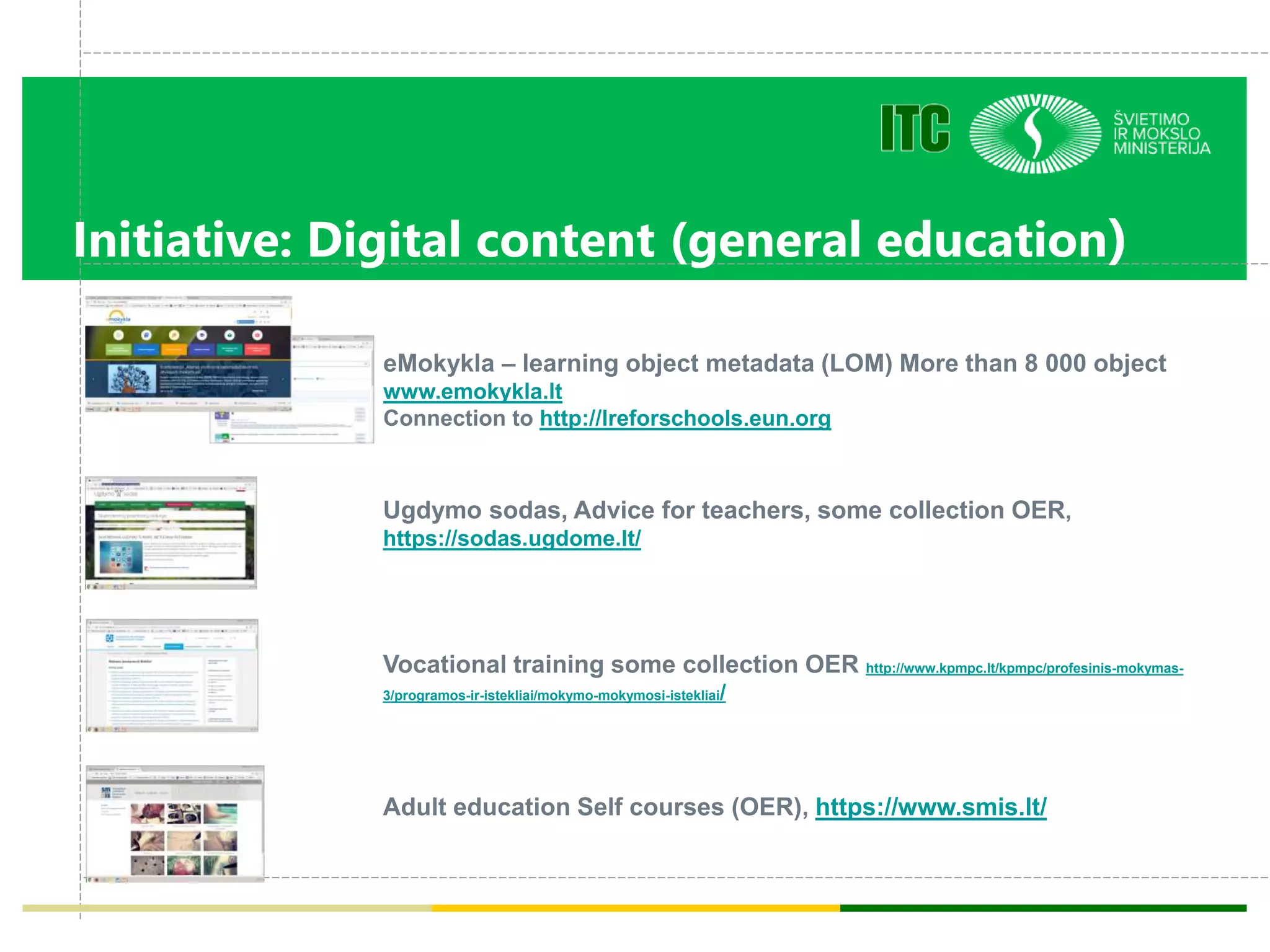
Initiative: Digital content (general education)
Ugdymo sodas, Advice for teachers, some collection OER,
https://sodas.ugdome.lt/
Vocational training some collection OER http://www.kpmpc.lt/kpmpc/profesinis-mokymas-
3/programos-ir-istekliai/mokymo-mokymosi-istekliai/
Adult education Self courses (OER), https://www.smis.lt/
eMokykla – learning object metadata (LOM) More than 8 000 object
www.emokykla.lt
Connection to http://lreforschools.eun.org
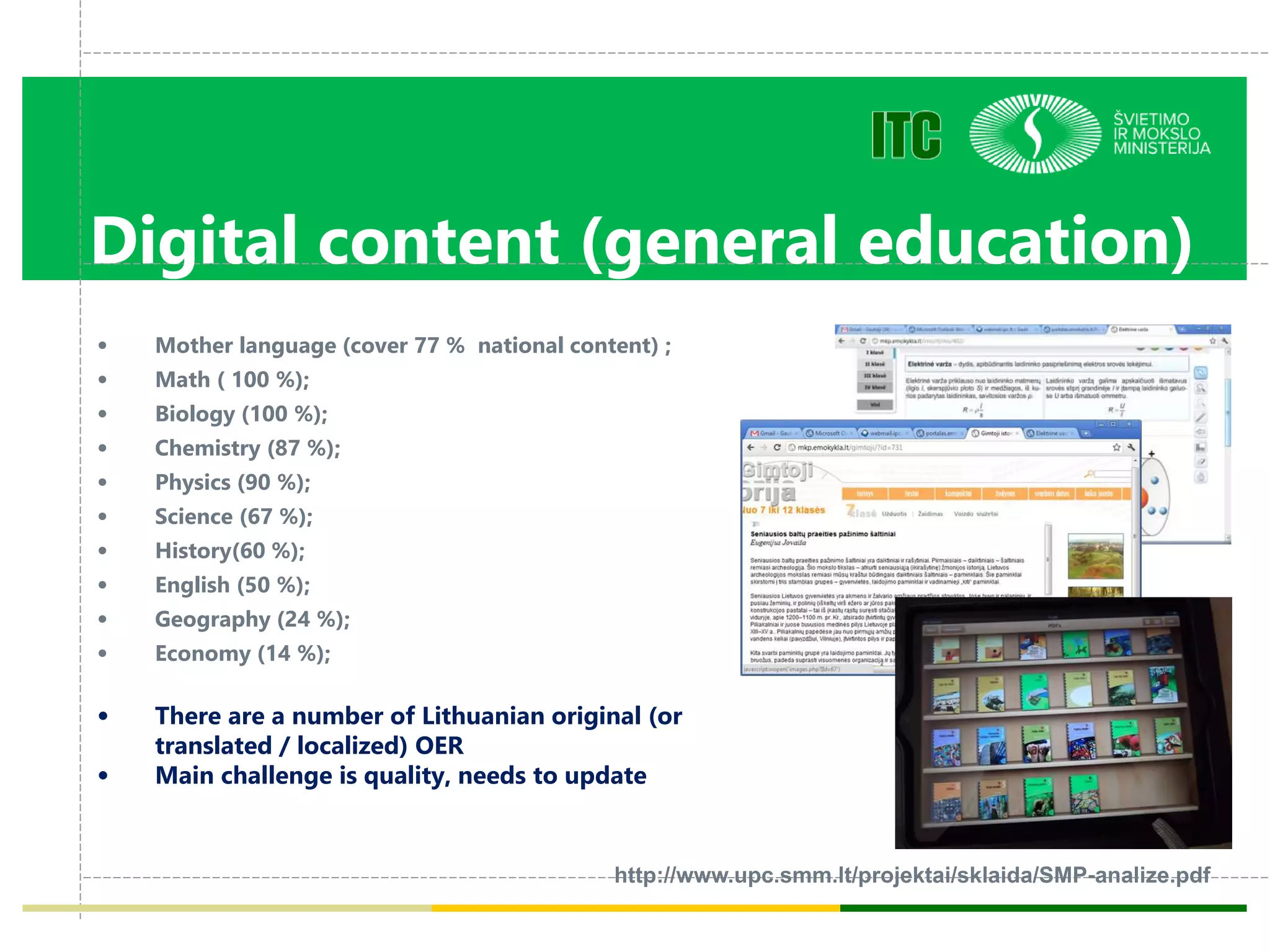
Digital content (general education)
• Mother language (cover 77 % national content) ;
• Math ( 100 %);
• Biology (100 %);
• Chemistry (87 %);
• Physics (90 %);
• Science (67 %);
• History(60 %);
• English (50 %);
• Geography (24 %);
• Economy (14 %);
• There are a number of Lithuanian original (or
translated / localized) OER
• Main challenge is quality, needs to update
http://www.upc.smm.lt/projektai/sklaida/SMP-analize.pdf
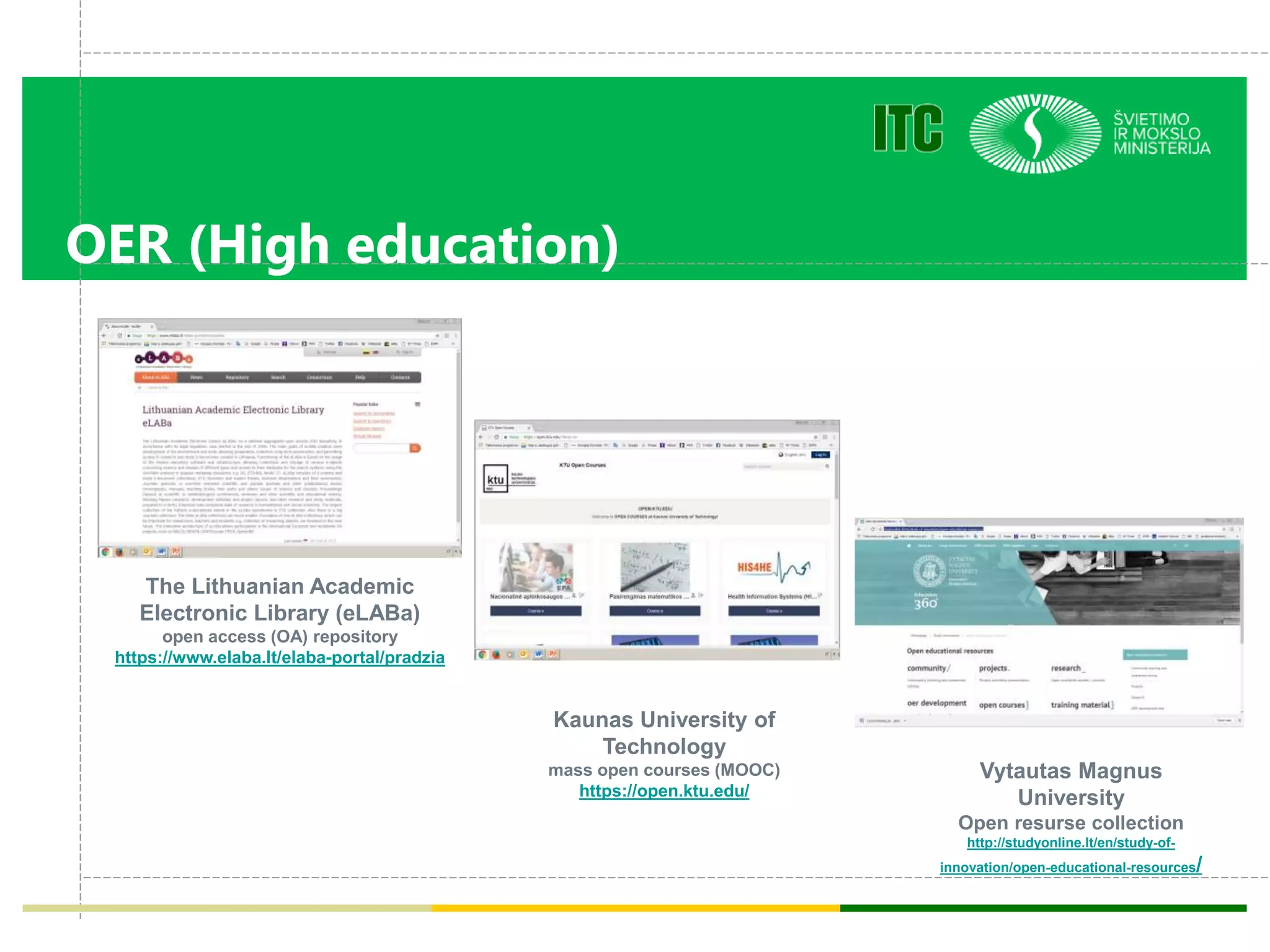
OER (High education)
The Lithuanian Academic
Electronic Library (eLABa)
open access (OA) repository
https://www.elaba.lt/elaba-portal/pradzia
Kaunas University of
Technology
mass open courses (MOOC)
https://open.ktu.edu/
Vytautas Magnus
University
Open resurse collection
http://studyonline.lt/en/study-of-
innovation/open-educational-resources/
3 challenge. Language & Cultural issues
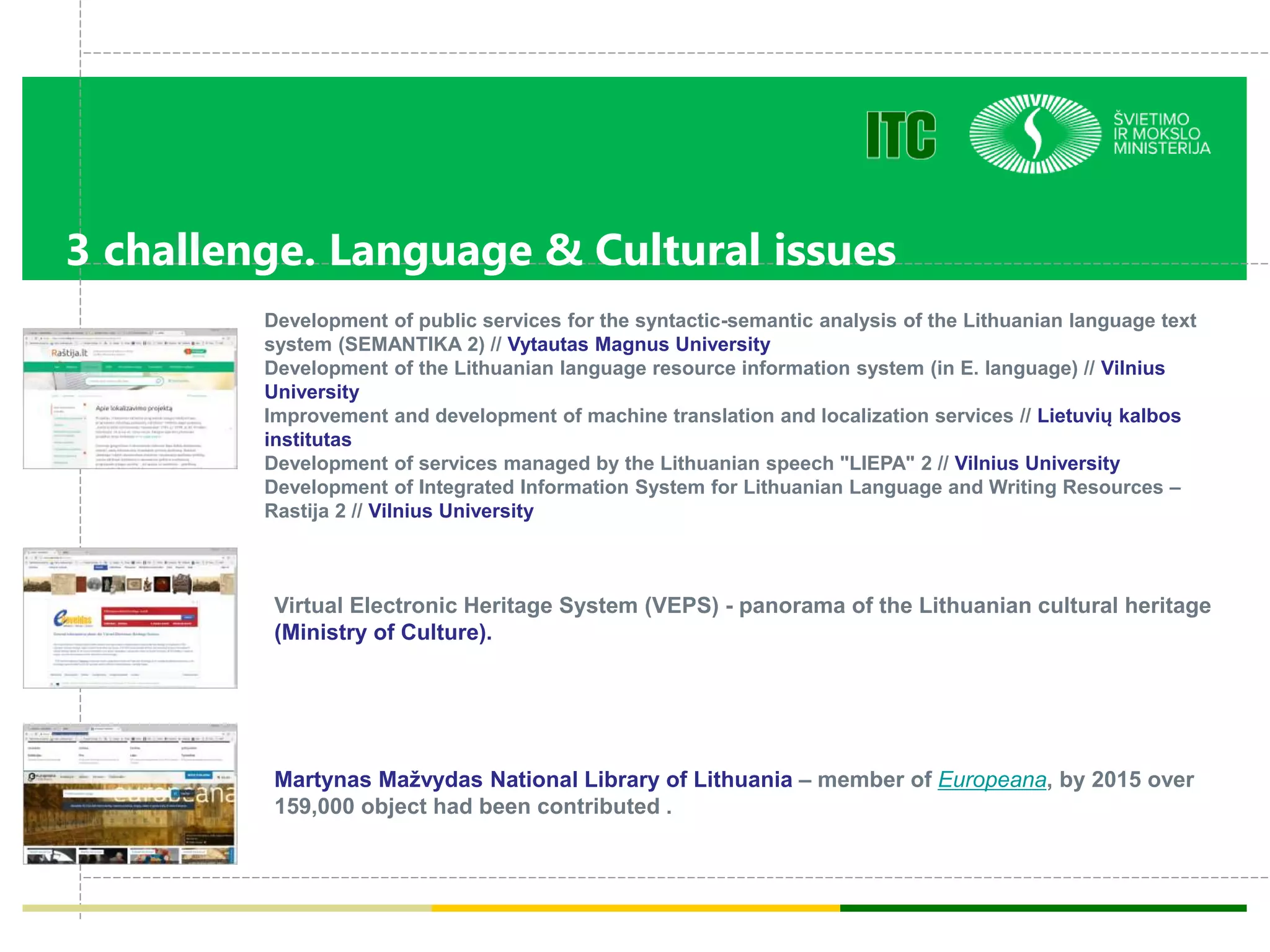
Development of public services for the syntactic-semantic analysis of the Lithuanian language text
system (SEMANTIKA 2) // Vytautas Magnus University
Development of the Lithuanian language resource information system (in E. language) // Vilnius
University
Improvement and development of machine translation and localization services // Lietuvių kalbos
institutas
Development of services managed by the Lithuanian speech "LIEPA" 2 // Vilnius University
Development of Integrated Information System for Lithuanian Language and Writing Resources –
Rastija 2 // Vilnius University
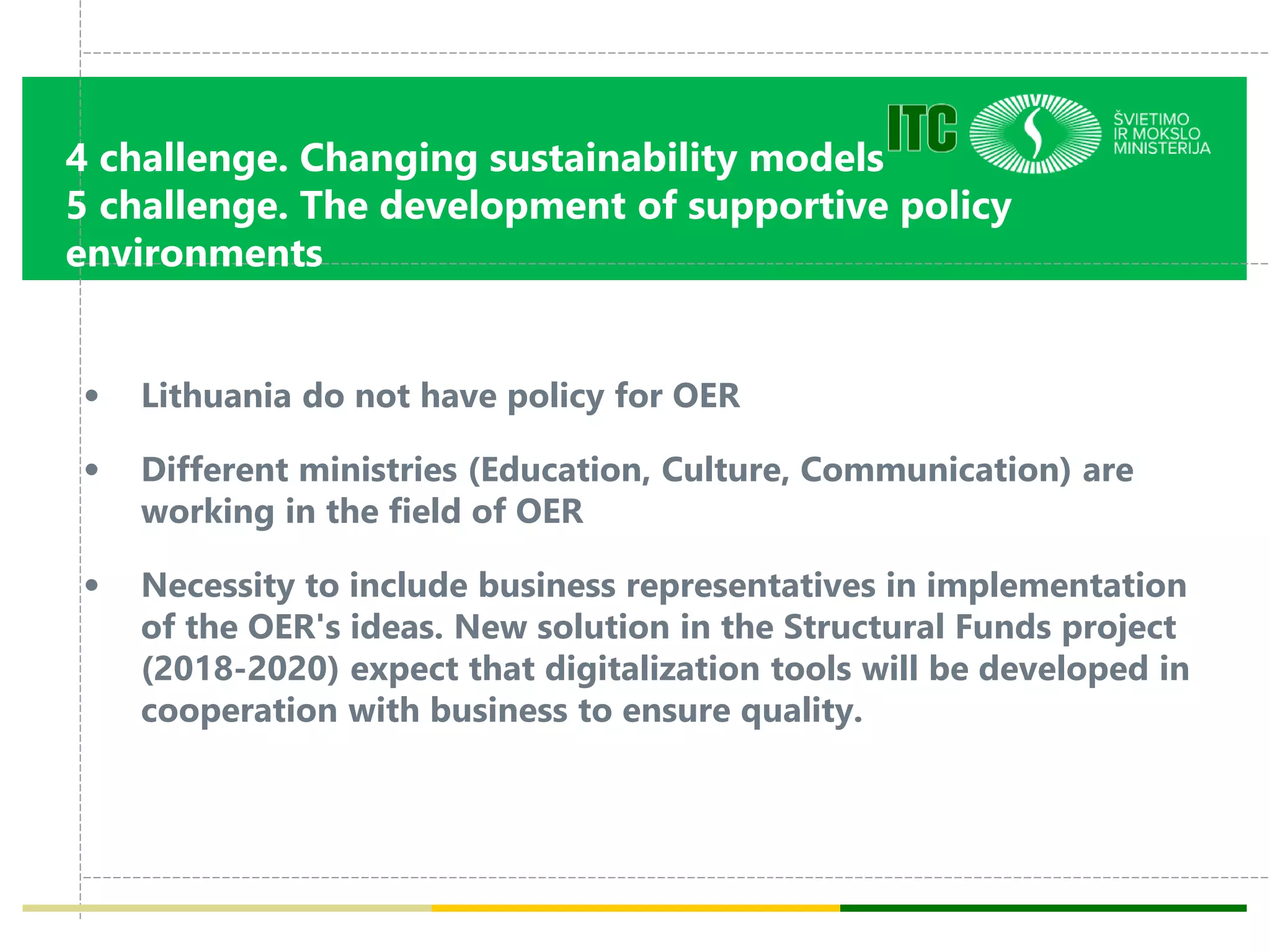
Virtual Electronic Heritage System (VEPS) - panorama of the Lithuanian cultural heritage
(Ministry of Culture).
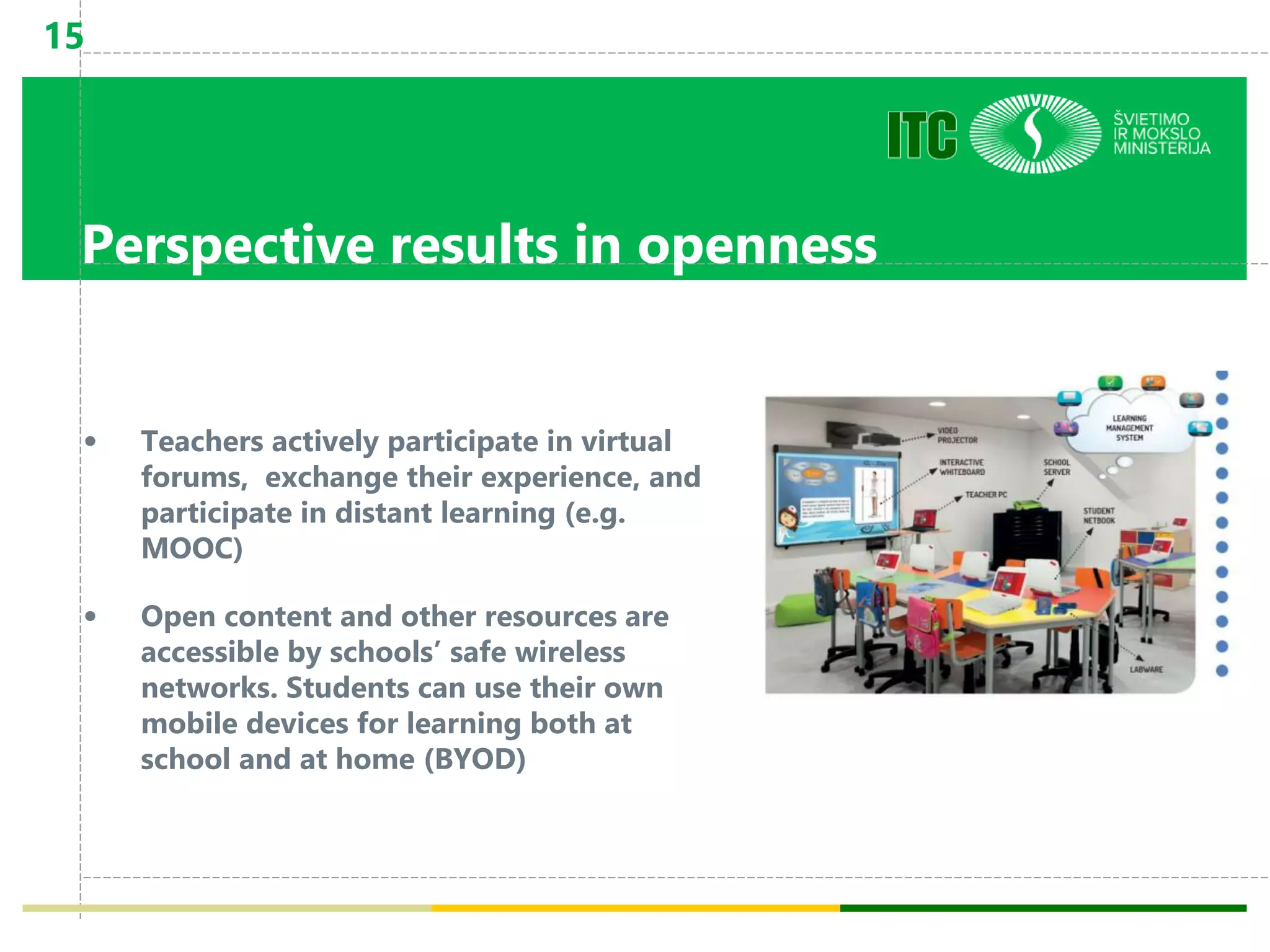
Martynas Mažvydas National Library of Lithuania – member of Europeana, by 2015 over
159,000 object had been contributed .
4 challenge. Changing sustainability models
5 challenge. The development of supportive policy
environments
• Lithuania do not have policy for OER
• Different ministries (Education, Culture, Communication) are
working in the field of OER
• Necessity to include business representatives in implementation
of the OER's ideas. New solution in the Structural Funds project
(2018-2020) expect that digitalization tools will be developed in
cooperation with business to ensure quality.
Perspective results in openness
• Teachers actively participate in virtual
forums, exchange their experience, and
participate in distant learning (e.g.
MOOC)
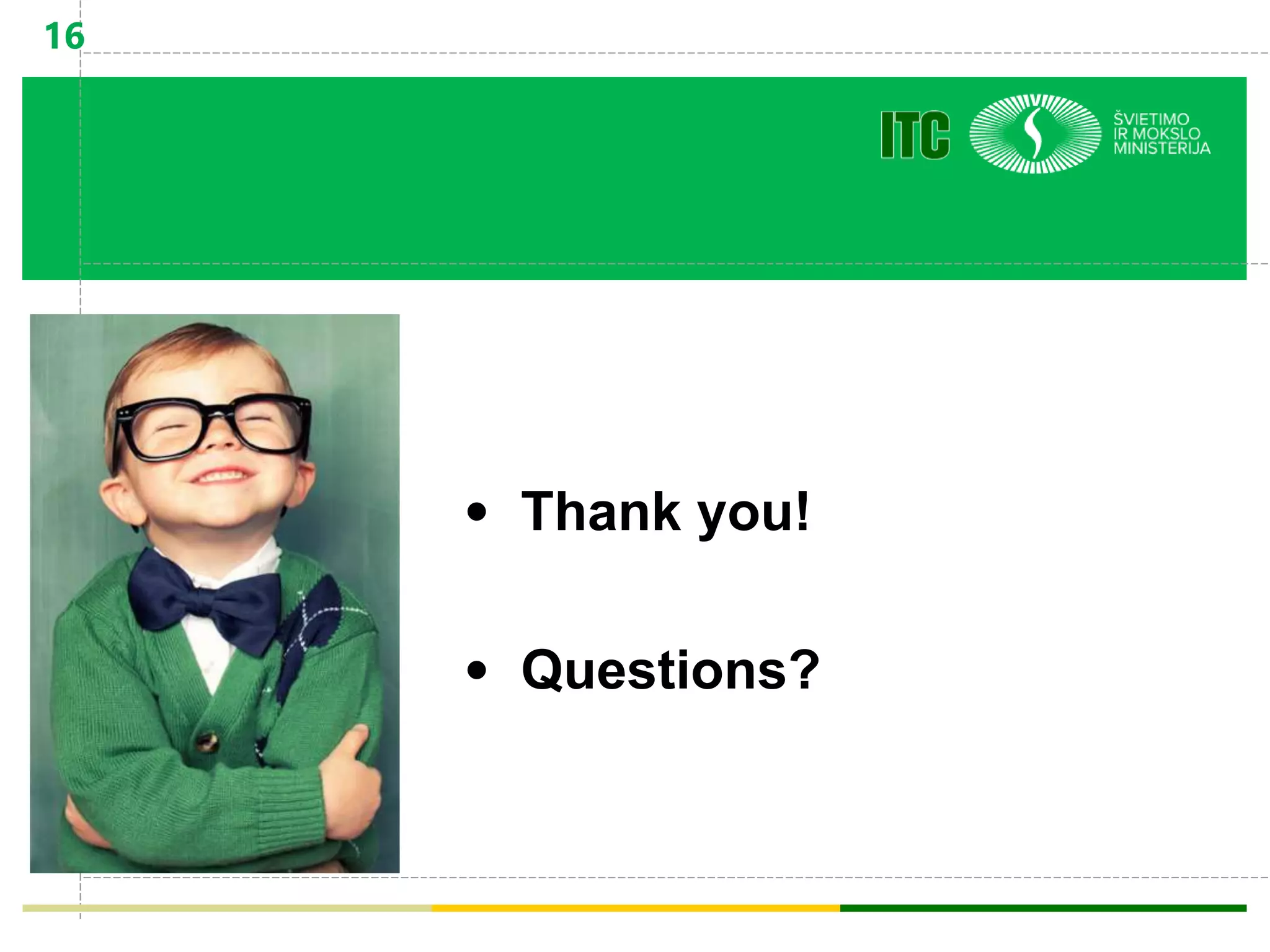
• Open content and other resources are
accessible by schools’ safe wireless
networks. Students can use their own
mobile devices for learning both at
school and at home (BYOD)
15
• Thank you!
• Questions?
1616

National ICT implementation initiatives for Educational Openness

  • 1.
    National ICT ImplementationInitiatives for Educational Openness Dr. Vaino Brazdeikis Centre of Information Technology for Education Ministry Education and Science Lithuania 10.11.2017 11 National ICT Implementati on Initiatives for Educational Openness
  • 2.
    Challenges for themainstreaming of OER 1)the capacity of users to find, re-use, create, and share OER 2)ensuring inclusive and equitable access to quality OER 3)language and cultural issues 4)changing sustainability models 5)developing supportive policy environments LJUBLJANA OER ACTION PLAN 2017
  • 3.
    1 challenge. Thecapacity of users to find, re-use, create, and share OER • Teachers Qualification Improvement Concept (2012) : Use of information technologies and information management skills are teachers’ general competencies • Teachers developing ICT competencies should gain: •The basics of technological literacy (Technology part) •Educational ICT application competence (Education part) 67.5 69.8 74.8 78.0 80.7 71.8 79.0 41.1 45.0 0.0 10.0 20.0 30.0 40.0 50.0 60.0 70.0 80.0 90.0 2009 2010 2011 2012 2013 2014 2015 2016 Pedagogues who obtained ICT literacy skills according to Pedagogues Computer Literacy Standard (technological part), % Pedagogues who obtained ICT literacy skills according to Pedagogues Computer Literacy Standard (educational part), %
  • 4.
    Initiative: Support ofteachers’ courses Centre of information technology for education • Distance learning course „Teachers' Computer Literacy: Educational Part“ • "Moodle 2.7" or “Itslearning” (part of project "E. School "Development") • Safe internet • …. Education Development Centre (EDC), regional teachers training centers….
  • 5.
    Teachers competencies (newdevelopment) 0.0 10.0 20.0 30.0 40.0 50.0 60.0 70.0 80.0 90.0 100.0 2009 2010 2011 2012 2013 2014 2015 2016 Pedagogues using ICT in their subject lessons, % Pedagogues using internet in their subject lessons, % Teachers Sharing Experiences in Virtual Communities • Attention to sharing experience in virtual communities • Self - assessment
  • 6.
    3 challenge. Ensuringinclusive and equitable access to quality OER; • Devices: computers, mobile devices…. • Highway: Broadband, Wifi …. • Digital content: collection of free, open and quality software
  • 7.
    Initiative: Schools computerization 13 16 25 34 4344 45 48 52 0 10 20 30 40 50 60 2008 2009 2010 2011 2012 2013 2014 2015 2016 Kompiuterizuotų mokytojų darbo vietų skaičius (proc.)/Computerized teachers work place (percent)
  • 8.
    Use of ownmobile phone
  • 9.
    Initiative: Broadband forschools and home • Broadband networks for rural area (RAIN) are creating Internet access for all country • Academic and Research Network in Lithuania LITNET Rain 1: 3357 km. of fiber optical, 509 network nodes; value - 21 million EUR RAIN – 2, RAIN - 3….. WIFI for schools: Safe internet (WIFI) for all schools through LITNET
  • 10.
    Initiative: Digital content(general education) Ugdymo sodas, Advice for teachers, some collection OER, https://sodas.ugdome.lt/ Vocational training some collection OER http://www.kpmpc.lt/kpmpc/profesinis-mokymas- 3/programos-ir-istekliai/mokymo-mokymosi-istekliai/ Adult education Self courses (OER), https://www.smis.lt/ eMokykla – learning object metadata (LOM) More than 8 000 object www.emokykla.lt Connection to http://lreforschools.eun.org
  • 11.
    Digital content (generaleducation) • Mother language (cover 77 % national content) ; • Math ( 100 %); • Biology (100 %); • Chemistry (87 %); • Physics (90 %); • Science (67 %); • History(60 %); • English (50 %); • Geography (24 %); • Economy (14 %); • There are a number of Lithuanian original (or translated / localized) OER • Main challenge is quality, needs to update http://www.upc.smm.lt/projektai/sklaida/SMP-analize.pdf
  • 12.
    OER (High education) TheLithuanian Academic Electronic Library (eLABa) open access (OA) repository https://www.elaba.lt/elaba-portal/pradzia Kaunas University of Technology mass open courses (MOOC) https://open.ktu.edu/ Vytautas Magnus University Open resurse collection http://studyonline.lt/en/study-of- innovation/open-educational-resources/
  • 13.
    3 challenge. Language& Cultural issues Development of public services for the syntactic-semantic analysis of the Lithuanian language text system (SEMANTIKA 2) // Vytautas Magnus University Development of the Lithuanian language resource information system (in E. language) // Vilnius University Improvement and development of machine translation and localization services // Lietuvių kalbos institutas Development of services managed by the Lithuanian speech "LIEPA" 2 // Vilnius University Development of Integrated Information System for Lithuanian Language and Writing Resources – Rastija 2 // Vilnius University Virtual Electronic Heritage System (VEPS) - panorama of the Lithuanian cultural heritage (Ministry of Culture). Martynas Mažvydas National Library of Lithuania – member of Europeana, by 2015 over 159,000 object had been contributed .
  • 14.
    4 challenge. Changingsustainability models 5 challenge. The development of supportive policy environments • Lithuania do not have policy for OER • Different ministries (Education, Culture, Communication) are working in the field of OER • Necessity to include business representatives in implementation of the OER's ideas. New solution in the Structural Funds project (2018-2020) expect that digitalization tools will be developed in cooperation with business to ensure quality.
  • 15.
    Perspective results inopenness • Teachers actively participate in virtual forums, exchange their experience, and participate in distant learning (e.g. MOOC) • Open content and other resources are accessible by schools’ safe wireless networks. Students can use their own mobile devices for learning both at school and at home (BYOD) 15
  • 16.
    • Thank you! •Questions? 1616

Editor's Notes

  • #14 2. Tai rimtas ir didelis iššūkis mažoms tautoms. Pagal galiojančią teisėkūra mokyklose turi būti mokoma valstybine kalba, tad gali būti naudojami tik lokalizuoti produktai . Tačiau jų kaita ir palaikymas reikalauja pastovaus jų atnaujinimo.
  • #15 Lithuania does not have a separate policy for the development of the OES, but the country seeks to adhere to the principles of openness to digital content and the conditions for access to it in all areas. It can be noted that one of the national aspects of the OER is the activities of various departments (Education, Culture, Relationships) in this field. It is obvious that it is also necessary to include business representatives in order to successfully implement the OER's ideas.