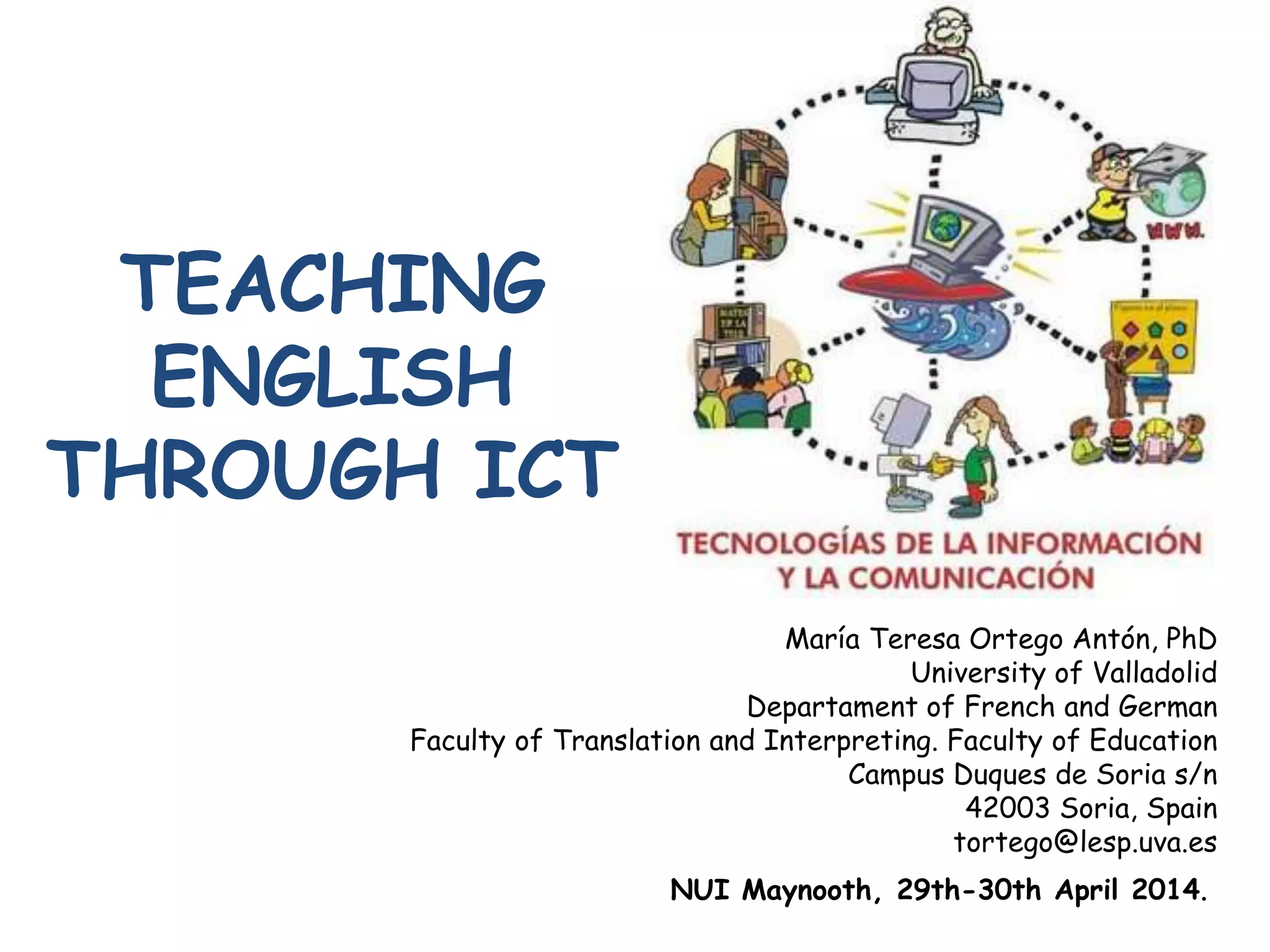
TEACHING
ENGLISH
THROUGH ICT
María Teresa Ortego Antón, PhD
University of Valladolid
Departament of French and German
Faculty of Translation and Interpreting. Faculty of Education
Campus Duques de Soria s/n
42003 Soria, Spain
tortego@lesp.uva.es
NUI Maynooth, 29th-30th April 2014.
1. INTRODUCTION
2
INDEX
1. INTRODUCTION
2. KEY COMPETENCES
3. ICT IN CLIL
4. ICT RESOURCES
5. REFERENCES
2. KEY COMPETENCES (I)
• What is a key competence?
– The ability to integrate knowledge,
skills and attitudes in a practical way to
solve problems and react appropriately
in a variety of contexts and situations.
In other words, it is the integration and
application of theoretical and practical
knowledge in settings outside the
academic context.
• Origin
– European Union.
– Delors Report (UNESCO, 1996).
– DeSeCo Project (OCDE, 1999).
3
INDEX
1. INTRODUCTION
2. KEY COMPETENCES
3. ICT IN CLIL
4. ICT RESOURCES
5. REFERENCES
2. KEY COMPETENCES (II)
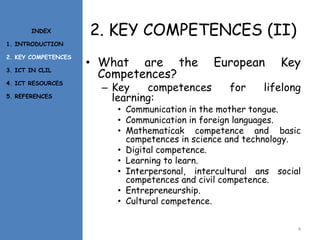
• What are the European Key
Competences?
– Key competences for lifelong
learning:
• Communication in the mother tongue.
• Communication in foreign languages.
• Mathematicak competence and basic
competences in science and technology.
• Digital competence.
• Learning to learn.
• Interpersonal, intercultural ans social
competences and civil competence.
• Entrepreneurship.
• Cultural competence.
4
INDEX
1. INTRODUCTION
2. KEY COMPETENCES
3. ICT IN CLIL
4. ICT RESOURCES
5. REFERENCES
2. KEY COMPETENCES (III)
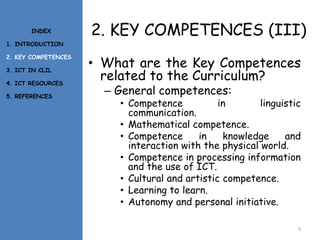
• What are the Key Competences
related to the Curriculum?
– General competences:
• Competence in linguistic
communication.
• Mathematical competence.
• Competence in knowledge and
interaction with the physical world.
• Competence in processing information
and the use of ICT.
• Cultural and artistic competence.
• Learning to learn.
• Autonomy and personal initiative.
5
INDEX
1. INTRODUCTION
2. KEY COMPETENCES
3. ICT IN CLIL
4. ICT RESOURCES
5. REFERENCES
3.ICT IN CLIL
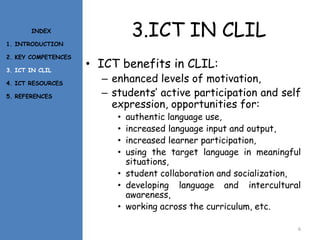
• ICT benefits in CLIL:
– enhanced levels of motivation,
– students’ active participation and self
expression, opportunities for:
• authentic language use,
• increased language input and output,
• increased learner participation,
• using the target language in meaningful
situations,
• student collaboration and socialization,
• developing language and intercultural
awareness,
• working across the curriculum, etc.
6
INDEX
1. INTRODUCTION
2. KEY COMPETENCES
3. ICT IN CLIL
4. ICT RESOURCES
5. REFERENCES
4. ICT RESOURCES (I)
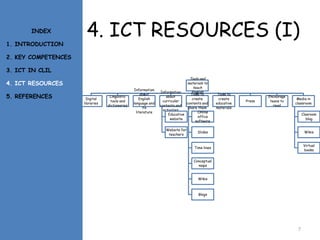
Tools and
materials to
teach
English
Digital
libraries
Linguistic
tools and
dictionaries
Information
about
English
language and
its
literature
Information
about
curricular
contents and
activities
Educative
website
Website for
teachers
Tools to
create
contents and
share them
Online
office
software
Slides
Time lines
Conceptual
maps
Wikis
Blogs
Tools to
create
educative
materials
Press
Encourage
teens to
read
Media in
classroom
Clasroom
blog
Wikis
Virtual
books
7
INDEX
1. INTRODUCTION
2. KEY COMPETENCES
3. ICT IN CLIL
4. ICT RESOURCES
5. REFERENCES
4. ICT RESOURCES (II)
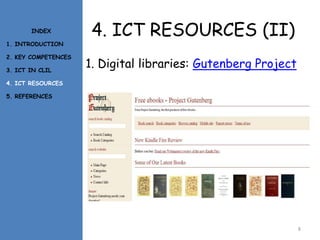
1. Digital libraries: Gutenberg Project
8
INDEX
1. INTRODUCTION
2. KEY COMPETENCES
3. ICT IN CLIL
4. ICT RESOURCES
5. REFERENCES
4. ICT RESOURCES (III)
2. Linguistic tools and dictionaries
– English learner’s dictionaries:
• Merriam Webster’s Learner’s Dictionary
• Oxford Learner’s Dictionaries
• Cambridge Advanced Learner’s
Dictionary
• Longman Dictionary of Contemporary
English
• Collins English for Learners
– General bilingual dictionaries:
• Cambridge inglés-español
• WordReference
• English-Spanish Oxford Dictionary
• Collins English-Spanish Dictionary
9
INDEX
1. INTRODUCTION
2. KEY COMPETENCES
3. ICT IN CLIL
4. ICT RESOURCES
5. REFERENCES
4. ICT RESOURCES (IV)
3. Information about English
language and its literature:
– Wikipedia
– MOOC (http://www.mooc-
list.com/tags/english)
– English Club
(http://www.englishclub.com/)
10
INDEX
1. INTRODUCTION
2. KEY COMPETENCES
3. ICT IN CLIL
4. ICT RESOURCES
5. REFERENCES
4. ICT RESOURCES (V)
4. Information about curricular contents and activities (I):
– Educative websites
 British Council
(http://learnenglishkids.britishcouncil.org/es/ )
 Educacyl (http://www.educa.jcyl.es/es)
 Spanish Ministry of Education
(http://recursostic.educacion.es/primaria/hello/w
eb/)
 Wikirecursostic
(https://wikirecursostic.wikispaces.com/INGL%C3
%89S)
 Mansión Inglés (http://www.mansioningles.com/)
 RedRed
(http://www.terueltirwal.es/redred/ingles.html)
 Clicatic (http://www.clicatic.org/home)
 Games to learn English
(http://gamestolearnenglish.com/)
11
INDEX
1. INTRODUCTION
2. KEY COMPETENCES
3. ICT IN CLIL
4. ICT RESOURCES
5. REFERENCES
4. ICT RESOURCES (VI)
4. Information about curricular
contents and activities (II):
– Websites for teachers
• Blogs
 http://paraprofesypadres.blogspot.c
om.es/p/recursos-primaria.html
 http://recursosticparaeducacioninfan
til.blogspot.com.es/
 http://recursostic.educacion.es/heda
/web/es/primaria/556-recursos-
para-las-clases-de-ingles-en-
primaria.es/inglesep/portada.html
12
INDEX
1. INTRODUCTION
2. KEY COMPETENCES
3. ICT IN CLIL
4. ICT RESOURCES
5. REFERENCES
4. ICT RESOURCES (VII)
5. Tools to create contents and share
them (I):
– Online Office Software (Google docs)
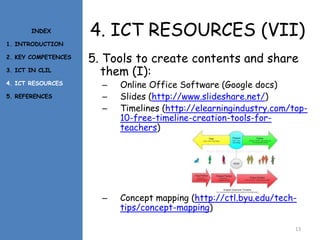
– Slides (http://www.slideshare.net/)
– Timelines (http://elearningindustry.com/top-
10-free-timeline-creation-tools-for-
teachers)
– Concept mapping (http://ctl.byu.edu/tech-
tips/concept-mapping)
13
INDEX
1. INTRODUCTION
2. KEY COMPETENCES
3. ICT IN CLIL
4. ICT RESOURCES
5. REFERENCES
4. ICT RESOURCES (VIII)
5. Tools to create contents and share them (II):
– Blogs and Wikis
• https://docentesenextremadura.wikispaces.com
/ICT+Resources+for+Primary+English+Teaching
• https://wikirecursostic.wikispaces.com/INGL%
C3%89S
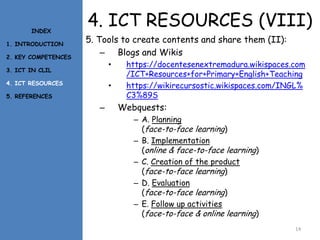
– Webquests:
– A. Planning
(face-to-face learning)
– B. Implementation
(online & face-to-face learning)
– C. Creation of the product
(face-to-face learning)
– D. Evaluation
(face-to-face learning)
– E. Follow up activities
(face-to-face & online learning)
14
INDEX
1. INTRODUCTION
2. KEY COMPETENCES
3. ICT IN CLIL
4. ICT RESOURCES
5. REFERENCES
4. ICT RESOURCES (IX)
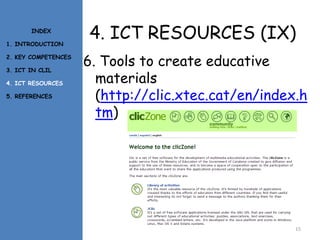
6. Tools to create educative
materials
(http://clic.xtec.cat/en/index.h
tm)
15
INDEX
1. INTRODUCTION
2. KEY COMPETENCES
3. ICT IN CLIL
4. ICT RESOURCES
5. REFERENCES
4. ICT RESOURCES (X)
7. Press
– BBC
(http://www.bbc.co.uk/worldservice/
learningenglish/
– National Geographic
(http://kids.nationalgeographic.com/
kids/)
16
INDEX
1. INTRODUCTION
2. KEY COMPETENCES
3. ICT IN CLIL
4. ICT RESOURCES
5. REFERENCES
4. ICT RESOURCES (XI)
8. Encourage teens to read
– Reading Rockets
(http://www.readingrockets.org/article
/192)
– Oxford Owl
(http://www.oxfordowl.co.uk/welcome/f
or-home/reading-owl/reading)
– OUP
(https://global.oup.com/education/cont
ent/primary/key-issues/independent-
reading/?view=ProductList&region=inter
national)
17
INDEX
1. INTRODUCTION
2. KEY COMPETENCES
3. ICT IN CLIL
4. ICT RESOURCES
5. REFERENCES
4. ICT RESOURCES (XII)
9. Media in classroom
– Classroom blog
• Hello Teacher
(http://helloteachermarta.blogspot.com.e
s/)
• Take the pen
(http://www.takethepen.net/)
• English si fun
(http://pilaringlescole.blogspot.com.es/)
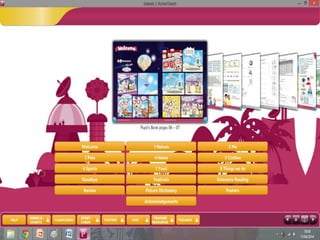
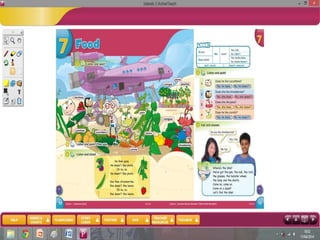
– Virtual books
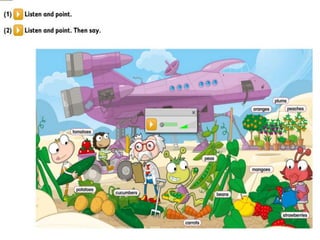
• Islands (Pearson)
– Subject: English
– 3rd year of Primary
18
INDEX
1. INTRODUCTION
2. KEY COMPETENCES
3. ICT IN CLIL
4. ICT RESOURCES
5. REFERENCES
19
20
21
5. REFERENCES
- Council of Europe:
http://europa.eu/legislation_summaries/education_training_
youth/lifelong_learning/c11090_en.htm
- Delors Report:
http://unesdoc.unesco.org/images/0010/001095/109590eo.
pdf
- DeSeCo project: http://www.oecd.org/edu/skills-beyond-
school/definitionandselectionofcompetenciesdeseco.htm
- Grenfell, M. (ed.) 2002. Modern Languages Across the
Curriculum. London: Routledge.
- Salaberri, S. 2012. Islands 3. Essex: Pearson.
- Vlachos, K. 2009. “The Potential of Information
Communication Technologies (ICT) in Content and Language
Integrated Learning (CLIL): The Case of English as a
Second/Foreign Language”. In: Marsh, D. et al. CLIL
practice: Perspectives from the Field. Finland: University of
Jyväskylä.
- Pérez Torres, I. 2009. "Apuntes sobre los principios y
características de la metodología AICLE“. In Pavón, V. &
Ávila, J. (eds.). Aplicaciones didácticas para la enseñanza
integrada de lengua y contenidos. Sevilla: Consejería de
Educación de la Junta de Andalucía-Universidad de Córdoba,
pp. 171-180.
22
INDEX
1. INTRODUCTION
2. KEY COMPETENCES
3. ICT IN CLIL
4. ICT RESOURCES
5. REFERENCES
THANK YOU FOR YOU
ATTENTION
NUI Maynooth, 29th-30th April 2014.

Teaching english through ict toa

  • 1.
    TEACHING ENGLISH THROUGH ICT María TeresaOrtego Antón, PhD University of Valladolid Departament of French and German Faculty of Translation and Interpreting. Faculty of Education Campus Duques de Soria s/n 42003 Soria, Spain tortego@lesp.uva.es NUI Maynooth, 29th-30th April 2014.
  • 2.
    1. INTRODUCTION 2 INDEX 1. INTRODUCTION 2.KEY COMPETENCES 3. ICT IN CLIL 4. ICT RESOURCES 5. REFERENCES
  • 3.
    2. KEY COMPETENCES(I) • What is a key competence? – The ability to integrate knowledge, skills and attitudes in a practical way to solve problems and react appropriately in a variety of contexts and situations. In other words, it is the integration and application of theoretical and practical knowledge in settings outside the academic context. • Origin – European Union. – Delors Report (UNESCO, 1996). – DeSeCo Project (OCDE, 1999). 3 INDEX 1. INTRODUCTION 2. KEY COMPETENCES 3. ICT IN CLIL 4. ICT RESOURCES 5. REFERENCES
  • 4.
    2. KEY COMPETENCES(II) • What are the European Key Competences? – Key competences for lifelong learning: • Communication in the mother tongue. • Communication in foreign languages. • Mathematicak competence and basic competences in science and technology. • Digital competence. • Learning to learn. • Interpersonal, intercultural ans social competences and civil competence. • Entrepreneurship. • Cultural competence. 4 INDEX 1. INTRODUCTION 2. KEY COMPETENCES 3. ICT IN CLIL 4. ICT RESOURCES 5. REFERENCES
  • 5.
    2. KEY COMPETENCES(III) • What are the Key Competences related to the Curriculum? – General competences: • Competence in linguistic communication. • Mathematical competence. • Competence in knowledge and interaction with the physical world. • Competence in processing information and the use of ICT. • Cultural and artistic competence. • Learning to learn. • Autonomy and personal initiative. 5 INDEX 1. INTRODUCTION 2. KEY COMPETENCES 3. ICT IN CLIL 4. ICT RESOURCES 5. REFERENCES
  • 6.
    3.ICT IN CLIL •ICT benefits in CLIL: – enhanced levels of motivation, – students’ active participation and self expression, opportunities for: • authentic language use, • increased language input and output, • increased learner participation, • using the target language in meaningful situations, • student collaboration and socialization, • developing language and intercultural awareness, • working across the curriculum, etc. 6 INDEX 1. INTRODUCTION 2. KEY COMPETENCES 3. ICT IN CLIL 4. ICT RESOURCES 5. REFERENCES
  • 7.
    4. ICT RESOURCES(I) Tools and materials to teach English Digital libraries Linguistic tools and dictionaries Information about English language and its literature Information about curricular contents and activities Educative website Website for teachers Tools to create contents and share them Online office software Slides Time lines Conceptual maps Wikis Blogs Tools to create educative materials Press Encourage teens to read Media in classroom Clasroom blog Wikis Virtual books 7 INDEX 1. INTRODUCTION 2. KEY COMPETENCES 3. ICT IN CLIL 4. ICT RESOURCES 5. REFERENCES
  • 8.
    4. ICT RESOURCES(II) 1. Digital libraries: Gutenberg Project 8 INDEX 1. INTRODUCTION 2. KEY COMPETENCES 3. ICT IN CLIL 4. ICT RESOURCES 5. REFERENCES
  • 9.
    4. ICT RESOURCES(III) 2. Linguistic tools and dictionaries – English learner’s dictionaries: • Merriam Webster’s Learner’s Dictionary • Oxford Learner’s Dictionaries • Cambridge Advanced Learner’s Dictionary • Longman Dictionary of Contemporary English • Collins English for Learners – General bilingual dictionaries: • Cambridge inglés-español • WordReference • English-Spanish Oxford Dictionary • Collins English-Spanish Dictionary 9 INDEX 1. INTRODUCTION 2. KEY COMPETENCES 3. ICT IN CLIL 4. ICT RESOURCES 5. REFERENCES
  • 10.
    4. ICT RESOURCES(IV) 3. Information about English language and its literature: – Wikipedia – MOOC (http://www.mooc- list.com/tags/english) – English Club (http://www.englishclub.com/) 10 INDEX 1. INTRODUCTION 2. KEY COMPETENCES 3. ICT IN CLIL 4. ICT RESOURCES 5. REFERENCES
  • 11.
    4. ICT RESOURCES(V) 4. Information about curricular contents and activities (I): – Educative websites  British Council (http://learnenglishkids.britishcouncil.org/es/ )  Educacyl (http://www.educa.jcyl.es/es)  Spanish Ministry of Education (http://recursostic.educacion.es/primaria/hello/w eb/)  Wikirecursostic (https://wikirecursostic.wikispaces.com/INGL%C3 %89S)  Mansión Inglés (http://www.mansioningles.com/)  RedRed (http://www.terueltirwal.es/redred/ingles.html)  Clicatic (http://www.clicatic.org/home)  Games to learn English (http://gamestolearnenglish.com/) 11 INDEX 1. INTRODUCTION 2. KEY COMPETENCES 3. ICT IN CLIL 4. ICT RESOURCES 5. REFERENCES
  • 12.
    4. ICT RESOURCES(VI) 4. Information about curricular contents and activities (II): – Websites for teachers • Blogs  http://paraprofesypadres.blogspot.c om.es/p/recursos-primaria.html  http://recursosticparaeducacioninfan til.blogspot.com.es/  http://recursostic.educacion.es/heda /web/es/primaria/556-recursos- para-las-clases-de-ingles-en- primaria.es/inglesep/portada.html 12 INDEX 1. INTRODUCTION 2. KEY COMPETENCES 3. ICT IN CLIL 4. ICT RESOURCES 5. REFERENCES
  • 13.
    4. ICT RESOURCES(VII) 5. Tools to create contents and share them (I): – Online Office Software (Google docs) – Slides (http://www.slideshare.net/) – Timelines (http://elearningindustry.com/top- 10-free-timeline-creation-tools-for- teachers) – Concept mapping (http://ctl.byu.edu/tech- tips/concept-mapping) 13 INDEX 1. INTRODUCTION 2. KEY COMPETENCES 3. ICT IN CLIL 4. ICT RESOURCES 5. REFERENCES
  • 14.
    4. ICT RESOURCES(VIII) 5. Tools to create contents and share them (II): – Blogs and Wikis • https://docentesenextremadura.wikispaces.com /ICT+Resources+for+Primary+English+Teaching • https://wikirecursostic.wikispaces.com/INGL% C3%89S – Webquests: – A. Planning (face-to-face learning) – B. Implementation (online & face-to-face learning) – C. Creation of the product (face-to-face learning) – D. Evaluation (face-to-face learning) – E. Follow up activities (face-to-face & online learning) 14 INDEX 1. INTRODUCTION 2. KEY COMPETENCES 3. ICT IN CLIL 4. ICT RESOURCES 5. REFERENCES
  • 15.
    4. ICT RESOURCES(IX) 6. Tools to create educative materials (http://clic.xtec.cat/en/index.h tm) 15 INDEX 1. INTRODUCTION 2. KEY COMPETENCES 3. ICT IN CLIL 4. ICT RESOURCES 5. REFERENCES
  • 16.
    4. ICT RESOURCES(X) 7. Press – BBC (http://www.bbc.co.uk/worldservice/ learningenglish/ – National Geographic (http://kids.nationalgeographic.com/ kids/) 16 INDEX 1. INTRODUCTION 2. KEY COMPETENCES 3. ICT IN CLIL 4. ICT RESOURCES 5. REFERENCES
  • 17.
    4. ICT RESOURCES(XI) 8. Encourage teens to read – Reading Rockets (http://www.readingrockets.org/article /192) – Oxford Owl (http://www.oxfordowl.co.uk/welcome/f or-home/reading-owl/reading) – OUP (https://global.oup.com/education/cont ent/primary/key-issues/independent- reading/?view=ProductList&region=inter national) 17 INDEX 1. INTRODUCTION 2. KEY COMPETENCES 3. ICT IN CLIL 4. ICT RESOURCES 5. REFERENCES
  • 18.
    4. ICT RESOURCES(XII) 9. Media in classroom – Classroom blog • Hello Teacher (http://helloteachermarta.blogspot.com.e s/) • Take the pen (http://www.takethepen.net/) • English si fun (http://pilaringlescole.blogspot.com.es/) – Virtual books • Islands (Pearson) – Subject: English – 3rd year of Primary 18 INDEX 1. INTRODUCTION 2. KEY COMPETENCES 3. ICT IN CLIL 4. ICT RESOURCES 5. REFERENCES
  • 19.
  • 20.
  • 21.
  • 22.
    5. REFERENCES - Councilof Europe: http://europa.eu/legislation_summaries/education_training_ youth/lifelong_learning/c11090_en.htm - Delors Report: http://unesdoc.unesco.org/images/0010/001095/109590eo. pdf - DeSeCo project: http://www.oecd.org/edu/skills-beyond- school/definitionandselectionofcompetenciesdeseco.htm - Grenfell, M. (ed.) 2002. Modern Languages Across the Curriculum. London: Routledge. - Salaberri, S. 2012. Islands 3. Essex: Pearson. - Vlachos, K. 2009. “The Potential of Information Communication Technologies (ICT) in Content and Language Integrated Learning (CLIL): The Case of English as a Second/Foreign Language”. In: Marsh, D. et al. CLIL practice: Perspectives from the Field. Finland: University of Jyväskylä. - Pérez Torres, I. 2009. "Apuntes sobre los principios y características de la metodología AICLE“. In Pavón, V. & Ávila, J. (eds.). Aplicaciones didácticas para la enseñanza integrada de lengua y contenidos. Sevilla: Consejería de Educación de la Junta de Andalucía-Universidad de Córdoba, pp. 171-180. 22 INDEX 1. INTRODUCTION 2. KEY COMPETENCES 3. ICT IN CLIL 4. ICT RESOURCES 5. REFERENCES
  • 23.
    THANK YOU FORYOU ATTENTION NUI Maynooth, 29th-30th April 2014.