GIVING EFFECTIVE
PRESENTATIONS
WestTexasA&M University
Department of Agricultural Sciences
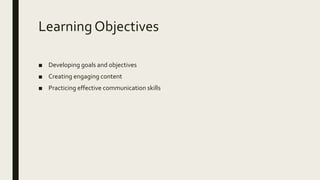
Learning Objectives
■ Developing goals and objectives
■ Creating engaging content
■ Practicing effective communication skills
PART ONE
Developing Goals & Objectives
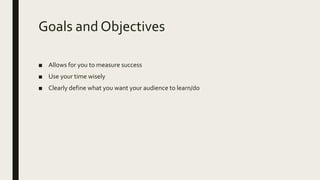
Goals and Objectives
■ Allows for you to measure success
■ Use your time wisely
■ Clearly define what you want your audience to learn/do
SMART Goals
■ S - Specific
■ M – Measurable
■ A – Attainable
■ R – Relevant
■ T –Time-bound
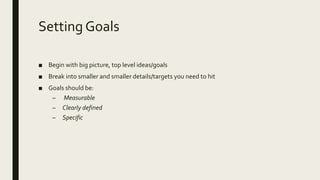
Setting Goals
■ Begin with big picture, top level ideas/goals
■ Break into smaller and smaller details/targets you need to hit
■ Goals should be:
– Measurable
– Clearly defined
– Specific
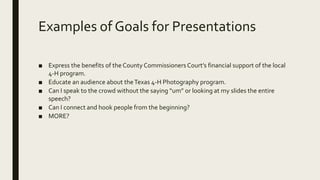
Examples of Goals for Presentations
■ Express the benefits of the County Commissioners Court’s financial support of the local
4-H program.
■ Educate an audience about theTexas 4-H Photography program.
■ Can I speak to the crowd without the saying “um” or looking at my slides the entire
speech?
■ Can I connect and hook people from the beginning?
■ MORE?
PARTTWO
Creating Engaging Content
■ Include engaging content on your slide, such as photos that tell the story you’re
portraying.
– Let the audience read the slide while you elaborate and sell your message
Creating content that is engaging but
not distracting
■ Use neutral colors for backgrounds
■ Use fonts and colors that are easy to read, usually dark colors are best
■ Less is more when it comes to the number of words used on each slide.
– If there are too many words, the audience won’t be listening, they will be reading
PART TWO
C R E AT I N G E N G A G I N G C O N T E N T
Engaging your audience
■ Twitter/Tweet Deck
■ Kahoot
■ What will engage your audience?
– Think about demographics when you’re trying to decide how to engage with your
audience.
– Is your audience older?Younger? Etc.
PARTTHREE
Practicing Effective Communication Skills
Practicing Effective Communication
Skills
■ Express your passion for the topic and connect with your audience
■ Keep the needs of your audience in mind
■ Keep it simple and concentrate on your core message/goals
■ Practice good interpersonal communication skills
Practicing Effective Communication
Skills
■ Have a strong start
■ 10-20-30 rule of thumb for most presentations:
– Contain approximately 10 slides
– Last no more that 20 minutes
– Use a font bigger than 30 point
■ Include stories or anecdotes
– If people can connect to your presentation personally they are more likely to stay
hooked.
MoreThings to Consider
■ Preparation for presentation/speaking engagement:
– Equipment
– Demographics
– Room layout
– Time constraints
– Number of people
– Special populations/ accommodations
Wrap-Up
■ Do you feel like you can:
– Develop goals and objectives for your presentations?
– Create engaging content for your audience?
– Utilize effective communication skills?
■ If not, what areas can we help expand on?

Effective presentations texas 4 h

  • 1.
  • 2.
    Learning Objectives ■ Developinggoals and objectives ■ Creating engaging content ■ Practicing effective communication skills
  • 3.
  • 4.
    Goals and Objectives ■Allows for you to measure success ■ Use your time wisely ■ Clearly define what you want your audience to learn/do
  • 5.
    SMART Goals ■ S- Specific ■ M – Measurable ■ A – Attainable ■ R – Relevant ■ T –Time-bound
  • 6.
    Setting Goals ■ Beginwith big picture, top level ideas/goals ■ Break into smaller and smaller details/targets you need to hit ■ Goals should be: – Measurable – Clearly defined – Specific
  • 7.
    Examples of Goalsfor Presentations ■ Express the benefits of the County Commissioners Court’s financial support of the local 4-H program. ■ Educate an audience about theTexas 4-H Photography program. ■ Can I speak to the crowd without the saying “um” or looking at my slides the entire speech? ■ Can I connect and hook people from the beginning? ■ MORE?
  • 8.
  • 9.
    Creating Engaging Content ■Include engaging content on your slide, such as photos that tell the story you’re portraying. – Let the audience read the slide while you elaborate and sell your message
  • 10.
    Creating content thatis engaging but not distracting ■ Use neutral colors for backgrounds ■ Use fonts and colors that are easy to read, usually dark colors are best ■ Less is more when it comes to the number of words used on each slide. – If there are too many words, the audience won’t be listening, they will be reading
  • 11.
    PART TWO C RE AT I N G E N G A G I N G C O N T E N T
  • 12.
    Engaging your audience ■Twitter/Tweet Deck ■ Kahoot ■ What will engage your audience? – Think about demographics when you’re trying to decide how to engage with your audience. – Is your audience older?Younger? Etc.
  • 13.
  • 14.
    Practicing Effective Communication Skills ■Express your passion for the topic and connect with your audience ■ Keep the needs of your audience in mind ■ Keep it simple and concentrate on your core message/goals ■ Practice good interpersonal communication skills
  • 15.
    Practicing Effective Communication Skills ■Have a strong start ■ 10-20-30 rule of thumb for most presentations: – Contain approximately 10 slides – Last no more that 20 minutes – Use a font bigger than 30 point ■ Include stories or anecdotes – If people can connect to your presentation personally they are more likely to stay hooked.
  • 16.
    MoreThings to Consider ■Preparation for presentation/speaking engagement: – Equipment – Demographics – Room layout – Time constraints – Number of people – Special populations/ accommodations
  • 17.
    Wrap-Up ■ Do youfeel like you can: – Develop goals and objectives for your presentations? – Create engaging content for your audience? – Utilize effective communication skills? ■ If not, what areas can we help expand on?