3 Cs of Media Convergence
• Computing
• Communications
• Content
LAYING THE FOUNDATION
• Shared farm and home information to rural areas.
• Traced back to 1800’s in the U.S.
• Those in the profession were often influential leaders in agriculture.
• In the 1900’s the craft became a highly competitive industry.
• Movies and radio was not seen as a threat to agricultural publications in the
1920’s.
(Tucker, Whaley, & Cano, 2003)
LAYING THE FOUNDATION
• The 1980’s saw a dramatic downturn in the farm economy.
• Farm audiences dwindled for farm publications.
• Consolidation of farm publications.
• Discussion of ag communicators ability to report on controversial topics.
(Tucker, Whaley, & Cano, 2003)
21st CENTURY PREPARATION
• Private and public sectors.
• Training to address complex issues:
• Controversial contemporary issues
• Food Safety
• Environmental Conservation
• GM of plants and animals
• Who is our audience in these issues and what mediums do we use?
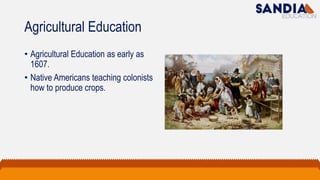
Agricultural Education
• Agricultural Education as early as
1607.
• Native Americans teaching colonists
how to produce crops.
Land Grant Institutions
• 1862 Morrill Act:
• Land Grant Colleges
• Focused on agriculture and
mechanical arts
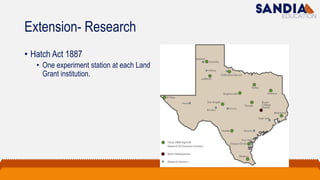
Extension- Research
• Hatch Act 1887
• One experiment station at each Land
Grant institution.
1890 Institutions
• Morrill Act of 1890
• Designated 19 colleges as land grant
institutions.
• Others prove that race was not admissions
criteria
• Alabama A&M University
• Alcorn State University
• Central State University
• Delaware State University
• Florida A&M University
• Fort Valley State University
• Kentucky State University
• Langston University
• Lincoln University
• North Carolina A&T State
University
• Prairie View A&M
University
• South Carolina State
University
• Southern University
System
• Tennessee State
University
• Tuskegee University
• University of Arkansas
Pine Bluff
• University of Maryland
Eastern Shore
• Virginia State University
• West Virginia State
University
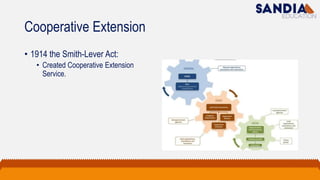
Cooperative Extension
• 1914 the Smith-Lever Act:
• Created Cooperative Extension
Service.
Extension Communication
• Topics:
• Crops
• Livestock
• General Ag
• Horticulture
• Ag Mechanics
• Economics
• Phone calls
• Bulletins/Newsletters
• Demonstrations/Instruction
Commodity Organizations
• Agricultural commodities:
• staple crops
• animals produced or raised on farms
or plantations
• Represent their respective
industries.
Checkoff Programs
• Checkoff (research and promotion)
programs:
• provide research and information
without reference to specific producers
or brands
• Some are mandatory, others are
voluntary.
Looking Back
• 1915- first radio broadcast of weather and crop reports
• 1920- first regular agricultural radio broadcast began
• 1921- first vocal broadcast—weather report
• 1921- first daily program for farmers
• 1922- first radio commercial
• 1923- first full-time farm broadcaster, Frank Mullion, took the air
Broadcast Today
• By 2000, agricultural media in the U.S. had exploded. The main sources of ag
media that year:
• 101 agricultural newspapers
• 432 magazines
• 1,001 AM stations
• 745 FM stations
• 12 state and 3 regional radio networks
• 3 television stations
Podcasts
• According to 2018 data from Edison Research:
• 44% of Americans have listened to a podcast
• 26% of Americans listen to podcasts monthly
• 33% of Americans ages 25-54 listen to podcasts monthly
Podcasts
• Versatile
• Accessible
• The decline in Farm Radio has given rise to new technologies:
• Satellite
• Podcasts
Looking Back
• 1950s- number of tv stations were increasing
• 1951- first regular farm tv show began
Television
• Uses both sight and sound
• Farm- primarily morning hours and weekends
• Most ag companies do not invest much into tv commercials
• Satellite TV dominates the farm tv category.
Communication Specialist
• The Communications Specialist
should be a motivated individual with
a passion for agriculture and should
work well alone or in teams.
• You are expected to serve a number
of different roles.
• Expected Skills:
• Digital development
• Web design
• E-publications,
• Virtual events
• Online video
• Mobile applications
• Podcasting
• Social media
Why I Farm
• Website
• Blog
• SM
• Facebook
• Twitter
• Instagram
• Video
• YouTube
• Vimeo
American’s Farmers: Bayer Fund
• Website
• Social Media
• Facebook
• Twitter
• Instagram
• Video
• YouTube
• Media Kits
Harvest Public Media
• Website
• SM
• Facebook
• Twitter
• Video
• YouTube
• Podcast
• Broadcast
• KCUR 89.3
U.S. Farmers & Ranchers
• Website
• SM
• Facebook
• Twitter
• Instagram
• LinkedIn
• Video
• YouTube
• Newsletter

Agricultural Media Convergence

  • 2.
    3 Cs ofMedia Convergence • Computing • Communications • Content
  • 3.
    LAYING THE FOUNDATION •Shared farm and home information to rural areas. • Traced back to 1800’s in the U.S. • Those in the profession were often influential leaders in agriculture. • In the 1900’s the craft became a highly competitive industry. • Movies and radio was not seen as a threat to agricultural publications in the 1920’s. (Tucker, Whaley, & Cano, 2003)
  • 4.
    LAYING THE FOUNDATION •The 1980’s saw a dramatic downturn in the farm economy. • Farm audiences dwindled for farm publications. • Consolidation of farm publications. • Discussion of ag communicators ability to report on controversial topics. (Tucker, Whaley, & Cano, 2003)
  • 5.
    21st CENTURY PREPARATION •Private and public sectors. • Training to address complex issues: • Controversial contemporary issues • Food Safety • Environmental Conservation • GM of plants and animals • Who is our audience in these issues and what mediums do we use?
  • 7.
    Agricultural Education • AgriculturalEducation as early as 1607. • Native Americans teaching colonists how to produce crops.
  • 8.
    Land Grant Institutions •1862 Morrill Act: • Land Grant Colleges • Focused on agriculture and mechanical arts
  • 9.
    Extension- Research • HatchAct 1887 • One experiment station at each Land Grant institution.
  • 10.
    1890 Institutions • MorrillAct of 1890 • Designated 19 colleges as land grant institutions. • Others prove that race was not admissions criteria • Alabama A&M University • Alcorn State University • Central State University • Delaware State University • Florida A&M University • Fort Valley State University • Kentucky State University • Langston University • Lincoln University • North Carolina A&T State University • Prairie View A&M University • South Carolina State University • Southern University System • Tennessee State University • Tuskegee University • University of Arkansas Pine Bluff • University of Maryland Eastern Shore • Virginia State University • West Virginia State University
  • 12.
    Cooperative Extension • 1914the Smith-Lever Act: • Created Cooperative Extension Service.
  • 13.
    Extension Communication • Topics: •Crops • Livestock • General Ag • Horticulture • Ag Mechanics • Economics • Phone calls • Bulletins/Newsletters • Demonstrations/Instruction
  • 15.
    Commodity Organizations • Agriculturalcommodities: • staple crops • animals produced or raised on farms or plantations • Represent their respective industries.
  • 16.
    Checkoff Programs • Checkoff(research and promotion) programs: • provide research and information without reference to specific producers or brands • Some are mandatory, others are voluntary.
  • 18.
    Looking Back • 1915-first radio broadcast of weather and crop reports • 1920- first regular agricultural radio broadcast began • 1921- first vocal broadcast—weather report • 1921- first daily program for farmers • 1922- first radio commercial • 1923- first full-time farm broadcaster, Frank Mullion, took the air
  • 19.
    Broadcast Today • By2000, agricultural media in the U.S. had exploded. The main sources of ag media that year: • 101 agricultural newspapers • 432 magazines • 1,001 AM stations • 745 FM stations • 12 state and 3 regional radio networks • 3 television stations
  • 21.
    Podcasts • According to2018 data from Edison Research: • 44% of Americans have listened to a podcast • 26% of Americans listen to podcasts monthly • 33% of Americans ages 25-54 listen to podcasts monthly
  • 22.
    Podcasts • Versatile • Accessible •The decline in Farm Radio has given rise to new technologies: • Satellite • Podcasts
  • 24.
    Looking Back • 1950s-number of tv stations were increasing • 1951- first regular farm tv show began
  • 25.
    Television • Uses bothsight and sound • Farm- primarily morning hours and weekends • Most ag companies do not invest much into tv commercials • Satellite TV dominates the farm tv category.
  • 26.
    Communication Specialist • TheCommunications Specialist should be a motivated individual with a passion for agriculture and should work well alone or in teams. • You are expected to serve a number of different roles. • Expected Skills: • Digital development • Web design • E-publications, • Virtual events • Online video • Mobile applications • Podcasting • Social media
  • 28.
    Why I Farm •Website • Blog • SM • Facebook • Twitter • Instagram • Video • YouTube • Vimeo
  • 29.
    American’s Farmers: BayerFund • Website • Social Media • Facebook • Twitter • Instagram • Video • YouTube • Media Kits
  • 30.
    Harvest Public Media •Website • SM • Facebook • Twitter • Video • YouTube • Podcast • Broadcast • KCUR 89.3
  • 31.
    U.S. Farmers &Ranchers • Website • SM • Facebook • Twitter • Instagram • LinkedIn • Video • YouTube • Newsletter