Describe
audience
analysis and the
benefit they
provide
communicators.
Choose between
different
methodologies.
Conduct an
audience
analysis.
Defining Audience Analysis
• Audience analysis is…
• “…assessing the characteristics and interests of different audiences and then
reshaping the information to fit what you know.” Gurak and Lannon
• “…learning to gauge the technical expertise of your audience and to write at a level
exactly suited to their needs.” Woolever
From a Creative Perspective
• Even if you think your video will be great for everyone, there has to be a
subset of “everyone” who will especially like it.
• How do you want this audience to react?
Outcomes of an Audience Analysis
• Writing styles and requirements differ from profession to profession and
company to company
• To strategically place key information
• To accommodate different Learning Styles
• To make your information understandable
Common Misconceptions
• “I know what these people want; I work with them everyday.”
• “I’ve used this product so often I know exactly what the users need.”
• “This audience is so broad I can’t possibly pin down specific characteristics;
it’s just the general public with no special qualities.”
Some General Questions
• Who will be reading, listening to, or using this material?
• What special characteristics do they have?
• What is their background and attitude toward the subject?
• What knowledge do they have?
Identifying Audiences
Primary Audiences
• An immediate audience
• The direct recipient of your
information
Secondary Audiences
• An audience outside the circle of
those who need it urgently
• Recipients who need the information
to contribute to some other aspect.
Example
Medical Report
• Who is the primary Audience?
• Attending Doctor
• Who is the Secondary Audience?
• Nurses, therapists, etc.
Movie Review
• Who is the Primary Audience?
• People who want to see the movie
• Who is the Secondary Audience?
• Directors, Actors, Movie Distributors,
etc.
Discourse Communities
• A group of people who…
• share the same opinions or thoughts
• use the same communication channels
• adopt similar speech patterns and language usage
• have the same standards for acceptable and unacceptable comments and
statements
• live in the same region or area
• have similar accents or communication forms
• share inside jokes, listen to the same music, etc.
Audience Analysis
• Discourse Community-
• People may belong to one or more discourse communities
• Discourse communities may have rules of communication that are flexible or strict.
• Some discourse communities will overlap
• Which discourse communities do you belong to?
• West Texas A&M University?
• Fans of a particular music?
• What else?
Conducting an Audience Analysis
• AUDIENCE Acronym
• Audience Analysis Grid
AUDIENCE
• Analysis
• Understanding
• Demographics
• Interest
• Environment
• Needs
• Customization
• Expectations
Analysis
• Technical writing should be designed to meet the needs of your audience
• To do so, you should be able to answer the 5Ws and H
• Who they are?
• What do they need?
• Where will they read?
• When will they read?
• Why will they read?
• How will they read (electronic, paper)?
Understanding
• What is the audience’s knowledge of the subject?
• Do they have knowledge of subject matter?
• What is their reading level?
• What is their level of understanding?
• What sources do they deem as credible?
• What is their level of experience/expertise with the subject matter?
Understanding
• What are the job functions of your audience?
• Knowing the job(s) your audience holds can help you understand what they are
looking for from your message and how they will use it
• How do they plan on using the communication material?
Demographics
• Facts about people that influence how they perceive messages
• Age
• Gender
• Race
• Family Size
• Socioeconomic
status
• Income
• Education
• Occupation
• Geographic information
Demographics
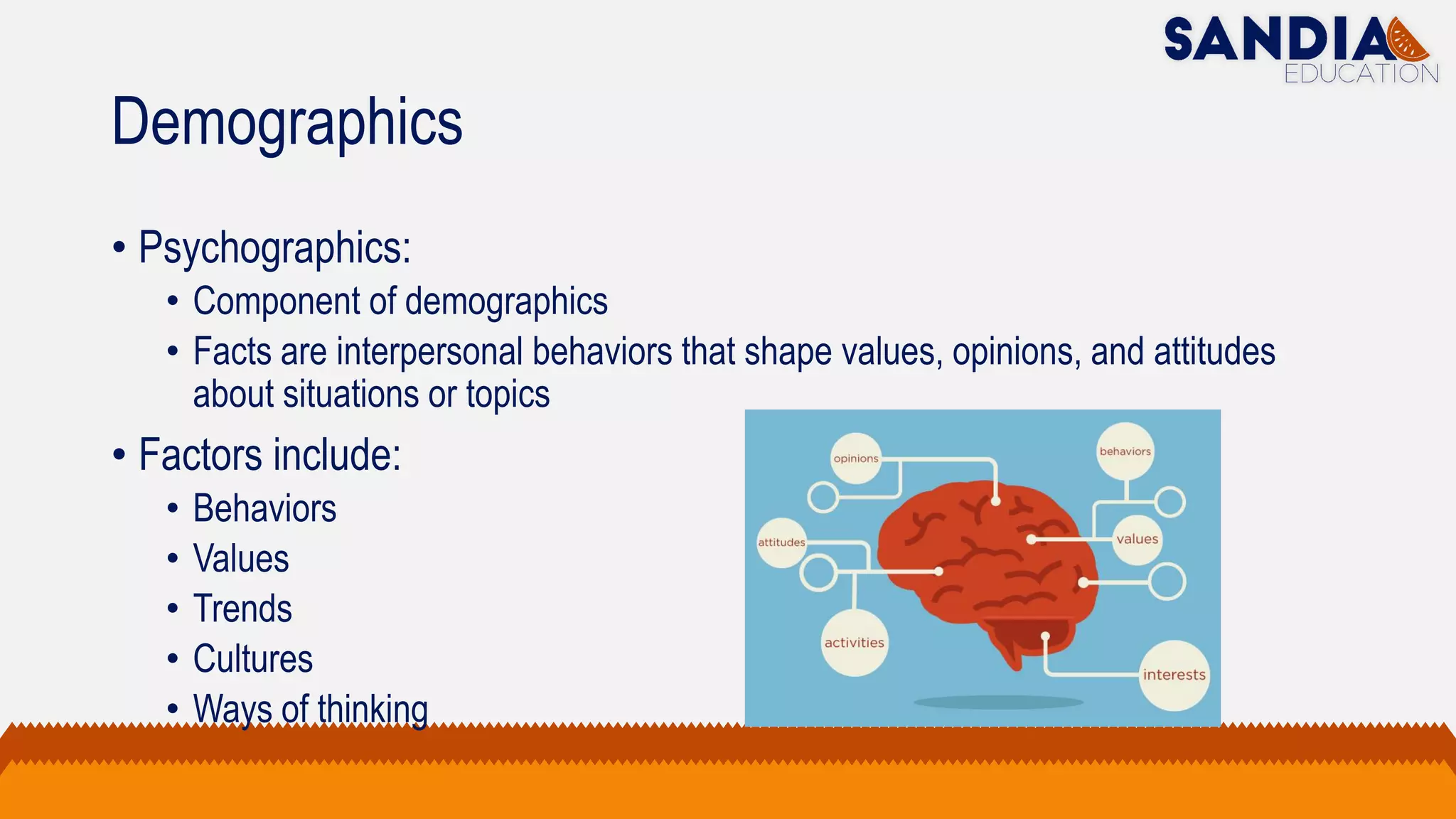
• Psychographics:
• Component of demographics
• Facts are interpersonal behaviors that shape values, opinions, and attitudes
about situations or topics
• Factors include:
• Behaviors
• Values
• Trends
• Cultures
• Ways of thinking
Interest
• People are very egocentric.
• They like to listen to messages that
are meaningful to
them.
• Think about:
• What are the interests
of your audience?
• Interest level in topic you
wish to communicate
• Subjects your audience is interested in
Environment
• The type of environment where the message will be received.
• What type of media?
• Print, online, video, graphics
• How large of a group?
• Small, large
• Occasion or time of the year
• Advertisements for the super bowl
• Black Friday promotions
• Messages during key events
• Physical environment
Needs
• What are the audience’s needs
associated with your document
topic?
• To keep up to date
• To learn how others have solved a
problem
• To inform themselves before
making a decision
• To complete some task
• To learn or grow
• Put what they need at the
beginning to catch their attention
Customization
• What specific needs/interests
should you the writer address
relating to the specific
audience?
• If there is more than one
audience, you can write
sections specific to the
corresponding audience
• Do they have any biases or
prejudgments
Expectations
• What does the audience expect to learn from your document?
• Initial questions should be answered and explained
• Professional Expectations
• Formats and styles
• ACOM is AP style for media and business writing, APA style for research writing
Creating an Audience Analysis Grid
Primary
Audience
Secondary
Audience
Who will receive your information?
What Discourse Communities do they belong to?
What are their levels of expertise and experience?
What do they need from this information?
Do they have any biases or prejudgments?
Under what conditions will they receive this information?
Who will receive your information?
• Be specific about your actual recipients
• Picture them in your head
• What are their demographics?
• Remember that more than one audience may get this information
What Discourse Communities do they belong to?
• Where does your audience live and work?
• Think about all possible factors that might apply
• Are these communities professional or personal?
• Do any of them overlap with your discourse communities?
What are their levels of expertise?
• Don’t use terms they won’t understand, and don’t explain things they already
understand
• Is your audience new to the subject matter?
• Find out who has the decision making power where your subject matter is
concerned
• NEVER present information that may be inaccurate
What do they need from this information?
• Does your audience want details or basic points?
• Frontloading-
• Placing recommendations or conclusions first, in front of background or other
information
• Useful when the audience is pressed for time, in summaries, and when the audience
doesn’t need background information.
• Bottom Line information:
• If you had to say one thing that your audience needs more than anything else, what is
it?
• Make this information easy to find and most prevalent
Do they have biases or prejudgments?
• Is your audience hostile to your ideas?
• Will they readily agree with you?
• What do they hope from or fear from you?
• Soften the negative affect and strengthen the positive
Under what condition will they receive the information?
• Identify any possible distractions
• Where will they be?
• Where will you be?
• What else is around?
• Know when to create information that requires intense concentration, and
when to make it ‘skimmable’
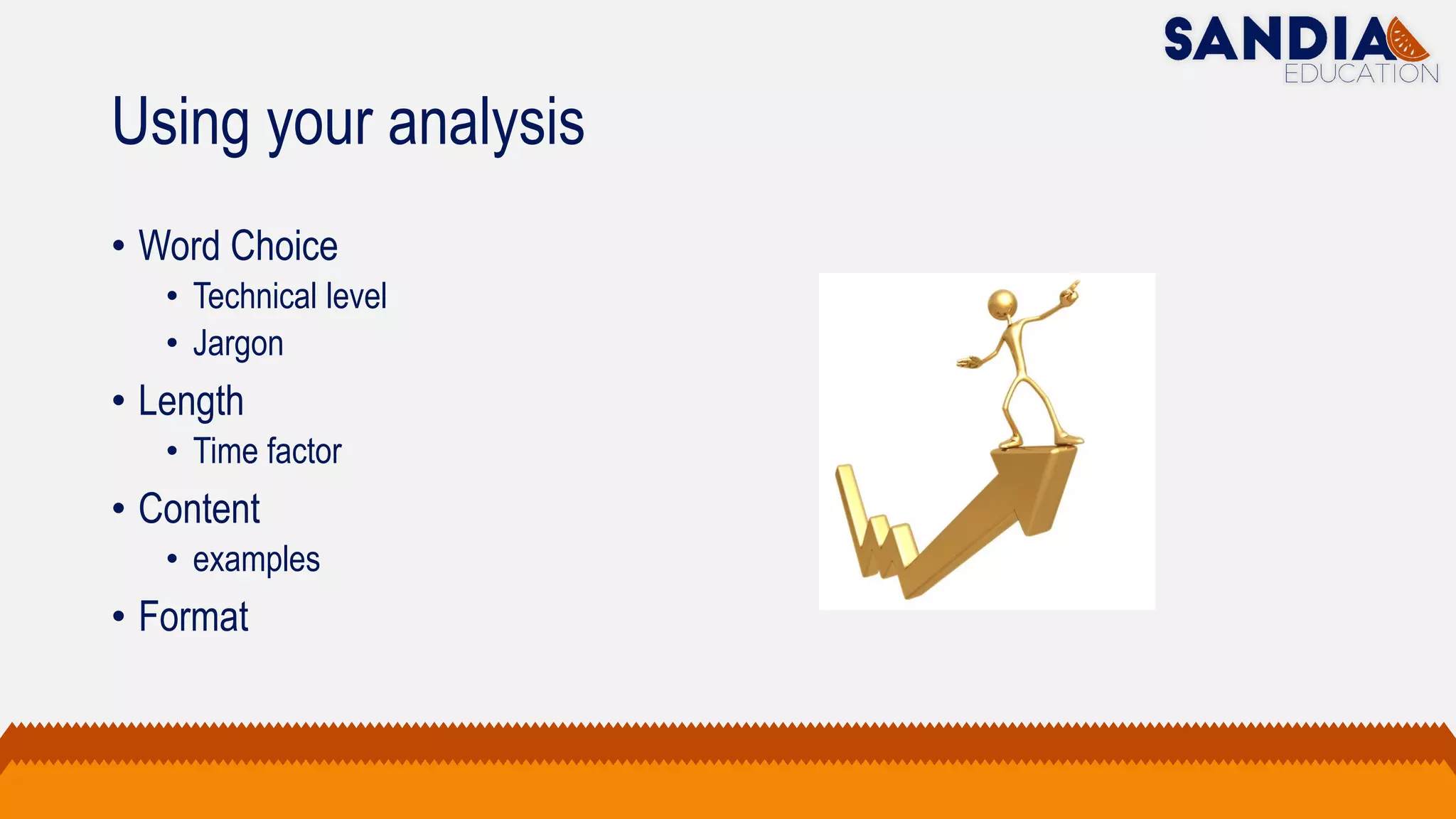
Using your analysis
• Word Choice
• Technical level
• Jargon
• Length
• Time factor
• Content
• examples
• Format
Think Before you Create
• WHO is your audience?
• WHO is the competition?
• WHAT does the audience want?
• WHEN will they be watching/consuming your creative output?
• WHERE are most people going to engage with what you have created?
• WHY use the specific outlet/medium you have chosen?
Know Your Audience
• Your creative project will be more well received if you consider your audience
first.
• Your audience can vary in size, and that is ok!
Describe
audience
analysis and the
benefit they
provide
communicators.
Choose between
different
methodologies.
Conduct an
audience
analysis.

Audience analysis

  • 2.
    Describe audience analysis and the benefitthey provide communicators. Choose between different methodologies. Conduct an audience analysis.
  • 3.
    Defining Audience Analysis •Audience analysis is… • “…assessing the characteristics and interests of different audiences and then reshaping the information to fit what you know.” Gurak and Lannon • “…learning to gauge the technical expertise of your audience and to write at a level exactly suited to their needs.” Woolever
  • 4.
    From a CreativePerspective • Even if you think your video will be great for everyone, there has to be a subset of “everyone” who will especially like it. • How do you want this audience to react?
  • 6.
    Outcomes of anAudience Analysis • Writing styles and requirements differ from profession to profession and company to company • To strategically place key information • To accommodate different Learning Styles • To make your information understandable
  • 7.
    Common Misconceptions • “Iknow what these people want; I work with them everyday.” • “I’ve used this product so often I know exactly what the users need.” • “This audience is so broad I can’t possibly pin down specific characteristics; it’s just the general public with no special qualities.”
  • 8.
    Some General Questions •Who will be reading, listening to, or using this material? • What special characteristics do they have? • What is their background and attitude toward the subject? • What knowledge do they have?
  • 9.
    Identifying Audiences Primary Audiences •An immediate audience • The direct recipient of your information Secondary Audiences • An audience outside the circle of those who need it urgently • Recipients who need the information to contribute to some other aspect.
  • 10.
    Example Medical Report • Whois the primary Audience? • Attending Doctor • Who is the Secondary Audience? • Nurses, therapists, etc. Movie Review • Who is the Primary Audience? • People who want to see the movie • Who is the Secondary Audience? • Directors, Actors, Movie Distributors, etc.
  • 11.
    Discourse Communities • Agroup of people who… • share the same opinions or thoughts • use the same communication channels • adopt similar speech patterns and language usage • have the same standards for acceptable and unacceptable comments and statements • live in the same region or area • have similar accents or communication forms • share inside jokes, listen to the same music, etc.
  • 12.
    Audience Analysis • DiscourseCommunity- • People may belong to one or more discourse communities • Discourse communities may have rules of communication that are flexible or strict. • Some discourse communities will overlap • Which discourse communities do you belong to? • West Texas A&M University? • Fans of a particular music? • What else?
  • 13.
    Conducting an AudienceAnalysis • AUDIENCE Acronym • Audience Analysis Grid
  • 14.
    AUDIENCE • Analysis • Understanding •Demographics • Interest • Environment • Needs • Customization • Expectations
  • 15.
    Analysis • Technical writingshould be designed to meet the needs of your audience • To do so, you should be able to answer the 5Ws and H • Who they are? • What do they need? • Where will they read? • When will they read? • Why will they read? • How will they read (electronic, paper)?
  • 16.
    Understanding • What isthe audience’s knowledge of the subject? • Do they have knowledge of subject matter? • What is their reading level? • What is their level of understanding? • What sources do they deem as credible? • What is their level of experience/expertise with the subject matter?
  • 17.
    Understanding • What arethe job functions of your audience? • Knowing the job(s) your audience holds can help you understand what they are looking for from your message and how they will use it • How do they plan on using the communication material?
  • 18.
    Demographics • Facts aboutpeople that influence how they perceive messages • Age • Gender • Race • Family Size • Socioeconomic status • Income • Education • Occupation • Geographic information
  • 19.
    Demographics • Psychographics: • Componentof demographics • Facts are interpersonal behaviors that shape values, opinions, and attitudes about situations or topics • Factors include: • Behaviors • Values • Trends • Cultures • Ways of thinking
  • 20.
    Interest • People arevery egocentric. • They like to listen to messages that are meaningful to them. • Think about: • What are the interests of your audience? • Interest level in topic you wish to communicate • Subjects your audience is interested in
  • 21.
    Environment • The typeof environment where the message will be received. • What type of media? • Print, online, video, graphics • How large of a group? • Small, large • Occasion or time of the year • Advertisements for the super bowl • Black Friday promotions • Messages during key events • Physical environment
  • 22.
    Needs • What arethe audience’s needs associated with your document topic? • To keep up to date • To learn how others have solved a problem • To inform themselves before making a decision • To complete some task • To learn or grow • Put what they need at the beginning to catch their attention
  • 23.
    Customization • What specificneeds/interests should you the writer address relating to the specific audience? • If there is more than one audience, you can write sections specific to the corresponding audience • Do they have any biases or prejudgments
  • 24.
    Expectations • What doesthe audience expect to learn from your document? • Initial questions should be answered and explained • Professional Expectations • Formats and styles • ACOM is AP style for media and business writing, APA style for research writing
  • 25.
    Creating an AudienceAnalysis Grid Primary Audience Secondary Audience Who will receive your information? What Discourse Communities do they belong to? What are their levels of expertise and experience? What do they need from this information? Do they have any biases or prejudgments? Under what conditions will they receive this information?
  • 26.
    Who will receiveyour information? • Be specific about your actual recipients • Picture them in your head • What are their demographics? • Remember that more than one audience may get this information
  • 27.
    What Discourse Communitiesdo they belong to? • Where does your audience live and work? • Think about all possible factors that might apply • Are these communities professional or personal? • Do any of them overlap with your discourse communities?
  • 28.
    What are theirlevels of expertise? • Don’t use terms they won’t understand, and don’t explain things they already understand • Is your audience new to the subject matter? • Find out who has the decision making power where your subject matter is concerned • NEVER present information that may be inaccurate
  • 29.
    What do theyneed from this information? • Does your audience want details or basic points? • Frontloading- • Placing recommendations or conclusions first, in front of background or other information • Useful when the audience is pressed for time, in summaries, and when the audience doesn’t need background information. • Bottom Line information: • If you had to say one thing that your audience needs more than anything else, what is it? • Make this information easy to find and most prevalent
  • 30.
    Do they havebiases or prejudgments? • Is your audience hostile to your ideas? • Will they readily agree with you? • What do they hope from or fear from you? • Soften the negative affect and strengthen the positive
  • 31.
    Under what conditionwill they receive the information? • Identify any possible distractions • Where will they be? • Where will you be? • What else is around? • Know when to create information that requires intense concentration, and when to make it ‘skimmable’
  • 32.
    Using your analysis •Word Choice • Technical level • Jargon • Length • Time factor • Content • examples • Format
  • 34.
    Think Before youCreate • WHO is your audience? • WHO is the competition? • WHAT does the audience want? • WHEN will they be watching/consuming your creative output? • WHERE are most people going to engage with what you have created? • WHY use the specific outlet/medium you have chosen?
  • 35.
    Know Your Audience •Your creative project will be more well received if you consider your audience first. • Your audience can vary in size, and that is ok!
  • 36.
    Describe audience analysis and the benefitthey provide communicators. Choose between different methodologies. Conduct an audience analysis.