Unit III: Oral Business Communication
(9 hrs)
Syllabus
3.1 Planning the presentation
3.2 Practicing persuasive speech
3.3 Developing the listening skills
3.4 Conducting and participating in meetings
3.5 Communicating non-verbally
Basics of the oral business communication process
• Oral communication is the exchange of information and ideas through
spoken words.
• It can occur in person during face-to-face interactions or through
electronic devices like phones, video platforms, or radios.
• Businesses often use oral communication, such as staff meetings,
webinars, and workshops, to effectively transmit information.
• It involves the ability to convey ideas from one person or group to
another.
• This includes direct conversations or telephone calls. Speeches,
presentations, and discussions are all examples of oral communication.
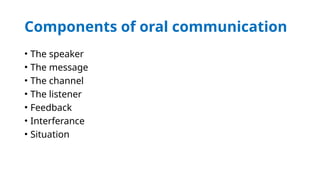
Components of oral communication
• The speaker
• The message
• The channel
• The listener
• Feedback
• Interferance
• Situation
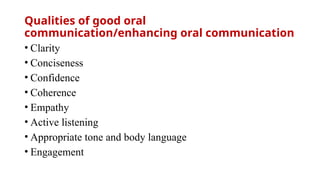
Qualities of good oral
communication/enhancing oral communication
• Clarity
• Conciseness
• Confidence
• Coherence
• Empathy
• Active listening
• Appropriate tone and body language
• Engagement
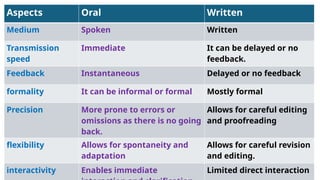
The Distinction between Oral and Written
Communication
Aspects Oral Written
Medium Spoken Written
Transmission
speed
Immediate It can be delayed or no
feedback.
Feedback Instantaneous Delayed or no feedback
formality It can be informal or formal Mostly formal
Precision More prone to errors or
omissions as there is no going
back.
Allows for careful editing
and proofreading
flexibility Allows for spontaneity and
adaptation
Allows for careful revision
and editing.
interactivity Enables immediate Limited direct interaction
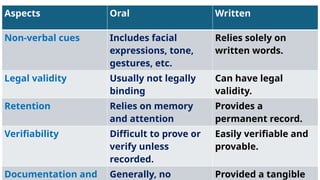
Aspects Oral Written
Non-verbal cues Includes facial
expressions, tone,
gestures, etc.
Relies solely on
written words.
Legal validity Usually not legally
binding
Can have legal
validity.
Retention Relies on memory
and attention
Provides a
permanent record.
Verifiability Difficult to prove or
verify unless
recorded.
Easily verifiable and
provable.
Documentation and Generally, no Provided a tangible
Day 23
Oral Presentation
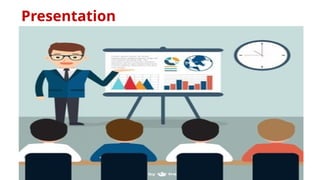
Presentation
What is a presentation?
• A presentation is the process of presenting a topic to an audience.
• It is typically a demonstration, introduction or sharing meant to
inform, persuade, inspire, motivate or to build goodwill or to
present a new idea or product.
• It is a talk or speech in which a new product, idea or piece of work
is shown and explained to a relatively smaller audience.
• Effective presentations are important in business, sales and
selling, training, teaching, lecturing, etc.
• The most important element is the speaker. It is the speaker that
the audience is concentrating on.
• The speaker should put himself/ herself in the shoes of the
audience.
Characteristics of a good
presentation
• It has a clear structure with an introduction, a discussion, and a
conclusion
• It is based on audience-centred approach (audience analysis)
• Facts and figures are visually represented in tables, graphs and
charts.
• Humor and anecdotes may be used to create a friendly
relationship and connections with audience.
• The presenter speaks clearly and logically and uses body
language effectively.
• Questions are given serious attention and are regarded as an
essential part of the presentation.
Planning your presentation
• Delivering an effective presentation involves more than just
standing in front of an audience and speaking.
• It requires careful planning, strategic thinking, and a deep
understanding of the message, the audience, and the
context.
• Like any other business message, a successful presentation
follows a structured process that includes analyzing the
situation, gathering relevant information, selecting the
appropriate medium, and organizing the content in a logical
and engaging way
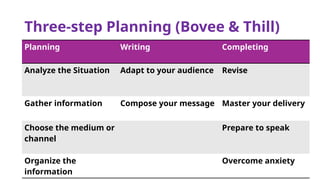
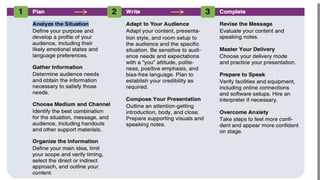
Three-step Planning (Bovee & Thill)
Planning Writing Completing
Analyze the Situation Adapt to your audience Revise
Gather information Compose your message Master your delivery
Choose the medium or
channel
Prepare to speak
Organize the
information
Overcome anxiety
a. Analyze
the
situation
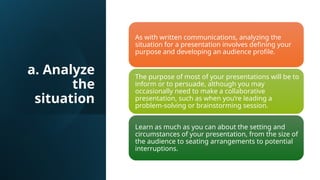
As with written communications, analyzing the
situation for a presentation involves defining your
purpose and developing an audience profile.
The purpose of most of your presentations will be to
inform or to persuade, although you may
occasionally need to make a collaborative
presentation, such as when you’re leading a
problem-solving or brainstorming session.
Learn as much as you can about the setting and
circumstances of your presentation, from the size of
the audience to seating arrangements to potential
interruptions.
..
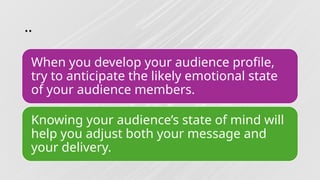
When you develop your audience profile,
try to anticipate the likely emotional state
of your audience members.
Knowing your audience’s state of mind will
help you adjust both your message and
your delivery.
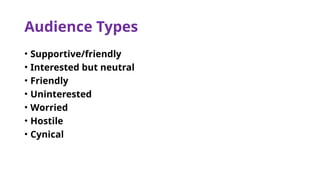
Audience Types
• Supportive/friendly
• Interested but neutral
• Friendly
• Uninterested
• Worried
• Hostile
• Cynical
Sitting arrangement
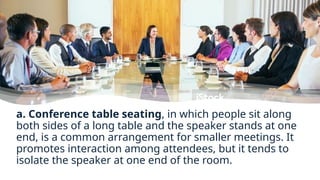
a. Conference table seating, in which people sit along
both sides of a long table and the speaker stands at one
end, is a common arrangement for smaller meetings. It
promotes interaction among attendees, but it tends to
isolate the speaker at one end of the room.
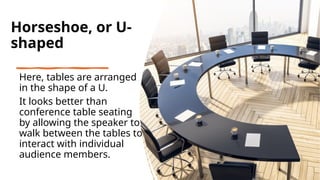
Here, tables are arranged
in the shape of a U.
It looks better than
conference table seating
by allowing the speaker to
walk between the tables to
interact with individual
audience members.
Horseshoe, or U-
shaped
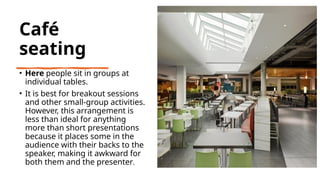
Café
seating
• Here people sit in groups at
individual tables.
• It is best for breakout sessions
and other small-group activities.
However, this arrangement is
less than ideal for anything
more than short presentations
because it places some in the
audience with their backs to the
speaker, making it awkward for
both them and the presenter.
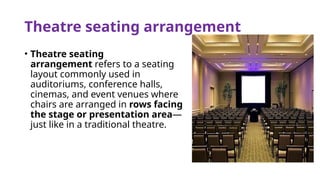
Theatre seating arrangement
• Theatre seating
arrangement refers to a seating
layout commonly used in
auditoriums, conference halls,
cinemas, and event venues where
chairs are arranged in rows facing
the stage or presentation area—
just like in a traditional theatre.
b. Gathering information
• Start by identifying what your audience needs to know.
• What information is essential for them to understand, accept, or act
upon your message?
• Gather relevant, accurate, and up-to-date information from
reliable sources.
• This might include data, case studies, reports, expert opinions,
charts, or visuals.
• If possible, conduct interviews, surveys, or consultations with
stakeholders to better understand their views.
• This can help you include content that is not only informative but also
personalized and meaningful to your listeners.
c. Select the Right Medium
• The choice of medium depends on several factors:
-The nature of the message: Is it complex, sensitive, or
straightforward?
-The size and location of the audience: Are you addressing a small
team in person or a large group across multiple locations?
-The setting and resources available: Do you have access to
projectors, slides, internet, or interactive tools?
-In addition to the primary mode of delivery, consider supporting
materials such as PowerPoint slides, handouts, charts, or
infographics that can aid comprehension.
• Visual aids can reinforce your key points, clarify complex
information, and keep the audience engaged.
d. Organize the Information
• Start by identifying your main idea or message
• Next, limit your scope to ensure that the content is
manageable within the given time frame.
• Avoid trying to cover too many topics in one session.
Prioritize information based on relevance, importance, and
audience interest.
• Decide whether to use a direct or indirect approach, linear
or non-linear.
..
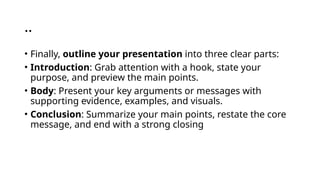
• Finally, outline your presentation into three clear parts:
• Introduction: Grab attention with a hook, state your
purpose, and preview the main points.
• Body: Present your key arguments or messages with
supporting evidence, examples, and visuals.
• Conclusion: Summarize your main points, restate the core
message, and end with a strong closing
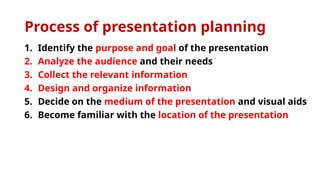
Process of presentation planning
1. Identify the purpose and goal of the presentation
2. Analyze the audience and their needs
3. Collect the relevant information
4. Design and organize information
5. Decide on the medium of the presentation and visual aids
6. Become familiar with the location of the presentation
30
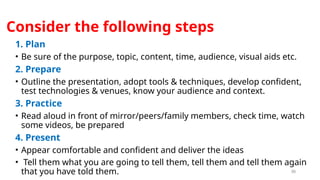
Consider the following steps
1. Plan
• Be sure of the purpose, topic, content, time, audience, visual aids etc.
2. Prepare
• Outline the presentation, adopt tools & techniques, develop confident,
test technologies & venues, know your audience and context.
3. Practice
• Read aloud in front of mirror/peers/family members, check time, watch
some videos, be prepared
4. Present
• Appear comfortable and confident and deliver the ideas
• Tell them what you are going to tell them, tell them and tell them again
that you have told them.
31
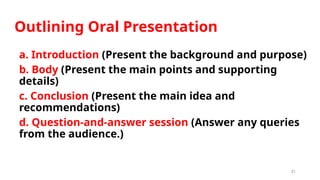
Outlining Oral Presentation
a. Introduction (Present the background and purpose)
b. Body (Present the main points and supporting
details)
c. Conclusion (Present the main idea and
recommendations)
d. Question-and-answer session (Answer any queries
from the audience.)
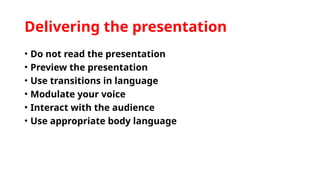
Delivering the presentation
• Do not read the presentation
• Preview the presentation
• Use transitions in language
• Modulate your voice
• Interact with the audience
• Use appropriate body language
More about delivering presentation
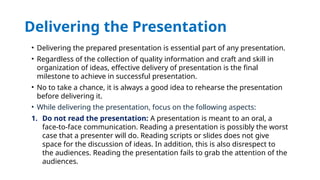
Delivering the Presentation
• Delivering the prepared presentation is essential part of any presentation.
• Regardless of the collection of quality information and craft and skill in
organization of ideas, effective delivery of presentation is the final
milestone to achieve in successful presentation.
• No to take a chance, it is always a good idea to rehearse the presentation
before delivering it.
• While delivering the presentation, focus on the following aspects:
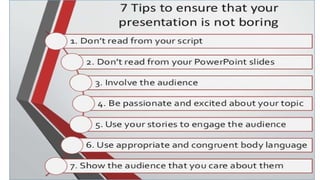
1. Do not read the presentation: A presentation is meant to an oral, a
face-to-face communication. Reading a presentation is possibly the worst
case that a presenter will do. Reading scripts or slides does not give
space for the discussion of ideas. In addition, this is also disrespect to
the audiences. Reading the presentation fails to grab the attention of the
audiences.
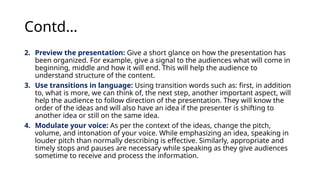
Contd…
2. Preview the presentation: Give a short glance on how the presentation has
been organized. For example, give a signal to the audiences what will come in
beginning, middle and how it will end. This will help the audience to
understand structure of the content.
3. Use transitions in language: Using transition words such as: first, in addition
to, what is more, we can think of, the next step, another important aspect, will
help the audience to follow direction of the presentation. They will know the
order of the ideas and will also have an idea if the presenter is shifting to
another idea or still on the same idea.
4. Modulate your voice: As per the context of the ideas, change the pitch,
volume, and intonation of your voice. While emphasizing an idea, speaking in
louder pitch than normally describing is effective. Similarly, appropriate and
timely stops and pauses are necessary while speaking as they give audiences
sometime to receive and process the information.
Contd…
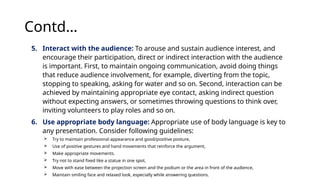
5. Interact with the audience: To arouse and sustain audience interest, and
encourage their participation, direct or indirect interaction with the audience
is important. First, to maintain ongoing communication, avoid doing things
that reduce audience involvement, for example, diverting from the topic,
stopping to speaking, asking for water and so on. Second, interaction can be
achieved by maintaining appropriate eye contact, asking indirect question
without expecting answers, or sometimes throwing questions to think over,
inviting volunteers to play roles and so on.
6. Use appropriate body language: Appropriate use of body language is key to
any presentation. Consider following guidelines:
 Try to maintain professional appearance and good/positive posture,
 Use of positive gestures and hand movements that reinforce the argument,
 Make appropriate movements.
 Try not to stand fixed like a statue in one spot,
 Move with ease between the projection screen and the podium or the area in front of the audience,
 Maintain smiling face and relaxed look, especially while answering questions.
Question and Answer/Discussion
Session
• Discussion on topic differentiates presentation from public
speech. For every professional oral presentation, a certain
amount of time is allocated questions and answers session.
• During this session, the audience and the presenter interact,
exchanging questions, explanations, and recommendations.
• A successful presenter always anticipates probable
questions and prepares the answers.
Also keep these points….
• Maintain good eye contact
• Vary your speaking volume
• Use pauses
• Do not read your presentation
• Don’t stand between the audience and slides
• Use stories , questions, clips, examples etc
• Practice makes perfect
Slide presentation
• Keep it simple.
• Limit bullet points and texts
• Use high quality graphics
• Have a visual themes, but avoid using power point templates
• Use appropriate chart
• Use color well
• Chose your font well
• Use video or audio
• Don’t stare at slides
41
What not to do during
presentations
• Do not fear
• Do not rush through your presentation
• Do not stick your hands in your pockets
• Do not underestimate your audience
• Do not hurt people’s feelings
• Do not dictate
• Do not repeat the same content much
• Do not avoid appropriate non-verbal communication
• Don’t be egotistical (thinking that you are better than anyone else)
Group Presentation in brief
1. Before presentation
- Appoint a team leader
- Have multiple meetings
2. During Presentation
- Introduce the team and members
- Allocate the roles or sections to present
- Rehearse the transitions and turn-taking
- Encourage the member
- Handle the nerves
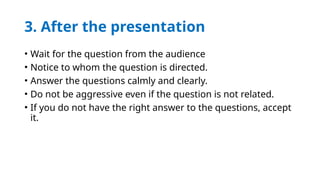
3. After the presentation
• Wait for the question from the audience
• Notice to whom the question is directed.
• Answer the questions calmly and clearly.
• Do not be aggressive even if the question is not related.
• If you do not have the right answer to the questions, accept
it.
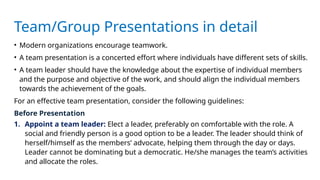
Team/Group Presentations in detail
• Modern organizations encourage teamwork.
• A team presentation is a concerted effort where individuals have different sets of skills.
• A team leader should have the knowledge about the expertise of individual members
and the purpose and objective of the work, and should align the individual members
towards the achievement of the goals.
For an effective team presentation, consider the following guidelines:
Before Presentation
1. Appoint a team leader: Elect a leader, preferably on comfortable with the role. A
social and friendly person is a good option to be a leader. The leader should think of
herself/himself as the members’ advocate, helping them through the day or days.
Leader cannot be dominating but a democratic. He/she manages the team’s activities
and allocate the roles.
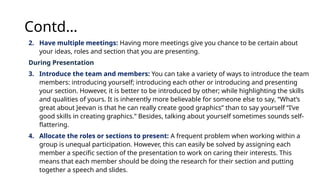
Contd…
2. Have multiple meetings: Having more meetings give you chance to be certain about
your ideas, roles and section that you are presenting.
During Presentation
3. Introduce the team and members: You can take a variety of ways to introduce the team
members: introducing yourself; introducing each other or introducing and presenting
your section. However, it is better to be introduced by other; while highlighting the skills
and qualities of yours. It is inherently more believable for someone else to say, “What’s
great about Jeevan is that he can really create good graphics” than to say yourself “I’ve
good skills in creating graphics.” Besides, talking about yourself sometimes sounds self-
flattering.
4. Allocate the roles or sections to present: A frequent problem when working within a
group is unequal participation. However, this can easily be solved by assigning each
member a specific section of the presentation to work on caring their interests. This
means that each member should be doing the research for their section and putting
together a speech and slides.
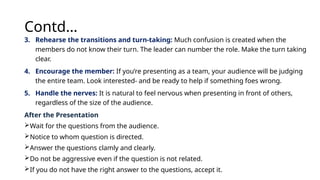
Contd…
3. Rehearse the transitions and turn-taking: Much confusion is created when the
members do not know their turn. The leader can number the role. Make the turn taking
clear.
4. Encourage the member: If you’re presenting as a team, your audience will be judging
the entire team. Look interested- and be ready to help if something foes wrong.
5. Handle the nerves: It is natural to feel nervous when presenting in front of others,
regardless of the size of the audience.
After the Presentation
Wait for the questions from the audience.
Notice to whom question is directed.
Answer the questions clamly and clearly.
Do not be aggressive even if the question is not related.
If you do not have the right answer to the questions, accept it.
Day 25
Persuasive Public
Speech
Introduction
• Public speaking is an oral presentation or speech on a topic delivered to a
live audience.
• It is a formal address or discourse delivered to an audience. It is also more
like an oral presentation.
• It involves presenting information in a structured manner, usually
following a clear introduction, main body, and conclusion.
• Many people cite public speaking as one of their biggest fears, but with
practice, you can learn to build confidence and improve your skills to
enjoy public speaking for any situation.
• Effective public speaking has the power to educate, persuade, and inspire
audiences, making it a critical skill that can be honed through practice and
continuous improvement.
..
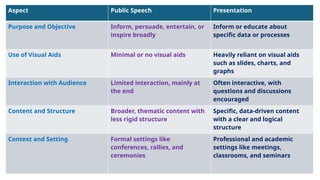
• Public speech differs from oral presentation
• First, a presentation focuses on specific topic and aims at
accomplishing certain goals whereas a speech is more
general in its scope.
• Second, a presentation uses visual aids whereas a speech
relies on spoken words.
• A speech is a one-way communication where the audience
listens but a presentation is a two-way communication
where the audience can ask questions and interact.
More differences
Aspect Public Speech Presentation
Purpose and Objective Inform, persuade, entertain, or
inspire broadly
Inform or educate about
specific data or processes
Use of Visual Aids Minimal or no visual aids Heavily reliant on visual aids
such as slides, charts, and
graphs
Interaction with Audience Limited interaction, mainly at
the end
Often interactive, with
questions and discussions
encouraged
Content and Structure Broader, thematic content with
less rigid structure
Specific, data-driven content
with a clear and logical
structure
Context and Setting Formal settings like
conferences, rallies, and
ceremonies
Professional and academic
settings like meetings,
classrooms, and seminars
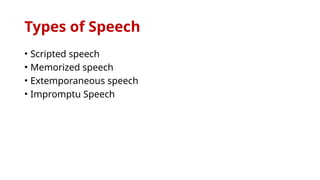
Types of Speech
• Scripted speech
• Memorized speech
• Extemporaneous speech
• Impromptu Speech
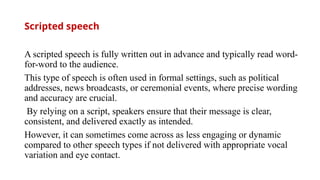
Scripted speech
A scripted speech is fully written out in advance and typically read word-
for-word to the audience.
This type of speech is often used in formal settings, such as political
addresses, news broadcasts, or ceremonial events, where precise wording
and accuracy are crucial.
By relying on a script, speakers ensure that their message is clear,
consistent, and delivered exactly as intended.
However, it can sometimes come across as less engaging or dynamic
compared to other speech types if not delivered with appropriate vocal
variation and eye contact.
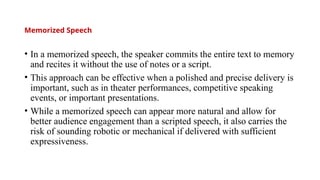
Memorized Speech
• In a memorized speech, the speaker commits the entire text to memory
and recites it without the use of notes or a script.
• This approach can be effective when a polished and precise delivery is
important, such as in theater performances, competitive speaking
events, or important presentations.
• While a memorized speech can appear more natural and allow for
better audience engagement than a scripted speech, it also carries the
risk of sounding robotic or mechanical if delivered with sufficient
expressiveness.
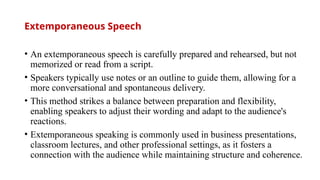
Extemporaneous Speech
• An extemporaneous speech is carefully prepared and rehearsed, but not
memorized or read from a script.
• Speakers typically use notes or an outline to guide them, allowing for a
more conversational and spontaneous delivery.
• This method strikes a balance between preparation and flexibility,
enabling speakers to adjust their wording and adapt to the audience's
reactions.
• Extemporaneous speaking is commonly used in business presentations,
classroom lectures, and other professional settings, as it fosters a
connection with the audience while maintaining structure and coherence.
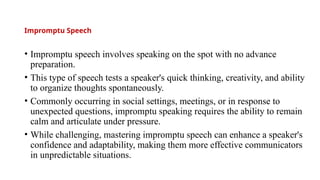
Impromptu Speech
• Impromptu speech involves speaking on the spot with no advance
preparation.
• This type of speech tests a speaker's quick thinking, creativity, and ability
to organize thoughts spontaneously.
• Commonly occurring in social settings, meetings, or in response to
unexpected questions, impromptu speaking requires the ability to remain
calm and articulate under pressure.
• While challenging, mastering impromptu speech can enhance a speaker's
confidence and adaptability, making them more effective communicators
in unpredictable situations.
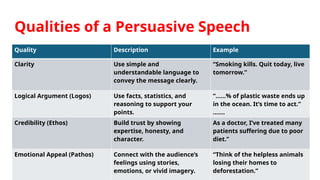
Qualities of a Persuasive Speech
Quality Description Example
Clarity Use simple and
understandable language to
convey the message clearly.
“Smoking kills. Quit today, live
tomorrow.”
Logical Argument (Logos) Use facts, statistics, and
reasoning to support your
points.
“……% of plastic waste ends up
in the ocean. It’s time to act.”
…….
Credibility (Ethos) Build trust by showing
expertise, honesty, and
character.
As a doctor, I’ve treated many
patients suffering due to poor
diet.”
Emotional Appeal (Pathos) Connect with the audience’s
feelings using stories,
emotions, or vivid imagery.
“Think of the helpless animals
losing their homes to
deforestation.”
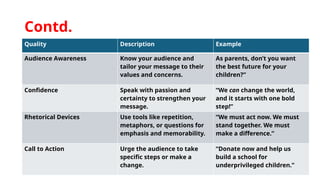
Contd.
Quality Description Example
Audience Awareness Know your audience and
tailor your message to their
values and concerns.
As parents, don’t you want
the best future for your
children?”
Confidence Speak with passion and
certainty to strengthen your
message.
“We can change the world,
and it starts with one bold
step!”
Rhetorical Devices Use tools like repetition,
metaphors, or questions for
emphasis and memorability.
“We must act now. We must
stand together. We must
make a difference.”
Call to Action Urge the audience to take
specific steps or make a
change.
“Donate now and help us
build a school for
underprivileged children.”
Preparing the speech
1. Planning
2. Organizing
3. Delivering
1.Planning
• Audience analysis
• Selecting the topic
• Gathering information
• Deciding your physical aspects and ambience
Organizing
• Opening
• Body
• Conclusion
3. Delivering
• Stand or sit up straight with your weight balanced
• Start with a strong opening.
• Make proper eye contact.
• Talk to your listeners as if you are having a conversation
with them.
• Use your voice expressively and meaningfully.
• Control pace and tone.
• Use your body language expressively and meaningfully.
• Engage with your audience.
How to overcome anxiety?
• Practice, practice, practice
• Think positively.
• Take a few deep breathe.
• Be ready.
• Be comfortable
• Don’t panic
• Concentrate on your message and audience, not on
yourself.
• Keep going.
Detail
1. Practice: If your are well-prepared with rehearsal, your
confidence increases and panic subsides. Thorough
preparation is the best antidote for nervousness.
2. Think positively: Positive thinking brings hope and
confidence. If you are confident about yourself, only then
will the audience feel confident about you.
3. Take a few deep breaths: Taking a few long breathe might
help you during the delivery.
4. Be ready: Memorize your couple of first sentence so your
can open on a confident note.
…
1. Be comfortable: Dress comfortably, considering the
occasion and drink a glass of water before your speech.
2. Don’t panic: If you have missed your point, ask questions
or ask for comments and reconnect with them.
3. Concentrate on your message and your audience, not
on yourself: Over self-consciousness brings anxiety, so
focus on your audience and message to forget your fears.
4. Keep going: Don’t stop, as you move ahead each
successful moment brings confidence in you.
Day 26:
Conducting and Participating in Meetings
•Meeting
•Notice
•Minutes
Meetings
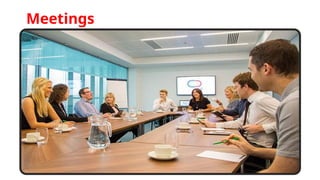
What is meeting?
• A meeting is a formal gathering of two or more people associated with a
company, project or team to discuss and decide on certain agenda.
• It is a gathering of people with a common cause and agenda.
• A meeting is convened for the purpose of achieving a common goal through
verbal interaction, such as sharing information or reaching agreement.
• Meetings may occur face-to-face or virtually, as mediated by
communications technology, such as a telephone conference call, a skyped
conference call or a videoconference.
• One can distinguish a meeting from other gatherings, such as a chance
encounter (not convened), a sports game or a concert (verbal interaction is
incidental), a party or the company of friends (no common goal is to be
achieved) and a demonstration (whose common goal is achieved mainly
through the number of demonstrators present, not through verbal
interaction).
Meeting terminologies
• Agenda: A list of items to be discussed or acted upon during a meeting.
• Amendment: A formal change or addition proposed or made to a motion, document,
or law.
• AoB (Any other Business): A section at the end of a meeting for discussing topics
not listed in the agenda.
• Ex-Officio Member: A person who is a member of a committee or board by virtue of
holding a particular office or position.
• Minutes: The official written record of what was said and decided during a meeting.
• Motion: A formal proposal put forward during a meeting for discussion and decision.
• Proxy: A person authorized to vote or act on behalf of another in a meeting.
• Quorum: The minimum number of members required to be present for a meeting to
be legally valid and able to make decisions.
• Adjournment: Formal closing of the meeting
• Unanimous: Decision agreed by everyone
Purposes
• To coordinate or arrange activities
• To give information to the team
• Share/ exchange updates/ideas with the concerned team
• Brainstorm ideas to make decisions and solve problems
• To obtain feedback and assistance from the team
• To create involvement and interest
• To put forward ideas or complaints
• To report on some activities or experience
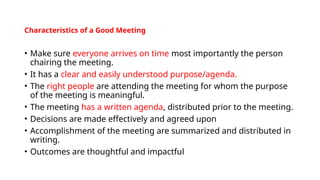
Characteristics of a Good Meeting
• Make sure everyone arrives on time most importantly the person
chairing the meeting.
• It has a clear and easily understood purpose/agenda.
• The right people are attending the meeting for whom the purpose
of the meeting is meaningful.
• The meeting has a written agenda, distributed prior to the meeting.
• Decisions are made effectively and agreed upon
• Accomplishment of the meeting are summarized and distributed in
writing.
• Outcomes are thoughtful and impactful
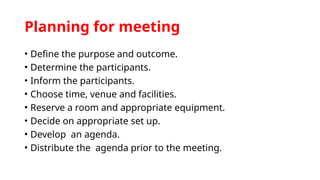
Planning for meeting
• Define the purpose and outcome.
• Determine the participants.
• Inform the participants.
• Choose time, venue and facilities.
• Reserve a room and appropriate equipment.
• Decide on appropriate set up.
• Develop an agenda.
• Distribute the agenda prior to the meeting.
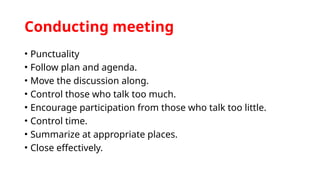
Conducting meeting
• Punctuality
• Follow plan and agenda.
• Move the discussion along.
• Control those who talk too much.
• Encourage participation from those who talk too little.
• Control time.
• Summarize at appropriate places.
• Close effectively.
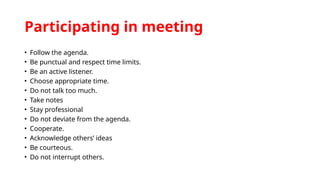
Participating in meeting
• Follow the agenda.
• Be punctual and respect time limits.
• Be an active listener.
• Choose appropriate time.
• Do not talk too much.
• Take notes
• Stay professional
• Do not deviate from the agenda.
• Cooperate.
• Acknowledge others’ ideas
• Be courteous.
• Do not interrupt others.
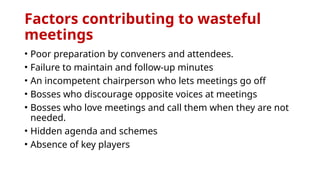
Factors contributing to wasteful
meetings
• Poor preparation by conveners and attendees.
• Failure to maintain and follow-up minutes
• An incompetent chairperson who lets meetings go off
• Bosses who discourage opposite voices at meetings
• Bosses who love meetings and call them when they are not
needed.
• Hidden agenda and schemes
• Absence of key players
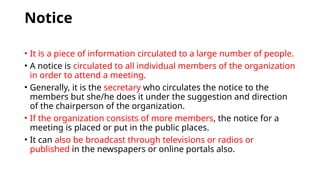
Notice
• It is a piece of information circulated to a large number of people.
• A notice is circulated to all individual members of the organization
in order to attend a meeting.
• Generally, it is the secretary who circulates the notice to the
members but she/he does it under the suggestion and direction
of the chairperson of the organization.
• If the organization consists of more members, the notice for a
meeting is placed or put in the public places.
• It can also be broadcast through televisions or radios or
published in the newspapers or online portals also.
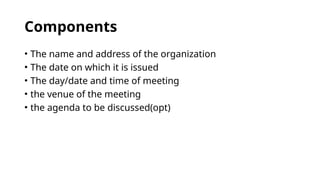
Components
• The name and address of the organization
• The date on which it is issued
• The day/date and time of meeting
• the venue of the meeting
• the agenda to be discussed(opt)
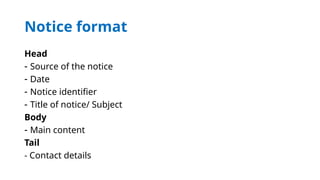
Notice format
Head
- Source of the notice
- Date
- Notice identifier
- Title of notice/ Subject
Body
- Main content
Tail
- Contact details
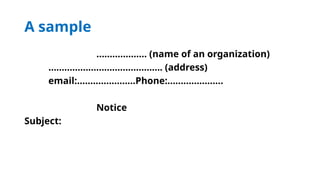
A sample
………………. (name of an organization)
……………………………………. (address)
email:………………….Phone:…………………
Notice
Subject:
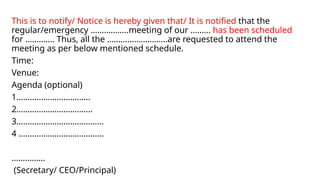
This is to notify/ Notice is hereby given that/ It is notified that the
regular/emergency ……………..meeting of our ……… has been scheduled
for …………. Thus, all the ………………………are requested to attend the
meeting as per below mentioned schedule.
Time:
Venue:
Agenda (optional)
1……………………………
2…………………………….
3…………………………………
4 ………………………………..
……………
(Secretary/ CEO/Principal)
82
Minutes
• Minutes are the official records of discussions held and
decisions made in the meeting.
• At the time of meeting, a recording secretary will be
appointed to write down and distribute the minutes of the
meeting.
• Usually at each meeting the minutes of previous meeting
are read out or printed copies of the minutes will be
distributed to the participants.
• Minutes contain the main points of the discussions, the
recommendations made by participants, the task assigned
to individual and groups and conclusion reached.
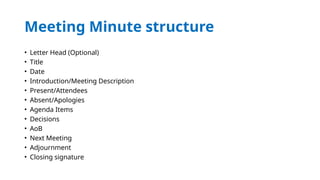
Meeting Minute structure
• Letter Head (Optional)
• Title
• Date
• Introduction/Meeting Description
• Present/Attendees
• Absent/Apologies
• Agenda Items
• Decisions
• AoB
• Next Meeting
• Adjournment
• Closing signature
84
Format
.
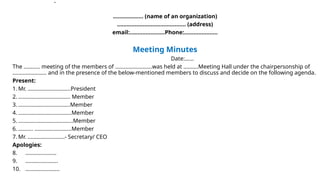
………………. (name of an organization)
……………………………………. (address)
email:………………….Phone:…………………
Meeting Minutes
Date:……
The ……….. meeting of the members of …………………….was held at ……….Meeting Hall under the chairpersonship of
………………….. and in the presence of the below-mentioned members to discuss and decide on the following agenda.
Present:
1. Mr. ………………………..President
2. ………………………........ Member
3. ……………………………..Member
4. ………………………………Member
5. ……………………………….Member
6. ………. …………………….Member
7. Mr. …………………….- Secretary/ CEO
Apologies:
8. …………………
9. ………………….
10. …………………..
86
..
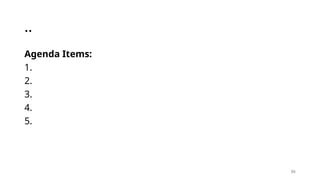
Agenda Items:
1.
2.
3.
4.
5.
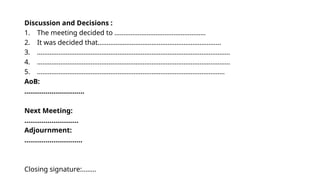
Discussion and Decisions :
1. The meeting decided to ……………………………………………
2. It was decided that……………………………………………………………
3. ………………………………………………………………………………………………
4. ………………………………………………………………………………………………
5. ……………………………………………………………………………………………
AoB:
………………………….
Next Meeting:
……………………….
Adjournment:
…………………………
Closing signature:……..
.
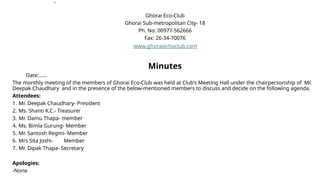
Ghorai Eco-Club
Ghorai Sub-metropolitan City- 18
Ph. No: 00977-562666
Fax: 26-34-70076
www.ghoraiechoclub.com
Minutes
Date:……
The monthly meeting of the members of Ghorai Eco-Club was held at Club’s Meeting Hall under the chairpersonship of Mr.
Deepak Chaudhary and in the presence of the below-mentioned members to discuss and decide on the following agenda.
Attendees:
1. Mr. Deepak Chaudhary- President
2. Ms. Shanti K.C.- Treasurer
3. Mr. Damu Thapa- member
4. Ms. Bimla Gurung- Member
5. Mr. Santosh Regmi- Member
6. Mrs Sita Joshi- Member
7. Mr. Dipak Thapa- Secretary
Apologies:
-None
89
..
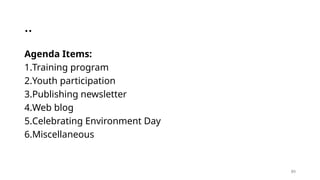
Agenda Items:
1.Training program
2.Youth participation
3.Publishing newsletter
4.Web blog
5.Celebrating Environment Day
6.Miscellaneous
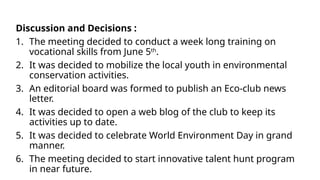
Discussion and Decisions :
1. The meeting decided to conduct a week long training on
vocational skills from June 5th
.
2. It was decided to mobilize the local youth in environmental
conservation activities.
3. An editorial board was formed to publish an Eco-club news
letter.
4. It was decided to open a web blog of the club to keep its
activities up to date.
5. It was decided to celebrate World Environment Day in grand
manner.
6. The meeting decided to start innovative talent hunt program
in near future.
…
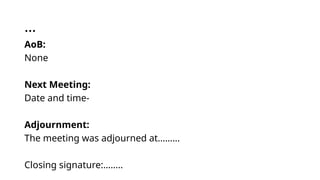
AoB:
None
Next Meeting:
Date and time-
Adjournment:
The meeting was adjourned at………
Closing signature:……..
Day 27-29
Non-verbal Communication
A quote
“We speak with our mouth but communicate
with our whole body”.
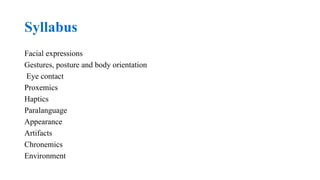
Syllabus
Facial expressions
Gestures, posture and body orientation
Eye contact
Proxemics
Haptics
Paralanguage
Appearance
Artifacts
Chronemics
Environment
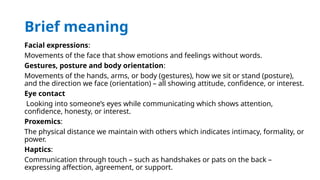
Brief meaning
Facial expressions:
Movements of the face that show emotions and feelings without words.
Gestures, posture and body orientation:
Movements of the hands, arms, or body (gestures), how we sit or stand (posture),
and the direction we face (orientation) – all showing attitude, confidence, or interest.
Eye contact
Looking into someone’s eyes while communicating which shows attention,
confidence, honesty, or interest.
Proxemics:
The physical distance we maintain with others which indicates intimacy, formality, or
power.
Haptics:
Communication through touch – such as handshakes or pats on the back –
expressing affection, agreement, or support.
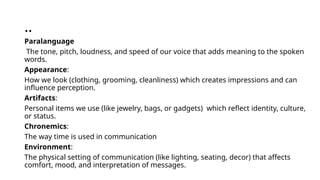
..
Paralanguage
The tone, pitch, loudness, and speed of our voice that adds meaning to the spoken
words.
Appearance:
How we look (clothing, grooming, cleanliness) which creates impressions and can
influence perception.
Artifacts:
Personal items we use (like jewelry, bags, or gadgets) which reflect identity, culture,
or status.
Chronemics:
The way time is used in communication
Environment:
The physical setting of communication (like lighting, seating, decor) that affects
comfort, mood, and interpretation of messages.
Non-verbal
Communicatio
n
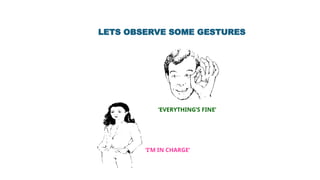
LETS OBSERVE SOME GESTURES
‘EVERYTHING’S FINE’
‘I’M IN CHARGE’
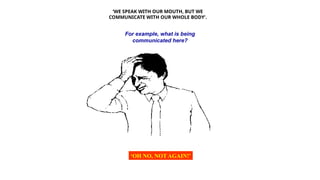
‘WE SPEAK WITH OUR MOUTH, BUT WE
COMMUNICATE WITH OUR WHOLE BODY’.
‘OH NO, NOT AGAIN!’
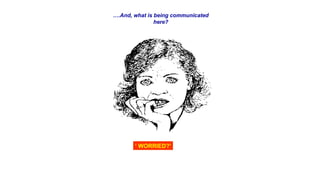
For example, what is being
communicated here?
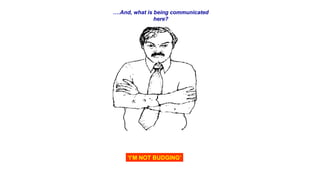
‘I’M NOT BUDGING’
….And, what is being communicated
here?
‘ WORRIED?’
….And, what is being communicated
here?
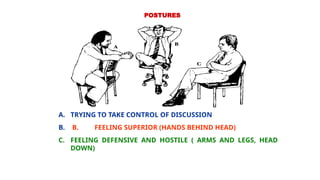
POSTURES
A. TRYING TO TAKE CONTROL OF DISCUSSION
B. B. FEELING SUPERIOR (HANDS BEHIND HEAD)
C. FEELING DEFENSIVE AND HOSTILE ( ARMS AND LEGS, HEAD
DOWN)
103
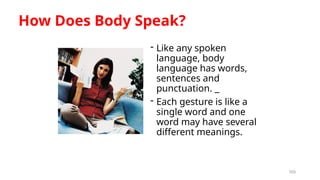
How Does Body Speak?
- Like any spoken
language, body
language has words,
sentences and
punctuation.
- Each gesture is like a
single word and one
word may have several
different meanings.
104
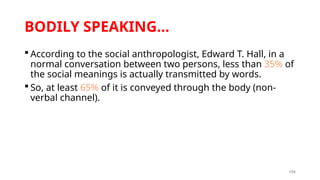
BODILY SPEAKING…
 According to the social anthropologist, Edward T. Hall, in a
normal conversation between two persons, less than 35% of
the social meanings is actually transmitted by words.
 So, at least 65% of it is conveyed through the body (non-
verbal channel).
Meaning
• Nonverbal communication is the transmission of messages or signals
through a nonverbal platform such as eye contact, facial expressions,
gestures, posture, and the distance between two individuals.
• It includes the use of visual cues such as body language (kinesics),
distance (proxemics) and physical environments/appearance, quality
of voice (paralanguage) and of touch (haptics).
• It can also include the use of time (chronemics) and eye contact and
the actions of looking while talking and listening, frequency of glances
and so on.
• Nonverbal signals play a vital role in communication because they can
strengthen or repeat a verbal message (when the nonverbal signals
match the words), weaken or contradict a verbal message (when
nonverbal signals don’t match the words), or replace words entirely.
Characteristics of non-verbal codes
1. Non-verbal codes may contradict verbal.
2. Non-verbal messages can be very important
3. Non-verbal communication cannot be avoided.
4. Much non-verbal communication is culture-bound.
5. The meaning of non-verbal behavior depends on the
context.
Non-verbal codes may contradict
verbal.
• Often body language contradicts a spoken message and we say that the
sender does not ‘mean what he says’ and is insincere.
• Sometimes, people may say one thing but their non-verbal cues may suggest a
different message. For example, a person might say "I'm fine" while looking
downcast and avoiding eye contact. In this case, the non-verbal cues suggest
that the person is not actually fine, despite what they are saying.
• Similarly, a person might say something with a sarcastic or insincere tone of
voice, which suggests that they don't really mean what they are saying.
Alternatively, they may say something with an upbeat tone of voice that
contradicts the negative content of their message.
Non-verbal messages can be very important
• Many of the books about make a claim that it is ‘powerful’.
• Verbal – 7 percent; the tone of voice –38 percent; visual – 55
percent.
• In other words, the majority of the meaning does not come
from the words.
• ‘Words take a definite back seat when compared to the impact
of vocal tone and the nonverbal images’.
• Research has shown that non-verbal signals can be very
important but they may not be so dominant in every situation.
Non-verbal communication cannot be avoided.
• You cannot avoid sending non-verbal signals.
• Even the purposeful avoidance of contact by one or both
parties sends a signal that they do not wish to
communicate.
• Eye contact, a smile or a proffered handshake all signal
varying degrees of willingness to communicate.
Much non-verbal communication is culture-bound.
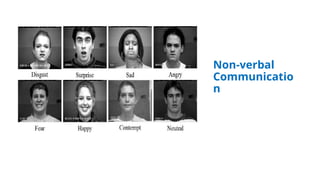
• Some non-verbal behavior appears to be universal –basic,
strong emotions such as fear, surprise, sadness, and so on.
• However, the expression of less intense emotions and
general social feelings is much more culture-bound.
• For example, in many situations in British and American
culture, failure to ‘look a person in the eye’ is interpreted as
shiftiness.
• But in many African and Hispanic cultures, averting the eyes
is a mark of respect for a person of higher status.
The meaning of non-verbal behavior depends on the context.
• Even within the same culture, we cannot expect a particular
non-verbal signal to mean the same thing in different
situations.
• A non-smiling face is seen as dominant, but does this mean
that dominant people smile less?
• Some studies have found that dominant members of a
group smile more!
• They suggest that people who are trying to achieve
dominance may use a different set of non-verbal signals
from those who have already achieved high status.
Types of Non-Verbal Communication
1. Physical Appearance
2. Paralanguage/tone of voice/vocal characteristics
3. Gesture and posture
4. Facial Expression
5. Use of Space/Proxemics
6. Touch/Haptics
7. Use of Time/ chronemics
8. Artefact
9. Physical environment
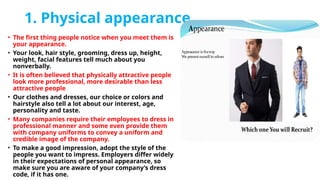
1. Physical appearance
• The first thing people notice when you meet them is
your appearance.
• Your look, hair style, grooming, dress up, height,
weight, facial features tell much about you
nonverbally.
• It is often believed that physically attractive people
look more professional, more desirable than less
attractive people
• Our clothes and dresses, our choice or colors and
hairstyle also tell a lot about our interest, age,
personality and taste.
• Many companies require their employees to dress in
professional manner and some even provide them
with company uniforms to convey a uniform and
credible image of the company.
• To make a good impression, adopt the style of the
people you want to impress. Employers differ widely
in their expectations of personal appearance, so
make sure you are aware of your company’s dress
code, if it has one.
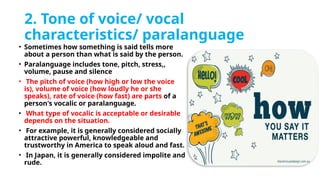
2. Tone of voice/ vocal
characteristics/ paralanguage
• Sometimes how something is said tells more
about a person than what is said by the person.
• Paralanguage includes tone, pitch, stress,,
volume, pause and silence
• The pitch of voice (how high or low the voice
is), volume of voice (how loudly he or she
speaks), rate of voice (how fast) are parts of a
person's vocalic or paralanguage.
• What type of vocalic is acceptable or desirable
depends on the situation.
• For example, it is generally considered socially
attractive powerful, knowledgeable and
trustworthy in America to speak aloud and fast.
• In Japan, it is generally considered impolite and
rude.
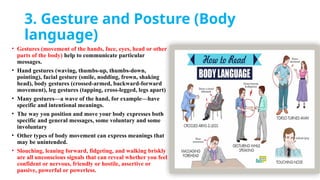
3. Gesture and Posture (Body
language)
• Gestures (movement of the hands, face, eyes, head or other
parts of the body) help to communicate particular
messages.
• Hand gestures (waving, thumbs-up, thumbs-down,
pointing), facial gesture (smile, nodding, frown, shaking
head), body gestures (crossed-armed, backward-forward
movement), leg gestures (tapping, cross-legged, legs apart)
• Many gestures—a wave of the hand, for example—have
specific and intentional meanings.
• The way you position and move your body expresses both
specific and general messages, some voluntary and some
involuntary
• Other types of body movement can express meanings that
may be unintended.
• Slouching, leaning forward, fidgeting, and walking briskly
are all unconscious signals that can reveal whether you feel
confident or nervous, friendly or hostile, assertive or
passive, powerful or powerless.
Lets learn more about gesture
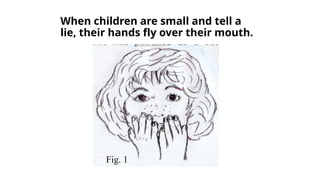
When children are small and tell a
lie, their hands fly over their mouth.
Fig. 1
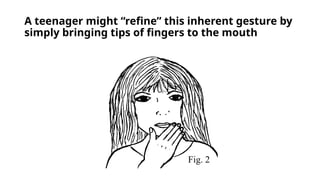
A teenager might “refine” this inherent gesture by
simply bringing tips of fingers to the mouth
Fig. 2
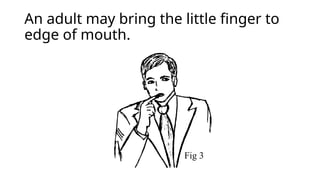
An adult may bring the little finger to
edge of mouth.
Fig 3
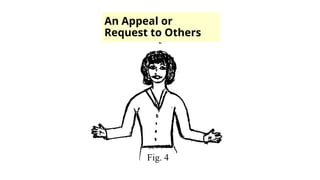
The Palm
Historically, an open palm
has signified honesty, truth,
allegiance, and submission.
Fig. 4
An Appeal or
Request to Others
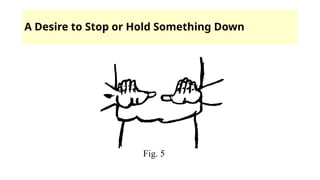
A Desire to Stop or Hold Something Down
Fig. 5
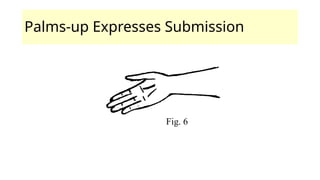
Palms-up Expresses Submission
Fig. 6
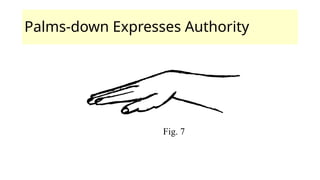
Palms-down Expresses Authority
Fig. 7
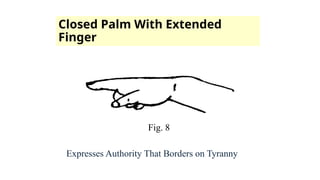
Closed Palm With Extended
Finger
Expresses Authority That Borders on Tyranny
Fig. 8
Handshakes
• Three basic attitudes are
transmitted through the
handshake:
Dominance
Submission
Equality
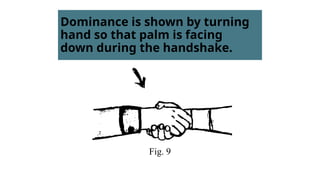
Dominance is shown by turning
hand so that palm is facing
down during the handshake.
Fig. 9
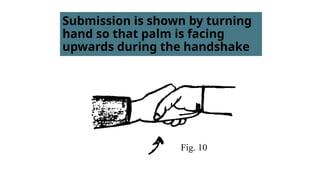
Submission is shown by turning
hand so that palm is facing
upwards during the handshake
Fig. 10
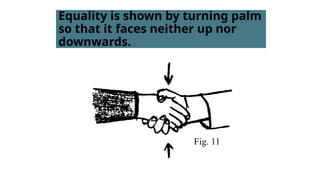
Equality is shown by turning palm
so that it faces neither up nor
downwards.
Fig. 11
Hybrid
Handshakes
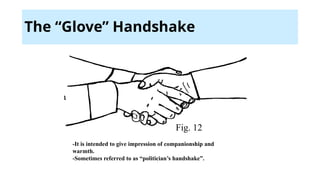
The “Glove” Handshake
Fig. 12
-It is intended to give impression of companionship and
warmth.
-Sometimes referred to as “politician’s handshake”.
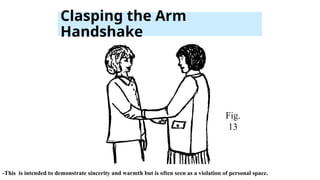
Clasping the Arm
Handshake
Fig.
13
-This is intended to demonstrate sincerity and warmth but is often seen as a violation of personal space.
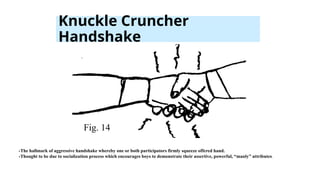
Knuckle Cruncher
Handshake
Fig. 14
-The hallmark of aggressive handshake whereby one or both participators firmly squeeze offered hand.
-Thought to be due to socialization process which encourages boys to demonstrate their assertive, powerful, “manly” attributes.
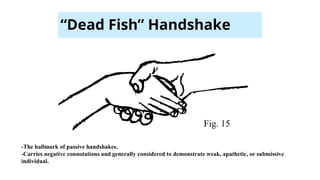
“Dead Fish” Handshake
Fig. 15
-The hallmark of passive handshakes.
-Carries negative connotations and generally considered to demonstrate weak, apathetic, or submissive
individual.
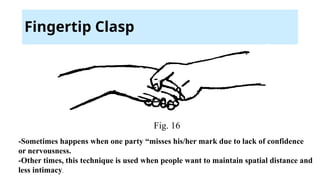
Fingertip Clasp
Fig. 16
-Sometimes happens when one party “misses his/her mark due to lack of confidence
or nervousness.
-Other times, this technique is used when people want to maintain spatial distance and
less intimacy.
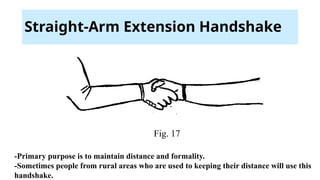
Straight-Arm Extension Handshake
Fig. 17
-Primary purpose is to maintain distance and formality.
-Sometimes people from rural areas who are used to keeping their distance will use this
handshake.
The Hands
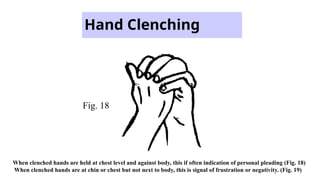
Hand Clenching
Fig. 18
When clenched hands are held at chest level and against body, this if often indication of personal pleading (Fig. 18)
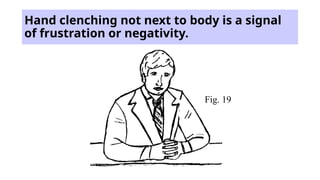
When clenched hands are at chin or chest but not next to body, this is signal of frustration or negativity. (Fig. 19)
Hand clenching not next to body is a signal
of frustration or negativity.
Fig. 19
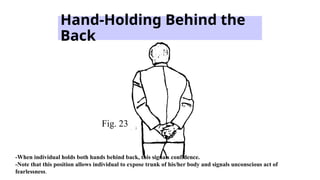
Hand-Holding Behind the
Back
Fig. 23
-When individual holds both hands behind back, this signals confidence.
-Note that this position allows individual to expose trunk of his/her body and signals unconscious act of
fearlessness.
Fingers & Hand
To Face, Head, & Neck
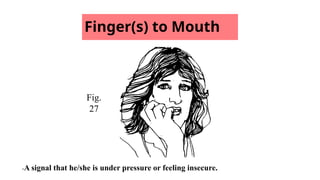
Finger(s) to Mouth
Fig.
27
-A signal that he/she is under pressure or feeling insecure.
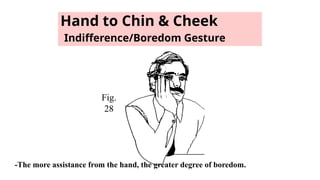
Hand to Chin & Cheek
Indifference/Boredom Gesture
Fig.
28
-The more assistance from the hand, the greater degree of boredom.
Deceit Gestures
Hand to Mouth, Ear, or Eye
Hear no evil, speak no evil, see no
evil . . .
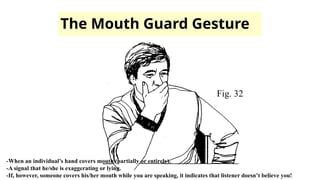
The Mouth Guard Gesture
Fig. 32
-When an individual’s hand covers mouth (partially or entirely).
-A signal that he/she is exaggerating or lying.
-If, however, someone covers his/her mouth while you are speaking, it indicates that listener doesn’t believe you!
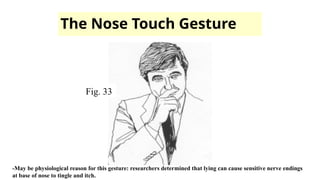
The Nose Touch Gesture
Fig. 33
-May be physiological reason for this gesture: researchers determined that lying can cause sensitive nerve endings
at base of nose to tingle and itch.
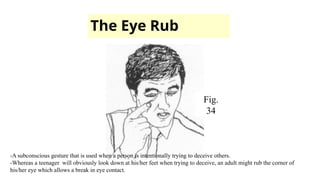
The Eye Rub
Fig.
34
-A subconscious gesture that is used when a person is intentionally trying to deceive others.
-Whereas a teenager will obviously look down at his/her feet when trying to deceive, an adult might rub the corner of
his/her eye which allows a break in eye contact.
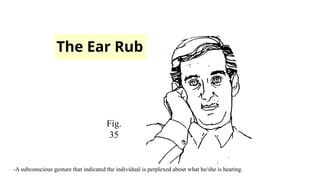
The Ear Rub
Fig.
35
-A subconscious gesture that indicated the individual is perplexed about what he/she is hearing.
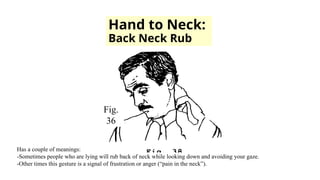
Hand to Neck:
Back Neck Rub
Fig.
36
Has a couple of meanings:
-Sometimes people who are lying will rub back of neck while looking down and avoiding your gaze.
-Other times this gesture is a signal of frustration or anger (“pain in the neck”).
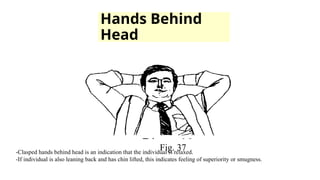
Hands Behind
Head
Fig. 37
-Clasped hands behind head is an indication that the individual is relaxed.
-If individual is also leaning back and has chin lifted, this indicates feeling of superiority or smugness.
Language of the
Arms
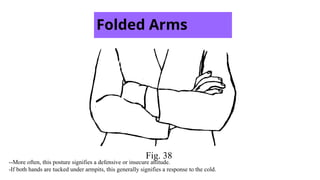
Folded Arms
Fig. 38
--More often, this posture signifies a defensive or insecure attitude.
-If both hands are tucked under armpits, this generally signifies a response to the cold.
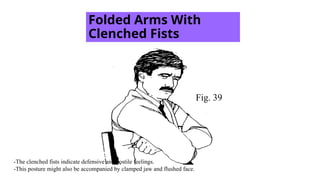
Folded Arms With
Clenched Fists
Fig. 39
-The clenched fists indicate defensive and hostile feelings.
-This posture might also be accompanied by clamped jaw and flushed face.
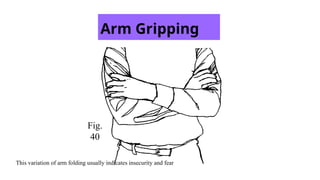
Arm Gripping
Fig.
40
This variation of arm folding usually indicates insecurity and fear
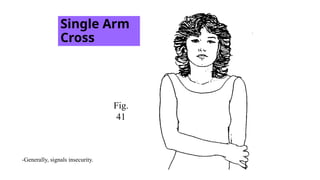
Single Arm
Cross
Fig.
41
-Generally, signals insecurity.
Language of
the Legs and
Feet
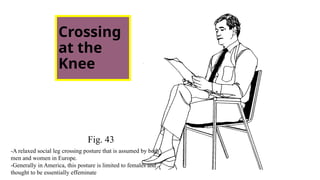
Crossing
at the
Knee
Fig. 43
-A relaxed social leg crossing posture that is assumed by both
men and women in Europe.
-Generally in America, this posture is limited to females and
thought to be essentially effeminate
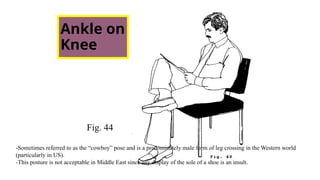
Ankle on
Knee
Fig. 44
-Sometimes referred to as the “cowboy” pose and is a predominately male form of leg crossing in the Western world
(particularly in US).
-This posture is not acceptable in Middle East since any display of the sole of a shoe is an insult.
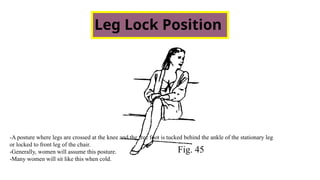
Leg Lock Position
Fig. 45
-A posture where legs are crossed at the knee and the free foot is tucked behind the ankle of the stationary leg
or locked to front leg of the chair.
-Generally, women will assume this posture.
-Many women will sit like this when cold.
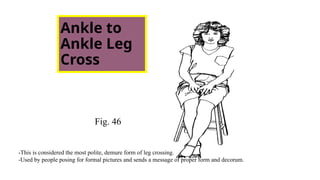
Ankle to
Ankle Leg
Cross
Fig. 46
-This is considered the most polite, demure form of leg crossing.
-Used by people posing for formal pictures and sends a message of proper form and decorum.
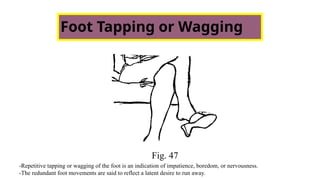
Foot Tapping or Wagging
Fig. 47
-Repetitive tapping or wagging of the foot is an indication of impatience, boredom, or nervousness.
-The redundant foot movements are said to reflect a latent desire to run away.
Language of
the Hair, Head,
and Face
Hair
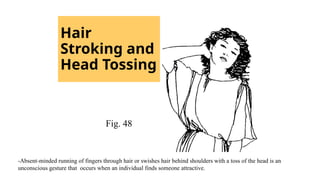
Stroking and
Head Tossing
Fig. 48
-Absent-minded running of fingers through hair or swishes hair behind shoulders with a toss of the head is an
unconscious gesture that occurs when an individual finds someone attractive.
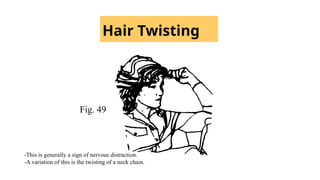
Hair Twisting
Fig. 49
-This is generally a sign of nervous distraction.
-A variation of this is the twisting of a neck chain.
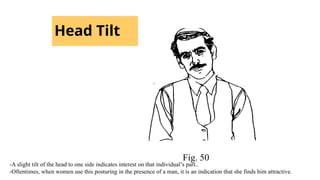
Head Tilt
Fig. 50
-A slight tilt of the head to one side indicates interest on that individual’s part..
-Oftentimes, when women use this posturing in the presence of a man, it is an indication that she finds him attractive.
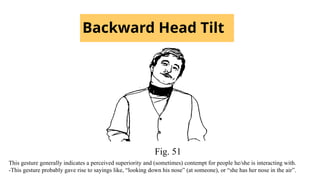
Backward Head Tilt
Fig. 51
This gesture generally indicates a perceived superiority and (sometimes) contempt for people he/she is interacting with.
-This gesture probably gave rise to sayings like, “looking down his nose” (at someone), or “she has her nose in the air”.
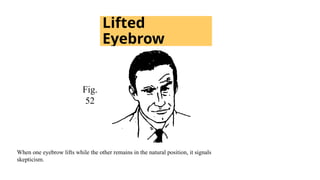
Lifted
Eyebrow
Fig.
52
When one eyebrow lifts while the other remains in the natural position, it signals
skepticism.
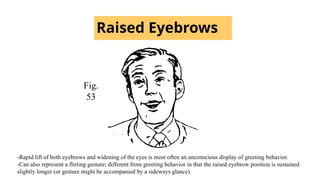
Raised Eyebrows
Fig.
53
-Rapid lift of both eyebrows and widening of the eyes is most often an unconscious display of greeting behavior.
-Can also represent a flirting gesture; different from greeting behavior in that the raised eyebrow position is sustained
slightly longer (or gesture might be accompanied by a sideways glance).
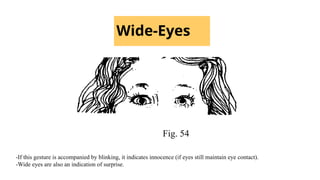
Wide-Eyes
Fig. 54
-If this gesture is accompanied by blinking, it indicates innocence (if eyes still maintain eye contact).
-Wide eyes are also an indication of surprise.
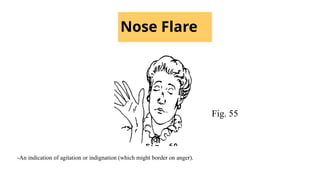
Nose Flare
Fig. 55
-An indication of agitation or indignation (which might border on anger).
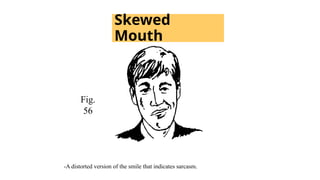
Skewed
Mouth
Fig.
56
-A distorted version of the smile that indicates sarcasm.
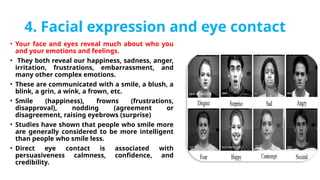
4. Facial expression and eye contact
• Your face and eyes reveal much about who you
and your emotions and feelings.
• They both reveal our happiness, sadness, anger,
irritation, frustrations, embarrassment, and
many other complex emotions.
• These are communicated with a smile, a blush, a
blink, a grin, a wink, a frown, etc.
• Smile (happiness), frowns (frustrations,
disapproval), nodding (agreement or
disagreement, raising eyebrows (surprise)
• Studies have shown that people who smile more
are generally considered to be more intelligent
than people who smile less.
• Direct eye contact is associated with
persuasiveness calmness, confidence, and
credibility.
Eye contact…
• Eye contact is a powerful form of non-verbal communication that conveys
interest, confidence, attention, and emotional connection.
• It plays a vital role in regulating the flow of conversation, signaling when it’s
another person’s turn to speak or showing active listening.
• For example, maintaining steady eye contact during a job interview can
indicate confidence and sincerity, while avoiding eye contact may be
interpreted as nervousness or dishonesty.
• In contrast, in some cultures, prolonged eye contact can be seen as
disrespectful or confrontational, especially when directed at authority
figures.
• Thus, the meaning of eye contact can vary across cultural contexts, but it
consistently serves as a key indicator of social engagement and intent.
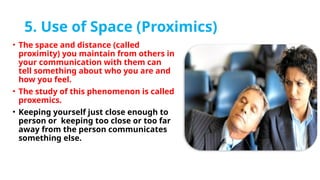
5. Use of Space (Proximics)
• The space and distance (called
proximity) you maintain from others in
your communication with them can
tell something about who you are and
how you feel.
• The study of this phenomenon is called
proxemics.
• Keeping yourself just close enough to
person or keeping too close or too far
away from the person communicates
something else.
…
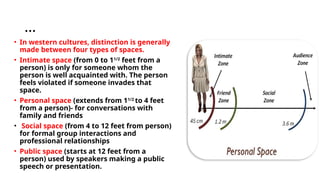
• In western cultures, distinction is generally
made between four types of spaces.
• Intimate space (from 0 to 11/2
feet from a
person) is only for someone whom the
person is well acquainted with. The person
feels violated if someone invades that
space.
• Personal space (extends from 11/2
to 4 feet
from a person)- for conversations with
family and friends
• Social space (from 4 to 12 feet from person)
for formal group interactions and
professional relationships
• Public space (starts at 12 feet from a
person) used by speakers making a public
speech or presentation.
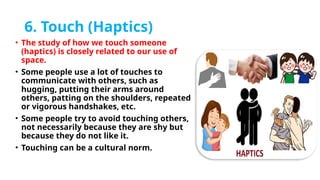
6. Touch (Haptics)
• The study of how we touch someone
(haptics) is closely related to our use of
space.
• Some people use a lot of touches to
communicate with others, such as
hugging, putting their arms around
others, patting on the shoulders, repeated
or vigorous handshakes, etc.
• Some people try to avoid touching others,
not necessarily because they are shy but
because they do not like it.
• Touching can be a cultural norm.
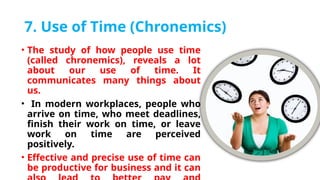
7. Use of Time (Chronemics)
• The study of how people use time
(called chronemics), reveals a lot
about our use of time. It
communicates many things about
us.
• In modern workplaces, people who
arrive on time, who meet deadlines,
finish their work on time, or leave
work on time are perceived
positively.
• Effective and precise use of time can
be productive for business and it can
Artefacts
• Artifacts, as a form of non-verbal communication, refer to the
physical objects, personal belongings, or appearance-related
elements that convey messages about an individual’s identity,
status, or cultural background without spoken words.
• These include clothing, accessories, hairstyles, makeup, and even
the design of one's workspace or choice of personal items.
Through artifacts, people often express their personality,
profession, social status, or group affiliation.
• For instance, a business suit can communicate professionalism
and authority, while traditional attire may signify cultural heritage.
• In essence, artifacts silently shape perceptions and play a powerful
role in interpersonal and cross-cultural communication.
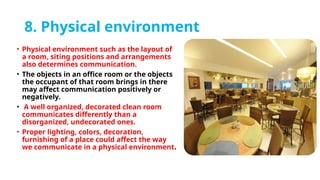
8. Physical environment
• Physical environment such as the layout of
a room, siting positions and arrangements
also determines communication.
• The objects in an office room or the objects
the occupant of that room brings in there
may affect communication positively or
negatively.
• A well organized, decorated clean room
communicates differently than a
disorganized, undecorated ones.
• Proper lighting, colors, decoration,
furnishing of a place could affect the way
we communicate in a physical environment.
Using Nonverbal Communication
Effectively: Key Considerations
• Paying attention to nonverbal cues will make you both a
better speaker and a better listener.
• When you’re talking, be more conscious of the nonverbal
cues you could be sending
• Consider a situation, be honest in expressing your emotions.
• Note that facial expressions (especially eye contact reveal
the type and intensity of a speaker’s feelings.
• Watch for cues from gesture and posture.
..
• Listen for vocal characteristics that signal who the
speaker is, the speaker’s relationship with the
audience, and the emotions underlying the
speaker’s words.
• Recognize that listeners are influenced by physical
appearance.
• Be careful with physical contact; touch can convey
positive attributes but can also be interpreted as
dominance or sexual interest.
• Pay attention to the use of time and space.
Extra Reading
More about Non-verbal
Communication
183
Let’s Examine How Body Communicates,
from head to toes
184
HEAD
- Nodding the head
- “Yes” in most societies
- “No” in some parts of Greece, Yugoslavia, Bulgaria, and
Turkey
- Tossing the head backward
- “yes” in Thailand, the Philippines, India, Laos
- Rocking head slowly, back and forth
- “yes, I’m listening” in most Asian cultures
185
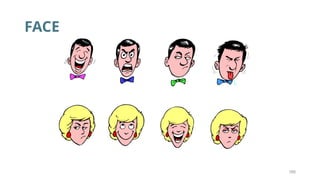
FACE
186
FACE
* Facial expressions reflect emotion, feelings and attitudes,
but…..
* The Asians are sometimes known as
- emotionless
- mixed-up emotion
187
EYES
* Eye contacts
- Encouraged in America, Canada, Europe
- Rude in most Asian countries and in Africa
* Raising eyebrows
- “Yes” in Thailand and some Asian countries
- “Hello” in the Philippines
* Winking eye
- Sharing secret in America and Europe
- flirtatious gesture in other countries
188
EYES (Cont’d)
* Closed eyes
- bored or sleepy in America
- “I’m listening and concentrating.” in Japan, Thailand,
China
189
EARS
* Ear grasp
- “I’m sorry.” in parts of India
* Cupping the ear
- “I can’t hear you.” in all societies
* Pulling ear
- “You are in my heart” for Navajo Indians
190
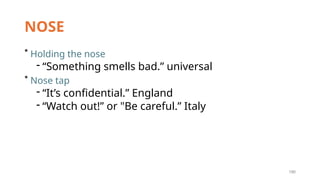
NOSE
* Holding the nose
- “Something smells bad.” universal
* Nose tap
- “It’s confidential.” England
- “Watch out!” or "Be careful.” Italy
191
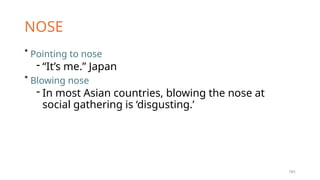
NOSE
* Pointing to nose
- “It’s me.” Japan
* Blowing nose
- In most Asian countries, blowing the nose at
social gathering is ‘disgusting.’
192
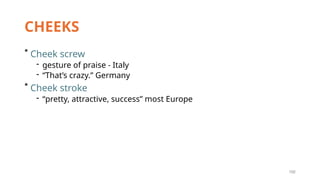
CHEEKS
* Cheek screw
- gesture of praise - Italy
- “That’s crazy.” Germany
* Cheek stroke
- “pretty, attractive, success” most Europe
193
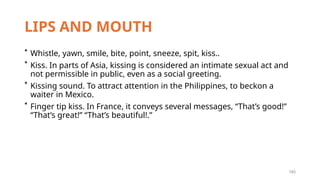
LIPS AND MOUTH
* Whistle, yawn, smile, bite, point, sneeze, spit, kiss..
* Kiss. In parts of Asia, kissing is considered an intimate sexual act and
not permissible in public, even as a social greeting.
* Kissing sound. To attract attention in the Philippines, to beckon a
waiter in Mexico.
* Finger tip kiss. In France, it conveys several messages, “That’s good!”
“That’s great!” “That’s beautiful!.”
194
LIPS AND MOUTH (Cont’d)
* Spitting.
* Spitting in public is considered rude and crude in most Western
cultures.
* In the PRC and many other Asian countries, spitting in public is to
rid a person’s waste and, therefore, is healthy.
195
THE LIP POINTING
* Lip pointing (a substitute for pointing with the hand or
finger) is common among Filipinos, Native Americans,
Puerto Ricans, and many Latin Americans.
* Open mouth. Any display of the open mouth is considered
very rude in most countries.
196
ARMS
* Some cultures, like the Italians, use the arms freely. Others,
like the Japanese, are more reserved; it is considered
impolite to gesticulate with broad movements of the arms.
* Folding arms are interpreted by some social observers as a
form of excluding self, “I am taking a defensive posture,” or
“I disagree with what I am hearing.”
197
ARMS (Cont’d)
* Arms akimbo. In many cultures, this stance signals
aggression, resistance, impatience, or even anger.
* Arms behind back, hands grasped is a sign of ease and
control.
* Arms in front, hands grasped, common practice in most
Asian countries, is a sign of mutual respect for others.
198
HANDS
* Of all the body parts, the hands are probably used most for
communicating non-verbally.
* Hand waves are used for greetings, beckoning, or farewells.
199
HANDS
* The Italian “good-bye” wave can be interpreted by Americans as
the gesture of “come here.”
* The American “good-bye” wave can be interpreted in many parts of
Europe and Latin America as the signal for “no.”
200
HANDS (Cont’d)
* Beckoning.
* The American way of getting attention (raising a hand with the
index finger raised above head) could be considered rude in Japan,
and also means “two” in Germany.
* The American “come here” gesture could be seen as an insult in
most Asian countries.
* In China, to beckon a waiter to refill your tea, simply turn your
empty cup upside down.
201
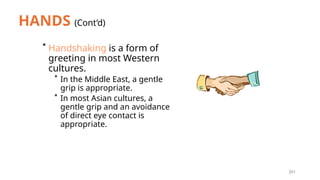
HANDS (Cont’d)
* Handshaking is a form of
greeting in most Western
cultures.
* In the Middle East, a gentle
grip is appropriate.
* In most Asian cultures, a
gentle grip and an avoidance
of direct eye contact is
appropriate.
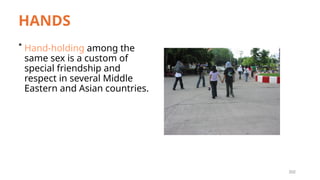
202
HANDS
* Hand-holding among the
same sex is a custom of
special friendship and
respect in several Middle
Eastern and Asian countries.
203
HANDS (Cont’d)
* Right hand. The right hand has special significance in many
societies. In certain countries in the Middle East and in Asia,
it is best to present business cards or gifts, or to pass dishes
of food, to get an attention, using only the right hand or
both.
* Left hand is considered unclean in much of the Middle East
and in parts of Indonesia.
204
HANDS (Cont’d)
* Hang loose. (thumb and little finger extended)
* could convey different meanings:
* in Hawaii, it’s a way of saying, “Stay cool,” or “Relax.”
* in Japan, it means six.
* In Mexico (do vertically), it means, “Would you like a drink?”
205
HANDS (Cont’d)
* Clapping hands.
* Russians and Chinese may use applause to
greet someone.
* In many central and eastern Europe, audience
frequently clap in rhythm.
206
FINGERS
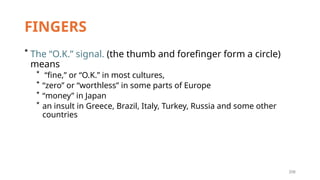
* The “O.K.” signal. (the thumb and forefinger form a circle)
means
* “fine,” or “O.K.” in most cultures,
* “zero” or “worthless” in some parts of Europe
* “money” in Japan
* an insult in Greece, Brazil, Italy, Turkey, Russia and some other
countries
207
FINGERS (Cont’d)
* “Thumb-up” means:
* “O.K.” “good job” or “fine” in most cultures,
* “Up yours!” in Australia
* “Five” in Japan; “One” in Germany
* Avoid a thumb-up in these countries: Australia, New
Zealand, Greece, Turkey, Iran, Russia, and most African
countries.
208
FINGERS (Cont’d)
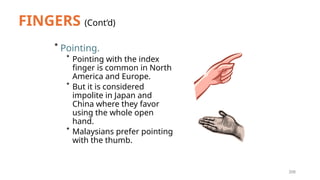
* Pointing.
* Pointing with the index
finger is common in North
America and Europe.
* But it is considered
impolite in Japan and
China where they favor
using the whole open
hand.
* Malaysians prefer pointing
with the thumb.
209
LEGS AND FEET
* In Asia, do not point with your toes.
* In Asia and some European countries, putting feet up on a
desk or any other piece of furniture is very disrespectful.
* Sitting cross-legged, while common in North America and
some European countries, is very impolite in other parts of
the world.
210
LEGS AND FEET (Cont’d)
* In most Asian countries, a solid and balanced sitting posture
is the prevailing custom. Sitting cross-legged shows the
sign of disrespect.
* In the Middle East and most parts of Asia, resting the ankle
over the other knee risks pointing the sole of your shoe at
another person, which is considered a rude gesture.
•
211
WALKING
* Walking can reflect many characteristics of a culture. For
example,
* In parts of Asia and some of the Middle Eastern countries, men
who are friends may walk holding each other’s hand.
* In Japan and Korea, older women commonly walk a pace or two
behind male companion.
* Asians often regard Western women as bold and aggressive, for
they walk with a longer gait and a more upright posture.
Active Listening
• It is listening with full concentration.
• Effective communication is not possible if the listener is not paying
attention to the speaker.
• Listening requires you to engage your mind, to pay attention to the
sound, to concentrate on the speaker, to gather information,
organize it, interpret and retain it.
• Hearing (involuntary) whereas listening (requires volition/will,
effort and attention)
• Poor listening leads to misunderstanding and break in
communication
• Poor listening indicates a lack of focus, hence irrelevant questions
• Active listening strengthens the relations
• Researches show we retain only 20% of what we hear.
Listening process
• Receiving
• Understanding/decoding
• Remembering
• Evaluating
• Responding
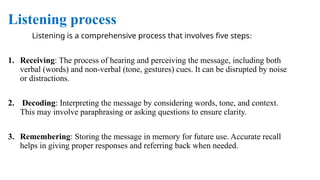
Listening process
Listening is a comprehensive process that involves five steps:
1. Receiving: The process of hearing and perceiving the message, including both
verbal (words) and non-verbal (tone, gestures) cues. It can be disrupted by noise
or distractions.
2. Decoding: Interpreting the message by considering words, tone, and context.
This may involve paraphrasing or asking questions to ensure clarity.
3. Remembering: Storing the message in memory for future use. Accurate recall
helps in giving proper responses and referring back when needed.
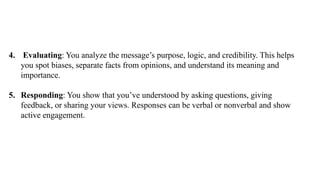
4. Evaluating: You analyze the message’s purpose, logic, and credibility. This helps
you spot biases, separate facts from opinions, and understand its meaning and
importance.
5. Responding: You show that you’ve understood by asking questions, giving
feedback, or sharing your views. Responses can be verbal or nonverbal and show
active engagement.
216
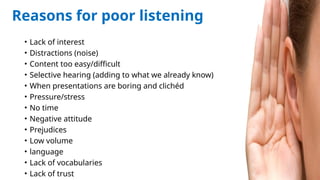
Reasons for poor listening
• Lack of interest
• Distractions (noise)
• Content too easy/difficult
• Selective hearing (adding to what we already know)
• When presentations are boring and clichéd
• Pressure/stress
• No time
• Negative attitude
• Prejudices
• Low volume
• language
• Lack of vocabularies
• Lack of trust
217
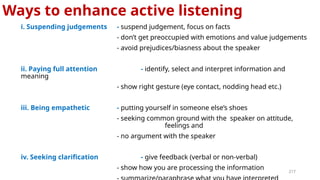
Ways to enhance active listening
i. Suspending judgements - suspend judgement, focus on facts
- don’t get preoccupied with emotions and value judgements
- avoid prejudices/biasness about the speaker
ii. Paying full attention - identify, select and interpret information and
meaning
- show right gesture (eye contact, nodding head etc.)
iii. Being empathetic - putting yourself in someone else’s shoes
- seeking common ground with the speaker on attitude,
feelings and
- no argument with the speaker
iv. Seeking clarification - give feedback (verbal or non-verbal)
- show how you are processing the information
Extra Reading
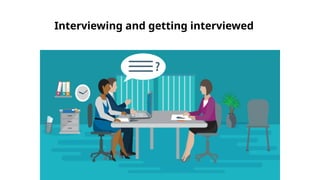
Interviewing and getting interviewed
Interview
• Interview is a procedure designed to obtain information from a
person through oral responses to oral inquiries.
• A job interview is the way of face to face conversation between the
interviewer and the interviewee, where the interviewer seeks replies
from the interviewee for choosing a potential human resource.
• According to Gary Dessler, “Interview is a selection
procedure designed to predict future job performance based on
applicants’ oral responses to oral inquiries.”
• It serves as the primary means to collect additional information on
an applicant. It serves as the basis for assessing an applicant’s job-
related knowledge, skills, and abilities.
• It is designed to decide if an individual should be interviewed
further, hired, or eliminated from consideration.
Types of interview
• Employment/ selection interview
• Promotion Interview
• Counselling interview
• Survey/ research interview
• Appraisal interview
• Disciplinary interview
• Grievance/ complaint interview
• Exit interviews
• Retain interview
Things judged
• Personal Characteristics. Do you have good grooming? Do you
have good manners? Do you maintain good eye contact?
• Self-Expression. Are you confident in expressing your ideas?
• Maturity. What about your overall sense of balance? Can you
make value judgments and decisions?
• Personality. What are you like? Outgoing? Shy? Overbearing
(arrogant)? Quiet? Will you fit into their corporate culture?
• Experience. What about your academic achievements?
Involvement in extracurricular activities? Job skills?
• Enthusiasm and Interest. Are you really interested in the
employer? The particular job? Industry?
• Career Goals. What do you want to do in your professional life?
Is it consistent with the company goals?
Guidelines for interviewer
• Plan the interview
• Know the purpose
• Fix the structure of the interview, question sequence, and setting
• Put the interviewee at ease
• Divide the interview into three sections: Opening, middle and close
• Make the purpose clear
• Let the interviewee do most of the talking
• Guide the interviewee
• Listen
• Keep a record
• End the interview
Sequence of questions
•Funnel sequence
•Inverted funnel
•Tunnel
For interviewee
• Prepare for the interview
• Practice good non-verbal communication
• Listen
• Don’t appear desperate
• Use appropriate language
• Make an appropriate appearance
• Show interest in interview
• Answer correctly and completely
• Practice courtesy
Things to do before an interview
• Get a good night’s sleep the night before. You’ll look better and feel
better.
• Do your research. Know the company that you are interviewing with
so you can answer their questions well and in the right context.
• Eat a good breakfast. You’ll be more alert and focused.
• Prepare questions beforehand. Know the answers to basic questions
that they will most likely ask you.
• Also come up with a few questions about the company or position
you are applying for to show that you’re interested.
• Make a few copies of your resume and put them somewhere where
you won’t forget to bring them.
• Search the web. It is likely someone else has interviewed with the
company, so search the web and see what others are saying about it.
Contd.
• Make sure your clothes are clean and wrinkle-free.
• Know who will be interviewing you, and learn a bit about their
background.
• Know your strengths and put together a list of them.
• Prepare a solid list of references that you can give your interviewer on
the spot.
• Pre-write your thank you notes so you can drop them off right
afterwards.
• Know how to answer the question, “What will you add to the company by
joining it?”
• Carry a tissue or handkerchief in your pocket to dry your hands in case
you are nervous before you go in.
• Have a story from each place you’ve already worked at that exemplifies
one of your strengths.
What to do during an interview
• Answer the question that was asked.
• Take a second before answering a question to show you are
putting some thought into your answer.
• Let your achievements speak for you.
• Ask questions, including asking for a full description of the
type of work that you will be doing.
• Keep eye contact.
• Be yourself.
What not to do during an interview
• Don’t talk too quickly.
• Don’t digress from your points. Answer questions directly.
• Don’t use slang.
• Don’t use words you don’t know the meaning.
• Don’t be arrogant.
• Don’t talk about your personal life.
• Don’t give the employer any reason to think you will not perform well.
• Don’t act nervous.
• Don’t fidget (restless). This might be something you have to practice but
it is worth it.
• Don’t get defensive. The interviewer will be asking technical questions.
Everyone has their weak spots and that is okay – work with it and
practice for it.
What to do after the interview
• Drop off your thank you note. Always thank your interviewer
after you’ve left.
• Create a list of items that you did well and that you would like to
improve on.
• Follow up appropriately.
• Sometimes the interviewer will tell you when they will notify you;
other times it will be your responsibility to make the follow up.
The 7 Deadly Sins in Interview
• Lying, exaggerating, inflating
• Dressing like you’re “Dancing with the Stars”
• Showing up late
• Not doing your homework
• Having no stories to tell
• Talking too much or too little
• Appearing desperate
Common interview questions for
practice
Unit 3- Oral Communication. BBA pptx.pptx

Unit 3- Oral Communication. BBA pptx.pptx

  • 1.
    Unit III: OralBusiness Communication (9 hrs)
  • 2.
    Syllabus 3.1 Planning thepresentation 3.2 Practicing persuasive speech 3.3 Developing the listening skills 3.4 Conducting and participating in meetings 3.5 Communicating non-verbally
  • 3.
    Basics of theoral business communication process • Oral communication is the exchange of information and ideas through spoken words. • It can occur in person during face-to-face interactions or through electronic devices like phones, video platforms, or radios. • Businesses often use oral communication, such as staff meetings, webinars, and workshops, to effectively transmit information. • It involves the ability to convey ideas from one person or group to another. • This includes direct conversations or telephone calls. Speeches, presentations, and discussions are all examples of oral communication.
  • 4.
    Components of oralcommunication • The speaker • The message • The channel • The listener • Feedback • Interferance • Situation
  • 5.
    Qualities of goodoral communication/enhancing oral communication • Clarity • Conciseness • Confidence • Coherence • Empathy • Active listening • Appropriate tone and body language • Engagement
  • 6.
    The Distinction betweenOral and Written Communication
  • 7.
    Aspects Oral Written MediumSpoken Written Transmission speed Immediate It can be delayed or no feedback. Feedback Instantaneous Delayed or no feedback formality It can be informal or formal Mostly formal Precision More prone to errors or omissions as there is no going back. Allows for careful editing and proofreading flexibility Allows for spontaneity and adaptation Allows for careful revision and editing. interactivity Enables immediate Limited direct interaction
  • 8.
    Aspects Oral Written Non-verbalcues Includes facial expressions, tone, gestures, etc. Relies solely on written words. Legal validity Usually not legally binding Can have legal validity. Retention Relies on memory and attention Provides a permanent record. Verifiability Difficult to prove or verify unless recorded. Easily verifiable and provable. Documentation and Generally, no Provided a tangible
  • 9.
  • 10.
  • 12.
    What is apresentation? • A presentation is the process of presenting a topic to an audience. • It is typically a demonstration, introduction or sharing meant to inform, persuade, inspire, motivate or to build goodwill or to present a new idea or product. • It is a talk or speech in which a new product, idea or piece of work is shown and explained to a relatively smaller audience. • Effective presentations are important in business, sales and selling, training, teaching, lecturing, etc. • The most important element is the speaker. It is the speaker that the audience is concentrating on. • The speaker should put himself/ herself in the shoes of the audience.
  • 13.
    Characteristics of agood presentation • It has a clear structure with an introduction, a discussion, and a conclusion • It is based on audience-centred approach (audience analysis) • Facts and figures are visually represented in tables, graphs and charts. • Humor and anecdotes may be used to create a friendly relationship and connections with audience. • The presenter speaks clearly and logically and uses body language effectively. • Questions are given serious attention and are regarded as an essential part of the presentation.
  • 14.
    Planning your presentation •Delivering an effective presentation involves more than just standing in front of an audience and speaking. • It requires careful planning, strategic thinking, and a deep understanding of the message, the audience, and the context. • Like any other business message, a successful presentation follows a structured process that includes analyzing the situation, gathering relevant information, selecting the appropriate medium, and organizing the content in a logical and engaging way
  • 15.
    Three-step Planning (Bovee& Thill) Planning Writing Completing Analyze the Situation Adapt to your audience Revise Gather information Compose your message Master your delivery Choose the medium or channel Prepare to speak Organize the information Overcome anxiety
  • 17.
    a. Analyze the situation As withwritten communications, analyzing the situation for a presentation involves defining your purpose and developing an audience profile. The purpose of most of your presentations will be to inform or to persuade, although you may occasionally need to make a collaborative presentation, such as when you’re leading a problem-solving or brainstorming session. Learn as much as you can about the setting and circumstances of your presentation, from the size of the audience to seating arrangements to potential interruptions.
  • 18.
    .. When you developyour audience profile, try to anticipate the likely emotional state of your audience members. Knowing your audience’s state of mind will help you adjust both your message and your delivery.
  • 19.
    Audience Types • Supportive/friendly •Interested but neutral • Friendly • Uninterested • Worried • Hostile • Cynical
  • 20.
  • 21.
    a. Conference tableseating, in which people sit along both sides of a long table and the speaker stands at one end, is a common arrangement for smaller meetings. It promotes interaction among attendees, but it tends to isolate the speaker at one end of the room.
  • 22.
    Here, tables arearranged in the shape of a U. It looks better than conference table seating by allowing the speaker to walk between the tables to interact with individual audience members. Horseshoe, or U- shaped
  • 23.
    Café seating • Here peoplesit in groups at individual tables. • It is best for breakout sessions and other small-group activities. However, this arrangement is less than ideal for anything more than short presentations because it places some in the audience with their backs to the speaker, making it awkward for both them and the presenter.
  • 24.
    Theatre seating arrangement •Theatre seating arrangement refers to a seating layout commonly used in auditoriums, conference halls, cinemas, and event venues where chairs are arranged in rows facing the stage or presentation area— just like in a traditional theatre.
  • 25.
    b. Gathering information •Start by identifying what your audience needs to know. • What information is essential for them to understand, accept, or act upon your message? • Gather relevant, accurate, and up-to-date information from reliable sources. • This might include data, case studies, reports, expert opinions, charts, or visuals. • If possible, conduct interviews, surveys, or consultations with stakeholders to better understand their views. • This can help you include content that is not only informative but also personalized and meaningful to your listeners.
  • 26.
    c. Select theRight Medium • The choice of medium depends on several factors: -The nature of the message: Is it complex, sensitive, or straightforward? -The size and location of the audience: Are you addressing a small team in person or a large group across multiple locations? -The setting and resources available: Do you have access to projectors, slides, internet, or interactive tools? -In addition to the primary mode of delivery, consider supporting materials such as PowerPoint slides, handouts, charts, or infographics that can aid comprehension. • Visual aids can reinforce your key points, clarify complex information, and keep the audience engaged.
  • 27.
    d. Organize theInformation • Start by identifying your main idea or message • Next, limit your scope to ensure that the content is manageable within the given time frame. • Avoid trying to cover too many topics in one session. Prioritize information based on relevance, importance, and audience interest. • Decide whether to use a direct or indirect approach, linear or non-linear.
  • 28.
    .. • Finally, outlineyour presentation into three clear parts: • Introduction: Grab attention with a hook, state your purpose, and preview the main points. • Body: Present your key arguments or messages with supporting evidence, examples, and visuals. • Conclusion: Summarize your main points, restate the core message, and end with a strong closing
  • 29.
    Process of presentationplanning 1. Identify the purpose and goal of the presentation 2. Analyze the audience and their needs 3. Collect the relevant information 4. Design and organize information 5. Decide on the medium of the presentation and visual aids 6. Become familiar with the location of the presentation
  • 30.
    30 Consider the followingsteps 1. Plan • Be sure of the purpose, topic, content, time, audience, visual aids etc. 2. Prepare • Outline the presentation, adopt tools & techniques, develop confident, test technologies & venues, know your audience and context. 3. Practice • Read aloud in front of mirror/peers/family members, check time, watch some videos, be prepared 4. Present • Appear comfortable and confident and deliver the ideas • Tell them what you are going to tell them, tell them and tell them again that you have told them.
  • 31.
    31 Outlining Oral Presentation a.Introduction (Present the background and purpose) b. Body (Present the main points and supporting details) c. Conclusion (Present the main idea and recommendations) d. Question-and-answer session (Answer any queries from the audience.)
  • 32.
    Delivering the presentation •Do not read the presentation • Preview the presentation • Use transitions in language • Modulate your voice • Interact with the audience • Use appropriate body language
  • 33.
  • 34.
    Delivering the Presentation •Delivering the prepared presentation is essential part of any presentation. • Regardless of the collection of quality information and craft and skill in organization of ideas, effective delivery of presentation is the final milestone to achieve in successful presentation. • No to take a chance, it is always a good idea to rehearse the presentation before delivering it. • While delivering the presentation, focus on the following aspects: 1. Do not read the presentation: A presentation is meant to an oral, a face-to-face communication. Reading a presentation is possibly the worst case that a presenter will do. Reading scripts or slides does not give space for the discussion of ideas. In addition, this is also disrespect to the audiences. Reading the presentation fails to grab the attention of the audiences.
  • 35.
    Contd… 2. Preview thepresentation: Give a short glance on how the presentation has been organized. For example, give a signal to the audiences what will come in beginning, middle and how it will end. This will help the audience to understand structure of the content. 3. Use transitions in language: Using transition words such as: first, in addition to, what is more, we can think of, the next step, another important aspect, will help the audience to follow direction of the presentation. They will know the order of the ideas and will also have an idea if the presenter is shifting to another idea or still on the same idea. 4. Modulate your voice: As per the context of the ideas, change the pitch, volume, and intonation of your voice. While emphasizing an idea, speaking in louder pitch than normally describing is effective. Similarly, appropriate and timely stops and pauses are necessary while speaking as they give audiences sometime to receive and process the information.
  • 36.
    Contd… 5. Interact withthe audience: To arouse and sustain audience interest, and encourage their participation, direct or indirect interaction with the audience is important. First, to maintain ongoing communication, avoid doing things that reduce audience involvement, for example, diverting from the topic, stopping to speaking, asking for water and so on. Second, interaction can be achieved by maintaining appropriate eye contact, asking indirect question without expecting answers, or sometimes throwing questions to think over, inviting volunteers to play roles and so on. 6. Use appropriate body language: Appropriate use of body language is key to any presentation. Consider following guidelines:  Try to maintain professional appearance and good/positive posture,  Use of positive gestures and hand movements that reinforce the argument,  Make appropriate movements.  Try not to stand fixed like a statue in one spot,  Move with ease between the projection screen and the podium or the area in front of the audience,  Maintain smiling face and relaxed look, especially while answering questions.
  • 37.
    Question and Answer/Discussion Session •Discussion on topic differentiates presentation from public speech. For every professional oral presentation, a certain amount of time is allocated questions and answers session. • During this session, the audience and the presenter interact, exchanging questions, explanations, and recommendations. • A successful presenter always anticipates probable questions and prepares the answers.
  • 39.
    Also keep thesepoints…. • Maintain good eye contact • Vary your speaking volume • Use pauses • Do not read your presentation • Don’t stand between the audience and slides • Use stories , questions, clips, examples etc • Practice makes perfect
  • 40.
    Slide presentation • Keepit simple. • Limit bullet points and texts • Use high quality graphics • Have a visual themes, but avoid using power point templates • Use appropriate chart • Use color well • Chose your font well • Use video or audio • Don’t stare at slides
  • 41.
    41 What not todo during presentations • Do not fear • Do not rush through your presentation • Do not stick your hands in your pockets • Do not underestimate your audience • Do not hurt people’s feelings • Do not dictate • Do not repeat the same content much • Do not avoid appropriate non-verbal communication • Don’t be egotistical (thinking that you are better than anyone else)
  • 42.
    Group Presentation inbrief 1. Before presentation - Appoint a team leader - Have multiple meetings
  • 43.
    2. During Presentation -Introduce the team and members - Allocate the roles or sections to present - Rehearse the transitions and turn-taking - Encourage the member - Handle the nerves
  • 44.
    3. After thepresentation • Wait for the question from the audience • Notice to whom the question is directed. • Answer the questions calmly and clearly. • Do not be aggressive even if the question is not related. • If you do not have the right answer to the questions, accept it.
  • 45.
    Team/Group Presentations indetail • Modern organizations encourage teamwork. • A team presentation is a concerted effort where individuals have different sets of skills. • A team leader should have the knowledge about the expertise of individual members and the purpose and objective of the work, and should align the individual members towards the achievement of the goals. For an effective team presentation, consider the following guidelines: Before Presentation 1. Appoint a team leader: Elect a leader, preferably on comfortable with the role. A social and friendly person is a good option to be a leader. The leader should think of herself/himself as the members’ advocate, helping them through the day or days. Leader cannot be dominating but a democratic. He/she manages the team’s activities and allocate the roles.
  • 46.
    Contd… 2. Have multiplemeetings: Having more meetings give you chance to be certain about your ideas, roles and section that you are presenting. During Presentation 3. Introduce the team and members: You can take a variety of ways to introduce the team members: introducing yourself; introducing each other or introducing and presenting your section. However, it is better to be introduced by other; while highlighting the skills and qualities of yours. It is inherently more believable for someone else to say, “What’s great about Jeevan is that he can really create good graphics” than to say yourself “I’ve good skills in creating graphics.” Besides, talking about yourself sometimes sounds self- flattering. 4. Allocate the roles or sections to present: A frequent problem when working within a group is unequal participation. However, this can easily be solved by assigning each member a specific section of the presentation to work on caring their interests. This means that each member should be doing the research for their section and putting together a speech and slides.
  • 47.
    Contd… 3. Rehearse thetransitions and turn-taking: Much confusion is created when the members do not know their turn. The leader can number the role. Make the turn taking clear. 4. Encourage the member: If you’re presenting as a team, your audience will be judging the entire team. Look interested- and be ready to help if something foes wrong. 5. Handle the nerves: It is natural to feel nervous when presenting in front of others, regardless of the size of the audience. After the Presentation Wait for the questions from the audience. Notice to whom question is directed. Answer the questions clamly and clearly. Do not be aggressive even if the question is not related. If you do not have the right answer to the questions, accept it.
  • 48.
  • 49.
    Introduction • Public speakingis an oral presentation or speech on a topic delivered to a live audience. • It is a formal address or discourse delivered to an audience. It is also more like an oral presentation. • It involves presenting information in a structured manner, usually following a clear introduction, main body, and conclusion. • Many people cite public speaking as one of their biggest fears, but with practice, you can learn to build confidence and improve your skills to enjoy public speaking for any situation. • Effective public speaking has the power to educate, persuade, and inspire audiences, making it a critical skill that can be honed through practice and continuous improvement.
  • 50.
    .. • Public speechdiffers from oral presentation • First, a presentation focuses on specific topic and aims at accomplishing certain goals whereas a speech is more general in its scope. • Second, a presentation uses visual aids whereas a speech relies on spoken words. • A speech is a one-way communication where the audience listens but a presentation is a two-way communication where the audience can ask questions and interact.
  • 51.
  • 52.
    Aspect Public SpeechPresentation Purpose and Objective Inform, persuade, entertain, or inspire broadly Inform or educate about specific data or processes Use of Visual Aids Minimal or no visual aids Heavily reliant on visual aids such as slides, charts, and graphs Interaction with Audience Limited interaction, mainly at the end Often interactive, with questions and discussions encouraged Content and Structure Broader, thematic content with less rigid structure Specific, data-driven content with a clear and logical structure Context and Setting Formal settings like conferences, rallies, and ceremonies Professional and academic settings like meetings, classrooms, and seminars
  • 53.
    Types of Speech •Scripted speech • Memorized speech • Extemporaneous speech • Impromptu Speech
  • 54.
    Scripted speech A scriptedspeech is fully written out in advance and typically read word- for-word to the audience. This type of speech is often used in formal settings, such as political addresses, news broadcasts, or ceremonial events, where precise wording and accuracy are crucial. By relying on a script, speakers ensure that their message is clear, consistent, and delivered exactly as intended. However, it can sometimes come across as less engaging or dynamic compared to other speech types if not delivered with appropriate vocal variation and eye contact.
  • 55.
    Memorized Speech • Ina memorized speech, the speaker commits the entire text to memory and recites it without the use of notes or a script. • This approach can be effective when a polished and precise delivery is important, such as in theater performances, competitive speaking events, or important presentations. • While a memorized speech can appear more natural and allow for better audience engagement than a scripted speech, it also carries the risk of sounding robotic or mechanical if delivered with sufficient expressiveness.
  • 56.
    Extemporaneous Speech • Anextemporaneous speech is carefully prepared and rehearsed, but not memorized or read from a script. • Speakers typically use notes or an outline to guide them, allowing for a more conversational and spontaneous delivery. • This method strikes a balance between preparation and flexibility, enabling speakers to adjust their wording and adapt to the audience's reactions. • Extemporaneous speaking is commonly used in business presentations, classroom lectures, and other professional settings, as it fosters a connection with the audience while maintaining structure and coherence.
  • 57.
    Impromptu Speech • Impromptuspeech involves speaking on the spot with no advance preparation. • This type of speech tests a speaker's quick thinking, creativity, and ability to organize thoughts spontaneously. • Commonly occurring in social settings, meetings, or in response to unexpected questions, impromptu speaking requires the ability to remain calm and articulate under pressure. • While challenging, mastering impromptu speech can enhance a speaker's confidence and adaptability, making them more effective communicators in unpredictable situations.
  • 58.
    Qualities of aPersuasive Speech Quality Description Example Clarity Use simple and understandable language to convey the message clearly. “Smoking kills. Quit today, live tomorrow.” Logical Argument (Logos) Use facts, statistics, and reasoning to support your points. “……% of plastic waste ends up in the ocean. It’s time to act.” ……. Credibility (Ethos) Build trust by showing expertise, honesty, and character. As a doctor, I’ve treated many patients suffering due to poor diet.” Emotional Appeal (Pathos) Connect with the audience’s feelings using stories, emotions, or vivid imagery. “Think of the helpless animals losing their homes to deforestation.”
  • 59.
    Contd. Quality Description Example AudienceAwareness Know your audience and tailor your message to their values and concerns. As parents, don’t you want the best future for your children?” Confidence Speak with passion and certainty to strengthen your message. “We can change the world, and it starts with one bold step!” Rhetorical Devices Use tools like repetition, metaphors, or questions for emphasis and memorability. “We must act now. We must stand together. We must make a difference.” Call to Action Urge the audience to take specific steps or make a change. “Donate now and help us build a school for underprivileged children.”
  • 60.
    Preparing the speech 1.Planning 2. Organizing 3. Delivering
  • 61.
    1.Planning • Audience analysis •Selecting the topic • Gathering information • Deciding your physical aspects and ambience
  • 62.
  • 63.
    3. Delivering • Standor sit up straight with your weight balanced • Start with a strong opening. • Make proper eye contact. • Talk to your listeners as if you are having a conversation with them. • Use your voice expressively and meaningfully. • Control pace and tone. • Use your body language expressively and meaningfully. • Engage with your audience.
  • 64.
    How to overcomeanxiety? • Practice, practice, practice • Think positively. • Take a few deep breathe. • Be ready. • Be comfortable • Don’t panic • Concentrate on your message and audience, not on yourself. • Keep going.
  • 65.
    Detail 1. Practice: Ifyour are well-prepared with rehearsal, your confidence increases and panic subsides. Thorough preparation is the best antidote for nervousness. 2. Think positively: Positive thinking brings hope and confidence. If you are confident about yourself, only then will the audience feel confident about you. 3. Take a few deep breaths: Taking a few long breathe might help you during the delivery. 4. Be ready: Memorize your couple of first sentence so your can open on a confident note.
  • 66.
    … 1. Be comfortable:Dress comfortably, considering the occasion and drink a glass of water before your speech. 2. Don’t panic: If you have missed your point, ask questions or ask for comments and reconnect with them. 3. Concentrate on your message and your audience, not on yourself: Over self-consciousness brings anxiety, so focus on your audience and message to forget your fears. 4. Keep going: Don’t stop, as you move ahead each successful moment brings confidence in you.
  • 67.
    Day 26: Conducting andParticipating in Meetings •Meeting •Notice •Minutes
  • 68.
  • 69.
    What is meeting? •A meeting is a formal gathering of two or more people associated with a company, project or team to discuss and decide on certain agenda. • It is a gathering of people with a common cause and agenda. • A meeting is convened for the purpose of achieving a common goal through verbal interaction, such as sharing information or reaching agreement. • Meetings may occur face-to-face or virtually, as mediated by communications technology, such as a telephone conference call, a skyped conference call or a videoconference. • One can distinguish a meeting from other gatherings, such as a chance encounter (not convened), a sports game or a concert (verbal interaction is incidental), a party or the company of friends (no common goal is to be achieved) and a demonstration (whose common goal is achieved mainly through the number of demonstrators present, not through verbal interaction).
  • 70.
    Meeting terminologies • Agenda:A list of items to be discussed or acted upon during a meeting. • Amendment: A formal change or addition proposed or made to a motion, document, or law. • AoB (Any other Business): A section at the end of a meeting for discussing topics not listed in the agenda. • Ex-Officio Member: A person who is a member of a committee or board by virtue of holding a particular office or position. • Minutes: The official written record of what was said and decided during a meeting. • Motion: A formal proposal put forward during a meeting for discussion and decision. • Proxy: A person authorized to vote or act on behalf of another in a meeting. • Quorum: The minimum number of members required to be present for a meeting to be legally valid and able to make decisions. • Adjournment: Formal closing of the meeting • Unanimous: Decision agreed by everyone
  • 71.
    Purposes • To coordinateor arrange activities • To give information to the team • Share/ exchange updates/ideas with the concerned team • Brainstorm ideas to make decisions and solve problems • To obtain feedback and assistance from the team • To create involvement and interest • To put forward ideas or complaints • To report on some activities or experience
  • 72.
    Characteristics of aGood Meeting • Make sure everyone arrives on time most importantly the person chairing the meeting. • It has a clear and easily understood purpose/agenda. • The right people are attending the meeting for whom the purpose of the meeting is meaningful. • The meeting has a written agenda, distributed prior to the meeting. • Decisions are made effectively and agreed upon • Accomplishment of the meeting are summarized and distributed in writing. • Outcomes are thoughtful and impactful
  • 73.
    Planning for meeting •Define the purpose and outcome. • Determine the participants. • Inform the participants. • Choose time, venue and facilities. • Reserve a room and appropriate equipment. • Decide on appropriate set up. • Develop an agenda. • Distribute the agenda prior to the meeting.
  • 74.
    Conducting meeting • Punctuality •Follow plan and agenda. • Move the discussion along. • Control those who talk too much. • Encourage participation from those who talk too little. • Control time. • Summarize at appropriate places. • Close effectively.
  • 75.
    Participating in meeting •Follow the agenda. • Be punctual and respect time limits. • Be an active listener. • Choose appropriate time. • Do not talk too much. • Take notes • Stay professional • Do not deviate from the agenda. • Cooperate. • Acknowledge others’ ideas • Be courteous. • Do not interrupt others.
  • 76.
    Factors contributing towasteful meetings • Poor preparation by conveners and attendees. • Failure to maintain and follow-up minutes • An incompetent chairperson who lets meetings go off • Bosses who discourage opposite voices at meetings • Bosses who love meetings and call them when they are not needed. • Hidden agenda and schemes • Absence of key players
  • 77.
    Notice • It isa piece of information circulated to a large number of people. • A notice is circulated to all individual members of the organization in order to attend a meeting. • Generally, it is the secretary who circulates the notice to the members but she/he does it under the suggestion and direction of the chairperson of the organization. • If the organization consists of more members, the notice for a meeting is placed or put in the public places. • It can also be broadcast through televisions or radios or published in the newspapers or online portals also.
  • 78.
    Components • The nameand address of the organization • The date on which it is issued • The day/date and time of meeting • the venue of the meeting • the agenda to be discussed(opt)
  • 79.
    Notice format Head - Sourceof the notice - Date - Notice identifier - Title of notice/ Subject Body - Main content Tail - Contact details
  • 80.
    A sample ………………. (nameof an organization) ……………………………………. (address) email:………………….Phone:………………… Notice Subject:
  • 81.
    This is tonotify/ Notice is hereby given that/ It is notified that the regular/emergency ……………..meeting of our ……… has been scheduled for …………. Thus, all the ………………………are requested to attend the meeting as per below mentioned schedule. Time: Venue: Agenda (optional) 1…………………………… 2……………………………. 3………………………………… 4 ……………………………….. …………… (Secretary/ CEO/Principal)
  • 82.
    82 Minutes • Minutes arethe official records of discussions held and decisions made in the meeting. • At the time of meeting, a recording secretary will be appointed to write down and distribute the minutes of the meeting. • Usually at each meeting the minutes of previous meeting are read out or printed copies of the minutes will be distributed to the participants. • Minutes contain the main points of the discussions, the recommendations made by participants, the task assigned to individual and groups and conclusion reached.
  • 83.
    Meeting Minute structure •Letter Head (Optional) • Title • Date • Introduction/Meeting Description • Present/Attendees • Absent/Apologies • Agenda Items • Decisions • AoB • Next Meeting • Adjournment • Closing signature
  • 84.
  • 85.
    . ………………. (name ofan organization) ……………………………………. (address) email:………………….Phone:………………… Meeting Minutes Date:…… The ……….. meeting of the members of …………………….was held at ……….Meeting Hall under the chairpersonship of ………………….. and in the presence of the below-mentioned members to discuss and decide on the following agenda. Present: 1. Mr. ………………………..President 2. ………………………........ Member 3. ……………………………..Member 4. ………………………………Member 5. ……………………………….Member 6. ………. …………………….Member 7. Mr. …………………….- Secretary/ CEO Apologies: 8. ………………… 9. …………………. 10. …………………..
  • 86.
  • 87.
    Discussion and Decisions: 1. The meeting decided to …………………………………………… 2. It was decided that…………………………………………………………… 3. ……………………………………………………………………………………………… 4. ……………………………………………………………………………………………… 5. …………………………………………………………………………………………… AoB: …………………………. Next Meeting: ………………………. Adjournment: ………………………… Closing signature:……..
  • 88.
    . Ghorai Eco-Club Ghorai Sub-metropolitanCity- 18 Ph. No: 00977-562666 Fax: 26-34-70076 www.ghoraiechoclub.com Minutes Date:…… The monthly meeting of the members of Ghorai Eco-Club was held at Club’s Meeting Hall under the chairpersonship of Mr. Deepak Chaudhary and in the presence of the below-mentioned members to discuss and decide on the following agenda. Attendees: 1. Mr. Deepak Chaudhary- President 2. Ms. Shanti K.C.- Treasurer 3. Mr. Damu Thapa- member 4. Ms. Bimla Gurung- Member 5. Mr. Santosh Regmi- Member 6. Mrs Sita Joshi- Member 7. Mr. Dipak Thapa- Secretary Apologies: -None
  • 89.
    89 .. Agenda Items: 1.Training program 2.Youthparticipation 3.Publishing newsletter 4.Web blog 5.Celebrating Environment Day 6.Miscellaneous
  • 90.
    Discussion and Decisions: 1. The meeting decided to conduct a week long training on vocational skills from June 5th . 2. It was decided to mobilize the local youth in environmental conservation activities. 3. An editorial board was formed to publish an Eco-club news letter. 4. It was decided to open a web blog of the club to keep its activities up to date. 5. It was decided to celebrate World Environment Day in grand manner. 6. The meeting decided to start innovative talent hunt program in near future.
  • 91.
    … AoB: None Next Meeting: Date andtime- Adjournment: The meeting was adjourned at……… Closing signature:……..
  • 92.
  • 93.
    A quote “We speakwith our mouth but communicate with our whole body”.
  • 94.
    Syllabus Facial expressions Gestures, postureand body orientation Eye contact Proxemics Haptics Paralanguage Appearance Artifacts Chronemics Environment
  • 95.
    Brief meaning Facial expressions: Movementsof the face that show emotions and feelings without words. Gestures, posture and body orientation: Movements of the hands, arms, or body (gestures), how we sit or stand (posture), and the direction we face (orientation) – all showing attitude, confidence, or interest. Eye contact Looking into someone’s eyes while communicating which shows attention, confidence, honesty, or interest. Proxemics: The physical distance we maintain with others which indicates intimacy, formality, or power. Haptics: Communication through touch – such as handshakes or pats on the back – expressing affection, agreement, or support.
  • 96.
    .. Paralanguage The tone, pitch,loudness, and speed of our voice that adds meaning to the spoken words. Appearance: How we look (clothing, grooming, cleanliness) which creates impressions and can influence perception. Artifacts: Personal items we use (like jewelry, bags, or gadgets) which reflect identity, culture, or status. Chronemics: The way time is used in communication Environment: The physical setting of communication (like lighting, seating, decor) that affects comfort, mood, and interpretation of messages.
  • 97.
  • 98.
    LETS OBSERVE SOMEGESTURES ‘EVERYTHING’S FINE’ ‘I’M IN CHARGE’
  • 99.
    ‘WE SPEAK WITHOUR MOUTH, BUT WE COMMUNICATE WITH OUR WHOLE BODY’. ‘OH NO, NOT AGAIN!’ For example, what is being communicated here?
  • 100.
    ‘I’M NOT BUDGING’ ….And,what is being communicated here?
  • 101.
    ‘ WORRIED?’ ….And, whatis being communicated here?
  • 102.
    POSTURES A. TRYING TOTAKE CONTROL OF DISCUSSION B. B. FEELING SUPERIOR (HANDS BEHIND HEAD) C. FEELING DEFENSIVE AND HOSTILE ( ARMS AND LEGS, HEAD DOWN)
  • 103.
    103 How Does BodySpeak? - Like any spoken language, body language has words, sentences and punctuation. - Each gesture is like a single word and one word may have several different meanings.
  • 104.
    104 BODILY SPEAKING…  Accordingto the social anthropologist, Edward T. Hall, in a normal conversation between two persons, less than 35% of the social meanings is actually transmitted by words.  So, at least 65% of it is conveyed through the body (non- verbal channel).
  • 105.
    Meaning • Nonverbal communicationis the transmission of messages or signals through a nonverbal platform such as eye contact, facial expressions, gestures, posture, and the distance between two individuals. • It includes the use of visual cues such as body language (kinesics), distance (proxemics) and physical environments/appearance, quality of voice (paralanguage) and of touch (haptics). • It can also include the use of time (chronemics) and eye contact and the actions of looking while talking and listening, frequency of glances and so on. • Nonverbal signals play a vital role in communication because they can strengthen or repeat a verbal message (when the nonverbal signals match the words), weaken or contradict a verbal message (when nonverbal signals don’t match the words), or replace words entirely.
  • 106.
    Characteristics of non-verbalcodes 1. Non-verbal codes may contradict verbal. 2. Non-verbal messages can be very important 3. Non-verbal communication cannot be avoided. 4. Much non-verbal communication is culture-bound. 5. The meaning of non-verbal behavior depends on the context.
  • 107.
    Non-verbal codes maycontradict verbal. • Often body language contradicts a spoken message and we say that the sender does not ‘mean what he says’ and is insincere. • Sometimes, people may say one thing but their non-verbal cues may suggest a different message. For example, a person might say "I'm fine" while looking downcast and avoiding eye contact. In this case, the non-verbal cues suggest that the person is not actually fine, despite what they are saying. • Similarly, a person might say something with a sarcastic or insincere tone of voice, which suggests that they don't really mean what they are saying. Alternatively, they may say something with an upbeat tone of voice that contradicts the negative content of their message.
  • 108.
    Non-verbal messages canbe very important • Many of the books about make a claim that it is ‘powerful’. • Verbal – 7 percent; the tone of voice –38 percent; visual – 55 percent. • In other words, the majority of the meaning does not come from the words. • ‘Words take a definite back seat when compared to the impact of vocal tone and the nonverbal images’. • Research has shown that non-verbal signals can be very important but they may not be so dominant in every situation.
  • 109.
    Non-verbal communication cannotbe avoided. • You cannot avoid sending non-verbal signals. • Even the purposeful avoidance of contact by one or both parties sends a signal that they do not wish to communicate. • Eye contact, a smile or a proffered handshake all signal varying degrees of willingness to communicate.
  • 110.
    Much non-verbal communicationis culture-bound. • Some non-verbal behavior appears to be universal –basic, strong emotions such as fear, surprise, sadness, and so on. • However, the expression of less intense emotions and general social feelings is much more culture-bound. • For example, in many situations in British and American culture, failure to ‘look a person in the eye’ is interpreted as shiftiness. • But in many African and Hispanic cultures, averting the eyes is a mark of respect for a person of higher status.
  • 111.
    The meaning ofnon-verbal behavior depends on the context. • Even within the same culture, we cannot expect a particular non-verbal signal to mean the same thing in different situations. • A non-smiling face is seen as dominant, but does this mean that dominant people smile less? • Some studies have found that dominant members of a group smile more! • They suggest that people who are trying to achieve dominance may use a different set of non-verbal signals from those who have already achieved high status.
  • 112.
    Types of Non-VerbalCommunication 1. Physical Appearance 2. Paralanguage/tone of voice/vocal characteristics 3. Gesture and posture 4. Facial Expression 5. Use of Space/Proxemics 6. Touch/Haptics 7. Use of Time/ chronemics 8. Artefact 9. Physical environment
  • 113.
    1. Physical appearance •The first thing people notice when you meet them is your appearance. • Your look, hair style, grooming, dress up, height, weight, facial features tell much about you nonverbally. • It is often believed that physically attractive people look more professional, more desirable than less attractive people • Our clothes and dresses, our choice or colors and hairstyle also tell a lot about our interest, age, personality and taste. • Many companies require their employees to dress in professional manner and some even provide them with company uniforms to convey a uniform and credible image of the company. • To make a good impression, adopt the style of the people you want to impress. Employers differ widely in their expectations of personal appearance, so make sure you are aware of your company’s dress code, if it has one.
  • 114.
    2. Tone ofvoice/ vocal characteristics/ paralanguage • Sometimes how something is said tells more about a person than what is said by the person. • Paralanguage includes tone, pitch, stress,, volume, pause and silence • The pitch of voice (how high or low the voice is), volume of voice (how loudly he or she speaks), rate of voice (how fast) are parts of a person's vocalic or paralanguage. • What type of vocalic is acceptable or desirable depends on the situation. • For example, it is generally considered socially attractive powerful, knowledgeable and trustworthy in America to speak aloud and fast. • In Japan, it is generally considered impolite and rude.
  • 115.
    3. Gesture andPosture (Body language) • Gestures (movement of the hands, face, eyes, head or other parts of the body) help to communicate particular messages. • Hand gestures (waving, thumbs-up, thumbs-down, pointing), facial gesture (smile, nodding, frown, shaking head), body gestures (crossed-armed, backward-forward movement), leg gestures (tapping, cross-legged, legs apart) • Many gestures—a wave of the hand, for example—have specific and intentional meanings. • The way you position and move your body expresses both specific and general messages, some voluntary and some involuntary • Other types of body movement can express meanings that may be unintended. • Slouching, leaning forward, fidgeting, and walking briskly are all unconscious signals that can reveal whether you feel confident or nervous, friendly or hostile, assertive or passive, powerful or powerless.
  • 116.
    Lets learn moreabout gesture
  • 117.
    When children aresmall and tell a lie, their hands fly over their mouth. Fig. 1
  • 118.
    A teenager might“refine” this inherent gesture by simply bringing tips of fingers to the mouth Fig. 2
  • 119.
    An adult maybring the little finger to edge of mouth. Fig 3
  • 120.
    The Palm Historically, anopen palm has signified honesty, truth, allegiance, and submission.
  • 121.
    Fig. 4 An Appealor Request to Others
  • 122.
    A Desire toStop or Hold Something Down Fig. 5
  • 123.
  • 124.
  • 125.
    Closed Palm WithExtended Finger Expresses Authority That Borders on Tyranny Fig. 8
  • 126.
    Handshakes • Three basicattitudes are transmitted through the handshake: Dominance Submission Equality
  • 127.
    Dominance is shownby turning hand so that palm is facing down during the handshake. Fig. 9
  • 128.
    Submission is shownby turning hand so that palm is facing upwards during the handshake Fig. 10
  • 129.
    Equality is shownby turning palm so that it faces neither up nor downwards. Fig. 11
  • 130.
  • 131.
    The “Glove” Handshake Fig.12 -It is intended to give impression of companionship and warmth. -Sometimes referred to as “politician’s handshake”.
  • 132.
    Clasping the Arm Handshake Fig. 13 -Thisis intended to demonstrate sincerity and warmth but is often seen as a violation of personal space.
  • 133.
    Knuckle Cruncher Handshake Fig. 14 -Thehallmark of aggressive handshake whereby one or both participators firmly squeeze offered hand. -Thought to be due to socialization process which encourages boys to demonstrate their assertive, powerful, “manly” attributes.
  • 134.
    “Dead Fish” Handshake Fig.15 -The hallmark of passive handshakes. -Carries negative connotations and generally considered to demonstrate weak, apathetic, or submissive individual.
  • 135.
    Fingertip Clasp Fig. 16 -Sometimeshappens when one party “misses his/her mark due to lack of confidence or nervousness. -Other times, this technique is used when people want to maintain spatial distance and less intimacy.
  • 136.
    Straight-Arm Extension Handshake Fig.17 -Primary purpose is to maintain distance and formality. -Sometimes people from rural areas who are used to keeping their distance will use this handshake.
  • 137.
  • 138.
    Hand Clenching Fig. 18 Whenclenched hands are held at chest level and against body, this if often indication of personal pleading (Fig. 18) When clenched hands are at chin or chest but not next to body, this is signal of frustration or negativity. (Fig. 19)
  • 139.
    Hand clenching notnext to body is a signal of frustration or negativity. Fig. 19
  • 140.
    Hand-Holding Behind the Back Fig.23 -When individual holds both hands behind back, this signals confidence. -Note that this position allows individual to expose trunk of his/her body and signals unconscious act of fearlessness.
  • 141.
    Fingers & Hand ToFace, Head, & Neck
  • 142.
    Finger(s) to Mouth Fig. 27 -Asignal that he/she is under pressure or feeling insecure.
  • 143.
    Hand to Chin& Cheek Indifference/Boredom Gesture Fig. 28 -The more assistance from the hand, the greater degree of boredom.
  • 144.
    Deceit Gestures Hand toMouth, Ear, or Eye Hear no evil, speak no evil, see no evil . . .
  • 145.
    The Mouth GuardGesture Fig. 32 -When an individual’s hand covers mouth (partially or entirely). -A signal that he/she is exaggerating or lying. -If, however, someone covers his/her mouth while you are speaking, it indicates that listener doesn’t believe you!
  • 146.
    The Nose TouchGesture Fig. 33 -May be physiological reason for this gesture: researchers determined that lying can cause sensitive nerve endings at base of nose to tingle and itch.
  • 147.
    The Eye Rub Fig. 34 -Asubconscious gesture that is used when a person is intentionally trying to deceive others. -Whereas a teenager will obviously look down at his/her feet when trying to deceive, an adult might rub the corner of his/her eye which allows a break in eye contact.
  • 148.
    The Ear Rub Fig. 35 -Asubconscious gesture that indicated the individual is perplexed about what he/she is hearing.
  • 149.
    Hand to Neck: BackNeck Rub Fig. 36 Has a couple of meanings: -Sometimes people who are lying will rub back of neck while looking down and avoiding your gaze. -Other times this gesture is a signal of frustration or anger (“pain in the neck”).
  • 150.
    Hands Behind Head Fig. 37 -Claspedhands behind head is an indication that the individual is relaxed. -If individual is also leaning back and has chin lifted, this indicates feeling of superiority or smugness.
  • 151.
  • 152.
    Folded Arms Fig. 38 --Moreoften, this posture signifies a defensive or insecure attitude. -If both hands are tucked under armpits, this generally signifies a response to the cold.
  • 153.
    Folded Arms With ClenchedFists Fig. 39 -The clenched fists indicate defensive and hostile feelings. -This posture might also be accompanied by clamped jaw and flushed face.
  • 154.
    Arm Gripping Fig. 40 This variationof arm folding usually indicates insecurity and fear
  • 155.
  • 156.
  • 157.
    Crossing at the Knee Fig. 43 -Arelaxed social leg crossing posture that is assumed by both men and women in Europe. -Generally in America, this posture is limited to females and thought to be essentially effeminate
  • 158.
    Ankle on Knee Fig. 44 -Sometimesreferred to as the “cowboy” pose and is a predominately male form of leg crossing in the Western world (particularly in US). -This posture is not acceptable in Middle East since any display of the sole of a shoe is an insult.
  • 159.
    Leg Lock Position Fig.45 -A posture where legs are crossed at the knee and the free foot is tucked behind the ankle of the stationary leg or locked to front leg of the chair. -Generally, women will assume this posture. -Many women will sit like this when cold.
  • 160.
    Ankle to Ankle Leg Cross Fig.46 -This is considered the most polite, demure form of leg crossing. -Used by people posing for formal pictures and sends a message of proper form and decorum.
  • 161.
    Foot Tapping orWagging Fig. 47 -Repetitive tapping or wagging of the foot is an indication of impatience, boredom, or nervousness. -The redundant foot movements are said to reflect a latent desire to run away.
  • 162.
    Language of the Hair,Head, and Face
  • 163.
    Hair Stroking and Head Tossing Fig.48 -Absent-minded running of fingers through hair or swishes hair behind shoulders with a toss of the head is an unconscious gesture that occurs when an individual finds someone attractive.
  • 164.
    Hair Twisting Fig. 49 -Thisis generally a sign of nervous distraction. -A variation of this is the twisting of a neck chain.
  • 165.
    Head Tilt Fig. 50 -Aslight tilt of the head to one side indicates interest on that individual’s part.. -Oftentimes, when women use this posturing in the presence of a man, it is an indication that she finds him attractive.
  • 166.
    Backward Head Tilt Fig.51 This gesture generally indicates a perceived superiority and (sometimes) contempt for people he/she is interacting with. -This gesture probably gave rise to sayings like, “looking down his nose” (at someone), or “she has her nose in the air”.
  • 167.
    Lifted Eyebrow Fig. 52 When one eyebrowlifts while the other remains in the natural position, it signals skepticism.
  • 168.
    Raised Eyebrows Fig. 53 -Rapid liftof both eyebrows and widening of the eyes is most often an unconscious display of greeting behavior. -Can also represent a flirting gesture; different from greeting behavior in that the raised eyebrow position is sustained slightly longer (or gesture might be accompanied by a sideways glance).
  • 169.
    Wide-Eyes Fig. 54 -If thisgesture is accompanied by blinking, it indicates innocence (if eyes still maintain eye contact). -Wide eyes are also an indication of surprise.
  • 170.
    Nose Flare Fig. 55 -Anindication of agitation or indignation (which might border on anger).
  • 171.
    Skewed Mouth Fig. 56 -A distorted versionof the smile that indicates sarcasm.
  • 172.
    4. Facial expressionand eye contact • Your face and eyes reveal much about who you and your emotions and feelings. • They both reveal our happiness, sadness, anger, irritation, frustrations, embarrassment, and many other complex emotions. • These are communicated with a smile, a blush, a blink, a grin, a wink, a frown, etc. • Smile (happiness), frowns (frustrations, disapproval), nodding (agreement or disagreement, raising eyebrows (surprise) • Studies have shown that people who smile more are generally considered to be more intelligent than people who smile less. • Direct eye contact is associated with persuasiveness calmness, confidence, and credibility.
  • 173.
    Eye contact… • Eyecontact is a powerful form of non-verbal communication that conveys interest, confidence, attention, and emotional connection. • It plays a vital role in regulating the flow of conversation, signaling when it’s another person’s turn to speak or showing active listening. • For example, maintaining steady eye contact during a job interview can indicate confidence and sincerity, while avoiding eye contact may be interpreted as nervousness or dishonesty. • In contrast, in some cultures, prolonged eye contact can be seen as disrespectful or confrontational, especially when directed at authority figures. • Thus, the meaning of eye contact can vary across cultural contexts, but it consistently serves as a key indicator of social engagement and intent.
  • 174.
    5. Use ofSpace (Proximics) • The space and distance (called proximity) you maintain from others in your communication with them can tell something about who you are and how you feel. • The study of this phenomenon is called proxemics. • Keeping yourself just close enough to person or keeping too close or too far away from the person communicates something else.
  • 175.
    … • In westerncultures, distinction is generally made between four types of spaces. • Intimate space (from 0 to 11/2 feet from a person) is only for someone whom the person is well acquainted with. The person feels violated if someone invades that space. • Personal space (extends from 11/2 to 4 feet from a person)- for conversations with family and friends • Social space (from 4 to 12 feet from person) for formal group interactions and professional relationships • Public space (starts at 12 feet from a person) used by speakers making a public speech or presentation.
  • 176.
    6. Touch (Haptics) •The study of how we touch someone (haptics) is closely related to our use of space. • Some people use a lot of touches to communicate with others, such as hugging, putting their arms around others, patting on the shoulders, repeated or vigorous handshakes, etc. • Some people try to avoid touching others, not necessarily because they are shy but because they do not like it. • Touching can be a cultural norm.
  • 177.
    7. Use ofTime (Chronemics) • The study of how people use time (called chronemics), reveals a lot about our use of time. It communicates many things about us. • In modern workplaces, people who arrive on time, who meet deadlines, finish their work on time, or leave work on time are perceived positively. • Effective and precise use of time can be productive for business and it can
  • 178.
    Artefacts • Artifacts, asa form of non-verbal communication, refer to the physical objects, personal belongings, or appearance-related elements that convey messages about an individual’s identity, status, or cultural background without spoken words. • These include clothing, accessories, hairstyles, makeup, and even the design of one's workspace or choice of personal items. Through artifacts, people often express their personality, profession, social status, or group affiliation. • For instance, a business suit can communicate professionalism and authority, while traditional attire may signify cultural heritage. • In essence, artifacts silently shape perceptions and play a powerful role in interpersonal and cross-cultural communication.
  • 179.
    8. Physical environment •Physical environment such as the layout of a room, siting positions and arrangements also determines communication. • The objects in an office room or the objects the occupant of that room brings in there may affect communication positively or negatively. • A well organized, decorated clean room communicates differently than a disorganized, undecorated ones. • Proper lighting, colors, decoration, furnishing of a place could affect the way we communicate in a physical environment.
  • 180.
    Using Nonverbal Communication Effectively:Key Considerations • Paying attention to nonverbal cues will make you both a better speaker and a better listener. • When you’re talking, be more conscious of the nonverbal cues you could be sending • Consider a situation, be honest in expressing your emotions. • Note that facial expressions (especially eye contact reveal the type and intensity of a speaker’s feelings. • Watch for cues from gesture and posture.
  • 181.
    .. • Listen forvocal characteristics that signal who the speaker is, the speaker’s relationship with the audience, and the emotions underlying the speaker’s words. • Recognize that listeners are influenced by physical appearance. • Be careful with physical contact; touch can convey positive attributes but can also be interpreted as dominance or sexual interest. • Pay attention to the use of time and space.
  • 182.
    Extra Reading More aboutNon-verbal Communication
  • 183.
    183 Let’s Examine HowBody Communicates, from head to toes
  • 184.
    184 HEAD - Nodding thehead - “Yes” in most societies - “No” in some parts of Greece, Yugoslavia, Bulgaria, and Turkey - Tossing the head backward - “yes” in Thailand, the Philippines, India, Laos - Rocking head slowly, back and forth - “yes, I’m listening” in most Asian cultures
  • 185.
  • 186.
    186 FACE * Facial expressionsreflect emotion, feelings and attitudes, but….. * The Asians are sometimes known as - emotionless - mixed-up emotion
  • 187.
    187 EYES * Eye contacts -Encouraged in America, Canada, Europe - Rude in most Asian countries and in Africa * Raising eyebrows - “Yes” in Thailand and some Asian countries - “Hello” in the Philippines * Winking eye - Sharing secret in America and Europe - flirtatious gesture in other countries
  • 188.
    188 EYES (Cont’d) * Closedeyes - bored or sleepy in America - “I’m listening and concentrating.” in Japan, Thailand, China
  • 189.
    189 EARS * Ear grasp -“I’m sorry.” in parts of India * Cupping the ear - “I can’t hear you.” in all societies * Pulling ear - “You are in my heart” for Navajo Indians
  • 190.
    190 NOSE * Holding thenose - “Something smells bad.” universal * Nose tap - “It’s confidential.” England - “Watch out!” or "Be careful.” Italy
  • 191.
    191 NOSE * Pointing tonose - “It’s me.” Japan * Blowing nose - In most Asian countries, blowing the nose at social gathering is ‘disgusting.’
  • 192.
    192 CHEEKS * Cheek screw -gesture of praise - Italy - “That’s crazy.” Germany * Cheek stroke - “pretty, attractive, success” most Europe
  • 193.
    193 LIPS AND MOUTH *Whistle, yawn, smile, bite, point, sneeze, spit, kiss.. * Kiss. In parts of Asia, kissing is considered an intimate sexual act and not permissible in public, even as a social greeting. * Kissing sound. To attract attention in the Philippines, to beckon a waiter in Mexico. * Finger tip kiss. In France, it conveys several messages, “That’s good!” “That’s great!” “That’s beautiful!.”
  • 194.
    194 LIPS AND MOUTH(Cont’d) * Spitting. * Spitting in public is considered rude and crude in most Western cultures. * In the PRC and many other Asian countries, spitting in public is to rid a person’s waste and, therefore, is healthy.
  • 195.
    195 THE LIP POINTING *Lip pointing (a substitute for pointing with the hand or finger) is common among Filipinos, Native Americans, Puerto Ricans, and many Latin Americans. * Open mouth. Any display of the open mouth is considered very rude in most countries.
  • 196.
    196 ARMS * Some cultures,like the Italians, use the arms freely. Others, like the Japanese, are more reserved; it is considered impolite to gesticulate with broad movements of the arms. * Folding arms are interpreted by some social observers as a form of excluding self, “I am taking a defensive posture,” or “I disagree with what I am hearing.”
  • 197.
    197 ARMS (Cont’d) * Armsakimbo. In many cultures, this stance signals aggression, resistance, impatience, or even anger. * Arms behind back, hands grasped is a sign of ease and control. * Arms in front, hands grasped, common practice in most Asian countries, is a sign of mutual respect for others.
  • 198.
    198 HANDS * Of allthe body parts, the hands are probably used most for communicating non-verbally. * Hand waves are used for greetings, beckoning, or farewells.
  • 199.
    199 HANDS * The Italian“good-bye” wave can be interpreted by Americans as the gesture of “come here.” * The American “good-bye” wave can be interpreted in many parts of Europe and Latin America as the signal for “no.”
  • 200.
    200 HANDS (Cont’d) * Beckoning. *The American way of getting attention (raising a hand with the index finger raised above head) could be considered rude in Japan, and also means “two” in Germany. * The American “come here” gesture could be seen as an insult in most Asian countries. * In China, to beckon a waiter to refill your tea, simply turn your empty cup upside down.
  • 201.
    201 HANDS (Cont’d) * Handshakingis a form of greeting in most Western cultures. * In the Middle East, a gentle grip is appropriate. * In most Asian cultures, a gentle grip and an avoidance of direct eye contact is appropriate.
  • 202.
    202 HANDS * Hand-holding amongthe same sex is a custom of special friendship and respect in several Middle Eastern and Asian countries.
  • 203.
    203 HANDS (Cont’d) * Righthand. The right hand has special significance in many societies. In certain countries in the Middle East and in Asia, it is best to present business cards or gifts, or to pass dishes of food, to get an attention, using only the right hand or both. * Left hand is considered unclean in much of the Middle East and in parts of Indonesia.
  • 204.
    204 HANDS (Cont’d) * Hangloose. (thumb and little finger extended) * could convey different meanings: * in Hawaii, it’s a way of saying, “Stay cool,” or “Relax.” * in Japan, it means six. * In Mexico (do vertically), it means, “Would you like a drink?”
  • 205.
    205 HANDS (Cont’d) * Clappinghands. * Russians and Chinese may use applause to greet someone. * In many central and eastern Europe, audience frequently clap in rhythm.
  • 206.
    206 FINGERS * The “O.K.”signal. (the thumb and forefinger form a circle) means * “fine,” or “O.K.” in most cultures, * “zero” or “worthless” in some parts of Europe * “money” in Japan * an insult in Greece, Brazil, Italy, Turkey, Russia and some other countries
  • 207.
    207 FINGERS (Cont’d) * “Thumb-up”means: * “O.K.” “good job” or “fine” in most cultures, * “Up yours!” in Australia * “Five” in Japan; “One” in Germany * Avoid a thumb-up in these countries: Australia, New Zealand, Greece, Turkey, Iran, Russia, and most African countries.
  • 208.
    208 FINGERS (Cont’d) * Pointing. *Pointing with the index finger is common in North America and Europe. * But it is considered impolite in Japan and China where they favor using the whole open hand. * Malaysians prefer pointing with the thumb.
  • 209.
    209 LEGS AND FEET *In Asia, do not point with your toes. * In Asia and some European countries, putting feet up on a desk or any other piece of furniture is very disrespectful. * Sitting cross-legged, while common in North America and some European countries, is very impolite in other parts of the world.
  • 210.
    210 LEGS AND FEET(Cont’d) * In most Asian countries, a solid and balanced sitting posture is the prevailing custom. Sitting cross-legged shows the sign of disrespect. * In the Middle East and most parts of Asia, resting the ankle over the other knee risks pointing the sole of your shoe at another person, which is considered a rude gesture. •
  • 211.
    211 WALKING * Walking canreflect many characteristics of a culture. For example, * In parts of Asia and some of the Middle Eastern countries, men who are friends may walk holding each other’s hand. * In Japan and Korea, older women commonly walk a pace or two behind male companion. * Asians often regard Western women as bold and aggressive, for they walk with a longer gait and a more upright posture.
  • 212.
    Active Listening • Itis listening with full concentration. • Effective communication is not possible if the listener is not paying attention to the speaker. • Listening requires you to engage your mind, to pay attention to the sound, to concentrate on the speaker, to gather information, organize it, interpret and retain it. • Hearing (involuntary) whereas listening (requires volition/will, effort and attention) • Poor listening leads to misunderstanding and break in communication • Poor listening indicates a lack of focus, hence irrelevant questions • Active listening strengthens the relations • Researches show we retain only 20% of what we hear.
  • 213.
    Listening process • Receiving •Understanding/decoding • Remembering • Evaluating • Responding
  • 214.
    Listening process Listening isa comprehensive process that involves five steps: 1. Receiving: The process of hearing and perceiving the message, including both verbal (words) and non-verbal (tone, gestures) cues. It can be disrupted by noise or distractions. 2. Decoding: Interpreting the message by considering words, tone, and context. This may involve paraphrasing or asking questions to ensure clarity. 3. Remembering: Storing the message in memory for future use. Accurate recall helps in giving proper responses and referring back when needed.
  • 215.
    4. Evaluating: Youanalyze the message’s purpose, logic, and credibility. This helps you spot biases, separate facts from opinions, and understand its meaning and importance. 5. Responding: You show that you’ve understood by asking questions, giving feedback, or sharing your views. Responses can be verbal or nonverbal and show active engagement.
  • 216.
    216 Reasons for poorlistening • Lack of interest • Distractions (noise) • Content too easy/difficult • Selective hearing (adding to what we already know) • When presentations are boring and clichéd • Pressure/stress • No time • Negative attitude • Prejudices • Low volume • language • Lack of vocabularies • Lack of trust
  • 217.
    217 Ways to enhanceactive listening i. Suspending judgements - suspend judgement, focus on facts - don’t get preoccupied with emotions and value judgements - avoid prejudices/biasness about the speaker ii. Paying full attention - identify, select and interpret information and meaning - show right gesture (eye contact, nodding head etc.) iii. Being empathetic - putting yourself in someone else’s shoes - seeking common ground with the speaker on attitude, feelings and - no argument with the speaker iv. Seeking clarification - give feedback (verbal or non-verbal) - show how you are processing the information
  • 218.
  • 219.
  • 220.
    Interview • Interview isa procedure designed to obtain information from a person through oral responses to oral inquiries. • A job interview is the way of face to face conversation between the interviewer and the interviewee, where the interviewer seeks replies from the interviewee for choosing a potential human resource. • According to Gary Dessler, “Interview is a selection procedure designed to predict future job performance based on applicants’ oral responses to oral inquiries.” • It serves as the primary means to collect additional information on an applicant. It serves as the basis for assessing an applicant’s job- related knowledge, skills, and abilities. • It is designed to decide if an individual should be interviewed further, hired, or eliminated from consideration.
  • 221.
    Types of interview •Employment/ selection interview • Promotion Interview • Counselling interview • Survey/ research interview • Appraisal interview • Disciplinary interview • Grievance/ complaint interview • Exit interviews • Retain interview
  • 222.
    Things judged • PersonalCharacteristics. Do you have good grooming? Do you have good manners? Do you maintain good eye contact? • Self-Expression. Are you confident in expressing your ideas? • Maturity. What about your overall sense of balance? Can you make value judgments and decisions? • Personality. What are you like? Outgoing? Shy? Overbearing (arrogant)? Quiet? Will you fit into their corporate culture? • Experience. What about your academic achievements? Involvement in extracurricular activities? Job skills? • Enthusiasm and Interest. Are you really interested in the employer? The particular job? Industry? • Career Goals. What do you want to do in your professional life? Is it consistent with the company goals?
  • 223.
    Guidelines for interviewer •Plan the interview • Know the purpose • Fix the structure of the interview, question sequence, and setting • Put the interviewee at ease • Divide the interview into three sections: Opening, middle and close • Make the purpose clear • Let the interviewee do most of the talking • Guide the interviewee • Listen • Keep a record • End the interview
  • 224.
    Sequence of questions •Funnelsequence •Inverted funnel •Tunnel
  • 225.
    For interviewee • Preparefor the interview • Practice good non-verbal communication • Listen • Don’t appear desperate • Use appropriate language • Make an appropriate appearance • Show interest in interview • Answer correctly and completely • Practice courtesy
  • 226.
    Things to dobefore an interview • Get a good night’s sleep the night before. You’ll look better and feel better. • Do your research. Know the company that you are interviewing with so you can answer their questions well and in the right context. • Eat a good breakfast. You’ll be more alert and focused. • Prepare questions beforehand. Know the answers to basic questions that they will most likely ask you. • Also come up with a few questions about the company or position you are applying for to show that you’re interested. • Make a few copies of your resume and put them somewhere where you won’t forget to bring them. • Search the web. It is likely someone else has interviewed with the company, so search the web and see what others are saying about it.
  • 227.
    Contd. • Make sureyour clothes are clean and wrinkle-free. • Know who will be interviewing you, and learn a bit about their background. • Know your strengths and put together a list of them. • Prepare a solid list of references that you can give your interviewer on the spot. • Pre-write your thank you notes so you can drop them off right afterwards. • Know how to answer the question, “What will you add to the company by joining it?” • Carry a tissue or handkerchief in your pocket to dry your hands in case you are nervous before you go in. • Have a story from each place you’ve already worked at that exemplifies one of your strengths.
  • 228.
    What to doduring an interview • Answer the question that was asked. • Take a second before answering a question to show you are putting some thought into your answer. • Let your achievements speak for you. • Ask questions, including asking for a full description of the type of work that you will be doing. • Keep eye contact. • Be yourself.
  • 229.
    What not todo during an interview • Don’t talk too quickly. • Don’t digress from your points. Answer questions directly. • Don’t use slang. • Don’t use words you don’t know the meaning. • Don’t be arrogant. • Don’t talk about your personal life. • Don’t give the employer any reason to think you will not perform well. • Don’t act nervous. • Don’t fidget (restless). This might be something you have to practice but it is worth it. • Don’t get defensive. The interviewer will be asking technical questions. Everyone has their weak spots and that is okay – work with it and practice for it.
  • 230.
    What to doafter the interview • Drop off your thank you note. Always thank your interviewer after you’ve left. • Create a list of items that you did well and that you would like to improve on. • Follow up appropriately. • Sometimes the interviewer will tell you when they will notify you; other times it will be your responsibility to make the follow up.
  • 231.
    The 7 DeadlySins in Interview • Lying, exaggerating, inflating • Dressing like you’re “Dancing with the Stars” • Showing up late • Not doing your homework • Having no stories to tell • Talking too much or too little • Appearing desperate
  • 232.

Editor's Notes

  • #118 This gesture is inherent and continues to be used throughout a lifetime in more refined and varied forms.
  • #119 Sometimes adults will refrain from using hands and bite lower lip, purse lips, or skew mouth from side to side.
  • #134 -The hallmark of passive handshakes. -Carries negative connotations and generally considered to demonstrate weak, apathetic, or submissive individual.
  • #157 .
  • #166 This gesture generally indicates a perceived superiority and (sometimes) contempt for people he/she is interacting with. -This gesture probably gave rise to sayings like, “looking down his nose” (at someone), or “she has her nose in the air”.
  • #167 -